U.S. rail volumes continue dip
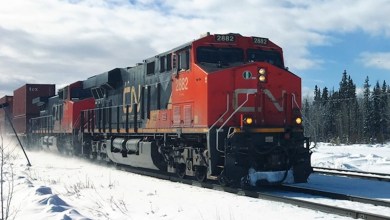
U.S. rail volumes fell yet again for the week ending July 20, according to data from the Association of American Railroads.
Total company revenue for Trinity Industries (NYSE: TRN) grew 16 percent to $736 million in the second quarter amid revenue gains for its rail product group.
There is some uncertainty for commodities such as grain, lumber, coal and crude, but Canadian National (NYSE: CNI) leaders are “cautiously optimistic” about volumes and how the company might perform in the second half of the year.
U.S. railroads had fewer employees on their payroll in June amid lower rail volumes overall and company decisions to trim workforce levels as part of changes to their operating models.
Maryland Governor Larry Hogan (R) said Maryland has received a $125 million federal grant that the state hopes will lead to an expanded rail tunnel in Baltimore to allow for taller trains to travel to the Port of Baltimore.
Jim Blaze writes about the pros and cons of shippers owning or leasing their own freight railcars to move their products.
The railroad said second quarter revenue totaled $714 million, a 5 percent increase from $682 million for the same period in 2018.
“You’ve heard me say this many, many times – we’re not going to use the lack of volume as an excuse not to make aggressive achievements on our productivity,” Union Pacific chief financial officer Rob Knight said.
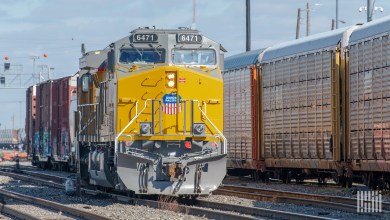
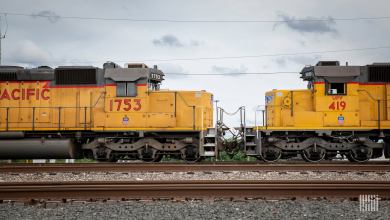
Union Pacific set an all-time record for its operating ratio in the second quarter despite lower freight volumes and a decline in freight revenue.
The continued decline of U.S. rail volumes was one of the themes mentioned in the second quarter earnings calls for CSX and Canadian Pacific.
Norfolk Southern and Union Pacific are modifying some of the ways they collect demurrage and accessorial charges for some commodities, but some shippers are questioning the modifications.
“The present economic backdrop is one of the most puzzling I have experienced in my career..”
Despite a drop in profit in the second quarter, CSX’s (NYSE: CSX) operating ratio set a company record.
Canadian Pacific’s (NYSE: CP) second quarter net income rose 66 percent amid a 13 percent increase in company revenue, the railroad reported on July 15. CP’s financials are reported in Canadian dollars, except for earnings per share.
The Cass Freight Index Report offers two questions. “Has economic contraction already begun? Will GDP be negative in Q2?”
Jim Blaze writes about earnings season for the railroads, and what investors, customers and employees should be looking and asking for in the railroads’ quarterly earnings reports.
While operational efficiencies get the credit for a freight railroad’s improved operating ratio, other factors, such as changes in fuel prices and increases in freight rates, play significant roles according to a research paper by a law firm representing shippers in Canada.
As the Class I railroads begin reporting their second quarter earnings results next week, some members of the Wall Street community expect the lower rail volumes from the second quarter to affect the railroads’ financial results.
Year-to-date U.S. rail volumes fell yet again this week, although improving economic indicators signal that rail volumes could moderate in the weeks and months ahead.
Although the U.S. Senate Commerce Committee has voted in favor of the nomination of an additional board member to the Surface Transportation Board (STB), whether and when she will be installed remains to be seen.
When it came to choosing the location for our latest and greatest event, Chicago was a no brainer. The Windy City isn’t just at the heart of the Midwest, it’s the center of all things freight, futures, and some of the most disruptive tech on the market today. That’s what makes Chicago the perfect place […]
“Without documented strategies for how it plans to communicate the results of its research, FRA may lose an opportunity to effectively work with internal and external stakeholders – such as railroads, rail workers and local communities – to address any risks of operating longer trains in support of the agency’s mission of enabling the safe, efficient and reliable transportation of people and goods.”
Jim Blaze writes about railroad movement of scrap – the market today and the future of the market.
Ben Thrower profiles Virgin Trains USA’s plans for private passenger service in Florida, Nevada and California. Richard Branson changed air travel; will he be able to do the same thing with passenger train service in the USA?
FreightWaves’ Freight Intel Group has released a new study of the impact of IMO 2020 on the U.S. trucking industries (and other industries). Read what may happen to diesel fuel prices.
The service problems associated with precision scheduled railroading (PSR) have motivated forest products and scrap recycling shippers to press the Surface Transportation Board to renew a longstanding request for regulatory oversight.
Rail volumes were off again for the week ending June 29, 2019 with U.S. railroads reporting a 5.5 percent decline.
Blocking railroad crossings in Oklahoma now could come at a financial cost for freight railroads.
In the longer-term, rail industry observers are waiting to see how and whether Genesee & Wyoming will be able to make the capital investments needed to maintain its infrastructure.
GBX management explains soft guidance and provides outlook for sequential earnings improvement.
Barge grain movements on Mississippi 85 percent lower than a year ago
Jim Blaze writes about the movement of grain by rail. This is a huge business for U.S. and Canadian railroads, and is also critical to the export market of the two countries.
GWR acquired in $8.4 billion deal that many investors view as the plan all along.
Some members of Congress remain determined to address the question of whether having more crew members on a train makes that train safer.
Year-to-date U.S. rail volumes fell again amid a loosening truck market, receding floodwaters in the Midwest and overall economic uncertainty.
An additional $300 billion in proposed U.S. tariffs against China could result in lower railroad freight volume , but economic uncertainty and competition from trucks appear so far to be bigger threats for rail volumes.
Market expert Jim Blaze writes about the railroads’ transportation of fracking sand, as well as stone and gravel, aggregates and phosphates.
Should the Class I railroads see U.S. rail volumes sustainably increase, furloughed workers could be called back to meet network capacity needs, resulting in a bump up of headcount levels. But another factor that could affect headcount levels in the long-term is the deployment of automation technologies.
The implementation of precision scheduled railroading has contributed to dwindling morale and could result in creating unsafe working conditions should the federal government withhold intervention, according to union witnesses at a June 20th Congressional hearing on rail safety.
Autonomous trains might be fully running in remote Australia, but it will take awhile before those kinds of trains will be rolling down the North American countryside.
U.S. rail volumes trended downward again for the week ending June 15, with weekly volumes falling over 5 percent and year-to-date volumes declining nearly 3 percent, according to the latest data from the Association of American Railroads.
Market expert Jim Blaze writes about the movement of coal by rail. He explores the history of rail-coal; more importantly, he writes about what the future may hold for coal in the U.S. and how that will impact the railroads.
The Federal Railroad Administration is awarding more than $326 million in grants to help states and localities repair, maintain and build rail infrastructure supporting freight rail and intercity passenger rail.
Flooding impacts, cheap natural gas prices, and trade and economic uncertainty could be factors contributing to a significant slump in weekly U.S. rail volume.
The American Short Line and Regional Railroad Association is urging Congress to pass legislation that would make permanent the tax credit that short lines receive for infrastructure improvements.
The transition to e-commerce and anticipated advances in automated trucking are forcing the freight railroads to adapt to supply chains that require railroads to be more responsive and nimble. One way that the railroads are seeking to address this challenge is by hiring executives outside of the railroading community, in the hopes that placing a non-rail executive in a leadership role will help the railroad weather systemic changes within the supply chain.
Railroad market expert Jim Blaze writes about the movement of chemicals by rail and how that sub-set of railroad traffic is profitable and may grow significantly in the near future.
U.S. coal export volumes are down 12.7 percent in the first four months of this year and the outlook looks even worse for 2020.
“It’s just a confusing time for all of us in transportation and anybody in manufacturing or business in general to have a really good sense of why we’re seeing this kind of softness,” said CSX chief executive officer Jim Foote.
U.S. intermodal volumes fell 5.9 percent in May, while carloads fell 2.1 percent amid economic uneasiness and uncertainties surrounding U.S. trade between Mexico and China.
Market expert Jim Blaze explores what railroads need to do to capture more of the market share of oversize loads, which are essential to the economy and profitable as well.
Canadian National’s (NYSE: CNI) strategy to build up its eastern network could include even more partnerships with trucking and intermodal partners, the company’s chief executive officer said at an investor conference.
e railroad industry is “concerned” about a possible disruption of the North American supply chain should the U.S. impose tariffs on imports from Mexico. But for now, the rail industry is taking a wait-and-see stance.
While the degradation was seen across most sectors, the transports are seeing outsized declines.
U.S. rail volumes tumbled 6.7 percent for the week ending May 25 as slumping intermodal volumes dragged total volumes lower. Softness in the housing and manufacturing sectors could be contributing to lower U.S. rail volumes year-to-date.
“The board has the authority to define reasonable practices. If you were in our shoes, what would you do?” said Surface Transportation Board vice chairman Patrick Fuchs to a panel representing BNSF, Canadian National and Canadian Pacific.
U.S. rail volumes fell again for the week ended May 18, while Canadian volumes grew, according to the latest data from the Association of American Railroads. The theme of higher U.S. carloads but lower intermodal volumes was also expressed by CSX this week.
FreightWaves SONAR now features railroad-related data from Commtrex. The article provides insight about the Commtrex, the data it will provide to SONAR and how SONAR users will benefit from it.
“The economy feels pretty good right now,” GWR chief executive Jack Hellmann said at an investor conference on May 14.
Market expert Jim Blaze explains the economics behind railcars. He also provides information about the various types of railcars and what market conditions the railroads are facing as they seek to “right-size” their fleets.
A Trinity Industries subsidiary has bought 230 acres in Iowa to construct a multi-million-dollar railcar maintenance facility. The facility’s location in Butler County will give Trinity access to the Class I railroad network and the upper Midwest, Trinity said.
Nevada joins Colorado in requiring freight trains to have at least two crew members on board. Meanwhile, preliminary data from the Surface Transportation Board shows April rail headcount level to be the lowest so far in 2019 and since January 2017.
Rail congestion in regions such as Chicago and Houston may have eased for now, but the railroads will still need to find ways to increase capacity at those busy city locations as the U.S. population grows, Class I railroad executives said at an investor conference this week.
Executives with eastern railroads CSX and Norfolk Southern expressed confidence this week that they can compete alongside trucks for e-commerce business.
Canadian rail volumes rose again year-to-date for the week ended May 11, while U.S. rail volumes continued downward amid U.S. tariff uncertainty and a fuzzy economic picture.
Rail market expert Jim Blaze discusses how FreightWaves SONAR can help determine how best to ship freight.
FreightWaves market expert Jim Blaze looks at a regulatory spat between Canadian National Railway and Canadian Pacific Railway over the concept of “open access.” Learn why that is important to all railroads – and shippers!
While the degradation was seen across most sectors, the transport sectors saw large declines.
A number of rail equipment lessors and manufacturers have been merging and consolidating in recent months as a way to leverage themselves against marketplace changes brought about by precision scheduled railroading. Meanwhile, industry observers are watching whether railcar utilization grow in 2019.
Market expert Jim Blaze compares and contrasts Amtrak and America’s freight railroads.
On stage at Transparency19, FreightWaves CEO Craig Fuller unveiled SONAR 4.0 (video included).
FreightWaves continues to push more features and data into its data analytics platform with 8 new features and 3 data sets.
Genesee & Wyoming, Inc. reported adjusted earnings per share of $0.78 for the first quarter of 2019, which were 11 percent better year-over-year, but less than NASDAQ’s consensus estimate of $0.83.
Market expert Jim Blaze looks at an under-appreciated asset of North America’s freight railroads – their real estate holdings. Read Jim’s hypothesis of what the railroads might do with this real estate in the near future.
Market expert Jim Blaze looks at how rail freight volume has changed over the years and what the outlook is for the next decade. Learn what he thinks will happen to the railroad industry in its long-term competition with trucking to carry freight.
Market expert Jim Blaze questions the benefits to-date of precision scheduled railroading (PSR). Read his views on how railroads could prove PSR’s value to shippers.
With first quarter 2019 earnings set to kickoff on Monday, April 15, FreightWaves is looking at expectations for the transportation stocks.
U.S. and European freight railroads are very different in many respects. Market analyst Jim Blaze gives insights about how the two systems differ.
Precision scheduled railroading and positive train control can help railroads improve service, safety and profits. Learn how in Jim Blaze’s piece.
Railroad company must re-open Thunder Bay, Ontario, span to vehicles after lengthy legal battle.
The request by the Association of American Railroads (AAR) asking the Surface Transportation Board (STB) to include a cost-benefit analysis into its rulemaking process is being viewed by some as a positive step towards aligning STB procedure with other U.S. Department of Transportation (DOT) agencies.
Two major railroads have stopped freight service because of catastrophic flooding in the Midwest where rails are washed out.
Amtrak wants to cut long distance trains for those that travel between heavily populated city pairs. But that plan doesn’t track with what Congress and the freight railroads want.
Rails may need to raise rates to comply with new rules from Washington.
Genesee & Wyoming, Inc. (NYSE: GWR) beat fourth quarter revenue consensus estimates by $4.89 million. Revenue was expected to decrease by 0.2 percent year-over-year (Y/Y), but it increased 0.7 percent Y/Y from $571.6 million to $575.6 million, according to Seeking Alpha. GWR also beat fourth quarter consensus earnings per share (EPS) estimates of $0.89 by $0.11 to $1.00.
Freight lobbyists are banking on leadership changes in the 116th Congress to pave the way for infrastructure financing that stalled during the first half of Trump’s administration.
Autonomous vehicles policy should go beyond the highways and roads, the rail trade group argues.
A decrease in coal volumes did not slow a revenue rise at BNSF Railway Company, which posted a 16% increase in operating revenues in the third quarter compared to Q3 2017.
The FreightWaves Research Institute is excited to announce the release of its second white paper, Global Freight Tickers, a worldwide study of publicly traded transportation and logistics companies
Under the terms of the Saudi joint venture, Greenbrier, the second largest freight railcar manufacturer in the U.S., will provide up to $100 million in new railcars, lift equipment and other terminal investments, and will operate intermodal and other freight terminals.
In his preview of the railroads’ Q3 earnings reports, Susquehanna’s Bascome Majors set optimistic price targets but warned that P/E valuations are at historically high levels.
Howard Green is best on fights between the serial CEO and his boards, activist investors, and proxy wars, but there’s a lot in the book for railroad buffs who want to know more about Harrison’s signature philosophy, precision scheduled railroading.
Mike Lacey sees some improvement in his relationship with railroads, but it’s coming from a very low point.
Stifel’s John Larkin captivated the audience with a wide-ranging presentation on transportation and logistics across modes during Tuesday’s lunch at the McLeod User Conference 2018.
There are approximately 600 rails spanning 140,000 miles in the United States. We take a look at this massive industry in our latest infographic.
A lack of crews and a slowdown in system operations is squeezing intermodal capacity and shutting off an alternative for those looking to move away from trucks.
Most of the gains that helped customers came in the first 25 years after the Staggers Act that deregulated the system. Since then, the gains have not been in service.
A Norfolk Southern executive suggested that the company’s management will have a lot to talk about on its next quarterly earnings call.
Intermodal tightness has pumped the hub of hubs, the Chicago freight market especially on lanes paralleling major railroads; meanwhile a minor heatwave in St. Louis may have been behind a massive surge in reefer turndowns.