New FHWA chief under pressure to fix truck parking
WASHINGTON — Owner-operators want Sean McMaster to do his part to keep truck parking at the top of the Trump administration’s transportation agenda now that McMaster has been confirmed to lead the Federal Highway Administration.
Join the leaders shaping freight’s future at F3: Future of Freight Festival, Oct 21-22. Network with the industry’s best and discover what’s next.
“Given his wealth of experience within the Department of Transportation, we believe he is a proven leader, well-suited to oversee our nation’s highway system,” said Owner-Operator Independent Drivers Association President Todd Spencer, after the Senate confirmed McMaster as FHA administrator on Thursday.
“We look forward to working with Administrator McMaster and Secretary Duffy to increase truck parking capacity and reduce road congestion in order to improve highway safety and supply chain efficiency.”
McMaster, who served as deputy chief of staff at DOT during the first Trump administration, said after being confirmed he looks forward to “partnering with state and local leaders to accelerate project delivery and get shovels in the ground.”
In a letter sent to Senate lawmakers in support of McMaster’s nomination in May, OOIDA noted that DOT had identified the shortage of truck parking across the country as a “critical safety issue.”
“We want to fund truck parking for our truckers in this country – a critical need for safety in the United States,” DOT Deputy Secretary Steve Bradbury stated at the meeting.
Morrison confirmed to head NHTSA
The Senate also voted on Thursday to confirm Jonathan Morrison as administrator of the National Highway Traffic Safety Administration.
“I look forward to enhancing safety on our nation’s roadways, supporting law enforcement, making vehicles more affordable again, and unleashing American innovation.”
While trucking companies – particularly large carriers – are optimistic about Morrison’s commitment to regulatory policy aimed at advancing autonomous technology, some safety advocates are concerned about NHTSA’s priority for other issues, particularly crashes involving trucks and passenger cars.
A long-standing and contentious rulemaking to require trucks to come equipped with side-guard equipment to avoid deaths and injuries in underride crashes was recently delayed until next year.
XPO’s rating at Moody’s held steady but outlook is now ‘positive’
LTL carrier XPO had its debt rating affirmed Thursday by Moody’s, but with one significant change: its outlook was adjusted upward to positive from stable.
A positive outlook is often a precursor to a rating increase (as a negative outlook can be a precursor to a rating downgrade.) But a positive outlook does not guarantee an upgrade.
Join the leaders shaping freight’s future at F3: Future of Freight Festival, Oct 21-22. Network with the industry’s best and discover what’s next.
As Moody’s defines a positive or negative outlook in its methodology statement, the two outlooks on either side of stable suggest a “higher likelihood that the credit rating may change in the medium term. In most cases, Moody’s Ratings follows up on an outlook change in about 12-18 months.”
XPO’s ratings were affirmed by Moody’s at Ba2 for the Corporate Family Rating (CFR) and Ba2-PD for its Probability of Default rating.
S&P and Moody’s at same level
Although Moody’s didn’t change the company’s rating, the move to a positive outlook comes less than three months after S&P Global Ratings downgraded XPO’s debt to BB from BB+. When S&P made that move, it put the two agencies’ rating of XPO (NYSE: XPO) at levels considered equivalent.
However, the S&P Global (NYSE: SPGI) outlook on XPO is stable, in contrast to the new positive outlook at Moody’s (NYSE: MCO) just bestowed this week.
The change to a positive outlook and the reasons Moody’s cited for the move stand in stark contrast to what S&P Global said in July in conjunction with its downgrade of XPO that came down at the start of July, even though both companies are effectively at the same place.
While S&P Global made its call largely on the basis of its expectation of the freight recession dragging on, Moody’s more optimistic outlook is tied to a “slow recovery” in freight markets as well as various operating changes XPO has implemented.
“The positive outlook reflects expectations that XPO will improve profitability and maintain credit metrics despite current industry challenges,” Moody’s said.
Moody’s added it expects improvement in XPO’s operating performance going into 2026, “driven by cost reduction initiatives and profitable growth from its network expansion following the acquisition of certain terminals previously owned by Yellow Corporation.” XPO acquired the terminals from Yellow in late 2023 and began opening them within the XPO network last year.
We’ve heard this statement previously
And in a sentence that could have been written anytime in the last two to three years, Moody’s said: “In addition, we expect a slow recovery in key transport areas such as freight volumes and spot pricing over the next year.”
The ratings agency also was upbeat about the outlook for XPO’s finances. “We anticipate that XPO will maintain a prudent approach to capital allocation while achieving profitable growth and stronger credit metrics, even in the face of end-market headwinds,” the ratings agency said. “We project that XPO will sustain solid profit margins and strong interest coverage, with debt-to-EBITDA stabilizing under 3.0x in 2026.”
XPO in the second quarter recorded revenue of $2.08 billion, almost identical to a year earlier. Its net income of $106 million was down from $150 million a year earlier.
Moving from a positive outlook to an actual upgrade, Moody’s said, would need “an improvement in margins, a sustained debt-to-EBITDA ratio approaching 3.0x and EBITDA-to-interest coverage of approximately 5 times.”
Reasons for a possible downgrade would include debt-to-EBITDA rising to 4X, or “if the company fails to improve EBIT margin from the current level of 8.5%,” Moody’s said.
An XPO spokesman declined comment on the Moody’s report.
XPO’s stock is up about 13.7% in the last year and 8.7% in the last three months.
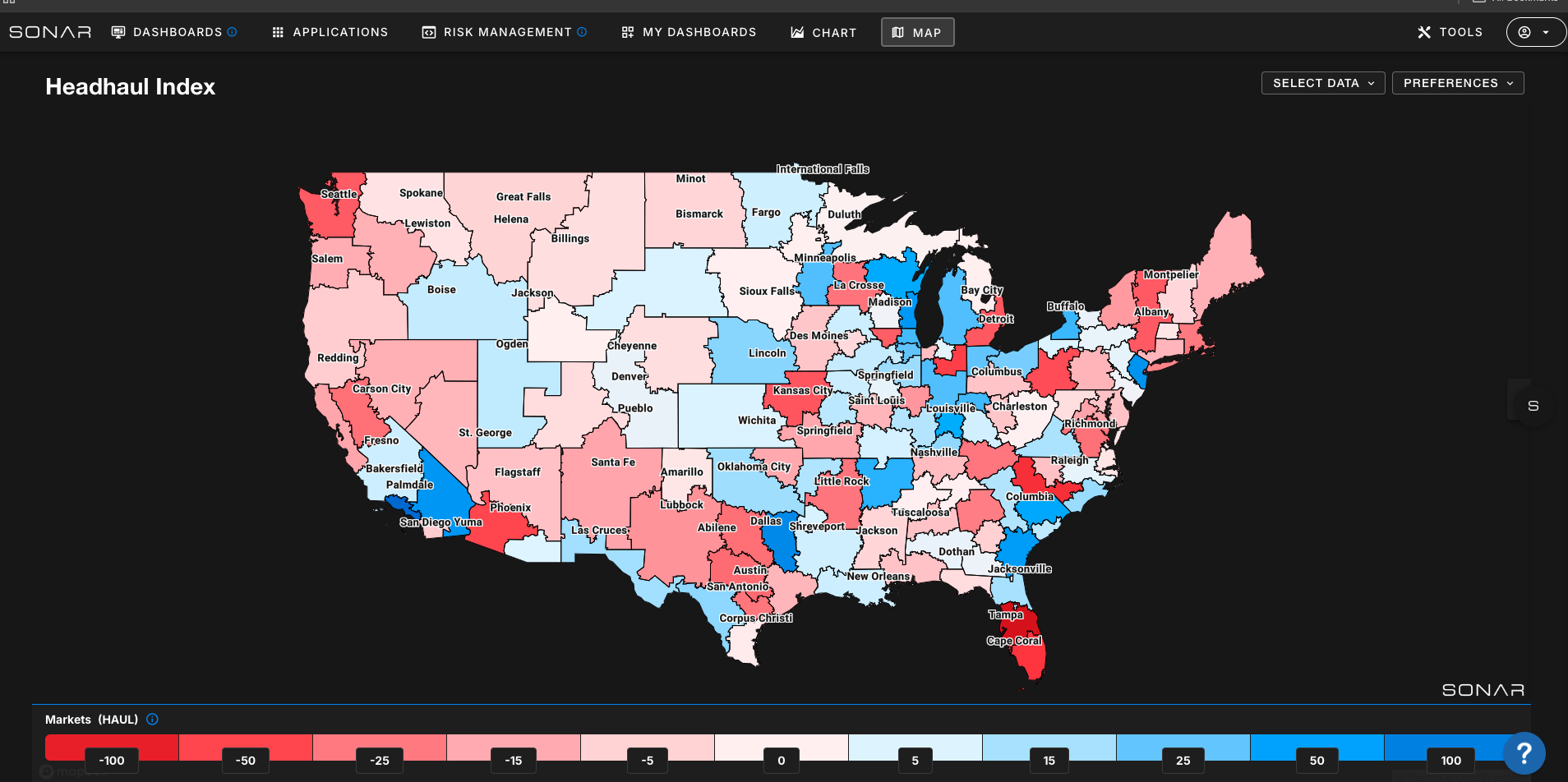
Last week, SONAR released enhancements to their map widget, this week, they made maps easier to access and use.
Enhanced Map Widget
SONAR redesigned the Map Widget to make it more powerful, intuitive, and user-friendly than ever.
What’s New
Seamless Experience: A cleaner layout and simplified controls make navigating and analyzing data smoother.
Data Controls: Clear descriptions show exactly where and how to:
Add in new datasets
Adjust preferences for weather, custom layers, legends, and more
Improved Hover Popups: See key details instantly with a more responsive, information-rich hover experience.
Instant access to actionable insights without leaving the map: Click on any market to open a dynamic side panel packed with Key Market Insights data bringing deeper context right where you need it.
Polished Visuals: A refreshed, streamlined design ensures maps are easier to read and insights are easier to act on.
This week, SONAR added Maps to the main menu in the UI to make the overall tool easier to use and navigate. The map now defaults to our HAUL Index with the ability to click on any market to display Key Market Insights. Map layers can be customized to include your locations, a weather radar and other preferences. Its also easy to change the data from our HAUL index to any of our other indices, market volatility, spot market conditions, tender volumes by market or rejections.
If you haven’t checked out maps in SONAR lately, be sure you do! To request a demo, click here.
How Carrier’s Ren program saves costs and boosts eco-efficiency
Carrier Transicold is once again shaking up the cold chain industry with its newly unveiled Reefer Enhancement and Next-Life (REN) Program, targeting a key segment of refrigeration units that are entering middle age. Designed for PrimeLINE reefers between six and ten years old, the REN initiative enables those aging units to be upgraded, allowing them to last longer, consume less energy, and incur fewer maintenance costs.
Join the leaders shaping freight’s future at F3: Future of Freight Festival, Oct 21-22. Network with the industry’s best and discover what’s next.
At the heart of the program are technical upgrades: customers can opt for high-efficiency EDGE compressors, more efficient coils, and kits to retrofit newer refrigerants. There’s also an option to add Carrier’s Lynx Fleet telematics for enhanced visibility into unit health, predictive maintenance, and smoother fleet management.
These combined enhancements promise fuel and maintenance savings, tighter adherence to environmental regulations such as the EU Emissions Trading System, and an uplifted resale value for the updated units.
The logic behind REN is straightforward but powerful. Instead of replacing aging reefers wholesale, which is expensive and resource-intensive, companies can refurbish and extend the useful lifespan of their existing fleet. Carrier claims up to three additional years of service. This appeals not only from a cost perspective but also from a sustainability angle, since refurbishing requires fewer resources than manufacturing new units.
“As the shipping and maritime industry accelerates its transition to lower carbon operations, companies are seeking solutions that maximize the value of existing assets while minimizing environmental impact,” said Pablo Martinez, Senior Director, Aftermarket and Services, Carrier Climate Solutions Transportation, in a news release. “Our Reefer Enhancement and Next-life Program enables shipping lines and leasing companies to easily enhance the efficiency, reliability and sustainability of their current fleets.”
In short, the REN Program positions Carrier Transicold to help its customers navigate tighter environmental standards and rising costs while getting more life and better performance from existing refrigeration units.
The Tech Roundup is a weekly rundown of advancements and news in the FreightTech space. This week: Ordoro & DropStream Partner to Streamline 3PL Fulfillment for E-commerce Merchants, PS Transportation Partners with Hyperscale Systems to Eliminate Driver Hold Times with VIC, a Breakthrough Digital Driver Assistant, HERE & Radaro Partner for Next-Gen Route Optimization and Tour Planning
Ordoro & DropStream partner to streamline 3PL fulfillment for E-commerce merchants
The challenges of scaling fulfillment in the E-commerce space often come down to the complexity of integrating multiple systems and partners. A new partnership between Ordoro, a company known for its centralized order and inventory management tools, and DropStream, which specializes in connecting merchants with warehouse management systems, is setting out to address this pain point.
Join the leaders shaping freight’s future at F3: Future of Freight Festival, Oct 21-22. Network with the industry’s best and discover what’s next.
By combining their capabilities, the two companies aim to simplify the way merchants work with third-party logistics providers and cut down on the manual processes that often lead to inefficiencies and errors.
At the heart of the collaboration is DropStream’s ability to plug merchants into more than one hundred warehouse management systems without the need for lengthy custom development projects. Pre-built integrations mean that new 3PL partners can be onboarded quickly, reducing downtime and keeping operations moving at the speed of retail demand. Ordoro’s order management system, meanwhile, ensures that sales coming from different channels are captured in one place, providing merchants with a single view of their operations. This combination not only reduces the risk of human error but also allows for faster and more accurate fulfillment decisions.
Automation is another central promise of the partnership. By pairing DropStream’s rules engine with Ordoro’s inventory synchronization, merchants can design fulfillment flows that account for location, shipping priority, and stock availability. This makes it easier to direct orders to the right warehouse, avoid overselling, and deliver on customer expectations without relying on manual interventions. The automation also scales naturally, meaning that businesses can process a handful of orders each day or tens of thousands without a proportional increase in workload or staffing needs.
The benefits, however, will depend on how well these systems can accommodate edge cases. While pre-built integrations may be ideal for common workflows, businesses with specialized needs could still find themselves looking for customization or technical support. Likewise, the robustness of the warehouse management systems themselves will play a role in the overall reliability of the partnership. The effectiveness of this collaboration ultimately hinges on how well Ordoro and DropStream can handle data consistency, exception management, and returns processing.
“For over a decade, DropStream has been eliminating the friction between merchants and their fulfillment partners”, said Kyle O’Neill, Vice President of Commercial Solutions at DropStream. “Ordoro’s merchant first approach perfectly aligns with our philosophy of making powerful technology accessible. Together, we’re proving that sophisticated fulfillment doesn’t require an engineering team or enterprise budget.”
PS Transportation partners with hyperscale systems to eliminate driver hold times with VIC, a digital driver assistant
PS Transportation has announced a collaboration with Hyperscale Systems to introduce VIC, a digital driver assistant designed to reduce driver hold times, streamline communication, and improve operational visibility. This is part of a push in trucking and logistics toward leveraging digital tools not just for routing or dispatch, but directly enhancing the experience and efficiency of drivers on the ground.
The new digital assistant acts as a real-time interface between drivers and operations. Drivers will use VIC to log arrival and departure, report delays, get instructions, and receive updates from operations staff without having to rely solely on phone calls, paper forms, or waiting for manual communication.
Hyperscale Systems provides the backend infrastructure, enabling secure data transmission and integration with PS Transportation’s existing dispatch and tracking systems. Because VIC is digital and always connected, hold times that previously resulted when drivers were stuck waiting at loading docks, terminals, or paperwork checkpoints are expected to drop significantly. The assistant also helps flag exceptions early, so operations can intervene proactively rather than reactively.
Improved transparency is one of the biggest promises of the partnership.
Drivers are notoriously underserved when it comes to knowing what’s happening further upstream: expected wait times, required paperwork, inspection issues, or gate access delays. VIC aims to keep drivers informed about those matters, allowing them to anticipate problems and adjust where possible. On the operations side, PS Transportation gains more precise, timely data on where delays are occurring and why, which supports more accurate planning, better customer updates, and better utilization of fleet assets.
The successful rollout of VIC could meaningfully improve driver satisfaction, cut down wait times that cost both drivers and carriers, and make operations more predictable. For shippers and customers too, more visible supply chains and more reliable ETAs can improve trust and reduce friction. This signals that digital driver assistants may become standard in trucking, not just tools for back-office dispatchers but crucial interfaces for drivers themselves.
HERE & Radaro partner for next-gen route optimization and tour planning
HERE Technologies and Radaro are joining forces to bring advanced route optimization and tour planning to enterprise-grade logistics operations. The partnership combines HERE’s expertise in mapping and location intelligence with Radaro’s global last-mile delivery platform, which is already in use in more than sixty countries. Together, the two companies aim to help businesses improve the way they plan, execute, and monitor deliveries across complex networks.
Radaro will integrate HERE’s tour planning capabilities directly into its platform, giving users access to tools that account for the many real-world constraints of fleet operations. That means routes can be optimised not only around geography and traffic but also based on vehicle load, driver schedules, and infrastructure limitations like weight restrictions or low bridges. The integration extends across the entire delivery lifecycle, from initial planning and dispatch to live routing and post-trip performance analysis. By feeding back insights such as delivery-in-full and on-time metrics, the platform provides enterprises with the data they need to refine operations and meet service level commitments.
The partnership is significant because many last-mile operations still rely heavily on static plans that do not adjust well to disruptions or shifting customer demands. By incorporating HERE’s dynamic location intelligence, Radaro is making it possible for companies to respond to challenges in real time, reducing wasted mileage and improving customer satisfaction. Adoption, however, will depend on how seamlessly the new capabilities integrate with existing logistics systems and how clearly businesses can see the return on investment. Still, for enterprises managing large, diverse fleets, this collaboration represents a step toward smarter, more adaptive delivery networks.
FMCSA Revokes ROBINHOOD ELD, The Price Value Dilemma
Motor carriers using the ROBINHOOD ELD (Model R-HOOD ELD, Identifier: RHD481) have until November 18 to replace the revoked device with a compliant ELD from the registered devices list. Until then, affected fleets must revert to paper logs or logging software to record hours-of-service data.
The revocation is the latest example of how choosing the wrong ELD can create costly headaches for fleets that fail to vet their technology vendors thoroughly.
Unlike European Union systems, which require third-party certification, U.S. ELD providers self-certify that their devices meet the FMCSA’s technical specifications. This process allows ELD manufacturers to register their devices on FMCSA’s approved list simply by attesting that their products comply with the extensive requirements outlined in the federal regulations.
The self-certification approach creates a vulnerability window, allowing non-compliant devices to enter the market and gain customers before the FMCSA discovers deficiencies. The agency only removes devices reactively, after problems are identified through field testing, compliance reviews, or user complaints.
This regulatory gap places the burden on fleets to conduct their own due diligence when selecting ELD vendors, a responsibility many carriers underestimate until they’re forced into an expensive replacement cycle.
For fleets now scrambling to replace ROBINHOOD ELD systems, the financial and operational impact extends far beyond the device cost. The replacement process involves multiple expensive and time-consuming steps:
Sourcing and trialing replacement vendors
Negotiating new contracts and pricing
Physical removal of old hardware and installation of new systems
Retraining drivers on different interfaces and protocols
Managing operational disruption during the transition
Dealing with driver frustration over constant technology changes
Drivers quickly lose patience with fleets that choose unreliable technology vendors. They’re already prone not to love fleet tech in many cases, especially not tech that’s regulatory required. Each failed implementation erodes trust and creates resistance to future system changes, even necessary ones.
The process of finding, evaluating, and implementing fleet technology represents a significant investment in time and resources. Smart fleets understand that cutting corners on vendor selection ultimately costs more than investing in reputable providers upfront.
When evaluating ELD vendors, fleets should prioritize several key factors over lowest-bid pricing:
Track record and stability: How long has the vendor been in business? Do they have a history of FMCSA compliance issues? Have their devices been removed from the registry before?
Technical capabilities: Does the device meet all current specifications in 49 CFR 395 Appendix A? Can the vendor demonstrate ongoing investment in product development and compliance?
Customer support: What level of technical support does the vendor provide? How quickly do they respond to driver issues or system malfunctions?
Company values and ethics: Does the vendor demonstrate commitment to regulatory compliance and safety, or do they market features that skirt the edges of legal requirements?
Financial stability: Is the company financially sound enough to provide long-term support and updates?
The most expensive ELD purchase is the one you have to make twice. Fleets that focus solely on upfront costs often discover that cheap providers lack the resources or commitment to maintain regulatory compliance over time.
Smart fleets invest time in comprehensive vendor evaluation before making ELD commitments. This includes:
Reviewing FMCSA compliance history and any past device removals
Testing devices in real-world conditions with actual drivers
Checking references from other fleets using the same system
Evaluating the vendor’s technical support capabilities
Assessing the company’s financial stability and long-term viability
The goal is to select a vendor that will provide reliable, compliant service for years, not months. This approach avoids the costly cycle of removal, replacement, and retraining that plagued fleets using providers like ROBINHOOD ELD.
Beginning November 18, motor carriers continuing to use the revoked ROBINHOOD ELD will be considered as operating without an ELD. Safety officials encountering drivers using the revoked device after that date will cite them for 395.8(a)(1) and place them out-of-service according to Commercial Vehicle Safety Alliance criteria.
Until November 18, enforcement officials are encouraged not to cite drivers using the revoked ELD for “No record of duty status” violations, instead requesting paper logs or using the ELD display as backup to review hours-of-service data.
FMCSA noted that if ROBINHOOD corrects all identified deficiencies, the device could be restored to the registered list. However, the agency strongly encourages carriers to replace the system now rather than wait for potential corrections.
The ROBINHOOD ELD removal continues a pattern of device revocations that have affected thousands of motor carriers. Earlier this year, FMCSA removed multiple devices including TT ELD PT30, ELOG42, and RENAISSANCE ELD, forcing affected fleets through similar replacement cycles.
Each removal drives home the importance of thorough vendor vetting and the risks of choosing ELD providers based primarily on price rather than reputation and compliance history.
For the trucking industry, investing in reputable, stable ELD vendors from the start saves money, time, and driver satisfaction in the long run. The cheapest option often becomes the most expensive when compliance failures force fleets back to the drawing board.
Transportation Secretary Launches HOS Flexibility Pilot Programs
Transportation Secretary Sean Duffy announced two pilot programs Monday aimed at giving truck drivers more flexibility in hours-of-service regulations, marking the latest effort in the Trump administration’s pro-trucker agenda as questions persist about the effectiveness of existing electronic logging device mandates.
The Federal Motor Carrier Safety Administration will test split-duty period options and flexible sleeper berth configurations through the new programs, which could affect how drivers manage their 14-hour driving windows and required rest periods. Protocol development begins in early 2026, with more than 500 commercial drivers expected to participate.
The Split Duty Period pilot program will allow participating drivers to pause their 14-hour “driving window” for no less than 30 minutes and no more than three hours, while the Flexible Sleeper Berth pilot program will explore additional sleeper berth split options beyond the current “8/2” and “7/3” configurations.
FMCSA will test the safety implications of allowing drivers to divide their 10-hour off-duty requirement into “6/4” and “5/5” split periods. The research will examine how these alternatives affect driver fatigue and overall safety performance.
“Truck drivers are the backbone of our economy, and we owe it to them to explore smarter, data-driven policies that make their jobs safer and more enjoyable,” said Duffy. “These pilot programs will help identify real solutions for America’s drivers without compromising safety.”
The programs represent part of the Department’s Pro-Trucker Package, unveiled in June following President Trump’s Executive Order on Enforcing Commonsense Rules of the Road for America’s Truck Drivers. The broader package includes more than $275 million in grant funding to expand truck parking nationwide, including $180 million for Florida to add 917 new truck parking spaces along the I-4 corridor.
As a CDL holder for more than 25 years who has worked both as a driver and in fleet operations, as well as owned fleets and dispatched under my authority and broker authority, I’ve seen firsthand why we have the regulations we do today. The hours-of-service rules didn’t emerge in a vacuum, they exist because of widespread violations that occurred when oversight was minimal. Electronic logging devices didn’t exist, and when money and survival are the objectives.
Having been a trucker who bent the rules earlier in my career, I understand the pressures drivers face. When you present the opportunity to work beyond legal limits to make more money, many will take it, particularly when financial survival and the survival of your small business or your family’s livelihood are at stake. For drivers and fleets struggling economically, the temptation to push past safety limits can be overwhelming.
This mindset often ignores the litigation and crash exposure potential that many believe will “never happen to them.” The reality is that fatigue-related incidents carry enormous consequences, both in human terms and financial liability.
FMCSA data show that hours-of-service violations have decreased since the ELD rollout, with compliance improving across the industry. However, research suggests the safety picture is more complex.
A University of Arkansas study found that the federal ELD mandate has not reduced accidents and may correlate with an increase in unsafe driving incidents. The research showed that “unsafe driving behaviors among the adopting carriers increased by about a third,” including infractions such as improper lane changes, following too closely, and speeding.
A separate study by Northeastern University’s Alex Scott found no measurable impact on accident numbers from widespread ELD adoption, particularly among small carriers where ELD adoption saw the most significant increase. The research suggests that while the ELD mandate achieved improved HOS compliance, with violations decreasing by 36.7% initially and a further 51.7% under stricter enforcement, this didn’t translate to fewer crashes.
One significant factor limiting ELD effectiveness is the substantial portion of the trucking industry that remains exempt from the mandate. Agricultural haulers, short-haul operators, driveaway operations, and vehicles with pre-2000 engines all operate outside ELD requirements. When regulations apply to only part of an industry, the overall safety impact becomes diluted.
Beyond exemptions, the U.S. ELD system faces additional challenges from fraud and inadequate oversight. Unlike European Union systems that require drivers to input individual cards tied to their personal records and utilize a limited number of certified tachograph manufacturers with third-party certification, the U.S. relies heavily on self-certification by ELD providers.
This approach has created vulnerabilities. Businesses that sell the ability to edit ELD records have emerged, undermining the system’s integrity. Not all ELD vendors meet the legitimate standards they should, and many fail to comply with the technical specifications outlined in the voluminous 49 CFR 395 Appendix A.
FMCSA regularly removes ELD providers from its registry for failing to meet these standards, but the self-certification system allows non-compliant devices to enter the market initially. The agency’s reactive approach to policing ELD compliance contrasts sharply with the EU’s proactive third-party certification model.
FMCSA plans to propose revisions to the existing ELD rule, targeting a notice of proposed rulemaking in the near future. Potential changes include reevaluating exemptions for pre-2000 engines, improving protocols for device failures, and streamlining procedures to remove non-compliant devices.
The agency has also been active in removing non-compliant devices from its approved list. On September 4, FMCSA removed TT ELD PT30, ELOG42, and RENAISSANCE ELD from the registered devices list due to companies’ failure to meet minimum requirements. Motor carriers using these devices must replace them with registered ELDs by November 3.
Meanwhile, Duffy has emphasized enforcement of English proficiency requirements for CDL holders, with more than 1,500 drivers seeing licenses revoked since the rules were reinstated.
The pilot programs offer a balanced approach to addressing driver quality-of-life concerns while maintaining safety oversight. The mixed results from ELD implementation serve as a reminder that even well-intentioned regulatory changes can produce unintended consequences.
At the root of many compliance issues lies a fundamental problem, drivers and fleets will often work themselves to death chasing the next dollar if allowed to do so. This stems from neglecting or not fully understanding our moral and ethical responsibilities around safety and sharing the road with the public.
The financial pressures in trucking are real, but they cannot override the basic obligation to operate safely. When economic survival drives decision-making without regard for safety consequences, the results can be catastrophic – not just for drivers and carriers, but for every motorist sharing the highway.
As someone who has experienced both sides of the compliance equation, while at the same time handling expert witness cases in litigation and handling hundreds of commercial crash claims, these pilot programs represent a positive step toward finding regulations that work for both safety and operational efficiency. The key will be ensuring that any flexibility granted doesn’t simply create new opportunities for the same unsafe practices that necessitated stricter rules in the first place.
The trucking industry needs regulations that acknowledge economic realities while prioritizing public safety. These pilot programs could help strike that balance, if they’re designed and implemented with appropriate safeguards based on real-world driving experience and a commitment to ethical operation that goes beyond mere regulatory compliance.
FedEx Freight spinoff on track for June 2026
The nation’s largest less-than-truckload carrier, FedEx Freight, is on track to become a standalone public company by June of next year. Parent company FedEx said Thursday it plans to spend $600 million enhancing IT infrastructure and systems ahead of the spinoff.
Join the leaders shaping freight’s future at F3: Future of Freight Festival, Oct 21-22. Network with the industry’s best and discover what’s next.
Shares of FedEx Freight will be listed on the New York Stock Exchange under the ticker FDXF.
FedEx (NYSE: FDX) reported consolidated adjusted earnings per share of $3.83 for its fiscal first quarter ended Aug. 31 after the market closed on Thursday. That was 22 cents higher than the consensus estimate and 23 cents higher year over year. Revenue of $22.2 billion was $550 million ahead of expectations.
FedEx Freight reported revenue of $2.26 billion for the quarter, a 3.1% y/y decline. Tonnage per day was down 2.5% while revenue per hundredweight, or yield, was off 0.6%. (The tonnage decline was driven by a 2.2% decline in shipments and a 0.3% dip in weight per shipment.)
Table: FedEx Freight’s key performance indicators
Management said the LTL market “remains rational” but topline trends continued to be constrained by a weak industrial economy and share loss to the truckload market where capacity is plentiful and rates are depressed.
The Purchasing Managers’ Index (PMI) registered a 48.7 reading for August (50 is neutral), placing it in negative territory for 32 of the past 34 months. (The dataset typically leads inflections in LTL volumes by approximately three months.)
The PMI new orders subindex – a signal for future activity – moved into expansion territory (51.4) after six consecutive months of decline. However, the dataset remained below 52.1, which the report identified as a required threshold for sustained increases in manufacturing orders.
FedEx Freight reported an 84% operating ratio (inverse of operating margin), which was 280 basis points worse y/y. The result included $9 million in separation costs (a nearly 40-bp y/y headwind) related to the spinoff.
Lower revenue and a 100-bp increase in salaries, wages and benefits expenses (as a percentage of revenue) were the culprits. Wage rates were higher than a year ago and the segment is also carrying the cost of 200 new dedicated sales associates. The sales staff is expected to double to 400 before the June separation.
For the fiscal year ending May 31, FedEx Freight’s revenue is forecast to increase y/y by a low-single-digit percentage, with yields improving modestly y/y in the back half. The unit’s full-year operating margin is expected to see modest y/y deterioration, but the declines have already started to narrow.
FedEx Freight recently announced a general rate increase of 5.9% on average that will take effect on Jan. 5.
Shares of FDX were up 5.4% in after-hours trading on Thursday.
SONAR: Longhaul LTL Monthly Cost per Hundredweight, Class 50-65 Index. Less-than-truckload monthly indices are based on the median cost per hundredweight for four National Motor Freight Classification groupings and five different mileage bands. To learn more about SONAR, click here.
EV Realty secures $75 million investment from NGP for charging expansion
EV Realty announced Thursday it has secured $75 million in growth equity from private equity investor NGP to scale its portfolio of commercial fleet charging hubs. The company also broke ground on its first large-scale project in San Bernardino, Calif., featuring 76 DC fast-charging stalls with 9.9 MW of grid capacity that can serve more than 200 Class 8 trucks daily.
“What we’ve focused on from the start is trying to address the barrier that we think really inhibits this adoption for the fleets that want to adopt, which is access to large amounts of power and a scalable solution,” said Patrick Sullivan, CEO of EV Realty, in an interview with FreightWaves.
The San Bernardino facility is strategically located in what Sullivan calls the gateway city to Southern California’s freight ecosystem. The site is positioned just two miles from the BNSF intermodal facility, with approximately 60 million square feet of industrial and distribution warehousing space and nearly 4,000 Class 8 trucks operating daily within five miles.
The location was selected using proprietary data science tools that mapped distribution power systems to identify optimal sites with available grid capacity.
“When we started the company, we built a set of proprietary data science tools—now a full software program—which at this point is probably a couple hundred different data sets, but it started with full mapping of the distribution power system in Southern California,” Sullivan said. This approach allows the company to identify areas with adequate power capacity near critical freight infrastructure.
The San Bernardino facility will be the largest grid-connected charging project in the country, with no backup generation required due to the ample grid capacity identified through EV Realty’s site selection process.
The project has received funding support from the South Coast Air Quality Management District and was selected for a conditional award from the EnergIIZE Commercial Vehicles Project, funded by the California Energy Commission.
The company’s business model focuses on private, dedicated facilities for commercial fleets rather than public truck stops. Customers typically sign multi-year contracts for dedicated portions of the property, with EV Realty providing full maintenance of both chargers and facilities.
“If a truck’s not moving, they’re not making money, and a truck that’s sitting still or has to wait for charging or has to go through a clumsy reservation or has to use a credit card, or all those things add friction. And for any company in my space to any fleet in my space, to make the switch, it has to be easy. It has to be able to let them do the same for less money or more for the same money, and any point of friction you add, especially at the driver level, is a real challenge,” Sullivan added.
Sullivan maintains that the long-term trend toward fleet electrification remains strong, particularly where the economics make sense.
“Despite the challenges, the long-term trend toward fleet electrification is unmistakable,” Sullivan noted, emphasizing that the economics are already working for some customers. “We’re seeing real customers moving real freight, not just potato chips, winning freight at market rates and operating at a positive margin to their competitors.”
This announcement builds on EV Realty’s recent strategic moves, including a partnership with Prologis to streamline fleet charging access across networks and the acquisition of assets from charging provider Gage Zero. The San Bernardino facility is scheduled to open later this year, marking a significant milestone in EV Realty’s expansion of its Powered Properties® portfolio.
State of Freight takeaways: volumes are weak to stable but silver linings on the horizon
Coming a few weeks after an earnings season that saw a lot of trucking companies struggling (or even failing) to turn a profit, and an interim update from LTL carriers that was decidedly weak, the FreightWaves September State of Freight webinar spent much of the time parsing through various data points of a market firmly in year three of a freight recession.
Join the leaders shaping freight’s future at F3: Future of Freight Festival, Oct 21-22. Network with the industry’s best and discover what’s next.
But by the end of the one-hour webinar, FreightWaves and SONAR CEO Craig Fuller was able to offer an optimistic outlook. The road to get there still has plenty of hurdles.
Here are five takeaways from this month’s session with Fuller and Zach Strickland, SONAR’s director of freight market intelligence.
Volume data has differences but shows little sign of strength
A discussion about comparing data sets on volume indicators noted that Cass data, which is widely respected, is based on invoices. So there is a lag between it and the data in the Outbound Tender Volume Index in SONAR.
The publication of Cass data a day before the State of Freight webinar was largely negative across the board. Its multimodal transportation index was down 9.3% year-over-year. Volumes in August were down 1.5% from a month earlier. Particularly weak were LTL shipments.
“Being invoice data it means that these invoices come in when the carrier, the provider, bills them,” Fuller said. “And sometimes it can be weeks or months. So you get this lag in Cass’ data.”
The OTVI, being based on real time data, shows that while the freight market measured by volume was “a pretty marginal summer, but it wasn’t a collapse.”
But the bigger picture, Fuller noted, is that the OTVI is now not far from where it was in 2018, which was considered a robust freight market. “The truth is that none of the volume data should ever revert back,” Fuller said. “It’s like having a business where you’re like, oh, we’re doing better than we were seven years ago. How is that something to brag about? You’ve lost seven years of compounded growth.”
Strickland noted that back in 2018, the Outbound Tender Rejection Index in SONAR was 17.5% against a volume that is largely unchanged. It’s now just over 5%.
How is it possible to have a low OTRI against a stable volume of freight?
With so much focus on the push by the federal government to remove non-English speaking and other non-qualified drivers from the road, Strickland and Fuller turned to the issue of capacity.
Strickland noted that despite all the market turmoil, SONAR’s OTRI is still hovering a little more than 5%, and has been for awhile.
It’s been a long road to get to the current level of capacity, Fuller said, citing a process that began in the Obama administration with an impact that continues today. That administration, he said, “loosened up rules” that allowed more drivers on the road, but some of it was encouraged by “trucking interests” who wanted them to allow for labor supply to come into the market. Because the thinking was we have a driver shortage and we need to bring new drivers in.”
That new capacity didn’t all end up at big carriers. To the contrary, their insurers would have halted that kind of hiring, Fuller said. Instead, he added, they went to smaller carriers, “the ones that are truly fighting for survival, and in doing so, it just exacerbated the excess capacity.”
What about the drivers being taken off the road?
The current pace of capacity exits, as recorded by FMCSA data and displayed in the CDNR.USA data series in SONAR, is showing signs that the exodus out of the market is continuing, Strickland said. And Fuller said that is not surprising.
Strickland noted there is a lag in the data. Fuller added that it was June when Secretary of Transportation Sean Duffy made the crackdown on non-English speaking drivers a key goal of the DOT. “That’s why I think you’re starting to see a lot of these regulatory changes are going to have an impact and it’s going to continue to show up in the data,” he said.
Everybody is losing money but many still stick around
Fuller made a startling observation. “For the most part most trucking companies on a per mile basis are losing money.” Then why aren’t the capacity exits occurring quicker?
Part of it is that about 40% of costs are fixed. Even as the miles rack up on a losing basis, cash is being generated, “even as they’re underwater,” Fuller said. “And what’s happened is that this freight recession has gone on so long that a lot of these guys have been losing money or equity, but generated enough cash to stay alive.”
But that can’t go on forever and that may be contributing to the loss in capacity that is showing up in the net revocations, but not yet in the OTRI. After years of those losses, Fuller said, “a lot of the trucks are now five years old.” And it’s getting near time to buy a new truck.
“When they need to go buy a new truck, they can’t,” Fuller said. “They can’t maintain them, and then the trucks start to fall apart. They start to have safety problems. The fleets can’t attract drivers, and they end up in accidents, because when you stop maintaining the truck, it’s going to become less safe.”
That combination, Fuller said, “is why I think capacity is going to continue to come out of the market.”
Hearing some positive news
Before turning to a more optimistic outlook, Fuller said “I truly think the economy, the freight economy is bad, the Main Street economy is bad.” But he said he also has been talking to other executives who are reporting more solid operations than the bad news might indicate.
Fuller mentioned a friend who he said runs a consulting business tied to logistics. “I talked to them yesterday, and he said we’ve never been more busy,” Fuller said, with a strong amount of business tied to M&A activity in the sector.
“There are companies willing to make investments in the business,” Fuller said. That doesn’t mean there’s going to be some quick turnaround, he added. “It’s not like we’re out of the (freight) recession. I want to be clear. I’m not saying we’re done.”
But he said those business executives he is speaking with “are starting to see signs of strength in their business. They’re starting to see things that feel a little bit better.”