Universal Logistics blames falling demand for weak first quarter

Transportation and supply chain provider Universal Logistics Holdings said lagging demand for auto parts contributed to a sluggish first quarter.

Universal Logistics’ (NASDAQ: ULH) first-quarter operating revenue decreased 22.3% year over year to $382.4 million. First-quarter earnings per share came in at 23 cents per share, an 88% year-over-year decrease.

“The overall freight environment remained sluggish, and our largest vertical, automotive, saw a slowdown in January but improved as the quarter progressed,” CEO Tim Phillips said during a call with analysts Friday. “While the results of this quarter were below our historical benchmarks, we remain confident in the resilience of our business model.”

The company released first-quarter financial results after the market closed on Thursday.

Universal Logistics is a Warren, Michigan-based truckload transportation, intermodal and logistics provider. The company provides services across the U.S, Mexico, Canada and Colombia and has more than 10,000 employees.

Universal Logistics missed Wall Street analysts’ revenue estimates of $454.1 million in the fourth quarter and earnings per share expectations of $1.04.

The company’s first-quarter results showed year-over-year decreases in its trucking, contract logistics, intermodal and managed brokerage segments.

CFO Jude Beres said the year got off to a slow start.

“In January of this year, Universal experienced its first loss ever in a January. We went into February 5 cents in the hole, losing 5 cents of earnings per share,” Beres said. “Then the quarter slowly got better. We went from negative 5 cents a share in January to positive 9 cents a share in February, and then 19 cents a share in March. So the quarter really started out low and the business really rebounded well.”

Universal’s contract logistics segment, including value-added and dedicated services, posted first-quarter revenue of $255.9 million, a decrease of 18.4% year over year from the same quarter in 2024.

By the end of the first quarter, Universal Logistics managed 87 value-added programs, including 20 rail terminal operations, compared to a total of 71 programs at the end of the same period in 2024.

“We have three key launches in contract logistics that will begin in the second quarter,” Phillips said. “These launches will increase our contract logistics annual revenue by 50 million per year.”

Universal’s trucking segment decreased 20.2% year over year to $55.6 million. During the first quarter, Universal moved 28,622 loads compared to 41,691 loads during the same period last year, a 31% decline. 

“We continue to see strong demand in our specialized heavy-haul window operation, which remains a strategic differentiator and a stabilizing force for this segment,” Phillips said. “Looking ahead, we expect this business to be a key contributor in 2025 especially as renewable energy infrastructure projects continue to move forward.”

The trucking segment’s average operating revenue per load, excluding fuel surcharges, increased 24% year over year to $1,874. The average number of Universal tractors decreased 22% year-over-year to 633.

Universal Logistics officials said while freight movements were slow in January, they rebounded in February, March and April.

“The quarter really started out low and the business really rebounded well,” Beres said. “For example, our cross-dock tonnage in February was up 30% from January, March’s cross-dock tonnage was up 64% from January. Auto production was up 29% in February compared to January, and then up 67.1% in March compared to January. If we just would have had an environment in January that was similar to February, the results would have looked a lot different. We would have definitely been within our guidance range of around $400 million in revenue and earnings of around 41 cents.”
Chief negotiator on union longshore pact to lead USMX

The United States Maritime Alliance has chosen F. Paul De Maria to serve as chief executive and chairman of the port employers’ group.

De Maria was the alliance’s chief negotiator in contentious contract talks with the International Longshoremen’s Association (ILA). The pact, one of the richest in the history of maritime labor, includes landmark provisions for automating container handling at East and Gulf Coast ports.

F. Paul De Maria (Photo: USMX)

De Maria succeeds David F. Adam, who retired in April after having served as chief operating officer from 2011-13 and chief executive and chairman since 2013.

The USMX board of directors made the change April 17.

“It’s an honor to lead this organization as we work together with the ILA to ensure we have the strong and efficient supply chains necessary to ensure American companies can access the global marketplace,” said De Maria, in a release. “Our focus will be on working day-in and day-out to make sure we are successfully implementing our agreement that prioritizes creating modern and safe working conditions across the industry while supporting longshore jobs.”

De Maria joined USMX in 2012 as vice president of labor relations and in 2021 moved up to executive vice president and chief operating officer. Prior to joining USMX, he was senior general manager of marine terminal operator Ports America. De Maria is a graduate of the State University of New York Maritime College in New York, where he earned a U.S. Coast Guard third mate’s license and a Bachelor of Science in Marine Transportation.

Find more articles by Stuart Chirls here.

Related coverage:

Trans-Pacific container rates stable as trade war rages

Shares of largest US-flag container carrier plunge under Trump tariffs
Trans-Pacific blank sailings soar as ocean shipments plunge

US plans phased approach to port fees for Chinese ships

PostalMag becomes part of FreightWaves: Meet your new editor

When Tom Wakefield started PostalMag.com more than two decades ago, the Dallas-based letter carrier simply wanted to provide a resource for colleagues about their U.S. Postal Service benefits and how to access them. Few websites provided comprehensive information and the ones that did weren’t updated frequently.

Today, PostalMag.com is a trusted platform read by postal workers, businesses and other stakeholders for news and information about every aspect of postal culture – from operations and rate changes, to union issues, mail carrier safety, dog attacks, postal regulation and financial performance. And, amazingly, the entire site is run by one man who still has a full-time job. 

FreightWaves, a leading media brand for logistics and supply chain news, this week announced it has acquired PostalMag.com. 

Hi, I’m Eric Kulisch, the new Managing Editor for PostalMag.com. I’m excited to carry on Tom’s vision for postal news and help take it to the next level. I’ve covered freight transportation and logistics for 25 years, most recently with a focus on air cargo. I find freight and parcel logistics fascinating because it requires organizations to constantly adapt complex networks to changing circumstances. But the most important thing for logistics success is having the right people in the right place executing together to get the load – and the mail – to the destination safely, efficiently and on time. During my career, I’ve been able to earn the trust of sources and readers by working hard to explain complex issues in a way that’s easy to understand, digging harder to get the facts below the surface and delivering information that helps you do your job. 

These are dynamic and turbulent times, with the unrelenting growth in e-commerce, lower parcel volumes for the international express carriers, a new administration in Washington looking to shake up the U.S. Postal Service and even rumblings of postal privatization. 

With FreightWaves’ backing, PostalMag.com will be able to provide even deeper, insightful content to its existing audience and attract new readers. We are very excited to bring you, the loyal audience, an enhanced look and feel to the website, giving you easier access to the news that impacts your day-to-day jobs. 

You can expect to see a different color scheme, layout, and story selection, but the dedication to the important news impacting the industry will not waver. 

The website has primarily served to aggregate news stories from other sites. Now, PostalMag.com will be able to deliver original content of its own in addition to curating news from all over the USPS ecosystem. We will also expand our coverage to include parcel delivery trends and competition from express carriers because the U.S. The Postal Service doesn’t exist in a vacuum. What happens at Amazon, FedEx, UPS and the regional couriers impacts the Postal Service, directly through contractual relationships or as competitors.

We will also continue running the discussion boards, where postal employees across the country can voice their opinions, vent frustrations and share information using anonymous postings. We encourage people to take advantage of all the good information shared in the forums, but to be respectful and thoughtful when expressing points of view.

FreightWaves and PostalMag.com will also launch a bi-monthly newsletter very soon, so stay tuned for that and please sign up.

I’m eager to hear from PostalMag’s loyal readers about the topics and issues that matter most to you. Please don’t hesitate to reach out with your ideas and feedback as we work to make PostalMag an even better resource for the postal and parcel community.

BNSF and UP say possible container glut doesn’t scare them

Since late last year, BNSF Railway and Union Pacific have been busy handling a surge of containers from West Coast ports as U.S. companies pulled forward imports to beat potential tariffs.

But now with a trade war underway — and tariffs as high as 145% on goods made in China — the number of containers bound to the U.S. from China has dropped precipitously. Container shipping line Hapag-Lloyd, for example, has seen its China-U.S. bookings drop by a third since tariffs were imposed on April 2. And so shipping lines are canceling sailings from Chinese ports.

“It’s my prediction that in two weeks’ time, arrivals will drop by 35% as essentially all shipments out of China for major retailers and manufacturers have ceased, and cargo coming out of Southeast Asia locations is much softer than normal,” Port of Los Angeles Executive Director Gene Seroka said Thursday.

The trade disruption is setting up the potential for kinks in the supply chain that could lead to congestion in the U.S. and a shortage of containers in Asia, intermodal analyst Larry Gross says.

The containers that came to the U.S. during the import surge need to make their way back to West Coast ports. But with far fewer ships now scheduled to call at U.S. ports, there won’t be as much capacity available for the containers to hitch a ride back to Asia.

So the fear is that the glut of empty containers will begin to stack up. “There’s a storm brewing,” Gross said.

UP (NYSE: UNP) and BNSF say they’re ready and able to handle any disruption that may arise.

Both railroads experienced congestion that accompanied strong demand for consumer goods after the pandemic hit in 2020. As inland warehouses filled up, customers were slow to remove their containers from terminals in Chicago and Texas. That created a logjam at BNSF and UP terminals, which spread across their networks and all the way back to the ports of Los Angeles and Long Beach.

The supply and demand dynamic is much different now, but huge volume swings can still create trouble. “The flow of empties westbound continues, and the ports will soon be clogged with empties and no ships to load them on to,” Gross said.

Union Pacific CEO Jim Vena says his railroad is closely monitoring terminal capacity and container flows and is nowhere near capacity. “Overall in our network, we’re very, very cognizant of what we have and what we can hold on to in our terminals,” he said in an interview Wednesday.

Meanwhile, West Coast ports now can handle more volume. “​​LA and Long Beach have done a good job of working on their capacity, so I think that they’re in better shape,” Vena said. It’s the same story in the Pacific Northwest, where Seattle and Tacoma have handled a surge in container traffic partly driven by regaining share from Vancouver and Prince Rupert, British Columbia, following labor unrest in Canada.

UP will be proactive to prevent congestion, a lesson learned during the pandemic-related disruptions.

“At UP we should have been way faster to say, ‘We’re not your storage on the inland terminals, we’re not going to sit on your containers, and we’re not going to load ’em at LA-Long Beach,’” said Vena, who rejoined UP as chief executive in 2023. “UP had 25 trains parked headed towards the city of Chicago — 25 trains, every one of those trains close to 2 miles long. So we had 50 miles of locomotives and trains parked. It will not happen under Jim Vena’s watch.”

A BNSF spokesman says the railroad doesn’t currently anticipate supply chain issues.

“But we’re confident in our ability to mitigate any issues as they arise,” said Zak Andersen, BNSF’s chief of staff and vice president of communications. “Since the supply chain challenges during the pandemic, we’ve added significant capacity, including nearly 93 miles of double-track and additional production tracks and parking at our intermodal facilities on the West Coast and across our network. We’re a bigger railroad with more capacity and capability than just a few years ago.”

Plus, there’s excess capacity in other parts of the supply chain, including trucking, drayage, containers and warehousing.

“The potential of a recurrence of supply chain challenges, however, underscores the need for our Barstow International Gateway,” Andersen said of the $1.5 billion terminal and transload center planned for Barstow, California. “Clearing containers from the ports as they arrive, the reduction in cycle time and our ability to pre-stage railcar supply at BIG will prevent the port congestion the supply chain experienced in 2021.”

Gross says eastbound trans-Pacific container volume won’t rebound until there’s clarity on the tariff situation. Meanwhile, he contends that disruptions in container supply and demand will create inefficiencies that will contribute to inflation. “There’s cost associated with all this — cost with no value generated,” he said.

Related:

Railroads take steps to ease intermodal congestion

Tariffs could mean the end of the line for the model railroad industry

model railroading

The beloved hobby of model railroading, a cornerstone of American culture for generations, faces an existential threat. As the toy and hobby industry grapples with potential new tariffs, small and mid-sized businesses find themselves on the brink of collapse. The proposed up to 145% tariff increase could spell doom for an entire sector, reducing it from a vibrant niche to a relic of the past.

At the heart of this crisis lies the unique economic structure of the model train industry. Unlike mass-market products, model trains operate on razor-thin margins, typically 15-20%. The industry relies heavily on pre-selling, with 95% of products sold months before arrival. This leaves no room for sudden price adjustments when shipments arrive, making the proposed tariff increase catastrophic.

The nature of model train production further compounds the problem. These are not mass-produced items but highly specialized, low-volume products. The costs of tooling and engineering are spread across small production runs, meaning there’s no economy of scale to offset the tariff’s impact. Whether a company produces 2,000 or 10,000 units, the fixed costs remain high, making any significant tariff increase devastating to the pricing structure.

Some might suggest moving production domestically, but this solution is neither economically viable nor logistically feasible. Labor and compliance costs in the U.S. are 5-10 times higher than in Asia. More critically, the specialized infrastructure required for model train production—including tooling, mold-making, and specialty die-casting—no longer exists in the United States. Decades of outsourcing have left the country without the plants, parts, or trained labor to match the precision and efficiency of Asian manufacturers.

It’s crucial to understand that these tariffs miss their intended target. Model trains and similar hobby products are not subject to dumping or unfair subsidies, nor do they pose a threat to national security. These legacy products, deeply embedded in American culture, were previously distinguished by the Section 301 exclusion process, but its removal now lumps them with mass-market imports that operate on much larger volumes and margins.

The consequences of this tariff threat are already unfolding. Inventory is frozen, orders for future seasons are being canceled, and production lines have ground to a halt. Small importers find themselves unable to clear containers or finance future shipments. Retailers are not receiving pre-ordered stock, and entire product lines are being shelved indefinitely.

If this tariff increase stands, it won’t just lead to temporary price hikes. It threatens to eradicate a uniquely American subculture, leading to permanent closures and the disappearance of generational brands that have been fixtures in the hobby for decades.

The model railroad industry isn’t seeking a bailout or special treatment. Rather, it’s calling for the reinstatement of the Section 301 exclusion process—a targeted tool that recognizes the economic scale, cultural significance, and trade harmlessness of this industry. Without such recognition and action, a cherished piece of American life may soon vanish, taking with it not just businesses and jobs, but a rich tradition of creativity, craftsmanship, and community.

As one industry insider poignantly stated, “If this stands, it’s not a temporary price hike—it’s the end of a uniquely American subculture.” The clock is ticking, and without intervention, the model railroad industry may indeed face its final stop.

Read more about model railroading from Firecrown brand, Model Railroader.

Saia badly misses Q1 mark, shares off 24% pre-market

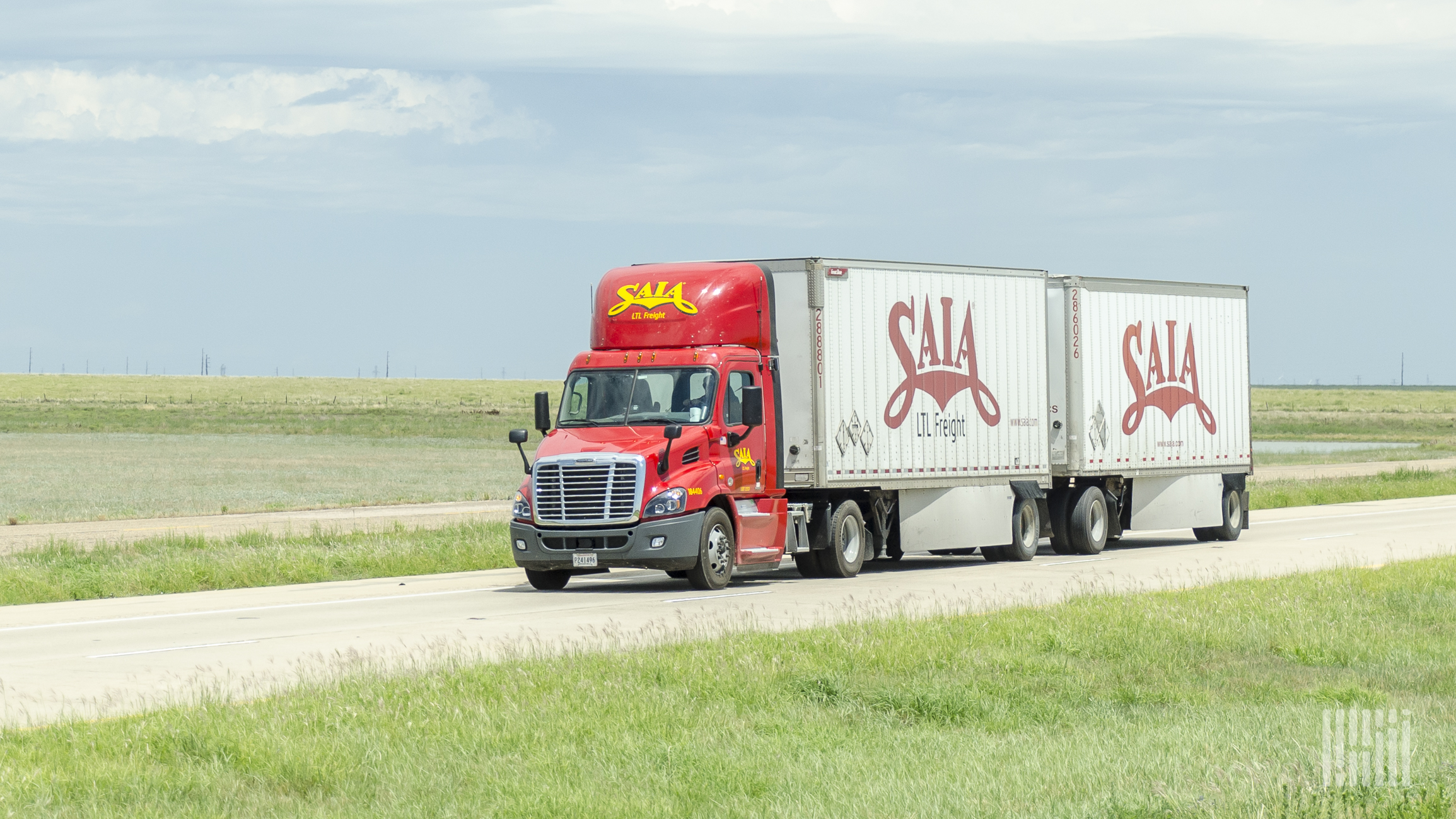
A red Saia daycab pulling two Saia pup trailers

Less-than-truckload carrier Saia said it didn’t get the March lift in demand it normally sees as customers pulled back in response to trade uncertainty.

Johns Creek, Georgia-based Saia (NASDAQ: SAIA) reported first-quarter earnings per share of $1.86 before the market opened on Friday. The result was well light of the $2.76 consensus estimate and the $3.38 the carrier posted in the year-ago period.

Further, the consensus number came down 31 cents in the 90 days ahead of the print as analysts lowered expectations on mounting trade fears.

Click for full report – “Saia’s shares sag 30% as tariffs tank demand, exacerbate growing pains”

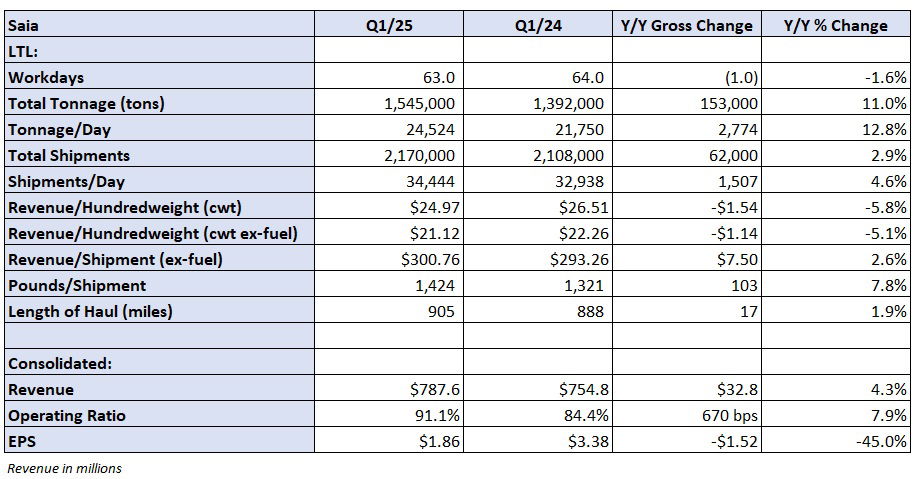
Saia’s revenue increased 4.3% year over year to $788 million (6% higher on a per-day comparison) as tonnage per day increased 12.8% and revenue per hundredweight, or yield, fell 5.8% (5.1% lower excluding fuel surcharges).

The tonnage increase was largely due to recent terminal openings. The decline in the yield metric was driven by a 7.8% increase in weight per shipment.

“Primarily resulting from an uncertain macroeconomic environment, we did not see the typical sequential growth in shipments through the quarter, with March shipments flat to February, causing our first-quarter revenues to fall well below our expectations,” President and CEO Fritz Holzgrefe said in a news release.

Click for full report – “Saia’s shares sag 30% as tariffs tank demand, exacerbate growing pains”

Table: Saia’s key performance indicators

A 91.1% operating ratio (inverse of operating margin) was 670 basis points worse y/y and notably worse than management’s guidance, which implied an OR near 87.5%. Costs from new terminals and abnormally poor weather in January were some of the factors.

Cost per shipment was up 9.4% y/y while revenue per shipment increased just 1.5%, a nearly 800-bp negative spread. Salaries, wages and benefits expenses (as a percentage of revenue) were 410 bps higher y/y, and depreciation expense was up 100 bps y/y.  

A $4.5 million swing from net interest income a year ago to net interest expense was a 13-cent drag on EPS in the quarter. Net debt was up $207 million y/y to fund the terminal acquisitions.

Shares of SAIA were off 23.8% in pre-market action on Friday.

Saia will host a conference call at 10 a.m. EDT on Friday to discuss first-quarter results.

More FreightWaves articles by Todd Maiden:

BNSF, UP battle over California mountain pass trackage rights

Every day Union Pacific and BNSF Railway trains battle gravity and curvature as they wind their way up and down the former Southern Pacific main line through the rugged Tehachapi Mountains of Southern California.

Now UP and BNSF are engaged in a different sort of fight: The railroads have been unable to come to terms on a new deal for BNSF’s use of the line. And so UP (NYSE: UNP) has brought a rare trackage rights dispute to the Surface Transportation Board.

The railroads filed final briefs in the case this month. Barring a settlement, regulators will determine how much BNSF ultimately will pay UP for continued use of the line that links Northern and Southern California.

Union Pacific says payments are so low under the current agreement that UP is subsidizing rival BNSF’s operations. BNSF says UP’s proposed payment increases would significantly boost BNSF’s costs and stifle competition.

“Through this proceeding, UP seeks to achieve through regulatory fiat what UP could never have achieved through private negotiations: a trackage rights compensation windfall and a dramatic increase in the costs of its competitor,” BNSF told the STB, adding that the trackage rights dispute is part of a broader UP effort to curb competition.

Not so fast, says UP.

“BNSF’s proposed … rental is below the $5.5 million rental accepted in a settlement more than 30 years ago by a financially weak Southern Pacific,” UP told the board. “Union Pacific’s proposed rental may appear large in relation to the current, very low rental, but … the new rental would not reduce BNSF’s or Union Pacific’s incentive or ability to compete vigorously for traffic moving over the Line – it would enhance competition by leveling the playing field.”

The precise trackage rights figures each railroad has proposed are redacted in the STB filings.

The railroads agree that the matter should be settled based on an Interstate Commerce Commission decision that aims to put the trackage rights tenant in the same position as the track owner in terms of variable and fixed costs as well as a return on investment in the line.

But the railroads come to very different conclusions on the annual interest rental payment that BNSF should make to UP based on the current market value of the line. BNSF says UP’s proposal is 36 times higher than the current agreement and 22 times higher than what BNSF has proposed.

The sides are so far apart partly due to the way they look at the tunnel clearance projects that BNSF funded in the 1990s so the line could host double-stack intermodal trains.

BNSF says calculations for determining the line’s current value should exclude earnings from double-stack traffic, as outlined in agreements with UP. But UP says BNSF must pay interest rental based on the Tehachapi line’s fair market value calculated by all the traffic that moves over the route.

UP also says the rental payment should be adjusted for inflation annually. BNSF says UP’s formula erroneously counts inflation three times, which would only widen the gap between the two railroads’ rental rate proposals as time goes by.

BNSF claims that UP’s proposed rate for the Tehachapi route is higher than market-based rates in other areas where they share trackage. “This is a well-functioning market where previously BNSF and UP have voluntarily agreed to fee levels for joint operations that are mutually beneficial,” BNSF told the board.

UP counters that the rate reflects the higher traffic density of the Tehachapi route compared to others shared with BNSF.

Under conditions the STB imposed to preserve competition as part of the 1996 UP-SP merger, BNSF and UP have trackage rights agreements across the West. BNSF operates over 6,000 miles of UP track, while UP runs on 5,000 miles of BNSF trackage.

BNSF’s trackage rights over 67.8 miles of UP’s Mojave Subdivision are much older: They date to 1899. Southern Pacific opened the line in 1876. Rather than build its own line through the pass, the Atchison, Topeka & Santa Fe gained trackage rights through an 1899 deal with the SP. The agreement has been updated several times over the decades through both voluntary agreements and ICC orders.

UP says it should not be bound by “the terms of an ancient, expired, voluntary agreement.”

“ATSF’s long-ago decision to become Southern Pacific’s tenant does not mean Union Pacific must subsidize BNSF’s use of the Line by accepting a below-market return on its investment after the original agreement expired,” UP told the board.

UP filed the case in January 2023, seeking revision of a 1967 ICC order that established conditions for Santa Fe’s continued use of the line after the original agreement expired in 1961. UP argues that the interest rental provision no longer provides fair compensation for BNSF’s use of the line. The railroads last updated the interest rental provision of the trackage rights agreement in 1993.

“BNSF’s current rental is far too low, which is why an appropriate increase appears high,” UP argues. “Placed in the proper context – that is, in the context of competition between Union Pacific and BNSF for origin-to-destination business – the increased rental will modestly increase BNSF’s total operating expenses for traffic moving over the Line. BNSF offers no evidence the increased expenses will make it uncompetitive.”

BNSF says its trackage rights between Kern Junction and Mojave are a crucial part of its network on the West Coast.

“For over 125 years, the Kern-Mojave Line has served as a critical link in BNSF’s rail network. Today, the Line forms a part of the spine of BNSF’s north-south route through the state of California and the Pacific Northwest moving traffic along the I-5 corridor,” BNSF told the STB. “Any freight that BNSF moves between the Pacific Northwest and Central/Southern California, including traffic that moves beyond Southern California and travels across BNSF’s southern transcontinental route, must traverse the Kern-Mojave Line.”

BNSF sends about 20 trains over the line per day, including intermodal, merchandise, grain, automotive and ethanol traffic. UP operates about 16 trains per day over the line.

Related:

Tehachapi Pass line reopened after derailment

First Look: Universal Logistics Holdings

Universal Logistics Holdings’ first-quarter operating revenue decreased 22.3% year over year to $382.4 million, which company officials attributed to a sluggish freight market.

“While we gained positive momentum as the quarter progressed, the early softness posed a significant headwind to our overall performance for the entire period,” CEO Tim Phillips said in a news release. “Lower auto production, combined with sustained weakness in the freight market, resulted in top-line revenues falling short of our expectations and contributed to a compression in our operating margin.” 

Universal Logistics (Nasdaq: ULH) is a Warren, Michigan-based truckload transportation, intermodal and logistics provider. The company provides services across the U.S, Mexico, Canada and Colombia and has more than 10,000 employees.

First-quarter earnings per share came in at 23 cents per share, an 88% year-over-year decrease.

Universal Logistics missed Wall Street analysts’ revenue estimates of $454.1 million in the fourth quarter and earnings per share expectations of $1.04 per share.

The company’s first-quarter results showed year-over-year decreases in its trucking, contract logistics, intermodal and managed brokerage segments.

In the contract logistics segment, which includes Universal Logistics’ value-added and dedicated services, first-quarter revenues decreased 18.4% year over year to $255.9 million.

By the end of the first quarter, Universal Logistics managed 87 value-added programs, including 20 rail terminal operations, compared to a total of 71 programs at the end of the same period in 2024.

Revenue in the intermodal segment decreased 9.8% year over year to $70.7 million in the first quarter. Load volumes declined 3.4% in the intermodal segment during the quarter, and the average operating revenue per load, excluding fuel surcharges, fell by an additional 8.7% on a year-over-year basis.

Trucking segment revenue in the first quarter decreased 20.2% year over year to $55.6 million. Load volumes declined 31.3% year over year, while average operating revenue per load, excluding fuel surcharges, increased 24.3%.

As of March 29, Universal Logistics held cash and cash equivalents totaling $20.6 million, and $12 million in marketable securities. Outstanding debt at the end of the first quarter was $740 million and capital expenditures totaled $52.6 million.

Universal Logistics announced a cash dividend of 10.5 cents per share of common stock. The dividend is payable to shareholders of record by June 2.

The company will hold a conference call to discuss results with analysts at 10 a.m. Friday.

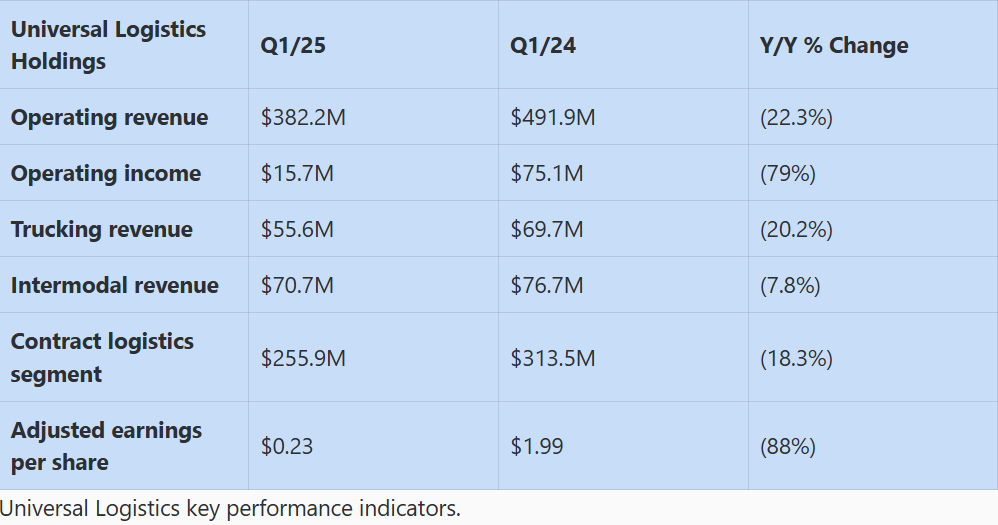
Universal Logistics HoldingsQ1/25Q1/24Y/Y % Change
Operating revenue$382.2M$491.9M(22.3%)
Operating income$15.7M$75.1M(79%)
Trucking revenue$55.6M$69.7M(20.2%)
Intermodal revenue$70.7M$76.7M(7.8%)
Contract logistics segment$255.9M$313.5M(18.3%)
Adjusted earnings per share$0.23$1.99(88%)

Universal Logistics key performance indicators.

Design flaws undercut law to bring chip manufacturing back to US, expert says

On the most recent Bring It Home Podcast, host JP Hampstead spoke with Julius Krein, founder and editor-in-chief of American Affairs, about U.S. industrial policy post-CHIPS Act.

The CHIPS and Science Act of 2022 aims to bring microchip manufacturing back to the U.S. after several decades of companies offshoring the technology.

According to a report by the Council on Foreign Relations – a nonpartisan think tank headquartered in New York – the U.S. produced 40% of the world’s semiconductor supply in 1990. Today, the U.S. produces only 12% as Taiwan has ramped up to over 60% of the world’s supply of semiconductors.

Krein dove into the historical context, challenges and prospects of America’s industrial strategy. He described U.S. industrial policy as targeted interventions aimed at boosting specific sectors to improve economic competitiveness and national security. 

He also critiqued traditional views that often portray such policies as economic externality management, arguing instead that U.S. industrial policy should strategically lower the cost of capital for essential projects to boost growth.

Krein said the CHIPS Act has had its limitations, pointing out its short-term focus and lack of a mechanism for ongoing policy adjustments. He said that mechanism would be vital for the long-term competitiveness of the U.S. semiconductor industry.

“I think the CHIPS Act was necessary,” Krein said. “But in sort of design and execution, I think it had two problems: one in terms of policy design, one in terms of more framing and rhetoric.”

“I think it’s a critical sector, but I’d like to think or at least hope that we could do both a lot better on policy design as well as kind of building a larger framework and ecosystem for all of these projects,” he continued.

Other headlines discussed in this episode included:

  • Recent announcements of large investments by tech conglomerates in the U.S., including Taiwan Semiconductor Manufacturing Co.’s commitment to extending its semiconductor manufacturing operations with a $100 billion investment.
  • Apple’s intention to expand its U.S. manufacturing footprint with a $500 billion investment, focusing on enhancing its supply network. 
  • The Stargate project, a joint venture by OpenAI, Softbank and Oracle aimed at developing AI infrastructure with a $500 billion pledge, reflecting broader trends toward investing in AI as a catalyst for new business models. 

Bring It Home dives into emerging industry trends and the push for reindustrialization in North America. The podcast is available on YouTube, Spotify and Apple Podcasts.

TFI’s Bedard upbeat on revamped US LTL operations even as numbers sink

(For a recap of TFI International’s core financial reporting from Wednesday, see this First look article.)

It may come as a surprise that TFI International CEO Alain Bedard was reasonably cheerful Thursday about 2025’s first quarter.

TFI had posted weak quarterly earnings a day earlier, there was a slide in the company’s stock price – about 40% in a year and just a little less than that over the past three months – and previous quarterly earnings calls have been laments about performance.

But Bedard noted there have been several changes in management in the U.S. LTL group and said, “I feel pretty good about where we’re going.”

Although truckload operations at Quebec-based TFI (NYSE: TFII) have been growing as a percentage of total revenue, primarily because of last year’s acquisition of flatbed operator Daseke, the focus on the earnings call Thursday and in recent quarters remains on its LTL operations. Specifically, the primary point of discussion is the U.S. operations that are primarily the legacy business of UPS Freight, which TFI bought in 2021.

The U.S. LTL group in the first quarter posted an operating ratio of 98.9%, deteriorating from 92.6% in the corresponding quarter a year earlier. It was 97.3% in the fourth quarter.

Bedard in earlier calls has said things such as “We’re too fat” or described some practices in the U.S. LTL group as “stupid.” But he was decidedly more positive Thursday, despite the weak performance of the group and the company’s decline in profitability that has stretched out over several quarters.

“The morale in the group has never been so good,” Bedard said. “The guys are working hard.”

Negative outlook at Merrill

Ken Hoexter at Bank of America Merrill Lynch took a different perspective, calling the U.S. results a “meltdown.”

He noted in a report released prior to the call that tons per day in U.S. LTL were down 4% year on year – he had expected a 2.5% decline – and that they were down sequentially from negative 3% in the fourth quarter of 2024. 

Bedard conceded on the call that the claims rate of 0.9% was “terrible.” Hoexter agreed, pointing out that the rate was 0.7% a year ago.

The truckload operating ratio (OR) of 93.7% was 150 basis points worse than where Hoexter said Merrill Lynch forecast it would come in. The OR for U.S. LTL was 98.9%.

Merrill Lynch has an underperform rating on the stock and has had that opinion since February. Hoexter reiterated it in his report. But he lowered the price objective to $72 from $78.

Jason Seidl of TD Cowen said the OR at the U.S. LTL operations had met Cowen’s forecast, but also said that projection had been reduced “given the continued challenges in the U.S. LTL market.”

Big drop in stock, stronger on Thursday

TFI’s stock is down about 40% in the past year and 38% in the past three months. Although TFI’s earnings did not react significantly at first to the company’s earnings, it climbed significantly later. At about 3:30 p.m., just before the trading day’s close, TFI was up to $84, an increase of $5.57 or 7.11%. The S&P 500 was up slightly less than 2% at that point.

In discussing other reasons for his optimism, Bedard returned to a theme that has been a core message in earlier calls: the need for U.S. LTL operations to increase market share with small to medium customers and reduce reliance on larger companies. “We lost so many of the small and medium-sized accounts, and we replaced them with corporate accounts with sometimes negative margins,” Bedard said. “That trend is reversed right now. We’re starting to see growth on the small and medium-sized accounts.”

He declared: “I feel really good. The guys are very focused, and that’s what we’re seeing so far.”

Bedard said U.S. LTL, which operates as TForce, has implemented better planning to optimize linehaul efficiency, and is doing the same for its package and delivery operations. 

He also cited improved software for pricing and file management, a problem he said has been “a rock in our shoe for so long.” That better pricing technology allows the sales staff to work better in the push to add small to medium-size accounts, Bedard added.

He also said there is better information on the unit’s productivity on a terminal-by-terminal basis.

One benchmark cited by Bedard for his more positive outlook for the LTL segment: missed pickups. A year ago it was about 4%, he said. It’s now down to about 1.7%.

“We are improving in real terms, not just in fantasy land,” Bedard said. “We are improving the reality of our service for the next day and for multiple days. We aren’t where we should be, but we are improving.”

Bedard touted on the call – as he did in the prepared earnings statement released Wednesday – the company’s first-quarter net cash from operating activities of $193.6 million, compared to $200.7 million in the first quarter of 2024. Free cash flow improved significantly, up to $191.7 million from $137.2 million in Q1 2024.

He said a combination of share purchases plus TfI’s dividend payment resulted in about $94 million of “excess cash returned to our shareholders during the quarter, which has always been an important objective of ours.” (With the recent decline in TFI’s stock price, its forward dividend yield, assuming an annual payout of $1.80, is about 2.3%).

Impact of tariffs

Tariffs and the state of the economy were the first subjects broached by analysts. Bedard said, “We’ve been really affected because our end customers are sitting on the fence. We will be seeing where this is going to all go, and this is why it’s very difficult for us to predict.”

Business heading south of Canada into the U.S. has held steady, Bedard said, but the backhaul to Canada is finding many trucks with lots of empty space.

The uncertainty has particularly hit what TFI refers to as its specialty truckload operations, which includes the legacy Daseke business. “The reason it is slow is because nobody knows if you’re a farmer today who is going to buy your crop, because the Chinese are saying, ‘We’re going to buy from Brazil, we’re not buying from the U.S. anymore,’” Bedard said. “Then you’re not going to buy a tractor, you’re not going to do anything until you get better visibility.”

The normally acquisitive TFI, which this year has made two small acquisitions, is not likely to make any major steps this year, Bedard said. Any spinoff of a unit as a stand-alone, like the U.S. LTL operations, would also need to wait for an improvement in the company’s market capitalization, he said. Current capitalization is about $5.9 billion.

“In order to be ready when the right time comes, M&A of a sizable deal is going to have to wait until 2026,” he said.

More articles by John Kingston

A market on the precipice: 5 takeaways from the April State of Freight

Wall Street embraces Ryder’s mildly positive earnings report then pulls back

OOIDA makes now-solo case in court that California’s AB5 should exempt trucking