Short line eyes Cali market, buys hydrogen locomotive builder

While railroads wait for guidance on alternative fuel power, a California short line is going straight to the source.

Sierra Northern Railway has acquired the assets of locomotive builder RailPower LLC as part of its efforts to develop hydrogen and other low- or zero-emission motive power.

RailPower has produced approximately 190 locomotives, including 55 hybrid switchers and 116 generator set locomotives which use several smaller diesel engines instead of a single prime mover, while Sierra Northern is currently involved in development of at least four hydrogen-powered locomotives.

There are currently no federal standards for hydrogen-powered locomotives. The Federal Railroad Administration has offered guidance for alternative-power technology.

Sierra Northern said in a release that it is “poised to integrate RailPower’s hybrid innovations with its hydrogen expertise.” It plans to build its hydrogen locomotives using RailPower’s platform in an effort initially targeting the 260 locomotives used by shortline railroads in California.

RailPower currently offers a series of four- or six-axle, single- or multiple-engine locomotives ranging from 600 to 2,800 horsepower.

Sierra Northern’s hydrogen project has been supported by the California Energy Commission and the California State Transportation Agency. In addition to operating short lines in three locations and providing switching at locations in Concord and Sacramento, Sierra Northern is principal owner of the Sierra Energy Corp., which has developed a waste-to-clean-hydrogen gasification technology.

Related coverage:

Ceremony marks CPKC opening of second US-Mexico rail bridge

Railcar builder CEO Tekorius appointed to Federal Reserve branch

Weekly US rail traffic back ahead of 2024 levels

ONE, LX Pantos in Boxlinks venture for US domestic intermodal

US hit its highest-ever trade total with any nation in 2024: $840B with Mexico

Mexico was the top U.S. trade partner for the second consecutive year in 2024, totaling a record-breaking $840 billion.

It was the highest annual trade total any country had ever recorded with the U.S., according to Ken Roberts, founder and president of market research firm WorldCity.

“Mexico was the top U.S. trade partner for the second consecutive year – a first for Mexico – and topped $800 billion in U.S. trade, the most ever by any nation,” Roberts wrote in a column on Forbes.com.

Canada ranked No. 2 for trade with the U.S. in 2024 at $761 billion, and China ranked third at $582 billion.

Mexico’s exports to the U.S. totaled $506 billion last year, a 6% year-over-year increase, while imports from the U.S. to Mexico increased 3% to $334 billion.

For the month of December, Mexico was also the top U.S. trade partner at $63.8 billion, followed by Canada at $62.4 billion and China at $50.1 billion.

The port of entry in Laredo, Texas, was the No. 1-ranked U.S. trade gateway in 2024 among the nation’s 450 airports, seaports and border crossings, according to Census Bureau data analyzed by WorldCity.

Two-way trade at Port Laredo totaled $339 billion in 2024, compared to $320 billion in 2023.

The Port of Los Angeles ranked No. 2 at $333 billion last year, while Chicago O’Hare International Airport was No. 3 and reported $295 billion in trade. 

The top three exports from Mexico to the U.S. through Laredo in 2024 were auto parts ($26.6 billion), passenger vehicles ($16.6 billion) and computers ($13.4 billion).

Top imports from the U.S. to Mexico in 2024 were auto parts ($14 billion), gasoline ($3.8 billion) and electric storage batteries ($3.5 billion).

The cost of shipping air is rising. Shared Truckload can help your business stay competitive.

Empty trailer space has long been an inefficiency in the trucking industry. With shifting market conditions and rising costs, shipping “air” is becoming more expensive than ever, driving urgency for shippers to adopt better solutions. Things like half-empty trailers and underutilized space aren’t just a headache anymore—they’re impacting your bottom line.

If you’re shipping freight in today’s evolving environment, it’s crucial to rethink how you utilize capacity and begin planning for market changes ahead of 2025. Here’s what’s happening, why it matters, and how a Shared Truckload solution can help save costs while improving operational efficiency.

Setting the stage for 2025 

As we move into 2025, several trends are shaping the trucking industry. FreightWaves’ market data indicates a turning tide in the truckload market, signaling a stronger advantage for carriers. Many providers are renegotiating truckload contract rates in favor of higher pricing, leaving shippers with rising bills. 

Simultaneously, capacity issues persist. Research shows that 43% of truckloads move partially empty—essentially shipping air. This inefficiency drives up costs for shippers and represents wasted revenue opportunities for carriers. Rising operational expenses, coupled with tighter margins, only magnify this challenge across the industry. 

Adding to the complexity, LTL NMFC code changes could nudge more shippers toward alternative solutions. Yet, for businesses unable to fill an entire trailer, traditional truckload shipping isn’t cost-effective—placing shippers in a frustrating bind. 

It’s within this context that Shared Truckload is emerging as a game-changing solution. 

How the market is driving the cost of shipping air 

Shipping air—moving a truckload trailer that isn’t completely full—wastes both money and resources. And as the market shifts to favor carriers, the cost of these inefficiencies is climbing fast. 

For carriers, partially empty trailers represent an increasing opportunity cost. Every unused cubic foot is a lost chance for profit. Dramatic fluctuations in demand, coupled with rising diesel prices, push carriers to maximize capacity in every shipment. For shippers, the rising costs of underutilized trailers can make staying competitive tougher than ever. 

The solution? Fill that empty space.

This is where Shared Truckload (STL) solutions step in, providing shippers with smarter, more efficient ways to pool loads and maximize trailer usage. STL allows multiple shippers to share trailer space, splitting costs proportionally without compromising delivery speed or performance. The result? Optimized shipping that’s better for shippers, carriers, and the environment. 

Technology at the core of Shared Truckload 

Executing Shared Truckloads efficiently is no easy feat. Freight brokers have attempted to manually coordinate shared loads for decades, but they’ve always struggled to harmonize complex details like commodities, shipment sizes, locations, and equipment requirements—all at scale. 

Enter Flock Freight’s pooling technology, a leader in the space capable of achieving what manual efforts cannot. 

Powered by machine learning, Flock’s proprietary algorithms instantly analyze every variable in the shipping equation: 

  • Route Optimization: Predicts the most efficient paths based on real-time data. 
  • Load Matching: Seamlessly pairs multiple compatible shipments. 
  • Carrier Integration: Helps carriers locate matching loads to fill unused trailer capacity. 

By doing so, Flock Freight not only improves efficiency but also provides precise, predictable outcomes for both shippers and carriers. It’s Shared Truckload at scale, bringing advanced technology to solve an age-old problem. 

Carrier benefits of Shared Truckload 

For carriers, the stakes are higher when trailers move partially empty. Rising costs and competition require them to operate as cost-efficiently as possible. 

With Flock Freight’s technology, carriers can proactively find and fill unused capacity to maximize their revenue per mile. For example, after booking a shipment, Flock Freight analyzes available space and helps carriers find additional loads that align with their route and timeline. 

Real Shared Truckload example

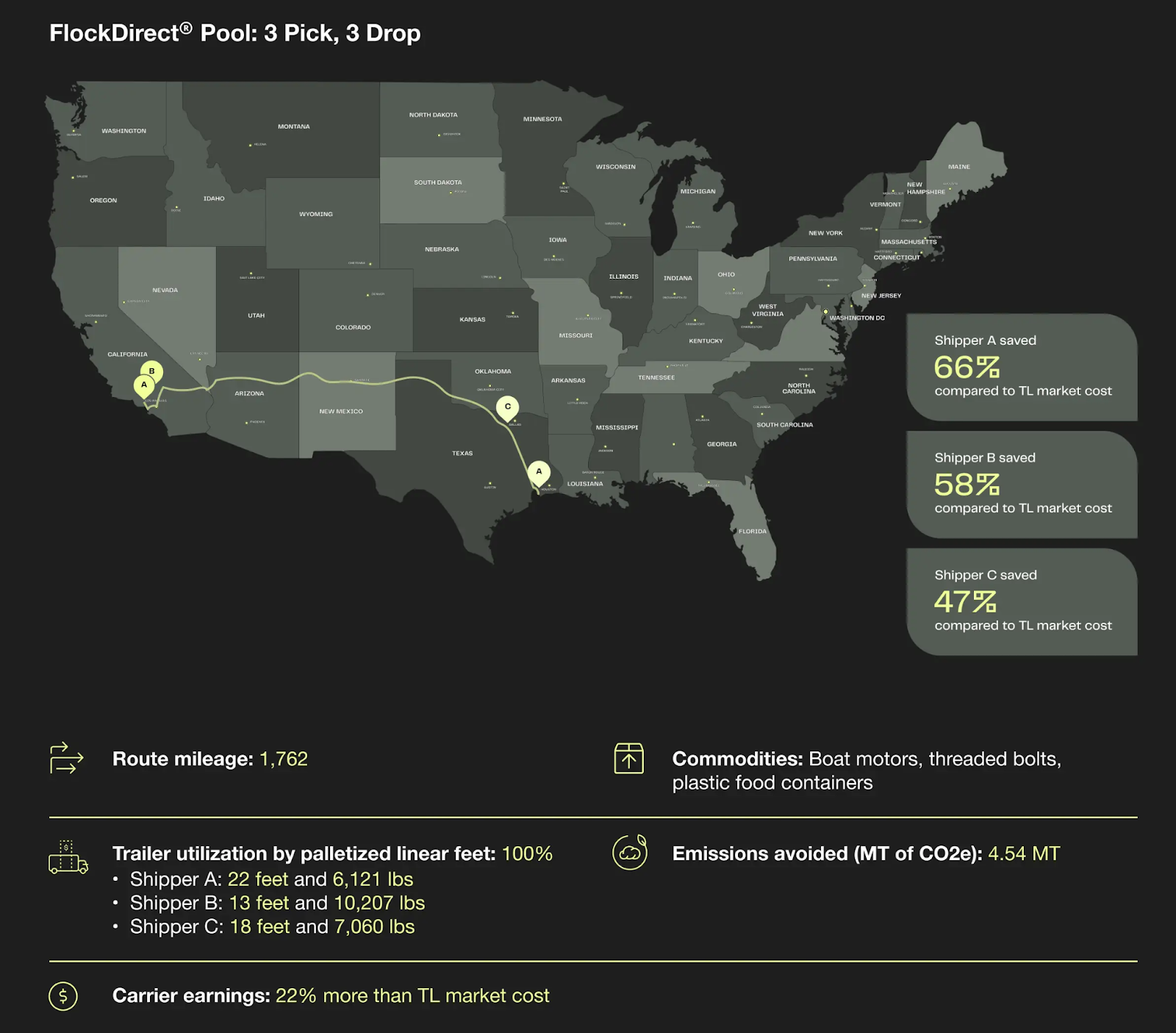
Consider this scenario from a recent Flock Freight Shared Truckload. Flock’s technology handled everything from load matching to optimization, so all three shippers saved money while maintaining their timelines. 

Flock delivered their goods alongside other businesses’ freight, splitting the trailer space and cutting transportation costs in half.  

It’s a simple, effective example of how STL addresses inefficiency while creating value for everyone involved. 

The time to act is now 

With shipping costs rising and the market becoming less favorable for shippers, it’s time to future-proof your transportation strategy. Shared Truckload offers a solution that’s flexible, cost-efficient, and technology-driven. 

For shippers, STL allows you to save on transportation costs and reduce inefficiencies while addressing the challenge of underutilized trailers. For carriers, STL represents a new revenue opportunity and a pathway to maximize efficiency. 

If shipping “air” is no longer an option, Shared Truckload is your chance to stay competitive in a fast-changing market.

Click here to learn more about Flock Freight.

EXCLUSIVE: Gaia Dynamics uses AI to help shippers save on compliance, tariffs

Gaia Dynamics is using AI tools to speed up and streamline customs compliance.

Led by co-founder and CEO Emil Stefanutti and co-founder and entrepreneur Andrew Ng’s AI Fund, Gaia Dynamics is a technology platform that aims to simplify cross-border regulation compliance.

The Palo Alto, California-based startup, which launched Tuesday, uses AI to automatically assign harmonized tariff schedule (HTS) codes to products at a 92% accuracy level within 30 seconds. 

It takes most people at least 15 minutes to complete the same task manually, the company said.

In addition, Gaia Dynamics’ platform can check for import and export tariffs on goods and help write descriptions of products being shipped, while focusing on reducing compliance checks for entire shipments from 10 hours down to two.

Gaia’s AI is also up to date with all regulatory changes and can predict anticipated risks and tariff adjustments, Stefanutti said.

Stefanutti said the idea for the company started when he and Ng talked about using AI to make it easier for people to ship products around the world.

“Andrew is one of the top people in AI, and we were talking one day and saying we should definitely do something about cross-border regulation compliance,” Stefanutti, co-founder and CEO of Gaia Dynamics, told FreightWaves in an interview. “When you get somebody like Andrew telling you he’s willing to start a company with you, then you jump right away.”

Ng is a globally recognized leader in AI and founder of DeepLearning.AI. He is also the executive chairman of LandingAI, general partner at AI Fund, chairman and co-founder of Coursera, and an adjunct professor at Stanford University’s computer science department.

“We talked about using modern AI to really try to make it easy or easier for all the people dealing with the amount of complexity that exists whenever you are moving products from one country to another,” Stefanutti said. “We’re essentially building what we want to become the standard platform for importers and exporters in the industry, for moving any product of any size from any country to any other destination. That’s really our goal.”

The AI Fund is a venture studio for AI-based companies founded by Ng in 2017. The AI Fund is backed by $176 million in capital by some of the leading VC firms and investors, including NEA, Sequoia and Greylock.

Gaia Dynamics is backed by $1.5 million in pre-seed from both the AI Fund and Zenda VC.

Gaia Dynamics AI platform can give tariff summaries for products being shipped around the world. (Image: Gaia Dynamics)

Stefanutti has more than 20 years of experience as an entrepreneur in technology, media and design. He co-founded ContractRoom, which was acquired by Mitratech in 2021.  

ContractRoom was a legal tech company disrupting how contract negotiations and management are done in business.

Prior to co-founding Gaia Dynamics, Stefanutti was the co-founder and CEO of Shoppr.tv, an ad tech startup focused on shoppable TV advertising for small businesses and direct-to-consumer brands.

Stefanutti said with all of the tariffs being announced by the Trump administration, having the right platform for cross-border compliance is more important than ever.

“Just when we thought it was big, Trump became president, and now it’s bigger than ever, and it doesn’t seem to be getting any smaller or any less complex anytime soon,” Stefanutti said.

More than 11 million maritime containers arrive at U.S. seaports every year, according to U.S. Customs and Border Protection. At land borders, another 11 million containers arrive by truck and 2.7 million by rail.

“The World Bank said that it takes 10 hours per shipment to deal with regulation and compliance,” Stefanutti said. “In the U.S. you take a blended hourly rate between lawyers and consultants and brokers. That’s roughly around $186 per hour, times 10 hours, times 56 million cargo shipments. That’s a crazy number. And that’s just the U.S. If you go to Mexico and Canada and China and Germany and then Japan and whatever it is, it just gets exponentially bigger. We believe that this is one of the most important economic challenges of our time. I don’t think I’ve seen much better use cases for generative AI and modern AI to then try and solve some of these issues.”

Gaia Dynamics’ platform is aimed at anyone who needs to ship products internationally.

“A lot of our customers are going to be brokers, consultants, and also you know actual importers and exporters, the actual manufacturers and brands that are struggling with this compliance,” Stefanutti said.

While AI tools could help streamline and speed up the global supply chain, Stefanutti said it will never completely replace the need for a human touch.

“We don’t want to automate everything, because logistics experts, these humans, are still needed,” Stefanutti said. “We want to accelerate things for sure, and we want to streamline things for sure. We don’t foresee anytime soon a future that doesn’t have brokers or that doesn’t have compliance experts.”

All quiet on the diesel front: Second week of small increases in DOE/EIA price

The diesel futures market has been trading in a fairly tight range, and it is showing up in relative stability at the pump.

The weekly average retail diesel price published Monday by the Department of Energy/Energy Information Administration, used for most fuel surcharges, rose 0.5 cents per gallon to $3.665. That follows an increase last week of 0.1 cents a gallon. One-tenth of a cent is the smallest increment the price can move each week.  

In the past 10 trading days, the price of ultra low sulfur diesel on CME is down just nine-tenths of 1 cent. The moves in that time have been relatively minor. Not surprisingly, retail prices are concurrently showing stability, and that’s reflected in the two latest small moves in the DOE/EIA price.

The retail diesel benchmark remains significantly above a recent low of $3.458 a gallon published on Dec. 9.

Most of the increase since then occurred in the first weeks of January as oil prices overall rose sharply on the back of a new package of sanctions imposed against the shipping of Russian oil by the outgoing Biden administration. It pushed the DOE/EIA diesel price as high as $3.715 a gallon published Jan. 20, coincidentally the day that Donald Trump took office. 

The DOE/EIA price fell 5.6 cents a gallon the following week before the small upward moves the past two weeks.

But the higher prices of ultra low sulfur diesel on the CME commodity exchange mostly came in January. A decline followed and in the past two weeks, price swings have been muted. 

On Jan. 27, two weeks prior to Monday, ULSD on CME settled at $2.46 a gallon. On Monday, ULSD settled at $2.4509, just .0091 cents per gallon less than two weeks ago.

In the interim, the moves have been fairly restrained. The low settlement during that period was $2.3942 a gallon last Wednesday. The high settlement was $2.4845 a gallon on Jan. 30.

The end result has been the stable pump prices reflected in the small moves the past two weeks in the DOE/EIA price.

Those tighter shipping sanctions imposed by the Biden administration appear to be having an impact on Russian output. 

A report by Bloomberg published Monday, quoting “people familiar with the figures,” said Russia’s output declined in January to 8.962 million barrels a day. That is 16,000 barrels per day less than the country’s quote under the OPEC+ agreement that is restricting output from both OPEC nations and a group of non-OPEC oil exporters led by Russia. It is also slightly less than the 8.97 million barrels a day produced in December, according to the monthly report of S&P Global Commodity Insights.

But continuing impact on prices from the sanctions is mostly out of the market. Brent, the world crude benchmark, settled Jan. 9 at $76.92 a barrel, the day before the sanctions were announced. The high settlement after that was $82.03 four days later. 

As financial markets in general have become more concerned about weak demand created by the possibility of a regional or global trade war, Brent prices have drifted down, settling Monday at $75.87 a barrel. That is higher than the recent low settlement from Thursday of $74.29.

More articles from John Kingston

BLS revision: Far fewer workers in truck transportation than earlier estimated

In a weak quarter for brokerages, RXO’s stock price takes a pounding after earnings

Trucking-backed suit may be arena for dumping Biden independent contractor rule

Project freight allows Radiant to overcome ‘pretty tough’ market

Trucks with containers waiting at the Port of Los Angeles

Radiant Logistics beat quarterly expectations Monday, but the bulk of the outperformance came from hurricane-related restocking opportunities. The company noted a still difficult operating environment but sounded more constructive on a recovery in the coming quarters.

“More broadly, it’s pretty tough out there for us and our competitors,” CEO Bohn Crain said on a conference call.

He said the market has been bouncing along the bottom for several quarters now and that shippers remain aggressive with price expectations. However, looking out on the horizon, Crain sees “significantly more upside than downside.”

The Renton, Washington-based 3PL reported adjusted earnings per share of 22 cents for the fiscal second quarter ended Dec. 31. The result was 12 cents higher than a consensus of two estimates averaging 10 cents and 11 cents higher year over year.

Consolidated revenue increased 32% y/y to $265 million in large part due to Hurricane Milton relief-related restocking. Revenue net of purchased transportation expenses increased 2% y/y.  

“We continue to take great pride in our work to support humanitarian and relief related projects around the globe,” Crain stated in a news release. “Our results this quarter reflect our support of a number of such projects, including chartering 49 flights to bring approximately 8 million units of IV fluid to the U.S. as a result of the national shortages resulting from Hurricane Milton.”

Table: Radiant’s key performance indicators

Radiant (NYSE: RLGT) reported adjusted earnings before interest, taxes, depreciation and amortization of $12 million, 56% higher y/y. Adjusted EBITDA was approximately flat without the project freight.

The company’s outlook calls for its fiscal third quarter ending March 31 to be soft but in line with the year-ago period. Radiant expects to see market improvement by the end of the calendar year.

Crain said changing trade policy has generally been a headwind but there was a modest demand pull forward in the quarter. A more complex tariff landscape will benefit the company’s customs brokerage offering.

“At the end of the day, I think when tariffs get put into place there will be some short-term disruptions as people try to respond and kind of reconfigure or adjust,” Crain said. He expects there to be some winners and losers across its customer portfolio.

In sum, he said the U.S doesn’t have the manufacturing capacity to keep up with consumption, and while production may be moved out of China, most goods will still come from abroad, meaning there is unlikely to be a material reduction in shipments.

Radiant ended the quarter with approximately $20 million in cash, little debt and no outstanding balance on a $200 million credit facility.

Shares of RLGT were up 8.5% in after-hours trading on Monday.

More FreightWaves articles by Todd Maiden:

The autonomous yard dog gets an AI-powered upgrade

A photo of an autonomous yard truck

The yard dog, the diminutive cousin of the Class 8 tractor, is getting an autonomous AI-powered upgrade courtesy of Outrider.

Outrider, an autonomous yard operations leader, recently announced an industry-first deployment of advanced reinforcement learning (RL) techniques across its customer sites. FreightWaves spoke with Andrew Smith, founder and CEO of Outrider about what the release means for the startup and how it’s taking the humble yard dog to new heights. 

For those outside the supply chain, yard operations can consist of drayage operations at ports, intermodal operations at railheads, or in the yards from distribution centers to trucking terminals. The humble yard dog is used to shuttle empty and loaded trailers to and from docks to parking places, where the larger Class 8 tractor hauls the goods for longer distances. 

Outrider noted in the release that incorporating the RL techniques increased path planning speed by 10x and enabled the Outrider System the ability to move freight more efficiently and safely through crowded, chaotic and busy distribution yards. Smith adds that right now their network represents about 20% of all yard trucks operating in North America with many customers invented in pilot operations since the early days of the company back in 2017. 

How the reinforcement learning works

RL is part of the successful application of AI in the physical world, where the AI collects a large dataset that is then used to train the AI. For the yard dog, Smith notes the 5 years’ worth of data collected from their autonomous yard trucks is the primary source to train the system. Outrider boasts over 200,000 safety scenarios while third-party safety experts and its Fortune 500 customers validate the safety cases. 

With that training data, the next step is to reinforce positive behaviors and interactions. Smith notes that some preferred behaviors like following traffic rules and maintaining appropriate distances from both a safety standpoint and driver comfort standpoint are two examples where RL can take the software from a traditional 90% there to the mid 90%, with the systems allowing the AI to handle more complex scenarios. 

A great metaphor is in manufacturing where you can spend half your resources to get to 80% production efficiency, and then the next half of your resources to go from 80% to mid-90%. In the world of AI and reinforcement learning, the RL part is where you get from 80% to the mid-90%. 

“Where we are learning and where we are applying these AI techniques is across the entire set of aspects that are not just driving the truck but all the other manual tasks that have to take place in a yard,” said Smith.

But yard operations do not just involve hauling a trailer across a yard, there’s also the backing, docking, and hooking then unhooking from trailers. 

A day in the life of an autonomous yard truck

At a busy hundred dock facility, yard dogs will handle hundreds of trailers a day, as warehouses load, unload, and reposition trailers from warehouse docks to trailer drop yards. 

Smith gives one example of how Outrider has automated not just the yard dog, but the warehouse, yard management, and transportation systems to dispatch the trucks. It first begins with an electronic message like, “Hey we need trailer 227 to be put at loading dock 14.” 

“What our system can do is autonomously dispatch an autonomous vehicle. It can move around the yard. It can find the trailer using deep learning and confirming the location of every asset in the yard,” said Smith.

The next step is where the magic happens, with Outrider equipping their autonomous yard dogs with an advanced claw capable of robotic manipulation to connect airlines, one of the biggest hassles if you don’t have a driver. 

Smith describes the process saying, “It can autonomously hitch to the trailer. It uses a deep-powered robotic manipulator to connect the airlines and electric lines if needed on the trailer. It can then move that trailer through traffic pausing for pedestrians, golf carts, maintenance workers, etc. and then place that trailer with centimeter accuracy and loading dock only after confirming with a proprietary safety system that dock door is closed and the door is safe to be backed into.”

The next step involves unhitching the trailer and disconnecting the airline and brake lines. Smith adds, “so all that movement can now be fully automated with the outrider system and the reinforcement learning we’ve integrated into it.”

The same RL techniques that teach the autonomous yard dog how to navigate the yard, back into spaces and shuttle trailers also extend down to operating the robotic claw which needs tactile precision to hook and unhook trailer air lines. 

Smith highlights that while many companies have tried to modify the trailer, Outrider’s system works with modified and unmodified units courtesy of the AI and robotic arm. 

“If you really want to go track down every trailer in your yard and modify it, we can connect to modified trailers as well. However, what we can do is with the existing fleet of unmodified trailers constantly flowing through all of our customer’s locations, we can use AI and robotic manipulation to connect airlines, which is one of the biggest hassles of a driver,” added Smith.

Autonomous yard dogs go electric

Outrider’s yard trucks can also go electric. Smith said, “Not only are we doing the fully integrated system with a custom design set of safety mechanisms but we also layer our systems on top of an electric vehicle platform.”

Smith notes that they’re able to help speed up the adoption of electric vehicles with autonomous trucks having the ability to charge when there’s downtime in the yard and knowing when to charge during lower periods of power usage. A common challenge for electric vehicle charging is if you charge during peak transmission time, there’s the potential to be charged extra compared to charging during periods of less activity. 

Additionally, the smaller yard truck does not require the range requirements compared to larger Class 8 trucks and day cabs, where mileage per charge is a limiting factor. 
Looking ahead 2025 looks to be a big year for Outrider, after securing multiple patent grants and raising a $62 million Series D financing back in October 2024. That brings the total equity capital raised to date to over $250 million.

Trump tariffs see retailers boosting US container imports

Imports are forecast to remain elevated at major U.S. container ports as shippers try to stay a step ahead of levies on China and other producer countries, according to the Global Port Tracker report released Monday by the National Retail Federation and Hackett Associates.

There’s no end in sight for monthslong frontloading, which has carried through from late last year into 2025.

United States ports covered by Global Port Tracker handled 2.14 million twenty-foot equivalent units in  December, absent the Port of New York and New Jersey and the Port of Miami, which have yet to report. Volume was off 0.9% from November but up 14.4% y/y — the busiest December on record.

Container flows for all of 2024 totaled 25.5 million TEUs, up 14.8% y/y and near the record 25.8 million TEUs during the pandemic in 2021.

Frontloading is just one way retailers are trying to cope with the effects of tariffs in the near term, said NRF Vice President for Supply Chain and Customs Policy Jonathan Gold, in a release.

“While we support the need to address the fentanyl crisis at our borders, new tariffs on China and other countries will mean higher prices for American families,” Gold said. “Retailers have engaged in mitigation strategies to minimize the potential impact of tariffs, including frontloading of some products, but that can lead to increased challenges because of added warehousing and related costs. We hope to resolve our outstanding border security issues as quickly as possible because there will be a significant impact on the economy if increased tariffs are maintained and expanded.”

There is also a concern on the part of importers, who continue to bring shipments forward, that China tariffs could increase further.

“There isn’t just one set of tariffs,” Gold told FreightWaves in an interview. “President Trump has also spoken about universal baseline tariffs, more tariffs on China and other countries, as well as reciprocal tariffs. So, there’s a wide variety of tariff discussions, and uncertainty over tariffs, that figure into retailers’ approach to the supply chain.”

Tariffs and the threat of a strike by union longshore workers for months spurred frontloading through December.

The White House on Feb. 1 announced tariffs of 25% on most imports from Canada and Mexico, and 10% on goods from China. The Canadian and Mexican tariffs were suspended on Feb. 3  for 30 days; the China tariffs took effect on Feb. 4.

Since retail merchandise from Mexico and Canada primarily moves by truck or train, the near-term effect on port traffic was seen as minimal. 

“At this stage, the situation is fluid, and it’s too early to know if the tariffs will be implemented, removed or further delayed,” said Hackett Associates founder Ben Hackett. “As such, our view of North American imports has not changed significantly for the next six months.”

The International Longshoremen’s Association and port employers represented by the United States Maritime Alliance agreed on a tentative contract days before an extension of the current pact was due to expire Jan. 15. The union expects to send the new contract to a ratification vote by members later this month.

January data has yet to be released, but the Global Port Tracker projected volume of 2.11 million TEUs, a gain of 7.8% y/y. Usually the slowest month of the year, February is forecast at 1.96 million TEUs, up 0.2% y/y despite the shutdown of factories for Lunar New Year.

March is forecast at 2.14 million TEUs, up 11.1%, April at 2.18 million TEUs, up 8.2%, and May at 2.19 million TEUs, up 5.4%. A decline of 0.6% on volume of 2.13 million TEUs is forecast for June.

This article was update Feb. 10 with comments from Jonathan Gold of the NRF, in an interview with FreightWaves.

Find more articles by Stuart Chirls here.

Related coverage:

Hydrogen trucks to get fuel station near busy East Coast container port

ILA sends longshore contract to rank-and-file for approval

Stolen chassis ring busted at Port of LA

Maersk says Red Sea key to profit in 2025

Feds respond to egg shortage by easing truck driver work rules

livestock truck

WASHINGTON — The Trump administration is taking the first steps to directly address a nationwide shortage of eggs by making it easier for drivers and trucking companies to transport live chickens away from areas affected by the avian flu.

The Federal Motor Carrier Safety Administration on Saturday issued a regional emergency declaration that loosens hours-of-service regulations for motor carriers, specifically exemptions from 49 CFR 395.3 of the Federal Motor Carrier Safety Regulations, which pertains to daily and weekly drive-time limits.

The exemptions respond “to the spread of highly pathogenic avian influenza (HPAI) resulting in the widespread loss of chicken flocks in affected areas impacting populations and the national food supply including the supply of eggs, and its effects on people and property, including immediate threats to human life, public safety, and public welfare,” according to FMCSA.

“This declaration addresses the emergency conditions creating a need for immediate interstate transportation of live chickens from highly impacted areas.”

The notice points out that California, Iowa and Louisiana in December gave motor carriers 14-day emergency hours-of-service waivers related to HPAI.

“Because emergency conditions related to HPAI have not abated and have arisen in other states, FMCSA is issuing this declaration and expanding and granting regulatory relief,” the exemption states.

The HPAI was first detected in the nation’s poultry flocks in January 2022, according to the Centers for Disease Control and Prevention, and has since killed millions of egg-laying chickens. That in turn has led to egg shortages, with prices for a carton of a dozen eggs rising in some cases to over $10.

In its latest weekly market report, the U.S. Department of Agriculture stated that outbreaks of HPAI continued into February with new cases reported in Ohio and the first case reported in Pennsylvania.

“This further [exacerbates] the supply situation, particularly in Eastern markets,” according to USDA, as retailers begin placing limits on how many eggs customers can buy per shopping trip. Trader Joe’s and Costco have started implementing such policies, according to press reports.

When the egg shortage was brought up at a White House press conference in January, press secretary Karoline Leavitt blamed it on the Biden administration.

The emergency waiver for motor carriers and drivers transporting live chickens away from areas hit by HPAI includes certain restrictions and conditions, including:

  • Motor carriers and drivers must ensure they have all approvals necessary for loading, transporting and delivering the chickens.
  • Before dispatch, the motor carrier must have a valid agreement from the receiving facility to accept delivery of the live chickens.
  • Drivers must not drive more than 16 hours in any 24-hour period and must stop all driving at midnight each day.
  • Drivers must take a minimum six-hour break in a sleeper berth before resuming driving.
  • Drivers must use paper records of duty status and supporting documents, maintain RODS and supporting documents for six months from the date the record is prepared, and make RODS and supporting documents accessible to FMCSA and law enforcement upon request.
  • Drivers must maintain a valid CDL and not be subject to an out-of-service order or loss of driving privileges. Motor carriers or drivers subject to an out-of-service order are not eligible for relief until the order has been rescinded in writing by the issuing jurisdiction.

The waiver is effective immediately and remains in effect until midnight March 10 unless the emergency situation ends before then, according to the notice.

Click for more FreightWaves articles by John Gallagher.

Auto hauler Jack Cooper shutting down: CEO letter to workers

Auto hauler Jack Cooper, severely damaged by the loss of its two key customers, is closing.

In an email sent Monday to Jack Cooper’s employees and obtained by FreightWaves, CEO Sarah Amico, who also is the primary owner of the family-controlled business, said “it is with extraordinary sadness that we are writing to let you know that after 97 years in business, Jack Cooper will be closing our doors in the near future.”

Jack Cooper has always received outsize interest in the trucking community not only because of its size as a major auto hauler but also as one of the larger trucking companies with a work force organized by the Teamsters.

The end has come quickly for Jack Cooper. At the close of 2024, there was no indication that  2025 would be anything other than a normal year. But on the first business day of the year, Ford Motor Co. (NYSE:F) invoked a 30-day out clause to terminate its contract with Jack Cooper.

“It appears that loss has now led our largest customer, General Motors (NYSE: GM), to likewise seek alternative capacity to move its product,” Amico said in the letter.

The letter said that since the announcement of the split with Ford, Jack Cooper had been negotiating with GM “in good faith … to agree on a continued business relationship.” Amico also noted that Jack Cooper has been GM’s “Supplier of the Year” three times in the past 15 years.

But GM had instructed its workers to stop loading new cars onto Jack Cooper trucks last Thursday. That led to news over the weekend that the relationship between the two companies was either terminated or simply kicked to the curb, and that Jack Cooper would no longer be serving GM, or GM had stopped doing business with Jack Cooper. The two sides traded accusations of which side caused the relationship to end. 

“Given the loss of our Ford revenue and General Motors’ unilateral decision, Jack Cooper’s management and Board of Directors are faced with no choice but to ask that our employees not return to work, unless contacted by management,” Amico’s letter said. It added that “a few” workers will be asked to remain on the staff to help with the company’s shutdown.

The dispute between Jack Cooper and Ford was considered significant enough that a pair of U.S. senators got involved last week by writing a letter to Ford management. But it does not appear that had any impact in the end.

“For nearly a century, Jack Cooper has set the standard in finished vehicle logistics. We have been proudly Women-Owned, union and family-operated,” Amico said. “We have won numerous industry awards, given back to the communities where we live and work, and proudly employed generations of employees across the country. Each of you has been a key part of that legacy, and your work is deeply appreciated.”

This is an ongoing story.

More articles from John Kingston

BLS revision: Far fewer workers in truck transportation than earlier estimated

In a weak quarter for brokerages, RXO’s stock price takes a pounding after earnings

Trucking-backed suit may be arena for dumping Biden independent contractor rule