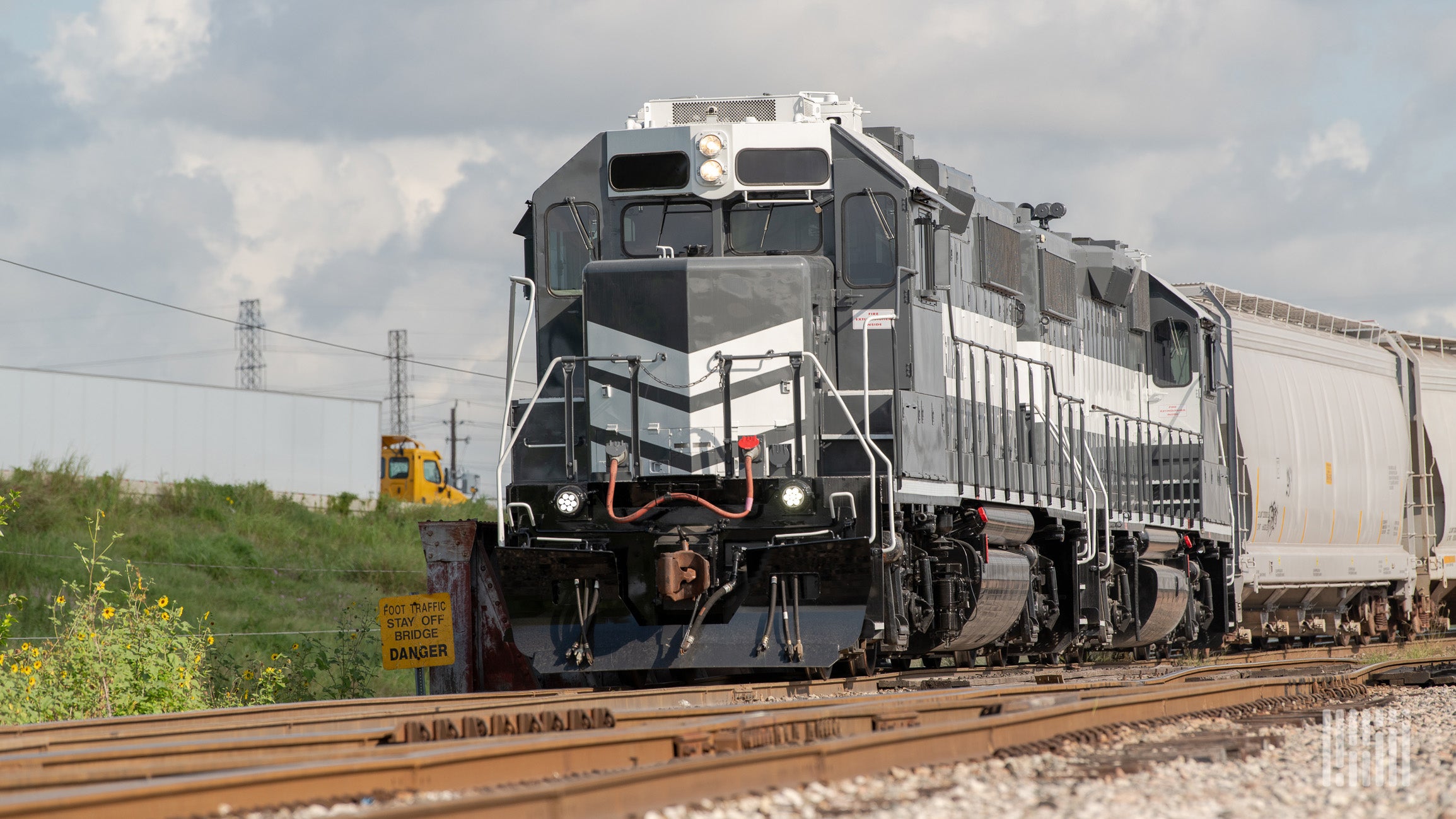
Port of LA-Long Beach railroad wins grant for electric locomotives

Pacific Harbor Line (PHL) — together with the California Air Resources Board (CARB) — has received partial funding for five zero-emission locomotives.

The funding for the acquisition will be provided through a U.S. Department of Transportation Consolidated Rail Infrastructure & Safety Improvements (CRISI) Program grant.

PHL, which serves the Port of Los Angeles-Long Beach complex, is a short line of Anacostia Rail Holdings.

The grant comes after a year of testing the zero-exhaust emission EMD Joule battery-electric locomotive manufactured by Progress Rail.

“We are gratified that PHL was chosen to receive funding as part of the CRISI grant award,” said Otis L. Cliatt II, PHL president, in a release. “This crucial support, combined with our investment, will enable us to purchase five zero-emission battery electric locomotives. It is a transformative step that will support our continuing commitment to reducing emissions at the Ports of Los Angeles and Long Beach, the busiest port complex in the U.S.”

The railroad is contributing $6.37 million toward the total $34.2 million cost to acquire five ZE locomotives and two charging stations that are included in CARB’s application, for a total roster of eight ZE locomotives. The remaining three units would be used in Sacramento, Imperial and San Bernardino, California, by other operators.

The PHL project is expected to reduce diesel-related nitrogen oxide emissions by over 17 tons per year and fine particulate matter (PM2.5) by 500 pounds\ per year, and to eliminate 459 metric tons of carbon dioxide equivalent per year. The ZE locomotives will help California meet its air quality goals and improve health impacts on disadvantaged communities already exposed to higher levels of pollution.

The new PHL locomotives will be manufactured in the United States by Progress Rail.

Find more articles by Stuart Chirls here.

Related coverage:

At Rail Trends: Grants, real estate key to short line rail growth

Red Sea attacks turn green for Zim investor

Trump tariffs to slow US trade, says analyst 

CargoNet warns of increased cargo theft risk during Thanksgiving holiday

The risk of cargo theft is expected to increase during Thanksgiving, according to CargoNet, which urges transportation companies to be vigilant during the holiday.

The cargo theft prevention company, which manages an information-sharing system about such thefts, reported that significant thefts typically occur from the Tuesday before Thanksgiving through the following Monday.

“This is one of the most interesting times of the year because of the delay,” said CargoNet Vice President of Operations Keith Lewis. “So actually, today, tomorrow, the supply chain is going to come to pretty much a halt.”

Thieves seize on the opportunity to prey upon sitting freight. CargoNet experts recommend increased vigilance and surveillance during the holiday period. 

Cargo theft is a growing problem, especially as schemes become more advanced and sophisticated. CargoNet reported a 13% increase in Q3 of reported thefts — a $39 million loss. 

Hot spots for cargo theft during this period include San Bernardino County and Los Angeles County in California and Cook County in Illinois. Texas has also been a major target the past five years.

Top commodities targeted in the schemes are food and beverage, household goods, and electronics, leading to companies reporting losses of $7.8 million over the past five years, according to CargoNet.

Food and beverage are leading goods targeted by thieves due to the inability to track a consumable item, like a bottle of tequila, compared to the serial number etched on an electronic, Lewis said. 

Thieves also target freight all-kinds (FAK) shipments, hard liquor and vehicle accessories, indicating to CargoNet experts that thieves zero in on these commodities due to relationships with black market buyers.

Warehouses are the top location targeted by thieves, followed by parking lots and truck stops. The average reported loss in cargo amounts to almost $160,000. 

Defrauding schemes have become more sophisticated. CargoNet has recorded 450 fraudulent pickup attempts this year, which leads the company to believe 2024 could be a record-breaking year.

Lewis said 20 years ago, it was not uncommon for thieves to make off with a trailer and leave items inside, indicating to Lewis that the thieves did not know what goods they were stealing. Now, theft rings will organize a team to track high-value loads in hopes of intercepting them through coordinated efforts.

“The bad guys have gotten much smarter,” he said. “The bad guys are playing chess and we’re playing checkers.”

Lewis urged companies to report cargo thefts to CargoNet, which tracks the problem and works to find solutions. Without proper reporting and data, it can make the issue appear less prevalent than it is, he said.

CargoNet recommends companies strengthen their security during the Thanksgiving holiday period. Companies should also implement stronger verification steps for shipments moving through high-risk areas.

Other recommendations include:

  • Make sure security managers and drivers know a vehicle’s license plate and vehicle identification number in case they need to report an incident.
  • Secure trailers with high-security ISO 17712-compliant barrier seals with hardened padlocks.
  • Secure tractors with high-security locking devices.

Trump tariffs would put cross-border rail traffic in the crosshairs

This story originally appeared on Trains.com.

President-elect Donald Trump’s plans to impose 25% tariffs on goods imported from Mexico and Canada could have a chilling impact on cross-border rail traffic, which has been one of the few sources of volume growth for North American Class I railroads.

Trump announced the plans Monday night in a social media post, saying he would sign an executive order on Jan. 20, 2025, his first day in office. The order also would hit goods produced in China with a further 10% tariff.

In his 2016 campaign, Trump called NAFTA the worst trade agreement ever and pledged to rip it up. Instead, the treaty was modernized and given a new name, the United States-Mexico-Canada Agreement. It went into effect in July 2020.

Canadian Pacific Kansas City — the only railway to link Canada, the U.S. and Mexico — faces the most risk if the tariffs are imposed.

In 2023, some 41% of CPKC’s $8.9 billion in revenue was tied to cross-border trade: 16% from Canada to the U.S.; 12% from the U.S. to Mexico; 6% U.S. to Canada; 5% Mexico to the U.S.; and 2% for traffic moving between Mexico and Canada.

CPKC is relying on a combination of trade growth, single-line service and market share gains from trucks and other railroads to help pay for the 2023 $31 billion merger of Canadian Pacific and Kansas City Southern.

“In spite of all this talk about tariffs, these three countries have never needed each other more,” CPKC CEO Keith Creel told the RailTrends conference earlier this month, before Trump put particulars around his plans for tariffs on imports from Canada and Mexico.

Creel noted that “there was a lot of aggressive rhetoric” about North American trade after Trump was elected in 2016. Yet while USMCA was being negotiated, trade grew 20%, Creel says.

And since the pandemic hit in 2020, manufacturers and retailers have been trying to diversify their supply chains, which has included near-shoring of manufacturing to Mexico.

“How do you unwind that,” Creel says, “and why would you?”

Canadian National is not far behind CPKC in its dependence on North American trade. Some 32% of its $11.9 billion in 2023 revenue was tied to U.S.-Canada cross-border traffic.

CPKC’s and CN’s cross-border traffic includes metals and minerals, forest products, petrochemicals and plastics, and auto parts and finished vehicles.

Mexico is an important traffic source for Union Pacific, the only railroad to serve all six U.S.-Mexico gateways. In 2023, 11% of the railroad’s volume — roughly 891,000 loads — was tied to Mexico.

UP considers cross-border traffic to be an important source of traffic growth. Last year, UP’s Mexico cross-border traffic was 59% intermodal and automotive, 21% bulk (mostly grain), and 20% industrial products.

Automotive, beer and beverages, and intermodal shipments represent 86% of northbound loads from Mexico, UP says. Southbound shipments primarily consist of auto parts, intermodal shipments, agricultural products and metals.

Union Pacific’s Mexico cross-border intermodal traffic is up 7% since 2021. (Photo: UP)

BNSF Railway is far less dependent on Mexico, which represents just 3.8% of its overall volume, a railway spokesman says. That translates into 342,000 annual loads. Cross-border traffic to and from Canada represents another 4% of BNSF’s overall volume.

The Eastern railroads — CSX and Norfolk Southern — are less dependent on Mexico traffic, but they nonetheless see Mexico as a growth market, particularly for automotive and intermodal business. CPKC and CSX, for example, are banking on growth in intermodal, automotive and forest products traffic through their new Alabama interchange via the former Meridian & Bigbee Railroad.

Cherilyn Radbourne, an analyst with TD Securities, says the Mexico market represents “a meaningful proportion” of the $1.5 billion in revenue synergies that CPKC is targeting through 2028.

“In the short term, we could see a volume benefit as shipments are pulled forward to get ahead of the proposed tariffs,” she says. “Beyond that, we would expect cross-border volumes to be negatively impacted by increased tariffs.”

Independent analyst Anthony B. Hatch says the negative impact of Trump’s trade policies will far outweigh any regulatory changes that would benefit the railroad industry.

Trump’s tariffs could lead to a trade war in which Mexico and Canada would likely reciprocate with tariffs of their own on U.S. products. Mexican President Claudia Sheinbaum said Mexico would impose tariffs on U.S. goods if Trump goes ahead with his plans.

“In any trade war scenario, every country knows that the U.S. is most vulnerable on ag,” Loop Capital Markets analyst Rick Paterson said at the RailTrends conference. “You maximize the pain for U.S. farmers, then let the ag lobby do your work for you in terms of nagging the administration for a change in trade policy.”

Jason Miller, a supply chain professor at Michigan State University, says the auto industry will be disproportionately affected by tariffs, which would affect $200 billion worth of parts and finished vehicles that cross the borders annually.

Some 70% of the crude oil that the U.S. imports comes from Mexico and Canada, Miller notes, which would raise gasoline prices.

Check Call: A new set of rules for freight brokers

people gathered around a desk of computers. Check Call news and analysis for 3pls and brokers
(GIF: GIPHY)

The Federal Motor Carrier Safety Administration is back to their rulemaking ways. This time the agency has proposed a rule on broker transparency. A little history on this is that in May of 2020, Owner-Operator Independent Drivers Association and the Small Business in Transportation Coalition petitioned the Federal Motor Carrier Safety Administration to improve broker transparency with particular emphasis on rate visibility. 

There is a lot of speculation as to what brokers margin per load is lately and given the rough freight market of the past few years, it’s not surprising. 

OOIDA requested that transaction information be provided within 48 hours of completion of contracted services and the SBTC wanted that and brokers prohibited from requiring carriers to waive their rights to review transaction records. The two organizations are asking the FMCSA to not allow exemptions for brokers around transparency requirements. 

A very long four years later, the FMCSA has turned the petitions into a proposed rule.

According to the FMCSA, “The proposed rule would revise the regulatory text to make clear that brokers have a regulatory obligation to provide transaction records to the transacting parties on request. The proposal would also make changes to the format and content of the records.”

The proposed rule includes four major provisions: 

  • Brokers must keep records in electronic format: This would make it easier for carriers and shippers “to review broker records on request, and remotely, as compared to the current practice of some brokers who respond to transparency requests by making only physical records available at their principal place of business. The agency believes that many brokers already maintain their records in an electronic format.”
  • Revisions to contents of brokers’ records, including itemizing charges and fees: FMCSA proposes eliminating a current distinction in the regulations between brokerage and non-brokerage services, and instead “require that the records contain, for each shipment in the transaction, all charges and payments connected to the shipment, including a description, amount, and date,” along with any claims connected to the shipment, such as a shipper’s claims for damage or delay. “This amendment would ensure the parties have full visibility into the payments, fees, and charges associated with the transaction so they can resolve issues and disputes among themselves without resorting to costlier remedies.”
  • Brokers must provide records upon request: FMCSA stated that the current regulation frames the broker transparency requirement as a right of the transacting parties to review the records. However, “the proposed amendment would reframe broker transparency as a regulatory duty imposed on brokers to provide records to the transacting parties.”
  • Records must be provided within 48 hours of request: This provision “is intended to ensure that the requesting party receives the records in a timely manner, to support the resolution of issues around service or payment.”

The proposed rule, as of right now, is still just a proposed rule. There will be a proper comment period where people can leave their thoughts. This link will take you to the rule in its entirety and the tab for document comments. The comment period will close on Jan. 21, 2025. 

As of right now the preliminary comments are a bit of a mixed bag with carriers in favor of the visibility and others pushing back on the FMCSA for choosing this as an area to focus on regulation versus freight fraud and much bigger issues facing the industry. 

SONAR Tickers: OTVI.SLC, OTRI.SLC

Market Check. This week’s market heads out west to Salt Lake City. Salt Lake has seen a drastic rise in outbound tender rejections while outbound tender volumes continue to fall. This has created a capacity crunch in the market. Outbound tender volumes have dropped 3.3% and given that we are heading into a holiday week, those numbers are unlikely to be revived until the middle of next week as shippers come back online and get caught up. 

The real capacity crunch comes with the sharply rising outbound tender rejections. That index has risen 405 basis points week over week, getting up to 11.11%. Rejections are currently double the levels seen earlier this year, which was holding the record at 5.51%. Shippers and brokers can expect low contract carrier compliance as the week goes on. Any shipment that isn’t mission critical should pre-emptively be rolled to next week to be recovered. 

(GIF: GIPHY)

Who’s with whom. The LTL carrier that has nine lives lives to see another. Roadrunner announced its CEO and the private equity group they are a part of have taken a controlling interest in the company. Roadrunner has found itself under new leadership…again. 

Prospero Staff Capital has acquired a majority stake in Roadrunner. The deal was co-led by Chris Jamroz, Roadrunner executive chairman and CEO, and investor Ted Kellner. The group replaces activist investor Elliott Investment Management as the majority holder. Elliott will retain a minority interest in the company.

The plan this time is to use “fresh capital” for organic growth and acquisitions. Following the announcement the shares of RRTS, traded on pink sheets, which means you don’t see it on the New York Stock Exchange, were up 41.9%. 

Here’s hoping this is the life the company needs to take off in the right direction. 

The more you know 

Macy’s says lone worker hid up to $154M in delivery expenses since 2021

Borderlands Mexico: Entrepreneurs, small business see value of investing in Mexico

Is Thanksgiving going to disrupt the status quo?

When “No Comment” Isn’t an Option: FMCSA Publishes Proposed “Broker Transparency” 

Modern Logistics partners with ATC Aviation for Latin America expansion

Trafficker implicates long-haul truckers in drug cartel case

Truck on highway at night

A drug trafficker connected to a violent Mexican cartel told prosecutors that long-haul truck drivers supported the operation by transporting narcotics and cash into and out of the U.S.

Oralia Rodriguez Flores pleaded guilty in federal court on Friday to three charges related to her role in trafficking drugs and money laundering for the Cártel de Jalisco Nueva Generación (CJNG), also known as the Jalisco New Generation Cartel.

Flores, 40, who lived in Clayton, North Carolina, pleaded guilty to one count of conspiracy to distribute methamphetamine and cocaine, one count of distribution of methamphetamine, and one count of conspiracy to commit money laundering. She faces a sentence of up to life imprisonment.

Flores admitted being involved with trafficking cocaine and methamphetamine in South Carolina for approximately three years, according to information obtained by the U.S. Drug Enforcement Administration.

She explained to agents in an interview that on five or six occasions “she met drivers of 18-wheeler trucks” to pick up cocaine hauled from Mexico, with each shipment containing approximately 10 kilograms of cocaine. She was able to sell it to customers in South Carolina for $22,000 per kilogram.

Flores also used commercial truck drivers to launder the drug proceeds back to Mexico. “She admitted that she provided over $1 million in cash to truck drivers and that she delivered drug proceeds to runners for an Asian money laundering network that were then sent to the source of supply in Mexico,” according to a press statement.

“Oralia Rodriguez Flores endangered countless individuals by trafficking in large quantities of deadly methamphetamine and cocaine,” said Robert Murphy, special agent in charge of the DEA’s Atlanta Division, in the statement. “She knowingly and intentionally helped members from the violent CJNG cartel distribute their drugs and launder their money.”

U.S. Attorney Michael called the CJNG one of Mexico’s most violent drug cartels.

“Their brutal reign is bankrolled by American drug proceeds flowing back to cartel leaders,” he said. “Our strategy is to systematically degrade the entire criminal network by taking down the traffickers running narcotics to the Carolinas and cutting off the cashflow back to Mexico.”

Trump crackdown looms

President-elect Donald Trump signaled on the campaign trail plans to crack down on the U.S.-Mexico cross-border drug trade. Mike Waltz, a Republican congressman tapped by Trump to be his national security adviser, introduced legislation last year that would authorize military force to target Mexican drug cartels.

Trump on Monday increased the pressure by announcing plans to impose a 25% tariff on all Mexican and Canadian imports, a move aimed at stopping drugs and illegal migrants from crossing into the U.S.

“Both Mexico and Canada have the absolute right and power to easily solve this long simmering problem,” Trump posted on Truth Social. “We hereby demand that they use this power, and until such time that they do, it is time for them to pay a very big price!”

Click for more FreightWaves articles by John Gallagher.

OneRail secures $42 million to solve last-mile delivery problems

Last-mile solutions provider OneRail has raised $42 million in venture capital backing for product development and to expand its team.

The Series C funding round was led by Los Angeles-based Aliment Capital. The venture raise brings OneRail’s total funding to $109 million.

“This new funding round enables us to deepen our decision logic upstream in the order process to help solve some of the acute challenges facing retailers and wholesalers, such as … split orders, out-of-stocks, or worse, cancelled orders,” OneRail founder and CEO Bill Catania said in a news release.

The Series C investment will be used to expand OneRail’s SaaS platform OmniPoint, aiming to streamline last-mile and fulfillment solutions for consumers. 

Bill and Lisa Catania founded Orlando, Florida-based OneRail in 2018, aiming to streamline the final mile of the delivery process. The company’s network connects shippers with 12 million drivers, OneRail said.

In addition to Aliment Capital, investors in the Series C round include eGateway Capital and Florida Opportunity Fund, as well as current investors Arsenal Growth Equity, Piva Capital, Bullpen Capital, Las Olas Venture Capital, Chicago Ventures, Gaingels and Mana Ventures. 

Citing a report from consultancy McKinsey and Co., OneRail said the Series C funding comes amid a challenging funding environment where venture capital funding in the logistics sector has seen a 90% decline the past two years.

“Last-mile delivery continues to be a significant hurdle for many companies, with nearly 90% of retailers facing challenges due to technical issues and high costs,” Bill Catania wrote in a blog on Friday.

In June, OneRail acquired Vancouver, British Columbia-based Orderbot, an enterprise inventory and distributed order management solution provider. The acquisition helps OneRail integrate inventory and order management capabilities to enable store-shelf-to-doorstep visibility, the company said.

Trump plans tariffs on Canada, China and Mexico on Day 1

President-elect Donald Trump said on Monday that he would impose import tariffs on all three of the United States’ largest trading partners on his first day in office on Jan. 20.

The measures would include 25% tariffs on all products coming into the U.S. from Canada and Mexico, as well as an additional 10% tariff on all goods originating from China.

The tariffs against Canada and Mexico, which could be in violation of the United States-Mexico-Canada Agreement trade pact, is aimed at stopping drugs and illegal migrants from crossing into the U.S., Trump said.

“As everyone is aware, thousands of people are pouring through Mexico and Canada, bringing Crime and Drugs at levels never seen before,” Trump wrote in a post on Truth Social. “On January 20th, as one of my many first Executive Orders, I will sign all necessary documents to charge Mexico and Canada a 25% Tariff on ALL products coming into the United States, and its ridiculous Open Borders.”

Trump said fentanyl from China is also being smuggled into the U.S. and the additional 10% tariffs are aimed at spurring Chinese officials to stop the flow of drugs.

“I have had many talks with China about the massive amounts of drugs, in particular Fentanyl, being sent into the United States …Until such time as they stop, we will be charging China an additional 10% Tariff, above any additional Tariffs, on all of their many products coming into the United States,” Trump wrote.

Mexican President Claudia Sheinbaum said Trump’s threats to impose tariffs could generate inflation and job losses in both countries. Sheinbaum plans to send an official letter to Trump requesting cooperation instead of tariffs.

“It is not with threats or tariffs that we will address the migration phenomenon, nor drug consumption in the United States. Cooperation and mutual understanding are required in the face of these great challenges. Even with the tariff, another will come in response and so on until we put common enterprises at risk,” Sheinbaum said Tuesday during a news conference.

Sheinbaum also said Mexican authorities enacted migrant policies in the past several years that have dramatically reduced border crossings between the U.S. and Mexico.

From December 2023 to August 2024, migrant crossings at the Mexican border have fallen 76%, from 249,741 to 58,038, according to data from the U.S. Customs and Border Protection.

Mexico is currently the top U.S. trading partner. Trade between the two countries totaled $72.5 billion in September, an increase of 8% year over year compared to the same month last year, according to the latest data from the Census Bureau.

Canada ranked No. 2 for trade with the U.S. at $63.8 billion in September, while China was third at $54.3 billion.

Officials in Canada also said tariffs could be harmful to their economy.

“A 25 percent tariff would be devastating to workers and jobs in both Canada and the U.S.,” Doug Ford, premier of Canada’s largest province, Ontario, posted on X. “The federal government needs to take the situation at our border seriously. We need a Team Canada approach and response—and we need it now. Prime Minister Trudeau must call an urgent meeting with all premiers.”

Another win for brokers: No liability for Echo Global in fatal South Carolina crash

Another recent court case is adding to the growing pile of legal precedents protecting brokers from any liability created from a crash involving a carrier hired by a 3PL.

In the most recent case, Echo Global Logistics was granted its request for summary judgement to be removed as a defendant from a case in the U.S. District Court for the District of South Carolina. In the Nov. 15 ruling, Judge Jacquelyn Austin granted that motion, citing the Federal Aviation Administration Authorization Act (F4A) as the basis for her decision, after Echo said the provisions of the act were the basis to exclude it from the litigation.

Echo’s involvement in the developments leading up to the fatal crash at the heart of the lawsuit was to hire carrier S&J Logistics to move a load from Conyers, Georgia, to East Greenville, Pennsylvania.

The driver of the load, Jason Gordon, picked up the freight on Jan. 3, 2022. A day later, according to the judge’s decision, Gordon “failed to stop as traffic slowed in a construction zone near Spartanburg, South Carolina, and slammed into the back of a pickup truck.”

In that pickup truck was James Fuelling. He was killed in the wreck. His wife, Angela, is the plaintiff in the case.

F4A, since its inception in 1994, has long been a feature of litigation over broker liability as well as questions of the legality of California independent contractor law AB5. Among other things, F4A blocks a state from implementing any law or regulation that could impact a trucking “price, route or service.” 

The law also has been interpreted to shield brokers from liability under some, but not all, circumstances. Austin’s order notes that all of the claims by the Fuelling estate against Echo are based on South Carolina definitions of negligence in the 3PL’s hiring of S&J.

The court, in its decision, quickly backed the Echo arguments. “The plaintiff’s negligence claims are expressly preempted by the FAAAA because they fall within the preemption provision of the FAAAA,” the judge wrote.

F4A’s preemption of state activity that could impact a “price, route or service” is directed at any action that the law says is “related to” those three standards. “The phrase ‘related to’ expresses a broad preemptive purpose and embraces any state enforcement actions ‘having a connection with, or reference to’ broker services, whether directly or indirectly,” Austin wrote.

Safety exception at issue

Echo also argued that it should not come under the “safety exception” of F4A. That provision of F4A says the law does not “restrict the safety regulatory authority of a State with respect to motor vehicles, the authority of a State to impose highway route controls or limitations based on the size or weight of the motor vehicle or the hazardous nature of the cargo.” It allows state action against negligent action that could be the focus of a lawsuit.

Austin’s review of the safety exception was far longer than her ruling on whether Echo was protected under F4A by a charge of negligence. 

The judge reviewed three significant cases involving broker liability settled in the last few years. Only in one – Miller vs. C.H. Robinson (NASDAQ: CHRW) – did a court (the 9th U.S. Circuit Court of Appeals) ultimately hold that the broker was not protected by F4A for damages incurred in an accident involving a carrier hired by Robinson. The safety exception was a reason for its finding.

The language and finding in that decision was cited by Austin. “The court held that even though the negligence claim was ‘related to’ broker services and expressly preempted, it was saved from preemption by the safety exception,” she wrote. “In so holding, the court concluded that ‘the safety regulatory authority of a State’ encompasses common-law tort claims and that ‘negligence claims against brokers, to the extent that they arise out of motor vehicle accidents, have the requisite connection with motor vehicles’ to be included in the safety exception.’” 

Past cases cited by judge

In reviewing the past cases, the judge essentially laid out a scorecard. Two cases – one involving Landstar (NASDAQ: LSTR) and the Aspen American Insurance Co., and the other involving GlobalTranz – resulted in decisions that protected the broker from liability arising from a theft (Landstar) and a death (GlobalTranz). (The Landstar case is unique because it did not involve a crash, unlike several of the other key lawsuits that raised the issue of broker liability).

But Miller vs. Robinson is out there on the books at the 9th Circuit with a more expansive interpretation of broker liability.

Without an obvious precedent in the 4th Circuit, which includes South Carolina, Austin could have chosen the Miller precedent in making her decision as to whether the safety exception protected Echo Global. But she did not. 

“The court finds Ye and Aspen are most instructive on the applicability of the safety exception to state law negligent hiring claims asserted against brokers,” she wrote. From there comes a long discussion of the phrase “respect to” in the safety exception and how it applies to brokers, given that a broker is not specifically the same thing as a motor vehicle. 

The judge went with the logic of “respect to” that the courts handed down in the Landstar and GlobalTranz cases. Austin said she was “narrowing construing (respect to) to save only claims that have ‘a direct relationship to’ motor vehicles.”

“Because there is no direct link between motor vehicles and Echo’s alleged negligent hiring by failing to properly screen S&J in its capacity as a transportation broker, the Court concludes the safety exception does not save (Fuelling’s) negligence claims from FAAAA preemption,” Austin wrote. 

There have been two attempts to have the U.S. Supreme Court resolve the conflicting circuit court decisions. An appeal by C.H. Robinson was rejected for review in the waning days of June 2022. Earlier this year, the court also rejected review of the GlobalTranz decision, also known as the Ying Ye case, based on the name of the widow whose husband was killed in an accident with a truck hired by GlobalTranz. 

Appeal will be pursued: Attorney

Liam Duffy, an attorney with Yarborough Applegate of Charleston, South Carolina, who represented Angela Fuelling, said his firm’s client does intend to appeal the decision to the 4th Circuit Court of Appeals. He added that the case against carrier S&J is going forward, adding that the company is defunct “with a history of repeated safety violations and prior crashes.”

Asked if he could foresee the Fuelling lawsuit eventually becoming the case that leads to a Supreme Court review of the issue of broker liability, Duffy was noncommittal. 

“Courts across the country are divided on the issue of FAAAA preemption, and until the Supreme Court weighs in and settles the debate (whether in this case or another case), our client remains committed to pursuing justice for her husband’s preventable death,” he said in an email to FreightWaves. 

Austin did not cite another recent case in her ruling: the July decision at the 11th Circuit Court of Appeals that held brokerage giant TQL was protected by F4A from legal action, focused on a fatal accident in Georgia involving a carrier named Hard to Stop, which had been hired by TQL.

In the TQL case, an appeal by plaintiff Katia Gauthier asking for an en banc hearing of the 11th Circuit was denied earlier this year. A query to Gauthier’s attorney from FreightWaves, seeking comment on whether a request for review by the Supreme Court is being contemplated, was not responded to by publication time.

More articles by John Kingston

Werner nuclear verdict case in Texas is hugely significant, says attorney at F3

Latest nuclear verdict in trucking: $141.5M against defunct Florida carrier

UPS hit with SEC fine over its internal valuation of UPS Freight before TFI sale

Diesel benchmark moves higher; OPEC+ group prepares for key meeting next week

For the first time in four weeks, the benchmark price used for most fuel surcharges has risen.

The weekly Department of Energy/Energy Information Administration average retail weekly diesel price rose 4.8 cents/gallon to $3.539/g. It follows three weeks of declines that had taken the price down 8.2 cts/g. 

With the move, the benchmark is now at the same level as it was Sept. 23.

The futures price of ultra low sulfur diesel recorded a sharp increase on Nov. 18 and then trended slightly upward last week, which likely was the spur for the higher retail prices. But after settling Friday at $2.2749/g, the Monday settlement fell almost four cents to $2.2353/g.

Although the various conflicts Israel has found itself embroiled in with Hamas in Gaza and Hezbollah in Lebanon have not taken any oil production off the market, futures prices Monday were said to have declined on reports Israel and Hezbollah were nearing a ceasefire agreement. 

But Hezbollah is a proxy for Iran. With the Trump administration set to regain power in two months, the prospect of renewed sanctions against Iran, which is a major crude producer and exporter, had been a bullish factor in the market. 

However, a Hezbollah-Israel deal could be seen as one step short of a temporary truce between Israel and Iran, which helped drive the price of oil lower Monday.  

Bloomberg quoted Rob Thummel, senior portfolio manager at Tortoise Capital, as saying of a lower possibility of sanctions against Iran: “If Iran’s going to keep the supply on the market, then that means you’ve got a fair amount of supply next year potentially coming online.”

Oil markets are preparing for the Dec. 1 meeting of the OPEC+ group, which will take up the issue of whether to begin rolling back its schedule of 2.2 million b/d in production cuts in effect since last year. 

While the total amount of output cuts from the group never reached that mark – they are down about 1 million b/d this year – the discipline shown by the group in keeping oil off the market has been enough to bring spare capacity to produce crude oil up to an estimated 5 million barrels a day or more, which outside of COVID is the largest ever.

The current policy in place is that the OPEC+ nations are to begin rolling back those cuts Jan. 1. But world crude benchmark Brent averaged about $78.90/b in August. On Monday, it settled at $73.01/b, throwing into doubt whether those increases in output will go through.

According to media reports, global bank HSBC said last week OPEC+ will keep all its cuts in place until April rather than starting to pare them back at the start of the year. 

What the OPEC+ group is facing was summed up in a recent report by the Bank of America Merrill Lynch research team led by Francisco Blanch, which on Sunday released its commodities outlook report for 2025. 

OPEC+, consisting of the members of OPEC and a group of non-OPEC oil exporters led by Russia, needed to cut its output over the last 18 months or more because of growing supplies from several non-OPEC producers, but four in particular: the U.S., Guyana, Brazil and Canada. 

That situation is likely to stay in place into 2025, BOA said. “With non-OPEC supply poised to increase meaningfully in 2025 and demand growth likely to remain steady (or possibly drop materially, if Trump tariffs come into play), we see an oil market surplus as incremental supply outpaces the projected global demand increase,” the bank’s forecast said “Thus, oil markets have already been trending lower for some time, only gaining occasional support from geopolitical tensions in the Middle East.”

More articles by John Kingston

Werner nuclear verdict case in Texas is hugely significant, says attorney at F3

Latest nuclear verdict in trucking: $141.5M against defunct Florida carrier

UPS hit with SEC fine over its internal valuation of UPS Freight before TFI sale

Kenan Advantage Group acquires Texas-based XBL

A white KAG tractor with a tank trailer

Kenan Advantage Group (KAG) announced Monday it has acquired dry bulk transporter XBL Industrial Materials and its logistics unit from private equity firm Lilium Group.

Weatherford, Texas-based XBL operates a fleet of 186 tractors (162 drivers) and 356 trailers, hauling bulk industrial commodities like sand, salt and lime as well as a variety of construction materials throughout the Eastern half of the U.S. It has a 53-person operations staff that manages its 10 storage silos and 11 terminals.

XBL touts the “largest dry bulk fleet in the Carolinas,” according to a news release.

Financial terms of the transaction were not provided.

“The transaction with XBL uniquely positions KAG to materially expand our dry bulk transportation platform in the future,” said Grant Mitchell, KAG’s president and chief operating officer. “With their impressive market position and a diverse group of tenured, blue-chip customers, we’ve solidified our entrance into a very niche marketplace.”

North Canton, Ohio-based KAG is the largest tank trucking company in North America, operating roughly 300 terminals. It provides bulk transportation of fuels, energy products, chemicals and food products. KAG Logistics is a broker, providing capacity solutions, managed transportation and logistics services.

On Friday, KAG announced the acquisition of Michigan-based dry bulk hauler PRM Trucking.