Texas driver honored as TCA Highway Angel for saving lives in Helene aftermath

The Truckload Carriers Association named a Texas truck driver a Highway Angel after he used his trailer to keep people alive during the aftermath of Hurricane Helene.

Michael Dorsey, 56, of Kingwood, had just finished loading his truck in Erwin, Tennessee, when the town was ravaged by catastrophic and deadly flooding from the Nolichucky River. Dorsey used his trailer to help 11 people seeking refuge from flooding caused by the Category 4 storm that wreaked havoc across the Southeast, notably in western North Carolina. 

The TCA has honored drivers who show exemplary courage since the program’s inception in 1997.

Dorsey was in an industrial park just a few hundred feet from the river near the North Carolina border when floodwaters swept through the area around 10 a.m. on Sept. 26. He told FreightWaves that 10 people climbed onto his trailer to escape the floodwaters, which the trucker estimated was moving at 55 to 60 mph. Another person seeking refuge, a woman named Bertha, got into his truck with him, Dorsey said.

The water spilled into the truck, so he and Bertha, whose last name he didn’t know, joined the others on the trailer. Chaos and tragedy – and survival – followed.

“The water was just rushing,” Dorsey said. “I was telling Miss Bertha because she was so panicky, ‘Don’t worry, I’ve got you.’”

He said the water flipped the truck and detached it from the trailer. The rushing waters carried away the trailer and the dozen people on it. He said Bertha was frightened, and he comforted her until something hit his head, knocking him unconscious and sending him into the raging water.

He said the water was so cold it shocked him awake. He was caught in the current until he grabbed on to debris and was later rescued by emergency personnel.

Of the dozen people on the trailer, six died, including Bertha, Dorsey said.

He has struggled with insomnia and guilt since the tragedy, he said. 

“I told her I had her, and I kind of feel guilty that I couldn’t hold on to her,” he said. “I know it wasn’t my fault, but I still feel responsible.”

Dorsey said he had connected with one of Bertha’s relatives and a survivor named Jacob.

A Marine veteran, Dorsey drives for Kentucky-based Mercer Transportation and said he borrowed a colleague’s truck to use until he receives money from his insurance company. As the sole provider for his family, he returned to work about a month after the tragedy.

“I don’t want nobody to look at me like I’m a hero,” he said. “I’m not a hero. I was in the right place at the right time. God puts you in certain situations. … I would want somebody to do the same for my family if the opportunity presented itself.”

Kuehne+Nagel adopts new Amazon air cargo service for China e-commerce

Light-blue tailed Amazon Prime Air jet with wheels down for landing against blue sky.

Kuehne+Nagel is pleased with how Amazon’s new wholesale air cargo service is helping the world’s largest freight forwarder by volume ship e-commerce packages from China to the United States, says CEO Stefan Paul. 

Switzerland-based Kuehne+Nagel is one of Amazon Air Cargo’s (NASDAQ: AMZN) first outside customers. FreightWaves reported earlier this month that Amazon has begun offering third-party shippers access to its dedicated fleet of cargo jets for freight transportation. The Amazon Air Cargo website lists Apex Logistics, a K+N subsidiary based in Hong Kong, as a customer.

Amazon’s private airline helps provide expedited delivery to Prime shoppers on the retailer’s website. It has sold excess cargo space to a limited number of logistics providers on a trial basis for several years. Now, Amazon Air is carrying general cargo alongside its own parcels after recently taking the concept to the full freight forwarding marketplace. The Amazon Air Cargo service is primarily available in the domestic U.S. market, where Amazon controls dozens of aircraft operated by partner airlines, as well as in Europe and India.    

K+N is using Amazon as a provider of middle- and last-mile transportation, Paul said on last week’s earnings call. Apex Logistics consolidates shipments from Chinese e-commerce platforms and manufacturers and arranges transport to Hawaii on scheduled commercial flights or chartered aircraft. The shipments are transloaded at Honolulu airport to one of Amazon’s new Airbus A330 converted freighters.

Amazon has six of the widebody jets, four of which are currently in service. Hawaiian Airlines operates the A330s for Amazon on major trunk legs, including between Honolulu and Amazon’s West Coast hub at San Bernardino airport in California, according to Flightradar24. The other two planes are in hangar facilities for upgrades.

“I have to say we are absolutely satisfied with the service offered by Amazon Air,” K+N’s CEO said. “We inject in Honolulu our e-commerce business into the Amazon air fleet business, and we leverage them for a distribution within the U.S. marketplace. This is a perfect fit. On one hand, we utilize the return flights for Amazon out of Honolulu, and on the other side, we have a direct connection into the different hubs of Amazon Air in the U.S. marketplace. So overall, I would call it a win-win situation.”

Major transfer stations that the A330s fly to and from include JFK airport in New York and Amazon’s national hub at Cincinnati/Northern Kentucky International Airport, according to flight data.

Peak season has peaked

K+N attributed its return to profit growth in the third quarter to shippers pulling forward international orders to avoid delays associated with a feared U.S. dockworker strike and ocean rerouting away from the dangerous Red Sea. It also lowered expectations for the current quarter because the same frontloading behavior shortened the traditional busy period for freight shipping.

“We see a muted peak season this year in Q4, with most likely modest low-single-digit percentage volume growth on both a sequential and year-over-year basis” for air and ocean freight, in contrast with more bullish expectations at midyear, Paul said. Pre-buying has resulted in “the earlier-than-expected conclusion to the peak season,” he added.

The logistics chief allowed for the possibility of higher fourth-quarter volumes if shippers move goods earlier than normal ahead of the Lunar New Year holiday in China, which begins on Jan. 29, earlier than in recent years.

Management also said Red Sea rerouting was no longer causing businesses to divert shipments to faster air transport because inventory levels are stable, reducing fears of stockouts. Contributing to K+N’s lukewarm peak season forecast is lower demand in the German auto sector and other industries. 

K+N is planning for global trade volumes in 2025 to grow in line with GDP, which the International Monetary Fund forecasts will grow 3.2%. 

For the first time since the end of the pandemic, K+N’s pretax earnings and profit during the third quarter increased sequentially and year over year. A new cost regime, which includes the removal of regional offices, has begun to bear fruit and also positively contributed to the bottom line.

The 3PL’s revenue increased 18% y/y to $7.5 billion, while earnings before interest and taxes grew 2% to $525 million. But pretax earnings are down 23% year to date through September. Global freight shipper DSV also posted its first profit since 2022.

K+N’s air cargo business continued to benefit from tight capacity, though volume growth of 7% came in below the overall market rate of 12% on the strength of perishable goods and trans-Pacific shipping by Apex. Paul attributed the difference to lower exposure to e-commerce than that of competitors, with Apex the only part of the company handling e-commerce traffic out of China. Management said net revenue is expected to improve sequentially in the fourth quarter but remain below normal benchmarks because Apex e-commerce volumes and perishables are lower-yielding segments.

Air forwarding operating income of $138.4 million was marginally worse than in the second quarter but a full 10% less than in 2023 due to rising costs.

Ocean volumes in the quarter grew 2% to 3.2 million twenty-foot equivalent units compared to an estimated market growth of 3% to 5%. The disparity is the result of management’s decision last quarter to deselect a customer that accounted for about 140,000 TEUs of volume last year and stop serving two other large accounts in the fourth quarter of 2023 in an effort to improve revenue quality. 

K+N said it was able to convert 42% of ocean gross profit into operating income, up 7.8% from the second quarter. Average yields fell as ocean market rates fell during the third quarter. Management said it expects yields to fully normalize in the fourth quarter as the market reaches overcapacity.  

In August, K+N completed the acquisition of the Malaysian company City Zone Express, allowing it to offer less-than-truckload services from China to major logistics centers in Southeast Asia.

Last month, the logistics giant opened a highly automated distribution center for Adidas in northern Italy that can process up to half a million e-commerce and retail bulk shipments per day.

Subscribe to the FreightWaves Air Cargo newsletter.

Vendor troubles slow delivery of Amazon freighter aircraft

Air cargo sector rides elongated peak season to strong finish

Click here for more FreightWaves/American Shipper stories by Eric Kulisch.

Millions in funding for key Montreal port commodity

The Montreal Port Authority has received CA$12.5 million ($8.99 million) from the government of Canada as part of the National Trade Corridors Fund (NTCF) for a project to redevelop and upgrade grain containerization operations at the Port of Montreal.

Worth a total of $17.98 million, this project will increase and optimize operational space and increase container storage capacity by 20% at the terminal operated by DG CanEst Transit Inc., which specializes in exporting containerized grain via the Port of Montreal to international markets.

The port said in a release that the grain business has grown by 78% over the past 10 years, among the highest for cargo categories at the eastern Canadian hub.

The latest financing complements a project by DG CanEst Transit Inc., which had itself received financial support in 2022 to upgrade its existing infrastructure and purchase new equipment for its facilities.

The port said the project will open the door to new export opportunities to markets in Asia, the Mediterranean, Northern Europe, the Middle East, Latin America and Africa.

The project includes commissioning of an electrical substation following demolition of the old electrical substation; work on the CanEst courtyard and rainwater outlet ; refurbishment of a level rail crossing, and work in Port of Montreal Workshop 42 yard.

Montreal is a major hub for grain handling. In addition to DG CanEst Transit, there is a large bulk grain elevator operated by Viterra. Annual grain volume in the millions of metric tons pass through the port via these two infrastructures.

Find more articles by Stuart Chirls here.

Related coverage:

Greenbrier Q4 rolls on higher railcar deliveries

International freight drives Q3 intermodal gains

ONE alliance adds Jaxport-East Asia services

Echo exec meets Mexico challenges with integrated logistics model

The Stockout Show: Logistics challenges abound in Mexico

(Image: FWTV)

On Monday’s The Stockout show, Grace Sharkey and I interviewed Troy Ryley, president, Mexico, at Echo Global Logistics. Ryley joined Echo in his current role 10 months ago with the objective of turning a basic truck brokerage model into an integrated logistics model. What that means is he intends for Echo to serve as a single point of accountability to shippers – one that is well equipped to handle the many challenges that arise with Mexico logistics.

Those risks include security, insurance, customs, warehousing, strikes and natural disasters. Cargo insurance in Mexico is particularly tricky with low liability limits and collection issues; Echo partners with Reliance to offer insurance solutions. Despite the challenges, Ryley remains bullish on the trajectory of Mexico manufacturing given its geographic and cost advantages. He expects significant growth in Mexican manufacturing across numerous shipper verticals in a manner similar to the auto industry, which already has a very large presence in the country. 

Monday’s show can be seen here. Catch up on the full The Stockout playlist here

Retail crime – no longer amateur hour 

(Image: FWTV)

Grace Sharkey and Isaiah Buchanan discuss retail crime in this The Stockout Community Spotlight. Retailers have seen a rise in theft in recent years. What’s different is that it’s no longer the purview of bored teens but instead run by sophisticated crime rings. Similar to freight fraud, the problem flies below the radar of many lawmakers because the individual crimes do not rise to thresholds that would prompt a stronger response.

Declining ocean spot rates more stable on China to US West Coast than China to US East Coast

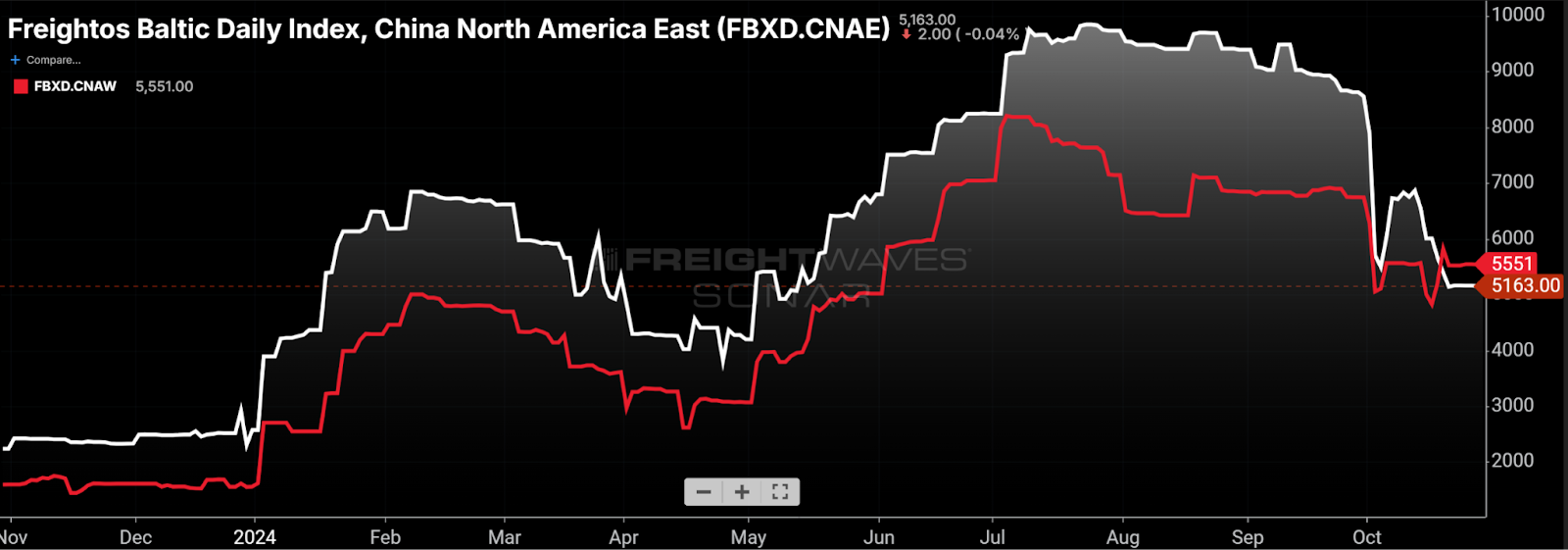
The white line shows the spot rate to move a 40-foot container from China to the U.S. East Coast. The red line shows the spot rate to move the same container from China to the U.S. West Coast. (Chart: SONAR)

Freightos ocean spot rates from China to the U.S. are shown in SONAR via the FBXD tickers – FBXD.CNAW for the rate to move a 40-foot container from China to the U.S. West Coast and FBXD.CNAE for China to the U.S. East Coast. Between the two, the rate to move from China to the U.S. East Coast is almost always higher, reflecting the greater cost associated with the longer sailing time and shippers’ desire to get closer by water to the largest consumption centers. However, the rates crossed this month, with rates from China to the U.S. West Coast slightly higher than those from China to the U.S. East Coast.

That seems to be a temporary phenomenon driven by a few factors. This time of year, speed becomes more important ahead of holidays, and ocean routing to the West Coast is faster by about two weeks. In addition, vessels with routings from China to the U.S. East Coast likely have extra capacity as a result of the lingering impact of shippers avoiding the U.S. East Coast due to the International Longshoremen’s Association strike or hurricane concerns. (Bookings on vessels are typically made well in advance of departure dates – Container Atlas shows an average lead time of nine to 13 days.)

Spot rates can change quickly so this phenomenon may be short-lived. The general trend for ocean spot rates right now is for them to decline due to the seasonal demand decline in the second half of the fourth quarter combined with capacity coming into the industry. (Ocean carriers estimate a 2%-3% capacity increase each quarter.) So, while rates for China to the U.S. West Coast have held relatively steady for now, pressure seems likely in the weeks ahead to move the spread versus the China to U.S. East Coast rates to more normal levels.

To subscribe to The Stockout, FreightWaves’ CPG and retail newsletter, click here.

Virginia engineer sentenced in $15.6M investor fraud scheme

A Virginia engineer was sentenced to seven years and six months in federal prison for his role in an investment fraud scheme that bilked investors out of over $15.6 million after purporting that he had lucrative engineering inspection contracts for federal and state government infrastructure projects.

Babu Ramaraj, 47, of Aldie, Virginia, was sentenced Friday in the U.S. District Court for the Eastern District of Virginia. Three months earlier, he had pleaded guilty to one court of wire fraud and one count of conducting an unlawful monetary transaction.

Once released from prison, Ramaraj will serve three years of supervised release per count to run concurrently. Senior U.S. District Judge Claude M. Hilton also ordered Ramaraj to pay over $15.6 million in restitution.

According to his plea deal, Ramaraj agreed to forfeit all interests in any “fraud-related and money laundering-related assets” that he owns. Those include two properties in Aldie and Ashburn, Virginia, as well as four vehicles – among them three 2023 Teslas.

What happened?

Ramaraj owned DAB Inspection and Consulting Services LLC (DAB), headquartered in Sterling, Virginia, and primarily did residential deck and patio renovations and other small construction work, according to the criminal complaint filed by the U.S. Department of Justice.

However, federal prosecutors claimed that he used his small business to operate an investment scheme. He purported to existing and potential investors “that DAB had lucrative contracts with the the Federal Aviation Administration, the Virginia Department of Transportation (VDOT), and others, and was a joint venture partner on a Washington DC Water Clean Rivers Project, for tens of millions of dollars each, supposedly to perform engineering inspection work on huge infrastructure projects,” according to a release from the U.S. Attorney’s Office for the Eastern District of Virginia.

Court filings state that over a four-year period — January 2020 until his arrest in May 2024 — Ramaraj pitched individuals, including members of his Loudon County cricket league, that he needed to make large upfront bond payments to secure the work on these government contracts, but could not obtain bank financing because of the “relative youth of DAB as a company.”

He also offered investors the opportunity to lend DAB money at high interest rates, annualized at 30% or more, according to court filings.

As part of Ramaraj’s scheme, federal prosecutors claimed he supplied falsified contract award letters, invoices, financial records and other documents to induce dozens of investors in at least five states, including Virginia, Maryland, North Carolina, New Jersey and Missouri, to lend funds that he claimed would be pooled into payments for bonds associated with the purported government contracts. However, the supposed bonds were never paid.

“Using money from later investors, Ramaraj paid initial investors the promised returns to entice them to continue investing and to recruit other friends and family to invest,” the U.S. attorney’s office said in a statement. “Instead of paying for the promised bonds, Ramaraj electronically transferred investor funds to his online brokerage accounts to engage in securities trades; wired over $1 million to accounts in India; purchased several automobiles, including several Teslas; obtained real properties; incurred millions in stock market trading losses, and made other payments to fund his lifestyle. Ramaraj took in nearly $40 million and caused losses to investors of approximately $15 million.”

Court filings claim that Ramaraj was confronted by two investors and signed an acknowledgment in October 2023 that he had tampered with numerous contracts and financial records and that he “continued to make material misrepresentations concerning DAB to other investors and potential investors.”

Prosecutors alleged that Ramaraj maintained a website that overstated DAB’s projects and work history. He also provided a slide deck to investors misrepresenting the company’s current projects and claimed that he submitted millions of dollars in bonds for supposed projects for VDOT, the FAA and other entities.

According to court filings, Ramaraj was pitching investors up until his arrest on May 30. He had remained in custody as a flight risk since that time.

In June, a federal grand jury indicted Ramaraj on 22 counts of wire fraud and six counts of money laundering. However, as part of his plea agreement, the court dismissed the remaining 26 counts.

SEC files civil complaint

On Tuesday, the clerk of courts for the U.S. District Court in Alexandria, entered a default judgment against Ramaraj after he failed to plead or otherwise respond in a timely manner to a civil complaint lodged against him in July by the Securities and Exchange Commission. The complaint was filed after Ramaraj had already pleaded guilty to two counts, which included wire fraud and money-laundering, in the DOJ’s criminal case.

Earlier Tuesday, the SEC filed a motion for default judgment with the court, four days after Ramaraj was sentenced in the DOJ’s case. 

The motion claims that Ramaraj failed to respond to the summons and complaint by Sept. 5, after being served on Aug. 14, while in custody at the Alexandria Adult Detention Center. The motion also alleges that Ramaraj made no attempt to hire an attorney to appear on his behalf in the civil action.

According to the SEC complaint, Ramaraj conducted an offering fraud through his company, DAB, and raised around $31 million from over 70 investors through the offer and sale of promissory notes.

“Ramaraj promised exorbitant rates of return and told prospective investors that he would use their funds to finance surety and performance bonds required to guarantee DAB’s performance of quality assurance services for government-sponsored multi-million-dollar infrastructure projects,” the SEC claims in court filings.

Do you have a news tip or story to share? Send Clarissa Hawes an email or message @cage_writer on X, formerly known as Twitter. Your name will not be used without your permission.

Read more here:

Ex-Slync CEO Chris Kirchner sentenced to 20 years in prison
Former trucking company owner in prison after pleading guilty in PPP fraud

Michigan trucking fraudster sentenced to 17 years for $40M Ponzi scheme

A Very WHAT THE TRUCK?!? Halloween

On Episode 777 of WHAT THE TRUCK?!?, Dooner is celebrating the Halloween season by looking at the numbers behind the holiday. With holiday sales stagnant, will we be looking at a spot market nightmare?

With one parking spot for every 11 drivers, finding a place to pull over for the night can be its own horror story. Truck Parking Club’s Evan Shelley and a Sasquatch stop by to talk about how they’re slaying the truck parking shortage.

ShipHero’s Aaron Rubin knows a thing or two about holiday demand. We’ll get the warehousing perspective on how the Christmas stocking season is shaping up. Rubin also tells us what we need to know about changes to de minimis shipments and has a surprise guest.

As a claims support specialist, Eric Furtado’s job is to clean up the supply chain crime scene. We’ll find out how claims work, how to prove your case and what goes into moving delicate commodities like flowers.

Plus, a look at how Halloween is being celebrated around the supply chain. 


Catch new shows live at noon EDT Mondays, Wednesdays and Fridays on FreightWaves
LinkedIn, Facebook, X or YouTube, or on demand by looking up WHAT THE TRUCK?!? on your favorite podcast player and at 5 p.m. Eastern on SiriusXM’s Road Dog Trucking Channel 146.

Watch on YouTube

Check out the WTT merch store

Visit our sponsor

Subscribe to the WTT newsletter

Apple Podcasts

Spotify

More FreightWaves Podcasts

XPO’s shares surge on solid Q3, favorable outlook

Two XPO daycabs pulling trailers near a terminal

XPO returned another solid quarter as it readies its network to take advantage of both the next market upturn and longer-term growth opportunities.

The less-than-truckload carrier reported third-quarter adjusted earnings per share of $1.02, 11 cents better than the consensus estimate and 14 cents higher year over year. The adjusted result included a 6-cent gain from an investment in a private company that was sold. Consolidated revenue increased 3.7% to $2.05 billion. It outpaced peers by logging 200 basis points of margin improvement in its LTL segment.  

Shares of XPO (NYSE: XPO) were up 13.3% at 12:46 p.m. EDT on Wednesday compared to the S&P 500, which was up 0.2%.

XPO has opened 21 of the 28 terminals it acquired from bankrupt Yellow Corp. (OTC: YELLQ). Eight of the terminals represent new service markets for the carrier while the other 13 are relocations into larger or better-suited spaces. The remaining seven service centers will be open by early 2025.

The additions will boost door count 10% to 15%, giving the carrier as much as 30% latent capacity across its network, which it says is key to improving service and winning market share.

Efficiency in its city operations has improved by a low- to mid-single-digit percentage in these markets. The company has seen a similar efficiency improvement in its linehaul network. The new sites are operating at or above management’s initial expectations.

XPO also added more than 4,000 tractors and nearly 15,000 trailers to its fleet over the past three years to meet future demand.

The update was shared on a quarterly call with analysts on Wednesday.

Table: XPO’s key performance indicators

XPO’s LTL margins improve as industry backs up

The company’s LTL segment generated revenue of $1.25 billion, a 1.9% y/y increase. Tonnage per day declined 3.9% y/y, but revenue per hundredweight, or yield, increased 3.7% (6.7% higher excluding fuel surcharges). The yield calculation was only partially aided by a 0.7% decline in weight per shipment.

Tonnage declines accelerated throughout the quarter. Tonnage per day was down 0.8% y/y in July, 4.7% in August and 6.1% in September. The year-ago period included the closure of Yellow, which redistributed roughly 8% market share to competitors.

Tonnage is expected to be off 8% y/y in October as demand trends have experienced normal seasonality during the month. The industry benefited from a cyberattack at Estes in the early part of October 2023, which contributed about 1,000 shipments per day to XPO’s network. Management said October tonnage is down approximately 6% y/y after excluding that event.

XPO’s tonnage is forecast to decline y/y by a mid-single-digit percentage during the fourth quarter. Management noted softer demand on the call, saying shipments from industrial customers declined at twice the rate of retail customers in the third quarter. It said customers with exposure to electrical equipment manufacturing and machinery are more bullish than construction- and agriculture-oriented shippers.

Chart: Initial reporting of LTL rates. 7-day moving average of daily median rate per 100 lbs. On a 14-day lag. Loads under 100 pounds are excluded. To learn more about SONAR, click here.

The company reiterated several rate opportunities on the call, which give it confidence that it will be able to price freight approximately 100 to 200 bps above the market next year and beyond.

It’s continuing to make investments that will allow it to close the service (and pricing) gap to best-in-class operators. It halved its claims ratio to 0.2% in the third quarter, and has improved on-time performance in 10 straight quarters.

XPO reported a more than 10% y/y increase in shipments from local accounts, which have higher yields and margins. It has grown the sales force in this channel roughly 20%, allowing it to add more than 8,000 local customers this year.

It is also increasing its percentage of revenue tied to premium services, which garner accessorial charges. A little more than 10% of its LTL revenue comes from premium services, and the plan is to move that 1 percentage point higher each year to a goal of 15%.

Average contractual price renewals were up y/y by a high-single-digit percentage for a fifth consecutive quarter.

The LTL unit reported an 84.2% adjusted operating ratio (inverse of operating margin), which was 200 bps better y/y and outpaced declines reported by peers.

The adjusted OR was 100 bps worse than in the second quarter, which was in line with the company’s previous guidance of 100 to 150 bps of deterioration (versus the historical trend of 200 to 250 bps of sequential degradation).

Purchased transportation expense saw the biggest move in the period, down 330 bps y/y as a percentage of revenue. XPO lowered its outsourced miles by 800 bps y/y to 13.6% in the quarter. The goal is to lower the percentage to single digits over time.

The company normally sees 250 bps of OR deterioration from the third to the fourth quarter. It expects to outperform that change rate this year. It also expects to be at the high end, or to outperform, a full-year 2024 OR guidance range that calls for 150 to 250 bps of improvement.

XPO’s European transportation segment reported a 6.8% y/y revenue increase to $803 million. It recorded an adjusted earnings before interest, taxes, depreciation and amortization margin of 5.4%, which was 40 bps worse y/y.

XPO lowered its net debt leverage ratio to 2.5 times adjusted EBITDA in the quarter, down from 3 times at the end of 2023.

It has several levers to further lower leverage and achieve investment-grade status. Cash flow generation will improve as margins improve, annual capex will move lower as it concludes the terminal expansion project, and it will likely sell its European business.

More FreightWaves articles by Todd Maiden

Greenbrier Q4 rolls on higher railcar deliveries

Higher new railcar deliveries helped Greenbrier (NYSE: GBX) post sales of $1.05 billion, up 3.5% y/y for the fourth fiscal quarter and full year ended Aug. 31.

Net earnings for the quarter were $62 million, or $1.92 per diluted share, on revenue of $1.1 billion.

Earnings before interest, taxes, depreciation and amortization was $159 million.

The Portland, Oregon-based company’s lease fleet grew by 300 units to 15,500 units in the fourth quarter, with lease fleet utilization of nearly 99%.

Quarterly new railcar orders totaled 4,400 units valued at $575 million with deliveries of 7,000 units. Full-year new railcar orders were 21,700 units valued at $2.8 billion with deliveries of 23,700 units.

The order backlog is 26,700 units with an estimated value of $3.4 billion.

“Greenbrier ended fiscal 2024 with a great fourth quarter,” said Lorie L. Tekorius, chief executive and president. “We are extremely pleased to have delivered aggregate gross margin of nearly 16% in fiscal 2024, in line with our long-term target. This achievement reflects the efficiency initiatives we have been focused on for the last 18 months to improve margins in our core manufacturing business and the growth of recurring revenue from our leasing platform.”

Tekorius said the improved results came amid an uncertain macroeconomic backdrop. This includes modest growth in North American rail freight volumes and idling of some rolling stock by railroads as part of their scheduled operating plans.

For full-year 2025, the company is forecasting railcar deliveries of 22,500-25,500 units and revenue of $3.35 billion-$3.65 billion.

Find more articles by Stuart Chirls here.

Related coverage:

International freight drives Q3 intermodal gains

ONE alliance adds Jaxport-East Asia services

Savannah container imports up 17%

Sustainability leaders key to more sustainable transportation

a Nikola truck on a highway

In the quest for sustainability, the transportation sector stands as one of the most significant arenas for change. With greenhouse gas emissions soaring, the need for sustainable transportation solutions has never been greater. Enter sustainability leaders — pivotal figures steering the industry toward a future where battery-electric and hydrogen-powered vehicles become the norm, not the exception.

Understanding the transportation emissions conundrum

The commercial transportation sector is a heavyweight in the race against climate change. Class 8 heavy-duty trucks contribute significantly to carbon emissions, underscoring the urgency of transitioning to cleaner alternatives. Companies such as Nikola are at the forefront, offering battery-electric and hydrogen fuel cell electric trucks as viable replacements for traditional diesel powertrains. The move is essential, considering that diesel trucks directly contribute to environmental degradation, air pollution and public health issues.

Sustainability leaders play a critical role here. They have the responsibility of navigating the complexities of vehicle replacement, choosing between various technologies and leveraging federal and state incentives to offset costs — which allows electric alternatives to not be just an environmental choice, but an economically sound decision as well.

The role of sustainability leaders in the transition to zero emissions

Transitioning to sustainable transportation isn’t just about swapping out diesel engines for electric ones. It requires a holistic approach spearheaded by sustainability leaders. These individuals are more than advocates; they’re strategists who can align their companies’ sustainability goals with economic imperatives, ensuring a shift that is both viable and impactful.

Sustainability leaders must juggle multiple roles. They are visionaries setting long-term goals, change agents advocating for greener policies and innovators pushing for technology integration. This multifaceted approach can ensure not only a reduced carbon footprint but also a stronger business case for sustainability.

According to Alexia Bednarz, Nikola’s head of sustainability, “Sustainability leaders face a monumental task in decarbonizing transportation. They must change the direction of a century-old industry to see real progress on emission reduction in transportation. At Nikola, we are here to support them on their fleet evolution journey as they consider the importance of decarbonizing their Class 8 trucks.”

Strategic vision and planning

Creating a sustainable fleet involves strategic planning that aligns with both environmental objectives and operational demands. Sustainability leaders are tasked with mapping out this transition — evaluating the feasibility of zero-emission trucks, considering factors like total cost, range and infrastructure. This strategic foresight is critical for phasing out diesel engines in favor of cleaner alternatives.

Getting top executive buy-in is crucial. Sustainability leaders must present a clear business case, emphasizing benefits that include reduced operating costs, regulatory compliance and enhanced brand reputation. By setting realistic milestones and leveraging available technologies, these leaders steer their organizations toward a more sustainable future.

Technology integration and innovation

The integration of new technologies is at the core of sustainable transportation. Sustainability leaders must ensure that battery-electric and hydrogen fuel cell electric trucks fit seamlessly into existing operations. This includes collaborating with logistics teams to address practical needs such as payload capacity and charging logistics, and potentially adopting new fleet management systems.

“A connected ecosystem is essential for companies not just to transition their fleets to battery-electric or hydrogen-electric, but also to help maximize uptime, strengthen driver retention and elevate safety,” said Ryan May, Nikola’s head of software. “Real-time data from individual trucks presents opportunities to enhance the overall ownership experience. Nikola’s ecosystem offers multiple ways to track the health and safety of trucks and drivers.”

Innovation is another critical component. By partnering with existing manufacturers as well as startups, sustainability leaders can pilot new vehicle models and explore emerging technologies. This proactive approach not only enables legacy companies to operate at the cutting edge but also turns early adoption into a competitive advantage. 

Supply chain and infrastructure development

Sustainability is not just about vehicles; it extends to the entire supply chain. Leaders must ensure that the materials used in battery-electric trucks and hydrogen fuel cells are sourced responsibly, which includes promoting recycled materials, supporting sustainable mining practices and ensuring ethical labor standards.

Nikola is a company currently “walking the talk,” having recently released its first sustainability report, achieving a 45% diversion rate of manufacturing waste and reaching a milestone in 2023 by recycling or reusing 100% of scrapped lithium-ion batteries. 

Infrastructure development is equally vital. Building the necessary charging and refueling stations is a prerequisite for widespread adoption of battery-electric and hydrogen fuel cell electric vehicles. Sustainability leaders must work with partners to develop infrastructure that supports their fleets, ensuring a smooth transition to cleaner energy.

Building a culture of sustainability

Creating a sustainable transportation system goes beyond technology and regulations; it’s about fostering a culture of sustainability within the organization. Leaders must inspire employees at all levels to adopt sustainable practices, whether through training programs, incentives or corporate social responsibility initiatives.

By embedding sustainability into the corporate culture, leaders ensure that their companies remain committed to greener practices in the long term.

The path to a sustainable future

The transition to sustainable transportation is both a challenge and an opportunity. With their strategic vision and leadership, sustainability leaders are driving change that benefits not only their organizations but the planet as well. From electrifying fleets to advocating for greener policies, these leaders are the architects of a cleaner, more sustainable future.

The road to sustainability is paved with innovation and collaboration. While the shift from diesel to battery-electric and hydrogen fuel cell electric trucks will not happen overnight, momentum is building. With leaders like Nikola setting the standard for zero tailpipe-emissions Class 8 transportation, the path forward is clear.

CSX launches double-stack service at Port of Baltimore

This story originally appeared on Trains.com.

BALTIMORE — CSX launched double-stack service to and from the Helen Delich Bentley Port of Baltimore on Monday thanks to clearance projects that have been completed north of the Howard Street Tunnel.

“This is a great day for the Port of Baltimore and a great day for Maryland,” Gov. Wes Moore said in a statement. “As the Port of Baltimore continues to grow, this transformational project will help increase business activity and create thousands of new jobs.”

Chicago-Baltimore train I104-26, with ES40DC No. 5303 on the point, had the honor of being the first stack train to arrive at the port.

The governor’s office said the port will become more competitive due to the ability to offer double-stack service to and from markets in the Midwest and Northeast.

State officials say double-stacking containers will help the port grow volumes by about 160,000 containers annually and will create 13,000 jobs in construction and operations. Double-stacking will also complement the expansion of the Seagirt Marine Terminal, operated by Ports America Chesapeake, as home to supersized Neo-Panamax cranes that handle ultralarge container ships.

“This is a significant milestone for intermodal rail service between Baltimore and Midwest markets and wouldn’t be possible without the ongoing collaboration between our federal, state, and local project partners,” CSX CEO Joe Hinrichs said in a statement. “This underscores our broader commitment to enhancing service efficiency and safely expanding our network capabilities through the Howard Street Tunnel project, allowing for greater efficiency in this critical corridor.”

Construction is ongoing at several Maryland sites. However, vertical clearance improvements at rail bridges north of Baltimore are complete, allowing CSX to operate double-stack rail service to the Midwest on a temporary route from the port along the CSX network via Pennsylvania, New Jersey and New York until the Howard Street Tunnel work is complete in 2026.

The Howard Street Tunnel Project includes reconstructing the 129-year-old tunnel in Baltimore and 21 other locations in Maryland, Delaware and Pennsylvania to increase vertical clearance by 18 inches to allow double-stacked container trains to operate to and from the Port of Baltimore. When fully complete, the double-stack project will allow CSX to offer double-stack intermodal service in the I-95 corridor.