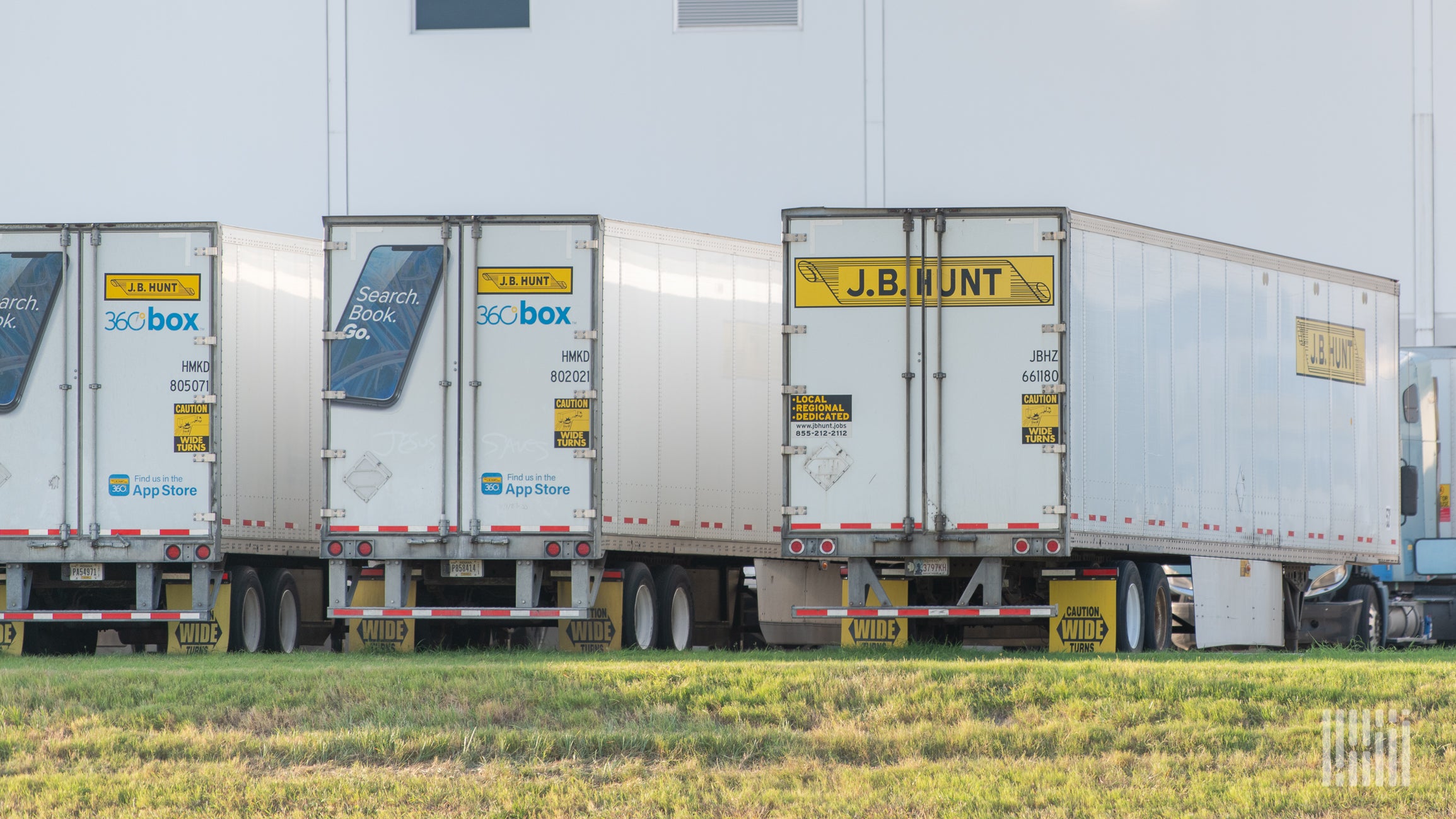
J.B. Hunt sees normal seasonality in Q3

J.B. Hunt intermodal containers being stacked at a port

J.B. Hunt Transport Services beat third-quarter expectations Tuesday, sending shares 7% higher in after-hours trading. The multimodal transportation provider saw stabilized, and in some cases improving, trends across its service offerings as it prepares for “an eventual turn in the freight market.”

J.B. Hunt (NASDAQ: JBHT) reported earnings per share of $1.49, which was 8 cents ahead of the consensus estimate but 31 cents lower year over year.

Table: J.B. Hunt’s key performance indicators – Consolidated

Intermodal puts and takes

J.B. Hunt’s intermodal segment saw demand improve throughout the quarter. Revenue was flat y/y at $1.56 billion as loads increased 5%, but revenue per load was off by a similar percentage.

Total intermodal loads increased 7% y/y in July and were 4% higher in both August and September. By comparison, total intermodal traffic on the U.S. Class I railroads was up 11% y/y in the quarter, according to the Association of American Railroads.

J.B. Hunt’s transcontinental loads were up 7% y/y (up by a double-digit percentage on eastbound transcontinental lanes out of Southern California) while Eastern network loads increased 3%. Eastern volumes are still seeing headwinds from depressed one-way truck pricing as well as some freight diversion ahead of a three-day dockworker strike earlier this month. The company said it could take a few more weeks for Eastern volumes to normalize and that the disruption at the East Coast ports could continue, as only a tentative agreement was reached and workers could strike again in mid-January without a permanent deal in place.

The unit posted a 92.8% operating ratio (operating expenses expressed as a percentage of revenue), which was 100 basis points worse y/y but 10 bps better than the second quarter. The company pointed to a network imbalance, resulting in incremental equipment repositioning costs, and driver hiring ahead of peak season as headwinds. However, Darren Field, president of intermodal, told analysts on a Tuesday evening call that bid compliance among customers is improving, which should reduce costs from lane imbalances moving forward.

Compared with the second quarter, intermodal loads increased 10% but revenue per load was up just slightly. Field said there was likely some volume pull forward ahead of peak season and as some customers altered trade routes around the East Coast to avoid disruptions from the strike. He also said the company has completed its 2024 intermodal bid season and that lower yields will likely linger through the first half of next year.

“We will be living with a large portion of current pricing through the first half of 2025,” Field said. He was a little more constructive on rate negotiations next year. “We just kicked off our 2025 bid season, and we do like our position given our service levels and ability to handle customer surge demand that we have been experiencing.”

J.B. Hunt said it does not expect any material change in its relationship with, or service levels provided by, rail partner BNSF (NYSE: BRK.B), following the railroad’s recent addition of industry veteran Ed Harris. There was some concern among analysts that BNSF’s service could be impacted as the precision scheduled railroading expert looks to cut costs.

Table: J.B. Hunt’s key performance indicators – Intermodal

Brokerage may be turning the corner

J.B. Hunt’s brokerage segment reported a $3.3 million operating loss in the period, a $10 million improvement from the second quarter and roughly one-third the loss it booked a year ago.

Revenue was down 7% y/y to $278 million as loads fell 10% and revenue per load improved 3%. A 17.9% gross margin (510 bps better y/y), reduced cargo claims, and a reduction in head count drove the improved result. An increase in project freight during the quarter lifted gross margin, which the company expects to revert back to the 14% to 15% range.

The period included a $2 million negative impact from the continued integration of BNSF Logistics’ brokerage operations, which J.B. Hunt acquired in September 2023.

Table: J.B. Hunt’s key performance indicators – Brokerage

Dedicated backfills lost business

Dedicated revenue fell 5% y/y to $846 million as average trucks in service were down 3% and revenue per truck per week was off by a similar amount. The company sold service on 258 trucks in the quarter (1,273 trucks placed so far this year), but the additions are only partially offsetting attrition within some accounts amid a depressed demand environment.

The unit recorded an 88.7% OR, 20 bps worse y/y and in line with the second quarter. Startup costs within new accounts have weighed on margins.

Table: J.B. Hunt’s key performance indicators – Dedicated

Other segments at a glance

Final-mile revenue dipped 3% y/y to $218 million as total stops fell 6%, but revenue per stop increased 3%. The unit reported $12 million in operating income, a 7% y/y decline.

Operating income in the truckload segment was up 6% y/y to $8.2 million. Revenue declined 12% but OR improved 80 bps.

Shares of JBHT were up 7.1% in after-hours trading on Tuesday.

Table: J.B. Hunt’s key performance indicators – Final Mile and Truckload

More FreightWaves articles by Todd Maiden

Benchmark diesel price rises, but futures prices now headed sharply lower

An increase in the weekly Department of Energy/Energy Information Administration average retail diesel price was about the only thing in the oil market pointing higher Tuesday.

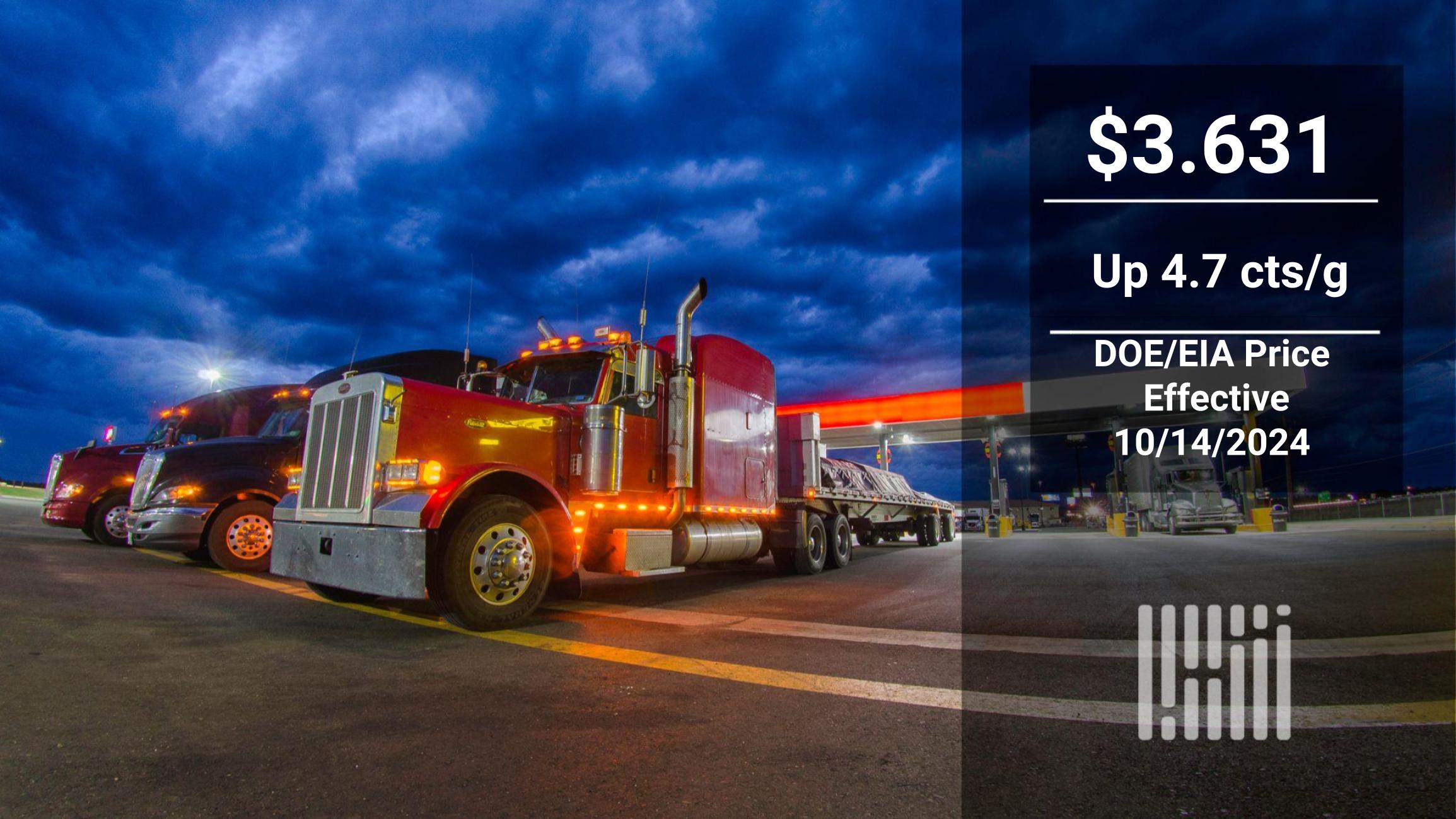
The diesel price used as the basis for most fuel surcharges rose 4.7 cents, to $3.631/gallon. It’s the fourth consecutive week the price has risen. 

Release of the price came a day later than usual due to the Columbus Day holiday Monday. 

But it moved higher in a market that after significant gains in futures prices has now turned decidedly lower. There is a lag between increases or decreases in futures and wholesale prices. (The latter tracks the former relatively closely.) The divergence of a higher retail price from DOE/EIA this week in the middle of a sell-off in futures price is a clear example of that market feature.

Ultra low sulfur diesel (ULSD) on the CME commodity exchange fell for the third consecutive day Tuesday, with the two-day decline totaling 15.67 cents a gallon. Tuesday’s settlement of $2.1877 per gallon, down 8.65 cents on the day, dropped the ULSD settlement to its lowest level since Oct. 2.

What happened in the interim was that not just the prospect but the reality of military action between Iran and Israel resulted in all oil markets, not just ULSD, spiking higher. In the ULSD market, the recent high settlement of $2.3962, recorded Monday, was 33.82 cents per gallon more than a recent low of $2.058 a gallon, recorded Sept. 10.

But since that initial frenzy that pushed prices higher, traders in the market reversed course when the Israel-Iran conflict got quiet and the feared attack on Iranian oil facilities didn’t materialize. In recent days, there were several reports that Israel had told the U.S. that when it came time to attack, Iranian oil facilities would not be targeted, leading to the big sell-off on Monday and Tuesday.

It isn’t just the recent swings in the Middle East political landscape that have been driving prices. The reality is that one year after the Oct. 7 attack on Israel, there has been no loss in oil output. If there has been a disruption to oil supplies, it has come from Houthi attacks on shipping in the Red Sea and by extension the Suez Canal. 

But concerns that oil prices would rise from longer shipping times due to diversion from the Suez Canal and shipping instead around the Cape of Good Hope never turned into actual evidence that prices were rising.

Longer term, the monthly supply/demand report of the International Energy Agency issued Tuesday had an overview of the market that should make truckers happy.

The focus in recent reports has been on demand, as its continuing slowdown leaves supply more than adequate. The IEA sees that trend continuing. 

According to the group’s October report issued Tuesday, the increase in global demand in 2024 was down about 40,000 to 50,000 barrels per day from the prior month’s growth forecast.

Other statements in the report that can’t be read as anything other than bearish for prices include:

  • The observation that OPEC+ spare capacity is about 5 million barrels a day, which except during the pandemic is at “historic highs.”
  • The fact that global product inventories are at three-year highs even as crude stocks are less than the five-year average for this point in the calendar.
  • And the fact that even with the drawdowns of inventories to counter the loss of Russian crude soon after that country invaded Ukraine, strategic stocks held by IEA members are enough to cover 75 days of refinery runs in the nations of the IEA. 

“For now, supply keeps flowing and in the absence of a major disruption, the market is faced with a sizable surplus in the new year,” the IEA said.

Crude output from OPEC+ dropped sharply in September, according to S&P Global Commodity Insights. But of that 500,000-barrel-per-day decline, which is a large one-month fall, about 410,000 barrels a day came from Libya, which went through another political crisis that reduced output but is now resolved. An additional 130,000 barrels a day came from Iraq, which had been under significant pressure to reduce its output relative to its OPEC quota. Other nations in the OPEC+ group of exporters held their production steady or had slight increases, according to SPGCI.

——-

More articles by John Kingston

ATRI survey: Drivers and carriers see top issues in trucking differently

OOIDA, Truckstop team up; load board is now group’s ‘exclusive’ partner

NFI’s Brown seeks dismissal of New Jersey case, cites minor role in dispute

J.B. Hunt Q3 first look: Stock jumps on earnings beat

J.B. Hunt trailers at a facility

J.B. Hunt Transport Services beat third-quarter expectations Tuesday after the market closed, reporting earnings per share of $1.49, 8 cents ahead of the consensus estimate but 31 cents lower year over year.

The multimodal transportation provider’s intermodal segment reported no y/y change in revenue as a 5% increase in loads was offset by an equal decline in revenue per load. The volume increase was approximately half the increase in total intermodal traffic reported by the U.S. Class I railroads during the quarter.

Click for full report – “J.B. Hunt sees normal seasonality in Q3”

J.B. Hunt (NASDAQ: JBHT) said intermodal demand improved as the quarter progressed, partly due to normal seasonal patterns as well as double-digit volume growth on eastbound transcontinental lanes out of Southern California. Compared with the second quarter, intermodal loads increased 10%.

A 92.8% operating ratio (operating expenses expressed as a percentage of revenue) deteriorated 100 basis points y/y but was 10 bps better than the second-quarter mark. Equipment repositioning costs and driver hiring costs ahead of peak season were some of the culprits.

Operating losses in the company’s brokerage segment narrowed during the period. Integrated Capacity Solutions reported a $3.3 million loss in the quarter, a $10 million improvement from the second quarter and roughly one-third the loss booked in the year-ago quarter.

Revenue in the segment was down 7% y/y as a 10% drop in volumes was partially offset by a 3% increase in revenue per load.

Shares of JBHT were up 8.1% in after-hours trading on Tuesday.
J.B. Hunt will host a call at 5 p.m. EDT on Tuesday to discuss third-quarter results.

Click for full report – “J.B. Hunt sees normal seasonality in Q3”

Table: Company report

More FreightWaves articles by Todd Maiden

Florida port gets $9.5M in Milton storm funding

Image shows seaport berth, cargo vessel, sky, containers and shoreside structures.

Florida’s SeaPort Manatee will receive $9.5 million in state emergency funding to aid recovery from Hurricane Milton.

The funding comes as fuel, food and other goods begin to move through the maritime hub near Tampa Bay.

The port serving southwest and central Florida suffered an estimated $200 million in damage when Milton made landfall Oct. 9.

Florida Gov. Ron DeSantis announced the funding Monday at the port.

“We want to make sure our supply chain is strong and that we get the port back to where it needs to be as soon as possible,” DeSantis said.

Warehouses, berths, the container yard, offices and security installations were battered by the hurricane, according to initial assessments.

The emergency funding is slated to include $5.5 million for emergency berth repairs and dredging in state waters, $3.5 million for immediate security needs and access control, and $500,000 to support planning activities for fortifying port infrastructure. 

The port will also receive staff support from multiple state agencies, DeSantis said, as well as Florida National Guard assistance with perimeter security.

President Joe Biden on a visit to survey the storm damage Sunday was to announce $612 million for six Department of Energy projects to improve the resiliency of the state’s electric grid in areas affected by the storm.

The combined efforts of county, state and federal authorities and industry partners has Manatee County’s seaport operations “almost normal,” said Executive Director Carlos Buqueras in a release. “This additional funding from the state will really make all the difference” in returning to full operational status.

The port has 10 deep-draft berths handling container, liquid and dry bulk, breakbulk, heavy-lift, project, and general cargo. It handled 177,108 twenty-foot equivalent units in fiscal 2023.

Find more articles by Stuart Chirls here.

Related coverage:

Longshore union halts overtime at Port of Montreal

Georgia’s Brunswick port expands ro/ro capacity

Analysis: Biden, ILA score wins in port strike, but larger issues remain

The pandas are back in town: ‘FedEx Panda Express’ brings bears to US

FedEx (NYSE: FDX) transported six giant pandas between the United States and China this week on what the company calls the “FedEx Panda Express.”

FedEx transported female Lun Lun and male Yang Yang, both 27 years old, from Hartsfield-Jackson Atlanta International Airport to Chengdu Shuangliu International Airport along with their twin female offspring, Ya Lun and Xi Lun. Lun Lun and Yang Yang had lived at Zoo Atlanta since 1999; their cubs were born in 2016. They were moved to the Chengdu Research Base of Giant Panda Breeding.

The company has worked with Chinese government officials for more than 20 years to transport giant pandas to and from China. The first FedEx panda flight was in 2000.

The company brought pandas Bao Li and Qing Bao, both 2, from China to the Smithsonian’s National Zoo and Conservation Biology Institute in Washington on Tuesday. Bao Li is the grandcub of Mei Xiang and Tian Tian, whom FedEx transported to China, along with their cub, Xiao Qi Ji, in November.

FedEx donated the transportation cost. Animal care experts from Zoo Atlanta and the Smithsonian zoo were on the flights. The pandas traveled with bamboo, water and treats. 

“Each giant panda move is special, and we’re always honored when selected as the trusted transportation provider,” said Richard W. Smith, chief operating officer, international, and chief executive officer, airline, at FedEx.

Bao Li and Qing Bao are quarantining ahead of their public debut on Jan. 24. The pandas will stay in the Smithsonian zoo for the next 10 years on loan from China.

The Smithsonian’s panda exhibit has sat empty since the departure of Mei Xiang, Tian Tian and Xiao Qi Ji when their lease ended last year. 

The zoo was the first in the United States to have giant pandas on display after first lady Pat Nixon mentioned her love of pandas to Chinese Premier Zhou Enlai in 1972. Enlai gifted giant pandas Ling-Ling and Hsing-Hsing to America as a gesture of goodwill.

Giant pandas were once deemed an endangered species due to illegal hunting and habitat loss but are now considered a vulnerable species, a category that is at less risk of extinction in the wild, according to the World Wildlife Fund.

Rebuilding the gateway to America: West Coast ports blaze path to sustainability

Despite the ongoing freight recession, freight is flowing to the West Coast. After a difficult few years, the ports of Los Angeles and Long Beach are again seeing record import levels. In August, the Port of Long Beach saw a 40% increase in loaded inbound containers on a year-over-year basis. During the same period, the Port of Los Angeles experienced a 17% increase in loaded imports.

This comes at a time when the ports are laser-focused on improving their carbon footprints.

Record levels amid shifting trade dynamics

Recent trends indicate that containers diverted to East Coast ports during pandemic-related port struggles on the West Coast are returning to California. This suggests shippers recognize the strategic advantages offered by the West Coast, especially in light of ongoing issues in the Red Sea and recent, potentially ongoing labor strikes at East Coast ports.

San Pedro Bay ports have successfully ramped up operations to meet growing demand without delays, according to Charlie Doucette, director of operations at Long Beach Container Terminal. He said LBCT achieves an average of about 31 moves per hour per crane, but that number can climb as high as 33 moves on a good shift.

Noel Hacegaba, COO at the Port of Long Beach, emphasized the port’s success is the culmination of decades of planning and investment, with over $4.5 billion allocated to modernization and capacity enhancements over the past 15 years.

Looking ahead, the Port of Long Beach has an additional $2.2 billion earmarked for accelerating zero-emission initiatives over the next decade.

Sustainability in the spotlight 

The Port of Long Beach’s current and planned sustainability-focused innovations are not happening in a vacuum. Neighboring Port of Los Angeles, Southern California logistics providers, local entrepreneurs and California state government are all rallying behind a more eco-conscious supply chain.

The ports and other logistics organizations are motivated to decarbonize their operations in part by California’s 2017 Clean Air Action Plan Update, which set the ports on a course to transition terminal equipment to zero emissions by 2030 and on-road drayage trucks by 2035.

This ambitious goal requires a variety of stakeholders to unite their efforts. Transportation providers, as well as the ports themselves, must focus on making the switch to zero-emission vehicles.

Talon lives on the cutting edge

The push for zero-emission vehicles is driving innovation within the industry. Companies like Talon Logistics are at the forefront of this transition, already deploying battery-electric and hydrogen fuel cell trucks. By becoming an early adopter – and innovator – in the zero-emission space, Talon has positioned itself as a leader among its peers and a proverbial lighthouse for shippers working to meet ambitious sustainability goals.

Education plays a vital role in the transition to zero-emission vehicles, and Talon works hard to inform shippers about the benefits of adopting these new technologies now. Talon Director of Business Strategy Isaac Castañeda pointed out the importance of building holistic and infomed partnerships within the growing eco-friendly business environment in order to reach near-parity with diesel costs while simultaneously moving toward sustainability.

For the folks at Talon, climate-positive business practices are about more than just reaching government-imposed deadlines, though.

“We want to be in the forefront. We are a community, we live here, our kids are going to live here,” Castañeda said. “Who doesn’t want clean air? What can we do little by little, trucker by trucker, life by life?” 

Building infrastructure to support a zero-emission future

To scale up zero-emissions efforts successfully, appropriate charging infrastructure must also be built to scale. That is where partnerships with companies like charging provider Forum Mobility come into play. 

“We built a team and we got to work,” said Ron Hunt, regional director of business development at Forum Mobility. “So far, we’ve already had a pilot customer running electric trucks in the drayage market in Southern California for almost two years, running over 200,000 miles.”

That test customer serves as an inspiration for others in the area hoping to achieve the same results. Forum is working alongside other industry players to create the infrastructure that makes that possible.

Forum’s first charging depot housed inside the Port of Long Beach is under construction and slated to open at the end of the year. The station will add more charging infrastructure to the port’s 100 active chargers. 

Harnessing alternative power at Pier Wind

The Port of Long Beach is also looking to increase its energy options in more unique ways. One of the most innovative initiatives underway at the Port of Long Beach is the development of Pier Wind, a groundbreaking project that aims to support California’s goal of generating 25 gigawatts of offshore wind energy by 2045. 

“Imagine fully assembled wind turbines capable of generating 20 megawatts of energy towed by sea from the Port of Long Beach to offshore wind farms in Central and Northern California,” said Port of Long Beach Executive Director Mario Cordero. “As society transitions to clean energy, our harbor is ideally located for such an enterprise – with calm seas behind a federal breakwater, one of the deepest and widest channels in the U.S., direct access to the open ocean, and no air height restrictions.”

This project not only aligns with the state’s renewable energy targets but also positions the Port of Long Beach as a standout leader in sustainable energy solutions. By harnessing offshore wind, the port aims to significantly reduce its carbon footprint while bolstering its energy supply for future operations.

Collaboration as a path forward

A holistic approach to improving sustainability is crucial. This includes creating an environment of collaboration – not competition – between human workers and modern technologies. Hacegaba acknowledged the vast contributions of the labor force alongside the port’s ongoing technological advancements.

“We would not be here without our labor force. We recognize the value of technology, but we also recognize the value of our workforce,” Hacegaba said. 

That collaborative spirit extends to industry partners as well. The relationship between the ports of Los Angeles and Long Beach has historically been strong. Since the introduction of the Cleaner Action Plan in 2005, they have worked together toward common environmental goals. As the industry grapples with changing regulations and the need for innovation, fostering relationships among other stakeholders — from motor carriers to shippers — is also critical for navigating these challenges.

The journey to a sustainable and efficient port complex is ongoing. Leaders in the industry are committed to making incremental improvements, believing that each step contributes to a healthier environment for future generations.

With a focus on collaboration, innovation and education, organizations like Talon and the ports of Los Angeles and Long Beach are not just adapting to change –– they are shaping a resilient future for global trade.

Tenstreet Content Library makes training more accessible to drivers and carriers

Article brought to you by Tenstreet

With insurance premiums remaining high and nuclear verdicts still being handed down frequently, improving safety and reducing exposure is top of mind for carriers of all shapes and sizes. Driver training is one of the most popular – and effective – ways to safeguard fleets against potential litigation.

But while training is important, training programs can be complicated, expensive and confusing. Tenstreet set out to change that with its training content library.

Tenstreet has made a name for itself in the driver recruiting and retention space. The company’s robust training library is a natural extension of its dedication to both fleets and drivers. 

“We created the training library to meet a need we saw in the market. Accessible, digestible training keeps drivers safer and has numerous benefits to carriers, including saving money at the onboarding stage,” said Tenstreet Product Manager Karley Ullery. 

The Tenstreet Content Library offers more than 260 training courses with audio and video options covering categories as diverse as compliance, defensive driving, hours of service, safety and driver wellness. Regardless of the topic, the content’s power is largely in its presentation.

Tenstreet’s training sessions are designed to be short, interactive and engaging for drivers. Instead of long, monotonous videos with confusing tests, drivers receive quick, dynamic content with short quizzes to confirm understanding.

This approach not only saves drivers time and frustration, it also helps them better absorb the information presented in the training.

Tenstreet has made accessing its training content library a breeze. The entire training infrastructure exists within the company’s popular Driver Pulse mobile application. By housing content in its app, Tenstreet has significantly reduced the friction both fleets and drivers often encounter with other training options.

“It is all right in the dashboard they are using for everything else from recruiting to onboarding to safety management. And letting carriers complete training on the go using a mobile app also means they’re more likely to stay on top of these assignments while on the road,” Ullery said. 

Carriers can review the entire training library, create bundles and assign training all within the app. Drivers then get push notifications about assigned training, which they also complete in the app. This one-stop-shop approach cuts down on app fatigue and reduces confusion around how to assign or complete training.

“A lot of people are filling multiple roles at their jobs, so keeping it all in one place is a win,” Ullery said. 

The content library also plays an active role in supporting other Tenstreet solutions. 

For example, the company’s CSA integration has a feature called “infraction action,” which automatically assigns relevant training to drivers when the system is notified of recorded infractions. This feature is immediate and does not require fleet managers to do anything extra, ensuring drivers receive appropriate training reminders when infractions are still fresh in their minds.

“It is happening the second we hear about an incident, so that is extremely powerful,” Ullery said.

While training courses can be assigned by fleet managers or pushed out via the infraction action feature, drivers can also explore the Tenstreet Content Library on their own. According to Ullery, they often do.

“If drivers are sitting there taking trainings on their own, that’s a testimony in and of itself,” Ullery said. Some of the company’s most popular courses with drivers are Avoiding Animal Collisions, Backing and Docking Procedures, and Active Shooter Preparedness.

The courses are designed to be accessible to as many drivers as possible, which is why the company offers some of its course catalog in Spanish and French as well as English.

The Tenstreet Content Library is a powerful training solution for carriers and their existing drivers. The library – combined with other Tenstreet offerings – can reshape the way carriers approach new driver onboarding.

“Clients have historically had to have multiday orientations,” Ullery said. “With the training content and Tenstreet’s ability to complete paperwork from anywhere, the driver can complete most aspects of onboarding on their phone ahead of time.” 

This can help carriers distill their orientation into a single afternoon, saving them significant amounts of money on hotel rooms and meals. A shortened onboarding process also enables drivers to get on the road sooner, maximizing profits for both drivers and carriers.

All in all, the Tenstreet Content Library is designed to work alongside the company’s other solutions to create a simple, dynamic and efficient experience for drivers and carriers alike. 

Click here to learn more about Tenstreet.

Machinist jobs safe for now, Boeing says

This story originally appeared on AirlineGeeks.com.

Boeing’s striking machinists are not currently expected to be the target of job cuts by the company, according to an internal presentation obtained by The Seattle Times.

In the Seattle Times report, Boeing’s “Reduction In Force” presentation stated that 17,000 workers across the company will be laid off by Jan. 17, 2025. Another phase, on Feb. 21, could see more layoffs to achieve the total 10% planned reduction.

The report stated that employees at all levels and management are to be considered for layoffs, except for production and maintenance employees. Striking members of the International Association of Machinists and Aerospace Workers in the Pacific Northwest are not slated for cuts at this time.

Boyan Novakov, communications lead at Boeing Communications, told FreightWaves that the reductions in Boeing’s workforce will include several job classifications.

“As announced last Friday, over the coming months we are planning to reduce the size of our total workforce by roughly 10%,” Novakov said. “These reductions will include executives, managers and employees and will include union-represented and non-union workers.”

Layoffs draw union ire

Brian Bryant, international president of the IAM Union, released an emailed statement on Monday blasting the announcement of layoffs by Boeing.

“Boeing just turned its back on 17,000 of its own workers – the same people who carried Boeing through crisis after crisis, year after year,” Bryant said in the statement. “Their reward? A pink slip. This is corporate greed at its worst. Shame on you, Boeing executives.”

Another news release from IAM emailed Monday said striking Boeing machinists will be joined by U.S. Sen. Maria Cantwell and U.S. Rep. Pramila Jayapal during a rally at the IAM District 751 Union Hall in Seattle on Tuesday afternoon.

The rally follows Boeing’s withdrawal of its final contract offer to the union on Oct. 8 and announcement of “next steps” – which were later seen to be widespread company layoffs and production program pauses.

“It’s time for Boeing to pay back the workers who sacrificed so much over the last decade in the face of rampant mismanagement by corporate executives,” said Jon Holden, president of IAM District 751. “The goal is to achieve respect and fair pay for the hardworking employees of Boeing who are trying to keep the US Aerospace industry a great resource in their communities, in the face of some historically bad corporate decisions and many years of workers making major sacrifices.”

Boeing’s financial trouble

Reuters reported preliminary earnings figures show that Boeing expects to report $5 billion in losses for the third quarter, and The Seattle Times reported Tuesday that the company is aiming to raise as much as $25 billion in debt and equity over a three-year period.

This money could help boost Boeing’s bargaining power with the striking IAM workers who are demanding higher wages, better health care and a reinstatement of their pension.

A report by The Air Current on Monday stated Emirates airline President Sir Tim Clark openly suggested Boeing’s financial situation has put it on a trajectory to bankruptcy protection unless it fixes its equity position.
“Unless the company is able to raise funds through a Rights Issue, I see an imminent investment downgrade with Chapter 11 looming on the horizon,” Clark said in a statement to The Air Current.

Drivers first: Netradyne offers innovative people-centric safety solution

Safety advocates see verdict boosting awareness for stricter trailer equipment standards. (Photo: Jim Allen/FreightWaves)

Despite their importance in keeping America running, truck drivers are often overlooked by consumers as well as by fellow members of the logistics community. Netradyne hopes to change that by designing innovative driver-first safety solutions.

“Being advocates for drivers is very near and dear to our hearts,” said Ofelia Chernock, senior product marketing manager at Netradyne. “We know that drivers are the lifeblood of our country and many other countries across the globe.”

One of the primary ways Netradyne advocates for drivers is by giving fleet managers a holistic view of their driving habits, highlighting the praiseworthy, safe choices they make every day.

When fleets use Netradyne’s Driver•i solution, 100% of the driving time is captured and analyzed, and drivers are assigned a score. This GreenZone Score considers both positive and risky driving behaviors. A scientific approach that leverages large amounts of fleet and driver data in a calculation ensures that drivers with a history of positive decision-making can see that reflected back to them in a tangible way.

Fleet managers can leverage these scores in coaching sessions and during reviews. They can utilize the scores to fuel safe driving incentive programs or use the data to recognize drivers who consistently do the right thing.

This emphasis on capturing positive driver behaviors sets Netradyne apart from other safety solutions on the market. Most available tools focus solely on tracking and correcting negative driving behaviors to reduce safety risks.

While Netradyne also analyzes risky behaviors, the company’s Driver•i solution addresses these issues with the driver’s experience in mind. When the solution picks up on potentially dangerous driving behaviors, the drivers receive an in-cab audio alert. This enables drivers to change their driving immediately, preventing additional problems.

“We enable the opportunity to make that change in the moment,” Chernock said. “We also give them a grace period to correct it before the system creates an alert that would appear in the Netradyne portal.”

This short grace period gives drivers more autonomy over their actions, leading to a stronger sense of ownership and responsibility. When drivers self-coach in the moment, they often eliminate the need for a fleet manager to get involved. This saves everyone time, money and frustration.

This sense of autonomy also goes a long way in helping drivers see camera-based solutions as helpful.

Drivers tend to associate negatively with in-cab cameras, and many worry about being “watched.” When drivers experience Driver•i firsthand, however, most become accustomed to the camera within a couple of weeks. Within a few months, drivers understand the solution’s value, according to feedback collected by Netradyne. 

To help calm fears initially, Chernock believes it is essential to help drivers understand that the Driver•i solution is not actively “watching” them personally, and human staff members are not constantly viewing cameras. 

Additionally, Netradyne can provide holistic feedback via metadata even if the driver prefers to use a lens cap or a carrier is operating in an area that requires the in-cab recording function to be disabled altogether.

Netradyne believes in improving road safety for drivers, and its solutions are designed to do just that.

Click here to learn more about Netradyne.

Check Call: Freight fraud gets long-overdue attention

people gathered around a desk of computers. Check Call news and analysis for 3pls and brokers

Have you always wanted to see creatures from the deep that are mildly terrifying yet also fascinating? What about fun facts about the ocean that remind you to stay out of the ocean? You’re in luck! The Future of Freight Festival in Chattanooga, Tennessee, this Nov. 19-21 can help you achieve those goals. There will be a party at the Tennessee Aquarium that allows you to see river monsters and other terrifying creatures from the water. Subscribers to Check Call can get a special discount on tickets, which might be the best deal on tickets now compared to normal price. This link or the promo code CheckCallF324 will be all you need to turn your aquatic dreams into nightmares. 

(GIF: GIPHY)

Happy Freight Fraud Awareness Day! Fraud has run rampant through the supply chain forever, but it is getting special focus on this day to highlight what a huge issue it has become in recent years. Carriers, shippers, brokers and seemingly everyone else is pointing out that they have been victims.

This first-ever Freight Fraud Awareness Day is geared toward bringing the issue to the attention of policymakers and leaders in the logistics space to work on solutions and policy changes that could make fraud easier to prevent or impose real consequences on those committing it.

In an article by FreightWaves’ Grace Sharkey, Andrey Drotenko, president of strategic relations at Verified Carrier, says, “It’s not just that this brokerage or that carrier got screwed over — it’s a whole supply chain issue affecting all of us. We’re all paying for it, whether through higher prices or damaged reputations.”

The best first step toward a situation as of now is to share experiences. Tell others what happened, how it happened, who the fraudulent party was, etc. so that they may learn and take the necessary steps to keep it from happening to them.

“Freight fraud schemes like double brokering and cargo theft are estimated to cost the industry between $500 million and $700 million,” Sharkey notes. 

According to the Transportation Intermediaries Association, fraud can cost roughly $402,000 annually per company in the industry.

Overhaul’s “United States & Canada H1 2024 Cargo Theft Report” found, “The surge in theft incidents has been accompanied by a dramatic rise in financial impact. The average loss per incident skyrocketed to $115,230, marking an 83% increase from the same period last year. This trend underscores the growing sophistication and ambition of cargo thieves, who are systematically targeting high-value shipments.”

Southern California remains the biggest target for theft. It’s more important than ever to have rigorous vetting in place for carriers and to communicate with those in the industry about these incidents. LinkedIn isn’t only good for humble bragging about sales wins and overcoming obstacles.

(SONAR Tickers: OTVI.CGI, OTRI.CGI)

Market Check. This week’s market sees some unusual activity out of southeast Missouri. Outbound tender rejections have skyrocketed in Cape Girardeau. The Outbound Tender Reject Index has risen 241 basis points to a 14.57% rejection rate. Cape Girardeau isn’t usually a hotbed of freight; rejection rates this high are extremely atypical for the market. It’s a 746-basis-point increase year over year. The sharp uptick in rejections is reminiscent of March 2020 when there was a massive jump in a short time as a result of the pandemic.

Fortunately there appears to be no new pandemic on the horizon to account for this drastic uptick. It’s more likely an indicator of the P&G plant working overtime to catch up on the rush of toilet paper following the panic-buying that occurred as a result of the East Coast port worker strike. In a few weeks, volumes and rejections will return to normal and Cape Girardeau will return to being a market that doesn’t take priority for securing coverage.

(GIF: GIPHY)

Who’s with whom? Let’s go, girls. It turns out women make up a significant part of the supply chain. The Women in Trucking Association regularly updates its Women in Trucking Index. This index serves as a benchmark to measure the percentage of women who make up various roles in the transportation and logistics industries. The one male-dominated field now is seeing some women shake up the space.

The most recent findings show that “A significant percentage of women are involved in leadership roles. For example, an average of 28% of executives in the C-suite are women and an average of 34.5% are company leaders with supervisory responsibilities. An average of 29.5% of board members are women. Approximately 40% of participating companies report that between 20% and 49% of their boards of directors are females. An average of 9.5% of all professional truck drivers who hold CDLs are women. Approximately 38.5% of dispatchers are women. An average of 38.5% of safety professionals are women.”

The more you know 

Hurricane Milton deals estimated $160B blow in damage, economic loss

Levi Strauss shifts Ohio logistics work to Maersk

Borderlands Mexico: US-Mexico trade hit $74B in August, Port Laredo No. 1 again 

ATRI survey: Drivers and carriers see top issues in trucking differently 

Trucker found guilty of murdering co-driver during cross-country haul