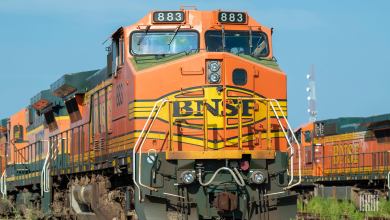
Railroads want price-fixing lawsuits at one venue
A U.S. judicial panel will hold a hearing in late January that will take up defendant Class I railroads’ request to move legal proceedings on fuel surcharge price fixing to one court.
New hopper cars and a high-efficiency train model at some elevators help boost volumes.
U.S. rail volumes fell 5% in 2019 amid trade worries, a sluggish industrial economy and a significant drop in coal carloads.
Lower rail volumes, an active Surface Transportation Board and a strike were among the key events that the U.S. and Canadian freight rail industry experienced this year.
The U.S. operations of the Class I railroads continue to shed employees.
The Federal Railroad Administration hopes to collect data on blocked rail crossings from the public and law enforcement.
Kansas City Southern and Canadian Pacific deliver goodwill to local communities along portions of their rail networks.
Private equity firms are likely to continue M&As in freight rail industry next year and beyond, observers say.
The continued dip in rail volumes comes as North American freight rail groups press for trade pact.
Stakeholders address the Surface Transportation Board, which is mulling over whether it should change the way it defines revenue adequacy.
Economic uncertainty weighs on rail volumes.
How the board calculates cost of capital is outdated. How much of an overhaul is needed?
The railroad will consolidate business segments to three groups from four to better adapt to market conditions.
U.S. rail volumes are down, but don’t call it a freight recession, according to Association of American Railroads executive.
Teck Resources opts not to renew 10-year deal for the transport of metallurgical coal.
The rail regulatory agency says the changes would help make the rate review process more accessible and transparent.
Railway Age reports NS wants to double-stack its trains as they move through Pittsburgh, but residents in the north side of the city are stacking up arguments and fighting back.
The railway attributes the record to its high efficiency train model and to collaboration with supply chain participants.
The changes come as the railroad deploys precision scheduled railroading.
Headcount within U.S. Class I rail operations tumbles amid declining rail volumes and the deployment of precision railroading.
The bill introduced by Sen. Dick Durbin (D-Illinois) would allow Amtrak to sue freight railroads for not giving Amtrak preference on freight rail-owned track.
Rail executives discussed short-term strategies for growing rail volumes amid expectations that volumes won’t pick up until well into 2020.
The railroad has completed the rollout of a cloud-based operational system.
In two unrelated announcements on Nov. 20, CP lays out plans to deepen network capacity.
The Federal Railroad Administration is proposing all states address highway-rail grade crossing safety.
U.S. rail volumes have been trending lower all year.
Gregg Mitchell promoted to new role after serving as chairman for Trinity’s highway products and logistics group.
The regulatory agency for rail receives a flurry of feedback on rail rate reasonableness and demurrage and accessorial charges.
U.S. rail trade associations say changes will help employees responding to unplanned events.
Lower operating expenses helped to increase profits.
The credit ratings firm sees coal and intermodal volumes under continued pressure next year.
Train crew size, healthcare are among the key issues, on top of grappling with systemic changes to the industry
Year-to-date U.S. rail traffic continues to trend lower.
The rail equipment and technology manufacturer sees international opportunities as an area for business to grow.
The rail equipment lessor said corrosion damage was found in 160 railcars.
The number of employees working for the U.S. operations of the Class I railroads slumps to its lowest level in years.
The Teamsters Canada Rail Conference could go on strike as early as Nov. 19 should talks deteriorate with Canadian National.
The rail equipment manufacturer said it delivered record railcar deliveries in the quarter.
Rail volumes fell yet again and the industry is casting its doubts about the fourth quarter.
Jim Blaze explains the new CSX trip compliance reporting… perhaps the first step for railroads to compete more effectively with the trucking industry.
The rail equipment manufacturer sees high utilization rate but says economy faces uncertainty.
Coal production in the region could fall significantly in 2020, affecting rail volumes.
Company eyes cross-border volume growth and efficiency improvements.
Rationalizing additional network assets is still a possibility in 2020.
Government initiatives are encouraging the freight rail sector to address cyber threats. But what else needs to be done?
With U.S. rail volumes slumping in the third quarter, can PSR soften that blow to the rail’s bottom line?
Excerpt: The companies promote and assign new roles to longstanding employees.
Awarded projects could benefit freight rail indirectly.
The proposed actions address major rail shipper complaints voiced to the Board earlier this year.
“We don’t know where the bridge went. We do know it went down, most of the middle sections did go down to the south.”
The rulemakings address cost of capital calculations and rail performance data for chemicals and plastics traffic; shippers also press Board to act on fuel surcharges.
The railway grappled with not only the potential for cold temperatures but also macro uncertainty in crafting plan.
Jim Blaze writes about the decisions that will go into determining 2020 capital expenditures by the freight railroads.
Year-to-date U.S. rail traffic down 3.8 percent from the same period in 2018.
To meet future rail demand, stakeholders must confront communication dysfunction.
The recommendations by the National Transportation Safety Board relate to a fatal October 2018 accident in which a moving train struck a stationary one.
As precision scheduled railroading takes hold, headcount levels drop to their lowest in years.
The rail equipment manufacturer will close its Boise facility and move operations to Erie.
Two lawmakers want more extensive review of the risks and practice of using tank cars to haul liquefied natural gas.
Trade uncertainty and loose truck capacity continue to weigh on rail traffic.
The trade group has been lobbying Congress to make permanent a tax credit for infrastructure investments.
The railroad, which has dedicated operations in Mexico, has invested in capital infrastructure related to energy.
The Surface Transportation Board has proposed two rules that could ease shippers’ burdens when contesting rail rates.
U.S. rail volumes are down nearly 4% year-to-date amid a 6.6% decline for coal and a 4% drop for intermodal.
The railroad was building the train when it derailed and caused a tank car to catch fire.
The Class I railroads are steadily implementing positive train control, but the railroads overall still have a ways to go before the December 2020 deadline.
Three Class I U.S. rail operations earned enough returns on investment in 2018 to support their capital projects.
Final investment decisions for new global LNG export plants are surging, a negative for future thermal coal demand.
Can carload rail become a volume and market share leader in today’s emerging high-tech freight logistics world? Or will it continue to exhibit a declining role?
The railcar manufacturer says the covered hoppers are shorter but enable faster grain discharges.
The two railroads said customers should expect delays and possible rerouting.
The decline in U.S. coal production could cost the railroads billions in lost revenue.
Weakness in the manufacturing sector is dragging U.S. rail volumes lower, AAR says.
Grain shippers wonder if the Canadian railways will keep up with demand in the 2019-20 crop year.
Slumping coal demand, trade wars and a competitive truck market are weighing on rail volumes for the remainder of the year.
The railroads say customers should expect delays and rerouting because of the hurricane
The new appointments could indicate how the companies are preparing to respond to future market trends.
Year-to-date U.S. rail volumes are still slumping this year, due in part to a competitive truck market for intermodal shipments.
Several intermodal containers on trains running between China to Europe run empty due to lack of exporter demand for capacity.
Market Voice Jim Blaze writes about rail intermodal and what is happening to this area of the railroad sector.
The railroad contends the Interstate Commerce Commission Termination Act and the Federal Railroad Safety Act preempt Oklahoma’s law.
The continued slump in U.S. rail volumes is putting pressure on overall North American rail volumes.
Headcount continues to fall at U.S. rail operations as the railroads implement precision scheduled railroading.
A federal appeals court denies a request by rail shippers to form a class lawsuit, and U.S. Senators press the Surface Transportation Board to take action.
Competition from other grain-producing countries weigh on U.S. grain exports – and on U.S. rail volumes for grain.
Year-to-date North American rail volumes fell 2.3 percent last week. But what about for the rest of the year?
The states of Illinois, Nevada and Washington are seeking to push ahead with state laws requiring a train crew size of at least two individuals, despite a federal declaration saying that such laws have been voided.
The announcements confirming Canada’s planned investments in rail infrastructure come as the country prepares for a federal election in October.
U.S. rail carloads no longer appear to be following the lead of broader economic indicators. Why? Look to concerns about rail service reliability and trade uncertainty as answers.
A short cost-benefit analysis of the mining, recycling and use of iron and steel.
CSX and Canadian National’s partnership to create new intermodal service between Montreal and Toronto and the greater New York City area is a strategy to expand each other’s geographical reach and compete with the long-haul trucking market.
Genesee and Wyoming sees second-quarter operating income decline amid lower freight revenues from its Australian and European operations and flat year-over-year revenue from its North American operations.
U.S. Senator Ron Wyden’s (D-Oregon) new bill would require the railroads to supply information on crude volumes to emergency responders, and it would mandate that the railroads share crude-by-rail data annually.
Second quarter revenue for BNSF rose 0.3 percent despite lower volumes for agricultural products, consumer products and industrial products.
“If a shipper can share some of its production forecast information to railroads, railroads can plan better to meet that capacity. Conversely, if railroads can open up and show where their empty railcars are to the shipper so that the shipper has a bit more confidence that the right number of railcars are going to show up, then the shipper can more confidently choose rail.”
A renewed focus on building western gran network capacity helped Canadian Pacific reach all-time records for grain hauls in the 2018-2019 crop year.
“I think we’re at a critical juncture. Six months from now I think we’ll be able to take a closer pulse to where things are.”
Blackjewel’s bankruptcy reminds the broader industrial sector of the vulnerability of U.S. coal production overall, particularly so for western U.S. coal production.
North American rail volumes are still lower year-over-year, but U.S. carloads recovered somewhat last week.
Train products manufacturer and supplier Wabtec lowered its sales guidance for 2019 but kept its projections for how much profit it expects to make from its operations.