The ‘ingenious strategy’ behind most truckers’ least favorite week of the year: International Roadcheck

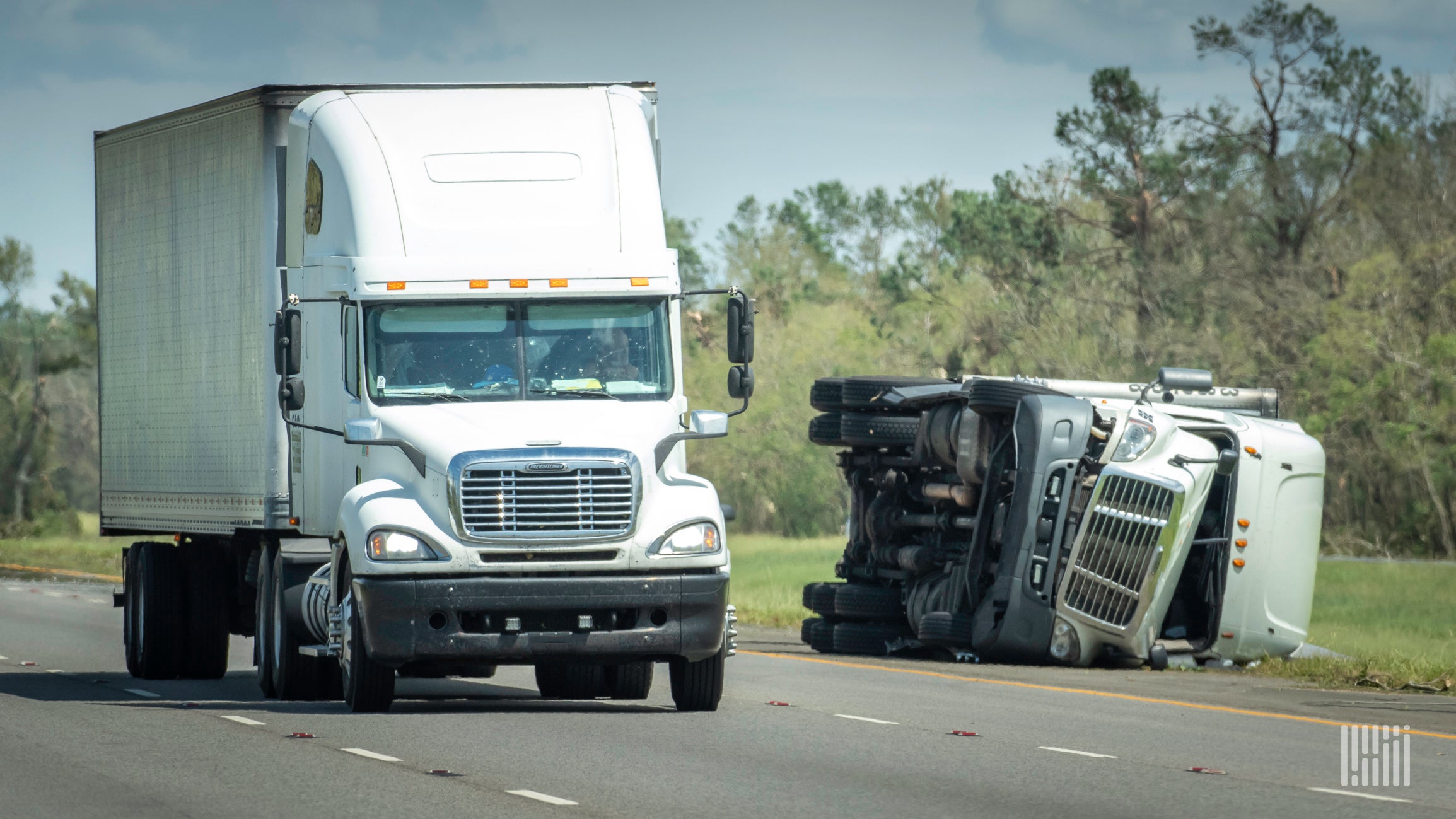
truck fallen over

International Roadcheck Week is hardly the sexiest topic in trucking, but it is a darn-tootin’ important one. Inspectors in the U.S. and Canada halt tens of thousands of trucks for vehicle inspections for a few days every summer or early fall. They remove thousands of trucks and drivers from the road; in 2021, 16.5% of inspected vehicles were put out of service along with 5.3% of drivers.

It’s uncommon for truck drivers to actually get their vehicles inspected at random during most of the year. To avoid International Roadcheck Week, many truckers simply don’t drive during that period of time — which, presumably, means more unsafe vehicles and drivers on the road outside of the inspection blitz. It’s a question that ate at Andrew Balthrop, a research associate at the University of Arkansas Sam M. Walton College of Business. 

Around 5% fewer one-person trucking companies are active during International Roadcheck Week. But Balthrop and his fellow researcher, Alex Scott of the University of Tennessee, found a major upside to the inspection blitz — even with all the folks who avoid it. According to their working paper published in March 2021, vehicles are safer a month before and after the inspection period. There’s a 1.8% reduction of vehicle violations, according to Balthrop and Scott’s analysis. Surprise inspection blitzes don’t result in the same uptick of compliance. 

I caught up with Balthrop about his research last week at FreightWaves’ Future of Supply Chain conference, and we chatted again on the phone this week about his findings on International Roadcheck Week.

Enjoy a bonus MODES and a lightly edited transcription of our phone interview: 

FREIGHTWAVES: For our readers who are not aware of what Roadcheck Week actually is, can you explain a little bit about what it and why it is important to drivers and companies?

BALTHROP: “The International Roadcheck is part of an alliance between the inspectors in Canada and the ones in Mexico and the U.S. to have a unified framework for making sure trucks are safe to operate. That should make it easier to go across borders when you have this kind of unified structure.

“In the U.S., one of these CVSA inspection blitzes is the International Roadcheck that happens for three days in the summer. Usually it’s a Tuesday, Wednesday and Thursday. And usually it’s the first week in June.

“And in it, they focus on Level One inspections, the North American Standard Inspection where they inspect the driver records, the hours of service, the licensure and I believe medical records as well. Then they inspect the truck. It’s an in-depth inspection where the inspector will actually crawl under the truck to look at various things. And these inspections, from the data that I’ve seen, take about a half an hour on average.

“During the Roadcheck Week, they’ll do about 60,000 inspections, so 20,000 a day. They’re going to pull over a lot of trucks, and this can cause a little bit of congestion at the weigh stations and the roadside inspections localities as the inspectors are doing these inspections.”

Roadcheck Week doesn’t catch all truck drivers, but it has a long-lasting benefit to safety

FREIGHTWAVES: So, can most drivers kind of expect to be pulled over? How likely is that?

BALTHROP: “There’s 1 million or 3 million trucks on the road, somewhere around there on any given day. With 20,000 inspections, most drivers still will not get inspected, but there’s going to be a higher proportion of drivers inspected. 

“You’re more likely to get inspected on these days. If you don’t have a recent inspection on your record, or if you have a bad recent inspection on your record, you’re more likely to be pulled over on these days.”

FREIGHTWAVES: Your research focused on that it’s just unusual that this inspection is announced, that it’s planned. We were talking before about how normally, if you’re trying to assure quality or compliance, you would not announce an inspection in advance. It would be more of a surprise-type situation. 

Can you walk us through why that’s so unusual, or what’s the rationale that you see behind announcing it in advance?

BALTHROP: “It is unusual, and on the surface, it doesn’t make much sense, but it turns out to be kind of an ingenious strategy. So I’ll walk through it here. 

“Over the course of a year, there’ll be 2 million inspections of 3 or 4 million trucks out there. The average rate of inspections is pretty low. It’s not uncommon for truckers to go years without having an inspection. With this low inspection intensity, the FMCSA has sort of a problem of, how does it get anybody to abide by the regulations?

“I’m a jaded economist, and I don’t worry or consider too much ethics and morality and all that kind of stuff. It comes down to incentives for drivers to follow these inspections. The incentives do guide behavior. So, how could the FMCSA incentivize drivers to follow these regulations more closely and adhere to the standards?

“They do this by announcing the blitz. This does two things. On one side, it allows everybody to prepare in advance. There’s a bunch of anecdotal evidence out there that people do prepare for these blitzes in advance. They will have their trucks inspected beforehand for any problems. They’ll time maintenance and upkeep in advance to make sure that their vehicles are in order. “They’ll be a little bit more cognizant of the driver-side regulations. One thing we notice in our study is that hours-of-service violations really drop during these extensions, because people see them coming. They don’t fudge the books in any way.”

Owner-operators can evade Roadcheck Week. Big carriers, not so much.

BALTHROP: “The issue with the announcement, on the flip side, is that it allows people to just dodge the inspection entirely. For a long time, people have talked about how owner-operators and smaller carriers time their vacations for this particular time. They could do this for a couple reasons. To avoid the hassle is a nice way to put it, but it also allows you to be noncompliant to avoid the high-intensity inspections.

“You have this balance here that on one side you get the behavior you want with people complying with regulations. That’s the behavior the FMCSA wants. But on the flip side, you get a bunch of people that are kind of outright dodging inspections.

“When you compare these two things on balance, the policy is actually pretty effective because you get a lot of people focused on maintaining their trucks and obeying the rules during that particular week. Especially with the vehicle maintenance stuff, that lasts a long time. 

“In our research, we saw that vehicle violations, a month before and up to a month afterwards, is when you still notice your vehicle violations. That trucks are kind of better maintained around these blitzes.

“The ingenious aspect of it is that the FMCSA, by concentrating their inspection resources all at one time and announcing it, they’re making it clear that they’re serious about enforcing these regulations and everybody prepares for it. For the number of inspections that are happening, you get fewer tickets than you would have otherwise expected.

“The FMCSA, they’re putting people through a little bit of a hassle, but they’re not having to write a bunch of tickets to get people to comply. They’re not really punishing a whole bunch of people because, by making this apparent that this is going to happen, people comply and the FMCSA gets what they want essentially without having to come down on carriers too hard.”

A convenient time for a vacation, indeed

FREIGHTWAVES: OK, interesting. And how does this pattern of shutting down, how does that compare for an owner-operator versus a driver for a big fleet?

BALTHROP: “If you’re a motor carrier with thousands of power units, you can’t just pack up and not do business on a particular day. They just don’t have that option. So they get inspected at a higher intensity, and you see the larger carriers kind of more focused on making sure that they’re prepared for these inspections. With so many inspections, the larger carriers are going to be inspected at higher rates. You can really damage your reputation if your equipment isn’t in order on this particular day. 

“Versus the smaller carriers, especially if you’re talking about a single-vehicle fleet, an owner-operator type, it is not that difficult to just not work for those three days. And so you see a lot about that. 

“In terms of what the roadway composition looks like, if we look at inspection data and relative to a typical day with the usual inspections, on these Roadcheck days, you have about 5% fewer owner-operators on the road than you otherwise would expect.”

FREIGHTWAVES: Wow. And when you say owner-operators, you also mean just like fleets with just —

BALTHROP: “One-vehicle fleets.”

FREIGHTWAVES: OK, that’s interesting.

BALTHROP: “You know, you see a little bit of effect with the smaller fleets, below six vehicles, but it basically disappears by the time you get to a hundred vehicles.

“This effect is being driven by smaller carriers staying off the road in terms of avoidance. You see this goes also how you would expect; it’s also older vehicles that stay off the road. This is correlated with carrier size. The larger carriers use newer vehicles and owner-operators tend to use some of the older vehicles. But it’s particularly the older vehicles that are off the road.

“This makes intuitive sense. Older vehicles are more costly to keep compliant. Maintenance is more costly, and they’ve been around longer so there’s time for more stuff to have broken essentially.

How a truck driver gets stopped for inspection

FREIGHTWAVES: Can you explain a little bit more, the idea of having this inspection history and why it would benefit a larger or small carrier?

BALTHROP: “Getting flagged for inspection is sort of random, but not totally. If somebody notices something obviously wrong with your truck, that’s ground for a more in-depth inspection. Or if you get pulled over for some other reason, this can be grounds for inspection of some type. 

“But there’s also the inspection selection service. The computer program that is random, that it randomly flags people in for inspection, but it’s based on your inspection history.

“So if your firm hasn’t been inspected recently, or if your carrier doesn’t have a very dense inspection history, you’ll be more likely to trigger that system to pull you in and have you inspected. If you have a dense inspection history, you’re less likely to get inspected.”

FREIGHTWAVES: So how do you get pulled over for inspection? As a person who only drives a passenger car, my main interaction with being pulled over is, I’m driving down the freeway or wherever, and I get stopped by the police. How does it work for a truck driver? How does getting pulled over or inspected work in that way?

BALTHROP: “The law is that you cannot pass a weigh station without pulling in and getting weighed. At that point they may flag you to be inspected. Now, in the past decade or two, there’s been a bunch of electronic devices that are installed in cabs. You may have heard of PrePass or Drivewise. This allows you to pass weigh stations. 

“I don’t have data on how many trucks have the in-cab devices. But from a trucking perspective, they’re so convenient that you don’t have to stop every time you cross a state line. I think the vast, overwhelming majority of trucks have some sort of one of these electronic devices. The DOT inspectors at these roadside inspection points have a dial they can twist essentially about how many people they want to inspect. 

“So during the roadcheck inspection week, they’ll crank that dial all the way up and pull everybody over. And if they get too backed up, they might crank it back down a little bit and so on.”

FREIGHTWAVES: OK, interesting. It reminds me of a highly sophisticated E‑ZPass.

A $10 million-plus expense to trucking companies every year … but it’s worth it if just one fatal crash is avoided

FREIGHTWAVES: Zooming out, when we hear about large truck crashes, something like a vehicle maintenance issue is not really the most sexy explanation. But just looking at the FMCSA data, in 29% of all truck crashes, a major factor is brake problems. So it seems like a lot of the truck crashes on the road are caused by vehicle maintenance, versus something like the driver using illegal drugs or some other sort of more dramatic explanation. Can you speak a little bit to why this sort of vehicle maintenance is important for safety in preventing large crashes?

BALTHROP: “We did a little bit of a back-of-the-envelope cost benefit analysis of this. Let me try and make sure I remember it clearly, but we have it in the paper that the cost of this on one side is that you have the compliance costs the firms are undertaking, and then you have to add to that the delay costs from doing this, and then the cost of the inspection itself, having to pay federal inspectors to do this.

“On the benefit side, it reduces crashes. So when we add up, just looking at the cost of what an inspection is, we don’t have a good idea of how to measure the compliance cost. It’d be fun to measure the delay cost, but I don’t have good enough price data on that to get at that cost. 

“But if you look at what the cost of an inspection is, it is something like $100 or $120 is what you would pay to have one of these inspections done privately. A lot of people do this in the run-up to inspections, and have it done privately so that you can fix whatever the problems are and be sure that you would pass the FMCSA inspection.

“With that $120 figure, if you aggregate that up to 60,000 inspections or whatever, and you take that in comparison, I’m going to give you a bad figure here, it’s on the order of $10 million. That is about the value of a statistical human life. Looking at this economically, it’s worthwhile if it saves one human life. If you identify just one faulty brake system that would’ve resulted in an accident, you’re getting some value out of the program. 

“When you add those other costs in there, we’re going to need to save a couple of lives, but in terms of cost benefit analysis with this kind of stuff, we’re usually looking at orders of magnitude differences in cost and benefits to say something for sure. 

“If you can save just a couple lives, this program will pay for itself.”

Time to start inspecting in the winter

FREIGHTWAVES: Then one last question: Is there any rationale for this program happening in the summer? 

BALTHROP: “I think part of it is that for the inspectors this gets much harder and much more miserable to do in winter conditions.”

FREIGHTWAVES: That makes sense.

BALTHROP: “Inspectors are less productive. One of the things that we talk about in the paper, that they have in addition to the International Roadcheck, is that they have Brake Week where they focus a little bit more on brake inspections. You have Operation Safe Driver a little bit later on in the summer, usually in September, where it’s a little bit more focused on passenger vehicles and how they drive around these trucks.

“But there’s not one in the winter time. There’s an unannounced brake check that usually happens in May, a surprise inspection that’s just one day. But you’re right in pointing out that it might be worthwhile having one of these in the wintertime. You have this periodic high-intensity inspection that kind of incentivizes everybody to be compliant through the summer. 

“But there’s nothing in the winter, so that’s an area. But if I was managing the FMCSA, that would be one of the first questions I ask, ‘Why don’t we have one of these in the wintertime?’”

FREIGHTWAVES: That makes sense. Maybe they can do it in the South or something. Maybe a Miami January inspection … 

That’s it for this special bonus MODES. Subscribe here if you’re not already receiving MODES in your inbox every Thursday. Email the reporter at rpremack@www.freightwaves.com with your own tales on International Roadcheck Week or any other trucking topics. 

Why the Northeast is quietly running out of diesel

The nozzle of a diesel fuel pump is inserted into the tank of a commercial truck as its driver looks on the bankground.

The East Coast of the U.S. is reporting its lowest seasonal diesel inventory on record. And some trucking companies appear spooked.

The East Coast typically stores around 62 million barrels of diesel during the month of May, according to Department of Energy data. But as of last Friday, that region of the U.S. is reporting under 52 million barrels. 

The sharp increase of diesel prices has been a major stressor in America’s $800 billion trucking industry since the beginning of 2022. According to DOE figures, the price per gallon of diesel has reached record highs — a whopping $5.62 per gallon. It’s even higher on the East Coast at $5.90, up 63% from the beginning of this year. 

When relief is coming isn’t yet clear, and experts say higher prices are the only way to attract more diesel into the Northeast.

“I wish I had some good news for the Northeast, but it’s bedlam,” Tom Kloza, global head of energy analysis at OPIS, told FreightWaves. 

2022 has seen record-setting diesel prices. (SONAR)

Everyday Americans don’t fill up their cars with diesel, but the fuel powers our nation’s agriculture, industrial and transportation networks. More expensive diesel means the price of everything is liable to increase. Trucks, trains, barges and the like consumed about 122 million gallons of diesel per day in 2020

Patrick DeHaan, a vice president of communications at fuel price site GasBuddy, reported that retail truck stops are hauling fuel from the Great Lakes to the Northeast, calling it “extraordinary.” We’ve also seen anecdotal reports from truck drivers posting company memos:

Pilot Flying J and Love’s, two of America’s largest truck stops, told the Wall Street Journal yesterday that they were not planning to restrict diesel purchases, but were monitoring low diesel inventory.

Not unlike every other supply chain crunch we’ve seen in the past few years, the cause of the Northeast’s diesel shortage is multifaceted. A yearslong degradation of refineries is rubbing against the Gulf Coast preferring to ship its oil to Europe and Latin America.

Here’s a breakdown:

1. The East Coast has lost half of its refineries. 

As Bloomberg’s Javier Blas wrote on May 4 (emphasis ours): 

In the past 15 years, the number of refineries on the U.S. East Coast has halved to just seven. The closures have reduced the region’s oil processing capacity to just 818,000 barrels per day, down from 1.64 million barrels per day in 2009. Regional oil demand, however, is stronger.

Rory Johnston, a managing director at Toronto-based research firm Price Street and writer of the newsletter Commodity Context, told FreightWaves that refining is a “thankless industry,” with intense regulations that have limited the opening of new refineries. The Great Recession of 2008 led to several East Coast refineries shuttering, but there have been more recent shutdowns too. One major Philadelphia refinery shuttered in 2019 after a giant fire (and it already had declared bankruptcy), and another refinery in Newfoundland shut down in 2020.

2. It’s a financial risk to bring diesel to the Northeast.

The Northeast has increasingly relied on diesel from the Gulf region. Much of that diesel travels to the Northeast through the famous and much-adored Colonial Pipeline. You may remember the 5,500-mile pipeline from last year, when a ransomware attack shuttered it for nearly a week!  

It takes 18 days for oil to travel on the Colonial Pipeline from its source in Houston to New York City (or, more specifically, Linden, New Jersey), Kloza said.

That’s a long enough time to prioritize Colonial pipelines financially risky for traders — or, as Kloza said, “incredibly dangerous” — thanks to a concept called “backwardation.”

Backwardation refers to the market condition in which the spot price of a commodity like diesel is higher than its futures price. It’s only gotten stronger over time in the diesel market, Kloza said. So, a company could send off a shipment of diesel and find that it dropped by $1 per gallon in the time the diesel traveled from the Gulf Coast to New York — er, New Jersey. That could mean hundreds of thousands or more in lost profits, so traders often avoid such a fate.

“We’re not in an era where there are any U.S. refiners or big U.S. oil companies who would ‘take one for the team’ and bring cargo in where it’s needed,” Kloza said. 

The desperation is showing in New England and the mid-Atlantic regions. New England diesel retail prices are up 75% from the beginning of 2022, per DOE data. In the mid-Atlantic, diesel is up 67%. 

It’s not worth the risk, even amid ultra-high prices. As FreightWaves’ Kingston reported last week, the spread between a gallon of diesel in the Gulf Coast and its New York harbor price is usually a few cents. Last week, that swung up to 66 cents.

But that uptick still isn’t justifying moving oil to the Northeast — particularly when traders can make so much more money selling diesel abroad. 

3. Of course, we can blame COVID and the crisis in Ukraine. 

The catalyst for this diesel shortage, of course, is the ongoing conflict in Ukraine — particularly Europe’s desperation for diesel after weaning off Russian molecules. 

As CNBC reported in March, Europe is a net importer of diesel. Europe consumed some 6.8 million barrels of diesel each day in 2019; Russia exported some 600,000 barrels per day of that. Today, Europe has only eliminated one-third of its Russian diesel, so prices are expected to continue to climb amid that transition. Latin America, too, has been clammoring for U.S. diesel.

The Gulf Coast has been happy to provide such diesel, amid “insane” prices for diesel abroad, said Johnston. Waterborne exports of diesel from the U.S. Gulf Coast hit record highs last month, according to oil analytics firm Vortexa. (The records only date back to 2016.)

Naturally, COVID is also to blame for the Northeast’s run on diesel. Those refineries still retained on the East Coast scaled back during the pandemic due to staffing issues. It takes six months to a year to reignite refineries that were previously shuttered, Kloza said.

The ‘everything shortage’ endures

It’s been a tale as old as, well, last year. An industry is quietly hampered by supply issues for years, or even decades, and COVID pulls back the curtains on its unsteady foundation. It’s particularly jarring for commodities we never thought about before, like shipping containers or pallets, but that quietly underpinned our livelihood all along. 

Recall the Great Lumber Shortage of 2020? Big Lumber had unusually low stockpiles of wood by the summer of 2020, thanks to a vicious 2019 in the lumber industry shuttering sawmills and the spring of 2020 sparking staffing issues. (There was also a nasty beetle infestation.) Those in lumber expected the pandemic to slow the economy, not ignite online shopping, construction and housing mania. It meant lumber went from around $350 per thousand board feet pre-pandemic to a crushing $1,515 by the spring of 2021. The lumber price roller coaster persists today.  

In diesel, there’s no beetle infestation, but there are plenty of other headaches. It all means higher fuel prices on the East Coast, particularly the Northeast, to lure molecules from the Gulf Coast. And, down the line, probably more expensive stuff for you. 

Do you work in the trucking industry? Do you want to say that you hate or love MODES? Are you simply wanting to chitchat? Email the author at rpremack@www.freightwaves.com, and don’t forget to subscribe to MODES.

Updated on May 13 with the latest comments from truck stops.

Exclusive: Central Freight Lines to shut down after 96 years

Nearly, 2,100 employees will be laid off right before Christmas. Central Freight Lines is the largest trucking company to close since Celadon ceased operations in 2019.


Waco, Texas-based Central Freight Lines has notified drivers, employees and customers that the less-than-truckload carrier plans to wind down operations on Monday after 96 years, the company’s president told FreightWaves on Saturday.

“It’s just horrible,” said CFL President Bruce Kalem.

A source close to CFL told FreightWaves that CFL had “too much debt and too many unpaid bills” to continue operating, despite exploring all available options to keep its doors open.

Kalem agreed.

“Years of operating losses and struggles for many years sapped our liquidity, and we had no other place to go at this point,” Kalem told FreightWaves. “Nobody is going to make money on this closing, nobody.” 

Central Freight will cease picking up new shipments effective Monday and expects to deliver substantially all freight in its system by Dec. 20, according to a company statement.

A source familiar with the company said he is unsure whether CFL will file Chapter 7 or “liquidate outside of bankruptcy,” but that the LTL carrier has no plans to reorganize.

The company reshuffled its executive team nearly a year ago in an effort to stay afloat, including adding the company’s owner, Jerry Moyes, as CFL’s interim president and chief executive officer. Moyes remained CEO after Kalem was elevated to president in July.

“I think it was surprising that there wasn’t a buyer for the entire company, but buyers were interested in certain pieces but not in the whole thing,” the source, who didn’t want to be identified, told FreightWaves. “Part of it could have been that just the network was so expansive that there was too much overlap with some of the buyers that they didn’t need locations or employees in the places where they already had strong operations.”

Third-party logistics provider GlobalTranz notified its customers that it had removed CFL as “a blanket and CSP carrier option immediately, to prevent any new bookings,” multiple sources told FreightWaves on Saturday.

CFL, which has over 2,100 employees, including 1,325 drivers, and 1,600 power units, is in discussions with “key customers and vendors and expects sufficient liquidity to complete deliveries over the next week in an orderly manner,” a CFL spokesperson said. Approximately 820 employees are based at the company headquarters in Waco.

Despite diligent efforts, CFL “was unable to gain commitments to fund ongoing operations, find a buyer of the entire business or fund a Chapter 11 reorganization,” another source familiar with the company told FreightWaves.

Kalem said the company had 65 terminals prior to its decision to shutter operations. 

FreightWaves received a tip from a source nearly two weeks ago that CFL wasn’t renewing its East Coast terminal leases but was unable to confirm the information with CFL executives. 

Another source told FreightWaves that some of the LTL carrier’s West Coast terminals had been sold recently, but that no reason was given for the transactions.

At that time, Kalem said the company was “working to find alternatives” and couldn’t speak because of nondisclosure agreements. He said executives at CFL, including Moyes, were trying to do everything to “save the company.”

“Jerry [Moyes] pumped a lot of money into the company, but it just wasn’t enough,” Kalem said.

Kalem said he’s aware that a large carrier is interested in hiring many of CFL’s drivers but isn’t able to name names at this point. 

“Central Freight is in negotiations to sell a substantial portion of its equipment,” the company said in a statement. “Additionally, Central Freight is coordinating with other regional LTL carriers to afford its employees opportunities to apply for other LTL jobs in their area.”

As of late Saturday night, Kalem said fuel cards are working and drivers will be paid for freight they’ve hauled for the LTL carrier until all freight is delivered by the Dec. 20 target date.

“I’m going to work feverishly with the time I have left to get these good people jobs — I owe it to them,” Kalem told FreightWaves. “We are going to pay our drivers — that’s why we had to close it like we’re doing now. We are going to deliver all of the freight that’s in our system by next week, and we believe we can do that.”

During the outset of the pandemic, Central Freight Lines was one of four trucking-related companies that received the maximum award of $10 million through the U.S. Small Business Administration’s Paycheck Protection Program (PPP). This occurred around the time that CFL drivers and employees were forced to take pay cuts, a move that didn’t go over well with drivers.

“It all went to payroll,” Kalem said about the PPP funds. “Yes, our employees and drivers did take a pay cut over the past few years, and we gave most of it back, even raised pay over the past several months, but it just wasn’t enough to attract drivers.”

FreightWaves staffers Todd Maiden, Timothy Dooner and JP Hampstead contributed to this report.


Watch: Central Freight Lines’ impact on the LTL market


FreightWaves CEO and founder Craig Fuller reacts to the Central Freight Lines news:

“With Central struggling for many years and unable to reach profitability, it makes sense that they would want to liquidate while equipment and real estate are fetching record prices.”


Central Freight Lines statement

Here is the statement given by Central Freight Lines to FreightWaves late Saturday after reports surfaced of its impending closure:

“We make this announcement with a heavy heart and extreme regret that the Company cannot continue after nearly 100 years in operation. We would like to thank our outstanding workforce for persevering and for professionally completing the wind-down while supporting each other. Additionally, we thank our customers, vendors, equipment providers, and other stakeholders for their loyalty and support.

“The Company explored all available options to keep operations going. However, operating losses sapped all remaining sources of liquidity, and the Company’s liabilities far exceed its assets, all of which are subject to liens in favor of multiple creditors. Despite diligent efforts, the Company was unable to gain commitments to fund ongoing operations, find a buyer of the entire business, or fund a Chapter 11 reorganization. Given its limited remaining resources, the Company concluded that the best alternative was a safe and orderly wind-down. As we complete the wind-down process, our primary goal will be to offer the smoothest possible transition for all stakeholders while maximizing the amount available to apply toward the Company’s obligations.

“Central Freight is in negotiations to sell a substantial portion of its equipment. Additionally, Central Freight is coordinating with other regional LTL carriers to afford its employees opportunities to apply for other LTL jobs in their area. Discussions are ongoing and no purchase of assets or offer of employment is guaranteed.”


Brief history of Central Freight Lines

1925Founded in Waco, Texas, by Woody Callan Sr.
1927Institutes regular routes in Texas between Dallas, Fort Worth and Austin.
1938Dallas facility opens as world’s largest freight facility.
1991Receives 48-state interstate operating authority, expands into Oklahoma.
1993Joins Roadway Regional Group and begins service in Louisiana.
1994Expands into Colorado, Kansas, Missouri, Illinois and Mississippi.
1995Consolidation of Central, Coles, Spartan and Viking Freight Systems into Viking Freight Inc. is announced. Central’s Waco corporate HQ starts closure.
1996Becomes the Southwestern Division of Viking Freight Inc.
1997Investment group led by senior Central management purchases assets of former CFL from Viking Freight and reopens as a new Central Freight Lines.
1999Expands into California and Nevada.
2009CFL Network provides service to Idaho, Utah, Minnesota and Wisconsin.
2013Acquires Circle Delivery of Tennessee.
2014Acquires DTI, a Georgia LTL carrier.
2017Acquires Wilson; new division created with an increase of 80 terminals.
2020Wins Carrier of the Year from GlobalTranz.
Acquires Volunteer Express Inc. of Dresden, Tennessee.
Source: Central Freight Lines

Warehouse cramming is about to begin — Freightonomics

nVision Global, is a leading Global Freight Audit, Supply Chain Management Services company offering enterprise-wide supply chain solutions. With over 4,000 global business “Partners”, nVision Global not only provides prompt, accurate Freight Audit Solutions, but also providing industry-leading Supply Chain Information Management solutions and services necessary to help its clients maximize efficiencies within their supply chain. To learn more, visit www.nvisionglobal.com

Warehouse space is at a premium right now and with peak season right around the corner, shippers are starting to scramble for space. 

Zach Strickland and Anthony Smith look into what shippers are doing to prepare for the end-of-year crunch. They welcome Zac Rogers from Colorado State University to the show to talk through the industry tightness. 

The three also talk about the latest Logistics Managers Index results and what they mean for the fourth quarter of 2021. 

You can find more Freightonomics episodes and recaps for all our live podcasts here.

Seasonality pushing rejections and rates higher ahead of the Fourth

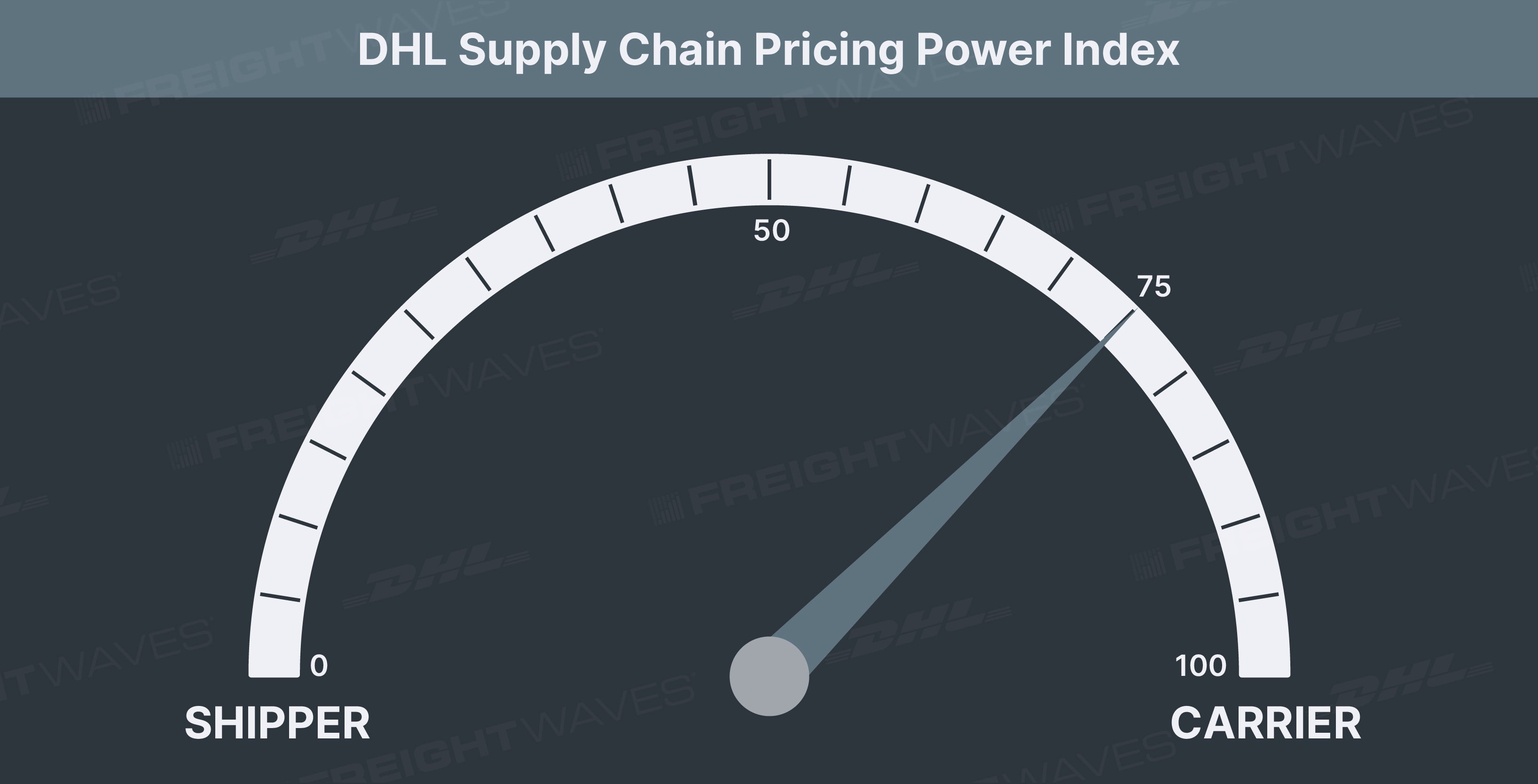
This week’s DHL Supply Chain Pricing Power Index: 75 (Carriers)

Last week’s DHL Supply Chain Pricing Power Index: 70 (Carriers) 

Three-month DHL Supply Chain Pricing Power Index Outlook: 70 (Carriers)

The DHL Supply Chain Pricing Power Index uses the analytics and data in FreightWaves SONAR to analyze the market and estimate the negotiating power for rates between shippers and carriers. 

The Pricing Power Index is based on the following indicators:

Load volumes: Absolute levels positive for carriers, momentum neutral

The Outbound Tender Volume Index at 15,980 is nominally higher now than basically at any point in the past 12 months with the exception of the week prior to Thanksgiving/Black Friday last year. OTVI captures all electronic tenders, including rejected ones, so when accounting for the rejection rate, we can get an even more accurate look at volumes. 

OTVI rose through the back half of May into the national holiday and has risen even further since. Throughout the back half of May and into the middle of June, tender rejections declined substantially. Meaning, current volume throughput is actually understated when comparing OTVI now to OTVI in November 2020. After adjusting for rejected tenders, the accepted outbound tender volume index is just 2.2% below the 2020 peak in November. At that time, OTVI surged towards 17,000, but the rejection rate moved in-kind towards its natural ceiling of 28%. So, the total accepted freight tenders in mid-June is comparable to the peakiest of peak seasons in 2020. Incredible. 

However, since the middle of June, tender rejections have begun increasing again heading into Independence Day, a time when many drivers spend time off the road with their families. The move higher in OTVI this week has been driven primarily by higher rejection rates, rather than higher freight demand. 

Over the past month, the drivers of freight volumes have continued to be imports and from just about every port. The west coast continues to provide seemingly non-stop container ships, while Houston, New Orleans, Miami and Savannah are seeing very strong throughput as well. 

It is van volumes that are driving freight markets higher right now. The Reefer Outbound Tender Volume index has tumbled 25% since its all-time high in the weeks after the polar vortex in February. Since Memorial Day, ROTVI has fallen another 10.5%. This is likely a factor of declining grocery demand, but I would expect the trend to reverse course in the near future as summer festivities accelerate. 

Dry van volumes pushed higher in the back half of May and into June while reefer volumes have declined significantly. 

SONAR: VOTVI.USA (Blue); ROTVI.USA (Green)

The congestion at our nation’s ports has spread from Los Angeles and Long Beach to Oakland, California. The California coastline is a parking lot of container ships, most of which are full to the brim with imports, awaiting berth. As detailed in the economic section, there are some signs that the reversion is underway with Americans paring back spending on pandemic superstar categories in favor of airlines, lodging and entertainment. But spending remains strong despite the moderation, and low inventory levels offset much of the decline that will occur from slowing demand. Real inventories are 3% higher now than pre-pandemic, but real sales growth is far outpacing inventory growth, leading to the lowest inventory-to-sales ratio in decades. 

On the manufacturing side, the ISM Manufacturing PMI expanded in May after declining in April. We’ve been in expansionary territory for 12 consecutive months. New orders, production, imports/exports and employment are all growing. The major issues should come as no surprise: Deliveries are slowing, backlogs are growing and inventories are too low. 

In all, there are many, many catalysts to keep freight demand strong for the foreseeable future. Americans are traveling and spending on services at a high clip, but the high savings rate is enabling it to occur without a massive detriment to goods spending. 

SONAR: OTVI.USA (2021 Blue; 2020 Green; 2019 Orange; 2018  Purple)

Tender rejections: Absolute level and momentum positive for carriers

After declining steadily from mid-March to mid-May, the Outbound Tender Reject Index has reversed course heading into Independence Day. This is typical for a national holiday as carriers selectively choose loads to bring drivers closer to home. OTRI now sits above 25% for the first time in June. 

One of our newest indices in SONAR gives us the ability to compare markets on as close to an apples-to-apples basis as possible. FreightWaves’ Carrier Trend Market Score indices are divided into two perspectives – shipper/broker and carrier. The scores are positioned on a scale from 1-100 and have values measuring van and refrigerated (reefer) capacity. The higher values represent more favorable trends for whichever perspective. For instance, a value near the high-end of the range would suggest very favorable conditions for carriers in our carrier capacity trend score index. 

For the past several weeks, capacity disparities have been driven by import volumes. The markets with the tightest carrier capacity coincide with the nation’s busiest ports. Ontario, California, Savannah, Georgia, and Atlanta all have carrier capacity trend market scores of 100. 

SONAR: Capacity Trend Market Score (Carriers – VAN)

By mode. Reefer rejection rates tumbled from it’s all-time high in March to under 35% in mid-June before popping higher over the past two weeks. Reefer rejections are still quite high from a historical standpoint at 38%, but are significantly lower than just three months ago when reefer carriers were rejecting half of all electronically tendered loads. 

SONAR: VOTRI.USA (Blue); ROTRI.USA (Orange)

Dry van tenders make up the majority of all tenders, so the van rejection rate mirrors the aggregate index closely. Van rejections have surged from ~23% to ~26% over the past two weeks. 

Yes, one-in-four loads being rejected is not ideal, but it’s better than 30%. I am unaware of any meaningful signals that capacity is being added at a rate that would change my outlook. With so many catalysts for demand, and many constraints on drivers including the Drug & Alcohol Clearinghouse, driver training school closures and continued government unemployment benefits, the outlook is tight throughout this year and into 2022. That’s not to say we won’t see improvement as consumers revert to pre-pandemic spending habits and drivers enter or reenter the market. But I’m not expecting any quick reversal of this environment; there are simply too many catalysts driving volume and suppressing capacity. 

SONAR: OTRI.USA (2020/21 Blue; 2020 Green; 2019 Orange)

Freight rates: Absolute level and momentum positive for carriers

Throughout June, spot rates have moderated while contract rates have pushed higher. The Truckstop.com dry van rate per mile (incl. fuel) has fallen from $3.21 to $3.11 since the beginning of June, while FreightWaves van contract rates have risen from $2.50 to $2.59/mile, exclusive of fuel. 

I still believe the Truckstop.com dry van national average will not retest the post-vortex surge pricing that brought spot rates up to an all-time high of $3.30. But, there aren’t many catalysts to bring spot rates down anytime soon either. Demand is unwavering with continued strong consumer goods demand, humming industrial recovery and a potentially cooling, yet still sizzling, hot housing market. And carriers can’t fill enough trucks to keep up with demand. 

Prior to the seasonal movements we’re seeing in tender rejections, routing guides generally had been improving through Q2. We should continue to see a convergence between spot and contract rates, but spot rates will remain historically very elevated throughout the summer as demand simply outstrips capacity. 

SONAR: TSTOPVRPM.USA (Blue); VCRPM1.USA (Green)  

Economic stats: Momentum and absolute level neutral

Several economic releases this week are worth noting.

Weekly jobless claims were released Thursday and give us one of the best close-to-real-time indicators of the overall economy.  This week, the data was again very promising as the labor market continues on a bumpy but trajectorially stable recovery path. 

First-time filings totaled 411,000 for the week ended June 19, a slight decrease from the previous total of 418,000 but worse than the 380,000 Dow Jones estimate, the Labor Department reported Thursday. Initial claims have held above 400,000 for consecutive weeks after falling to a pandemic low of 374,000 three weeks ago. As things stand, the current level of initial claims is about double where it was prior to the Covid-19 pandemic. 

The good news on the jobs front is that continuing claims are on the decline, falling to 3.39 million, a drop of 144,000. That number runs a week behind the headline claims total.

Initial jobless claims (weekly in May 2020-May 2021)

At the time of writing, the newest weekly data for the week ending May 29 had not been updated in SONAR. This week, claims fell from 405,000 to 385,000. 

SONAR: IJC.USA

Consumer. Turning to consumer spending, as measured by Bank of America weekly card (both debit and credit) spending data, total card spending (TCS) in the latest week accelerated to 22% over 2019. This is the first time in June that TCS has topped 20% over 2019, but spending has been running up 16-19% consistently on a two-year comp for months. For contect, the average pre-pandemic two-year growth rate was about 8% (from 2012 to 2019). 

The Bank of America team highlighted service spending in the nation’s two largest state economies, California and New York, which are now fully reopened. Spending at restaurants is now well above 2019 in both states, and the team believes there is more capacity for spending to accelerate in the states that were slower to reopen given pent-up demand. 

There was also a notable acceleration in spending on clothing this week, according to Bank of America. It could be a reversal from some softening in the early weeks of June, or an indication of people refreshing wardrobes ahead of a return to work, more travel and vacations. One tepid statement for freight markets from this week;s report: Leisure spending is on the rise and durable goods spending is flatlining.  

FreightWaves’ Flatbed Outbound Tender Reject Index, both a measure of relative demand and capacity, moves directionally with the ISM PMI. 

SONAR: ISM.PMI (Blue); FOTRI.USA (Green) 

Manufacturing. Over the past two weeks, regional manufacturing surveys have reported generally positive readings amid logistical challenges. The New York Fed’s Empire State business conditions index declined 6.9 points to 17.4 in June, retreating from strong readings the past two months. The Empire State Index is a diffusion index with a baseline of zero; any reading above zero indicates improving or expansionary conditions. 

Delivery times lengthened to a new record during the month, new orders and shipments fell, and inventories entered negative territory. The supply chain and transportation challenges are as visible upstream as downstream, but overall the manufacturing sector is handling. Growth continued throughout the second quarter in both the Empire State and Philly Fed indices. 

The Philadelphia Federal Reserve’s business activity index edged lower to a still robust 30.7 in June from 31.5 in the prior month. Unlike NY, the pace of shipments growth accelerated in the Philly region during June. The employment subcomponent rose to a very healthy 30.7 from 19.3 last month, the regional bank said. 

Record-long lead times, wide-scale shortages of critical basic materials, rising commodities prices and difficulties in transporting products are continuing to affect all segments of the manufacturing economy, but demand remains strong. 

For more information on the FreightWaves Freight Intel Group, please contact Kevin Hill at khill@www.freightwaves.com or Andrew Cox at acox@www.freightwaves.com.

Check out the newest episodes of our podcast, Great Quarter, Guys, here.

Project44 acquires ClearMetal to strengthen predictive tools

Project44, a leader in real-time visibility of the global supply chain, announced on Thursday it has acquired ClearMetal, a San Francisco-based supply chain planning software company that focuses on international freight visibility, predictive planning and overall customer experience. The terms of the acquisition were not disclosed.

ClearMetal, founded by top software engineers and data scientists from Stanford, Google and other Silicon Valley elites, has created a “continuous delivery experience” that leverages proprietary machine learning algorithms that can forecast supply chain disruptions. 

In an interview, Jason Duboe, chief growth officer at project44, explained that bringing in ClearMetal’s elite team is essential for the company’s future predictive solutions.

“Their team construct is fundamentally different. When you look at their data science, machine learning and computer science background, they are best in class,” he said. “Applying the team to solve really interesting challenges, starting with highly predictive ETA and deeper exception management to create more predictive analytics is really a key component here.”

Project44 recently acquired Ocean Insights to gain global supply chain vessel visibility and has announced it has expanded its truckload tracking services within Asia. Bringing on this new team of engineers will allow the company to capitalize on strong predictive tools, strengthening the supply chain of its customers.

“We’re going to be expanding deeper into Asia, and from a port perspective, getting data much earlier than competitors,” explained Duboe. “Our freight forwarder integrations will give us much deeper visibility from an end-to-end perspective in these regions.”

Along with the acquired skills the ClearMetal team will bring to project44, it brings a large book of customers, including large CPGs, retailers, manufacturers, distributors and chemical companies. These advanced use cases will strengthen the predictive planning tools, and project44 continues to expand into different customer markets.

“What we gain from ClearMetal is a holistic platform for anybody that joins the platform in the future,” said Duboe. “They have large customers with incredibly demanding and advanced use cases. So when it comes to order and inventory, functionality, supplier onboarding, and moving upstream into those processes, we can capture exceptions earlier on.”

Click here for more articles by Grace Sharkey.

Related Articles:

Project44 expands real-time visibility into China

Project44 reels in Ocean Insights in ‘largest acquisition in visibility space’

‘Project44’s vision has always been global’

Radiant Logistics beats FQ2 expectations

a blue sleeper cab leaving a port gate pulling and ocean container

Radiant Logistics beat quarterly expectations on Monday after the market closed.

Management from the company said on a call with analysts that customers are “growing increasingly bullish” even as international ocean volumes remain soft. It noted broad tightening in domestic truck capacity but said the impact hasn’t yet shown up in the financials.

The Renton, Washington-based 3PL said it is having success with the rollout of Navegate, a proprietary global trade management platform. The offering aggregates and organizes supply chain data, providing customers with better routing and capacity purchasing options. (Radiant acquired Navegate in 2021.)

“We believe this speed to market and ease of deployment represent a clear competitive advantage and that Navegate will serve as a meaningful catalyst for organic growth as we introduce the technology to our current and prospective customers in coming quarters,” said Bohn Crain, Radiant founder and CEO, in a news release.

Table: Radiant’s key performance indicators

Radiant (NYSE: RLGT) reported revenue of $232 million for the fiscal second quarter ended Dec. 31. That was $32 million lower year over year and $3 million light of consensus (two analysts cover the stock). However, the y/y comparisons are skewed as the year-ago result had the benefit of $64.8 million in air charter revenue from Hurricane Milton relief operations.

Radiant reported adjusted net income of $8.1 million, or 17 cents per share. That was 9 cents ahead of the consensus estimate but 5 cents lower y/y. (Hurricane Milton project work contributed $4.5 million to adjusted net income in the year-ago quarter.)

Adjusted earnings before interest, taxes, depreciation and amortization of $11.8 million came in 2% lower y/y, but the comp had a $5.9 million headwind from the hurricane project last year.

Radiant ended the quarter with $32 million in cash, which exceeded debt and finance lease obligations by nearly $1 million. The company has a $200 million credit facility, which it will use to continue to buy back stock, fund acquisitions and convert third-party agent stations into company-owned operations.

Shares of RLGT were up 7.4% in after-hours trading on Monday.

More FreightWaves articles by Todd Maiden:

How Carriers and Insurers Are Subsidizing Failure

Three hundred bucks, some paperwork, and you’re officially a motor carrier. But insurance, that was supposed to be different. That was supposed to be the moment where someone who actually understood risk sat across from you and asked the hard questions: Are you serious about this, or are you just playing trucker?

That moment doesn’t exist anymore for large parts of the market. And for the first time, we have data that shows exactly where the gate failed, who’s holding it open, and what it’s costing everyone else.

Insurance was trucking’s last real barrier to entry. In key parts of the market, it’s collapsed. Instant-issue coverage, inadequate minimums, and zero-verification underwriting have flooded our highways with operations that no responsible professional would have ever bound.

Insurance carriers don’t have to keep eating these losses. They don’t have to keep jacking up premiums on good operators to subsidize the bad ones. They can fix their own books. They can reduce their own exposure. They can stop passing the cost of garbage underwriting to the motoring public.

It starts with one thing most of the market has abandoned: real risk control. Performed by people who actually understand trucking. Not industrial hygienists. Not generalists. Trucking people.

Where the Gate Failed

I built a scorecard that matches every insurer-carrier relationship on file with the FMCSA against the carrier’s actual safety performance. Crashes. Fatal crashes. Out-of-service rates. Violations. Prior revocations. Five hard indicators are aggregated into a single risk score from 0 to 100 at the insurer level.

Carriers are bucketed into four tiers: LOW (0-10), MODERATE (10-25), HIGH (25-50), and CRITICAL (50-100). Those scores roll up to the insurer level. The key metric is the percentage of an insurer’s book falling into HIGH or CRITICAL.

The dataset covers 1,310 insurers and 2,840,743 insurer-carrier relationships. The baseline HIGH/CRITICAL share is 12.4%. The median insurer has about 212 carriers and a high-critical rate of 19.1%.

That’s the norm. Then the outliers show up.

Thirteen insurers meet two thresholds simultaneously: at least 500 carriers insured, and at least 50% of their book in HIGH/CRITICAL. That group represents 18,547 relationships, just 0.65% of the total.

But that same 0.65% accounts for roughly 1,086,571 crashes (6.01%), 34,968 fatal crashes (5.98%), and 645,108 injuries (6.08%).

Less than 1% of the insurer-carrier relationships. Roughly 6% of the crashes and fatalities. That’s not noise. That’s a signal.

This isn’t a claim that these insurers caused those crashes. But insurance is supposed to be a filter. When more than half of an insurer’s book is scoring HIGH or CRITICAL across five safety indicators, the question is: What does the underwriting look like on the way in?

The New-Entrant Pipeline

The scorecard also identifies 40,188 new-entrant relationships (carriers under 18 months old). The top 10 insurers by new-entrant volume account for 50.25% of all new entrants. The top 20 account for 67.78%.

Three GEICO entities alone account for 5,465 new-entrant carrier relationships, with average authority ages from 3.3 to 4.2 years. Their risk scores look clean right now, 0.74 to 1.95, but that’s the trap. The score looks clean because the carrier hasn’t existed long enough to build a record. The question isn’t what their score is today. It’s what it’ll be in three years.

Accredited Specialty stands out: 13,708 carriers insured; 1,470 new entrants. When you’re writing nearly 14,000 carriers and more than one in ten is brand-new authority, you’re not curating a book. You’re running a pipeline.

How It’s Supposed to Work

Professional fleets don’t shop for insurance online. They’re in captives, group or sole-member, and getting in isn’t easy. Best-in-class carriers form their own insurance company. They own it. They control it. Profits go back to members, not corporate shareholders. You earn your way in.

Risk control professionals review your application. They verify driver qualification files, safety programs, telematics usage, and training protocols. They want to know you’re defensible when the crash happens, not if. Once you’re in, you’re an owner with responsibilities. Consultants review your violation data. Claims managers analyze your crash history. On-site audits happen. If your risk profile deteriorates, you’re on alert. If you don’t improve, you’re out.

That’s accountability. That’s what insurance was designed to create.

GEICO and Progressive are running a different model. GEICO’s commercial truck program advertises “quick purchase” options and “an instant price and coverage within minutes.” No risk control review. No underwriter on the file. Self-attestation, payment, and a policy.

A non-domiciled individual with no license, no office, and no policies can go online, enter someone else’s information, and get instantly underwritten for less than what legitimate insurance costs.

Welcome to trucking.

Nuclear Verdicts Meet Paper-Thin Coverage

The average verdict in truck crash lawsuits exceeding $1 million jumped from $2.3 million in 2010 to $22.3 million by 2018. A 967% increase. By 2022, the median nuclear verdict hit $36 million. In 2024, thermonuclear verdicts over $100 million reached a record 49 cases. Total nuclear verdicts across all industries hit $31.3 billion, a 116% increase over 2023.

Between 2020 and 2023, the average trucking verdict ran $27.5 million. Some carriers absorbed rate hikes of over 100%. Others closed their doors entirely.

While these verdicts bankrupt legitimate carriers who played by the rules, we’re making it easier than ever for high-risk operators to get on the road with minimal coverage and zero scrutiny. Make that make sense.

The Chameleon Problem

Instant-issue insurance has a best friend: the chameleon carrier. A trucking company causes a catastrophic crash. The owner folds the company, walks away from the judgment, and reopens under a new name with a new DOT number and a new instant-issue policy, often with the same insurers. Same owner. Same trucks. Same dangerous practices. New name. New policy. Back on the highway.

Take the case of William “Bill” Card, a 69-year-old Indianapolis man killed in a truck crash in 2021. The truck that killed him was operated by a single-truck owner carrying only minimum insurance. After the crash, the owner changed the company name and re-emerged as a different carrier. The Card family received inadequate compensation. The person responsible for Bill Card’s death kept right on trucking.

Chameleon carriers consistently show higher crash rates than legitimate new entrants. They undermine safety oversight and fair competition. Every time one reincarnates with a fresh instant-issue policy, everyone sharing that highway pays the price.

We have carriers declaring three vehicles on their policies while operating 20-plus trucks. When an undisclosed vehicle is involved in a crash, the insurer denies the claim. “You lied on your application. Coverage denied.” That protects the insurer. Not the motoring public. Not the victim.

Who Pays

When a policy is exhausted, and the carrier is judgment-proof, the public pays. Medicaid covers approximately 15.8% of hospital costs for motor vehicle crashes. Medicare picks up another 7.3%. Social Security Disability rolls increase. Welfare programs absorb the overflow. Foregone taxes compound the damage when injured workers stop contributing to the workforce.

The federal minimum liability remains $750,000, set in the 1980s. Inflation-adjusted, that figure would be $5.5 million today. That $750,000 is the total for ALL claims from a single incident. Not per victim. Total.

When a chameleon carrier folds after a crash, when an instant-issue policy covers a fraudulent operation, when minimum coverage can’t touch the actual damages, families suffer first. Government programs absorb the overflow. Taxpayers foot the bill. Premiums go up for everyone.

Everyone pays except the people who created the risk.

The Risk Control Problem

So we’ve got the data. We know where the gate failed. Now what?

The answer is risk control. Real risk control. Not a PDF that says “safety program exists.” The kind that digs into a motor carrier’s actual operations before the policy is ever bound.

But the risk control industry itself is busted when it comes to trucking. When an insurance company orders a risk control assessment on a motor carrier, they dispatch a “risk control professional” who might be an industrial hygienist. Expert in slip-and-fall prevention. Legitimate discipline. But that person has never conducted a driver qualification file audit. Never reviewed an HOS compliance program. Doesn’t know what a BASIC percentile means or how an ISS score triggers roadside inspections.

They’re a risk control professional. They are not a fleet risk control professional. In trucking, that’s the difference between a real assessment and a waste of everyone’s time.

This happens every day. An underwriter orders a risk control survey. The risk control company dispatches whoever’s available in the region. That person walks through a terminal, completes a generic questionnaire, takes photos, and produces a report stating that the carrier has a safety program. What it doesn’t say is whether that program actually works. Whether it’s being enforced. Whether the carrier’s FMCSA data tells a completely different story than what’s on paper. Whether the operation would survive a plaintiff’s attorney in litigation.

The insurer gets a report. The report looks professional. And the insurer knows exactly as much about their actual exposure as they did before they paid for it. This is how dangerous carriers stay insured. This is how loss ratios blow up. This is how premiums rise for the entire market.

Insure the Best. Price the Rest. Know the Difference.

Real fleet risk control starts with data. Real-time FMCSA data: SAFER records, SMS scores, violation history, ISS scores, out-of-service rates, and crash history. Not a snapshot. A trend analysis.

Then you dig into the operation. Over 200 FMCSA-focused questions covering all six compliance factors. Policy and procedure review. Claims data integration. Gap analysis that finds systemic failures, not just individual screw-ups.

Then the analysis. A trucking-specific assessment by certified professionals who have operated fleets, held CDLs, served as expert witnesses, and know what a plaintiff’s attorney looks for when discovery opens.

That’s what TruckSafe Consulting does. We’re one of the few risk control services in the country that specializes exclusively in passenger and property risk control for insurance companies and TPAs in transportation. We are attorneys, certified safety professionals, CDL holders, former fleet operators, and expert witnesses. We do this and only this.

Traditional risk control runs $3,700 to $6,100 per assessment with a 3-6 week timeline, performed by generalists who don’t know what to look for. TruckSafe delivers a comprehensive Fleet Risk Control Assessment for $1,250 with a five-business-day turnaround. That’s 60-76% cost savings with a dramatically better product.

The real return isn’t in assessment costs. It’s in loss ratio improvement. When you understand what you’re insuring, you make better underwriting decisions. Fewer bad risks. Fewer catastrophic claims. Lower premiums for everyone.

What Has to Change

Regulatory: Every policy requires a thorough underwriting review. Minimum coverage limits need to reflect 2026, not 1986. A sliding scale based on fleet size, miles driven, or revenue, audited annually like workers’ comp, would ensure exposure matches coverage. Broker bonds should scale with transaction volume. Insurers that issue policies without verification should eat the consequences. You collected the premium. Pay the claim.

Operational: This is where insurers currently have agency rights. No waiting for Congress. No waiting for FMCSA. Every insurer writing commercial trucking should be asking three questions before binding any motor carrier: Who are you willing to hire? What equipment are you willing to put on the highway? What are you willing to do to be accountable when something goes wrong?

If you can’t verify those answers through specialized risk control, you have no business binding that policy. If your risk control provider is sending an industrial hygienist to evaluate a trucking operation, you’re getting answers that aren’t worth the paper they’re printed on.

The captive model worked because it required accountability. It created a community of carriers with skin in the game, operators who knew their safety performance affected their fellow members. That model hasn’t disappeared. It’s just gotten more exclusive while the bottom of the market turned into a free-for-all.

The scorecard proves what anyone in this industry long enough already knew. A small number of insurers account for a disproportionate share of the worst safety outcomes in America. The new-entrant pipeline is concentrated among a few high-volume, low-friction players. And the risk control infrastructure that’s supposed to catch problems before they become catastrophes is staffed by generalists who don’t know what they’re looking at.

The State Signal: Illinois and California

The scorecard shows state-level patterns that line up with where enforcement and chameleon carrier activity have historically concentrated.

In Illinois, filtering by insurers with 20+ carriers and average risk scores above 25 yields 20 qualifying insurers. American Inter-Fidelity Exchange has 331 carriers at an average risk score of 34.0. ACE Property and Casualty insures 328 carriers at 31.4. State National Specialty holds 651 carrier relationships at 28.4, the largest high-risk book in that filter.

California’s voluntary market is broader, but the patterns exist. ACE Property and Casualty appears in both states: 328 carriers at 31.4 in Illinois, 135 carriers at 28.3 in California. Hallmark Insurance carries 74 California carriers at 28.8 and also appears in Illinois with 21 carriers at 31.0. Multi-state patterns. Not random fluctuations.

The assigned-risk plans in these states are designed to ensure coverage for operations that can’t obtain coverage voluntarily. The question is what happens when 80,000-pound commercial motor carriers end up in those pools and keep running with minimal scrutiny. That data exists in state filings. We’re going to find it.

The motoring public shouldn’t be holding the bag because the insurance market won’t police its own underwriting. The tools exist. The data exists. The expertise exists.

The question is whether the market is willing to use them.

Until it does, the public will continue to pay the price. One crash at a time.

Methodology Note

Data source: Insurer-carrier relationship and carrier performance data linked to FMCSA filings. The dataset captures historical insurer-carrier pairings as reflected in FMCSA records; it includes active and historical relationships and may not reflect current coverage status. Carrier risk scores are based on cumulative crash, violation, and enforcement data, not point-in-time snapshots. The scorecard is a research tool intended to identify concentration patterns, not to establish legal liability or prove specific underwriting failures.

Model: 0-100 composite scoring across five FMCSA-linked indicators (crashes, fatal crashes, out-of-service rate, violations, revocations) with defined caps and scaling. Carrier tiers: LOW (0-10), MODERATE (10-25), HIGH (25-50), CRITICAL (50-100).

Risk control services: TruckSafe Consulting provides specialized fleet risk control assessments exclusively for the transportation insurance industry. For more information, visit TruckSafeConsulting.com.

Fuel Transport builds for the next cycle with expanded warehousing footprint

Fuel Transport is taking a long-term view on growth, expanding owned warehouse infrastructure at a time when many logistics providers remain cautious. 

For Robert Piccioni, CEO of Montreal-based Fuel Transport, the strategy reflects years of disciplined investment and close collaboration with customers, not a reaction to short-term market swings. While Fuel operates primarily as a freight broker and 3PL, Piccioni said the company’s willingness to invest in physical assets has become a key differentiator.

“Our success has come from working with customers to find the right solutions,” Piccioni said. “Because we’ve stayed fiscally disciplined, we’ve been able to self-finance these investments and grow alongside them.”

That philosophy is now playing out most visibly through a major rebuild of Fuel’s Cordner facility in Montréal. The expansion, currently underway and scheduled for completion in 2026, will add 126,000 square feet of warehousing capacity in Quebec, delivering modern, high-performance space designed to support higher volumes, improved throughput, and flexible operating models.

While leasing warehouse space can offer short-term advantages, Piccioni said it often limits a provider’s ability to align infrastructure with customer needs. “Leasing doesn’t always suit what you’re trying to accomplish long term,” he said. “In this case, building allowed us to deliver exactly what customers needed.”

The Cordner project was shaped through conversations that began more than a year and a half ago. Rather than reacting to immediate demand, Fuel worked through timelines, costs, and operational requirements with customers, carrying the transition risk while partners committed to longer-term agreements.

“That’s how you create stickiness,” Piccioni said. “When customers see you willing to invest alongside them, trust follows.”

Fuel’s expansion strategy also includes its Brampton, Ontario warehouse, a key node for national and cross-border distribution. Expanded capacity at the facility is set to come online in early 2026, supported by a new long-term customer commitment and designed to deliver scalable warehousing for multiple industries.

Together, the Montréal and Brampton projects underscore Fuel’s view of warehousing as a partnership-driven business. Facilities are designed to support both dedicated and shared-use models, giving customers flexibility without sacrificing operational reliability.

As customer expectations around warehousing evolve, Fuel has taken a measured approach to technology investment. The company continues to enhance its warehouse management system and evaluate automation tools, but Piccioni said the focus remains on solutions that fit Fuel’s pallet-in, pallet-out operating environment and integrate cleanly with customer systems.

Fuel’s willingness to expand during a softer market is rooted in long-term planning. Much of the company’s industrial investment was made before the pandemic and funded through profitability rather than leverage, positioning Fuel to offer what Piccioni described as Grade A facilities as demand begins to stabilize.

“What we’re really selling is trust,” he said. “We’re a broker, a logistics provider, and an asset-backed partner that’s invested in our customers’ success.”

Looking ahead, Fuel plans to continue expanding its U.S. footprint, with Chicago as a key base, while also pursuing opportunities in LTL. For Piccioni, the strategy remains consistent: invest with intention, grow alongside customers, and build infrastructure designed to outlast the cycle.

Self-driving bill greenlights revenue-generating rigs

Autonomous truck on the road

WASHINGTON — The Self Drive Act of 2026 has officially cleared a significant hurdle for autonomous trucking: the ability to earn while you test.

Moving beyond the framework of an earlier discussion draft, the official version introduced on February 5 by U.S. Rep. Bob Latta, R-Ohio, gives the secretary of transportation explicit authority to allow manufacturers and fleets to engage in “limited commercial operations” while under a testing permit.

For the first time, federal legislation defines a path for autonomous rigs to carry members of the public as passengers or – crucially for the trucking sector – to transport freight as part of their evaluation process, effectively transitioning pilot programs from cost centers into revenue streams.

While the discussion draft touched on testing, the bill as introduced provides the green light for these rigs to generate revenue by considering a manufacturer’s specific “operational use case” and mileage objectives.

To protect the market from unregulated deployment, the transportation secretary is empowered to set reasonable limits on the number of participating vehicles and revenue generation on a jurisdiction-by-jurisdiction basis, ensuring that testing remains rigorous while allowing carriers to prove the economic viability of driverless technology.

There are several other reasons why the official legislation is likely to be viewed by the trucking industry as more “industry friendly” that the draft version.

Both aim to end the regulatory patchwork” among individual states that hinders interstate commerce, but federal preemption in the official bill is hardened by specifically prohibiting any state or local subdivision from enacting laws that “prohibit in whole or in part” the manufacture, sale, or introduction of automated driving systems into interstate commerce.

Regarding the creation of a National Automated Vehicle Safety Data Repository, the official version of the bill gives manufacturers 30 days after a crash occurs – or 10 days after they receive notice of it – to file a report. The previous version was much tighter, requiring reports within 20 days of the crash or 7 days after notice. The extra 10 days will likely be considered a win for carrier legal and safety teams.

The official bill also narrowed the scope of what data must be handed over to the federal government. Data reporting is triggered by objective outcomes such as fatalities, hospital-transported injuries, airbag deployment, strikes of vulnerable road users, or vehicle towing.

As initially drafted, the bill had included a police report as a standalone trigger for a mandatory report. By removing this in the official version, the bill prevents fleets from having to report minor “fender benders” that happen to involve a police report but result in no damage or injury.

In addition, the official bill adds a specific state prohibition with regard to data confidentiality: a state may not require a manufacturer to report covered crash data directly to them if that data is already being reported to the federal repository. This ensures a “single point of entry” for data, reducing the risk of proprietary fleet information leaking through state records requests.

The bill is scheduled to be marked up in committee this week.

Click for more FreightWaves articles by John Gallagher.

A Billion-Dollar Fix for a Distraction Problem Disguised as an Underride Problem

On Feb. 4, a bipartisan group of lawmakers reintroduced legislation that would require side underride guards on all newly manufactured semi-trailers in the United States, reigniting a decades-old safety debate that pits grieving families against an industry staring down what the Owner-Operator Independent Drivers Association has called “one of the costliest federal trucking mandates in history.”

The Stop Underrides Act 2.0, filed as H.R. 7354 in the House and S. 3775 in the Senate, was introduced by Representatives Steve Cohen (D-TN), Mark DeSaulnier (D-CA), and Deborah Ross (D-NC), along with Senators Kirsten Gillibrand (D-NY) and Ben Ray Luján (D-NM). It is cosponsored in the Senate by Richard Blumenthal (D-CT), Chris Van Hollen (D-MD), Tammy Duckworth (D-IL), and Elizabeth Warren (D-MA). The bill is supported by 18 organizations, including the Teamsters, the Truck Safety Coalition, the Center for Auto Safety, and Advocates for Highway and Auto Safety.

The bill would direct the National Highway Traffic Safety Administration to finalize rulemaking requiring side underride guards on commercial trucks, restart the Department of Transportation’s Advisory Committee on Underride Protection, fund new research through the National Academies of Sciences, instruct the Government Accountability Office to study the implementation of NHTSA’s 2022 rear underride rule, require NHTSA to correct misclassified underride crashes in its fatality database and create free training for law enforcement to better identify underride incidents at crash scenes.

It is the fourth time this legislation has been introduced. And to understand why it keeps coming back, and why it keeps dying, you have to understand the collision between emotional advocacy, federal math, and an industry that has been asked to bankroll a solution to a problem it largely didn’t create.

From Mansfield to Mandate

The story of underride protection in America begins with a dead actress and a Louisiana highway.

On June 29, 1967, Jayne Mansfield was riding in the front seat of a 1966 Buick Electra when the car rear-ended a tractor-trailer that had slowed behind a pesticide spray truck near Biloxi, Mississippi. The top of the Buick was sheared off. Mansfield, her driver, and her lawyer were killed instantly. Her three children, including future actress Mariska Hargitay, survived in the back seat. The crash became one of the most widely publicized traffic fatalities in American history, and it prompted the first federal conversation about what would eventually become rear underride guards, colloquially known to this day as “Mansfield bars.”

“Conversation” is the operative word. The NTSB introduced the first underride standards in 1953, requiring guards on vehicles with cargo beds 30 inches or more above the ground. Those early rules exempted most commercial vehicle types and were largely toothless. After Mansfield’s death, NHTSA proposed new requirements, but the trucking industry pushed back hard. The American Trucking Associations argued it was “fundamentally unfair to place all of the onus on the innocent party, the truck, to protect the driver of the impacting vehicle.” Sound familiar? It should. That was 1969.

A new rear guard mandate didn’t arrive until 1996, nearly 30 years later. By 1998, all new trailers were required to have rear underride guards meeting specific strength standards. Side guards? NHTSA concluded in 1991 that “combination truck side underride countermeasures have been determined not to be cost effective.” That determination stood for decades.

The modern legislative push began in 2013, when Marianne Karth survived a rear underride crash in Georgia that killed her two teenage daughters, 17-year-old AnnaLeah and 13-year-old Mary. Karth’s Crown Victoria had a rear underride guard on the truck it struck, but the guard failed. She and Lois Durso, whose 26-year-old daughter Roya Sadigh was killed in a side underride crash in Indiana in 2004, became the movement’s most visible advocates.

Together, they made 15 trips to Washington in a single year, paid out of pocket, and helped push the first Stop Underrides Act in December 2017. That bill, which sought front, rear, and side guards plus retrofit requirements for existing fleets, never received a vote. It was reintroduced in the 116th Congress (2019) and the 117th Congress (2021), but both times it died in committee. The 2021 Bipartisan Infrastructure Law included provisions directing NHTSA to research side underride guards, which led to a 2023 Advance Notice of Proposed Rulemaking. That ANPRM produced the cost-benefit analysis that would become the centerpiece of industry opposition.

The Math “Ain’t Mathing” 

The bill’s sponsors cite “at least 300” underride deaths per year. The bill itself claims that since the formation of NHTSA more than 50 years ago, underride crashes have claimed 31,500 lives. Those numbers include combined rear, side, and front underride crashes, but this bill targets only side guards.

NHTSA’s own 2023 analysis estimates 89 light vehicle occupant fatalities and 409 serious injuries annually in two-vehicle crashes where a passenger vehicle strikes the side of a tractor-trailer and underrides it. After applying a 97 percent effectiveness rate for impacts at or below 40 mph, NHTSA projected that side guards would save 17.2 lives and prevent 69 serious injuries per year once all trailers in the fleet are equipped.

The cost? Between $970 million and $1.2 billion annually, including hardware, installation, and the lifetime fuel cost increase from adding 450 to 800 pounds to every trailer. The average installation cost per trailer: $2,990. The mandate would apply to roughly 260,000 new trailers manufactured each year. The resulting cost per equivalent life saved ranges from $73.5 million to $103.7 million.

NHTSA’s standard value of a statistical life is $11.9 million. This mandate would cost six to nine times that amount per life saved.

The Insurance Institute for Highway Safety disagrees sharply with NHTSA’s numbers. IIHS Senior Research Engineer Matthew Brumbelow projected that side guards could prevent 159 to 217 passenger vehicle occupant fatalities per year, more than 10 times NHTSA’s estimate, arguing the agency excluded relevant crash types, used speed limits rather than event data recorder speeds, and failed to account for pedestrian, cyclist, and motorcyclist deaths. Proponents also argue that NHTSA’s own crash database, FARS, systematically undercounts underride incidents. Marianne Karth herself discovered that the 2016 Tesla Autopilot side underride crash that killed Joshua Brown in Florida, perhaps the most famous underride crash in modern history, investigated by the NTSB itself, was coded as “no underride or override noted” in FARS data.

The 2.0 version of the bill attempts to address the data problem by instructing NHTSA to review FARS and correct misclassified underride crashes. It also requires the agency to develop law enforcement training on identifying underride incidents, a tacit admission that the data underpinning the cost-benefit analysis may be fundamentally unreliable.

Who Is Actually Causing These Crashes?

This reminds me of when we banned lawn darts because people simply lacked common sense not to throw sharp objects at each other. In the vast majority of side underride crashes, who is the striking vehicle, and what is the driver doing to not see this 53’ long trailer?

The answer, overwhelmingly, is the passenger vehicle and distraction.

A side underride crash, by definition, occurs when a car strikes the side of a trailer. The car is the bullet. The trailer is the wall. And while there are certainly scenarios where the truck driver bears fault, making an improper turn across traffic, failing to yield, crossing a divided highway, the physics of the crash type itself means that the passenger vehicle is the one making contact. The Federal Motor Carrier Safety Administration’s Large Truck Crash Causation Study found that in two-vehicle crashes between a large truck and a passenger vehicle, the passenger vehicle was assigned the “critical reason” 56 percent of the time. The truck was assigned the critical reason only 44 percent of the time.

Now layer distracted driving on top of that.

NHTSA reports that distracted driving killed 3,275 people in 2023 alone, accounting for 8 percent of all fatal crashes and an estimated 13 percent of all injury crashes. But even the agency acknowledges that distraction is “likely underreported because the behavior is difficult to detect during crash investigations.” A study cited by NHTSA estimated that distraction was actually involved in 29 percent of all crashes, resulting in more than 10,500 fatalities and $98.2 billion in economic costs in a single year. Among teen drivers, distraction was a factor in 58 percent of crashes. In commercial vehicles, 40 percent of truck crashes and 56 percent of motorcoach crashes involved potentially distracting behavior.

The Joshua Brown crash is the Rosetta Stone of this debate. On May 7, 2016, Brown was driving his Tesla Model S on Autopilot at 74 mph on U.S. Highway 27 in Williston, Florida, when a tractor-trailer hauling blueberries made a left turn across the divided highway. The Tesla passed entirely under the trailer, shearing off the roof. Brown was killed instantly. The truck driver alleged Brown was watching a Harry Potter movie. The NTSB found Brown was “overreliant” on the Autopilot system and had been disengaged from driving for an extended period. Neither Brown nor the Autopilot system applied the brakes or took any evasive action in the 10.4 seconds Brown had to respond.

Would a side underride guard have saved Joshua Brown? At 74 mph and a perpendicular angle, it’s debatable; the bill’s own standard is rated to 40 mph. But would paying attention to the road have saved him? Almost certainly.

A Question of Responsibility

This debate deserves honesty more than it deserves another talking point.

I believe deeply in the employer’s responsibility. If you run a trucking company, it is your obligation to put guardrails in place that control behaviors, mitigate risk, and protect your employees and the motoring public. Collision avoidance systems, stability control, proper maintenance, rigorous hiring, meaningful training, all of it. If a technology exists that makes my fleet safer, I want it. That is the duty of the employer.

There is a difference between an employer’s duty to manage risk and a government mandate that forces an entire industry to spend a billion dollars a year to protect the general public from its own behavior. One is personal responsibility. The other is community responsibility. And in a society that increasingly wants someone else to pay for the consequences of its own choices, that distinction matters.

The argument for side underride guards is essentially this: people will be distracted. People are going to drive into the sides of trucks, and because those impacts are so catastrophic, the truck needs to have armor to absorb the blow. It is the same logic that drives seatbelt mandates, airbag requirements, and guardrails on mountain roads. Society has decided that certain protections must exist because human fallibility is a given, not a variable.

I understand that argument. I respect the people making it, particularly the families who have lost children in these crashes. Marianne Karth and Lois Durso have done extraordinary work, and their pain is real. No one with a soul disputes that.

I also believe that it is not my job to babysit the motoring public. It is not my job to protect you from yourself. When NHTSA’s own numbers say this mandate would cost $73 to $104 million per life saved, six to nine times the agency’s own value of a statistical life, while the root cause of these crashes goes essentially unaddressed, we have to ask whether we are solving a problem or performing a ritual.

What the 2.0 Version Changes

Credit where it is due: this iteration of the bill is smarter than its predecessors.

The original Stop Underrides Act of 2017 sought to require front, rear, and side guards, with mandatory retrofits for existing fleets within two years. The industry, rightly, called that unworkable. A committee member representing truck drivers noted that the cost to retrofit some older trailers would exceed the trailers’ value, and many of those units are used primarily for storage.

The 2.0 version eliminates the retrofit requirement and focuses solely on new equipment. It mandates a 40 mph performance standard and, in a nod to the weight and fuel cost concerns that have dogged the issue, requires that side guards “contribute to fuel efficiency through the integration of aerodynamic design or components furthering fuel efficiency.” In other words, the guards must also function as side skirts, potentially offsetting some of the fuel penalty.

That is a meaningful concession, but the fundamental cost-benefit problem remains. Even with aerodynamic integration, the hardware, weight, and operational impacts represent a massive financial burden on an industry running on thin margins. And the 40 mph standard leaves a significant gap. NHTSA’s own data shows that side underride crashes “predominantly” occur at impact speeds above 40 mph, and a 2023 crash test showed a side guard failing to prevent a Ford Fiesta at 45 mph and a 45-degree angle from going under the trailer.

The Conversation Worth Having 

The Stop Underrides Act 2.0 will almost certainly face the same political headwinds that killed its three predecessors. Every Democrat-only sponsored safety mandate introduced in a Republican-controlled Congress faces steep odds, and OOIDA’s opposition, which represents the owner-operators who would bear the cost through higher trailer prices, carries significant weight on Capitol Hill.

Whether this bill passes or dies is largely irrelevant. The real failure is the conversation itself.

We are having a debate about armoring trailers while refusing to have a serious national conversation about why people keep driving into them. Distracted driving is the single greatest preventable killer on American roads, and it is getting worse, not better. The smartphone has turned every car on the highway into a potential weapon, and our regulatory response has been scattered, underfunded, and politically timid.

You could mandate side underride guards on every trailer in America tomorrow, and people would still die, because the guards are rated to 40 mph, and distracted drivers don’t brake. The bill itself seems to implicitly acknowledge this: one of its supporting organizations is EndDistractedDriving.org. But the bill itself contains no provisions addressing distraction, no funding for enforcement, and no call for technology mandates for passenger vehicles.

That is not a safety bill. That is half a safety bill. And the missing half is the half that could actually move the needle.

We should also demand that the conversation be honest. The underride crisis is a distraction crisis by another name. Until we are willing to say that out loud, we will keep introducing the same bill every two years, keep having the same argument, and keep burying the same people.

Truck orders rebound in January, but recovery remains uneven

North American commercial truck orders showed renewed momentum in January, with data pointing to solid year-over-year gains in Class 8 demand.

However, January’s rebound in truck orders reflects fleets finally executing delayed replacement plans rather than expanding capacity, according to reports from ACT Research and FTR Transportation Intelligence.

“Some stabilization and improvement in the freight market since late 2025 also may have provided modest support at the margin, but fleet profitability and capital discipline remain binding constraints,” Dan Moyer, senior analyst for commercial vehicles at FTR, sad in a statement. 

Moyer added that purchasing behavior continues to be replacement-driven, with only modest early influence from EPA 2027 regulations.

FTR reported preliminary January Class 8 net orders of 32,500 units, down 24% month over month but up 27% year over year and well above the 10-year January average of 26,300 units. 

January marked the second consecutive month of year-over-year growth — the first such stretch since spring 2024 — though cumulative Class 8 orders for the 2026 order season remain down 13% year over year, underscoring lingering softness in underlying freight demand.

ACT Research, meanwhile, estimated preliminary December North American Class 8 net orders at 30,800 units, also up 20% year over year, reflecting a modest rebound after a weak fall ordering season.

ACT Research analyst Carter Vieth said improved regulatory clarity around EPA’s 2027 emissions standards, firmer spot market conditions following winter weather disruptions, and clearer tariff-adjusted pricing helped jumpstart truck sales last month.

“After a weak October and November, a few things have happened that, in our thinking, have helped spur recent order activity,” Vieth said in a statement.

Medium-duty demand remained more subdued. ACT Research reported preliminary January Class 5-7 orders of 15,800 units, up 11% year over year, though analysts cautioned that the increase was inflated by an unusually weak comparison period in early 2025. 

Both research firms warned that a durable recovery will require sustained year-over-year order growth alongside meaningful improvement in freight volumes, pricing and carrier profitability — conditions that remain uncertain amid elevated costs and ongoing macroeconomic and geopolitical risks.

White Paper: Why Some Mid-Market Fleets Will Win in 2026—and Others Won’t

Freight conditions may level out in 2026, but profitability will separate fast. Rising costs, tighter labor, and increasing compliance demands mean mid-market fleets can’t rely on market recovery to protect margin.

This free strategic planning guide shows how disciplined operators are preparing by tightening cost control, building data-driven decision systems, and choosing technology with clear ROI.

Designed for fleet decision makers, the guide delivers practical insight from PCS Software, a transportation management system (TMS) provider with decades of experience helping carriers navigate uncertain freight cycles.

Fill out the form below to access the full guide.

Corvus deploys autonomous inventory drones for warehousing

Warehouse automation is entering a new phase, one driven less by fixed infrastructure and more by autonomous systems that can perceive, adapt and operate continuously inside live facilities. 

The next wave of FreightTech isn’t just optimizing transportation lanes or digitizing workflows in the cloud. It’s moving into the four walls of the warehouse, where physical AI is starting to replace manual processes that have resisted automation for decades.

Corvus Robotics is pushing that shift forward with Corvus One for Cold Chain, an autonomous drone-based inventory platform designed to operate in sub-zero environments. Freezer warehouses are among the most difficult settings in logistics, but the bigger story is what they represent: a proving ground for infrastructure-free autonomy and real-time inventory intelligence.

Inventory remains one of the most persistent blind spots in warehousing. Cycle counts are still often periodic, labor-intensive and disconnected from the speed modern distribution demands. Corvus is betting that inventory accuracy should function more like a continuous data stream than an occasional audit. By flying autonomously through active facilities, the system delivers frequent cycle counts and persistent visibility into pallet locations and dwell time.

That capability matters as warehouses evolve into high-velocity fulfillment nodes with expanding SKU complexity and tighter service-level expectations. In that context, cold chain operations are less a niche and more an extreme stress test. Ice buildup, condensation, glare and heavy airflow expose the limitations of conventional robotics and scanning systems, forcing advances in sensing, stability and onboard perception that translate across industrial logistics.

“Operating autonomous aerial systems continuously in freezer environments is an engineering challenge most robotics platforms were never designed to handle,” said Jackie Wu, CEO at Corvus Robotics. “Corvus One for Cold Chain required re-architecting thermal management, sensing, flight stability, and onboard perception so the system could maintain autonomy and accuracy despite frost, glare, airflow, and extreme temperature swings. The result is a system that performs reliably in environments that have historically defeated automation.”

Corvus One is designed to run without Wi-Fi, localization markers, lighting modifications or special barcodes. That infrastructure-free approach lowers the adoption barrier in warehouses where retrofits are expensive and operational disruption is a nonstarter. Instead of forcing operators to rebuild workflows around automation, the automation adapts to the environment.

Corvus is delivering the platform through a robots-as-a-service model, aligning with the broader shift toward subscription-based physical automation tied to outcomes rather than equipment ownership. Automated battery management and device health monitoring support continuous uptime, reinforcing that autonomy has to be reliable at scale, not just impressive in pilots.

The system is already deployed in live freezer operations with Kroger, where it is reducing reliance on manual cycle counts while maintaining consistent inventory visibility. That kind of adoption signals that warehouse robotics is moving beyond experimentation and into core logistics infrastructure.

Augment brings institutional knowledge into the flow of freight

Logistics has long depended on tribal knowledge, the unwritten rules and hard-earned judgment held by a small group of experienced operators. They know which carriers actually perform on certain lanes, how specific customers expect exceptions to be handled, and what worked the last time a shipment went wrong. That knowledge has powered freight networks for decades, quietly passed along through emails, spreadsheets, Slack messages, and memory.

But as logistics organizations scale and automate, that informal model has become a real operational risk.

“Logistics teams don’t lack information,” said Harish Abbott, co-founder and CEO of Augment. “They lack shared context, delivered at the moment decisions need to be made.”

That insight drove the launch of Augment’s Knowledge Hub, a freight-native knowledge layer designed to capture how logistics companies actually run their operations and surface that intelligence directly inside daily workflows. Rather than functioning as a traditional knowledge base, Knowledge Hub acts as infrastructure, unifying operational data, policies, historical decisions, and institutional judgment into a governed system that supports execution in real time.

The product grew out of Augie, Augment’s AI teammate built to take tedious, repetitive work off operators’ plates. As Augie took on more responsibility, it needed to understand nuance: SOPs that vary by customer, carrier preferences that change by lane, and escalation patterns that depend on context rather than rigid rules.

“We were encoding all of that context so Augie could do its job,” Abbott said. “Over time, we realized we were also capturing how the company thinks.”

Customers soon began asking Augie higher-order questions. Why was this carrier chosen for this lane? Is this customer becoming a churn risk? Should a rep spend time here or focus elsewhere? Answering those questions requires stitching together multiple data sources, load history, service performance, customer behavior, financials and delivering judgment, not just information.

That capability became the foundation for Knowledge Hub.

Knowledge Hub is designed to meet operators where they work. It can be embedded into TMS workflows, Slack, Microsoft Teams, email, and customer portals, delivering context at the moment of action. When a load goes sideways, operators don’t need a document repository, they need clarity about what happened before, what’s expected now, and what options are acceptable.

Exception handling, where experience matters most, has historically been the hardest challenge to systematize. Augment addresses this by acknowledging ambiguity. When guidance conflicts, decisions are escalated to process experts rather than forced into a single answer. In cases where no clear right answer exists, Knowledge Hub presents vetted options and relevant context, allowing human judgment to remain central, especially for newer operators.

As that judgment becomes shared rather than siloed, organizations begin to change. Onboarding accelerates. Senior operators field fewer repetitive questions. Customers receive more consistent answers and service levels. According to Abbott, some customers have even tied productivity gains to better incentives for frontline teams, reinforcing adoption.

Still, the biggest obstacle isn’t technology.

“AI in logistics will be limited by change management before it’s limited by capability,” Abbott said. “The hard part is building the culture and incentives so people trust and use it.” The goal, Abbott said, isn’t replacement, but amplification. “How do we turn people into 10x operators?” he said. “That starts by making institutional knowledge work for everyone, all the time.”

New Jaxport project to boost Toyota volumes

A new Vehicle Processing Center at The Port of Jacksonville, Fla., is expected to boost Toyota’s volumes at the maritime hub.

The $145 million port project includes two state-of-the-art processing buildings with the addition of on-site rail connections and truck loading areas. 

The project by Southeast Toyota Distributors, the automaker’s (NYSE: TM) largest global independent distributor, relocated and modernized the existing vehicle processing operation from Talleyrand terminal to Blount Island. When fully operational, the new center will have capacity to process nearly 4,000 vehicles per week, a 6% improvement from the old facility.

Jaxport terminals processed more than 500,000 vehicles in 2024, making it the busiest port for autos on the East Coast. CSX (NASDAQ: CSX) and Norfolk Southern (NYSE: NSC) directly serve the port.

The new center spans more than 380,000 square feet, with seven buildings across 88 acres. The Accessory Installation Building, the primary building on the site, accounts for 272,000 square feet of the total blueprint and contains office space, a full kitchen, cafeteria, locker rooms and fitness center.

Find more articles by Stuart Chirls here.

Related coverage:

EXCLUSIVE: BlackRock could bid for largest New York container terminal

Maersk posts Q4 pre-tax loss, will cut 1,000 jobs

Panama targeted Canal ports contract, China company claims

Carriers say military to secure Red Sea voyages