J.B. Hunt expands premium intermodal offering to shippers in Mexico
J.B. Hunt Transport Services announced the latest iteration of Quantum, its premium intermodal offering, on Friday.
Quantum de Mexico will provide cross-border service to Mexican shippers with “service-sensitive” transportation needs utilizing the networks of Western Class I railroad BNSF Railway (NYSE: BRK.B) and Mexico’s largest rail provider, GMXT.
In line with J.B. Hunt’s (NASDAQ: JBHT) current Quantum offering, customers can expect 95% on-time delivery and up to one less day of transit time versus the standard intermodal service. The offering is designed to better compete with time-sensitive, highway freight hauled by truck.
“Mode conversion is one of the leading opportunities businesses can leverage in today’s economic environment to drive efficiency and cost savings,” said Spencer Frazier, head of sales and marketing at J.B. Hunt, in a news release. “The collaboration we’re announcing today brings the full suite of our industry-leading intermodal service and its unmatched service excellence, scale and capacity to Mexico, building on the innovative success of a 35-year relationship.”
To ensure premium service, new tracking systems will provide real-time shipment visibility. Quantum loads will be given priority status for drayage moves and railcar loading and unloading. Support staff from all three companies will provide around-the-clock service.
Major Mexican markets served include Mexico City, Guadalajara and Monterrey to go along with key touch points in the U.S. like Chicago, Dallas-Fort Worth, the U.S. West Coast and other locations in the eastern U.S.
The three companies partnered in 2024 to provide Mexico inbound-outbound intermodal service through the Eagle Pass Gateway.
The new service was announced on Friday at an industry event in Puerto Vallarta, Mexico. J.B. Hunt also announced the opening of a new office in Queretaro, Mexico, in conjunction with the service launch.
“Quantum de México represents a significant milestone in our commitment to innovation and excellence in logistics,” said Jon Gabriel, group vice president of consumer products at BNSF. “Expanding our reach from coast to coast allows us to harness our collective strengths and broaden our ability to deliver an unparalleled experience to our customers.”
Capacity, courtrooms and caution – what’s really driving the market this week
As California’s employee classification law, AB5, gains legal ground, ports like Los Angeles and Long Beach could soon see major shifts in how independent owner-operators do business. (Photo: Jim Allen/FreightWaves)
California Court Stirs the Pot on Lease-On Model
If you’re leased on under someone else’s authority and operating in or around California — or even just watching the legal landscape — pay attention.
A ruling from the 9th U.S. Circuit Court of Appeals just gave California’s AB5 law a major boost, making it even harder for trucking companies to classify drivers as independent contractors. The court sided with the state, saying there’s nothing illegal about enforcing the law across the trucking industry — even though it directly conflicts with how the lease-on model has worked for decades.
Why this matters:
AB5 uses what’s called the “ABC Test” to decide if a worker is truly independent. And most leased-on owner-operators don’t pass the test — especially the part that says the worker must do something outside the core business of the company. (Hauling freight is the core business.) That means, in California, leased-on drivers might be forced to become employees — or risk being deemed “misclassified.”
This ruling could put serious heat on carriers that rely on lease-on contractors in California. And while this specific case was about one company, the court’s message was loud and clear: Enforcement is fair game, and state labor laws can override how the trucking model is traditionally operated.
What happens next?
The Owner-Operator Independent Drivers Association might push this to the Supreme Court, but so far, no green light. If this stands, it opens the door for stricter enforcement, back-pay lawsuits and fines for companies not in line with AB5.
What small carriers and leased-on O/O’s need to do right now:
If you’re leased on: Start looking at your options. Running under your own authority may offer more protection long term if AB5-style rules spread to other states.
If you run a small fleet using leased on drivers: Talk to a compliance attorney. Make sure you understand how this law could impact your operation — especially if you’re doing business in California.
Watch for ripple effects: Other states could follow suit, especially New Jersey, New York and Illinois — all of which have flirted with similar rules.
This potentially isn’t just a California issue anymore. This could reshape how independent trucking operates across the country.
(Photo: Jim Allen/FreightWaves)
Trade Court Tariff Ruling Put on Hold — But It’s Far from Over
On Wednesday, the U.S. Court of International Trade ruled that President Donald Trump’s sweeping import tariffs overstepped constitutional boundaries, briefly delivering a hard stop to one of the most aggressive trade maneuvers in decades. But the legal drama was just getting started. On Thursday, a federal appeals court stayed the trade court ruling temporarily. Depending on the final legal outcome, we could see the beginning of a major shift in the freight economy.
So what happened?
The trade court decided that the White House can’t use emergency powers to impose broad tariffs without congressional approval — specifically targeting the Trump-era global import tax that hit nearly every U.S. trading partner. The ruling also blocked a set of retaliatory tariffs aimed at China, Mexico and Canada.
But then the U.S. Court of Appeals for the Federal Circuit weighed in, staying the trade court order, and many legal experts agree the case is heading to the Supreme Court. If the high court ultimately sides with the trade court rather than the appeals court, thousands of small importers could be in line for massive refunds — plus interest.
Now, what does that mean for the freight market?
If the tariffs are pulled back permanently or suspended during appeals, expect to see some key effects:
More imports, more volume. Lower duties mean more goods flowing through ports, intermodal hubs and distribution centers. That spells opportunity for carriers running out of the ports or pulling freight from warehouse zones like Savannah, LA/Long Beach, New York/New Jersey, and Chicago.
Spot market momentum. If manufacturing and retail sectors get tariff relief, shippers may surge back into the market to replenish inventory or accelerate imports. This could temporarily boost available loads on high-traffic lanes.
Fuel for a potential rate lift. Increased freight demand — paired with rising tender rejection rates we’ve seen in recent weeks — could finally start to tip the rate scales in favor of carriers, especially if capacity continues to tighten.
Here’s what to watch:
Legal delays. The appeals process will drag out. If this reaches the Supreme Court, a final decision could be months away — so don’t expect immediate change.
Border ops. For now, U.S. Customs is still collecting tariffs until told otherwise. But brokers and importers are already adjusting contract terms in anticipation of future refunds or reversals.
Shipper sentiment. Some shippers are already reevaluating their long-term pricing and sourcing strategies. If they believe these tariffs won’t stick, they’ll start planning freight moves more aggressively — and that means load boards could heat up faster than usual.
Bottom line:
This isn’t just a courtroom technicality — it’s a potential freight catalyst. Small carriers should pay attention to trade headlines, because this could lead to more volume, more stability and stronger lanes. But until the final gavel falls, stay cautious. Legal moves this big don’t play out overnight.
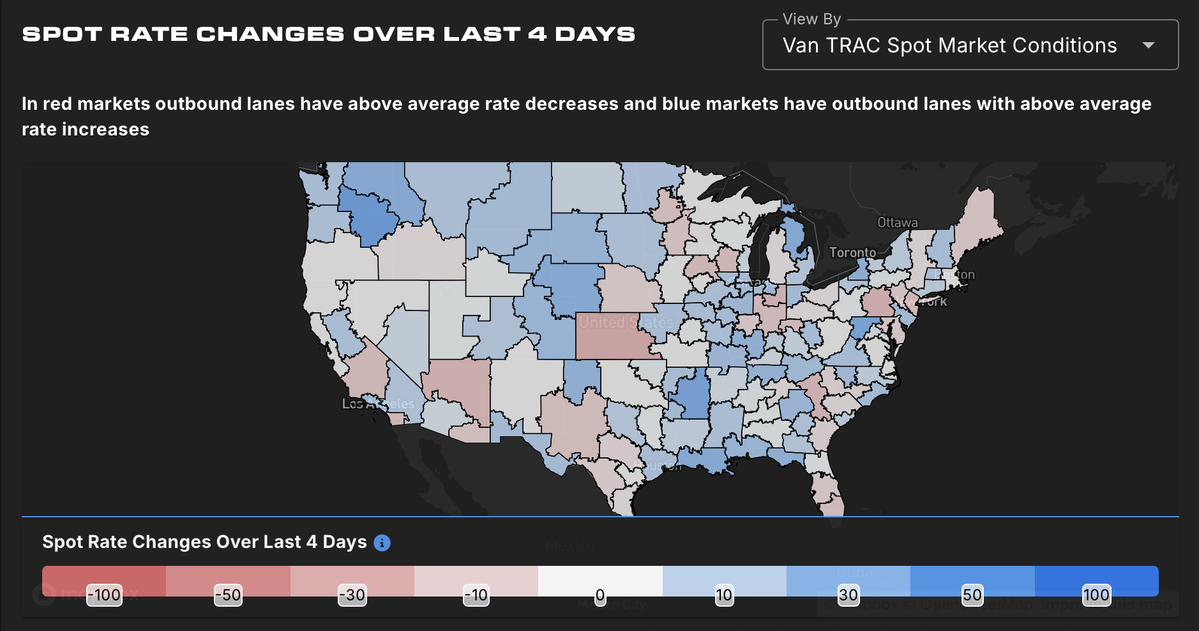
(Source: SONAR Spot Rate Changes Over Last 4 Days (Van TRAC Map).Blue markets are showing above-average rate increases, especially in the Southeast, Mid-Atlantic and South Central regions. Red zones are still cooling.)
Where the Numbers Are Pointing Now
Despite the noise suggesting a turnaround, the real data tells us we’re still stuck in a holding pattern. Volume and rates may have seen temporary bumps, but capacity just isn’t leaving the market fast enough to tip the scales. Instead of the large-scale exits that would tighten supply and drive up pricing power, we’re seeing a trickle of new entrants still flowing in — and that’s keeping competition stiff for small carriers trying to survive.
So what does that mean? It means we’re in a “grind-it-out” season. No magic flip, no clean recovery. Just tactical execution and watching the data like a hawk. Let’s unpack what the latest SONAR charts are showing us — and why they might be the first signs of a market shift worth preparing for:
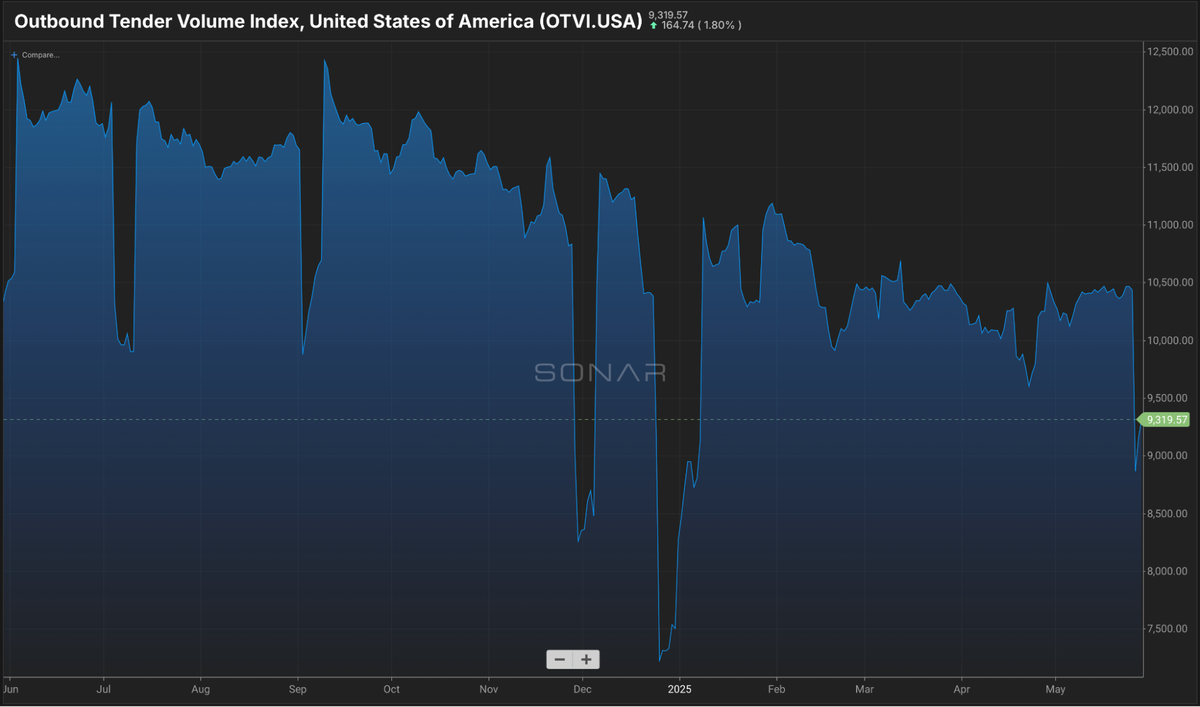
(Chart: SONAR Outbound Tender Volume Index (OTVI.USA). Freight volumes are holding steady above 9,319, signaling strong tender activity from shippers even as the market navigates volatility.)
We saw a meaningful 1.8% bump in tender volumes this week. That’s notable. But it needs context. Tender volumes are still down compared to seasonal expectations, and even with this increase, we’re not yet in peak season mode. The spike could reflect a mix of delayed Memorial Day freight, rebalancing or just a short-term burst of demand. Either way, it’s movement — and movement matters.
For small carriers, this is where you need to be watching your lane activity. Look for trends in your region — are tenders climbing? Are brokers calling you instead of the other way around? This volume bump means some areas are seeing freight flow again, and you need to be first to spot it.
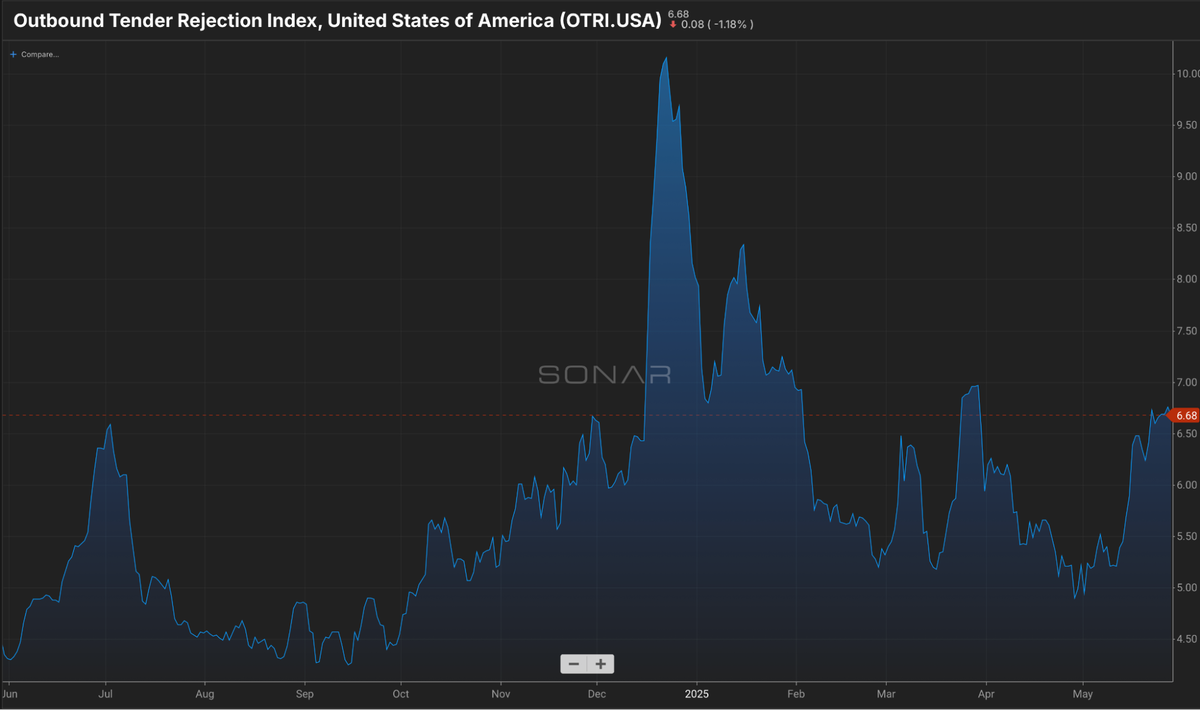
(Chart: SONAR Outbound Tender Rejection Index (OTRI.USA). Tender rejections have climbed to 6.68%, marking a continued shift in carrier behavior and signaling increased pressure on spot market rates.)
Tender rejections are creeping back up — and that matters more than most folks realize. A rate near 7% isn’t what we’d call a tight market just yet, but it’s a strong signal that carriers are beginning to say “no thanks” to low-paying, inconvenient freight. The higher this number climbs, the more leverage shifts back toward the truck.
This is the highest rejection rate we’ve seen in several weeks, and it’s not happening in isolation. It’s part of a broader trend of tightening in key regions — especially the Southeast, Mid-Atlantic and Texas. That tells us capacity is starting to push back, even if it’s not dropping off in droves.
Takeaway for small carriers: If you’re still taking whatever a broker throws your way, it’s time to reconsider. Use this as an opportunity to start building rate discipline. If you’re hauling into one of the tightening regions, ask for more. Use language like, “Look, rejections are up in this lane. I can take it, but not at that number.” Keep it firm, not combative. Remember, the market is shifting — and when it does, early movers make the most of it.
You may not be able to flip every rate, but if you don’t start flexing your pricing muscle now, you’ll be left behind when momentum really starts to turn.
(Chart: SONAR National Truckload Index (NTI.USA). National truckload rates are sitting at $2.31 per mile. This is a slight decline over the past several days, just ahead of the summer shipping season.)
After a brief rally earlier this month, national linehaul rates are easing back down to $2.31 per mile on the seven-day average, according to the SONAR National Truckload Index. We saw a nice post-Memorial Day lift — likely driven by tighter holiday windows and carriers that sat out International Roadcheck — but it didn’t stick. The dip we’re seeing now tells a clear story: Spot shippers were willing to bump up rates temporarily, but in the long run, they’re still in the driver’s seat when it comes to negotiating power. The broader market hasn’t tightened enough to create lasting upward pressure just yet.
What does that mean for small carriers? It’s a reminder that we’re still operating in a shipper-favored environment. You might get lucky on a few loads, especially if you’re running into hotter regions, but don’t treat these bumps as the new norm. Protect your margins by doubling down on the controllables — accessorials like detention time, layover pay, TONU (Truck Order Not Used) and fuel surcharges can make the difference between profit and breakeven on tighter runs. Start tracking your weekly averages across core lanes and be aggressive with follow-up negotiations. Every penny matters right now.
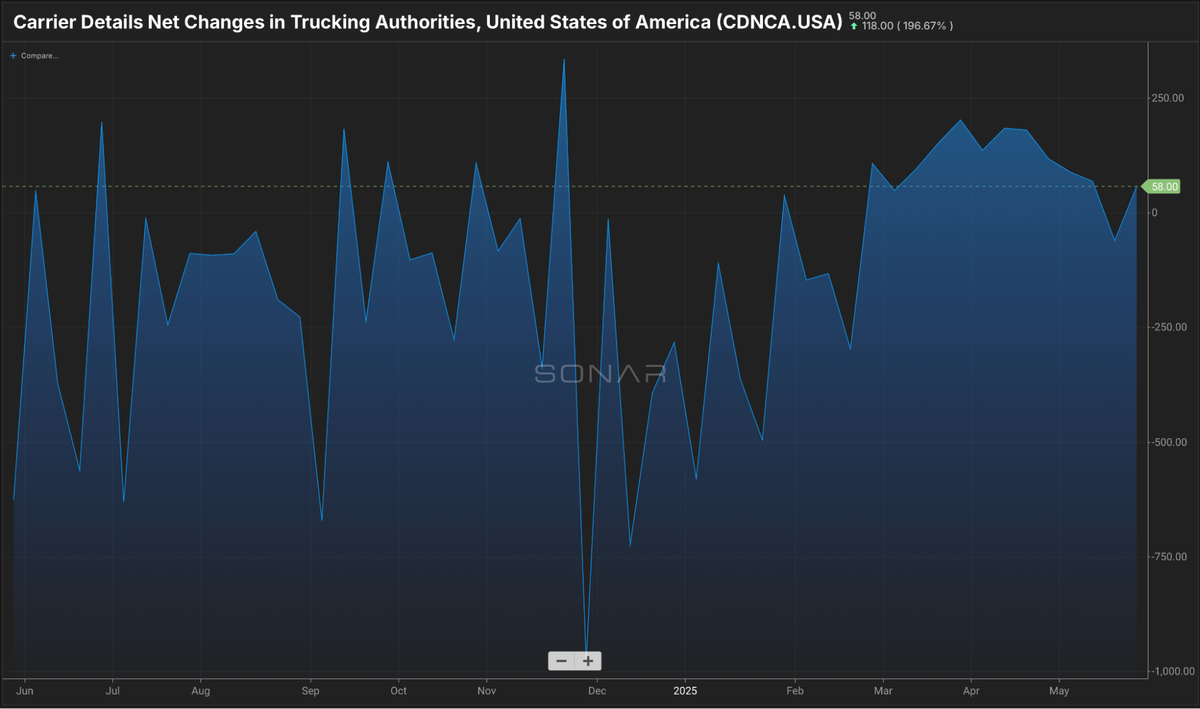
(Chart: SONAR Carrier Details Net Changes In Trucking Authorities). Capacity remains sticky. The market isn’t bleeding out yet, as small net gains in carrier authorities suggest stabilization instead of contraction.)
This is the one to keep your eye on — not because it’s explosive, but because it’s telling a deeper story that most folks will miss. At a glance, a net positive gain in carrier authorities might feel like a good sign. But in reality, it’s a red flag when we’re trying to signal a capacity correction. A healthy recovery for small carriers means less competition, not more. And what we’re seeing here is that new entrants are still trickling into the market — even in the middle of a freight recession.
This isn’t a flood like we saw in 2021 or early 2022, but it’s enough to stall meaningful upward rate pressure. If carriers aren’t leaving and new ones are still popping up, then pricing power stays diluted. More trucks fighting over the same — or even fewer — loads.
This is where we need to start thinking about supply and demand, not just in terms of freight volume, but in terms of how many competitors are left in the room. Every new MC that goes active adds noise to the rate negotiation process, keeps the load board crowded and makes it harder to get consistency. This is the bottleneck that’s holding rates back from a true rebound.
Takeaway for small carriers: Waiting for the market to tighten is no longer a strategy — it’s a liability. Capacity isn’t leaving fast enough to do the hard work for you. So the move now is to get sharper: Build out shipper/broker relationships, refine your value proposition, and focus on making your truck stand out when it counts. That means improving service levels, delivering on time, investing in communication tools, and showing brokers and customers that you’re a reliable partner when others flake.
You have to outlast — but more importantly, you have to outsmart. This isn’t a game of patience. It’s a game of precision, and the ones who thrive are the ones who stop waiting for the economy to save them and start engineering their own edge.
(Photo: Jim Allen/FreightWaves)
Used Truck Prices Just Jumped — But Here’s the Full Story
If you’re in the market for a used truck, or even thinking about unloading one, now’s the time to pay attention.
Auction prices for sleeper tractors surged in April — especially for newer, low-mileage models. According to the latest data, 2023 model trucks went for nearly $97,000, up over 20% from just last month. Even older 4-to-6-year-old models saw a 30% price jump compared to this time last year. That’s not noise — that’s movement.
Why It Matters to You
This tells us two things:
Fleets are buying again, especially when they can grab trucks with less than 300,000 miles. These buyers aren’t waiting around for the next EPA mandate or another rate spike.
Inventory may be tightening, which means if you’re holding on to a clean truck with reasonable miles, you have leverage. Dealers and auction houses are seeing stronger bidding and more competition — which wasn’t the case even a few months ago.
And if you’re still using a higher-mileage unit that’s eating you alive on maintenance? That temporary pause on tariffs from China might help stabilize some parts costs, but new truck uncertainty still looms with 2027 emission rules in limbo.
Average Hammer Price (3-to-6-Year-Old Sleepers):
Prices spiked hard in April — especially on 3-year-olds. This wasn’t a one-month blip. When you zoom out, you’ll notice prices are still well above 2019 levels. If you have a late-model truck, its value might be higher than you think.
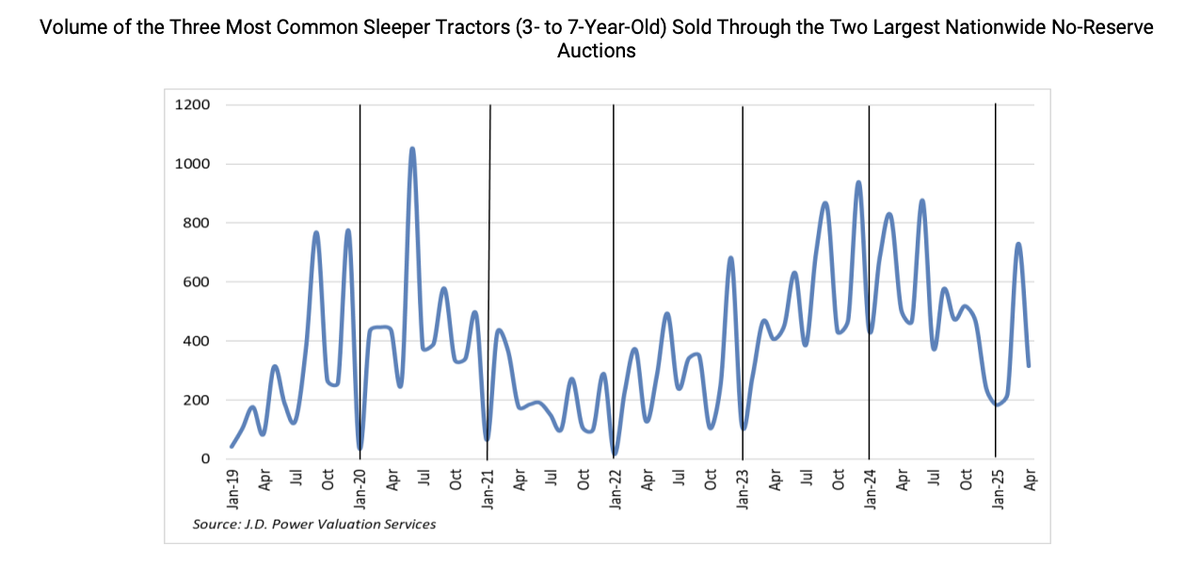
Auction Volume of Used Sleepers (3-7 Years Old):
While prices jumped, the number of trucks sold fell. That’s classic supply and demand. More buyers, fewer good trucks to sell = stronger pricing. But don’t be fooled — this isn’t a long-term guarantee. If rates cool or macro demand weakens, pricing could level.
Bottom Line for Owner-Ops and Small Fleets:
Don’t panic-buy, but do start comparing pricing if you’re planning to scale or replace this summer.
If your truck is clean, low-mileage and well-specced, you might get top dollar right now if you need to sell or trade.
Keep in mind — 2027 model pricing is already inflated due to emissions prep. Used might remain a smart move for the near future.
Let’s keep it real: Higher prices at auction don’t mean the market is “back” — but they do show signs of life. And in a freight cycle like this, every signal counts.
Right after a week of hot debate around truck driver qualifications and regulatory enforcement, this week’s podcast couldn’t have landed at a better time. Adam sat down with Avante Jackson — known across social media as CDL Shorty — a seasoned CDL instructor and trucking mentor who’s built a massive following by calling out the real issues behind the so-called “driver shortage.” In this episode, Avante breaks down what’s really going on behind the curtain — from CDL mill scams to carriers hiring undertrained drivers just to keep wheels turning. We also dig into how the system sets up new drivers to fail and what needs to change if we want safety and skill to actually matter again. If you care about raising the bar in this industry — whether you’re a fleet owner, dispatcher or new driver — this one’s required listening. (Photo: Jim Allen/FreightWaves)
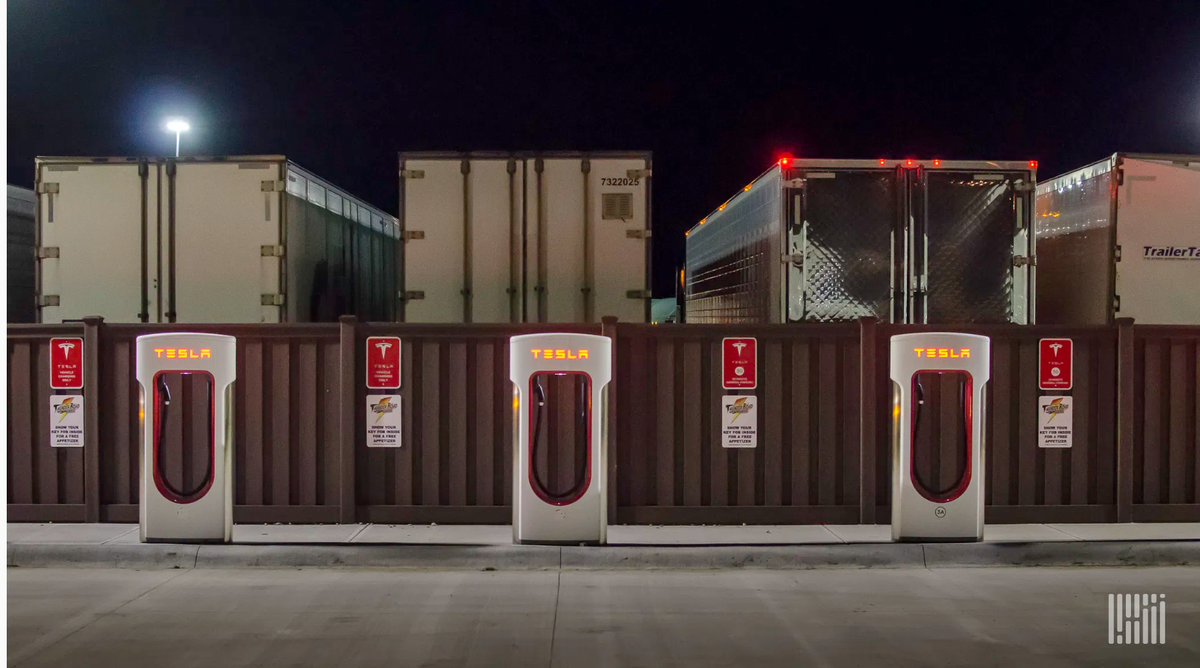
Tesla Semi Delays Again — But Here’s What It Really Means for Small Carriers
Another quarter, another delay. Tesla’s long-promised electric Semi has once again been pushed back, with no firm date on when wider production will begin. According to an article by Thomas Wasson, only limited deliveries are expected this year, and most of those are earmarked for internal use by Tesla and hand-picked test customers.
For most small carriers and owner-ops, this headline probably feels like a rerun. And in many ways, it is. Tesla made waves back in 2017 when it first unveiled the Semi, promising 500-mile range, rapid charging and a bold new vision for trucking. But seven years later, most fleets still haven’t touched one — and may not for a while.
So what does this delay actually mean?
Here’s the takeaway:
EV adoption in heavy trucking is still crawling, especially outside of short-haul and drayage work. The infrastructure simply isn’t there yet for most small carriers to switch without major disruption.
The headlines outpace the reality. There’s a lot of noise about electric trucks, but the diesel rig in your yard still has more real-world uptime, easier access to fueling and a stronger repair network than any EV on the market.
If you’re running a smaller fleet, this is not your signal to pivot to electric. It’s your reminder to stay focused on what you can control: fuel efficiency, preventative maintenance and managing your cost per mile.
Tesla isn’t alone in missing timelines. Even legacy OEMs with decades of fleet relationships (like Peterbilt and Volvo) have seen rollout delays due to battery sourcing, grid challenges and high production costs. And with the EPA’s 2027 emissions standards still looming in limbo, the truth is the diesel-to-EV transition for heavy trucks is going to stretch well into the next decade.
Bottom line?
Keep an eye on the tech — but don’t let it distract you from building a strong, resilient business now. There’s opportunity for small carriers in this gap while the big guys play catch-up.
Final Word – Windows Don’t Stay Open Forever
This week wasn’t filled with fireworks, but it carried real freight for the sharp carriers paying attention. A court ruling that could reshape the leased-on model. Another delay in Tesla’s long-promised Semi. Spot rates creeping upward while volume sputters and capacity refuses to exit stage left.
These aren’t random headlines. They’re signals.
We’re not in a boom. But we’re not in freefall either. This is what the freight middle looks like — and the ones who thrive here are the ones who know how to work it.
Maybe your margins are still tight. Maybe the load board still feels like a war zone. But if you’ve been watching the charts, reading the tea leaves and positioning yourself in the regions where freight is heating up — you’re already ahead.
So here’s your charge this week:
Don’t wait for a recovery. Operate like the recovery is already testing you. Every mile matters. Every rate negotiation counts. Every move should be strategic.
Until next time — stay focused, stay dangerous and keep your wheels turning.
Lawmakers reintroduce ban on hauling horses in double-deck trailers
WASHINGTON — Rep. Steve Cohen, D-Tenn., has been advocating for more humane transportation of horses by livestock haulers since 2008, but he believes he finally has the support to get legislation addressing the issue through Congress.
Cohen and Reps. Dina Titus, D-Nev., and Brian Fitzpatrick, R-Pa., reintroduced on Thursday the Horse Transportation Safety Act, a bill to ban the transportation of horses across state lines in double-deck trucks or trailers containing two or more levels stacked on top of one another.
“Double-deck trailers do not provide adequate headroom for adult horses, and accidents involving double-deck trailers are a terrifying reminder that the practice is also dangerous to the driving public,” Cohen said in a press statement.
“I look forward to seeing this measure move forward as it did last year and be signed into law. Transporting horses can be precarious even under the best circumstances, and we should not compound the risks with unsafe double-deck trailers.”
Double-deck trailers can accommodate livestock such as cattle and hogs but usually do not provide enough headroom for horses to stand upright.
The U.S. Department of Agriculture issued rules in 2001 prohibiting livestock haulers from using double-deck trailers to carry horses to slaughter. “The purpose of the regulations is to establish minimum standards to ensure the humane movement of equines to slaughtering facilities via commercial transportation,” USDA stated in the rule.
However, the rules did not ban the commercial transport of horses in double-deck trailers over long distances to feedlots, for example, or to other interim points before they are transferred to single trailers for final transportation to a slaughter facility. Cohen’s bill would close this loophole.
“Transporting horses in stacked double-deck trailers isn’t just inhumane – it’s dangerous,” Fitzpatrick said. “These trailers were never designed for animals of this size and using them puts both horses and drivers at serious risk. This bill is long overdue, and it’s time to get it across the finish line.”
The bill made it through the House twice, in 2020 and 2022, when it was attached to larger pieces of legislation, but has yet to get through the Senate.
If passed, the measure would likely affect only a small sector of trucking, based on owner-operator data.
In a 2022 member survey conducted by the Owner-Operator Independent Drivers Association Foundation, only 1% of respondents indicated that livestock trailers were the type of trailers they primarily pull.
FreightWaves has reached out to OOIDA for comment.
Transfix CEO: In margin-crunched market, brokers must rethink tech strategy
In today’s turbulent freight environment, where uncertainty lingers over everything from tariffs to tender volumes, freight brokers are facing increasing pressure to make smarter, faster decisions, often with less margin for error. At the heart of that challenge lies the critical but often inefficient process of RFP management.
In a recent conversation with FreightWaves, Transfix CEO and co-founder Jonathan Salama shed light on how the company’s newly enhanced RFP workflow tool aims to transform this complex process into a strategic advantage.
Salama acknowledged the anxiety gripping the freight market, driven not only by volatile demand and geopolitical shifts, but also by the ambiguity of how to prepare.
“There is a real worry out there of what’s going to happen,” he explained. “It’s much deeper than, ‘Will the market respond positively or negatively?’ The worry is more, ‘Will I make the right decision now for either outcome?”
In such a scenario, he emphasized, technology becomes not just useful, but essential to react faster than people can respond.
That belief is core to Transfix’s updated RFP workflow platform. Released recently, the tool has already evolved. It now offers collaboration alerts, more granular data visualization, and sophisticated lane grouping and rule-setting features. These updates help brokers not only price faster but also gain a deeper understanding of their true costs, both carrier and operational.
Much of the freight brokerage industry still runs on tribal knowledge — insights built over years of experience that are often lost when employees move on or roles shift. Salama emphasized how seasonal margin fluctuations can lead teams to forget the original pricing strategy behind a lane. Without a system to track expectations versus actual performance, it’s easy to misjudge success or overcorrect.
Transfix’s latest tools are designed to preserve this kind of strategic intelligence by embedding historical context directly into the workflow, helping brokers make more informed decisions and maintain continuity even as teams evolve.
While the knowledge is unique, brokers are understanding the importance of leveraging valuable technology partners, shifting away from building custom in-house tools and instead turning to ready-made solutions that deliver immediate value. The logic is simple: Time spent maintaining code could be better spent understanding true business costs and improving operational efficiency.
This shift has sparked a broader reevaluation of tech stacks across the industry. Instead of chasing the latest AI buzzwords, brokers are starting to prioritize functionality and ROI, according to Salama. Solutions that streamline core processes, like RFP management, are gaining traction.
Yet amid the influx of new platforms and features, Salama cautions brokers to remain discerning. The market is saturated with vendors riding the AI hype cycle, as not all tools are built to solve specific, day-to-day problems. A thoughtful approach to vetting solutions, one grounded in a thorough understanding of the brokerage’s unique challenges, can mean the difference between a strategic investment and a sunk cost.
Just as importantly, brokers should apply their negotiation skills when engaging with tech vendors. Despite making a living negotiating freight, Salama found the irony in how many brokers accept software quotes at face value. In a market where efficiency and cost control are paramount, even tech partnerships should be approached with the same rigor and leverage that define the brokerage business itself.
Running on Ice: Lufthansa beefs up temperature-sensitive options
(Photo: Jim Allen/FreightWaves)
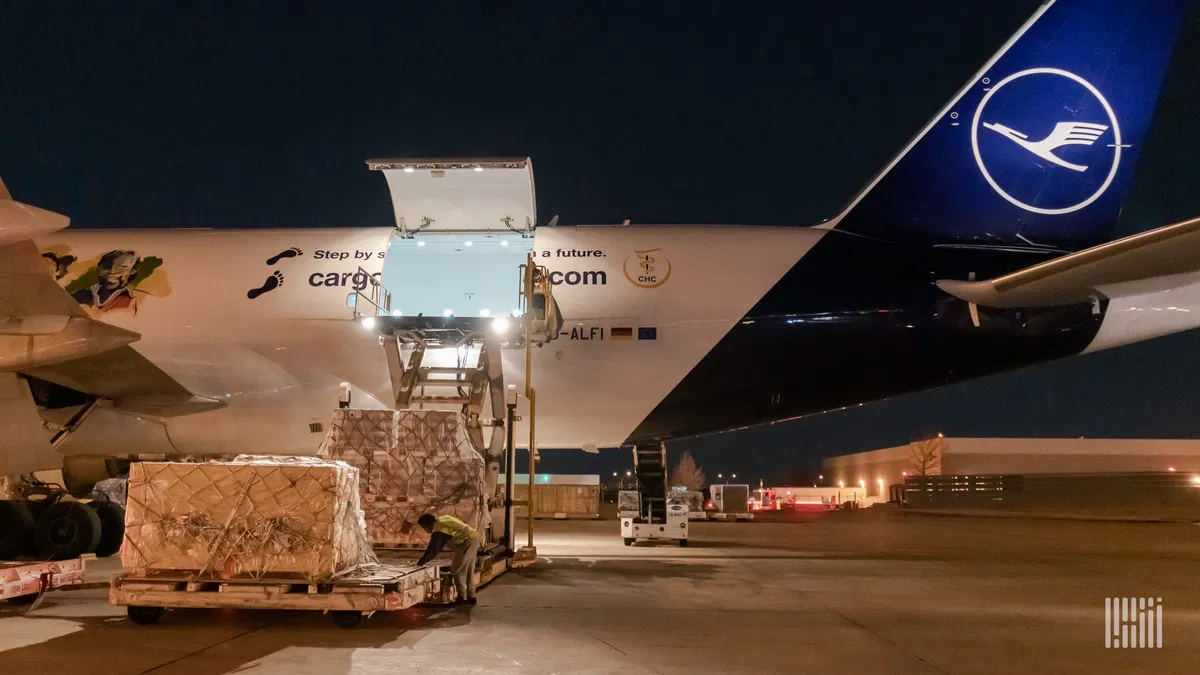
Lufthansa Cargo has taken temperature-controlled shipping to the next level. The air cargo giant has added four new features to enhance temperature-sensitive services, with the goal of increasing quality, speed and control.
The features are round-the-clock monitoring through a Pharma Control Tower, additional protection via Thermo Covers, real-time tracking with smartULD and faster booking through td.Zoom.
The Pharma Control Tower allows 24/7 monitoring of shipments at Lufthansa Cargo hubs in Munich and Frankfurt, Germany, as well as Brussels. The feature supports both active and passive temperature control.
Thermo covers are most commonly used for the passive temperature support to shield goods from extreme heat or cold during ramp handling.
Smart ULD is real-time monitoring for active-temperature-control shipments that equips certain container types with sensors that continuously record temperature. This provides customers with end-to-end visibility from pickup to delivery.
Td.Zoom is an update that allows customers to book passive temperature support for expedited transportation. This option offers faster access to capacity and reduced transit times for items like pharmaceuticals, diagnostics and high-tech products, without any weight restrictions.
This is the first rollout in a series of improvements the cargo giant is making to improve its temperature-controlled solutions.
Blitz week breakdown: top violations; authority approvals down 50%; tariffs? | WHAT THE TRUCK?!?
On episode 844 of WHAT THE TRUCK?!? Dooner is catching up with SearchCarrier’s Garrett Allen. His new site allows you to easily look up any carrier and see how often it’s been put out of service, inspected and more. We’re also diving into his blitz week dashboard to break down this year’s top violations.
Konexial’s Jerry D’Addesi on the latest in AI load matching, double broker prevention and edge computing.
Is the FMCSA starting to take freight fraud more seriously? After FMCSA’s identity verification became mandatory in April 2025, published authority counts dropped by over 50%. We’ll take a look at the numbers.
And in headlines: tariffs on, tariffs off; fast food restaurants vs fleet sizes; excessive LEGO sets and more.
Chapters
3:04 New authority approvals down 50%
5:19 Tariffs on, tariffs off, tariffs on
8:16 Fleet sizes vs. fast food restaurant locations
Catch new shows live at noon EDT Mondays, Wednesdays and Fridays on FreightWaves LinkedIn, Facebook, X or YouTube, or on demand by looking up WHAT THE TRUCK?!? on your favorite podcast player and at 5 p.m. Eastern on SiriusXM’s Road Dog Trucking Channel 146.
NTSB cites hydraulic and electrical failures in FedEx 757 gear failure
The National Transportation Safety Board has determined that a FedEx Boeing 757-200’s belly landing in Chattanooga, Tennessee, was caused by the failure of the alternate gear extension system, which prevented the landing gear from being lowered during an emergency.
On Oct. 4, 2023, FedEx (NYSE: FDX) flight 1376 experienced an “abnormal runway contact” when the flight crew was unable to extend the landing gear during the approach to Chattanooga’s Lovell Field.
Shortly after takeoff from Chattanooga, the captain called for gear up, and the first officer raised the landing gear control lever to retract the landing gear. Both the main landing gear and nose landing gear retracted to their up and locked position. Digital flight data recorder data showed that 22 seconds after gear retraction, the hydraulic fluid quantity and pressure in the left hydraulic system began to decrease.
After troubleshooting the hydraulic issue per procedures in the Quick Reference Handbook, the flight crew made the decision to return to Chattanooga. While preparing to land, the landing gear did not extend as expected when the landing gear control lever was positioned to its down position.
“Gear disagree. The gear is not coming down,” the first officer confirmed, according to cockpit voice recorder data documented by the NTSB.
Despite multiple attempts to deploy the landing gear using both normal and alternate extension systems, the crew was forced to perform a belly landing. The aircraft slid off the departure end of Runway 20 and impacted localizer antennas before coming to rest about 830 feet beyond the end of the runway.
Findings
Postaccident inspections of the landing gear system found that hydraulic fluid was leaking from the left landing gear door actuator retract hydraulic hose. Inspections also found that the engine indication and crew alerting system showed the left hydraulic system had only 32% fluid quantity remaining after the main landing gear door retraction shortly after takeoff, which is considered fully depleted.
Analysis of the failed hydraulic hose revealed multiple broken wire strands along its length and a rupture in its inner liner. The cause of the broken wire strands most likely originated from an overload event as evidenced by the necking down of the wire strands and a reduction in their area, investigators shared.
More critically, electrical system inspections of the alternate extension system found no electrical continuity between the alternate gear extend switch and the alternate extension power pack. A visual examination revealed a break in a wire between the circuit breaker and the alternate gear extend switch, which prevented the system from functioning as a backup.
“Analysis of the wire’s fracture surfaces showed a reduction in area and circumferential cracking of the coating, consistent with tensile loading,” the final report stated. “No obvious defects or anomalies were observed on the fracture surfaces.”
Evacuation issues
The investigation also identified issues with the aircraft’s evacuation equipment. After the airplane came to a stop, the jumpseat occupant attempted to open the L1 door, which only rotated halfway open and would not fully deploy. The R1 door also became lodged on the slide pack before the jumpseat occupant used force to open it.
Investigators found that the R1 door’s bannis latch did not conform to the configuration required by an FAA Airworthiness Directive from 1986, which caused the slide pack to jam during evacuation.
The NTSB determined the probable cause of this accident to be “the failure of the alternate gear extension system, which prevented the landing gear from being lowered. The cause of the system failure was a broken wire, due to tensile overload, between the alternate gear extend switch and the alternate extension power pack, preventing the AEPP from energizing and supplying hydraulic fluid to the door lock release actuators for the nose landing gear and main landing gear.”
Contributing to the accident was “the loss of the left hydraulic system due to a ruptured left main gear door actuator hose from fatigue, which prevented normal landing gear operation.”
The NTSB noted that the crew of FedEx flight 1376 demonstrated good Crew Resource Management during the emergency, remaining calm and professional throughout the accident sequence. They displayed effective workload management by distributing tasks among themselves, with the captain flying and the first officer working to resolve the issue with air traffic control.
“The crew maintained clear and concise communication between all crewmembers to include a jumpseat occupant, and with ATC, actively soliciting feedback and input, and crosschecking with one another to ensure everyone was working with the same mental model,” the report stated.
As a result of this investigation, the NTSB issued four new safety recommendations to the FAA and three new recommendations to Boeing on March 27, 2025. These recommendations address the need to inspect and modify bannis latches on Boeing aircraft doors and update aircraft maintenance manuals with correct configurations.
Following the accident, FedEx implemented a 275 Flight Hour check on the alternate extension system, including performing a general visual inspection while the nose landing gear and main landing gear doors are open while on the ground.
Wells Fargo will sell its rail leasing equipment business to a new joint venture of GATX Corp. and Brookfield Infrastructure, the financial company announced Thursday.
The joint venture will purchase approximately 105,000 railcars for $4.4 billion; Brookfield (NYSE: BIP) will separately acquire the Wells Fargo (NYSE: WFC) rail finance portfolio of approximately 23,000 cars and 400 locomotives, according to GATX.
“This transaction is consistent with Wells Fargo’s ongoing strategy of simplifying our businesses and focusing on products and services that are core to our clients,” David Marks, executive vice president with Wells Fargo Commercial Banking, said in a press release.
GATX (NYSE: GATX) will own 30% of the joint venture and will manage the equipment from both the joint venture and the separate Brookfield transaction. GATX, which has an extensive international rail equipment leasing business, has an option to eventually acquire 100% ownership of the joint venture.
“This is an outstanding opportunity to build on GATX’s leading North American platform,” GATX CEO Robert C. Lyons said in a press release. “… Importantly, by acquiring the assets in this manner, we will maintain the financial flexibility and capacity to continue growing all of our businesses while capitalizing on the value creation opportunities inherent in the assets acquired.”
Brookfield, an international firm with 67% of its operations in North America, is owner of shortline holding company Genesee & Wyoming. Its holdings operate more than 22,500 miles of rail lines worldwide.
The transaction is expected to close by the first quarter of 2026.
Texas bill, a trucking priority for tort reform, dies in House committee
Legislation that passed the Texas Senate last month and that the trucking industry believed would bring about “much-needed reforms” in trucking-related lawsuits has died in the House.
But another piece of legislation backed by the industry, SB30, and its companion bill, HB 4806, are still considered alive as the Texas state legislative session races toward its Monday conclusion.
The companion House bill to SB39, approved in April, was HB 4688. It was referred to the Committee for Judiciary & Civil Jurisprudence. While the House of Representatives’ docket for the legislation shows several steps at the committee, including public hearings, there is no vote on the list of developments.
With no action taken on the bill in recent days, barring a miraculous turn of events, the bill is considered dead in the Texas Legislature, which meets every two years.
When the bill passed in the Senate, it was hailed by the Texas Trucking Association. In a prepared statement released at the time, TTA President John Esparaza said the legislation “marks a significant step forward in protecting the integrity of our legal system and Texas trucking industry.”
“This bill introduces much-needed reforms to how commercial motor vehicle collision cases are handled in Texas courts,” he said at the time. “These reforms will establish fair, consistent, and statewide standards, helping to ensure that justice is applied equally across the state.”
But in a statement released to FreightWaves Thursday, Esparaza conceded defeat for this session.
“SB 39 was an important piece of our tort reform package …,” he said in the statement. “As a priority…we are disappointed that SB 39 died in the House Judiciary & Civil Jurisprudence Committee and will not become law this session.”
Law firm spells out what was in the bill
In a commentary about what SB39 and its companion House bill would have accomplished, attorneys for the law firm of Lewis Brisbois touched on several key points.
One change would have minimized questions about the background of the driver, according to the law firm. “Where defendant trucking companies have already stipulated to their drivers being in the course and scope of employment, plaintiffs’ attorneys can no longer inflame juries with arguments about the trucking companies’ actions when they have no causal/legal relationship with the harms alleged,” Lewis Brisbois said. “In other words, if a case goes on to trial, then the jury should solely be focused on the actions of the drivers involved in the incident.”
SB39 also was the vehicle that the TTA spoke of last year in trying to complete the unfinished work of HB 19, passed in 2021 but generally seen as not providing the relief in litigation that trucking attorneys had expected.
Admissions rule
In an interview last year with FreightWaves, Lee Parsley, general counsel for Texans for Lawsuit Reform (TLS), said one of the goals of HB 19 was to give new emphasis to the “admission rule.”
Last year, Parsley said of that rule: “It basically says that if I, as the employer, agree to accept responsibility for my employees’ actions that may have caused the injury, it is supposed to simplify the trial. You don’t need to go down the rabbit hole of figuring out things like negligent hiring and negligent training. It’s supposed to simplify it so that in the trial, you’re just focused on who actually caused the accident and what the damages are at that point.”
The Lewis Brisbois commentary said SB39 would have “recognized the admissions rule by eliminating key exceptions.” Quoting a precedent involving Werner Enterprises (NASDAQ: WERN), the attorneys said the admission rule clarifies that an “employer’s admission that an employee was acting in the course and scope of their employment when the employee allegedly engaged in negligent conduct bars a party allegedly injured by the employee’s negligence from pursuing derivative theories of negligence against the employer.”
That citation quoted by the attorneys is from the case of Blake vs. Werner, the nuclear verdict initially handed down in 2018 and which now awaits a decision by the Texas Supreme Court following oral arguments in December. The original verdict, less than $90 million, has ballooned to more than $100 million with interest.
The case involves the death and injuries in a family that crossed the median strip in bad winter weather in West Texas and collided with a Werner truck headed the other direction. The jury verdict that the Werner driver should have been going slower in that weather and would therefore not have been in position to slam into the oncoming vehicle has been a particular source of anger within trucking. But the Blake family involved in the crash won at trial and on appeal before it headed to the state’s highest court.
The Lewis Brisbois commentary said the critics of SB39 “have voiced concerns that this change will further stifle plaintiffs’ abilities to ensure that juries consider all parties and trucking companies’ own liability in the harms by alleged company misdeeds.”
Life for SB30
There is still hope at the TTA for SB30, which seeks to limit various types of payouts in crashes involving trucks through a variety of steps. Like SB39, SB30 passed the Senate. It is considered to have life as HB 4806 before the end of the legislative session.
“We will continue to pursue tort reform in SB30, however, as we head into the weekend and our final day of session on Monday, June 2,” Esparaza said.
HB 4806, is still listed as being in committee in the House.
It would place caps on economic damages, the firm said. It restricts payouts only to amounts paid by the plaintiffs rather than what was billed by the providers of health care services to the plaintiffs. It makes changes in rules of evidence and also changes various liability standards. A jury must be unanimous in settling on noneconomic standards. There is also a shift in defining interest charges.
In a summary of SB30 published by TLS, the organization said the combined SB30/HB 4806 “guides jurors with fair and consistent rules for awarding noneconomic damages, ensuring they are truly compensatory.”
Among the provisions in the bill, according to TLS, are that the legislation “gives jurors understandable definitions of pain and suffering and mental anguish and clear instructions that those damages should be based on the plaintiff’s injury — not the defendant’s conduct that is unrelated to the incident being litigated — and cannot be used to punish a defendant.”
How shippers can prepare for supply chain disruptions
The volatile intersection of manufacturing and delivery processes in today’s rapidly changing global environment presents numerous challenges, but it can also create opportunities for well-positioned companies to grab larger market shares and shore up operations.
On May 20, FreightWaves collaborated with G3 Logistics and EY to host a webinar on the complex landscape of supply chain disruptions and the strategic opportunities they present.
FreightWaves’ Mary O’Connell sat down with Jonathan Hanak, principal, strategy for EY, Nicole Ostertag, head of solutions and strategy at G3 logistics, and Adam Cooper, principal, supply chain and operations for EY, to gain expert insight into navigating supply chain disruptions.
Forces across the entire supply chain system, from geopolitical tensions to commodity price fluctuations, economic volatility and trade uncertainties, have created unprecedented challenges for businesses.
“It’s an incredibly volatile time,” said Hanak. “Manufacturing processes directly impact delivery processes and vice versa, creating a deeply interconnected system where disruptions in one area cascade throughout the entire chain.”
Tariff uncertainties are just one recent example of the type of massive supply chain disruption that can cause these cascades. “Many companies ramped up for a date in April that changed very quickly,” said Ostertag. “Now we’re all in a ‘wait-and-see period’ ahead of anticipated July changes.”
The Russia-Ukraine conflict was another major disruptor that affected not only rail and road freight in Europe, but also sea freight.
The Black Sea was heavily restricted, with key ports shut down. This disruption impacted over $300 billion in global trade, and rerouting increased costs by 15%-25% for many European and Asian routes.
Manufacturing operations have been significantly affected by these disruptions. Many manufacturers have been engaging in raw material stockpiling in an attempt to hedge against uncertain future costs.
“Companies have been trying to figure out, ‘How do I understand what this is going to do to my unit cost or my conversion cost metric?’” Cooper said.
This proactive stockpiling has subsequently led to production schedule adjustments as manufacturers now work to utilize these accumulated materials. “It creates a delicate balancing act between plant capacity and demand forecast,” Cooper said.
Technological foundations are critical for navigating today’s supply chain challenges. According to Ostertag, organizations without certain basic technological capabilities are already behind their competitors.
“Real-time visibility platforms are essential today,” Ostertag said. “You have to know exactly where your load is and what its status is. You have to be able to verify information like the inventory of a particular SKU in real time at your warehouse.”
These capabilities are no longer optional, but fundamental requirements for effective operations in today’s environment. For any company to remain flexible, diversifying transportation strategies is of critical importance.
“If events in the last five years have taught us anything, it’s that multimodal, diversified strategy is critical in transportation now,” Ostertag said. “If there’s a major port strike or a railroad labor negotiation or if the truck market consolidates again, you need contingencies.”
Companies that rely exclusively on a single transportation mode significantly limit their ability to adapt quickly when disruptions occur, an increasingly common scenario in today’s supply chain environment.
Structured risk management plans are now essential, particularly regarding cybersecurity threats.
“Because of the technology we rely on, nothing has the ability to ruin a supply chain faster than a widespread cyberattack,” Ostertag said.
Cyberattacks account for over a third of the recorded supply chain disruptions every single year, a fact that underscores the importance of robust cybersecurity measures as part of a comprehensive risk management strategy.
The move from pure just-in-time inventory models toward hybrid approaches incorporating just-in-case elements has been a significant shift. This doesn’t necessarily mean maintaining higher inventory levels at every distribution point, but rather taking a more strategic approach.
“If you think about how to structure your business around a just-in-case case model, it doesn’t mean that you have to have more inventory at every single one of your distribution centers,” Ostertag said. “It might just mean strategically placing backup inventory at one centralized distribution center in a place such as Chicago or Memphis, where you can access most of the U.S. within a one- or two-day transit or by having something like an air freight provider relationship with which you can overnight a critical repair part.”
Many companies are increasingly adopting this balanced approach, according to Ostertag.
“We’re seeing a shift from the small inventory, just-in-time model to a more flexible just-in-case model, and that is making folks more resilient to those big disruptions,” she said.
3PLs can offer significant advantages in managing growth and scaling operations.
“A 3PL can essentially scale for you, and a good 3PL has the ability to do so with a presence around the country where they’re pre-investing,” Ostertag said.
This approach, she says, allows companies to test new markets with smaller footprints and then grow into them over time or as quickly as needed instead of having to make all of those investments directly. Relying on a 3PL to scale provides both flexibility and reduced capital requirements during expansion.
The sustainability benefits of incorporating rail transport into supply chain strategies are yet another reason to diversify transportation methods.
“Rail is really the most sustainable way for most of us to get our products to move around the country, often up to four times more fuel efficient than truck,” Ostertag said.
Due to the interconnected nature of manufacturing and logistics decisions, planning for rail transport requires upstream adjustments to production processes and inventory planning.
One interesting strategy includes using rail transport as mobile inventory storage, according to Hanak: “I’ve had some clients lower their overall inventory storage capacity by putting their goods in movement, and that strategy has worked well for them,” he said.
According to Ostertag, Cooper and Hanak, three core elements are essential for navigating today’s supply chain challenges:
Data integration: Moving from physical to digital operations to leverage AI and analytics tools.
Operational agility: Developing standardized processes with built-in flexibility to respond to changing conditions.
Workforce development: Recognizing that even with advanced technology, human talent remains a fundamental differentiator for companies.
While manufacturing no longer dominates the U.S. economy in terms of GDP contribution, there is significant sector-specific activity in manufacturing infrastructure development. The ability to pivot and expand capacity varies widely by industry, with automotive, semiconductor and plastics value chains each facing unique challenges and opportunities.