
What the Latest Rate Dip Means for Small Carriers (Part 2)

Rate Dip

Let’s not sugarcoat it—rates are slipping again.

If you’re a small carrier, you probably don’t need another graph, another report, or another freight economist telling you what you already feel in your wallet. You feel it when you bid a lane and get undercut by someone running for fuel money. You feel it when you see a load at $1.75 per mile and you’re wondering, “Who in their right mind is moving freight this cheap?”

This isn’t new. But this—this right now—is a different kind of rate dip. And if you’re still running your business like it’s 2022, you’re going to get wiped out in 2025.

This is Part 2 of a conversation we need to keep having. Because too many small carriers are treating rate dips like weather—hoping it’ll just pass. What you need to understand is that this market shift isn’t just a blip. It’s a pressure test. And only those with sound fundamentals are going to survive.

Let’s break down what’s happening, what it actually means for you, and most importantly—what to do about it.


A Market Rebalancing, or a Market Reset?

Let’s talk facts.

Rates have dipped 14% year-over-year in key dry van markets. Reefer isn’t doing much better. Spot market loads are down. Contract freight is getting tighter. And meanwhile, operating costs haven’t dropped—they’ve risen. Insurance is up. Fuel, while slightly down from last year, is still volatile. And maintenance costs have spiked due to parts delays and labor shortages.

Now, the big question I get from small carriers is:

“Adam, is this just a correction… or is this the new normal?”

The honest answer? It’s both.

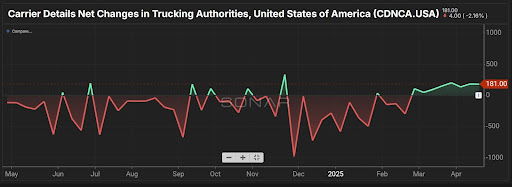
We’re seeing a market rebalancing—yes. Capacity surged after 2020. Everyone and their cousin bought a truck, got their MC number, and hit the road with stars in their eyes. But now, those who entered with emotion instead of strategy are exiting with regret.

This rate dip is the industry’s way of clearing the board. It’s not personal, it’s math.


Why This Dip Hits Small Carriers Harder

Larger carriers have scale. They’ve got rolling contract freight. They’ve got direct shipper relationships. They’ve got fuel surcharge programs, better insurance leverage, maintenance programs, and in some cases, their own freight.

You?

You might have one truck. Maybe three. Maybe you’re juggling payroll while fielding cold calls. You’re running spot freight to make ends meet. You’re the dispatch, the driver, the mechanic, and the customer service team all in one.

So when rates fall 20 cents, that doesn’t just trim your profit margin—it wipes it out.

Here’s where it gets dangerous:

  • You start chasing miles instead of chasing margin
  • You compromise on your minimum RPM
  • You burn more fuel on deadhead than you do on loaded miles
  • You start paying yourself last—if at all

And if that sounds familiar, you’re not alone. But it’s not sustainable.


The Bottom Line: Know Your Numbers or Lose Your Business

If I could give you a tattoo that wraps around your forearm so you’d see it every day, it would say:

“Revenue is vanity. Profit is sanity. Cash flow is reality.”

In a rate dip, your survival is directly tied to one thing: your understanding of your numbers.

Do you know your:

  • Break-even RPM (per truck)?
  • Cost-per-mile (with and without fuel)?
  • Revenue-per-hour of service?
  • Fixed cost threshold per week?

If you’re using Playbook’s Operating Calculator, you’ve already got access to tools like the built-in Breakeven Calculator. Use it. Live in it. Let it be your first and last check before booking a load.

I can’t tell you how many carriers I’ve coached who thought they were doing well—until we ran the numbers. That $2,800 load from Atlanta to Denver? After fuel, time, tolls, and deadhead back, they were working for less than minimum wage.

In a volatile market, numbers tell the truth even when the market lies.


What to Do Right Now if You’re Feeling the Squeeze

If you’ve read this far, you’re not the type to bury your head in the sand. So let me give you some real, practical things you can do starting this week:

1. Build a Weekly Financial Scorecard

Track these every week without fail:

  • Revenue per mile
  • Revenue per day
  • Deadhead percentage
  • Fuel cost per mile
  • Gross margin per load

This isn’t busywork—it’s your business heartbeat. Know when it skips.

2. Get Aggressive with Direct Freight

Spot freight is like fishing in a pond where everyone else already dropped bait.

Direct freight is your lifeline. If you’re not making 5 cold calls a day to shippers, you’re leaving money—and stability—on the table.

Start with:

  • Warehouse managers at smaller distribution centers
  • Local manufacturers
  • Packaging companies
  • Produce vendors if you’re running reefer

Use your local knowledge to your advantage.

3. Stop Running for the Sake of Running

This one’s hard to hear. But every mile you run below your break-even is a mile you’re paying to be in business.

Park the truck if the rate’s not right. Period. Better to live another week than run yourself into the red for pride.

4. Renegotiate Fixed Expenses

Your insurance, factoring, trailer rental, ELD subscription—go back to every vendor and ask for a better rate. Loyalty is great when times are good. But when it’s tight, it’s time to sharpen the pencil.

5. Lean Into Community and Coaching

You shouldn’t be navigating this alone. Get with a mentorship program, join roundtables, attend webinars, and plug into content that shows you what others are doing. You’ll be surprised how much game you pick up from being in the right rooms.


A Quick Word on Spot Market Addiction

Some of y’all are out here treating load boards like it’s the Gospel.

Listen, load boards are a tool, not a strategy. And when the spot market dries up, so does your plan if that’s all you rely on.

A rate dip should force you to pivot your model—not panic.

You don’t need to chase rates. You need to create lanes.

Start by:

  • Mapping out your ideal triangle routes
  • Identifying weekly recurring loads
  • Offering consistent availability to small brokers

The ones who win in a market like this are the ones who stop playing checkers and start playing chess.


If You’re New to the Industry

If you got your authority in the last 18 months and this is your first major dip, welcome to the proving ground.

You’re not crazy. You didn’t make a mistake getting into the business. But you do need to unlearn the “boom year” behaviors.

It’s time to:

  • Tighten up your business fundamentals
  • Stop accepting every load just to stay moving
  • Think like a business owner, not just a truck driver

Remember: Your authority doesn’t make you a carrier. Your margin does.


The Opportunity Inside the Dip

Let me leave you with this.

Rate dips—while painful—are filters.

They separate the folks who hustled in without a plan from the ones who are willing to do the work to build a foundation. The real opportunity in this dip is learning what you’re made of—and building a business that can weather any storm.

I’ve seen people with one truck and no dispatch team land dedicated freight because they were persistent, professional, and strategic. I’ve seen operators double their profit by simply understanding how to say no.

And I’ve also seen people disappear because they waited too long to adapt.

Don’t let that be you.


Final Word

This market ain’t for the faint of heart. But neither are you.

Use this dip as a wake-up call, not a death sentence. Get your numbers right. Focus on margin. Learn how to sell. And most importantly, run your business like a business.

Because the carriers that survive this cycle? They’re the ones who’ll own the next one.

Meet Bubba. The AI Voice Assistant Built for Truckers

When it comes to trucking technology, most of us have learned the hard way that promises are cheap and real help is rare. That’s why, when I sat down with Tapan Chaudhari, the founder of Hey Bubba (Bubba.ai) in Austin, Texas, this week, I was skeptical. I’ve spent over 20 years behind the wheel, running fleets and freight, and I’ve seen a lot of technology come and go. Most of it was designed by people who have never hauled a load or negotiated with brokers over cheap freight. But after turning down a matcha blueberry tea at Jo’s Coffee and opting for a Coke while watching Bubba in action, I have to admit, this one’s different.

Bubba is the first AI-powered voice assistant built for truckers, not brokers or dispatch services. At its core, Bubba acts like the dispatcher we always wished we had, one who knows your lanes, understands your profit and loss (P&L), speaks your language and never tries to sell you short.

Tapan simply laid his phone on the table and said, “Hey Bubba, I’m stuck here in Austin trying to get out. Find me something.” Within seconds, Bubba started rattling off a list of outbound loads.

When Tapan picked a load heading to Alabama, Bubba asked if he wanted help negotiating it. After a quick “yes,” Bubba called my phone, since I was acting as the pretend broker across the table. Bubba asked for my best rate. I lowballed, like any spot broker would, and Bubba pushed back with real-time market rate data and the carrier’s profit benchmarks.

We negotiated for a few minutes, and when I refused to accept a fair rate, Bubba simply ended the call. It’s not going to help you haul cheap freight. It knows what the rates should be, and it knows what you need the rate to be so you maximize margin. Bubba is standing up for drivers, pulling real market benchmarks, analyzing your P&L and fighting to ensure you don’t haul for a loss, automatically. Best of all, you’re still in control. Bubba does the heavy lifting, but you make the final call.

What Bubba AI Can Do for Drivers and Fleets

Here’s what sets Bubba apart from every dispatch service and DIY load board out there:

  • Finds and vets freight: Bubba doesn’t just pull random loads. It matches your equipment, location and goals.
  • Negotiates rates automatically: Bubba talks to brokers on your behalf, pushes back when rates are garbage and tees up the deals worth taking.
  • Handles documents: Bubba can verify rate cons, confirm appointments and manage your paperwork so you can stay rolling.
  • Speaks like a driver: Southern drawl, Midwestern flat, Spanish first language? Bubba gets it. Bubba speaks fluent trucker, and polished broker language too.
  • Protects your time and money: At only 2%, Bubba’s service fee is lower than what a lot of dispatchers charge, and you know exactly what you’re paying for.

Most importantly, Bubba isn’t trying to take over your operation. It’s just there to clear the noise so you can do what you do best: drive, deliver and make money.

Why Bubba Matters Right Now

Let’s be honest: Brokers already use AI. If you’re still cold-calling off public load boards and making blind guesses, you’re playing a game that’s already a loss.

Bubba levels the playing field. Bubba gives drivers the ability to compete with data-backed negotiation, more intelligent routing and faster booking, without needing a whole office staff to make it happen.

Worried about trying another piece of tech that promises the moon but burns you out? Bubba’s making it easy: no credit card required, three months free and you can sign up with just your DOT number and email. Test it. Use it. See if it makes your life easier.

Bubba’s Future

While Bubba already has its own load board, plans are underway to integrate with major national load boards in the future, making it the Swiss Army knife for finding, booking and managing freight from your phone or cab. Bubba also allows you to connect your broker load boards directly. This means load boards like C.H. Robinson, etc., already work with Bubba.  The goal isn’t to replace dispatchers, drivers or fleets; it’s here to make you faster, sharper and better positioned to get the best available freight.

Bubba is your right-hand man: negotiating, planning, hustling and keeping the small stuff off your plate so you can focus on the road ahead. Try it yourself at Bubba.ai.

2 more charged in death of Louisiana staged truck accident witness

A new indictment in the staged accident scam in Louisiana charges a disbarred lawyer and another man with participating in the murder of a cooperating witness who was gunned down in his home in 2020.

The superseding indictment in what prosecutors have dubbed Operation Sideswipe was unsealed Friday and reported by the U.S. attorney’s office Monday. It replaces a January indictment that charged Ryan Harris, 36, also known as Red, with murdering Cornelius Garrison at his home. When that indictment was unsealed, Harris had agreed to plead guilty to the charges. He was first indicted in May 2024.

But in the legal document known as the proffer that was released in connection with Harris’ guilty plea, it was revealed that Harris had identified disbarred lawyer Sean Alfortish and Leon Parker, also known as Chunky, with participating in Garrison’s murder. They were not indicted at the time. Alfortish had been working with law firms involved in Operation Sideswipe. 

The proffer says Parker murdered Garrison and that Alfortish paid him for the act. As for Harris’ role, he arranged for Altorfish and Parker to meet, according to the proffer. “Harris knew that, by arranging the meeting between Alfortish and Parker, he was assisting Alfortish and Parker’s scheme to murder Garrison.”

Harris was sentenced to 35 years in prison. 

Harris was first indicted in May 2024 along with Jovanna Gardner. But prosecutors later concluded Gardner had only minimal involvement in Garrison’s shooting, and her case was dismissed after she pleaded guilty to witness tampering.

Charges against lawyers reiterated in new action

The indictment, as a superseding legal step, also reiterates the earlier indictments of several other attorneys and their firms that the U.S. Attorney’s Office for the Eastern District of Louisiana says were involved in the planning of Operation Sideswipe. The series of staged accidents began as far back as 2011 with the goal of prying loose insurance payouts from trucking companies and insurers. The largest payout is believed to involve an accident with truckload carrier C.R. England that totaled about $4.75 million.

The indictment charging Alfortish and Parker with Garrison’s murder said they conspired with “others known and unknown to the grand jury” in Garrison’s shooting. 

Parker and Alfortish are in custody, according to the court filing that set May 14 as the date for the arraignment of all the defendants in the case. The others are free on bond from the original indictment.

It is the indictment of Alfortish and Parker that is fresh in the superseding indictment.

Otherwise, its verbiage appears identical to the December indictment against the other defendants who were charged with much of the planning for Operation Sideswipe: attorney Vanessa Motta, 43 of New Orleans; the Motta law firm; Jason Giles, 46, of New Orleans, an attorney and partner at the King Firm, a New Orleans law firm that also was indicted; and defendants, Diaminike Stalbert, Carl Morgan and Timara Lawrence. (Local media in New Orleans reported that Motta, a former stuntwoman,

The latter three were charged with being part of the staged accidents. Earlier indictments of others who were not planners but participated in the collisions primarily with Class 8 vehicles but also with buses and high-priced cars have mostly resulted in guilty pleas on charges of mail fraud. Out of 63 indictments so far, a spokesman for the U.S. Attorney’s office said there have been 51 guilty pleas, with no indictments going to trial.

(In an unusual twist, Motta’s mother has asked U.S. Attorney General Pam Bondi to intervene in the case, according to local press reports.)

The indictment also refers to the participation of slammers “G, H and I” without identification. Slammers, in the staged accident scam, created the collision with a vehicle and then exited their own automobile as soon as the crash took place, with somebody else taking their spot in the driver’s seat.

Two of the organizers of the scam, Damian Labeaud (who also was a slammer) and attorney Danny Keating, pleaded guilty in 2020 (Labeaud) and 2021 (Keating). Their respective sentencings have been delayed multiple times; Labeaud’s was to be in early May but was recently  postponed until October. Keating’s sentencing scheduled for earlier this year also got pushed to that month.

The recap in the superseding indictment includes references to several people who already have pleaded guilty, including Keating and Labeaud. The sentences handed down so far in the case range from probation to home detention to four years in federal prison.

The U.S. attorney’s office also notes attorneys “C,D,E and F” as being part of the planning and execution of Operation Sideswipe. That suggests indictments of other attorneys may be handed down in the future.

Those unidentified attorneys “knowingly pursued fraudulent lawsuits based on staged collisions,” according to the superseding indictment.

Earlier indictments referred to attorneys “A and B.” Those two letters are not mentioned in the latest round, suggesting they were the attorneys and law firms in the superseding indictment who are now identified: the Motta firm and the King firm. 

The specific charges against Parker and Alfortish are witness tampering through murder, conspiracy to retaliate against a witness through murder and causing death through use of a firearm.

More articles by John Kingston

A market on the precipice: 5 takeaways from the April State of Freight

Wall Street embraces Ryder’s mildly positive earnings report then pulls back

TFI’s Bedard upbeat on revamped US LTL operations even as numbers sink

Trump mandates English for truckers, import delays expected this week

import delays

In a significant development for the trucking industry, President Trump is set to sign an executive order requiring all truck drivers in the United States to demonstrate proficiency in English.This move is hailed as a step toward improving safety in the transportation sector but is expected to have far-reaching implications for trucking capacity nationwide. A truck weighing 80,000 pounds traveling on the highway with a driver unable to read signs or understand regulations poses significant safety risks.

The executive order could help address the industry’s current excess capacity by reducing the number of eligible drivers. While this may lead to a more efficient “right-sizing” of the sector, it will likely create short-term challenges as the industry adapts to the new requirements. 

An insurance executive from one of the country’s largest firms estimated that 40% of truck drivers are first-generation immigrants and 10% of the total driver population lacks proficiency in English.

Meanwhile, ongoing trade tensions are beginning to disrupt domestic supply chains. This week marks a critical juncture, as U.S. ports are experiencing a noticeable decline in container ships and cargo volumes. The slowdown will first affect West Coast ports like Los Angeles and Long Beach, where officials told FreightWaves they expect a 35% drop in container volumes in the coming weeks. East Coast ports will likely follow in the weeks after, with the impact eventually reaching the Heartland as reduced cargo flows affect the Midwest and Southeast. This decrease in incoming goods is a direct result of the trade war and recently imposed tariffs.

The combination of these factors—a potential reduction in truck drivers due to the language proficiency requirement and a decrease in incoming cargo—could create market volatility, first with the status of many truck drivers in question and second with the slowdown in cargo from imports.

Longshore union blasts Trump tariffs, warns of massive job losses

Calling President Donald Trump’s trade policies “reckless” and “shortsighted,” the West Coast dockworkers union is warning that U.S. tariffs will lead to massive job losses and higher prices for working-class Americans.

“The International Longshore and Warehouse Union (ILWU) unequivocally condemns the recent tariffs that the Trump administration has imposed,” the union said in a statement. “Tariffs are taxes. These and other reckless, shortsighted policies have begun to devastate American workers, harm critical sectors of the economy, and line the pockets of the ultra-wealthy at the expense of hardworking families. The tariffs have also sown distrust among our allies and inflamed geopolitical tensions. These tariffs are nothing more than a direct attack on the working class and should be opposed outright.”

West Coast ports are seeing a sharp decline in containerized imports from China, where reciprocal tariffs have all but stopped commerce between the former trading partners.

“Hundreds of thousands of jobs are dependent on or connected to global trade. Constricted trade between the world’s two largest economies could lead to devastating job losses for workers employed in the global supply chain,” the union said. It pointed to a recent move by Ocean Network Express further delaying resumption of its PS5 trans-Pacific West Coast service scheduled for May, and said “[i]ndirect effects of these tariffs, like rising fuel costs and increased costs of construction materials, have already led to layoffs as American businesses struggle to adapt.”

The ILWU counts 42,000 members in the U.S. and Canada.

“Despite claims to the contrary, recent history indicates that the cost of these tariffs will be passed on to the American worker. In 2018 and 2019, when the U.S. imposed tariffs on Chinese imports, those tariffs did not meaningfully change the balance of U.S.-China trade. Instead, the import prices were passed onto U.S. consumers. It is clear that corporations and foreign countries will pass on costs to consumers while they continue to rake in record profits. Meanwhile, families struggling to get by are being hit with higher grocery bills, unaffordable car payments, and soaring costs for everyday necessities.

“These tariffs are nothing less than an economic war on working people.” 

The union criticized the Trump administration’s “America First” approach as “haphazard” and “destructive,” and “a trade policy in name only.”

“The reality is clear: these tariffs don’t put ‘America First’ — they put American working people last. They will kill jobs, raise costs, and fuel economic instability that will ripple through every community in this country. 

“We demand fair trade policies that put working class Americans first, protect jobs, and reduce taxes on the American people, not trade policies dictated by a president’s whims.

“We call on every worker, every union, and every person who believes in economic justice to stand with us against these Trump tariffs.”

Find more articles by Stuart Chirls here.

Related coverage:

‘No way’ US can recoup lost China container imports: Analyst

Drewry: Global container volumes to drop 1% on Trump tariffs

Chief negotiator on union longshore pact to lead USMX

Trans-Pacific container rates stable as trade war rages

Trump requiring that truckers speak and read English

Trump and truck

WASHINGTON — President Trump signed an executive order on Monday requiring truck drivers be able to speak English or be placed out of service.

Among other requirements, the order “mandates revising out-of-service criteria to ensure drivers violating English proficiency rules are placed out-of-service, enhancing roadway safety,” according to a fact sheet published by the White House.

The order reverses a 2016 Federal Motor Carrier Safety Administration policy change made under the Obama Administration that removed the requirement to place truck drivers out of service for violating federal English Language Proficiency (ELP) rules.

“President Trump believes that English is a non-negotiable safety requirement for professional drivers, as they should be able to read and understand traffic signs; communicate with traffic safety officers, border patrol, agricultural checkpoints, and cargo weight-limit station personnel; and provide and receive feedback and directions in English,” the fact sheet states.

“Federal law mandates that commercial vehicle drivers read and speak English sufficiently, yet this requirement has not been enforced pursuant to Obama Administration guidance, compromising roadway safety as trucking fatalities have increased since this guidance was issued.”

In addition to mandating that drivers be placed out of service for lacking proficiency in English, it instructs the Transportation secretary to review state issued non-domiciled commercial driver’s licenses “to identify any irregularities and ensure American drivers are validly licensed and qualified,” the fact sheet notes.

It also directs the Transportation secretary “to carry out additional administrative, regulatory, or enforcement actions to improve the working conditions of America’s truck drivers.”

The issue of English proficiency and related safety concerns among commercial truck drivers was elevated earlier this year after Trump issued an order on March 1 designating English as the official language of the U.S.

An informal sampling of over 500 comments submitted to the Department of Transportation after its recent request for recommendations on regulations that should be scrapped or revised found that roughly 10% – mostly owner-operators – want the department to enforce CDL requirements on speaking English.

Federal motor carrier safety regulations [391.11(b)(2)] requires that drivers “be able to read and speak the English language sufficiently to converse with the general public, to understand highway traffic signs and signals in the English language, and to respond to official inquiries and to make entries on required reports and records.”

The move by the administration on Monday “is a welcome step toward restoring a common-sense safety standard,” said Owner-Operator Independent Drivers Association President Todd Spencer.

“Basic English skills are essential for reading critical road signs, understanding emergency instructions, and interacting with law enforcement. Road signs save lives — but only when they’re understood. That’s why OOIDA petitioned the Commercial Vehicle Safety Alliance earlier this year to reinstate English proficiency as an out-of-service violation.”

OOIDA’s CVSA request asserts that “the ability to understand and react to road signs, especially in emergency situations, is critical for public and operational safety,” and that the lack of proficiency “has led to increased accidents due to misunderstandings or misinterpretations of safety instructions and road signage.”

The Arkansas Trucking Association, which supported legislation on English proficiency requirements for truck drivers that was signed into law in Arkansas earlier this month, was encouraged to see the issued elevated on a national level.

“Because trucking is fundamentally an interstate industry, a federal approach is necessary to ensure consistent enforcement of the safety standards across all highways,” commented Shannon Newton, the association’s president.

The reason CVSA members voted to remove English proficiency from its out of service policy in 2015 was because “they could not substantiate the safety impacts” FMCSA stated in its 2016 policy change.

A press release issued by DOT on Monday recognizing the new executive order called on CVSA to update the out-of-service criteria to include the ELP standard.

“Once incorporated, FMCSA’s policy will provide uniform enforcement by Federal and State inspectors,” DOT stated.

Click for more FreightWaves articles by John Gallagher.

Motive’s Vision 25 Conference Reimagines Fleet Safety Culture with AI and a Personal Touch

(The author of this article is also an independent writer for Motive. This article does not reflect the opinions of FreightWaves or any of its subsidiaries.)

At Motive’s Vision 25 Innovation Summit last week in Austin, Texas, the future of fleet management wasn’t just unveiled; it was driven home with the kind of grit, technology and culture that resonates with real fleet professionals. Over 850 fleet leaders, drivers and partners gathered to get a firsthand look at Motive’s newest AI-powered tools, live product showcases and industry panels focused on making physical operations safer, smarter and more human-centered.

Vision 25 was about the people behind the wheel, the ones who build and move America, and how the right tools, used the right way, can change and save lives.

From a show-stopping 2025 Blackjack Express Peterbilt brought in by legendary trucker Ingrid Brown, to the high-energy karaoke cars and piano bar throwdowns, to a powerful Driving Women Forward breakfast panel highlighting female leadership and mentorship in the industry, Motive showed that fleet innovation and driver culture aren’t just compatible, they’re inseparable.

AI That Works With Drivers, Not Against Them

While artificial intelligence is the buzzword across every sector at this point, at Vision 25, Motive made it clear that fleets don’t need flash, they need real solutions that frontline workers can trust.

The headliners? A whole slate of AI features aimed at making the road and the back office safer and more efficient for our drivers and those they share the road with.

  • Motive AI Coach: The industry’s first fully AI-generated coaching avatar. Personalized weekly coaching videos now break down each driver’s most significant wins, as well as critical areas for improvement, without overwhelming managers with extra work. Drivers even get custom avatars and human-like messaging that reflect their driving behaviors.
  • Fatigue Index, Lane Swerving and Unsafe Parking Detection: Motive’s AI dashcams now track the early signs of drowsiness, detect lane drifts before they become accidents and alert managers when a vehicle parks somewhere dangerous, all in real time.
  • AI Assistant: A cross-platform agent that surfaces time-sensitive alerts, like severe weather ahead, pinpoints affected drivers, and suggests the best next steps automatically. Think of it as a second set of eyes on the road and the yard, 24/7.
  • $250,000 Fraud Protection Guarantee: Motive’s AI-enhanced fuel card not only tracks fuel purchases but also prevents unauthorized transactions before they occur. Skimming, card cloning, out-of-policy fuel-ups? Caught and stopped.
  • Motive Analytics: A new natural language analytics suite that lets fleet, safety and finance teams pull reports, spot trends and drill down to root causes with just a few clicks, or even simple questions typed into a dashboard.
  • Workforce Management Expansion: Onboarding, licensing, coaching, qualification tracking, all centralized into one AI-powered portal that ties together people, assets and compliance.

It’s a full-circle evolution of what began years ago as a simple ELD solution.

The message from Motive’s leadership, CEO Shoaib Makani, CPO Jai Ranganathan and VP Abhishek Gupta, was clear: AI should enhance human decision-making, not replace it.

“Our work here will never be done,” Makani said during the keynote. “There’s zero tolerance for error in your operations, because the stakes are too high. That’s why we’re building AI that’s contextually aware, highly accurate and always in service to the people who run fleets every day.”

Real Stories, Real Results

The value of Motive’s evolving platform wasn’t just theory. Customers like RoadSafe Traffic Systems reported a 20% reduction in injuries in just six months after integrating Motive’s AI Dashcam. Companies like Southwind, achieved savings of over $2 million in insurance premiums and $500,000 in fuel costs by using Motive to unify their safety, operations and financial systems.

As Dwayne Morrison, senior director of safety and compliance at Southwind, put it: “You don’t just need another tool — you need a better way to run your fleet. Motive doesn’t give you a camera or a card. They give you a platform that helps every department pull together.”

Building Trust with Drivers

One of the most significant discussions at Vision 25 centered on trust. From Daniel Patterson of Western Express to Robert Fountain of Gemaire Distributors, fleet leaders emphasized that driver buy-in is essential for success with AI-powered safety programs. It’s about coaching, support and clear expectations.

“We tell our drivers, ‘This isn’t Big Brother,’” Fountain said. “It’s Big Coach. We’re not here to fire you — we’re here to make sure you get home safe.”

Western Express even structured safety scorecards and bonus programs directly around Motive data, showing that AI-driven coaching can drive not just compliance, but driver loyalty and pride.

The Driving Women Forward breakfast was a spotlight on the future. Empowering women in trucking is about tapping into a broader, stronger and more innovative workforce. Ingrid Brown’s Peterbilt at center stage was a statement.

The Takeaway Is Visibility Matters 

Whether it’s through real-time weather alerts, fraud monitoring, coaching drivers at scale, or dual-facing dash cams that detect distracted driving, visibility remains the core of fleet success.

At every level, from driver to dispatcher, safety manager and CFO, Vision 25 drove home that it’s not enough to collect data. You have to connect it, understand it and act on it. Motive’s platform is designed to prevent mistakes, change habitual behaviors, guide drivers and protect fleets from unnecessary risk, one decision at a time.

From the blackjack tables to the keynote stage, from AI avatars to karaoke cab rides, Vision 25 proved that in trucking’s future, technology won’t replace the driver, it will protect them. For fleets ready to lead the next era of trucking, Motive isn’t just building technology; it’s building a road forward.

A Week of Winning, Even Beyond The Expo Floor 

As Vision 25 wrapped up and customers boarded planes home, another major win for Motive made headlines, this one from a courtroom instead of a stage. On April 24, a jury in the U.S. District Court for the Northern District of California delivered a unanimous verdict: Motive does not infringe on any of Omnitracs’ patents.

The ruling wasn’t just a legal win. It was a resounding affirmation that Motive’s success has been earned the right way, through genuine innovation, cutting-edge technology and tangible results for the fleets it serves.

“Omnitracs chose to wrongfully accuse us instead of investing their time in building better products,” said Shu White, Motive’s chief legal officer. “This victory ensures fleets across the physical economy continue to get access to the best tools in the world.”

In an industry where technology and trust go hand in hand, Vision 25 and the courtroom made it clear that Motive is raising the bar, defending it, delivering it and driving it forward.

Dispute over $6.7 million leads to closure of Kingsley Trucking

A 46-year-old Canadian trucking company has been put into receivership at the request of Royal Bank of Canada (RBC), which said the carrier owes it $6.7 million.

Kingsley Trucking ceased operations on Thursday, the same day that the British Columbia Supreme Court placed the carrier into receivership due to the company’s being “unable to secure a transaction, financing, or other arrangement to address the defaults or repay the Indebtedness owing to the Bank,” according to court filings.

The Vancouver Island-based trucking company was founded in 1979. It had more than 100 employees, including a fleet of 23 trucks and 41 drivers.

Company officials did not return a request for comment from FreightWaves.

Kingsley Trucking is related to a lumber company called the San Group, which is in a dispute with its lenders for over $150 million, including RBC and Business Development Bank of Canada.

The San Group sought creditor protection under Canada’s Companies’ Creditors Arrangement Act (CCAA) filings on Nov. 29, 2024. 

The San Group of Companies, which included Kingsley Trucking, was founded in 1979 by CEO Kamal Sanghera and President Suki Sanghera, along with partner Iqbal Deol. The group of companies included five wood product manufacturing plants and over 625 employees.

According to court documents, the San Group’s financial troubles started in 2023, when global and domestic lumber prices dropped domestically and globally.

RBC persuaded the court to add Kingsley Trucking to the proceedings in February, as well as another firm owned by the San Group called Cojax Heavy-Duty Repair.

Kingsley Trucking provided transportation services for the San Group’s products on Vancouver Island, while Cojax performed heavy-duty equipment repair services, primarily to Kingsley, court documents said.

In its petition to add Kingsley Trucking and Cojax Heavy-Duty Repair to the proceedings, RBC cited payments to the related companies leading up to the San Group’s CCAA filings in Canada.

Deloitte Restructuring, which was appointed monitor to the CCAA proceeding for the San Group, said payments were made to Kingsley in January that could not be explained.

“The monitor has not received a clear answer on why these payments were made leading up to the CCAA proceedings,” Deloitte said in court documents. “The monitor also understands that two payments totaling approximately $300,000 were made to Kingsley from San Group in October 2024, which do not appear to relate to or be applied against specific accounts payable invoices or recorded in the San Group accounts payable subledger for Kingsley.”

New railroad heralds Indiana multimodal development

The opening of a shortline railroad heralds a new freight initiative for southwest Indiana.

The Mount Vernon Railroad, a partnership between OmniTRAX, the largest privately held, family-owned U.S. rail transportation company, and Ports of Indiana-Mount Vernon, Indiana’s largest port, creates what officials are calling a “mega-modal” opportunity.

At the heart of this development is an economic opportunity centered around development of the port’s 500-acre multimodal megasite. The Mount Vernon Railroad, owned by Ports of Indiana and operated by OmniTRAX, serves as the switching carrier for the port, which handles 25,000 railcars annually.

Ports of Indiana is making a $25 million investment to bolster growth in various sectors including steel, automotive, plastics, energy and heavy industry. This investment aims to attract large multimodal industries that depend on both inland barge and rail transportation.

The port offers access to four Class I railroads and is part of the largest inland port district in the U.S. by tonnage. Officials also foresee additional development resources from OmniTRAX parent The Broe Group, a multibillion-dollar private infrastructure firm with diverse holdings across 41 North American states and provinces.

OmniTRAX’s extensive operations include 29 industrial railroads throughout the U.S. and Canada, complemented by 52 transload facilities and five industrial parks. The partners said the network positions the Mount Vernon Railroad as a key player in the region’s transportation infrastructure.

“Our ports and railroads are critical to Indiana businesses and Gov. [Mike] Braun’s plans for helping grow our economy,” said Indiana Secretary of Commerce David Adams, at the ceremony. “Our state’s ports provide essential rail and maritime connections for Hoosiers companies and contribute $8.7 billion per year to our state’s economy while supporting 50,000 jobs. This new partnership with OmniTRAX creates a tremendous opportunity for growth in southwest Indiana by supporting existing business and attracting new investment.”

OmniTRAX Chief Commercial Officer Ryan Higgins called the port “a hidden gem” thanks to its access to the U.S. agricultural and industrial heartland.

Mount Vernon is one of three Indiana inland ports, along with Jeffersonville and Burns Harbor.

Subscribe to FreightWaves’ Rail e-newsletter and get the latest insights on rail freight right in your inbox.

Find more articles by Stuart Chirls here.

Related coverage:
BNSF and UP say possible container glut doesn’t scare them

BNSF, UP battle over California mountain pass trackage rights

Illinois railcar owner doesn’t have to pay damages in Ohio train derailment

Union Pacific posts flat quarterly results despite volume growth

‘Sweatystartup’ Nick Huber on his new book ‘How To Get Rich Doing Boring Things’ | WHAT THE TRUCK?!?

On Episode 831 of WHAT THE TRUCK?!?, Dooner is talking to ‘Sweatystartup’ Nick Huber about his new book, ‘How To Get Rich Doing Boring Things.’ 

Huber started his first business, Storage Squad, in 2011 and grew it to 25 major college towns before he sold the business in 2021 for $1.7 million. He also became one of the originators of B2B rage bait on social media. We’ll find out the logistics of building boring businesses, leveraging controversy to generate cash and what Huber’s ventures may tell us about the economy in 2025.

Iamfr8 Inc. CEO Tristan Bordallo says detention is wage theft. He’ll tell us why getting drivers paid is such a problem in this industry. Bordallo also tells us what he’s seeing in the West Coast freight market and talks about a case in which 15,000 drivers were in danger of losing their CDLs due to a pair of shady doctors.

Plus, reports say Trump will sign an executive order Monday enforcing English in trucking.

Trucking lost a great one. This episode is in loving memory of Brittany Traylor.

Follow up with Nick Huber right here:

Sweatystartup.com

Boltstorage.com

Somewhere.com

Recostseg.com

Catch new shows live at noon EDT Mondays, Wednesdays and Fridays on FreightWaves LinkedIn, Facebook, X or YouTube, or on demand by looking up WHAT THE TRUCK?!? on your favorite podcast player and at 5 p.m. Eastern on SiriusXM’s Road Dog Trucking Channel 146.

Watch on YouTube

Check out the WTT merch store

Visit our sponsor

Subscribe to the WTT newsletter

Apple Podcasts

Spotify

More FreightWaves Podcasts