Exploring fraud claims at Kal Freight

California-based trucking company Kal Freight Inc. is facing accusations of fraud so extensive it’s reshaping conversations around financial misconduct in the freight industry. 

With $325 million in long-term debt and $24 million in unsecured claims, the company’s recent Chapter 11 bankruptcy filing is only the beginning of a scandal involving phantom assets, forged titles and misappropriated collateral.


Kal Freight’s largest creditor, Daimler Truck Financial Services, alleges the company secured $16.8 million in loans to purchase 164 trailers from Vanguard — trailers that recently were discovered to have never existed. Kal Freight supplied Daimler with fraudulent titles for these nonexistent assets and even made monthly payments to perpetuate the illusion.


The deceit didn’t stop at ghost assets. Daimler claims Kal Freight illegally transferred 366 trailers, which later were used as loan collateral, to its Canadian affiliate, Big Rig Trailers & Leasing. 

These trailers were then sold or leased to third parties, potentially leaving Daimler with a $20 million shortfall and embroiling innocent third parties in legal disputes over ownership.


Kal Freight is also accused of transferring trucks and trailers, while still under Daimler’s lien, to another affiliate, Kal Trailers & Leasing, which then sold the assets to unsuspecting buyers. 

Daimler received no proceeds from these transactions, further jeopardizing its recovery efforts.
Founded in 2014 with just six trucks, Kal Freight’s meteoric rise included rapid expansion into parts and tire businesses during the COVID-19 boom. But these ventures, launched in 2020 and 2021, proved unprofitable and drained the company’s finances. By the time market rates dropped, Kal Freight was already drowning in debt.


In response to mounting legal and financial pressure, Kal Freight has removed its president, Kalvinder Singh, as a director and appointed independent directors and a chief restructuring officer to oversee its operations.

As part of the Chapter 11 proceedings, the company is liquidating non-core assets, including parts and tire businesses, to focus on its core trucking operations.

Read more about what this bankruptcy means for the industry here.

GIF: Tenor


Holiday Hijinks 🎁

A sophisticated freight scam has left Flycatcher, a London-based toy company, reeling after three shipments of its popular Smart Sketcher toys — valued at over $1 million — were stolen. 

The heist happened in October when scammers posing as legitimate trucking companies secured contracts through double-brokering schemes. Instead of delivering 12,600 toys to a Walmart distribution center in Atlanta, two trucks were diverted to Los Angeles, while the fate of the third shipment remains unknown.

Making the situation worse, the stolen toys soon appeared online, sold at steep discounts by third-party retailers on platforms like Amazon. Flycatcher’s founder, Shay Chen, described the financial toll as devastating, as the company has had to lower prices to compete with unauthorized sellers. 

Flycatcher has filed lawsuits against 14 online retailers suspected of selling the stolen goods, but new sellers continue to emerge as quickly as others are shut down.

As law enforcement continues to investigate, they warn that organized crime rings behind such scams are unfortunately guarded by minimal policing and low risk of capture. The crisis underscores the urgent need for improved safeguards in the logistics industry.

Learn more about the heist details here.

GIF: Tenor

Twerk and return 📦

A bizarre porch piracy incident in Sicklerville, New Jersey, ended with an unexpected twist after two thieves, caught on a Ring camera twerking during their heist, returned the stolen package. 

The thieves had swiped a delivery containing baby items and glasses worth $74, taunting the homeowner with their dance moves.

Days later, the pair appeared remorseful after the footage went viral on the Ring Neighbors app. 

While amusing, the incident highlights the growing, creative prevalence of porch piracy. 

Authorities continue to seek the suspects.


From the Fraud Desk

Macy’s $151M freight accounting scandal: What happened with parcel deliveries?

Freight Essentials takes aim at WWEX Group in federal lawsuit

Manager of New York freight forwarder accused of illegal oil, gas product exports

Data visibility and demand forecasting help eliminate waste in produce delivery 

The defining challenge of transporting perishable goods is providing timely and efficient delivery with as little waste as possible. Due to complex supply chains, the need for temperature control, and fluctuating demand, carriers in the produce sector face increasing pressure to reduce spoilage, improve traceability, and optimize last-mile delivery to meet consumer expectations for freshness and sustainability. 

Through real-time temperature monitoring, predictive analytics, and smart routing, Forefront Global Logistics minimizes spoilage and ensures that fresh produce reaches its destination at peak quality.

This effort is supported by the expertise and leadership of partners Kristofer Lopez, Daniel Shirazi, and Giovanni Ciaccio, who are committed to driving innovation and excellence in the industry.

“Enhancing supply chain visibility is the key to our platform,” said Lopez. “Better tracking, traceability, and forecasting of demand help to reduce waste and improve overall sustainability,” he said.

With scalable, temperature-controlled storage solutions and streamlined last-mile delivery, growers, distributors, and retailers are able to meet the increasing demands of the market while maintaining the highest standards of freshness and environmental responsibility.

“What sets us apart is real-time monitoring and data analytics,” said Shirazi. “Our clients, including produce distributors like Trader Joe’s, Albertsons, and Sprouts, want that ability to predict and prevent spoilage,” he said.

Cutting-edge sensors and IoT technology are utilized to track the condition of produce during transportation, ensuring optimal temperature and humidity levels at all times. 

This results in a higher success rate of delivering fresh produce compared to traditional methods. 

Over the past 4 years, Forefront has successfully reduced spoilage rates by 30% and improved on-time delivery by 25% for major clients in the produce industry.

Thanks to an easy-to-use performance dashboard that provides real-time data on shipment status, temperature monitoring, and delivery timelines, clients can make informed decisions using their own data models and optimize their supply chain in ways that are best for them.

Several high-profile clients have seen a direct increase in their bottom lines due to this reduction in spoilage during transportation.

Spoilage reduction is not the only factor in produce logistics, however; it’s just as vital for distributors to reliably improve on metrics such as efficiency and sustainability. 

That’s where AI-driven software comes in. Intelligent route planning reduces transit time, fuel consumption, and environmental impact, ensuring faster and more sustainable deliveries. 

This sustainability commitment goes beyond route optimization and includes high operational standards for reducing waste and the carbon footprint of the supply chain. 

As part of its sustainability efforts, the company is exploring new ways to make its transportation network carbon-neutral by 2030. 

By utilizing energy-efficient, temperature-controlled transportation methods and employing green packaging solutions, the company’s carbon reduction initiatives have continued to save CO2 emissions annually.

Forefront is working with several industry partners to integrate electric vehicle fleet networks, sustainable fuel sources, and eco-friendly, reusable containers into its operations, reducing environmental footprint even further.

“We’re particularly excited about our new circular packaging program, which drastically reduces packaging waste in the supply chain,” Ciaccio said.

For those shippers with unique or highly situational needs, custom-tailored logistics solutions are available. “Whether you’re managing seasonal surpluses or serving high-demand markets, we can get it done,” Ciaccio added. 

In just the 4 years since Forefront’s inception, the team has made great strides in reducing waste and enhancing efficiency in produce logistics, but they have much more coming in the near future. 

The team is currently developing a network of carriers with IoT-enabled sensors, which will provide even more granular data on the condition of perishable goods during transportation.

These new sensors will offer predictive capabilities that can anticipate and mitigate issues like temperature fluctuations before they even occur. 

Enhancements like those will, of course, provide even greater reliability and reduce spoilage rates further.

“The produce industry continues to evolve, and Forefront is at the frontline of this transformation. As businesses strive to stay competitive in a dynamic and time-sensitive market, Forefront offers the expertise, technology, and infrastructure needed to streamline the supply chain for fresh produce.” said Shirazi.

By leveraging the services of Forefront, companies can ensure faster, more efficient deliveries while maintaining the quality and freshness of their products. This allows businesses to focus on their core operations, improve efficiency, and meet the challenges of today’s global marketplace with confidence.

In the coming months, Forefront will also be rolling out a next-generation AI-powered platform that will integrate seamlessly into customers’ existing logistics operations. 

This system will use advanced machine learning algorithms to optimize not only routes but also inventory management, ensuring the right stock is always in the right place at the right time.

Likewise, the team is developing a new predictive analytics tool that will enable customers to more accurately forecast demand and better plan for fluctuations in produce availability. 

“Between all of our new tools, our clients are going to further reduce waste, optimize stock levels, and make smarter decisions when managing their inventories,” Lopez said.

The company’s founders are unanimous in giving credit to the entire sales team for the company’s success. “Without such a great team behind us, we could have never accomplished any of this”

As we look toward the new year in 2025, Forefront Global Logistics is poised to continue revolutionizing the produce logistics industry, setting new standards for efficiency, freshness, and environmental responsibility.

Click here to learn more about Forefront Global Logistics

China target of new US freight car security rule

The Federal Railroad Administration has issued a new final rule on freight car safety standards including limitations on cars or parts from China or another “country of concern.”

The rule, released Thursday and effective Jan. 21, 2025, fulfills a requirement of the Infrastructure Investment and Jobs Act.

The rule requires railcars to be manufactured or assembled in “a qualified facility by a qualified manufacturer.” In addition to limiting components from countries of concern or state-owned enterprises in such countries, it bars essential components or sensitive technology from such countries and enterprises. Penalties include prohibiting manufacturers from supplying freight cars for U.S. use.

“By enforcing stringent controls on where freight car technology and materials originate, this rule aims to minimize risks related to compromised security, ensuring that U.S. rail remains safe and reliable,” FRA Administrator Amit Bose said in a media release.

Under the rule originally proposed in 2023, railcar manufacturers would need to electronically certify to FRA that each freight car complies with the rule before it can operate on U.S. railroads. However, railcar manufacturers would not have a continuing obligation to certify their assets on a regular basis, nor would the rule apply to after-manufacture changes, or to cars already in service.

The Rail Security Alliance, a coalition of U.S. railcar manufacturers, suppliers and unions, praised the new rule. The group’s executive director, Erik Olson, said in a release that the rule “makes our freight rail interchange safer.” Olson also said the RSA looks forward to “working with the incoming Trump Administration to ensure this regulation remains intact to prevent Chinese incursion into the freight rail interchange.”

The RSA was formed in 2015 as Chinese firms, including state-owned CRRC Corp., the world’s largest builder of rolling stock, were looking to enter the American freight car market. CRRC had already supplied passenger equipment to a number of U.S. transit agencies. Vertex, a joint Chinese-American venture based in Wilmington, North Carolina, manufactured freight cars for the domestic market before closing in 2018.

Find more articles by Stuart Chirls here.

Related coverage:

New legislation would require 10% of China imports to move on US ships

Waiting game: Port strike or no port strike?

Reserve now before it’s too late! Houthis mull Red Sea security webinar

Reverse stock splits: Often a path to oblivion

The reverse stock split, a form of financial engineering that artificially boosts a company’s stock price, often sounds a death knell, especially for startups that exhausted funds in mergers with special purpose acquisition companies.

The widespread carnage of failed advanced technology startups, especially in electrification and autonomy, is remarkable. With a few exceptions, companies opting for a reverse split end up on a path to oblivion.

All hat, no cattle

According to the independent Financial Industry Regulatory Authority (FINRA), an example of a  reverse stock split works like this: A company announces a 200:1 reverse split. Once approved, investors receive one share for every 200 shares they own. So, 5,000 shares of stock with a price of 10 cents per share and worth a total of $500 before the reverse split becomes 25 shares at $20 each. The $500 value doesn’t change, just the number of shares.

Startup incubator FasterCapital lists five examples where a reverse split worked out: Amazon (1999); Apple (2000); Priceline (2003); Netflix (2004); and Citigroup (2011). In Citi’s case, its stock was battered after the Great Recession. Its 1:10 reverse split helped restore investor confidence. FINRA said established companies trading on a major exchange rarely go this route.

After the initial price bump that helps regain stock exchange listing compliance – for example, $1 a share on the Nasdaq – investors often disappear. The selldown can take months or longer. The next step often is an acquisition or bankruptcy.     

An artificial boost to keep trading

Company                     Product           Split       Date     Status         Price

Embark TrucksAutonomous trucks1:208/22AcquiredDelisted
Lordstown MotorsElectric Trucks1:155/23BankruptcyDelisted
Ree AutomotiveElectric powertrains1:308/23NASDAQ:REE$9.10
Workhorse GroupElectric trucks1:206/24NASDAQ:WKHS$0.76
Nikola Corp.Fuel cell trucks1:306/24NASDAQ:NKLA$1.17
Mullen AutomotiveElectric trucks1:1009/24NASDAQ:MULN$1.19
Hyzon MotorsFuel cells1:509/24NASDAQ:HYZN$1.66

The list above is not exhaustive. Of the companies hanging on, only Ree – the Israel-based maker of the first fully by-wire propulsion system – appears to be on a path to viability after a reverse split.

As of August, 409 companies listed on the Nasdaq traded below $1 a share, according to The Wall Street Journal. The Nasdaq publishes a daily list of non-compliant companies. The exchange is pushing new rules to weed out many of these companies, typically by delisting them. That tends to push them to over-the-counter trading while they appeal. 

Ree bucks the trend

Ree reported this week that demand for Powered by Ree vehicles surged in the third quarter with reservations growing by 230% to $137 million, including reservations for production that extend beyond 2025. The first North American deliveries are on target for the first half of 2025.

Ree raised new funds through a direct sale of stock to India-based conglomerate Motherson, which is managing Ree’s supply chain as part of its asset-light approach. The company burned through less cash in Q3 and saw its liquidity rise 47% to $88.8 million, including a $15 million credit facility.

Israel-based Ree is one company that could thrive after executing a reverse stock split. Its P7 by-wire chassis is on target for North American production in the first half of 2025. (Photo: Ree)

“Ree is hitting cost and cash targets as peers file insolvency or furlough staff,” TD Cowen analyst Jeff Osborne wrote in an investor note Wednesday.

Slip sliding away

Nikola laid off an undisclosed number of workers last week. It was the company’s second head count reduction since October.

Canada-based Lion Electric, filed for protection on Tuesday under the Companies Credit Arrangement Act, a Canadian federal law that allows insolvent companies to avoid liquidation. Lion has been unable to raise capital to avoid defaulting on loans. The company recently paused production at its electric bus plant in Joliet, Illinois, laying off 400 workers.

Even after dramatically reducing their share counts to inflate their stock prices and avoid being delisted, Nikola, Workhorse, Hyzon and Mullen could again face that prospect.

Workhorse Group is the closest to the edge. Though it continues to expand its dealer network, sales of its Class 5 electric step van are slow and its liquidity fell to just $3.2 million as of Sept. 30.

Nikola announced a new Hyla mobile hydrogen facility in West Sacramento, California, on Wednesday, even as its stock price remained in a near free fall after a 1:30 split in June temporarily pushed the price to about $9. Nikola shares closed Thursday at $1.17, just 2 cents above their 52-week low of $1.15. Without new capital, Nikola could run out of cash in the first quarter.

Hyzon announced a conditional sale of two hydrogen fuel cell-power refuse trucks on Tuesday. But its stock price is falling dangerously close to the $1 threshold that could restart Nasdaq delisting protocols. Hyzon is seeking a partner and is desperate to raise more cash, which stood at $30.4 million as of Sept. 30, including $3.8 million raised in a direct stock offering.

Mullen’s 6 reverse splits

Of the companies executing reverse splits, Mullen Automotive makes it a habit. It has completed  six reverse splits, most recently a 1:100 swap in September. The company has aggressively snapped up assets of bankrupt and distressed companies, including the Electric Last Mile Solutions (ELMS) and Romeo Power.

ELMS was liquidated in a Chapter 7 bankruptcy. Nikola purchased Romeo in August 2022 and liquidated the business in July 2023.

The Mullen Class 1 delivery vehicle strongly resembles the former Electric Last Mile Solutions model on which it is based. (Photo: Alan Adler/FreightWaves)

Its stock price has plummeted 99% this year, according to investor site Invezz. Mullens’ market capitalization is less than $3 million based on Thursday’s closing price of $1.19. It spent $240 million to purchase ELMS, which included a former General Motors plant in Indiana. It also paid $148 million for 60% of Bollinger Motors.

Mullen is producing and selling Class 1 and Class 3 electric trucks, including a Class 3 electric refrigerated box truck. Bollinger produces Class 4 electric chassis cabs in Michigan where contract manufacturer Roush assembles the trucks.


Exit TuSimple, enter CreateAI

One-time leading autonomous truck developer TuSimple is no more. The company has officially rebranded to CreateAI Holdings and released a 21-page investor presentation focused on anime and video game production.

Two of the many characters CreateAI plans to make in lifelike animation. (Image: CreateAI)

The intrigue over whether TuSimple’s remaining $450 million in cash will find its way to China will be decided in the courts. But wherever that money ends up – returned to TuSimple shareholders or transferred to the new venture – it won’t be used in driverless truck development.

TuSimple has laid off workers involved in autonomous trucks in China, which it said was a better alternative to autonomous vehicles than its once burgeoning U.S. business. TuSimple wound down its U.S. presence about a year ago, including voluntarily delisting from the Nasdaq.

In a letter to stockholders on Monday, TuSimple co-founder Xiaodai Hou laid out a narrative alleging improper and illegal attempts by his co-founder, Mo Chen, and CEO Cheng Lu to get the money to China. TuSimple denied the allegations. It also released unaudited Q3 financials under the name CreateAI Holdings.


Briefly noted …

Could the Lego Technic version of the Mack LR Electric refuse truck outsell the original? The model features a fully functional side-loading mechanism that can grab, lift and tip waste bins.

The LR Electric refuse truck is the latest Mack product to be assembled brick by brick. (Photo: Lego)

The Michigan-based Shyft Group has a definitive agreement to combine with Switzerland-based Aebi Schmidt Group in an all-stock merger to create a leading specialty vehicles company.

Schneider National has surpassed 6 million zero-emission miles in its fleet of Freightliner eCascadias.


Truck Tech Episode No. 95: Changing of the guard and a look-ahead across trucking technology in 2025 and beyond  

After two years and more than 90 episodes, Truck Tech gets a new host with Thomas Wasson succeeding Alan Adler.

That’s it for this week. Thanks for reading and watching. Click here to subscribe and get Truck Tech delivered to your email on Fridays. And catch the latest episodes of the Truck Tech podcast on the FreightWaves YouTube channel. Send your feedback on Truck Tech to Alan Adler at aadler@firecrown.com.

A stand-alone FedEx Freight gives LTL investors another pure play

A FedEx tractor pulling two FedEx pup trailers

Investors are getting more optionality when it comes to playing the less-than-truckload market. FedEx Corp. said Thursday it will move forward with a plan to spin off FedEx Freight, the nation’s largest LTL carrier, which experts say could be worth as much as $30 billion.

Details surrounding the transaction were sparse, but FedEx (NYSE: FDX) said separating into two publicly listed companies – a domestic and international package and freight business generating $78 billion in annual revenue, and a domestic LTL carrier with a nearly $10 billion top line – is the best path to unlock “significant value” for shareholders.

LTL stocks have been in favor since COVID and FedEx is looking to cash in.

The heavily consolidated LTL industry (there are just a few full-scale, national players) benefited greatly during the pandemic. Less-than-truckload networks proved a natural fit for delivery of big-and-bulky items in addition to being a good provider of linehaul service to e-commerce companies. Carriers are also now more willing to make big investments in tech and other service-related initiatives, which have proved to have a direct correlation with higher yields and ultimately earnings.

That has produced some rich equity valuations.  

Valuation multiples on LTL carriers have swelled from topping out near 20 times earnings in past cycles to 40 times, and higher. That’s a far cry from the low-teens multiple FedEx garners, and the reason the company is moving forward with the breakup.

Shares of FDX moved 8.9% higher in after-hours trading on Thursday but were down 0.5% shortly after the Friday open. Shares of LTL carriers were off by mid-single-digit percentages.

A spinoff is expected to occur within the next 18 months.

LTL pure plays no longer a scarcity?

Less-than-truckload pure plays were a scarcity a couple of years ago with the comp pool largely consisting of Old Dominion Freight Line (NASDAQ: ODFL) and Saia (NASDAQ: SAIA).

ArcBest (NASDAQ: ARCB) subsidiary ABF Freight has traditionally presented an LTL play, but the company’s asset-light brokerage and managed transportation offerings now account for more than one-third of revenue and will one day represent half.

Yellow Corp. (OTC: YELLQ) wasn’t really an option for many investors as it walked the profitability tightrope and possessed an untenable debt structure for years before it eventually shut down last year.

Forward Air’s (NASDAQ: FWRD) expedited LTL offering often received interest from some investors. However, following a botched merger, it appears more likely to be taken private than to continue as a public company. Even if it remains public, it now has a large freight forwarding component, as well as a heavy debt burden, making it currently more attractive to event-driven and activist investors than traditional LTL investors.

But the tide has turned. More available comps will put more focus on the space and likely push total LTL equity investment dollars higher.

In 2022, XPO Logistics split up the transportation and logistics business it had amassed through a decade of acquisitions. At the time, it said the multimodal company’s valuation was being penalized with a conglomerate’s discount. XPO (NYSE: XPO) is largely viewed as an LTL pure play today even though it still has to divest its European transportation business. But that’s a matter of when not if.

The public entities that once made up XPO Logistics now have a combined market cap more than double the amount prior to the decision to execute a breakup.

TFI International (NYSE: TFII) acquired UPS Freight in 2021 and now has plans to spin off its truckload operations. That would result in TFI’s LTL unit, TForce, being a largely stand-alone LTL company. (The unit has about 15% revenue exposure to the package and courier markets.) TFI said it needs to get bigger to accomplish this and is hopeful to make a $4 billion to $5 billion acquisition in the U.S. LTL market by late next year.

Roadrunner (OTC: RRTS) is making its way back as a stand-alone LTL operation focused on long-haul, metro-to-metro shipments after it underwent a restructuring. The company recently changed hands and received a capital infusion.

Knight-Swift Transportation (NYSE: KNX), traditionally a truckload services provider, has purchased three regional LTLs since 2021. However, with just north of $1 billion in LTL revenue, and the need to acquire a Northeast operator and fill other coverage gaps to patch together a national network, it’s likely a long way from being able to break up the business.

FedEx Freight sees tough quarter

FedEx touted 1,100 basis points of margin improvement (over a five-year stretch) at FedEx Freight when it announced Thursday it was spinning off the segment. However, it coughed up a few points during its fiscal second quarter ended Nov. 30.

The LTL business reported an 85.7% operating ratio (inverse of operating margin) for the quarter, 570 bps worse year over year and 450 bps worse sequentially. The year-ago period had the benefit of a $30 million (120-bp) gain from terminal sales, which negatively skews the comp. 

Table: FedEx Freight’s key performance indicators

A soft industrial landscape weighed on results.

Revenue fell 11% y/y to $2.18 billion as tonnage fell by a similar percentage and revenue per hundredweight (yield) was basically flat. Lighter shipments weights, down 3.5% y/y, weighed on results.

A 3.5% decline in revenue per shipment was amplified by a 3.5% increase in cost per shipment. Salaries, wages and benefits as a percentage of revenue increased 330 bps y/y.

SONAR: Longhaul LTL Monthly Rate per Ton Mile, Class 125+ Index. Less-than-truckload monthly indices are based on the median rate per ton mile for four National Motor Freight Classification groupings and five different mileage bands. To learn more about SONAR, click here.
SONAR: Midhaul LTL Monthly Rate per Ton Mile, Class 70-85 Index for 2024 (blue shaded area), 2023 (pink), 2022 (green) and 2021 (yellow). To learn more about SONAR, click here.

This was not the quarter the company hoped for as it looks to attract new investors. Management said there will be y/y revenue declines in the business in the second half of its fiscal year (ending May 31) but that the recent period will likely prove to be the trough for freight revenue.

FedEx said the split will provide enhanced operational focus at both businesses.

It now sees an “opportunity to play offense” in the LTL market and will start hiring sales professionals in January with a goal of adding 300 in short order. It also said it will implement an enhanced pricing system, which it hopes will allow it to win business and better fill existing capacity.

FedEx will remain a customer of FedEx Freight following the split. Management pushed back on the view that some LTL contracts carry lower rates as they are part of bundled services agreements. It said the bulk of its LTL volume comes from separately negotiated contracts. It also said it will now aim for a heavier mix of industrial freight, which often accompanies a higher margin profile.

On a consolidated basis, FedEx generated revenue of $22 billion in the period, down 0.9% y/y. Adjusted earnings per share came in better than expected at $4.05, 6 cents higher y/y.

The company lowered its fiscal 2025 outlook again. It now expects consolidated revenue to be flat y/y (versus the expectation of a low-single-digit increase previously), and $19 to $20 in adjusted EPS ($1 lower at each end of the range).

More FreightWaves articles by Todd Maiden:

Globalized trade vs. US protectionism: Round 2

With the global freight industry bracing for a tectonic shift in trade dynamics, President-elect Donald Trump’s tariff proposals are top of mind for shippers and other logistics professionals.

Trump plans to implement tariffs of 10% (at minimum) on imports from China and to enact 25% duties on goods from Mexico and Canada. How will the industry react to trade muscles that have not been flexed in nearly a century — well before the novelties of containerization and GPS?

The tip of the spear

Trump’s tariff proposals are set to unfold in three waves, commencing in the summer of 2025. The strategy primarily targets Chinese imports, with a calculated approach aimed at maximizing tariff revenue while attempting to minimize the impact on consumer prices.

Current forecasts indicate a significant escalation in tariff levels, potentially rising to an imposing 75% on Mexican goods by September 2026, aligning with a strategic pivot toward a protectionist trade policy.

In addition to these steep tariffs, there’s a proposed 3% levy on intermediate and capital goods sourced from other countries. This broader application highlights an overarching agenda to shield domestic industries from global competition, reinforcing the administration’s focus on narrowing trade imbalances and generating revenue through these mechanisms.

The economic implications of the tariff proposals are significant. Analysts predict a rise in U.S. average tariffs to nearly 8% by the end of 2026, a move that would mark the steepest increase since the Smoot-Hawley tariffs of 1930.

This shift is expected to trigger a notable decline in U.S. trade share, potentially dropping from 21% to 18% of global trade.

SONAR: Inbound Ocean TEUs Index for 2024 (white), 2023 (pink), 2022 (green), 2021 (yellow) and 2020 (blue).
To learn more about FreightWaves SONAR, click here.

The impact on import volumes is projected to be substantial. Overall U.S. trade could see a decline of up to 11%, with China facing the brunt of the impact. Estimates suggest China could lose up to 83% of its sales to the U.S. market.

This seismic shift in trade patterns is likely to have cascading effects across various industries, particularly those heavily reliant on Chinese imports. As companies scramble to adjust their supply chains, expect a significant realignment of global trade routes and partnerships.

Choppy waters ahead

The global container shipping market stands at the forefront of these changes. Industry experts from Linerlytica project a potential 8%-12% decline in trans-Pacific trade flows due to the proposed tariffs. This reduction could translate to a 1.7% decrease in global container trade.

However, it’s not all doom and gloom for the shipping industry. As Linerlytica points out, “This lost demand could be offset by growing intra-Asia and Latam volumes, and the experience with past tariffs suggests trade flows will shift to ASEAN & India rather than be lost.”

Furthermore, the anticipation of tariffs could lead to a short-term surge in shipping demand. Historical patterns suggest a potential 5%-15% boost in demand as importers rush to frontload shipments ahead of tariff implementation.

Making waves

The implementation of these tariffs is not without its challenges. Congressional resistance, particularly from Republicans wary of retaliation against farm exports, could shape Trump’s ability to fully realize his tariff vision.

Clete Willems, former economic adviser to the White House who aided in implementing Trump’s first-term tariffs, argues such moves are justifiable: “It gives us the moral high ground in our conversation” with China.

However, the unpredictability of Trump’s policies creates a complex landscape for market forecasting. As noted by analysts, there’s an ongoing need to balance market stability with aggressive economic policy.

The appointment of key figures like Scott Bessent as Treasury secretary and Jamieson Greer as U.S. Trade Representative signals a continued focus on protectionist policies. This team is likely to emphasize tariffs not just as trade balance tools but as significant revenue generators to offset proposed tax cuts.

Key takeaways

As the global shipping and trade landscape prepares for potential upheaval, several key points emerge:

  1. Trump’s tariff strategy, if implemented, could significantly reduce U.S.-China trade and reshape global trade patterns.
  2. While overall trade volumes may decrease, certain markets like intra-Asia shipping could see increased activity.
  3. The unpredictability of policy implementation and potential congressional pushback add layers of uncertainty to the market outlook.
  4. Companies in the shipping and logistics sector must prepare for a range of scenarios, from drastic trade flow shifts to prolonged short-term surges in demand.

As this landscape comes into focus, staying informed will be crucial for industry stakeholders.

FreightWaves will continue to provide in-depth analysis and up-to-date information on these critical market shifts. Subscribe to our newsletters and expert insights to navigate the evolving landscape of global trade and shipping in the face of changing tariff policies.

EPA OKs California’s tighter diesel NOx rule; can waiver survive under Trump?

The Environmental Protection Agency has granted a waiver to California to implement the state’s “Omnibus” regulation that tightens rules for nitrogen oxide (NOx) emissions from diesel engines.

The EPA also on Wednesday granted a waiver for the Advanced Clean Cars Rule II (ACC II), the second iteration of the state’s tighter emission standards governing automobiles. It is aimed at ceasing all sales of cars with internal combustion engines by 2035 and replacing them with zero-emission vehicles (ZEVs).

The original NOx standards under the Heavy-Duty Omnibus – the formal name of the rule – were more stringent than the federal standards that were formally rolled out in 2022. However, the California Air Resources Board and the Engine Manufacturers Association last year came to an agreement in which the state said it would align its standards on NOx emissions with the pending federal rules in exchange for the manufacturers choosing not to pursue various legal and regulatory fights over the rule.

The CARB rules would have required tighter standards by the 2024 model year. As a result of the deal with the engine manufacturers, that’s now pushed out to align with the federal rules that launch in 2027.

Summarizing the provisions of the Omnibus, CARB, in a prepared statement after the waiver was granted, said the rule will reduce NOx emissions by 90%, “overhaul engine testing procedures and further extend engine warranties.”

With the Omnibus waiver now granted, attention turns to related questions: Can an incoming Trump administration yank the Omnibus and ACC II waivers, as well as other waivers for more stringent standards granted to California over the years; would the process for removing those waivers withstand a court challenge; and is a decision on the pending waiver for the Advanced Clean Fleets rule going to be rushed before Trump’s inauguration on Jan. 20 – and if so, would it be an empty gesture as it too faces possible reversal under a new administration?

The ACF is a package of standards and mandates designed to gradually remove ICE trucks from the state’s trucking fleet. 

The prospect that the Omnibus waiver could be reversed was raised by the American Trucking Associations in its highly critical prepared statement released in the wake of the EPA’s action Wednesday.

“This ill-advised waiver will be short-lived,” ATA President and CEO Chris Spear said in the statement. “We look forward to the incoming administration and soon-to-be EPA Administrator Lee Zeldin reversing these misguided policies and restoring common sense to the nation’s environmental policy.”

Spear returned to a growing theme about California: that bifurcated federal and state standards and an uncertain regulatory future are causing shortages of new vehicles in the state.

“California’s mandates have already created significant truck shortages and price increases, needlessly limiting truck sales and purchases in California,” Spear said. “These policies are divorced from reality, disregard the operational needs of the trucking industry, and will have adverse consequences for consumers in the price they pay for everyday goods.”

The 2023 agreement between the Engine Manufacturers Association and CARB came in for attack from Spear last month, when he wrote a letter to the CEOs of several engine manufacturers, including Cummins (NYSE: CMI) and Paccar (NASDAQ: PCAR), asking them to abandon the deal.

The deal between the two sides is known as the Clean Truck Partnership. It was a target of an ongoing lawsuit filed by several parties last month, led by Nebraska Attorney General Mike Hilgers, seeking to invalidate the agreement. The Hilgers suit was filed a day before the Spear letter.

“The shifting political landscape creates an opportunity for the industry to work with the incoming Trump Administration to course correct the impossible timelines and stringency targets laid out by California and the Environmental Protection Agency,” Spear wrote. “That begins with leveraging existing, near-zero technologies that are available today thanks to the innovations of your companies. It requires a joint agreement that, as an industry engaged in interstate commerce, we need uniform national standards free of conflicting state policy to achieve regulatory certainty and success.”

The letter touches on two repeated themes coming from opponents of many of California’s actions: that there are numerous technologies that could be made available to replace or improve diesel engines (such as natural gas) short of forcing a ZEV mandate; and the sheer size of California will effectively make the state’s standards the governing rules for the rest of the country, as OEMs seek to avoid the need to build trucks to both a California specification and a less stringent federal specification for the rest of the country.    

More articles by John Kingston

Despite win on appeal, TQL wants Supreme Court to review broker liability issue

Credit position of BMO’s transportation clients worsens in the fourth quarter

C.H. Robinson speaks to investors – and Wall Street’s support soars anew

FedEx’s divestiture of LTL business marks end of conglomerate era

FedEx’s decision to spin off its LTL unit marks the end of an era that began nearly 30 years ago when major parcel carriers sought to provide comprehensive transportation solutions for their customers. This strategic shift reflects a changing landscape in the logistics industry and a return to core competencies for FedEx.

The journey began in the mid-1990s when FedEx acquired Viking Freight, a regional LTL carrier operating primarily in the Western United States. This move was soon followed by the purchase of American Freightways in 2001 for $1.2 billion, which expanded FedEx’s LTL presence into the Midwest, South, and Northeast. These acquisitions were rebranded as FedEx Freight in 2002, creating a nationwide LTL network that complemented FedEx’s existing parcel services.

At the time, the strategy made sense. FedEx aimed to offer customers a one-stop-shop for all their shipping needs, from small packages to full truckloads. This approach mirrored that of its chief rival, UPS, which had acquired Overnite Transportation in 2005 for $1.25 billion to establish its own LTL division.

The idea was that by providing a full suite of transportation services, these companies could capture more business from their existing customers and attract new ones seeking simplified logistics solutions. It also allowed for potential synergies between different shipping modes and the ability to cross-sell services.

However, the landscape of the transportation industry has evolved significantly since those early acquisitions. The rise of e-commerce, changing customer expectations, and the increasing complexity of global supply chains have reshaped the market. Additionally, the LTL sector itself has become more competitive, with companies like Old Dominion Freight Line and XPO Logistics emerging as strong players focused solely on LTL operations.

FedEx’s decision to spin off its freight division follows a trend seen in the industry. In 2021, UPS sold its LTL business, UPS Freight, to TFI International for $800 million — a move that signaled a shift away from the integrated service model. Similarly, XPO Logistics has undergone its own transformation, spinning off its contract logistics business (now GXO Logistics) and its brokerage operations (now RXO) to focus primarily on LTL.

Similar strategic choices have been taking shape within the industry, reflecting a broader realignment. One such example is UPS’ acquisition of Coyote Logistics and its eventual sale to RXO. In 2015, UPS purchased Coyote Logistics for about $1.8 billion. The acquisition was part of UPS’ strategy to strengthen its position as a comprehensive logistics provider, augmenting its existing capabilities with Coyote’s asset-light freight brokerage services.

However, much like FedEx, UPS eventually shifted its focus back to its core competencies. As part of a strategic transformation to become the premium small-package logistics provider, UPS announced the sale of Coyote to RXO Inc. for $1.02 billion, a move designed to better align with its focus on small-package delivery. This deal, finalized in 2024, allowed UPS to concentrate resources on its primary business operations while divesting from an area that diverged from its strategic priorities.

This sale mirrors the industry’s ongoing trend of divesting non-core segments to focus on areas of stronger expertise or higher growth potential. The UPS-Coyote-RXO transaction further exemplifies how logistics giants are reshaping their portfolios to adapt to the dynamic market landscape and increasingly competitive environment. As FedEx and UPS fine-tune their business models, these strategic realignments underscore a pivotal shift towards specialization across the logistics industry.

The rationale behind these moves is clear: companies are finding greater value in specializing rather than diversifying. For FedEx, the spin-off allows it to concentrate on its core parcel and express delivery services, where it faces intense competition from UPS, Amazon, and other players. By divesting the LTL business, FedEx can allocate more resources to areas like e-commerce fulfillment, international expansion, and technological innovation in its primary operations.

The LTL business, while profitable, operates on different dynamics compared to the parcel sector. It requires a distinct operational model, separate infrastructure, and often serves a different customer base. By spinning off FedEx Freight into a standalone company, it can potentially unlock value for shareholders and allow the LTL division to pursue its own growth strategies without being tied to the broader FedEx corporate structure.

This decision also reflects the evolving preferences of customers. While some shippers still value integrated services, many have become more sophisticated in their logistics operations and prefer to work with best-in-class providers for each mode of transportation. This shift has reduced the perceived advantage of offering a full suite of services under one corporate umbrella.

The spin-off of FedEx Freight, expected to be completed within the next 18 months, will create a new publicly traded company that will be a major player in the LTL market. With annual revenue of approximately $9.4 billion, the new entity will have the scale and resources to compete effectively in the LTL sector.

For the logistics industry as a whole, this move signifies a broader trend towards specialization and focus. It suggests that the era of mega-carriers attempting to be all things to all shippers may be coming to an end. Instead, we’re likely to see more companies honing in on their core strengths and seeking to excel in specific areas of the supply chain.  

As the dust settles on this latest industry shakeup, it’s clear that the transportation landscape will continue to evolve. The success of both FedEx and its soon-to-be-independent LTL unit will depend on their ability to adapt to changing market conditions, invest in technology, and meet the ever-increasing demands of shippers in a digital age.

The end of this 30-year experiment in integrated shipping services doesn’t necessarily mean failure. Rather, it represents an acknowledgment that the logistics industry has matured and become more complex. As FedEx refocuses on its roots in express delivery and e-commerce logistics, and the new FedEx Freight charts its own course in the LTL market, both entities will be writing the next chapter in the ongoing story of American transportation.

The freight broker transparency fight four years in the making

Joplin 44 Petro truck stop

For those living under a rock or missed the last four years, a fight over the ability for carriers to see how much brokerages make is inching closer to a showdown. 

The Federal Motor Carrier Safety Administration (FMCSA) has proposed sweeping changes to broker transparency regulations, potentially reshaping how freight transactions are documented and shared within the industry. 

The latest escalation came on Nov. 20, when the FMCSA published a Notice of Proposed Rulemaking (NPRM) titled “Transparency in Property Broker Transactions,” aiming to modernize and strengthen the existing regulations under 49 CFR 371.3. While 49 CFR 371.3 already gives carriers the “right to review the record of the transaction,” the FMCSA’s rulemaking notice pointed out that carriers rarely exercise that right due to contractual barriers imposed by brokers.

The current rules, which date back to the Motor Carrier Act of 1980, have been criticized by carriers for their lack of enforceability and the ease with which they can be circumvented through contractual waivers. Often freight brokers put waivers in the carrier onboarding packet, forcing carriers to sign away their rights to book a load.

Fast forward to May 2020 when the Owner-Operator Independent Drivers Association (OOIDA) and the Small Business in Transportation Coalition (SBTC) petitioned the FMCSA to weigh in on broker transparency. 

What a broker sees may not be what a carrier gets

The NPRM that OOIDA and SBTC petitioned outlines four primary amendments to the current regulations:

  1. Electronic Recordkeeping: Brokers would be required to maintain transaction records in an electronic format, facilitating easier access and review by carriers and shippers.
  2. Comprehensive Content Requirements: The proposal mandates that records contain detailed information on all charges and payments related to each shipment, including descriptions, amounts, and dates.
  3. Regulatory Duty vs. Right to Review: In a significant shift, the FMCSA proposes to reframe transparency as a “regulatory duty” imposed on brokers rather than a “right” given to carriers. This change aims to strengthen compliance and reduce the use of contractual waivers.
  4. Timely Disclosure: Brokers would be obligated to provide requested records within 48 hours.

These proposed changes have ignited a fierce debate within the industry, with stakeholders divided on their potential impact and necessity.

Industry Reactions, ‘Yes, No, Maybe’

Proponents of the new rules, including OOIDA and SBTC, argue that enhanced transparency is crucial for fairness in the freight market.

During an FMCSA listening session last year at the Mid-America Trucking Show OOIDA Executive Vice President Lewie Pugh argued problems with broker transparency are brought up by their members every week. “One big broker, in particular, is guilty of this but from others as well. Our guys are getting chargebacks after they go to a customer and get a clean bill of lading and leave. A week or two later, they get a bill saying there’s a claim, and they always charge an even number like $500 or $1,000 … Because they don’t have broker transparency, they don’t even have to tell what the charge is for … ” adds Pugh. 

Owner-operators like Daniel Koors challenged the FMCSA during the listening session, “You have the power to change this. You have the power to tell these brokers they have to follow the guidelines. That’s what we’re asking for.”

Freight brokers have voiced strong opposition to the proposed changes. The Transportation Intermediaries Association (TIA) has vowed to fight the rulemaking, arguing that it imposes unnecessary burdens and fails to address more pressing issues in the industry.

“We’ve got a situation where hundreds of millions of dollars of freight is being stolen by fraudulent companies in the trucking market, the [National Highway Traffic Safety Administration] is telling us that truck crashes are up 10%, a majority of the trucks on the road go without a [safety] rating — it’s a complete failure by the FMCSA when it comes to safety,” Chris Burroughs, former VP of government affairs and now president and CEO of the TIA said. “Instead, they want to initiate a rulemaking that involves private commercial contract negotiations. We’re kind of dumbfounded.”

Burroughs adds there are privacy concerns, as many brokers fear a carrier will use the information to back door or steal their customer. Burroughs adds, “Our problem with electronic submission of data from our members is that this is our customers’ information, and we’re not confident this information will be kept confidential,”

For those who help brokers and carriers find each other, Ken Adamo, chief of analytics at DAT, took a deep dive and discovered that while many carriers think brokers are extorting them, the actual margins are not enough to fill every parking spot with brand new Mercedes G-Wagons. In a nine-page report, Adamo told Overdrive, “When looking at margin percentages by equipment type,” according to the published paper, “flatbed (F) comes in on top with a mean margin of 15.14%, followed by refrigerated (R) at 13.82%, with dry van (V) at the lowest margin” at 13.01%. The mean (average) margin reported among all the loads in the sample was 13.47%.”

That has not done much to dissuade drivers who believe freight brokers are taking an unfair amount of money from their pockets via margin. Other drivers feel freight brokers short-change them over cargo claims and other accessorials.

One brokerage in particular, Cincinnati-based Total Quality Logistics (TQL) came under fire from the National Owner Operators Association (NOOA) when driver Gabriel Scott drove his truck to TQL’s headquarters with his reefer trailer spray painted, “TQL PAY ME MY $8000 I GOT BILLS TO PAY.” 

Overdrive’s Alex Lockie interviewed Scott, who began his five-month crusade against TQL after a cargo claim was placed on a $2000 shipment. For Scott, he didn’t find out until after the fact. “I went to send the documents to my factoring company, and in my email the next day TQL said there’s a claim on the load,” Scott told Lockie. “The driver said the customer never said anything, so I called TQL and they said the customer claimed there’s a hole in my trailer the size an eagle can fly through.”

Scott sent photos and documentation to exonerate his driver but told Overdrive that TQL went radio silent. Scott added, “If it would have just been a $2,000 load, I probably wouldn’t have gone to TQL’s office,” he said. But “according to them, it’s the policy of TQL to not release owed money pertaining to the carrier until all claims are solved.”

Ironically for freight brokers, driver groups like NOOA who organize boycotts against brokers and fight for higher spot rates were accidentally helped by brokerage incompetence. Mike Boston president and CEO of NOOA started with a private Facebook Group called NOOA/Owner Operators/No Authority/New Authority after getting lowballed on rates.

Matt Cole of Overdrive recounts the story, writing, “That idea took hold in the last few weeks after conversations with representatives from J.B. Hunt’s Power-Only Carriers program, which Boston said was offering rates too low for him to move his trucks. An email thread between Boston and a J.B. Hunt rep featuring, discussions to that effect was inadvertently sent by the rep to his full carrier list — many of the unwitting recipients jumped quickly to Boston’s defense.”

Boston’s NOOA/Owner Operators/No Authority/New Authority Facebook group now has over 44,000 members at the time of writing. 

Regarding potential impacts, “It depends.”

For trucking and carriers, the proposed rules could provide a stronger foundation for rate negotiations and help reduce instances of fraudulent practices or mistaken chargebacks. The increased transparency might allow carriers to make more informed decisions about which loads to accept and at what price.

Avery Vise, vice president of trucking for FTR wasn’t as optimistic. Vise told Overdrive that getting access to brokers’ financial agreements could result in a marginal upward pressure in spot rates but doubts that, “it would make a significant difference.” 

Vise adds “No level of transparency trumps market conditions when it comes to rate setting. If carriers have low utilization, they will take loads at lower rates than they would prefer. Ultimately, brokers will pay the rates needed to get capacity when and where they need it, and if they do not need to pay more, they won’t.”

The impact on shippers remains a point of contention. FreightWaves’ John Kingston wrote, “Jeff Tucker, the CEO of 3PL Tucker Worldwide, said during the comment period that shippers do not want information on what they are getting charged for shipping to ‘get down to the carrier level, because shippers don’t want their competitors to know what they’re paying for freight.’”

The economic implications of the proposed rule are still being debated. While FMCSA believes that the cost of implementing these changes would be minimal for most brokers who already maintain electronic records, industry representatives argue that the administrative burden could be substantial.

For everyone else, the FMCSA encourages stakeholders across the industry to submit their feedback before the public comment period ends on January 21, 2025. Make your voice heard. Go to Regulations.gov and search for the docket number FMCSA-2023-0257 to find the specific rulemaking on broker transparency. You can then follow the instructions to submit your comment online. 

Tariffs could reshape North American supply chains for autos, lumber, agrifoods

Automotive companies on both sides of the U.S.-Mexico border could feel the most pain if President-elect Donald Trump moves forward with his proposed 25% tariffs on all imports from Canada and Mexico once he takes office Jan. 20.

A 25% tariff imposed on parts and vehicles coming from Canada and Mexico to the U.S. would “break the entire system” of the North American automotive supply chain, said John Lash, group vice president of product strategy at e2open.

Austin, Texas-based e2open is a connected supply chain software platform.

“The automotive industry is actually one that’s going to get hit the hardest,” Lash told FreightWaves in an interview. “The reason I say they’re going to be kind of like a poster child of this is because, over the past few decades, the automotive industry has really gone and specialized on how to efficiently manage production between America, Canada and Mexico. If all of a sudden you get a 25% tariff on all parts, or automobiles that come from Canada and Mexico, that just breaks the entire system.”

Auto factories in the U.S., Canada and Mexico are dependent on parts moving back and forth across the borders multiple times before a vehicle is ultimately assembled, Lash said. 

The U.S.-Mexico automotive supply chain includes global automakers such as General Motors, Ford, Toyota, BMW, Nissan, Volkswagen, Stellantis, Freightliner, Kenworth and Navistar. (Photo: Jim Allen/FreightWaves)

The automotive industry plays a major role in the North American economy. The automotive sector contributed more than $809 billion to the U.S. economy in 2023 and accounted for 11% of total manufacturing output, according to a report from the U.S. Trade Representative.

The U.S.-Mexico automotive supply chain includes automakers such as General Motors, Ford, Toyota, BMW, Nissan, Volkswagen, Stellantis, Freightliner, Kenworth and Navistar — companies that have factories on both sides of the border.

“The automotive industry is responsible for 9.7 million direct and indirect U.S. jobs. Additionally, industry estimates that every job with an auto manufacturer in the United States creates on average nearly 11.5 other jobs upstream (e.g., auto parts producers) and downstream (e.g., auto dealerships) in the U.S. economy,” the USTR report said.

In Mexico, the automotive sector contributes almost 4% annually to the country’s gross domestic product and 20.5% of the manufacturing GDP, according to the Mexican Association of the Automotive Industry. The auto industry employs more than 900,000 people directly and generates millions of indirect jobs. 

From January through November, auto factories in Mexico produced 3.7 million units and exported 3.2 million vehicles, the National Institute of Statistics and Geography said. The U.S. import market accounted for about 80% of passenger vehicles assembled in Mexico and 95% of commercial trucks.

Mexico’s National Auto Parts Industry, an organization that represents 700 auto parts makers in the country, predicts the automotive industry will produce $126.1 billion in goods in 2024, a signigicant increase compared to 2023, reported Mexico Business News. The U.S. accounts for over 40% of automotive parts exported from Mexico.

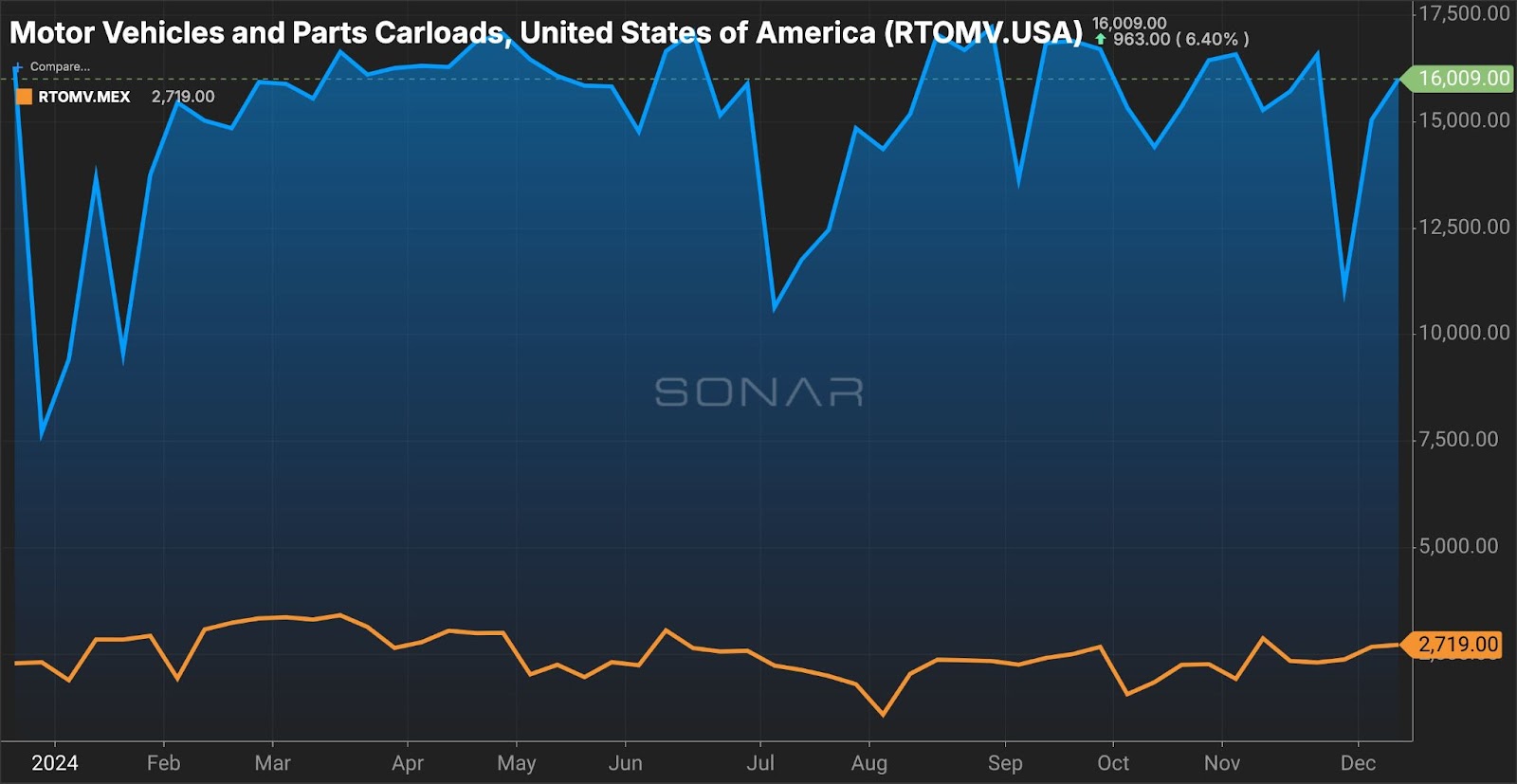
For the week of Dec. 14, U.S. shipments of finished vehicles and auto parts totaled 16,009 rail carload shipments, according to SONAR’s RTOMV.USA index. It was a 27% week-over-week increase.

In Mexico, shipments of finished vehicles and auto parts increased about 15% week over week to 2,719 carloads.

SONAR: U.S. and Mexico rail volumes (RTOMV.USA and RTOMV.MEX) for finished vehicles and auto parts have been trending higher week over week in December. To learn more about SONAR, click here.

“It’s really simple and easy to say, ‘We’re going to put this tariff on things … it’s going to be good for the country, it’s going to generate revenue,’” Lash said. “But there are all of these hidden consequences, and there’s structural, long-term investments that you don’t know. You don’t shift supply chains overnight. How long does it take to build a factory? It’s three years, four years. It’s not like you just shift them and move these things around. You put them in place, and then it’s a long-term investment for it.”

Lash said other cross-border industries that could be affected by Trump’s proposed tariffs are lumber producers and oil and gas suppliers. 

“Tariffs have some really important uses. … [T]he ones that really come top of mind is to protect against unfair trade practices,” Lash said. “When you think of the lumber side of things, Canada and the U.S. have been in a trade war essentially since the 1980s.”

Tree growers in the U.S. allege that the lumber industry in Canada is being subsidized by the Canadian government, allowing tree producers to sell timber in the U.S. at below-market prices.

In August, the Biden administration raised tariffs on lumber from Canada to 14.5%. 

“The National Association of Home Builders said this is really going to kill affordability, because it’s going to drive the houses, the construction costs, the material costs of homes, up,” Lash said. “We already have an affordability crisis. Well, guess what? If tariffs go up by 25%, that’s not good for affordability.”

Trump’s tariff threat could shake up the cross-border agrifood trade across North America, according to David Dienesch, CEO and chief agent at Allianz Trade in Canada.

Canada’s agricultural crops (wheat, canola, barley, corn and soybeans) have had steady demand over the past year from international markets driven by the war in Ukraine.

The agrifood sector in Canada represents about 7% of Canada’s GDP and includes agriculture, food manufacturing, food services, as well as wholesale and retail sales of food commodities. Canada’s agrifood sector employs about 2.3 million people.

“Food is one of the top imports of the U.S. from Canada. It’s roughly $30 billion a year; it’s a big sector,” Dienesch told FreightWaves in an interview. “If I add the tariffs as they’re being projected right now, that’s going to increase energy prices too. For U.S. food producers, that’s a recipe for inflation. … [T]he result is going to be higher prices for you when you go to the grocery store and a ripple effect overall in the supply chain.”

Paris-based Allianz Trade is a global provider of trade credit insurance and a specialist in surety, debt collection, fraud insurance, structured trade credit and political risk.