Trump trade war halts ships, strands empty containers 

Container shipping, the linchpin of global trade, has been thrown into turmoil once again as President Donald Trump’s trade war continues to escalate. 

Recent weeks have seen a dizzying array of tariff announcements, exemptions and retractions, leaving shippers and importers struggling to keep pace with the rapidly changing situation, analyst Judah Levine of Freightos said in a weekly research note.

On April 2, Trump announced unprecedented reciprocal tariffs on about 60 U.S. trading partners, which went into effect on April 9. However, just a day later, these tariffs were paused for three months for most countries. China, which had chosen to retaliate against the reciprocal tariffs, was excluded from this pause, resulting in both countries imposing a minimum of 125% tariffs on each other’s goods.

Adding to the complexity, Trump exempted electronics including smartphones, computers and semiconductors from all reciprocal tariffs late last week for an unspecified period. This exemption applies to Chinese electronics as well, although the president’s earlier 20% tariffs on China and any previous tariffs still apply.

The situation remains fluid, with Trump initiating trade investigations into semiconductors and pharmaceuticals, which could lead to new sectoral tariffs in the coming weeks. The 90-day pause on reciprocal tariffs still leaves in place the 10% global tariff, 25% levy on Canada and Mexico, and 25% tariffs on vehicle imports, though Trump is considering a short-term exemption on the latter.

Many countries are attempting to negotiate with the U.S. during this three-month reprieve, but no settlements have been announced. The European Union reports that talks have not been productive, while Trump has called on China to come to the negotiating table.

The impact on freight has been significant, Levine said. The initial rollout of reciprocal tariffs led to a widespread drop in container bookings out of Asia. However, the subsequent 90-day pause and escalation with China have created a complex situation. While shipments out of China remain paused, many shippers sourcing from other Asian countries have started increasing their orders again, attempting to get ahead of possible tariff resumptions in July.

The Freightos Baltic Index found Asia-U.S. West Coast rates increased 10% to $2,465 per forty-foot equivalent unit for the week ending April 11. Asia-U.S. East Coast prices rose 3% to $3,647 per FEU.

While frontloading likely helped push container rates from China, Taiwan and Vietnam to the Port of Long Beach, California, sharply up ahead of the April 9 implementation of reciprocal tariffs, Freightos data showed rates from Shanghai have dropped 16% since tariffs went into effect, while prices from Taiwan and Vietnam have stayed elevated. That may indicate a realigning of manufacturing in the region.  

The extreme tariffs on Chinese goods have led to a sharp decline in container export bookings, with reports of increased blanked sailings on this lane as demand slumps. Many U.S. importers had been frontloading goods since the November election in anticipation of tariff hikes, building up inventory that may allow them to pause and assess the situation before deciding their next moves.

For shippers on other lanes, the 90-day reprieve offers another opportunity to pull forward goods ahead of possible tariff increases. This is likely to increase demand for ocean freight on these lanes in the near term, followed by lower demand after the deadline passes. This pattern suggests that the typical peak season months may be subdued due to demand pulled forward since late last year.

Asia-North Europe prices fell 1% to $2,365 per FEU, while Asia-Mediterranean prices declined 5% to $2,751 per FEU.

The need to blank sailings out of China while potentially increasing services from other Asian origins poses challenges for ocean carriers and may cause delays for shippers. The concentration of empty containers in China is likely to exacerbate these issues. Trans-Atlantic surcharges announced for May could indicate carrier expectations of frontloading ahead of the July deadline.

While overall Asia-North America container rates increased somewhat last week due to start-of-month general rate increases, daily rates have since reversed much of those modest gains. Demand patterns between China and other Asian origins may be reflected in diverging rates at the port-pair level.

Maersk (OTC: AMKBY) this week announced a pair of peak season surcharges effective May 15: $2,000 per FEU transiting from Asia to the U.S. and Canada, and $750 per FEU for shipments from Turkey and Egypt to the U.S.

Hapag-Lloyd (OTC: HPGLY), Maersk’s partner in the new Gemini Cooperation, announced a peak season surcharge of $2,000 per FEU from East Asia to North America, effective May 12.

Find more articles by Stuart Chirls here.

Related coverage:

Analyst warns of ‘carnage’ on shifts in container shipping

US considering making port fees more affordable for Chinese ships: Report

‘Tariff shockwave’ leads to collapse in ocean container bookings

Early container rush ahead as Asia-Pacific defies global growth slowdown

Autonomous truck platooning test aims to boost technology’s adoption in Midwest

The 175-mile trek between Columbus, Ohio, and Indianapolis was the setting recently for two tractor-trailers testing autonomous truck platooning technology as part of a project partly funded by the U.S. Department of Transportation.

The trucks were hauling shipments Monday for Dublin, Ohio-based Ease Logistics as part of a collaboration between the Ohio Department of Transportation and the Indiana Department of Transportation, according to DriveOhio, an agency focused on advancing smart mobility. The goal is to promote adoption of truck automation tech throughout the Midwest, where autonomous vehicle testing has been scarcer than in warmer Southern climates, DriveOhio stated in a news release.

The trucks are equipped with Kratos Defense platooning technology that links them electronically. The driver of the lead vehicle can control the speed and direction of the second truck, “enabling it to precisely follow the path of the leader,” DriveOhio noted. Along portions of the trips across Interstate 70, the follower truck – which also had a professional in the driver’s seat – relied on the autonomous system to accelerate, brake and steer. The drivers of both trucks could shut off the system and take control of the vehicles if needed.

The trucks traveled close together, the release stated, so purple lights on the cabs let law enforcement know they were electronically linked.

“This technology offers a complete safety system with redundancies that could make roadways safer,” Ohio State Highway Patrol Capt. Chris Kinn said. “Unlike human drivers, automated vehicles do not drive impaired, text while driving, fall asleep at the wheel or recklessly speed. The goal of this technology is to take the human error out of the safety equation.”

ODOT Director Pam Boratyn added: “We’re committed to reducing deaths on our roadways and vehicle automation technologies can be part of the solution. Many vehicles on the road today have some degree of automated driving systems including adaptive cruise control, lane keep assist, and automatic braking. All of these features are designed to improve safety and reduce driver stress.”

The technology is key to meeting challenges in everything from the agricultural, mining and energy sectors to national defense, said Maynard Factor, vice president of business development at Kratos Defense.

“This project offers a real-world opportunity to demonstrate how proven automated driving systems can increase safety, strengthen supply chain resilience, and ensure economic vitality,” Factor said in the release. “Operating along the I-70 corridor between Ohio and Indiana enables us to showcase performance in complex, all-weather conditions essential to Midwest freight operations and accelerates readiness for broad adoption.”

The technology can markedly cut air drag and fuel consumption for fleets, according to a 2024 study.

A DOT grant is partially funding the $8.8 million, multiyear project, which is gauging different levels of automation in truck fleets.

Related:

Autonomous trucking technology makes a splash in Las Vegas

Fictiv acquired for $350M by Japanese components supplier

San Francisco-based Fictiv has been acquired by Misumi Group Inc. in an all-cash deal worth $350 million.

The acquisition will help Misumi Group expand its digital services and expand its customer base, officials said. 

Tokyo-based Misumi Group is one of the largest global industrial suppliers of off-the-shelf manufacturing components. The company has 22 manufacturing sites and 20 logistics facilities around the world, producing and distributing industrial supplies to 318,000 global companies.

“The aim of this acquisition is to enhance our digital services … while concurrently expanding our customer domain,” the company said in a news release. “By acquiring Fictiv, we will rapidly increase the value we provide from the traditional realm of production equipment to the upstream area of product development within the value chain.”

Misumi Group’s U.S. locations include a supplier network called Sugura USA, with facilities in Addison, Illinois, along with distribution centers in Chicago and Torrance, California.

Fictiv, founded in 2013, offers on-demand procurement services for custom mechanical components parts for the U.S. manufacturing industry. The company has production operations in the U.S., China, India and Mexico, with a total of 400 employees.

Fictiv has produced over 35 million commercial and prototype components to date and also has a global partner network of 250 manufacturing partners worldwide. 

In November 2023, Fictiv opened a production facility in Monterrey, Mexico, aiming to offer more options for on-demand manufacturing services across North America.

“This agreement marks a major milestone for Fictiv and the broader manufacturing ecosystem. Misumi’s investment validates the power of AI-driven supply chain innovation and our shared vision to make manufacturing more accessible, intelligent, and scalable,” Dave Evans, Fictiv’s co-founder and CEO,  said in a statement. “Together, we’re building a global platform that helps engineering and supply chain teams bring ideas to life faster and more efficiently than ever before.”

Related: Diverse supply chain can limit tariffs’ impact, expert says

UPS white paper casts shade on e-commerce gig delivery providers

Close up side view of male driver wearing blue shirt and hat in car with packages stacked up in passenger seat.

As traditional parcel carriers face rising competition from an increasingly diverse array of carriers, the financial services unit of UPS has published a white paper aimed at discrediting last-mile delivery companies that utilize gig drivers even though it owns a crowdsourced delivery platform. Not discussed is the possibility that shippers are looking for delivery alternatives because of frustration over the size and frequency of rate increases from FedEx and UPS.

The paper, published on Monday, serves as a promotional vehicle for UPS Capital’s InsureShield Shipping Insurance, which the company says can help merchants mitigate last-mile risks. However, it also offers valuable insights for merchants into the habits of e-commerce buyers.

Online merchants are struggling to meet customer expectations for ultra-fast, reliable delivery and control over their delivery experience, while containing costs, but gig logistics providers have not proved to be a reliable solution, UPS Capital said in the paper.

Sixty-two percent of merchants reported an increase in damage, theft or delays tied to gig-driven deliveries. Only 12% of respondents expressed confidence in gig carriers’ service quality compared to 69% in 2022 who believed gig services provided superior customer satisfaction over traditional carriers, according to the research by Dynata commissioned by UPS Capital. 

Dynata polled 500 e-commerce vendors and 1,000 U.S. consumers for the survey. 

“Brands that fail to proactively manage shipping visibility, customer communication, and risk mitigation will bear the brunt of consumer dissatisfaction,” the white paper said.

Consumer sentiment has also shifted from 63% preferring retailers that offer same-day gig delivery to 55% now favoring traditional carriers, with just 20% actively choosing gig-powered delivery. The most common consumer complaints about gig delivery companies and apps – like Uber Courier, Shipt (a Target company), Postmates and Dispatch – include delayed packages, lack of timely communication, and missing or damaged shipments, the paper said. 

UPS owns Roadie, a delivery platform with independent drivers that use their own automobiles to provide last-mile, on-demand and same-day delivery services.

Nearly a third of consumers rated delivery speed as their top shopping priority, over cost and product selection. Demand for speed is even more pronounced among younger consumers, with 51% of Gen Z respondents prioritizing quick shipping compared to only 15% of people age 62 and older. 

Personalization is also a key consideration, with 44% of shoppers surveyed wanting the ability to customize their shipping preferences and 84% saying they’re more likely to buy from merchants that offer the ability to set delivery options. Consumers are more likely to purchase from a merchant that offers the ability to track packages in real time, pick the package arrival day and time, and guarantee insurance coverage for all packages in case of mishap, according to the white paper.

Nearly all surveyed merchants agreed that the negative delivery issues – late or missed deliveries, packages left in unsafe locations, or lack of real-time tracking – can heavily influence future purchasing decisions. If a brand fails to resolve a shipping issue, a quarter of surveyed consumers hesitate to shop with them again, and nearly 44% of Gen Z respondents demand issue resolution before considering a repeat purchase, the paper said.

The rise in popularity of shopping directly through platforms like Instagram, TikTok and Facebook is transforming e-commerce, but only 19% of surveyed shoppers trust social media storefronts for deliveries and 39% have never attempted a social commerce purchase at all.

Consumers no longer solely blame carriers when things go wrong, UPS Capital and Dynata said. In 2022, 83% of surveyed consumers blamed delivery providers for delivery mishaps. This year, that number has dropped to 39%, as more shoppers now hold merchants accountable for ensuring a seamless delivery experience.

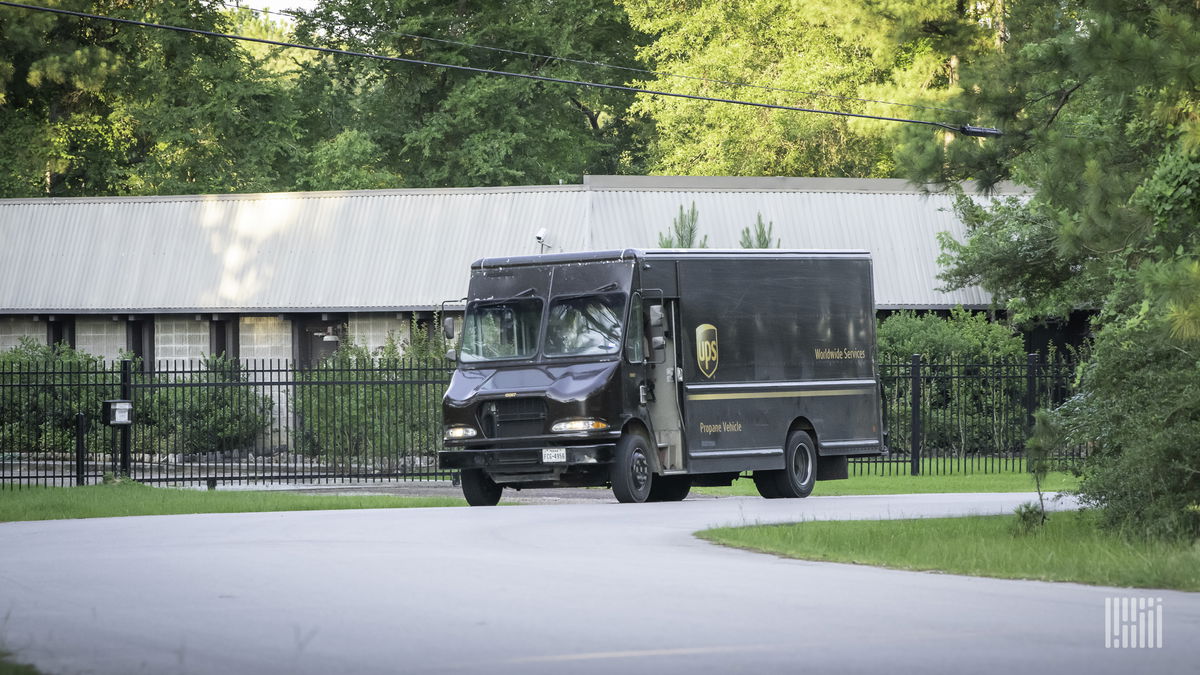
A UPS delivery van runs its route through a suburban neighborhood. (Photo: Jim Allen/FreightWaves)

UPS Capital said merchants can regain control of last-mile logistics by using advanced tracking technologies for real-time shipping status, conducting regular performance reviews and feedback loops to ensure service quality, and gathering customer feedback through satisfaction surveys. It also recommended choosing reliable carriers that ensure quality and secure delivery, as well as leveraging comprehensive shipping insurance – like its own InsureShield – to protect against financial losses.

More than 40% percent of surveyed merchants report that 2% to 5% of their shipments suffer from damage, loss or theft each quarter. Larger enterprises with revenues exceeding $50 million face even steeper losses, the paper said.

The insurance offered by UPS Capital protects shippers against lost or damaged shipments, allowing them to cover their cost to refund or replace a purchase when this occurs, said John Costanzo, who heads parcel and freight consultant LDK Global Logistics.

“They’d make a better case if they could show how using well established carriers like UPS reduced delays and damages, in addition to a more consistent delivery experience. That would tie their value proposition to the main elements identified in the survey – cost, visibility and speed of delivery. Shipper insurance really only is a protection for when last mile delivery fails in a pretty dramatic way,” he said by email. 

TD Cowen/AFS Logistics Freight Index details parcel rate escalation

But the incentive to partner with gig logistics companies could be growing as legacy express carriers take a more aggressive pricing approach.

Parcel carriers no longer are announcing rate increases on a predictable, annual cadence with plenty of advance notice. Over the past 18 months, FedEx and UPS have introduced more frequent, subtle price changes that take effect more quickly as the fight for revenue in a low-demand environment intensifies, said AFS Logistics and investment bank TD Cowen in their freight index report last week.

During the first quarter, UPS announced new ZIP code zone alignments, new fees on print and paper invoices, fees for check and wire payment, an increase to the late payment fee, and a new payment processing fee. Both carriers have also continued to make fuel surcharge changes, the net result of which is the UPS ground fuel surcharge increasing 15% and the FedEx equivalent rising 12% from Q1 2024 to Q1 2025 — even as the price of diesel fuel fell 8.4% over the same period, according to the analysis.

“These latest changes introduce even more complexity for shippers to digest and negotiate. If they overlook any one of these subtle updates, they can find themselves subject to punitive provisions like a blanket payment processing fee that’s in effect a 2% price hike,” said Mingshu Bates, chief analytics officer and president of parcel at AFS. “If you look at the state of the market, these changes fit the carriers’ stated aims of prioritizing network efficiency and revenue quality. Competition from the Postal Service and regional carriers has FedEx and UPS looking to defend their slice of a soft market while trying to shift away from the discount-heavy dynamics of the past year and a half.”

Ground parcel pricing remained extremely strong, as the cost per package rose 4% quarter over quarter to a record-high average, driven by rate increases, surcharge adjustments and higher billed weight. The ground parcel rate-per-package index is expected to decrease from 31.3% in the first quarter to 29.5% in the second, which still represents a 2.6% increase year over year.

Express parcel pricing grew in line with seasonal trends in the first quarter, with general rate and fuel surcharge increases powering a 5.2% sequential quarterly increase in cost per package. But volume growth remains a challenge in the domestic express parcel market, which is partly due to carriers’ own success in optimizing ground networks, enabling shippers to shift volume to less expensive ground service for similar performance. 

But, said AFS/TD Cowen, volumes have also been challenged by competition from an increasingly diverse carrier landscape. The U.S. Postal Service, for example, recently launched priority next-day service in 54 markets. 

Click here for more FreightWaves/American Shipper stories by Eric Kulisch.

RELATED READING:

FedEx begins its first direct Singapore-US air cargo service

Hongkong Post to stop handling US-bound packages amid tariff conflict

UPS hires Delta Air Lines to maintain Boeing 757 engines

Another federal circuit weighs broker liability, boosting odds of Supreme Court review 

Another case involving the question of broker liability – one that brokerage giant TQL already won at the federal district court level – is awaiting a decision from the U.S. Court of Appeals for the 6th Circuit on the appeal from the family of a woman killed by a truck hired by TQL.

The location of the case is significant. The original case, Cox vs. TQL, was decided in favor of TQL in June 2024 in the U.S. District Court for the Southern District of Ohio. Ohio is in the 6th  Circuit of the federal judiciary system.

Oral arguments were heard in January.

Attorneys who represent brokerage companies have been hoping the U.S. Supreme Court will take up the question of whether a broker is liable if a carrier hired by the 3PL gets into an accident or some other misfortune occurs, such as a theft. The scoreboard so far: Brokerages have prevailed in cases not just in lower courts but at the appellate level in the 7th and 11th circuits. But in the case of Miller vs. C.H. Robinson (NASDAQ: CHRW), a 9th Circuit court ruled against the brokerage in a complicated decision.

Three strikes so far at SCOTUS

With the split decisions among the circuits, there have been at least three attempts to get the Supreme Court to clarify the issue of broker liability, but it has swatted them all away so far in not granting certiorari.

One of those cases also involved TQL. Its attempt to get Supreme Court review was unusual in that while it was the plaintiff that filed the request with the high court, TQL, which had won at the appellate level in the 11th Circuit, agreed with the plaintiff that the Supreme Court should take up the issue. Like many others in the brokerage sector, it sought to have Supreme Court clarification on the issues. But the request was denied in January.  

A decision by the 6th Circuit upholding the lower court ruling in favor of TQL would add slightly to the split, because the scorecard would have three circuits ruling in favor of the legal argument that federal law under the Federal Aviation Administration Authorization Act (F4A) preempts broker liability in such cases, with the 9th Circuit decision in Miller vs. C.H. Robinson on the other side of the divide to a limited degree.

But a 6th Circuit decision in favor of the plaintiff in the TQL case, the family of Greta Cox, killed in the 2019 crash, would create further divisions in the issue, which might pry open the door to Supreme Court review a little wider.

At the recent Capital Ideas Conference of the Transportation Intermediaries Association, Marc Blubaugh, co-chair of the transportation practice at the Benesch law firm – and coincidentally located in Columbus, Ohio, in the 6th Circuit – raised the prospect of Cox vs. TQL helping a push for certiorari on the question of broker liability.

More decisions mean more chances

“The more circuit decisions that come out, the greater the likelihood that the court would resolve the split among the circuits,” Blubaugh said. “It is one of the criteria that the court looks at in addition to whether it is an issue of critical importance to the Supreme Court.”

In the Ohio case, according to court documents, Greta Cox was driving with her grandson Brian Ragland on May 8, 2019, when her car was struck from behind by a truck driven by Amarjit Singh Khaira, who was driving for a company called Golden Transit.

That company had been hired by TQL to transport condiments from Kraft Heinz (NASDAQ: KHC) from Illinois to California.

In the original complaint filed by the Cox estate in January 2019, attorneys make several claims. One is that TQL was a motor carrier and identified itself as such. It’s not just a casual term in litigation questions over brokers and the F4A; decisions have been made in favor of 3PLs in which a court has determined a 3PL is not a motor carrier. If it were, it could be found liable under the so-called “safety exception” of F4A, which has the potential to bring in a wider range of negligence and other claims against a carrier that otherwise might be blocked by F4A.

The key provision of F4A, which dates back to 1994, is that a state cannot take regulatory action that impacts a “price, route or service” of a motor carrier or other transportation method. But the safety exception says F4A does not “restrict the safety regulatory authority of a State with respect to motor vehicles,” including such issues as cargo size, weight and insurance. It was the safety exception that led to an unfavorable decision for C.H. Robinson.

The lawsuit also says Golden Transit was “an unsafe, incompetent motor carrier with a history of publicly available red flags [and had] a history of safety violations.”

The initial suit against Golden Transit and its drivers was settled out of court for an undisclosed amount.

That left the litigation against TQL, which said action against it was preempted by F4A. Judge Jeffrey Hopkins agreed.

Hopkins said of the Cox estate’s claim that TQL was a motor carrier, which could have opened the door to the safety exception, that the charge was “preempted because a common law negligence claim enforced against a broker is not a law that is with respect to motor vehicles.”

On the question of liability and whether finding a broker can be liable or negligent under F4A, Hopkins turned to a court ruling in a case involving Ying Ye and GlobalTranz, in which the 3PL prevailed. The case was one of the decisions where the losing plaintiff sought Supreme Court review and didn’t get it. 

“The enforcement of such a claim and the accompanying imposition of liability would have a significant economic effect on broker services,” Hopkins wrote. He then cited, working from the GlobalTranz case: “By recognizing common-law negligence claims, courts would impose in the name of state law a new and clear duty of care on brokers, the breach of which would result in a monetary judgment.”

More articles by John Kingston

Breaking from the FreightTech AI pack: Companies make their case at TIA meeting

New Mack long-haul truck makes grand entrance in bid for market share

ATBS says independent drivers earned a little more in ’24 but drove more as well

Congestion nicks CSX’s earnings, volume and revenue

CSX’s first-quarter profits fell as congestion hurt volumes and revenue while driving up the railroad’s expenses. 

CSX (NASDAQ: CSX) has been struggling operationally this year after a string of harsh storms. Roundabout detours required by the rebuilding of the hurricane-damaged Blue Ridge Subdivision and the closure of the Howard Street Tunnel in Baltimore for a clearance project have reduced the railroad’s ability to bounce back from bad weather.

CEO Joe Hinrichs said that providing consistent, reliable service strengthens the railroad’s relationship with its customers and leads to volume growth.  

“Unfortunately, our performance fell short of our expectations. As a result, we left good business on the table, reduced our revenues, and our inefficiencies meant we incurred more expense. We take full accountability for our performance this quarter and we are not standing still,” he told investors and analysts on the railroad’s Wednesday afternoon earnings call.

First-quarter operating income declined 22%, to $1.04 billion, as revenue decreased 7%, to $3.42 billion. Earnings per share declined 24%, to 34 cents.

The railroad’s operating ratio increased 5.9 points, to 69.6%, as expenses rose by 2% for the quarter. The congestion added $45 million in costs, while lower fuel surcharge revenue and slumping export coal prices contributed to the revenue decline.

Overall volume declined 1%. Merchandise traffic declined by 2%, as automotive traffic dropped due to reduced vehicle production. Intermodal volume increased by 2% thanks to increased port traffic, while domestic volume was flat. Coal slumped 9%, led by a 12% drop in export coal tonnage. Domestic coal, which primarily is thermal coal used for electricity generation, declined 4%.

Chief Commercial Officer Kevin Boone said freight demand remains strong despite the trade war that is creating economic uncertainty. “If markets hold, we see opportunities to capitalize on improved network performance,” Boone said.

CSX was unable to handle demand for grain and coal unit train service during the quarter.

The trade war and related uncertainty prompted CSX executives to reduce their outlook for the year. The railroad still expects to see full-year volume growth but withdrew prior guidance of low- to mid-single-digit growth.

Boone expressed optimism about continued growth in industrial development projects on the CSX network, which he said would benefit the railroad now as well as long term if tariff policy ultimately boosts U.S. manufacturing.

Two dozen customer facilities opened on CSX in the first quarter, including projects for Chick-fil-A, Hyundai, Nova Chem, aluminum producer Novelis and steelmaker Nucor. The facilities will add 28,000 annual carloads once production ramps up fully. 

Also in the works: up to 50 more projects scheduled to come online by the end of the year. Meanwhile, CSX’s industrial development pipeline remains strong, with roughly 600 projects in the works.

CSX’s key operational metrics reflected the impact of congestion. Average train velocity fell 3%, while terminal dwell increased 19%. On-time train originations fell 9%, to 68%, with on-time arrivals dropping 21%, to 55%.

Service metrics also declined for the quarter compared to a year ago. Intermodal trip plan compliance declined 4%, to 90%, while carload trip plan compliance slumped 16%, to 69%. Customer switch performance, however, was 93%, a decline of 2%.

“I have no excuse as to where we are other than a buildup of a series of significant events that really took away the capacity that we had planned once we took down the Howard Street Tunnel,” Chief Operating Officer Mike Cory said. 

The railroad is taking several steps to smooth operations, he says. Among them: placing extra locomotives in service, boosting mechanical staffing to speed locomotive servicing, transferring train crews to congested terminals, and temporarily reducing trackwork in the areas hardest hit by congestion.

Flooding this month in the Nashville, Tennessee, and Cincinnati areas – on CSX’s corridor linking Chicago and the Southeast – further complicated operational recovery efforts.

“It is going to be a gradual process to get the network back, and so it’s not going to be overnight,” Cory said. The Howard Street Tunnel and the Blue Ridge Subdivision, the former Clinchfield main line in the rugged mountains along the Tennessee and North Carolina border, aren’t expected to reopen until fall.

CSX’s safety performance improved during the quarter, with the personal injury and train accident rates both declining from a year ago as well as from the fourth quarter.

Related:

CSX detours 16-plus trains per day as Baltimore tunnel work begins

Despite quarterly loss and battered stock, Triumph Financial stays aggressive

Even in the midst of a sharp drop in his company’s stock price and a freight market that is not supporting the bottom line at Triumph Financial, CEO Aaron Graft touted milestones reached and signaled a new aggressiveness in pricing the company’s products.

In his quarterly letter to investors released in conjunction with the company’s earnings on Wednesday, Graft said Triumph’s “network engagement” – the percentage of brokered freight that one or more of its payments systems touch – crossed the 50% mark in the first quarter for the first time. The road to that number has been steady; the four prior quarters from the first quarter of last year through the end of 2024 went 42.7%, 46.6%, 47.8% and 48.7%.

But after two quarters of positive earnings before interest, taxes, depreciation and amortization, the Payments group at Triumph slipped to a slight negative margin of 0.1%. In the letter, Graft said the group had several noncore charges that led to the EBITDA red ink.

That isn’t stopping Triumph from more aggressively pricing its payment products, Graft said. 

Monetizing the network

“The time has come to shift more emphasis to monetization of the Network” – the “Network” being the full invoice audit and payment system that has been the core of Triumph’s growth plans. 

“Our efforts to monetize payments will be aimed at fairly and consistently pricing our services based on the value created for our clients as we continue to build income,” Graft said. Many current customers date back to when Triumph purchased HubTran in 2021, kicking off the growth of the audit network, and their fees have not kept up. “The value we are creating for many of our clients has grown faster than our pricing,” he said. 

Triumph’s stock price has taken a beating in recent months. It is down 34.4% for the year and far more for the past three months: 45.6%. Graft acknowledged that slide without citing specific numbers, but did say that “seasonality and cyclicality have converged with uncertainty around trade policy and recession fears, [and] our enterprise valuation has been affected.”

But in this quarter’s version of what he has been saying repeatedly, Graft also said that earlier declarations that “the plan is to stick to the plan … [have] not changed.”

“We will not blame the freight market and trade policy for our results, nor will we let them dissuade us from our strategic vision,” he said. “We could have deviated from the plan and ceased additional investments, delayed immediate realignment expenses, or cut our way to modest profitability this quarter. Each of those has a cost – whether you execute it or avoid it. It is not in our nature to avoid pain today at the risk of jeopardizing long-term value.”

The plan for Greenscreens

Graft’s letter was the first published since Triumph acquired Greenscreens.ai, the analytical pricing tool that is now the core of the company’s Intelligence division. It isn’t expected to stop there in developing the unit, building in the other data it generates from its payment and factoring operations.

“Because we transmit and audit more data in furtherance of making a payment than anyone, we have the densest and cleanest data set in the market upon which to build rating products,” Graft said. “We also have the customer relationships and integrations to expedite our go-to-market strategy. This is why we have gone down this road, and why we intend to see it through.”

Graft said Greenscreens has a gross margin of about 90%. Closing is expected this quarter.

The LoadPay service designed to serve small to medium carriers has been launched. LoadPay’s target is to get money more quickly into a bank account that is part of the LoadPay offering. The first quarter saw payments of $5 million into carriers’ LoadPay account; $3.2 million of that occurred in March. Triumph has a little more than 1,000 LoadPay accounts at present and expects to finish the year with between 5,000 and 10,000.

Even though LoadPay is still in its infancy, Graft made it clear the plans for it are ambitious. The company’s factoring operations have long been a foundational business at Triumph and will have a “symbiotic” relationship with LoadPay, since both operations are designed to get money into drivers’ hands faster.

But Graft sees LoadPay as having a higher upside. “The interchange revenue we realize in LoadPay is higher per dollar of spend than our discount rate we charge in Factoring,” he said. “LoadPay is a more efficient business model and generates higher margin revenues.”

Factoring is still valuable, he said, but Triumph now sees it more as “part of a larger suite of products.”

In other points Graft made in the letter:

  • Earnings were impacted by expenses connected to both LoadPay and the company’s Factoring-as-a-Service product, which assists in back-office factoring activities at third-party clients. But revenue from those products is just starting, impacting the bottom line. Graft also said C.H. Robinson (NASDAQ: CHRW) is the first customer for the Factoring-as-a-Service offering. 
  • The average invoice factored by Triumph was $1,769, just $2 more than in the prior quarter and $2 less than a year earlier. However, the average diesel price as measured by the weekly Department of Energy/Energy Information Administration price was up 9-10 cents per gallon in the quarter, which would have worked to increase the size of the average invoice. For the first time, Graft’s letter published its average dry van rate per mile found in the invoices it factors. For the first quarter, it was $2.05, up from $2.02 a quarter earlier. The two quarters prior to that were both $1.98.
  • References in the Graft letter to the market were decidedly negative. One particular point: Contract rates have slid. “The downward trajectory on the average invoice size was more aggressive in 2025, creating greater pressure on contract rates than spot. We have, for the first time in the last three years, experienced a reduction in contract over spot pricing. Contract rates were down 7% while spot rates went down 5%.

More articles by John Kingston

Marten’s first quarter short on good news as OR worsens, profit dips

Freight fraud everywhere, but Truckstop CEO asks: Is anybody going to jail?

Breaking from the FreightTech AI pack: Companies make their case at TIA meeting

160-truck carrier closes after nearly 50 years of operation

A family-owned and -operated Florida trucking company has announced it will close after 44 years in business.

Davis Express, located in Starke, Florida, will stop making deliveries after April 23. In an announcement posted Wednesday to the company’s Facebook page, owner James “Jimmy” Davis said the company would return all trucks and trailers to its Starke terminal by the end of the month.

The post stated that all employees will continue to be paid as scheduled every Friday and will receive benefits through the pay period ending June 15. Davis wrote that the business would continue employing mechanics and operate the shop as equipment is taken out of service and sold.

According to SAFER data, Davis Express is an interstate carrier with 160 power units employing 140 drivers. The business carried general freight, fresh produce, meat, refrigerated food and beverages.

As required by federal law for companies experiencing mass layoffs or permanent closures, Davis Express filed a Florida WARN Notice on Wednesday. In the notice, Davis cited “unfavorable business conditions” as the reason for the closure.

A total of 146 employees will be laid off on June 15, and the remaining 17 are expected to be laid off around Aug. 31, according to the notice. These totals are broken down into 117 truck drivers, 35 office employees and 11 mechanics.

In his Facebook post, Davis said the past few years have been very challenging for refrigerated trucking due to rising costs and stagnating or falling rates.

“We have been unprofitable since early 2023 and do not see any signs of improvement in 2025,” he wrote in the post. “In addition, plaintiff’s attorneys have increasingly targeted the trucking industry. Every trip a driver takes is Russian Roulette for everything I worked for my entire life. After 50 years in the trucking industry, I am ready to retire and do not wish to wait any longer for things to improve or to try to find a buyer for the company.”

Although the company has been unprofitable lately, Davis said it is not bankrupt and does not have any “cash flow problems.” He said there is enough money to pay out all employees, vendors and creditors timely.

“As we enter the final chapter of Davis Express, I want to thank everyone that has made the company successful over the years,” he concluded.

FreightWaves reached out to Davis Express for comment.

Infrastructure investment firm Stonepeak acquires Dupre Logistics

A white Dupre tractor pulling a tank trailer on a highway

Infrastructure-focused private equity firm Stonepeak has acquired energy transportation and logistics company Dupre Logistics.

Lafayette, Louisiana-based Dupre offers transportation, private fleet services and truck brokerage along the Gulf Coast and throughout the U.S. It boasts a fleet of more than 700 trucks and 1,000 drivers, along with a network of over 16,000 carrier partners, hauling bulk liquid products including chemicals, industrial gases and perishables. The company also arranges third-party capacity for customers.

Financial terms of the transaction were not disclosed.

“Over the last 40 years, Dupre has established an impressive footprint, becoming an integral part of the supply chain in the Sun Belt,” said Graham Brown, managing director at Stonepeak, in a news release. “Their continued quality and delivery of mission-critical services has resulted in a loyal customer base and an established position as a regional industry leader.”

Twenty-five-year industry veteran Chris Sower has been named Dupre’s new CEO effective immediately, succeeding Mike Weindel, who is departing from the company.

“We are now ushering in a new era at Dupre with new leadership, and with change comes opportunity,” said Dupre founder Reggie Dupre. “With Stonepeak’s extensive supply chain expertise and experience with similar transportation and logistics businesses, we’ll have an expanded toolkit at our disposal to be able to even better deliver for our customers.”

The Dupre family will maintain an ownership stake in the company with Reggie Dupre serving as a board member.

Brown Gibbons Lang & Co. served as the exclusive financial adviser to Stonepeak. G2 Capital Advisors acted as Dupre’s financial adviser.

Stonepeak completed its $3.1 billion acquisition of Air Transport Services Group last week.

More FreightWaves articles by Todd Maiden:

Marten’s first quarter short on good news as OR worsens, profit dips

There was almost no positive news in the first-quarter earnings of truckload carrier Marten Transport. 

The earnings, released midday Wednesday in an unusual move given that the stock market was open for business, saw declines in almost every major metric. 

The operating metrics also showed a company that has gotten smaller by several measures.

The most visible benchmark – operating ratio – was worse across the board.

For its truckload segment, the OR net of fuel was on the wrong side of the breakeven mark, coming in at 100.3% compared to 99.5% a year ago.

The dedicated segment saw OR deteriorate by more than 500 basis points from a year ago, sliding to 92.2% from 87.1% in the first quarter of 2024.

Marten’s Intermodal segment, which already was at a 100%-plus OR a year ago, blew up to 108.3% from 101.5% in the first quarter of 2024. 

Brokerage was the star performer in that it did not decline as much as the other segments. Its OR of 93.5% was 110 bps weaker than a year earlier. 

Marten does not hold a conference call with analysts. But in the prepared statement released in conjunction with the earnings, Executive Chairman Randolph Marten needed to reach to find a positive spin on the quarter.

He touted the dedicated and brokerage segments but then turned immediately to the state of the truckload market where Marten operates.

“Our earnings have continued to be heavily pressured by the considerable duration and depth of the freight market recession’s oversupply and weak demand and the cumulative impact of inflationary operating costs, freight rate reductions and freight network disruptions,” Marten said in the statement.

“We remain focused on minimizing the freight market’s impact and now the impact of the U.S. and global economies with the current trade policy volatility while investing in and positioning our operations to capitalize on profitable organic growth opportunities, with fair compensation for our premium services, across each of our business segments,” he added.

One positive in Marten’s trucking activities was that its average revenue net of fuel per tractor per week was notably improved.

In the truckload segment, that measurement rose to $4,196 from $3,996. In dedicated, it climbed to $3,846 from $3,781. 

But that improvement is occurring in a smaller company. Marten’s total tractors are down to 3,040 from 3,406 a year ago. In truckload, the drop is to 1,670 from 1,830, In dedicated, that number is now 1,262 compared to 1,459 a year ago. (There also is a small number of tractors in intermodal).

Truckload’s total miles fell to 38.3 million from 39.7 million, while in dedicated, the drop was to 25.2 million from 29 million. 

There also was good news in the brokerage segment. Brokerage handled 20,416 loads, up from 20,061 loads a year ago. 

Intermodal loads were down to 3,657 from 4,589 in 2024’s first quarter. 

The smaller footprint came with a reduction in salaries, wages and benefits to $78.8 million from $88.8 million a year ago. Total operating expenses dropped to $217.3 million from $237.4 million.

But with the drop in operating revenue to $223.1 million from $249.7 million, the end result was that net income more than halved, to $4.34 million from $9.65 million, and earnings per share fell to 5 cents from 12 cents.

If there was any other good news, it was that Marten (NASDAQ: MRTN) grew its cash stockpile considerably, rising to $39.9 million at the end of the first quarter from $17.3 million at the end of 2024.

More articles by John Kingston

Breaking from the FreightTech AI pack: Companies make their case at TIA meeting

New Mack long-haul truck makes grand entrance in bid for market share

ATBS says independent drivers earned a little more in ’24 but drove more as well