LTL pricing index to hit record high in Q3

A white sleeper cab pulling two white LTL pup trailers

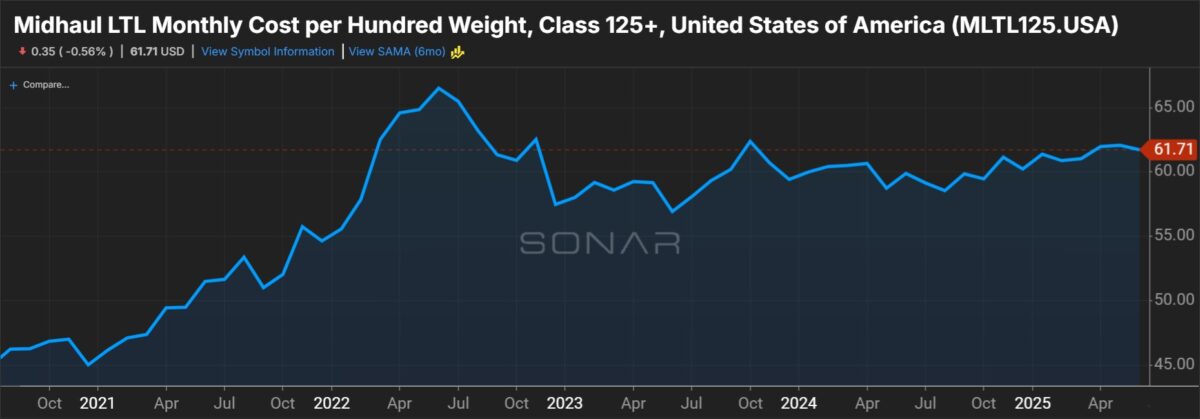
A sagging industrial economy and global trade uncertainty continue to constrain less-than-truckload demand, but carriers are still pushing through rate increases. The LTL rate-per-pound component of the TD Cowen/AFS Freight Index is expected to reach a record high during the third quarter, a quarterly report showed on Tuesday.

Third-party logistics company AFS Logistics and financial services firm TD Cowen are forecasting their LTL rate index to climb to a level that is 65.9% higher than a January 2018 baseline. That would be 170 basis points above the second quarter reading and 130 bps above the prior peak set during the freight boom that concluded in 2022.

If the forecast holds, the index would be up on a year-over-year comparison for a seventh straight quarter.

“The continued resilience of the rate-per-pound index shows the effect of carrier pricing discipline, and the upcoming NMFC [National Motor Freight Classification] transition to a density framework should equip carriers with another method to tightly manage freight classification and pricing,” said Aaron LaGanke, vice president of freight services at AFS, in the report.

(Changes to the National Motor Freight Traffic Association’s classification system will take effect on Saturday.)

SONAR: Midhaul LTL Monthly Cost per Hundredweight, Class 125+ Index. Less-than-truckload monthly indices are based on the median cost per hundredweight for four National Motor Freight Classification groupings and five different mileage bands. To learn more about SONAR, click here.

Cost per LTL shipment fell 2.9% y/y in the second quarter but weight per shipment was off 5.1% y/y, “indicating that carriers are holding firm on pricing and emphasizing revenue management strategies,” the report said.

Sequentially, cost per shipment was down 1.6% but weight per shipment (down 1.8% from the first quarter) and fuel surcharges (down 1.3%) were headwinds, which were offset by a 3.6% increase in length of haul.

The report is in line with second-quarter updates in early June that showed LTL carriers continued to realize y/y yield increases in April and May.

Truckload data from the index, however, continued to show depressed trends.

The TL rate-per-mile component of the TD Cowen/AFS index is expected to decline 40 bps sequentially in the third quarter to just 5.6% above the 2018 baseline. That would mark 10 straight quarters of trough-like conditions for the pricing dataset after peaking at 25.7% in the first quarter of 2022.

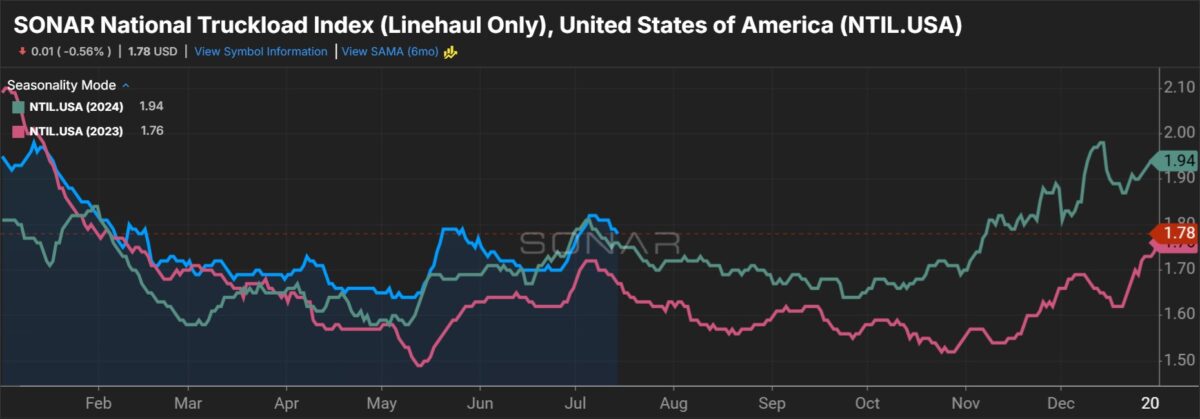
SONAR: National Truckload Index (linehaul only – NTIL) for 2025 (blue shaded area), 2024 (green line) and 2023 (pink line). The NTIL is based on an average of booked spot dry van loads from 250,000 lanes. The NTIL is a seven-day moving average of linehaul spot rates excluding fuel. Spot rates remain slightly higher on a y/y comparison.

Truckload linehaul cost per shipment was up 1.7% sequentially in the second quarter, but the increase was driven by a 1.8% uptick in miles per shipment.

“Ongoing trade and tariff uncertainty is hampering the truckload market’s recovery from the freight recession that started three years ago,” the report concluded.

The LTL earnings season kicks off on July 25 when Saia (NASDAQ: SAIA) reports second-quarter results before the market opens.

AFS Logistics is a non-asset-based 3PL providing audit and cost management services, managed transportation, and freight brokerage. It has visibility into more than $39 billion in annual freight spend.

More FreightWaves articles by Todd Maiden:

DHL rotates leaders at forwarding, supply chain divisions

View of stage at a DHL annual meeting, with DHL yellow signage.

DHL Group executives have been playing a game of musical chairs in the past month. On Tuesday, the parent company’s board announced the transfer of Oscar de Bok, the chief executive officer of DHL Supply Chain, to head DHL Global Forwarding. He will succeed Tim Scharwath, who will retire from the company.

Hendrik Venter, currently responsible for Supply Chain in mainland Europe, Middle East and Africa will move up to lead the Supply Chain division. The leadership changes take effect on Aug. 16.

Management credited Scharwath with modernizing Supply Chain’s IT infrastructure, accelerating digitalization, and improving customer service. 

Deutsche Post AG is the legal entity that does logistics business worldwide as DHL Group. Post and Parcel is a separate unit that provides national mail service in Germany.

De Bok joined DHL Group in 1999 and was managing director of DHL Supply Chain for several countries and regions, including Italy, the Nordics, and Asia. He was named CEO of DHL Supply Chain in October 2019. De Bok will lead Global Forwarding, Freight until August 2030.

Venter has more than 15 years of management experience at DHL Supply Chain. 

Last week, DHL named Markus Voss to succeed Uwe Brinks as CEO of DHL Freight, effective Sept. 1. Voss currently is chief development officer at DHL Supply Chain. He will report to de Bok. One of his top agenda items will be to digitize more customer-facing products and services. Brinks built up DHL’s road freight business for nearly nine years. 

DHL also said it established a European Transportation Board to enhance cross-divisional collaboration in land transport among DHL Global Forwarding, DHL Freight, and DHL Supply Chain. The initiative aims to deliver more integrated and efficient solutions for customers while unlocking further business growth opportunities. 

Earlier this month, DHL named a new CEO for Forwarding in the United States, as well as a new leader for DHL eCommerce Americas. And in June, DHL promoted Mark Kunar to CEO of DHL Supply Chain North America  


Click here for more FreightWaves/American Shipper stories by Eric Kulisch.

FedEx buys world’s first ATR 72-600 passenger-to-freighter aircraft

DHL appoints new chiefs for Americas divisions

DHL Express Canada reinstates service after workers ratify labor deal 

Diesel benchmark moves up slightly but in a market with increasingly bullish factors

The benchmark diesel price used for most fuel surcharges rose Monday for the fifth time in six weeks, and it seems that market conditions for distillates–which includes diesel–are the only oil market fundamentals garnering attention these days.

The Department of Energy/Energy Information Administration average weekly retail price rose 1.9 cents/gallon to $3.758/g, effective Monday and published Tuesday. That stretch of five up, one down in the last six weeks has added 30.7 cts/g to the benchmark.

Most of the chatter on broad oil market moves has been looking to geopolitics as reasons for movement. But when it turns to fundamentals, it is the diesel market that has been the most important factor.

That the oil markets are being led by diesel can be seen in one basic comparison.

Since the start of last month, the price of Brent on the CME commodity exchange has risen 7%, to a settlement Monday of $69.21 from a starting point of $64.63/barrel on June 2.

During that same period, ultra low sulfur diesel on CME climbed to a settlement Monday of $2.3898/g from $2.0445/g, an increase of 16.9%.

The widening of diesel to crude continued Tuesday. At approximately 11 a.m., ULSD was up about 0.75% while Brent crude was down about 0.16%.

The broader market economics for crude still remains heavily weighted toward bearish. The OPEC+ group continues to add supply into the market, voting to approve higher output in August when it met earlier this month. 

It has been setting that “more is better” policy for several months when it gathers for its remote meetings. The OPEC+ more than 2-million barrel/day cutback in production that dates back to 2023 is expected to be fully unwound by September, far earlier than expected. 

The monthly production estimate from S&P Global Commodity Insights, which had not been showing large increases in OPEC+ output in recent months despite the changes in the group’s production policies, finally did so in its estimate of OPEC+ output in June. It was up about 600,000 b/d, a huge one-month increase.

And the monthly estimate of the International Energy Agency released late last week still showed an overall global petroleum market where new supply is outstripping new demand.

But that is the macro picture. In diesel and distillates, tight inventories are driving their price higher relative to crude. 

A straight comparison of the price of ULSD versus the price of CME Brent, translated into cents per gallon, shows that ULSD was about 53 cts/g more than Brent on June 2. That number is now solidly above 70 cts/g. 

In his weekly report, energy economist Philip Verleger, who has long focused on diesel markets as the underappreciated driver of oil prices,  cited several factors that he said could be tightening diesel supply, leading to those dwindling stocks.

The OPEC cuts that are in place, as well as sanctions against Russia, are removing heavier barrels from the market that tend to have strong diesel yields when refined. Those supplies in many cases have been replaced with light crude from the U.S. which has a much lower diesel yield, Verleger wrote.

A tighter emissions rule for shipping in the Mediterranean that took effect in May also is a factor, Verleger said. That rule dropped the sulfur emission limit in that body of water to 0.1% from the broader worldwide limit of 0.5%. To get there, diesel or distillate molecules are often called upon to replace heavier and dirtier fuel sources. 

The Iran-Israel conflict also has a role in the tighter diesel market, Verleger reported. Israel, as a defensive move, had cut supplies of its offshore natural gas production that had been used to power generators in Egypt, Verleger said. But with those cuts, Egypt has turned to diesel as a generating fuel, adding another source of demand that didn’t exist a few months ago.

The overall impact of these various factors can be seen in how tight ULSD inventories are in the U.S. for this time of year. The most recent weekly report on ULSD inventories was published Wednesday with data for the week ended July 4. It shows that current ULSD inventories are well below those of other reports for the first week of July.

Truck maker plans to layoff 2,000 workers in the US, Mexico

Daimler Truck North America plans to temporarily lay off 2,000 employees from five facilities in the U.S. and Mexico amid weak market demand, the company said.

The layoffs, which will be effective Friday, include two facilities near Charlotte, as well as factories in Detroit, Portland, and Saltillo, Mexico. Each site will experience different impacts based on local business needs, Daimler officials said.   

“As we navigate a challenging economic environment, we’ve seen a notable slowdown in new truck orders, particularly in our medium-duty, on-highway, and electric vehicle segments,” Daimler Truck North America spokesman Andrew Johnson told FreightWaves in an email. “To align with current market conditions, we’ve made the tough decision to implement workforce reductions across several facilities.”

The layoffs in North Carolina include 546 employees from a manufacturing plant in Mount Holly, and 27 workers from a components and logistics site in Gastonia, according to a Worker Adjustment and Retraining Notification Act notice.

The job cuts include truck assemblers, painters, supervisors, material handlers, office supervisors, technicians, and logistics staff. The lay offs are expected to be temporary, but do not have a return date yet. 

Portland, Oregon-based Daimler Truck North America employs 29,200 people, according to its website

Daimler Truck North America operates manufacturing plants in Cleveland, Gastonia, High Point, and Mount Holly, North Carolina; Gaffney, South Carolina; Redford, Michigan; and Saltillo and Santiago, Mexico.

Daimler Truck North America is a subsidiary of Germany-based Daimler Truck AG. The company’s brands include Freightliner, Western Star, Mercedes-Benz, Fuso, BharatBenz and Rizon.

June box record for Port of Los Angeles 

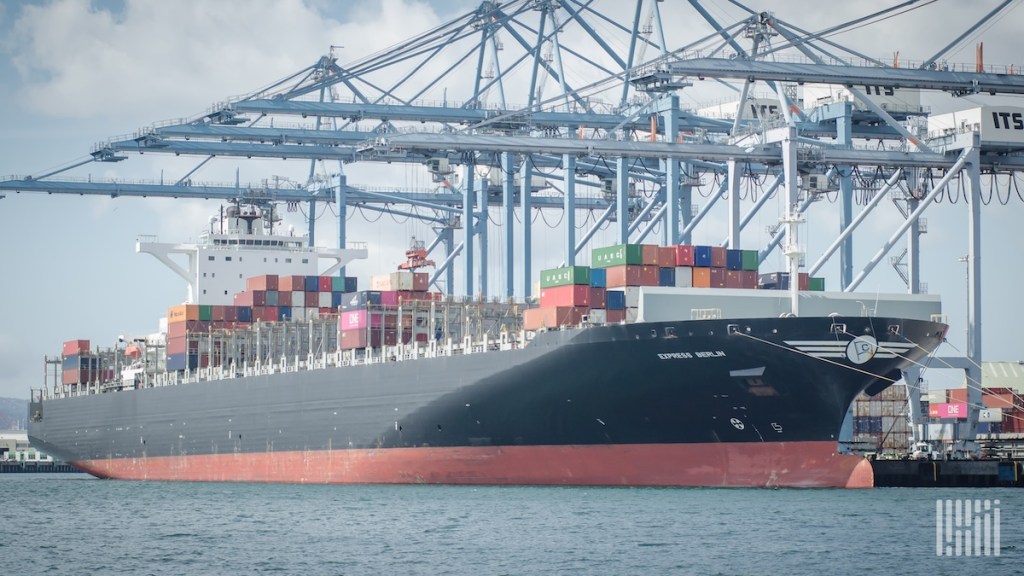
The Port of Los Angeles reported its busiest June ever, handling 892,340 twenty foot equivalent units (TEUs), marking an 8% increase in container traffic from the same month a year ago.

“Some importers are bringing in year-end holiday cargo now ahead of potential higher tariffs later in the year,” Port of Los Angeles Executive Director Gene Seroka said in a media briefing. His comments highlighted how importers are adapting to potential shifts in trade policies by frontloading shipments amid an uncertain tariff environment.

June’s statistics were buoyed by loaded imports at 470,450 TEUs, a 10% improvement y/y as retailers begin to bring in end-of-year holiday merchandise well in advance.

Loaded exports saw a rise of 3% to 126,144 TEUs.

“July may be our peak season month as retailers and manufacturers bring orders in earlier than usual, then brace for trade uncertainty,” Seroka said, illustrating the forward-looking strategies employed by businesses spurred by tariff uncertainties. The proactive stance, he said, preempts potential supply chain disruptions, ensuring steadiness in goods movement across critical periods.

Empty containers jumped 7% to 295,746 units, a positive indicator as logistics providers look to balance operations.

For the fiscal year ended June 30 the port processed 10.5 million TEUs.

“That marks our third fiscal year exceeding 10 million TEUs,” Seroka said, and emphasized that improving operational efficiencies helped achieve the milestone without any vessel backlog.

The first half of 2025 saw cumulative handling of 4,955,812 TEUs, up 5% y/y. 

Find more articles by Stuart Chirls here.

Related coverage:

China-US container trade trending down as peak season nears

Container Q2 volumes up 4.4% for OOCL parent 

Longshore unions to unite for ‘anti-automation’ protest

Tariff pauses ‘unlikely’ to halt tumbling trans-Pacific rates: Freightos

ColdTrack gets 100% pack accuracy for perishable order fulfillment

ColdTrack, a leader in logistics and fulfillment for cold and frozen eCommerce brands, has made waves with the introduction of a pioneering 100% Pack Accuracy Guarantee. This guarantee is a significant achievement made possible by ColdTrack’s substantial $10 million investment in technology and automation. At the heart of this improvement is ColdTrack Live, the company’s bespoke order management system, and its partnership with Deposco’s Warehouse Management System (WMS), both pivotal in transforming their pick-and-pack operations.

The operational changes at ColdTrack have nearly eliminated errors in their warehouse services, achieving an impressive 99.9% pack accuracy rate, improving order accuracy by 67% from the previous year. 

CFO Josh Abramson emphasized, “We are committed to providing our partners with the highest level of service and reliability. Making a deliberate multi-million dollar investment in our technology, which is powered by top-tier talent recruited from across the industry, has transformed our operations to enable unprecedented accuracy. Our Pack Accuracy Guarantee is a testament to our tech-forward approach and the commitment of our team to excellence, innovation, and client satisfaction.”

ColdTrack commits to reimbursing clients promptly if any errors are detected in orders picked and packed at their facilities. Such a contract ties directly into their technological upgrades, starting from the moment inventory enters their operations, where each item is scanned for information, such as lot numbers and expiration dates. 

“In perishable fulfillment, order accuracy is the difference between a delighted customer and a costly, brand-damaging experience,” said Josh Lett, Senior Vice President of Professional Services at Deposco, in a news release. “ColdTrack’s investment in our WMS platform demonstrates their exceptional commitment to their customers’ success. This investment delivers immediate value through error-proofed operations, white-glove expertise and support, and long-term dividends in customer satisfaction and retention—so brands can focus on growth rather than fulfillment worries at a time when operating expenses run high and consumer loyalty is never a given.”

Further enhancing their processes, ColdTrack Live OMS introduces innovative tools like a weather-based coolant algorithm, revolutionizing how perishable shipments are managed by adjusting coolant variables according to destinations. This feature empowers ColdTrack staff by refining upstream order logic and reducing manual intervention, enhancing accuracy.

“The combination of ColdTrack Live OMS and Deposco WMS has been phenomenal from a productivity and performance management standpoint,” said Margaret Szczykutowicz, VP of Fulfillment Operations, ColdTrack, in a news release. “The level of precision data provided from Deposco allowed us to implement an incentive program to reward our top order selectors, boosting order accuracy rates by 40%.”

In addition to the vast order accuracy improvements, the company has also realized a 128% increase in order packing velocity, shipping deadline adherence of 99.9%, and inventory management accuracy of 99.8%.

ColdTrack’s position in the market as a front-runner in cold chain logistics is solidified with their 100% Pack Accuracy Guarantee. This move not only reassures clients of their precision in order fulfillment but also allows businesses to focus on core operations, secure in the dependability of their logistics partner.

USPS hikes parcel rates and stamps by 7%

Close photo of a USPS Priority Mail package being filled.

The price of sending packages, letters and bulk mail through the U.S. Postal Service went up on Sunday, to the dismay of mass mailers and e-commerce sellers.

The product and service price increases were telegraphed earlier this year and received approval from the Postal Regulatory Commission. 

The price for domestic shipping service increased about 6.3% for Priority Mail service, 7.1% for USPS Ground Advantage and 7.6% for Parcel Select. Ground Advantage, introduced two years ago, is an economical service for shipping packages up to 70 pounds in two to five business days. It replaced three other parcel delivery products. The minimum charge for small packages now exceeds $4.

Meanwhile, the price of a first-class mail stamp increased to 78 cents from 73 cents. Letter and postcard rates on average increased 7.4%.

Single-piece letters weighing more than an ounce increased a penny to 29 cents for each additional ounce. 

The new prices lists are available here.

Price increases for mailing services are based on the consumer price index, while shipping services are adjusted according to market conditions. The board of governors said the new rates will keep the Postal Service competitive while providing the agency with needed revenue. The cost of a first-class Forever stamp has risen seven times since 2021, when it was 55 cents.

The higher shipping rates will impact small-and-medium companies that sell goods online and some could go out of business, said Lucas Zheng, founder of San Jose, California-based startup Samezip.

“Although many companies also provide services cheaper than USPS, only USPS can cover the entire United States and can provide free delivery at home, which is something that no other company can do. In addition, it is still very difficult for small and medium-sized shippers to do pre-sorting because they don’t have many packages. For large customers, the price increase of USPS may still be a good thing, because they can do pre-sorting, use multiple package channels, and finally throw the packages that other companies cannot cover to USPS,” he wrote on LinkedIn.

Criticism from mass advertisers and non-profits

Bulk mailers say the rate increases are unwelcome. Keep US Posted, which advocates for greeting card publishers, magazines, catalogs, and printing and paper interests, this month urged incoming Postmaster General David Steiner to call on the board to freeze the mailing rates until after he takes office.

“We believe it is counterproductive for another postage surge to take place immediately before you undertake leadership of the Postal Service, as it will deprive you of the ability to thoroughly assess, and potentially rectify, one of the most destructive policies in DeJoy’s Delivering for America plan,” Executive Director Kevin Yoder said in a letter to Steiner.

Delivering for America is a 10-year turnaround strategy aimed at improving transportation efficiency and returning the Postal Service to financial viability, including by raising revenue. The Postal Service this month reduced service to remote post offices as part of an effort to streamline inefficient routes and consolidate distribution facilities. 

Louis DeJoy left as postmaster general in March under pressure from White House, which encroached on the agency’s independence.

The mail system lost $16 billion in the past two years, partly due to congressional mandates on how to account for worker benefits.

The Alliance of Nonprofit Mailers says record rate hikes the past three years have worsened the Postal Services finances. 

The Association for Postal Commerce last month requested that the Postal Service delay implementation of the rate hikes to Sept. 28 so businesses would have enough time to adjust their own customer pricing. 

In a June 6 letter to the board of governors, the trade group complained that documentation needed for developers to update commercial mailing software should have been available no later than mid-April, but was not provided until May 1 and is not expected to be finalized until mid-June.

“Software companies, corporate mail centers, and mail service and logistics providers will therefore be forced to take shortcuts to meet an unrealistic deadline as well as seek exceptions for their clients who will otherwise fail to comply with preparation and entry requirements. Either way, July 13 implementation of the new rates is likely to result in misdirected mail, operational bottlenecks, postage payment adjustments, and severe service disruptions,” wrote Michael Plunkett, president of the Association for Postal Commerce.

PostCom said it didn’t receive a response from the board.

(Correction: An earlier version of this story incorrectly stated that the Alliance of Nonprofit Mailers is a member of the Association for Postal Commerce.)

Click here for more FreightWaves/American Shipper stories by Eric Kulisch.

Write to Eric Kulisch at ekulisch@freightwaves.com.

US parcel market to grow 36% by 2039, Pitney Bowes says

Postal Service board names FedEx official as CEO before vetting complete

Accounting change, higher labor costs drive $3.3B Postal Service loss

BNSF launches new expedited LA-Houston intermodal service

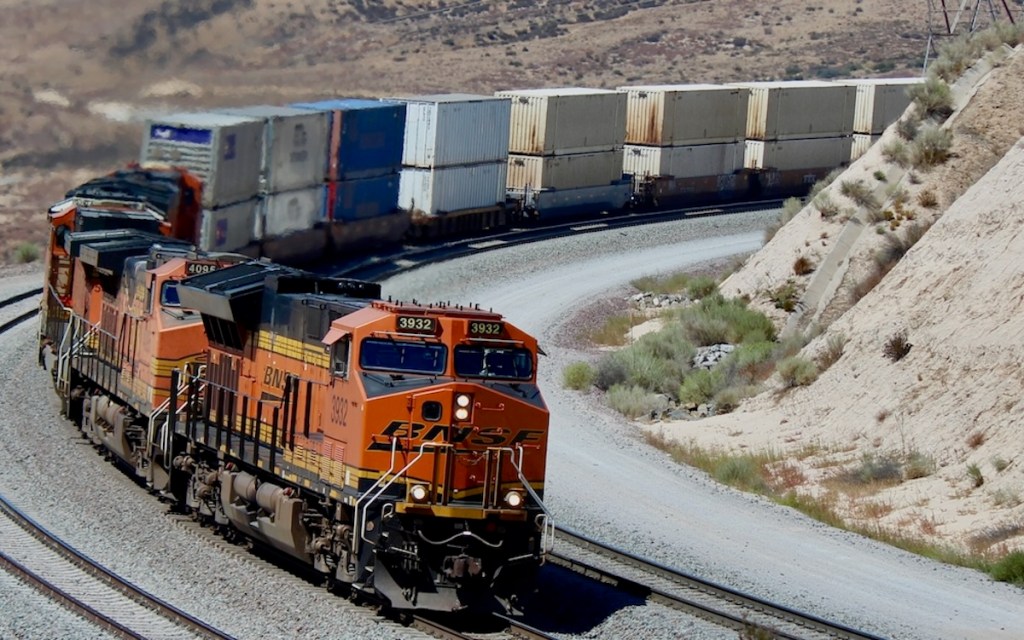
BNSF Railway has launched expedited intermodal service from Los Angeles to Houston on a schedule that shaves two days from previous transit times.

“By continuing to create more opportunities to convert over-the-road freight to rail, we provide a cost-effective, direct solution to bring freight to the dynamic and growing Houston area,” Jon Gabriel, BNSF’s group vice president, consumer products, said in a statement.

The new third-day service from the Hobart terminal in Los Angeles to the Pearland facility in the Houston area is designed to meet the needs of customers that require faster service, especially for those currently draying intermodal loads from Dallas-Fort Worth to Houston, BNSF said.

The new service, which debuted on July 10, rides Hobart-Clovis, N.M., train Z-LACCLO and Clovis-Pearland train Z-CLOPEA.

Subscribe to FreightWaves’ Rail e-newsletter and get the latest insights on rail freight right in your inbox.

Related coverage:

CSX cuts dozens of management jobs

UPDATE: CPKC denies KCS wrongdoing as rail union polls members on strike

Rail freight gains in short week

Setback for rail shippers as court vacates switching rule

Disappearing US government support for EVs? Panel at WEX sees technology moving ahead anyway

Portland, Maine–It was difficult at times, in listening to a panel discussion on fleet electrification at a WEX-sponsored forum here, to remember it was taking place against a backdrop of Washington eliminating various subsidies and incentives designed to reorient transportation toward electrons and away from petroleum molecules.

A $7,500 U.S. federal tax break for buyers of new electric vehicles (EVs)? Gone. A $4,000 break if you purchase a used EV? Ditto. A tax credit for new wind and solar projects? That’s still around, but given the aggressive timeline to get the projects moving, it might as well not be. 

And Congress has taken steps to undercut California’s Advanced Clean Trucks (ACT) rule by withdrawing its EPA waiver, though the legality of that is being challenged. 

But for the panel at the forum sponsored by WEX, which is mostly a payments provider but also has its own division that invests in mobility technology, the outlook remained positive. If there was a theme running through the comments by the panel’s members, it was that technology is racing ahead so fast that while U.S. government policies are shifting quickly from a pro-EV slant to at best a neutral stance, those changes will not derail the energy transition.

The members of the panel have a stake in seeing it happen; they were all in businesses that will flourish on the back of EV growth. 

But their message did not falter at all during the panel. They left little doubt about where they see the electrification of fleets heading.

Looking around the corner

Andrew Beebe, the managing director at venture capital firm Obvious Ventures, said a failure of those who are now predicting a big slowdown in EV technology is that they are not “looking around the corner in terms of making probability-weighted predictions about technology that’s coming, that’s in the labs, that are soft of breakthrough things that we invest in as venture capitalists.”

While much of the focus on the panel was on smaller vehicles including medium-duty trucks, discussion on heavy-duty trucks crept into the conversation with a balance of acknowledgement of current limitations but still with a belief that technology will eventually be able to overcome them.

Beebe made the analogy to trans Pacific ocean shipping “which we’ve all thought for a long time there’s no way you can electrify that.”

He cited an unidentified company that three or four years ago that Obvious Ventures looked at for an investment. At the time, the company’s engineers said of electrified trans-Pacific shipping, “we want to do that someday, but there’s no way we can get there in the next five to 10 years.”

But in recent discussions, Beebe said, the company is now saying “we can get across the Pacific with a container ship that’s fully electrified and it’s more cost effective than today’s container ships.”

That led Beebe to note that the assumption in long-distance over the road trucking always has been that a transition would need to end up with hydrogen as the fuel, because battery weight and storage capacity would be inadequate. He’s no longer sure: “Batteries do extraordinary things and they will be an order of magnitude better over the next decade. So I would just encourage everyone to sort of go on a journey of suspended belief.” 

Lessons from the solar industry

Beebe is a former executive in the solar industry. “Remember the solar cost curve and others that we’ve seen over time that have blown our minds in terms of the capabilities to reduce costs,” he said. “I think we will get to those places faster than a lot of people anticipate.”

Beebe also said during his days as a solar investor, the challenge was to have solar power generate electricity at less than $1 per watt. He noted that it is now 15 cents per watt. 

Lisa Drake, the director fleet electrification for third party fleet manager Merchants Fleet, was somewhat more cautious about the pace of electrification in general. Medium duty trucks were part of her discussion of the market.

“Pickup trucks and cargo vans in 2021 really weren’t ready,” she said. “I think that the excitement and curiosity and some level of readiness to at least get started was there, but the vehicles were not.”

But that was followed by a period where both tax and other incentives came into the market through the Inflation Reduction Act. Concurrently, more vehicles were making their entrance as well. She also said the now-sidelined California Advanced Clean Fleets (ACF) rule also arose during that period and was “the first regulation that really forced fleets to create the demand.”

Sustainability not a big worry anymore for many

But with ACF effectively done and ACT either done or locked in litigation for the foreseeable future, electrification for some fleets is “the least of their worries, unless they have sustainability goals or parent company expectations.”

Without those factors, Drake said, “we see many, many fleets taking a break.” They haven’t written off that there might eventually be change in vehicle propulsion, she added. “But it doesn’t have to be today.”

Drake said there’s an upside to that. “I think it gives us some time to breath and kind of reevaluate what are the right services that are going to meet our fleets’ needs,” she said.

Sarah Booth, panel moderator and the director of Sawatch Labs, which WEX purchased last year sounded a sentiment similar to Drake: the pace of adoption is slowing. Sawatch consults with companies investigating making a full or partial switch to EVs.

“Ultimately, the people that run logistics today and fleets are sometimes not super forward thinking, and they‘re used to doing it one way,” Booth said. That reluctance often still exists even after Sawatch has shown that if total cost of ownership is the guide, EVs are clearly superior. 

“Sometimes they’re still saying we’re going to hold up another two years,” Booth said. “So they’re making a more expensive decision by putting an internal combustion engine in because change is hard.”

‘Just more efficient’

The representative on the panel who works for a company that is actually using EVs was Mathias Krieger, the chief product officer and co-founder of the UK’s HIVED, which is a parcel delivery service. He came back to the point that any long-term analysis of EVs will always wind up with the conclusion that it will become the dominant mobility technology. That case can be made without making reference to net zero or other climate goals. 

“It is just more efficient to deploy,” Krieger said. “I think people are gradually realizing that. I don’t think there’s a sudden shift, but I think more and more people are realizing that is the case.”

But beyond the withdrawal of government support, what about the reports of EVs being warehoused due to a lack of buyers? Part of that development is due to Tesla and its political problems, but it extends beyond Elon Musk’s company. 

Beebe cautioned that while the industry is experiencing a drop in the rate of growth, he still expects more EVs to be sold in the U.S. this year than in 2024. 

The confidence of not just the panel but those in attendance could be seen in a spot “raise your hands” poll conducted by Booth.

A few hands went up when she asked if the audience saw global new sales of passenger vehicles being 100% by 2035. But when the timestamp was pushed out to 2040, the number rose to close to 100%. For over the road trucks, the time frame of 2050 got some support. 

As far as the rest of the world’s adoption of EVs, Beebe said Europe is “sort of holding steady” and “China is cranking ahead.”

More articles by John Kingston

At a conference of mostly green investors, AlFleet pushes marriage of AI and trucking

Another broker liability case knocks at Supreme Court door, this one involving C.H. Robinson 

XPO rating cut by S&P, agency cites continuing weak freight market

CSX cuts dozens of management jobs

CSX has cut dozens of mostly management-level jobs, as the effects of an uncertain freight economy continue to be felt across the supply chain.

The job cuts announced July 10 affected 125 employees out of 23,000 across the company’s 26-state network. Seventy-seven were at the company’s Jacksonville, Fla. headquarters where 2,000 are employed.

CSX (NASDAQ: CSX)  is scheduled to report second quarter earnings on July 23.

The layoffs reduced management staff by about 5%, according to filings with the Surface Transportation Board.

“We can confirm that CSX has implemented changes to its management structure as part of the company’s ongoing efforts to continually improve business performance and ensure the company’s long-term success,” a spokesman said in an email to FreightWaves. “Approximately 125 management employees were impacted by this difficult decision. These employees will be provided with robust support during this transition, including competitive severance and employment transition services. 

“The decision reflects the company’s commitment to aligning resources with business needs and will help ensure that CSX continues to deliver for all of our stakeholders.”

Subscribe to FreightWaves’ Rail e-newsletter and get the latest insights on rail freight right in your inbox.

Find more articles by Stuart Chirls here.

Related coverage:

UPDATE: CPKC denies KCS wrongdoing as rail union polls members on strike

Rail freight gains in short week

Setback for rail shippers as court vacates switching rule

BNSF, UP clash over new Salt Lake City intermodal service