Parcels drive 2% global revenue gain for postal operators 

A red Royal Mail van parked on a cobblestone street.

Global postal revenues increased 2.1% on average in 2024 on the strength of parcel shipping, according to preliminary results published Thursday by the International Post Corporation.

“Posts’ efforts to increase efficiency while at the same time capture e-commerce growth, paid off. The overall economic uncertainty continues, however, to put pressure on posts,” who must continue to pursue transformation, said Holger Winkbauer, the CEO of IPC, in a news release.  

The report covers postal operators in 49 countries.

While global letter mail volumes dropped, reflecting continuing digital substitution, parcel volumes are rebounding, driven by online shopping and cross-border e-commerce flows. Postal operators are expanding e-commerce services to capture this trend. In Asia Pacific, a growing middle class and urbanization are driving parcel demand.

Regulatory obligations such as universal service mandates and certain price caps continue to constrain pricing flexibility, especially for legacy mail networks and in rural areas, the IPC report said.

Despite wage pressures and fuel prices, parcel unit prices have been under competitive pressure. The postal industry is responding to the difficult operating environment by optimizing networks, diversifying in areas such as  financial services and logistics, investing in automation and digital platforms to increase efficiencies and improve service. 

Managing costs and sustaining parcel momentum are keys to maintaining posts’ financial viability, the IPC said. 

The U.S. Postal Service, for example, is implementing a restructuring plan called Delivering for America that includes streamlining ground and air transportation, and distribution centers. But the agency has less flexibility to address financial shortfalls than mail systems in other countries, the Office of Inspector General found earlier this year

In 2023, postal operators collectively experienced a 1.5% increase in revenues.


Click here for more FreightWaves/American Shipper stories by Eric Kulisch.

US ranks low among international postal services on financial flexibility

US Postal Service expands new delivery standards nationwide

US parcel market to grow 36% by 2030, Pitney Bowes says

Longshore unions to unite for ‘anti-automation’ protest

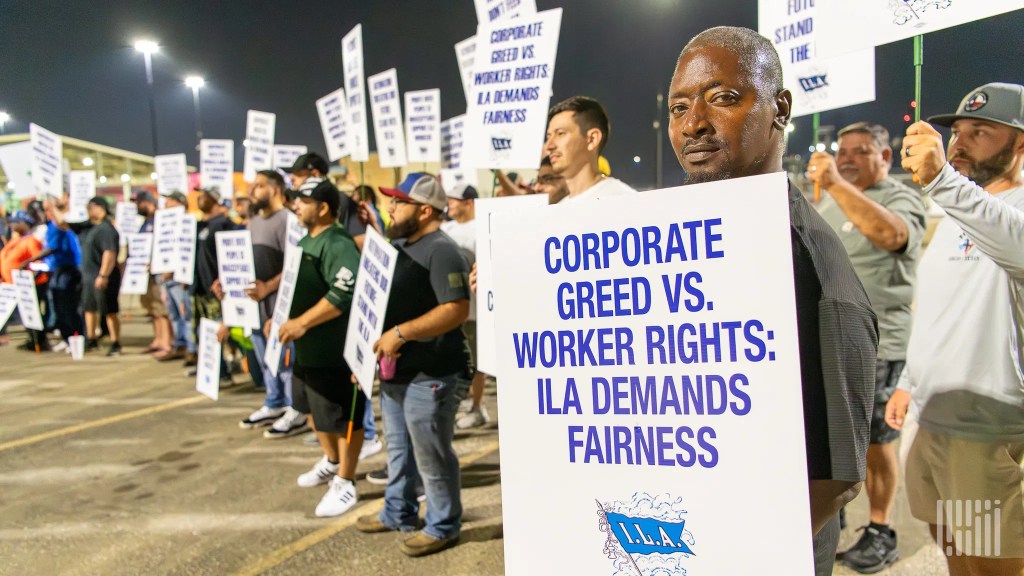
Longshore unions are planning a global meeting to map out what they are framing as a war of survival against automation.

The U.S.-based International Longshoremen’s Association (ILA) and International Dockworkers Council (IDC) in a release Wednesday announced the People Over Profit Anti-Automation Conference Nov. 5-6 in Lisbon, Portugal, home of the IDC.

The invitation to all maritime unions, trades, and leadership aims to “collectively strategize, share experiences, and strengthen our united front against the rise of job replacing automation,” and was signed by ILA President Harold Daggett; his son, ILA Executive Vice President and IDC General Coordinator Dennis Daggett; IDC International Labor Coordinator Jordi Arugunde; and IDC Secretariat Xavier Bellido.

“This is not just about protecting our jobs. It is about preserving our communities, our families, and the very future we are building for the next generation,” Dennis Daggett said in an accompanying letter. 

The ILA, which represents 24,000 workers, was at the center of a bitter contract dispute over dockside automation that boiled over into a three-day strike in October 2024, shutting down container handling at East and Gulf coast ports. The union and port employers eventually settled on a landmark six-year agreement that permits some port automation, but with significant job protections.

“Automation is creeping into every sector, little by little, industry by industry, while global corporations hide behind words like efficiency and progress,” Dagget wrote. “They are also pushing job-killing automation under the guise of safety. But what they are truly after is one thing only – cutting labor costs.

“This is not a blue-collar problem. It is a working class crisis, threatening both white and blue collar livelihoods. Whether you work in a crane cab or at a terminal console, the risks are the same. And so is the responsibility to act.”

“Technology should serve humanity, not replace it.”

The IDC comprises 92 organizations from 41 countries and has over 100,000 affiliated members. 

Find more articles by Stuart Chirls here.

Related coverage:

Tariff pauses ‘unlikely’ to halt tumbling trans-Pacific rates: Freightos

June rebound as West Coast containers best East, Gulf ports

Port Newark opens new electric drayage charging station

Italy shipbuilder appoints new US chief

China expert Leland Miller announced as keynote speaker at FreightWaves’ Future of Freight Festival

FreightWaves has announced that Leland Miller, CEO of China Beige Book International, will deliver a keynote address at the upcoming Future of Freight Festival (F3) this October. The event, a premier gathering for freight and logistics leaders, promises to equip attendees with forward-looking strategies amid ongoing U.S.-China trade dynamics and supply chain volatilities.

The Future of Freight Festival, now in its fourth year, is FreightWaves’ flagship event designed to convene industry experts, entrepreneurs, and innovators to explore emerging trends in transportation, logistics. Scheduled for October 21-22, 2025 at the Chattanooga Convention Center, the festival will feature interactive sessions, technology demos, and networking opportunities focused on topics like market forecasts, sustainability, and digital transformation. This year’s theme emphasizes resilience in global supply chains, making Miller’s participation particularly poignant as professionals seek clarity on international economic shifts that ripple through domestic freight operations.

Leland Miller is widely regarded as a leading authority on China’s economy and financial system. As co-founder and CEO of China Beige Book (CBB), he has spent over a decade pioneering independent economic data collection in one of the world’s most opaque markets.

Before establishing CBB in 2010, Miller worked in capital markets attorney roles and studied international relations at prestigious institutions including the University of Virginia and Oxford University. His expertise extends to frequent media appearances on outlets such as CNBC, where he dissects U.S.-China trade relations and their broader implications.

Miller is also a sought-after speaker at high-profile conferences, often addressing audiences on China’s economic trajectories and policy impacts.

At the heart of Miller’s work is the China Beige Book, a groundbreaking data analytics platform modeled after the U.S. Federal Reserve’s Beige Book but tailored to China’s vast and complex economy.

Leland Miller, co-founder and CEO of China Beige Book.

Founded to address the unreliability of official Chinese government statistics, CBB employs a proprietary methodology involving quarterly surveys of thousands of firms across China’s provinces and sectors. This includes direct interviews with executives in manufacturing, retail, real estate, and services, capturing on-the-ground indicators like employment trends, investment levels, and credit conditions. Unlike state-released data, which can be politically influenced or delayed, CBB’s approach provides real-time, granular insights through a network of in-country analysts, ensuring independence and accuracy.

The platform aggregates this information into comprehensive reports, dashboards, and forecasts, helping clients anticipate shifts in economic activity.

This methodology has proven invaluable during turbulent periods, such as the COVID-19 disruptions and recent stimulus measures in China. For instance, CBB’s data has highlighted slowdowns in manufacturing output or surges in commodity demand well before official figures, enabling proactive decision-making.

Miller himself has noted in interviews that traditional metrics often mask underlying weaknesses, like the June 2025 economic “falloff in just about everything,” underscoring the need for alternative data sources.

For U.S. supply chain professionals, Miller’s insights are especially relevant amid escalating geopolitical tensions and trade uncertainties. China remains the world’s manufacturing powerhouse, accounting for a significant portion of global exports that feed into U.S. ports, trucking networks, and warehouses. Economic fluctuations there—whether from policy changes, like potential tariffs under evolving U.S. administrations, or internal challenges like property sector woes—directly impact freight volumes, shipping rates, and inventory strategies.

Supply chain leaders have grappled with disruptions from events like the U.S.-China trade war, where CBB’s early warnings on export slowdowns helped firms diversify sourcing or adjust logistics plans.

In an era of nearshoring and resilience-building, understanding China’s economic health is critical for forecasting demand in sectors like electronics, automotive parts, and consumer goods. Miller’s keynote is expected to delve into how CBB’s data reveals vulnerabilities and opportunities, such as the effects of Beijing’s recent fiscal stimuli on global commodity flows. 

“The U.S. needs to articulate clear goals in its China policy to avoid reactive supply chain chaos,” Miller recently stated on CNBC, highlighting the interplay between economics and trade.

Attendees at the Future of Freight Festival can anticipate Miller’s address to offer actionable intelligence, blending macroeconomic analysis with practical advice for freight executives. As global supply chains continue to evolve, this session underscores the festival’s role in fostering informed, strategic discussions.

FreightWaves CEO Craig Fuller expressed enthusiasm: “Leland’s expertise will illuminate how China’s economic signals shape our industry’s future, empowering professionals to navigate uncertainties with confidence.” With registrations now open, the event is poised to draw over 1,000 participants, solidifying its status as a must-attend for supply chain innovators.

Another broker liability case knocks at Supreme Court door, this one involving C.H. Robinson

Even as the trucking legal community looks for the possibility of the Supreme Court being asked to review a court decision that put Total Quality Logistics on the losing side of the issue of broker liability, there is another federal case on the same subject that already is on the nine justices’ formal requests for high court certiorari.

Legal filings heated up this week in the case of Shawn Montgomery vs. Caribe Transport II, a carrier. 3PL giant C.H. Robinson (NASDAQ: CHRW), which hired Caribe Transport, also is a defendant.

Montgomery was injured in December 2017 in an Illinois collision with a Caribe Transport truck. C.H. Robinson prevailed (separately from Caribe Transport) on two separate requests for summary judgement in late 2023 and early 2024, respectively, from the U.S. District Court for the Southern District of Illinois. The U.S. Court of Appeals for the Seventh Circuit affirmed the lower court in early January. 

That led Montgomery to seek Supreme Court certiorari in a filing made last month. C.H. Robinson is backing Montgomery’s request for a Supreme Court review, even though it was victorious against that plaintiff in the lower courts. 

CHRW backs its opponent

C.H. Robinson’s support of the certiorari request has similarities to that of TQL in the request for Supreme Court review by Katia Gauthier. She was the widow of a man killed in a collision with a truck hired by TQL. 

TQL was victorious in Gauthier in a lower court and on appeal on the issue of whether the Federal Aviation Administration Authorization Act (F4A) would preempt a state tort action against the broker. Despite the win, TQL wanted the Supreme Court to weigh in on the broader issues of F4A interpretation, given that circuit courts’ decisions on the provision of F4A known as the safety exemption were not consistent. 

Gauthier’s request for certiorari was denied.    

The lower court’s decision in Montgomery looked to guidance from the case of Ying Ye vs. GlobalTranz, also in the Seventh Circuit, where GlobalTranz successfully argued that F4A, signed into law in 1994, protected it from liability. Ye’s husband had been killed by a truck hired by GlobalTranz.

C.H. Robinson, with successful court decisions in hand, could have just taken a victory lap after the Montgomery case. But it is backing its litigation foe Montgomery by supporting his request for Supreme Court certiorari. Its amicus brief was filed this week supporting Montgomery’s request.

“Now is the time for this Court to provide certainty to the industry by resolving the conflict between the circuits,” C.H. Robinson said in its filing. (The National Association of Manufacturers also filed an amicus brief in support of Montgomery’s request for certiorari).

If the Supreme Court decides to review F4A, the judges would not be asked to rule on the heart of the law: the requirement that states take no action that would impact a transportation “price, route or service,” also known as the preemption clause.  There are no conflicting circuit decisions on that part of the law.

What it would be asked to tackle: the safety exemption.

The safety exemption says the “price, route or service” part of the law “shall not restrict the safety regulatory authority of a State with respect to motor vehicles, the authority of a State to impose highway route controls or limitations based on the size or weight of the motor vehicle, or the authority of a State to regulate carriers with regard to minimum amounts of financial responsibility relating to insurance requirements and self-insurance authorization.”

In other words, if bad safety-related stuff happens to a truck booked by a broker, it is possible the broker will found to have some degree of liability. But it isn’t certain.  

On one side of the conflicting circuit decisions are precedents in the Seventh and Eleventh circuits that found a broker’s liability in a disastrous outcome involving a truck it hired–Ye in the Seventh, and a case involving a stolen truck brokered by Landstar (NASDAQ: LSTR) in the Eleventh–was not undercut by the safety exemption. The plaintiff therefore could not recover damages.  Add to that the decision in the Montgomery/C.H. Robinson case and the victory count for 3PLs due to the safety exemption is three. 

The Supreme Court already rejected certiorari in the Ying Ye case last year.

A widening divide among the circuits

The conflicts between the circuits have now become more stark following Cox vs. TQL joining Miller vs. Robinson as cases where the safety exception didn’t protect a 3PL, and Montgomery vs. Caribe adding to the list of cases where it did.

In Cox vs. TQL, handed down Tuesday by the U.S. Court of Appeals for the Sixth Circuit, the second-biggest U.S. 3PL ended up on the losing side in a lawsuit brought by Robert Cox, whose wife Greta was killed in a crash with a truck hired by TQL.

The second case where the safety exception didn’t protect a 3PL is the Miller vs. C.H. Robinson case from 2019 in the Ninth Circuit, with the Supreme Court having already denied a C.H. Robinson certiorari request in 2022. Allen Miller was left a quadriplegic after being involved in a 2016 crash near Elko, Nevada with a truck from RT Service, which C.H. Robinson had hired to move a load from Sacramento to Salt Lake City for Costco.

The C.H. Robinson amicus brief in the Montgomery case does not mention the Sixth Circuit or the Cox vs. TQL case. The amicus brief and the Cox decision were published within a day of each other. 

TQL has not commented on its plans after the Sixth Circuit appellate court in Cox found that TQL’s action in hiring a potentially dangerous carrier was the type of behavior that F4A’s safety exception targets: a transportation provider creating an unsafe situation and then being able to be sued without protection from federal law. 

But given that TQL sought Supreme Court certiorari in the Gauthier case even though it had won, it is not unreasonable to assume it would now, as the losing party, ask the high court to review the conflicting circuit court cases on just how much F4A protects brokers under the safety exception.

The court, if it chooses to review the issue, could take the Montgomery certiorari request, or a presumed TQL request, or both.

Echo Global loses in Illinois case

To add to the confusion, a recent decision in an Illinois state court involving Echo Global Logistics came down on the side of the plaintiff and against the broker.

In the case of Kaipust vs. Echo Global, Judge Scott McKenna of the Appellate Court of Illinois for the First District rejected Echo’s claim that the safety exception of F4A protected it against the actions of a carrier it hired.

In the Echo case, the 3PL had hired Critical Supply Solutions to move a load. In September 2021, a company truck was involved in a Nebraska collision that killed Mark Kaipust and his child Taylor. Mark Kaipust’s widow Jamie filed suit.

“We reject Echo’s argument that interpreting the safety exception to protect state negligence claims against brokers would lead to the safety exception ‘swallowing’ the preemption clause itself,” McKenna wrote. The preemption clause is the foundation of F4A, restricting state action against that triumvirate of prices, routes and service. “The preemption clause’s application to attempted economic regulation of broker conduct unrelated to safety is left untouched by this ruling. Only when a plaintiff can establish that the broker’s conduct implicated the state’s safety regulatory authority will a claim survive preemption per the present ruling.”

In its amicus brief, C.H. Robinson cited the Echo case as another reason why the Supreme Court should take up Montgomery’s request for certiorari, even though it is a state action and not in the federal court system. “The resulting uncertainty over which motor carriers can be hired—by brokers or for that matter any other entity, such as the owner of freight that contracts directly with motor carriers—has a direct, adverse effect on interstate commerce that needs to be resolved by this Court,” the 3PL wrote. 

Vicarious liability shot down

In the case of Montgomery vs. Caribe and C.H. Robinson, the plaintiff sought to bring up the issue of vicarious liability, where C.H. Robinson’s actions in its relationship with Caribe established a level of “control” could be seen as establishing an agency relationship. That could have allowed greater liability for C.H. Robinson. 

But both the lower court and the Court of Appeals rejected that argument. Much of the appeals court decision in Montgomery reviews that question. And that is mostly because the three-judge unanimous panel quickly rejects Montgomery’s argument that the precedents set in Ye about “agency” should be overturned, as it was the Ye decision that was the basis for much of the court’s ruling in Montgomery.

Quoting an earlier case, the court said “we do not take lightly suggestions to overrule circuit precedent.”

Echo Global Logistics is involved in another case involving broker liability where it prevailed in federal district court for South Carolina in a case brought by Angela Fuelling, widow of James Fuelling who was killed in a 2022 crash on interstate 85. A carrier hired by Echo Global slammed into Fuelling’s vehicle.

Echo Global’s request for summary judgment to be removed from that case, citing F4A,  succeeded last year. 

Angela Fuelling appealed to the U.S. Court of Appeals for the Fourth Circuit earlier this year, where the case resides. It is considered significant enough that the Transportation Intermediaries Association, the brokerage industry’s main trade group, has filed an amicus brief in the case.  

More articles by John Kingston

XPO rating cut by S&P, agency cites continuing weak freight market

First legal steps taken, this time by WSTA, to untangle the legal knot of the Clean Truck Partnership

Two positive votes on logistics at Moody’s: GXO and C.H. Robinson

Building a Load Intake Process That Keeps You Organized

If your load intake process looks like scribbled notes, missed emails, and “I’ll remember it later” — you’ve already lost. Not to the load board, not to rates — but to disorganization. And disorganization is the silent killer in this industry. It’s what clogs your cash flow, confuses your drivers, and burns you out before your business ever hits stride.

You can’t scale chaos. You can’t delegate what’s stuck in your head. And you damn sure can’t grow a fleet of guesswork. That’s why today we’re going to lock in on one of the most overlooked systems in a trucking operation — the load intake process.

Let’s walk through what that actually looks like when it’s done right — step-by-step — so you can run a cleaner, tighter, and more profitable operation.

Why Your Load Intake Process Matters More Than You Think

When freight hits your phone or inbox, that’s the starting line of your service. And what happens next determines whether the rest of your operation flows smoothly or becomes a dumpster fire of last-minute calls and missed details.

Here’s what a poor intake process causes:

  • Missed appointment windows
  • Confused dispatching
  • Incorrect billing
  • Routing mistakes
  • Lack of visibility for your team
  • Stress you don’t need

All of this could’ve been avoided if the load was properly captured, stored, and communicated up front.

Your intake process is how you protect your business from rework, costly mistakes, and unnecessary stress. Get this right, and your dispatching, accounting, driver communication, and customer service all level up automatically.

Step 1 – Centralize Your Load Intake

You cannot build a system that depends on you remembering everything. So the first thing you need to do is centralize how loads come in.

One intake channel. One process. One location.

Whether it’s email, phone calls, or a load board, you need a consistent method for documenting and storing each load before it ever touches a driver.

Use a load intake form or TMS system where every load gets entered the same way every time — by you, your dispatcher, or whoever’s on intake duty.

Here’s what should be captured immediately:

  • Load ID or PO number
  • Broker/shipper contact name and phone number
  • Pickup and delivery address (with ZIP codes)
  • Appointment times (not just dates)
  • Commodity and weight
  • Equipment requirements
  • Rate and terms (including detention, TONU, etc.)
  • Any special instructions

If it’s not captured here, it will be missed later. Guaranteed.

Pro tip: Use a shared Google Form or TMS with required fields so nobody can skip a step. Don’t assume people will remember to ask for everything.

Step 2 – Lock Down Load Confirmation Protocol

Too many carriers run with verbal confirmation or “the rate con’s coming later.” That’s how you end up running loads you can’t bill for — or worse, getting ghosted on payment.

Every load should have a rate confirmation in writing before wheels turn.

Not only do you need the rate con, but you also need a checklist to verify:

  • Is the rate con signed
  • Do the pickup and delivery windows match what was agreed
  • Are detention, layover, and accessorial terms clearly listed
  • Are lumper instructions or reimbursements defined

Train your team to push back. If a broker sends a half-complete rate con, don’t move until it’s fixed. Your process has to protect your money.

Step 3 – Integrate Your Intake with Dispatch and Driver Communication

Once a load is confirmed, it’s time to hand it off cleanly. That means:

  • Dispatch gets every detail without chasing you down
  • Driver gets a clear briefing with no missing info
  • You’re not retyping or relaying the same info three times

If you’re using a TMS like TruckingOffice, PCS, or Ascend, the info should flow straight into dispatch.

If not, use a standardized driver dispatch sheet. Here’s what should be on it:

  • Load number
  • Pickup and delivery info
  • Appointment times
  • Commodity details
  • Special notes or delivery instructions
  • Contact names and phone numbers
  • Deadhead and loaded miles
  • Rate

Make this part templated. Your drivers should know exactly what to expect when a load comes through — no guesswork, no confusion.

Step 4 – Document the Load Flow End-to-End

After the load is dispatched, you need to track its status — not just from the driver’s mouth, but in your system.

You should be able to answer these questions without digging:

  • Has the driver been dispatched
  • Did they arrive on time
  • Was there a detention
  • Any OS&D (Overages, Shortages, or Damages)
  • Have we invoiced the broker yet
  • Are the PODs uploaded and stored

This is where many carriers fall apart. They stop tracking the load after it leaves the dock — and then scramble when something goes wrong or payment is delayed.

Even if you’re small, build your habit like a big carrier. Track every load to the finish line. Use color-coded statuses, tags, or simple spreadsheets if you don’t have TMS software yet.

Step 5 – Review and Reconcile Weekly

This is the step that separates organized operators from those who just “hope it all works out.”

Every week, you should be reviewing:

  • Which loads were entered and run
  • What’s been invoiced
  • What’s been paid
  • Any exceptions (missed appointments, claims, etc.)
  • Any breakdowns in your intake process

This is how you refine. If a dispatcher keeps forgetting to log accessorials, fix the process. If a broker always sends late rate cons, flag them. This is how you protect your profits and tighten your back office.

What It Looks Like When You Get This Right

Let’s paint the picture.

A load comes in. It’s entered into your system within five minutes. All load info is there — addresses, contacts, times, special instructions. A rate con is signed, saved, and attached. Your dispatcher sees it without asking. The driver gets a clean, formatted dispatch sheet on time. Delivery happens, POD gets uploaded, invoice goes out the same day. You follow up on payment without chasing paper.

That’s what it looks like when your operation is organized. That’s what allows you to scale without losing your mind. That’s how you build a business — not just run a truck.

Final Word

Every single load that comes into your business is an opportunity — or a liability. The difference is in the process. Don’t just “get the load covered.” Build a system that captures, stores, and communicates every piece of that freight from intake to invoice.

You don’t need a 10-truck fleet to run tight. You need discipline. You need repeatable steps. And you need a process that doesn’t rely on memory or last-minute scrambles.

Fix your intake, and the rest of your business gets easier.

Let’s get to work.

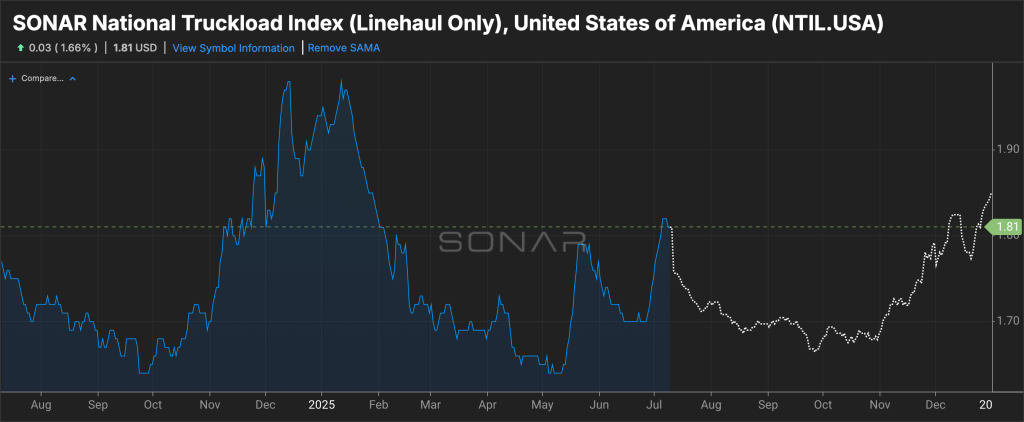
Seeing Ahead: Seasonally Adjusted Forecast Now in SONAR Charts

Staying ahead of the freight market just got easier.

We’re excited to roll out a new enhancement to our charting experience: Seasonally Adjusted Moving Average Projections. This feature forecasts a trendline six months into the future, giving you a clear, data-driven view of where the market might be heading based not only on historical patterns, but also on how this year is shaping up so far.

Here’s how it works: 

We start with a 2-year average for each calendar month, for example, July is averaged from July 2023 and July 2024, to capture the typical seasonal flow. Then, we compare the current year-to-date (YTD) average (say, January through June 2025) to the same period in the previous two years. This gives us a scaling factor that adjusts upcoming months to better reflect today’s market conditions.

So if the market this year is trending higher than usual, your projection line will shift upward. If it’s underperforming, it adjusts down. And to avoid overreacting to short-term volatility, we’ve added a smoothing option that blends the adjusted values with the original 2-year baseline, giving flexibility to control how much weight we place on recent activity versus long-term trends.

This feature is built for those who rely on SONAR to plan ahead: brokers, analysts, shippers, and logistics leaders who need to make forward-looking decisions with less guesswork. Whether you’re preparing for a surge, evaluating lanes, or simply trying to get ahead of the curve, these projections help ground your expectations in real, seasonal and real-time data.

And while we’re talking chart upgrades don’t miss two other recent enhancements now live in the UI:

  • You can now search lane-level Spot and Contract rates directly on the chart
  • Plus, toggle seasonality on/off for lane searches and now with the Seasonally Adjusted Moving Average Projections to view how current trends stack up against past years.

The combination of lane-level precision, historical context, and forward projections makes SONAR’s charting tools more powerful and actionable than ever.

This is a UI-only feature (not available via API), so head into the charts and see it in action. We think it’s going to change the way you look at what’s next.

Don’t have access to SONAR? If you want to make forward-looking decisions with less guesswork and more confidence, request a demo to learn how SONAR can help.

FedEx to terminate nearly 500 jobs, close two facilities

Close up of a purple-orange FedEx sign on lawn of business park.

FedEx plans to get rid of more than 480 workers and close two facilities by the fall as it moves forward with a huge network consolidation program. 

The integrated logistics provider disclosed the plans in public notices to workforce development agencies in four states.

FedEx (NYSE: FDX) said it will close package distribution stations in Greensboro, North Carolina, and Omaha, Nebraska, resulting in the elimination of 164 and 102 jobs, respectively. In a letter to the Nebraska Department of Labor, FedEx said it is relocating work at the Omaha facility to another one within 50 miles. 

The company also announced 84 positions will be eliminated at a facility in Des Moines, Iowa. Another 131 staff reductions are planned this summer at facilities in Garland and Plano, Texas. The closures and layoffs will take effect Sept. 1.

FedEx said the closures and layoffs are related to Network 2.0, a multi-year effort to integrate the separate FedEx Express and FedEx Ground networks for improved delivery efficiency and reduction of transportation costs. 

The Commercial Appeal, FedEx’s hometown newspaper in Memphis, Tennessee, broke the news about the latest layoffs and closures. FedEx said many workers will be offered other roles within the company, although that could require some of them to commute long distances or relocate.

FedEx executives said during a recent earnings presentation that it plans to close 30% of its parcel terminals within two years, as FreightWaves reported. In June, FedEx combined the operation of 63 stations across 20 local markets. So far, FedEx has optimized operations in 100 U.S. facilities. 

Click here for more FreightWaves/American Shipper stories by Eric Kulisch.

FedEx, UPS lose parcel market share to retailers, small couriers

US parcel market to grow 36% by 2030, Pitney Bowes says

FedEx to close 30% of package facilities as network integration ramps up

Trump pledges 50% tariff on goods from Brazil

President Donald Trump said he is considering 50% tariffs on imports from Brazil over the country’s prosecution of its former president, Jair Bolsonaro

Trump accused the Brazilian government of conducting a “witch-hunt” against Bolsonaro, who is under investigation for allegedly attempting to overturn his 2022 election defeat.

“The way that Brazil has treated former President Bolsonaro, a Highly Respected Leader throughout the World during his Term, including by the United States, is an international disgrace. This Trial should not be taking place. It is a Witch Hunt that should end IMMEDIATELY!” Trump wrote in a letter posted Wednesday on Truth Social.

Brazil is the 12th largest U.S. trading partner, with two-way trade totaling around $92 billion in 2024, according to data from the U.S. Census Bureau.

The U.S. exports aerospace goods, petroleum, crude oil, coal, and semiconductors to Brazil, while importing crude oil, coffee, and steel and iron.

Brazilian President Luiz Inácio Lula da Silva said on Wednesday that his government is prepared to retaliate if Trump imposes tariffs on goods from his country.

“Brazil is a sovereign nation with independent institutions and will not accept any form of tutelage,” da Silva said in a statement posted to social media platform X.

The Trump administration also began sending letters on Monday to dozens of U.S. trade partners that higher import tariffs could kick in by August, including Japan and South Korea.

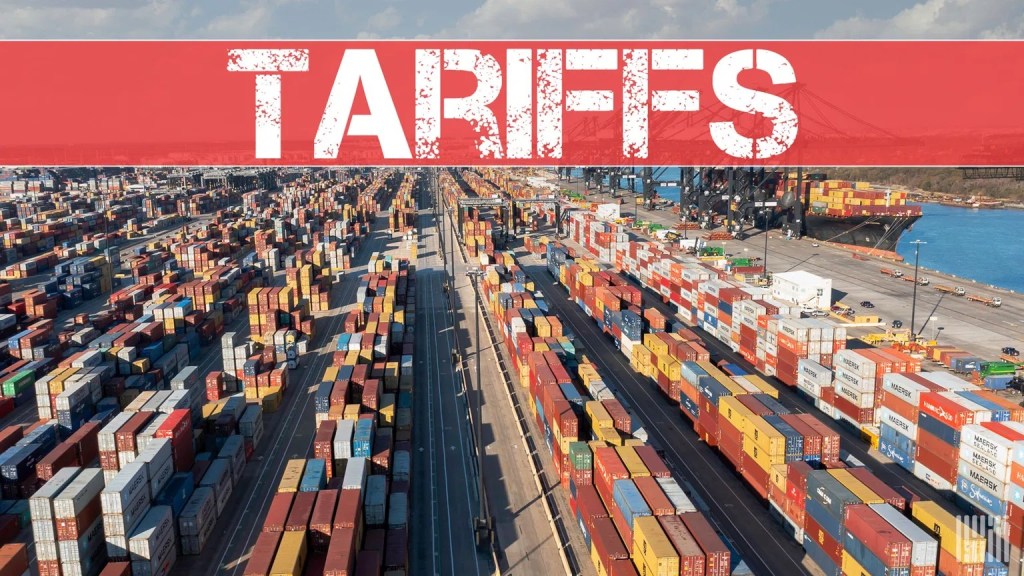
Trump’s 90-day pause on the April 2 “reciprocal” tariffs was set to end Wednesday, but was delayed to Aug. 1 to allow more time for negotiations.

The latest round of tariff letters sent Wednesday includes Sri Lanka, Algeria, Brunei, Iraq, Libya, Moldova and the Philippines.

Mike Short, president of global forwarding at C.H. Robinson, said shippers are revaluating inventory and frontloading needs amid all the ongoing tariff changes.

“Some shippers rushed to move freight before the previous July 9 deadline, while others cut it too close or weren’t able to ramp up production in time,” Short said in an email to FreightWaves. “The extension gives nearly a month of breathing room, but that’s not enough for most ocean shipments, which takes 20 to 30 days on average — and capacity could tighten as we approach peak retail season.”

Trump said he is also placing a 50% tariff on imports of copper starting in August, and is considering a 200% tariff on imported pharmaceutical products later this year. 

Biggest gets bigger: Walmart leads all retailers as sales grew 7% in 2024

Walmart again led the rankings of the top 100 retailers as its sales grew 7% to $568.70 billion in 2024.

Amazon retained its hold on the second position with sales of $273.66 billion, according to data compiled by the National Retail Federation and Kantar. Costco Wholesale, The Kroger Co., and The Home Depot completed the top five.

This year’s list reveals a notable trend of stability among the largest stores, with the top 13 chains remaining mostly unchanged from the previous year. Target dropped from the seventh to the eighth position, while Boots Alliance made an upward move to claim seventh place.

“As consumers evaluate their spending priorities, businesses are unlocking new ways to better connect with customers and retain loyalty,” said Mark Mathews, NRF’s executive director of research, in a release, who noted that the modern retail environment increasingly demands a nuanced understanding of consumer needs, digital transformation, and a commitment to customer engagement.

(Graphc: NRF/Kantar)

“While the companies at the top of the list not only reflect those with the strongest retail sales, they are also a reflection of those that have remained nimble to a changing landscape from the impacts of trade policy and shifting consumer habits,” said David Marcotte, senior vice president of global insights and technology at Kantar.

The report also touches on the declining fortunes of drugstores, with Rite Aid notably sliding from No. 29 to No. 40. This decline can be attributed to a drop in front-store sales, even as health services performed well following the pandemic. At the same time, the pet retail industry has seen moderate changes. PetSmart and Petco experienced slight decreases in their U.S. store numbers and sales, reflecting the stabilization of pet ownership post-pandemic and changing discretionary spending on pet products.

Find more articles by Stuart Chirls here.


Related coverage:

“Brace!” Endless disruptions mark new path to supply chain resiliency

Geodis returns solutions aim for streamlined reverse logistics
Warehouse automation surging ahead despite predicted slowdown

FedEx to close 30% of package facilities as network integration ramps up

Trump taps DOT’s Duffy to head NASA

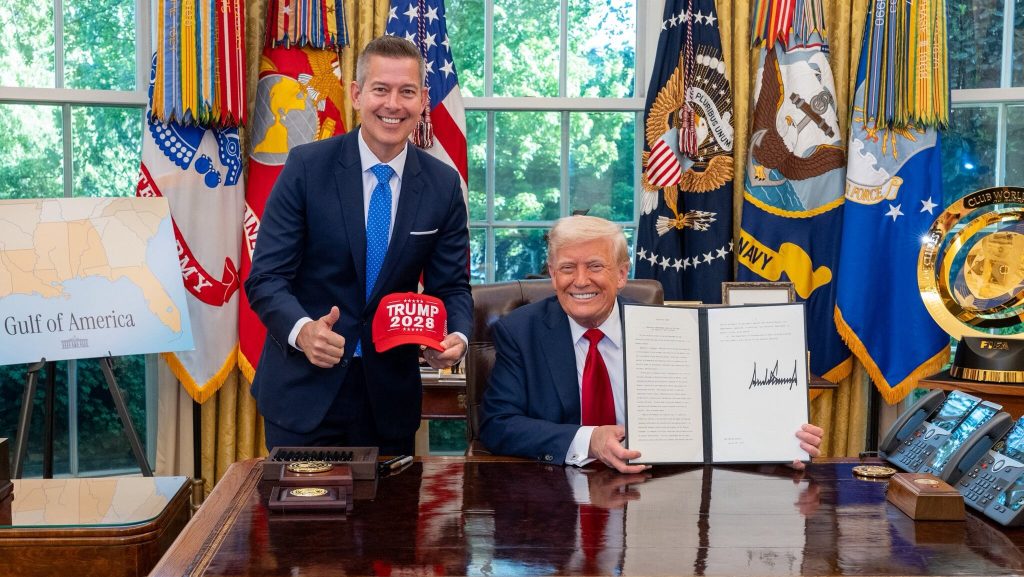
Sean Duffy and Donald Trump

WASHINGTON — President Trump has named Transportation Secretary Sean Duffy to be the interim administrator of National Aeronautics and Space Administration (NASA), becoming the latest member of the president’s cabinet to take on dual roles within the administration.

Trump praised Duffy for his oversight of modernizing the country’s air traffic control system and for improving transportation infrastructure.

“Honored to accept this mission. Time to take over space. Let’s launch,” Duffy posted on X in response to Trump’s announcement.

The previous nominee tapped to lead the agency, billionaire entrepreneur and private astronaut Jared Isaacman, was withdrawn by the White House just days the Senate was scheduled to vote on his nomination.

The Hill newspaper called Isaacman “a close ally” of Tesla CEO and a former special government employee Elon Musk “who has since had a falling out with the president,” the publication reported.

In taking on multiple leadership roles within the Trump administration, Duffy joins Secretary of State Marco Rubio, who is also National Security Advisor, and Office of Management and Budget Director Russel Vought, who is also Acting Director of the Consumer Financial Protection Bureau.

Click for more FreightWaves articles by John Gallagher.