Cencora makes $1 billion investment in pharma supply chains
Cencora is betting on the future of pharmaceutical logistics, announcing a $1 billion investment through 2030 to expand and modernize its U.S. distribution infrastructure. This move is not just network growth, but a shift aimed at supporting the rising demand of prescription medications and strengthening the reliability of the supply chain that delivers them.
The cornerstone of the investment is a second national distribution center in Ohio, a 530,000-square-foot facility in Harrison scheduled to be fully operational by spring 2027. Equipped with advanced automation technologies, including artificial intelligence, robotic handling systems, and autonomous mobile robots, the new center is designed to significantly increase Cencora’s storage capacity and throughput.
According to Bob Mauch, Cencora’s President & CEO, in a news release, providers depend on that capability. “Healthcare providers rely on us to provide efficient access to the medications their patients need, and we’re able to deliver on that promise because of the robust distribution infrastructure and operations we’ve built through decades of investment. This investment underscores our commitment to and role in building a resilient pharmaceutical supply chain and in ensuring patients across the United States have timely and reliable access to prescribed medications, where and when they need them.”
The company is also expanding on the West Coast, where a 430,000-square-foot facility in Fontana, California, will nearly double its existing footprint in the region when it becomes operational in fall 2026. Like the Ohio site, Fontana will run on automation and advanced technology that improves efficiency and continuity of supply.
But the most strategically significant portion of the investment may be taking place in Dothan, Alabama, where Cencora is expanding one of its dedicated specialty pharmaceutical distribution centers. Specialty therapies, including those used in oncology, immunology, and treatments for rare diseases, are rapidly reshaping pharmaceutical demand.
Research cited by Cencora, in a news release, shows that 70% of new medicines launched globally through 2027 are expected to be specialty pharmaceuticals, and half of those new launches are projected to require cold chain storage. Cencora’s expansion will increase refrigerated storage capacity in Dothan by 500 percent and frozen storage by 200 percent, ensuring the facility can handle the rising volume of temperature-sensitive therapies.
Rich Tremonte, Executive Vice President and President of Cencora’s U.S. Pharmaceuticals and Animal Health division, said the expansion is rooted in anticipating customer needs as specialty drugs become more prevalent. “We’re committed to delivering an industry-leading customer experience—and that starts with listening to our customers, anticipating their needs and making strategic investments to ensure we can provide the exceptional service they expect,” Tremonte said. “As demand continues to grow and more specialty pharmaceuticals reach the market, the investments we’re making today will strengthen our ability to support our customers’ current and future needs, enabling them to continue delivering high-quality patient care in their communities.”
For Cencora, the expansion is also a response to the increasing expectations placed on distributors. Pharmacies, physician practices and hospitals are facing cost pressures, shifting patient volumes and intensifying complexity in product handling requirements. Many therapies today cannot be delayed, mishandled or stored incorrectly without compromising patient safety. A more resilient distribution network isn’t just about efficiency; it’s about maintaining uninterrupted care.
Each day, Cencora ships more than five million medications and healthcare products from more than 30 distribution centers across the United States. The company sees this scale as both an advantage and a responsibility, especially as drug shortages and logistical disruptions continue to pose challenges to healthcare providers nationwide.
By committing $1 billion to infrastructure, automation and cold chain advancements, Cencora is positioning itself to handle the next decade of pharmaceutical innovation and the increasingly complex logistics that come with it. As Mauch stated, the goal is clear: “To ensure medications reach patients where and when they need them.”
Every Load You Haul Starts Here — Don’t Skip the Fine Print
You’ve seen thousands of them by now. The broker emails the rate confirmation, you glance at the pay, the pickup, the drop — maybe the weight if you’re paying attention — and then hit “Sign.”
But that one-page piece of paper you treat like a formality? It’s the contract. Not a suggestion. Not a handshake. A legally binding agreement that can make or break your payday if you don’t understand what’s actually written between those lines.
I’ve seen small carriers lose thousands — detention, TONU, layover, accessorials, even chargebacks — all because they didn’t slow down long enough to read the fine print.
So let’s tear that document apart, line by line, and talk about what you’re really agreeing to when you sign a Rate Confirmation — and how to protect your money before the first mile is driven.
1. The Header — Who’s in Control and Who’s at Risk
Right at the top, you’ll usually see the broker’s logo, contact info, load number, and sometimes their MC number. It looks innocent, but it tells you who owns the load and who’s financially responsible.
Check these details every single time:
Broker Name & MC#: Make sure it matches who’s paying you. Some brokers double-broker freight under different entities.
Carrier Name: Your company’s legal name must be correct, not your DBA. That’s the name tied to your insurance and your right to payment.
Load Number & Reference ID: This is the paper trail. Always match it on your invoice and BOL.
If the name or MC number doesn’t match your agreement, you’re technically hauling under the wrong contract. And if something goes sideways, that broker can legally say, “We don’t owe you a dime.”
2. Load Details — The Bait and the Trap
This is the part everyone focuses on first:
Pickup location, date, and time Delivery location, date, and time Weight and commodity Equipment type
Simple, right? Until you realize how this section can be worded to trap you.
Watch for these details:
Appointment vs. FCFS: “Appointment Required” means they can hold you 6 hours past your time and still claim you weren’t “detained.” Always ask if it’s strict or flexible. Delivery Time Zones: Brokers sometimes list delivery in EST when the shipper’s in CST — that’s an easy missed appointment and a quick fine. Commodity Descriptions: “General freight” can mean anything. Make sure you know what’s in that trailer. If it’s hazmat, high-value, or temp-controlled, you need to know before signing. Weight Accuracy: If the weight shows 42,000 lbs but the actual load scales at 46,000, that’s a safety and mechanical risk. Document it before leaving the dock.
A clean rate con should have no gray areas — clarity is protection.
3. The Rate Section — The Number Everyone Sees, and the Terms Nobody Reads
Here’s the line that gets everybody excited:
“Carrier Rate: $1,800”
That’s where most people stop reading. But the real money is in the fine print that follows it.
Key details to verify:
Linehaul: This is the base pay for the load.
Accessorials: Look for detention, layover, TONU (Truck Ordered Not Used), extra stops, or driver assist pay. If it’s blank, you’re at their mercy.
All-In Rate Language: If it says “All-In Rate,” that means you’re agreeing that the $1,800 covers everything — including detention, fuel, extra stops, and lumper fees.
Example: You see: “Rate: $1,800 — All-In.” Then the driver waits 5 hours to load and pays a $250 lumper. Bam. You’re out $250 and 5 hours of revenue because the “all-in” language locked you out of any extras.
Always make sure the rate section lists:
Linehaul amount
Detention rate (per hour after 2 hours)
Layover (flat rate per day)
TONU (Truck Ordered Not Used rate)
If they say “We’ll add it later,” tell them to send a revised rate con before you sign. If it’s not on paper, it doesn’t exist.
4. Payment Terms — Where Cash Flow Lives or Dies
Usually tucked toward the middle or end, this section quietly decides how long your money sits in limbo.
Common phrasing:
“Carrier will be paid within 30 days of receipt of invoice and signed BOL.”
That means Net-30 from receipt, not from delivery. If you take a week to send your paperwork, you just turned it into Net-37.
Other watch-outs:
Quick Pay Fees: 2–5% cuts into your margin. Calculate if it’s worth it.
Factoring Compatibility: Some brokers have “no assignment” clauses, meaning they won’t pay your factoring company directly. If you factor, confirm they’re approved.
Paperwork Deadlines: “Invoices must be submitted within 7 days” — miss that and they can legally withhold payment.
Always send your paperwork the same day as delivery. Make that a company standard, not an afterthought.
5. Liability & Claims — The Quiet Kill Section
This is where the lawyers live. You’ll find lines like:
“The carrier assumes full responsibility for cargo from pickup until delivery.” “Any damage claim must be filed within 24 hours of delivery.” “Carrier waives right to setoff against payment for disputed charges.”
Translation: You own that load the second you leave the dock. Even if the shipper loads it wrong or seals it before you see it.
Protect yourself by:
Taking pictures before sealing.
Refusing to sign the BOL if you weren’t allowed to witness loading.
Immediately reporting any product issue at delivery — silence equals acceptance.
Waiver of Setoff means if they claim damage later, they can withhold future payments, even on other loads, until it’s resolved. That’s why this line matters — you’re agreeing to let them play with your cash.
6. Fines, Fees, and the “Gotcha” Clauses
Some brokers slip these in toward the end or bottom:
Late Arrival Deductions: “$150 per hour past appointment.”
Equipment Cleanliness Fees: “Unclean trailer deductions up to $300.”
Load Tracking Requirements: “Failure to use the assigned app may result in a $250 penalty.”
You’d be surprised how many small carriers get hit with $250–$500 deductions for simply not using a tracking app or missing a check call.
If you see anything that says “failure to comply may result in a penalty,” highlight it and ask questions before you sign.
7. Signatures — The Moment You’re Legally Bound
Once you sign that rate confirmation and email it back, it’s binding. That means:
You’ve agreed to the rate and all attached terms.
You’ve accepted all liability.
You’ve given up the right to dispute anything you didn’t clarify.
Don’t let a dispatcher or broker rush you with “We need this back ASAP or we’ll lose the load.” That’s pressure — and it’s how they get inexperienced carriers to sign bad contracts fast.
Take the extra 3 minutes. Ask questions. Call if something looks off. Because the minute your name hits that paper, it’s your responsibility.
Example Breakdown: A Real-World Rate Con Walkthrough
Let’s run through a simple one and what each part means.
“Carrier agrees to provide clean, dry trailer and maintain continuous load tracking. Failure to comply results in $250 deduction. Detention payable after 3 hours at $35/hr with prior written approval. Carrier assumes full responsibility for cargo condition and agrees to provide POD within 24 hours of delivery.”
Now let’s decode it:
“43,000 lbs” — verify weight at pickup. If over 44,000, take photos.
“$1,900 All-In” — no detention, lumper, or extra stop pay unless agreed.
“Detention payable after 3 hours with written approval” — if you don’t email them for approval while you’re detained, you won’t get paid for it.
“Continuous tracking required” — if you forget to log into MacroPoint, they’ll deduct $250 from your settlement.
“POD within 24 hours” — fail to send it in time and they can delay payment indefinitely.
See how much risk is hiding behind one simple line?
Q&A Section
Q: Can I refuse to sign a rate confirmation if something looks off? A: Absolutely. A rate con is an offer, not an obligation. Negotiate the terms before signing — once it’s signed, it’s a contract.
Q: What if I sign and the load changes later? A: Always request a revised rate confirmation showing the new pickup, delivery, or rate. Never rely on verbal confirmation — it’s not enforceable.
Q: Can brokers change the fine print after I’ve signed? A: No. Any change requires a new signature. Keep every version in your records. If they try to modify it later, that’s breach of contract.
Final Thought
A rate confirmation is more than a piece of paper — it’s your business handshake in writing. And just like any deal, the strength of that handshake depends on how well you understand what you’re agreeing to.
Don’t chase miles without reading the rules. The fine print is where your profit either lives or dies.
So before you hit “sign,” ask yourself:
Do I know every fee?
Do I understand every risk?
Is the math clear and fair?
Because once your truck rolls, that rate con becomes a legal agreement — and no load is worth signing away your protection.
Judge rejects DOT’s immigration enforcement tie
A Rhode Island court rejected the Trump administration’s attempt to leverage federal transportation funds – including billions of dollars in grants for freight projects – to coerce states to help enforce federal immigration laws.
“Had Congress wished to try to make federal transportation funding contingent on cooperation with federal civil immigration enforcement, it could certainly have attempted to do so,” wrote U.S. District Court for the District of Rhode Island Chief Judge John McConnell, in granting summary judgement to 20 states that had sued the U.S. Department of Transportation.
“Absent any clear indication of such an attempt, the court declines to find that DOT was vested with the sweeping power it asserts in setting a condition that is so obviously unrelated to the grant programs it administers.”
The lawsuit was filed in May shortly after Transportation Secretary Sean Duffy, who was also a defendant in the lawsuit, issued a letter to recipients of all federal transportation funding reminding them that they must enforce the administration’s immigration rules or risk losing out on the money.
“DOT has noted reported instances where some recipients of Federal financial assistance have declined to cooperate with ICE investigations, have issued driver’s licenses to individuals present in the United States in violation of federal immigration law, or have otherwise acted in a manner that impedes Federal law enforcement,” Duffy wrote in the April 24 letter.
“Such actions undermine federal sovereignty in the enforcement of immigration law, compromise the safety and security of the transportation systems supported by DOT financial assistance, and prioritize illegal aliens over the safety and welfare of the American people whose federal taxes fund DOT’s financial assistance programs.”
But McConnell disagreed, ruling that by demanding that those receiving federal grants and other transportation funding adhere to immigration laws, DOT and Duffy “have blatantly overstepped their statutory authority, violated the [Administrative Procedure Act], and transgressed well-settled constitutional limitations on federal funding conditions. The Constitution demands the court set aside this lawless behavior.”
The ruling is a reprieve for highway, port and rail projects at risk of losing money for expansion projects as well as for maintenance.
Jeff Davis, senior fellow at the Eno Center for Transportation, a non-partisan policy group, told FreightWaves that the ruling also eliminates confusion for those applying for grants.
“States don’t like it when the federal government rewrites existing rules for grants in the middle of the process,” Davis said.
The Office of the U.S. Trade Representative (USTR) on Tuesday announced a public comment process on the proposed suspension of port fees on Chinese vessels.
The action first announced in April followed the results of a federal investigation that found China leveraged unfair advantages to build a dominant position in global shipping and shipbuilding. The fees went into effect Oct. 14 at the rate of approximately $50 per net ton of capacity per ship per U.S. voyage.
China retaliated with port fees on U.S.-registered ships and shipping companies that had substantial U.S. investment.
The fees — part of an initiative by the Trump administration to blunt China’s maritime dominance and revive U.S. shipbuilding — set off a scramble by carriers to shift China-built ships away from U.S. services, or to re-register vessels in other countries such as Singapore and India. Atlantic Container Line, owned by the Grimaldi Group of Italy, re-registered a vessel under the U.S. flag. Washington earlier made an exception to the fees for empty ships loading American agricultural and other bulk exports.
Plans to suspend the fees for one year were part of a wide-ranging trade agreement that came out of meetings between President Donald Trump and Chinese leader Xi Jinping earlier this month in South Korea.
The pause is scheduled to take effect Nov. 10. The public can submit written comments here by 5 p.m. Nov. 7.
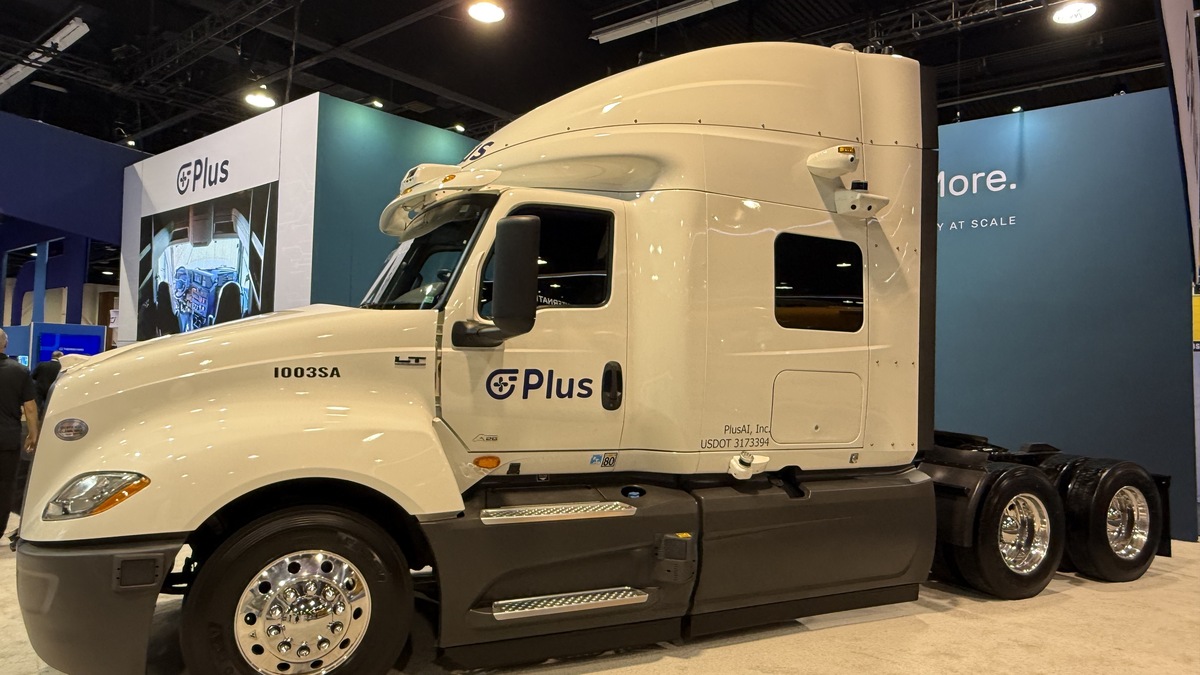
PlusAI, International and NVIDIA move closer to autonomous truck commercialization
Development of Level 4 autonomous trucks is moving closer to full commercialization, according to a recent partnership update among trucking original equipment manufacturer International, autonomous truck technology maker PlusAI and NVIDIA.
These new factory-built vehicles will be built by International, with PlusAI providing SuperDrive, the virtual driver. The AI computing power comes from NVIDIA, whose DRIVE AGX Thor compute platform is powered by custom-built Blackwell chips specifically designed for AI workloads to make safe autonomous driving possible.
“We are excited about the advancements we’re making in our autonomy program with our global autonomy partner PlusAI. Building on our fleet trials in Texas, the collaboration with NVIDIA and PlusAI is an important step on our path to production,” said Tobias Glitterstam, senior vice president and chief strategy and transformation officer at International, in a press release.
The collaboration between International and PlusAI was announced earlier in September and involved customer fleet trials using second-generation autonomous trucks. The pilots took place along the Interstate 35 corridor in Texas that runs between Laredo and Dallas.
Glitterstam added that the combination of automotive-grade computing with AI-native autonomous driving software will develop real value and reliability for many of International’s customers.
The collaboration also addresses the scalability requirements for widespread adoption of autonomous trucking technology. This is part of a wider Traton partnership with a later planned expansion throughout Europe as PlusAI looks toward full autonomous vehicle commercialization in 2027.
“By collaborating with International and NVIDIA, we’re enabling scalable, factory-built autonomy designed to meet the real-world performance and safety expectations of fleets. We have to build for a future with thousands of self-driving trucks on the road and that requires not just cutting-edge AI-native autonomous driving technology, but relentless rigor in safety, reliability, and excellence in large-scale manufacturing,” said David Liu, CEO and co-founder at PlusAI.
NVIDIA’s role in providing the advanced computing infrastructure is crucial for the success of the partnership. “NVIDIA DRIVE AGX Thor delivers the compute performance, functional safety, and scalability required for production-ready autonomous trucks,” said Rishi Dhall, vice president of automotive at NVIDIA, in the release.
This comes as PlusAI recently announced in June that it is going public via a special purpose acquisition company merger with Churchill Capital Corp. IX.
RXO faces a rate squeeze: what it means for the 3PL
The word that came up repeatedly from RXO management during the 3PL’s earnings call with analysts was “squeeze.”
RXO is facing a squeeze created by contractual rates the brokerage locked in at lower numbers and a suddenly rising level of rates needed to provide capacity into those obligations. And while the call with analysts may have been about RXO (NYSE: RXO), it is reasonable to assume it’s the same predicament that much of the 3PL sector finds itself in at present.
The earnings call came soon after RXO released its third quarter earnings, a report that had few pieces of positive news. RXO lost money on a net income basis again, and Wall Street reacted by sending the stock lower.
But during the call, CEO Drew Wilkerson laid out the scenario for the difficult market that helped lead to the weak earnings. And while he said RXO was “well positioned” to take advantage of a turnaround or stabilization, he made it clear that the ongoing fourth quarter is not going to be that time.
“We expect the squeeze dynamic to intensify into the fourth quarter,” Wilkerson said. “Contrary to our assumptions on last quarter’s call, the market tightened in September. Capacity began exiting in certain regions, driven primarily by regulatory changes in enforcement.”
The increase has not been huge, but it’s enough to create problems for 3PLs tied in to higher contract rates.
The SONAR National Truckload Index data series, which just measures linehaul rates without fuel, was $1.68 per mile on a national basis at the midway point of the third quarter. More recently it has been $1.80 per mile, and was $1.72 by the end of the quarter.
Wilkerson added that about two-thirds of the freight handled by RXO in the quarter came from regions that saw an increase in rates.
The rate increase came against a backdrop of weaker volume, according to Wilkerson. “Buy rates increased faster than our contractual sales rates with no meaningful corresponding increase in accretive spot opportunities,” he said.
Wilkerson suggested that the changes in the market–with capacity exiting in part because of the crackdown on non-domiciled and non-English speaking drivers–is not temporary. The shifts, he said, “have the potential to be one of the largest structural changes to truckload supply since deregulation,” which took place at the start of the 1980’s.
Higher for longer
As a result, Wilkerson said, the freight market might be on the cusp of a “higher for longer” period. “If the regulatory changes hold and enforcement continues, we believe a significant amount of truckload capacity will permanently exit the market,” Wilkerson said.
The call took place after the weak earnings report that followed by about a week a strong earnings report, the latest in a string of them, from C.H. Robinson (NASDAQ: CHRW). RXO, after the acquisition of Coyote Logistics last year, described itself as the third-largest freight brokerage. Ahead of it would be C.H Robinson and TQL Logistics, which is privately-held.
Comparing various financial metrics between C.H. Robinson and RXO is not a good look for the latter. That helped lead Brandon Oglenski of Barclays Investment Bank to ask Wilkerson on the call about the continued lagging performance at RXO.
“This is going to come off a little critical, but I think it’s probably for the betterment of everyone on the call,” Oglenski said.
He noted that the guidance for adjusted EBITDA in the fourth quarter, reduced from earlier estimates, is down about 40% year on year. “And that’s a year into Coyote,” Oglenski said. “We thought Coyote was going to be transformative. Investors are trying to look for more tangible actions.”
Coyote going well, except for the finances
Wilkerson said the Coyote acquisition has “gone extremely well” as measured by the staff members integrated into RXO, the customers who have come on board and the adoption of joint technology. “But the financial results are not where they need to be,” he added.
The CEO tied some of the problems back to the decision the company made on pricing coming into the 2025 market, numbers that are now a growing issue given the sudden rise in freight rates. “I made the wrong call on that one, and that is something that has impacted overall volumes,” Wilkerson said. “I look forward to us getting back to the days of where we are the market leader from a growth standpoint of taking market share. Clearly, 2025 is not where we want to be overall.”
The projected downturn in the fourth quarter EBITDA to $20 million to $30 million comes after a third quarter performance of $32 million and $38 million in the second quarter. Brokerage volume is expected to decline by a “low single-digit percentage,” the company said. The gross margin is projected to be between 12% and 13% in the fourth quarter. It was 16.5% in the third quarter.
The decline in quarterly EBITDA expected for the fourth quarter is tied closely to an expected drop in RXO’s last mile business. Wilkerson said that decline is counter-seasonal between the two quarters.
Big and bulky is sliding
“While we posted another quarter of impressive double digit growth in the third quarter (in Last Mile) since Labor Day, we’ve seen a weakening in demand for big and bulky goods,” Wilkerson said.”
Whereas C.H. Robinson gives a headcount figure each quarter, RXO does not. But the call seemed to have a defensive aspect to it from management, as they came back several times to their own cost cuts that have not received as much publicity as that at C.H. Robinson.
Wilkerson said brokerage headcount in the third quarter was down about 15% from the corresponding quarter of 2024.
The news in the earnings release about cost cuts was that RXO will undertake a new round of them that is expected to yield $30 million.
In the slide presentation released in conjunction with the earnings, management laid out the total cost cuts it says it has implemented since RXO was spun off from XPO in 2022: $65 million described as “post-spin”; $70 million in synergies with Coyote; and the $30 million announced Thursday which was said to be coming from “increasing operational efficiency, automating key processes and leveraging technology.”
C.H. Robinson also has touted its adoption of AI in its own cost reductions. RXO management made sure to use the earnings call to highlight what it’s done on that front as well.
“Our actions to date, including our investments in technology, have already yielded substantial productivity gains and brokers productivity increased by 19% over the last 12 months and by 38% over the last two years,” he said. “These are sticky changes to our business that will yield benefits in the future.”
Texas supply chain sector hit by more than 920 layoffs
More than 920 supply chain-related workers across Texas are facing layoffs as companies navigate contract losses, production consolidation and weakening consumer demand, according to state Worker Adjustment and Retraining Notification (WARN) filings.
The job cuts span a wide range of employers — including food processors, packaging manufacturers, greenhouse producers and crude oil haulers — underscoring the pressure on labor-intensive segments of the supply chain that rely on steady volume and high asset utilization.
Flagstone Foods LLC, 225 workers
Flagstone Foods, the parent company of Emerald Nuts, plans to lay off about 225 workers at its El Paso facility by the end of the year as part of a company-wide restructuring, according to a state notice.
The snack manufacturer said it will shift production to facilities in Robersonville, North Carolina, and Dothan, Alabama, resulting in a phased shutdown of the affected El Paso positions.
Congo LLC, 155 workers
Congo Brands, the company behind Prime Hydration and Alani Nu, plans to lay off 155 employees that work out of the firm’s Lewisville location, according to a notice filed with the state.
Congo Brands, headquartered in Louisville, Kentucky, is a consumer-packaged goods company focused on developing, launching, and scaling beverage and nutrition brands.
Eden Green Technology, 102 workers
Eden Green Technology, a vertical farming company based in Cleburne, Texas, will close its operations on Dec. 13, resulting in 102 job cuts, according to a state WARN notice.
The company, which supplied fresh leafy greens and herbs to Walmart and other regional retailers, announced the closure after expanding production in recent years.
Natura PCR, 88 workers
Natura PCR laid off 88 workers in October from its film recycling facility in Waller, due to poor market conditions and low demand for its recycled plastic pellets, the company said in a state notice.
Natura PCR is part of Houston-based Waste Management Inc.
Pure Hothouse Foods, 80 workers
Pure Hothouse Foods LLC is closing a plant and distribution center in San Antonio, which will result in 80 employees being laid off.
The company said the layoffs are part of consolidation measures and will relocate production to its facility in Edinburg.
The layoffs will be finalized by Dec. 31. The company is a supplier of greenhouse-grown produce.
M&M Manufacturing, 75 workers
M&M Manufacturing, which produces sheet metal products for air conditioning units, is shutting down a factory in Houston. The layoffs, which include six truck drivers, are scheduled to begin on Dec. 15.
Firebird Bulk Carriers, 74 workers
Firebird Bulk Carriers will lay off 74 employees across several locations in the state by the end of the year, according to a layoff notice. The job cuts include 59 truck drivers.
Firebird Bulk Carriers said it initiated the layoffs after losing contracts and experiencing increased insurance costs. (Photo: Firebird Bulk Carrriers)
The reductions affect terminals in George West, Carrizo Springs, Bryan, Dilley, Dayton, Tarzan and Victoria. The layoffs will be finalized by the end of December.
In a state WARN notice, the company said the “reduction in its workforce due to an unforeseeable business circumstance, which is the recent loss of one-third of our contracts, together with the unexpected and unforeseen increase in our required insurance premiums.”
Houston-based Firebird Bulk Carriers crude provides oil transportation services. The company has 176 trucks and 128 drivers according to the Federal Motor Carrier Safety Administration.
Tekni-Plex, 64 workers
Tekni-Plex Inc. ceased most of its operations at an egg carton manufacturing plant in Dallas, eliminating 64 jobs, according to a state filing. The layoffs will be finalized by Dec. 26.
Apogee Architectural Metals, 58 workers
Apogee Architectural Metals, a division of Apogee Enterprises, announced it is closing a production facility and laying off 58 workers in Mesquite.
The closure of the production facility will be completed by Jan. 3. Minneapolis-based Apogee Enterprises is a provider of architectural products and services.
Why shippers are consolidating their tech stack for long-term growth
Following the pandemic-era logistics boom, shippers found themselves drowning in technology. The rush to digitize supply chains brought an explosion of new tools, each claiming to solve a critical problem, from delivery visibility to customer communication. However, as many soon learned, having more platforms didn’t always mean greater efficiency. Instead, it exacerbated common problems of complexity, fragmented data, redundant systems, and silos that slowed down the very networks they were meant to optimize.
Now, the tide is turning. A growing number of shippers are taking a hard look at their logistics tech stacks and finding that less can, in fact, be more. The next phase of FreightTech isn’t about adding tools; it’s about integrating intelligence.
“We’re seeing customers consolidate and deprecate other platforms once they get the right solution,” says Bill Catania, founder and CEO of OneRail, the Orlando-based delivery orchestration platform. “In some cases, we’ve seen as many as four systems replaced.”
This movement toward platform consolidation marks a major inflection point for the logistics industry. As costs rise and margins tighten, shippers are recognizing that a fragmented tech stack drives inefficiency.
Systems built for single functions, rate shopping, customer notifications, or fleet management often fail to share data fluidly, creating blind spots in visibility and costing valuable time and money.
“The reality is, more solutions mean more data fragmentation and less fluidity in the supply chain,” says Catania. “There’s a real need to solve a broader array of problems through one platform instead of several partial ones.”
That need for unification stems from hard lessons learned during the pandemic. When disruptions hit, many shippers layered on software quickly to plug immediate gaps.
Some shippers now find themselves juggling multiple courier networks, driver tracking apps, and homegrown dispatch tools that don’t talk to each other.
It’s becoming a common trend as case studies are more commonly showing platform consolidation. EFC International showed how a North American manufacturing client had over 100 fastener‑commodity suppliers, multiple ERPs, many SKUs, and logistics inefficiencies. By consolidating suppliers, rationalizing SKUs, and fully integrating an ERP system, they were able to solve these problems.
According to Catania, consolidation isn’t just about cutting costs; it’s about decision-making agility. “Shippers shouldn’t think about shipping terms as static,” he explains. “They need a system that can tell them, dynamically, what’s best for a specific shipment based on cost, SLA, and service-level performance. That’s what drives efficiency.”
The challenge, however, often extends beyond technology into organizational boundaries. As shippers start to narrow down their logistics stack, questions arise over who owns which system and who can make the call to retire a platform.
In many companies, separate departments have implemented overlapping technologies for different parts of the shipping journey, customer experience, fulfillment, and fleet operations, without a unified strategy.
That fragmentation has paved the way for FreightTech platforms that don’t just add features, but replace the stack entirely.
OneRail is among the solutions leading that shift, integrating the full delivery lifecycle, from order routing and rate optimization to tracking, proof of delivery, and payment, under one roof. “We act as an intermediary,” Catania explains. “Our platform handles the payment to the courier, the shipment execution, and the customer experience. Everything flows through one system.”
This approach highlights a broader evolution in FreightTech, from app-based logistics to platform-based orchestration. Rather than relying on a patchwork of niche applications, shippers are moving toward unified ecosystems that aggregate data, automate decisions, and provide end-to-end visibility.
That consolidation also sets the stage for the next leap forward: intelligent automation.
When it comes to the use of AI within platform consolidation, Catania says OneRail began investing heavily in artificial intelligence several years ago, and those efforts are now paying dividends. “When we built the platform, it was designed to learn from every delivery,” he explains. “It understands demand cycles, courier performance by geography, and can make routing decisions based on data. The impact is in removing the mundane. That’s where AI delivers the most value.”
For shippers navigating an increasingly complex environment, that kind of intelligence is invaluable. But as Catania cautions, “It’s getting harder as a shipper to know what’s real and what’s not. The best evidence for AI is in the right place, where it’s replacing manual tasks and driving measurable performance gains.”
The future of FreightTech, then, isn’t about who has the most features; it’s about who integrates best. Shippers that are embracing consolidation not as a cost-cutting measure, but as a foundation for smarter, faster, more adaptive supply chains have set themselves up for the greatest success.
“The old way,” Catania says, “can end up being the most expensive. Consolidation isn’t about taking something away—it’s about unlocking what’s next.”
New trade deals, and ‘tenuous stability’ for ocean freight
While China and the United States made recent breakthroughs in trade and shipping agreements, there are few indicators of a resurgence coming to the trans-Pacific anytime soon.
Lingering uncertainty has seen ocean carriers seek higher freight prices through general rate increases amid weaker demand.
Eastbound rates from Asia to the U.S. West Coast fell 1% to $1,999 per forty foot equivalent unit (FEU) in the latest week, according to the Freightos Baltic Index. Asia-U.S. East Coast prices increased 4% to $3,628 per FEU.
The talks between President Donald Trump and Chinese leader Xi Jinping in South Korea yielded not only a pause in the tariff war but also in the onerous U.S. port fees that would have hit China’s Cosco (002401.SZ) and OOCL (0316.HK) with millions of dollars in charges for calling U.S. ports.
“For the container market, the port call fee pauses will mostly mean a sense of relief for Chinese carriers who were facing significant costs if these surcharges had remained in place,” wrote research head Judah Levine of Freightos, in an update. “Operators of U.S.-linked container vessels calling in China will welcome the pause too, though these represent a much smaller slice of the market. It is possible non-Chinese carriers will keep some of their adjustments to deployments of China-built vessels in place just in case the restrictions are restored on short notice.”
Levine said it was unlikely the China-U.S. deescalation would fuel a sudden surge in demand on the trans-Pacific freight demand.
“About two-thirds of all exports from China to the U.S. face tariffs of up to about 25% put in place during the first Trump administration. With these coming on top of the now 20% tariff baseline on all Chinese exports, tariffs on China are still significantly higher than on other countries.”
Demand could also be damped by importers diversifying their sourcing away from China who will probably continue to do so, he said, along with frontloading that made for an early peak season and the typically slow months of November and December.
Uncertainty and volatility could return in the short term after the U.S. Supreme Court heard arguments Wednesday in a case challenging Trump’s use of emergency powers to levy tariffs, but a ruling might not come until June. Concurrently, trade barriers remain as Washington continues to roll out sectoral tariffs facilitated by other areas of trade law.
“Supply chain stakeholders have more certainty and stability regarding the tariff landscape at the moment, and possibly for the next 12 months, than at any point so far in 2025,” Levine said. “This albeit tenuous stability could mean that for 2026 we won’t see the frontloading and start-and-stop ocean volumes that we saw this year, suggesting a return to seasonality for freight markets, even if tariffs mean higher costs to importers.”
November GRIs by carrier saw last week’s stable prices rise for now.
Daily rates for trans-Pacific containers to the West Coast have jumped $1,000 per FEU to $2,962 per FEU so far this week to levels last seen in July, said Levine. But he noted published reports that said carriers are offering much lower rates amid weak demand and prices to the East Coast have already fallen about $100 per FEU this week, “suggesting that rate increases on this lane did not take at all.”
Asia-Europe daily prices are up about $300 to $2,500 per FEU; rates to the Mediterranean have risen $500 to about $2,800 per FEU.
“Carriers will likely only succeed in maintaining these price increases or in keeping rates from slipping back to lows hit in mid-October, if they are able to adjust and keep capacity level with likely easing demand via blanked sailings,” Levine said. Improved volumes y/y and persistent congestion at European ports hasn’t stopped Asia-Europe rates from falling more than 40% lower than a year ago, “suggesting capacity growth is responsible for overall downward pressure on rates even as Red Sea diversions continue.”
Yellow’s $137M-plus lawsuit against Teamsters revived
A federal appeals court has reinstated defunct Yellow Corp.’s $137-million-plus lawsuit against the International Brotherhood of Teamsters. The decision overturns a previous dismissal by a lower court, allowing the former less-than-truckload carrier to pursue its breach-of-contract case.
A Wednesday decision from the U.S. Court of Appeals for the Tenth Circuit remanded the case back to a federal district court in Kansas. Yellow can now amend its complaint against the union, which it claims deliberately blocked a restructuring dubbed “One Yellow,” a plan the company aserts was required for its survival.
Running out of cash, Yellow sued the union in June 2023, saying the labor organization didn’t have the authority to stop a proposed change of operations. Phase 2 of One Yellow would have allowed the company to merge its four LTL operating companies, consolidate terminals and alter work rules.
The union agreed to Phase 1 of the plan in 2022, which Yellow hailed as a success. Yellow, however, blamed the union’s “stonewalling” of Phase 2 as the cause of its “death spiral.”
The suit alleged Sean O’Brien, Teamsters general president, used the blockade as leverage to “extract wage increases,” and that he was willing to let the company fail “as a show of strength” ahead of labor negotiations with larger companies like UPS (NYSE: UPS).
The Teamsters called the claims “unfounded and without merit,” at the time of the suit. It accused Yellow of using the union as a “scapegoat for the company’s inevitable demise,” according to the Wednesday filing. The union maintained that the proposed changes in Phase 2 violated the collective bargaining agreement.
Yellow closed its doors on July 30, 2023, a month after it filed the lawsuit, leaving 30,000 people, including 22,000 Teamsters, unemployed.
The U.S. District Court for the District of Kansas dismissed the lawsuit in March 2024, siding with the union’s argument that Yellow failed to follow the internal grievance procedures mandated by the National Master Freight Agreement before initiating legal action.
A three-judge panel ruled Wednesday that the district court “erred” by denying Yellow’s subsequent request to amend its complaint to include additional facts, which came to light during discovery. The appeals court’s decision centered on the legal principle of repudiation, which exempts a party from exhausting grievance procedures if the other party has refused to participate.
The ruling cited allegations that the union categorically refused to support the change of operations, with O’Brien publicly stating the Teamsters “are done making concessions” and would “go after [Yellow] with everything we’ve got.”
The decision also said O’Brien allegedly told the Teamsters’ board that its “position is that we do not in any way support Yellow’s proposed change of operations” and “will therefore not adhere to any such changes and will reject, up to and including striking, any proposals of such.”
The case will now return to the district court where Yellow will be permitted to file an amended complaint to include new evidence. Yellow’s suit initially sought $137 million in lost adjusted earnings before interest, taxes, depreciation and amortization, and at least $1.5 billion in lost enterprise value if the company were to shut down.
“The Teamsters defeated Yellow’s baseless complaint and look forward to defeating their baseless Amended Complaint,” a spokesperson with the Teamsters told FreightWaves.