Bill would force FMCSA to back off truck speed controls
WASHINGTON — U.S. Rep. Josh Brecheen is again leading the charge to keep regulators from capping truck speeds below the legal limits posted on highways and interstates.
The Deregulating Restrictions on Interstate Vehicles and Eighteen-Wheelers (DRIVE) Act, introduced on Thursday by the Oklahoma Republican, would prohibit the Federal Motor Carrier Safety Administration from requiring that trucks over 26,000 pounds be equipped with a speed limiting device set to a maximum speed.
When FMCSA notified the public in 2022 that it intended to propose a speed limiter mandate, the notice received over 15,000 comments, mostly opposition from owner-operators and small trucking companies.
“Under the Biden Administration, we saw blatant overreach that would have required speed-limiters as low as 60 mph for heavy-duty trucks,” Brecheen said in a press release.
“I have spent years driving a semi hauling heavy equipment and years in different ranch vehicles hauling livestock and farm equipment. Safety is enhanced in keeping with the flow of traffic as set by state law, not on a one-size-fits-all regulation enforced by bureaucrats in Washington.”
Brecheen’s speed limiter pushback has strong support from truck drivers and smaller carriers. The Owner-Operator Independent Drivers Association, the National Association of Small Trucking Companies, and 15 other trucking and affiliated groups sent a letter in January to President-elect Donald Trump a week before he took office asking that he postpone and rescind the speed limiter rulemaking.
“Truckers required to operate below the posted speed limit must drive longer hours to cover the same distance, which increases their fatigue and places even greater stress on them to comply with burdensome hours-of-service regulations,” the letter states.
“This mandate will also literally slow freight movement across the country. To account for this, more trucks will be needed to carry the same amount of freight in the same amount of time, which would increase road congestion. All of these effects would unnecessarily hamper economic growth under your leadership.”
Many large trucking companies, in contrast, already use speed limiters in their fleets and consider trucks unencumbered by speed limiters as having a potential competitive advantage.
The American Trucking Associations, which represents such carriers, has supported a mandatory 70 mph limit set in trucks equipped with automatic braking and adaptive cruise control systems, and a maximum set speed of 65 mph in trucks without them.
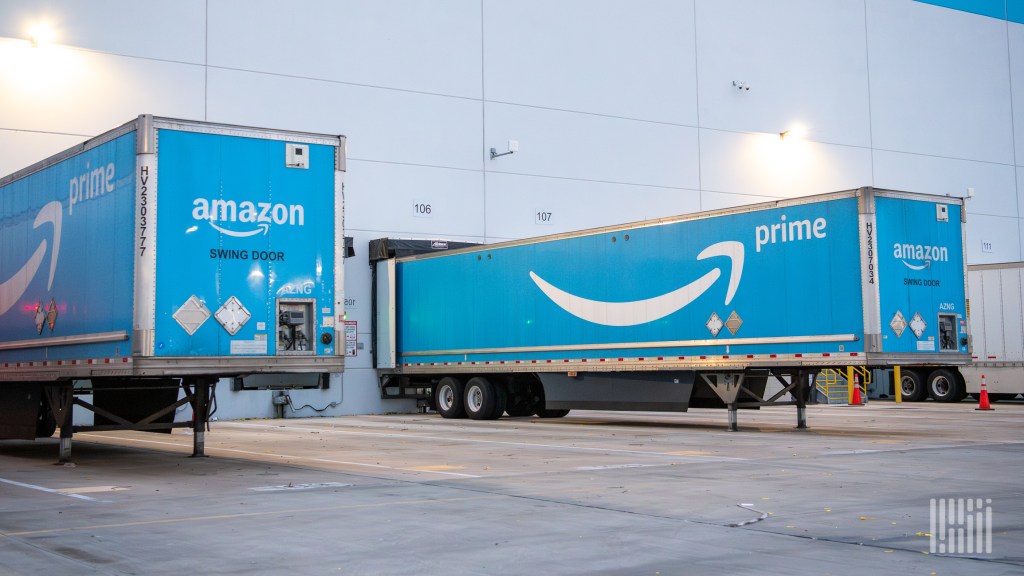
Amazon is offering less-than-truckload service through its Amazon Freight platform, according to a memo to customers. The service is being billed as a cost-effective solution for customers unable to fill a full trailer, but only available for inbound delivery to Amazon facilities, where the goods will be stored and later shipped through the company’s regular package delivery network.
The new service is for vendors shipping goods to Amazon distribution centers and does not resemble a traditional hub-and-spoke LTL network in which palletized shipments are picked up, cross-docked at a nearby location and ultimately delivered to a final destination still on a pallet.
The option is available on the Amazon Freight portal along with extant full truckload service. The site provides quotes up to 14 days ahead of shipment and allows users to compare full- and less-than-truckload options side by side. The site also allows load tracking, invoicing and payment options.
Amazon Freight touts a fleet of more than 60,000 trailers and 20,000 intermodal containers.
“We have been listening closely to our customers and understand their desire to have more ways to move their freight,” said Ari Silkey, general manager at Amazon Freight. “With LTL, they are now getting access to Amazon’s trusted infrastructure and cutting-edge technology to move more of their loads into Amazon’s fulfillment centers.”
The statement was circulated via email to customers on Thursday, but an attached news release with the details had a date of Friday, April 4.
Reports recently surfaced saying Amazon (NASDAQ: AMZN) has been actively hiring LTL personnel and seeking to more meaningfully compete in the industry. However, the current offering is not available outside Amazon’s network and doesn’t allow shippers to ship freight directly to customers.
“At this time, Amazon Freight LTL is only available to customers shipping inbound to Amazon’s fulfillment centers. However, we are constantly evaluating our lanes and services to meet shippers’ changing needs,” the statement concluded.
The company launched an LTL offering in Germany in 2024.
FedEx, UPS lose parcel market share to big retailers, smaller couriers
Americans are shipping more parcels than ever, but traditional parcel carriers FedEx and UPS are losing market share to private fleets operated by online retailers and regional couriers, many of which have sprouted in recent years to meet e-commerce demand for last-mile delivery.
That’s the conclusion of a report on Thursday from ShipMatrix Inc., a parcel management, consulting and analytics firm with a strong history assessing industry trends.
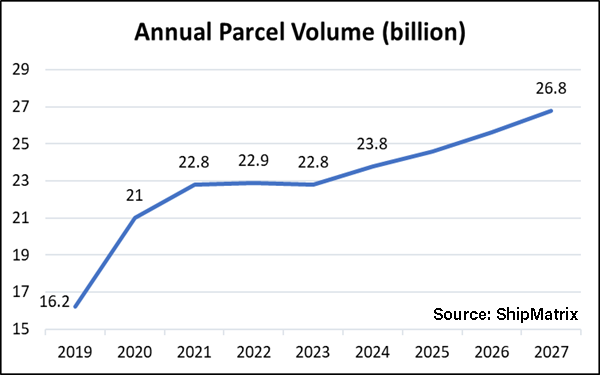
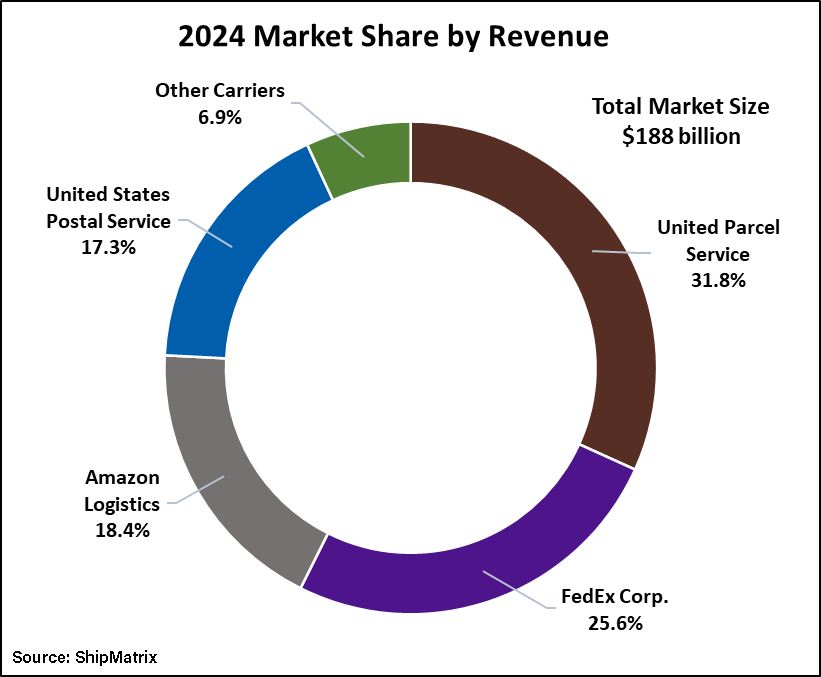
In 2024, parcel volumes reached an all-time high of 23.8 billion, up 4% from the prior year and 50% since 2019. Parcel delivery revenues grew 4.1% to $188 billion, with an average revenue of $8 per parcel.
ShipMatrix estimates U.S. parcel volume will grow at a compound annual rate of 4% over the next three years to 26.8 billion in 2027. “However, most of that growth will be handled by private networks of Amazon, Walmart and other retailers, resulting in a flat to negative growth for UPS, FedEx and USPS,” the report said.
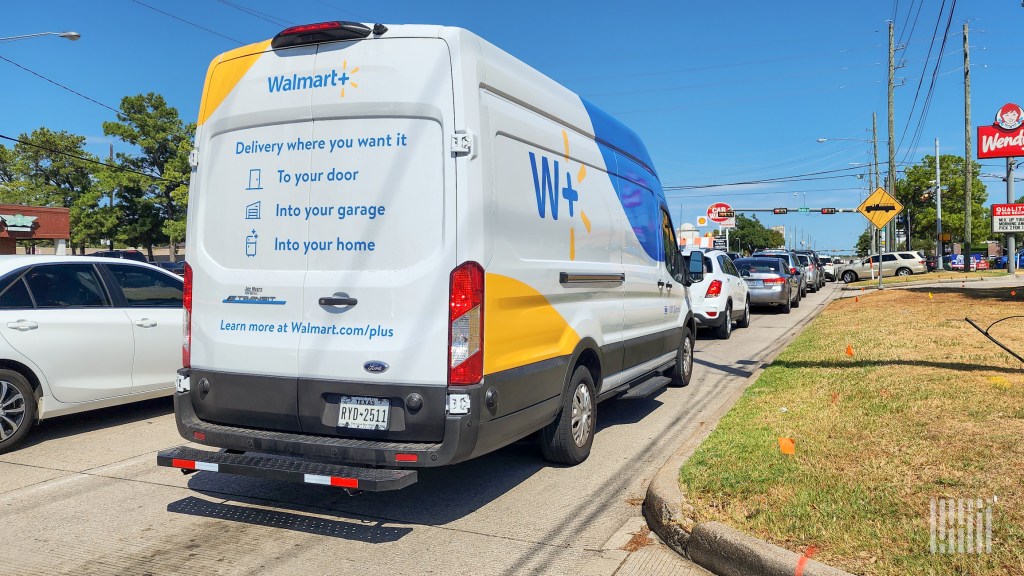
FedEx (NYSE: FDX) and UPS (NYSE: UPS) face keen competition in parcel shipping from Amazon Logistics (NASDAQ: AMZN), Walmart (NYSE: WMT) and Target, as well as smaller, independent carriers such as OnTrac, Better Trucks, Jitsu, Veho, SpeedX and UniUni.
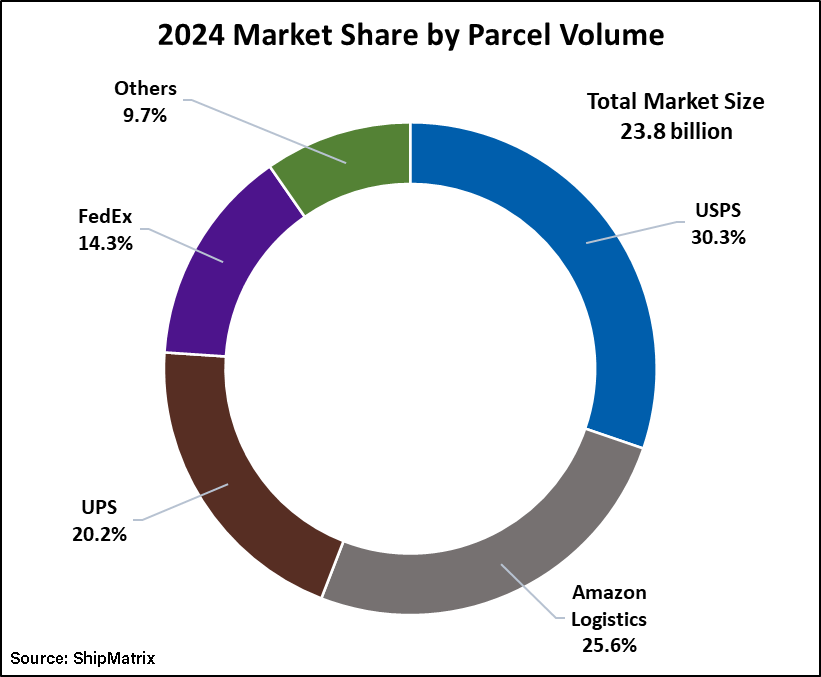
The growth of volume among companies that are, or were, the largest customers of FedEx, UPS and the U.S. Postal Service is the most dramatic market development in recent years and poses an ongoing risk to the legacy carriers, ShipMatrix said. Amazon dropped FedEx as a carrier five years ago. UPS said in January it will slash volumes it handles for Amazon by 50% over the next 18 months as it focuses on higher-yield freight.
Amazon delivered 6.1 billion packages in 2024 compared to 1.7 billion in 2019. Other carriers, led by Walmart, saw growth jump 44% year over year to 2.3 billion packages. The number of shipments for this cohort has nearly quadrupled from 600 million in 2019. UPS parcel volume of 4.8 billion was flat year over year, while FedEx recorded a marginal decrease to 3.4 billion packages.
Parcel industry revenue growth has normalized after spiking in 2021 and 2022 when consumers were reluctant to shop in person because of COVID and heavily relied on ordering goods from their computers or mobile devices. UPS led the way in revenue last year at $59.8 billion. Other carriers, excluding Amazon, FedEx and the Postal Service, experienced 48% revenue growth to $13 billion.
Walmart’s ability to fulfill orders from its stores and clubs has been a key driver of its e-commerce growth, CEO Doug McMillon said during an investor town hall on Wednesday. The retailer’s coverage of U.S. households with same-day delivery has grown by 22% during the past two years. The company can now provide same-day delivery to 93% of U.S. residences, up from 76% of households two years ago, he said.
Management said e-commerce represents 17% of the retailer’s total net sales and expects it to contribute 50% of topline growth over the next five years. The U.S. e-commerce business has turned a corner this quarter and the company now forecasts it to achieve profitability for the full year after, McMillon said.
In related news, Shipium, a shipping platform for e-commerce brands, has added UniUni to its carrier network, the last-mile logistics company announced on Tuesday.
ShipMatrix said it relied on company reports, regulatory filings and other data sources for its findings.
Fun facts from the ShipMatrix report:
* Some 67 million parcels are delivered per day.
* Seventy parcels were delivered per adult in 2024, or 1.8 parcels per week. The demand allows carriers to build network density for business-to-consumer deliveries.
As the Trump administration’s tariff battle against China heats up, U.S. Customs and Border Protection is gearing up for a major enforcement operation. While the political drama surrounding tariff hikes captures the public’s attention, fears of fraudsters exploiting the tariff system are emerging.
The surge in tariffs, particularly on Chinese goods, has created an opportune environment for customs fraud. Importers facing steep duties are resorting to creative, and sometimes illegal, methods to avoid paying the required fees. Mislabeling goods, undervaluing shipments and falsely declaring the country of origin are just a few tactics being employed to bypass customs inspections. These actions can cost the U.S. government billions in lost revenue, creating a headache for both enforcement agencies and compliant businesses.
These types of fraudulent activities have already had significant financial implications. In one case from the early 2000s, a group of importers used fraudulent schemes to misrepresent the country of origin of textiles from China to evade tariffs. In that instance, the perpetrators were caught, but not before costing the U.S. Treasury over $100 million in lost duties.
Another case involved a California-based electronics company in 2018, which underreported the value of goods from China to avoid paying tariffs. The company eventually settled, but the case served as a reminder of the vulnerabilities in the U.S. customs system.
With the ongoing increase in tariffs, the threat of such fraud is once again rising, prompting CBP officials to brace for reported massive enforcement tasks.
Compounding this issue, legal experts have noted that customs fraud is increasingly being pursued through the False Claims Act, which allows private parties to file lawsuits on behalf of the government. This has led to a rise in lawsuits brought by whistleblowers who have insider knowledge of fraud. In some cases, these whistleblowers can receive a reward, creating an incentive for employees and competitors to expose fraudulent activities. The act has already resulted in several large settlements, including one in 2016 in which a company was forced to pay $11 million after submitting false claims regarding imported goods.
Apropos of nothing, came here to remind you that Customs and Border Protection offers whistleblowers who report customs fraud 10% of any money recovered.
A new bill introduced in the U.S. House, the Staged Accident Fraud Prevention Act, seeks to combat the growing issue of fraudsters staging truck accidents to file frivolous lawsuits against trucking companies.
Sponsored by Rep. Mike Collins, R-Ga., and Rep. Brandon Gill, R-Texas, the legislation classifies intentionally causing or arranging a collision with a commercial motor vehicle as a federal crime. Perpetrators could face up to 20 years in prison, with harsher penalties if the crash results in serious injury or death.
Staged crashes often involve con artists in passenger vehicles deliberately colliding with trucks to secure substantial settlements. These scams not only endanger public safety but also drive up insurance costs, disproportionately affecting small trucking businesses and owner-operators. The bill also targets co-conspirators such as attorneys and medical professionals who knowingly participate in these schemes.
One of the most notable cases of staged truck crashes, Operation Sideswipe, has been ongoing since 2019 in Louisiana, resulting in multiple indictments. Advocacy groups like the American Trucking Associations and the Owner-Operator Independent Drivers Association have strongly supported the bill, arguing it will help protect the industry from costly and dangerous fraud.
Federal prosecutors and the Washington police department’s internal affairs unit are investigating more than two dozen officers accused of fraudulently securing federal pandemic relief funds, including through the Paycheck Protection Program (PPP). Prosecutors allege some officers even claim to operate nonexistent trucking businesses.
The investigation focuses on whether the officers intentionally misrepresented their business activities to obtain loans meant to help struggling companies during the COVID-19 pandemic. If proven guilty, they could face up to 20 years in prison.
One notable case involves former D.C. officer Kalynn Fields, who is accused of fraudulently applying for $35,000 in PPP loans by falsely claiming to operate a long-haul trucking business, among other ventures. Prosecutors allege that Fields used the loan money for personal expenses, including meals, liquor and designer items, and sought loan forgiveness despite not having a legitimate business.
Registration open for May Freight Fraud Symposium in Dallas 🎉
Be part of the solution that stops freight fraud in its tracks. Let’s cut through the noise and address this issue head-on!
Freight fraud has reached a crisis level, and it impacts everyone in the industry. It’s time for us to come together to address this critical problem and share best practices on how to mitigate it.
Join us on May 14 in Dallas at the Freight Fraud Symposium, where transportation executives, freight leaders and technology buyers will come together to discuss the issues we all face, share lessons learned and get insights on the latest technology to tackle this problem. Space is limited, so register now to save your spot!
Fighting freight fraud an immediate focus at annual meeting of brokers’ group
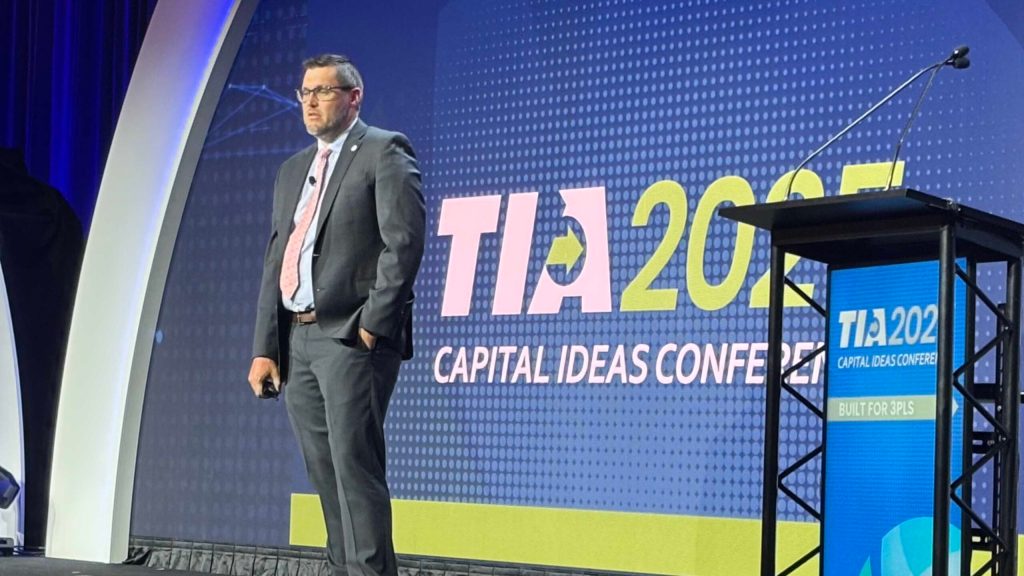
SAN ANTONIO – The one consistent theme in opening addresses at the Capital Ideas Conference of the Transportation Intermediaries Association was that freight fraud remains a major problem for brokers, and there are few signs of progress in combating it.
Two years after then-TIA President Anne Reinke described double brokering as “out of control,” none of the three TIA officials who spoke at this year’s gathering gave any hint that fraud is on the decline. Reinke’s comments in 2023 were directed at double brokering; this year it was fraud in general, of which double brokering is one part.
The meeting here with more than 1,500 attendees is the first for Chris Burroughs as president of the TIA. He moved into the top slot last September after Reinke took over leadership of the Intermodal Association of North America.
Burroughs, in his first remarks to a TIA conference as president, said the organization has been “tackling this problem” since the 2012 passage of a federal antifraud law. He noted it was one of the first pieces of legislation he had worked on at TIA after joining the organization that year.
Nonetheless, Burroughs said, “the situation has obviously exploded into a massive fraud.”
2020 data from the Federal Motor Carrier Safety Administration said that the agency had more than 80,000 complaints of freight fraud in its database, a figure Burroughs said was “staggering and quite frankly unexpected.”
“It’s tarnishing our industry and our reputation,” he said.
He cited a list of actions TIA has taken that have no enforcement mechanism but do raise the profile of the freight fraud issue: a task force, “best practices” brokers can follow to reduce the amount of fraud, white papers, work with other organizations and the launch of a media campaign “to continue to raise awareness on this issue.”
“We’re also working directly with Congress and the federal agencies to push forward and getting regulations that are already on the books enforced,” Burroughs said.
Rob Kemp, the president and founder of K-R Sales Inc. and DRT Transportation and incoming chair of the TIA, said he recently had a frustrating experience in his own company’s battle with fraud.
“We just had a situation not too long ago. We ended up calling the FBI and were disappointed to hear the FBI say, and you guys have probably heard this, ‘We can’t help you.’ So if they can’t help you, who can help you?” Kemp said.
Mark Christos, the president of SolvLogix Inc. and outgoing chair of the TIA, opened the conference with a push for the TIA as a bulwark against fraud.
“Every time I’ve been on the phone with a shipper or a prospective customer who has reservations about something really unfortunate that happened with them, relative to brokerage, I find that it’s not with a TIA member,” Christos said. “Same thing with the carrier side. They will tell us stories, all legitimate. I will ask the carrier, who is that with specifically? And they’ll all say it is not a TIA member.”
Broker transparency raised as an issue
Burroughs also took the opportunity to tamp down the view that brokers and carriers are at odds with each other. Perceptions of that relationship hit bottom in spring 2020, when in the face of extremely low rates soon after the pandemic started, truckers took to the streets of Washington to protest the low levels and blamed brokers. Bob Voltmann, who had the TIA head job before Reinke, made a stunning short video defending his members. He was ousted soon after, and it was never clear whether the video was the cause of his departure.
Tensions between the two groups may be arising again over the issue of broker transparency, with the FMCSA recommending new regulations.
“Carriers and brokers obviously need each other,” Burroughs said. He did not mention the broker transparency regulations but said that “instead of trying to expose this sensitive business data, we should focus on the real issues, building trust, enhancing efficiencies and strengthening our partnerships together. Brokers don’t survive without carriers.”
“We don’t want to be enemies, but when bad policy threatens our industry, we will obviously stand up,” he added.
EU delays US tariffs for 90 days following Trump’s pause
The European Union will match the Trump administration’s 90-day pause on tariffs, delaying duties on $22 billion worth of U.S. products. Trump’s new 10% baseline tariff on trade partners remains in effect.
The pause comes a day after the European Commission authorized retaliatory measures against the U.S. over 25% steel and aluminum tariffs imposed by President Donald Trump.
The EU tariffs would have hit next Tuesday on a wide range of U.S. exports, including orange juice, soybeans, motorcycles, beauty products and more.
Ursula von der Leyen, president of the European Commission, said the commission was suspending tariffs against the U.S. to pursue negotiations.
The European Commission is the primary executive arm of the EU.
“We took note of the announcement by President Trump. We want to give negotiations a chance. While finalizing the adoption of the EU countermeasures that saw strong support from our Member States, we will put them on hold for 90 days. If negotiations are not satisfactory, our countermeasures will kick in,” von der Leyen said on a social media post on Thursday.
Trump unveiled a broad “reciprocal” tariff plan for all U.S. trade partners April 2, including a baseline 10% tariff on trade partners, as well as 25% tariffs on certain imported vehicles and auto parts arriving into the U.S.
Trump’s tariff policy went into effect at 12:01 a.m. on Wednesday, including 20% on the EU, 10% on the United Kingdom, 34% on China, 24% on Japan and 32% on Taiwan.
On Wednesday, Trump said he was pausing the reciprocal tariffs and dropped duties under his new trade plan to 10% on imports from most countries for 90 days.
Trump also said in a social media post on Wednesday that he was raising tariffs imposed on imports from China to 125%, hours after China boosted the duty on American goods to 84%. Trump increased the import tariffs against China to 145% on Thursday.
Trump’s 90-day pause does not include the 25% duties on imported cars and auto parts, as well as steel and aluminum, which also remain under a 25% import tax that began April 2.
In February, Trump launched 25% tariffs on imports from Mexico and Canada, citing fentanyl and illegal immigration as justifications.
However, goods covered by the United States-Canada-Mexico Agreement will be exempt from tariffs, while products that aren’t exempt under the trade deal will still have a 25% duty. Canadian energy and fertilizer products will have a 10% levy.
Where President Donald Trump’s tariffs currently stand
10% baseline tariffs
Trump is maintaining the 10% baseline global tariff announced on April 2, except for Canada, China and Mexico
China tariffs
Tariffs on China currently set between 145% to 245%
Automotive tariffs
25% tariffs on imported cars, light-duty trucks, and auto parts remain in place
Steel and aluminum tariffs
25% tariffs on imported steel and aluminum remain in place
Canada and Mexico
25% tariffs on most imported goods, except products covered by the United States-Canada-Mexico Agreement
Venezuela
Trump imposes 25% tariff on countries buying Venezuelan oil and gas starting April 2
Trump sics DOGE on the Navy but ignores China port fees
President Donald Trump on Wednesday signed an executive order that moves the U.S. ahead on shipbuilding but doesn’t address controversial port fees on Chinese ships.
The order also directs Elon Musk’s Department of Government Efficiency to review how the Department of Defense orders new military vessels.
Trump’s directive calls for greater enforcement of the collection of the Harbor Maintenance Tax, including on imports entering the U.S. by land after unloading from ships at ports in Mexico and Canada.
Buried deep in the order was a call for DOGE to review vessel procurement processes by Defense and Homeland Security, with recommendations included in the Maritime Action Plan “to improve the efficiency and effectiveness of these processes.”
The executive order follows up on Trump’s initiative calling for a revitalization of U.S. maritime capabilities. That followed an investigation by the Biden administration finding China had leveraged unfair advantages to seek a dominant position in global shipbuilding and shipping.
To blunt China’s maritime influence, the U.S. proposed punitive charges on Chinese ships of as much as $1.5 million per port call. But opposition by maritime-related businesses led the administration to back off on implementation of the charges pending further review.
The executive order directs the departments of State, Defense, Commerce, Labor, Transportation and Homeland Security, as well as the United States trade representative to jointly submit a Maritime Action Plan by Nov. 6 but provided few details on what the plan should include.
US rail traffic sees second double-digit increase of 2025
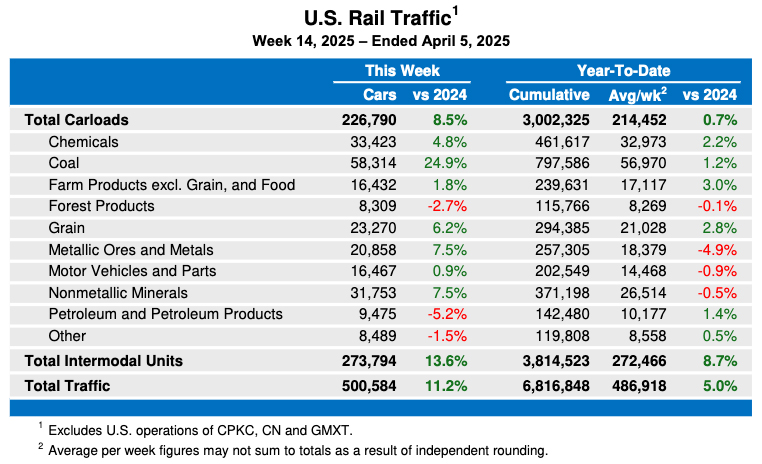
U.S. weekly rail traffic remained ahead of 2024 levels in the week that ended on Saturday, the sixth straight gain and just the second showing a double-digit increase.
According to the Association of American Railroads, volume for the week was 500,584 carloads and intermodal units, an 11.2% increase over the same week a year ago. That includes 226,790 carloads, up 8.5%, and 273,794 containers and trailers, a 13.6% increase.
(Chart: Association of American Railroads)
The only other week this year to see double-digit gains over 2024 levels was the week ending Jan. 18, when traffic jumped 25.9%.
Year to date, carload traffic is up 0.7%, and intermodal volume is up 8.7%. The total of 6,816,848 carloads and intermodal units represents a 5% increase over the first 14 weeks of 2024.
North American volume for the week, as reported by nine U.S., Canadian and Mexican railroads, was 685,076 carloads and intermodal units, a 7% increase over the corresponding week in 2024. That includes 329,212 carloads, up 3.7%, and 335,865 intermodal units, up 10.3%.
North American volume through 14 weeks is 9,367,352 carloads and intermodal units, up 3.3% compared to the same period a year ago. That includes a 0.1% increase in Canada and an 8.2% drop in Mexico.
US Postal Service seeks letter price raise to 78 cents
Sending a domestic letter through the post office could cost 78 cents starting July 13, 5 cents more than the price of a first-class mail stamp today, if the Postal Regulatory Commission approves proposed adjustments for mailing services filed Wednesday.
The U.S. Postal Service said it notified the commission of plans to raise letter and postcard rates an average of 7.4%. A domestic postcard will cost 62 cents, up from the current 56 cents, while the price for sending an international postcard will increase by a nickel to $1.70. Rate changes apply to single-piece and metered mail.
Single-piece letters weighing more than an ounce will increase a penny to 29 cents for each additional ounce.
The Postal Service is also seeking price adjustments for its Special Services products. Notably, the Postal Service will apply a price reduction of 12% for postal insurance when mailing an item.
The quasicommercial agency said the price changes are needed to help achieve financial stability as it implements operational changes in a changing market to save money. Postal Service prices remain among the most affordable in the world, it said.
Following a directive from the commission, the Postal Service also filed two sets of prices for marketing mail and package services products. While only one set of rates will go into effect on July 13, these prices address the pending proposal to eliminate bound printed matter and expand marketing mail, pending the commission’s approval. The agency said it will provide more details on those changes in the future.
During the first quarter of fiscal year 2025, the organization narrowed its net loss to $140 million. It generated about $150 million in operating profit versus a $2 billion loss for the same period in the prior year.
Under a restructuring plan called Delivering for America, the Postal Service has reduced billions of dollars in costs by adjusting the logistics network to integrate delivery of mail and package categories and shift more air transportation to ground, and it has created new products, adjusted rates and persuaded Congress to repeal a requirement that the Postal Service prepay health plans for retirees.
The architect of the plan, Postmaster General Louis DeJoy, abruptly left office last month.
New Mack long-haul truck makes grand entrance in bid for market share
BROOKLYN, N.Y. – Truck manufacturers roll out new models all the time. What they don’t often do is bring a slew of journalists who write about trucking into New York City to talk about it.
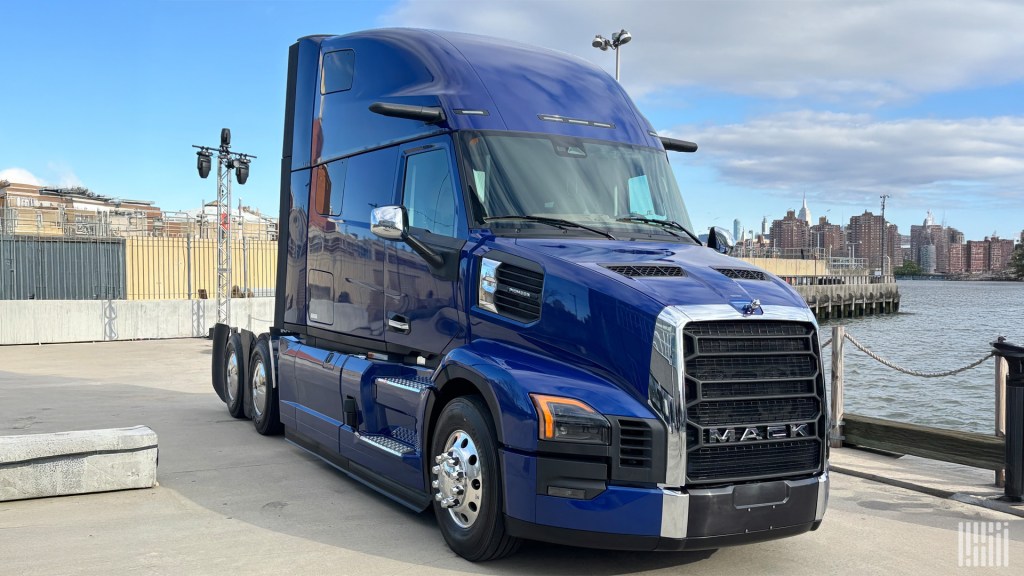
But that happened earlier this week when Mack Trucks, a member of the Volvo Group, introduced the Mack Pioneer, the manufacturer’s attempt to improve on its current 2% (by its estimate) share of the over-the-road truck market in the U.S.
“We haven’t really achieved a lot of success in the long-haul market,” Fernando Couceiro, Mack’s vice president and product owner for highway trucks, said at a briefing with journalists shortly after they were transported to the Brooklyn Navy Yard for a first look at the new tractor. (A full reveal to the public at the Navy Yard occurred Tuesday evening.)
Couceiro said the Anthem, Mack’s current leading tractor offering, “is a great day cab product. We have a very strong position in the market. But we haven’t really achieved a lot of success in the long-haul sleeper segment.”
The Pioneer – which has an automatic transmission – is designed to change that, and Couceiro said Mack would be ready to begin taking orders on it Wednesday, the day after the Brooklyn revea to the media and in the bigger evening event to a larger group.
Throughout the two days, Couceiro and other Mack officials touted the key features of the Pioneer that are driving their enthusiasm.
Couceiro described it as “the most aerodynamic truck in the world.” The working project name for the Pioneer had the word Aero in it.
Specifically, he said by various measures, the combination of a number of changes – from the aerodynamic design to the digital mirrors – translates into an 11% increase in efficiency over the Anthem. He split that as a 3% improvement in power train efficiency and 8% from the aerodynamic features of the tractor.
The company highlighted the digital mirrors especially. In the press release announcing the Pioneer, Mack said the mirrors are a camera system that would produce about 1 percentage point of the 11% estimate of greater efficiency.
But the word that kept coming up in the discussions was “comfort.” It was one of the four features, along with driving efficiency, reliability and fuel efficiency, that Couceiro said drivers and buyers of the trucks sought in their purchases.
Lukas Yates, the brand designer for Mack Trucks who kicked off the presentation to the trucking media, said the design changes include a shift in the iconic bulldog that sits at the front of all Mack Trucks.
“Rather than sitting on a pedestal, the bulldog hood ornament is now integrated with the truck’s design, flanked by air intakes that help manage airflow under the hood, making it an integral part of the truck’s performance rather than just an emblem,” Yates said, according to the company’s prepared statement about the Pioneer launch.
Couceiro said the launch of the Pioneer did not mean the end of the Anthem, which will coexist for “a little while, and then there’s more to come.” He added that Mack expects to “reintroduce” its entire line of trucks within the next few years, and the Pioneer is the “first one out of the gate.”
For all the focus on the design, Couceiro said the ultimate key performance indicator would be market share.
“The lagging KPI is really market share,” he said. “It means we’re in the wrong place. The leading KPI really is whether people are willing to buy more and more trucks.”
The goal, Couceiro said, would be to add 5 to 6 percentage points in over-the-road market share via a successful rollout of the Pioneer. The time frame on that goal is now through 2030, he added.
“We want drivers to be bugging their fleet managers saying, ‘I want to drive that truck,’” Couceiro said. “So for me personally, that’s what I would consider a success when we get that feedback, and we have customers that are considering it for their long-haul applications.”
Mack officials said the Pioneer was tested at a driver clinic at Virginia Tech, whose Blacksburg campus coincidentally is near the site of the Volvo truck manufacturing plant, a sister operation to Mack Trucks within the Volvo Group. They said the test was unbranded so drivers did not know they were driving a Mack Truck, allowing them to “provide unbiased evaluations of the cab’s ergonomics and features,” according to the Mack statement.
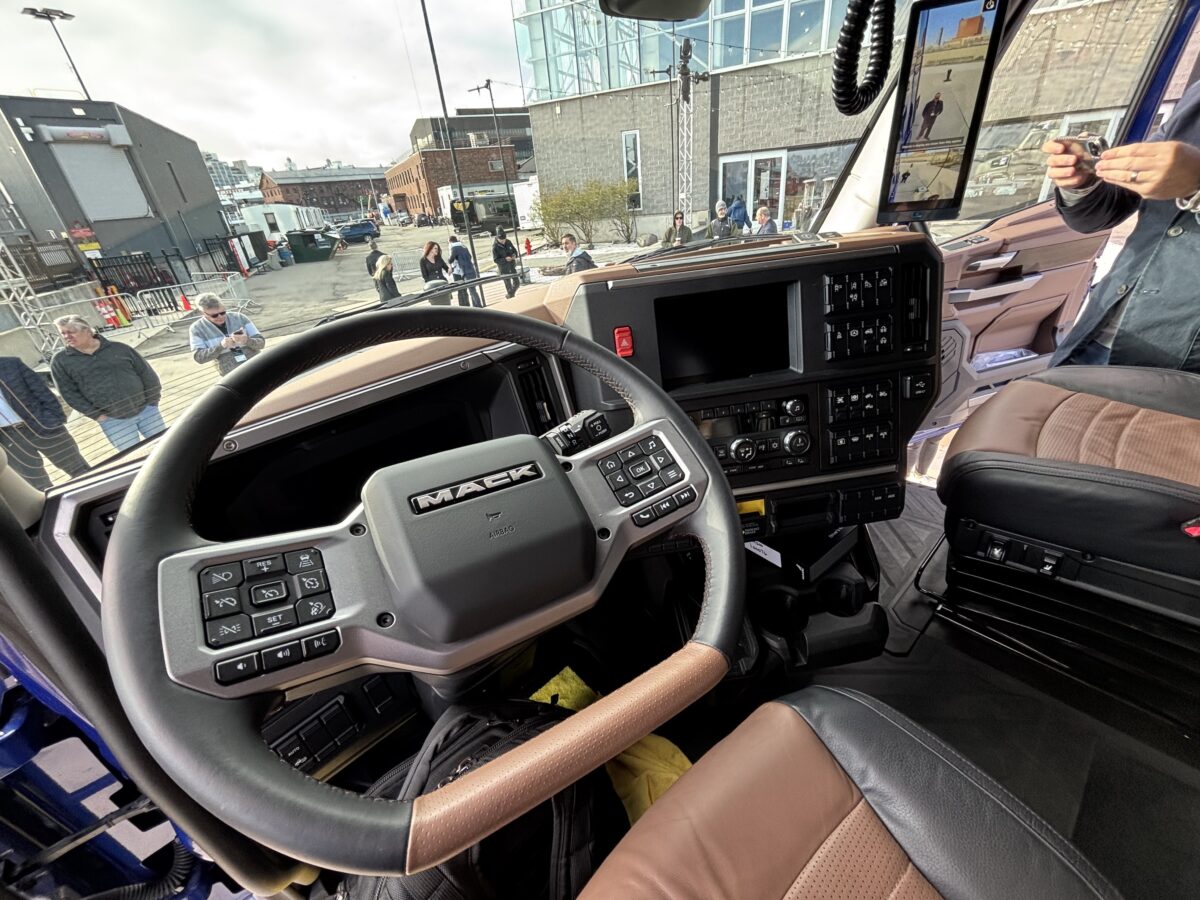
Vince Lokers, Mack’s specialist and chief designer who led the creation of the cab, went through the wide range of changes Mack is spotlighting about the driver experience – among them a refrigerator under the seat, where the cupholders are, and an electronic logging device pivot that allows more movement of the ELD. It’s the full range of features inside a cab that can appear unimportant at first but which, as Lokers described it, are key to getting driver acceptance that your cab is better than the next guy’s. (And truck manufacturers compete fiercely over the little things.)
Included in the features that Mack has gone out of its way to highlight that would specifically target drivers:
Seats with armrests on both sides, which Mack said “ensures drivers’ arms travel with them on the suspension rather than resting on the fixed door panel.”
Holes in the steps to reduce the buildup of ice or snow.
Multiple configurations that include a day cab, three midroof sleepers of 44, 64 and 76 inches, and a 76-inch-high roof sleeper that allows the rear bunk to be “rotated” against the sleeper area’s real wall for more space. The presentation showed a small eating area in the place where the lower bunk would have been before it was folded up.
Frontal air bags as standard and a side air curtain protection system that is also part of the package.
Couceiro put a wrap on the message by discussing the experience behind the wheel. Conceding that he wasn’t a truck driver but had driven in numerous vehicles, he said the Pioneer is “easy to drive, but you feel powerful. … It feels like you’re driving a really luxurious pickup truck, not really a Class A heavy-duty tractor, right? So that’s at least my personal feedback of what comes to my mind in terms of, how does it feel to drive this amazing vehicle?”