
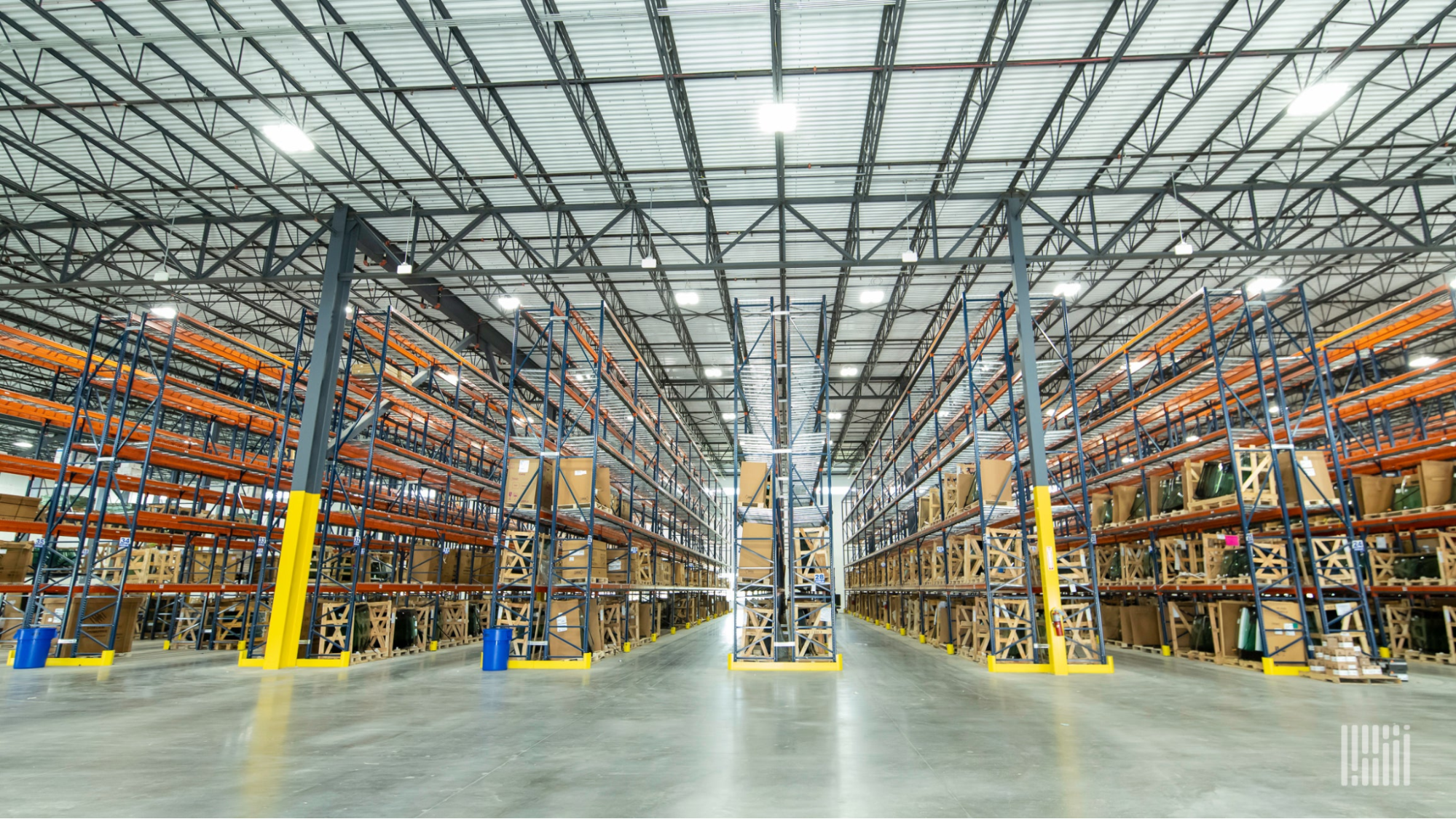
Dexory secures $165M to accelerate AI-driven warehouse intelligence

Dexory has raised $165 million to expand its AI-powered warehouse intelligence platform, a move that highlights the logistics industry’s growing appetite for automation and real-time visibility. Led by Eurazeo’s Growth team with participation from LTS Growth, Endeavor Catalyst, and existing investors including DTCP, Atomico, and Lakestar, the funding will help the company scale globally and advance its next generation of autonomous technology.

Since its Series B in 2024, Dexory has rapidly grown its footprint across Europe, North America, and APAC, opening a North American headquarters in Nashville, Tennessee. Its AI-enabled platform, DexoryView, is now used by logistics leaders like GXO, Maersk, and DHL, as well as manufacturers such as Stellantis and GE Appliances.

Join the leaders shaping freight’s future at
F3: Future of Freight Festival, Oct 21-22.
Network with the industry’s best and discover what’s next.

According to CEO and Co-Founder Andrei Danescu, “Our full-stack approach, which combines autonomous mobile robots with the DexoryView intelligence platform, has enabled us to move from initial deployments to full-on expansion with major operators. They’re seeing real gains in accuracy and efficiency.”

DexoryView serves as a living digital twin of the warehouse, continuously updated by autonomous robots that scan more than 10,000 locations per hour. Beyond standard identifiers like barcodes and RFID tags, its LiDAR sensors capture 3D data, mapping inventory conditions and space utilization in real time. “By combining this depth of data with real-time analysis, Dexory delivers a complete, contextual view of operations,” Danescu explained. “Most competitors focus on either hardware or analytics; we bring both together in one ecosystem.”

That unified approach extends to integration. DexoryView is designed to complement existing warehouse management systems, automatically reconciling physical scans with digital records. This allows operators to modernize incrementally without disrupting daily operations. “Our AI learns from live data to recommend improvements that integrate naturally into workflows,” Danescu said.

The new funding will accelerate development of agentic AI, autonomous systems capable of perceiving, deciding, and acting independently, to help warehouses shift from systems of record to systems of action. 

One customer already seeing results is DCL Logistics, a fulfillment partner for omnichannel brands. DexoryView helped DCL automate inventory audits that once took hours of manual effort. “They now complete counts ten times faster, improve pallet accuracy by 14%, and save 16 hours of labor each day,” said Danescu.

As Dexory scales globally, it’s tailoring its technology to regional needs. European warehouses prioritize space efficiency and labor optimization, while North American customers emphasize speed and scalability. “Our modular platform allows flexible configuration to meet different operational realities,” Danescu said.

Eurazeo Partner Raluca Ragab said, “Dexory’s extraordinary combination of robotic and software engineering harnesses operational data at scale and turns it into actionable insights. We see a vast global market ahead, and Dexory is uniquely positioned to help the industry leap into the future.”

Looking forward, Danescu sees an opportunity to build adaptive, self-learning warehouses that can sense, decide, and act autonomously. “The key challenges are interoperability with legacy systems, closing the skills gap, and building trust through explainable AI,” he said. “But the goal remains clear, creating efficient, resilient, and sustainable warehouses that empower people through intelligence.”

Tariffs are the wake-up call supply chains needed, Arkestro says

Edmund Zagorin, co-founder and chief strategy officer of Arkestro, believes the current tariff war and trade volatility could spur lasting transformation in the global supply chain.

“Never waste a good crisis,” Zagorin told FreightWave. “Leaders that are savvy are using this as a way to say, ‘look, there’s a lot of changes we’ve wanted to make. There’s never been a better moment to take AI and use it to perform some of these tasks that are very resource intensive.’”

Zagorin said supply chain leaders should view tariffs not just as a cost to manage — but as an opportunity to accelerate innovation and resilience.

“The cost of complying with tariffs — not even the tariffs themselves — has reached between 1% and 3% of the cost of every product,” Zagorin said. “Companies are spending enormous time and energy just figuring out what rules apply, and that’s unsustainable. The leaders I talk to are using this moment to rethink how procurement operates.”

Join the leaders shaping freight’s future at
F3: Future of Freight Festival, Oct 21-22.
Network with the industry’s best and discover what’s next.

San Francisco-based Arkestro was founded in 2017 by Zagorin and CEO Robert DeSantis. The company is a predictive procurement orchestration platform that utilizes behavioral science, game theory and AI to predict and win faster value across all quoted spends. 

To show how AI can help the procurement process, Arkestro is hosting “Optimal ’25: The Celebration of Game-Changing Procurement,” on Oct. 29–30 in Houston. The event will bring together global leaders from industries such as retail, manufacturing, oil and gas, and chemicals to explore AI-driven procurement transformation. 

Zagorin said the idea for Arkestro came from recognizing how much time procurement teams waste responding to inflated supplier quotes. Most companies already possess vast data on what they’ve paid and what they want to pay — data that could be used proactively, he said. 

By applying AI and simulation, Arkestro can predict negotiation outcomes and generate “suggested offers” for suppliers to review, flipping the traditional dynamic. This approach, Zagorin said, can cut 60% to 90% of sourcing time while improving pricing accuracy and decision speed.

“Arkestro generates tens of thousands of quotes every day,” Zagorin said.

AI is beginning to reshape freight procurement, giving large shippers and global 3PLs new tools to negotiate rates, accelerate bid cycles and manage tariff costs. 

The global AI in procurement market is projected to surge from $1.9 billion in 2023 to $22.6 billion by 2033, growing at a 28.1% CAGR, according to data from market.us. North America currently leads the market with a 38% share, or about $700 million in revenue.

Platforms such as Arkestro, Fairmarkit and Pactum are gaining traction with Fortune 500 manufacturers, energy companies and retailers that manage complex sourcing and volatile freight markets. These systems simulate bids, generate suggested offers, and cut sourcing cycles from months to weeks.

Zagorin, whose company works with Fortune 500 manufacturers like Chevron, Koch Industries and Valvoline, said the past year of shifting tariffs has exposed how reactive many supply chains remain. 

“Most enterprises and procurement organizations are not staffed with people that have subject matter expertise in customs and duties and the correct procedure or how the rates change based on country of origin and so forth,” Zagorin said.

Zagorin’s advice is to move from reactive to predictive and he encourages companies to adopt “test-and-learn” approaches with AI procurement tools.

“We see the enterprises that are being really successful with AI now have developed a way to quickly pick a few technologies and use them and then see if there’s benefit as far as what they want to do,” Zagorin said. “The enterprises that are really struggling are the ones that are six months into designing a request for proposals for this technology.”

Container Atlas gets granular

Last week, SONAR released a new dashboard within the Container Atlas application, titled Maritime Trade Console. 

This is the latest of the dashboards added to SONAR and, like the others, is intended to enhance SONAR’s usability and is powered by Google Looker. It includes details on ocean data that haven’t been released elsewhere, as bookings and US Customs data are broken down into detail. 

The best way for SONAR users to understand it is not to read this blog, but to poke around the app. The Maritime Trade Console can be found at the top of SONAR under Applications / Other Applications / Container Atlas – the Maritime Trade Console is the fourth tab at the top. 

(Chart: SONAR Maritime Trade Console)

Use Case #1: Know who is most exposed to tariffs

Tariffs remain a moving target, and that uncertainty is part of the rationale for why we are rolling out the Maritime Trade Console now. 

Two examples that come to mind immediately are imports from India and furniture. 

Last month, I wrote a blog titled, People still have to sit, and other furniture observations from SONAR, following the announcement that furniture tariffs would be forthcoming. It illustrates the utility of the Maritime Trade Console makes it easy to assess potential impacts on a particular shipper vertical, such as furniture. 

By using the Maritime Trade Console, I could easily detail: 

  • Where furniture is sourced
  • Which US ports are most impacted
  • The shippers and consignees most exposed to furniture
  • The ocean carriers most exposed to furniture

I anticipate that investment analysts will find value in those breakdowns as they assess the impact of geopolitical events. 

Data on imports from India to the U.S. can be used as an example of how the Maritime Trade Console enhances the product. SONAR could already quantify the drop in ocean booking volume in response to tariffs – the chart below shows booking volume from India to the US. The Maritime Trade Console takes that further to show which ports, shippers, consignees, and ocean carriers are most impacted. 

Bookings volume of imports from India to the U.S. has dropped sharply in response to tariff increases. (Chart: SONAR)

When sorting by the India-to-US trade lane only, the Maritime Trade Console shows that the East Coast ports are the ones most impacted by tariffs imposed on imports from India. (Chart: SONAR)

The Maritime Trade Console also shows which ocean carriers are most impacted by the India-to-the-US trade lane. The different colors in the bars represent different shipper verticals. (Chart: SONAR)

The Maritime Trade Console also shows which industries are most impacted, which include clothing and textiles, and also industrial equipment and components. (Chart: SONAR)

Use Case #2: Benchmarking by shipper vertical and/or geography

Shippers are best served by data that pertains to their industry specifically. Especially during volatile times, what’s happening with high-value and low-value shipments can differ greatly. For instance, relatively high-value imports from India might be able to withstand the current tariffs, but low-value imports will not. 

The Maritime Trade Console allows shippers to benchmark the quality of the service they are receiving from carriers, for their industry only. For instance, the Maritime Trade Console provides visibility into the TEU Rejection Rate, which includes containers rejected because of blank sailings and also those that are being rolled to subsequent sailings. It also shows the average lead time between booking and departure date, and average transit times. 

The charts above pertain only to apparel made in India to be imported into the US. Consistent with expectations, bookings and the ocean rejection rate have fallen sharply as tariffs have risen. (Chart: SONAR)

Use case #3: Business development

The Maritime Trade Console names names. That is, it provides the names of the largest shippers, consignees, and ocean carriers moving containers, sorted by shipper vertical and/or ocean origin/destination/trade lane. That information is valuable to railroads, port authorities, and drayage companies as they market their services. For example, a company that owns warehousing space in Dallas may want to call on shippers and consignees that use the Port of Houston in an effort to pick up volume that might otherwise be warehoused closer to the port.  

The example below is a list of top shippers and consignees importing containers through the Port of Houston. Companies that serve that region should have this as a targeted customer list. (Chart: SONAR)

Trucks to feel pressure from weaker port, rail: ITS

Nothing in the supply chain happens in a vacuum.

While lower import volumes give intermodal terminals and railheads a break of sorts, higher fees and regulatory changes are shifting pressure to other parts of the supply chain.

The October forecast from the ITS Logistics US Port/Rail Ramp Freight Index shows a continued downward trend in import volumes, and truckers are expected to feel the pressure.

The weaker international container market “is driving tighter assessment of accessorial fees as ports seek to capture revenue during peak season,” ITS said in a release. “Outside the ports, the evolving regulatory situation surrounding non-domiciled commercial driver licenses is driving lower-cost capacity out of the market, increasing the risk of financial insolvency for some carriers. 

These compounding factors are placing a downward squeeze on an already soft drayage market, ITS said, which could cause problems for shippers in both the short and long term.

“Terminals and rail ramps should not face any major challenges due to inbound or export volumes,” said Paul Brashier, ITS vice president of global supply chain. “There are, however, some storm clouds on the horizon that could negatively impact trucking and, by extension, terminal and port operations upstream.”

A federal and state crackdown on non-domiciled CDLs and English-language requirements among drivers begun in September is already causing a surge in bankruptcies across small- and mid-size carriers. Drayage has seen several major providers shutter operations. 

The net result, said ITS, will exacerbate financial challenges for many companies in a rate environment negative to operating costs, reducing overall capacity in a process that will eventually affect terminal and port operations.

“In the near term, these new regulations will remove capacity from the ecosystem and cause market disruption,” Brashier said. “In the long term, it could drive many carriers out of business as they struggle to withstand both evolving regulatory pressures and the ongoing freight recession that has pushed rates down to or below operating levels. Vetting service provider health will become even more important as shippers begin late 2025 and early 2026 RFP [request for [contract] proposal] activity.”

The National Retail Federation earlier projected U.S. September import volume at 2.12 million TEUs, down from 2.28 million TEUs in August and a 6.8% year-over-year decline. The trade group expects monthly imports will continue to drop for the remainder of the year on tariffs and first-half frontloading. 

“In response to low container demand and declining per-container revenue, ocean carriers are strictly enforcing their accessorial schedules to maintain profitability,” ITS said. “With minimal exceptions beyond clear operational failures, ITS Logistics recommends shippers review their supply chains for any inefficiencies that could be exposed and penalized under this renewed focus.”

Accessorial charges can cover detention, demurrage, customs inspections, chassis usage, storage, pre-pull, and other fees outside standard pickup, transport and delivery. These fees can also range to, say, repairing a damaged twistlock that is preventing a container from being properly secured.

“Shippers should take this opportunity to confirm that accessorial dispute processes and documentation requirements are clearly defined in their SOPs [standard operating procedure],” Brashier said. “If your supply chain utilizes rail for ocean container movement, it’s also important to ensure you understand items like chassis pool flip policies and which parties to engage with to resolve issues within free time.”

Subscribe to FreightWaves’ Rail e-newsletter and get the latest insights on rail freight right in your inbox.

Find more articles by Stuart Chirls here.

Related coverage:

CN and Congebec partner to expand cold chain rail across North America

Rail intermodal, carloads gain for second week in row

Sneaker reseller’s arrest highlights surge in US cargo thefts

Senate confirms Fink to lead Federal Railroad Administration

CN and Congebec partner to expand cold chain rail across North America

Canadian National Railway (CN) and Congebec have announced a new partnership to expand cold chain logistics across North America, unveiling plans to build a state-of-the-art temperature-controlled facility within CN’s Calgary Logistics Park. The project aims to bridge a long-standing gap between rail and cold storage, creating a more efficient and sustainable network for temperature-sensitive goods. The construction partner for this project will be Matthews Tribal. 

By embedding the facility directly within CN’s logistics hub, the partnership eliminates many of the inefficiencies that occur when freight transfers between transport modes. The collaboration blends CN’s rail infrastructure with Congebec’s expertise in refrigerated logistics to streamline the flow of perishables such as produce, proteins, and pharmaceuticals across Canada and the United States.

Join the leaders shaping freight’s future at
F3: Future of Freight Festival, Oct 21-22.
Network with the industry’s best and discover what’s next.

Carleigh Oude-Reimerink, Vice-President, Development. Matthews Tribal said in a press release, “We are proud to contribute our development expertise to a project that sets a new standard for cold chain logistics. This facility represents the kind of genuine partnership Matthews Tribal believes in—built on trust and creating lasting value. By combining our Calgary presence with CN’s network and Congebec’s cold chain expertise, we’re helping customers overcome real challenges while supporting long-term growth in Western Canada.”

For Congebec, one of Canada’s largest cold storage providers, the collaboration marks a major step toward building a connected, multimodal cold chain. Congebec President, Richard Patenaude, said “Working with CN on this new Calgary facility is a natural extension of our mission to provide reliable, sustainable cold chain solutions. By combining Congebec’s expertise in temperature-controlled logistics with CN’s expansive rail network, we’re giving customers the confidence to move their products anywhere they need to go, with efficiency and care.” 

Calgary’s strategic location made it an obvious choice for the project. The region serves as a major agricultural and manufacturing hub, linking Western Canada’s producers to national and cross-border markets. The facility will enable faster consolidation and distribution of temperature-sensitive goods, giving shippers more reliable options in an increasingly competitive and capacity-constrained market.

Industry analysts view the move as part of a broader trend in infrastructure investment aimed at modernizing North America’s cold chain. Integrating rail-connected cold storage is increasingly seen as essential to addressing congestion, reducing emissions, and mitigating risks from climate and supply disruptions.

While CN and Congebec have not announced a completion date, the project represents a significant shift toward a more resilient and connected model for cold chain logistics. As supply chains continue to evolve, their collaboration stands as a blueprint for how transportation and logistics providers can work together to deliver speed, sustainability, and confidence in the movement of perishable goods.

Technology at the crossroads: How AI and sustainability are transforming trucking

Trucking’s path to sustainability isn’t straightforward, but artificial intelligence is bridging the gap between aspiration and action.

In a recent episode of Loaded and Rolling, host Thomas Wasson welcomed EROAD Chief Data Science Officer Dean Marris and Chief Sustainability Officer Craig Marris to explore the “messy middle” between sustainability and artificial intelligence in the trucking industry.

The trio’s conversation revealed how fleets are leveraging cutting-edge technology to navigate the transition to more sustainable practices while maintaining operational efficiency and profitability.

Sustainability and AI are no longer separate conversations in trucking. Together, they’re redefining what’s possible for fleets determined to cut costs and emissions without sacrificing performance.

Digital twin simulation: Testing before investing

Digital twin technology has emerged as a critical tool for fleets contemplating the shift to alternative fuels and electric vehicles. As Craig explained, these simulation models allow companies to test potential transitions without the immediate financial commitment.

Digital twins and simulation are helping fleets make the leap to more sustainable operations, whether that means electric vehicles, renewables, or both. By pulling in real routing data from transportation management systems or telematics, these tools can model different scenarios and show how those changes would play out in the real world.

These simulations reveal critical insights about which routes might be suitable for electric vehicles, what charging infrastructure would be necessary, and where the gaps exist in current planning. For regional fleets that might find pure electric vehicles impractical for longer routes, the simulations can help evaluate alternatives like hydrogen, renewable diesel, or biodiesel.

What makes these digital twins particularly valuable is their ability to provide cost projections. Fleet managers can visualize the total cost of ownership before making substantial investments, allowing for more informed decision-making about sustainability initiatives.

Dean highlighted how modern digital twins are not static models but continuously learning systems. 

“The digital twin isn’t a one-off model, it keeps learning from the real routes, the weather, traffic, even charger queues. So the simulations actually stay current,” he said.

AI driving efficiency across operations

Beyond planning future fleet transformations, artificial intelligence is already making significant impacts on day-to-day operations, particularly in reducing waste across the supply chain.

One powerful use case is reducing empty miles, according to Dean. Transportation management systems and freight marketplaces now use AI to match backhaulers and pull loads based on live truck location, asset type, appointment windows, and dwell history. When paired with hours-of-service data from providers like EROAD, these platforms can generate realistic route options—not just theoretical ones.

AI is proving particularly valuable in cold chain management. EROAD’s product CoreTemp uses advanced algorithms to provide actual product temperature readings rather than just air temperature. The product also provides diagnostics that can spot patterns like frequent shutdowns or slow temperature drift.

“Shippers are wanting far better visibility on the integrity of products, and receivers want to make sure they are receiving a good product,” Craig said.

AI-fueled solutions like CoreTemp allow carriers to detect potential issues before they result in spoiled products, reducing waste and improving efficiency. Emerging technologies can algorithmically determine product temperature without requiring physical probes, while simultaneously tracking other efficiency metrics like time on stop and route optimization.

The shift to electric refrigeration units, combined with AI and other emerging technologies, is playing a major role in cutting emissions. Fine-tuning pre-cooling practices is especially important to see these gains, according to Craig. Additionally, new hybrid units can switch to diesel when electric power runs low—offering the best of both worlds.

Safety innovations through AI vision

AI also plays an increasing role in safety innovations, particularly in camera systems. 

Modern multicamera setups with AI built directly into the in-cab device. Side, rear, and forward cameras feed data to an onboard computer that performs real-time object detection, classifying what it sees—cars, tractors, cyclists, or pedestrians—and mapping them into blind spot zones.

The technology is particularly valuable in urban environments where sideswipe accidents are common.

These systems also monitor for driver drowsiness and distraction by detecting behaviors like yawning and unsafe driving practices. When incidents occur, video clips are uploaded to the cloud for review and coaching purposes. According to Dean, approximately 80% of the time these recordings actually exonerate drivers rather than implicate them.

Data sharing powers collaborative progress

The final piece of the sustainability puzzle lies in collaboration and data sharing across the industry—a notable shift from just a few years ago. Today, there’s a growing willingness among stakeholders to form partnerships and exchange data in ways that simply weren’t happening four or five years ago.

Regulatory requirements are also driving this change, with states like California mandating emissions reporting for companies generating over a certain revenue threshold. Such regulations necessitate information sharing across the supply chain as shippers seek to report on both direct and indirect emissions.

As the transportation industry continues navigating this “messy middle” between conventional operations and a more sustainable future, the integration of AI with sustainability initiatives is proving to be not just environmentally beneficial but economically advantageous as well. Through digital twins, efficiency-focused AI, advanced safety systems, and collaborative data sharing, companies like EROAD are helping fleets make this transition with greater confidence and reduced risk.

Click here to learn more about EROAD. 

U.S. threatens global shipping over new carbon tax

Calling it a “European-led neocolonial export of global climate regulations,” the Trump administration has threatened new measures against nations that vote for mandatory greenhouse gas (GHG) limits on international shipping and establishes a pricing system for emissions. 

Shipping nations are gathering this week in London to vote on the Net-Zero Framework developed by the International Maritime Organization.

“President Trump has made it clear that the United States will not accept any international environmental agreement that unduly or unfairly burdens the United States or harms the interests of the American people,” the State Department said in a release. “This will be the first time that a United Nations organization levies a global carbon tax on the world.”

Under the plan, vessel operators will be required to report GHG levels annually; those vessels exceeding emissions limits will pay fees based on their excess emissions, while those using cleaner fuels will receive incentives.

Ocean carriers for years have been pro-active in reducing harmful emissions; the largest ships account for 85% of the sector’s GHG total. About 41% of container ships on order are designed to operate with alternative fuels such as liquefied natural gas or ammonia – more than half the tonnage of container ships on order.

Nearly all ocean-going ships are built outside the U.S., mostly in China, 51%; South Korea, 28%, and Japan, 15%.

“​​The Administration unequivocally rejects this proposal before the International Maritime Organization and will not tolerate any action that increases costs for our citizens, energy providers, shipping companies and their customers, or tourists. The economic impacts from this measure could be disastrous, with some estimates forecasting global shipping costs increasing as much as 10% or more.  We ask you to join us in rejecting adoption of the NZF at the October meeting and to work together on our collective economic and energy security.” 

The statement was signed by Secretary of State Marco Rubio, Secretary of Energy Chris Wright, and Secretary of Transportation Sean Duffy.

In the U.S. statement, retaliatory measures against nations voting for the plan could include:

  • Blocking vessels from U.S. ports;
  • Probes and possible regulations over those nations’ anti-competitive practices;
  • Visa restrictions for vessel crews;
  • Penalties covering U.S. government contracts for new commercial ships and liquified natural gas terminals;
  • Additional port fees on ships owned, operated, or flagged by those countries;
  • Sanctions on officials sponsoring activist-driven climate policies.

“The United States will be moving to levy these remedies against nations that sponsor this European-led neocolonial export of global climate regulations.  We will fight hard to protect our economic interests by imposing costs on countries if they support the NZF.  Our fellow IMO members should be on notice.”

Washington had previously worked closely with the IMO on GHG regulations. The reversal is not unprecedented: The U.S. was central to the development of the International Criminal Court, but has never ratified the treaty recognizing its authority. 

The new measures come as the U.S. escalates its trade war with China. Costly fees on Chinese-built and -operated cargo ships calling American ports are slated to take effect Tuesday; new tariffs more than doubling the cost of Chinese-made container cranes and other equipment are set to take effect Nov. 1.

Beijing has retaliated with port fees on U.S. shipping, also effective Oct. 14.

Find more articles by Stuart Chirls here.

Related coverage:

Hike brings U.S. tariffs on China container cranes to as much as 270%

China retaliates with new fees on U.S. shipping

Maersk ‘closely’ monitoring Red Sea for eventual return to Suez Canal, says diplomat

Tariffs cause some China imports to crash 44% in September

The Real Cost of Idling – When It Saves You Money and When It Burns Your Bottom Line

For small fleets and owner-operators running on thin margins, idling is one of those hidden costs that can sneak up and eat thousands off your bottom line. But here’s the truth: not all idling is bad. Sometimes it protects your engine, your driver, and even your revenue. The key is knowing when idling makes sense and when it’s bleeding money you can’t afford to lose.

Why Idling Matters More Than You Think

Idling feels harmless because the truck isn’t moving but the meter’s still running. ATRI’s most recent data shows that a single hour of idling burns about 0.8 gallons of diesel. At today’s $3.71 per gallon national average, that’s $3.32 an hour. Doesn’t sound like much? Let’s do the math.

  • One driver idles three hours a day waiting on docks.
  • At $3.32/hour, that’s nearly $10 per day.
  • Over 250 workdays, you’re looking at $2,500 per truck, per year  just sitting.

Now multiply that across five trucks, and you’ve just spent over $12,500 on fuel that never moved you an inch. For a small fleet, that’s the cost of a set of drive tires or two full months of insurance premiums.

When Idling Actually Protects You

Idling isn’t always the enemy. There are times when shutting down does more harm than good.

1. Cold Starts in Winter

In freezing weather, shutting down and restarting multiple times can put serious stress on batteries, starters, and injectors. An extra hour of idle may burn $3 worth of fuel, but a no-start repair on a cold morning could run $600–$1,200 between towing and parts.

2. Protecting Sensitive Cargo

If you’re hauling temperature-sensitive freight like bottled wine, idling may be the only way to keep product within range. One rejected load can wipe out an entire month of profit. Fuel is cheap compared to cargo claims.

3. Safety and Comfort for the Driver

A driver parked overnight in 95-degree heat without A/C isn’t just uncomfortable — it’s unsafe. Heat stroke and fatigue create bigger risks than the cost of a few gallons of diesel. Same goes for frigid nights where heaters keep a driver functional.

When Idling Burns Your Bottom Line

Not all idle time is smart. Here’s where it crosses into wasted money.

1. At Shippers and Receivers

If you’re backed into a dock for three hours with no reason to keep the engine running, that’s money going up the stack. Discipline matters here. Train drivers to cut engines unless they need power for specific purposes.

2. At Fuel Stops and Breaks

Ten minutes at the pump while scrolling on the phone might not feel like much, but across a fleet it adds up. Multiply those “little moments” and you’ll find whole days of fuel wasted each year.

3. Traffic Jams and Staging Lots

If you know you’re going to be sitting more than five minutes, most manufacturers recommend shutting down. Modern engines can handle frequent restarts without damage. The old-school belief that idling is “better for the engine” just doesn’t hold up anymore.

The Hidden Costs Beyond Fuel

Fuel isn’t the only thing you lose. Excessive idling beats up your truck in ways that don’t show up until later.

  • DPF Regens: Unburned fuel during idle loads up soot faster. More idling = more forced regens, which burn both fuel and time.
  • Oil Contamination: Idling doesn’t fully heat oil, leaving more contaminants inside. That means more frequent oil changes or higher wear.
  • Warranty and Resale: High idle hours show up on ECM reports. Buyers see it as poor maintenance, and warranty claims can even be denied for “excessive idle.”

A truck with 8,000 idle hours can look like it’s aged two extra years compared to one with disciplined idle habits.

Tactical Steps to Control Idling

This isn’t about eliminating idling altogether, it’s about controlling it.

  1. Track It: Most modern ECMs report idle percentage. Set a benchmark, aim for under 25% idle time per truck.
  2. Train Drivers: Show them the math. If a driver saves 1 hour of idle daily, that’s $800+ in annual savings. Offer bonuses tied to idle reduction.
  3. Invest in Solutions: Auxiliary power units (APUs), bunk heaters, or battery-based HVAC systems aren’t cheap, $8,000–$10,000 installed. But they can pay back in 2–3 years through fuel savings and reduced wear.
  4. Set Policies: Make “engine off at the dock” a company standard. Enforce it with random checks. Culture drives behavior.
  5. Plan Smarter: If you know certain shippers always hold you for hours, factor it into your rate negotiations. Idle time has a cost, and detention pay should cover it.

FAQs

Q: Is idling bad for modern engines?
A: It can be excessive. Today’s emissions systems aren’t built for long idle. Excessive idling leads to clogged DPFs, regens, and more shop visits.

Q: Should I invest in an APU?
A: If your fleet idles a lot for climate control, yes. At $3.71 diesel, an APU often pays for itself in 24–30 months.

Q: What’s an acceptable idle percentage?
A: Some OEM recommend staying under 25%. Anything over 30% consistently is eating into profit.

Q: Can I pass idle costs to brokers or shippers?
A: Only indirectly, through detention pay or rate negotiation. But discipline is still your responsibility.

Q: Does idling help warm up engines before driving?
A: Short warm-ups (3–5 minutes) are fine, especially in winter. Anything beyond that is wasteful. Driving under light load warms the engine faster and cleaner.

Final Word

Idling isn’t just about fuel, it’s about discipline. The mega fleets can spread idle waste across thousands of trucks. You can’t. Every gallon burned without moving is money straight out of your pocket.

But smart carriers know the difference. Idling to keep a driver safe or protect freight? That’s an investment. Idling because the driver doesn’t want to hit the start button again? That’s money down the drain.

The lesson is simple: track it, train it, and cut it where it hurts. Because in trucking, survival isn’t about what you gross, it’s about what you keep. And idle fuel is one cost you don’t need stealing your margin.

FMCSA Grants Another Extension for National Registry II Medical Certification Compliance

The Federal Motor Carrier Safety Administration issued a waiver on October 9, 2025, extending the deadline for full implementation of the National Registry II electronic medical certification system. The waiver, effective October 13, 2025, and expiring January 10, 2026, allows interstate CDL holders, CLP holders, and motor carriers to continue relying on paper copies of medical examiner’s certificates as proof of medical certification for up to 60 days after issuance.

FMCSA is recommending that medical examiners continue issuing paper Medical Examiner’s Certificates (Form MCSA-5876) to drivers at the time of examination while also submitting physical qualification examination results electronically.

If you’re a driver, nothing changes for now. You’ll still get your paper DOT medical card from your examiner, and you’ll still need to provide it to your state DMV and your employer. The waiver just gives everyone more time to get the electronic system fully up and running.

The idea behind National Registry II is simple. Instead of relying on paper certificates that can get lost or take weeks to reach your state licensing agency, medical examiners would upload your exam results directly to FMCSA’s database. That information would then flow to your state’s CDL system automatically. It’s supposed to make things faster, more reliable, and harder to fake.

The National Registry II system has been in development and rollout for more than a decade. It has taken over 10 years to get states set up to receive electronic medical certification uploads.

Twelve states still can’t do it.

This isn’t even the first extension beyond the original deadline. States have already gotten extra time, multiple times, and now they’re getting another 90 days. Let’s be honest about what we’re talking about: uploading a PDF or electronic form from a doctor’s office to a government database. This isn’t rocket science. This isn’t artificial intelligence or blockchain or some bleeding-edge technology. This is the digital equivalent of sending a fax, except it’s 2025 and we figured out how to do this in the ’90s.

Your local pizza place can take online orders, process payment, and send you text updates. Amazon can deliver a package to your door in 24 hours with real-time tracking, but after 10 years, twelve states still can’t set up a system to receive medical exam results electronically.

If you’re a carrier or driver, you know how this story usually goes. Miss your medical certification deadline by one day? You’re parked. Screw up your logbook? Here’s a fine. Let your registration lapse? Out of service.

FMCSA doesn’t give you extensions because “it’s complicated” or “we need more time to figure out our systems.” You either comply or you face consequences. That’s how regulation works, at least for the regulated. When states can’t meet federal requirements after a decade? Extension granted. Need more time? Sure, take another 90 days. Having trouble with implementation? No problem, we’ll push the deadline again. It’s hard not to see the double standard here.

Carriers operate in an environment where safety is supposedly the top priority, and compliance isn’t optional. CSA scores can destroy your business. One bad inspection can sideline your trucks. The enforcement apparatus is real, immediate, and unforgiving. That same urgency apparently doesn’t apply when the government can’t get its own house in order.

States collectively receive over $400 million annually through the Motor Carrier Safety Assistance Program (MCSAP). That’s federal money, your tax dollars, specifically designated to help states enforce federal motor carrier safety regulations.

To get MCSAP funding, states have to adopt federal motor carrier safety regulations as state law and agree to enforce them. It’s a pretty straightforward deal: we’ll give you money, you implement the rules.

Except we’re seeing repeated failures:

  • States issuing non-domiciled CDLs where the work authorization expires before the CDL does
  • Inconsistent enforcement of English language proficiency requirements
  • Failure to implement basic electronic systems after 10 years
  • Continued paper processes that are slower, less secure, and more prone to errors

These aren’t minor administrative hiccups. These are fundamental compliance failures by the very entities collecting hundreds of millions in federal funding to prevent these exact problems. If a carrier took federal money and then didn’t comply with the terms, there would be issues. 

Tie MCSAP funding to actual compliance. If you can’t implement National Registry II after 10 years and multiple extensions, your MCSAP funding gets suspended until you do. If you’re not enforcing the federal CDL standards you adopted to get federal money, you won’t receive the money anymore. This isn’t complicated. The funding exists for a specific purpose. If that purpose isn’t being met, cut the funding until it is.

FMCSA should:

  • Make January 2026 the hard deadline. No more extensions after this one, period
  • Publish monthly compliance reports. Show everyone which states are compliant and which aren’t
  • Suspend MCSAP funding for non-compliant states. Money follows performance
  • Create real consequences. States that continue to miss deadlines should face escalating financial penalties.

The National Registry II system exists for real safety reasons. Paper DOT medical cards can get lost. They can be forged. They can sit in a mailbox or on someone’s desk for weeks while a driver is operating the vehicle. They create gaps where a driver might be medically unqualified, but nobody knows it yet because the paperwork hasn’t caught up.

Electronic transmission fixes all of this. The medical examiner uploads your results immediately. Your state licensing agency gets them in real-time. Your carrier can verify your status instantly. It’s faster, more reliable, and more secure. We can’t get the benefits of this system if we can’t actually implement it. We can’t implement it because after 10 years, twelve states still haven’t figured out how to receive an electronic file.

This comes down to accountability and credibility. FMCSA’s entire regulatory framework is built on the premise that safety is paramount and compliance isn’t negotiable. That’s the standard applied to every carrier and every driver, every single day. When that same standard isn’t applied to government agencies, when states get extension after extension for failures that would put a carrier out of business, it undermines the whole system.

How can you enforce strict compliance in the industry when you can’t enforce basic compliance on your own state partners? How can you argue that safety is the top priority when you keep extending deadlines for safety-related systems? Carriers and drivers are right to ask these questions. If a small trucking company can figure out ELDs, e-logs, electronic fuel tax reporting, and a dozen other mandated technologies. Why can’t a state government figure out how to receive a PDF after 10 years?

We’ve had a decade. We’ve had extensions before this one. Now we’re getting another 90 days. The technology isn’t the problem. The question is whether there’s any real consequence for not implementing it. January 2026 needs to be the end of the line. No more waivers. No more extensions. Either the States comply or they lose MCSAP funding until they do. Simple as that.

Safety is supposed to matter at every level, not just at the carrier and driver level, where enforcement is swift and harsh, but at the federal and state level, where accountability has been conspicuously absent. At some point, you have to mean what you say. FMCSA says safety comes first. 

Rail intermodal, carloads gain for second week in row

U.S. rail traffic was up for a second consecutive week, according to the latest statistics from the Association of American Railroads.

Join the leaders shaping freight’s future at
F3: Future of Freight Festival, Oct 21-22.
Network with the industry’s best and discover what’s next.

Statistics for the week ending Oct. 4 show U.S. volume of 503,538 carloads and intermodal units, an increase of 3.6% from the same week in 2024. That includes 224,972 carloads, up 0.002% from the same week last year, and 278,566 containers and trailers, up 6.7%.

Through 40 weeks of 2025, total U.S. rail volume is 19,729,514 carloads and intermodal units, up 2.9% from the same period last year. The overall figure includes 8,877,247 carloads, an increase of 2.1%, and 10,852,267 intermodal units, up 3.6%.

(Chart: AAR)

North American volume for the week, as reported by nine U.S., Canadian, and Mexican railroads, was 697,118 carloads and intermodal units, up 4.7%. That includes 330,856 carloads, up 0.8%, and 366,262 intermodal units, up 8.4%. For the year to date, North American volume is 27,154,570 carloads and intermodal units, a gain of 2.4% over the first 40 weeks of 2024.

Canadian traffic for the week was 93,421 carloads, a decrease of 1.4% from the corresponding week of 2024, and 72,787 intermodal units, up 6%. For the year to date, the Canadian volume of 6,473,565 carloads and intermodal units represents a 2% gain.

In Mexico, the week’s volume was 12,463 carloads, up 45.1% from the same week a year ago, and 14,909 intermodal units, up 82.9%. For the year to date, volume on Mexican railroads is 951,491 carloads and intermodal units, a decrease of 5.9% compared to the first 40 weeks of 2024.

Subscribe to FreightWaves’ Rail e-newsletter and get the latest insights on rail freight right in your inbox.

Related coverage:

Sneaker reseller’s arrest highlights surge in US cargo thefts

Senate confirms Fink to lead Federal Railroad Administration

Regional railroad offers $10M for Pa. county lines

New AAR analysis signals rail freight caution
