The ‘ingenious strategy’ behind most truckers’ least favorite week of the year: International Roadcheck

truck fallen over

International Roadcheck Week is hardly the sexiest topic in trucking, but it is a darn-tootin’ important one. Inspectors in the U.S. and Canada halt tens of thousands of trucks for vehicle inspections for a few days every summer or early fall. They remove thousands of trucks and drivers from the road; in 2021, 16.5% of inspected vehicles were put out of service along with 5.3% of drivers.

It’s uncommon for truck drivers to actually get their vehicles inspected at random during most of the year. To avoid International Roadcheck Week, many truckers simply don’t drive during that period of time — which, presumably, means more unsafe vehicles and drivers on the road outside of the inspection blitz. It’s a question that ate at Andrew Balthrop, a research associate at the University of Arkansas Sam M. Walton College of Business. 

Around 5% fewer one-person trucking companies are active during International Roadcheck Week. But Balthrop and his fellow researcher, Alex Scott of the University of Tennessee, found a major upside to the inspection blitz — even with all the folks who avoid it. According to their working paper published in March 2021, vehicles are safer a month before and after the inspection period. There’s a 1.8% reduction of vehicle violations, according to Balthrop and Scott’s analysis. Surprise inspection blitzes don’t result in the same uptick of compliance. 

I caught up with Balthrop about his research last week at FreightWaves’ Future of Supply Chain conference, and we chatted again on the phone this week about his findings on International Roadcheck Week.

Enjoy a bonus MODES and a lightly edited transcription of our phone interview: 

FREIGHTWAVES: For our readers who are not aware of what Roadcheck Week actually is, can you explain a little bit about what it and why it is important to drivers and companies?

BALTHROP: “The International Roadcheck is part of an alliance between the inspectors in Canada and the ones in Mexico and the U.S. to have a unified framework for making sure trucks are safe to operate. That should make it easier to go across borders when you have this kind of unified structure.

“In the U.S., one of these CVSA inspection blitzes is the International Roadcheck that happens for three days in the summer. Usually it’s a Tuesday, Wednesday and Thursday. And usually it’s the first week in June.

“And in it, they focus on Level One inspections, the North American Standard Inspection where they inspect the driver records, the hours of service, the licensure and I believe medical records as well. Then they inspect the truck. It’s an in-depth inspection where the inspector will actually crawl under the truck to look at various things. And these inspections, from the data that I’ve seen, take about a half an hour on average.

“During the Roadcheck Week, they’ll do about 60,000 inspections, so 20,000 a day. They’re going to pull over a lot of trucks, and this can cause a little bit of congestion at the weigh stations and the roadside inspections localities as the inspectors are doing these inspections.”

Roadcheck Week doesn’t catch all truck drivers, but it has a long-lasting benefit to safety

FREIGHTWAVES: So, can most drivers kind of expect to be pulled over? How likely is that?

BALTHROP: “There’s 1 million or 3 million trucks on the road, somewhere around there on any given day. With 20,000 inspections, most drivers still will not get inspected, but there’s going to be a higher proportion of drivers inspected. 

“You’re more likely to get inspected on these days. If you don’t have a recent inspection on your record, or if you have a bad recent inspection on your record, you’re more likely to be pulled over on these days.”

FREIGHTWAVES: Your research focused on that it’s just unusual that this inspection is announced, that it’s planned. We were talking before about how normally, if you’re trying to assure quality or compliance, you would not announce an inspection in advance. It would be more of a surprise-type situation. 

Can you walk us through why that’s so unusual, or what’s the rationale that you see behind announcing it in advance?

BALTHROP: “It is unusual, and on the surface, it doesn’t make much sense, but it turns out to be kind of an ingenious strategy. So I’ll walk through it here. 

“Over the course of a year, there’ll be 2 million inspections of 3 or 4 million trucks out there. The average rate of inspections is pretty low. It’s not uncommon for truckers to go years without having an inspection. With this low inspection intensity, the FMCSA has sort of a problem of, how does it get anybody to abide by the regulations?

“I’m a jaded economist, and I don’t worry or consider too much ethics and morality and all that kind of stuff. It comes down to incentives for drivers to follow these inspections. The incentives do guide behavior. So, how could the FMCSA incentivize drivers to follow these regulations more closely and adhere to the standards?

“They do this by announcing the blitz. This does two things. On one side, it allows everybody to prepare in advance. There’s a bunch of anecdotal evidence out there that people do prepare for these blitzes in advance. They will have their trucks inspected beforehand for any problems. They’ll time maintenance and upkeep in advance to make sure that their vehicles are in order. “They’ll be a little bit more cognizant of the driver-side regulations. One thing we notice in our study is that hours-of-service violations really drop during these extensions, because people see them coming. They don’t fudge the books in any way.”

Owner-operators can evade Roadcheck Week. Big carriers, not so much.

BALTHROP: “The issue with the announcement, on the flip side, is that it allows people to just dodge the inspection entirely. For a long time, people have talked about how owner-operators and smaller carriers time their vacations for this particular time. They could do this for a couple reasons. To avoid the hassle is a nice way to put it, but it also allows you to be noncompliant to avoid the high-intensity inspections.

“You have this balance here that on one side you get the behavior you want with people complying with regulations. That’s the behavior the FMCSA wants. But on the flip side, you get a bunch of people that are kind of outright dodging inspections.

“When you compare these two things on balance, the policy is actually pretty effective because you get a lot of people focused on maintaining their trucks and obeying the rules during that particular week. Especially with the vehicle maintenance stuff, that lasts a long time. 

“In our research, we saw that vehicle violations, a month before and up to a month afterwards, is when you still notice your vehicle violations. That trucks are kind of better maintained around these blitzes.

“The ingenious aspect of it is that the FMCSA, by concentrating their inspection resources all at one time and announcing it, they’re making it clear that they’re serious about enforcing these regulations and everybody prepares for it. For the number of inspections that are happening, you get fewer tickets than you would have otherwise expected.

“The FMCSA, they’re putting people through a little bit of a hassle, but they’re not having to write a bunch of tickets to get people to comply. They’re not really punishing a whole bunch of people because, by making this apparent that this is going to happen, people comply and the FMCSA gets what they want essentially without having to come down on carriers too hard.”

A convenient time for a vacation, indeed

FREIGHTWAVES: OK, interesting. And how does this pattern of shutting down, how does that compare for an owner-operator versus a driver for a big fleet?

BALTHROP: “If you’re a motor carrier with thousands of power units, you can’t just pack up and not do business on a particular day. They just don’t have that option. So they get inspected at a higher intensity, and you see the larger carriers kind of more focused on making sure that they’re prepared for these inspections. With so many inspections, the larger carriers are going to be inspected at higher rates. You can really damage your reputation if your equipment isn’t in order on this particular day. 

“Versus the smaller carriers, especially if you’re talking about a single-vehicle fleet, an owner-operator type, it is not that difficult to just not work for those three days. And so you see a lot about that. 

“In terms of what the roadway composition looks like, if we look at inspection data and relative to a typical day with the usual inspections, on these Roadcheck days, you have about 5% fewer owner-operators on the road than you otherwise would expect.”

FREIGHTWAVES: Wow. And when you say owner-operators, you also mean just like fleets with just —

BALTHROP: “One-vehicle fleets.”

FREIGHTWAVES: OK, that’s interesting.

BALTHROP: “You know, you see a little bit of effect with the smaller fleets, below six vehicles, but it basically disappears by the time you get to a hundred vehicles.

“This effect is being driven by smaller carriers staying off the road in terms of avoidance. You see this goes also how you would expect; it’s also older vehicles that stay off the road. This is correlated with carrier size. The larger carriers use newer vehicles and owner-operators tend to use some of the older vehicles. But it’s particularly the older vehicles that are off the road.

“This makes intuitive sense. Older vehicles are more costly to keep compliant. Maintenance is more costly, and they’ve been around longer so there’s time for more stuff to have broken essentially.

How a truck driver gets stopped for inspection

FREIGHTWAVES: Can you explain a little bit more, the idea of having this inspection history and why it would benefit a larger or small carrier?

BALTHROP: “Getting flagged for inspection is sort of random, but not totally. If somebody notices something obviously wrong with your truck, that’s ground for a more in-depth inspection. Or if you get pulled over for some other reason, this can be grounds for inspection of some type. 

“But there’s also the inspection selection service. The computer program that is random, that it randomly flags people in for inspection, but it’s based on your inspection history.

“So if your firm hasn’t been inspected recently, or if your carrier doesn’t have a very dense inspection history, you’ll be more likely to trigger that system to pull you in and have you inspected. If you have a dense inspection history, you’re less likely to get inspected.”

FREIGHTWAVES: So how do you get pulled over for inspection? As a person who only drives a passenger car, my main interaction with being pulled over is, I’m driving down the freeway or wherever, and I get stopped by the police. How does it work for a truck driver? How does getting pulled over or inspected work in that way?

BALTHROP: “The law is that you cannot pass a weigh station without pulling in and getting weighed. At that point they may flag you to be inspected. Now, in the past decade or two, there’s been a bunch of electronic devices that are installed in cabs. You may have heard of PrePass or Drivewise. This allows you to pass weigh stations. 

“I don’t have data on how many trucks have the in-cab devices. But from a trucking perspective, they’re so convenient that you don’t have to stop every time you cross a state line. I think the vast, overwhelming majority of trucks have some sort of one of these electronic devices. The DOT inspectors at these roadside inspection points have a dial they can twist essentially about how many people they want to inspect. 

“So during the roadcheck inspection week, they’ll crank that dial all the way up and pull everybody over. And if they get too backed up, they might crank it back down a little bit and so on.”

FREIGHTWAVES: OK, interesting. It reminds me of a highly sophisticated E‑ZPass.

A $10 million-plus expense to trucking companies every year … but it’s worth it if just one fatal crash is avoided

FREIGHTWAVES: Zooming out, when we hear about large truck crashes, something like a vehicle maintenance issue is not really the most sexy explanation. But just looking at the FMCSA data, in 29% of all truck crashes, a major factor is brake problems. So it seems like a lot of the truck crashes on the road are caused by vehicle maintenance, versus something like the driver using illegal drugs or some other sort of more dramatic explanation. Can you speak a little bit to why this sort of vehicle maintenance is important for safety in preventing large crashes?

BALTHROP: “We did a little bit of a back-of-the-envelope cost benefit analysis of this. Let me try and make sure I remember it clearly, but we have it in the paper that the cost of this on one side is that you have the compliance costs the firms are undertaking, and then you have to add to that the delay costs from doing this, and then the cost of the inspection itself, having to pay federal inspectors to do this.

“On the benefit side, it reduces crashes. So when we add up, just looking at the cost of what an inspection is, we don’t have a good idea of how to measure the compliance cost. It’d be fun to measure the delay cost, but I don’t have good enough price data on that to get at that cost. 

“But if you look at what the cost of an inspection is, it is something like $100 or $120 is what you would pay to have one of these inspections done privately. A lot of people do this in the run-up to inspections, and have it done privately so that you can fix whatever the problems are and be sure that you would pass the FMCSA inspection.

“With that $120 figure, if you aggregate that up to 60,000 inspections or whatever, and you take that in comparison, I’m going to give you a bad figure here, it’s on the order of $10 million. That is about the value of a statistical human life. Looking at this economically, it’s worthwhile if it saves one human life. If you identify just one faulty brake system that would’ve resulted in an accident, you’re getting some value out of the program. 

“When you add those other costs in there, we’re going to need to save a couple of lives, but in terms of cost benefit analysis with this kind of stuff, we’re usually looking at orders of magnitude differences in cost and benefits to say something for sure. 

“If you can save just a couple lives, this program will pay for itself.”

Time to start inspecting in the winter

FREIGHTWAVES: Then one last question: Is there any rationale for this program happening in the summer? 

BALTHROP: “I think part of it is that for the inspectors this gets much harder and much more miserable to do in winter conditions.”

FREIGHTWAVES: That makes sense.

BALTHROP: “Inspectors are less productive. One of the things that we talk about in the paper, that they have in addition to the International Roadcheck, is that they have Brake Week where they focus a little bit more on brake inspections. You have Operation Safe Driver a little bit later on in the summer, usually in September, where it’s a little bit more focused on passenger vehicles and how they drive around these trucks.

“But there’s not one in the winter time. There’s an unannounced brake check that usually happens in May, a surprise inspection that’s just one day. But you’re right in pointing out that it might be worthwhile having one of these in the wintertime. You have this periodic high-intensity inspection that kind of incentivizes everybody to be compliant through the summer. 

“But there’s nothing in the winter, so that’s an area. But if I was managing the FMCSA, that would be one of the first questions I ask, ‘Why don’t we have one of these in the wintertime?’”

FREIGHTWAVES: That makes sense. Maybe they can do it in the South or something. Maybe a Miami January inspection … 

That’s it for this special bonus MODES. Subscribe here if you’re not already receiving MODES in your inbox every Thursday. Email the reporter at rpremack@www.freightwaves.com with your own tales on International Roadcheck Week or any other trucking topics. 

Why the Northeast is quietly running out of diesel

The nozzle of a diesel fuel pump is inserted into the tank of a commercial truck as its driver looks on the bankground.

The East Coast of the U.S. is reporting its lowest seasonal diesel inventory on record. And some trucking companies appear spooked.

The East Coast typically stores around 62 million barrels of diesel during the month of May, according to Department of Energy data. But as of last Friday, that region of the U.S. is reporting under 52 million barrels. 

The sharp increase of diesel prices has been a major stressor in America’s $800 billion trucking industry since the beginning of 2022. According to DOE figures, the price per gallon of diesel has reached record highs — a whopping $5.62 per gallon. It’s even higher on the East Coast at $5.90, up 63% from the beginning of this year. 

When relief is coming isn’t yet clear, and experts say higher prices are the only way to attract more diesel into the Northeast.

“I wish I had some good news for the Northeast, but it’s bedlam,” Tom Kloza, global head of energy analysis at OPIS, told FreightWaves. 

2022 has seen record-setting diesel prices. (SONAR)

Everyday Americans don’t fill up their cars with diesel, but the fuel powers our nation’s agriculture, industrial and transportation networks. More expensive diesel means the price of everything is liable to increase. Trucks, trains, barges and the like consumed about 122 million gallons of diesel per day in 2020

Patrick DeHaan, a vice president of communications at fuel price site GasBuddy, reported that retail truck stops are hauling fuel from the Great Lakes to the Northeast, calling it “extraordinary.” We’ve also seen anecdotal reports from truck drivers posting company memos:

Pilot Flying J and Love’s, two of America’s largest truck stops, told the Wall Street Journal yesterday that they were not planning to restrict diesel purchases, but were monitoring low diesel inventory.

Not unlike every other supply chain crunch we’ve seen in the past few years, the cause of the Northeast’s diesel shortage is multifaceted. A yearslong degradation of refineries is rubbing against the Gulf Coast preferring to ship its oil to Europe and Latin America.

Here’s a breakdown:

1. The East Coast has lost half of its refineries. 

As Bloomberg’s Javier Blas wrote on May 4 (emphasis ours): 

In the past 15 years, the number of refineries on the U.S. East Coast has halved to just seven. The closures have reduced the region’s oil processing capacity to just 818,000 barrels per day, down from 1.64 million barrels per day in 2009. Regional oil demand, however, is stronger.

Rory Johnston, a managing director at Toronto-based research firm Price Street and writer of the newsletter Commodity Context, told FreightWaves that refining is a “thankless industry,” with intense regulations that have limited the opening of new refineries. The Great Recession of 2008 led to several East Coast refineries shuttering, but there have been more recent shutdowns too. One major Philadelphia refinery shuttered in 2019 after a giant fire (and it already had declared bankruptcy), and another refinery in Newfoundland shut down in 2020.

2. It’s a financial risk to bring diesel to the Northeast.

The Northeast has increasingly relied on diesel from the Gulf region. Much of that diesel travels to the Northeast through the famous and much-adored Colonial Pipeline. You may remember the 5,500-mile pipeline from last year, when a ransomware attack shuttered it for nearly a week!  

It takes 18 days for oil to travel on the Colonial Pipeline from its source in Houston to New York City (or, more specifically, Linden, New Jersey), Kloza said.

That’s a long enough time to prioritize Colonial pipelines financially risky for traders — or, as Kloza said, “incredibly dangerous” — thanks to a concept called “backwardation.”

Backwardation refers to the market condition in which the spot price of a commodity like diesel is higher than its futures price. It’s only gotten stronger over time in the diesel market, Kloza said. So, a company could send off a shipment of diesel and find that it dropped by $1 per gallon in the time the diesel traveled from the Gulf Coast to New York — er, New Jersey. That could mean hundreds of thousands or more in lost profits, so traders often avoid such a fate.

“We’re not in an era where there are any U.S. refiners or big U.S. oil companies who would ‘take one for the team’ and bring cargo in where it’s needed,” Kloza said. 

The desperation is showing in New England and the mid-Atlantic regions. New England diesel retail prices are up 75% from the beginning of 2022, per DOE data. In the mid-Atlantic, diesel is up 67%. 

It’s not worth the risk, even amid ultra-high prices. As FreightWaves’ Kingston reported last week, the spread between a gallon of diesel in the Gulf Coast and its New York harbor price is usually a few cents. Last week, that swung up to 66 cents.

But that uptick still isn’t justifying moving oil to the Northeast — particularly when traders can make so much more money selling diesel abroad. 

3. Of course, we can blame COVID and the crisis in Ukraine. 

The catalyst for this diesel shortage, of course, is the ongoing conflict in Ukraine — particularly Europe’s desperation for diesel after weaning off Russian molecules. 

As CNBC reported in March, Europe is a net importer of diesel. Europe consumed some 6.8 million barrels of diesel each day in 2019; Russia exported some 600,000 barrels per day of that. Today, Europe has only eliminated one-third of its Russian diesel, so prices are expected to continue to climb amid that transition. Latin America, too, has been clammoring for U.S. diesel.

The Gulf Coast has been happy to provide such diesel, amid “insane” prices for diesel abroad, said Johnston. Waterborne exports of diesel from the U.S. Gulf Coast hit record highs last month, according to oil analytics firm Vortexa. (The records only date back to 2016.)

Naturally, COVID is also to blame for the Northeast’s run on diesel. Those refineries still retained on the East Coast scaled back during the pandemic due to staffing issues. It takes six months to a year to reignite refineries that were previously shuttered, Kloza said.

The ‘everything shortage’ endures

It’s been a tale as old as, well, last year. An industry is quietly hampered by supply issues for years, or even decades, and COVID pulls back the curtains on its unsteady foundation. It’s particularly jarring for commodities we never thought about before, like shipping containers or pallets, but that quietly underpinned our livelihood all along. 

Recall the Great Lumber Shortage of 2020? Big Lumber had unusually low stockpiles of wood by the summer of 2020, thanks to a vicious 2019 in the lumber industry shuttering sawmills and the spring of 2020 sparking staffing issues. (There was also a nasty beetle infestation.) Those in lumber expected the pandemic to slow the economy, not ignite online shopping, construction and housing mania. It meant lumber went from around $350 per thousand board feet pre-pandemic to a crushing $1,515 by the spring of 2021. The lumber price roller coaster persists today.  

In diesel, there’s no beetle infestation, but there are plenty of other headaches. It all means higher fuel prices on the East Coast, particularly the Northeast, to lure molecules from the Gulf Coast. And, down the line, probably more expensive stuff for you. 

Do you work in the trucking industry? Do you want to say that you hate or love MODES? Are you simply wanting to chitchat? Email the author at rpremack@www.freightwaves.com, and don’t forget to subscribe to MODES.

Updated on May 13 with the latest comments from truck stops.

Exclusive: Central Freight Lines to shut down after 96 years

Nearly, 2,100 employees will be laid off right before Christmas. Central Freight Lines is the largest trucking company to close since Celadon ceased operations in 2019.


Waco, Texas-based Central Freight Lines has notified drivers, employees and customers that the less-than-truckload carrier plans to wind down operations on Monday after 96 years, the company’s president told FreightWaves on Saturday.

“It’s just horrible,” said CFL President Bruce Kalem.

A source close to CFL told FreightWaves that CFL had “too much debt and too many unpaid bills” to continue operating, despite exploring all available options to keep its doors open.

Kalem agreed.

“Years of operating losses and struggles for many years sapped our liquidity, and we had no other place to go at this point,” Kalem told FreightWaves. “Nobody is going to make money on this closing, nobody.” 

Central Freight will cease picking up new shipments effective Monday and expects to deliver substantially all freight in its system by Dec. 20, according to a company statement.

A source familiar with the company said he is unsure whether CFL will file Chapter 7 or “liquidate outside of bankruptcy,” but that the LTL carrier has no plans to reorganize.

The company reshuffled its executive team nearly a year ago in an effort to stay afloat, including adding the company’s owner, Jerry Moyes, as CFL’s interim president and chief executive officer. Moyes remained CEO after Kalem was elevated to president in July.

“I think it was surprising that there wasn’t a buyer for the entire company, but buyers were interested in certain pieces but not in the whole thing,” the source, who didn’t want to be identified, told FreightWaves. “Part of it could have been that just the network was so expansive that there was too much overlap with some of the buyers that they didn’t need locations or employees in the places where they already had strong operations.”

Third-party logistics provider GlobalTranz notified its customers that it had removed CFL as “a blanket and CSP carrier option immediately, to prevent any new bookings,” multiple sources told FreightWaves on Saturday.

CFL, which has over 2,100 employees, including 1,325 drivers, and 1,600 power units, is in discussions with “key customers and vendors and expects sufficient liquidity to complete deliveries over the next week in an orderly manner,” a CFL spokesperson said. Approximately 820 employees are based at the company headquarters in Waco.

Despite diligent efforts, CFL “was unable to gain commitments to fund ongoing operations, find a buyer of the entire business or fund a Chapter 11 reorganization,” another source familiar with the company told FreightWaves.

Kalem said the company had 65 terminals prior to its decision to shutter operations. 

FreightWaves received a tip from a source nearly two weeks ago that CFL wasn’t renewing its East Coast terminal leases but was unable to confirm the information with CFL executives. 

Another source told FreightWaves that some of the LTL carrier’s West Coast terminals had been sold recently, but that no reason was given for the transactions.

At that time, Kalem said the company was “working to find alternatives” and couldn’t speak because of nondisclosure agreements. He said executives at CFL, including Moyes, were trying to do everything to “save the company.”

“Jerry [Moyes] pumped a lot of money into the company, but it just wasn’t enough,” Kalem said.

Kalem said he’s aware that a large carrier is interested in hiring many of CFL’s drivers but isn’t able to name names at this point. 

“Central Freight is in negotiations to sell a substantial portion of its equipment,” the company said in a statement. “Additionally, Central Freight is coordinating with other regional LTL carriers to afford its employees opportunities to apply for other LTL jobs in their area.”

As of late Saturday night, Kalem said fuel cards are working and drivers will be paid for freight they’ve hauled for the LTL carrier until all freight is delivered by the Dec. 20 target date.

“I’m going to work feverishly with the time I have left to get these good people jobs — I owe it to them,” Kalem told FreightWaves. “We are going to pay our drivers — that’s why we had to close it like we’re doing now. We are going to deliver all of the freight that’s in our system by next week, and we believe we can do that.”

During the outset of the pandemic, Central Freight Lines was one of four trucking-related companies that received the maximum award of $10 million through the U.S. Small Business Administration’s Paycheck Protection Program (PPP). This occurred around the time that CFL drivers and employees were forced to take pay cuts, a move that didn’t go over well with drivers.

“It all went to payroll,” Kalem said about the PPP funds. “Yes, our employees and drivers did take a pay cut over the past few years, and we gave most of it back, even raised pay over the past several months, but it just wasn’t enough to attract drivers.”

FreightWaves staffers Todd Maiden, Timothy Dooner and JP Hampstead contributed to this report.


Watch: Central Freight Lines’ impact on the LTL market


FreightWaves CEO and founder Craig Fuller reacts to the Central Freight Lines news:

“With Central struggling for many years and unable to reach profitability, it makes sense that they would want to liquidate while equipment and real estate are fetching record prices.”


Central Freight Lines statement

Here is the statement given by Central Freight Lines to FreightWaves late Saturday after reports surfaced of its impending closure:

“We make this announcement with a heavy heart and extreme regret that the Company cannot continue after nearly 100 years in operation. We would like to thank our outstanding workforce for persevering and for professionally completing the wind-down while supporting each other. Additionally, we thank our customers, vendors, equipment providers, and other stakeholders for their loyalty and support.

“The Company explored all available options to keep operations going. However, operating losses sapped all remaining sources of liquidity, and the Company’s liabilities far exceed its assets, all of which are subject to liens in favor of multiple creditors. Despite diligent efforts, the Company was unable to gain commitments to fund ongoing operations, find a buyer of the entire business, or fund a Chapter 11 reorganization. Given its limited remaining resources, the Company concluded that the best alternative was a safe and orderly wind-down. As we complete the wind-down process, our primary goal will be to offer the smoothest possible transition for all stakeholders while maximizing the amount available to apply toward the Company’s obligations.

“Central Freight is in negotiations to sell a substantial portion of its equipment. Additionally, Central Freight is coordinating with other regional LTL carriers to afford its employees opportunities to apply for other LTL jobs in their area. Discussions are ongoing and no purchase of assets or offer of employment is guaranteed.”


Brief history of Central Freight Lines

1925Founded in Waco, Texas, by Woody Callan Sr.
1927Institutes regular routes in Texas between Dallas, Fort Worth and Austin.
1938Dallas facility opens as world’s largest freight facility.
1991Receives 48-state interstate operating authority, expands into Oklahoma.
1993Joins Roadway Regional Group and begins service in Louisiana.
1994Expands into Colorado, Kansas, Missouri, Illinois and Mississippi.
1995Consolidation of Central, Coles, Spartan and Viking Freight Systems into Viking Freight Inc. is announced. Central’s Waco corporate HQ starts closure.
1996Becomes the Southwestern Division of Viking Freight Inc.
1997Investment group led by senior Central management purchases assets of former CFL from Viking Freight and reopens as a new Central Freight Lines.
1999Expands into California and Nevada.
2009CFL Network provides service to Idaho, Utah, Minnesota and Wisconsin.
2013Acquires Circle Delivery of Tennessee.
2014Acquires DTI, a Georgia LTL carrier.
2017Acquires Wilson; new division created with an increase of 80 terminals.
2020Wins Carrier of the Year from GlobalTranz.
Acquires Volunteer Express Inc. of Dresden, Tennessee.
Source: Central Freight Lines

Warehouse cramming is about to begin — Freightonomics

nVision Global, is a leading Global Freight Audit, Supply Chain Management Services company offering enterprise-wide supply chain solutions. With over 4,000 global business “Partners”, nVision Global not only provides prompt, accurate Freight Audit Solutions, but also providing industry-leading Supply Chain Information Management solutions and services necessary to help its clients maximize efficiencies within their supply chain. To learn more, visit www.nvisionglobal.com

Warehouse space is at a premium right now and with peak season right around the corner, shippers are starting to scramble for space. 

Zach Strickland and Anthony Smith look into what shippers are doing to prepare for the end-of-year crunch. They welcome Zac Rogers from Colorado State University to the show to talk through the industry tightness. 

The three also talk about the latest Logistics Managers Index results and what they mean for the fourth quarter of 2021. 

You can find more Freightonomics episodes and recaps for all our live podcasts here.

Seasonality pushing rejections and rates higher ahead of the Fourth

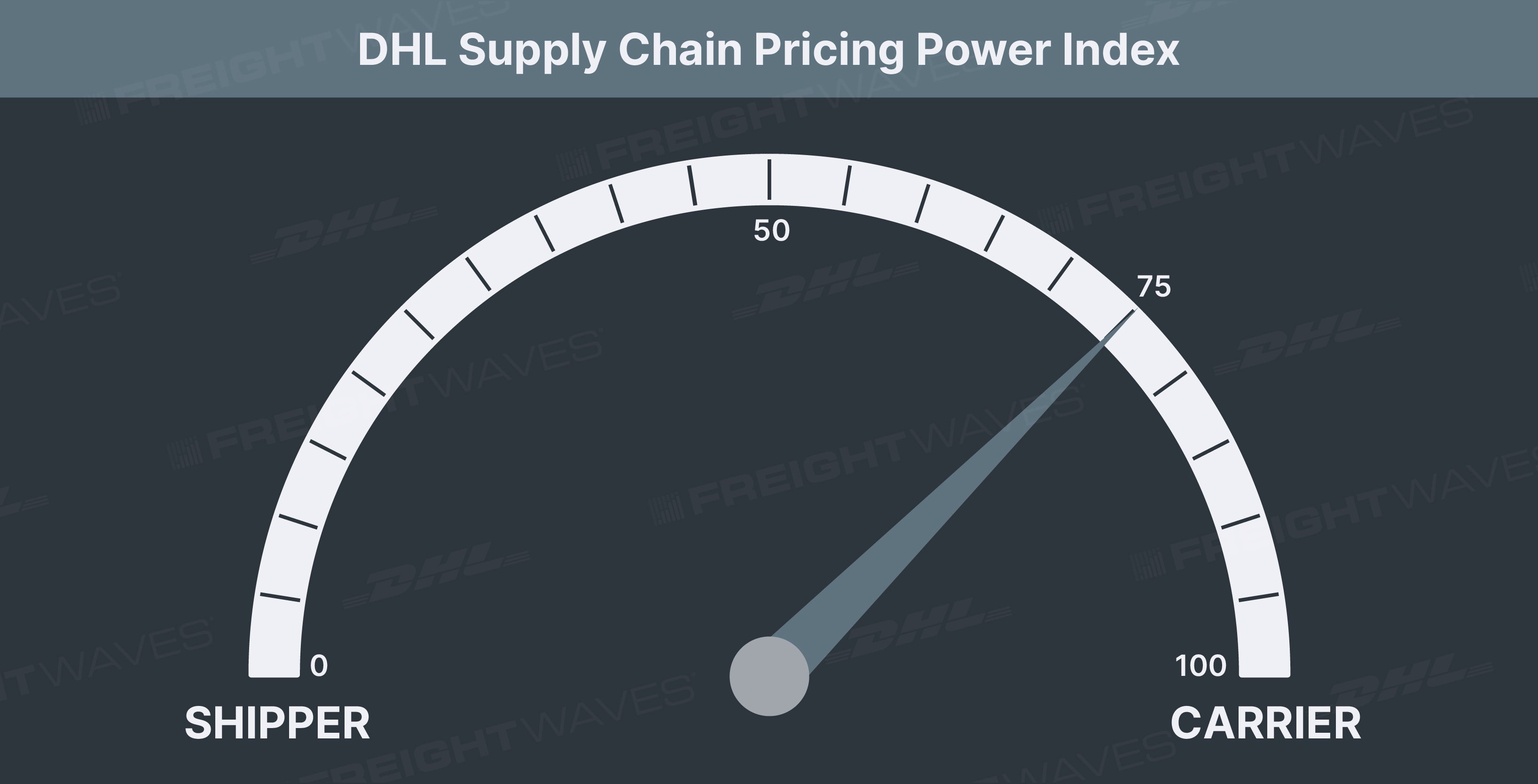
This week’s DHL Supply Chain Pricing Power Index: 75 (Carriers)

Last week’s DHL Supply Chain Pricing Power Index: 70 (Carriers) 

Three-month DHL Supply Chain Pricing Power Index Outlook: 70 (Carriers)

The DHL Supply Chain Pricing Power Index uses the analytics and data in FreightWaves SONAR to analyze the market and estimate the negotiating power for rates between shippers and carriers. 

The Pricing Power Index is based on the following indicators:

Load volumes: Absolute levels positive for carriers, momentum neutral

The Outbound Tender Volume Index at 15,980 is nominally higher now than basically at any point in the past 12 months with the exception of the week prior to Thanksgiving/Black Friday last year. OTVI captures all electronic tenders, including rejected ones, so when accounting for the rejection rate, we can get an even more accurate look at volumes. 

OTVI rose through the back half of May into the national holiday and has risen even further since. Throughout the back half of May and into the middle of June, tender rejections declined substantially. Meaning, current volume throughput is actually understated when comparing OTVI now to OTVI in November 2020. After adjusting for rejected tenders, the accepted outbound tender volume index is just 2.2% below the 2020 peak in November. At that time, OTVI surged towards 17,000, but the rejection rate moved in-kind towards its natural ceiling of 28%. So, the total accepted freight tenders in mid-June is comparable to the peakiest of peak seasons in 2020. Incredible. 

However, since the middle of June, tender rejections have begun increasing again heading into Independence Day, a time when many drivers spend time off the road with their families. The move higher in OTVI this week has been driven primarily by higher rejection rates, rather than higher freight demand. 

Over the past month, the drivers of freight volumes have continued to be imports and from just about every port. The west coast continues to provide seemingly non-stop container ships, while Houston, New Orleans, Miami and Savannah are seeing very strong throughput as well. 

It is van volumes that are driving freight markets higher right now. The Reefer Outbound Tender Volume index has tumbled 25% since its all-time high in the weeks after the polar vortex in February. Since Memorial Day, ROTVI has fallen another 10.5%. This is likely a factor of declining grocery demand, but I would expect the trend to reverse course in the near future as summer festivities accelerate. 

Dry van volumes pushed higher in the back half of May and into June while reefer volumes have declined significantly. 

SONAR: VOTVI.USA (Blue); ROTVI.USA (Green)

The congestion at our nation’s ports has spread from Los Angeles and Long Beach to Oakland, California. The California coastline is a parking lot of container ships, most of which are full to the brim with imports, awaiting berth. As detailed in the economic section, there are some signs that the reversion is underway with Americans paring back spending on pandemic superstar categories in favor of airlines, lodging and entertainment. But spending remains strong despite the moderation, and low inventory levels offset much of the decline that will occur from slowing demand. Real inventories are 3% higher now than pre-pandemic, but real sales growth is far outpacing inventory growth, leading to the lowest inventory-to-sales ratio in decades. 

On the manufacturing side, the ISM Manufacturing PMI expanded in May after declining in April. We’ve been in expansionary territory for 12 consecutive months. New orders, production, imports/exports and employment are all growing. The major issues should come as no surprise: Deliveries are slowing, backlogs are growing and inventories are too low. 

In all, there are many, many catalysts to keep freight demand strong for the foreseeable future. Americans are traveling and spending on services at a high clip, but the high savings rate is enabling it to occur without a massive detriment to goods spending. 

SONAR: OTVI.USA (2021 Blue; 2020 Green; 2019 Orange; 2018  Purple)

Tender rejections: Absolute level and momentum positive for carriers

After declining steadily from mid-March to mid-May, the Outbound Tender Reject Index has reversed course heading into Independence Day. This is typical for a national holiday as carriers selectively choose loads to bring drivers closer to home. OTRI now sits above 25% for the first time in June. 

One of our newest indices in SONAR gives us the ability to compare markets on as close to an apples-to-apples basis as possible. FreightWaves’ Carrier Trend Market Score indices are divided into two perspectives – shipper/broker and carrier. The scores are positioned on a scale from 1-100 and have values measuring van and refrigerated (reefer) capacity. The higher values represent more favorable trends for whichever perspective. For instance, a value near the high-end of the range would suggest very favorable conditions for carriers in our carrier capacity trend score index. 

For the past several weeks, capacity disparities have been driven by import volumes. The markets with the tightest carrier capacity coincide with the nation’s busiest ports. Ontario, California, Savannah, Georgia, and Atlanta all have carrier capacity trend market scores of 100. 

SONAR: Capacity Trend Market Score (Carriers – VAN)

By mode. Reefer rejection rates tumbled from it’s all-time high in March to under 35% in mid-June before popping higher over the past two weeks. Reefer rejections are still quite high from a historical standpoint at 38%, but are significantly lower than just three months ago when reefer carriers were rejecting half of all electronically tendered loads. 

SONAR: VOTRI.USA (Blue); ROTRI.USA (Orange)

Dry van tenders make up the majority of all tenders, so the van rejection rate mirrors the aggregate index closely. Van rejections have surged from ~23% to ~26% over the past two weeks. 

Yes, one-in-four loads being rejected is not ideal, but it’s better than 30%. I am unaware of any meaningful signals that capacity is being added at a rate that would change my outlook. With so many catalysts for demand, and many constraints on drivers including the Drug & Alcohol Clearinghouse, driver training school closures and continued government unemployment benefits, the outlook is tight throughout this year and into 2022. That’s not to say we won’t see improvement as consumers revert to pre-pandemic spending habits and drivers enter or reenter the market. But I’m not expecting any quick reversal of this environment; there are simply too many catalysts driving volume and suppressing capacity. 

SONAR: OTRI.USA (2020/21 Blue; 2020 Green; 2019 Orange)

Freight rates: Absolute level and momentum positive for carriers

Throughout June, spot rates have moderated while contract rates have pushed higher. The Truckstop.com dry van rate per mile (incl. fuel) has fallen from $3.21 to $3.11 since the beginning of June, while FreightWaves van contract rates have risen from $2.50 to $2.59/mile, exclusive of fuel. 

I still believe the Truckstop.com dry van national average will not retest the post-vortex surge pricing that brought spot rates up to an all-time high of $3.30. But, there aren’t many catalysts to bring spot rates down anytime soon either. Demand is unwavering with continued strong consumer goods demand, humming industrial recovery and a potentially cooling, yet still sizzling, hot housing market. And carriers can’t fill enough trucks to keep up with demand. 

Prior to the seasonal movements we’re seeing in tender rejections, routing guides generally had been improving through Q2. We should continue to see a convergence between spot and contract rates, but spot rates will remain historically very elevated throughout the summer as demand simply outstrips capacity. 

SONAR: TSTOPVRPM.USA (Blue); VCRPM1.USA (Green)  

Economic stats: Momentum and absolute level neutral

Several economic releases this week are worth noting.

Weekly jobless claims were released Thursday and give us one of the best close-to-real-time indicators of the overall economy.  This week, the data was again very promising as the labor market continues on a bumpy but trajectorially stable recovery path. 

First-time filings totaled 411,000 for the week ended June 19, a slight decrease from the previous total of 418,000 but worse than the 380,000 Dow Jones estimate, the Labor Department reported Thursday. Initial claims have held above 400,000 for consecutive weeks after falling to a pandemic low of 374,000 three weeks ago. As things stand, the current level of initial claims is about double where it was prior to the Covid-19 pandemic. 

The good news on the jobs front is that continuing claims are on the decline, falling to 3.39 million, a drop of 144,000. That number runs a week behind the headline claims total.

Initial jobless claims (weekly in May 2020-May 2021)

At the time of writing, the newest weekly data for the week ending May 29 had not been updated in SONAR. This week, claims fell from 405,000 to 385,000. 

SONAR: IJC.USA

Consumer. Turning to consumer spending, as measured by Bank of America weekly card (both debit and credit) spending data, total card spending (TCS) in the latest week accelerated to 22% over 2019. This is the first time in June that TCS has topped 20% over 2019, but spending has been running up 16-19% consistently on a two-year comp for months. For contect, the average pre-pandemic two-year growth rate was about 8% (from 2012 to 2019). 

The Bank of America team highlighted service spending in the nation’s two largest state economies, California and New York, which are now fully reopened. Spending at restaurants is now well above 2019 in both states, and the team believes there is more capacity for spending to accelerate in the states that were slower to reopen given pent-up demand. 

There was also a notable acceleration in spending on clothing this week, according to Bank of America. It could be a reversal from some softening in the early weeks of June, or an indication of people refreshing wardrobes ahead of a return to work, more travel and vacations. One tepid statement for freight markets from this week;s report: Leisure spending is on the rise and durable goods spending is flatlining.  

FreightWaves’ Flatbed Outbound Tender Reject Index, both a measure of relative demand and capacity, moves directionally with the ISM PMI. 

SONAR: ISM.PMI (Blue); FOTRI.USA (Green) 

Manufacturing. Over the past two weeks, regional manufacturing surveys have reported generally positive readings amid logistical challenges. The New York Fed’s Empire State business conditions index declined 6.9 points to 17.4 in June, retreating from strong readings the past two months. The Empire State Index is a diffusion index with a baseline of zero; any reading above zero indicates improving or expansionary conditions. 

Delivery times lengthened to a new record during the month, new orders and shipments fell, and inventories entered negative territory. The supply chain and transportation challenges are as visible upstream as downstream, but overall the manufacturing sector is handling. Growth continued throughout the second quarter in both the Empire State and Philly Fed indices. 

The Philadelphia Federal Reserve’s business activity index edged lower to a still robust 30.7 in June from 31.5 in the prior month. Unlike NY, the pace of shipments growth accelerated in the Philly region during June. The employment subcomponent rose to a very healthy 30.7 from 19.3 last month, the regional bank said. 

Record-long lead times, wide-scale shortages of critical basic materials, rising commodities prices and difficulties in transporting products are continuing to affect all segments of the manufacturing economy, but demand remains strong. 

For more information on the FreightWaves Freight Intel Group, please contact Kevin Hill at khill@www.freightwaves.com or Andrew Cox at acox@www.freightwaves.com.

Check out the newest episodes of our podcast, Great Quarter, Guys, here.

Project44 acquires ClearMetal to strengthen predictive tools

Project44, a leader in real-time visibility of the global supply chain, announced on Thursday it has acquired ClearMetal, a San Francisco-based supply chain planning software company that focuses on international freight visibility, predictive planning and overall customer experience. The terms of the acquisition were not disclosed.

ClearMetal, founded by top software engineers and data scientists from Stanford, Google and other Silicon Valley elites, has created a “continuous delivery experience” that leverages proprietary machine learning algorithms that can forecast supply chain disruptions. 

In an interview, Jason Duboe, chief growth officer at project44, explained that bringing in ClearMetal’s elite team is essential for the company’s future predictive solutions.

“Their team construct is fundamentally different. When you look at their data science, machine learning and computer science background, they are best in class,” he said. “Applying the team to solve really interesting challenges, starting with highly predictive ETA and deeper exception management to create more predictive analytics is really a key component here.”

Project44 recently acquired Ocean Insights to gain global supply chain vessel visibility and has announced it has expanded its truckload tracking services within Asia. Bringing on this new team of engineers will allow the company to capitalize on strong predictive tools, strengthening the supply chain of its customers.

“We’re going to be expanding deeper into Asia, and from a port perspective, getting data much earlier than competitors,” explained Duboe. “Our freight forwarder integrations will give us much deeper visibility from an end-to-end perspective in these regions.”

Along with the acquired skills the ClearMetal team will bring to project44, it brings a large book of customers, including large CPGs, retailers, manufacturers, distributors and chemical companies. These advanced use cases will strengthen the predictive planning tools, and project44 continues to expand into different customer markets.

“What we gain from ClearMetal is a holistic platform for anybody that joins the platform in the future,” said Duboe. “They have large customers with incredibly demanding and advanced use cases. So when it comes to order and inventory, functionality, supplier onboarding, and moving upstream into those processes, we can capture exceptions earlier on.”

Click here for more articles by Grace Sharkey.

Related Articles:

Project44 expands real-time visibility into China

Project44 reels in Ocean Insights in ‘largest acquisition in visibility space’

‘Project44’s vision has always been global’

Super Bowl by the billions: 1.5B wings prepped for game day

As the Seattle Seahawks and New England Patriots converge to Levi’s Stadium to compete in Super Bowl LX, a massive logistical operation is culminating to fuel fans across the country. 

The goods moved and costs associated with food and beverage consumption for the game are staggering, supported by a highly coordinated supply chain.

Truckloads of chicken

Americans are projected to eat 1.48 billion chicken wings while watching the game, according to the National Chicken Council. Transporting that many wings would require a convoy of more than 3,400 fully loaded semi-trucks. 

Additionally, United Press International reported that about 130,000 tons of avocados were shipped from Michoacán, Mexico, to meet rising demand for guacamole. This is an increase of nearly 20% from last year.

Beer remains a gameday favorite, and it’s estimated that Americans drink over 325 million gallons on Super Bowl Sunday.

This level of consumption comes at a significant cost. The National Retail Federation forecasts that total spending on food, drinks, apparel, and decorations will reach a record $20.2 billion, which averages out to $94.77 per person watching. 79% of that spending will be on food and beverages.

https://infogram.com/1pw0lvx5edpw7vfvj7p07gp2pvt97xmnl6z

Snackflation

Innova Market Insights stated that consumers may face “snackflation,” as prices for chicken, beef, chips, and pizza often spike for the event. In spite of this, the National Chicken Council reports that retail prices for fresh chicken wings are down 2.8% year-over-year.

The logistical effort to get these products to stores, venues, and homes is immense. For last year’s Super Bowl in New Orleans, data from Truckstop showed over 240 active freight lanes funneled goods into the city, with load volume jumping 38% in the week before the game. 

The Houston-to-New Orleans route was the busiest, and refrigerated trucks were in high demand for temperature-sensitive cargo. Hundreds of trucks were required just to deliver concessions to the stadium itself.

Borderlands Mexico: Mexican truckers win union rights after years of intimidation, dismissals

Borderlands Mexico is a weekly rundown of developments in the world of United States-Mexico cross-border trucking and trade. This week: Mexican truckers win union rights after years of intimidation, dismissals; Port of Lázaro Cárdenas posts record cargo volumes in 2025; and Port of Lázaro Cárdenas posts record cargo volumes in 2025.

Mexican truckers win union rights after years of intimidation, dismissals

Kamu Transport, a Tijuana, Mexico-based cross-border trucking company formerly known as Liber Gennesys, has reached an agreement with U.S. and Mexican authorities following allegations that it denied drivers the right to organize and bargain collectively.

The remediation was negotiated under the United States-Mexico-Canada Agreement’s (USMCA) facility-specific Rapid Response Labor Mechanism, according to a news release from the U.S. Trade Representative.

Kamu and its affiliated company in San Diego, California provides cross-border transportation services for Hyundai Motor Co. in Mexico and the U.S.

In July, Mexican truck drivers for Kamu, represented by the Sindicato de Transportistas de las Cadenas de Suministro (SITRABICS) workers union, filed a complaint alleging retaliation, intimidation and unlawful dismissals tied to union activity at the company’s Tijuana operations.

Under the agreement, Kamu committed to reinstating fired workers with back pay or severance, granting union access to company facilities, rescinding anti-union policies, issuing neutrality statements, and implementing worker training on freedom of association and collective bargaining rights. 

Mexican authorities will monitor compliance with the measures, which must be completed by Feb. 13.

Jesús Salinas, general secretary of the newly created SITRABICS, said he was fired from Liber Gennesys four years ago, as workers began to discuss organizing.

“The process was quite long, there were more layoffs, and the company didn’t react very well. We filed labor claims here in conciliation, they never progressed and finally the path led us to learn about the [USMCA] labor mechanism,” Salinas told El Sol de Tijuana.

The case marks the first time the USMCA rapid response mechanism has been applied to a cross-border trucking company in Baja California and is viewed by labor advocates as a precedent-setting enforcement action in the transportation sector.

Labor groups say the outcome demonstrates that the USMCA enforcement tools can be used by truck drivers — not just factory workers — to challenge labor violations in cross-border logistics.

Port of Lázaro Cárdenas posts record cargo volumes in 2025

The Port of Lázaro Cárdenas closed 2025 with 27.3 million metric tons of cargo handled, marking a historic year for one of Mexico’s most important Pacific gateways.

Imports accounted for 63% of total cargo, followed by exports at 27% and coastal shipping at 10%, according to federal data

By cargo type, containerized freight led the mix at 49%, followed by mineral bulk at 30%, with the remaining 21% split among automotive cargo, general cargo, agricultural bulk, fluids and petroleum products.

Container traffic totaled 2.62 million TEUs, up 9% from 2024, supported by multimodal connectivity that moved 74% of containers by truck and 26% by rail. The port also handled 804,955 vehicles, a 19% year-over-year increase, reinforcing Lázaro Cárdenas’ growing role in Mexico’s automotive supply chain.

IMAS Fresh breaks ground on new food facility in Pharr

IMAS Fresh has broken ground on a new food-related facility in Pharr, Texas. 

The project is being developed with support from the Pharr Economic Development Corp., who said the facility will contribute to regional job growth and strengthen the region’s food and logistics ecosystem, according to Texas Border Business.

Construction is expected to begin immediately, with completion targeted for the second quarter of the year. Officials said the development aligns with broader efforts to attract food processing, trade and distribution projects tied to cross-border commerce through South Texas.

Will the weather shock fade into a long term shift for trucking?

Chart of the Week:  SONAR Truckload Rejection Index – USA SONARSTRI.USA with Seasonally Adjusted Moving Average

The SONAR Truckload Rejection Index (STRI), a measure of truckload capacity availability where higher values indicate a more challenging procurement environment, has surged more than four percentage points over the past two weeks following Winter Storm Fern, which left a swath of snow and ice across portions of the South. This storm has proven to be the most disruptive weather event to surface transportation markets in nearly five years, leading many to wonder whether it is the catalyst the market has been waiting for. The recently introduced seasonally adjusted moving average (SAMA), represented by the dotted line, helps answer that question.

What is a SAMA?

In simple terms, the SAMA is an average of the past two years of index values, adjusted to reflect the current year’s trend. Any sharp deviation from the normal seasonal movements of the prior two years—either higher or lower—causes the SAMA to correct sharply back toward the established trendline. The magnitude of that correction highlights just how anomalous the current environment is relative to the longer-running trend.

The longer the correction, the more unusual the event. For businesses, recognizing that they are operating in a market well outside predictable conditions is invaluable. It signals that standard operating procedures may not apply and that contingency planning is warranted.

In this case, the SAMA indicates a decline of roughly five percentage points would be required to return to the prevailing market trend, placing STRI near 9.2%. For those familiar with the behavior of the STRI, this represents an exceptionally large deviation from the baseline. In effect, the recent move has made normal volatility appear almost stationary.

For context, the STRI has increased by more than two percentage points in only two instances: the past two Christmas seasons. Winter storm events over the previous two years pushed rejection rates roughly one percentage point higher, but it took 49 and 32 days, respectively, for the index to return to trend. This extended recovery period is where the SAMA struggles—or, more plainly, does not work particularly well.

By design, this statistical tool is meant to identify long-running trends and make only incremental adjustments in response to sustained movements. It largely ignores short-lived anomalies until they evolve into something more persistent.

Turning the page

For those trying to determine whether the market has finally broken out, the SAMA points to a baseline that is meaningfully higher than at any point over the past three years. The model shows STRI reaching a low of 6.98% in early May, historically the softest point in the post-COVID market. Notably, that level is roughly in line with last year’s summer peak around the Fourth of July.

So while this does appear to be a fleeting winter weather event, it does not necessarily mean the market will revert to the conditions we have grown accustomed to over the past three years.

About the Chart of the Week

The FreightWaves Chart of the Week is a chart selection from SONAR that provides an interesting data point to describe the state of the freight markets. A chart is chosen from thousands of potential charts on SONAR to help participants visualize the freight market in real time. Each week a Market Expert will post a chart, along with commentary, live on the front page. After that, the Chart of the Week will be archived on FreightWaves.com for future reference.

SONAR aggregates data from hundreds of sources, presenting the data in charts and maps and providing commentary on what freight market experts want to know about the industry in real time.

Sam Express, AJ Partners, and Sham CDL School Aydana in Investigation of Fatal Indiana Amish Crash

U.S. Transportation Secretary Sean Duffy confirmed Friday that federal investigators have expanded the scope of their inquiry into the Feb. 3 Indiana crash that killed four members of an Amish community, naming the employing carrier, the broader network, and the CDL training school now under investigation.

As I mentioned in earlier articles this week, AJ Partners was the carrier involved, but Secretary Duffy has confirmed this today. “The name of the carrier that employed the illegal is AJ Partners,” Duffy wrote in a post on X, the social media platform. “FMCSA is expanding the scope of the investigation to include a number of other companies, including Sam Express Inc.”

Duffy said investigators are “gathering evidence at each company RIGHT NOW” and described the interconnected carriers as having “all the markings of FRAUD,” using the term “CHAMELEON CARRIERS,” an industry designation for companies that swap names and DOT numbers to evade federal enforcement. The question is, is it too late? Preservation is always an issue. 

He also identified the CDL training school that helped the at-fault driver obtain his commercial license: Aydana Inc., operating as U.S. CDL.

“Our team is also on the ground investigating the driver entry training school, Aydana Inc./ U.S. CDL, that helped this UNVETTED, UNQUALIFIED driver get behind the wheel in the first place,” Duffy wrote. “If this is in fact a sham school, any other licenses they supported will be called into question.”

It is believed to be the first time a sitting U.S. Secretary of Transportation has publicly used the term “chameleon carriers” on social media to describe an active federal investigation.

The Crash

The collision occurred just before 4 p.m. on State Road 67 near County Road 550 East in Jay County, Indiana, approximately three miles from the Ohio border.

According to the Indiana State Police, Bekzhan Beishekeev, 30, of Philadelphia, was driving a 2022 Freightliner semi-tractor-trailer eastbound when he failed to stop for a slowing semi-truck ahead. Rather than braking, Beishekeev swerved into the westbound lane and struck a 2011 Chevrolet van head-on.

The van was driven by Donald Stipp, 55, of Portland, Indiana, who remains hospitalized. Four passengers from the Amish community of Bryant, Indiana, were killed: Henry Eicher, 50; his sons Menno Eicher, 25, and Paul Eicher, 19; and family friend Simon Girod, 23. The Jay County Coroner confirmed all four died of multiple blunt force trauma injuries.

The Department of Homeland Security confirmed Beishekeev is a Kyrgyzstani national who entered the United States on Dec. 19, 2024, through the Nogales, Arizona, port of entry using the Biden administration’s CBP One mobile application and was released on parole. He obtained a non-domiciled commercial driver’s license in Pennsylvania in July 2025, approximately seven months before the fatal crash.

ICE issued an immigration detainer on Feb. 4 and took Beishekeev into custody at the Jay County Jail the following day. He remains in ICE Fort Wayne custody pending immigration proceedings.

The Network

Federal Motor Carrier Safety Administration records show that AJ Partners LLC (USDOT 3617842) has shared 139 vehicle identification numbers with Tutash Express Inc (USDOT 3487141) and 36 VINs with KG Line Group (USDOT 3487333). The same triangular mountain logo, associated with Sam Express Inc. (USDOT 3235924) of Mount Prospect, Illinois, has been observed on trucks operating under multiple DOT numbers across the network. FreightX community members have documented trucks from this network swapping company name decals and DOT numbers at truck stops in real time.

The network comprises more than 20 interconnected Illinois-based carriers that share equipment, drivers, registered officers, and physical addresses while maintaining the legal appearance of separate companies. Sam Express’s primary officer is listed as Saipidin Tutashov, the same surname as that of the Tutash Express entities. Corporate officer names across the network are uniformly Kyrgyz. The company’s website and Facebook page display a Kyrgyz telephone number (+996) alongside the American and Kyrgyz flags.

Across the documented network, federal safety data shows more than 2,993 inspections, 1,552 violations, 439 out-of-service orders, and 91 crashes. Most carriers in the network exceed both the national average vehicle out-of-service rate of 22.26 percent and the national average driver out-of-service rate of 6.67 percent. An inspection of a KG Line Group driver on I-80 in Illinois in November 2025 placed the driver out of service because he could not read or speak English sufficiently to converse with law enforcement or read highway signs while operating an 80,000-pound truck hauling freight.

The Lawsuit That Names the Possible Device

A federal civil complaint filed in the Northern District of Illinois describes the network as a “unified fraudulent enterprise” in which nominally separate carriers operate as a single operation under common control.

The complaint, brought by a former driver, alleges a predatory leasing scheme in which drivers were promised 88 percent of gross revenue but received falsified rate confirmations showing lower amounts. Drivers were charged more than $14,000 in fuel deductions that exceeded what was physically possible given the miles driven. A 12 percent dispatch fee was deducted for services never independently provided. Drivers paid $250 per pay period for insurance policies that were voidable because they were operating under a different authority than the one listed on the policy.

The complaint further alleges that when a driver operating under one authority within the network was involved in a safety incident, the driver would be transferred to a different authority, effectively resetting the safety record.

Critically, the court filings reference Hero ELD by name, the electronic logging device used across the network, and allege that the device had “backdoor” capabilities allowing remote manipulation of hours-of-service records and records of duty status. ELDs are federally mandated devices that record driver rest and drive times to prevent fatigue-related crashes. A backdoor would allow someone to alter legally required records from a remote location.

The Firm That Built It

Hero ELD is developed and published by AITIM Inc., a division of AITIM Holding Group, a Chicago-based consulting firm founded and led by Timur Tilenov.

The connection between AITIM and Sam Express is not inferential. It is published.

At the AITIM Awards gala on Dec. 15, 2023, a black-tie, invite-only event that drew 150 attendees from 15 states and five countries, Sam Express received the “Best Trucking Company of the Year” award. A branded feature published in New York Weekly described Sam Express as operating “an impressive fleet of 350 trucks” and stated that “Sam Express and AITIM will collaborate on the grand prize of $50,000 towards the transportation of goods.”

AITIM Group’s LinkedIn page describes the firm as offering “comprehensive business services, specializing in Trucking, Consulting, Media, Blogging” with “a network of 70,000 trucks.” Tilenov’s career arc runs directly through the Kyrgyz-American trucking ecosystem. According to professional directory records and a 2020 FreightWaves feature, he previously served as CEO of KGZ Transport Corp (USDOT 2839654) in University Park, Illinois, “KGZ” being the ISO country code for Kyrgyzstan, and worked with Manas Express Corp (USDOT 2508694), a 210-truck carrier in Aurora, Illinois, named for the Kyrgyz national epic hero. His LinkedIn profile indicates he maintains an office in Bishkek, Kyrgyzstan.

Other AITIM Awards recipients included PixelCo, a digital marketing firm described as “a leader in marketing in the trucking industry of the USA” offering “everything from brand formation and corporate identity to full-scale PR”; the Silk Road International School Chicago, with headquarters in Bishkek; and Codewise Academy, an IT training school.

The implication is direct: the entity that publicly celebrated Sam Express, that claims a network of 70,000 trucks, that offers trucking consulting services, and that maintains an office in the same country from which the network recruits drivers, also manufactured the electronic logging device that federal court filings allege was equipped with a backdoor to falsify safety records.

An inquiry to AITIM Group regarding the use of Hero ELD by Sam Express network carriers was not returned.

The Markham Terminal and Adjacent Operations

The physical infrastructure supporting this network extends beyond the carriers themselves.

Multiple carriers in the network share terminal facilities across the Chicago suburbs. In South Holland, at 16647 Vincennes Ave. In Joliet, Tutash Express, KG Line Group, and Borcha Inc (USDOT 4059241) share a facility at 10 Gougar Rd. KG Line Group claims to operate 310 trucks from a residential home at 312 English Oak Lane in Streamwood.

A particularly dense cluster exists at 2064 W 167th St in Markham, Illinois. Federal carrier records show Tutash Express Inc has operated from this address, which is also the location of Markham Truck Center, a commercial truck repair facility, and the headquarters of Dovgal Express Inc (USDOT 2192698), a 152-truck carrier operating as DVL Express.

Dovgal Express is not alleged to be part of the Sam Express chameleon network. Its founder, Oleksandr Dovgal, is Ukrainian, not Kyrgyz, and the company is an Inc. 5000 honoree and a top workplace. However, the company and its principals appear in the broader litigation orbit. A separate federal lawsuit, Tsybikov v. Dovgal (1:19-cv-03334, N.D. Ill.), names Dovgal, Alina Kim, DVL Express Inc., and Altex Logistics Inc. as defendants in a contract dispute brought by a former driver. A second case, Commercial Credit Group Inc v. Dovgal Express Inc et al (N.D. Ill. 2024), also names the company.

The relevance is geographic and infrastructural: the Markham terminal complex, where Tutash Express operates, is the same facility where DVL Express is headquartered, where its repair shop services trucks, and where a CDL training program has also been associated with the address. Whether this constitutes a landlord-tenant relationship, a shared-services arrangement, or something more complex remains an open question that federal investigators may now be positioned to answer.

The CDL School

Duffy’s identification of Aydana Inc., doing business as U.S. CDL, as the training school under investigation introduces a new entity with no discernible public web presence. “Aydana” is a Kyrgyz given name.

The Entry-Level Driver Training rule, which took effect in February 2022, requires all CDL applicants to complete training from an FMCSA-registered provider listed in the Training Provider Registry. If Aydana Inc./U.S. CDL is found to have issued training certificates without adequate instruction, what Secretary Duffy called a “sham school”, every CDL supported by that school’s certification could face review.

Aydana Inc. and What the Corporate Record Shows

Now that Secretary Duffy has publicly identified Aydana Inc., operating as U.S. CDL, as the training school under federal investigation, the corporate record warrants examination.

Pennsylvania Department of State records show that Aydana was filed as a domestic business corporation on August 24, 2022, with a registered address at 524 Continental Road, Hatboro, Pennsylvania, 19040, in Montgomery County. The sole officer listed is Aleksandr Piurveev, identified as both President and Governor of the entity. The corporation’s status is active, with an annual report due June 30, 2026.

The name “Aydana” is a Kazakh and Kyrgyz female given name, consistent with the Central Asian demographic pattern documented throughout the Sam Express network. The surname “Piurveev” is a Russian-language patronymic, consistent with Kalmyk or Buryat origin, ethnic groups in the Russian Federation with cultural and linguistic ties to Central Asia.

As of this publication, no public record has been identified connecting Aleksandr Piurveev directly to Saipidin Tutashov, Timur Tilenov, AITIM Group, or any of the named officers in the Sam Express chameleon carrier network. That absence of a documented connection does not preclude one. Corporate officer records, phone number cross-references, address overlaps, and social media connections are standard investigative tools FMCSA and law enforcement use to establish or rule out such a link. Secretary Duffy’s announcement that federal investigators are “on the ground” at Aydana suggests that the process is now underway.

What the public record does show is that Aydana, an entity that Secretary Duffy has identified as the training school that helped Beishekeev obtain his CDL, has no presence on the FMCSA Training Provider Registry, no presence on Pennsylvania’s licensed CDL training provider list maintained by the State Board of Private Licensed Schools, no website, no Google Business listing, no Yelp listing, and no discernible digital footprint of any kind for an entity that has been incorporated for more than three years.

The Pennsylvania Department of Education website explicitly states that providers on its licensed list are “the only training providers in Pennsylvania who may legally offer ELDT.” If Aydana is not on that list and is not on the FMCSA Training Provider Registry, the question is not whether the school is legitimate. The question is how a training certification from an unregistered, unlicensed entity was accepted by PennDOT as the basis for issuing a commercial driver’s license.

The English Language Proficiency Question

Aydana Inc. is not the only CDL training entity that raises questions about how drivers are being prepared, or whether they’re being prepared at all, for the English language proficiency requirements that apply to every commercial driver operating on American highways.

Federal regulation 49 CFR § 391.11(b)(2) has required since 1937 that commercial drivers “read and speak the English language sufficiently to converse with the general public, to understand highway traffic signs and signals in the English language, to respond to official inquiries, and to make entries on reports and records.” The regulation is not new. What is new is that it is finally being enforced.

On May 20, 2025, following President Trump’s executive order on trucking safety, FMCSA issued new enforcement guidance establishing a two-step roadside assessment: a conversational English interview followed by a highway traffic sign recognition test. Translation tools, interpreters, and smartphone apps are prohibited during the assessment. Drivers who fail are placed out of service immediately. The Commercial Vehicle Safety Alliance added English language proficiency non-compliance to its North American Standard Out-of-Service Criteria effective June 25, 2025. As of December 2025, Secretary Duffy reported that more than 11,500 drivers had been removed from service for failing to meet the standard.

That enforcement context makes the business model of certain CDL training schools worth examining.

Bulldog Driving School Inc., operating out of Elmwood Park and Palos Hills, Illinois, is a state-certified, FMCSA Training Provider Registry-listed CDL school owned by Mahmoud Masoud. It openly advertises instruction in five languages: Ukrainian, Russian, Arabic, Spanish, and Polish. Its website states that “language should never be a barrier to education” and that “our multilingual program ensures that you can learn in the language you are most comfortable with.” It claims a 98 percent pass rate and participates in the federal Workforce Innovation and Opportunity Act grant program, meaning some students receive free CDL training funded by taxpayers.

Bulldog is not alleged to be a sham school. It is registered, certified, and by outward appearances, legitimate. That is precisely why it illustrates a systemic problem rather than an individual one.

The question is straightforward: if a student completes CDL training conducted primarily in Russian or Arabic, graduates in four weeks, and passes the state skills test, how has the training provider or the employing carrier verified that the driver meets the federal English language proficiency standard? The ELDT rule does not require that training be conducted in English. The FMCSA Training Provider Registry is a self-certification system. The state skills test evaluates driving competency, not language competency. And until June 2025, roadside inspectors were explicitly instructed not to place drivers out of service for language deficiencies under Obama-era guidance that had been in effect since 2016.

The result was a decade-long gap in the pipeline: a driver could be trained in their native language, pass a driving test without demonstrating conversational English, be hired by a carrier that never assessed language proficiency because FMCSA guidance told inspectors not to enforce it, and operate an 80,000-pound vehicle on American highways without being able to read a dynamic message sign or explain to an officer why they were driving 14 hours past their limit.

In November 2025, a KG Line Group driver was placed out of service on I-80 in Illinois because he could not read or speak English sufficiently to communicate with the inspecting officer or read highway signs. KG Line Group is part of the Sam Express network. The driver was operating an 80,000-pound truck hauling freight. The inspection record does not indicate where the driver received his CDL training.

Duffy’s crackdown has closed or warned 7,500 CDL schools nationwide since December 2025, finding 44 percent of the 16,000 reviewed providers non-compliant. The question for investigators is not whether multilingual CDL training is inherently problematic—it is whether the training-to-licensure pipeline includes any point at which English language proficiency is independently verified before a driver is handed the keys to a commercial vehicle. Right now, the answer appears to be no.

Equipment Beyond State Lines

The network’s geographic reach extends beyond the Chicago suburbs.

Illinois-registered license plates associated with carriers in this network appear on trucks operating under the markings of carriers in other states, including Minnesota. Such plate-sharing across carrier identities is a recognized indicator of chameleon carrier operations and is the type of evidence that FMCSA inspection records, which capture license plate numbers, VINs, and carrier information at each roadside stop, are designed to detect.

The California expansion of the network has been documented through corporate filings. Ruslanbek Olzhebaev serves as the registered agent for Tutash Express Inc.’s California filing, as well as for EMIRKHAN LLC and AJ Trucking Partners LLC, three separate carrier entities that share a single registered agent.

The Political Dimension

The crash has become a flashpoint in the national debate over immigration enforcement and CDL issuance.

DHS Assistant Secretary Tricia McLaughlin said the crash was preventable: “Not only was Bekzhan Beishekeev released into our country by the Biden administration using the CBP One app, but he was also given a commercial driver’s license by Governor Shapiro’s Pennsylvania.”

Pennsylvania Gov. Josh Shapiro’s office disputed the characterization, noting that Beishekeev “had legal status” in the DHS-administered Systematic Alien Verification for Entitlements database when PennDOT issued the license in July 2025 and “still shows as eligible to receive a license as of today.”

In November 2025, the FMCSA found that Pennsylvania had violated federal safety regulations by issuing non-domiciled CDLs illegally, including to ineligible foreign nationals. The Department of Transportation threatened to withhold approximately $75 million in federal funding unless the state revoked improperly issued licenses.

DHS also noted a separate case: Akhror Bozorov, 31, an Uzbek national wanted in his country for alleged ties to a terrorist organization, was arrested in Kansas in November while driving commercially with a Pennsylvania-issued CDL.

The SAVE Check and the Question Nobody Is Asking

Governor Shapiro’s office has pushed back on DHS’s characterization of Beishekeev as an “illegal alien,” and the rebuttal is worth examining closely, not because it is wrong, but because of what it reveals about a system designed to check a box rather than answer a question.

A spokesperson for Shapiro told Fox News that “every person who applies for a non-domiciled commercial driver’s license issued by PennDOT must provide proof of identity and proof of their legal presence in the United States. That information is verified by the federal Systematic Alien Verification for Entitlements (SAVE) database, administered by Kristi Noem and the United States Department of Homeland Security.” The spokesperson added that Beishekeev “had legal status” when PennDOT issued the CDL in July 2025 and “still shows as eligible to receive a license as of today.”

Take the governor at his word. The SAVE check returned a positive result. PennDOT followed its process. The question is what that process actually verified.

Beishekeev entered the United States on December 19, 2024, through the Nogales, Arizona, port of entry using the CBP One mobile application and was released on parole under INA § 212(d)(5). Parole is not an immigration status. It is a discretionary mechanism that allows physical presence in the United States without formal admission. Parolees who entered via CBP One were typically granted parole for one to two years and were eligible to apply for an Employment Authorization Document under category C11, work authorization incident to parole.

Here is what the public record does not tell us, and what neither the governor’s office nor DHS has disclosed:

What category of work authorization does Beishekeev hold? Was it a C11 parole-based EAD? Was it based on a pending asylum application? Was it something else entirely? The category matters because it determines the legal basis for both the work authorization and the CDL issuance.

What is the expiration date of that work authorization? CBP One parolees were typically granted parole for one to two years. Beishekeev entered in December 2024. If his parole period was one year, it would have expired or be expiring around December 2025, before the February 2026 crash. If two years have passed, it would still be valid. The I-94 record would contain this information. Neither side has produced it.

Has his parole been terminated? Beginning in late April 2025, DHS began issuing email notifications of intent to revoke employment authorization to individuals paroled via CBP One appointments who had previously received parole termination notices. USCIS guidance confirms that if DHS terminates parole before the expiration date, the I-94 is updated to reflect the new termination date. A parolee whose parole has been terminated may still appear facially valid in the SAVE database if the system has not been updated or if the termination is being challenged. USCIS itself has acknowledged that “aliens whose parole has been terminated early may still possess an older printout of their electronic Form I-94 that appears facially valid but includes the original Admit Until Date that is no longer valid.”

The governor’s statement that Beishekeev “still shows as eligible” in the SAVE database may be technically accurate while simultaneously obscuring the underlying reality. SAVE verifies a status at a point in time. It does not evaluate whether that status is sufficient, appropriate, or durable for the purpose of operating a commercial motor vehicle on American highways. And it does not answer the question that should be asked before any non-domiciled CDL is issued: Is this person’s authorization to be in this country going to outlast the two-year CDL renewal cycle?

PennDOT issued a CDL in July 2025 to a Kyrgyzstani national who had been in the country for approximately seven months on discretionary parole, a status that the current administration has been actively terminating as a matter of policy. Whether the SAVE database returned a green light is not the relevant question. The relevant question is whether anyone in the licensing pipeline asked whether the green light would still be on six months later.

The ELD Integrity Crisis

Since October 2025, the FMCSA has removed 14 electronic logging devices from its registered list for non-compliance. Research conducted by Colorado State University and funded by the FMCSA found that ELD data manipulation is often undetected by roadside inspectors. The Cybersecurity and Infrastructure Security Agency has issued advisories about vulnerabilities in commercial ELD systems.

The broader ELD integrity crisis makes the specific allegations in this case more credible, not less. If the device manufacturer is the same entity that consulted on carrier formation and publicly celebrated the network’s growth at a gala dinner, the question of whether the device was designed with compliance in mind or with compliance avoidance in mind becomes unavoidable.

What’s Next

There’s a lot to unwrap with this web. I discover more and more every day. Secretary Duffy stated that “the Federal Motor Carrier Safety Administration is working AROUND THE CLOCK to hold anyone involved in this horrific crime accountable.”

The investigation now encompasses multiple carriers in the Sam Express network, the Aydana Inc./U.S. CDL training school, and the broader question of how a Kyrgyzstani national who entered the country via a mobile phone application 14 months ago obtained a commercial driver’s license to operate an 80,000-pound vehicle on American highways.

Federal carrier safety data, corporate filings, vehicle identification cross-references, court documents from the Northern District of Illinois, and a cabinet secretary’s public statements all point to the same conclusion: this was not a single driver making a single mistake. It was a system, a pipeline of recruitment, training, placement, and regulatory evasion built on consulting services, proprietary technology, and community infrastructure stretching from Bishkek to Chicago, that produced the conditions for a fatal crash on a rural Indiana road.

Four men from an Amish community that does not seek media attention, file lawsuits, or demand accountability are dead. The question now is whether the federal investigation will follow the network to its roots, past the driver, past the carrier, past the terminal, to the consulting firm that built it, the ELD that tracked it, and the gala that celebrated it.

As the market turns, broker stress tests are already underway

The freight market has spent the better part of two years grinding along the bottom, offering little relief to brokers operating on thin margins and tighter credit. But as early signals suggest the cycle may finally be inflecting upward, recent earnings calls from RXO and C.H. Robinson offer a timely warning: a rising market does not automatically mean an easier one.

In fact, the transition phase may be where financial and operational stress becomes most acute.

RXO’s fourth-quarter results showed just how fragile broker economics remain. The company pointed to continued pricing pressure, margin compression and the challenge of balancing carrier costs against still-cautious shipper demand. 

FreightWaves’ John Kingston writes, “Those various results show what happens when the freight market suddenly gets stronger, as it did in the last four to five weeks of the quarter, and 3PLs face the reality of filling earlier booked capacity with higher-priced truckload rates.”

Brokers often struggle most not at the bottom of the cycle, but as it begins to move. RXO’s commentary fits that pattern. Capacity remains readily available in many lanes, but it is no longer uniformly cheap. Spot rates can move quickly, contract rates lag behind, and brokers caught between the two are forced to make uncomfortable decisions about margin sacrifice versus customer retention.

That tension is likely to intensify as 2026 unfolds.

Where Brokers Feel the Pressure First

One of the clearest risks in an upward-inflating market is working capital strain. As carrier rates firm faster than shipper pricing, brokers are asked to float higher payments while waiting for contractual adjustments to catch up. For large, well-capitalized players, this is manageable. 

RXO acknowledged this dynamic indirectly, emphasizing discipline around pricing and lane selection. The message was subtle but important: not all freight is worth chasing in a turn. Growth without margin is still just risk. As reported in RXO’s fourth quarter call, “The bottom line GAAP net loss was $46 million in the fourth quarter. That was more than a $25 million GAAP net loss in the fourth quarter of 2024, and $14 million in the third quarter.”

SONAR. Spot (linehaul) to contract rate spread 

Another stress point is operational. Rising volatility rewards brokers with strong carrier relationships and real-time visibility into lane-level pricing. Those relying too heavily on static models or national averages are more likely to misprice freight and pay for it later.

Why C.H. Robinson Looks Different

The contrast with C.H. Robinson is revealing.

Despite ongoing headwinds, Robinson’s earnings calls struck a notably different tone. While management acknowledged the tough environment, the company highlighted productivity gains, cost discipline and improved execution. The market responded accordingly, sending the stock higher even as freight fundamentals remained mixed.

C.H. Robinson, CFO  Damon Lee said the North American Surfact Transport group is “still on a very good trajectory to get to that 40% target. We’ll make an earnings growth and quality of earnings growth decision on whether we continue to expand margins at that point, or whether we reinvest that into demonstrable growth.”

The difference is not simply scale, though scale helps. Robinson has spent the downturn restructuring operations, investing in technology and reducing headcount to better align with demand. That has given it flexibility heading into a turn, the ability to absorb short-term margin pressure without losing strategic footing.

XEO of C.H. Robinson, Dave Bozeman said, “There could be a ‘shift’ in the headcount, because we are shifting to a more customer-focused and automating largely through AI processes that have a lot of friction and a lot of entry-level headcount. And for some of that, we’re not backfilling.”

What Brokers Should Be Watching Now

As signals of recovery build, brokers would be wise to focus less on headline rate increases and more on the mechanics underneath them. Lane-by-lane volatility, customer mix and carrier loyalty will matter more than broad market direction.

Equally important is credit exposure. Shippers slow to adjust rates upward may also be slow to pay, compounding cash flow challenges. Brokers who tighten credit terms or proactively manage receivables may find themselves better positioned when conditions tighten further.

Finally, the RXO and Robinson results both point to a hard truth: the market’s next phase will reward execution, not optimism. The easy money of past upcycles is unlikely to return in the same form.

ACT Expo 2026 embraces the digital frontier for commercial fleets

Two speakers on stage at ACT Expo presenting key lessons learned in electric truck deployment, including matching innovation to application, early utility engagement, and scalable depot planning for commercial fleets

ACT Expo 2026 is shaping up to be the most comprehensive show in the event’s 16-year history. The transportation expo, held this year in Las Vegas, brings nearly 400 speakers, over 200 vehicles on display and in the Ride & Drive, and typically over 12,000 attendees. This year’s conference highlights a commercial transportation industry in the throes of technological transformation—and wrestling with what to do about it.

Beyond the sheer scale of the event, there’s also an expansion of what attendees will find on the show floor. Emerging green technologies will still be there, but ACT Expo will showcase the digital technology layer that sits on top of advanced vehicle platforms. This focus will make the show useful to any fleet that needs pragmatic advice about measurable returns of new technologies taking hold in the market. 

Erik Neandross, president of Clean Transportation Solutions at TRC, and host of ACT Expo told FreightWaves in an interview that the event reflects a maturation of the industry’s approach to emerging technologies. As always at ACT Expo, fleet presentations on their experiences with new technology deployments will be a cornerstone of the conference. That real-world experience provides more insight than a showcase of innovation.

“There’s no end to the technology choices, fuel options and drivetrain options available to commercial operators,” Neandross said. “But the key is what really makes sense for them from a financial perspective. Where can fleets expect to achieve equivalent or improved Total Cost of Ownership (TCO) and thus, a return on their investment in a given period of time?”

That question—where the value actually lies for fleet operators—will drive much of the conversation at this year’s event.

The Digital Frontier Expands to Fleets

A big focus of ACT Expo 2026 is what Neandross calls “the digital frontier”—a catch-all term encompassing software-defined vehicles (SDVs), real-time data analytics, artificial intelligence (AI) in fleet management, the growing role of predictive maintenance, and a lot more.

“Last year we explored software-defined vehicles, which was kind of a new topic, and we will see continued progress in this area this year,” Neandross said. “While the digital frontier can be all-encompassing and overwhelming to fleets, especially given how loosely the term ‘AI’ is thrown around these days, when a customer is able to make the right technology selections to fit their application and operation, we have seen fleets reporting significant improvements in uptime, asset utilization and productivity, the driver experience, and safety.  There is real value here, but it’s important for fleets to understand the landscape of the digital frontier and make the right selections in terms of technology and partners.”

Another big focus of ACT Expo 2026 will be driver assist technologies and autonomous vehicle (AV) commercialization. The conference will feature a main stage panel with leading figures in the autonomous space including Aurora, Kodiak, Waabi, Torc, and PlusAI.  These industry leaders will be discussing where the technology stands as it moves beyond pilot demonstrations and into a commercialization phase.  A key focus will be identifying where and how the technology best fits into a fleet’s operation, and ultimately, how to achieve the right ROI on the investment. 

“Regardless of the product we’re talking about, ACT Expo has always served the market to showcase technologies moving from the R&D and pilot phases and into the commercialization phase,” Neandross explained. “Between the conference sessions and technology on the show floor, the event highlights how the industry will scale a technology from a handful of units, to dozens to then hundreds or thousands on the road.”

As part of this advanced digital transformation – which includes driver assist and autonomous technologies, the use of AI, and a lot more – safety is an area of focus that is gaining a lot more attention from fleets. 

“That’s something we heard loud and clear last year,” he said. “In all of the conversations we were having about digital or autonomy, I just kept hearing safety, safety, safety.”

For an event historically focused on clean technology and alternative powertrains, the emphasis on safety represents a notable addition. The driving forces aren’t mysterious; nuclear verdicts in trucking litigation have become almost routine headlines, and fleets are looking for every available tool to protect themselves, improve driver and vehicle safety, increase uptime and reduce costs.

Advanced Driver Assistance Systems (ADAS) are at the center of this conversation. Lane-keeping technology, collision avoidance systems, automatic braking, and camera systems—both inside and outside the cab—are increasingly working together to create safer vehicles.

The economic benefits extend well beyond avoiding crashes. Neandross outlined a cascade of advantages for fleets that invest in safety technology: improved driver retention, reduced downtime and lower repair costs (the vehicle spends less time in the shop), happier customers (deliveries arrive as scheduled), reduced legal and public image liability, improved Compliance, Safety, Accountability (CSA) scores (which attract more business), and better insurance outcomes.

“Fleets that operate more safely have better CSA scores, which they can then use to better retain existing customers, attract more customers, and develop longer-term, more robust relationships,” he said. “You’re avoiding litigation, lawsuits, nuclear verdicts, all those sorts of things. And then ultimately, we also see it helping with fleets having better access to insurance coverage options, and lower insurance costs.”

The challenge lies in quantifying these benefits. Unlike a 3% efficiency improvement from an aerodynamic package, the return on investment (ROI) for safety technology involves variables like mitigated repair costs and insurance savings that don’t fit neatly into traditional total cost of ownership (TCO) models.

“Those are things that are not necessarily easy to put into a TCO model,” Neandross acknowledged. “But they matter, they’re important, and the economic value is there. The challenge, and opportunity for us, is to help illustrate the business case for fleet safety investments, which will be a key area of focus for ACT Expo this year as fleet presenters will highlight their experiences with these technologies and their return on investment.”

2026 Brings an EV Reality Check

When asked about the state of commercial electric vehicles heading into ACT Expo 2026, Neandross noted that the event will take this topic head-on.

“Clearly the interest level in EVs is a bit reduced from frenzied pitch we saw a couple of years ago,” he noted. “The changes and removal of several EV-forcing regulations in California and other states, along with reductions in federal funding support for EVs and charging infrastructure are having an impact on the market.”

However, he pointed to data showing consistent growth in commercial battery-electric vehicle deployments.

“When you look at the data, that always tells the real story,” Neandross said. Market figures show commercial EV deployments rising year over year, from about 800 in 2021, to 13,500 in 2022, 26,000 in 2023, and more than 41,000 battery-electric commercial vehicles deployed in 2024, according to the 2025 edition of State of Sustainable Fleets. While many projected higher growth rates based upon the regulatory environment that previously existed, the industry is clearly maturing and has been roughly doubling year-over-year.

Much of this growth has occurred in the cargo van segment, driven by Rivian’s partnership with Amazon. Rivian’s CEO RJ Scaringe will deliver a keynote address at the conference.

The company committed to putting 100,000 electric delivery vehicles on the road, and that program is well underway.

In the heavy-duty segment, Tesla’s Semi program appears ready to drive significant growth in the Class 8 battery electric truck market, alongside OEMs like Volvo Trucks and Daimler Truck which have significant deployed fleets. Tesla recently announced a partnership with Pilot to install charging infrastructure across five states, and its Semi production facility is expected to begin commercial production in the coming months, poised to again shake up the market as this product begins to roll out to customers.

“As pricing decreases and a product’s operational capability improves, the EV business case becomes increasingly more attractive, even without incentives or regulations,” Neandross said.  “As customers see the ROI on technology that meets their operational needs, and financial and environmental goals, we are going to see the needle really start to move in these applications.  This, in turn, drives increased competition in the marketplace, which then further benefits the customers with improved products and lower prices.”  

Gaseous Fuels, Alternative Powertrains and Clean Diesel

In addition to the attention paid to digital tech and electrification, ACT Expo 2026 will feature substantial programming on gaseous fuels—natural gas vehicles (NGVs), liquefied petroleum gas (LPG) and hydrogen—where significant activity continues.

Cummins has provided strong updates over the past year on its X15N natural gas engine product, with more deployments generating real-world data which prove the use-case, operational feasibility and ROI.

“Natural gas is one of the technologies that’s a great example of what we’re talking about—there’s real TCO there,” Neandross said. “In the right application, with the right project team and approach, we have seen tremendously positive economic outcomes for a customer. As one large over-the-road fleet once told me, ‘these things print money.’ ”

Clean and advanced diesel technology will also be given significant attention at this year’s ACT Expo, driven in part by the finalization of Environmental Protection Agency (EPA) 2027 emissions standards.

“The OEMs are excited to talk about EPA 2027 compliant engine solutions they are bringing to market, as we all prepare for those federal standards to take effect,” Neandross said. “There is new technology that fleets need to know about, and increased costs, but some real benefits to these new engines.  In addition to the technology aspect, we’re seeing more use of renewable diesel, B100, those sorts of things; so we’ll have a lot of coverage on diesel.”

Sessions will examine fuel efficiency and reliability improvements across advanced powertrains, along with how fuel management technologies and hybrid systems are improving uptime and reducing costs for diesel fleets.

Professional Development Opportunities

Another big addition to this year’s ACT Expo will be the introduction of a continuing education certification program.

More than 25 sessions have been approved by the NAFA Fleet Management Association for Continuing Professional Education hours applicable toward Certified Automotive Fleet Manager (CAFM) recertification. Additionally, Green Business Certification Inc. (GBCI) has also confirmed that 10 ACT Expo workshops meet its criteria for general continuing education hours.

“Given the massive array of technology that’s out there these days and all the different varieties—from the clean diesel to the gaseous fuels to the electric drive to everything digital overlaying all of the powertrain and fuel technologies—there’s just a ton going on,” Neandross said. “We’ve been talking about these continuing education credits for a couple of years, and the team was able to make it happen this year. It’s exciting because attendees can return home with stronger credentials and knowledge they can apply to their job right away.  It provides even more value for fleets attending the event this year.”

The workshop programming spans practical applications of artificial intelligence and software-defined vehicles, automation and advanced safety systems, EV charging strategies and grid integration, alternative fuel pathways, cleaner combustion and vehicle efficiency, and market dynamics shaping fleet investment decisions.

“We realize fleets are pressed—frankly, everyone’s pressed—for time and budget,” Neandross said. “Our agenda puts people in a position to maximize their time and learn which new technologies will have the biggest impact on their financial returns and operational success. That’s what will allow for further investments in these advanced technologies, and what will ultimately make the industry stronger.”

To learn more, visit www.actexpo.com.

Paladin Capital files for Chapter 11 as trucking portfolio unravels

Paladin Capital Inc., a Tennessee-based private equity firm that owns multiple trucking and logistics companies, has filed for Chapter 11 bankruptcy protection, impacting hundreds of truck drivers, mechanics and logistics industry workers.

Paladin Capital filed its voluntary Chapter 11 petition on Jan. 26 in the U.S. Bankruptcy Court for the Middle District of Tennessee, listing between $10 million and $50 million in assets and between $100 million and $500 million in liabilities, according to court records.

Paladin Capital is headquartered in Brentwood, Tennessee, and operates as the ultimate parent of a sprawling trucking and logistics platform.

Court filings show Paladin Capital owns 100% equity interests in more than 20 operating subsidiaries, including Robert Bearden Inc. and the Quickway family of companies. Those two carriers have each filed separate Chapter 11 petitions in recent weeks amid operational shutdowns, driver layoffs and equipment returns, as FreightWaves previously reported.

In filings outlining the events leading to bankruptcy, Paladin Capital cited prolonged freight market weakness, rising insurance and equipment costs, and liquidity pressures tied to its lending arrangements. The company said it defaulted under a credit facility with Truist Bank after insurers drew on letters of credit tied to accident claims, draining cash needed to service equipment leases.

As a result, Paladin Capital said it has been unable to make payments to major equipment lenders since mid-2025.

The filing also shows that Robert Bearden Inc. was a significant cash drain within the portfolio prior to the Chapter 11 filing, according to Paladin’s restructuring documents. The firm said it attempted to negotiate a workout with lenders but ultimately filed for bankruptcy protection to prevent widespread equipment repossessions and preserve remaining operations.

Paladin Capital reported employing approximately 912 workers across its portfolio at the time of the filing, including more than 150 employees at Robert Bearden Inc. and nearly 500 workers tied to the Quickway entities. The company said it plans to pursue Section 363 sales of individual business units rather than a single sale of the entire platform.

The Paladin Capital bankruptcy adds to a growing list of private equity-backed trucking platforms seeking court protection as the prolonged freight downturn continues to pressure highly leveraged carriers.

Increased Amazon flight activity boosts Sun Country cargo revenue

A light-blue Amazon Prime cargo jet takes off.

Sun Country Airlines on Thursday reported record cargo revenue of $48 million for the fourth quarter primarily driven by the addition of eight freighter aircraft last year under its transportation service agreement with Amazon. 

Cargo has become an increasingly important prong in the Minneapolis-based carrier’s diversified business model — it is best known for passenger service to leisure destinations and also operates charter flights. It agreed last month to be sold to Allegiant (NASDAQ: ALGT), another passenger airline that mostly serves secondary markets. Allegiant has said it welcomes the Amazon business.

Cargo revenue increased 68% year over year behind 50.6% growth in flight hours. Sun Country (NASDAQ: SCNY) has operated a dozen Boeing 737-800 converted freighters in Amazon’s network for six years. Last year, Amazon transferred eight more aircraft from another vendor to Sun Country. Full-year cargo revenue jumped 44.6% to $155 million. 

The carrier reiterated that it plans to add two freighters, supplied by Amazon, bringing the fleet to 22 cargo aircraft. The new planes are expected to be operational in July. One of the new freighters will be utilized as a spare to ensure schedule reliability for Amazon, according to the earnings report.

A new operations base at Cincinnati/Northern Kentucky International Airport, where Amazon’s North America super hub is located, is scheduled to open this month. Management said it will help improve efficiency for the Amazon operation. Sun Country currently shares facilities with other carriers. 

Overall, Sun Country generated $281 million in revenue, up 7.9% year over year and its fourteenth consecutive profitable quarter, although net income dropped nearly 40% to $8.1 million. 

The Allegiant transaction is expected to close in the second half, subject to shareholder and regulatory approvals.

Click here for more FreightWaves/American Shipper stories by Eric Kulisch.

Allegiant to absorb Sun Country’s Amazon business

Alaska Airlines dissatisfied with Amazon cargo contract, executive says

EXCLUSIVE: BlackRock could bid for largest New York container terminal

In a case of terminal superlatives, the world’s largest asset manager could back a bid by the world’s biggest container line to buy the busiest container terminal at the top U.S. East Coast port.

BlackRock, the New York-based investment manager, could partner with Mediterranean Shipping Co. to purchase Maher Terminals, which handles more than a third of all box traffic moving through the Port of New York-New Jersey, sources told FreightWaves.

The Port Authority of New York and New Jersey recently signed a 33-year lease extension through 2063 with Macquarie Group, the Australian investor that acquired a controlling interest in Maher from Deutsche Bank in 2016 through its Macquarie Asset Management unit. An agency spokesman referred questions to Macquarie, which also owns Long Beach Container Terminal (LBCT) in California.

Maher processed more than 3 million twenty foot equivalent units (TEUs) of New York’s total 8.7 million TEUs in 2024, making it the busiest terminal at the port complex.

GCT, one of the other four terminals in New York-New Jersey and about half the size of Maher, was sold to CMA CGM for $3 billion in 2023. An executive with knowledge of the prospective deal said that the lease extension spurred interest from prospective buyers, including private infrastructure fund managers. The executive added that the sale process is not yet underway and no timeline has been established.

Macquarie’s stake in Maher is through private infrastructure fund Macquarie Infrastructure Partners III, managed by Macquarie Asset Management. The sale of Maher and other investments coincides with the end of the fund’s term in 2030.

The Maher sale won’t affect Macquarie-owned LBCT, International Transportation Service in Long Beach, and TraPac at the Port of Los Angeles.

The Maher sale was first reported by the Wall Street Journal. 

Ocean carrier Hapag-Lloyd of Germany (HLAG.DE), and terminal operators PSA International of Singapore and Dubai’s DP World are reportedly interested in Maher, the only New York terminal not controlled by ocean carriers.  

BlackRock (NYSE: BLK), with $11-$12 trillion under management, emerged as a factor in global maritime infrastructure in 2025 when it teamed with MSC’s Terminal Investment Limited to buy most of the terminals business of Hong Kong’s CK Hutchison (0001.HK) for $23 billion. Beijing later blocked the deal which included terminals at the Panama Canal, demanding a controlling stake for state-owned carrier Cosco (1919.HK). 

A BlackRock spokesman said the company had no comment on the Maher report, or the Hutchison deal.

Media-shy MSC is controlled by the Aponte family out of Geneva, led by founder and chairman Gianluigi Aponte. The octogenarian has been on a spending spree fueled by a reported $75 billion cash reserve, including recent orders for six new cruise ships worth $16 billion, as well as new and second-hand container vessels totaling 2 million TEUs. The company is also constructing a new container terminal at the Port of Baltimore. 

FreightWaves has reached out to the companies in this article for comment.

This article was update Feb. 6 to clarify that a sale of Maher would start at $3 billion, and delete a reference to NYK’s ownership stake.

Find more articles by Stuart Chirls here.

Related coverage:

Maersk posts Q4 pre-tax loss, will cut 1,000 jobs

Panama targeted Canal ports contract, China company claims

Carriers say military to secure Red Sea voyages

Leaner inventories weaken ocean demand, a harbinger for higher tender rejections, increased truck rates

How St. Christopher Fund supports drivers beyond emergencies and its record-breaking support from TravelCenters of America

TravelCenters of America’s (TA) most recent charity golf tournament did more than set a fundraising record. It showed that industry support for driver health and hardship relief is not only growing, but becoming more intentional.

The tournament raised more than $100,000 for the St. Christopher Truckers Relief Fund, the largest single-year contribution since the partnership between TA and SCF began in 2017. For Courtney Niemann, executive director of SCF, the milestone is meaningful precisely because it wasn’t expected.

“We weren’t anticipating a record-breaking year,” Niemann said. “It speaks to how many people genuinely want to support drivers in any way they can. Someone got a good golf game out of it, and drivers got support when they needed it most.”

The balance of community engagement and tangible impact has defined TA’s relationship with SCF over the past several years. What began as a charitable partnership has evolved into a deeper alignment around driver well-being, with TA leaders and board members actively involved in supporting the organization’s mission.

Niemann said. “That kind of sustained involvement shows a growing awareness across the industry that driver health can’t be treated as an afterthought.”

For SCF, the funding directly strengthens a safety net designed specifically for over-the-road drivers who are sidelined by illness or injury. The nonprofit provides short-term financial assistance to drivers who have been taken off the road within the past 365 days, helping cover household expenses while they navigate recovery and, in many cases, the gap before other benefits begin.

Beyond emergency financial relief, SCF has increasingly invested in prevention and wellness programs aimed at addressing the long-term health challenges drivers face. The organization now operates five core prevention initiatives, including Rigs Without Cigs for nicotine cessation, vaccine vouchers for flu, COVID, pneumonia, shingles and other immunizations, diabetes prevention, chronic disease management through its Long Haul program, and at-home cancer screening for prostate and colon cancer, with cervical cancer screening for women set to launch soon.

“Drivers are still facing many of the same challenges we’ve seen for years,” Niemann said. “They’re on the road, they don’t always have a primary care provider, and when something comes up, they can’t easily make an appointment.”

That reality is compounded by the sedentary nature of the job and the difficulty of prioritizing rest, nutrition and movement while running long-haul schedules. According to Niemann, shifting that mindset, both individually and across the industry, is critical.

“We’re here for drivers who are over the road four days or more, whether they’re independent contractors or company drivers,” she said. “Sometimes we can offer programs or support that a company may not be able to. Our goal is to remove barriers and meet drivers where they are.”

Record contributions also give SCF room to plan beyond immediate needs. Niemann said the organization is looking at internal growth as well as expanded community engagement, including upcoming fundraising efforts like its auction at the Mid-America Trucking Show and a virtual walk in May

“Being able to say we might have the opportunity to hire more staff, grow programs, and give more money to those in need — that’s huge,” Niemann said.

For Niemann, what stands out most about TA’s record-breaking donation isn’t just the amount, but what it represents within the broader trucking ecosystem.

“When larger corporations support smaller nonprofits, it matters,” she said. “Drivers are the backbone of America. They move everything we have. When organizations step up and say, ‘This is a cause we trust,’ it strengthens the entire community.”