




- Read
- Watch
- Listen
- Newsletters
- SONAR
- Events
- Awards
- Discover
- Resources
- About Us

Nov
- 2018 -
29 November

Zach Strickland, FW Market Expert & Market Analyst
Read More »
Weekly Market Update: Markets stabilize after pre-holiday run
Freight activity surged prior to Thanksgiving with help from Los Angeles volume. Drivers returned to the road this week, and carriers have figured out where to position their trucks to alleviate some tightness.
25 November
Zach Strickland, FW Market Expert & Market Analyst
Read More »
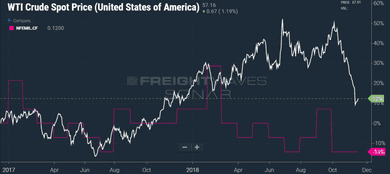
Oil price drops rapidly, but this is not a good thing for truckers
The benchmark price of domestic crude oil has dropped by 25% since early October. Historically, that would be a great thing for truckers, but with carriers operating more efficient trucks and oil production tied into the freight economy more than ever, it could be a warning sign for the broader freight market.
18 November
Zach Strickland, FW Market Expert & Market Analyst
Read More »
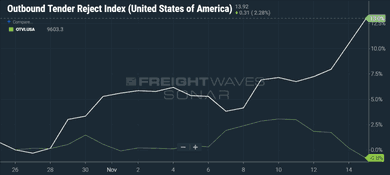
Capacity shrinks due to lower supply, not increased volume
With the Thanksgiving holiday approaching, drivers are spending less time on the road and more time at home. This is shrinking the availability of capacity in the market.
11 November

Zach Strickland, FW Market Expert & Market Analyst
Read More »
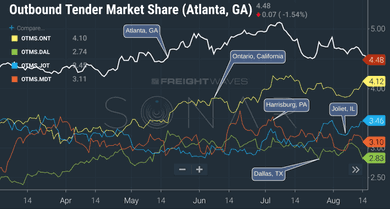
Ontario, California dethrones Atlanta as largest outbound market
Ontario California has toppled the Atlanta market, the reigning capital of freight volume in the country. Surging volume is to blame. How long will the elevated volume last?
08 November

Zach Strickland, FW Market Expert & Market Analyst
Read More »
Weekly Market Update: All’s not quiet on the western front
The freight market remains slow in most parts of the country except for one. Will it spill into other regions?
03 November
Zach Strickland, FW Market Expert & Market Analyst
Read More »
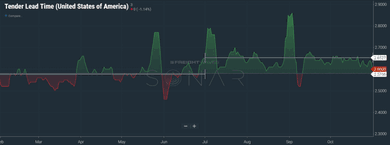
Shippers respond to volatile market by increasing lead times in the second half of the year
Lead times increasing are a sign that shippers are taking capacity shortages seriously. Carriers and brokers that depend on spot market freight are left wanting.
Oct
- 2018 -
31 October

Zach Strickland, FW Market Expert & Market Analyst
Read More »
Weekly Market Update: Are the markets tricking us into thinking they are turning?
The freight market is showing the first signs of turning in over a month. Is this the start of retail season?
27 October
Zach Strickland, FW Market Expert & Market Analyst
Read More »
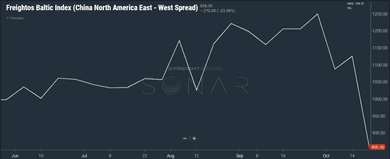
East coast containers running at a discount due to overwhelmed west coast ships
East coast bound containers from China are getting a pre-holiday discount as shippers increase volume to North America in front of tariff increases.
24 October

Zach Strickland, FW Market Expert & Market Analyst
Read More »
Weekly Market Update: is this the calm before the storm?
The freight market continues to stabilize, but there should be a little fuel left in the tank for one more seasonal push before the holidays.
21 October
Zach Strickland, FW Market Expert & Market Analyst
Read More »
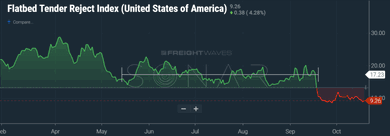
Demand for flatbeds drop off. Is this a sign of an industrial economy slowdown?
Demand for flatbeds always drop off this time of year, but is this a sign of a broader industrial slowdown?
17 October

Zach Strickland, FW Market Expert & Market Analyst
Read More »
Weekly Market Update: A tale of two Octobers
October of 2018 has been very different from the same month a year ago thus far. We have had 2 major hurricanes make landfall and the economy is still strong. So why does it seem so different?
13 October
Zach Strickland, FW Market Expert & Market Analyst
Read More »
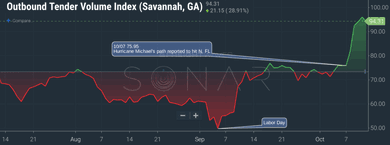
Savannah outbound volumes shoot up 26% as Southeast deals with Hurricane Michael
Outbound tender volumes have shot up 26% out of the Savannah market as the Southeast deals with hurricane Michael
10 October

Zach Strickland, FW Market Expert & Market Analyst
Read More »
Weekly Market Update: Volume continues to fall as Michael bears down on Florida Panhandle
Truckload volume continues to decline to annual lows after the first week of October. Freight volume is redistributing out west as Michael hits the Southeast U.S.
06 October
Zach Strickland, FW Market Expert & Market Analyst
Read More »
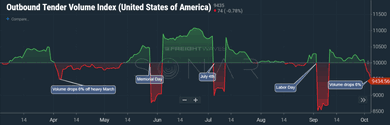
Volume drops 6% in the first week of October: Time to panic or take a closer look
Trucking volumes have dropped by 6% since the beggining of the month of October. Is this an indication that the market is slowing or is it a normal seasonal pattern?
03 October

Zach Strickland, FW Market Expert & Market Analyst
Read More »
Weekly market update: Freight volume declines to lowest level since April
October is traditionally a slower month than the 4 preceding it in terms of volume. This year it has happened as soon as the calendar turned. This seasonal swing does not mean it will be a quiet fourth quarter for everyone.
Sep
- 2018 -
30 September
Zach Strickland, FW Market Expert & Market Analyst
Read More »
Post ELD mandate update: trucking market has added 4% more trucks since April 1, 2018
Since the ELD hard mandate went into effect, the trucking market has added 4% more truck capacity
26 September

Zach Strickland, FW Market Expert & Market Analyst
Read More »
Capacity increases keeping spot market moderated for now
There is plenty of evidence for increased capacity in the freight market. Volumes are higher than they were in March when the spot market was considered more volatile.
22 September

Zach Strickland, FW Market Expert & Market Analyst
Read More »
Freight activity out of the North Carolina coast drops by more than 60%
Hurricane Florence has practically shutdown any outbound trucking activity out of the North Carolina coastal market
19 September

Zach Strickland, FW Market Expert & Market Analyst
Read More »
Weekly Market Update: Florence has regional impact on freight markets; remain relatively flat nationally
The full brunt of Florence has yet to be felt in the freight market, but there was plenty of regional impact as carriers and shippers scrambled over the past week to mitigate damages.
16 September

Zach Strickland, FW Market Expert & Market Analyst
Read More »
Charlotte and Atlanta are flooded with relief supplies as truckers help prepare for Florence
Charlotte and Atlanta see outsized inbound volumes as carriers move relief suppies into staging areas
12 September

Zach Strickland, FW Market Expert & Market Analyst
Read More »
Weekly Market Update: Hurricane Florence Edition
Hurricane Florence bears down on the Carolinas. Freight markets are reacting before the first rain drops have fallen.
08 September
Zach Strickland, FW Market Expert & Market Analyst
Read More »
No walking in Memphis: the city is the #1 headhaul market in the U.S.
Truckers are not singing the blues in Memphis (except on Beale Street): It’s currently the number one headhaul market in the U.S.
04 September

Zach Strickland, FW Market Expert & Market Analyst
Read More »
One year after Harvey, tropical storm Gordon threatens Gulf Coast
One year later the memories of Harvey are still fresh. With the peak of the Atlantic hurricane season approaching the first real tropical threat to the U.S. mainland is targeting the central Gulf Coast with flooding rain and storm surge potential.
02 September
Zach Strickland, FW Market Expert & Market Analyst
Read More »
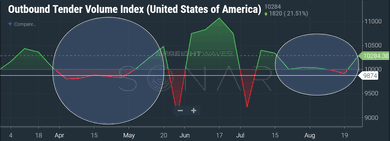
Freight volumes in the 3rd quarter have been stronger than the 2nd, it just doesn’t feel that way
For the trucking market, the third quarter has been stronger than the second, but no one would know it
Aug
- 2018 -
31 August

Zach Strickland, FW Market Expert & Market Analyst
Read More »
Weekly Market Update – Unofficial end of summer and freight doldrums?
It looks like the freight market is waking up from the long running summer doldrums, or is it just a byproduct of the pre-holiday shipper procrastination.
25 August
Zach Strickland, FW Market Expert & Market Analyst
Read More »
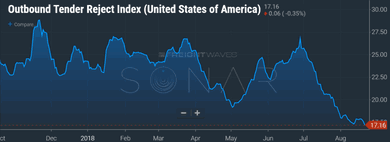
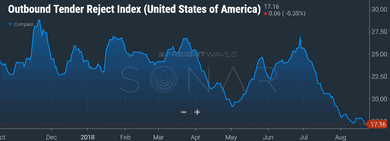
Truckload turndowns currently at 2018 low: Is the bottom in?
Carriers and brokers have been talking about how slow August has been. Good news: According to our technical indicators, the market is about the turn back in their favor
22 August
Zach Strickland, FW Market Expert & Market Analyst
Read More »
Weekly Market Update – Volumes fall as market flattens
Volume falls this week in the freight markets but rejections are flattening indicating there are still some spots where capacity is an issue.
18 August
Zach Strickland, FW Market Expert & Market Analyst
Read More »
The top five trucking markets represent 18% of all U.S. domestic volume
The top five trucking origin points represent 18% of the volume in the freight market, according to a new index added to SONAR this past week
15 August

Zach Strickland, FW Market Expert & Market Analyst
Read More »
Freight Market Update 8.15.18 – Volumes steady while capacity stabilizes
This week’s freight market continues the same patter toward stability, but volume remains steady as we move towards a more volatile time of year.
11 August

Zach Strickland, FW Market Expert & Market Analyst
Read More »
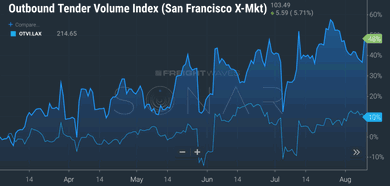
San Francisco outbound freight volumes continue to climb driven by Tesla
Tesla’s auto production in Fremont and high container volumes out of Oakland are driving demand for trucks in the San Francisco market
Zach Strickland, FW Market Expert & Market Analyst
Read More »
San Francisco outbound freight volumes continue to climb driven by Tesla
Tesla’s auto production in Fremont and high container volumes out of Oakland are driving demand for trucks in the San Francisco market
04 August
Zach Strickland, FW Market Expert & Market Analyst
Read More »
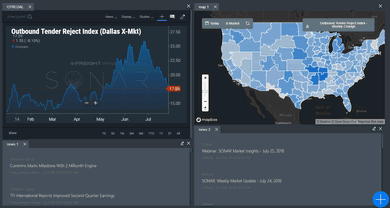
Wall Street traders panic. SONAR data shows why they are wrong.
Wall Street is in a panic over fears that the truckload sector has peaked. Wall Street is wrong. We break down the reasons using data from SONAR.
Jul
- 2018 -
30 July
Zach Strickland, FW Market Expert & Market Analyst
Read More »
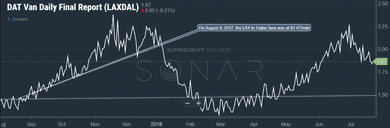
FreightWaves adds DAT Indices, lane tender rejection rates in most recent SONAR release
Introducing the latest additions to our SONAR platform: DAT lane pricing / Lane Tender Rejection Rates
Zach Strickland, FW Market Expert & Market Analyst
Read More »
Freight market continues in summer slump
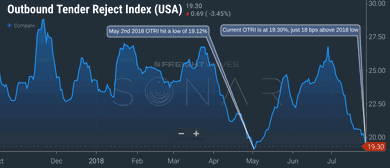
Tender rejections continue to fall towards the May 2nd low, indicating that capacity is loosening in the market. If it reaches the critical level of 19.12%, it could mean that the rest of the summer will be disappointing for carriers that reported a bullish summer outlook.
25 July

Zach Strickland, FW Market Expert & Market Analyst
Read More »
Weekly Market Update 7.25.18
Freight markets continued to cool last week, but have stalled for the moment. Isolated markets showed increased activity around the international borders. What we should be looking at moving forward as we move into August?
22 July
Zach Strickland, FW Market Expert & Market Analyst
Read More »
July trucking market off to a slower start
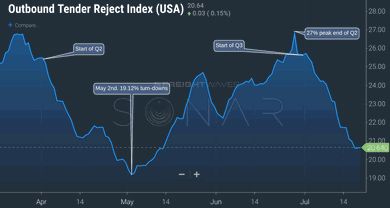
July has started off slower than carriers would like, showing normal freight patterns. Softer demand is also impacting utilization in the market.
18 July

Zach Strickland, FW Market Expert & Market Analyst
Read More »
Weekly Market Update 7.18.18
The freight markets continue to cool, but looking at the bigger picture provides perspective on what to expect moving forward.
15 July
Zach Strickland, FW Market Expert & Market Analyst
Read More »
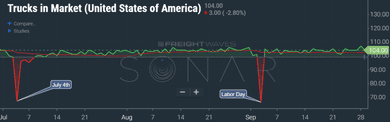
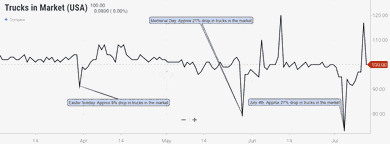
Nearly 30% of trucks went off-duty for July 4th: SONAR chart of the week
Holidays have a huge impact on the freight markets, with drivers going off-duty and altering their work schedules. In this chart of the week, we examined how different holidays impacted available capacity.
10 July

Zach Strickland, FW Market Expert & Market Analyst
Read More »
Weekly Market Update 7.11.18
The freight markets took a slight break in the last few days, but this is nothing new and is not a sign of a turning market…yet.

Zach Strickland, FW Market Expert & Market Analyst
Read More »
Volatility on container prices out of China to the North American West Coast
The Freightos Baltic Container Price Index shows the volatility of container prices out of China to the North American West Coast as importers try to adjust to a new era of global trade.
09 July
Zach Strickland, FW Market Expert & Market Analyst
Read More »
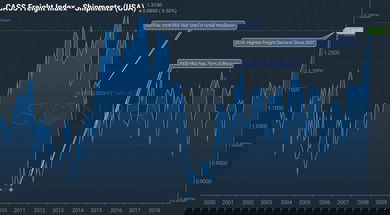
Freight volume is the highest in over a decade: Cass Shipment Index
The Cass Shipment Index (CFIS.USA) is showing freight market volumes that are nearly as strong as the 2006 peak season. This is a bullish sign for the second half of 2018.
05 July

Zach Strickland, FW Market Expert & Market Analyst
Read More »
Weekly Freight Market Update 7.5.18
With the second quarter of 2018 coming to an end this past Saturday, we saw tender rejections spike to their highest level since January at almost 27%. Major markets like Atlanta and Dallas hit highs for the year topping out around 31% and 26% respectively. Both are southern tier markets that have been increasing since […]

Zach Strickland, FW Market Expert & Market Analyst
Read More »
Weekly Freight Market Update 7.5.18
The end of the second quarter was explosive in terms of freight market activity. Rates expanded as carriers refused loads. July typically sees volumes fall a bit in relation to June. There is no reason to think it will be indicative of any long run contractions in rates.
Jun
- 2018 -
19 June

Zach Strickland, FW Market Expert & Market Analyst
Read More »
Today’s Pickup: Digital brokerage app lacking traction, freight markets still volatile
Digital trucking apps have a hard road to gaining traction, while the freight markets are not phased by tariff talks, yet.

Zach Strickland, FW Market Expert & Market Analyst
Read More »
The Chainalytics-Cowen Indices tell us what we already knew about freight markets 2 months ago, the good news for carriers is a lot has changed since
The Chainalytics-Cowen Indices are indicating a slowing freight market in April, but how does that help us in mid-June?
13 June

Zach Strickland, FW Market Expert & Market Analyst
Read More »
Today’s Pickup: Canadian National invests in infrastructure; Fed raising rates; new truck purchases, all good signs
Canadian National is making good on its promises to fix some of their deteriorated infrastructure and ramp up in response to being challenged on their ability to handle surging freight volumes. The Fed is expected to raise rates while trucking companies invest in the future.
08 June

Zach Strickland, FW Market Expert & Market Analyst
Read More »
Daimler Trucks of North America will release 2 new data driven services in Q4 2018
Daimler Trucks of North America reveals 2 new services that take a very datacentric approach. One of them will improve the driver experience.
07 June

Zach Strickland, FW Market Expert & Market Analyst
Read More »
Daimler throws down the electric gauntlet
Daimler released two electric commercial vehicles at yesterdays Market Days event for investors and media. The commercial vehicle maker just let everyone know their intentions to not only play but win the electric game.

Zach Strickland, FW Market Expert & Market Analyst
Read More »
Will the Freightliner eCascadia kill the Tesla Semi?
Incumbent OEMs like Daimler, Volvo, and VW have seized the reins in the electric truck race. The only question is whether trucks like the Freightliner eCascadia will be able to deliver a performance competitive with Elon Musk’s Tesla Semi.
04 June

Zach Strickland, FW Market Expert & Market Analyst
Read More »
Los Angeles freight market gets a wake up call off inflow from China
The L.A. market wakes up after a sleepy early spring. With container prices increasing on the spot market, China could be the main factor.
May
- 2018 -
18 May

Zach Strickland, FW Market Expert & Market Analyst
Read More »
The Missouri River Valley needs attention, according to the tender rejection index
Capacity is tightening in portions of the Missouri valley as warmer temperatures have agriculture shipment volumes and the need for reefers increasing. This could be a sign of the overall market heating up again.
15 May

Zach Strickland, FW Market Expert & Market Analyst
Read More »
Today’s Pickup: retail sales are up, trucking companies remain optimistic
Retail sales are in. One more indicator the economy is still rolling along. Trucking companies show signs of continuous improvement.
08 May

Zach Strickland, FW Market Expert & Market Analyst
Read More »
Kenco’s Innovation Lab: managing innovation without internal disruption
Companies may tell you they are innovative, but a lot of the time standard procedures and internal structure inhibits the creative process limiting a company’s ability to progress. Kenco has found success by dedicating themselves to the cause.
03 May

Zach Strickland, FW Market Expert & Market Analyst
Read More »
The spot market continues to degrade as freight market stabilizes
The spring season has yet to see an event big enough to move carriers from their newly executed contracts.
02 May

Zach Strickland, FW Market Expert & Market Analyst
Read More »
Carrier confidence has impacted freight markets as much as capacity
Freight rates have increased significantly in a short period of time over the past year. Aside from shipping volume increases and driver shortages, there is another less discussed factor at play.
01 May

Zach Strickland, FW Market Expert & Market Analyst
Read More »
CarrierLists combines forces with SaferWatch to provide new level of carrier management tool
Carrier Lists combines their carrier sourcing information with SaferWatch’s assessment data to provide a unique consolidated service for freight brokers.

Zach Strickland, FW Market Expert & Market Analyst
Read More »
Today’s Pickup: April is in the books, trucking companies prepare for warmer weather and market conditions
The first month of the second quarter is in the books. While the economy shows it is still going strong, there is some tempering in the freight market. Trucking companies are still uncertain with what lies ahead.
Apr
- 2018 -
27 April

Zach Strickland, FW Market Expert & Market Analyst
Read More »
USA Truck continues its turnaround with a strong 1st quarter
USA Truck posts a strong first quarter earnings continuing its torrid turnaround pace.
26 April

Zach Strickland, FW Market Expert & Market Analyst
Read More »
Echo Global has a booming first quarter
Echol Global Logistics a 3PL based in Chicago busts through earnings estimates in the first quarter. A combination of market conditions and productivity improvements paved the way.
25 April

Zach Strickland, FW Market Expert & Market Analyst
Read More »
TRI suggests spot rates will continue to head down in the freight market
DAT is reporting dry van rates are decreasing. The Tender Rejection Index is indicating this trend should continue over the next few weeks.

Zach Strickland, FW Market Expert & Market Analyst
Read More »
The Easter Bunny and egg recall cause egg prices to spike with transportation costs a big factor
The Rose Acre Farms egg recall had im-peck-able timing occuring right after the Easter season. Here is how the freight industry had a hand in egg price increases.
24 April

Zach Strickland, FW Market Expert & Market Analyst
Read More »
Today’s Pickup: Technology offers solutions to driver retention; blockchain keeps us healthy
Driver retention is a hot button topic in trucking right now. Some trucking companies are focusing their technological improvements on helping create a better environment for their pivotal employees.
21 April

Zach Strickland, FW Market Expert & Market Analyst
Read More »
Digital apps are not replacing load-boards anytime soon
The third installment of CarrierLists and FreightWaves load sourcing survey has more of the same. We dig a little deeper to see something about the industry that is seemingly obvious, but is it?
Zach Strickland, FW Market Expert & Market Analyst
Read More »
Digital apps are not replacing load-boards anytime soon
The third installment of CarrierLists and FreightWaves load sourcing survey has more of the same. We dig a little deeper to see something about the industry that is seemingly obvious, but is it?
19 April

Zach Strickland, FW Market Expert & Market Analyst
Read More »
Today’s Pickup: ELDs, sensing technology, and trucking
ELD hard enforcement had its impact on rates months ago, but the physical impacts to drivers and people on the ground is still an issue. Autonomous vehicle technology is progressing rapidly.
17 April

Zach Strickland, FW Market Expert & Market Analyst
Read More »
DAT reporting a softening spot market
DAT reported flat to lower rates in this weeks national averages. The TRI has been suggesting a softening market for the past few weeks.

Zach Strickland, FW Market Expert & Market Analyst
Read More »
Today’s Pickup: Trucking markets climbing, and are still looking up
The first quarter of 2018 has come to a close. While volatile, many transportation companies saw growth and shippers are recognizing a potential shift in who has the leverage in the marketplace for the first time in years.
16 April

Zach Strickland, FW Market Expert & Market Analyst
Read More »
XPO Connect has a chance to make a statement for incumbent logistics providers in the digital marketplace
XPO announced it is releasing a consolidated digital platform into the marketplace. XPO Connect is the latest digital offering by a transportation provider attempting to offer more visibility an functionality to its customers.
14 April

Zach Strickland, FW Market Expert & Market Analyst
Read More »
Density based pricing is nothing new
A push for density-based pricing is happening in the less-than-truckload (LTL) segment of the transportation industry, but it’s nothing new.
13 April

Zach Strickland, FW Market Expert & Market Analyst
Read More »
Today’s Pickup: Big trucking is embracing the technological revolution
The technological revolution is underway in supply chain management. The big companies are investing heavily in growing this largely ignored aspect of the industry.
10 April

Zach Strickland, FW Market Expert & Market Analyst
Read More »
The digital broker needs to think outside the app
The second wave of survey results from CarrierLists shows a similar result as the first. Little to no freight is being sourced by the digital app. The developers may need to dig a little deeper. .

Zach Strickland, FW Market Expert & Market Analyst
Read More »
Today’s Pickup: Trump and China give freight markets one less thing to think about
Trump and China cool off which should allow the economy and subsequently the transportation industry some respite. China creepily leading the pack on AI.
06 April

Zach Strickland, FW Market Expert & Market Analyst
Read More »
The ELD “hard” enforcement period is almost a week old, but the freight markets are responding with a shrug
Freight market activity is stabilizing as carriers move into new contract cycles. The ELD hard enforcement period appears to be a non-factor so far.
05 April

Zach Strickland, FW Market Expert & Market Analyst
Read More »
Sorry Chicago spot fans, the action is in the contract freight market
The Chicago area is considered a keystone to many freight networks and as such a reliable indicator to the overall health of the trucking industry. WIth all the talks of trade wars and ELDs signs point to a remarkably stable environment, but for how long?
03 April

Zach Strickland, FW Market Expert & Market Analyst
Read More »
ELD-driven capacity shortage or April Fools?
There has been a lot of hype surrounding the arrival of the hard enforcement period of ELD carrier compliance, but according to the Tender Rejection Index it has mostly been a non-factor to the overall freight market.

Zach Strickland, FW Market Expert & Market Analyst
Read More »
Carriers still getting majority of loads directly from shippers, while digital apps are a non-factor
Transportation is increasing its usage of technology in many areas, but apparently relationships still drive the small to mid-size carrier market when it comes to load generation. Freight brokers could also be blind to an untapped resource…until now.
02 April

Zach Strickland, FW Market Expert & Market Analyst
Read More »
Today’s Pickup: Trade war threats loom as ELD enforcement begins
Trump and China continue to trade blows as threats of a trade war increase. The ELD mandate gets the next level treatment as enforcement gets real.
Mar
- 2018 -
28 March

Zach Strickland, FW Market Expert & Market Analyst
Read More »
The South heats up, but Atlanta is burning with freight
Spring has sprung in the Southeast as warmer weather sends shippers into full throttle. The unofficial capital of the South is leading the way according to a new index. Could this mean higher rates in an already heated market?
26 March

Zach Strickland, FW Market Expert & Market Analyst
Read More »
Severe weather in Texas and Oklahoma could slow early spring volume spikes and provide rails with more excuses
A wet pattern continues in the middle to eastern sections of the country, making it difficult for carriers to manage surging spring volumes coming out of the south. This impacts all modes of transportation including the beleaguered rail lines.
23 March

Zach Strickland, FW Market Expert & Market Analyst
Read More »
Freight costs increase the price of Cheerios, but the future may provide other options
General Mills is citing higher freight costs as a reason for lower than expected earning. This is not an uncommon issue in today’s marketplace. There could be solutions coming in the future.
21 March

Zach Strickland, FW Market Expert & Market Analyst
Read More »
Charleston turns up the heat in winter as Savannah cools
An new opportunity in an old port town is being largely ignored by the trucking community. Charleston South Carolina is showing signs of rapid expansion as the freight market cools down in the more voluminous Savannah.

Zach Strickland, FW Market Expert & Market Analyst
Read More »
Winter weather gives truckers another reason to avoid the Northeast
As record setting winter weather continues to disrupt all forms of transportation in America, the Northeast sees dramatic declines in freight acceptance.