US ranks low among international postal services on financial flexibility

A female postal carrier with black hair wearing yellow Deutsche Post uniform hands mail to a home owner in Germany.

The U.S. Postal Service has less flexibility to address financial shortfalls than mail systems in other countries because of its obligation to provide universal service, the size of population served and regulatory limits on competing with the private sector outside its core postal business, according to the agency’s independent watchdog. 

The Postal Service’s business model is largely restricted to postal products, making it one of the least diversified posts in the world, the Office of Inspector General said in a white paper published on Monday. Many foreign counterparts enjoy greater freedom in pursuing financial stability, with more relaxed delivery schedules, multiple revenue streams and government funding to support universal service obligations.

In 2023, the Postal Service delivered about 49% of the world’s 227 billion mailpieces, far surpassing the volumes managed by any other national postal operator.

The report compared the postal models of 25 other national postal operators, including Japan, Portugal and China, with the United States. Most posts are fully or partially owned by the government, with very few fully privatized.

“Posts that have diversified, either within the parcel and logistics sector or in other business areas, tend to be more profitable as they can offset the declining or negative profitability of mail,” the OIG study said. The long-term viability of postal services depends largely on their ability, with government support, to adapt business models to evolving market conditions and societal needs, it concluded.

A post’s legal structure is important to how it operates. Fifteen of the other 25 posts surveyed operate as private corporations. The U.S. Postal Service and other counterparts are state-owned corporations, which are limited to varying degrees from certain self-help measures. The U.S. Postal Service, Canada Post and Swiss Post, for example, are subject to debt caps that may restrain capital expenditures.

U.S. law gives the Postal Service more room than many international posts to set service standards, but the agency is more constrained by the obligation to serve all addresses than many other postal operators, including a wider scope of universal services, stricter pricing regulations and a six-day delivery requirement instead of five-, three- or every-other-day frequencies elsewhere.

Most countries require government approval to raise letter mail prices, but the Postal Service is subject to stricter pricing regulations, with 100% of its mail volume falling under a price cap. Also, parcel pricing is generally less regulated for foreign posts than in the United States, where price adjustments for retail and commercial parcel prices require approval.

At the same time, the U.S. Postal Service faces more business restrictions than most counterparts, especially when it comes to borrowing funds, managing pension obligations and expanding into other lines of business. 

About half the posts sampled obtain two-third or more of their revenue from mail and parcels. (Source: U.S. Postal Service, Office of Inspector General)

Most posts have more flexibility than the Postal Service in managing pension funds, including the ability to determine how to diversify investments of retiree assets and propose changes to the rules governing pension funds. 

About half of the sampled foreign postal services lost money in 2023. 

The U.S. Postal Service finished fiscal year 2023 with a $6.5 billion net loss. DeJoy’s agency overhaul over four years has brought the agency close to breakeven. In the first quarter of fiscal year 2025, the Postal Service said it generated about $150 million in operating profit versus a $2 billion loss for the same period in the prior year. DeJoy has repeatedly asked Congress and the Postal Regulatory Commission to relax restrictions on how it can pursue cost-cutting and raising revenue.

In nine countries, governments provide funding – up to 8% of the posts’ annual revenue – to support nationwide universal delivery obligations or other public service missions. The U.S. Postal Service is almost entirely self-funded.

Postal services that operate as private entities generally have greater commercial freedom than government-owned ones to streamline costs, optimize workforce size and composition, and manage capital investments, the OIG report said. Most posts, for example, have more flexibility than the Postal Service in managing employment-based postal pension funds and determining how to diversify investments of retiree assets. 

Posts that have diversified, either within the parcel and logistics sector or in other business areas, tend to be more profitable because they can offset the declines in mail volume and revenue, according to the study.

DeJoy this week proposed that the U.S. Postal Service could serve as a third-party logistics provider for other federal agencies, which would pay to use its vast freight transportation and warehousing infrastructure to move material. By better utilizing existing capacity, the Postal Service could better offset overhead costs, he suggested.

It’s worth noting that profitability isn’t the only indicator of a postal service’s value. Posts play a crucial role in broader economic development and connecting rural and urban areas, facilitating social cohesion and feelings of national belonging that go beyond the desire for profitability.

Faced with declining mail volumes and increasing competition in parcel delivery, postal operators are trying to streamline operations, expand into markets related to postal services and seek legislative reforms to alleviate regulatory and financial burdens.

The European Union, United Kingdom, Australia and Canada, for example, are requesting that lawmakers relax their universal service obligations or provide more government funding.

DeJoy’s overhaul strategy

Under DeJoy, the U.S. Postal Service has embarked on a 10-year transformation plan, called Delivering for America, to put the quasipublic agency on a path toward financial sustainability and improved service delivery. It is reducing billions of dollars in costs by adjusting the logistics network to integrate delivery of mail and package categories and shift more air transportation to ground, and it has created new products, adjusted rates and persuaded Congress to repeal a requirement that the Postal Service prepay health plans for retirees.

The postmaster general has previously asked Congress to change the way Civil Service Retirement System liabilities are calculated, allow the use of market-based investments for retiree funds and increase the agency’s debt limit of $15 billion. Last week he engaged Elon Musk’s efficiency team to help speed up the retiree fixes. 

The second-phase of the Delivering for America plan lacks specific timelines for implementing key reforms and details on their expected impact on finances, leaving uncertainty about the Postal Service’s long-term financial sustainability, the OIG said. 

Click here for more FreightWaves/American Shipper stories by Eric Kulisch.

Postal Service weighs serving as logistics partner for federal agencies

FreightWaves: Postal Service weighs serving as logistics partner for federal agencies
The U.S. Postal Service is examining how it can generate additional revenue by offering logistics services to other parts of the federal government, Postmaster General Louis DeJoy said Monday.

In a letter to members of Congress, DeJoy gave more details about how Elon Musk’s Department of Government Efficiency will assist the Postal Service’s ongoing turnaround campaign aimed at improving operational efficiency and product appeal, slashing costs and growing revenue.

Among the initiatives assigned to DOGE is developing a business case for leveraging existing infrastructure to help other agencies with logistics needs.

DeJoy said the Postal Service’s retail locations, logistics capability, delivery services, vehicles, buildings and stocking locations can help other agencies reduce costs while enhancing its own profitability. “I believe there are billions of dollars annually that will benefit us and significantly reduce government-wide costs,” he said.

Commercializing an in-house capability is something logistics companies often do in the private sector. DeJoy, who recently announced his intent to resign at an undetermined date, held the top leadership positions at New Breed Logistics and XPO Logistics’ supply chain business in the Americas before being appointed postmaster general by the post’s board of governors in 2020.

DOGE intervention is needed, the mail chief said, because congressional micromanagement, meddling and issuance of conflicting requirements has handicapped the Delivering for America (DFA) cost-saving strategy started four years ago. He has repeatedly castigated Congress for requiring the Postal Service to cover its costs while being forced to expand service.

“The fact is that DOGE is the only other game in town that seems oriented toward helping us to achieve our efficiency and cost goals that are reflected in the DFA plan, instead of parochial protectionism that is grounded in political self-interest and that is contributing to the financial peril of the Postal Service and our universal service mandate,” he wrote.

DeJoy on Thursday announced he had signed an agreement with DOGE, the Trump administration office staffed by Musk acolytes tasked with downsizing the federal government and eliminating waste. In a separate letter to congressional leaders, the chief executive officer said Musk’s efficiency team would focus on fixing structural problems with postal worker retirement plans, bringing down workers’ compensation costs and reducing regulatory strictures by the Postal Regulatory Commission that prevent modernization.

He reiterated those focus areas on Monday but said DOGE would also develop solutions for other issues Congress has failed to address.

DOGE will review leases on nearly 31,000 post office buildings and whether they should be renewed when decades-long leases expire, considering that about half of retail centers fail to cover their cost of local operations.

Musk’s outside consulting team will also analyze how the Postal Service is combating counterfeit postage, which costs the agency an estimated $1 billion per year. The agency has implemented several technological and physical security measures, but DOGE’s creative problem-solving ability could help develop additional innovations to address the problem, said DeJoy.

He reassured lawmakers that the initiatives mentioned are the only ones he has requested and authorized DOGE to assist on so far and that only data and information required for those specific tasks will be shared. DOGE will also not be involved in hiring freezes and layoffs, as has happened in other parts of the federal government, because the Trump administration recognizes the Postal Service’s independent status within the executive branch. And he denied that DOGE’s role in postal reforms signals any attempt to prepare the agency for privatization or merger with the Department of Commerce.

DeJoy said implementing several of the corrective measures, including changes to employee benefit accounting or the way pension assets are invested, will require legislative action.

The Postal Service, he said, is on track to soon break even, or even achieve modest operating profits, on a continuing basis because of the restructuring effort.

Democrats not satisfied

House Democrats were not assuaged by DeJoy’s characterization that DOGE’s mission is very narrow.

“The Postmaster General is trying to rewrite history after cutting a backroom deal to turn the keys of the Postal Service over to Elon Musk and DOGE.  This letter is rife with contradictions and does nothing to assuage concerns about his ‘agreement’ with DOGE,” ranking member Gerald Connolly of Virginia said in a statement. “DeJoy cannot decry a lack of collaboration with Congress while rejecting Congressional requests for transparency and reforms.  He cannot claim to recognize the independence of the Postal Service while putting out the welcome mat for DOGE to forcefully and unlawfully implement his favored reforms behind Congress’s back and at the expense of Americans’ mail service and the agency’s independence.”

Democrats on Monday demanded the Republican-controlled Oversight and Government Reform Committee hold a hearing on the Trump administration’s and DOGE’s plans for the U.S. Postal Service, which delivers more than 115 million pieces of mail and parcels each year. They also urged Chairman James Comer to request copies of all signed agreements DeJoy made with DOGE and the General Services Administration, saying recent administration statements and actions constitute a “broad assault” on the Postal Service’s independence.

“We agree that there are steps Congress could take to strengthen the financial sustainability of the Postal Service, but any potential deal that would give Elon Musk and his DOGE associates unilateral authority to manipulate the most critical, expansive national mail network on the planet is deeply troubling. Such an agreement signed between the Postmaster General and DOGE associates would threaten access to affordable and reliable postal service for millions of American families and businesses,” the minority members said.

(Correction: An earlier version of this story incorrectly stated who appointed DeJoy as postmaster general in 2020. It was the Postal Service board of governors.)

Click here for more FreightWaves/American Shipper stories by Eric Kulisch.

SmartLynx Airlines disbanding cargo charter fleet

Icelandic cargo airline Bluebird Nordic shuts down

FedEx says economic uncertainty slowing parcel and freight demand

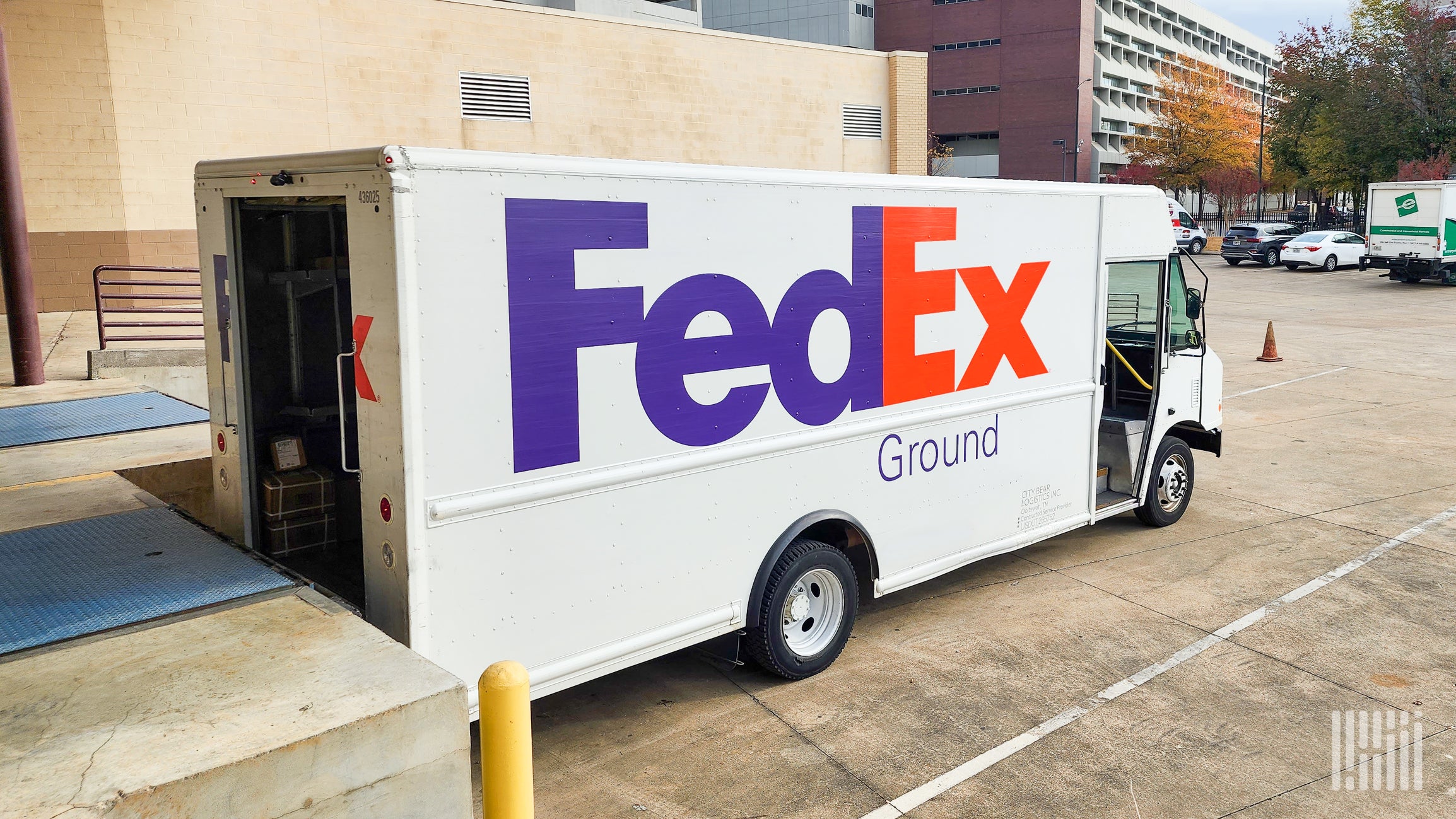
Close up photo of a FedEx Ground delivery van pulled up to a loading dock.

FedEx Corp. shares fell more than 5% in aftermarket trading Thursday after the integrated parcel giant reduced its full-year guidance for the third consecutive quarter because of intensifying macroeconomic headwinds and uncertainty in the U.S. industrial economy, which are crimping higher margin B2B shipping services.

FedEx (NYSE: FDX) said it expects revenue to be flat to slightly down year over year from the previous outlook of flat revenue. The estimated range of earnings per share, excluding certain costs, is $18 to $18.60 compared to the prior forecast of $19 to $20 per share.

A primary area of uncertainty that could impact FedEx’s bottom line is the rapid escalation of tariffs and tariff threats from the United States, which is inviting retaliation and worries of diminished consumer demand because of higher import prices. 

During the fiscal year third quarter ended Feb. 28, FedEx increased revenue 1.9% to $22.2 billion and delivered adjusted operating income of $1.5 billion, up 11% year over year, despite a compressed peak shipping season and severe weather events, including wildfires and winter storms, in North America. It was the first time revenue has increased since the start of the fiscal year in June. FedEx said it experienced higher costs for purchased transportation because of inflation and higher labor costs due to wage increases and increased hiring to support volume growth.

Adjusted earnings per share missed consensus Wall Street estimates by 12 cents but were up 17% from the prior-year period, while revenue was better than predicted by $320 million.

Management said it expects the mix of shipments to continue shifting to deferred service offerings, which will negatively affect results. During the third quarter U.S. deferred package volume increased 5%, while priority express volume declined 3%.

The company attributed better profitability to three factors: the success of the Drive network transformation, which aims to permanently remove $4 billion in structural costs, including $2.2 billion during the current fiscal year, while improving customer service; higher pricing across the transportation segments; and higher volume at FedEx Express. During the quarter, FedEx achieved $600 million in cost savings from Drive. 

FedEx Express, which is integrating its network with FedEx Ground, generated a 17% gain in adjusted operating income to $1.4 billion despite the significant negative impact from losing a domestic air cargo contract with the U.S. Postal Service. Express enjoyed greater U.S. and international export volume, which helped juice revenue 2.7% to $19.2 billion.

International economy package volume increased 48% in the third quarter and 42% in the nine months of 2025 primarily due to continued growth in deferred service offerings as a result of strengthening e-commerce. U.S. ground home delivery/economy package volume increased 11% in the quarter because of increased demand the timing of cyber week. International priority package volume decreased 16% and 11% in the first three quarters, driven by softness in the global industrial economy.

Operating results at FedEx Freight, which management said in December it would spin off into a separate less-than-truckload company, were pressured by lower fuel prices negatively affecting yields through lower fuel surcharges, reduced weight per shipment and fewer shipments due to slower global industrial production. Operating income fell 23% to $261 million.

Click here for more FreightWaves/American Shipper stories by Eric Kulisch.

FedEx makes big push for third-party air cargo

Postal Service weighs serving as logistics partner for federal agencies

Kreilkamp Trucking acquires Iowa truckload carrier’s assets

Kreilkamp Trucking Inc. has acquired the assets of Waterloo, Iowa-based Gray Transportation, which is ceasing operations after over 40 years in business.

The deal allows Kreilkamp Trucking to assume control of an undisclosed number of Gray Transportation’s trailers and freight contracts, and some drivers will join Kreilkamp from Gray, said CEO Tim Kreilkamp.

“I don’t want to go into too much detail, but there were certain assets that were advantageous to our fleet moving forward,” Kreilkamp told FreightWaves in an interview.

Terms of the agreement were not disclosed.

Kreilkamp Trucking is a family-owned carrier based in Allenton, Wisconsin. The company primarily services an area covering the Midwest to the Eastern Seaboard.

Kreilkamp hauls products including refrigerated meats, cheese, spirits, agricultural supplies, manufacturing supplies, paper goods and printed material. 

“We’ve been in business since 1935 and I currently represent the fourth generation of family management, with the fifth generation working here as well,” Kreilkamp said. “Kreilkamp is a Midwest carrier and we’re running about 300 trucks.”

Kreilkamp Trucking also owns regional refrigerated carrier Brent Redmond Transportation. Based in Hollister, California. Brent Redmond provides transportation services throughout the Southwestern U.S.

In addition, Kreilkamp owns WB Warehousing & Logistics, Farmer’s Implement Inc., and Farmer’s Grain & Feed.

Gray Transportation was founded in 1984 by Leroy Gray with one truck and a handful of employees.

In recent years, Gray Transportation had a fleet of over 150 trucks, 500 trailers and 100 drivers, offering over-the-road dry van solutions. Global equipment manufacturer John Deere was one of Gray Transportation’s main freight accounts.

Gray Transportation President Darrin Gray said low freight rates and rent increases on leased trucks from Ryder were the main reasons for shutting down the company.

Gray’s fleet of trucks were all leased from Ryder.

“The spot market rates were low when we had to use brokers to get our trucks back into our contracted freight lanes,” Gray told FreightWaves in an interview.

Gray will be working with Kreilkamp Trucking and was hopeful that most of his drivers based in the Midwest would find jobs with the carrier.

“I was the last part of the generation of the family in the business, so I’ll work with Kreilkamp,” Gray said. “2024 was probably one of the toughest years.”

Port of Long Beach posts ninth straight monthly cargo gain

In February, trade passing through the Port of Long Beach, California, experienced significant growth, marking the ninth consecutive month of increased cargo movement, and corresponding with retailers’ strategic efforts to move goods in advance of anticipated tariffs.

Volume totaled 765,385 twenty-foot equivalent units, reflecting a 13.4% increase from February of the previous year. Imports surged by 11.8% to 368,669 TEUs, while exports saw a 2.9% rise to 90,026 TEUs. Meanwhile, the movement of empty containers jumped by 19.1%, to 306,690 TEUs.

Category20252024% Change
Loaded Inbound368,669329,85011.8%
Loaded Outbound90,02687,4742.9%
Empties Inbound14,39712,93011.3%
Empties Outbound292,293244,47019.6%
Total (TEU)765,385674,72313.4%
(Chart: Port of Long Beach)

Overall, in the first two months of 2025, the port managed to move a substantial 1,718,118 TEUs, up 27.4% y/y. 

Find more articles by Stuart Chirls here.

Related coverage:

Hapag-Lloyd sees mixed earnings in 2024

Port of Los Angeles sees strong container volumes in February

Chassis manufacturers look to navigate supply chain, trade changes ahead

Canada ports facing container delays due to weather, rail issues

Hapag-Lloyd expects lower profits in 2025

German shipping giant Hapag-Lloyd has released its financial results for 2024, revealing a complex picture of growth and challenges across its business segments.

While liner transport volume rose to 12.5 million twenty-foot equivalent units, up from 11.9 million TEUs, average freight rates declined to $1,492 from $1,500 per TEU in 2023. This combination resulted in segment revenue of $20.3 billion, up from $19.2 billion in 2023. However, profitability metrics showed mixed results, with earnings before interest, taxes, depreciation and amortization  (EBITDA) increasing slightly to $4.9 billion, while earnings before interest and taxes (EBIT) remained nearly flat at $2.7 billion.

Hapag-Lloyd (OTC: HPGLY) expanded its fleet capacity and container volumes. The company operated 299 vessels in 2024, up from 266 the previous year. This expansion increased aggregate vessel capacity to 2,346,000 TEUs and container capacity to 3,654,000 TEUs.

The Terminal & Infrastructure segment, a relatively new focus area for Hapag-Lloyd, showed promising growth. Revenue more than doubled to $433 million, with EBITDA and EBIT also seeing significant increases to $150 million and $71.3 million, respectively.

At the group level, Hapag-Lloyd reported total revenue of $20.6 billion, an increase from $19.4 billion in 2023. Group EBITDA rose to $5.02 billion, while EBIT reached $2.8 billion. The group’s net profit declined to $2.6 billion from $3.2 billion the previous year, resulting in earnings per share of $14.72. The company saw higher operating expenses from longer vessel voyages diverting away from the Red Sea region and around Africa’s Cape of Good Hope, the company said in an earnings release.

“In a challenging market environment, we achieved solid results and further increased customer satisfaction,” said Rolf Habben Jansen, chief executive of Hapag-Lloyd AG, in the release. “We have further consolidated and expanded our terminal business under the Hanseatic Global Terminals brand. Finally, we launched the largest newbuild program in our company’s history, which will enable us to further modernize and decarbonize our fleet.”

Hapag-Lloyd maintained a strong financial position, with equity rising to $22.4 billion and an improved equity ratio of 61.6%. The company’s net liquidity position decreased to $983 billion, reflecting ongoing investments and market challenges.

Efficiency metrics showed slight declines, with EBITDA margin falling to 24.3% and EBIT margin to 13.5%. Return on invested capital also decreased, to 14.1%.

For 2025, Group EBITDA is expected to be in the range of $2.5 billion to $4 billion, and  Group EBIT from zero to $1.5 billion. The company cited “considerable uncertainty” due to volatile freight rates and major geopolitical challenges.

“In 2025 we are off to a very good start with Gemini [the new cooperative alliance with Maersk (OTC: AMKBY)], but the economic and geopolitical environment remains fragile, said Habben Jansen. “In this context, we anticipate earnings in 2025 to be lower than in 2024.”

The company is proposing a dividend of $8.89 per share for the 2024 financial year.

Find more articles by Stuart Chirls here.

Related coverage:

Port of Los Angeles sees strong container volumes in February

Chassis manufacturers look to navigate supply chain, trade changes ahead

Canada ports facing container delays due to weather, rail issues

Wan Hai Lines sees record revenue, profit 

EPA gives trucking OEMs whiplash with emissions rule rollback plan

Consumer sentiment plunges to lowest level since 2022

Recent consumer sentiment data released by the University of Michigan points to continued deterioration as fears of inflation and higher unemployment are set against a backdrop of tariffs. Consumer sentiment fell 11% from 64.7 points to 57.9 points. The declines were consistent across all groups by age, education, income, wealth, political affiliation and geographic region. This is the third consecutive decline in consumer sentiment and the lowest level since 2022.

Surveys of Consumers Director Joanne Hsu said in the release: “Many consumers cited the high level of uncertainty around policy and other economic factors; frequent gyrations in economic policies make it very difficult for consumers to plan for the future, regardless of one’s policy preferences.”

Inflation expectations for the year ahead surged 4.3% m/m, the highest reading since November 2022, “marking three consecutive months of unusually large increases of 0.5 percentage points or more.” Long-term inflation expectations also surged, up 3.5% in February to 3.9% in March, the largest m/m increase since 1993.

Carrier lease-purchase programs: A pragmatic approach

(Photo: Jim Allen/FreightWaves)

In a recent Overdrive editorial, David Owen, president of the National Association of Small Trucking Companies, argues that while some carriers have indeed exploited drivers through predatory lease-purchase agreements, many companies offer the programs as legitimate pathways to truck ownership and entrepreneurship for drivers.

The article was inspired by the recent recommendation by the Federal Motor Carrier Safety Administration’s Truck Leasing Task Force to eliminate carrier lease-purchase programs.

Owen contends that a ban on such programs would exceed regulatory authority and harm the industry as a whole.

“Let’s regulate and legislate from a positive perspective rather than a negative one that represents an unattainable goal of perfection,” Owen writes, advocating for a more balanced approach that doesn’t penalize responsible carriers for the actions of a few bad actors.

Owen points out that lease-purchase agreements have been part of the trucking landscape since deregulation in the 1980s, providing opportunities for drivers who might not otherwise have access to vehicle ownership. He acknowledges that some companies have “pushed the envelope” with predatory practices but argues that many more have designed their programs to genuinely help drivers succeed.

FTR January truckload conditions fall amid tough comps

(Source: FTR Transportation Intelligence)

FTR Transportation Intelligence recently released its Trucking Conditions Index for January, which saw a decline of 2.56, almost a mirror image of its December increase of 2.67. The index represents five major conditions in the U.S. full truckload market combined into a single index that gauges fleet behavior.

FTR cites higher diesel prices, weak freight rates, and less volume and utilization as part of the unfavorable overall market conditions for January. There was one positive, which was the cost of capital.

Avery Vise, FTR’s vice president of trucking, commented: “January proved to be tough for carriers as we anticipated. Although we still forecast an improving market for trucking companies in the months ahead, we remain very concerned that the great uncertainty introduced by tariffs – and especially the lack of clarity over scope and timing – will chill activity and investments that drive freight demand. We do not see any impetus for further significant declines in capacity, so carriers will need stronger volumes to tighten the market and set the stage for stronger freight rates.”

The Home Depot grows its flatbed distribution network (Trucking Dive)

ArcBest takes on TL freight to fill empty capacity (FreightWaves)

Kal Freight bankruptcy staying under Chapter 11, allaying fears of chaotic exit (FreightWaves)

Year-Over-Year Auction Pricing Remains Positive (J.D. Power)

No Prebuy Surge: Trump Admin Scraps Costly Truck Regulations (FreightWaves)

Could a sun protection device improve driver retention? (Commercial Carrier Journal)

Weekly US rail traffic remains ahead of 2024 levels

Weekly U.S. rail traffic remains ahead of 2024 levels, with a third straight week of gains greater than 5%, according to the Association of American Railroads.

Volume for the week ending March 15 was 503,473 carloads and intermodal units, a 6.2% increase from the same week a year ago. That includes 226,027 carloads, an increase of 3.1%, and 227,446 containers and trailers, up 8.8%.

(Chart: AAR)

Through the first 11 weeks of 2025, overall volume is 5,306,497 carloads and intermodal units, an increase of 4.1% y/y. That includes a 1.1% drop in carload volume and an 8.4% gain in intermodal traffic.

North American volume for the week, as reported by nine U.S., Canadian and Mexican railroads, included 334,557 carloads, a gain of 1%, and 361,603 intermodal units, up 7%. The total volume of 696,160 carloads and intermodal units is a 4.1% increase.

Traffic for the first 11 weeks of 2025 is 7,270,749 carloads and intermodal units, a 2.5% increase over the same period in 2024. That includes a 0.6% decline in Canada and an 8.2% decline in Mexico.

Subscribe to FreightWaves’ Rail e-newsletter and get the latest insights on rail freight right in your inbox.

Find more articles by Stuart Chirls here.

Related coverage:

County Line Rail acquires Sabine River & Northern Railroad

OmniTRAX joint venture acquires California short line railroad

North American trade disputes an opportunity for CPKC, CEO says

CPKC, Patriot Rail partner on new Texas transload site

Carrier to pay millions in cleanup, penalties for Connecticut gasoline spill

A Connecticut transportation company will pay millions of dollars in penalties and cleanup costs related to a 2022 gasoline spill – the biggest in the state’s history, according to Attorney General William Tong.

“Soundview is fully responsible for the ongoing remediation and clean-up of the site, costing millions of dollars,” a Wednesday news release on the company’s settlement with the state noted.

Soundview also faces penalties and payments totaling $350,000 in connection with the accident in Norfolk.

Two smaller spills in the state – in Milford in March 2023 and at the Gateway Montville terminal in September 2023 – are included in the settlement and have been remediated, the attorney general’s office said.

The Norfolk accident caused “severe disruption to neighbors and significant environmental harm,” the release stated. “Soundview has taken responsibility for the ongoing remediation, and the state continues to closely monitor that work.”

Early on Nov. 5, 2022, a tanker truck leased and operated by Soundview struck a fire hydrant and utility pole on State Route 44 in Norfolk, according to the attorney general’s office. It rolled, slid several hundred feet on the road and spilled its entire 8,200 gallons of gasoline through the ruptured tank, “contaminating the yards of nearby residences and traveling through the town’s stormwater sewer system into nearby surface and groundwaters.”

Nearby residents were evacuated until that evening amid fears of a possible explosion.

Ground saturated with gasoline at the nearest properties had to be excavated to 9 feet deep, and 600 tons of contaminated soil and 90,000 gallons of contaminated water were removed.

The $350,000 penalty to be paid to the state includes a $200,000 payment to the Department of Energy and Environmental Protection, a $100,000 civil penalty and $50,000 to the Office of the Attorney General’s Consumer Fund to support enforcement actions.

The Federal Motor Carrier Safety Administration’s SAFER website states that Soundview has 48 drivers and 45 power units. Its 11.8% vehicle out-of-service rate is about half the national average, and its 2.2% driver out-of-service rate is about one-third the national average.

Brad Jacobs’ QXO has first building products acquisition, as Beacon OKs sale

Brad Jacobs, who put together less-than-truckload carrier XPO and its later spinoffs, 3PL RXO and logistics provider GXO, has snagged his first acquisition in the building products sector through his newest company, QXO.

In what was shaping up to be a hostile takeover attempt, QXO (NYSE: QXO) and Beacon Roofing Supply (NASDAQ: BECN) announced early Thursday that they had reached an agreement to acquire Beacon for $124.35 per share. The total value of the deal is about $11 billion.

When QXO first publicly announced its desire to acquire Beacon on Jan. 15, the price offered was $124.25 per share, just 10 cents less than the final acquisition. The formal tender offer launched Jan. 27.

Beacon’s stock price closed Wednesday at $121.53. Just before QXO announced its desire to acquire Beacon, the stock price of the building products supplier was trading near $102. 

Beacon reported net sales of $9.8 billion for calendar year 2024. 

The agreement comes about two weeks after Beacon put out a statement calling QXO’s offer “an opportunistic attempt to take advantage of the current macro environment and acquire Beacon at a discount to its intrinsic value for the benefit of QXO but to the detriment of Beacon’s shareholders.” But soon after that statement, it was reported that the two sides were in discussions toward reaching a deal.

Talking since November

While news of QXO’s interest in Beacon first emerged in January, a statement released Thursday by Beacon Chairman Stuart Randle said QXO had first approached Beacon in November.

‘“Since QXO made its initial offer last November, we have evaluated strategic alternatives to enhance value for all of our shareholders,” Randle said. “Following our Board’s comprehensive review, we concluded that this transaction is in the best interests of Beacon and its shareholders given the immediate premium and certainty of value in cash it offers, particularly in an uncertain environment.”

Although a move into consolidating building supply companies may seem a significant change in direction for Jacobs and his prior focus on freight and logistics, he has said he believes the consolidation of the ecosystem of building products suppliers is actually a supply chain story. Jacobs said from the launch of QXO that he saw the industry as fragmented, and that consolidation could provide huge cost savings and synergies, with supply chain benefits as one of the key areas for growth.

In commenting on the transaction, Ryan Merkel of the research firm of William Blair was positive about the deal.

“Beacon employees should feel energized to be part of QXO’s journey to $50 billion of sales,” he said in a report. “Beacon gives QXO a strong nationwide footprint and a business that lends itself well to other adjacencies. Beacon had already started to dig into waterproofing, and we expect QXO to investigate similar adjacent verticals in future moves.”

QXO was created by Jacobs’ acquisition of a small publicly traded software company, SilverSun, that had nothing to do with freight or logistics. Its market cap was about $20 million in late 2023 when the acquisition was complete.

But Jacobs pumped about $1 billion in new capital into the company, transformed it into QXO, his vehicle for buying building products companies, and created a juggernaut in that industry. He moved QXO from the Nasdaq to the New York Stock Exchange. The QXO platform for his move into building products and the logistics behind them was then set up when he took his run at Beacon.

In its announcement that the deal had been completed, QXO said antitrust clearance had been granted in the U.S. and Canada. 

Lots of money on hand for more

With other financing completed since the original $1 billion launch of QXO, the company said it has $5 billion of cash and secured financing commitments for the full purchase price, including debt refinancing and transaction costs. It has lined up purchase agreements for an $830 million private placement that will be completed after the Beacon deal is closed.

In a statement released to FreightWaves, a spokesman for QXO said the company intends to make it “very big, as quickly as possible, because it will benefit both our customers and our shareholders. We’re targeting $50 billion of annual revenue.”

Discussing the fragmentation of the industry, the spokesman said QXO has identified 7,000 players in the building products industry in North America and 13,000 in Europe.

Jacobs remains non-executive chairman of RXO (NYSE: RXO), chairman at GXO (NYSE: GXO) and executive chairman at XPO (NYSE: XPO).

More articles by John Kingston

ATA economist: US port fees on Chinese ships will hurt freight markets

TransForce, which hires thousands of drivers a year, eyeing smaller fleets

Stolen load of cellphones involving RXO may be another key broker liability case