Source: WWEX Group to acquire 3PL JEAR Logistics

Dallas-based WWEX Group is acquiring JEAR Logistics, a 3PL focused on refrigerated freight, according to an anonymous source.

According to the tip provided to FreightWaves by someone familiar with the discussions, employees at JEAR were informed about the acquisition on Feb. 14. 

JEAR Logistics was founded in 2007 and is headquartered in Charleston, South Carolina. The firm provides over-the-road truckload and less-than-truckload hauling services. JEAR has offices in Tampa, Florida, and Nashville, Tennessee, and it has more than 200 employees, according to LinkedIn.

WWEX Group is a 3PL provider and parent company of Worldwide Express, GlobalTranz and Unishippers.

FreightWaves has reached out to JEAR Logistics and WWEX for comment.

Trinity Q4 results fall on lower railcar deliveries

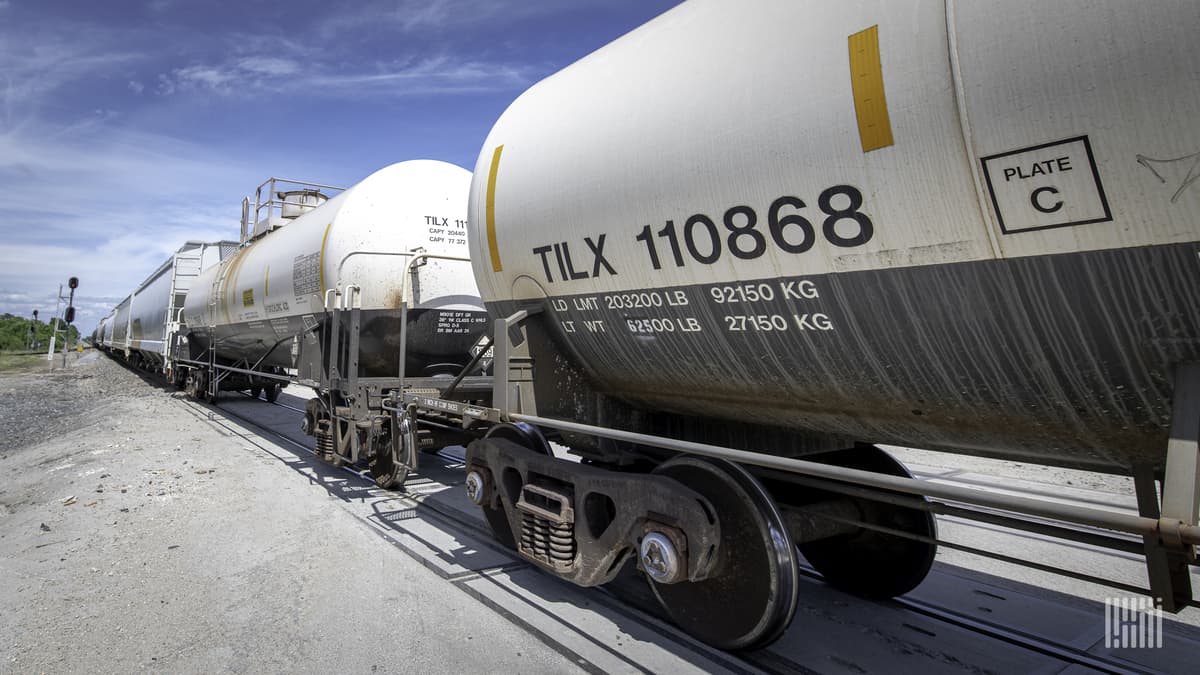
A photograph of tank cars parked in a rail yard.

Trinity Industries saw revenue and profit fall in the fourth quarter on fewer deliveries of new railcars and said U.S. tariffs are expected to cut industry deliveries by 20% in 2025.

For the three months ending Dec. 31, Dallas-based Trinity (NYSE: TRN) on Thursday reported revenue of $629 million, down from $798 million year over year, and operating profit of $112 million, off from $149 million.

Pretax earnings fell to $191 million from $225 million. Diluted earnings per share totaled 39 cents from 82 cents a year ago.

Trinity delivered 3,760 railcars in the quarter and recorded 1,500 new orders. Lease fleet utilization was 97% with a future lease rate differential (FLRD) of positive-24.3% at quarter’s end. The owned lease fleet was 109,635 cars, up from 109,295 y/y. Investor-owned lease cars was higher at 34,230 from 33,005.

For full-year 2024, revenue climbed to $3.1 billion from $2.9 billion on higher volume of external repairs and higher lease rates, as well as higher deliveries, partially offset by a lower volume of sustainable railcar conversions in the Rail Products Group.

Operating profit was $491.5 million, up from $417 million. Pretax earnings of $804.1 million increased from $720.1 million. Diluted earnings per share of $1.82 improved from $1.38.

“In our Railcar Leasing and Services Group, we concluded the year with a 10% year over year revenue increase,” said Chief Executive and President Jean Savage, in a release. “We have now repriced over half of our fleet in a higher rate environment while maintaining a favorable utilization rate. We expect these positive trends to continue. In the Rail Products Group, the impact of improved labor and operational efficiencies is evident with a 68% full-year improvement in profit despite relatively flat revenue performance.”

Savage said Trinity expects industry deliveries of 35,000 cars in 2025, “approximately a 20% decrease from 2024 as uncertainty around tariffs is delaying investment decisions.”

Those tariffs would mean higher prices on imported steel, aluminum and other raw materials used in railcar production, which would also affect carloads, as well as higher interest rates that are expected to damp demand. 

About 90% of railcar production by American builders is located outside the U.S.

Trinity offered initial full-year earnings estimates of $1.50 to $1.80 per share.

Subscribe to FreightWaves’ Rail e-newsletter and get the latest insights on rail freight right in your inbox.

Related coverage:

Norfolk Southern reopens Heartland Corridor after repairing flood damage

Union Pacific to lease 1.25 miles of Kansas City trackage to new shortline railroad

US weekly rail traffic shows slight gain over 2024

Union Pacific locomotive to honor Abraham Lincoln

Newspaper: Trump to order hostile takeover of US Postal Service

Rows of Postal Service vans in a parking lot.

President Donald Trump plans to remove the leadership of the U.S. Postal Service and take away the agency’s independent status by placing it under the direct control of the White House, which poses a risk for disruption of mail and parcel delivery, according to exclusive reporting by The Washington Post.

The newspaper, citing six anonymous sources, said the Postal Service’s board of governors is prepared to contest a hostile takeover in court, and postal experts said such a takeover would probably be illegal.

Trump will issue an executive order within days putting the Commerce Department in charge of the Postal Service, The Washington Post said. Some policy observers see that as a first step toward privatizing the nation’s mail carrier. Before taking office, Trump expressed interest in making the Postal Service, which employs more than 533,000 people, a private enterprise. 

Such an action would align with an executive order on Tuesday aimed at consolidating power that would require independent agencies like the Securities and Exchange Commission, the Federal Communications Commission, the Federal Trade Commission and Consumer Protection Safety Commission to submit proposed regulations to the White House for review. The order also orders agency heads to submit any strategic plans to the Office of Management and Budget and for OMB to review the agencies’ spending to ensure it fits with the president’s priorities.

A clue that change was afoot at the Postal Service came Monday when Postmaster General Louis DeJoy notified the board he planned to resign. The announcement was a surprise because DeJoy, a Trump donor in 2020, was hired during the first Trump administration by a postal board made up of Trump appointees and is in the midst of a 10-year campaign to modernize the money-losing agency and strip out $4 billion in annual costs.

Trump’s ability to execute a postal power grab could be enabled by filling several vacancies on the board of governors. The board selects the postmaster general, subject to confirmation by the U.S. Senate.

Last month, the Post reported that Trump was looking for candidates to replace DeJoy even though the president doesn’t have direct authority to fire him.

A Postal Service spokesperson did not respond to a FreightWaves request for information. A White House media official told the Washington Post after the story was published that no executive order regarding a Postal Service capture was planned. 

“If this reporting is true, it would be an outrageous, unlawful attack on a storied national treasure, enshrined in the Constitution and created by Congress to serve every American home and business equally. Any attack on the Postal Service would be part of the billionaire oligarch coup, directed not just at the postal workers our union represents, but the millions of Americans who rely on the critical public service our members provide every single day,” Mark Dimondstein, president of the American Postal Workers Union, said in a statement.

“The public Postal Service is the low-cost anchor of a $1.2 trillion mail and shipping industry, which supports more than 7 million jobs in communities across the country,” he added. “Efforts to privatize the Postal Service, in whole or in part, or to strip it of its independence or public service mission, would be of no benefit to the American people. Instead, it would drive up postage rates and lead to reduced service, especially to rural America.”

John Costanzo, a parcel and freight transportation consultant, agreed in a phone interview that the postal board may need some revamping but wasn’t sure how the agency would function under the Commerce Department.

He predicted large mailers who are used to huge taxpayer-subsidized discounts for bulk mail flyers will complain the loudest about any transfer of power.

“I think one of the outcomes of this might be a relook at that kind of archaic system, and you’ll hear a lot of screaming by direct marketers and periodical companies,” Costanzo, who runs advisory firm LDK Global, said. 

He endorsed the idea of making the Postal Service a private company, pointing to the successful privatizations of national mail carriers in the Netherlands, Germany and the United Kingdom.

“Technically, they are a private corporation, but they have no latitude to do anything. So if they get that change, that’s a good thing,” he said.

DeJoy defends policies

The uneven rollout of Delivering for America, as well as insourcing of parcel delivery handled by couriers and rising prices for stamps and packages, has generated criticism. Large retailers that use the postal network say DeJoy’s strategy should be reevaluated, especially rate hikes for last-mile package delivery that have motivated FedEx and UPS to self-handle economy packages rather than inject bulk shipments at destination postal centers.

The Postal Regulatory Commission (PRC), which oversees the agency’s service and rates, recently questioned the effectiveness of DeJoy’s transformation initiatives, saying they are negatively impacting service for certain products and rural communities, and that cost savings are overstated.

On Thursday, DeJoy pushed back on the PRC’s opinion about changing service standards. 

“I was confounded by the Commission’s dismissal of cost savings of nearly $4 billion a year as ‘meager,’ while characterizing service standard changes that are carefully designed and modest in impact within the current service standard day ranges as a ‘severe degradation’ in service that must be avoided at all costs,” DeJoy said in a response cover letter to PRC Chairman Michael Kubayanda.

“The PRC presents a completely one-sided narrative that unjustifiably ignores or dismisses as unlikely to occur all of the positive benefits of the proposal; at times misrepresents or misunderstands the Postal Service’s plans; and characterizes the service impacts in a way that lacks any sense of context or proportion,” the Postal Service said in its 34-page response. “The Postal Service’s legacy transportation and processing networks are highly inefficient, and therefore stand in the way of the achievement of … statutory obligations [for prompt, reliable and efficient service.] Much of this inefficiency is dictated by the Postal Service’s current service standards, and specifically the fact that those standards do not account for the time and effort needed to transport end-to-end mail and packages from the origin retail facility to the processing network; instead, the standards only reflect the distance between the origin and destination processing facilities.”

DeJoy argued the agency is operating a large number of trips from local post offices to sort centers with mostly empty trucks, which wastes money and adds to carbon emissions. The intent is to downgrade a minority of volume to a lower standard that adds an extra day to the delivery process for single-piece First Class mail originating in areas far from processing centers so that more volume can be accumulated for each truck trip to improve efficiency. The standards would still aim for final delivery within two to five days.

Postal Service management insisted the proposal is not “speculative” but reflects achievable operational strategies “which will lead to more cost-effective, precise, and reliable operations. Characterizing $4 billion in annual savings as ‘meager,’” Postal Service management said, “is nothing short of astonishing.”

DeJoy acknowledged that sweeping changes have led to temporary service disruptions in some areas, but said the best response is make adjustments based on lessons learned rather than giving up. He said the PRC had some positive suggestions that his team will adopt as part of its reform effort.

Click here for more FreightWaves stories by Eric Kulisch.

DeJoy announces plan to step down as Postal Service chief

TFI acknowledges US LTL ‘disaster’ and difficult Daseke integration in Q4

While the theme of TFI International’s fourth-quarter earnings call was much like that of the third quarter – its U.S. less-than-truckload operations are struggling years after the acquisition of UPS Freight – CEO Alain Bedard also turned his attention to how things are going at another high-profile acquisition: Daseke.

Bedard summed up the overall performance on the call with analysts: “Q4 was a disaster for us,” he said.

But that comment was mostly reflecting on the U.S. LTL operations, the core of which is TForce, built from the UPS acquisition.

As for Daseke, TFI (NYSE: TFII) bought the flatbed operator in April. Its performance is embedded in the TFI earnings for Specialty Truckload. The data in those numbers as well as Bedard’s comments make clear that the former Daseke operations have room for improvement.

“If you look at the trend since we bought Daseke in April, the second quarter was OK,” he said. “And then we had issues with revenue per mile that keeps dropping because the freight recession is still with us.”

Continuing into this quarter, Bedard said the former Daseke operations still suffer from “a very high pressure on rates,” though he added the decline has “stabilized.” “But the number of miles are down and our costs also are too high,” he said.

While revenue in the specialized truckload group was significantly higher – no surprise given that Daseke was not part of TFI in 2023 – other measures show how it has dragged down some performance metrics.

OR at former Daseke about 98%

For example, the adjusted operating ratio of the specialized truckload operations at TFI ballooned to 91.6% from 87% a year earlier. The return on invested capital fell to 8.5% from 10.3%.

While the specialized truckload data does not break out Daseke separately, the percentage of that business that is former Daseke can be estimated. Revenue in the fourth quarter, with Daseke included, was $531.9 million. A year earlier, without Daseke, it was $283.3 million, for an 87.7% growth.

And while the operating margin may be a combined number, Bedard talked about the performance. He said the legacy Daseke business is “probably running like a 98 OR.” And he lamented the fact that the specialized truckload segment at TFI, during his tenure, had always been a sub-90% OR and now is above that.

Bedard also said the legacy Daseke business was suffering from “too much capital invested.”

“And why is that?” he said. “Because when we acquired Daseke, they had committed to buy a large number of trucks, which we could not walk away from.”

The end result is that “we have way too many trucks in a very difficult environment.” The process to sell some of that excess is ongoing, Bedard said.

But he was generally optimistic about the future of the legacy Daseke operations. He said he believes TFI will be able to turn it around primarily through cost-saving measures, with equipment a key part of that. “If the market does not improve, we have a path forward by shedding equipment, improving our costs and improving our overhead as well,” he said. 

Stones in shoes

In contrast, the problems at the company’s U.S. LTL operations, the bulk of which came from the UPS acquisition, sound like they are going to be tougher to fix.

Bedard used a description made famous in various iterations of “The Godfather” trilogy: “TForce is a big rock in my shoe.” (The actual quote was “a stone in my shoe,” spoken by, among others, the legendary Joey Zaza, but the Bedard statement was memorable enough that Jason Seidl of TD Cowen, in his report on TFI’s earnings, titled it “TForce Becoming A Rock In TFI’s Shoe.”)

Bedard’s statements about TForce echo what he has been saying quarter after quarter: “Our costs are still too high. We’re also getting killed because our volume keeps dropping. Our shipment count is down 6% year over year. Although our weight per shipment is about the same, it’s still a very difficult environment. So we still have a lot of work to do at TForce Freight on the fleet side to reduce our costs.”

But Bedard looked forward and said, “We’re on the right track there.”

He returned to a theme he has discussed before: density. He said the Canadian LTL operations involve more deliveries in a smaller area, but that is not the case with TForce.

M&A might be needed

“The mission we give our sales force is to try to grow organically but also to try to improve the density,” Bedard said. Density in the Canadian operations is “second to none,” while the situation in the U.S. is “really bad.”

Fixing that may take an acquisition. “If you can’t get the density organically from your sales team, then you have to focus down the road in trying to find a target that could help,” he said. “You improve your density.”

The earnings report wasn’t greeted warmly by investors. By 10 a.m. Friday, TFI stock had fallen from about $122 at Wednesday’s close to less than $98 per share.

The research team at Bank of America Merrill Lynch led by Ken Hoexter cut its rating on TFI to underperform from neutral.

Several other negative aspects of the TFI earnings report and call with analysts about the issues at TForce were cited by Merrill Lynch: declining market share in profitable small to medium business, a rise in missed pickups and a claims rate of 0.9%, which is shockingly high when placed against the corresponding rate of LTL competitor Old Dominion Freight Line (NASDAQ: ODFL) of 0.1%.

Bedard summed up the disaster on the call and said conditions in the first quarter aren’t improving. “Q1 Is going to be a very difficult quarter,” he said. “We didn’t do a good job in managing our labor cost. We had too many issues with accidents and claims. If you look at my claim ratio, I went all the way to 0.9% of revenue, which is just unacceptable, right?”

In its earnings announcement Wednesday, TFI said it was going to “re-domicile” in the U.S. On the call with analysts, Bedard said the change would not involve moving employees from Canada to the U.S. 

More articles by John Kingston

State of Freight: taking stock of the market after a month of Trump

XPO lawsuit against 2 ex-employees gives look into noncompete agreements

Manhattan Associates’ sudden C-suite change not what it seemed, executives say

Norfolk Southern reopens Heartland Corridor after repairing flood damage

ATLANTA – Trains are rolling again on Norfolk Southern’s Heartland Corridor after flooding on the route in southern West Virginia, eastern Kentucky, southwest Virginia and eastern Ohio due to a storm that began last Friday.

Both mainline tracks were operational as of midday Thursday, NS said in a customer advisory. Service between Portsmouth, Ohio, and Bluefield, West Virginia, had been restored Tuesday but was closed again after subsequent washouts near Williamson, West Virginia.

The railroad has advised customers to expect residual delays over the next 72 to 96 hours due to the volume of backlogged traffic.

“Our thoughts remain with those who have been impacted by the severe weather event, especially the families mourning a loss of life and severe property damage. We are donating $100,000 to the American Red Cross for immediate and long-term recovery needs,” the railroad said in a statement Thursday. “Additionally, we have two programs in place to assist Norfolk Southern railroaders who have been impacted. Our teams have been working safely and urgently to restore service on affected routes, ensuring access for the region and our customers.”

NS is encouraging employees to donate to the Red Cross, with a 2-to-1 match, and will continue hosting blood drives throughout the year to support the Red Cross’ overall mission.

NS also said it will launch an Employee Hardship Fund in the coming weeks. The new initiative is designed to support railroaders and their families during natural disasters, medical emergencies or other qualifying events — ensuring help is available when it’s needed most. The activation will retroactively cover employees impacted by this incident and others, like Hurricane Helene. The program will be in addition to existing programs that NS activates when the Federal Emergency Management Agency declares a natural disaster.

UP to lease 1.25 miles of Kansas City trackage to new shortline railroad

WASHINGTON – Union Pacific will lease 1.25 miles of trackage in Kansas City, Missouri, to a new Jaguar Transport short line in March.

The Kansas City West Bottoms Railroad will serve a cluster of customers located off UP’s KC Metro Big Mary Subdivision between milepost 0.63 and milepost 1.6 in Kansas City, according to a regulatory filing. KCWB also will lease and operate the adjacent State Line Yard trackage.

“Union Pacific and Jaguar Transport are excited about the growth potential of the … short line railroad and the positive impact that the operation will have on local industries,” UP spokeswoman Robynn Tysver said.

The deal – the second transfer this year of UP local switching operations to a short line – is scheduled to take effect on or after March 2.

UP is handing off local and yard operations in Eugene, Oregon, to Genesee & Wyoming short line Central Oregon & Pacific.

Jaguar representatives did not respond to an email requesting additional information about the Kansas City transaction. Jaguar currently operates 15 short lines, including industrial switching agreements.

Trucking execs see green shoots as industry awaits upturn

sideview of a parked Werner tractor-trailer with a driver

Signs that a freight recovery may be taking shape continue to surface, said trucking executives on the investor conference circuit this week. The overall sentiment is that the truckload industry is no longer in a recession and that normal seasonal trends have returned, but no one is ready to commit to when a meaningful positive inflection will occur.

“We know we’re coming off the bottom of the market,” Drew Wilkerson, CEO at truck broker RXO (NYSE: RXO), told investors at Citi’s 2025 Global Industrial Tech and Mobility Conference in Miami on Wednesday. “You are starting to see the signs of a market that’s shifting. The thing that’s not known is, what’s the pace of the recovery?”

He cited a recent run in TL spot rates and noted that contract rates have turned positive. He also talked about the increase in carrier tender rejections and said internal data shows load-to-truck ratios have nearly doubled year over year.

RXO is calling for contract rates to increase y/y by low- to mid-single digits this year. The company’s TL revenue per load is up y/y by a low-single-digit percentage to start the year after being flat in the fourth quarter.

SONAR: Outbound Tender Reject Index for 2025 (blue shaded area), 2024 (green line) and 2023 (pink line). A proxy for truck capacity, the Outbound Tender Reject Index, shows the number of loads being rejected by carriers. Current tender rejections are outperforming the levels seen at the beginning of 2023 and 2024. To learn more about SONAR, click here.
SONAR: The National Truckload Index (linehaul only – NTIL) for 2025 (blue shaded area), 2024 (green line) and 2023 (pink line). The NTIL is based on an average of booked spot dry van loads from 250,000 lanes. The NTIL is a seven-day moving average of linehaul spot rates excluding fuel. To learn more about SONAR, click here.

Management from TL carrier Werner Enterprises (NASDAQ: WERN) offered some positive anecdotes as well.

The company said dialogue with customers – mostly nondiscretionary retail and food and beverage companies – has been more positive than it was a year ago. The carrier is coming off a peak season in which project freight volumes doubled y/y even though rates were higher.

Werner also pointed to an improvement in spot rates and said its one-way TL unit has seen two straight quarters of y/y rate improvement. It is calling for a “gradually improving market throughout the rest of the year.” The outlook calls for rate per total mile in the one-way fleet to increase by 1% to 4% y/y during the first half of 2025, with revenue per truck per week in its dedicated unit to be flat to 3% higher for the full year.

Management said it was still early in bid season but results from contractual negotiations are consistent with expectations heading into the year. It expects truck capacity to continue to exit even as the market improves, pointing to the end of payment forbearance programs as lenders to the industry are taking sizable write-offs.

“If you’re a small or medium-size carrier that’s just been barely scraping by and maybe doing an interest-only payment, or maybe not making a payment at all, and the [market] turn comes later, it’s probably too late,” Nathan Meisgeier, Werner president and chief legal officer, said at Barclays 42nd Annual Industrial Select Conference in Miami on Wednesday.

“Even with an improvement in spot rate, even with the turn, we expect to see capacity attrition. We’re still seeing it right now.”

Werner is calling for truck growth of 1% to 5% y/y, with most of the additions coming at its dedicated fleet where the pipeline remains strong.

J.B. Hunt Transport Services (NASDAQ: JBHT) said the fact that it doesn’t have anything negative to announce is probably a positive. It said the market has reached an inflection as normal seasonal patterns have returned after a 30-month-plus freight recession. Its customers are bracing for TL rates to increase 3% to 8% y/y in 2025 but it also cautioned that the same customers were expecting rate increases a year ago. 

The company said it’s still too early to forecast what will happen with intermodal rates this year but that it plans to focus on freight selection in hopes of running a balanced network with improved asset utilization and minimal repositioning costs.

It also expects to get back to adding trucks in its dedicated service, without any notable offset from customer attrition, by the back half of the year. The company placed more than 1,700 trucks into a new service last year, but the additions were wiped out as some customers cut back on their capacity needs and others went out of business.

J.B. Hunt reiterated a long-term goal of adding 800 to 1,000 net trucks in dedicated annually.

Interested in more analysis of the current freight market? Watch the February edition of The State of Freight webinar here.

More FreightWaves articles by Todd Maiden:

FreightWaves’ first Fraud Symposium

FreightWaves is hosting its first-ever Freight Fraud Symposium on May 14 in Dallas, a must-attend event for industry leaders battling the growing crisis of freight fraud. 

With scams becoming more sophisticated and brokers facing increased legal risks, this exclusive gathering will provide crucial insights, expert discussions and high-level networking opportunities.

Designed for transportation executives and technology buyers, the symposium will explore the latest fraud prevention strategies to protect your business. 

Don’t miss this chance to stay ahead of emerging threats — register now and join the fight against freight fraud! 


Closing the software understanding gap 🧑‍💻

A newly released federal report underscores a growing cybersecurity risk: the software understanding gap.

This gap – the disconnect between the rapid advancement of software development and the ability to fully comprehend and secure it – poses serious threats to critical infrastructure, national security and supply chain sectors, according to the report from the Cybersecurity and Infrastructure Security Agency, the Defense Advanced Research Projects Agency, the Office of the Under Secretary of Defense for Research and Engineering, and the National Security Agency.

The report highlights how software has become foundational to essential systems, including logistics networks, fleet management platforms and digital freight marketplaces. However, the rapid evolution of the technology leads to vulnerabilities that can be exploited by cybercriminals and state-sponsored actors.

Notably, the report warns that China has strategically invested in software research and security, positioning itself ahead in a digital arms race. China’s policies require foreign and domestic software to undergo national security reviews, ensuring that the Chinese government maintains control over critical digital infrastructure.

Cyberattacks targeting supply chain software have already resulted in major disruptions. The 2021 Colonial Pipeline ransomware attack is a prime example: Cybercriminals exploited software vulnerabilities, leading to fuel shortages and widespread operational disruptions. 

The report also cites the 2021 SolarWinds attack and recent exploits by groups such as Volt Typhoon, which have infiltrated critical infrastructure networks, including transportation and logistics systems.

The freight industry increasingly relies on AI-driven logistics, automated warehouses and interconnected tracking systems, all of which are susceptible to cyberthreats due to the software understanding gap. This lack of deep insight into software vulnerabilities could allow malicious actors to manipulate supply chain operations, disrupt fleet communication networks and compromise data integrity.

To mitigate these risks, the report calls for a shift toward “secure by design” principles, advocating for rigorous software verification, third-party security measures and improved risk assessment capabilities. Current reliance on patchwork solutions is insufficient to protect against sophisticated cyberthreats.

For the freight industry, this means adopting security-first approaches in transportation management systems, fleet tracking software and digital freight matching platforms. Companies must prioritize continuous software validation, invest in cybersecurity expertise and collaborate with industry and government partners to enhance resilience.

(Photo: Rhymetec.com)

Random train heist or inside job? 🛤️

Thieves are increasingly targeting high-value cargo on Arizona trains, with a recent heist involving $440,000 worth of a style of Nike shoes that had not yet been released. 

The culprits disabled the train’s brake system, stole the goods and hid them until the suspects were tracked and apprehended. Experts suggest inside knowledge of cargo locations may be fueling these crimes, with transnational criminal organizations increasingly focusing on high-ticket items like electronics and apparel.

Eleven arrests were made, including 10 undocumented individuals. Experts are calling for greater safety measures and vigilance to prevent these escalating incidents. Public tips on suspicious activity could be key in preventing future heists in the area.

(GIF: Tenor)

Protect yourself with The Playbook 📖

Small carriers play a crucial role in the trucking industry, but they face significant risks, like double brokering and freight fraud. Building strong relationships with shippers and brokers can help prevent these issues and foster trust.

To navigate these challenges, check out FreightWaves’ new offering, The Playbook. Launched on Feb. 14, this comprehensive guide, created by Adam Wingfield, provides educational resources tailored to small carriers. With tools like The Roadmap, Masterclass and The Long Haul podcast, The Playbook equips carriers with the knowledge to thrive and protect their business.

Join today at www.freightwaves.com/playbook.

(Photo: FreightWaves)

From the Fraud Desk

Recent drug seizures at ports of entry in 3 states top $32M

Missouri truck company owner gets 9 years for PPP fraud, other felonies

Feds taking another look at truck-broker contract rules

State of Freight: Taking stock of the market after a month of Trump

One month after the inauguration of Donald Trump, his impact on the freight market was front and center in the FreightWaves February State of Freight webinar. 

Here are five takeaways coming out of the discussion between Craig Fuller, founder and CEO of FreightWaves and SONAR, and SONAR Director of Freight Market Intelligence Zach Strickland. 

Trump has added to market uncertainty

“The reality is that Donald Trump’s willingness to implement policies really quickly without a lot of warning is certainly in vogue,” Fuller said. “And I think the issue or the challenge is that you really don’t know what’s next.” 

That risk is across the board, “whether you’re pro-tariff, anti-tariff, pro-DOGE or you think it’s the worst thing to happen since whatever,” he said, referring to the newly formed Department of Government Efficiency.

In the freight sector, uncertainty is the “overriding theme,” Fuller said. Some reactions to that uncertainty have already shown up, he added, such as the inventory “pull forward” that has resulted in extremely strong import numbers at the ports of Los Angeles and Long Beach in recent months. “So that continues to be a constant struggle for a lot of these companies to figure out, OK, regardless of what we think about demand, what are we going to do?” in the face of Trump-created uncertainty, according to Fuller.

But Fuller said he still believes that tariffs, at least in the short term, are “generally good for domestic trucking.”

The drop in volume 

Strickland noted an unusual decline in the Outbound Tender Volume Index (OTVI) in SONAR, which measures freight volume. The OTVI has held relatively steady during the three years of the freight recession, lending support to the idea that the issue in the market is not one of inadequate freight moving on trucks but rather too much capacity to haul it.

Strickland said while some decline into February might usually start the month, at some point “we’d start to see a pickup.” But that hasn’t been the case this month. Strickland suggested that a tough winter – one of the harshest in many years in parts of the country – has had some impact on volumes. “I think we’re seeing a little bit of death by a thousand cuts,” he said. 

Strickland cited data from ports that suggested imports should be rising soon. “The imports, when they come back in March, should recover a lot of that softness in February,” Fuller added. 

Jack Cooper and other impacts on capacity

Auto hauler Jack Cooper shut down earlier this month, though it does not appear to have filed for bankruptcy yet. (And the family that owns the company has headed off in a new direction in the less-than-truckload business.) What does that mean for capacity?

Strickland noted that the Outbound Tender Reject Index (OTRI), a proxy for capacity, has not declined in sympathy with the drop in the OTVI. 

Fuller chimed in that even with “all the other elements in the economy,” tender rejections were in “a pretty good spot compared to where they were over the last couple of years.”

Two years ago, the OTRI was a little more than 3%. A year ago it was hanging around 5%. On Thursday, SONAR reported the OTRI at 5.6%.

“It is telling us what we want to hear, which is that capacity is resetting,” Fuller said. “That reset is continuing.”

As far as the exit of Jack Cooper, Fuller said it “would create some level of disruption inside the market, “even though the act of hauling cars, which is Jack Cooper’s business, is different than dry van transportation. The Jack Cooper drivers will be absorbed into the market, he said, though not likely in a union job like the rank and file had at Jack Cooper. 

“From a long-term perspective, this is sort of what you want to see if you’re able to hang in there,” Fuller said. A significant closure or bankruptcy could result in bankers becoming skittish about lending money to the industry, he said, “and I think those things are generally positive if you’re operating in the business and you’re not Jack Cooper.”

Rates are probably at their lowest

If the weakness in volume has shown up anywhere, it has been in spot rates. Strickland highlighted a chart of the National Truckload Index Linehaul Only (NTIL) rate that showed it was at $1.98 per mile on Jan. 11 but was down to $1.71 per mile on Wednesday.

Fuller said the rates “suck.” But he said that “the fact that in mid-February and where it’s at when  Chinese New Year is also in effect, I think I consider it a positive. And I think I’ve been looking at the spot market as the effective bottom end of the market in terms of rates.”

He noted that the spread between spot and contract rates, which got as wide as spot being $1 less than contract deals in 2022, is now at about 50 cents. While that is still low, “it hasn’t gotten worse. To that, that says that again we are largely in a recovery phase.”

Intermodal still having an impact

All the data coming out of the intermodal sector has been bullish. Strickland said he has been watching “how intermodal has been really a drag on the demand side of the trucking sector. I’m looking to see how that sustains.”

“A lot of shippers have shown that they’re OK with some level of dwell time and increased service deterioration, as they kind of have this rolling storage situation moving,” Strickland said. “How long does that persist?”

The strength in intermodal means there’s been a boom in short-haul trucking. Should that trend stick, he said, “a lot of the trucks are being utilized for much shorter movements around these cities, and that’s going to change the way that a lot of these carrier networks operate.”

More articles by John Kingston

XPO lawsuit against 2 ex-employees gives look into noncompete agreements

Manhattan Associates’ sudden C-suite change not what it seemed, executives say

Missouri truck company owner gets 9 years for PPP fraud, other felonies

Lawmakers demand details on DOT’s workforce cuts

DOT HQ Washington, DC

WASHINGTON — Senate Democrats want Transportation Secretary Sean Duffy to stop mass layoffs and firings at the Department of Transportation and are questioning Elon Musk’s role in the department’s downsizing strategy.

Duffy at his nomination hearing on Jan. 15. Credit: U.S. Senate

DOT’s roughly 57,000 employees have been among those affected by the sweeping federal workforce reduction mandate initiated during the first weeks of the Trump administration.

“At the Department of Transportation, safety must come first, but that commitment appears in doubt as the Trump administration promotes cost-cutting over protecting the public,” wrote Sen. Ed Markey, D-Mass., in a letter sent on Thursday to Duffy, co-signed by 12 of his Senate colleagues.

“We urge you to cease this dangerous approach to governing and request important information on how the [DOT] plans to prioritize safety in this environment.”

Much of the alarm in the letter is directed at workforce cuts at the Federal Aviation Administration in the wake of the deadly crash on Jan. 29 at Washington’s Reagan Airport, raising concerns about giving Musk and the Department of Government Efficiency (DOGE) “free [rein] to cut the federal workforce,” and “turning Musk, DOGE, and their unqualified staff loose on the air traffic control system.”

But they also underscored the role of DOT’s subagencies, including the National Highway Traffic Safety Administration, the Federal Railroad Administration and the Pipeline and Hazardous Materials Safety Administration, as well as the need to maintain employees responsible for public safety at those agencies.

Bradbury at his nomination hearing on Feb. 20. Credit: U.S. Senate

“Their expertise, experience, and commitment cannot be easily replaced,” the senators wrote.

The letter coincided with the nomination hearing on Thursday of Steve Bradbury, the Trump administration’s pick to be Duffy’s deputy at DOT.

Bradbury was questioned about Musk’s potential conflict of interest as the head of DOGE at the same time that NHTSA is investigating the safety of self-driving technology at Tesla (NASDAQ: TSLA), of which Musk is CEO.

“Are you fully committed to ensuring that the Department of Transportation holds Tesla accountable if you’re confirmed?” asked Sen. Gary Peters, D-Mich.

“Yes,” Bradbury responded, adding, “and I believe the secretary [at his nomination hearing] was very firm in saying he would not treat any particular company favorably vis-a-vis other companies. In other words, we would have a fair and objective approach, in particular regarding NHTSA’s recall investigations on these important issues.”

The letter to Duffy asked for written answers, by March 13, to five questions “to help us better understand your plans for ensuring transportation safety”:

  • How many DOT employees were offered the buyout? How many accepted? How many declined or did not respond? Identify by subagency where these workers were employed. [The buyout refers to a Jan. 28 email sent from the Office of Management and Budget to federal workers offering eight months’ pay in exchange for their resignation.]
  • How many DOT employees were ineligible to take the buyout? Identify them by job title and subagency.
  • How many DOT employees have lost their jobs since Jan. 20? Identify them by job title and subagency.
  • Describe Musk’s and DOGE’s role in reviewing DOT personnel and program information. What steps is the department taking to ensure that Musk and the DOGE do not compromise public safety?
  • Describe Musk’s and DOGE’s involvement with the [air traffic control] system. Include in the answer where, when and how they will have access to it and the steps DOT is taking to ensure that air traffic safety is not compromised.

Click for more FreightWaves articles by John Gallagher.