Disruptions panel: Supply chain stronger after pandemic, but more work is needed

Port of L.A. Pier 300

WASHINGTON, D.C. — Transportation stakeholders are taking a lesson from the pandemic and taking steps to ensure a resilient supply chain, so future disasters don’t turn into catastrophes.

“There’s a difference,” said Jose Holguin-Veras, director, Center for Infrastructure, Transportation, and the Environment (CITE) at Rensselaer Polytechnic Institute. “A disaster assumes a region has the resources to respond within three days. 

“A catastrophe wipes out the local capacity to respond.”

Holguin-Veras spoke at a panel discussion on supply chain disruptions Sunday at the opening session of the Transportation Research Board’s 104th annual meeting. The event attracts public and private entities along with academics, researchers, suppliers and other transportation stakeholders from around the world

“Disruptions occur on a port site almost every day,” said Jonathan Daniels, executive director, Maryland Port Administration (MPA). “I oversee 20,000 employees at the MPA, and stakeholders from rail, highway and maritime. We do a lot of ‘tabletops’. The [Francis Scott] Key bridge collapse in the Port of Baltimore in March 2024] involved more than 200 stakeholders.” 

A tabletop exercise is a scenario-based methodology to test and refine emergency response plans.   

A potential disruption occupying the attention of Daniels and other East and Gulf coast port executives is a potential strike by the International Longshoremen’s Association (ILA).

The union and port employers represented by the United States Maritime Alliance (USMX) are expected to resume contract negotiations on Tuesday, just a week before the current contract extension ends Jan. 15.  

“An ILA walkout would be a local disruption in many respects but international in impact,” Daniels said, alluding to how a port shutdown would ripple through global logistics. “Hopefully that won’t occur as the sides are going back to the negotiating table this week.”

The panelists addressed how planning for disruptions has changed since the Covid pandemic, an event that put the worldwide supply chain in the headlines.

Daniels, who worked at the Mississippi State Port Authority and Port Everglades, Fla., during the pandemic, said the hardest part was not knowing how long it was going to last.

“But we did know that how we dealt with passenger ships was going to carry over to the cargo side. We were seeking to minimize the effects of disruption, both on the ships and on the docks. What we learned was how to put plans to counter large disruptions into effect very quickly and effectively. So now, it’s like muscle memory, putting in place protocols and procedures, scaling activities into large container terminals with thousands of people. Some of those at Port Everglades and at Baltimore put in place in 2020 and 2021 are still in place.” 

Other panelists noted that there were signs supply chain required more attention even before the pandemic.

“We heard pre-Covid in the state legislature that there needed to be an elevated voice for freight,” said Christine Casey, deputy secretary for freight policy for the California State Transportation Agency and the first such cabinet-level appointee, by Gov. Gavin Newsom. 

“Everybody notices when the state stops working, that’s where my position and team came from, with direct communications with the Governor. We saw disruptions most visibly at the Port of Los Angeles-Long Beach, with all the ships waiting to get in. We want too get it front of mind for policy makers, for policy changes that will help in the future, coordinating with industry, an open-door policy with freight and transportation stakeholders.” 

Emergency response also needs to be focused on the most vital freight, what one panelist termed supply chain exclusivity.

“That Covid could happen was something that we never think about,” said Farideh Dassi, senior planner for the Texas Department of Transportation. “We have to respond to the public, how to make a disaster less disruptive and how we can move goods like food and medication and fuel.” 

In 2017 access to Port Houston, the second-busiest U.S. port, was cut off when Interstate 10 was flooded by Hurricane Harvey. Said Dassi, “We planned for alternate highway movements for freight on I-610. We also had to carefully consider freight movements coming up from Mexico because we don’t have alternatives. That involves a lot of fruit imports. But we’re working on that so we can have alternate infrastructure for that.”

Daniels said how planning for disruptions was informed by what he learned from his father, a grain shovelman at the Port of Erie, Pa., and a football coach.

“Talk about hard work — a shovelman made sure grain didn’t clog during loading of ships. As a coach, I saw how he prepared and anticipated the next play,” said Daniels, who worked as a defensive coordinator for Maine Maritime Academy football. “You have to think 30 seconds ahead, and what the next play is moving forward. Like, what do we have to do to prepare for disruptions in other parts of the supply chain? Resiliency within port structures, and how trucking and rail have to step up.”

Ever the football coach, when asked by FreightWaves Daniels said that he preferred a base 3-4 defense “because of its flexibility, for logistics planning.”

“The pandemic was a case study in resiliency and disruption, and how it affected the supply chain global implications. I learned about time management in small increments, and how to work with my counterparts at other ports. I hate to do it because we are competitors, but Covid impacted us as a whole. 

“Sometime you need to step outside the competitive advantage that we have to ensure that it all works smoothly.” 

There’s ample available research into supply chain, said Casey, but how to tap into that research to make it usable for decision-makers is a challenge, particularly when it’s sometimes collected in a bubble. 

“Next, and so important, is having the voices of stakeholders in my head when we’re freight planning. There’s a lot of noise but you have to hear all of it. There’s not always one right answer.

“You have to have everything in front of you before you make a decision.”

The nub, Dassi said, “is what does ‘freight’ mean, and how do we work with that? As a state agency, we are working for the public. But they don’t want to know about policy, so we want to transmit a simple message.” 

In a separate panel focused on international disruptions, Georgia Ayfantopoulou, senior advisor for the Hellenic Institute of Transport, Greece, said, “We learn through impacts. Planning, forecasting — we are always looking for new models for forecasting. And, we need more coordination to plan for the future.”

What’s the elephant in the room?

Port analyst Walter Kemmsies said shipping has learned the hard way to diversify.

“Assessing risk, for example. [Shippers] have to use more ports, more gateways. Don’t bring all your shipments from Asia into Los Angeles — that’s stupid if something happens [to the port].”

Important as diversification is, Kemmsies added that because so much of business is dominated by Wall Street interests, “they want us to keep costs down, and don’t want us to buy ‘insurance’ But I need to pay for insurance if I’m going to stay in business, no matter what the MBA’s say.”

Ayfantopoulou said collaboration is needed to produce disruption solutions. 

“Solutions come from innovation. But we need to see the validity of the technology that provides the solutions. It must be well-defined and well-selected, and heuristic. There is always new research agenda — new models, new ways of profiling new tools. The elephant in the room is cost. In Europe, there is something else: We are going for green transport and that will add costs. 

“How will we share those costs of making things happen?”   

What’s missing?

“If I’m a shipper, I want U.S. locations that are going to have a good Nafta trade, for domestic and global flows,” Kemmsies said. “That would be Dallas, for all three coasts, highway connections. Shippers are always looking for the three Cs: costs, consistency, and capacity. But we have found the freight planning for that is woefully inadequate. Working with commercial real estate companies, we have knocked a lot of [U.S.] locations off this list because they don’t have those things. We need to think a lot more about shippers. For international it’s even worse; there are only a handful of ports for that.” 

Modernizing project management, policy-making, and planning should be international priorities. 

“In Europe, planning is not very well coordinated, planners need to build on a consistent approach,” said Ayfantopoulou.

Kemmsies said that lack of coordination was missing in the U.S. during the pandemic. 

“Truck drivers were turning back because they found state-to-state differences in what was ‘essential’ freight. It was incredible how much food got [wasted] because it was going somewhere that wasn’t considered essential.”

It was pointed out that current container volumes moving through the Port of Los Angeles-Long Beach Port are approaching pandemic numbers, but with no disruptions.

What Kemmsies terms the fiefdoms of railroads moving coal, grain, and other freight, are fading.

“You can’t have that in a resource-constrained system like we have,” he said. “In Los Angeles, what we are seeing is that this is changing. Same in Savannah [Georgia]. We are seeing domestic and international trains being built in the same place. Why? Because it makes sense. Domestic is beginning to work more with international.”

Difference between disasters and catastrophes 

The panelists advised planners to fortify the supply chain ahead of catastrophic events.

“Disaster response plans are designed for disasters, and assume locals have the capacity to respond within the first three days,’ said Holguin-Veras. “But a catastrophe requires a different way to respond.”

He pointed out that government and religious leaders died in the Haiti earthquake of 2010, and in the tsunami that devastated Kobe, Japan in 2011. 

“In Puerto Rico there were basically no local supplies after Hurricane Maria [in 2017], he said. “We need to pre-position supplies. I don’t believe what we are doing is enough to prepare.” 

To that end, Ayfantopoulou said critical networks need to be developed, as part of capacity-building for logistics infrastructure.

“We’ve studied all that but the economics are tough,” Kemmsies said. “There’s a cost-benefit curve that you trace out over time. And, the interior of this country doesn’t see as much of that as the East Coast, and places that get frequent storms. A lot more needs to be done. People don’t understand that a supermarket is critical infrastructure if an ice storm takes out the electrical grid.”

Find more articles by Stuart Chirls here.

Related coverage:

CMA CGM delays US East Coast container surcharge

Maersk urges container pickup ahead of potential port strike

Sources: ILA, USMX to restart contract talks ahead of deadline for possible port strike

Borderlands Mexico: US wins multibillion-dollar corn dispute with Mexico

Borderlands is a weekly rundown of developments in the world of United States-Mexico cross-border trucking and trade. This week: US wins multibillion-dollar cross-border corn dispute with Mexico; China-based carrier launches new ship for Mexico trade route; Volkswagen moves Golf vehicle manufacturing to Mexico; and Parts Town opens Phoenix area distribution center.

US wins multibillion-dollar cross-border corn dispute with Mexico

A five-year battle over Mexico’s ban on imports of genetically modified (GM) corn grown in the U.S. ended after a panel ruled the ban violated the U.S.-Mexico-Canada Agreement (USMCA).

The USMCA panel agreed with the U.S. on all seven legal claims, issuing its finding on Dec. 20 that Mexico’s GM corn ban is not based on science and prohibits market access that Mexico agreed to provide as part of the trade agreement.

“The panel’s ruling reaffirms the United States’ longstanding concerns about Mexico’s biotechnology policies and their detrimental impact on U.S. agricultural exports,” U.S. Trade Representative Katherine Tai said in a news release.

Under USMCA rules, Mexico has 45 days from the date of the final report to comply with the panel’s findings.

American Farm Bureau President Zippy Duvall said the panel’s decision will help U.S. farmers.

“If left in place, Mexico’s restrictions would have impacted the corn supply chain, stifled innovation, hurt trade and opened the door for other countries to pursue similar restrictive measures,” Duvall said in a statement.

Mexico’s plan to prohibit the importation of GM corn began in 2020, when then-President Andres Manuel Lopez Obrador said he would eliminate the use of the herbicide glyphosate and genetically modified corn in the country. (Photo: Shutterstock)

Mexico’s plan to prohibit the importation of GM corn began in 2020, when then-President Andres Manuel Lopez Obrador said he would eliminate the use of the herbicide glyphosate and GM corn in the country.

Lopez Obrador was also pushing for Mexico to achieve self-sufficiency in production of white corn. In June 2023, Mexico began imposing a 50% tariff on white corn exports entering the country from the U.S.

The United States requested the dispute settlement panel in August 2023, bringing six legal claims under the USMCA’s sanitary and phytosanitary measures chapter and one legal claim under the chapter on national treatment and market access for goods.

The USMCA panel’s ruling comes at a time when Mexico is importing increasing amounts of corn and other agricultural goods from the U.S. Mexico is the largest importer of U.S. corn, both yellow and white.

From January through October, the U.S. exported $4.8 billion of corn to Mexico. In 2023, Mexico imported a total of $5.3 billion worth of U.S. corn.

Mexico was the No. 1 export market for U.S. agricultural producers in 2024. The market grew 7% year over year to $30 billion compared to 2023, according to the U.S. Department of Agriculture.

Canada was the No. 2 market for U.S. agricultural goods at $29 billion, followed by China at $27.5 billion.

The majority of U.S. corn is produced in states such as Iowa, Nebraska and Illinois, and shipped by rail, truck and barge, according to the USDA. The bulk of U.S. corn exports to Mexico are shipped either from the Port of New Orleans via container ship or by truck from the port of entry in Laredo, Texas.

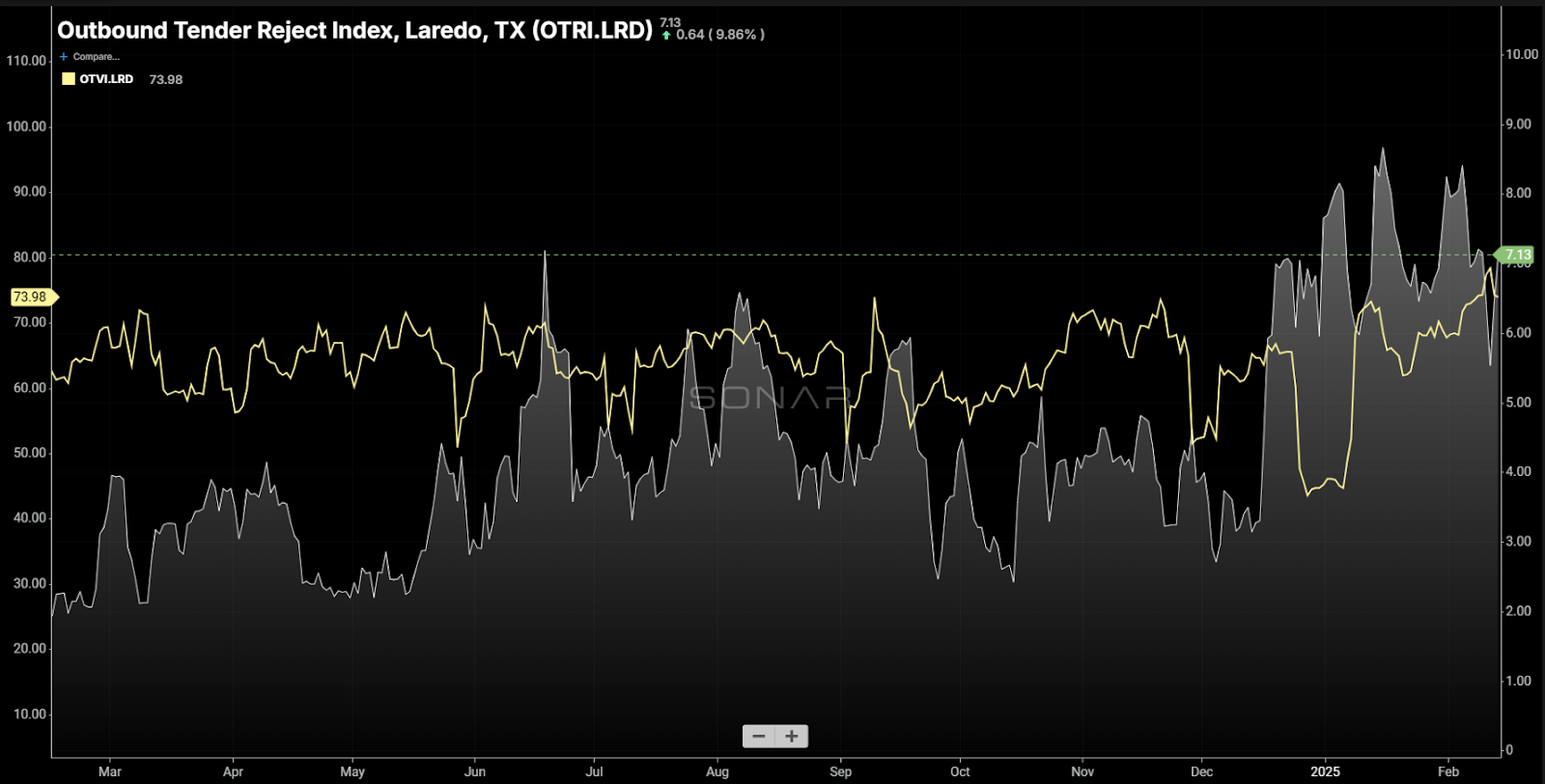
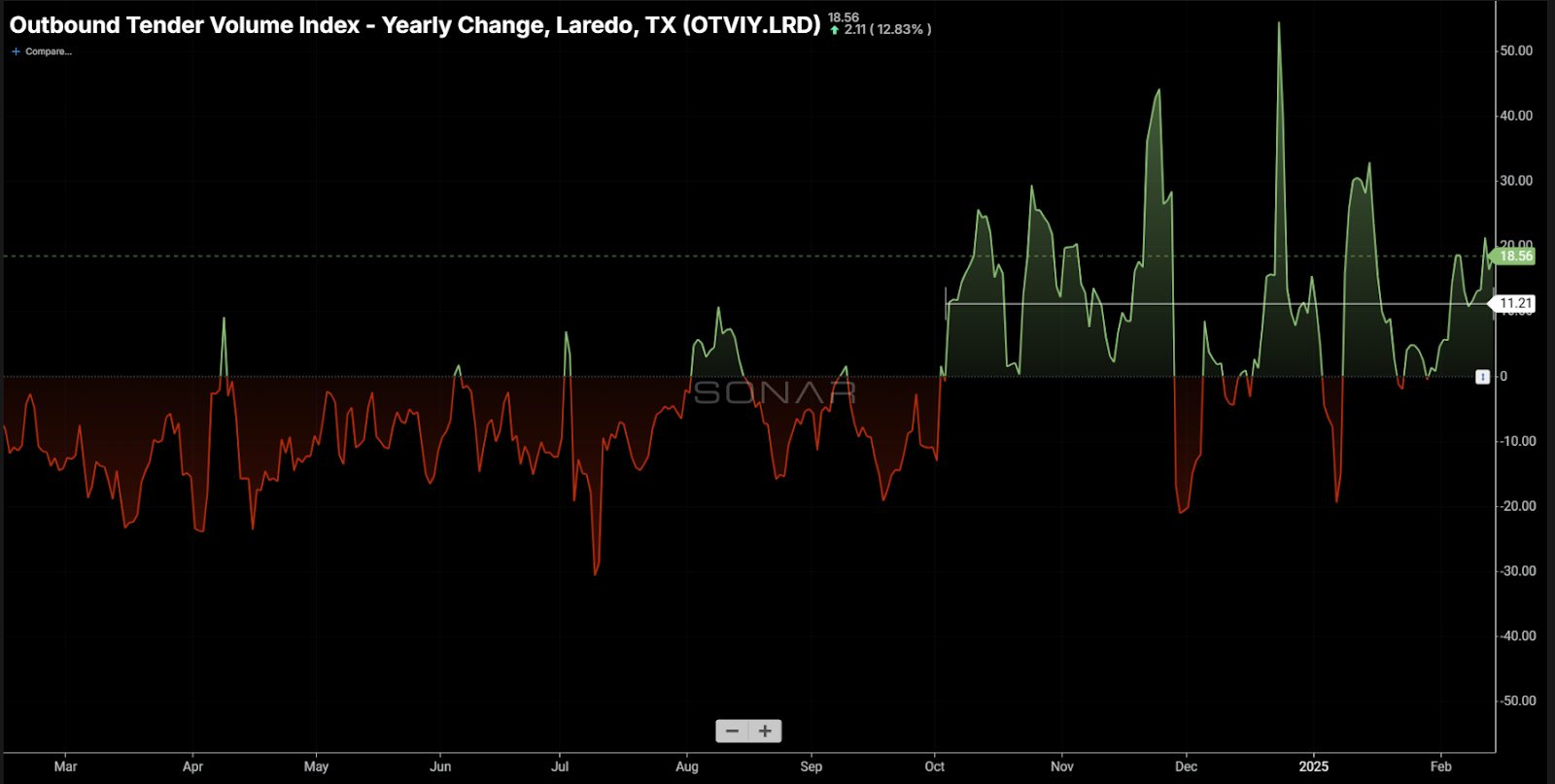
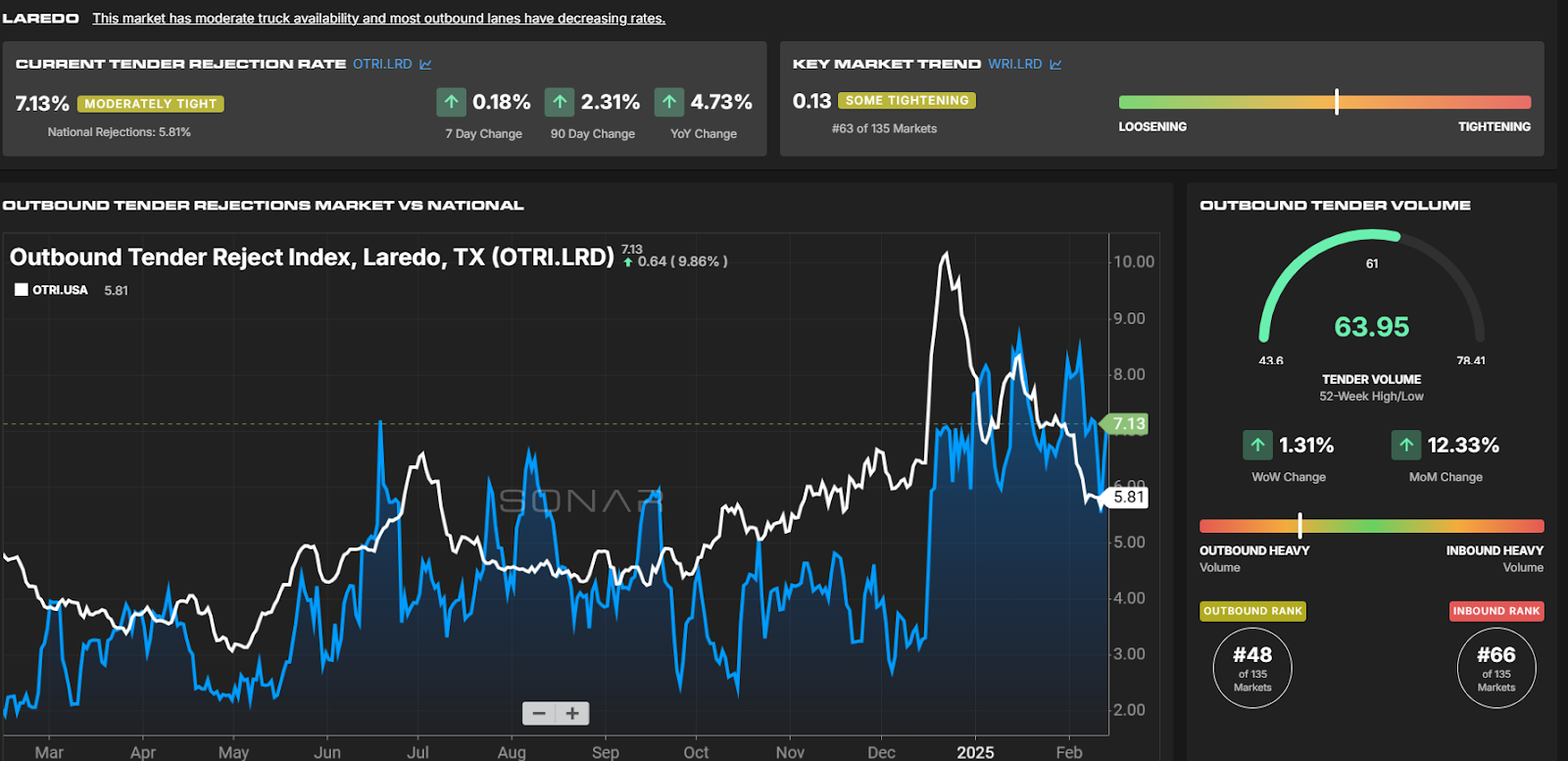
As of Jan. 1, truckload demand in Laredo was at 0.52% of the total freight market in the U.S. Trucking capacity demand in Laredo is slightly lower than the same period in 2024 but higher than 2023. 

Outbound tender market share in Laredo (OTMS.LRD) is currently 0.52% of the overall freight market. To learn more about FreightWaves SONAR, click here.

China-based carrier launches new ship for Mexico trade route

SAIC Anji Logistics has launched the Anji Prestige, which will be used to transport finished vehicles to Mexico.

The vessel, which measures 656 feet and is 13 stories tall, has the capacity to haul 7,800 vehicles. It is reportedly the largest liquefied natural gas-powered roll-on/roll-off ship in the world.

China-based SAIC Anji Logistics recently launched the Anji Prestige, which will be used to transport finished vehicles to Mexico. (Photo: SAIC Motor)

SAIC Anji Logistics is the automotive shipping subsidiary of China state-owned car maker SAIC Motor, which has joint ventures with Volkswagen and General Motors. SAIC Motor does not currently sell vehicles in the U.S.

SAIC Anji Logistics currently operates 33 vessels, including 13 ships used for international trade. The company has established eight international routes that include Southeast Asia, Mexico, South America, Europe and Oceania.

In 2023, SAIC Motor launched a new shipping route linking China’s Port of Ningde and Mexico’s Port of Lazaro Cardenas, carrying SAIC’s MG brand cars for exports.

Volkswagen moves Golf vehicle manufacturing to Mexico

Volkswagen is moving production of its Golf hatchback from Germany to its plant in Puebla, Mexico, according to The Associated Press.

The move is part of a companywide restructuring plant that will see the automaker eliminate 35,000 jobs in Germany by 2030.

The deal is aimed at enabling the carmaker to manage a drop in demand in Europe, along with higher raw material costs and increasing competition from Chinese automakers. Volkswagen did not provide a timeline for the Golf’s production move to Puebla.

Wolfsburg, Germany-based Volkswagen builds passenger and commercial vehicles, motorcycles, engines and turbomachinery.

Volkswagen’s plant in Puebla employs 6,100 assembly workers. In 2023, the Puebla factory produced 349,227 vehicles, with 67% of the units exported for sale in the U.S. market.   

Parts Town opens Phoenix area distribution center

Parts Town has launched a 420,000-square-foot distribution center in Glendale, Arizona.

The facility, about 10 miles west of downtown Phoenix, features automation and robotics solutions to enhance speed of delivery, according to a news release.

The distribution center employs about 100 workers and will be focused on growth in the food service parts distribution market.

Parts Town is a distributor of original equipment manufacturing food service equipment parts, residential appliance parts, HVAC parts, consumer electronic parts and more.

Addison, Illinois-based Parts Town is a subsidiary of Parts Town Unlimited, which has 50 unique brands and more than 5,300 team members worldwide.

Rejection rates hit highest level since 2022 – but could have been higher 

Chart of the Week: Outbound Tender Reject Index, National Truckload Index (linehaul only) – USA SONAR: OTRI.USA, NTIL.USA

The national Outbound Tender Reject Index (OTRI), which is the rate at which truckload carriers turn down requests from customers to move their freight, pushed over 10% for the first time since April 2022 during the Christmas holiday. Spot rates (excluding the estimated cost of fuel) also peaked nearly 10% higher than in 2023.

While this is further evidence that enough capacity has come out of the market to make it noticeably more uncomfortable for shippers, it could be much worse from a transportation management perspective.

The truckload market can typically be measured by its peaks and troughs when looking at tender rejection rates. Seasonal swings define the market, but seasonality has been challenging to find since the pandemic due to extreme under- and oversupply of capacity. 

As the truckload market emerges from one of the longest periods of extreme oversupply, seasonal peaks are becoming more noticeable, Christmas being the highest among them.

Last Christmas, the OTRI topped out at 5.6%, a figure that characterizes a relatively easy transportation sourcing environment. This means shippers would have trouble finding a truck for one in every 18 loads. 

During the pandemic years, the OTRI hovered above 20% for nearly 18 months. This means the transportation managers are having to navigate sourcing problems about one in every five loads. That is quite a bit of extra work.

While the current market is still a far cry from where it was two years ago, it is continuing to transition away from the easiest of sourcing environments and becoming more erratic. The increasing volatility may be the more challenging component as shippers can plan for seasonal swings but still have trouble with estimating the magnitude. 

Shippers have been employing strategies that mitigate their exposure to increasing transportation market volatility. 

Increasing lead times, the amount of time between the initial request and requested pickup date, has been an ongoing trend even as the market has been relatively loose. Shippers are giving about half a day more notice to carriers on average than in 2019. 

Intermodal has regained favor with the shipping community, with domestic-size containers (ORAILDOML) averaging over 10% higher y/y this past December. International containers (ORAILINTL) are staying on trains and moving inland with more frequency, which has also taken pressure off West Coast trucking capacity since this summer.

Inventory management practices have evolved, eliminating a lot of the distance between warehouses and consumers. In the weeks leading into Christmas, middle (MOTVI) haul loads, moving 250 to 450 miles, were down 8% y/y while local (COTVI) haul loads, moving less than 100 miles, were up 6%.

A blend of just-in-time at downstream warehouses and just-in-case at upstream facilities has become more prevalent as supply chains have endured an onslaught of increasing geopolitical risk since 2020.

It is challenging and time-consuming to shift manufacturing facilities and sources, but it is easy and relatively cheap to hold goods in remote locations away from city centers.

Even with all of these mitigating factors, the trucking market has become more responsive. This is due to the fact that all of these strategies, save for lead time, remove demand from the market.

Extreme demand deficiency in relation to the supply of capacity has led to a record number of carrier exits, roughly netting 41,000 fewer carriers since July 2022, according to Carrier Details analysis of Federal Motor Carrier Safety Administration data.

If shippers had fallen back purely to a pre-COVID supply chain management strategy, the truckload market would have been in chaos over the holiday season. Many of these strategies are only making the market transition to a tighter state more manageable, which is a good thing for all. With capacity still bleeding off at record levels, what has become never-ending economic uncertainty and geopolitical instability, supply chain and transportation managers will have their work cut out for them in 2025.

About the Chart of the Week

The FreightWaves Chart of the Week is a chart selection from SONAR that provides an interesting data point to describe the state of the freight markets. A chart is chosen from thousands of potential charts on SONAR to help participants visualize the freight market in real time. Each week a Market Expert will post a chart, along with commentary, live on the front page. After that, the Chart of the Week will be archived on FreightWaves.com for future reference.

SONAR aggregates data from hundreds of sources, presenting the data in charts and maps and providing commentary on what freight market experts want to know about the industry in real time.

The FreightWaves data science and product teams are releasing new datasets each week and enhancing the client experience.

To request a SONAR demo, click here.

US rail volume remains up in final full week of 2024

This story originally appeared on Trains.com.

WASHINGTON — U.S. weekly rail traffic remained ahead of year-earlier levels for the final week of 2024, the Association of American Railroads reported Friday.

For the week ending Dec. 28, 2024, total volume was 389,700 carloads and intermodal units, a 5.1% increase over the same week in 2023. That included 184,028 carloads, a 1.1% increase, and 205,672 containers and trailers, an increase of 9%.

Through 52 weeks, the total of 11,336,412 carloads is down 2.9% from 2023, while the 13,842,174 intermodal units is a 9.3% increase.  The total volume of 25,178,586 carloads and intermodal units is a 3.4% increase over the same period in 2023.

The week’s volume in North America, as reported by nine U.S., Canadian, and Mexican railroads, includes 275,294 carloads, up 1.4% from the corresponding week in 2023, and 266,932 intermodal units, up 4.1%. The combined weekly traffic of 542,226 carloads and
intermodal units represents a 2.6% increase.

The 52-week North American total of 34,885,113 carloads and intermodal units is a 2.3% increase over the same period in 2023. That includes 8,221,597 carloads and intermodal units in Canada, a decline of 1%, and 1,484,930 carloads and intermodal units in Mexico, an increase of 2.4%.

DOT takes heat for drug testing certification delays

DOT headquarters in Washington, DC

WASHINGTON — Drug testing facilities that have invested in oral-fluid-based testing for motor carriers, airlines, railroads and pipeline operators are pushing back on a proposal by the U.S. Department of Transportation that would temporarily reinstate urine-testing requirements.

DOT’s notice of proposed rulemaking, published in December, would revise its May 2023 drug testing procedures final rule, which became effective in June 2023.

In the final rule, DOT codified a procedure requiring that an oral fluid test – rather than a urine test – be conducted in certain circumstances when an observed collection is required, for example, if the original sample was invalid without a medical explanation, or to satisfy a successful return to duty for a truck driver.

However, oral fluid testing cannot be implemented until the Department of Health and Human Services certifies at least two laboratories, one to serve as a primary laboratory and a second to serve as a split-specimen laboratory – something HHS has not yet been able to do.

“Because no oral fluid laboratories have been certified, it is not yet possible to comply with this provision,” DOT stated in its proposed rule.

To address the problem, DOT proposed amending its regulations to require the conduct of directly observed urine collections in those circumstances for an interim period.

“We intend this provision to require directly observed urine tests in situations where an oral fluid collection is required, but is not yet available, to be a temporary, short-term solution,” DOT stated. “This provision will sunset one year after HHS publishes a Federal Register notice that it certified the second oral fluid drug testing laboratory.”

DOT pointed out that the proposed rule “will not affect a significant number of drug tests, and as such, will not impose any significant costs or have any significant impacts on the DOT testing program.”

But others disagree, pushing back on the one-year sunset provision included in the proposed rule.

“We have spent quite a bit to get people trained and in new lab kits in preparation for the new regulation, and delaying this any further means return on these investments will be pushed back as well,” Indira Narinesingh, a principal with Occupational Health Solutions, a health care services company, told FreightWaves.

Her company works primarily in the oil and gas pipeline sector. However, “these concerns would apply equally with any of the [DOT] modalities,” Narinesingh said.

In comments filed with DOT, Narinesingh wrote that DOT should be focusing on expediting the lab certification process “rather than implementing temporary measures that create additional operational complexity and financial burden for regulated entities.”

“We respectfully request that the Department reconsider this proposed rule and instead prioritize working with HHS to accelerate the certification of oral fluid testing laboratories.”

KorManagement Services LLC, which provides workplace drug and alcohol testing programs, commented that because sample collectors have been conducting oral fluid collection training, “one year grace time puts undue burden and confusion on those who paid significant amount of money for training and travel to be trained to become oral fluid collector trainers and to train oral fluid collectors.”

“Extending this out for another year after laboratories are certified will add undue costs to all of the individuals who have met the requirements to train and be able to complete oral fluid collections when the company orders them or a direct observation is required.”

One of the benefits of giving employers an oral fluid option for drug testing is to “help combat employee cheating on urine drug tests and provide a less intrusive means of achieving the safety goals of the program,” DOT stated in the 2023 rule, and representatives of both small and large carriers generally supported the increased flexibility.

The Owner-Operator Independent Drivers Association cautioned when the final rule was proposed that “any new drug testing guidelines or regulations must prioritize privacy concerns of professional truckers.”

Click for more FreightWaves articles by John Gallagher.

Why Susquehanna is getting bullish on trucking

The truckload market enters 2025 showing signs of stabilization after nearly three years of freight recession. While earnings remain depressed across the sector, Susquehanna analyst Bascome Majors sees reasons for optimism that the industry is poised for recovery over the next two years. In a Friday client note, Majors writes that “tangible signs of progress are still incremental – a holiday peak with seasonal lifts in tender rejection rates and slightly super-seasonal dry van spot rates, supported by our checks that reveal more optimism toward one-way truckload contract price recovery this bid season.”

Against this backdrop, Majors has upgraded several truckload and intermodal stocks, forecasting that 2025 will serve as a “bridge year” to more meaningful improvement in 2026. He believes shares can perform well this year “as incremental progress on pricing and margins over the next six to nine months drives hope for a more meaningful price-driven earnings recovery in 2026.”

Knight-Swift Transportation (KNX) received a rating upgrade to Positive with a $67 price target, implying 27% upside. Majors acknowledges near-term margin pressures in KNX’s expanding LTL network but believes “a solid peak season performance in one-way truckload should support both 1Q25 estimated earnings expectations and sentiment toward a greater price and margin recovery in 2026.” He projects KNX’s 2026 earnings per share to reach $3.50, up from an estimated $1.03 in 2024.

(The National Truckload Index is a national average spot rate, inclusive of fuel, in U.S. dollars per mile. Chart: SONAR. To learn more about SONAR, click here)

J.B. Hunt Transport Services (JBHT) was also upgraded to Positive with a $200 price target, representing 17% upside. Majors expects “moderate price and margin recovery in 2025” for JBHT’s intermodal business and views the company as “in excellent position to capitalize on a more meaningful intermodal recovery in 2026.” His 2026 EPS estimate for JBHT stands at $8.75, a significant jump from $5.71 projected for 2024.

Hub Group (HUBG) received an upgrade to Positive and a $55 price target, implying 25% upside. Majors sees potential upside from “self-help in Logistics margins for HUBG in 2025” and forecasts 2026 EPS of $2.90, up from $1.95 expected in 2024.

C.H. Robinson Worldwide (CHRW) was upgraded to Positive with a $130 price target, suggesting 26% upside. Majors believes CHRW shares “create an interesting mid-term entry point for investors to ride the ‘new operating model’ into a mid-cycle truckload market in 2026.” He projects 2026 EPS of $5.90 for CHRW, compared to $4.44 estimated for 2024.

Werner Enterprises (WERN) saw an upgrade to Neutral with a $38 price target, representing 7% upside. While Majors sees “meaningful risk to 2025 consensus EPS,” he notes that WERN no longer has “downside to shares when capitalizing a 2026 EPS recovery.” His 2026 EPS estimate for WERN is $2.10.

Underlying these upgrades is Majors’ belief that the trucking industry is approaching an inflection point after an extended downcycle. He writes, “We believe it’s appropriate to capitalize a greater 2026 profit recovery at target multiples modestly above long-term averages, a shift from our prior peak multiples on near-trough earnings approach.” This change in valuation methodology has driven most of Majors’ target prices higher.

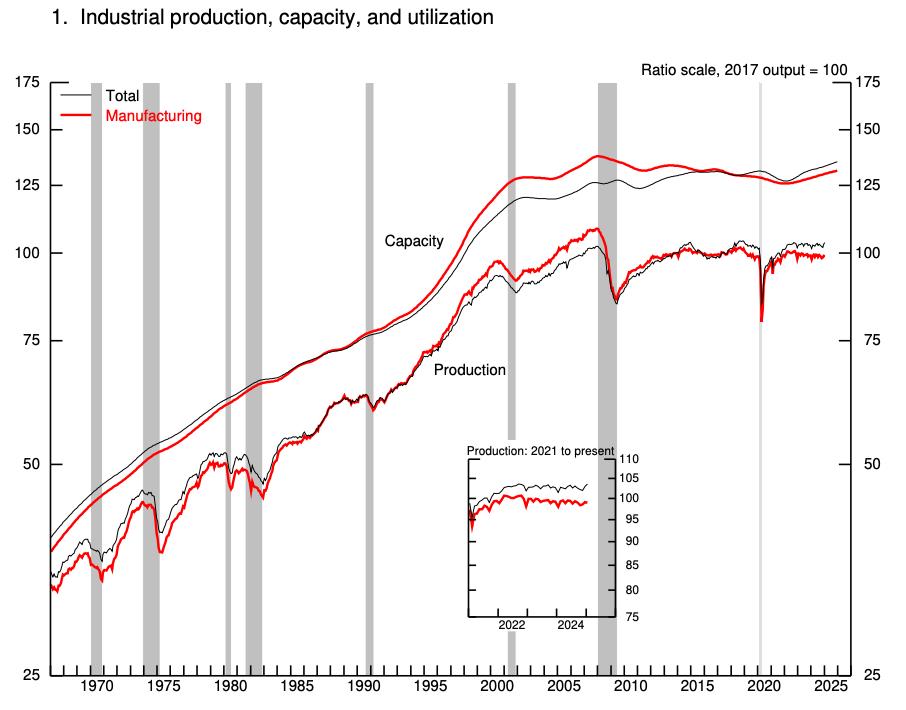
Macroeconomic factors supporting the potential recovery include stabilizing truckload capacity, retail spending and industrial production. Majors notes that “Class 8 tractor sales remain just above replacement levels” and that “current forecasts suggest net Class 8 truck fleet growth slows to a crawl in 2025 but won’t turn negative.” 

Looking ahead to 2025, Majors highlights several key indicators to watch. These include the progress of the spring bid season, which he describes as “a critical step on the journey to mid-cycle” pricing and margins. He also points to potential catalysts like “a likely disruption from an East Coast/Gulf ILA-Port Strike” and “ongoing pre-shipping ahead of expected Trump tariffs.” Additionally, Majors suggests monitoring Class 8 truck orders and intermodal container turns as barometers of industry capacity and efficiency.

While Majors acknowledges that “2025 won’t be a banner year for truckload-related transports,” he believes it “should deliver enough progress to keep the hope for real recovery in 2026 alive.” His upgrades reflect a cautious optimism that the worst may be over for the trucking industry, with potential for significant earnings growth on the horizon.

Midwest braces for snow, ice and coldest air of season so far

map of US 1/03/2024

Travel impacts and power outages expected from Missouri to New England 

A major winter storm is forecast to impact the central Midwest up to the Northeast over the weekend, bringing bitterly cold temperatures, freezing rain, sleet and snow to states from Missouri to Maine.

Forecasters with the National Weather Service expect temperatures from Kentucky northward to dip into the teens with wind chills approaching zero to negatives. Precipitation will develop behind the cold front that will make travel dangerous north of the Interstate 70 corridor. 

Drivers moving through the Midwest over the weekend should be prepared for freezing rain and ice as well as blowing snow, which could cause whiteout conditions at times. 

This snow and ice will add to the ongoing lake effect snow that is currently impacting the western shores of Michigan and the I-90 corridor between Cleveland  and Buffalo, New York.

Significant disruption is also anticipated at airports in the affected areas, especially south/central Missouri, Illinois, Indiana, Ohio and Northern Kentucky, where ice accumulations could get over half an inch.

Omnitracs, Platform Science IP lawsuit may have reached the end of the road

The long-running intellectual property dispute between technology providers Omnitracs and Platform Science has potentially come to an end. A California federal court issued a clear ruling on Dec. 23 denying Omnitracs’ requests for a retrial and overturned the jury’s previous decisions including a right to $19.3 million in damages. 

It remains unclear whether Omnitracs will appeal, as the judge not only canceled the $19.3 million verdict but also conditionally ruled under Federal Rule of Civil Procedure 50(c)(1) that if the cancellation were overturned, a new trial should be held to reexamine the case.

This legal battle began in May 2020 when Omnitracs accused Platform Science of stealing its intellectual property. Omnitracs alleged that Platform Science had developed its Connected Vehicle Platform and other products by using patented innovations that Omnitracs had created. The seven patents — three invalidated before trial and four that went to trial — covered technologies such as wireless data transfer, fleet management systems, and onboard computing devices.

The case went to trial, and in July 2024, the jury delivered a mixed verdict. It found that Platform Science had infringed on one patent (U.S. Patent No. 6,925,308), which relates to logistics software for fleet management. The jury awarded Omnitracs $19.3 million in damages. However, the jury found that Platform Science had not infringed on the other three patents that went to trial. The court had dismissed one of those patent claims before the jury reached its decision.

The recent December ruling — delivered by U.S. District Judge Cathy Ann Bencivengo of the U.S. District Court for the Southern District of California— comes after Platform Science pushed back against the verdict, arguing that its products did not infringe on the fleet management patent and that the award for damages was excessive. The company also noted that the jury included damages for a period after the patent in question had expired in 2022, calling the calculation improper.

Omnitracs also asked the court to revisit the non-infringement findings for two patents and requested a retrial on previously dismissed patent claims. Omnitracs also asked the court to revisit the $19.3 million damages awarded to ensure the amount reflected all legally permissible damages for the infringement.

The court upheld the original jury’s findings. Omnitracs’ request to revisit the non-infringement verdicts for two patents and its push for a new trial on damages were denied. The court explained that Platform Science’s Connected Vehicle Device required manual configuration to work with different vehicle communication systems, directly contradicting Omnitracs’ claim that the device automatically adapted to such systems.

Similarly, the court dismissed Omnitracs’ claims regarding another patent, finding the evidence insufficient. Omnitracs had attempted to introduce new arguments midtrial, but the court deemed this unfair and prejudicial to Platform Science.

This ruling is a significant win for Platform Science, as it successfully defended itself against Omnitracs’ allegations.

It remains to be seen whether Omnitracs will appeal the decision. FreightWaves has reached out to Omnitracs for comment. Platform Science has declined to comment.


Can the industry overcome its cybersecurity woes?

Top 5 freight fraud stories of 2024

Gatego goes live, CEO addresses inefficiencies in yard operations

Project44’s latest lawsuit in intellectual property dispute targets SMC3

An earlier dispute between project44 and MyCarrier has been extended to bring in SMC3, as the provider of freight visibility now accuses SMC3 of theft of intellectual property. 

The lawsuit by project44 (p44) was filed Tuesday in the U.S. District Court for the Northern District of Georgia.

Project44’s lawsuits against MyCarrier and SMC3 may be separate pieces of litigation, but they are effectively linked in describing the sequence of events that led to their filings.

According to the lawsuit, MyCarrier had a five-year agreement with p44 that enabled MyCarrier to offer p44’s functionality through the MyCarrier transportation management system. It was signed in 2023. 

The deal would allow MyCarrier “to offer the [p44’s] features to its customers, who are typically small to medium shippers of goods without their own TMS platforms of logistics departments.”

The deal also held confidentiality provisions, prohibiting MyCarrier from using what it gleaned through the p44 contract to build its own functionality, particularly in regard to a robust API service provided by the p44 software.

Case in Delaware goes on

“p44 eventually learned that MyCarrier was breaching the terms of the Agreement by, among other things, developing software that copied some of the features of p44’s Software in violation of the No Build Behind Restrictions,” the latter provision being part of the contract between the two companies. The suit notes that the dispute that ensued ended up in Delaware Chancery Court, where the case continues. (There is a Jan. 23 hearing in Delaware regarding pt44’s request for an injunction against MyCarrier, according to a p44 spokeswoman.)

That review of the initial dispute between p44 and MyCarrier is at the heart of the Delaware action. Where the latest suit between p44 and SMC3 diverges is that it focuses on what happened between MyCarrier and SMC3, which p44 believes is a further violation of the confidentiality provisions of the initial p44/MyCarrier agreement.

With the relationship between p44 and MyCarrier negatively impacted by the dispute in the Delaware court, MyCarrier turned to SMC3 (whose full name, Southern Motor Carriers Association Inc., is used in identifying the actual defendant) to provide many of the same functions that the TMS had been getting from p44.

But according to the lawsuit, SMC3 was unable to match what p44 provided. “SMC3 encountered difficulty in enhancing its technology to meet those needs and reached out to MyCarrier for assistance,” the lawsuit says. “MyCarrier subsequently disclosed to SMC3 the trade secrets it learned from p44, including how p44’s Software talks to different systems and collates data across them. SMC3 then used those trade secrets to enhance its own software and keep MyCarrier’s business.”

p44 says in the lawsuit that it had sent a cease-and-desist letter to SMC3 when it became aware of SMC3’s alleged activities. 

Individual is a defendant in the case

Additionally, there is a second defendant in the lawsuit: Tim Story, who is a board member at both MyCarrier and SMC3. According to the lawsuit, Story “had reviewed and approved the provisions in his role at MyCarrier’s board,” so he should have known about the confidentiality restrictions in the p44/MyCarrier contract.

“Nevertheless, SMC3 knowingly disregarded the restrictions (in the p44/MyCarrier agreement) in reaching out to MyCarrier and in acquiring and using p44’s trade secrets for its own benefit,” the lawsuit says. “In doing so, it solicited MyCarrier to disclose p44’s trade secrets in breach of the Agreement’s confidentiality restrictions.”

The p44 lawsuit turns to some specifics. “One functionality of p44’s Software is the ability to digitize, exchange, and store electronic bills of lading (‘eBOL’),” the suit says. “As such, eBOL functionality was subject to the No Build Behind Restrictions” in the original p44/MyCarrier agreement.

The suit says p44 learned around June 2024 that MyCarrier was “working to develop eBOL functionality in violation of those restrictions, and potentially doing so in collaboration with SMC3.”

That led to another cease-and-desist letter, this time sent to SMC3. According to the lawsuit, the response from SMC3 was “carefully worded.” It said SMC3 was “not a party or beneficiary to any agreement between MyCarrier and project44” and was “not aware of any involvement of SMC3 with respect to any alleged MyCarrier eBOL service.”

The initial agreement between p44 and MyCarrier has been “breached and essentially abandoned by MyCarrier,” according to the lawsuit. There are numerous sections of redacted portions in the lawsuit dealing with some of the specifics in the agreement.

The lawsuit lists two counts of misappropriation of trade secrets and two counts of tortious interference with business relations. The suit asks for permanent and temporary injunctive relief against SMC3 prior to a jury trial.

A request to SMC3 for comment had not been responded to by publication time. The request to the spokeswoman for SMC3 also included a request to Story, an SMC3 board member.

More articles by John Kingston

Trac Intermodal’s outlook at Moody’s now negative, but debt rating affirmed

Benesch 2024: Pent-up dollars could be big factor in logistics M&A next year

Oil in 2025 increasingly looking like a buyer’s market

Running on Ice: Carrier wants reefer containers out of ports ASAP

Blue Truck on a sheet of ice over a blue background and Running on Ice Logo

All thawed out

(Photo: Jim Allen/FreightWaves)

In October 2024, U.S. East and Gulf Coast port workers went on strike. The strike ended after three days with both parties agreeing to go back to the negotiation table and extending the master agreement till Jan 15. Well, that agreement still has not been reached, and at the end of 2024 talks got rocky over the issue of automation. The International Longshoremen’s Association wants nothing to do with additional automation, and the United States Maritime Alliance would like more automation allowed to improve efficiency.

Talks have resumed in the new year, but it’s still uncertain what will happen, as neither side seems particularly willing to budge on its automation stance.

Enter Maersk. The container carrier is urging shippers to clear out reefer containers from East and Gulf Coast ports ahead of Jan 15. With large volumes of produce imported through those ports, shippers need to have a plan to get goods out as fast as possible to reduce the amount of spoilage and otherwise damaged cargo should another strike happen. 

There are 12 days for two parties that have been working on this negotiation for months to somehow find common ground. The Biden administration in October said it isn’t getting involved in the dispute, and President-elect Donald Trump has come out in favor of the union. If there is a second strike, there will likely not be any interference from the executive branch.

Temperature checks 

(Photo: Jim Allen/FreightWaves)

In early 2025, Maine International Cold Storage Facility is planning to open a new cold storage warehouse near the Port of Portland. It has chosen Taylor Logistics, a 3PL, to run the operation.

The new facility is designed with 106,000 square feet of space and can handle minus 10 F goods. Its location is near the port rail system and the facility provides much-needed outbound truckload freight from Maine. The location near the port was crucial for both Taylor Logistics and MICSF’s commitment to sustainability and reduced emissions.

“The Maine International Cold Storage Facility represents an incredible opportunity to deliver best-in-class cold storage and logistics solutions while supporting the local community and economy,” said Will Roberson, president and COO of Taylor Logistics Inc., in a news release. “We look forward to collaborating with the team behind MICSF to create value for businesses in the region and beyond.”

Food and drug

(Photo: Jim Allen/FreightWaves)

The new year is all about resolutions and self-improvement. Finding ways to boost those efforts and stay on track with goals has consumers turning to the frozen food section of the grocery store.

According to a survey commissioned by the National Frozen & Refrigerated Foods Association, “66% of Americans say pre-portioned ingredients help them achieve their health goals, while 75% cite cost savings as a top reason for choosing the frozen and refrigerated aisles – signaling a continued shift in shopping and eating habits.”

The survey also found that parents are emerging as sophisticated shoppers, with 77% using pre-portioned ingredients to meet family health goals.

Other findings include: “52% use January to reorganize their freezer and refrigerator spaces for the year ahead; 50% have switched to yogurt from traditional snacks for healthier choices; 75% rely on frozen options to streamline busy morning routines; 78% leverage bulk buying for budget management while reducing waste.”

Consumers want more options in the freezer aisle that are healthy, convenient and affordable – a trend that appears to be the new normal. 

Cold chain lanes

SONAR Tickers: ROTVI.BUF, ROTRI.BUFF

This week’s market under a microscope heads northeast to Buffalo, New York. Capacity has loosened as a result of the holidays. Reefer outbound tender volumes have returned to consistent levels following the last-minute press for the holiday season. Taking the same path back to normality is the reefer outbound tender rejection rate, which has fallen from 50.55% on Dec. 27 to 37.42%.

Reefer rejection rates consistently hanging out at or above 20% for the past month does indicate an elevated spot market for reefer freight in Buffalo. The national average is 17.76% rejection rates for reefer loads. Buffalo is more than double that. Heading into January when there are snowstorms and inclement weather aplenty, capacity is likely to struggle over the next few weeks in Buffalo as lake effect snow season kicks into gear.  

Is SONAR for you? Check it out with a demo!

Shelf life

Domino’s Pizza orders new energy efficient fleet

Two patents filed for improved electric refrigerated cargo transportation

Youngstown sells Cold Storage property to condo builders

Premier Protein expands frozen foods line

It’s about to get dangerously cold, even for winter 

Wanna chat in the cooler? Shoot me an email with comments, questions or story ideas at moconnell@www.freightwaves.com.

See you on the internet.

Mary

If this newsletter was forwarded to you, you must be pretty chill. Join the coolest community in freight and subscribe for more at www.freightwaves.com/subscribe.