DHL, SF Airlines most impacted by 757 freighter crack risk

Black-tailed SF Airlines freighter taxis at an airport.

DHL Express and China-based SF Airlines are most impacted by the discovery of fatigue cracking in Boeing 757-200 aircraft that were converted from passenger to cargo configuration during the past 19 years, according to a FreightWaves analysis.

The Federal Aviation Administration last month issued an airworthiness directive requiring inspections within three months and repair and replacement, where necessary, to the lavatory service panel located on the fuselage bottom of freighters modified by Beaverton, Oregon-based Precision Aircraft Solutions. 

The FAA order only applies to 13 aircraft registered in the United States, but 120 aircraft worldwide are affected. Precision Aircraft Solutions has issued a service bulletin to customers on how to resolve the safety issue, but the FAA directive goes further in requiring a fix within about two years. Aviation authorities in other countries could also issue their own directives to airlines based in their jurisdictions.

SF Airlines, the in-house airline of China-based parcel delivery giant SF Express, has 38 757 freighters in its fleet that were converted by Precision Aircraft Solutions. DHL Express has 32 Precision-modified 757 cargo jets, including a handful operated by partner Blue Dart Aviation in India, according to publicly available aviation databases and Precision news releases. 

Precision has completed more than 150 conversions for 25 customers around the world. Other airlines with 757 passenger-to-freighter aircraft from Precision include Asia Pacific Airlines (Guam), Cargojet (Canada), Air Transport International (U.S.), Alibaba’s logistics arm Cainiao, Air China Cargo, China Postal Airlines and YTO Cargo Airlines in China. The FAA order applies to Air Transport International and Asia Pacific Airlines since the companies are licensed in the U.S.

“DHL does have a number of aircraft that are subject to the service bulletin issued by Precision Conversions in May regarding inspections and repairs on various 757 aircraft that they converted. We are in close cooperation with Precision and will complete all of the inspections and potential necessary repairs within the time period permitted with little additional cost or downtime to our network,” spokeswoman Pam Duque said in an emailed statement.

The cracks underscore how 757 freighters are legacy aircraft that average more than 27 years of age and transforming a used passenger jet to carry main-deck cargo is a complex engineering process. That effort includes gutting the interior, installing a cargo door and reinforcing the floor and interior walls to support heavy loads. 

Early this year, Lufthansa Cargo had to pull from service two Airbus A321 converted freighters so small cracks in rear floor boards could be repaired. The A321s were converted by Elbe Flugzeugwerke GmbH, the aircraft maintenance company owned by Airbus and its engineering partner. They were only 12 and 15 years old, and had been in service with Lufthansa less than two years. EFW said the cracked shear plates found in the rear floor structure during a routine check were unrelated to its conversion work.

The FAA safety directive was prompted by reports of cracking in the structure in and around the access panel covering the service drain to the onboard toilet. The FAA said excessive stress buildup is causing fatigue cracking, which could lead to “significant in-flight depressurization and structural integrity issues if not properly inspected and repaired.”

The agency is requiring operators to repetitively inspect the lavatory service panel, access pan and attaching structure for cracks, reinforce the attaching structure, and, if necessary, replace the access pan or repair cracked parts. Reinforcement must be installed within 2,000 flight cycles after the initial inspection.

Assuming a cargo aircraft conducts 700 to 800 takeoffs and landings annually, it could take two years or more before operators have to do repair work on the freighters. 

“Since [certification] in 2005, the 757-200 converted freighter fleet has demonstrated an excellent quality and safety record having accumulated over 1.4 million flight hours and over 750,000 flight cycles. Precision will work with each operator individually to ensure AD compliance in a timely manner with minimal operational disruption,” the engineering firm said in a statement provided to FreightWaves.

The long time frame for completing any necessary repairs means that operators likely will be able to make fixes when aircraft spend one to two weeks undergoing deep maintenance inspections, which usually take place every 20 to 24 months. Under those circumstances, operators probably can minimize any extra downtime. The FAA estimates reinforcement will take about 38 hours to complete. 

Click here for more FreightWaves/American Shipper stories by Eric Kulisch.

Kalitta Air faces $400,000 penalty for FAA violation

Your role in the Safe Driver Apprenticeship Pilot Program – Taking the Hire Road

The Federal Motor Carrier Safety Administration established the Safe Driver Apprenticeship Pilot (SDAP) Program to meet requirements set forth by the Infrastructure Investment and Jobs Act, also known as the Bipartisan Infrastructure Law (BIL).

This three-year program will help 18-, 19- and 20-year-old individuals explore interstate trucking careers and help trucking companies hire and train new drivers through an apprenticeship.

Nikki McDavid, FMCSA chief, commercial driver’s license division, and Becky Rehberg, FMCSA transportation specialist, sat down with Taking the Hire Road host Jeremy Reymer to share the goal of the SDAP Program and to discuss how carriers and drivers can participate.

“As you know, currently you have to be 21 to operate in interstate commerce,” said McDavid. “Under this pilot program, drivers from 18 to 20 years old can go across state lines.”

“We announced the establishment of this three-year pilot program with a Federal Register notice in January of 2022 and started accepting carrier applications in July of 2022,” said Rehberg. The program is roughly halfway through and is slated to end in November 2025.

Any carrier wishing to take part in the program must apply at fmcsa.dot.gov/sdap. “Carriers will find a toolkit, the application and all kinds of information on the website, but before you go to the website, you have to read your Federal Register notice to make sure you meet the qualifications,” said McDavid.

Those qualifications include proper operating authority, registration and minimum levels of financial responsibility. High- or moderate-risk carriers, carriers with conditional or unsatisfactory safety ratings, and carriers with vehicle and driver crash rates above the national average are excluded from the SDAP Program.

Asked about the length of the application and approval process, McDavid said it typically takes the FMCSA about 30 days for vetting and verifying the information in the application.

Under BIL, the FMCSA cannot have more than 3,000 apprentices at a time. “In order for us to have 3,000 apprentices, we would need about 1,000 carriers,” McDavid said. “But the good news is that the miles that the apprentices are traveling are getting us to a point where we will have a statistically valid sample of miles to be able to use to make future decisions.” Although the SDAP Program does not yet have 3,000 enrolled apprentices, it is nearing its targeted mileage goals.

Even though the program is approximately halfway over, McDavid says, there is still plenty to gain from applying at this point. “For one, a lot of those drivers may turn 21 by November of 2025, and carriers can bring them on permanently,” she said. “And for the apprentices who are still under the age limit, their experience will certainly be useful for intrastate operation after the program ends.”

Rehberg says individual carriers can help recruit eligible apprentices through their own social media and marketing campaigns. Anyone interested in becoming an apprentice can visit the Job Opportunities tab on the FMCSA website to see all of the carriers that have been approved under the pilot program and apply directly with those carriers.

“We are about to implement an interactive map that apprentice applicants can use to find carriers in their state,” said Rehberg. Since they are still looking for more drivers to reach their goal, the FMCSA is working hard to expedite apprentice applications. “If a driver goes through the approval process, it only takes about 14 days to vet the application,” added McDavid.

There have been recent changes to the carrier requirements for the SDAP Program. “Congress actually mandated changes,” McDavid explained. “They mandated that we remove the requirement for inward-facing cameras and the requirement for motor carriers to register with the Department of Labor,” she said.

These changes now make it easier for more carriers to become eligible for the SDAP, as not all carriers have the necessary systems in place. Note that carriers do still have the option to implement inward-facing cameras and to register with the Department of Labor. “We do hear positive feedback from carriers who use the cameras, so we still unofficially encourage carriers to use them and register with the DOL if they choose,” McDavid said.

To promote program participation, the FMCSA is focusing on outreach. “We’ve worked with high schools, technical schools, school counselors, career advisers and industry partners to promote the program,” said Rehberg. “We’ve attended job fairs, industry trade shows, motor carrier-focused events, because we want the public to help us complete this program and gather as much data as we can,” she said.

“Our focus remains on safety,” McDavid said. “It’s our middle name, and we’ll always continue to promote anything that increases safety.”

Click here to learn more about the FMCSA Safe Driver Apprenticeship Pilot Program.

Sponsors: The National Transportation Institute, Career Now Brands, Carrier Intelligence, Infinit-I Workforce Solutions, WorkHound, Asurint, Arya By Leoforce, Transportation Marketing Group, Seiza, Drive My Way, F|Staff, Trucksafe Consulting, Seated Social, Repowr

Optimistic retail numbers suggest trucking market is trending positive

Motive’s July economic report

On Wednesday, telematics and analytics provider Motive released its July Monthly Economic Report, which looked at data across its platform of 120,000 customers. July is forecast to see higher retail sales compared to last year as the Fourth of July holiday and Amazon Prime Day drive sales. The foreshadowing of the strong July performance comes from Motive’s June data from its Big Box Retail index, which tracks visits to warehouses of the top 50 U.S. retailers. Restocking jumped 10.8% in June compared to May and 16% year over year. It varied across sectors.

Hamish Woodrow, head of strategic analytics at Motive, wrote in the report, “When it comes to performance across sectors, department stores, apparel & electronics (+32.9% YoY), and home improvement (+24.4% YoY) were top performers in June. Grocery & Superstores and Discount Retailers & Wholesalers also jumped 22.1% and 13% YoY respectively. We’re seeing particularly strong momentum in brick-and-mortar retail as these stores anticipate a very strong summer peak season. For example, department stores, electronics, and apparel retailers with brick-and-mortar locations saw a 13.8% jump heading into July, representing a 33% YoY climb.”

The growth in restocking throughout June and into July so far has not changed the current strategy for retailers, which involves a low-inventory approach and restocking at the last minute based on demand. Motive believes that trucking rates are set to increase in the second half of the year, forcing retailers to adjust this inventory management strategy and hold inventory longer. Higher transportation costs will make restocking more expensive, and Motive expects to see this change take hold by the holiday season.

Preliminary trailer order slowdown continues in June

On Tuesday, ACT Research released its figures on June preliminary net trailer orders, which showed a continued slowdown as the trailer market experiences its seasonal slow period. Jennifer McNealy, director, commercial vehicle market research and publications at ACT Research, noted that June data shows 26,000 trailers were ordered in Q2 of 2024, a 14% decline compared to Q2 of ’23. Looking at total orders year to date, the first half of 2024 saw 74,500 orders placed, a decline of 24% or 23,900 units compared to H1 of 2023.

McNealy added that despite the lower numbers, this is in line with consensus based on trailer order seasonality. She wrote: “This year’s slower trailer orders are no surprise given the elevated order velocity of the past few years, and with continuing weak for-hire truck market fundamentals, and already-filled dealer inventories, it looks like trailer demand is likely to remain constrained for some time. That said, it is important to remember that for orders, we are now in the weakest months of the annual cycle, minimally suggesting there is no catalyst for stronger orders before the fall and the OEMs’ opening of their 2025 order books.”

Looking ahead, McNealy said, “Industry anecdotes suggest that the ‘pause button’ is expected to remain pressed through the remainder of 2024. The industry’s largest segments remain under pressure, cancellations remain elevated as dealers and fleets recalibrate their needs.”

Additionally, the looming EPA implementation of 2027 regulations represents another headwind to trailer orders as fleets will prioritize purchasing newer power units before the model year 2027 units, which are expected to be more expensive due to additional emissions regulations.

Market update: Cass June data shows lower shipments paired with hurricane impacts

On Monday, audit and payment provider Cass Information Systems released its June Cass Freight Index data, which showed continued deterioration in freight volumes with an added warning for shippers based on the current hurricane season. The shipments index fell 1.8% m/m seasonally adjusted, down 6% y/y. FreightWaves’ Todd Maiden writes, “The shipments subindex fell to its lowest point since January despite June typically being a big month for freight flows. When seasonally adjusted, the index reached its lowest level since July 2020 when widespread COVID-related lockdowns were starting to be lifted.”

Two lingering challenges in the for-hire space remain an abundance of truckload capacity paired with increased private fleet activity in the spot market. The report notes: “The freight market continues to be characterized by overcapacity, and with private fleets engaging in spot activity more than in past cycles, rates remain only slightly above the Q4’23 lows. Owner-operators are resilient as ever, but ongoing private fleet capacity additions are putting less freight into the for-hire market in a slowing economy. We expect the for-hire freight market conditions will improve once excess capacity additions end.”

The report noted that Hurricane Beryl, the earliest Category 5 storm on record, impacted the U.S. in a weakened state but caused $30 billion in damage nonetheless. A more active hurricane season was described by the report as another “different this time” variable shippers need to consider. “But if forecasts for a bad hurricane season are right, and they are so far, shippers will have plenty else to worry about,” added the report. 

(Source: FreightWaves SONAR)

Summary: Despite the absence of a sustained post-July Fourth rally, dry van outbound tender rejection rates remain elevated and continue to perform better than at this time last year. While VOTRI fell 68 basis points in the past week from 5.89% on July 8 to 5.21%, it is up 230 bps year over year from July 15, 2023, which saw VOTRI at 2.91%. Nationwide outbound tender rejection rates followed a similar trend, down 54 bps w/w from 5.65% to 5.11% but up 204 bps y/y from 3.07% to 5.11%.

Dry van spot market rates, while down compared to this time last week, continue to improve when compared to last year. The NTI fell 2 cents per mile all-in w/w from $2.37 on July 8 to $2.35. This is still a 10-cent-per-mile improvement compared to 2023 when dry van spot market rates were at $2.25 per mile.

The next big holiday on the freight calendar will be Labor Day, to see if outbound tender rejection rates show greater sensitivity through August and before the first week of September. In the meantime, second-quarter trucking earnings reports are being released this week, which should provide insights into whether carrier executives are optimistic moving into the second half of the year.

Aifleet CEO discusses use of AI to boost driver utilization (FreightWaves)

When Convoy Collapsed, the Uber for Trucking Left Behind Collateral Damage (Inc.)

Cheema Freightlines CEO sees industry becoming more about ‘serious truckers’ (FreightWaves)

Trump’s VP pick supports truck parking, opposes speed limiters (FreightWaves)

Trucking groups receive extension in AB5 appeal (Land Line) 
Debate on valuing freight for state income tax purposes heats up (FreightWaves)

Like the content? Subscribe to the newsletter here.

Large truck crash fatalities fell 11% in 2023

Trucks and cars on rainy highway

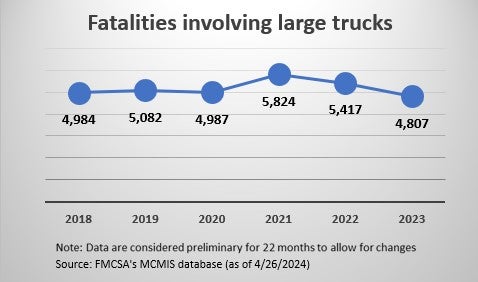
WASHINGTON — Deaths from crashes involving at least one large truck fell 11% in 2023, according to the latest data from the Federal Motor Carrier Safety Administration, hitting the lowest point in six years.

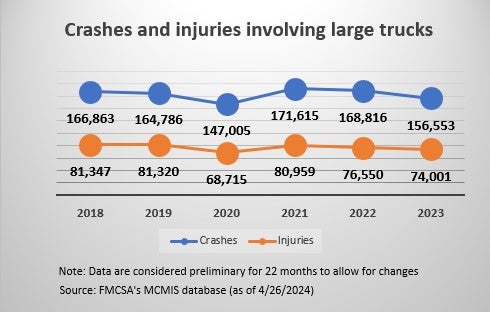
The drop in fatalities – from 5,417 in 2022 to 4,807 in 2023 – followed a corresponding 7% decrease in crashes overall that involved at least one large truck, which fell from 168,816 to 156,553. Injuries resulting from such crashes decreased 3%, from 76,550 to 74,001.

Large-truck crashes and fatalities spiked in 2021, during the height of the pandemic, but have come down in each of the past two years since then. The 4,807 deaths in 2023 was the lowest since 2018, when FMCSA recorded 4,984 fatalities (see chart).

The full-year Motor Carrier Management Information System (MCMIS) data released by FMCSA on Tuesday follows a trend that started in the first quarter of 2023, which showed fatalities down 14% compared with the same period in 2022.

It also roughly aligned with data compiled by the National Highway Traffic Safety Administration, which estimated fatalities in crashes involving at least one large truck in 2023 decreased 8%, from 5,936 in 2022 to 5,439 in 2023.

Like FMCSA, NHTSA defines large trucks as having over a 10,000-pound gross vehicle weight rating (GVWR). However, NHTSA also includes noncommercial vehicles, such as heavy pickup trucks, which may account for the higher overall numbers.

MCMIS data compiled by FMCSA, on the other hand, defines a reportable large-truck crash as a fatal, injury or towaway crash involving at least one large truck “designed, used, or maintained primarily for carrying property.” It covers a weight-class range from Class 3 to Class 8, which includes delivery vans and box trucks up to large tractor-trailers.

Transportation Secretary Pete Buttigieg told members of Congress last month that his department’s National Roadway Safety Strategy, unveiled in January 2022, has been helping to curb highway deaths over the past two years.

For trucking, a drop in new operating authorities – which shot up during the pandemic when rates began to climb – could also be factoring into the improved safety statistics.

Asked to comment, Zach Cahalan, who represents truck crash victims and their families as executive director of the Truck Safety Coalition, told FreightWaves in an email that he and his members “hope that this downward trend is confirmed when NHTSA publishes its official truck crash fatality figures for 2023.” The coalition recently took DOT to task for delaying safety rulemakings.

“Far too many lives are lost needlessly in preventable large truck crashes every year, and TSC and our victim-advocates will never stop fighting for change.”

Click for more FreightWaves articles by John Gallagher.

ABF Freight head Seth Runser named president of parent ArcBest

A sideview of an ArcBest trailer

ArcBest announced Thursday that Seth Runser will become president of the company effective Aug. 1. Runser has served as president of the company’s less-than-truckload subsidiary, ABF Freight, since 2021.

Current ArcBest (NASDAQ: ARCB) Chairman, CEO and President Judy McReynolds will continue to serve as the company’s chairman and CEO.

Runser joined ABF as a management trainee in 2007, assuming roles of increasing responsibility since. He has served as an operations supervisor, a regional vice president of operations and the vice president of linehaul operations.

“Seth has made tremendous contributions to ArcBest’s success over his time with our company, including as president of ABF,” said McReynolds. “Under his leadership, ABF has consistently delivered record results and has made great strides in enhancing profitability and operational efficiency.”

Runser is credited with delivering eight quarters of record results at ABF, growing the network’s door count by more than 550 and renewing a five-year collective bargaining agreement with the Teamsters union.

ABF has seen door count grow nearly 10% since Runser took over. The company recently acquired four terminals (77 doors) from bankrupt Yellow Corp. (OTC: YELLQ). Door count additions are expected to continue through the end of the year, with initial plans calling for 347 new doors in 2024 after adding 299 in 2023.

Photo: From left to right: Matt Godfrey, Judy McReynolds and Seth Runser (Credit: ArcBest)

“His deep knowledge of the business, innovative spirit and commitment to advancing ArcBest’s mission and strategy make him the right person to succeed me as president,” McReynolds added. “I look forward to working alongside him and the rest of the team as we advance our strategy for long-term growth and value creation for the benefit of our employees, customers and shareholders.”

Matt Godfrey, ABF’s current vice president of engineering, will take over as president of ABF on Aug. 1. He has been with the carrier for 20 years, serving in his current role where he helped orchestrate efficiency initiatives, since 2021.

“Working closely with Seth on the ongoing execution of ABF’s transformation, Matt’s leadership has already brought about significant improvements to ABF,” said McReynolds. “He has guided our optimization efforts, which have increased capacity and delivered value for customers, and he deeply understands the ABF network, our strategy and our Quality Process.”

“With our innovative mindset and integrated solutions, ArcBest is uniquely positioned to help customers solve their most complex logistics challenges,” Runser said. “I am committed to accelerating growth, increasing efficiency and driving continued innovation.”

More FreightWaves articles by Todd Maiden

Mark Manera talks driver health, barriers to care

FIRESIDE CHAT TOPIC:

How enterprise fleets can promote health to drivers to improve their overall quality of life on the road

DETAILS:

Mark Manera, CEO and founder of Supply Chain Fitness, speaks with Mary O’Connell of FreightWaves about the health of truck drivers and why companies should not only invest in drivers’ health, but find ways to make drivers feel engaged in their benefits and care. 

KEY QUOTES FROM MANERA:

“When you look at anyone trying to be healthy, if you’re in an office, if you’re behind the wheel, whatever you’re doing, we all have different barriers set up that makes it more difficult for us to make our health a priority. … But If you’re sitting behind a wheel for 10, 11 hours a day, maybe you’re working your shift 12, 13, 14 hours a day, the lack of time and also just feeling mentally exhausted after you get done is a one-two punch that is really, really difficult to combat.”

“It’s just really easy to put it on the backburner and just think about, ‘OK, today I need to drive as many miles as I possibly can, because I need to put food on my family’s table.’” … You do that day after day for 20, 30 years and then all of a sudden, drivers are looking back, and they’re like, ‘What the heck happened?’” And so that’s one of the biggest barriers we see when we’re talking to drivers and really trying to figure out, hey, how do you make this a priority?”

“I think the biggest thing that I’m seeing is this conversation at the executive level around drivers’ health, not just being this feel-good initiative, but an actual cost risk mitigation and also cost reduction strategy.”

“All of the health benefits that a lot of these trucking companies have even available to offer to their employees are all industry-agnostic, which means they were built for someone who works in a cubicle. They’re great for the office staff, and then they’re handed to drivers as an afterthought, and it’s like, how are we going to get these people healthier if none of them are engaging and none of them are really excited and feel like the benefits are even built for them?”

U.S. weekly rail traffic remains above 2023 levels

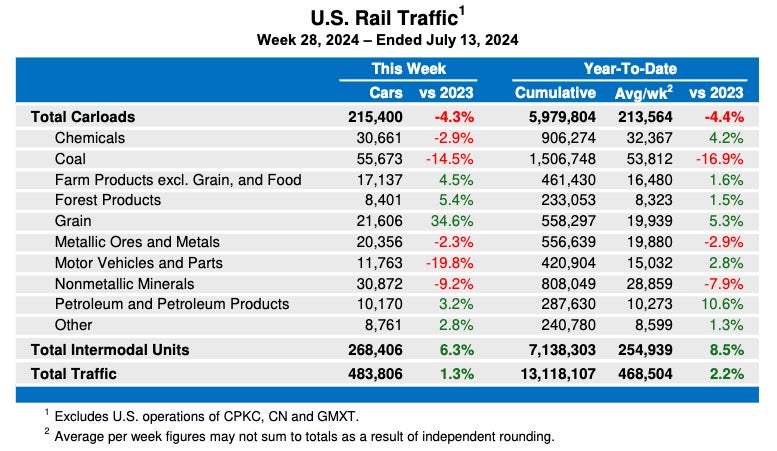
U.S. WASHINGTON — U.S. weekly rail traffic continues to run ahead of 2023 levels, thanks to intermodal volume, according to statistics from the Association of American Railroads.

For the week ending July 13, total U.S. volume was 483,806 carloads and intermodal units, an increase of 1.3% over the same week in a year ago. That includes 215,400 carloads, down 4.3% from last year, and 268,406 containers and trailers, up 6.3%.

Through 28 weeks, U.S. traffic in 2024 is up 2.2% compared to the same period in 2023, with carload volume down 4.4% and intermodal traffic up 8.5%.

North American volume for the week, from 10 reporting U.S., Canadian, and Mexican railroads, included 318,065 carloads, down 3.8% from the same week a year ago, and 349,079 intermodal units, an increase of 10.9%. The total volume of 667,144 carloads and intermodal units represents a 3.3% increase. Through 28 weeks, this year’s North American volume is up 2.4% compared to the same period a year ago. In Canada, cumulative volume through 28 weeks is up 2%, while in Mexico, overall volume is up 6.3%.

Debate on valuing freight for state income tax purposes heats up

A battle over the complex issue of how states tax the value of freight movements and deliveries may soon reach a climax, with significant resistance to change coming from the trucking sector.

On one side of the argument is a push by some states, notably California, to move away from what is known as a “mileage approach” and instead to a “pickups and deliveries approach.” The latter is also known as a destination-based system.

The dispute is completely about trucking; it is not part of a wider tax reform process. For example, the collection of motor fuel taxes across various states under the terms of the International Fuel Tax Agreement is not impacted by the discussions and controversy at the quasi governmental Multistate Tax Commission (MTC), which is studying the issue and released a draft proposal last month. 

It is a complicated standoff, but here is a quick summary: Shifting to some combination of state income tax determination on the basis of origin/destination could benefit tax revenues in states that are the beginning and end point of delivering a product along the supply chain, like California with its massive Southern California port complex, or a big metropolitan area like New York. But it could damage states that aren’t the starting or end point of a supply chain even if trucks travel many miles in those states.

Big states could benefit

Critics of the plan under consideration at MTC also envision a scenario in which a movement of a truck from a port like Long Beach, California, to a destination such as Chicago could now see the total assessment increase even though the value of the freight is unchanged. Critics note that if that freight movement has tax impacts that state by state now add up to 100% through a largely consistent mileage-based system, those assessments under a hybrid system could, due to inconsistency, rise to a figure that is effectively more than 100% of the value of the freight being transported.

MTC’s Model Receipts Sourcing Regulation Review Work Group, which floated a draft proposal, met Monday. MTC first took up the issue in 2022; its draft proposal was issued last month in anticipation of this week’s meeting. The group is expected to meet again toward the end of the month.

The American Trucking Associations has come out against the change. In a letter sent earlier this month to the MTC, the ATA said it “believes the potential change from the current mileage rule to a … destination-based [sourcing] is not a direction the trucking industry can support.”

The law firm of Eversheds Sutherland, which represents several trucking companies, summarized in a letter to the MTC earlier this month just what is being debated and by extension, just what it is that should be taxed.

“Is the service only the pick-up and drop off of a package?” attorneys Chelsea Marmor and Eric Tresh of Eversheds Sutherland wrote in the letter. “Or is the service the entire transportation — the moment the package is collected until and through the delivery?”

Their answer: “Industry representatives have continuously made clear that the service is provided the entire time the package is in the service provider’s possession.”

“Miles has been the model rule for this industry for almost half a century, and adopted by the majority of states,” Marmor and Tresh said in their letter. “More than half of the states that have participated in the work group stated that their respective state will not depart from a miles rule.”

No power to compel

The MTC does not have legal power to compel a state to adopt a certain system, Marmor said in an interview with FreightWaves. Most states have been using the mileage-based approach to determine the income distribution for state income tax purposes, she added. 

But a destination-based system, or a system where the originating point and the destination point are the basis, would be significantly different, Marmor said. 

The fact that there could be multiple systems is why the total tax bill for a shipment could be viewed as being more than 100% of the revenue the freight produces. A state that could benefit from an origin/destination model — like California, New York or Illinois — would tax it on that basis. But a state with plenty of miles to be traversed by trucks would want to stick with a mileage-based system.

“The mileage rule says to determine how many receipts you attribute to a state, you take the intrastate miles” Marmor said. She gave the example of a shipment that went through New York. If a truck trip covers 1,000 miles, and 100 of that is in New York, 10% of the income from the freight movement would be allocated to the New York tax system.

The MTC originally looked at a system for a revenue split. A California-to-Illinois trip that had $100 in sales tied to it would see the two states each collect $50.

But now MTC is looking more to a destination-only system, with all $100 considered to be sales to Illinois. That then is part of the Illinois tax base that yields revenue to the state. The former system would have seen that $100 divided among the states where the freight had transited on its way to Illinois.

MTC’s Uniformity Committee is studying the issue. In a letter sent in March to Helen Hecht, the uniformity counsel of the MTC, the Council on State Taxation (COST) questioned why, with most states using the mileage system and uniformity established as a goal, there is a push for a change.

Few states have backed a shift, COST senior tax counsel Stephanie Do said in the letter. “The lack of engagement indicates that a uniformity problem does not exist at a level that warrants the Uniformity Committee’s involvement,” Do wrote. “The committee’s decision to move forward on this creates newfound problems that are inconsistent with uniformity and simplification.”

In a document, the MTC laid out the pros and cons of the various systems used or under consideration. Some of the pros for the mileage system are its current widespread use, that it “appears to be a workable approach” and that it “takes into account that length of trip is a major component of the service that is provided.”

Among its cons are legal decisions in New Mexico and Montana that could be in conflict with the mileage approach, differences with the tax considerations for competing freight transportation options such as rail and air, and a general, slightly vague statement by MTC that mileage systems “may not reflect the many aspects of modern logistics.”

The pros of the delivery method listed by MTC are aligning itself with the New Mexico and Montana decisions and aligning itself with the tax consideration of air transportation, as well as the fact that it “can be said to reflect where the service is delivered.” Its cons are mostly in line with the fact that switching to a delivery method overturns a system that at present is widely used and generally has been uncontroversial.

The push from California

Documents available through the MTC website suggest that California’s Laurie McElhaton of that state’s Franchise Tax Board has been the leading voice for a realignment into a delivery method for determining taxation.

There are some states that have already adopted market-based sourcing for sales of services that would like to align their method for sourcing trucking receipts with more of a market method which might be any combination of delivery and/or pick up,” McElhaton wrote in making her proposal. “Historically, when we have a split in approaches the MTC has offered two different options to states.”

In her proposal, she also recommends a mediation pathway – which MTC has included in its draft rule – to work through controversies between states with different approaches toward taxation.

Marmor and Tresh in their letter criticized the need for a mediation process. “The MTC seems to acknowledge that there will be winners and losers using either pick-up/drop-off or drop-off only because the MTC included a mediation provision,” they wrote. “And particularly, what has been said time and time again, is that having two alternative rules will result in taxation chaos.”

More articles by John Kingston

Victory for a 3PL again — TQL — in case involving broker liability 

Transfix, recently out of the brokerage business, offering its first software solution 

Bid to block Biden independent contractor rule moves to federal appeals court

Triumph Financial staying course on growth targets despite weak earnings

A weak freight market led to a weak earnings report at Triumph Financial, the trucking-focused bank, but CEO Aaron Graft’s quarterly letter to shareholders continued to emphasize long-term strategy over short-term earnings.

Graft’s letter, which this quarter ran 11 pages of text, graphs and charts, opened by labeling quarterly earnings “anemic” and said the primary reason is that “expenses have risen while revenue has stagnated.”

But a possibly more important measure for Triumph Financial’s (NASDAQ: TFIN) growth is earnings before interest, taxes, depreciation and amortization at TriumphPay, the division at Triumph Financial that houses its TriumphPay Network. The network processes transportation invoices and generates revenue via fees, as opposed to generating revenue through interest payments tied to quick pay activities, which is also part of TriumphPay.

The EBITDA margin at TriumphPay was negative 10% in the second quarter, a 3-percentage-point improvement from the first quarter. EBITDA margin was flat in the fourth quarter of 2023, the only quarter it has not been negative.

Graft said TriumphPay still expects a positive EBITDA margin by the end of 2024. 

The focus of Graft’s letter was on the growth of TriumphPay and the hurdles to get there. It is coming off a quarter in which it announced the network had pulled in the biggest fish of all in the brokerage world: C.H. Robinson (NASDAQ: CHRW). But Graft also disclosed that LTL carrier ArcBest (NASDAQ: ARCB) has become a user of the TriumphPay Network. 

The ArcBest addition had not been announced by Triumph Financial previously, and Graft noted that the disclosure of the C.H. Robinson signing, six to nine months before the company actually goes live on the network, was unusual. “Given the size of CHRW, we wanted to inform investors,” he wrote.

“We are in the density building phase of our network development, which is the most difficult phase,” Graft wrote. “We will be in this phase through the rest of this year and much of 2025. We will remain primarily focused on the task of building density regardless of freight recessions, Fed tightening cycles or any other events outside of our control.”

Shooting for 50%

Along with positive EBITDA, there is a clear numerical goal TriumphPay hopes to reach in the medium term: having its network “engage” with more than 50% of all brokered freight, based on an internally generated estimate of the size of the market. Triumph Financial’s estimate is that it reached 47% of the market this past quarter.

“With the announcements this quarter, we have a trajectory towards network engagement with over 50% of all brokered freight by the end of this year,” Graft wrote. “Long term, we intend to achieve well beyond 50% network engagement.”

Other statistics: Network transactions were up 13% sequentially from the first quarter. Total network volume hit $5 billion for the first time. The first “conforming” transaction that utilized all the capabilities of the network that was enabled by Triumph’s purchase of HubTran in April 2021 occurred in January 2022. “That is an impressive rate of growth for any business beginning with a cold start,” Graft wrote.

Although Graft made reference in his letter multiple times to staying the course, he acknowledged that the rise in expenses in the middle of a freight recession, the primary cause of its earnings miss, needs to be reined in. “A cap on expenses is appropriate for the next several quarters,” he said. “We have roughly doubled our expenses over the last five years as we morphed from a community bank into a financial technology platform. Despite that remarkable change, we must remember that we are a bank, and banks are supposed to consistently make money.”

According to SeekingAlpha, GAAP earnings at Triumph Financial of 8 cents per share missed targets by 14 cents, though revenue of $105 million topped estimates by $1 million.

Stock price on a roll

Investors appear recently to be buying into the long-term story of Triumph Financial. The stock hit its 52-week high Wednesday at $95.46, and it’s up about 42.9% in the past 52 weeks and 21.1% in just the past month. The weak earnings report appears to have had no impact on investor sentiment; even after the earnings were released, the price of Triumph Financial was unchanged.

The other part of Triumph Financial’s business, its factoring operations, provides a wealth of data into the state of the freight market. And for Triumph Financial, there was little sign of overall improvement but there were signs of life as the quarter came to an end and July began. 

Operating income for the factoring segment was $4.6 million, down $2.5 million from the prior quarter. Interest income grew by slightly more than 5%, but that was offset by lower average invoice prices.

The average invoice size factored by Triumph Financial was $1,738. The industry has been talking of an imminent turnaround in freight markets for months, but the invoice size declined from the first quarter, which came in at $1,771. A year ago, in the second quarter of 2023, it was $1,773. In the first quarter of 2023, it was $1,911.

But Graft also reported that for the 16 days of July leading up to the release of the earnings, the average invoice size had risen to $1,796.

Within the overall numbers, there also were some signs of a freight recession recovery. Graft said carriers “locked into the spot market” had a mid-April low average invoice of $1,296, but the figure had risen to $1,399 by the end of the quarter. Triumph Financial customers with more exposure to contract markets recorded an average invoice size of $1,998 in mid-April and $2,158 by the end of the quarter.

Diesel prices have an impact

Some of the increase, Graft said, was a result of the rising price of diesel fuel by the end of the quarter, as the cost of fuel is part of the invoice to be factored. The average retail cost of diesel as measured by the weekly number published by the Energy Information Administration opened the second quarter at $3.996 a gallon, fell as low as $3.658 for the price published June 10 and was $3.813 for the price published July 1.

Reflecting a market where the general consensus is that the weak market is a result more of excess capacity than weak demand, Triumph Financial reported that invoice purchases per client were up 10.4%, and total transactions increased by 4.7%. Triumph reported that purchased invoice volume in dollars was up 2.9% compared to the first quarter, but with transaction volume rising faster than total invoice dollars, the result is a lower average price per invoice.

Graft said carrier capacity “continues to leave the market, and we are starting to see the pressures of the environment affect even solid and seasoned operators. However, capacity is still not exiting quickly enough and some sources I see assert current attrition rates won’t reach 2019 levels of capacity until late Q4 of this year.” Specifically, Graft said Triumph Financial lost 2.5% of its “small carrier clients” compared to the first quarter, though the cutoff point for what constitutes a small carrier was not disclosed.

More articles by John Kingston

Victory for a 3PL again — TQL — in case involving broker liability 

Transfix, recently out of the brokerage business, offering its first software solution 

Bid to block Biden independent contractor rule moves to federal appeals court

CEO Joni Casey retiring after 27 years of leadership at IANA

Joni Casey, president and CEO of the Intermodal Association of North America (IANA), announced Wednesday that she will retire at the end of 2024 after 27 years of leadership at the organization.

The association’s board of directors has begun a search to identify Casey’s successor, IANA said in a news release, and aims to ensure a seamless transition and continuity of the organization’s mission.

“It has been a privilege and an incredible opportunity to witness and contribute to the evolution and growth of the intermodal industry,” Casey said in the emailed news release. “I am proud of IANA’s accomplishments on behalf of intermodalism and our members over the years. And I am deeply appreciative of the guidance and support I have received from the Board of Directors and the staff of the Association. Their efforts have been instrumental to the organization’s success.”

Under Casety’s leadership, Calverton, Maryland-based IANA has reached a number of milestones, notably the growth in membership from several hundred companies to over 1,000. Casey has led efforts by the association to create and expand industry technology programs under IANA’s Intermodal Information Services. Additionally, she has overseen a scholarship program aimed at fostering the next generation of talent in freight and intermodal transportation. The program has awarded over $5.3 million. 

Before her work as a career association executive at IANA, Casey was executive director of the American Trucking Associations’ Intermodal Council and president and CEO of the Transportation Intermediaries Association.

“Joni’s transformative leadership has shaped IANA into a dynamic organization poised to address the evolving needs of the intermodal community,” said Trevor Ash, chair of IANA’s board and CEO of CIE Manufacturing, in the news release. “Her legacy is one of innovation, resilience, and steadfast commitment to advancing intermodal transportation.”