Union Pacific, Norfolk Southern: Rival alliances bolster merger case

Chief executives Jim Vena of Union Pacific and Mark George of Norfolk Southern say the interline partnerships that BNSF, CSX, and Canadian National have announced recently are proof that the proposed UP-NS merger will boost railroad competition.

“Just the mere idea of having a transcontinental railroad has already enhanced competition … And I think that’s a very, very important point. Our argument is being made for us,” George told an investor conference Wednesday.

The Surface Transportation Board’s 2001 merger review rules encourage alliances that can provide merger-like benefits without integration-related service problems. The rules also require a major merger to enhance, rather than merely preserve, competition.

“We’ve got lots of competition coming at us … I love it. And I think it helps us with the STB,” Vena said in a separate appearance at the conference.

Last month BNSF and CSX (NASDAQ: CSX) announced an intermodal partnership that will offer seamless domestic coast-to-coast service, plus new international service linking BNSF’s Kansas City terminal with CSX-served ports on the East Coast.

And on Monday CSX and Canadian National unveiled plans to develop a new interline intermodal service linking Nashville, Tenn., with Vancouver and Prince Rupert, British Columbia, via interchange at Memphis.

BNSF, CSX, CN (NYSE: CNI), and Canadian Pacific Kansas City (NYSE: CP) executives have all said that Class I mergers are not necessary and that they will focus on interline partnerships that can offer shippers more options today.

Vena says there’s no doubt alliances will make the other railroads more competitive. But he also insisted that mergers are far more effective because they’re permanent and place decision-making under one railroad’s control.

“Bottom line is this: A cooperation agreement is completely different than a consolidation,” Vena said. “There are way more benefits on a consolidation, on a merger, than there ever is on an agreement where you’re going to work together.”

A railroad will abandon a run-through power agreement, for example, when it’s short of locomotives.

“If you’re short locomotives or tight for people, you have to set the priority, and you’re going to look inward,” Vena said. “So that’s why they always break down.”

Vena also downplayed the potential impact of the CN-CSX agreement, noting the UP-NS route from West Coast U.S. ports to Nashville is 700 miles shorter than CN from Vancouver to Memphis and CSX from Memphis to Nashville.

UP (NYSE: UNP) and NS (NYSE: NSC) have said that one of the key selling points for their merger is its potential to boost the U.S. economy, make American companies more competitive in global markets, and support an American industrial renaissance.

Vena said he met with senior Trump administration officials in Washington on Tuesday. “They get it,” he said. “They understand the value of what we’re proposing, and they think it’s an absolute win for the country.”

George compared the merger to President Dwight Eisenhower’s creation of the Interstate Highway System in 1956.

“This will be as transformative as what Eisenhower did in the ’50s … when it comes to freight transportation,” George said. “Ever since then, when that highway system was built, freight has started to navigate toward the highway, and it’s been hard for rail to recapture share. 
This is our opportunity to redefine rail’s role in freight transportation.”

Shipper associations, some rail labor leaders, and some elected officials have criticized the UP-NS merger, saying it will leave shippers with fewer options and lead to service problems.

But George said feedback from shippers, labor unions, and elected officials has generally been positive. “There’s just a lot of optimism and positivity toward what we’re doing, and we’re really excited by that,” he said.

Vena says a fragmented rail network — with two Class I railroads in the East, two in the West, and two in Canada that extend into the U.S. — cannot effectively deliver for customers. “Does anybody want to go back to 40 Class I railroads? Absolutely not. 
Does anybody want to go back to the days of the railroad having so much power? That’s not where we are. Where we are is trucks are our biggest competition,” he said.

UP and NS teams are working on the more than 4,000-page merger application that will be submitted to the STB sometime after Oct. 29. “It’s a monster,” George said.

The spirit of cooperation between UP and NS employees mirrors the initial merger talks between the CEOs, George added.

“I’m really proud of the collaboration between the NS team and the UP team. We are working extremely well and extremely close, and it speaks to why I think the combination of UP and NS makes the most sense,” George said. “There’s a cultural fit.”

The UP-NS deal also requires shareholder approval. NS aims to hold its shareholder vote on the merger by the end of the year, George said.

The executives spoke at the Morgan Stanley Laguna Conference.

Subscribe to FreightWaves’ Rail e-newsletter and get the latest insights on rail freight right in your inbox.

Related coverage:

Labor and industry clash over rail automation
CN, CSX join on new Nashville intermodal service

U.S. rail freight narrowly up as key commodity sinks

New ‘green’ report for Port of Long Beach on-dock rail

ATRI launches research initiative on entry-level driver training impacts

An image of a tractor trailer with driver training wrote on the back doors. The truck driver appears to be a student driver, similiar to what ATRI plans to study.

The American Transportation Research Institute (ATRI) is looking for motor carrier participants in research to analyze the impacts of new-entrant truck driver training on safety and retention. The study is a sequel to earlier research published by ATRI in 2008, which focuses on the efficacy of the Federal Motor Carrier Safety Administration’s Entry-Level Driver Training requirements.

“This research represents a critical opportunity to understand which training approaches actually produce safer drivers,” ATRI said in its announcement. The study requires participating carriers to submit specific data points for each new-entrant driver, including demographics, days employed, CDL training provider information, total miles driven, and driver-specific safety events such as crashes, violations and telematics events.

For the study, new entrants are defined as CDL drivers who have been driving professionally for three weeks to 24 months, with their first professional driving job at the participating carrier. The study will include drivers who have met this definition since March 2022.

“Participating carriers must have employed a minimum of 25 new entrant drivers in the requested time period (March 2022-August 2025),” the ATRI announcement states. In addition to individual driver data, carriers will need to report fleetwide averages for training and retention metrics, including training hours and frequency of home time.

ATRI emphasizes that all submitted information will remain strictly confidential, with the organization prepared to execute nondisclosure agreements with participating companies. All collected data will undergo anonymization and will only be published in aggregate form to protect carrier privacy.

The earlier study from 2008 was the first known examination of the safety impact of training on new entrant commercial drivers. The study analyzed data from more than 16,000 drivers representing 29% of annual new entrant driver population estimates at the time.

The research collected information from 10 driver training programs, examining curriculum components, instructional environments and their correlation with safety outcomes. Programs varied considerably in their approach, with total contact hours ranging from 88 to 272 hours and different emphasis on classroom versus behind-the-wheel training.

Motor carriers interested in contributing to this industrywide safety research can complete the questionnaire through ATRI’s website.

DHL to buy US healthcare courier SDS Rx

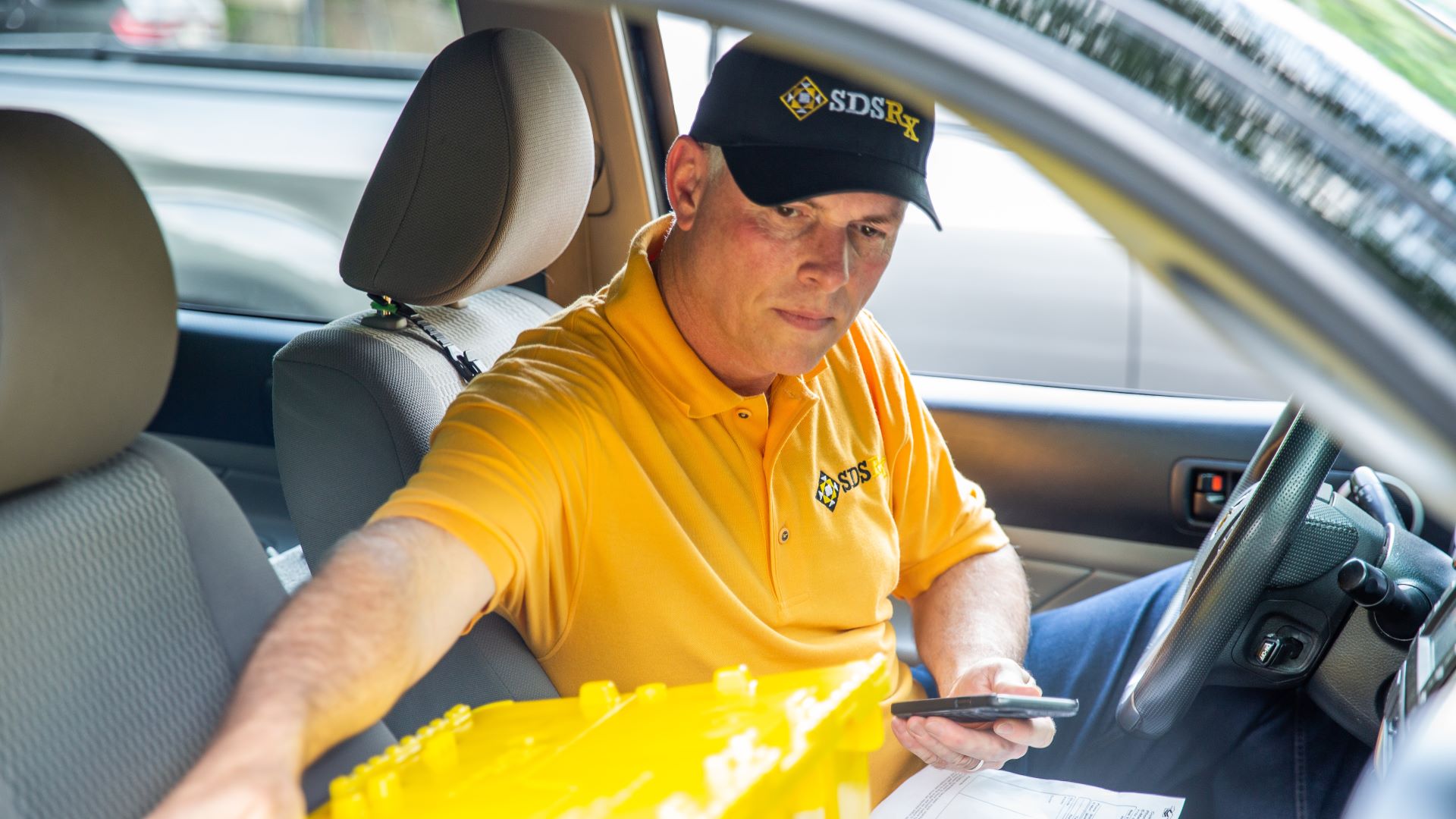
Inside car, view of delivery driver wearing gold shirt with black hat that reads SDS Rx

DHL Group’s contract logistics arm has tentatively agreed to acquire Tampa, Florida-based SDS Rx, a provider of specialized final-mile delivery to medical establishments, as part of the company’s strategic focus on building capabilities in the high-margin healthcare logistics.

SDS Rx provides delivery services for long-term care facilities, hospitals, laboratories, drug distributors, specialty pharmacies and nuclear pharmacies. SDS Rx operations will be integrated into DHL Supply Chain’s North American Life Science & Healthcare business, and will continue to operate under local leadership, DHL said in a news release on Tuesday. 

The life sciences and healthcare sector is projected to grow 11% per year through 2030, pulling along the logistics market that supports it. Next year, the healthcare logistics market is estimated to reach $152 billion next year, up from $130 billion in 2023 as an aging global population needs more drugs and biological medical products to deal with chronic disease, say industry experts.

Specialty pharmacy firms account for about 50% of total prescription drug spending in the U.S. and the number of patients served by specialty pharmacies grew by 12% between 2018 and 2022, according to market research platform Gitnux. 

It is the second healthcare transaction for DHL Supply Chain this year following the acquisition of Nashville, Tennessee-based CryoPDP, a white-glove courier service with operations in 15 countries that focuses on clinical trials, biopharma, and cell and gene therapies with cold chain requirements.

SDS Rx, formally known as Strategic Delivery Solutions, supports healthcare system networks from 200 locations nationwide. The combination with DHL will enable SDS to scale its business to meet increased demand for time-sensitive specialty pharma transportation, while DHL will be able to support a wider range of healthcare customers, DHL said.

In April, DHL Group said it planned to invest $2.2 billion to upgrade its logistics portfolio in the life sciences and healthcare sector, with half the money earmarked to the Americas. The investment is part of DHL’s recent strategy to double health care logistics revenue to $10.8 billion by 2030, with an extensive temperature-controlled network, first- and last-mile specialty courier coverage, and integrated service offerings.

“The increasing demand for specialty pharma and healthcare solutions presents significant opportunities for DHL to leverage its scale, expertise, and commitment to operational excellence. With this acquisition, we are expanding our healthcare logistics capabilities, attracting a new segment of healthcare customers, and reinforcing our position as a trusted partner in building resilient and connected healthcare supply chains,” said Mark Kunar, CEO of DHL Supply Chain North America, in the announcement.

Terms of the deal were not disclosed.

Integrated logistics competitors FedEx and UPS have also focused on healthcare logistics as major profit centers.

In January acquired Frigo-Trans and sister company BPL, which provide temperature-controlled warehousing and transportation in Europe for pharmaceutical and biotech companies. 

Click here for more FreightWaves/American Shipper stories by Eric Kulisch.

Write to Eric Kulisch at ekulisch@freightwaves.com.

DHL expands health logistics campus in Germany

DHL to buy US pharma logistics specialist CryoPDP for $195M

US de minimis policy could trim DHL profit by 3%

Express logistics providers bet big on healthcare business

Kodiak Robotics delivers its first factory-made autonomous truck

Kodiak Robotics' first factory-built autonomous truck, a beige Peterbilt semi-tractor, parked in Roush Industries' manufacturing facility in Livonia, Michigan.

Kodiak Robotics announced Wednesday the delivery of its first autonomous truck created directly off a factory production line. Roush Industries, a supplier servicing the mobility, aerospace, defense, and theme park industries, upfitted the truck powered by Kodiak’s virtual driver at its Livonia, Michigan, facility. The truck was then delivered to Atlas Energy Solutions in August.

“Taking delivery of the first Roush-upfitted truck is another example of how the future of freight is arriving,” said Don Burnette, founder and CEO of Kodiak, in a press release. “The speed and quality of Roush’s work confirm why we are confident they’re the right partner to help us transform the freight and logistics market at scale. Together, we believe we are well positioned to transform the trucking industry.”

Atlas began taking deliveries of the Kodiak Driver-equipped trucks back in December 2024 when the company placed an initial 100-truck order. To date, Atlas has taken delivery of eight of those driverless trucks.

The manufacturing partnership with Roush was announced back in June 2025. Following the announcement, Roush established a dedicated production line to scale the upfitting of autonomous trucks equipped with the Kodiak Driver. According to the release, Roush and Kodiak intend to scale production into the hundreds of trucks by the end of 2026.

“Delivering the first Roush-upfit truck shows how our contract manufacturing process can meet Kodiak’s high standards while supporting its ability to scale,” said Brad Rzetelny, vice president of contract manufacturing at Roush. “We’re playing an important role in putting this technology where it belongs: into commercial service.”

This news comes as Kodiak announced earlier in April its plan to go public through a SPAC with Ares Acquisition Corporation II. If the merger is successful following a shareholder vote on Sept. 25, the company plans on listing on the Nasdaq Stock Market on Sept. 25.

Werner faces social media storm over Kenyan driver rumors

(Editor’s note: the article has been amended from its original publication to include a statement by the office of the Nebraska Secretary of State).

Werner Enterprises is at the center of a growing social media uproar, after online rumors claimed the Nebraska-based trucking giant was possibly planning to hire Kenyan truck drivers — rumors the company firmly denies.

As can be the case with trying to explain what is driving a social media frenzy, understanding the moving parts in the Werner/Kenya story can be head-scratching. But for Werner (NASDAQ: WERN), it is facing numerous social media posts accusing it of hatching a plan to hire truck drivers from Kenya and have them operate in the U.S., presumably at the expense of U.S.-based drivers.

Werner took the unusual step Tuesday of putting out a statement on X, denying that it had signed or even discussed a plan for the “recruitment of Kenyan truck drivers to the United States.”

“Any claims suggesting otherwise are just false,” the statement said. 

Tackling controversies is not the usual offering of Werner’s X feed. Recently the company used it to celebrate both National Grandparents’ Day and National Read a Book Day.

Nebraska trip by Kenyans last year

Based on the various social media posts about Werner and Kenya, what does appear to have set off the controversy begins with a 2024 meeting Werner held at its headquarters in Omaha with economic development officials from Kenya.   

In a story from June 2024 in a news service called the Kenyan Diaspora, it was reported that a Kenyan official, Diaspora Principal Secretary Roseline Njogu, had led a delegation on a business-related visit to Omaha, Nebraska, where Werner is headquartered.

The article contained a picture of Werner representatives at the meeting, with the company’s logo on the wall. The names of the Werner representatives were not mentioned in the article, which did not include any quotes from Werner representatives. 

The article did quote Nebraska Secretary of State Bob Evnen who was at the meeting as saying “there are tens of thousands of truck driving jobs that are open at any given time.” 

The Kenyan delegation’s trip did get some local news coverage as well. And while the local media reported Evnen’s comments about tight truck driver availability, it did not quote Werner. 

Fast forward to the first days of September, and Evnen was in the news again in regards to Kenya. 

In an article dated Sept. 4 and published on the website entitled Kenyans, Evnen was reported as having attended the Kenya-Nebraska Agriculture, Trade and Investment Conference, a conference in the capital city of Nairobi. 

At that conference, Evnen signed what the website called a “landmark” deal between Nebraska and Kenya, formally titled a “Labour Mobility and Diaspora Support Memorandum of Understanding (MoU).” The article contains a picture of Evnen signing the deal along with Njogu.

And while Werner is not mentioned in the reporting of Evnen’s remarks, the trucking industry is discussed.

According to the article in Kenyans, Evnen said Nebraska carriers have begun to hire Kenyan drivers. The article also quotes Evnen as saying “We have commercial truck drivers already who are being trained, partially in Kenya, and then they complete their training in Nebraska.” 

Without quoting anyone directly, the article then says “this initiative is in direct response to the pressing shortage of commercial drivers in the United States, particularly those operating tractor-trailer combinations.”

Evnen also is the official referred to in the story’s headline: “American Official Hails Kenyan Talent, Opens Path for Kenyans to Get Jobs in the U.S.”

On a website called Kenya Insights, an article by Annabel Makhwaya was more explicit on the impact of the MoU. 

“The deal…explicity targets licensed commercial drivers amid a significant shortage of truck drivers across America,” the article said. “Evnen confirmed the high demand for skilled drivers in his state and emphasized that the agreement provides an organized, legal pathway for Kenyans seeking employment opportunities in the US. 

This was not Evnen’s first trip to Kenya. He led a trade mission to the country in February 2024, before the delegation’s trip to Nebraska that included meeting Werner. 

Nebraska Secretary of State weighs in

A spokeswoman for Evnen said in an email to FreightWaves that the MoU is “stated in general terms and says nothing about truck drivers. The MOU requires full compliance with all Nebraska and federal laws, and that includes the President’s Executive Order on CDL driver requirements and U.S. immigration law.”

In a prepared statement, the Secretary of State’s office said the primary focus of the trip was mostly agriculture.

A prepared statement the Secretary of State’s office put out after the trade mission said the Kenya trip was Evnen’s sixth such trade mission trip to a foreign country since he took office in 2019. It was also his second trip to Kenya.

A list of companies that attended that trade mission notably did not include Werner, but it did include Grand Island Express, a refrigerated carrier based in Nebraska. 

None of the reporting in Kenyan media about last week’s Nairobi conference, or the MOU or Evnen’s presence in the country, mentioned Werner.

Possible root of the rumor

But it isn’t a long road for some social media warriors to apparently perform this logic: Werner met with a Kenyan delegation last year; Nebraska officials just signed a cooperation deal with Kenya over labor training and opportunities, in which a leading Cornhusker State official talked about training Kenyan truck drivers; Werner is in Nebraska. Ergo, Werner is looking to hire Kenyan truck drivers that would presumably take jobs away from Americans.

Beyond the posting on X, a spokeswoman for Werner released the following statement to FreightWaves. 

“In May 2024, at the request of the Nebraska Secretary of State’s office, Werner hosted a group of dignitaries from Kenya as part of a standard trade mission visit,” she said. “The conversation at Werner covered a variety of topics; however, there were no commitments made or discussions regarding a program or Werner sponsoring visas. The group visited multiple companies across various industries in Nebraska and held discussions, but there were no takeaways, follow-up discussions or meetings involving Werner since that time. Whatever agreement the Secretary of State may have made during his recent visit does not include Werner Enterprises.” 

The social media critiques of the cooperation between Kenya and Nebraska over the issue of truck drivers is non-specific, as the details of the MoU are not widely disclosed. Many of the critics don’t seem to know about the MoU. 

But they otherwise fall into two categories.

One is general criticism of any sort of arrangement that might bring Kenyans to the U.S. to work as truck drivers.

The second are very specific critiques directed at Werner, apparently based on the assumption that if it’s about trucking in Nebraska, the giant truckload carrier based in Omaha must be part of it.

This posting on X is an example. It reaches back to the 2024 meeting and the Kenyan news media reports about the meeting at Werner and puts it with a post about the recent MoU signing. “The Secretary of State of Nebraska is working with one of the largest trucking companies in America, Werner Enterprises, to replace American truckers with migrants from Kenya,” the posting says. 

The issue Wednesday was considered significant enough at Werner that its CEO Derek Leathers checked in on his own X feed.

Responding to a poster who had critiqued the reported “deal,” Leathers said “We did not, do not and will not work to bring drivers in from foreign countries on Visas or otherwise.” 

More articles by John Kingston

Transportation/warehousing jobs up slightly in BLS model revision

Raucous Teamsters demonstration at Amazon in New York belies tough road for unionization efforts

First step taken by Trump administration to supplant Biden’s independent contractor rule at Labor department

TruckSmarter secures $16M: A new era for transport AI

TruckSmarter has secured a $16 million equity raise, a move that reflects both confidence in its core business and an acknowledgment that the industry is standing on the edge of major change. The company, best known for its trucker-first load board, is now investing heavily in research, development, and talent to push further into artificial intelligence.

Socium Ventures, a venture and growth investment firm backed by Cox Enterprises, led the equity financing, with support from Thrive Capital, Founders Fund, a16z, Bain Capital Ventures, FinVC, and other industry leaders. 

For co-founder and CEO Daniel Kao, the decision came after a period of reflection earlier this year. “During annual planning, we asked ourselves if load boards as we know them will still exist in five years,” Kao said. “The answer wasn’t a definite yes, so we decided to build the future we want to see.” That future will be shaped by AI tools designed not just for brokers but specifically for truck drivers.

The company’s new AI-driven product, Dispatch, is an early step in that direction. Dispatch began with a deceptively simple problem: load verification. Too often, drivers spend valuable time chasing down freight postings that are incomplete or inaccurate, calling one by one to sort out critical details. 

TruckSmarter’s technology automates this process, surfacing verified loads and presenting options that align with a driver’s specific needs. “Drivers love that it calls for them and shows them what they want,” Kao explained. “The more it learns about the business, the more it can pinpoint the right opportunities.”

In testing, Dispatch has already shown its ability to save drivers time and frustration. Data inconsistencies are still widespread. TruckSmarter found that 40% of loads called on had changes from the posted information, but the longer-term vision is an assistant that can cut through the noise entirely, finding freight tailored to a driver’s specific preferences and history.

That vision, Kao emphasized, is less about chasing the hype around AI and more about creating long-term value through intelligence that compounds over time. While much of the current wave of AI investment in freight tech is focused on broker tools, TruckSmarter is aiming to build technology that strengthens the driver’s position in the market.

The funding round, backed entirely by equity, gives the company room to grow its team and double down on R&D. Kao sees this as just the beginning of a larger push to reimagine how freight is sourced, verified, and ultimately booked. Whether load boards in their current form survive the next five years is uncertain. What is clearer is that TruckSmarter intends to shape what comes next.

Labor and industry clash over rail automation

Trains in rail yard

WASHINGTON — Labor and industry are giving the Trump administration opposing takes on how technology and automation in freight railroading should be considered as a long-term economic strategy.

In comments filed with the U.S. Department of Transportation’s request for comments to help the department update its five-year strategic plan extending to 2030, the International Association of Sheet Metal, Air, Rail and Transportation Workers (SMART-TD) said the rail industry is at a point of critical mass.

“Under the guise of new and improved efficiencies, Class I railroads have hollowed out their workforce and pushed unsafe practices, including the operation of ever longer and heavier trains that infrastructure cannot safely accommodate,” wrote SMART-TD Legislative Director Jared Cassity. “These practices directly threaten the resilience of the rail network and, by extension, the nation’s supply chain.”

Cassity told DOT that the strength of the rail network is already beginning to weaken with current technological failures, including delays caused by end-of-train devices that routinely lose communication, locomotive engine power losses, and unplanned stops caused by positive train control snags.

“These railroads cannot even get their handheld radio systems to function consistently with the length of today’s trains. If the carriers … cannot perfect basic technologies such as reliable radios, DOT cannot allow the nation to place blind faith in their ability to operate a railroad strictly through unproven, untested automation.”

To preserve safety and resiliency, SMART-TD, which represents train engineers and conductors, said DOT and Congress must require two-person crews on all freight trains.

“Railroading is a high-risk industry where automation cannot yet guarantee safety for workers or the public. The aggressive pursuit of automation and new technologies by freight railroads, despite fragile safety standards, is reckless.”

But the Association of American Railroads considers a mandate on two-person crews one that conflicts with the Trump administration’s policy goals of regulatory reform, and is pushing the administration to repeal the Biden-era federal rule requiring them.

“Efforts to require at least two-person crews in the freight rail industry lack a safety justification and ignore the successful use of single-person crews in the U.S. and globally,” according to an AAR policy statement. “Such regulations disrupt collective bargaining and hinder the rail industry’s ability to compete with less climate-friendly transportation methods while also impeding innovation and harming small businesses.”

On the use of automation in freight rail more broadly, AAR is urging DOT and Federal Railroad Administration policymakers to encourage more use of technologies that it contends improves rail safety and operations.

“For example, automated track inspection can improve detection of defects and response time, leading to fewer track-related accidents, and safety data collected from the automated track inspection programs clearly support further deployment of this important technology,” AAR stated in its own comments filed with DOT on the department’s long-term strategy.

“Unfortunately, due to the existing regulatory framework, new rail technologies can often only be used alongside, rather than as an enhancement to, manual inspections required by existing FRA regulations.

“Railroads, however, will continue to develop and implement new technologies to improve infrastructure safety and performance, but achieving maximum benefit will require regulatory flexibility that does not hinder innovation, allows railroads to find what works best, and encourages railroads to keep investing in those technologies.”

Click for more FreightWaves articles by John Gallagher.

The strategic truth behind Tobin’s cold chain acquisitions

Rising Imperatives in Cold Chain and Controlled-Temperature Storage

In the life sciences industry, the demand for precision-controlled logistics is surging. Biopharma innovation, the rise of cellular and gene therapies, and regulatory scrutiny require storage and transport solutions that guarantee temperature stability, whether in labs, manufacturing, or clinical supply chains. Facility expansions, infrastructure upgrades, and strategic acquisitions are becoming critical strategies for companies aiming to offer “gold standard” reliability and compliance across the cold chain ecosystem.

Recent industry movements from cold chain pharmaceutical companies emphasize major investments in temperature-controlled facilities, rapid regional expansion, and enhanced crisis resilience. Against this backdrop, Tobin Scientific’s recent announcements, including a new cGMP-compliant warehouse and a major acquisition, highlight how the company is evolving in lockstep with these pivotal supply chain trends.

Expanding Infrastructure: cGMP Storage That Delivers Scale and Redundancy

In mid-July 2025, Tobin Scientific unveiled a new 40,000 sq ft cGMP-compliant warehouse in Wilmington, Massachusetts, just 20 miles north of Boston. The facility features dual –20 °C storage chambers built for full redundancy, high-density racking, validated ambient ranges (15–25 °C), and comprehensive backup power systems. 

It marks Tobin’s third such facility in as many years, aligned with its $65 million growth capital raise earlier in 2025.

This expansion underscores a broader industry imperative: the need for geographically dispersed, high-integrity storage hubs. Such infrastructure enables responsiveness to R&D and supply-chain disruptions, supports scalability for biotech and pharma customers, and ensures compliance with standards like cGMP. 

As Erik Groszyk, COO at Tobin Scientific, puts it, the company has “created a proven model for rapidly designing and deploying advanced warehouses that provide our clients with precision temperature control at unmatched value.”

Strategic Integration: Acquiring Wakefield to Amplify Scale and Scope

Just weeks later, Tobin announced the acquisition of Wakefield Moving & Storage, a definitive deal adding 300,000 sq ft of warehouse space in New England. Wakefield brings deep expertise in lab relocations, sensitive equipment moves, and secure facility transitions. The acquisition notably broadens Tobin’s industry reach to sectors like semiconductors and defence, while strengthening core services in biotech, pharma, and academic research logistics.

This move reflects a clear trend: integration across cold chain and logistics verticals to offer clients end-to-end solutions under one roof. The integration of Wakefield’s robust capabilities allows Tobin to tailor offerings, from frozen storage to turnkey relocation, without relying on external vendors.

Vertically Integrated Service: Single-Source Solutions in a Fragmented Market

Tobin Scientific defines itself as “the nation’s only fully–integrated single-source provider of life science laboratory relocation and biorepository.” It delivers a comprehensive array of specialized services: frozen biological and cryogenic transportation, laboratory relocation, temperature-controlled storage (ambient, cGMP, ultra-cold), mobile cold rooms, and biorepository management.

Its biorepository services feature a wide temperature envelope, from –196 °C to 4 °C, and include layered power redundancies, 24/7 alarm monitoring, and real-time data logging. 

Capital and Growth: Fueling the Infrastructure Build-Out

Supporting this expansion is a strategic $65 million growth capital infusion secured in May 2025, led by Denali Growth Partners, Truck 9 Partners, and backed by Eastern Bank financing. Tobin’s leadership emphasized that this funding will be deployed to scale its cGMP-compliant infrastructure, expand geographically in pharmaceutical hubs, and support further M&A activities across the life sciences supply chain.

This capital-driven acceleration reinforces trends toward rapid scalability in cold chain infrastructure.

The life sciences sector’s push toward precision, reliability, and regulatory fidelity in cold chain logistics is no passing wave; it’s becoming the new baseline. Tobin Scientific is a strong example of how companies can meet these demands head-on through strategic infrastructure, integrated services, and forward-looking investment.

Veho brings e-commerce delivery network to southern California

A billboard below the Hollywood hills in Los Angeles promotes Veho, a parcel delivery company.

Fast-growing e-commerce parcel carrier Veho on Wednesday announced the expansion of its delivery footprint to Southern California, underscoring how competition in the parcel sector is heating up.

Parcel shippers have increasingly turned to alternative carriers like Veho for lower delivery costs as FedEx, UPS and the U.S. Postal Service raise rates and surcharges. 

Veho is now providing delivery services to much of Los Angeles, Long Beach, Orange Country and the Inland Empire, allowing e-commerce brands to reach about 8 million residents. New distribution centers in Santa Fe Springs and Ontario will enable more than 100,000 parcel deliveries per week, the company said.

Spokesman Evan Wagner said Veho is starting Southern California operations with about a dozen clients. 

Earlier this year, Veho began serving St. Louis, Cleveland, Pittsburgh, New York City, Richmond, Virginia, and Louisville, Kentucky, a UPS stronghold.

Veho’s network now covers 38% of the U.S. population in 56 major markets. 

New York-based Veho said additional coverage and distribution centers across California are planned in the coming months. 

The company, which provides last-mile delivery for retailers such as Macy’s, Sephora, Lululemon, Saks, Stitch Fix, Hello Fresh, Nespresso, Warby Parker and logistics providers like Flexport, ShipBob, ShipHero and Stord, says volume has more than doubled in the past six months compared to the 2024 holiday peak season. 

Co-founder Fred Cook explained in a LinkedIn post why it took longer than anticipated for Veho to open for business in California.

“Huge number of client fulfillment centers, enormous metro areas, fair weather all made it perfect for our model. But between the cost and client demand, we got pulled East. And in every one of the 7 years since then as we’ve done the same math, our expansion continued to tend toward building dense regions in the middle of the country and East Coast,” he wrote.

Veho went to market in 2018 with a different business model than most delivery startups. Instead of using dedicated independent contractors, it relies on 85,000 crowdsourced drivers and a tech platform to match them to packages for delivery. 

Veho’s delivery network (Source: Veho)

Its core product is Ground Plus, with transit times of one-to-three days. In January, Veho began offering a two-to-five day Premium Economy service. 

The company’s platform gives e-commerce consumers control over their deliveries, including the ability to provide delivery instructions, communicate with their delivery driver, reschedule or reroute deliveries and receive photo proof of delivery. A client portal enables shippers to track shipments in real time and proactively address issues before they become problems.

During the summer Veho participated in a test of delivery robots

Veho says its on-demand partner network and AI-assisted routing algorithms enable it to provide high service levels at lower cost than traditional carriers. 

On Tuesday, rival carrier OnTrac announced a new deferred service and an express coast-to-coast service in partnership with Clearjet, which uses narrowbody passenger aircraft for middle-mile transportation.

Veho began offering deferred service eight months ago, as an alternative to the Postal Service’s Parcel Select and Ground Advantage products, as well as UPS Ground Saver, and saw an immediate influx of new customers, said Wagner. And it teamed with ClearJet in February 2024 to enable online merchants with West Coast distribution centers to quickly reach the central and eastern United States, where its network is more concentrated.

Click here for more FreightWaves/American Shipper stories by Eric Kulisch.

Write to Eric Kulisch at ekulisch@freightwaves.com.

OnTrac challenges FedEx, UPS with cross-country delivery services

Bezos-backed robotics firm teams with Veho on e-commerce deliveries

FedEx and UPS cease parcel discounts, ‘weaponize’ fuel surcharges: report

Impersonation Attacks Are Here To Stay

This article is contributed content. It does not reflect the views or opinions of FreightWaves or any of its subsidiaries.

This article has been updated following commentary and feedback from Amazon.

For the last five years, the complexity of scams attacking the transportation industry has evolved into one of the most elaborate and complex forms of fraud attacking commerce.  We have watched fraud evolve from simple double brokering scams to very complex impersonation scams involving document forgery, fake transportation management system (TMS) platforms and websites, hijacked email accounts and spoofed phone numbers.  The level of complexity is so utterly mind blowing that even the best carrier screening platforms have a difficult time determining what is real and what is a scam.

Carrier Impersonation Evolution

In March of 2023, hackers breached the Department of Transportation (DOT) database.  At the time, DOT admitted to only employee information being compromised, however, it was discovered by October of the same year that the entire DOT PIN database was compromised, and available on the Dark Web.

Some free advice:  If you have not changed your DOT PIN number since March of 2023, go to https://www.fmcsa.dot.gov/registration/request-pin-number and follow the instructions.

It was this compromise that gave way to scammers famously searching for ideal target carriers in the Federal Motor Carrier Safety Administration (FMCSA) SAFER database.  When a target was identified, the scammer would purchase the applicable PIN and file an MCS-150 to change the contact info of the carrier with the FMCSA Registration Department.  Once SAFER information was updated to sources controlled by the scammers, they would book loads with brokers with impunity.

Thanks to updated procedures at FMCSA, in cooperation with FreightValidate.com’s free SAFERWatch program, carriers and brokers now know within hours if there are changes made to their registrations.  The Freight Fraud Task Force (FFTF) has been helping both carriers and brokers who have had SAFER information compromised.  The FFTF is using a playbook devised by the FFTF co-founders to help rescue compromised authorities, with the support and backing of the Registration Department at FMCSA.

Latest in Carrier Impersonation

Over the last six months, scammers have found it far more difficult to compromise FMCSA data, and have shifted gears to impersonating carriers by directly attacking their communications, specifically email.  Scammers are still combing FMCSA data to identify potentially weak targets, including motor carriers that lack any level of sophistication with regard to computer security.  Scammers appear to be watching for carriers with public domain email addresses and poor password strength to hack.  

Once a victim is identified, the scammers begin their hacking attack.  They infiltrate the carrier’s email, and begin inserting special code. The scammer finds past sent emails with COI’s, Certificates of Authority, Notices of Assignment, and W9s.  Once that data is gathered, the scammer starts using the carrier’s own email to book loads with potentially weak brokers.  Scammer tech deletes emails from the “sent messages” folder to avoid detection.  When the weak broker replies to the email, scammer tech intercepts the email, and prevents it from ever reaching the user’s inbox, again to avoid detection.  Once the deal is done, the scammer sends in a fake carrier to load and steal the cargo.  Once the weak broker realizes they were scammed, the scammer breaks their connection with the impersonated carrier.  New emails going to the carrier’s inbox are finally visible and both the broker and carrier are wondering “what just happened”?  By this point, the scammer has control of the cargo and disappears, leaving the weak broker and the impersonated carrier to deal with the aftermath.

Broker Impersonation

This form of attack is constant and is visible across the load boards every day.  Brokers are impersonated by scammers who manage to gain access to broker email, TMS and/or broker load board credentials.  Scammers obtain past copies of BOLs and rate confirmations as a template to forge fake documents.  If real documents cannot be easily located, scammers simply cut and paste brokerage logos onto generic documents to make them look authentic.  The scammers then start making load posts in the broker’s name and offer above-market rates for these loads.  This has a distinct odor of a traditional double broker scam.  In the end, a weak carrier books the load, hauls the freight which usually goes to the correct intended destination, and the scammer runs away with the carrier’s pay.  By the time either the impersonated broker or weak carrier figures it out, the attack is over and the bad guy gets away.

This is an extremely popular form of attack involving real shippers and brokers.  As scammers purchase or somehow acquire a closed carrier’s credentials for booking systems, they probe for brokers they can impersonate.  Once a victim broker is identified, the scammer literally books as many loads as possible in as short a time as possible, and using their tech, they repost these loads on load boards almost instantly.  In one such attack last year, a victim broker had over 400 loads posted in their name in the course of an hour (per verbal conversation with the impersonated broker).  Each load was covered by a weak and unsuspecting carrier.  The scammer (and their team) is believed to have grossed as much as $500k in a single attack, based on market lane estimates.  No one knows how much revenue was successfully stolen, however, the number is believed to be quite significant.  Broker victims have no liability to pay carriers for the loads they hauled so they catch the abuse of the weak carriers who don’t know how to direct their energies.  Those who finally make the connection that a specific shipper (or broker on the shipper’s behalf) is liable to pay the final mile carrier under 40 CFR 377, are potentially mired in a complicated claims process that takes experienced collections agents or attorneys to even attempt filing a claim in the hopes of getting the carrier paid for their work.

Latest Impersonation Trend Against Brokers: Fake Shippers

We are seeing a sharp increase in reports of bad actors claiming to be shippers.  In this scam, the bad guys target fairly new brokerages to seek inexperienced brokers with little real sales experience.  This allows the scammer to maximize the odds of profiting from a green or naive broker.  Traditionally we see this as a short-term attack, where a shipper calls a broker out of the blue and offers them freight that actually does not exist.  The green broker gets excited, offers rates, and is “awarded” the freight.

The bad guy throws in another layer… the carrier plant.  The scammer tells the broker that they have a carrier they want to use but it’s easier if the broker just handles it for them instead of doing a direct carrier award by the scammer.  The green broker believes they have achieved a significant success: they have secured freight from a new customer and do not need to locate a carrier.   The carrier is actually a plant by the scammer.  The reality is that no cargo is actually moving.  It is purely a paperwork exercise using fake releases, fake signatures on the Bill of Lading, etc…  The scam is designed so that the green broker pays the planted carrier, and after 30-45 days (pending broker invoice terms) the scammer shipper disappears and fails to pay the green broker.  The potential loss to victim brokers is well into six-figures.

Targeting New Entities

Scammers are here to stay.  There is no doubt on how they operate or how they target victims.   One common theme in target selection is how new, naïve, or weak the victim is.  A recent scam making waves across social media is no exception.  This scam victimizes both carriers and brokers, with the financial effect on the carrier.

FFTF contributor Thomas Azpell was discussing this very issue in a recent LinkedIn post: 

(https://www.linkedin.com/posts/thomas-azpell-19a13314a_logistics-freightfraud-logistics-activity-7368742915675803650-Vf54?utm_source=share&utm_medium=member_desktop&rcm=ACoAAAFa9cUBnF6J4D9l3oUa239cNXjGarMK3VE).

He discovered that his company has a scammer that is impersonating his brokerage.  Worse than that, the scammer has even setup a website and domain to make the scam appear more legitimate.  

This scam targets carriers, while impersonating brokers.  It basically says that the impersonated brokerage has access to regular, direct freight, and is looking for carriers to haul it.  If the carrier pays a $500 deposit, the broker will ensure the carrier gets work on these lanes.  For new carriers out there, no broker charges a “deposit” for preferred access to dedicated lanes.  This scam is a cash grab, and the bad guy will disappear the instant you send the funds.

Azpell has shared on social media, his conversation with the scammer that is still impersonating his brokerage.  “I asked him why he just doesn’t open his own brokerage.  He clearly knows how the freight industry operates.  He could do well in the business”.  This is a common sentiment when industry stakeholders discuss these bad guys and motives. Azpell continued, “He laughed at me.  He asked if I would make $2,000 profit per day.  Of course, I don’t.  But he (scammer) did.”  The reality is that there are upwards of 600 new carriers entering the industry every week.  Just four of these per day need to bite on the scam, and the scammer makes a fortune off the ignorance of new carriers in the impersonated broker’s name.

Steps to Protect Yourselves

Motor Carriers can take simple steps to help protect themselves.  First, do not come into this industry blindly.  Commercial driver license (CDL) mills can teach you how to hold a steering wheel, but they don’t teach how to run a business.  The same is true for the $500 per class videos on YouTube University.  First, find a mentor.  Not just a social media person who acts like they know everything and only read their posts.  Literally befriend them and talk to them.  Find a reliable source of information and learn.  Next, be knowledgeable in computer security practices.  Such practices will reduce the chance you can fall victim to phishing attacks.  Third, purchase a domain reflective of your business name.  It costs a scammer nothing to make a similar Gmail account to impersonate you.  Having a private domain usually costs under $50 per year and legitimizes your business, builds your brand, and makes it more difficult for scammers to hack without it being noticed.  The result of a carrier failing basic defensive measures usually means the carrier loses money on a load.  This is a costly mistake for a profession that operates on razor thin margins.

Brokers also need to take basic steps to help fortify themselves.  Again, train your staff and agents on computer security.  Next, when speaking to potential clients, focus on developing  your relationships.  Rewards in this industry are never easy. A promise of easy reward is always a red flag.  Third, avoid kneejerk reactions.  Processes are key to survival and abandoning those processes for convenience or speed leads to extremely costly mistakes.  A failure in process can lead to your freight being double brokered, or worse.  This can be a six-figure mistake that insurance will most likely not cover.

Help is available if you know where to look.  The Freight Fraud Task Force is building training programs, webinars, and audit programs to help all industry stakeholders.  We have resources we can guide stakeholders to in times of doubt.  Reach out to the FFTF on our LinkedIn page for help.