The ‘ingenious strategy’ behind most truckers’ least favorite week of the year: International Roadcheck

truck fallen over

International Roadcheck Week is hardly the sexiest topic in trucking, but it is a darn-tootin’ important one. Inspectors in the U.S. and Canada halt tens of thousands of trucks for vehicle inspections for a few days every summer or early fall. They remove thousands of trucks and drivers from the road; in 2021, 16.5% of inspected vehicles were put out of service along with 5.3% of drivers.

It’s uncommon for truck drivers to actually get their vehicles inspected at random during most of the year. To avoid International Roadcheck Week, many truckers simply don’t drive during that period of time — which, presumably, means more unsafe vehicles and drivers on the road outside of the inspection blitz. It’s a question that ate at Andrew Balthrop, a research associate at the University of Arkansas Sam M. Walton College of Business. 

Around 5% fewer one-person trucking companies are active during International Roadcheck Week. But Balthrop and his fellow researcher, Alex Scott of the University of Tennessee, found a major upside to the inspection blitz — even with all the folks who avoid it. According to their working paper published in March 2021, vehicles are safer a month before and after the inspection period. There’s a 1.8% reduction of vehicle violations, according to Balthrop and Scott’s analysis. Surprise inspection blitzes don’t result in the same uptick of compliance. 

I caught up with Balthrop about his research last week at FreightWaves’ Future of Supply Chain conference, and we chatted again on the phone this week about his findings on International Roadcheck Week.

Enjoy a bonus MODES and a lightly edited transcription of our phone interview: 

FREIGHTWAVES: For our readers who are not aware of what Roadcheck Week actually is, can you explain a little bit about what it and why it is important to drivers and companies?

BALTHROP: “The International Roadcheck is part of an alliance between the inspectors in Canada and the ones in Mexico and the U.S. to have a unified framework for making sure trucks are safe to operate. That should make it easier to go across borders when you have this kind of unified structure.

“In the U.S., one of these CVSA inspection blitzes is the International Roadcheck that happens for three days in the summer. Usually it’s a Tuesday, Wednesday and Thursday. And usually it’s the first week in June.

“And in it, they focus on Level One inspections, the North American Standard Inspection where they inspect the driver records, the hours of service, the licensure and I believe medical records as well. Then they inspect the truck. It’s an in-depth inspection where the inspector will actually crawl under the truck to look at various things. And these inspections, from the data that I’ve seen, take about a half an hour on average.

“During the Roadcheck Week, they’ll do about 60,000 inspections, so 20,000 a day. They’re going to pull over a lot of trucks, and this can cause a little bit of congestion at the weigh stations and the roadside inspections localities as the inspectors are doing these inspections.”

Roadcheck Week doesn’t catch all truck drivers, but it has a long-lasting benefit to safety

FREIGHTWAVES: So, can most drivers kind of expect to be pulled over? How likely is that?

BALTHROP: “There’s 1 million or 3 million trucks on the road, somewhere around there on any given day. With 20,000 inspections, most drivers still will not get inspected, but there’s going to be a higher proportion of drivers inspected. 

“You’re more likely to get inspected on these days. If you don’t have a recent inspection on your record, or if you have a bad recent inspection on your record, you’re more likely to be pulled over on these days.”

FREIGHTWAVES: Your research focused on that it’s just unusual that this inspection is announced, that it’s planned. We were talking before about how normally, if you’re trying to assure quality or compliance, you would not announce an inspection in advance. It would be more of a surprise-type situation. 

Can you walk us through why that’s so unusual, or what’s the rationale that you see behind announcing it in advance?

BALTHROP: “It is unusual, and on the surface, it doesn’t make much sense, but it turns out to be kind of an ingenious strategy. So I’ll walk through it here. 

“Over the course of a year, there’ll be 2 million inspections of 3 or 4 million trucks out there. The average rate of inspections is pretty low. It’s not uncommon for truckers to go years without having an inspection. With this low inspection intensity, the FMCSA has sort of a problem of, how does it get anybody to abide by the regulations?

“I’m a jaded economist, and I don’t worry or consider too much ethics and morality and all that kind of stuff. It comes down to incentives for drivers to follow these inspections. The incentives do guide behavior. So, how could the FMCSA incentivize drivers to follow these regulations more closely and adhere to the standards?

“They do this by announcing the blitz. This does two things. On one side, it allows everybody to prepare in advance. There’s a bunch of anecdotal evidence out there that people do prepare for these blitzes in advance. They will have their trucks inspected beforehand for any problems. They’ll time maintenance and upkeep in advance to make sure that their vehicles are in order. “They’ll be a little bit more cognizant of the driver-side regulations. One thing we notice in our study is that hours-of-service violations really drop during these extensions, because people see them coming. They don’t fudge the books in any way.”

Owner-operators can evade Roadcheck Week. Big carriers, not so much.

BALTHROP: “The issue with the announcement, on the flip side, is that it allows people to just dodge the inspection entirely. For a long time, people have talked about how owner-operators and smaller carriers time their vacations for this particular time. They could do this for a couple reasons. To avoid the hassle is a nice way to put it, but it also allows you to be noncompliant to avoid the high-intensity inspections.

“You have this balance here that on one side you get the behavior you want with people complying with regulations. That’s the behavior the FMCSA wants. But on the flip side, you get a bunch of people that are kind of outright dodging inspections.

“When you compare these two things on balance, the policy is actually pretty effective because you get a lot of people focused on maintaining their trucks and obeying the rules during that particular week. Especially with the vehicle maintenance stuff, that lasts a long time. 

“In our research, we saw that vehicle violations, a month before and up to a month afterwards, is when you still notice your vehicle violations. That trucks are kind of better maintained around these blitzes.

“The ingenious aspect of it is that the FMCSA, by concentrating their inspection resources all at one time and announcing it, they’re making it clear that they’re serious about enforcing these regulations and everybody prepares for it. For the number of inspections that are happening, you get fewer tickets than you would have otherwise expected.

“The FMCSA, they’re putting people through a little bit of a hassle, but they’re not having to write a bunch of tickets to get people to comply. They’re not really punishing a whole bunch of people because, by making this apparent that this is going to happen, people comply and the FMCSA gets what they want essentially without having to come down on carriers too hard.”

A convenient time for a vacation, indeed

FREIGHTWAVES: OK, interesting. And how does this pattern of shutting down, how does that compare for an owner-operator versus a driver for a big fleet?

BALTHROP: “If you’re a motor carrier with thousands of power units, you can’t just pack up and not do business on a particular day. They just don’t have that option. So they get inspected at a higher intensity, and you see the larger carriers kind of more focused on making sure that they’re prepared for these inspections. With so many inspections, the larger carriers are going to be inspected at higher rates. You can really damage your reputation if your equipment isn’t in order on this particular day. 

“Versus the smaller carriers, especially if you’re talking about a single-vehicle fleet, an owner-operator type, it is not that difficult to just not work for those three days. And so you see a lot about that. 

“In terms of what the roadway composition looks like, if we look at inspection data and relative to a typical day with the usual inspections, on these Roadcheck days, you have about 5% fewer owner-operators on the road than you otherwise would expect.”

FREIGHTWAVES: Wow. And when you say owner-operators, you also mean just like fleets with just —

BALTHROP: “One-vehicle fleets.”

FREIGHTWAVES: OK, that’s interesting.

BALTHROP: “You know, you see a little bit of effect with the smaller fleets, below six vehicles, but it basically disappears by the time you get to a hundred vehicles.

“This effect is being driven by smaller carriers staying off the road in terms of avoidance. You see this goes also how you would expect; it’s also older vehicles that stay off the road. This is correlated with carrier size. The larger carriers use newer vehicles and owner-operators tend to use some of the older vehicles. But it’s particularly the older vehicles that are off the road.

“This makes intuitive sense. Older vehicles are more costly to keep compliant. Maintenance is more costly, and they’ve been around longer so there’s time for more stuff to have broken essentially.

How a truck driver gets stopped for inspection

FREIGHTWAVES: Can you explain a little bit more, the idea of having this inspection history and why it would benefit a larger or small carrier?

BALTHROP: “Getting flagged for inspection is sort of random, but not totally. If somebody notices something obviously wrong with your truck, that’s ground for a more in-depth inspection. Or if you get pulled over for some other reason, this can be grounds for inspection of some type. 

“But there’s also the inspection selection service. The computer program that is random, that it randomly flags people in for inspection, but it’s based on your inspection history.

“So if your firm hasn’t been inspected recently, or if your carrier doesn’t have a very dense inspection history, you’ll be more likely to trigger that system to pull you in and have you inspected. If you have a dense inspection history, you’re less likely to get inspected.”

FREIGHTWAVES: So how do you get pulled over for inspection? As a person who only drives a passenger car, my main interaction with being pulled over is, I’m driving down the freeway or wherever, and I get stopped by the police. How does it work for a truck driver? How does getting pulled over or inspected work in that way?

BALTHROP: “The law is that you cannot pass a weigh station without pulling in and getting weighed. At that point they may flag you to be inspected. Now, in the past decade or two, there’s been a bunch of electronic devices that are installed in cabs. You may have heard of PrePass or Drivewise. This allows you to pass weigh stations. 

“I don’t have data on how many trucks have the in-cab devices. But from a trucking perspective, they’re so convenient that you don’t have to stop every time you cross a state line. I think the vast, overwhelming majority of trucks have some sort of one of these electronic devices. The DOT inspectors at these roadside inspection points have a dial they can twist essentially about how many people they want to inspect. 

“So during the roadcheck inspection week, they’ll crank that dial all the way up and pull everybody over. And if they get too backed up, they might crank it back down a little bit and so on.”

FREIGHTWAVES: OK, interesting. It reminds me of a highly sophisticated E‑ZPass.

A $10 million-plus expense to trucking companies every year … but it’s worth it if just one fatal crash is avoided

FREIGHTWAVES: Zooming out, when we hear about large truck crashes, something like a vehicle maintenance issue is not really the most sexy explanation. But just looking at the FMCSA data, in 29% of all truck crashes, a major factor is brake problems. So it seems like a lot of the truck crashes on the road are caused by vehicle maintenance, versus something like the driver using illegal drugs or some other sort of more dramatic explanation. Can you speak a little bit to why this sort of vehicle maintenance is important for safety in preventing large crashes?

BALTHROP: “We did a little bit of a back-of-the-envelope cost benefit analysis of this. Let me try and make sure I remember it clearly, but we have it in the paper that the cost of this on one side is that you have the compliance costs the firms are undertaking, and then you have to add to that the delay costs from doing this, and then the cost of the inspection itself, having to pay federal inspectors to do this.

“On the benefit side, it reduces crashes. So when we add up, just looking at the cost of what an inspection is, we don’t have a good idea of how to measure the compliance cost. It’d be fun to measure the delay cost, but I don’t have good enough price data on that to get at that cost. 

“But if you look at what the cost of an inspection is, it is something like $100 or $120 is what you would pay to have one of these inspections done privately. A lot of people do this in the run-up to inspections, and have it done privately so that you can fix whatever the problems are and be sure that you would pass the FMCSA inspection.

“With that $120 figure, if you aggregate that up to 60,000 inspections or whatever, and you take that in comparison, I’m going to give you a bad figure here, it’s on the order of $10 million. That is about the value of a statistical human life. Looking at this economically, it’s worthwhile if it saves one human life. If you identify just one faulty brake system that would’ve resulted in an accident, you’re getting some value out of the program. 

“When you add those other costs in there, we’re going to need to save a couple of lives, but in terms of cost benefit analysis with this kind of stuff, we’re usually looking at orders of magnitude differences in cost and benefits to say something for sure. 

“If you can save just a couple lives, this program will pay for itself.”

Time to start inspecting in the winter

FREIGHTWAVES: Then one last question: Is there any rationale for this program happening in the summer? 

BALTHROP: “I think part of it is that for the inspectors this gets much harder and much more miserable to do in winter conditions.”

FREIGHTWAVES: That makes sense.

BALTHROP: “Inspectors are less productive. One of the things that we talk about in the paper, that they have in addition to the International Roadcheck, is that they have Brake Week where they focus a little bit more on brake inspections. You have Operation Safe Driver a little bit later on in the summer, usually in September, where it’s a little bit more focused on passenger vehicles and how they drive around these trucks.

“But there’s not one in the winter time. There’s an unannounced brake check that usually happens in May, a surprise inspection that’s just one day. But you’re right in pointing out that it might be worthwhile having one of these in the wintertime. You have this periodic high-intensity inspection that kind of incentivizes everybody to be compliant through the summer. 

“But there’s nothing in the winter, so that’s an area. But if I was managing the FMCSA, that would be one of the first questions I ask, ‘Why don’t we have one of these in the wintertime?’”

FREIGHTWAVES: That makes sense. Maybe they can do it in the South or something. Maybe a Miami January inspection … 

That’s it for this special bonus MODES. Subscribe here if you’re not already receiving MODES in your inbox every Thursday. Email the reporter at rpremack@www.freightwaves.com with your own tales on International Roadcheck Week or any other trucking topics. 

Why the Northeast is quietly running out of diesel

The nozzle of a diesel fuel pump is inserted into the tank of a commercial truck as its driver looks on the bankground.

The East Coast of the U.S. is reporting its lowest seasonal diesel inventory on record. And some trucking companies appear spooked.

The East Coast typically stores around 62 million barrels of diesel during the month of May, according to Department of Energy data. But as of last Friday, that region of the U.S. is reporting under 52 million barrels. 

The sharp increase of diesel prices has been a major stressor in America’s $800 billion trucking industry since the beginning of 2022. According to DOE figures, the price per gallon of diesel has reached record highs — a whopping $5.62 per gallon. It’s even higher on the East Coast at $5.90, up 63% from the beginning of this year. 

When relief is coming isn’t yet clear, and experts say higher prices are the only way to attract more diesel into the Northeast.

“I wish I had some good news for the Northeast, but it’s bedlam,” Tom Kloza, global head of energy analysis at OPIS, told FreightWaves. 

2022 has seen record-setting diesel prices. (SONAR)

Everyday Americans don’t fill up their cars with diesel, but the fuel powers our nation’s agriculture, industrial and transportation networks. More expensive diesel means the price of everything is liable to increase. Trucks, trains, barges and the like consumed about 122 million gallons of diesel per day in 2020

Patrick DeHaan, a vice president of communications at fuel price site GasBuddy, reported that retail truck stops are hauling fuel from the Great Lakes to the Northeast, calling it “extraordinary.” We’ve also seen anecdotal reports from truck drivers posting company memos:

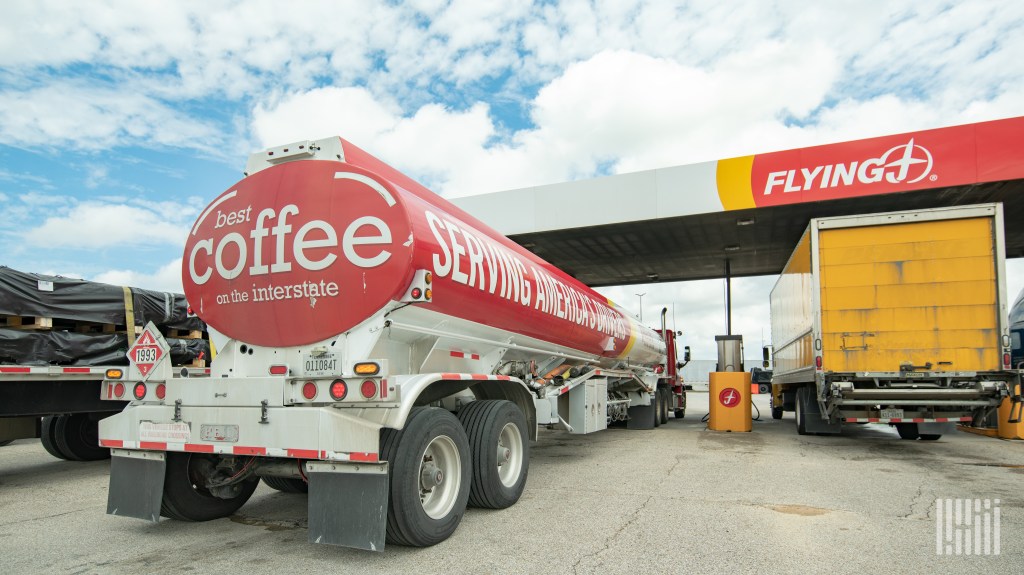
Pilot Flying J and Love’s, two of America’s largest truck stops, told the Wall Street Journal yesterday that they were not planning to restrict diesel purchases, but were monitoring low diesel inventory.

Not unlike every other supply chain crunch we’ve seen in the past few years, the cause of the Northeast’s diesel shortage is multifaceted. A yearslong degradation of refineries is rubbing against the Gulf Coast preferring to ship its oil to Europe and Latin America.

Here’s a breakdown:

1. The East Coast has lost half of its refineries. 

As Bloomberg’s Javier Blas wrote on May 4 (emphasis ours): 

In the past 15 years, the number of refineries on the U.S. East Coast has halved to just seven. The closures have reduced the region’s oil processing capacity to just 818,000 barrels per day, down from 1.64 million barrels per day in 2009. Regional oil demand, however, is stronger.

Rory Johnston, a managing director at Toronto-based research firm Price Street and writer of the newsletter Commodity Context, told FreightWaves that refining is a “thankless industry,” with intense regulations that have limited the opening of new refineries. The Great Recession of 2008 led to several East Coast refineries shuttering, but there have been more recent shutdowns too. One major Philadelphia refinery shuttered in 2019 after a giant fire (and it already had declared bankruptcy), and another refinery in Newfoundland shut down in 2020.

2. It’s a financial risk to bring diesel to the Northeast.

The Northeast has increasingly relied on diesel from the Gulf region. Much of that diesel travels to the Northeast through the famous and much-adored Colonial Pipeline. You may remember the 5,500-mile pipeline from last year, when a ransomware attack shuttered it for nearly a week!  

It takes 18 days for oil to travel on the Colonial Pipeline from its source in Houston to New York City (or, more specifically, Linden, New Jersey), Kloza said.

That’s a long enough time to prioritize Colonial pipelines financially risky for traders — or, as Kloza said, “incredibly dangerous” — thanks to a concept called “backwardation.”

Backwardation refers to the market condition in which the spot price of a commodity like diesel is higher than its futures price. It’s only gotten stronger over time in the diesel market, Kloza said. So, a company could send off a shipment of diesel and find that it dropped by $1 per gallon in the time the diesel traveled from the Gulf Coast to New York — er, New Jersey. That could mean hundreds of thousands or more in lost profits, so traders often avoid such a fate.

“We’re not in an era where there are any U.S. refiners or big U.S. oil companies who would ‘take one for the team’ and bring cargo in where it’s needed,” Kloza said. 

The desperation is showing in New England and the mid-Atlantic regions. New England diesel retail prices are up 75% from the beginning of 2022, per DOE data. In the mid-Atlantic, diesel is up 67%. 

It’s not worth the risk, even amid ultra-high prices. As FreightWaves’ Kingston reported last week, the spread between a gallon of diesel in the Gulf Coast and its New York harbor price is usually a few cents. Last week, that swung up to 66 cents.

But that uptick still isn’t justifying moving oil to the Northeast — particularly when traders can make so much more money selling diesel abroad. 

3. Of course, we can blame COVID and the crisis in Ukraine. 

The catalyst for this diesel shortage, of course, is the ongoing conflict in Ukraine — particularly Europe’s desperation for diesel after weaning off Russian molecules. 

As CNBC reported in March, Europe is a net importer of diesel. Europe consumed some 6.8 million barrels of diesel each day in 2019; Russia exported some 600,000 barrels per day of that. Today, Europe has only eliminated one-third of its Russian diesel, so prices are expected to continue to climb amid that transition. Latin America, too, has been clammoring for U.S. diesel.

The Gulf Coast has been happy to provide such diesel, amid “insane” prices for diesel abroad, said Johnston. Waterborne exports of diesel from the U.S. Gulf Coast hit record highs last month, according to oil analytics firm Vortexa. (The records only date back to 2016.)

Naturally, COVID is also to blame for the Northeast’s run on diesel. Those refineries still retained on the East Coast scaled back during the pandemic due to staffing issues. It takes six months to a year to reignite refineries that were previously shuttered, Kloza said.

The ‘everything shortage’ endures

It’s been a tale as old as, well, last year. An industry is quietly hampered by supply issues for years, or even decades, and COVID pulls back the curtains on its unsteady foundation. It’s particularly jarring for commodities we never thought about before, like shipping containers or pallets, but that quietly underpinned our livelihood all along. 

Recall the Great Lumber Shortage of 2020? Big Lumber had unusually low stockpiles of wood by the summer of 2020, thanks to a vicious 2019 in the lumber industry shuttering sawmills and the spring of 2020 sparking staffing issues. (There was also a nasty beetle infestation.) Those in lumber expected the pandemic to slow the economy, not ignite online shopping, construction and housing mania. It meant lumber went from around $350 per thousand board feet pre-pandemic to a crushing $1,515 by the spring of 2021. The lumber price roller coaster persists today.  

In diesel, there’s no beetle infestation, but there are plenty of other headaches. It all means higher fuel prices on the East Coast, particularly the Northeast, to lure molecules from the Gulf Coast. And, down the line, probably more expensive stuff for you. 

Do you work in the trucking industry? Do you want to say that you hate or love MODES? Are you simply wanting to chitchat? Email the author at rpremack@www.freightwaves.com, and don’t forget to subscribe to MODES.

Updated on May 13 with the latest comments from truck stops.

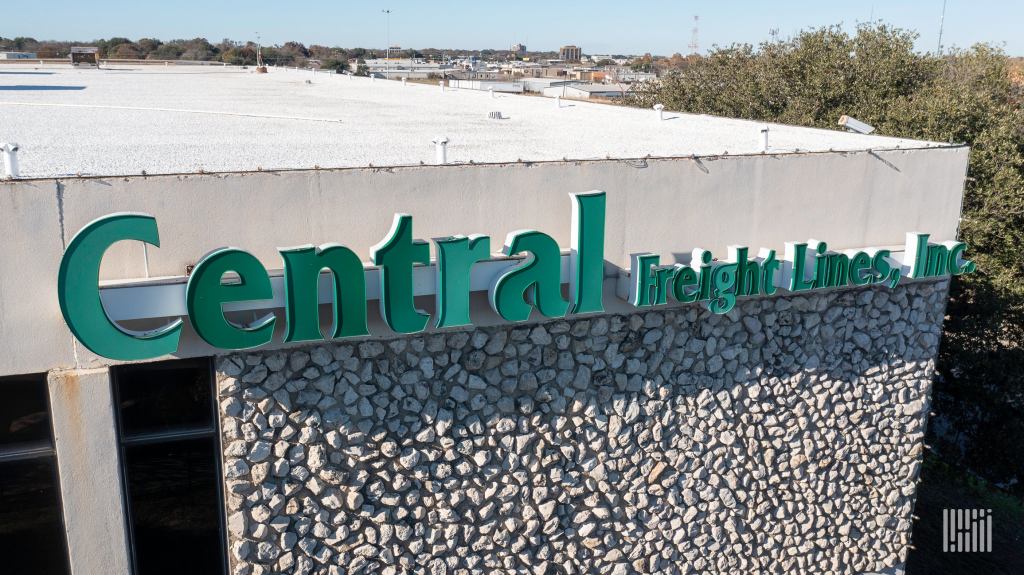
Exclusive: Central Freight Lines to shut down after 96 years

Nearly, 2,100 employees will be laid off right before Christmas. Central Freight Lines is the largest trucking company to close since Celadon ceased operations in 2019.


Waco, Texas-based Central Freight Lines has notified drivers, employees and customers that the less-than-truckload carrier plans to wind down operations on Monday after 96 years, the company’s president told FreightWaves on Saturday.

“It’s just horrible,” said CFL President Bruce Kalem.

A source close to CFL told FreightWaves that CFL had “too much debt and too many unpaid bills” to continue operating, despite exploring all available options to keep its doors open.

Kalem agreed.

“Years of operating losses and struggles for many years sapped our liquidity, and we had no other place to go at this point,” Kalem told FreightWaves. “Nobody is going to make money on this closing, nobody.” 

Central Freight will cease picking up new shipments effective Monday and expects to deliver substantially all freight in its system by Dec. 20, according to a company statement.

A source familiar with the company said he is unsure whether CFL will file Chapter 7 or “liquidate outside of bankruptcy,” but that the LTL carrier has no plans to reorganize.

The company reshuffled its executive team nearly a year ago in an effort to stay afloat, including adding the company’s owner, Jerry Moyes, as CFL’s interim president and chief executive officer. Moyes remained CEO after Kalem was elevated to president in July.

“I think it was surprising that there wasn’t a buyer for the entire company, but buyers were interested in certain pieces but not in the whole thing,” the source, who didn’t want to be identified, told FreightWaves. “Part of it could have been that just the network was so expansive that there was too much overlap with some of the buyers that they didn’t need locations or employees in the places where they already had strong operations.”

Third-party logistics provider GlobalTranz notified its customers that it had removed CFL as “a blanket and CSP carrier option immediately, to prevent any new bookings,” multiple sources told FreightWaves on Saturday.

CFL, which has over 2,100 employees, including 1,325 drivers, and 1,600 power units, is in discussions with “key customers and vendors and expects sufficient liquidity to complete deliveries over the next week in an orderly manner,” a CFL spokesperson said. Approximately 820 employees are based at the company headquarters in Waco.

Despite diligent efforts, CFL “was unable to gain commitments to fund ongoing operations, find a buyer of the entire business or fund a Chapter 11 reorganization,” another source familiar with the company told FreightWaves.

Kalem said the company had 65 terminals prior to its decision to shutter operations. 

FreightWaves received a tip from a source nearly two weeks ago that CFL wasn’t renewing its East Coast terminal leases but was unable to confirm the information with CFL executives. 

Another source told FreightWaves that some of the LTL carrier’s West Coast terminals had been sold recently, but that no reason was given for the transactions.

At that time, Kalem said the company was “working to find alternatives” and couldn’t speak because of nondisclosure agreements. He said executives at CFL, including Moyes, were trying to do everything to “save the company.”

“Jerry [Moyes] pumped a lot of money into the company, but it just wasn’t enough,” Kalem said.

Kalem said he’s aware that a large carrier is interested in hiring many of CFL’s drivers but isn’t able to name names at this point. 

“Central Freight is in negotiations to sell a substantial portion of its equipment,” the company said in a statement. “Additionally, Central Freight is coordinating with other regional LTL carriers to afford its employees opportunities to apply for other LTL jobs in their area.”

As of late Saturday night, Kalem said fuel cards are working and drivers will be paid for freight they’ve hauled for the LTL carrier until all freight is delivered by the Dec. 20 target date.

“I’m going to work feverishly with the time I have left to get these good people jobs — I owe it to them,” Kalem told FreightWaves. “We are going to pay our drivers — that’s why we had to close it like we’re doing now. We are going to deliver all of the freight that’s in our system by next week, and we believe we can do that.”

During the outset of the pandemic, Central Freight Lines was one of four trucking-related companies that received the maximum award of $10 million through the U.S. Small Business Administration’s Paycheck Protection Program (PPP). This occurred around the time that CFL drivers and employees were forced to take pay cuts, a move that didn’t go over well with drivers.

“It all went to payroll,” Kalem said about the PPP funds. “Yes, our employees and drivers did take a pay cut over the past few years, and we gave most of it back, even raised pay over the past several months, but it just wasn’t enough to attract drivers.”

FreightWaves staffers Todd Maiden, Timothy Dooner and JP Hampstead contributed to this report.


Watch: Central Freight Lines’ impact on the LTL market


FreightWaves CEO and founder Craig Fuller reacts to the Central Freight Lines news:

“With Central struggling for many years and unable to reach profitability, it makes sense that they would want to liquidate while equipment and real estate are fetching record prices.”


Central Freight Lines statement

Here is the statement given by Central Freight Lines to FreightWaves late Saturday after reports surfaced of its impending closure:

“We make this announcement with a heavy heart and extreme regret that the Company cannot continue after nearly 100 years in operation. We would like to thank our outstanding workforce for persevering and for professionally completing the wind-down while supporting each other. Additionally, we thank our customers, vendors, equipment providers, and other stakeholders for their loyalty and support.

“The Company explored all available options to keep operations going. However, operating losses sapped all remaining sources of liquidity, and the Company’s liabilities far exceed its assets, all of which are subject to liens in favor of multiple creditors. Despite diligent efforts, the Company was unable to gain commitments to fund ongoing operations, find a buyer of the entire business, or fund a Chapter 11 reorganization. Given its limited remaining resources, the Company concluded that the best alternative was a safe and orderly wind-down. As we complete the wind-down process, our primary goal will be to offer the smoothest possible transition for all stakeholders while maximizing the amount available to apply toward the Company’s obligations.

“Central Freight is in negotiations to sell a substantial portion of its equipment. Additionally, Central Freight is coordinating with other regional LTL carriers to afford its employees opportunities to apply for other LTL jobs in their area. Discussions are ongoing and no purchase of assets or offer of employment is guaranteed.”


Brief history of Central Freight Lines

1925Founded in Waco, Texas, by Woody Callan Sr.
1927Institutes regular routes in Texas between Dallas, Fort Worth and Austin.
1938Dallas facility opens as world’s largest freight facility.
1991Receives 48-state interstate operating authority, expands into Oklahoma.
1993Joins Roadway Regional Group and begins service in Louisiana.
1994Expands into Colorado, Kansas, Missouri, Illinois and Mississippi.
1995Consolidation of Central, Coles, Spartan and Viking Freight Systems into Viking Freight Inc. is announced. Central’s Waco corporate HQ starts closure.
1996Becomes the Southwestern Division of Viking Freight Inc.
1997Investment group led by senior Central management purchases assets of former CFL from Viking Freight and reopens as a new Central Freight Lines.
1999Expands into California and Nevada.
2009CFL Network provides service to Idaho, Utah, Minnesota and Wisconsin.
2013Acquires Circle Delivery of Tennessee.
2014Acquires DTI, a Georgia LTL carrier.
2017Acquires Wilson; new division created with an increase of 80 terminals.
2020Wins Carrier of the Year from GlobalTranz.
Acquires Volunteer Express Inc. of Dresden, Tennessee.
Source: Central Freight Lines

Warehouse cramming is about to begin — Freightonomics

nVision Global, is a leading Global Freight Audit, Supply Chain Management Services company offering enterprise-wide supply chain solutions. With over 4,000 global business “Partners”, nVision Global not only provides prompt, accurate Freight Audit Solutions, but also providing industry-leading Supply Chain Information Management solutions and services necessary to help its clients maximize efficiencies within their supply chain. To learn more, visit www.nvisionglobal.com

Warehouse space is at a premium right now and with peak season right around the corner, shippers are starting to scramble for space. 

Zach Strickland and Anthony Smith look into what shippers are doing to prepare for the end-of-year crunch. They welcome Zac Rogers from Colorado State University to the show to talk through the industry tightness. 

The three also talk about the latest Logistics Managers Index results and what they mean for the fourth quarter of 2021. 

You can find more Freightonomics episodes and recaps for all our live podcasts here.

Seasonality pushing rejections and rates higher ahead of the Fourth

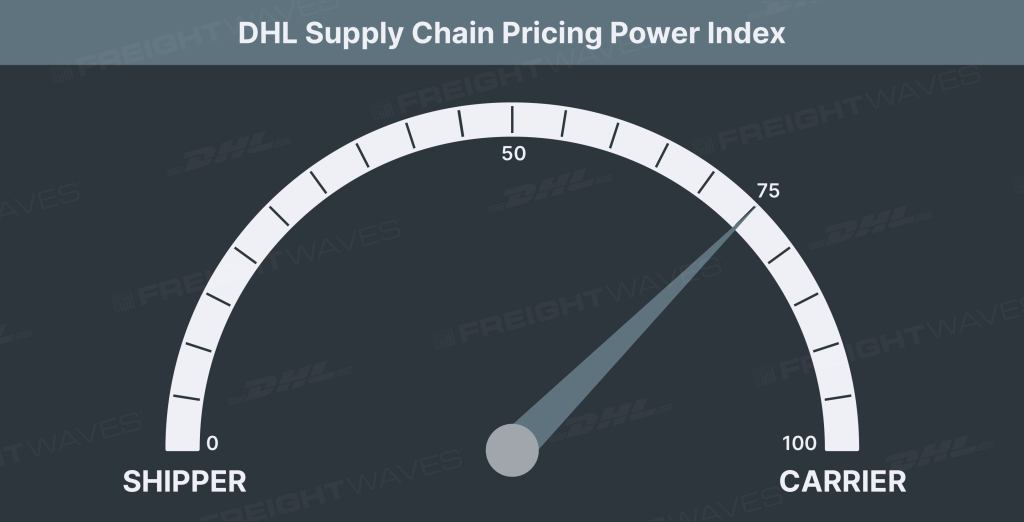
This week’s DHL Supply Chain Pricing Power Index: 75 (Carriers)

Last week’s DHL Supply Chain Pricing Power Index: 70 (Carriers) 

Three-month DHL Supply Chain Pricing Power Index Outlook: 70 (Carriers)

The DHL Supply Chain Pricing Power Index uses the analytics and data in FreightWaves SONAR to analyze the market and estimate the negotiating power for rates between shippers and carriers. 

The Pricing Power Index is based on the following indicators:

Load volumes: Absolute levels positive for carriers, momentum neutral

The Outbound Tender Volume Index at 15,980 is nominally higher now than basically at any point in the past 12 months with the exception of the week prior to Thanksgiving/Black Friday last year. OTVI captures all electronic tenders, including rejected ones, so when accounting for the rejection rate, we can get an even more accurate look at volumes. 

OTVI rose through the back half of May into the national holiday and has risen even further since. Throughout the back half of May and into the middle of June, tender rejections declined substantially. Meaning, current volume throughput is actually understated when comparing OTVI now to OTVI in November 2020. After adjusting for rejected tenders, the accepted outbound tender volume index is just 2.2% below the 2020 peak in November. At that time, OTVI surged towards 17,000, but the rejection rate moved in-kind towards its natural ceiling of 28%. So, the total accepted freight tenders in mid-June is comparable to the peakiest of peak seasons in 2020. Incredible. 

However, since the middle of June, tender rejections have begun increasing again heading into Independence Day, a time when many drivers spend time off the road with their families. The move higher in OTVI this week has been driven primarily by higher rejection rates, rather than higher freight demand. 

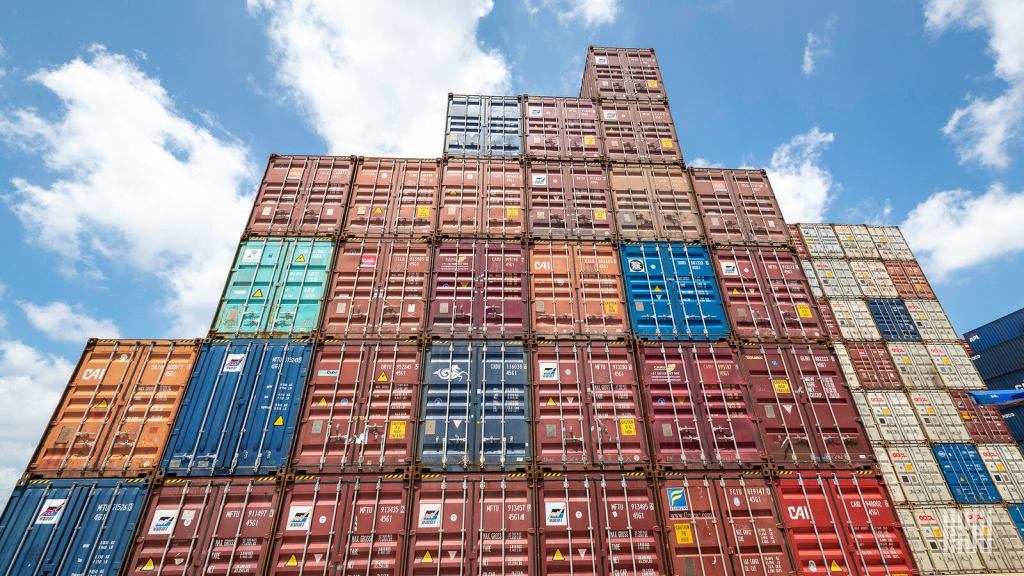
Over the past month, the drivers of freight volumes have continued to be imports and from just about every port. The west coast continues to provide seemingly non-stop container ships, while Houston, New Orleans, Miami and Savannah are seeing very strong throughput as well. 

It is van volumes that are driving freight markets higher right now. The Reefer Outbound Tender Volume index has tumbled 25% since its all-time high in the weeks after the polar vortex in February. Since Memorial Day, ROTVI has fallen another 10.5%. This is likely a factor of declining grocery demand, but I would expect the trend to reverse course in the near future as summer festivities accelerate. 

Dry van volumes pushed higher in the back half of May and into June while reefer volumes have declined significantly. 

SONAR: VOTVI.USA (Blue); ROTVI.USA (Green)

The congestion at our nation’s ports has spread from Los Angeles and Long Beach to Oakland, California. The California coastline is a parking lot of container ships, most of which are full to the brim with imports, awaiting berth. As detailed in the economic section, there are some signs that the reversion is underway with Americans paring back spending on pandemic superstar categories in favor of airlines, lodging and entertainment. But spending remains strong despite the moderation, and low inventory levels offset much of the decline that will occur from slowing demand. Real inventories are 3% higher now than pre-pandemic, but real sales growth is far outpacing inventory growth, leading to the lowest inventory-to-sales ratio in decades. 

On the manufacturing side, the ISM Manufacturing PMI expanded in May after declining in April. We’ve been in expansionary territory for 12 consecutive months. New orders, production, imports/exports and employment are all growing. The major issues should come as no surprise: Deliveries are slowing, backlogs are growing and inventories are too low. 

In all, there are many, many catalysts to keep freight demand strong for the foreseeable future. Americans are traveling and spending on services at a high clip, but the high savings rate is enabling it to occur without a massive detriment to goods spending. 

SONAR: OTVI.USA (2021 Blue; 2020 Green; 2019 Orange; 2018  Purple)

Tender rejections: Absolute level and momentum positive for carriers

After declining steadily from mid-March to mid-May, the Outbound Tender Reject Index has reversed course heading into Independence Day. This is typical for a national holiday as carriers selectively choose loads to bring drivers closer to home. OTRI now sits above 25% for the first time in June. 

One of our newest indices in SONAR gives us the ability to compare markets on as close to an apples-to-apples basis as possible. FreightWaves’ Carrier Trend Market Score indices are divided into two perspectives – shipper/broker and carrier. The scores are positioned on a scale from 1-100 and have values measuring van and refrigerated (reefer) capacity. The higher values represent more favorable trends for whichever perspective. For instance, a value near the high-end of the range would suggest very favorable conditions for carriers in our carrier capacity trend score index. 

For the past several weeks, capacity disparities have been driven by import volumes. The markets with the tightest carrier capacity coincide with the nation’s busiest ports. Ontario, California, Savannah, Georgia, and Atlanta all have carrier capacity trend market scores of 100. 

SONAR: Capacity Trend Market Score (Carriers – VAN)

By mode. Reefer rejection rates tumbled from it’s all-time high in March to under 35% in mid-June before popping higher over the past two weeks. Reefer rejections are still quite high from a historical standpoint at 38%, but are significantly lower than just three months ago when reefer carriers were rejecting half of all electronically tendered loads. 

SONAR: VOTRI.USA (Blue); ROTRI.USA (Orange)

Dry van tenders make up the majority of all tenders, so the van rejection rate mirrors the aggregate index closely. Van rejections have surged from ~23% to ~26% over the past two weeks. 

Yes, one-in-four loads being rejected is not ideal, but it’s better than 30%. I am unaware of any meaningful signals that capacity is being added at a rate that would change my outlook. With so many catalysts for demand, and many constraints on drivers including the Drug & Alcohol Clearinghouse, driver training school closures and continued government unemployment benefits, the outlook is tight throughout this year and into 2022. That’s not to say we won’t see improvement as consumers revert to pre-pandemic spending habits and drivers enter or reenter the market. But I’m not expecting any quick reversal of this environment; there are simply too many catalysts driving volume and suppressing capacity. 

SONAR: OTRI.USA (2020/21 Blue; 2020 Green; 2019 Orange)

Freight rates: Absolute level and momentum positive for carriers

Throughout June, spot rates have moderated while contract rates have pushed higher. The Truckstop.com dry van rate per mile (incl. fuel) has fallen from $3.21 to $3.11 since the beginning of June, while FreightWaves van contract rates have risen from $2.50 to $2.59/mile, exclusive of fuel. 

I still believe the Truckstop.com dry van national average will not retest the post-vortex surge pricing that brought spot rates up to an all-time high of $3.30. But, there aren’t many catalysts to bring spot rates down anytime soon either. Demand is unwavering with continued strong consumer goods demand, humming industrial recovery and a potentially cooling, yet still sizzling, hot housing market. And carriers can’t fill enough trucks to keep up with demand. 

Prior to the seasonal movements we’re seeing in tender rejections, routing guides generally had been improving through Q2. We should continue to see a convergence between spot and contract rates, but spot rates will remain historically very elevated throughout the summer as demand simply outstrips capacity. 

SONAR: TSTOPVRPM.USA (Blue); VCRPM1.USA (Green)  

Economic stats: Momentum and absolute level neutral

Several economic releases this week are worth noting.

Weekly jobless claims were released Thursday and give us one of the best close-to-real-time indicators of the overall economy.  This week, the data was again very promising as the labor market continues on a bumpy but trajectorially stable recovery path. 

First-time filings totaled 411,000 for the week ended June 19, a slight decrease from the previous total of 418,000 but worse than the 380,000 Dow Jones estimate, the Labor Department reported Thursday. Initial claims have held above 400,000 for consecutive weeks after falling to a pandemic low of 374,000 three weeks ago. As things stand, the current level of initial claims is about double where it was prior to the Covid-19 pandemic. 

The good news on the jobs front is that continuing claims are on the decline, falling to 3.39 million, a drop of 144,000. That number runs a week behind the headline claims total.

Initial jobless claims (weekly in May 2020-May 2021)

At the time of writing, the newest weekly data for the week ending May 29 had not been updated in SONAR. This week, claims fell from 405,000 to 385,000. 

SONAR: IJC.USA

Consumer. Turning to consumer spending, as measured by Bank of America weekly card (both debit and credit) spending data, total card spending (TCS) in the latest week accelerated to 22% over 2019. This is the first time in June that TCS has topped 20% over 2019, but spending has been running up 16-19% consistently on a two-year comp for months. For contect, the average pre-pandemic two-year growth rate was about 8% (from 2012 to 2019). 

The Bank of America team highlighted service spending in the nation’s two largest state economies, California and New York, which are now fully reopened. Spending at restaurants is now well above 2019 in both states, and the team believes there is more capacity for spending to accelerate in the states that were slower to reopen given pent-up demand. 

There was also a notable acceleration in spending on clothing this week, according to Bank of America. It could be a reversal from some softening in the early weeks of June, or an indication of people refreshing wardrobes ahead of a return to work, more travel and vacations. One tepid statement for freight markets from this week;s report: Leisure spending is on the rise and durable goods spending is flatlining.  

FreightWaves’ Flatbed Outbound Tender Reject Index, both a measure of relative demand and capacity, moves directionally with the ISM PMI. 

SONAR: ISM.PMI (Blue); FOTRI.USA (Green) 

Manufacturing. Over the past two weeks, regional manufacturing surveys have reported generally positive readings amid logistical challenges. The New York Fed’s Empire State business conditions index declined 6.9 points to 17.4 in June, retreating from strong readings the past two months. The Empire State Index is a diffusion index with a baseline of zero; any reading above zero indicates improving or expansionary conditions. 

Delivery times lengthened to a new record during the month, new orders and shipments fell, and inventories entered negative territory. The supply chain and transportation challenges are as visible upstream as downstream, but overall the manufacturing sector is handling. Growth continued throughout the second quarter in both the Empire State and Philly Fed indices. 

The Philadelphia Federal Reserve’s business activity index edged lower to a still robust 30.7 in June from 31.5 in the prior month. Unlike NY, the pace of shipments growth accelerated in the Philly region during June. The employment subcomponent rose to a very healthy 30.7 from 19.3 last month, the regional bank said. 

Record-long lead times, wide-scale shortages of critical basic materials, rising commodities prices and difficulties in transporting products are continuing to affect all segments of the manufacturing economy, but demand remains strong. 

For more information on the FreightWaves Freight Intel Group, please contact Kevin Hill at khill@www.freightwaves.com or Andrew Cox at acox@www.freightwaves.com.

Check out the newest episodes of our podcast, Great Quarter, Guys, here.

Project44 acquires ClearMetal to strengthen predictive tools

Project44, a leader in real-time visibility of the global supply chain, announced on Thursday it has acquired ClearMetal, a San Francisco-based supply chain planning software company that focuses on international freight visibility, predictive planning and overall customer experience. The terms of the acquisition were not disclosed.

ClearMetal, founded by top software engineers and data scientists from Stanford, Google and other Silicon Valley elites, has created a “continuous delivery experience” that leverages proprietary machine learning algorithms that can forecast supply chain disruptions. 

In an interview, Jason Duboe, chief growth officer at project44, explained that bringing in ClearMetal’s elite team is essential for the company’s future predictive solutions.

“Their team construct is fundamentally different. When you look at their data science, machine learning and computer science background, they are best in class,” he said. “Applying the team to solve really interesting challenges, starting with highly predictive ETA and deeper exception management to create more predictive analytics is really a key component here.”

Project44 recently acquired Ocean Insights to gain global supply chain vessel visibility and has announced it has expanded its truckload tracking services within Asia. Bringing on this new team of engineers will allow the company to capitalize on strong predictive tools, strengthening the supply chain of its customers.

“We’re going to be expanding deeper into Asia, and from a port perspective, getting data much earlier than competitors,” explained Duboe. “Our freight forwarder integrations will give us much deeper visibility from an end-to-end perspective in these regions.”

Along with the acquired skills the ClearMetal team will bring to project44, it brings a large book of customers, including large CPGs, retailers, manufacturers, distributors and chemical companies. These advanced use cases will strengthen the predictive planning tools, and project44 continues to expand into different customer markets.

“What we gain from ClearMetal is a holistic platform for anybody that joins the platform in the future,” said Duboe. “They have large customers with incredibly demanding and advanced use cases. So when it comes to order and inventory, functionality, supplier onboarding, and moving upstream into those processes, we can capture exceptions earlier on.”

Click here for more articles by Grace Sharkey.

Related Articles:

Project44 expands real-time visibility into China

Project44 reels in Ocean Insights in ‘largest acquisition in visibility space’

‘Project44’s vision has always been global’

Inside hotshot trucking’s ghost fleets

Suplicium Transport LLC told the federal government it runs one truck. Its registration with the Federal Motor Carrier Safety Administration lists a single power unit and a single driver, operating out of Springfield, Illinois. In the same reporting period, roadside inspectors stopped Suplicium’s trucks 801 times in 46 states, on 675 different vehicle identification numbers. No single truck is inspected 801 times across 46 states in a year. The figure on the registration was never a count of equipment. It was the basis for an insurance premium.

Suplicium is one of 32 motor carriers that, taken together, report 38 power units to FMCSA. Inspection records tied to those 32 authorities account for 6,082 unique VINs across 7,505 inspections, with some carriers appearing in as many as 46 states. That works out to roughly 160 vehicles on the road for every truck on the books, and the vehicles do not stay with one company. They circulate.

A migration into the slow lane

The pressure on long-haul Class 8 trucking has built steadily over the past year and a half. English-language proficiency is again an out-of-service violation. The rules on non-domiciled commercial licenses are tightening. The electronic logging mandate closed the hours-of-service gaps that thin-margin carriers once relied on. For an operator built on cheap drivers, light paperwork and a minimum policy, long-haul stopped paying.

Many of those operators moved into hotshot and auto transport. A one-ton pickup pulling a car-hauler attracts fewer inspections than a tractor-trailer, and its insurance costs a fraction of a Class 8 fleet’s. The equipment is also easy to move. A pickup and a gooseneck trailer can be retitled, replated and run under a new limited liability company in a matter of days.

The shift shows up in the equipment. Of roughly 500 vehicles that appear under more than one carrier in this network, 46 percent are Ford and Ram pickups and another 14 percent are Kaufman-style car-hauler trailers. Almost none are heavy freight trucks. The timing tracks the broader auto-haul market. When Jack Cooper, a 97-year-old unionized auto hauler, shut down in early 2025 after losing its Ford and General Motors contracts, the finished-vehicle freight it carried did not disappear. It dispersed down the chain into smaller carriers, and some of those carriers are in this group.

The network is also recent. Twenty-six of the 32 carriers hold DOT numbers issued recently enough to date their authority to 2023 or later, and 21 trace to 2024 and 2025. Their insurance filings follow the same line, with 26 of the most recent policies bound during 2025, most in the spring and summer. This is a wave that formed over the past 18 months and had already generated thousands of inspections before the connections between the companies became visible.

Tenure, or the lack thereof, is where the system is weakest. A newly authorized carrier enters an 18-month new-entrant window during which FMCSA is supposed to run a safety audit before the authority becomes permanent. The problem is arithmetic. The agency processes well over 150,000 new carrier registrations a year and cannot audit a meaningful share of them inside that window. A carrier that draws scrutiny, fails a new entrant review, or has its authority headed for revocation does not have to fight it. It can let that DOT number lapse and file for a fresh one, and the clock starts over with a clean record and another 18 months of runway. The vehicles, the drivers and the people behind them carry forward. Only the identifier changes. A cluster of authorities that are almost all a year or two old is the signature of operators who treat the DOT number as disposable, and who reach for a new one the moment an old one becomes a liability.

The same truck, different doors

The clearest evidence is the shared VIN. One Ford F-350, carrying Illinois plate DRL6327, was inspected 15 times under seven different carrier DOT numbers in 12 states. The most-inspected unit in the set, another Ford on plate P1295664, drew 17 stops across a dozen states. Across the network, single vehicles surface under three, four, five, and six separate authorities. These aren’t driveaway towaway, these are real freight carriers. 

The plates swap too. A carrier running its own equipment shows roughly one tag per truck. These carriers show more plates than trucks. Sakara LLC, registered to two power units in Otis Orchards, Washington, accounts for 682 VINs wearing 695 plates. Suplicium shows 681 plates on 675 VINs. Cobra Inc shows 303 plates on 288 VINs. At the level of an individual vehicle, the pattern is insane. One car-hauler turned up under four carriers wearing eight different plates across 14 inspections, most of them near-identical variations on a single Illinois number with a Maine tag mixed in. Others ran on plates reading APPLIED, TEMP, or NOTAG. A trooper at the scale and a toll camera on the interstate both read the plate, not the VIN, so a shifting or temporary tag breaks the link between a violation and the truck that earned it.

The rotation serves a purpose. Spreading inspections and violations across many DOT numbers keeps any single carrier from accumulating the record that triggers an FMCSA intervention. The safety scores stay clean because no one company carries the full history. A bad inspection under one authority is followed by the next inspection under another. After a crash, the vehicle can be tied to whichever entity has the most favorable standing at that moment. In recent attempts to avoid the most active USDOT and FMCSA in history, which is hot on their trail, the answer is to run with no tag at all. 

One carrier anchors the group. Auto Haul Express LLC, registered to a single truck in La Grange, Illinois, under officer Olha Kurilovych, appears on 225 of the roughly 500 shared vehicles, close to half the entire crossover set. A second company by the same name, under a different DOT number, is registered to Oleg Shevchenko in Nine Mile Falls, Washington, inside the network’s western cluster. The highest-ratio carrier in the set, Suplicium, lists officer Jamshedjon Ismailov Sr. at a Springfield address while showing a separate officer address in Brooklyn. Its closest equipment partner, Sakara, is run by Ara Sarkisyan, who also controls a second carrier, Rideon LLC, in the same Washington area.

How the companies connect

Secretary Sean Duffy described the problem in nearly the same terms in February, when he said the government cannot allow 200 DOT numbers to trace back to a single post office box.

The ownership ties show up in the people. Anton Mapin, listed on Tsar Transportation in Illinois, also appears on an entity in Connecticut. Gulbakhor Mukhammadieva, on LBS Logistics, also controls a second Illinois carrier. Ara Sarkisyan runs both Sakara and Rideon in eastern Washington. Officer-name matching has limits, since common names collide, but distinctive names recurring across separate authorities are the kind of link a phone-number or address query never catches. The equipment is shared, the formation infrastructure is shared, and a handful of operators turn up again and again behind nominally unrelated companies.

Run as a network rather than a list, the structure is hard to argue with. The carriers that share equipment resolve into a single connected web, not a set of unrelated one-truck firms, and that web breaks down into three tighter operating cells. The same Auto Haul Express that anchors the equipment sits at the center of the network by every measure of connectedness. Tested against a model that randomly reshuffles the same vehicles across the same carriers, the volume of equipment these companies share comes in roughly 20 standard deviations above what chance would produce. A result three standard deviations from the mean is already treated as no coincidence. This is far past that. The shared iron is not an artifact of a busy used-truck market.

The web also has a geography. Of the carriers in and around this network, just under half are registered in Illinois, and another one in seven is in Ohio. The two states together account for nearly 60 percent of the group. Within Illinois, the addresses bunch even tighter, in the Chicago suburbs of Schaumburg, Hoffman Estates, Palatine, Arlington Heights and the registered-agent suites of Springfield. A second pole sits in eastern Washington, around Spokane. When the formation addresses are traced outward to every carrier that shares them, the same suites recur: a single address in Canton, Ohio, ties to 16 carriers, a Spokane suite to a dozen more, a Fargo address to several others in the network. The officers carry the same concentration. The recurring names on these authorities are overwhelmingly Eastern European and Central Asian, the same handful surfacing across nominally unrelated companies and clustered in the same metro areas. That pattern, the same kind of operator forming the same kind of carrier through the same suites in the same cities, is what a list of 236 individual registrations hides and a network map shows.

A number that does not survive

Every carrier files a form called the MCS-150, on which it reports its mileage and truck count. Those two figures are what regulators and insurers use to size a carrier’s exposure, and neither is checked against anything.

In this group, the mileage figure collapses on inspection. Five carriers reported driving exactly one mile for the year. One of them is Auto Haul Express, the same company that appears in 749 inspections across 43 states. Three others reported between 2.9 million and 15.3 million miles on one or two trucks, a figure no truck can produce, since even a hard-run unit covers about 130,000 miles a year. The remaining 21 carriers reported no mileage at all. Of the 32, only one reported a number in a believable range.

The truck count tells the same story in shorthand. One unit, one unit, one unit, against a footprint that crosses the country.

Two insurers, then none

Premium is built on one self-declared truck. The actual exposure is hundreds of vehicles operating under that authority, in dozens of states, driven by people the underwriter never evaluated. The carrier was priced as one truck and is running a fleet.

These carriers are not insured by obscure offshore programs. They are insured by some of the largest names in the business. Of the 32 carriers’ most recent filings, companies in the Progressive group wrote 59 percent and companies in the GEICO group wrote another 28 percent, most through the kind of fast-issue commercial-auto programs that bind coverage off a self-reported application.

The policies are short-lived. Across the group, the filing history shows coverage that rarely lasts a full quarter, with a median of 92 days before cancellation. One policy ran for five days. One was bound and canceled the same day. The same rhythm repeats company to company: bind a minimum policy, run the fleet for a few months, let it lapse, rebind with another insurer. One carrier has moved through nine insurers this way.

Eight entities no longer hold any active authority, having been put out of service by the agency, as the next section lays out. This is the end state that the bind-and-lapse pattern was always heading toward.

The limits sit at the federal floor or just above it, $750,000 for most of the group and $1 million for the rest. A $750,000 policy meets the law on paper. It was priced for one truck and is backed by a fleet that renews its coverage every few months. The MCS-90 endorsement attached to these filings requires the insurer to pay an injured member of the public even when the policy would otherwise deny the claim, so the loss lands on the carrier’s insurer at a multiple of the premium it collected. The insurer recovers it in the only way it can: by raising rates across its entire book. A carrier running 50 trucks and insuring all 50 ends up subsidizing the one that reported a single truck and ran hundreds of trucks. Commercial auto insurance has lost money on underwriting for more than a decade, and fleet-count fraud is part of it, the part no one measures, because the federal government never reconciles the reported number against the road.

A floor set in 1980

The minimum these carriers meet was written for a different industry. The $750,000 liability requirement for general freight was set by the Motor Carrier Act of 1980 and has not been raised since. Adjusted for inflation, it would exceed $2.8 million today. FMCSA itself told Congress that if the figure had merely tracked medical inflation, it would sit above $3 million. The agency opened a rulemaking to raise it in 2014 and abandoned that effort in 2017 after industry opposition from the ATA and OOIDA. OOIDA runs its own Risk Retention Group, so there are obvious reasons why they would not favor a minimum increase. I’d argue that an Association that’s testifying to policymakers on “behalf of drivers” while owning a risk retention group shouldn’t be able to testify that it doesn’t want its minimum coverage limits increased. Call me old-fashioned, but there seems to be a conflict there. Not to mention, it calls into question whether they are testifying in these insurance minimum considerations in the interest of their driver base or in their own interests? 

Below the general freight line, the floor drops further. A carrier hauling non-hazardous freight in vehicles rated under 10,001 pounds owes $300,000, and a property carrier whose vehicles fall under that weight is exempt from the federal minimum altogether unless it hauls specific regulated goods. Hotshot work sits right on that boundary. A one-ton dually pulling a loaded car-hauler clears 10,001 pounds easily, which means operators who file at the lower tier or claim the exemption are often misclassified, and no one checks.

The thread running through it all is self-attestation. The carrier sets its own truck count, its own mileage, and, by classifying its own weight, its own insurance tier. Three numbers, all chosen by the party with the most reason to understate them, all accepted on faith by the regulator and the insurer. That made sense when the only way to count a carrier’s trucks was to ask. It does not now.

The crackdown

Enter Sean Duffy, Derek Barrs, the FMCSA investigators and private industry tech. Starting in 2025, this network began to come apart, one authority at a time, and the record of how it came apart is the clearest proof of what it always was.

Almost all of these companies are creatures of the last few years, and the registration records show the front door has never stopped opening. A handful trace to 2021 and 2022. Seven were granted authority in 2024. The single largest wave, 17 of the 32, came in 2025, even as chameleon carriers were drawing national scrutiny. One more, Golla, registered in January 2026. The carriers the agency is shutting down now were, for the most part, admitted to the road over the same stretch of months it spent building the case to remove them. The pattern that should have stopped them was not being read at the point of entry, so they scaled fast, ran up inspections and crashes far beyond what a one-truck operation should generate, and drew a hard audit only after the record was built. The systematic shutdown has intensified over the past year, with the heaviest impact in recent months. Enforcement is catching and closing them in near real time. The registration system is still letting them in.

On November 28, 2025, FMCSA put Auto Haul Express out of service. The order followed a failed new-entrant audit and a denial of access; the carrier would not produce the records the agency asked for. Over the next five months, twelve more of the core carriers fell the same way, nearly all of them for refusing an audit or refusing contact. Sakara went out on December 7. Central Transit’s authority was revoked effective December 8. MLS Capital fell on February 2, 2026; Lipchenko on February 7; DMLCSL and ONEPOINT on March 14; Hauldex on March 16; MTMFO’s authority was revoked effective March 25; Novaline went out on April 6; LCZW on April 24; Golla on April 27; and Shapoval on April 29. Thirteen authorities at the center of the cluster, gone in five months and a day. For those claiming enforcement is not acting, you have no idea how wrong you are until right now. 

That is enforcement at work, and it deserves recognition. The out-of-service tool that took these carriers down is not new, and the loophole they worked sat open for years under administrations of both parties. What changed is the posture. The agency has made unmasking chameleon carriers a stated priority and has paired it with a push to restore the requirement that a carrier keep a real, inspectable place of business. The cluster coming apart on a five-month timeline is what that posture looks like in the data.

The posture now comes with machinery. In late 2025, the agency began phasing in Motus, a rebuilt registration system that adds identity verification and business validation at the front door, the exact point where a reincarnated carrier has always slipped through. It has moved to enforce the principal-place-of-business rule and announced 40 additional investigators. In February 2026, bipartisan legislation, the Safety and Accountability in Freight Enforcement Act, directed the FMCSA to develop and test an automated tool to flag chameleon applications during registration, codifying a data-driven detection approach the government had once funded more than a decade ago and then let idle. The thirteen authorities in this cluster did not come apart on their own. They came apart while the agency was rebuilding the door they had walked through. Administrator Derek Barrs, Secretary Sean Duffy and the Trump Administration are not only shutting the door, but they’re cleaning out the closet at the same time with minimal resources. 

Killing the authority did not take the trucks off the road. It moved them. When Auto Haul Express went out on November 28, its equipment did not park. Within 48 hours, the same vehicle identification numbers were turning up under other carriers in the group. MLS Capital and Central Transit inspected Auto Haul’s trucks on November 29, DMLCSL and Jay Torres on November 30. Over the following weeks, 92 of Auto Haul’s vehicles surfaced under Hauldex, 84 under MTMFO, 72 under DMLCSL, with dozens more spread across Lipchenko, LCZW, Golla, Auto Titi, and Shapoval. The hub authority was dead. Its fleet kept rolling under new numbers.

When Sakara went out nine days later, the pattern repeated at a larger scale. The day after its December 7 shutdown, 236 of Sakara’s VINs began appearing under Hauldex. Another 102 went to Golla, 62 to Richroad, 51 to MTMFO. The trucks did not change. The authority on the paperwork and the door markings did.

As the agency worked down the list, the carriers that had caught the equipment became targets in turn, and the iron moved again. Hauldex absorbed hundreds of vehicles from Auto Haul and Sakara over the winter, and then on March 16, Hauldex itself was put out of service. The next day, 51 of the vehicles that had been running shifted to Golla. Golla’s authority was revoked six weeks later, on April 27. The same trucks had now outlived four separate authorities and were looking for a fifth. Across the cluster, more than 1,300 vehicles passed through carriers that were each, in turn, shut down, equipment walking down a line of shells, every one of them dying behind it.

The newest authorities tell the rest of the story. KDN Transport Group, formed in Charleston, Illinois, and NHX Logistics, formed in Plano, Illinois, were both brand-new carriers in early 2026, each carrying a fresh million-dollar policy. As the older shells were being killed off through the winter and spring, these two were catching their equipment. KDN picked up vehicles from five different out-of-service carriers, with its first inspections dated March 17 through March 25, the most recent in the entire record. NHX took 48 vehicles from the freshly closed MLS Capital. The oldest iron in the network was landing on the youngest authorities, the ones still too new to have drawn an audit.

The plates make it concrete and current. One Illinois tag, 209267F, was read by inspectors on trucks operating under Jay Torres, MTMFO and Golla, three nominally separate carriers, the last reading dated March 24, 2026. A second Illinois plate moved across the same three companies. MTMFO and KDN share more than a dozen tags between them, the most recent seen on March 25. These are the same physical plates moving between active carriers inside the past several weeks, while the enforcement that killed the parent companies was still underway.

That is how fast “chameleon activity” occurs. The agency can revoke an authority, and it is doing so more quickly and deliberately than before. Revocation acts on the number, and the number is the one thing in this network that is disposable. The trucks, the plates, and the people behind them re-form under the next clean authority, and the new-entrant clock starts over. It reforms fast. The same equipment moved within 48 hours of each shutdown, and new authorities were being created even as the old ones were killed. KDN and NHX were formed in January 2026, in the middle of the very enforcement wave that was dismantling the carriers whose equipment they would inherit weeks later. That is the network showing its hand, how quickly it can change names and shift assets to stay a step ahead of the agency and its investigators. Until the reported fleet count is reconciled against the inspection record at the moment a carrier registers, the door the old authorities walked out of stays open for the new ones to walk back in.

What the inspections were finding

Behind the paperwork, the same network incurred more than 17,000 violations in its inspection record. The single most-cited violation across these carriers, appearing at more than half of them and recorded 775 times, is operating a commercial vehicle without a valid commercial driver’s license. In nearly every instance, the driver was placed out of service on the spot. A separate citation for operating without a CDL adds hundreds more. Alongside them sit 380 citations for drivers who could not satisfy the English-language proficiency requirement, again overwhelmingly resulting in an out-of-service order.

The equipment failures track the licensing failures. Hundreds of out-of-service brake violations, missing or inoperable breakaway systems on the trailers, defective brakes exceeding a fifth of the braking system, bald tires below the legal tread depth, and tires leaking or carrying weight past their rated limit. These are the conditions that turn a loaded car hauler into something that cannot stop or stay in its lane. Read together, the violation record describes the predictable result of the fraud on the registration form: when the entity exists only to carry an insurance filing and the trucks are run hard under disposable authorities, no one is checking whether the driver is licensed or whether the brakes work.

The crash record is where it lands. The carriers in and around this network appear in more than 3,000 crashes. The toll is heavily concentrated in the larger fleets the network’s equipment touches, which is its own warning, but even confined to the small one- and two-truck shells at the core, the carriers reporting a single vehicle while running dozens, the record holds hundreds of crashes, dozens of fatalities and hundreds of injuries. Manas Express, which reported two trucks and put more than 360 distinct vehicles through inspections, appears in 240 crashes with five deaths and remains listed as active. This is the public-safety cost of a self-declared fleet count and an authority that can be replaced in an afternoon.

A death at the end of the chain

The cost is not only financial. I have served as an expert witness on multiple fatal interstate crashes that began in exactly this part of the industry, with a hotshot operator. In one case, a pickup pulling a car hauler and a driver who held only a Russian commercial license. The load had been brokered and re-brokered four times through enough hands that establishing who controlled the driver, who dispatched the freight and who was responsible for confirming the driver belonged behind the wheel was nearly impossible. Someone died. The driver had no business operating a commercial vehicle, and the carrier’s reported fleet size bore no relation to what it was actually running. The killer piece of this case specifically wasn’t even the Russian CDL; it was the flashlights mounted to the rear of the trailer serving as marker lamps that ultimately killed a man who didn’t see the trailer and hit it at night. 

That is what the diluted safety score, the lapsed minimum policy, and the layered brokerage add up to on a dark interstate. The structure is built to keep the responsible party out of reach until a death forces someone to trace it back.

The brokers are exposed now

For years, the layering served as both a legal and a practical shield. When a crash led back to a broker who had placed the load with an unsafe carrier, the broker’s defense was federal preemption: the Federal Aviation Administration Authorization Act of 1994 bars state laws related to a broker’s services, and most courts read that to knock out state negligent-selection claims before they reached a jury. A broker who booked a ghost carrier could argue it was not the law’s business how it chose.

That defense is gone. On May 14, 2026, in Montgomery v. Caribe Transport II, LLC, the Supreme Court ruled unanimously that the FAAAA does not preempt state-law claims that a broker negligently selected an unsafe motor carrier. The Court placed those claims inside the statute’s safety exception, which preserves a state’s authority over motor-vehicle safety, reasoning that a broker’s choice of carrier directly determines which trucks and drivers end up on the road. The decision resolved a long-running split among the circuits and applies immediately to pending cases and future ones alike. A broker that books a load with a carrier reporting one truck and running hundreds, with a safety record built on unlicensed drivers and out-of-service brakes, can now be made to answer for that choice in front of a jury.

The catch is that being liable and being able to pay are not the same thing, and freight brokers sit on the wrong side of that gap. A carrier has to carry at least $750,000 in liability coverage, thin as that floor is. A broker carries no liability insurance requirement at all. The only federal financial requirement for a broker is a $75,000 surety bond, which exists to cover unpaid carrier and shipper claims, not to pay out a wrongful-death judgment. Most brokerages are small, and a large share of the market is handled by independent agents operating under their own authority with few assets behind them. So the broker who is most likely to place freight with a ghost carrier, the one not vetting at all, is frequently the one with nothing to collect against when the negligent-selection claim succeeds. Justice Kavanaugh, concurring, noted that the litigation and insurance costs of the decision will be real even for brokers who ultimately win, and that those costs will work their way through the economy. The honest, well-capitalized broker will buy contingent liability coverage and tighten its vetting. The fly-by-night agent will carry the bond, book the cheap carrier and have little to surrender when the case is traced back. Accountability, in other words, lands hardest where there is something to reach, which is not always where the freight was actually placed.

This is the same hole that runs through the entire scheme. A carrier insured at a 1980 minimum, or not insured at all, hauling under an authority that can be discarded and reformed, booked by a broker with a bond and no assets. At every link, the financial responsibility that is supposed to stand behind a loaded truck on a public road has been engineered down to the smallest number the rules allow, or below it.

The fix is a query

The data needed to catch this already exists inside FMCSA. Every inspection record carries the VIN, the plate, the carrier’s DOT number, the date, and the location. Comparing a carrier’s reported truck count with the number of unique VINs that appear in its inspections is a database query. We built one. It runs against millions of records in minutes and finds these groups.

A ratio of 10 vehicles to one reported truck should prompt a review. A ratio of 160 to one should prompt an investigation. An insurer should not be able to bind a one-truck policy for a carrier that already has hundreds of VINs in the federal inspection record without first seeing that record.

There is movement, and it is moving fast. FMCSA Administrator Derek Barrs said in February 2026 that unmasking chameleon carriers was a priority and that the agency was restoring enforcement of the requirement that a carrier have a real principal place of business. The reforms announced alongside it would require carriers to keep a physical location where records can be inspected within 48 hours, move English-proficiency violations from out-of-service status to license revocation, and add new rules on suspensions, new-entrant vetting, and broker testing. Motus registration system is now live with identity verification and business validation aimed at the shell entities and ghost offices this network runs on, and Congress has moved to require an automated chameleon-detection tool at the point of registration. Those measures attack the formation mills and the mailbox addresses. They do not yet reconcile the reported truck count with the inspection record, the single step that would expose the fleet-size fraud at the center of this.

The same signals that exposed this cluster, shared VINs, migrating plates, and common formation addresses, are now being read by a layer of tools the agency has brought into its own work. I have worked with the FMCSA on multiple cases like this for some time with my own system, and the FMCSA has also adopted the use of GenLogs, which runs a sensor network that reads plates off the road, and Bluewire, a carrier-risk scoring system, both of which are in active procurement use against the same or similar problems. Paired with the rebuilt Motus registration system, verifying identity and business legitimacy at the front door, the federal government and the private market are, for the first time, reading the same data and arriving at the same carriers. The capability is no longer the missing piece. The will to run it continuously and to act on what it returns has changed.

The floor has to move as well. A bill introduced in the House in April 2026, the Fair Compensation for Truck Crash Victims Act, would raise the minimum to $5 million and index it to inflation so it cannot calcify again for 40 years. The objection will be that it burdens small carriers. The carriers it would actually burden are the ones in this story, reporting one truck and running hundreds, and they are the ones it should. The honest operator already carries at least $1 million in coverage. The fraud carries the minimum, lets it lapse, and leaves the public and every law-abiding carrier to cover the gap.

The agency knows it has taken on more than it can comfortably handle. Administrator Barrs has said as much, that they bit off more than they could chew, and they are going to keep on chewing anyway. In thirteen shuttered authorities and a year of audits, a list of refusers was whittled down; that is what the record looks like. The other side is fast, sprinting to stay one identity ahead. For the first time in my years in this industry, the distance between a fraud and the enforcement that catches it is closing toward real time. Sometimes that level of focus, ambition, and drive is all it takes.

Logistics M&A accelerates as WWEX and Auctane form ShipStation Global

Dallas-based WWEX Group and shipping software provider Auctane have completed their merger, creating a new company called ShipStation Global that executives say will become one of the industry’s most comprehensive AI-enabled logistics platforms for small and midsize businesses.

The newly formed company combines WWEX Group’s freight brokerage and transportation services network with Auctane’s portfolio of shipping technology products, including ShipStation, Stamps.com, Metapack and Packlink. 

The merged company is backed by private equity firm Thoma Bravo, while CVC Funds and other WWEX investors retain minority stakes.

“Small and mid-sized businesses have been forced to stitch together multiple tools and relationships just to keep up,” ShipStation Global CEO Tom Madine said in a news release. “We’re combining the best AI-powered shipping software in the market with one of the country’s most powerful freight networks.”

The merger creates a logistics platform serving more than 3 million customers and handling over 3 billion shipments annually. ShipStation Global’s network includes more than 75 less-than-truckload carriers, 350 regional, national and international carriers, 600 technology partners and approximately 45,000 truckload carriers. 

The platform connects parcel, LTL, truckload and international shipping services through a single interface.

ShipStation Global’s portfolio includes ShipStation, Stamps.com, Worldwide Express, GlobalTranz, Metapack, Packlink, Unishippers, JEAR Logistics and BLX Logistics. The company will be headquartered in Texas with offices in Dallas and Austin.

Thoma Bravo, one of the world’s largest technology-focused investment firms, acquired WWEX Group in March.

AI driving a new wave of logistics consolidation

The ShipStation Global launch comes amid a surge of mergers and acquisitions across the logistics, supply chain and transportation technology sectors as companies seek to strengthen artificial intelligence capabilities and expand end-to-end service offerings.

One of the most active acquirers this year has been Coupa. In May, the cloud-based spend management platform announced the acquisition of workflow automation startup Tonkean, just days after acquiring intelligent document processing provider Rossum. 

Coupa executives said the deals will help power the company’s growing “agentic trade network,” designed to automate procurement, invoicing and supplier transactions across global supply chains. Financial terms of both acquisitions were not disclosed.

Transportation visibility provider project44 also expanded its AI capabilities in April through the acquisition of LunaPath.ai. 

The all-cash transaction added more than 50 AI agents designed specifically for logistics execution and orchestration, enabling automated tasks such as appointment scheduling, proof-of-delivery retrieval, claims initiation and exception management. project44 executives said the acquisition supports the company’s vision of creating an AI-native supply chain platform.

Echo Global Logistics announced in January that it had agreed to acquire Reno, Nevada-based ITS Logistics, creating a combined company with approximately $5.4 billion in pro forma annual revenue.

 Echo executives said the deal would combine ITS’ specialized logistics solutions with Echo’s technology platform, analytics and AI capabilities while expanding the company’s scale across North America.

Recent Logistics & Supply Chain Mergers and Acquisitions

Acquirer / MergerTargetDate AnnouncedStrategic FocusDeal Value
WWEX Group + AuctaneMerger creating ShipStation GlobalJune 2026AI-enabled logistics platform combining freight, parcel and shipping softwareNot disclosed
CoupaTonkeanMay 2026Workflow orchestration, AI agents, procurement automationNot disclosed
CoupaRossumMay 2026Intelligent document processing and AI-powered trade workflowsNot disclosed
project44LunaPath.aiApril 2026AI agents for logistics execution and supply chain orchestrationUndisclosed all-cash deal
Echo Global LogisticsITS LogisticsJanuary 2026Scale expansion, multimodal logistics, AI and transportation technologyCreates combined company with ~$5.4 billion revenue
Several major logistics-related deals announced in 2026 have centered on one of two themes: AI-enabled automation or platform scale. T

FedEx Freight embarks on journey as standalone LTL carrier

FedEx Freight tractor pulling two LTL trailers

The nation’s largest less-than-truckload carrier, FedEx Freight, began trading Monday on the New York Stock Exchange under the ticker symbol FDXF. The spinoff from parent FedEx Corp. allows the carrier to approach the market with a narrowed commercial focus. The transaction is also expected to unlock shareholder value at both companies.

The transaction included a pro rata distribution of 80.1% of FedEx Freight’s (NYSE: FDXF) outstanding common stock to FedEx (NYSE: FDX) shareholders. Investors of record as of May 15 received one share of the new standalone company for every two shares of FedEx held. FedEx will keep a 19.9% stake in FedEx Freight, but plans to dispose of the holdings within two years through debt repayment or dividend distributions to shareholders.

FedEx Freight has replaced American Airlines (NASDAQ: AAL) in the Dow Jones Transportation Average (DJTA). The stock has also been included in the S&P 500. FedEx remains in the DJTA and the S&P 500.

Shares of FDXF were off 2.9% to $155.75 in early trading on Monday. Shares of FDX were up 0.8%.

“We move forward as an independent company with a sharpened focus and disciplined strategy to build on our competitive advantages and accelerate profitable growth,” said John Smith, FedEx Freight president and CEO, in a news release. “As the largest pure-play LTL carrier in North America, we will leverage our comprehensive network with more than 26,000 service center doors to deliver cost and service advantages to our customers and capitalize on growth opportunities in high-potential verticals.”

Financial targets outlined at April investor day

“Medium-term” financial expectations were provided at an April investor day in New York City.

The company forecast compound annual growth rates of 4% to 6% for revenue and 10% to 12% for adjusted operating income. The outlook implies high-20% incremental margins at the midpoints of the ranges, assuming 2026 fiscal year baselines of $8.7 billion in revenue and $1.1 billion in adjusted operating income. (The adjusted operating income forecast excludes $500 million in estimated spinoff costs.)

Revenue increases will be driven by higher yields and volumes, with an emphasis on yields. Combined with cost reductions, the improved revenue profile is expected to generate 300 basis points of adjusted operating margin improvement, pushing the company’s operating margin from roughly 12% currently to 15% over the near term. (The company flagged a 50-bp margin headwind from spinoff costs and fees associated with unwinding existing service agreements.)

FedEx Freight now has over 500 dedicated LTL sales reps and is currently targeting small- and midsize shipper accounts, which typically generate higher margins. It is also targeting the healthcare, grocery and energy (data centers) verticals.

The company previously said it has unwound 99% of its bundled-pricing agreements (agreements for customers using both parcel and freight services) to reflect an LTL-specific framework.

On the cost side, it is continuing to optimize its linehaul network and dock operations, and lower its fleet age. Further, tech upgrades are expected to reduce manual touchpoints by 60% in the coming years.

The company’s long-term goal is to generate 50 cents in operating income for each $1 of gross profit.

Annual capex is forecast at just 5% of revenue. For the year ended May 31, plan allocations included equipment (45%), facilities (25%), technology (25%) and “other” (5%). The company will also look to replace its lease-heavy terminal portfolio with owned locations in key markets.

FedEx Freight’s guidance calls for over $1 billion in annual free cash flow. Management previously said the company would exit the transaction with $4.3 billion in debt. It plans to lower gross debt leverage to 2.5x within 12 months while maintaining an investment-grade rating.

FedEx’s LTL origins

FedEx began LTL operations in 1998 with the acquisition of Viking Freight. It acquired American Freightways in 2001 and Watkins Motor Lines in 2006. In 2011, it merged its national (Watkins) and regional (Viking and American Freightways) operations into one network offering priority and economy services.

FedEx Freight has 40,000 employees, 365 terminals (26,000 doors) and 30,000 vehicles (17,000 tractors), generating approximately $9 billion in annual revenue.

More FreightWaves articles by Todd Maiden:

Is a drop in China manufacturing index concerning?

Workers with yellow vests in a warehouse.

In May, the purchasing managers’ index (PMI) of China’s manufacturing industry was 50.0%, a decrease of 0.3 percentage points from the previous month.

An index above 50% is usually considered expansion, while anything below that is viewed as contraction.

According to data from the National Bureau of Statistics, the index for the largest enterprises was 51.1%, an increase of 0.9 percentage points from the previous month, which was above the threshold, while the PMI for medium- and small-sized enterprises were 48.6% and 48.5%, respectively, a decrease of 1.9 and 1.6 percentage points from the previous month, or below the threshold.

While the data could be a worrying sign of things to come, analysts note that China grew exports 6.1% in 2025 while the PMI declined in 11 of 12 months of the year.

Chart showing narrow decline of composite PMI since the outbreak of the Iran war. (Chart: China National Bureau of Statistics)

Inflationary effects on manufacturers have been seen as the conflict in the Strait of Hormuz pushed up the cost of raw materials. The monthly Purchase Price Index was at 54.8 prior to the outbreak of the Iran war in February, increased to 63.9 and 63.7 in March and April, and settled at 60.5 in May.

Among the five sub-indices that make up the manufacturing PMI, the production index was above the threshold, while the new order index, the raw materials inventory index, the employment index and the supplier delivery time index were all below the threshold.

The production index was 51.2%, a decrease of 0.3 percentage points from the previous month and still above the threshold, indicating a continued expansion in production activities in the manufacturing industry.

The new order index was 49.9%, a decrease of 0.7 percentage points from the previous month, indicating a decline in the market demand climate of the manufacturing industry.

The raw materials inventory index was 48.6%, a decrease of 0.7 percentage points from the previous month, indicating a decline in the inventories of main raw materials in the manufacturing industry.

The employment index was 48.6%, a decrease of 0.2 percentage points from the previous month, indicating a decline in the employment climate of the manufacturing industry.

The supplier delivery time index was 49.2%, a decrease of 0.3 percentage points from the previous month, indicating that the delivery time of raw material suppliers in the manufacturing industry continued to extend compared to the previous month.

Read more articles by Stuart Chirls here.

Related coverage:

Oakland exports lead imports in April

U.S. fines Maersk $1.9 million over detention charges

Maersk denies report its vessel transited dangerous Mideast route

WATCH: Port of Virginia CEO talks about tariffs, investment, and why her new cranes are the most unique among U.S. container hubs

FedEx trucking hub expansion in Netherlands aids new air cargo strategy

A FedEx tractor trailer truck drives into a FedEx terminal with a pink sky at dawn in the background.

FedEx Corp. is investing $54 million to expand a major truck terminal in the Netherlands that is key to supporting logistics customers in Europe and the new strategic focus on international premium air freight, which was recently integrated with the company’s less-than-truckload network.

The express shipping company last week said it will buy and develop a facility adjacent to its road hub in Duiven, Netherlands, to increase capacity and improve service reliability across its European road network, as it pursues growth in the premium parcel and freight market. The project will increase palletized freight handling capacity by more than 50% and add 65 dock doors, bringing the total to 265 docking spaces on site. That will allow more freight shipments to be delivered directly from FedEx (NYSE: FDX) customers instead of having to route through intermediate consolidation centers.

FedEx’s European trucking network has become more important after the recent reorganization of FedEx’s air network into express parcel and deferred freight segments to maximize aircraft density and sorting efficiency on the ground. A portion of FedEx’s airline now operates an international daytime schedule to carry heavy freight that doesn’t require maximum speed, allowing for the integration of air and road networks in a truck-fly-truck delivery model that is more efficient to operate than moving all goods by air.

Management has described this deferred air network as an extension of its European and U.S. less-than-truckload networks, designed to attract high-yield freight, such as pharmaceuticals, perishables, electronics and automotive components that is more profitable per pound than heavier, general consignments. 

Since 2024, FedEx has prioritized capturing a greater slice of the $90 billion deferred air cargo market, especially the premium segment. The addressable market for premium air freight is $22 billion and FedEx says it currently holds a 12% market share. 

“Our European road network plays a vital role in supporting this ambition,” said Safia Ladhari, managing director, network operations at FedEx, in a news release. “It enables us to move intercontinental air freight shipments efficiently across Europe by road, complementing our air operations. This integrated…model is a defining element of our very competitive freight services and offers customers a highly reliable and cost‑efficient solution.”

The first phase of the expansion will focus on the initial requirements to operate the facility, said FedEx. Subsequent phases will focus on improving operational efficiency, including through connectivity between the new and current building. 

“Over the past year, the Duiven facility has seen strong growth in parcel and freight volumes, particularly during peak periods such as the year‑end season,” Ladhari explained. “This expansion ensures we are well positioned to support our customers through continued growth.”

Click here for more FreightWaves/American Shipper stories by Eric Kulisch.

UPS upgrades service level for US-Mexico industrial shippers

Why cargo theft affects every American

When Donna Lemm speaks about cargo theft, she is not speaking as an observer. She is speaking as someone who has lived through it. During her keynote discussion at the Fraud Symposium at the Rock & Roll Hall of Fame in Cleveland, Lemm delivered a message that was equal parts warning, encouragement and call to action. While much of the industry’s conversation around cargo theft focuses on statistics, technology and criminal tactics, her message centered on something else entirely: people.

For decades, Lemm has been a respected voice in transportation and logistics. Today, she serves as chief strategy officer at IMC Logistics. Donna has become one of the industry’s most visible advocates in the fight against organized cargo theft. Her efforts took her to Washington, D.C., where she testified before the U.S. Senate Judiciary Committee in 2025 about cargo theft, organized retail crime and their growing impact on the nation’s supply chain.

“It’s a little scary,” she admitted when discussing her congressional testimony.

Preparation, authenticity, and a commitment to telling the truth helped carry her through. She described the experience not as a political exercise, but as an opportunity to represent an industry facing a problem that has grown far beyond isolated theft incidents. Looking back, she emphasized the human element of the experience. Despite the formality of the hearing room, she found encouragement in the interactions she had with lawmakers and staff members who understood the importance of the issue and were willing to listen.

When cargo theft became something bigger

The issue became personal years ago. During her keynote, Lemm described an incident involving two stolen loads taken from an IMC Logistics facility in St. Louis. IMC Logistics was the victim in the incident; the company’s freight was stolen, and the alleged criminal activity was carried out by third parties unknown to the company at the time.

According to Lemm, local authorities initially treated the matter as an insurance issue before federal investigators later contacted the company regarding the stolen equipment. She said investigators later told her they had recovered the stolen trailers and that cash had allegedly been concealed inside the reefer units. Lemm also said she was told the shipment may have been headed out of state, possibly toward the southern border.

During her testimony before the U.S. Senate Judiciary Committee, Lemm similarly recounted the incident and said investigators believed the recovered equipment may have been connected to a broader organized theft investigation.

The account is based on Lemm’s keynote remarks and Senate testimony describing what investigators told her following the recovery of the stolen equipment. FreightWaves has not independently verified the investigative details, the reported discovery of cash inside the recovered units, the alleged destination of the shipment, or any potential connection to a broader organized or transnational criminal operation.

Security can no longer be an afterthought

“How do you know it’s bigger than us?” she asked the audience. “You start talking and other people start talking.”

Those conversations have revealed what Lemm believes is a troubling reality. During her keynote, she described what she sees as an increase in the aggressiveness and sophistication of criminal groups targeting freight moving through the supply chain.

Lemm pointed to trains stopped in remote areas, unattended containers and unsecured freight staging areas as examples of vulnerabilities that organized theft groups can exploit. In many cases, she said, the criminals are not targeting a specific shipment but rather looking for opportunities.

As described during her keynote, organized theft groups may board trains stopped in isolated areas, break seals and search for valuable cargo. Lemm argued that even when cargo is not stolen, tampering can create significant losses, particularly for refrigerated and perishable shipments.

These observations reflect Lemm’s assessment based on her industry experience and discussions with supply chain stakeholders. FreightWaves has not independently verified the specific trends, incidents or examples referenced in her remarks.

“We never once thought about the value and security of the goods,” she said while reflecting on earlier stages of her career. “We were talking only about speed.”

That mindset is no longer enough. Throughout the discussion, Lemm repeatedly returned to the importance of verification, authentication and physical security. She encouraged shippers, brokers and logistics providers to ask tougher questions about where freight is being staged, how facilities are secured, and what protections exist beyond basic compliance requirements. In her view, security can no longer be treated as a secondary consideration or a discussion centered solely around cost. The industry must understand where freight is going, who is handling it and what safeguards are actually in place.

Building a coalition around freight security

Perhaps the most powerful part of Lemm’s keynote was not about theft at all. It was about collaboration. She expressed optimism about the growing coalition of stakeholders coming together to address freight fraud and cargo theft. Industry organizations, law enforcement agencies, trade associations, carriers, technology providers and security professionals are increasingly willing to work together rather than operate in isolation. She believes meaningful progress is finally possible because more people are recognizing that no single company, organization or government agency can solve this problem alone.

“I am so encouraged,” she told attendees. “We’re learning from each other.”

That spirit of cooperation has become a central theme in many of the industry’s recent conversations. Including ongoing efforts to strengthen partnerships between private-sector stakeholders and government agencies. For Lemm, however, success depends on reaching beyond transportation. One of the biggest challenges, she explained, is helping consumers understand why cargo theft matters. Most Americans never see the theft. They only experience the consequences through higher prices, product shortages and supply chain disruptions. Connecting those dots remains one of the industry’s most important responsibilities.

“If we can give this same message to people that don’t understand how they got that shirt on their back or that food on their table, and we can move them, we can do anything,” she said. It is a message she continues to carry despite the challenges.

When asked whether the constant effort ever becomes exhausting, her answer was immediate.

“Yes, I do.”

She explained that the work can be exhausting at times. But she finds energy in the people who continue to step forward and demand change. She encouraged attendees to become advocates themselves and help carry the message beyond the transportation industry.

That may have been the most important takeaway from her keynote. Cargo theft and freight fraud affect far more than the companies that move freight. They impact the cost, availability and reliability of the products Americans depend on every day. According to Donna Lemm, meaningful change will come when enough people decide they care enough to act.

Click here for more articles on cargo theft and freight fraud by Phillip Brink.

Why the freight industry needs Certified Fraud Compliance Officers – FreightWaves

Why the safest freight brokerages are usually the most boring – FreightWaves

Atlas Air to invest in freighter operator Air Atlanta, buy aircraft

Close front view of a Boeing 747 jumbo cargo jet with Magma logo.

Atlas Air, the fifth largest cargo airline by traffic and the world’s largest operator of Boeing 747 freighter aircraft, is getting bigger. 

The New York-based carrier on Thursday said it will acquire a 49% stake in Iceland-based Air Atlanta, a provider of contracted charter service, as well as its fleet of 14 owned widebody aircraft to expand capacity amid tight supply for large freighter aircraft.  

As part of the new ownership structure, Air Atlanta’s CEO and vice presidents will acquire a 51% controlling interest in the operating companies (Air Atlanta Icelandic and Air Atlanta Europe). Air Atlanta will continue to operate under its existing leadership team and operating structure, while both companies collaborate commercially to pursue incremental global growth opportunities. 

Atlas Air will buy the Air Atlanta aircraft through its Titan Aviation Leasing subsidiary and lease the aircraft back to Air Atlanta airlines to continue operating. Sale-leasebacks are financial transactions that allow aircraft owners to extract capital from assets while retaining their use through fixed lease payments to the new owner.

Atlas Air said that partnering with Air Atlanta strengthens its ability to provide freight service to business at a time when many large freighters are nearing retirement age and manufacturers have been unable to increase production.

Between its Iceland and Malta certified airlines, Air Atlanta operates 18 widebody aircraft and owns 14 of them: 12 Boeing 747-400 cargo jets, two Boeing 777-300 passenger-to-freighter conversions, and four 777 passenger jets. It also owns four Boeing 747-400 cargo jets that are leased to Saudia Cargo, according to aviation databases.

The transaction is expected to close in the third quarter following customary regulatory reviews.

“Teaming up with a strong, experienced international operator such as Atlas only strengthens Air Atlanta and opens new opportunities for continued growth in an ever-evolving global market. The partnership can expand access to aircraft, enhance our ability to renew the fleet and support value creation for our employees and customers around the world,” said Air Atlanta CEO Baldvin  Hermannsson on LinkedIn.

Air Atlanta Executive Chairman Hannes Hilmarsson will step down after 20 years in leadership roles with the company.

Air Atlanta operates two 777-300 converted freighters for Hong Kong-based Fly Meta, which leased the aircraft and placed them with Air Atlanta to operate on its behalf. Other Air Atlanta customers include Magma Aviation and Network Airline Management. All three companies are cargo management companies that lack aircraft operating certificates and rely on third-party carriers as their operating platform.  

Atlas Air made a splash in March when it ordered 20 A350 freighters from Airbus after decades as an all-Boeing airline. 

In related news, Titan Aviation Leasing announced on Friday the sale of a Boeing 767-300 converted freighter, previously leased by Ethiopian Airlines, to Cargo Aircraft Management, the leasing arm of Air Transport Services Group.

Click here for more FreightWaves/American Shipper stories by Eric Kulisch.

Write to Eric Kulisch at ekulisch@freightwaves.com.

RELATED STORIES:

Atlas Air switches to Airbus, orders 20 A350 cargo jets

UPS upgrades service level for US-Mexico industrial shippers

UPS cargo jets with close up view of brown tails.

United Parcel Service this summer will begin offering time-definite, heavy freight air service between the United States and Mexico on its own aircraft for the first time as part of an initiative to provide more tailored supply chain services to automotive and other industrial customers with operations in both countries.

The integrated logistics and parcel giant said Friday it has also invested nearly $50 million to build a freight-friendly cross-border product within the UPS Ground parcel transportation system and teams with more than 300 industry-specific experts who can help customers navigate the best logistics options amid increased trade complexity associated with higher tariffs, changing regulations, and rising fuel prices. 

UPS (NYSE: UPS) in August will begin offering one-day, two-day and three-day service options to and from Mexico that are designed to help manufacturers move high-value, time-sensitive parts with greater speed and predictability than previous offerings. UPS will also use trucks for some traffic.

UPS services between the United States and Mexico have traditionally focused on small package shipments, with remaining capacity allocated for freight. The difference now is that UPS is offering a service upgrade in which shippers can receive day-definite, guaranteed service, spokesman Jim Mayer explained in an email. 

UPS operates scheduled flights to-and-from Mexico City, Guadalajara and Monterrey. Depending on the service option selected and time-in-transit, volume also may move on ground from Mexico to U.S. gateways, such as El Paso and Dallas, Texas, where it will be loaded onto a UPS flight to destinations anywhere in the U.S. or Canada. In some cases, a movement may go by ground only, he said.

Within the United States, UPS has long offered a special pricing option for partial-load shipments moving in the UPS Ground network to attract less-than-truckload business.

“Our automotive and industrial customers want an easy button for logistics,” said Matt Guffey, UPS chief commercial and strategy officer, in a news release. 

WeatherTech uses UPS to ship automotive accessories and CEO David MacNeil said the company is pleased with the shipping reliability, according to the news release.

The new investments in North American cross-border shipping dovetail with UPS’s strategy to deemphasize low-margin parcel business and focus on high-value goods and complex supply chains, such as automotive, that require premium services.

Heavy freight trend

UPS is the latest express carrier to place greater emphasis on capturing more general cargo as parcel volumes stagnate. FedEx two years ago launched Tricolor, a strategy to pursue premium heavy freight from freight forwarders and create more efficiency by segregating overnight parcel and deferred freight using separate aircraft on different schedules. But FedEx has opted to mix in fewer large freight shipments with its expedited priority parcels, instead holding certain aircraft to operate a deferred network. DHL Group is also dedicating more internal aircraft for use by its DHL Forwarding division and offering express heavy freight service through DHL Express.

Click here for more FreightWaves/American Shipper stories by Eric Kulisch.

Write to Eric Kulisch at ekulisch@freightwaves.com.

DHL Forwarding to expand Asia-US air cargo capacity in June

UPS projects to boost capacity at 3 Asia air hubs

New COO for Norfolk Southern

Norfolk Southern today appointed Brian Barr as chief operating officer.

Barr, who led the mechanical department at Atlanta-based NS (NYSE: NSC) since 2024, succeeds Executive Vice President and Chief Operating Officer John Orr. Orr will remain as a special advisor to the board chairman through June 2027 or the earlier closing of the proposed merger with Union Pacific (NYSE: UNP).

Operations are already under the microscope as federal regulators evaluate the historic transcontinental tie-up that will create a rail network with 53,000 miles of track in 43 states. The Surface Transportation Board this past week gave conditional approval of the revised merger application but asked for more information, to be submitted by July 27.

Brian Barr

Barr, with almost three decades’ experience, oversees railway operations, including safety, transportation, network planning and operations, engineering and equipment maintenance at NS.

“Brian is the right leader for operations, bringing a strong commitment to safety, broad railroading expertise and a proven ability to build a fast, resilient network that earns customer trust every day,” said Chief Executive Mark George, in a release. “Brian’s career has given him a front row seat to every aspect of the operation and a deep understanding of the complexities of an eastern rail network. This gives him a unique vantage point to help take us to the next level to serve our customer demands.”

Barr’s appointment is effective today.

“We are grateful to John for his leadership and many contributions to our operations,”George said of Orr. “NS is better today because of John’s impactful tenure.”  

Barr at CSX (NASDAQ: CSX) served in senior roles in network planning, operations, and engineering. At UP he was senior vice president, transportation. He started his career in 1998 as a craft dispatcher at Conrail.

Barr holds a business administration degree from Bellevue University and has completed the Executive Leadership Forum with Harvard Executive Education.

Subscribe to FreightWaves’ Rail e-newsletter and get the latest insights on rail freight right in your inbox.

Read more articles by Stuart Chirls here.

Related coverage:

How rail mega-merger moved ahead, and STB avoided making history

STB conditionally accepts UP-NS rail merger application, wants more data

Rail freight rolls on in latest data

UP refutes new AG claims, says it provided all answers in merger paperwork

Borderlands Mexico: Thousands of Mexican truckers lose US visas over cabotage violations

Borderlands Mexico is a weekly rundown of developments in the world of United States-Mexico cross-border trucking and trade. This week in Borderlands Mexico: Thousands of Mexican truckers lose US visas over cabotage violations; US, Mexico complete first round of USMCA review talks; and RealCold expands into pharmaceutical logistics with SCL Cold Chain acquisition.

Thousands of Mexican truckers lose US visas over cabotage violations

More than 3,000 Mexican truck drivers have lost their authorization to enter the U.S. in recent months as federal authorities intensify enforcement of cabotage and visa regulations.

Pedro Lozano Martínez, president of the Nuevo Laredo Freight Carriers Association and a delegate of Mexico’s National Chamber of Freight Transportation (CANACAR), said approximately 3,200 drivers across the border region have had their visas revoked. 

The cancellations have affected carriers operating through major commercial gateways, Lozano said.

“It has been a serious issue in recent weeks,” Lozano told Agencia Rn Noticias. “CANACAR data indicates around 3,200 drivers have been affected along the entire border region.”

According to Lozano, the visa revocations stem from increased coordination between the U.S. Department of Transportation (DOT) and U.S. Customs and Border Protection (CBP), allowing authorities to identify drivers previously flagged for potential cabotage violations. 

Cabotage occurs when a foreign carrier transports freight between two domestic points inside the U.S. without authorization.

“What happened is that the DOT and CBP systems merged, and all operators who had any warnings about possible cabotage were automatically identified,” Lozano said. “CBP is now revoking their visas through the system.”

Drivers often unaware until they reach the border

Lozano said many drivers do not realize their visas have been revoked until they attempt to cross into the U.S.

“The operator doesn’t even realize it unless they check their email,” Lozano said. “When they arrive at the border, the system tells them they must surrender their visa.”

Before the systems were integrated, DOT inspectors could issue warnings or administrative findings related to cabotage during roadside inspections or weigh station checks. Those findings generally did not carry immigration consequences because DOT lacked authority to revoke visas. 

Under the new enforcement framework, carriers say prior warnings are now triggering visa cancellations.

The Otay Mesa Chamber of Commerce warned in an April advisory that hundreds of visas had already been revoked and that enforcement efforts had expanded beyond recent activity to include reviews of alleged violations dating back several years. 

The chamber said federal authorities have placed increased emphasis on cabotage compliance and other visa-related requirements for Mexican commercial drivers.

Border enforcement expands

The recent visa cancellations come amid broader federal enforcement efforts targeting foreign commercial drivers operating in the U.S.

In November, Border Patrol agents in Arizona revoked the border-crossing privileges of two Mexican truck drivers accused of violating cabotage regulations after determining they were hauling freight between domestic U.S. locations. CBP said the drivers were returned to Mexico and their crossing cards were processed for revocation.

Additional enforcement actions documented this year include a Mexican driver whose visa was revoked after authorities alleged he transported commodities from Nogales, Arizona, to Laredo, Texas, in violation of cabotage rules. Another driver was deported after being accused of hauling produce from Arizona to Washington state while operating under a B-1/B-2 visa.

Federal authorities have repeatedly emphasized that violations of transportation, customs and immigration regulations can result in visa revocations, future entry restrictions and other penalties.

Industry warns of capacity constraints

The Otay Mesa Chamber of Commerce said the visa cancellations are likely to reduce the pool of available cross-border drivers and could contribute to delays and higher transportation costs.

“Expect delays and increased pricing in trucking services since there will be a shortage of truck drivers across the U.S.-Mexico border,” the chamber said in its advisory.

Lozano acknowledged that the crackdown has affected international trucking operations but said many displaced drivers are finding employment in Mexico’s domestic freight market, where carriers are also facing a driver shortage.

“It is not people who are losing their jobs,” Lozano said. “They are switching from the United States to Mexico. There is also a great need for operators here.”

Lozano said CANACAR has sought clarification from U.S. authorities and has worked with congressional offices, including that of U.S. Rep. Henry Cuellar, to better understand the scope of the visa revocations and enforcement policies. He said the situation underscores the need for carriers and drivers to strictly comply with international transportation regulations.

“We have to do things right,” Lozano said. “There will be greater oversight, and that puts us in a more formal competitive position in the international trucking market.”

US, Mexico complete first round of USMCA review talks

The U.S. and Mexico have concluded the first bilateral round of negotiations related to the joint review of the United States-Mexico-Canada Agreement (USMCA), marking an early step in what could become one of the most consequential trade discussions in North America over the next year.

According to the Office of the U.S. Trade Representative (USTR), negotiators meeting in Mexico City focused on reducing the U.S. trade deficit with Mexico and strengthening North American supply chains. Discussions centered on automotive rules of origin, steel and aluminum trade, and economic security issues.

The two countries also discussed enhancing regulatory compatibility in several sectors, including medical devices, pharmaceuticals and cosmetics, as part of broader efforts to strengthen regional manufacturing and supply chain integration.

USTR said additional negotiations are scheduled for June 16-17 in Washington, D.C., where officials will discuss agriculture and maintaining a level playing field for businesses. A third round of talks is planned for the week of July 20 in Mexico City.

The U.S. said it will continue emphasizing that the USMCA should benefit American manufacturers, farmers, ranchers, workers and businesses while addressing concerns about “free-riding from third countries.”

RealCold expands into pharmaceutical logistics with SCL Cold Chain acquisition

Dallas-based RealCold, a cold storage and logistics provider, announced Wednesday that it acquired SCL, a CEIV-certified temperature-controlled logistics provider specializing in pharmaceuticals, medical devices, wine and specialty foods. 

Financial terms of the transaction were not disclosed.

The acquisition marks RealCold’s entry into pharmaceutical cold chain logistics, a sector requiring strict temperature controls, regulatory compliance and end-to-end shipment visibility. 

SCL brings expertise in continuous temperature monitoring, FDA-registered facilities and chain-of-custody management for temperature-sensitive products, according to a news release

The deal also adds pharmaceutical logistics capabilities to RealCold’s national network, which includes more than 61 million cubic feet of temperature-controlled warehouse space and over 180,000 pallet positions across the United States.

Founded in 2022, RealCold operates a national cold chain network serving food retailers, producers and distributors. SCL Cold Chain will continue operating under its existing brand as part of RealCold.