The ‘ingenious strategy’ behind most truckers’ least favorite week of the year: International Roadcheck

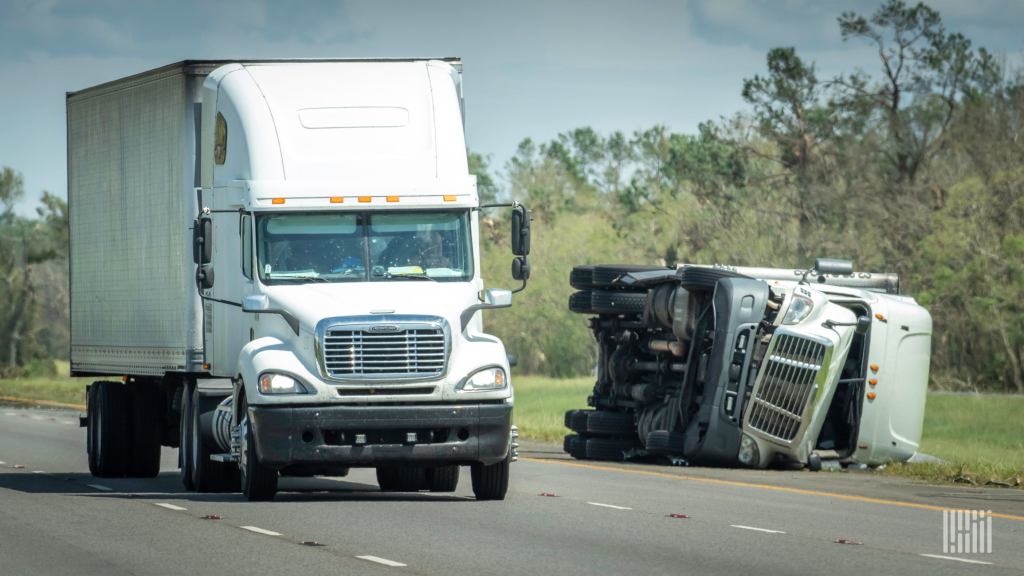
truck fallen over

International Roadcheck Week is hardly the sexiest topic in trucking, but it is a darn-tootin’ important one. Inspectors in the U.S. and Canada halt tens of thousands of trucks for vehicle inspections for a few days every summer or early fall. They remove thousands of trucks and drivers from the road; in 2021, 16.5% of inspected vehicles were put out of service along with 5.3% of drivers.

It’s uncommon for truck drivers to actually get their vehicles inspected at random during most of the year. To avoid International Roadcheck Week, many truckers simply don’t drive during that period of time — which, presumably, means more unsafe vehicles and drivers on the road outside of the inspection blitz. It’s a question that ate at Andrew Balthrop, a research associate at the University of Arkansas Sam M. Walton College of Business. 

Around 5% fewer one-person trucking companies are active during International Roadcheck Week. But Balthrop and his fellow researcher, Alex Scott of the University of Tennessee, found a major upside to the inspection blitz — even with all the folks who avoid it. According to their working paper published in March 2021, vehicles are safer a month before and after the inspection period. There’s a 1.8% reduction of vehicle violations, according to Balthrop and Scott’s analysis. Surprise inspection blitzes don’t result in the same uptick of compliance. 

I caught up with Balthrop about his research last week at FreightWaves’ Future of Supply Chain conference, and we chatted again on the phone this week about his findings on International Roadcheck Week.

Enjoy a bonus MODES and a lightly edited transcription of our phone interview: 

FREIGHTWAVES: For our readers who are not aware of what Roadcheck Week actually is, can you explain a little bit about what it and why it is important to drivers and companies?

BALTHROP: “The International Roadcheck is part of an alliance between the inspectors in Canada and the ones in Mexico and the U.S. to have a unified framework for making sure trucks are safe to operate. That should make it easier to go across borders when you have this kind of unified structure.

“In the U.S., one of these CVSA inspection blitzes is the International Roadcheck that happens for three days in the summer. Usually it’s a Tuesday, Wednesday and Thursday. And usually it’s the first week in June.

“And in it, they focus on Level One inspections, the North American Standard Inspection where they inspect the driver records, the hours of service, the licensure and I believe medical records as well. Then they inspect the truck. It’s an in-depth inspection where the inspector will actually crawl under the truck to look at various things. And these inspections, from the data that I’ve seen, take about a half an hour on average.

“During the Roadcheck Week, they’ll do about 60,000 inspections, so 20,000 a day. They’re going to pull over a lot of trucks, and this can cause a little bit of congestion at the weigh stations and the roadside inspections localities as the inspectors are doing these inspections.”

Roadcheck Week doesn’t catch all truck drivers, but it has a long-lasting benefit to safety

FREIGHTWAVES: So, can most drivers kind of expect to be pulled over? How likely is that?

BALTHROP: “There’s 1 million or 3 million trucks on the road, somewhere around there on any given day. With 20,000 inspections, most drivers still will not get inspected, but there’s going to be a higher proportion of drivers inspected. 

“You’re more likely to get inspected on these days. If you don’t have a recent inspection on your record, or if you have a bad recent inspection on your record, you’re more likely to be pulled over on these days.”

FREIGHTWAVES: Your research focused on that it’s just unusual that this inspection is announced, that it’s planned. We were talking before about how normally, if you’re trying to assure quality or compliance, you would not announce an inspection in advance. It would be more of a surprise-type situation. 

Can you walk us through why that’s so unusual, or what’s the rationale that you see behind announcing it in advance?

BALTHROP: “It is unusual, and on the surface, it doesn’t make much sense, but it turns out to be kind of an ingenious strategy. So I’ll walk through it here. 

“Over the course of a year, there’ll be 2 million inspections of 3 or 4 million trucks out there. The average rate of inspections is pretty low. It’s not uncommon for truckers to go years without having an inspection. With this low inspection intensity, the FMCSA has sort of a problem of, how does it get anybody to abide by the regulations?

“I’m a jaded economist, and I don’t worry or consider too much ethics and morality and all that kind of stuff. It comes down to incentives for drivers to follow these inspections. The incentives do guide behavior. So, how could the FMCSA incentivize drivers to follow these regulations more closely and adhere to the standards?

“They do this by announcing the blitz. This does two things. On one side, it allows everybody to prepare in advance. There’s a bunch of anecdotal evidence out there that people do prepare for these blitzes in advance. They will have their trucks inspected beforehand for any problems. They’ll time maintenance and upkeep in advance to make sure that their vehicles are in order. “They’ll be a little bit more cognizant of the driver-side regulations. One thing we notice in our study is that hours-of-service violations really drop during these extensions, because people see them coming. They don’t fudge the books in any way.”

Owner-operators can evade Roadcheck Week. Big carriers, not so much.

BALTHROP: “The issue with the announcement, on the flip side, is that it allows people to just dodge the inspection entirely. For a long time, people have talked about how owner-operators and smaller carriers time their vacations for this particular time. They could do this for a couple reasons. To avoid the hassle is a nice way to put it, but it also allows you to be noncompliant to avoid the high-intensity inspections.

“You have this balance here that on one side you get the behavior you want with people complying with regulations. That’s the behavior the FMCSA wants. But on the flip side, you get a bunch of people that are kind of outright dodging inspections.

“When you compare these two things on balance, the policy is actually pretty effective because you get a lot of people focused on maintaining their trucks and obeying the rules during that particular week. Especially with the vehicle maintenance stuff, that lasts a long time. 

“In our research, we saw that vehicle violations, a month before and up to a month afterwards, is when you still notice your vehicle violations. That trucks are kind of better maintained around these blitzes.

“The ingenious aspect of it is that the FMCSA, by concentrating their inspection resources all at one time and announcing it, they’re making it clear that they’re serious about enforcing these regulations and everybody prepares for it. For the number of inspections that are happening, you get fewer tickets than you would have otherwise expected.

“The FMCSA, they’re putting people through a little bit of a hassle, but they’re not having to write a bunch of tickets to get people to comply. They’re not really punishing a whole bunch of people because, by making this apparent that this is going to happen, people comply and the FMCSA gets what they want essentially without having to come down on carriers too hard.”

A convenient time for a vacation, indeed

FREIGHTWAVES: OK, interesting. And how does this pattern of shutting down, how does that compare for an owner-operator versus a driver for a big fleet?

BALTHROP: “If you’re a motor carrier with thousands of power units, you can’t just pack up and not do business on a particular day. They just don’t have that option. So they get inspected at a higher intensity, and you see the larger carriers kind of more focused on making sure that they’re prepared for these inspections. With so many inspections, the larger carriers are going to be inspected at higher rates. You can really damage your reputation if your equipment isn’t in order on this particular day. 

“Versus the smaller carriers, especially if you’re talking about a single-vehicle fleet, an owner-operator type, it is not that difficult to just not work for those three days. And so you see a lot about that. 

“In terms of what the roadway composition looks like, if we look at inspection data and relative to a typical day with the usual inspections, on these Roadcheck days, you have about 5% fewer owner-operators on the road than you otherwise would expect.”

FREIGHTWAVES: Wow. And when you say owner-operators, you also mean just like fleets with just —

BALTHROP: “One-vehicle fleets.”

FREIGHTWAVES: OK, that’s interesting.

BALTHROP: “You know, you see a little bit of effect with the smaller fleets, below six vehicles, but it basically disappears by the time you get to a hundred vehicles.

“This effect is being driven by smaller carriers staying off the road in terms of avoidance. You see this goes also how you would expect; it’s also older vehicles that stay off the road. This is correlated with carrier size. The larger carriers use newer vehicles and owner-operators tend to use some of the older vehicles. But it’s particularly the older vehicles that are off the road.

“This makes intuitive sense. Older vehicles are more costly to keep compliant. Maintenance is more costly, and they’ve been around longer so there’s time for more stuff to have broken essentially.

How a truck driver gets stopped for inspection

FREIGHTWAVES: Can you explain a little bit more, the idea of having this inspection history and why it would benefit a larger or small carrier?

BALTHROP: “Getting flagged for inspection is sort of random, but not totally. If somebody notices something obviously wrong with your truck, that’s ground for a more in-depth inspection. Or if you get pulled over for some other reason, this can be grounds for inspection of some type. 

“But there’s also the inspection selection service. The computer program that is random, that it randomly flags people in for inspection, but it’s based on your inspection history.

“So if your firm hasn’t been inspected recently, or if your carrier doesn’t have a very dense inspection history, you’ll be more likely to trigger that system to pull you in and have you inspected. If you have a dense inspection history, you’re less likely to get inspected.”

FREIGHTWAVES: So how do you get pulled over for inspection? As a person who only drives a passenger car, my main interaction with being pulled over is, I’m driving down the freeway or wherever, and I get stopped by the police. How does it work for a truck driver? How does getting pulled over or inspected work in that way?

BALTHROP: “The law is that you cannot pass a weigh station without pulling in and getting weighed. At that point they may flag you to be inspected. Now, in the past decade or two, there’s been a bunch of electronic devices that are installed in cabs. You may have heard of PrePass or Drivewise. This allows you to pass weigh stations. 

“I don’t have data on how many trucks have the in-cab devices. But from a trucking perspective, they’re so convenient that you don’t have to stop every time you cross a state line. I think the vast, overwhelming majority of trucks have some sort of one of these electronic devices. The DOT inspectors at these roadside inspection points have a dial they can twist essentially about how many people they want to inspect. 

“So during the roadcheck inspection week, they’ll crank that dial all the way up and pull everybody over. And if they get too backed up, they might crank it back down a little bit and so on.”

FREIGHTWAVES: OK, interesting. It reminds me of a highly sophisticated E‑ZPass.

A $10 million-plus expense to trucking companies every year … but it’s worth it if just one fatal crash is avoided

FREIGHTWAVES: Zooming out, when we hear about large truck crashes, something like a vehicle maintenance issue is not really the most sexy explanation. But just looking at the FMCSA data, in 29% of all truck crashes, a major factor is brake problems. So it seems like a lot of the truck crashes on the road are caused by vehicle maintenance, versus something like the driver using illegal drugs or some other sort of more dramatic explanation. Can you speak a little bit to why this sort of vehicle maintenance is important for safety in preventing large crashes?

BALTHROP: “We did a little bit of a back-of-the-envelope cost benefit analysis of this. Let me try and make sure I remember it clearly, but we have it in the paper that the cost of this on one side is that you have the compliance costs the firms are undertaking, and then you have to add to that the delay costs from doing this, and then the cost of the inspection itself, having to pay federal inspectors to do this.

“On the benefit side, it reduces crashes. So when we add up, just looking at the cost of what an inspection is, we don’t have a good idea of how to measure the compliance cost. It’d be fun to measure the delay cost, but I don’t have good enough price data on that to get at that cost. 

“But if you look at what the cost of an inspection is, it is something like $100 or $120 is what you would pay to have one of these inspections done privately. A lot of people do this in the run-up to inspections, and have it done privately so that you can fix whatever the problems are and be sure that you would pass the FMCSA inspection.

“With that $120 figure, if you aggregate that up to 60,000 inspections or whatever, and you take that in comparison, I’m going to give you a bad figure here, it’s on the order of $10 million. That is about the value of a statistical human life. Looking at this economically, it’s worthwhile if it saves one human life. If you identify just one faulty brake system that would’ve resulted in an accident, you’re getting some value out of the program. 

“When you add those other costs in there, we’re going to need to save a couple of lives, but in terms of cost benefit analysis with this kind of stuff, we’re usually looking at orders of magnitude differences in cost and benefits to say something for sure. 

“If you can save just a couple lives, this program will pay for itself.”

Time to start inspecting in the winter

FREIGHTWAVES: Then one last question: Is there any rationale for this program happening in the summer? 

BALTHROP: “I think part of it is that for the inspectors this gets much harder and much more miserable to do in winter conditions.”

FREIGHTWAVES: That makes sense.

BALTHROP: “Inspectors are less productive. One of the things that we talk about in the paper, that they have in addition to the International Roadcheck, is that they have Brake Week where they focus a little bit more on brake inspections. You have Operation Safe Driver a little bit later on in the summer, usually in September, where it’s a little bit more focused on passenger vehicles and how they drive around these trucks.

“But there’s not one in the winter time. There’s an unannounced brake check that usually happens in May, a surprise inspection that’s just one day. But you’re right in pointing out that it might be worthwhile having one of these in the wintertime. You have this periodic high-intensity inspection that kind of incentivizes everybody to be compliant through the summer. 

“But there’s nothing in the winter, so that’s an area. But if I was managing the FMCSA, that would be one of the first questions I ask, ‘Why don’t we have one of these in the wintertime?’”

FREIGHTWAVES: That makes sense. Maybe they can do it in the South or something. Maybe a Miami January inspection … 

That’s it for this special bonus MODES. Subscribe here if you’re not already receiving MODES in your inbox every Thursday. Email the reporter at rpremack@www.freightwaves.com with your own tales on International Roadcheck Week or any other trucking topics. 

Why the Northeast is quietly running out of diesel

The nozzle of a diesel fuel pump is inserted into the tank of a commercial truck as its driver looks on the bankground.

The East Coast of the U.S. is reporting its lowest seasonal diesel inventory on record. And some trucking companies appear spooked.

The East Coast typically stores around 62 million barrels of diesel during the month of May, according to Department of Energy data. But as of last Friday, that region of the U.S. is reporting under 52 million barrels. 

The sharp increase of diesel prices has been a major stressor in America’s $800 billion trucking industry since the beginning of 2022. According to DOE figures, the price per gallon of diesel has reached record highs — a whopping $5.62 per gallon. It’s even higher on the East Coast at $5.90, up 63% from the beginning of this year. 

When relief is coming isn’t yet clear, and experts say higher prices are the only way to attract more diesel into the Northeast.

“I wish I had some good news for the Northeast, but it’s bedlam,” Tom Kloza, global head of energy analysis at OPIS, told FreightWaves. 

2022 has seen record-setting diesel prices. (SONAR)

Everyday Americans don’t fill up their cars with diesel, but the fuel powers our nation’s agriculture, industrial and transportation networks. More expensive diesel means the price of everything is liable to increase. Trucks, trains, barges and the like consumed about 122 million gallons of diesel per day in 2020

Patrick DeHaan, a vice president of communications at fuel price site GasBuddy, reported that retail truck stops are hauling fuel from the Great Lakes to the Northeast, calling it “extraordinary.” We’ve also seen anecdotal reports from truck drivers posting company memos:

Pilot Flying J and Love’s, two of America’s largest truck stops, told the Wall Street Journal yesterday that they were not planning to restrict diesel purchases, but were monitoring low diesel inventory.

Not unlike every other supply chain crunch we’ve seen in the past few years, the cause of the Northeast’s diesel shortage is multifaceted. A yearslong degradation of refineries is rubbing against the Gulf Coast preferring to ship its oil to Europe and Latin America.

Here’s a breakdown:

1. The East Coast has lost half of its refineries. 

As Bloomberg’s Javier Blas wrote on May 4 (emphasis ours): 

In the past 15 years, the number of refineries on the U.S. East Coast has halved to just seven. The closures have reduced the region’s oil processing capacity to just 818,000 barrels per day, down from 1.64 million barrels per day in 2009. Regional oil demand, however, is stronger.

Rory Johnston, a managing director at Toronto-based research firm Price Street and writer of the newsletter Commodity Context, told FreightWaves that refining is a “thankless industry,” with intense regulations that have limited the opening of new refineries. The Great Recession of 2008 led to several East Coast refineries shuttering, but there have been more recent shutdowns too. One major Philadelphia refinery shuttered in 2019 after a giant fire (and it already had declared bankruptcy), and another refinery in Newfoundland shut down in 2020.

2. It’s a financial risk to bring diesel to the Northeast.

The Northeast has increasingly relied on diesel from the Gulf region. Much of that diesel travels to the Northeast through the famous and much-adored Colonial Pipeline. You may remember the 5,500-mile pipeline from last year, when a ransomware attack shuttered it for nearly a week!  

It takes 18 days for oil to travel on the Colonial Pipeline from its source in Houston to New York City (or, more specifically, Linden, New Jersey), Kloza said.

That’s a long enough time to prioritize Colonial pipelines financially risky for traders — or, as Kloza said, “incredibly dangerous” — thanks to a concept called “backwardation.”

Backwardation refers to the market condition in which the spot price of a commodity like diesel is higher than its futures price. It’s only gotten stronger over time in the diesel market, Kloza said. So, a company could send off a shipment of diesel and find that it dropped by $1 per gallon in the time the diesel traveled from the Gulf Coast to New York — er, New Jersey. That could mean hundreds of thousands or more in lost profits, so traders often avoid such a fate.

“We’re not in an era where there are any U.S. refiners or big U.S. oil companies who would ‘take one for the team’ and bring cargo in where it’s needed,” Kloza said. 

The desperation is showing in New England and the mid-Atlantic regions. New England diesel retail prices are up 75% from the beginning of 2022, per DOE data. In the mid-Atlantic, diesel is up 67%. 

It’s not worth the risk, even amid ultra-high prices. As FreightWaves’ Kingston reported last week, the spread between a gallon of diesel in the Gulf Coast and its New York harbor price is usually a few cents. Last week, that swung up to 66 cents.

But that uptick still isn’t justifying moving oil to the Northeast — particularly when traders can make so much more money selling diesel abroad. 

3. Of course, we can blame COVID and the crisis in Ukraine. 

The catalyst for this diesel shortage, of course, is the ongoing conflict in Ukraine — particularly Europe’s desperation for diesel after weaning off Russian molecules. 

As CNBC reported in March, Europe is a net importer of diesel. Europe consumed some 6.8 million barrels of diesel each day in 2019; Russia exported some 600,000 barrels per day of that. Today, Europe has only eliminated one-third of its Russian diesel, so prices are expected to continue to climb amid that transition. Latin America, too, has been clammoring for U.S. diesel.

The Gulf Coast has been happy to provide such diesel, amid “insane” prices for diesel abroad, said Johnston. Waterborne exports of diesel from the U.S. Gulf Coast hit record highs last month, according to oil analytics firm Vortexa. (The records only date back to 2016.)

Naturally, COVID is also to blame for the Northeast’s run on diesel. Those refineries still retained on the East Coast scaled back during the pandemic due to staffing issues. It takes six months to a year to reignite refineries that were previously shuttered, Kloza said.

The ‘everything shortage’ endures

It’s been a tale as old as, well, last year. An industry is quietly hampered by supply issues for years, or even decades, and COVID pulls back the curtains on its unsteady foundation. It’s particularly jarring for commodities we never thought about before, like shipping containers or pallets, but that quietly underpinned our livelihood all along. 

Recall the Great Lumber Shortage of 2020? Big Lumber had unusually low stockpiles of wood by the summer of 2020, thanks to a vicious 2019 in the lumber industry shuttering sawmills and the spring of 2020 sparking staffing issues. (There was also a nasty beetle infestation.) Those in lumber expected the pandemic to slow the economy, not ignite online shopping, construction and housing mania. It meant lumber went from around $350 per thousand board feet pre-pandemic to a crushing $1,515 by the spring of 2021. The lumber price roller coaster persists today.  

In diesel, there’s no beetle infestation, but there are plenty of other headaches. It all means higher fuel prices on the East Coast, particularly the Northeast, to lure molecules from the Gulf Coast. And, down the line, probably more expensive stuff for you. 

Do you work in the trucking industry? Do you want to say that you hate or love MODES? Are you simply wanting to chitchat? Email the author at rpremack@www.freightwaves.com, and don’t forget to subscribe to MODES.

Updated on May 13 with the latest comments from truck stops.

Exclusive: Central Freight Lines to shut down after 96 years

Nearly, 2,100 employees will be laid off right before Christmas. Central Freight Lines is the largest trucking company to close since Celadon ceased operations in 2019.


Waco, Texas-based Central Freight Lines has notified drivers, employees and customers that the less-than-truckload carrier plans to wind down operations on Monday after 96 years, the company’s president told FreightWaves on Saturday.

“It’s just horrible,” said CFL President Bruce Kalem.

A source close to CFL told FreightWaves that CFL had “too much debt and too many unpaid bills” to continue operating, despite exploring all available options to keep its doors open.

Kalem agreed.

“Years of operating losses and struggles for many years sapped our liquidity, and we had no other place to go at this point,” Kalem told FreightWaves. “Nobody is going to make money on this closing, nobody.” 

Central Freight will cease picking up new shipments effective Monday and expects to deliver substantially all freight in its system by Dec. 20, according to a company statement.

A source familiar with the company said he is unsure whether CFL will file Chapter 7 or “liquidate outside of bankruptcy,” but that the LTL carrier has no plans to reorganize.

The company reshuffled its executive team nearly a year ago in an effort to stay afloat, including adding the company’s owner, Jerry Moyes, as CFL’s interim president and chief executive officer. Moyes remained CEO after Kalem was elevated to president in July.

“I think it was surprising that there wasn’t a buyer for the entire company, but buyers were interested in certain pieces but not in the whole thing,” the source, who didn’t want to be identified, told FreightWaves. “Part of it could have been that just the network was so expansive that there was too much overlap with some of the buyers that they didn’t need locations or employees in the places where they already had strong operations.”

Third-party logistics provider GlobalTranz notified its customers that it had removed CFL as “a blanket and CSP carrier option immediately, to prevent any new bookings,” multiple sources told FreightWaves on Saturday.

CFL, which has over 2,100 employees, including 1,325 drivers, and 1,600 power units, is in discussions with “key customers and vendors and expects sufficient liquidity to complete deliveries over the next week in an orderly manner,” a CFL spokesperson said. Approximately 820 employees are based at the company headquarters in Waco.

Despite diligent efforts, CFL “was unable to gain commitments to fund ongoing operations, find a buyer of the entire business or fund a Chapter 11 reorganization,” another source familiar with the company told FreightWaves.

Kalem said the company had 65 terminals prior to its decision to shutter operations. 

FreightWaves received a tip from a source nearly two weeks ago that CFL wasn’t renewing its East Coast terminal leases but was unable to confirm the information with CFL executives. 

Another source told FreightWaves that some of the LTL carrier’s West Coast terminals had been sold recently, but that no reason was given for the transactions.

At that time, Kalem said the company was “working to find alternatives” and couldn’t speak because of nondisclosure agreements. He said executives at CFL, including Moyes, were trying to do everything to “save the company.”

“Jerry [Moyes] pumped a lot of money into the company, but it just wasn’t enough,” Kalem said.

Kalem said he’s aware that a large carrier is interested in hiring many of CFL’s drivers but isn’t able to name names at this point. 

“Central Freight is in negotiations to sell a substantial portion of its equipment,” the company said in a statement. “Additionally, Central Freight is coordinating with other regional LTL carriers to afford its employees opportunities to apply for other LTL jobs in their area.”

As of late Saturday night, Kalem said fuel cards are working and drivers will be paid for freight they’ve hauled for the LTL carrier until all freight is delivered by the Dec. 20 target date.

“I’m going to work feverishly with the time I have left to get these good people jobs — I owe it to them,” Kalem told FreightWaves. “We are going to pay our drivers — that’s why we had to close it like we’re doing now. We are going to deliver all of the freight that’s in our system by next week, and we believe we can do that.”

During the outset of the pandemic, Central Freight Lines was one of four trucking-related companies that received the maximum award of $10 million through the U.S. Small Business Administration’s Paycheck Protection Program (PPP). This occurred around the time that CFL drivers and employees were forced to take pay cuts, a move that didn’t go over well with drivers.

“It all went to payroll,” Kalem said about the PPP funds. “Yes, our employees and drivers did take a pay cut over the past few years, and we gave most of it back, even raised pay over the past several months, but it just wasn’t enough to attract drivers.”

FreightWaves staffers Todd Maiden, Timothy Dooner and JP Hampstead contributed to this report.


Watch: Central Freight Lines’ impact on the LTL market


FreightWaves CEO and founder Craig Fuller reacts to the Central Freight Lines news:

“With Central struggling for many years and unable to reach profitability, it makes sense that they would want to liquidate while equipment and real estate are fetching record prices.”


Central Freight Lines statement

Here is the statement given by Central Freight Lines to FreightWaves late Saturday after reports surfaced of its impending closure:

“We make this announcement with a heavy heart and extreme regret that the Company cannot continue after nearly 100 years in operation. We would like to thank our outstanding workforce for persevering and for professionally completing the wind-down while supporting each other. Additionally, we thank our customers, vendors, equipment providers, and other stakeholders for their loyalty and support.

“The Company explored all available options to keep operations going. However, operating losses sapped all remaining sources of liquidity, and the Company’s liabilities far exceed its assets, all of which are subject to liens in favor of multiple creditors. Despite diligent efforts, the Company was unable to gain commitments to fund ongoing operations, find a buyer of the entire business, or fund a Chapter 11 reorganization. Given its limited remaining resources, the Company concluded that the best alternative was a safe and orderly wind-down. As we complete the wind-down process, our primary goal will be to offer the smoothest possible transition for all stakeholders while maximizing the amount available to apply toward the Company’s obligations.

“Central Freight is in negotiations to sell a substantial portion of its equipment. Additionally, Central Freight is coordinating with other regional LTL carriers to afford its employees opportunities to apply for other LTL jobs in their area. Discussions are ongoing and no purchase of assets or offer of employment is guaranteed.”


Brief history of Central Freight Lines

1925Founded in Waco, Texas, by Woody Callan Sr.
1927Institutes regular routes in Texas between Dallas, Fort Worth and Austin.
1938Dallas facility opens as world’s largest freight facility.
1991Receives 48-state interstate operating authority, expands into Oklahoma.
1993Joins Roadway Regional Group and begins service in Louisiana.
1994Expands into Colorado, Kansas, Missouri, Illinois and Mississippi.
1995Consolidation of Central, Coles, Spartan and Viking Freight Systems into Viking Freight Inc. is announced. Central’s Waco corporate HQ starts closure.
1996Becomes the Southwestern Division of Viking Freight Inc.
1997Investment group led by senior Central management purchases assets of former CFL from Viking Freight and reopens as a new Central Freight Lines.
1999Expands into California and Nevada.
2009CFL Network provides service to Idaho, Utah, Minnesota and Wisconsin.
2013Acquires Circle Delivery of Tennessee.
2014Acquires DTI, a Georgia LTL carrier.
2017Acquires Wilson; new division created with an increase of 80 terminals.
2020Wins Carrier of the Year from GlobalTranz.
Acquires Volunteer Express Inc. of Dresden, Tennessee.
Source: Central Freight Lines

Warehouse cramming is about to begin — Freightonomics

nVision Global, is a leading Global Freight Audit, Supply Chain Management Services company offering enterprise-wide supply chain solutions. With over 4,000 global business “Partners”, nVision Global not only provides prompt, accurate Freight Audit Solutions, but also providing industry-leading Supply Chain Information Management solutions and services necessary to help its clients maximize efficiencies within their supply chain. To learn more, visit www.nvisionglobal.com

Warehouse space is at a premium right now and with peak season right around the corner, shippers are starting to scramble for space. 

Zach Strickland and Anthony Smith look into what shippers are doing to prepare for the end-of-year crunch. They welcome Zac Rogers from Colorado State University to the show to talk through the industry tightness. 

The three also talk about the latest Logistics Managers Index results and what they mean for the fourth quarter of 2021. 

You can find more Freightonomics episodes and recaps for all our live podcasts here.

Seasonality pushing rejections and rates higher ahead of the Fourth

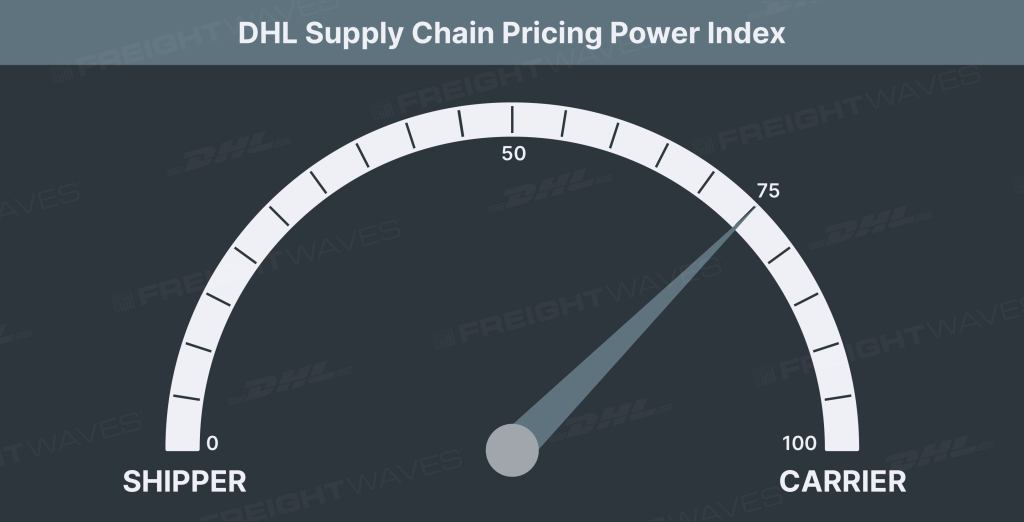
This week’s DHL Supply Chain Pricing Power Index: 75 (Carriers)

Last week’s DHL Supply Chain Pricing Power Index: 70 (Carriers) 

Three-month DHL Supply Chain Pricing Power Index Outlook: 70 (Carriers)

The DHL Supply Chain Pricing Power Index uses the analytics and data in FreightWaves SONAR to analyze the market and estimate the negotiating power for rates between shippers and carriers. 

The Pricing Power Index is based on the following indicators:

Load volumes: Absolute levels positive for carriers, momentum neutral

The Outbound Tender Volume Index at 15,980 is nominally higher now than basically at any point in the past 12 months with the exception of the week prior to Thanksgiving/Black Friday last year. OTVI captures all electronic tenders, including rejected ones, so when accounting for the rejection rate, we can get an even more accurate look at volumes. 

OTVI rose through the back half of May into the national holiday and has risen even further since. Throughout the back half of May and into the middle of June, tender rejections declined substantially. Meaning, current volume throughput is actually understated when comparing OTVI now to OTVI in November 2020. After adjusting for rejected tenders, the accepted outbound tender volume index is just 2.2% below the 2020 peak in November. At that time, OTVI surged towards 17,000, but the rejection rate moved in-kind towards its natural ceiling of 28%. So, the total accepted freight tenders in mid-June is comparable to the peakiest of peak seasons in 2020. Incredible. 

However, since the middle of June, tender rejections have begun increasing again heading into Independence Day, a time when many drivers spend time off the road with their families. The move higher in OTVI this week has been driven primarily by higher rejection rates, rather than higher freight demand. 

Over the past month, the drivers of freight volumes have continued to be imports and from just about every port. The west coast continues to provide seemingly non-stop container ships, while Houston, New Orleans, Miami and Savannah are seeing very strong throughput as well. 

It is van volumes that are driving freight markets higher right now. The Reefer Outbound Tender Volume index has tumbled 25% since its all-time high in the weeks after the polar vortex in February. Since Memorial Day, ROTVI has fallen another 10.5%. This is likely a factor of declining grocery demand, but I would expect the trend to reverse course in the near future as summer festivities accelerate. 

Dry van volumes pushed higher in the back half of May and into June while reefer volumes have declined significantly. 

SONAR: VOTVI.USA (Blue); ROTVI.USA (Green)

The congestion at our nation’s ports has spread from Los Angeles and Long Beach to Oakland, California. The California coastline is a parking lot of container ships, most of which are full to the brim with imports, awaiting berth. As detailed in the economic section, there are some signs that the reversion is underway with Americans paring back spending on pandemic superstar categories in favor of airlines, lodging and entertainment. But spending remains strong despite the moderation, and low inventory levels offset much of the decline that will occur from slowing demand. Real inventories are 3% higher now than pre-pandemic, but real sales growth is far outpacing inventory growth, leading to the lowest inventory-to-sales ratio in decades. 

On the manufacturing side, the ISM Manufacturing PMI expanded in May after declining in April. We’ve been in expansionary territory for 12 consecutive months. New orders, production, imports/exports and employment are all growing. The major issues should come as no surprise: Deliveries are slowing, backlogs are growing and inventories are too low. 

In all, there are many, many catalysts to keep freight demand strong for the foreseeable future. Americans are traveling and spending on services at a high clip, but the high savings rate is enabling it to occur without a massive detriment to goods spending. 

SONAR: OTVI.USA (2021 Blue; 2020 Green; 2019 Orange; 2018  Purple)

Tender rejections: Absolute level and momentum positive for carriers

After declining steadily from mid-March to mid-May, the Outbound Tender Reject Index has reversed course heading into Independence Day. This is typical for a national holiday as carriers selectively choose loads to bring drivers closer to home. OTRI now sits above 25% for the first time in June. 

One of our newest indices in SONAR gives us the ability to compare markets on as close to an apples-to-apples basis as possible. FreightWaves’ Carrier Trend Market Score indices are divided into two perspectives – shipper/broker and carrier. The scores are positioned on a scale from 1-100 and have values measuring van and refrigerated (reefer) capacity. The higher values represent more favorable trends for whichever perspective. For instance, a value near the high-end of the range would suggest very favorable conditions for carriers in our carrier capacity trend score index. 

For the past several weeks, capacity disparities have been driven by import volumes. The markets with the tightest carrier capacity coincide with the nation’s busiest ports. Ontario, California, Savannah, Georgia, and Atlanta all have carrier capacity trend market scores of 100. 

SONAR: Capacity Trend Market Score (Carriers – VAN)

By mode. Reefer rejection rates tumbled from it’s all-time high in March to under 35% in mid-June before popping higher over the past two weeks. Reefer rejections are still quite high from a historical standpoint at 38%, but are significantly lower than just three months ago when reefer carriers were rejecting half of all electronically tendered loads. 

SONAR: VOTRI.USA (Blue); ROTRI.USA (Orange)

Dry van tenders make up the majority of all tenders, so the van rejection rate mirrors the aggregate index closely. Van rejections have surged from ~23% to ~26% over the past two weeks. 

Yes, one-in-four loads being rejected is not ideal, but it’s better than 30%. I am unaware of any meaningful signals that capacity is being added at a rate that would change my outlook. With so many catalysts for demand, and many constraints on drivers including the Drug & Alcohol Clearinghouse, driver training school closures and continued government unemployment benefits, the outlook is tight throughout this year and into 2022. That’s not to say we won’t see improvement as consumers revert to pre-pandemic spending habits and drivers enter or reenter the market. But I’m not expecting any quick reversal of this environment; there are simply too many catalysts driving volume and suppressing capacity. 

SONAR: OTRI.USA (2020/21 Blue; 2020 Green; 2019 Orange)

Freight rates: Absolute level and momentum positive for carriers

Throughout June, spot rates have moderated while contract rates have pushed higher. The Truckstop.com dry van rate per mile (incl. fuel) has fallen from $3.21 to $3.11 since the beginning of June, while FreightWaves van contract rates have risen from $2.50 to $2.59/mile, exclusive of fuel. 

I still believe the Truckstop.com dry van national average will not retest the post-vortex surge pricing that brought spot rates up to an all-time high of $3.30. But, there aren’t many catalysts to bring spot rates down anytime soon either. Demand is unwavering with continued strong consumer goods demand, humming industrial recovery and a potentially cooling, yet still sizzling, hot housing market. And carriers can’t fill enough trucks to keep up with demand. 

Prior to the seasonal movements we’re seeing in tender rejections, routing guides generally had been improving through Q2. We should continue to see a convergence between spot and contract rates, but spot rates will remain historically very elevated throughout the summer as demand simply outstrips capacity. 

SONAR: TSTOPVRPM.USA (Blue); VCRPM1.USA (Green)  

Economic stats: Momentum and absolute level neutral

Several economic releases this week are worth noting.

Weekly jobless claims were released Thursday and give us one of the best close-to-real-time indicators of the overall economy.  This week, the data was again very promising as the labor market continues on a bumpy but trajectorially stable recovery path. 

First-time filings totaled 411,000 for the week ended June 19, a slight decrease from the previous total of 418,000 but worse than the 380,000 Dow Jones estimate, the Labor Department reported Thursday. Initial claims have held above 400,000 for consecutive weeks after falling to a pandemic low of 374,000 three weeks ago. As things stand, the current level of initial claims is about double where it was prior to the Covid-19 pandemic. 

The good news on the jobs front is that continuing claims are on the decline, falling to 3.39 million, a drop of 144,000. That number runs a week behind the headline claims total.

Initial jobless claims (weekly in May 2020-May 2021)

At the time of writing, the newest weekly data for the week ending May 29 had not been updated in SONAR. This week, claims fell from 405,000 to 385,000. 

SONAR: IJC.USA

Consumer. Turning to consumer spending, as measured by Bank of America weekly card (both debit and credit) spending data, total card spending (TCS) in the latest week accelerated to 22% over 2019. This is the first time in June that TCS has topped 20% over 2019, but spending has been running up 16-19% consistently on a two-year comp for months. For contect, the average pre-pandemic two-year growth rate was about 8% (from 2012 to 2019). 

The Bank of America team highlighted service spending in the nation’s two largest state economies, California and New York, which are now fully reopened. Spending at restaurants is now well above 2019 in both states, and the team believes there is more capacity for spending to accelerate in the states that were slower to reopen given pent-up demand. 

There was also a notable acceleration in spending on clothing this week, according to Bank of America. It could be a reversal from some softening in the early weeks of June, or an indication of people refreshing wardrobes ahead of a return to work, more travel and vacations. One tepid statement for freight markets from this week;s report: Leisure spending is on the rise and durable goods spending is flatlining.  

FreightWaves’ Flatbed Outbound Tender Reject Index, both a measure of relative demand and capacity, moves directionally with the ISM PMI. 

SONAR: ISM.PMI (Blue); FOTRI.USA (Green) 

Manufacturing. Over the past two weeks, regional manufacturing surveys have reported generally positive readings amid logistical challenges. The New York Fed’s Empire State business conditions index declined 6.9 points to 17.4 in June, retreating from strong readings the past two months. The Empire State Index is a diffusion index with a baseline of zero; any reading above zero indicates improving or expansionary conditions. 

Delivery times lengthened to a new record during the month, new orders and shipments fell, and inventories entered negative territory. The supply chain and transportation challenges are as visible upstream as downstream, but overall the manufacturing sector is handling. Growth continued throughout the second quarter in both the Empire State and Philly Fed indices. 

The Philadelphia Federal Reserve’s business activity index edged lower to a still robust 30.7 in June from 31.5 in the prior month. Unlike NY, the pace of shipments growth accelerated in the Philly region during June. The employment subcomponent rose to a very healthy 30.7 from 19.3 last month, the regional bank said. 

Record-long lead times, wide-scale shortages of critical basic materials, rising commodities prices and difficulties in transporting products are continuing to affect all segments of the manufacturing economy, but demand remains strong. 

For more information on the FreightWaves Freight Intel Group, please contact Kevin Hill at khill@www.freightwaves.com or Andrew Cox at acox@www.freightwaves.com.

Check out the newest episodes of our podcast, Great Quarter, Guys, here.

Project44 acquires ClearMetal to strengthen predictive tools

Project44, a leader in real-time visibility of the global supply chain, announced on Thursday it has acquired ClearMetal, a San Francisco-based supply chain planning software company that focuses on international freight visibility, predictive planning and overall customer experience. The terms of the acquisition were not disclosed.

ClearMetal, founded by top software engineers and data scientists from Stanford, Google and other Silicon Valley elites, has created a “continuous delivery experience” that leverages proprietary machine learning algorithms that can forecast supply chain disruptions. 

In an interview, Jason Duboe, chief growth officer at project44, explained that bringing in ClearMetal’s elite team is essential for the company’s future predictive solutions.

“Their team construct is fundamentally different. When you look at their data science, machine learning and computer science background, they are best in class,” he said. “Applying the team to solve really interesting challenges, starting with highly predictive ETA and deeper exception management to create more predictive analytics is really a key component here.”

Project44 recently acquired Ocean Insights to gain global supply chain vessel visibility and has announced it has expanded its truckload tracking services within Asia. Bringing on this new team of engineers will allow the company to capitalize on strong predictive tools, strengthening the supply chain of its customers.

“We’re going to be expanding deeper into Asia, and from a port perspective, getting data much earlier than competitors,” explained Duboe. “Our freight forwarder integrations will give us much deeper visibility from an end-to-end perspective in these regions.”

Along with the acquired skills the ClearMetal team will bring to project44, it brings a large book of customers, including large CPGs, retailers, manufacturers, distributors and chemical companies. These advanced use cases will strengthen the predictive planning tools, and project44 continues to expand into different customer markets.

“What we gain from ClearMetal is a holistic platform for anybody that joins the platform in the future,” said Duboe. “They have large customers with incredibly demanding and advanced use cases. So when it comes to order and inventory, functionality, supplier onboarding, and moving upstream into those processes, we can capture exceptions earlier on.”

Click here for more articles by Grace Sharkey.

Related Articles:

Project44 expands real-time visibility into China

Project44 reels in Ocean Insights in ‘largest acquisition in visibility space’

‘Project44’s vision has always been global’

BMO’s credit data shows little improvement despite stronger freight market

Data from Canada’s BMO on the trucking sector’s credit conditions for the bank’s second quarter suggests the upturn in freight rates has yet to significantly strengthen the finances of many of its clients.

BMO, the former Bank of Montreal, is one of the largest lenders to the trucking sector. As a publicly-traded company, its quarterly data on various metrics in its transportation group–of which about 90% consists of financing to truckers–is viewed as a strong indicator of the credit health of the industry. 

However, the group is being sold to Stonepeak, a private equity company. That deal is expected to close in the fourth quarter, so the latest BMO (NYSE: BMO) earnings report released Wednesday will likely be the next to last one of its kind that gives a transparent picture of credit conditions in the trucking sector.

Four key indicators in BMO’s transportation sector of the credit health of trucking barely budged in the second quarter of 2026. BMO’s fiscal year calendar begins in November. 

Gross impaired loans rose to Ca$576 million (US$417.2 million) from $563 million in the first quarter. While that is down from the recent peak of $585 million in the fourth quarter, it remains well above the $503 million in the corresponding quarter of the 2025 fiscal year.

Allowances for credit losses on impaired loans rose to $86 million from $77 million. A year earlier, that figure was $57 million.

Provisions for credit losses were $41 million. That is up from $39 million in the prior quarter. They peaked at $85 million in 2024’s final three months. 

An allowance is considered a “contra asset,”with its impact is on a company’s balance sheet. A provision is a liability, so it impacts income. But both are acknowledgements of a company that it believes there will be difficulty being repaid by a debtor.

Net writeoffs rose slightly, to $25 million, up from $24 million. The recent peak was $63 million in 2024’s fourth quarter.

While earlier data suggested BMO might be trimming the size of its book of business in preparation for a sale, the size of the loan portfolio rose in the second quarter from the prior three months, rising to $12.65 billion, up from $12.42 billion. A year earlier, it was just over $14 billion.

The highest quarterly book of business in BMO’s transportation sector was recorded in the fourth quarter of 2023, when it stood at $15.61 billion.

It also might be expected that BMO might be slowing new lending as it awaits a transition to its new owners. But that wasn’t the case, with loan originations in the second quarter more than a year ago, more than three quarters ago and more than the preceding quarter. 

More articles by John Kingston

Crucial changes in latest NJ independent contractor rule impacting truckers

New pot of money available to buy ZEV trucks in California

Nuclear verdict alert: almost $50M against a mystery Texas trucking company

Rail freight rolls on in latest data

Shipments of forest products returned to earth after a brief comeback last week, but that didn’t drag down strong U.S. railfreight volumes as intermodal led data higher.

Total U.S. weekly rail traffic for the week ending May 23 was 523,574 carloads and intermodal units, up 7.2% compared with the same week a year ago, the Association of American Railroads said.

Freight totaled 230,831 carloads, up 2.2%, while intermodal volume of containers and trailers was 292,743 units, better by 11.5% y/y.

Six of 10 carload commodity groups tracked by AAR were higher y/y. Grain remained the pacesetter, up 15.3%; followed by metallic ores and metals, 9%. Motor vehicles and parts shook off a slow year, up 2.3%

For the first 20 weeks of this year, U.S. railroads saw cumulative volume of 4,528,563 carloads, up 3.3%, and 5,555,553 intermodal units, a gain of 1.4% from the prior year. Total combined volume was 10,084,116 carloads and intermodal units, better by 2.3% y/y.

North American rail volume for the week on nine reporting U.S., Canadian and Mexican railroads totaled 340,946 carloads, an increase of 3.8%, and 381,548 intermodal units, up 10.3% from 2025. Total combined traffic was 722,494 carloads and intermodal units, ahead by 7.2%. North American rail volume for the first 20 weeks of 2026 improved 2.1% to 13,877,362 carloads and intermodal units.

Subscribe to FreightWaves’ Rail e-newsletter and get the latest insights on rail freight right in your inbox.

Read more articles by Stuart Chirls here.

Related coverage:

UP refutes new AG claims, says it provided all answers in merger paperwork

Short line rail hits T&I truck benefits, costly safety mandates

AAR slams “hypocrisy” as Trump-backed rail safety measure is included in transportation funding bill

UP CEO confident rail merger application checks all the STB’s boxes

ArcBest launches shipment execution platform

An ArcBest trailer on a highway

Transportation and logistics provider ArcBest announced Wednesday the launch of ArcBest View, a digital platform allowing logistics customers to manage all shipments and shipment functions through a single interface.

ArcBest’s (NASDAQ: ARCB) customers can now quote, book and track shipments from start to finish within one unified space. Key capabilities include direct access to shipment details, billing records, supporting documents and performance reporting.

Users can set up custom views and specific watchlists, and monitor historical transportation costs and service execution metrics.

“We built View in close partnership with customers, shaping it around how they manage shipments day to day,” said ArcBest President and CEO Seth Runser. “It provides a self-serve way to access the information they need, with ArcBest experts ready to step in when situations become more complex.”

Automation is driving better financial results within ArcBest’s asset-light unit.

The segment reported adjusted operating income of $2.8 million in the first quarter, which came in ahead of management’s expectations. Productivity hit a record high in the period with selling, general and administrative expenses (on a per-shipment basis) seeing an all-time low.

More FreightWaves articles by Todd Maiden:

Why the safest freight brokerages are usually the most boring

Cargo theft and freight fraud are not exciting topics. Nobody gets excited to review a carrier’s inspection history or sit on hold listening to the same music while waiting to verify a certificate of insurance. There is nothing glamorous about vetting a carrier before a load moves. In fact, there are more verification steps today than ever before.

The industry cannot move the same way it did years ago. Trust alone is no longer enough. Freight fraud has changed how brokerages operate, how carriers are onboarded, and how risk is managed before freight ever leaves the dock. To run a successful freight brokerage, you need the ability to onboard new capacity safely in different parts of the country. That only happens when your team follows a structured process that does not skip steps under pressure.

The safest brokerages often look the most boring

The process itself is not exciting. You repeat the same actions over and over. You verify the carrier, contact information, insurance, and banking details. When information changes unexpectedly, you slow down and verify again.

A brokerage that follows a repeatable process every day may actually seem more boring than a company rapidly approving new carriers with little verification at all. But boring is usually a good thing in transportation. A boring day often means nothing went wrong. No freight disappeared. No shipment was rerouted. No payment was stolen. No emergency calls were made trying to track down a load that vanished halfway across the country.

Excitement in freight is often tied to problems. The companies that stay disciplined during routine operations are usually the companies that avoid major losses later.

That mindset is one reason FreightWaves built the Certified Freight Compliance Officer program. The goal was not to create investigators or turn operations teams into law enforcement. The goal was to help the industry build repeatable operational discipline that teams can follow day after day.

CFCO starts with awareness. It teaches professionals how cargo theft and freight fraud actually move through modern logistics operations. The course then moves into process, verification, risk management, and eventually the integration of training with technology.

Verification creates consistency customers can trust

The strongest fraud prevention programs combine education with technology. Teams need to understand risk, follow a structured process, and use technology to strengthen verification without replacing critical thinking. The core verification process should remain consistent regardless of company size or freight volume. The fundamentals still matter. And when something changes unexpectedly, you slow down instead of skipping steps.

The transportation industry often focuses on speed and efficiency, but consistency may be the most valuable thing a brokerage can deliver today. Customers want freight moved safely. They want reliable communication and confidence that the company handling their shipment is following a real process instead of relying on assumptions.

That consistency is what creates trust. And right now, trust is something this industry could use more of.

Click here for more articles on cargo theft and freight fraud by Phillip Brink.

Why the freight industry needs Certified Fraud Compliance Officers – FreightWaves

Cargo theft is changing, and the risk is now inside the truck – FreightWaves

Florida theft ring accused of moving $7 million in stolen goods across multiple states – FreightWaves

UP refutes new AG claims, says it provided all answers in merger paperwork

Union Pacific refuted claims by top law enforcement officials of six red states this week that it failed to provide required information when it filed a revised application with federal regulators for its merger with Norfolk Southern.  

In a Tuesday filing with the Surface Transportation Board, the Covington law firm said that the railroads met their obligations for additional information on:

  • Market shares incorporating projected traffic growth for the postmerger UP (NYSE: UNP) and NS (NYSE: NSC) as required by the Board
  • Downstream post-merger effects 
  • Planned divestment of its shares of the Terminal Railroad Association of St. Louis and the Kansas City Terminal Railway 
  • Use of their partial ownership of railcar pool TTX for non-competitive purposes

“[I]f the attorneys general independently review the merits [of the merger in the revised application], “they will recognize this end-to-end transaction will produce substantial pro-competitive benefits for shippers in the states they serve,” the letter said. UP added that competitors are fighting the proposed transaction “because they understand they will face much stronger competition from a merged UP/NS.”

The partners pushed back at the AGs’ claims that the STB again rejecting the application as incomplete again would not advance President Trump’s policies. 

“[T]he proposed transaction will directly advance the administration’s policies of reindustrialization and affordability…[and] transform the U.S. supply chain, enhance American competitiveness, and energize virtually every sector of the economy.”

The STB is expected to rule on the updated application this week. In recent merger history dating to the 1990s, no merger application has been rejected twice.

Read more articles by Stuart Chirls here.

Related coverage:

Short line rail hits T&I truck benefits, costly safety mandates

AAR slams “hypocrisy” as Trump-backed rail safety measure is included in transportation funding bill

UP CEO confident rail merger application checks all the STB’s boxes

Six out of seven weeks: diesel benchmark down again

The benchmark price used for most diesel surcharges fell for the sixth time in the last seven weeks, with the prospect of more declines ahead.

This week’s Department of Energy/Energy Information Administration average weekly retail diesel price fell 7.3 cents/gallon to $5.523/g

Despite the six out of seven ratio, the benchmark used for most fuel surcharges is still more than where it was four weeks ago, $5.351/g on April 27. That’s because three weeks ago the DOE/EIA recorded a 28.9 cts/g gain. 

The latest decline comes against a backdrop of steep declines in the futures price of ultra low sulfur diesel (ULSD) on the CME commodity exchange, as markets sell off on the prospect of some sort of peace deal among the U.S., Iran and Israel that could reopen the Strait of Hormuz to full or at least limited traffic.

Sliding on CME

The scorecard on ULSD on CME is that it hit a recent peak settlement of $4.1625/g May 19. With talk emerging after that of a possible peace deal, the settlement plummeted to $3.7146/g on Tuesday, a decline of 44.79 cts/g, or 10.8%. 

In Wednesday morning trading, ULSD at approximately 9:40 a.m.  was $3.5409/g, down 12.85 cts/g or 3.47%. If it settled at that level, it would be the lowest settlement since April 20.

As the energy research team at Merrill Lynch said in a recent note, “There have been several false starts around reopening – i.e. the Apr 1 US claims that Iran asked for ceasefire, the Apr 8 joint announcement of ceasefire, the May 6 claims of progress made toward peace, etc.”

But as the report also noted–referring to energy-related stocks but in a statement that could be applied to petroleum commodities as well–”even though the strait remains closed, some energy investors are hesitant to add to energy stocks, knowing the strait could reopen soon and stocks could drop materially.”

While the Trump administration continues to claim that oil prices will come down sharply should some sort of peace agreement take hold, voices from the industry themselves are less sure of a coming deep slide in price, even if there is an initial bearish selloff. 

Inventories will need to be restocked

In that Merrill report, the prospect of the oil industry needing to restore inventories back toward normal levels was highlighted. That would provide a source of demand that may not be getting priced in to the market at this point.

“The world has lost 3- to 4-million barrels/day of damaged Persian Gulf refined product capacity and 11-million b/d of net crude flows as the Iran War and Hormuz Strait closure reaches day 85,” the report said. “We assume that after this, strategic petroleum reserves of both will be fully refilled, and commercial storage will be refilled to at least the midpoint.”

Merrill’s math is that there will be 1.2 billion barrels of crude restocking demand, and 300 million barrels of restocking demand for refined products. At 1.5 billion barrels between the two, that’s almost 15 days’ worth of total daily pre-war global oil demand that would be  needed just to bring inventories  back to a more normal level.

Small loss of supply can have big impact

Jeffrey Currie, the former head of commodity research at Goldman Sachs who has been one of the loudest bullish voices during the Iran war, said in a recent interview that the impact of reducing oil supplies by roughly 20% because of the closure of the strait can’t be measured by simple mathematical calculations. 

Currie, in an interview with CNBC, discussed two previous price spikes: the 2008 surge to almost $150/b, and the jump in prices after Russia invaded Ukraine.

“What’s very different here from other times is that at the higher prices, you still had availability,” he said. “What’s different now is that we’re getting to a point where as you pull that molecule out of the system, it has a big impact on growth.”

Currie compared it to recent squeezes on rare earth supplies impacting car manufacturing.  

Rare earths were the raw material that went into magnets in car doors, Currie said, “and you take the battery out or you took the magnet out, you shut down Detroit,” Currie said. 

He made an analogy to recent increases in copper prices. Copper production is dependent on sulfuric acid, and restrictions on sulfur exports out of the Middle East means that sulfuric acid markets have been squeezed as well. 

“(Markets) are not going to pay attention until it actually creates real shortages and forces them to,” Currie said. 

More articles by John Kingston

Crucial changes in latest NJ independent contractor rule impacting truckers

New pot of money available to buy ZEV trucks in California

Nuclear verdict alert: almost $50M against a mystery Texas trucking company

WATCH: Port of Virginia CEO talks about tariffs, investment, and why her new cranes are the most unique among U.S. container hubs

VIRGINIA BEACH, Va. – Just weeks after she had delivered her first State of the Port address in April, the Virginia Port Authority had seen enough – elevating Sarah McCoy from interim leader to its new chief executive and executive director.

The 11-year agency veteran and former chief counsel lands as one of the new generation of North American port leaders in an era where chaos, change and geopolitics go hand-in-hand with planning, infrastructure and investment. Virginia ranked sixth among U.S. container ports in 2025, moving 3.24 million TEUs.

Prior to her title change, McCoy spoke with FreightWaves at the port event.  

Read more articles by Stuart Chirls here.

Related coverage:

Port Houston sees April cargo dip, expects rebound in May

ILA’s McNamara enters International Maritime Hall of Fame

Georgia ports volumes hit by higher costs, softer market

Cathay Pacific, Air China Cargo top up orders for Airbus A350 freighter

Fuselage of an A350 freighter aircraft in the manufacturing hall as technicians install a cargo door.

(UPDATED May 27, 2026, 9:58 a.m. ET)

Hong Kong-based Cathay Pacific on Wednesday announced it has exercised options to buy two additional Airbus A350 freighter aircraft, bringing its total commitment for the new aircraft type to eight units. Meanwhile, Air China Cargo placed a firm order with Airbus for four additional A350 freighter aircraft, bringing its total order for the new type to 10 aircraft. Air China Cargo previously ordered six A350Fs in November.

Cathay Pacific is one of the top 10 cargo carriers in the world, based on traffic. It operates 20 Boeing 747 cargo jets and manages shipments carried on the airline’s passenger fleet.

“This additional order . . . is a crucial strategic decision for the company to further optimize our fleet structure and expand transport capacity. It will allow us to better match and meet the demands of the international air cargo market, laying a solid foundation for the company’s long-term stable development,” said Wang Hongyan, vice president of Air China Cargo, in a joint news release on Tuesday.

Air China Cargo currently has a fleet of 24 freighters, including three Boeing 747-400Fs and 13 Boeing 777Fs, according to aircraft database Planespotters. The airline began introducing Airbus cargo jets to its fleet at the end of 2023, and currently operates eight A330-200 passenger-to-freighter converted aircraft. The A350s will handle long-haul routes, while the A330s are best suited for medium-to-long routes.

Air China Cargo previously said it expected to receive the initial six aircraft between 2029 and 2031. 

The A350 freighter is designed to carry up to 120 tons with a maximum range of 4,700 nautical miles. It will feature the industry’s largest main deck cargo door to ease loading of shipping containers and out-of-gauge cargo. Powered by twin Rolls-Royce Trent XWB-97 engines and with an airframe that is 70% carbon fiber, the A350 is estimated to reduce fuel consumption and carbon emissions by up to 20% compared to previous generation widebody aircraft.

Airbus last month completed the assembly of its first main deck cargo door and planned to install it on the fuselage of the first test aircraft this month. 

The European manufacturer is striving to make its first commercial delivery by late 2027. But ongoing problems receiving fuselages from Spirit Aerosystems, first flagged by Airbus last year, could push back the production timeline. Reuters reported last week that the acquisition of certain plants from troubled Spirit Aerosystems, which Boeing recently brought under its ownership, has not gone smoothly and that Airbus is having production disruptions related to the cargo door.

Airbus says it has registered 103 orders for the A350F from 14 customers.

Boeing has received more than 50 orders for its next-generation 777-8 freighter, which competes head-to-head with the A350 in the widebody cargo market.

Click here for more FreightWaves/American Shipper stories by Eric Kulisch.

Write to Eric Kulisch at ekulisch@freightwaves.com.

Atlas Air switches to Airbus, orders 20 A350 cargo jets

Ontario’s driver training system riddled with oversight failures, audit says 

An auditor general report from the Canadian province of Ontario has concluded authorities failed to effectively monitor commercial truck driver training, inspections and licensing, uncovering widespread compliance gaps that industry groups warn have jeopardized highway safety for years.

The May 12 audit found that some truck driving schools issued Entry Level Training (ELT) certificates without providing the province’s required minimum training hours, while regulators failed to inspect dozens of schools offering commercial driver instruction.

The report examined Ontario’s Class A commercial driver licensing system, which governs tractor-trailer operators. Auditors noted that large commercial trucks account for only about 3% of vehicles on Ontario roads but are involved in 12% of fatal crashes.

Ontario Auditor General Shelley Spence’s office sent undercover “secret shoppers” to six truck driving schools between June and December 2025. Investigators found two private career colleges provided only 59.5 hours and 81 hours of training, well below the province’s mandatory minimum of 103.5 hours.

According to the report, some students were never taught critical maneuvers such as left turns at major intersections, reverse parking and emergency stopping.

Auditors also found evidence of falsified student records and schools failing to maintain documentation proving students completed required instruction.

The report said Ontario’s Ministry of Colleges, Universities, Research Excellence and Security (MCURES) had never inspected 54 of the province’s 216 registered private career colleges offering ELT as of March 2025. More than half of schools that had reached the ministry’s five-year reinspection threshold had still not been reinspected.

Auditors also discovered that six unregistered schools previously investigated and penalized by regulators were still booking road tests as recently as June 2025.

The report further criticized the lack of coordination between MCURES and Ontario’s Ministry of Transportation (MTO), saying inspection and investigation results were not routinely shared between agencies.

Ontario’s Ministry of Transportation also failed to consistently test commercial drivers on highway driving and reversing maneuvers, according to the audit. Some DriveTest centers used lower-speed expressways for testing, while others only evaluated one type of reversing exercise instead of randomly selecting maneuvers as required.

The auditor’s office also questioned Ontario’s licensing requirements, noting that drivers with demerit points, suspensions or convictions could still obtain Class A or D commercial licenses.

The province accepted all 13 recommendations outlined in the audit.

Following the report’s release, Ontario Minister of Colleges and Universities Nolan Quinn said every career college offering commercial truck driver training would be inspected within six weeks. The province had already inspected 14 trucking colleges as of May 13.

“We’re going to continue going after the bad actors,” Quinn told CBC News. “Since we have taken office we have closed 19 career colleges, 11 of those are trucking colleges.”

Mike Millian, president of the Private Motor Truck Council of Canada, said the audit validated concerns long raised by trucking industry stakeholders.

“The PMTC, along with many other stakeholders, unfortunately are not the least bit surprised by the AG’s report,” Millian wrote in commentary released Monday.

Millian said industry groups warned Ontario officials as early as 2017 that the province needed stronger compliance and enforcement measures before implementing mandatory entry-level training standards.

“For a period of six years, none of these recommendations were acted upon,” Millian wrote. “The current mess we are in did not occur overnight; it was allowed to fester and expand over a period of years with no meaningful changes or enforcement occurring.”

Millian also criticized weak enforcement penalties and oversight gaps that allowed suspended or unregistered schools to continue operating.

“The fact that this can occur is insane, is reckless, & clearly has a detrimental effect on road safety,” Millian wrote regarding suspended training organizations continuing to certify drivers.

The PMTC said it is now working with Ontario officials on proposed reforms, including mandatory waiting periods before drivers can attempt a Class A road test, enhanced auditing, tougher penalties and expanded oversight measures.

Ontario officials have already begun implementing some changes. According to the audit, the province established a Driver Training Compliance Oversight Modernization Office in 2025 and has begun coordinated inspections between transportation and education regulators.

House committee OKs transportation bill that cuts wide swath across trucking

The first key step toward turning into law the sweeping surface transportation bill was approved overwhelmingly Friday by the House Transportation & Infrastructure (T&I) committee, raising the question of which of its many provisions is the most significant for the trucking sector.

The bill, known also as the BUILD America 250 Act, has a 5-year authorization period, replacing a bill that also was in effect for that length of time. 

Following the committee’s passage, it received praise from both the Owner Operator Independent Driver Association (OOIDA) and the American Trucking Associations (ATA), two groups that don’t always end up on the same side of political questions.

The bill passed the T&I committee by a 62-2 vote. Its formal name is the Infrastructure Investment and Jobs Act , but is also being branded with the Build America moniker.

Two provisions in the bill that have drawn a lion’s share of attention deal with issues that are very much on the ground for truckers: bathrooms and parking.

Bathroom access would be made law

Under the section entitled Restroom Access (section 5102 for those searching the more than 1,000 page bill), drivers will be given access to bathroom facilities under various scenarios they are likely to encounter when on the road.

Drivers will be “granted access to any covered restroom facility at any covered establishment” where the driver is delivering “any goods or cargo,” or “is waiting at such covered establishment to transport goods or for cargo to be loaded.”

But the bill also states that the establishments do not need to make any physical alterations in their existing facilities to comply with the new law.

A “covered driver” is “any commercial motor vehicle operator with respect to whom the Secretary of Transportation has power to establish qualifications and maximum hours of service.”

The covered establishment is “a place of business open to the general public” or structures such as “a shipper, receiver, manufacturer, warehouse, distribution center” or other facility that is taking in or sending out goods.

There’s also a specific requirement impacting drayage drivers. “A terminal operator shall provide a sufficient number of covered restrooms for use by covered drayage truck operators in areas of the terminal to which such operators typically have access.” the law requires.

“Drivers servicing shippers and receivers should not be denied access to bathroom facilities, and this language makes sure they won’t be,” the ATA said in its summary of the bill.

Jason’s Law as the basis

The parking section of the surface transportation bill is under the heading of the “codification and improvement of Jason’s Law.” The specifics of Jason’s Law are that it requires a federal survey of truck parking availability and is named after Jason Rivenburg, who was murdered in 2009 while parked at an abandoned gas station.

But Jason’s Law also permits federal funding for parking, and that is where the latest transportation bill comes into play.

The parking section of the bill allows the Department of Transportation to make grants for commercial vehicle parking. There is a list of entities that can receive that grant money, including a state or local government.

A private entity can partner with a government to complete a project, according to the bill.

As well as being able to put new parking on a federal highway, where it already exists, the grant program would permit parking to be built in what the bill calls “a freight facility.” It can also be parking added to an existing location, such as a weigh station. 

In an online commentary about the legislation, the law firm of Holland & Hart noted that the corresponding committee in the Senate, the Environment and Public Works committee, “has not yet released the content of its transportation bill, but it is expected in the coming months.”

The existing authorization legislation expires September 30, the law firm said.

Among other surface transportation highlights in the bill:

Cabotage

The Transportation Department will conduct a study on cabotage. Specifically, the study will focus on “the safety and economic impacts of cabotage violations using commercial motor vehicles.” Cabotage is a term used to describe the movement of goods between two locations in the same country or political entity. It is often regulated so that only a transporter based in that country can move those goods. The Jones Act, which requires that any product shipped on the water between two U.S. cities move on a U.S.-flagged vessel, is an example of a cabotage law.

In trucking, a truck coming across the border from Mexico or Canada is permitted to take foreign-originated goods to a U.S. destination. It can take goods from that destination back to Mexico or Canada. But it can’t stop at somewhere in between and haul goods, nor can it take goods between U.S. destinations. 

There long has been allegations that some non-U.S. carriers are regularly violating cabotage laws. The study mandated by the surface transportation bill will study the impact of illegal cabotage in the U.S. 

Broker qualifications

There already are requirements on the books regarding establishing qualifications for brokers and freight forwarders. The surface transportation bill requires the Secretary of Transportation, within two years, to issue a final rule that would more thoroughly implement them. 

The Transportation Intermediaries Association, in an email to its membership and others, said that proposal is “a reform TIA has championed for more than a decade.”

Leasing

The bill would require lease deals between a carrier and an independent owner operator to contain a disclosure form. That form, according to the bill, would need to include information on weekly compensation; average weekly mileage and driver schedules; data on the number of drivers at that company who sign a lease and the number that fulfill that agreement; and deduction information on fuel, insurance and other charges. The DOT also will be able to “carry out a campaign to increase awareness of how standard lease-purchase programs work. 

The section refers to “predatory leases.” The definition of what constitutes “predatory” in the bill is not specific, but encompasses a wide range of issues, including the carrier’s policy and practices on recruitment, operations, taxes and other financial issues, such as “(where” the motor carrier controls the work, compensation and debts of the driver, and the driver accrues no equity or is forced to give up equity accrued in the contracted truck.”

Legislation introduced last year by Rep. Julia Brownley regarding lease purchase programs has not advanced out of the T&I committee. 

Further initiatives

Other parts of the bill that will be the focus of future reporting include regulation of electronic logging devices, the creation of a committee to review cargo theft, and an extension of the safe driver apprenticeship program.

More articles by John Kingston

Crucial changes in latest NJ independent contractor rule impacting truckers

New pot of money available to buy ZEV trucks in California

BMO’s transportation group, huge lender to trucking, is being sold