East Palestine, Norfolk Southern reach $22M settlement over derailment
EAST PALESTINE, Ohio — Norfolk Southern and the village of East Palestine have reached a $22 million settlement to resolve all claims by the village resulting from the Feb. 3, 2023, derailment and hazardous-materials release, the two parties have announced.
A joint statement on the East Palestine website Monday says the village recognizes the approximately $13.5 million NS has already spent in the village — including replacement of fire and police vehicles, improvements to the water treatment plant, and exterior renovation of the East Palestine railroad station. NS also remains committed to spending $25 million on improvements to East Palestine City Park.
A defective wheel bearing led to the derailment of 38 cars of an NS train in East Palestine at about 9 p.m. on Feb. 3, while 12 more became involved in a subsequent fire. Eleven of the cars were carrying hazardous materials. Fearing an explosion, NS eventually conducted a vent and burn of the five cars carrying highly toxic vinyl chloride — a move the National Transportation Safety Board would eventually determine was unnecessary, and one that spread the material throughout the area [See “NTSB releases final East Palestine report,” News Wire, July 13, 2024]
The derailment led to intense scrutiny of rail safety nationwide. It had cost NS $2.2 billion, including cleanup and legal expenses, as of the end of 2024. It also led to a proxy fight that saw activist investor Ancora Holdings make an unsuccessful attempt to gain control of the NS board, although Ancora did gain some seats and eventually reached a settlement giving it further influence. [See “News Wire top stories of 2024, No. 1 …,” News Wire, Dec. 31, 2024.]A planned regional safety training center in East Palestine, however, will not be built, as the railroad and village have determined it is “not feasible,” according to the statement. NS will transfer 15 acres for that planned facility to the village for a use to be determined by the village. NS had broken ground on the $20 million facility, which had been planned for first responders from Ohio, Pennsylvania, West Virginia and the surrounding region, in September 2023.
The United States’ nuclear energy industry has long been a cornerstone of the nation’s power generation landscape. Beginning in the mid-20th century, the U.S. rapidly expanded its nuclear portfolio, driven by the promise of a virtually limitless, low-carbon energy source. And according to a new report by the International Energy Agency, 2025 will be a record year for nuclear power generation — but nuclear’s comeback wasn’t a sure thing.
This is JP Hampstead, co-host of the Bring It Home podcast with Craig Fuller. Welcome to the 11th edition of our newsletter, in which we take note of the shifting public — and regulatory — attitude toward nuclear energy.
By the 1970s and 1980s, nuclear power plants became integral to the country’s electricity supply, providing a stable and substantial portion of the nation’s energy.
However, over the past few decades, the momentum stalled. The construction of new nuclear power plants halted, leaving the U.S. without fresh additions to its aging fleet for over 30 years. This pause was primarily due to a confluence of factors including escalating construction costs, prolonged development timelines, public apprehension following incidents like Three Mile Island and Chernobyl, and the rise of cheaper and more flexible energy alternatives such as natural gas and renewables.
The cessation of new nuclear projects created a significant gap in U.S. energy infrastructure. Existing plants, many nearing the end of their initial operating licenses, faced the dual challenges of maintenance and eventual decommissioning without adequate replacements. This stagnation not only limited the growth of the nuclear sector but also impeded the country’s ability to leverage nuclear energy as a key driver for economic and industrial revitalization.
(Plant Vogtle, near Waynesboro, Georgia. Photo: Southern Nuclear)
Nuclear power holds distinct advantages that make it exceptionally well suited to support the United States’ reindustrialization efforts. Unlike intermittent renewable sources like wind and solar, nuclear power provides a consistent and reliable energy output. Nuclear reactors operate at high capacity factors, often exceeding 90%, meaning they produce maximum power more than 90% of the time. (Compare that to 34.5% for wind and 25% for solar.) This reliability ensures that industries receive a steady supply of electricity, critical for manufacturing processes that cannot tolerate energy fluctuations. Nuclear energy generates large amounts of power from a single facility, making it highly efficient in meeting the substantial energy demands of heavy industries.
Reindustrialization necessitates abundant and affordable energy to rebuild and expand the manufacturing sector, create jobs, and drive economic growth. A few weeks ago, we covered the deindustrialization of Germany and explored how it coincided with de-nuclearization and subsequent energy crises in the country. In this context, nuclear power emerges as a pivotal element. Its capacity to deliver high-density, low-carbon energy aligns perfectly with the goals of modernizing the industrial base while adhering to stringent environmental standards. As the U.S. seeks to regain its competitive edge in global manufacturing, the integration of nuclear energy into the national grid becomes indispensable.
To harness these benefits and reinvigorate the nuclear sector, the role of the Nuclear Regulatory Commission (NRC) is more critical than ever. The NRC serves as the federal body responsible for regulating nuclear power plants, ensuring their safe and secure operation. Facilitating the approval and construction of new nuclear facilities requires a delicate balance between maintaining rigorous safety standards and fostering an environment conducive to efficient project development.
Lately the balance has been shifting away from extreme, prohibitive safetyism to an attitude that would facilitate and enable nuclear energy. AI data centers are now emerging as a distinct new market for nuclear energy, especially from a new generation of small modular reactors.
The NRC recently updated its mission statement to reflect that, and new Commissioner David Wright, just appointed by President Donald Trump, has emphasized that he wants the commission to be part of the solution.
One notable example is the Vogtle Electric Generating Plant in Georgia. Vogtle Units 3 and 4, which came online in 2023 and 2024, are the first new nuclear reactors to be constructed in the U.S. in over three decades. Managed by Southern Co. through its subsidiary Georgia Power and built by Bechtel, these reactors signify a renewed commitment to nuclear energy. The NRC’s streamlined review processes and supportive regulations have been instrumental in bringing Vogtle to fruition, despite the complexities and challenges inherent in developing new nuclear technology.
Similarly, the Natrium project in Wyoming, spearheaded by TerraPower and Bechtel, represents a forward-thinking approach to nuclear energy. Natrium is a novel small modular reactor (SMR) that incorporates advanced sodium-cooled fast-reactor technology alongside molten salt energy storage. Approved by the NRC, this project is set to begin construction shortly, aiming for operational status by the early 2030s. The NRC’s role in facilitating the approval and oversight of such innovative projects is pivotal in demonstrating that nuclear power can evolve to meet contemporary energy needs while adhering to the highest safety standards.
The NRC can play a pivotal role in expanding the nuclear energy sector in the U.S. by implementing a range of strategic actions. First, by enhancing the efficiency of permit reviews and reducing bureaucratic delays, the NRC can accelerate the timeline for bringing nuclear projects online. This requires adopting flexible regulatory frameworks that accommodate technological advancements while maintaining safety standards. Supporting innovation is also crucial, particularly when it comes to the development and deployment of SMRs and advanced reactor designs. The NRC can facilitate this by creating pathways for faster licensing of these innovative technologies and providing clear guidelines to help developers meet safety and operational requirements. Collaboration among government entities, private companies and research institutions is also vital for driving nuclear innovation. The NRC can act as a coordinator, ensuring that regulatory frameworks are conducive to these partnerships, which are essential for the development and deployment of new nuclear technologies.
Massively increasing the United States’ nuclear power production is not merely a return to an old energy strategy but a crucial component of reindustrialization. Nuclear energy’s unmatched reliability and high power output make it indispensable for revitalizing the manufacturing sector and driving economic growth. The NRC’s proactive facilitation of new plant approvals and support for innovative projects like Vogtle and Natrium are essential steps toward realizing this vision, and a hopeful sign that the United States has turned the corner on nuclear energy policy.
Wind and solar are part of the United States’ energy strategy, especially for mitigating carbon emissions, but they cannot produce enough reliable power to meet the demands of the 21st century by themselves. For that, we must split atoms.
Quotable
“The [Nuclear Regulatory Commission] protects public health and safety and advances the nation’s common defense and security by enabling the safe and secure use and deployment of civilian nuclear energy technologies and radioactive materials through efficient and reliable licensing, oversight, and regulation for the benefit of society and the environment.” (Emphasis added.)
– Mission statement of the NRC, updated on Jan. 28, 2025, as ordered by the Accelerating Deployment of Versatile, Advanced Nuclear for Clean Energy (ADVANCE) Act, signed into law by President Joe Biden in July 2024.
President Trump’s new NRC commissioner, David Wright, has said the NRC should “position itself to be part of the solution.”
Texas factory activity picked up notably in January, according to business executives responding to the Texas Manufacturing Outlook Survey. The production index, a key measure of state manufacturing conditions, rose seven points to 12.2.
Other measures of manufacturing activity also moved higher this month. The new orders index rose 6 points to 7.7, its highest level since April 2022. The capacity utilization and shipments indexes moved up to 5 and 8.7, respectively, after near-zero readings in December.
China’s manufacturing activity unexpectedly contracted in January, an official factory survey showed on Monday, its weakest since August, keeping alive calls for stimulus in the world’s second-largest economy.
The official Purchasing Managers’ Index contracted to 49.1 in January from 50.1 in December, below the 50-mark separating growth from contraction and missing a median forecast of 50.1 in a Reuters poll.
Manufacturing is central to Alabama’s economy as the sector accounts for nearly one-fifth of the state’s GDP, generates more than $40 billion in annual economic output, and provides nearly 300,000 Alabama workers with high-quality, good-paying jobs.
Irrefutable evidence proves that Alabama manufacturers are winning on the international stage. The state now ships goods to nearly 200 countries and is the nation’s No. 1 auto exporter.
BelugaST fleet goes belly-up as Airbus closes cargo airline
Airbus has shut down its new for-hire cargo airline focused on transporting oversize shipments using the odd-shaped Beluga superfreighter because of self-described operational challenges and what appears to be weak demand for the service.
The aerospace manufacturer last week terminated Airbus Beluga Transport (AiBT), the specialized airfreight business introduced last March for hauling outsize cargo, and suspended BelugaST flights, Airbus confirmed in a statement.
French business daily Les Echos first reported on Airbus’ decision to ground the third-party cargo service due to a lack of external customers, resulting in the loss of 75 jobs. Airbus said operational issues, not weak demand, were the biggest challenge. But the two problems went hand in hand, according to an air cargo professional familiar with the market for heavy-lift cargo.
“I believe the lengthy internal procedures to permit new cargo types on the aircraft and high charter costs prevented ABT from being a competitive player. I would also say chartering the Beluga externally wasn’t a high priority for Airbus,” said Brian Davis, commercial director for Neo Air Charter, an aircraft broker based in Ruesselsheim, Germany, that matches logistics companies and other shippers that need custom airlift with available cargo airlines.
“The limitations on cargo weight as well as the complex requirements for organizing and relocating special loading conveyors closed them off to a lot of business,” he added.
While the BelugaST can accommodate oversize loads, it’s not as versatile as the Antonov An-124 or Boeing 747 because of weight limitations and the need for special loading equipment. With a maximum payload of 44 tons, it isn’t able, for example, to transport tanks, generators or other heavy industrial equipment that can easily be rolled onto other freighters that have front or rear ramps.
Loading and unloading is a complex process that requires a dedicated, trained crew. The loader is basically scaffolding with a built-in rail system that allows the plane to be filled from a high point, above the cockpit. The platform has to be assembled, put in containers, and transported to each destination. It takes several hours to position the platform in front of the aircraft, connect it with the aircraft handling system and load/unload shipments, with the assistance of a crane.
When the loader is carried on the same flight as a load, it reduces the available capacity.
The BelugaST completed a total of six missions for external customers in 2024, the Airbus spokeswoman said by email.
In addition to meeting customers’ requirements for safe carriage of sensitive equipment, Airbus’ aircraft design office had to approve different types of payloads to make sure lashing systems and other systems would hold large shipments in place.
AiBT operated four BelugaST superfreighters. Aircraft tracking site Flightradar24 shows the planes were parked in Toulouse and Bordeaux, France, starting in the first week of January.
No decision has been made yet about their midterm and long-term future, an Airbus spokeswoman told FreightWaves. The ultralarge aircraft for now will be placed under the air operating certificate of Airbus Transport International, the in-house airline that operates larger BelugaXL jets that transport aircraft sections between different Airbus manufacturing sites in Europe. Whether they will be used again for internal purposes depends on future circumstances, she said.
A space satellite is unloaded from a BelugaST freighter at Orlando Sanford International Airport in Florida using a specialized platform. (Photo: Airbus)
The unique aircraft’s design is based on an A300-600 and borrows features from the beluga whale, a species with a distinctive white color and prominent forehead found in Arctic coastal waters. Airbus modified the frame by lowering the cockpit and adding a bulbous fuselage shell to accommodate large aircraft sections so they could be moved from factories to assembly plants in Europe by its in-house airline.
Airbus announced plans in January 2022 to commercialize its fleet of BelugaST freighters after replacing them with the BelugaXL, which is built on a larger A330-200 frame. The business offered dedicated transport services to shippers with cargo that is too tall or wide to fit in a traditional freighter aircraft.
With the largest cross section of any transport aircraft in the world – 50% higher and 10% wider than alternatives such as the Antonov An-124 or Boeing 747-8 – the Beluga was well suited for nonstandard shipments such as satellites and helicopters. But the limitations on heavy-lift cargo and complexity to operate reduced its overall appeal. The aircraft also is unable to make long journeys without multiple trips because it was designed for regional flying in Europe.
Capacity for project cargo?
Over time it will become extremely difficult to transport oversize and heavy cargo, Neo Air Charter’s Davis explained. The biggest issue is the lack of replacements for the ultralarge An-124.
In the wake of Russia’s invasion of Ukraine, only a handful of An-124 ultralarge freighters are available to charter in the European and North American regions. Ukrainian freighter operator Antonov Airlines, which relocated to Leipzig/Halle airport in Germany when the war started, has only two An-124s in commercial service. Two other An-124s are committed to flying military cargo for Ukraine, and the three remaining aircraft have been inactive for months or years, according to industry sources and Flightradar24 data. Meanwhile, Russian cargo airline Volga-Dnepr, which operates An-124s and Ilyushin IL-76s, is banned from U.S. and European airspace.
The only other An-124 operator is Abu Dhabi-based Maximus Airlines, which has a single aircraft.
The An-124s are getting very old, and finding replacement parts is increasingly difficult, said Davis.
Atlas Air and Cargolux operate the largest fleets of Boeing 747 freighters.
Airlines are gradually phasing out Boeing 747-400s because of their age and high fuel consumption. Boeing stopped making the 747-8 last year. The largest production freighter currently available from Boeing is the twin-engine 777, but it lacks the nose-loading capability of many 747s.
Azerbaijan-based Silkway Airlines also operates two IL-76s that can operate in the U.S. and Europe.
For all the recent contentious talk of tariffs and trade, the dollar value of cross-border freight moving between the United States, Canada and Mexico in November was unchanged from the previous year.
Cross-border freight totaled $131 billion moved by all modes of transportation, unchanged from November 2023, according to the U.S. Bureau of Transportation Statistics (BTS).
Freight between the U.S. and Canada was valued at $61.8 billion, down 5.2% y/y. Freight moving between the U.S. and Mexico came to $69.1 billion, up 5.1% from November 2023.
It was the 21st straight month Mexico led Canada in freight dollar value.
Mexico and Canada are the number one and number two U.S. trade partners, respectively, ahead of China at number three.
Trucks moved $82.6 billion of freight, up 0.4%, while railroads accounted for $16.3 billion, off 5.8%.
Maritime vessels moved $9.7 billion of freight, down 6.6%, which included 11.3% less mineral fuels by dollar value.
Pipelines’ share was $7.9 billion, a decrease of 25.2% compared to November 2023, including a decline of 25.2% in mineral fuels by dollar value.
A total of $5.2 billion of freight moved by air, up 7.3% compared to November 2023.
Detroit, Buffalo, and Port Huron, Mich., are the top truck ports for U.S. freight flows with Canada, according to the BTS release. Laredo and El Paso, Texas, and Otay Mesa, California, are the top truck ports with Mexico.
Detroit, Port Huron, and International Falls, Minnesota, are the top rail connection ports with Canada; Laredo, El Paso, and Eagle Pass, Texas are the leading rail connections.
The ports of Houston, Arthur, and Texas City, Texas, are the top water port connections for U.S. energy flows on the southern border.
Trump tariff threats leave supply chain stakeholders scrambling for answers
A lot of people are hungry for guidance on how to navigate the supply chain if 25% tariffs on imports from Mexico and Canada come into effect on Saturday, judging from a recent webinar by global supply chain provider Kuehne + Nagel.
“I was blown away and very encouraged by the turnout,” Greg Tompsett, vice president of customs brokerage USA at Kuehne + Nagel and host of the webinar, told FreightWaves in an interview. “It just shows people are desperate for information.”
President Donald Trump has threatened to impose the tariffs as part of an initiative to get Mexico and Canada to do more on migrant and drug smuggling issues.
While Tompsett believes the threats could be a bargaining tactic, he said if they are implemented on Saturday, shippers will need to immediately take stock of what goods they have in the supply chain.
“What is already out on the water,” Tompsett said. “What purchase orders have already been booked? What are things that we can’t really change or shift, and what temporary options do we have to buy us a little time? Can we move something in bond – that’s where it hasn’t technically been imported yet, but it gets in and we set it off at a bonded warehouse, and we can keep it at bay for a little bit – and what’s that cost? Can we defer or hold off importing it? Do we have the ability to move it in a foreign trade zone – those are things we’ll be looking at.”
In 2018, during Trump’s first term as president, he imposed a 10% tariff on $200 billion of imports from China.
The 2018 tariffs acted as a sort of stimulus to the freight industry, boosting trucking rates and tightening capacity, according to a 2019 FreightWaves report.
Tompsett said some transportation providers may raise their rates if tariffs are imposed Saturday.
“As we’ve seen in the past, many companies have taken advantage of this and used it as an opportunity to charge premiums or surge pricing or different elements like that,” he said. “I would be naive to think that some companies won’t try to do so again. But I think each company is going to try to weigh what value they can bring to their customers, and what they can do to try to maintain that business. I think we’ve also seen in the past, some companies think it’s great to try to grab a little bit of money in the short term, but a lot of times you burn those relationships when you try to do that.”
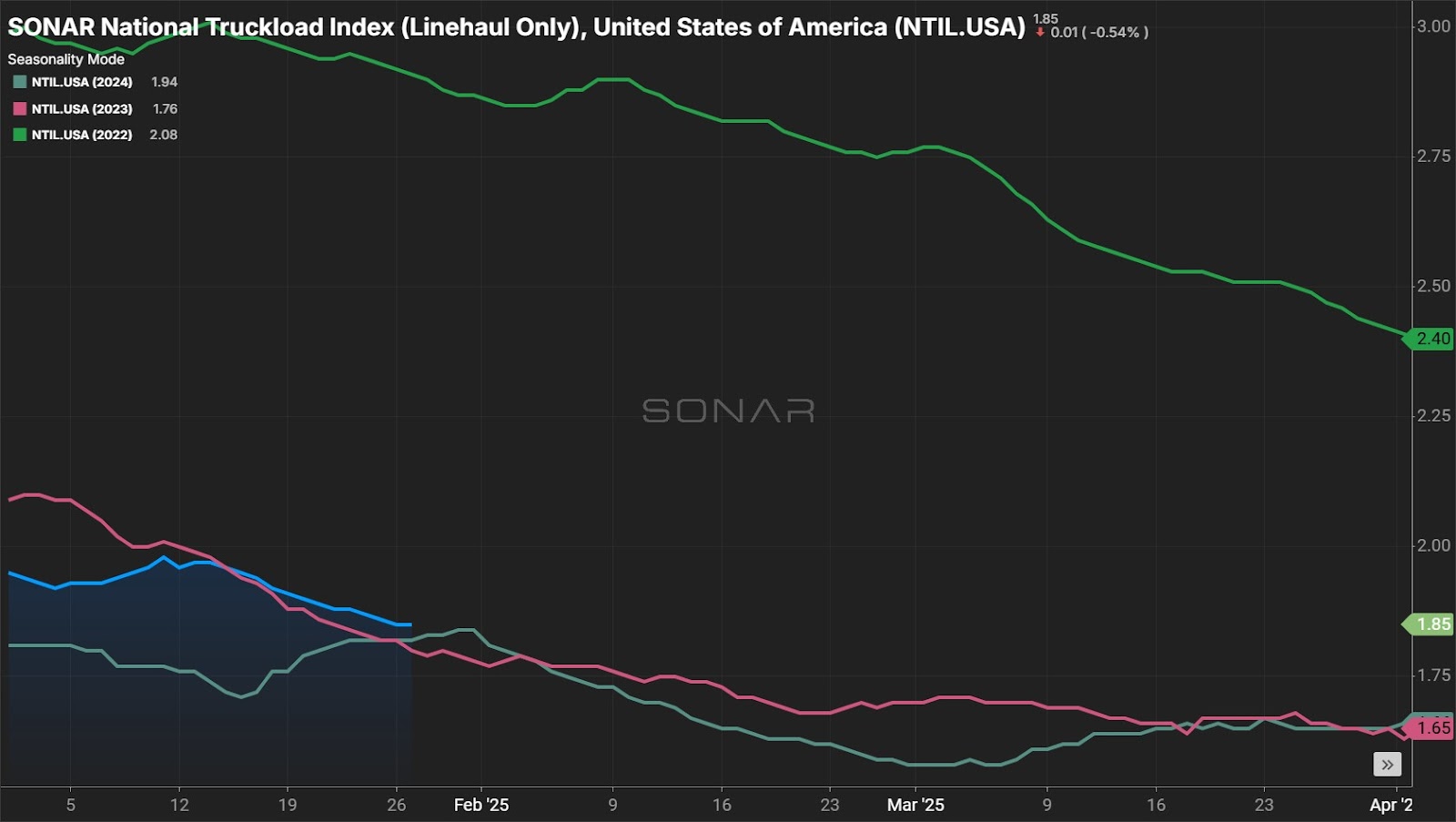
As of Monday, the SONAR National Truckload Index Linehaul Only (NTIL) showed the nationwide dry van spot rate was at $1.85 per mile, down 2% week over week and 4.6% year over year.
The NTIL measures the average spot rate for dry van loads moving more than 250 miles excluding the total estimated cost of fuel. The NTIL has been trending higher over the past year and a half but has been moving downward since Jan. 11.
FreightWaves SONAR National Truckload Index (NTIL.USA) shows dry van spot rates at $1.85 per mile as of Monday. To learn more about FreightWaves SONAR, click here.
Trump’s tariff policies could also shift more supply chains and manufacturing operations back to the U.S., but it will take time, Tompsett said.
“I don’t know if it’s going to be to the degree that is being hoped for, or if it’s going to be the kind of high-end manufacturing jobs that people want to associate it to. People are hoping, but I just don’t know that I ever see that era coming back to U.S. manufacturing,” Tompsett said.
Nari Viswanathan, senior director of supply chain strategy at Coupa Software, said while businesses and supply chain leaders can’t control trade policies, they can control how they respond to potential tariffs.
Foster City, California-based Coupa Software offers a cloud-based software platform that aims to help businesses optimize their supply chains.
“Preparing for tariff disruptions before they happen is essential, and plans should happen in the most optimal way possible,” Viswanathan told FreightWaves in an email. “Those who don’t may risk a severe revenue downturn in 2025, and businesses must prioritize resiliency and agility. When preparing for tariffs, regulations, and geopolitical fluctuations, it’s critical to have complete visibility of the end-to-end supply chain.”
When Trump imposed tariffs on China in 2018, they spurred some supply chains to move away from China and relocate to countries such as Vietnam, Thailand and Mexico.
Companies should be developing contingency plans and risk scenarios now to find the best supply chain solutions, Viswanathan said.
“Running scenarios with different types of taxes and tariffs can help businesses design a realistic and strategic perspective on managing future costs,” Viswanathan said. “Developing contingency plans for different tariff forecasts can include shifting sourcing, increasing local production, or adjusting product prices. Additionally, conducting a supplier risk assessment can help identify a business’ exposure to tariffs, especially if suppliers are in Canada or Mexico. This assessment can help leaders make better decisions when diversifying suppliers and evaluating the costs and benefits of producing goods within different geographies.”
Tompsett, who said he’s a student of trade policy history, said he feels Trump’s tariff threat is a bargaining chip against Mexico, Canada, China and other nations that do business with the U.S.
“My gut instinct is that a person doesn’t normally set a deadline 10 days out if their intention is just to implement it,” Tompsett said. “This administration certainly could have just implemented it at midnight Jan. 20. My guess is that we will see this be deferred until the United States-Mexico-Canada Agreement, which expires in July of 2026, is renegotiated. My guess is we see that deferred until then, and then there’ll be some response in the way of increased border security. Then this administration will check that off as, ‘Hey, look, look what I achieved. I used this as a weapon, and I got us the increased border security we needed.’ Each of those countries, Canada and Mexico, will say, ‘Hey, look what I did. I got him to hold back on the 25% tariffs.’ Everybody marks it as a win, and then they deal with it 18 months from now.”
Senate debates ways to gain leverage over Panama Canal
WASHINGTON — President Donald Trump vowed to “take back” the Panama Canal in his inaugural address, but he likely wouldn’t be able to do so and still be within the confines of the 1977 treaty that signed over authority to Panama, according to an international law expert.
Testifying before the Senate Commerce Committee on Tuesday, Eugene Kontorovich, a senior research fellow at the conservative Heritage Foundation, told lawmakers that countries “need to think long and hard” before signing treaties that effectively give away strategic assets as important as the Panama Canal.
“The U.S. is free to cancel this treaty or withdraw from it at any time, but given that the U.S. has transferred control and sovereignty of the Canal Zone to Panama, the cancellation of the treaty would not necessarily reverse the concession” and return the canal to the U.S., Kontorovich said.
“Now, it is the case that America can take all sorts of measures to insist on neutrality. But a kind of territorial control is not a clear remedy.”
Much of the hearing centered around whether and how much China is effectively controlling freight flows through the canal given that Chinese-backed terminal operators run terminals on both sides of the waterway – a potential violation of the neutrality provided under the current treaty between the U.S. and Panama.
Asked by Sen. Ted Cruz, R-Texas, about the range of remedies available if Panama were found in violation of the treaty, Kontorovich said the use of armed force to enforce the treaty’s provisions – as opposed to taking outright control of the canal itself – is an option.
“Panama agreed that the U.S. could enforce this regime of neutrality by force,” he responded. “Of course, armed force should never be the first recourse for any kind of international dispute and should not be arrived at rashly before negotiations and other kinds of options are exhausted. But it’s quite clear that the treaty contemplates that as a remedy for violations.”
Also discussed during the hearing was the Panama Canal Authority’s practice of giving canal transit times to the highest bidder when water levels in the region are low, which was the case during a water shortage in the region starting in 2023.
“Our concern [was] that the Canal Authority was collecting much more money per transit during the crisis than it had before” the shortage, Federal Maritime Commission board member Dan Maffei told the committee.
“I do have continuing concern about the auction-like slot allocation procedures – not so much as they are applied right now when transits are not being rationed – but when another lower rainfall period occurs. If we can show that it is interfering with foreign trade of the U.S., there are certain things we can do.”
When pressed, Maffei said one of those options is to sanction Panamanian-flag ships. “The Panamanian flag is one of their major sources of revenue and the number one flag of convenience in the world.”
But Maffei also questioned the intense focus on China’s influence on the canal when the Chinese-backed company in the region, Hutchison Ports, operates ports in almost every part of the world.
“If owning and managing adjacent ports means that China somehow has operational or strategic control of the Panama Canal, they also have it over the Suez, the Singapore Straits, the Mediterranean Sea and the English Channel,” Maffei asserted.
“We need some sort of overall maritime strategy; we have to acknowledge that this is part of our national security, and that economic resilience is extraordinarily important. I believe that if we start countering some of [China’s investment] efforts, we can do it, but it has to be a national priority.”
President Donald Trump’s administration on Wednesday rescinded a freeze on federal grants and other funding that could have had far-reaching effects on the transportation sector, one day after the order was announced amid public uncertainty and criticism, media outlets reported.
The reversal also follows a federal judge’s order on Tuesday that temporarily blocked the pause in funding by Trump pending a review by his administration.
Supply chain executives were waiting to see how billions of dollars from the U.S. Department of Transportation would have been affected by the order pausing spending on thousands of federal assistance programs.
The Trump administration on Monday issued a vague, two-page memo ordering government agencies to temporarily suspend all federal assistance payments except for Social Security and Medicare.
Politico reported Tuesday that the Office of Management and Budget (OMB) has asked federal agencies to provide information by Feb. 7 about programs and related spending through March 15. The pause in funding “will provide the Administration time to review agency programs and determine the best uses of the funding for those programs consistent with the law and the President’s priorities,” Monday’s memo says.
The request for spending program information, detailed in a 52-page spreadsheet, asks DOT to identify programs the agency currently funds – meaning rail, highway and maritime programs potentially could be on the administration’s chopping block.
Among them:
–The Consolidated Rail Infrastructure and Safety Improvements (CRISI) Program.
–Grants to Amtrak that would fund the acquisition of new equipment and route expansion.
–Capital assistance to states for intercity passenger rail service.
–High-speed rail corridors and intercity passenger rail service.
–Federal-state partnership for intercity passenger rail.
–The Passenger Rail Investment and Improvement Act.
–The Railroad Rehabilitation and Improvement Financing Program.
–Grade crossing elimination programs.
–Grants for railroad safety technology and research and development.
–Rail line relocation programs.
It also appears that the Treasury Department is being asked to provide information about the 45G tax credit that shortline railroads rely on to fund track maintenance.
Representatives for Amtrak, the Federal Railroad Administration, which administers rail-related grant and loan programs, and the Maritime Administration did not immediately respond to requests for comment.
The Association of American Railroads referred federal funding questions to the OMB and DOT.
“As a reminder, railroads privately fund the overwhelming majority of our infrastructure projects to the tune of more than $23 billion a year,” the AAR said in an email statement. “Those investments will continue moving forward to enhance the safety and reliability of the national rail network regardless of the status of federal funding disbursements.”
The American Short Line and Regional Railroad Association says that while it’s unclear how the various spending programs will be judged, the CRISI and rail crossing elimination programs do not appear to be in conflict with the administration’s priorities.
For now, however, shortline funding programs appear to be on ice. “Short line project grantees are definitely affected, at least temporarily,” ASLRRA President Chuck Baker said in the statement.
It’s unclear how the programs will be reviewed, Baker says.
“If every single project has to be reviewed and reconsidered, that could be a lengthy delay,” he said. “There are hundreds of projects just in those two programs, and spread across the whole government the number of projects would likely run well into the tens of thousands.”
Baker adds that he expects Transportation Secretary Sean Duffy — who was confirmed Tuesday afternoon — to “approach this with considered common sense and get projects reviewed and approved quickly.”
“We do believe that it would be a bad precedent to set to allow a new administration to cancel or even unnecessarily delay projects that have already been selected by the previous administration under the statutory criteria at the time, as long as the grantee is keeping up its end of the bargain,” Baker said. “It’s one thing to change the criteria going forward or to make different types of selections in the next round than the previous administration would have made, that is their right and the expected consequence of an election. But to undo prior grants risks making the whole program less effective and predictable and that uncertainty would make building infrastructure more expensive.”
Other supply chain stakeholders were awaiting clarification.
The order and subsequent guidance leaves “a lot of uncertainty and room for interpretation,” said Elaine Nessle, executive director of the Coalition for America’s Gateways & Trade Corridors, an intermodal advocacy group based in Washington, in an email to FreightWaves. “I am hoping we will have more clarity in the coming days.”
“With federal grant funding now under review, we will wait for that process to be completed,” said Gene Seroka, executive director, Port of Los Angeles, in a statement. “Federal partnership is an important component of our public-private initiatives. We stand ready to work with all levels of government to reach our infrastructure and sustainability goals.”
In 2024 the Environmental Protection Agency announced a $412 million grant for LA’s zero-emissions port equipment and terminal upgrades.
The port’s infrastructure projects in 2024 were helped by a record $60 million in federal money from the U.S. Army Corps of Engineers’ Harbor Maintenance Trust Fund, which ports pay into. It is uncertain whether those monies would be affected.
Trump’s order has caused a stir in Washington.
Democrats are calling Trump’s order an illegal violation of Congress’ authority, while the attorneys general of several states plan to challenge the order in federal court.
They argue that a 1974 law requires the executive branch to spend money that has been authorized by Congress and signed by the president. Programs that would fall into this category include funding authorized under President Joe Biden’s Bipartisan Infrastructure Law – which included $66 billion in rail spending.
Included in that total through fiscal year 2026: $22 billion for Amtrak, $5 billion for CRISI grants, $3 billion for railroad crossing elimination and $36 billion in federal-state passenger partnerships.
This article was updated Jan. 28 to add that a federal judge blocked the order. This article was updated Jan. 29 to add comment from the Coalition for America’s Gateways & Trade Corridors.
Southern California softness cited for 2024 drop in logistics real estate rents
Annual market rents on logistics real estate fell in 2024 for the first time since the 2007-2009 global financial crisis, according to a Tuesday report from warehouse operator Prologis. The company’s outlook for 2025, however, calls for a modest recovery.
Prologis’ (NYSE: PLD) annual rent index showed global rents were off 5% in 2024 – the combination of a 7% drop in the U.S. and Canada, with just a 1% dip in Europe. The biggest deterioration was seen in Southern California, a market that saw industry-leading rent growth during the pandemic, where rents were off more than 20% last year. Excluding that market, global rents were off just 2%.
“Cautious decision-making” ahead of the U.S. presidential election and higher interest rates were cited as the primary headwinds to leasing activity in the year.
This was the first decline in logistics rents in the U.S. and Canada in more than 15 years. Even with the down year, market rents are 59% higher in the U.S. and 33% higher in Europe than they were at the end of 2019.
Houston, San Antonio and Nashville, Tennessee, were the top U.S. markets for rent growth last year. Newly constructed facilities had rents 100 basis points higher than older properties.
New construction starts fell 33%, and new property deliveries were down 29% last year. Market rents remain 15% below replacement cost rents, which could drive prices higher this year.
“Declining market rents, restricted capital access, elevated construction costs and difficulty accessing critical infrastructure slowed new projects,” the report said. “Fewer completions ahead will allow market conditions to rebalance and allow market rents to narrow the gap with replacement cost rents.”
Logistics property vacancies were 7.1% in the U.S. in the fourth quarter and 4.8% in Europe.
“An influx of new supply – coupled with positive but subdued demand rooted in economic, financial market and supply chain uncertainty – pushed vacancy rates up in most markets across the globe.”
Vacancies are forecast to fall this year as project completions drop again by 38%.
Net absorption – leased space less the amount of space vacated – was 13% below pre-pandemic levels around the globe in 2024 (down 30% in the U.S.) “as users leveraged existing capacity.” However, multiyear leases renewing this year will still see “a significant increase in most locations” as those rents catch up with the sharp jump in rents over the past few years.
“Improved economic growth, the need to navigate a shifting trade environment, on/nearshoring, and the need to secure bulk space amid fewer availabilities could drive leasing activity in 2025,” the report said.
Demand for newer properties, high replacement cost rents and limited supply are expected to produce a “moderate recovery in market rents in 2025 and stronger gains in 2026.”
Heartland Express logs sixth straight quarter in the red
Truckload carrier Heartland Express posted a sixth straight quarterly net loss (excluding one-time gains) but noted some improvement in fundamentals so far in the new year.
North Liberty, Iowa-based Heartland (NASDAQ: HTLD) reported a net loss of $1.9 million, or 2 cents per share, for the 2024 fourth quarter (just a 1-cent loss when excluding deal-related amortization expense). The result was better than the consensus expectation of a 4-cent loss for the period.
The carrier reported headline earnings per share of 6 cents in the prior-year period. However, that quarter included nonrecurring gains of $25.6 million from the sale of three terminals.
In a Tuesday news release, CEO Mike Gerdin cautiously noted favorable trends so far in the first quarter with the expectation of momentum building throughout the year.
“While it is early in the quarter and extreme winter weather conditions so far in 2025 make comparison difficult, we are seeing a positive shift in customer rate and volume negotiations that we expect to strengthen as the year unfolds,” Gerdin said.
The fourth quarter included $6 million in gains on the sale of used equipment, which are viewed by analysts as part of normal operations and a recurring offset to operating expenses. However, Heartland’s gains on equipment sales in 2024 were heavily weighted to the fourth quarter (80% of the full-year total) and benefited the period by roughly 6 cents when using a normalized tax rate.
Fourth-quarter revenue of $242.6 million was 11.9% lower year over year and 8.9% lower when excluding the impact of fuel surcharges. Revenue excluding fuel was 5.5% lower than in the third quarter.
Heartland does not provide operating metrics for utilization and pricing.
Table: Heartland’s key performance indicators
The carrier booked a 98.9% adjusted operating ratio (operating expenses expressed as a percentage of revenue), which was 400 basis points worse than the 2023 fourth quarter (inclusive of the real estate gains) but an improvement from the 105.8% OR that excluded the gains.
Salaries, wages and benefits (as a percentage of revenue) were down 60 bps y/y, and rents and purchased transportation expenses fell 220 bps. Operations and maintenance expenses were 190 bps higher as the average tractor age increased to 2.5 years in the quarter from 2.2 years in the year-ago period.
The company’s average tractor age for the current cycle peaked at 2.7 years in the third quarter.
SONAR: Outbound Tender Reject Index for 2025 (blue shaded area), 2024 (green line) and 2023 (pink line). A proxy for truck capacity, the Outbound Tender Reject Index, shows the number of loads being rejected by carriers.Current tender rejections are outperforming the depressed levels seen in January 2024 and January 2023, and nearing market equilibrium. To learn more about SONAR, click here.
Heartland has seen a prolonged stretch of tough results in part due to the severity of the freight recession but also as it acquired two fleets (Smith Transport and Contract Freighters) in the summer of 2022 – the early days of the downturn.
Its legacy operations, which include the 2019 acquisition of Millis Transport, generated a 96.3% OR in the fourth quarter. Heartland didn’t provide a y/y comparison, instead opting to compare results to the seasonally weakest first quarter. Legacy operations generated a 99.9% OR in the 2024 first quarter.
The fleets acquired in 2022 operated at a 102.6% OR in the fourth quarter compared to a 109.7% OR in the first quarter.
The company’s 2023 fourth-quarter report showed full-year ORs of 86.9% for the legacy business and 103.8% for the acquired fleets (inclusive of the real estate gains).
“We are making progress and have significant additional room for improvement through self-help and market uplift when it occurs,” Gerdin said. “We expect to continue our focus on cost improvements, operating system integrations, and asset utilization strategies ahead of an expected favorable increase in overall freight demand.”
He said the goal is to return to a low- to mid-80s OR, expand the profitable revenue base (including through future acquisitions) and return to a debt-free balance sheet.
The company repaid $100 million in debt during 2024 (and nearly $300 million in total since the 2022 acquisitions). It ended the year with $187.9 million in net debt (inclusive of financing lease obligations) with no balance on a revolving credit facility that has $88.3 million in availability.
Shares of HTLD were off 2.6% at 1:07 p.m. EST on Tuesday compared to the S&P 500, which was up 0.9%.
Project44, MyCarrier trade courtroom claims of contract violation, poor service
(Editor’s note: Several additional aspects of the dispute have been added from its original edition.)
WILMINGTON, Del. – The dispute between MyCarrier and project44 (p44) made its way into a courtroom last week with two key claims by attorneys: that MyCarrier’s development of its own electronic bill of lading (eBOL) and APIs violates a contract between the companies, and that issues MyCarrier had with p44’s eBOL made that step by MyCarrier necessary.
In a three-hour hearing at Delaware Chancery Court, held in Wilmington because p44 is incorporated in the state and because the two sides’ contract requires that disputes be settled there, the immediate issue at hand was the p44 request for a temporary injunction that would stop development work being undertaken by MyCarrier.
Project44, which says it is the largest network of APIs in transportation, wants MyCarrier, whose TMS is targeted to mostly smaller less-than-truckload carriers, to halt development of what p44 says would be a competing eBOL.
The two companies are operating under a five-year agreement that allows MyCarrier to sell certain p44 product offerings. The deal was signed in August 2023. But the relationship between the two companies had gone back further than that.
In the original lawsuit filed last summer, MyCarrier sought to have p44 enjoined from suspending MyCarrier’s access to some of the services provided in the contract. That was the basis for the original legal action filed July 1. An attorney for p44 said the original injunction request from MyCarrier had been withdrawn and what was before the Delaware court was only the p44 request for an injuntion.
‘False promises not to compete’
The core of p44’s accusation against MyCarrier was laid out in the request for the injunction p44 filed in August and then in a December brief.
“At the same time the parties were negotiating the contract, which restricts MyCarrier’s ability both to compete with p44 and to ‘build behind’ anything that is substantially similar to what p44 provided, MyCarrier was planning to build a standalone system to replace p44 and avoid the price increases that would kick in halfway through the contract’s five-year term,” the injunction request said. “After knowingly inducing p44 with false promises not to compete, MyCarrier developed a competitive eBOL product (a product already offered by p44 in the suite of Services licensed by MyCarrier) so it could offer the valuable function of electronic billing to customers directly, instead of through p44 — the first step in an 18-month plan to incrementally introduce a proxy system with the same functionality as p44.”
The only testimony in court was from the attorneys for the companies: Lazar Raynal of the law firm of King & Spalding for p44 and Jeffrey Simes of Goodwin Procter representing MyCarrier.
The case was heard before Judge Kathaleen McCormick, chancellor of the Chancery Court. Given Delaware’s role as a leading state for incorporations due to favorable laws and tax policies, the Chancery Court is the site of many notable court battles. A year ago, the dispute between Forward Air (NASDAQ: FWRD) and Omni Logistics was settled as the two sides were about to go to trial, and Forward’s controversial acquisition of Omni was completed.
McCormick most recently heard the case involving Elon Musk’s pay package at Tesla. She did not issue a ruling from the bench at the close of Thursday’s arguments by MyCarrier and p44.
Boiling down the arguments, Raynal accused MyCarrier of working behind p44’s back in clear violation of the contract between the companies. MyCarrier did not dispute that the project was ongoing, but Simes said significant problems with p44’s eBOL, specifically in its capabilities for LTL carriers, made whatever work it was undertaking necessary.
While Simes laid out his arguments in an oral presentation, Raynal came complete with a presentation that included video snippets from depositions taken during the discovery process.
‘Amazing accelerator’
That presentation also included screenshots of emails including one from MyCarrier CEO Michael Bookout to p44 CEO Jett McCandless. In it, Bookout said MyCarrier “would never build behind your back. We have always been complimentary about your services. P44 has been an amazing accelerator.”
Raynal, citing Bookout’s deposition, said the CEO had said, “I have no intention to compete with p44.” But a replacement for the p44 eBOL was already being developed in the proxy project, Rynal said, “and it would allow them to go straight to a carrier without using us.”
One of the most notable moments in the three hours of testimony came when Raynal showed excerpts from testimony of Chris Scheid, a co-founder with Bookout of MyCarrier. Under questioning from Rynal about meetings he participated in regarding the proxy project, Scheid took long pauses before answering, said there were instances he could not recall and looked extremely uncomfortable when asked to discuss the subject.
“This is the guy who was in charge of the project, and he can’t answer a simple straight question with a simple straight answer,” Raynal said.
In his own deposition, McCandless said MyCarrier had been given a discounted price for p44 services because the data that would come to p44 as a result of the MyCarrier deal would provide value beyond the price in the contract.
The slide presentation also includes a screenshot of an internal MyCarrier memo about the proxy project that says the goal is to “incrementally introduce a proxy system that could eventually replace the P44 system.”
Although it wasn’t extensively discussed, the dispute between p44 and MyCarrier took on what amounts to a third player in late December when p44 sued competing supply chain platform SMC3 in federal court in Georgia for its deal with MyCarrier to offer services similar to p44’s.
Another document introduced by p44 showed the thinking at MyCarrier that was then echoed by Simes in his presentation: there were technical issues with the p44 eBOL.
A charge of instability
In an internal email from Sept. 27, 2023, John Hess of MyCarrier summarizes a conversation among MyCarrier executives as the motivation for the proxy project – an email dated less than two months after MyCarrier and p44 signed the five-year deal. At the top of the list: “P44 has been unstable due to technical debt, underinvestment and poor customer focus.”
The open court discussion by Simes of the p44 eBOL as it was used by LTL carriers was harsh. He said major LTL carriers Old Dominion (NASDAQ: ODFL) and Estes had shut down their use of the p44 eBOL “because it was not set up for LTL,” Simes said.
P44 was “unwilling to do what we asked them to do,” Simes said, “and we won’t go forward unless we can solve those problems.”
An attorney for p44 said both LTLs cited by Simes continue to use the p44 eBOL. A spokeswoman for Estes said the service was never “turned off,” as was stated in court.
Simes said an eBOL is “not complicated” and is not a tool that has a customer charge attached to it.
“So why would MyCarrier go through all this trouble to provide eBOLs for a handful of parties?” Simes said. “Because those carriers want it. MyCarrier exists to service these carriers, and project44 was not supplying [an eBOL] in a way that worked.”
Whether that was going to be fixed was a concern at MyCarrier, according to Simes. “We weren’t sure they are committed to this space,” he said.
The dispute is wide enough that descriptions of the current status of the relationship between the two companies aren’t consistent.
An attorney for p44 said in an email to FreightWaves that the p44 eBOL/LTL Dispatch product can still be accessed through MyCarrier. The contract signed in August 2023 was not canceled as a result of the dispute.
But Simes, in an email to FreightWaves, said that while the p44 offerings are still available through MyCarrier, the deal with SMC3 was aimed at replacing p44.
He also said arbitration is ongoing in the dispute, with a status conference to be held this week.