The reefer market isn’t cooling down

Peak retail season may be over, but reefer national average spot rates are breaking above $2.91 per mile.

The refrigerated trucking market continues to demonstrate robust strength into January, buoyed in part by the challenges posed by severe winter weather systems like Winter Storm Cora. Spot rate and tender rejection data reveal a sustained demand for temperature-controlled transportation, underscoring the critical role of reefer trucks in maintaining the integrity of perishable goods during harsh climatic conditions.

The impact of severe winter weather on the reefer market is particularly pronounced in regions susceptible to freezing temperatures and heavy snowfall. Cora, forecast to affect a broad swath of the southern United States, from Texas and Oklahoma to Virginia and North Carolina, exemplifies the type of extreme weather events that drive up the demand for reefer trucks. These trucks, equipped with insulated trailers and temperature-control units, are essential for safeguarding perishable goods against freezing, thereby ensuring uninterrupted supply chains.

Geographically, areas such as Yuma, Arizona, known as the “Winter Lettuce Capital of the World,” play a significant role in the reefer market. Truckload volumes in Yuma were 15% higher compared to the same period in 2023, with reefer rates ending 2024 almost 1% higher at an average of $2.40 per mile. High-volume regional lanes like Yuma to Los Angeles are averaging $3.73 per mile, nearly 50 cents per mile higher than last year. These elevated rates reflect the increased demand and the critical nature of refrigerated transport in ensuring the timely delivery of leafy greens consumed nationwide during winter months.

Cora’s approach is expected to exacerbate the demand for reefer trucks in affected regions. The storm’s path covers key agricultural areas, including portions of Texas, Oklahoma, Arkansas, Tennessee and the Carolinas, where the transportation of perishable commodities is vital. In Buffalo, New York, for instance, the reefer outbound tender rejection rate has surged to 36%, significantly above the national average of 15.4%. This spike indicates a tightening of reefer truck capacity as shippers prioritize temperature-controlled freight to mitigate the risks associated with the impending winter weather.

The shortage of reefer trucks in these regions is underscored by the national trends in tender rejection rates. Since early October, the Reefer Outbound Tender Reject Index (ROTRI) has averaged above 14%, a substantial increase from the historic lows of 5.3% in 2023. This rise in rejection rates suggests that demand for refrigerated capacity is outstripping supply, particularly in areas impacted by severe weather. As Winter Storm Cora intensifies, the need for reliable reefer transportation becomes even more critical, further straining available resources.

(The Reefer Truckload Index is a national average of refrigerated truckload spot rates in U.S. dollars per mile; the Reefer Outbound Tender Reject Index is the percentage of refrigerated truckload tenders rejected by carriers. Chart: SONAR. To learn more about SONAR, click here.)

Reefer capacity constraints are not limited to peak winter periods. As 2024 came to a close, reefer truck shortages were reported in Idaho’s Twin Falls, Burley and Upper Valley regions, as well as Washington’s Columbia River Basin, according to the U.S. Department of Agriculture’s Refrigerated Truck Dashboard. These shortages reflect broader overcapacity concerns in the industry, where approximately 7,000 carrier authorities have been lost each month. Despite these challenges, carriers like RST Inc. in Caldwell, Idaho, have not seen significant rate increases, suggesting that the market may be approaching a bottom cycle, although the impact of ongoing winter weather could alter this trajectory.

Winter weather also affects the operational efficiency of refrigerated trucks. The necessity for insulated trailers and precise temperature-control systems means that reefer trucks are in higher demand during periods of extreme cold. This demand surge is particularly evident in regions experiencing heavy snowfall and freezing temperatures, where maintaining the cold chain is crucial for preventing spoilage and ensuring the safety of transported goods.

(SONAR’s Critical Events dashboard. Map: SONAR)

Outperformance in the restaurant industry is also driving demand for temperature-controlled logistics higher.

In November, the Restaurant Performance Index (RPI) saw a modest increase of 0.8%, reaching a value of 101.2. This uptick was largely attributed to improved business outlooks among restaurant operators, who reported a net increase in same-store sales for the second time since December 2023. The Expectations Index, which measures a six-month outlook, also rose to 102 — its second consecutive month above 100 — indicating growing optimism about sales growth and economic conditions. This positive sentiment translates into steady demand for refrigerated trucking services as restaurants anticipate higher consumption rates.

In addition to increased demand, winter weather conditions contribute to higher operational costs for reefer trucking companies. The need for specialized equipment and the challenges of navigating treacherous roads and adverse weather conditions require carriers to invest more in their fleets and operations. These factors collectively drive up reefer rates and contribute to the sustained strength of the refrigerated trucking market.

Looking ahead, the winter outlook remains a critical factor for the reefer market. With Cora poised to impact a significant portion of the United States, the demand for temperature-controlled transportation is expected to remain strong. Reefer trailers will not only be essential for cooling but also for protecting goods from freezing temperatures, underscoring the indispensable role of reefer trucks in the supply chain during winter months.

The regional disparities in reefer truck availability highlight the uneven impact of weather conditions on the market. While regions like Buffalo and Idaho’s Upper Valley experience heightened demand and capacity constraints, other areas may see more balanced conditions. However, the overarching trend points to a reefer market that is not only resilient but also adapting to the increasing challenges posed by severe winter weather.

The refrigerated trucking market’s continued strength in January testifies to the critical importance of temperature-controlled transportation in maintaining the flow of perishable goods through challenging winter weather. Severe events like Winter Storm Cora amplify the demand for reefer trucks, leading to higher spot rates and increased tender rejection rates.

Bankruptcies, closures and fraud: Key trucking stories in 2024

2024 was another brutal year for trucking companies and freight brokerages. Thousands of firms called it quits, sought bankruptcy protection or both. Fraud-related stories also dominated the headlines. FreightWaves looks back at some of the year’s key stories.

Illinois-based Nationwide Cargo Inc. files for bankruptcy

Founded in June 2010, Nationwide Cargo Inc. of East Dundee, Illinois, filed for Chapter 11 bankruptcy on March 13. The company hauls general freight, fresh produce and meat, according to the Federal Motor Carrier Safety Administration’s SAFER website.

The petition, filed in the U.S. District Court for the Northern District of Illinois, listed Hristo Angelov as the president of Nationwide Cargo.

No reason was given as to why the carrier filed for bankruptcy protection, but it sought to reorganize, according to the petition. Nationwide Cargo listed its assets as between $1 million and $10 million and its liabilities as between $10 million and $50 million. It had 171 drivers and 183 trucks.

At the time of its filing, Nationwide Cargo was involved in three pending lawsuits in Tennessee, Illinois and Arizona. Read more here.

92-year-old Texas carrier files for bankruptcy liquidation

A 92-year-old trucking company, Arnold Transportation Services of Grand Prairie, Texas, which had 341 truck drivers and 402 power units, ceased operations in late April 2024 and filed for Chapter 7 bankruptcy liquidation.

Three affiliated companies — Parker Global Enterprises, Parker Transport Co. and DVP Holding Corp. — also filed for Chapter 7 liquidation in the U.S. Bankruptcy Court for the District of Delaware.

In February 2022, Arnold Transportation was acquired by Pride Group Logistics, an affiliate of Pride Group Holdings of Mississauga, Ontario, one of Canada’s largest trucking and leasing companies. Pride Group and its affiliates, including the four companies listed above, filed for creditor protection on March 28 in Canada, citing a capacity glut and low rates.

Pride Group stated in court filings that “Arnold has not been profitable and therefore Pride Logistics has been funding Arnold operations. Some of Arnold’s dispatchers are paid through Pride Logistics payroll.”

Former Arnold Transportation drivers reported being laid off without warning on April 25 and stated that their medical benefits were also canceled.

The company listed its assets as up to $10 million and its liabilities as between $10 million and $50 million, according to the petition, which stated that it has up to 199 creditors and that funds would be available for distribution to unsecured creditors. Read more here.

California Intermodal Associates Inc. blames independent contractor law for closure 

A family-owned trucking company and brokerage, California Intermodal Associates Inc. (CIA), headquartered in Commerce, California, was forced to cease operations in April 2024 after nearly 25 years, citing the state’s independent contractor law.

CEO Gabriel Chaul told FreightWaves the law – AB5 – was the main reason his company was forced to close. He said all hope that his company would survive faded in March after a federal judge in California rejected trucking and trade associations’ legal challenges to stop enforcement of AB5, a controversial state law that severely restricts the use of independent contractors.

“California is a hostile place to operate a business,” Chaul said. “This law has created a hostile operating environment and an environment of unfair competition.”

Chaul said his company complied with the law and switched his owner-operators over to become a company fleet of around 30 drivers.

“We had a hard time maintaining that number because they started falling off because they were enticed by our competition that builds its business with owner-operators,” he said.

Chaul said once he notified customers that the company was fully compliant with AB5, the phones stopped ringing.

“It seems like as soon as our customers knew that we were complying with the law and hiring employee drivers and had our own assets, our costs went up by as much as 30%,” he said. “There was no incentive to use CIA anymore.” Chaul’s company has not filed for bankruptcy. Read more here.

Texas-based US Logistics Solutions filed for bankruptcy liquidation

About 2,000 truck drivers, warehouse and dockworkers, and office personnel of Humble, Texas-based US Logistics Solutions (USLS), formerly Forward Air Solutions, say they were blindsided on June 20 when they were notified via conference calls or text messages that the company was ceasing operations and they would not receive paychecks the following day.

USLS, a logistics company that provided last-mile handling and distribution of time-sensitive products, had 500 drivers and 732 power units, according to the Federal Motor Carrier Safety Administration’s SAFER website.

In a statement to FreightWaves after the closure and bankruptcy filing, a spokesperson for Ten Oaks Group, the private equity firm that owned the logistics firm, said the company was “deeply disappointed by the lender’s sudden decision to cease further funding for US Logistics Solutions, which left the company no time to provide advanced notice to employees or properly wind-down operations.”

From Jan. 1, 2024, to its filing date, the company listed its gross profits as around $70 million. In 2023, it made over $217 million and in 2022 it made $203 million. Read more here

LTL carrier Tony’s Express filed for Chapter 11 

Less-than-truckload carrier Tony’s Express of Fontana, California, filed for bankruptcy protection in June, nearly three months after it abruptly ceased operations by notifying around 200 truck drivers, warehouse workers and office personnel via text message that they no longer had jobs.

John H. Ohle, president and sole shareholder of Tony’s Express, bought the company in May 2023 from brothers Anthony “Tony” Raluy and George Raluy. Their father started the business in 1954.

Less than a year after acquiring Tony’s Express, Ohle shuttered operations of the 70-year-old carrier by sending workers a text message on March 28. The message, which was obtained by FreightWaves, notified employees that the company was closing its doors that day and could not cover the previous week’s payroll or workers’ paid time off.

“The current market just didn’t support our ability to operate and be a profitable company, and the cost of fuel in California made it very difficult,” Ohle told FreightWaves a few days after the closure. “We were in very serious discussions with two different companies about coming in and partnering or taking over Tony’s, and those fell apart at the very end, and literally, it was a last-minute decision.”

Tony’s Express filed its Chapter 11 bankruptcy petition in the U.S. Bankruptcy Court for the Central District of California, under subchapter V, which provides a path for small businesses seeking to reorganize.The filing for Tony’s Express listed both its assets and liabilities as up to $10 million. The company states that it has up to 199 creditors and that funds will be available for distribution to unsecured creditors. Read more here.

On Oct. 29, U.S. Bankruptcy Judge Vincent P. Zurzolo granted Tony’s Express’ motion to dismiss its Chapter 11 bankruptcy case pending its paying the allowed fees and expenses of the subchapter V trustee.

Former US Postal contractor Midwest Transport Inc. abruptly ceases operations

An Illinois-based trucking and logistics company that contracted with the U.S. Postal Service to haul mail notified over 650 employees, including more than 480 drivers, that the carrier is ceasing operations, according to sources familiar with the closure.

Former truck drivers for Midwest Transport Inc. (MTI), headquartered in Robinson, Illinois, told FreightWaves that they received telephone calls from their regional managers on Sept. 6 notifying them the company was winding down operations. According to an email, obtained by FreightWaves, that was sent to MTI employees and drivers about the closing, the company stated that postal operations “will complete all trips through the trips that begin on Sunday, September 8. Freight operations should be following the instructions from your load planners on returning. Terminal and office personnel will receive information and updates from your managers as we progress through this transition.”

MTI, founded in 1980, operated key terminals in Greenup, Illinois; Harmony, Pennsylvania; Memphis, Tennessee; and two terminals in Tampa and Jacksonville, Florida, according to its website.

MTI had over 480 drivers and 428 power units, according to the Federal Motor Carrier Safety Administration’s SAFER website. According to the SAFER database, MTI was cited for acute/critical violations in two categories: controlled substances/alcohol and driver fitness.

Prior to ceasing operations, MTI had two compliance reviews on July 7 and July 25, according to FMCSA. Read more here.

According to court filings, a receiver, First Merchants Bank, was appointed over the assets and liabilities of MTI in Crawford County, Illinois, Circuit Court on Sept. 9, the same day a former employee, Anthony Ballog, filed a Worker Adjustment and Retraining Notification Act complaint against the former Postal Service contractor. Read more here.

MTI denied that it was liable under the WARN Act to provide a 60-day notice of a planned shutdown before laying off 650 employees, including nearly 500 drivers, claiming the company was “actively seeking capital to stay open and further unforeseeable business circumstances forced the closure of MTI,” according to court documents. The company also stated that it consented to the receivership because MTI was in default under the loan documents and First Merchants Bank had a vested interest in the efficient operation of the business to manage, protect and preserve the collateral.

Starship Logistics LLC of Long Beach filed for Chapter 11 bankruptcy 

A California logistics company filed for bankruptcy protection, citing the loss of its largest “anchor” customer as one of the main reasons it is seeking to reorganize.

Starship Logistics LLC of Long Beach filed for Chapter 11 bankruptcy on Nov. 11 in the U.S. Bankruptcy Court for the Central District of California. The filing comes amid eviction legal proceedings and several lawsuits being filed against Starship Logistics for breach of contract.

Starship Logistics is owned by RPG Star Holdings Inc., which was incorporated in Delaware.  Starship Logistics, located near the Port of Long Beach, provided international customers mid- and last-mile logistics services “to fulfill all types of shipping requirements,” according to its website.

The company also stated that it offered a cloud-based platform that “integrates order and label management, operational capability management and logistics resources for e-commerce merchants and global freight forwarders … and that its software is ‘able to sync with major e-commerce platforms, including DHL, Shopify, eBay, Amazon’s service provider network, UPS, and the U.S. Postal Service,’” according to court filings.

The company lists both its assets and liabilities as between $1 million and $10 million.The company stated that it had up to 49 creditors and that funds would be available for distribution to unsecured creditors.

The company’s gross revenues from Jan. 1 until its bankruptcy filing date were around $8.7 million. Its petition stated the company made about $14.3 million in 2023 and nearly $12.1 million in 2022.

In its petition, Starship Logistics stated that it was named in eight legal actions that were pending or had concluded in California state court. Read more here.

Miami trucking company, 5 affiliates file for Chapter 11 

A Miami trucking company and its five affiliates with more than 400 drivers filed for Chapter 11 bankruptcy protection on Nov. 1.

Star Transportation PA Inc., doing business as Star Transportation of Miami, filed for bankruptcy protection on Nov. 1 in the U.S. Bankruptcy Court for the Southern District of Florida.

A day later, its five affiliated companies – Finance Solutions LLC, MDL Business Group LLC, Star Transportation A Inc., Star Truck Service Inc. and US Express Line LLC – also filed for Chapter 11 bankruptcy. U.S. Bankruptcy Judge Corali Lopez-Castro approved the entities’ motion to have the cases jointly administered with Star Transportation PA as the lead case.

The companies filed a consolidated creditor matrix because the debtors operate as an integrated business and share cash management and operational systems. 

Star Transportation has 411 drivers and 233 power units, according to the Federal Motor Carrier Safety Administration’s SAFER website, and remains in operation. The companies list assets of nearly $10.3 million and liabilities of around $29.5 million. The petition listed the number of creditors as up to 99 and stated that funds would be available for distribution to unsecured creditors. It listed its accounts receivable as nearly $2.2 million.

The bankruptcy petitions, which sought to reorganize, listed Victor Khramov as the president and 100% shareholder of all six entities.

In a court filing, Khramov said the trucking industry had been in a state of distress for several years, but that “the situation in 2024 has reached unprecedented levels, with a cascade of negative trends creating a perfect storm of financial distress and widespread collapse.”

Khramov also blamed rising fuel costs, increased insurance claims, and the cost of maintaining and repairing trucks and trailers, which has skyrocketed, with some repair costs nearly triple what they were a few years ago, according to court documents. 

The move to file for Chapter 11 reorganization came after Star Transportation and its entities learned that one of its lenders had issued an order for the repossession of 47 of its financed trucks, according to court documents. 

Creditors with secured claims by property include: VFS US LLC of Greensboro, North Carolina, owed more than $3 million; Banc of America Leasing and Capital LLC  of Atlanta, owed over $2.2 million; and M&T Capital and Leasing Corp. of Bridgeport, Connecticut, owed nearly $1.2 million.
The decision to file for bankruptcy protection came nearly a week after two former workers of Star Transportation filed a lawsuit in federal court alleging that the trucking company and its entities misclassified workers as independent contractors instead of employees in violation of the Fair Labor Standards Act. The deadline for all creditors to file a proof of claim is Jan. 10, 2025, while the government has until March 30, 2025, to file a proof of claim. Star Transportation and its entities must file a Chapter 11 plan by March 3, 2025. Read more here.

California-based Kal Freight with 600 drivers files for Chapter 11

Kal Freight on Dec. 5 filed for Chapter 11 bankruptcy in the Southern District of Texas. Filing of Chapter 11 will allow the company to reorganize while continuing operations. 

Co-founder MP Singh told FreightWaves no jobs should be impacted by the restructuring and that operations will continue as normal for the Texas-based company. According to a filing with the Federal Motor Carrier Safety Administration, Kal Freight employed 600 drivers and had 580 power units.

Singh said the company had overexpanded after experiencing a surge in demand in 2020 because of the coronavirus pandemic.

“I think we did so much of overexpansion, and we lost money in the new ventures of ours and tires and everything, but Kal Freight was always making the money,” he said in an interview with FreightWaves. 

“We were doing good, but all the money was being used from Kal Freight.”

Kal Freight will be pulling back from other ventures, including KVL Tires, its tire company, he said. Other businesses included aircraft parts distribution, truck parts distribution and trailer leasing. The company will wholesale its parts and tires and will also sell some properties, including personal real estate.
The bankruptcy filing shows that the company has 50 to 99 creditors. The creditors with the largest unsecured claims include companies offering professional services, inventory and litigation. 

Unsecured claims total at least $24 million, according to court filings. Among the largest unsecured creditors are CIMC Reefer Trailer Inc., owed more than $12 million; Continental Tire, owed more than $1 million; and Cargo Solution Express, owed more than $950,000.

The company was founded in 2014 and has locations in California, Texas, New Jersey, Indiana, Tennessee, Georgia, Arizona and Arkansas.

However, a deeper dive into Kal Freight’s court documents in its Chapter 11 bankruptcy revealed a far more troubling picture of its operations, as reported by FreightWaves founder Craig Fuller. 

According to his report, Daimler Truck Financial Services USA LLC, the company’s largest vehicle finance lender, has uncovered evidence of massive fraud perpetrated by Kal Freight against its creditors. Daimler alleged that Kal Freight fraudulently obtained nearly $16.9 million to purchase 164 trailers from Vanguard. However, the company never actually paid Vanguard or received the trailers. Instead, Kal Freight somehow managed to provide Daimler with fraudulent certificates of title for these nonexistent trailers, complete with recorded liens. Kal Freight continued to make monthly payments on this loan as if the trailers had been purchased and were in its possession. Read more here.

Humper Equipment, RBX Inc. file for Chapter 11

Humper Equipment LLC and its trucking affiliate, RBX Inc., headquartered in Strafford, Missouri, filed emergency bare-bones Chapter 11 bankruptcy petitions in December in the U.S. Bankruptcy Court for the Western District of Missouri. The trucking company has 265 power units and 255 drivers, according to the Federal Motor Carrier Safety Administration’s SAFER website. Read more here.

In the four-page amended petition for Humper, which was filed on Dec. 23, the equipment leasing company listed assets as up to $10 million and liabilities as between $10 million and $50 million. The petition listed the number of creditors as up to 99 and stated that funds would be available for distribution to unsecured creditors.

In its amended bankruptcy petition, RBX listed assets and liabilities as between $10 million and $50 million.

Humper Equipment and RBX Inc. claimed the filings were necessary to prevent further repossessions and reclaim those vehicles that were repossessed, James A. Keltner, CEO of RBX, stated in court filings. Both companies sought to reorganize and continue operating as usual. 

On Jan. 3, 2025, RBX Inc. and its equipment leasing affiliate, Humper Equipment, filed suit against Paccar Financial Inc. of Bellevue, Washington. They are asking a Missouri bankruptcy judge to force Paccar to turn over 28 Kenworth and Peterbilt tractors it repossessed in late November amid an ongoing engine performance dispute with the global commercial truck financing company and its subsidiary, Paccar Engine Co. 

According to the seven-page complaint filed prior to the commencement of these bankruptcy proceedings, Humper and RBX “began experiencing engine performance issues in a large number of the trucking units, which, upon information and belief, were caused by computer malfunctions stemming from faulty design by Paccar Engine.” 

In early November 2024, the entities participated in ongoing attempts to resolve the issues related to the engine malfunctions with Paccar Engine and Paccar Financial. Despite those efforts, Paccar seized the tractors from RBX’s facility in Strafford.  

However, in court documents, Keltner acknowledged that Humper and RBX “did not pay in full their financing obligations [to Paccar] and attempted to renegotiate such obligations in light of the performance issues, which led to more downtime and significantly increased RBX’s cost of doing business.” Read more here.

Yellow Corp. continues winddown in Chapter 11 bankruptcy

FreightWaves’ Todd Maiden continued to report on the winddown of less-than-truckload carrier Yellow Corp. since Aug. 6, 2023, when the 99-year-old trucking firm filed for Chapter 11 bankruptcy protection, making it the largest filing in U.S. trucking history.

On Dec. 18, Maiden reported that a federal bankruptcy judge in Delaware approved two separate purchase agreements representing $192.5 million of Yellow Corp.’s real estate. According to his article, Richmond, Virginia-based less-than-truckload carrier Estes is buying 11 terminals, four of which are leased, from defunct Yellow (OTC: YELLQ) for $142.5 million, and Wilmington, Ohio-based R+L Carriers is buying one location – a 304-door terminal in Maybrook, New York – for $50 million. Read more here.

Maiden also reported on an upcoming Jan. 21 hearing regarding claims by former Yellow employees that they weren’t given proper notice of mass layoffs, which occurred in July 2023, under the WARN Act. Read more here

Ex-Slync CEO Chris Kirchner sentenced to 20 years

Ex-Slync CEO Christopher Kirchner was sentenced to 20 years in federal prison on July 11 in the U.S. District Court for the Northern District of Texas. In his ruling, U.S. District Court Judge Mark T. Pittman also ordered Kirchner, 36, of Westlake, Texas, to pay over $65.4 million in restitution. Kirchner had remained in custody since a jury found him guilty of four counts of wire fraud and seven counts of money laundering following a four-day trial in January. Pittman denied his motion seeking bail until sentencing. Soon after the company received the $60 million fund raise in 2021, court filings in a wrongful termination lawsuit by a former company vice president claimed Kirchner bought a 2010 Gulfstream G550 jet for $16 million. It has since been sold. Read more here.

Kirchner was facing a maximum prison sentence of 150 years. The jury found that Kirchner, who served as Slync’s CEO from 2017 until he was fired by the FreightTech company’s board of directors in August 2022, defrauded investors out of nearly $25 million for his personal use. Before his firing, sources told FreightWaves that Kirchner had come under scrutiny after he failed to pay employees for months, used his private jet to fly to celebrity golf tournaments and attempted to buy an English soccer team. Read more here.

Slync was forced to seek an alternative option to a traditional bankruptcy and wind down operations in October 2023 after Kirchner filed suit a month earlier against his former employer for legal fee advancement and indemnification in Delaware’s Court of Chancery.

Kirchner sought to have Slync pay his legal bills in his fraud case after his assets were frozen and a federal public defender was assigned to handle his case. Read more here

Freight ransom allegations rock brokerage industry

A freight ransom scheme rocked the brokerage industry in July after nearly two dozen freight brokers said an Illinois trucking company and its network of “affiliated carriers” targeted their companies a few days before the Fourth of July holiday and were holding 36 confirmed loads hostage until ransom demands were paid. 

On July 8, 22 freight brokerages came forward with claims that their companies fell victim to an elaborate scheme allegedly orchestrated by Agility Express Inc. of Mundelein, Illinois, and its affiliate network of more than 24 carriers. Some brokers said they called law enforcement about their freight being held hostage but were told it appeared to be civil disputes with the carriers.

The amount of unpaid debt allegedly owed to Agility and its affiliates ranges from a few hundred dollars to around $9,000 owed to a carrier that a broker suspected of double-brokering and paid the amount to the trucking company that actually delivered the loads. Some of the unpaid debts went as far back as 2019. After searching through their records, the brokers FreightWaves spoke to found the unpaid fees Agility and its affiliates were attempting to collect, but added that the carriers were aware of the brokerages’ policies for missing appointment times, missing cases of product or failing to properly secure loads in transit. Read more here

Royal Bengal Logistics owner convicted in $112 million Ponzi scheme

Following a two-week trial in November, a federal jury in the U.S. District Court for the Southern District of Florida convicted Sanjay Singh, 45, of Coral Springs, of eight counts of wire fraud, money laundering and conspiracy charges for his role in an elaborate three-year truck investment Ponzi scheme that bilked investors out of $112 million.

Singh, who founded Royal Bengal Logistics Inc. (RBL),  a Florida trucking and logistics company, remains in custody by the U.S. Marshals Service until his sentencing, which is set for Feb. 28. RBL purportedly had 91 drivers and 166 power units, according to the SAFER website, until its operating authority was involuntarily revoked. Read more here

In a parallel civil case, the  U.S. Securities and Exchange Commission filed a complaint against Singh in June 2023, accusing him of fraudulently raising approximately $112 million from investors in a Ponzi scheme. The complaint stated that Singh, through RBL, “sold investors high-yield investment programs that purportedly generated 12.5% percent to 325% in guaranteed returns.”

The SEC also charged two more RBL executives with participating in a truck investment scheme. Ricardi Celicourt, 40, of Coconut Creek, and Brisly Guillaume, 39, of Boynton Beach, were named in a lawsuit filed by the SEC in July 2024  in the U.S. District Court for the Southern District of Florida. The lawsuit charges both with violations of securities registration and broker-dealer registration provisions. Read more here.

Westfield Transport co-owner sentenced for falsifying driving logs 

In November, the co-owner of now-defunct Westfield Transport of West Springfield,  Massachusetts, was sentenced to two months in prison after admitting that he falsified driving logs and lied to investigators in connection with a June 2019 fatal collision involving the driver of one of the company’s vehicles. 

Dunyadar “Damien” Gasanov, 39, of West Springfield, co-owner of now-defunct Westfield Transport, pleaded guilty in August in the U.S. District Court for the District of Massachusetts to three counts of making false statements to federal investigators. 

Judge Mark G. Mastroianni also sentenced him to one year of supervised release, during which he is prohibited from driving a commercial vehicle. Read more here. 
In July 2022, a jury acquitted Westfield Transport driver Volodymyr Zhukovskyy, now 28, of killing seven members of the Jarheads Motorcycle Club. He originally faced seven counts of negligent homicide, seven counts of manslaughter and one court of reckless conduct in the collision in rural New Hampshire. However, jurors found that the lead motorcyclist of the Jarheads, Albert “Woody” Mazza, was impaired and over the centerline of the road at the time of the collision. Zhukovskyy was driving an empty flatbed trailer at the time of the crash. Read more here.

Do you have a news tip or story to share? Send Clarissa Hawes an email or message @cage_writer on X, formerly known as Twitter. Your name will not be used without your permission.

Click here for more articles by Clarissa Hawes.

US rail traffic up slightly to start 2025

Weekly U.S. rail traffic showed a slight uptick over 2024 in the first report from the Association of American Railroads for 2025.

Overall volume for the week ending Jan. 4 was 421,410 carloads and intermodal units, a 1% increase over the first week a year ago. That included 198,500 carloads, down 4.6%, and 222,910 containers and trailers, up 6.6%.

North American volume, from nine reporting U.S., Canadian and Mexican railroads, included 289,826 carloads, down 5.1% from the corresponding week a year ago, and 292,942 intermodal units, up 5.2%. The combined volume of 582,768 carloads and intermodal units represents a 0.2% decline.

Chart: Association of American Railroads

In Canada, railroads moved 80,417 carloads, down 6.1% from a year ago, and 61,767 intermodal units, up 3.8%. The overall volume of 142,184 carloads and intermodal units represents a 2% decline. In Mexico, volume included 10,090 carloads, down 7.8% from a year ago, and 8,265 intermodal units, down 16.8%. The overall volume of 19,174 carloads and intermodal units is an 11.9% drop from the first week of 2024.

Trucking companies need a lender that understands transportation

Trucking companies often face significant challenges in securing credit due to the industry’s inherently volatile cycles and operational uncertainties. Freight demand can vary seasonally or even year to year, and cash flow is frequently impacted by delayed payments from clients. All of these factors make it difficult to meet consistent financial obligations.

Additionally, many transportation businesses lack the extensive credit history that traditional lenders require, which complicates access to financing. These issues are compounded by high operating costs such as fuel, maintenance and insurance, leaving smaller operators struggling to build the financial stability necessary to qualify for conventional loans. 

Commercial Credit Group is an industry-leading commercial finance company that offers flexible solutions for transportation businesses based on a model of relationships over rigid data. 

Dale Delmege, western region vice president of CCG, says traditional lenders are not a reliable source of financing for heavy equipment.

“When they’re comfortable, traditional lenders will lend to trucking companies, but they aren’t committed to the cyclical nature of trucking,” Delmege said. “Smaller fleets can’t rely on the banks through difficult times.”

Freight is intrinsically associated with fluctuating revenue streams, and it’s typical for many trucking companies to experience financially lean seasons.

“No one can change the fact that it’s hard to perform with a perfect credit record in trucking,” said Delmege. “That means a lot of small and mid-sized carriers are less attractive to the banks and don’t necessarily fit the model for captive finance companies.”

Due to the cash flow volatility in trucking, borrowers often run into eligibility issues based on a history of just one or two missed payments. Most financial institutions operate with rigid rules based on specific requirements, and one set of difficult circumstances can permanently ruin a small fleet’s ability to finance.

Whether via rates, terms or volume, these trucking companies are often at a borrowing disadvantage compared to small enterprises in other industries.

Unlike traditional banks, CCG has built its business model around forging personal relationships with the individuals who run trucking companies.

“We are a company who will listen, because we know the industry intimately,” said Delmege. “In fact, in most cases we don’t lend without first going out to see the business firsthand.”

Sometimes, there are perfectly legitimate reasons for a trucking company to have a stain on its record, and Delmege says CCG wants to work with each organization on a case-by-case basis.

A small local fleet might have an opportunity to land lucrative contracts or meet the needs of a growing market, and CCG is there to help prospective borrowers take advantage of those moments when mainstream lenders would disqualify them. 

“We get to know companies and collect financial data because it’s valuable, not because it’s a disqualifier,” Delmege said. “The bank will see your history and say, ‘No, we will not lend you more money – period.’ We don’t operate that way. We do business with people, not numbers.”

Most lenders won’t allow for cash-out restructures. If a business is cash-starved, that typically means the business is distressed. CCG, however, understands that freight cycles are temporary and subject to change.

“We won’t penalize someone for being in the trucking business,” Delmege said. “We know our customers and trust their character, so with our expertise we can usually create a finance solution based on their particular needs.”

Since 2004, CCG has been providing equipment loans, working capital loans and other financial solutions for companies in the transportation and heavy equipment sectors, and during that time, the organization has maintained relationships with many of the same partners.

“We have customers who have been with us the whole time, and they’ve gone up and down – but we’ve always been there for each other,” Delmege said. 

In determining whether a company will be approved for a loan, CCG relies on personal connections and partnerships rather than inflexible protocols and credit statements. 

“We look at three things,” Delmege said. “Most important is the character of the borrower: Do they take responsibility for their obligations and openly communicate? Second, who are they, and what type of collateral does their operation maintain? Thirdly, we look at cash flow.

“Cash flow and asset-to-liability ratios are all most banks will look at, but we take a lot more into account when we get to know a company,” Delmege said.

Additionally, CCG sales representatives act as consultants for their borrowers. “We want to succeed together, and we can help with our asset management expertise,” Delmege said. “We’ve found that there’s a real need for independent finance companies who know trucking.”

With over 11,000 unique customers, CCG is equipped to provide commercial truck loans and heavy equipment financing to a variety of clients, and it is expanding its reach daily. 

Click here to learn more about Commercial Credit Group.

ILA, USMX reach contract agreement on automation, avoiding port strike

The International Longshoremen’s Association (ILA) and the United States Maritime Alliance (USMX) have reached a tentative agreement on a new six-year master contract. The agreement will replace the expiring contract which had been extended after a short strike in October 2024. 

The two groups issued a joint statement late Wednesday evening, saying “the two sides agreed to continue to operate under the current contract until the union can meet with its full Wage Scale Committee and schedule a ratification vote, and USMX members can ratify the terms of the final contract.”

The agreement covers approximately 25,000 union workers in container-handling at 14 ports and maritime cargo centers from Texas to Boston.

Workers in roll on-roll off vehicle handling, which was also shut down during the October work stoppage, are not included in the new deal.

In a classic compromise, both sides got what they had been seeking. A source with knowledge of the agreement told FreightWaves that terminal operators and ocean carriers get broader rights to introduce semi-automated rail-mounted gantry cranes and other technology they say are needed to improve efficiency in container-handling, while the union receives guarantees for new jobs linked specifically to each piece of equipment. Jobs associated with cranes are among the highest-paying among port workers.

The agreement came together quickly, the source said, after the sides fleshed out details in meetings ahead of formal negotiations.

The sides had previously agreed to a 62% pay increase following the October strike, but that was contingent on completing a new contract. Benefits and container royalties are among the details still to be worked out.

Had an agreement not been reached, dockworkers could have gone on strike Jan. 15, when the extension expired. President Joe Biden had previously refrained from stepping in during strike activity in October.

It was also a clear-cut victory for ILA President Harold Daggett, who publicly portrayed foreign-based ocean carriers as siphoning billions of dollars in profits out of the U.S. earned on the backs of underpaid American dockworkers, and that automation technology would eliminate union jobs.

The current longshore contract negotiated in 2018 specifically prohibits full automation technology.

The potential strike could have coincided with the start of President-elect Donald Trump’s second term; Trump had not made it clear whether federal action would have been taken this time around. In December he publicly backed the union in its anti-automation position.

In a separate statement Wednesday, the ILA said Trump’s support was key to securing a new contract. The union also revealed for the first time that when Daggett and his son, Dennis Daggett, also a union official, met with Trump at Mar-a-lago in December,  the President-elect spoke by phone with USMX officials to express his support for the ILA.

“You have proven yourself to be one of the best friends of working men and women in the United States,” the statement said in part.

Details of the tentative agreement will not be announced during the final negotiation and ratification process, which will likely stretch into the summer.

Importers, ports and trade groups welcomed news of the agreement.

“We are pleased to see the ILA and USMX come to a final agreement on a new contract, as U.S. ports on the East and Gulf Coasts play a critical role in the retail supply chain,” said National Retail Vice President Jonathan Gold, in a statement. “Providing certainty with a new contract and avoiding further disruptions is paramount to ensure retail goods arrive in a timely manner for consumers.

“The agreement will also pave the way for much-needed modernization efforts, which are essential for future growth at these ports and the overall resiliency of our nation’s supply chain.”

The Georgia Ports Authority, which manages the Port of Savannah, praised the pact. The agency is unusual in that some of its employees work directly in container-handling operations.

“We’re pleased the ILA/USMX reached a tentative agreement and we want to thank both organizations for their efforts in the collective bargaining process,” said President and Chief Executive Griff Lynch, in a release. “We will now work closely with Gateway Terminals and our local ILA partners to deliver high productivity port operations to make our supply chains the most competitive in our industry.”

The International Association of North America (IANA), a trade group which represents hundreds of logistics providers across rail, road, and sea, hailed the announcement.

“We commend the dedicated and focused efforts of both parties in achieving an agreement that paves the way for a brighter, growth-focused future. This milestone is not only vital for fostering the economic growth of containerized freight but also for supporting and empowering the individuals who drive its daily operational movement.

“While we understand that the details of the agreement have not been made public yet, we still appreciate the collaboration shown by the two parties. Their cooperation underscores the importance of unity and shared vision in ensuring the continued strength and sustainability of the intermodal freight supply chain.”

This article was updated Jan. 9 to add comments from the Georgia Ports Authority and Intermodal Association of North America.

CPB looks to close security gaps on rail exports to Canada, Mexico

Freight train

WASHINGTON — Federal regulators will attempt to close security gaps on the U.S. rail system for exports destined for Mexico and Canada through a new rulemaking by U.S. Customs and Border Protection.

The proposed rule, posted Wednesday, would require the electronic transmission of rail export cargo manifest data, including an initial filing 24 hours prior to departure and a final transmission of remaining data at least two hours prior to departure.

“CBP does not presently require the pre-departure electronic submission of data for all exported cargo as it does for imported cargo. This can result in a threat to cargo and broader U.S. national security because CBP has no regulation prescribing any method or means of review for cargo being exported by rail,” according to the agency.

“CBP is proposing this rule to reduce the data gaps existing under current regulations, and to address important cargo security concerns resulting from incomplete data … while providing efficiencies to the trade.”

Boosting requirements for electronic export information (EEI) data in CPB’s Automated Commercial Environment (ACE) system will allow the agency to review and examine cargo “such that high risk shipments such as narcotics, weapons or ammunition, including any that may not be subject to EEI filing requirements … have a means of being discovered and withheld thereby enhancing the security of the United States,” the agency stated.

According to the proposed rule, any rail cargo identified by CBP as requiring a review will be held until additional information related to the shipment is submitted. Rail carriers will be prohibited from moving cargo across the border that has a hold until the issues are resolved.

CBP is proposing penalties in the new rule of $5,000 to $100,000 per departure violation.

“Although there is the possibility for liquidated damages, compliance is CBP’s goal and CBP aspires to work alongside rail carriers and other parties to ensure that trade members provide the proper data in a timely manner, so that CBP can properly review the data, conduct risk assessment of high-risk shipments, and enforce U.S. export laws and regulations on U.S. rail exports,” CBP stated.

Rail carriers and others that provide data on their behalf, such as customs agents, could incur costs to meet the proposed rule’s requirements, CBP stated, including having someone available 24/7 to respond to issues that may arise from CBP’s review of transmitted cargo data.

However, “CBP anticipates that any additional staffing costs to participants would be negligible because they typically have someone working at all times for other business operations that can respond to CBP questions and issues.”

FreightWaves has reached out to the Association of American Railroads for comment.

Kim Calicott, chair of the transportation committee of the National Customs Brokers and Forwarders Association of America, pointed out that the proposed rule will affect Non-Vessel-Operating Common Carrier (NVOCC) shipments booked with an ocean carrier that are transported by rail across the U.S. border to load onto vessels for export at Canadian or Mexican seaports.

“This [NPRM] provides NVOCCs with an important opportunity to review and assess the proposed requirements to ensure they are reasonable and workable for the described scenario,” Calicott told FreightWaves in an email.

Calicott noted that the rulemaking will also provide insight for similar rulemakings expected from CBP affecting air and sea transport modes.

“We anticipate submitting formal comments to CBP to ensure our members’ perspectives are represented,” Calicott said.

Click for more FreightWaves articles by John Gallagher.

UPS broadens network with double health care acquisition

UPS (NYSE: UPS) has completed an acquisition of Frigo-Trans and its sister company BPL, a leader in health care logistics solutions across Europe. Terms of the deal were not disclosed.

In a news release, the company said it is looking to enhance the end-to-end capabilities for UPS Healthcare customers, which have seen rising demand for temperature-controlled and time-cricial logistics solutions on a global scale.

“Frigo-Trans’ network includes temperature-controlled warehousing ranging from cryopreservation (-196°C) to ambient (+15° to +25°C) as well as Pan-European cold chain transportation. This combined with the logistics solutions brought by BPL’s time-critical freight forwarding capabilities further enhances UPS Healthcare solutions for customers in Europe,” said the company.

Known for its small package business, UPS has been consistently investing in the health care sector. By the end of 2023, UPS Healthcare was a $10 billion business, accounting for one-tenth of total revenue. The company aims to double that number by 2026, primarily through acquisitions and new ventures.

“The fast-paced innovation in the pharmaceutical industry is creating the need to have more integrated cold and frozen supply chains,” said Kate Gutmann, UPS EVP and president of international, health care and supply chain solutions. “Frigo-Trans will help deepen our portfolio of solutions for our customers and accelerate our journey to become the number one complex healthcare logistics provider in the world addressing their needs.”

The health care industry is less subject to economic cycles and more focused on the progression and development of the industry as a whole. According to McKinsey and Co, “healthcare profit pools will grow at a 7 percent CAGR, from $583 billion in 2022 to $819 billion in 2027.”

Health care is moving toward a more personalized model with an emphasis on convenience to the patient.

Gutmann said in March at the 2024 Investor and Analyst Day presentation, “the health care logistics market is a major strategic move for UPS because the demand of health care is growing, and health care companies of all sizes are rapidly innovating to keep pace with the needs of an aging population and problems related to chronic disease. For example, new medical devices, especially ones suitable for home use, are on the rise.”

UPS is specifically targeting cold chain, clinical advanced therapies, labs and diagnostics, pharma, home health care, and medical devices – essentially products or lab samples that are time- and temperature-sensitive.

7 days until potential ILA port strike; acquiring Greenland; Gulf of America | WHAT THE TRUCK?!?

On Episode 789 of WHAT THE TRUCK?!?, Dooner is talking to FreightWaves’ Stuart Chirls about a potential International Longshoremen’s Association strike that could shut down ports from Maine to Texas on Jan. 15. 

They’ll also look at the U.S.’s interest in buying Greenland, Trump’s decision to rename the Gulf of Mexico and the impact of wildfires in Los Angeles.

Locksmith just sold its brokerage unit to FreightVana. We’ll learn all about the deal from Loadsmith CEO Brett Suma.

Virtual Freight Inspections’ John Kemp talks about how they’re accelerating the claims process by combining world-class technology with boots-on-the-ground inspectors. 

Plus, somehow Trevor Milton returned; most unique city in the world; and more.

Catch new shows live at noon EDT Mondays, Wednesdays and Fridays on FreightWaves LinkedIn, Facebook, X or YouTube, or on demand by looking up WHAT THE TRUCK?!? on your favorite podcast player and at 5 p.m. Eastern on SiriusXM’s Road Dog Trucking Channel 146.

Watch on YouTube

Check out the WTT merch store

Visit our sponsor

Subscribe to the WTT newsletter

Apple Podcasts

Spotify

More FreightWaves Podcasts

Deadly California wildfires close interstates, may disrupt freight across LA area

At least three wildfires are burning out of control on the north side of the Los Angeles metro area, driven by dry conditions and extremely high winds. 

The Palisades Fire and Eaton Fire tore through neighborhoods from the Pacific Coast to Pasadena, burning thousands of structures and claiming at least five lives so far. 

Conditions fueling the fires, specifically the high winds, are making travel conditions dangerous as gusts over 50 mph overturn trailers on the highways.

The California Department of Transportation District 7 issued this statement via X about interstate closures due to both those high winds and the fire activity, which has jumped highways as fires move inland.

High winds and reduced visibility are also causing some slight delays at Los Angeles International Airport, but LAX air traffic control says to check with airlines for specific delays. 

Forecasters at the LA National Weather Service office issued warnings for a “life-threatening and destructive windstorm” but say the strongest winds should end Wednesday morning. Gusts up to 35 mph are still expected through the weekend with conditions that support fire spread continuing as well.

Numerous issues on shippers’ radar to start year

ILA and USMX come to the table

While it’s still unclear what will happen in the middle of this month, a report from CNBC noted that the two sides in the East and Gulf Coast port labor dispute are meeting, which is a step in the right direction. That is a contrast to the days leading up to the strike deadline this past fall, when it appeared to the United States Maritime Alliance (and most others) that the International Longshoremen’s Association had already decided to strike. That said, the two parties still have major differences. The union wants human workers to be added to payrolls to complement added automation/semiautomation, while the employers say that automating/semiautomating repetitive tasks is one of the methods for paying for the wage increase the parties agreed to this past fall.
For details, see these CNBC and FreightWaves articles. 

Ocean rates moving higher near term but may fall later in Q1

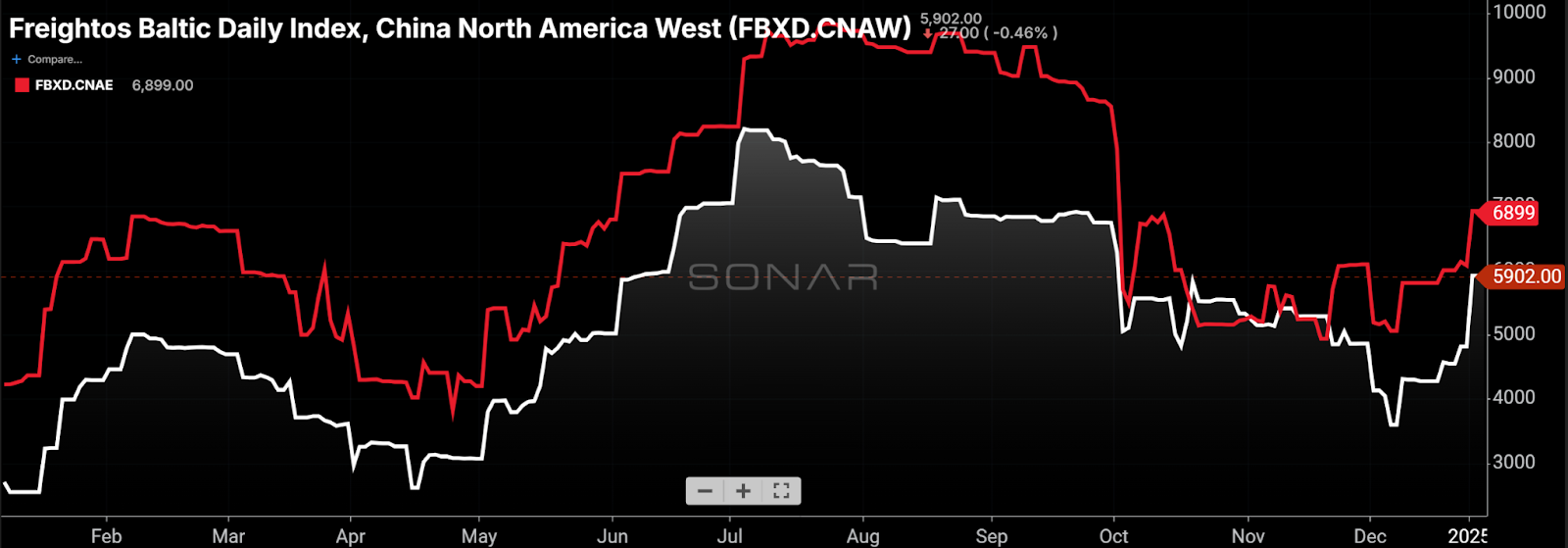
Trans-Pacific eastbound spot rates have risen to start the year. The spot rates to move a 40-foot container from China to the U.S. West Coast and U.S. East Coast are shown in white and red, respectively. (Chart: SONAR)

It stands to reason that containership capacity that is set to come into the industry this year and next – Flexport estimates the added capacity will total 8% and 6% of total capacity in 2025 and 2026, respectively – will put pressure on ocean rates. However, the near-term fundamentals point to higher rates in the immediate term. JP Hampstead describes why in a FreightWaves article. In short, general rate increases took hold at the start of the year combined with a volume pull-forward ahead of Lunar New Year, a potential ILA strike and higher tariffs. Drewry forecasts rates to rise further in the coming week while Freightos expects rates to decline given an expected seasonal demand decrease in late February.

Following the holidays, truckload capacity returns to the market

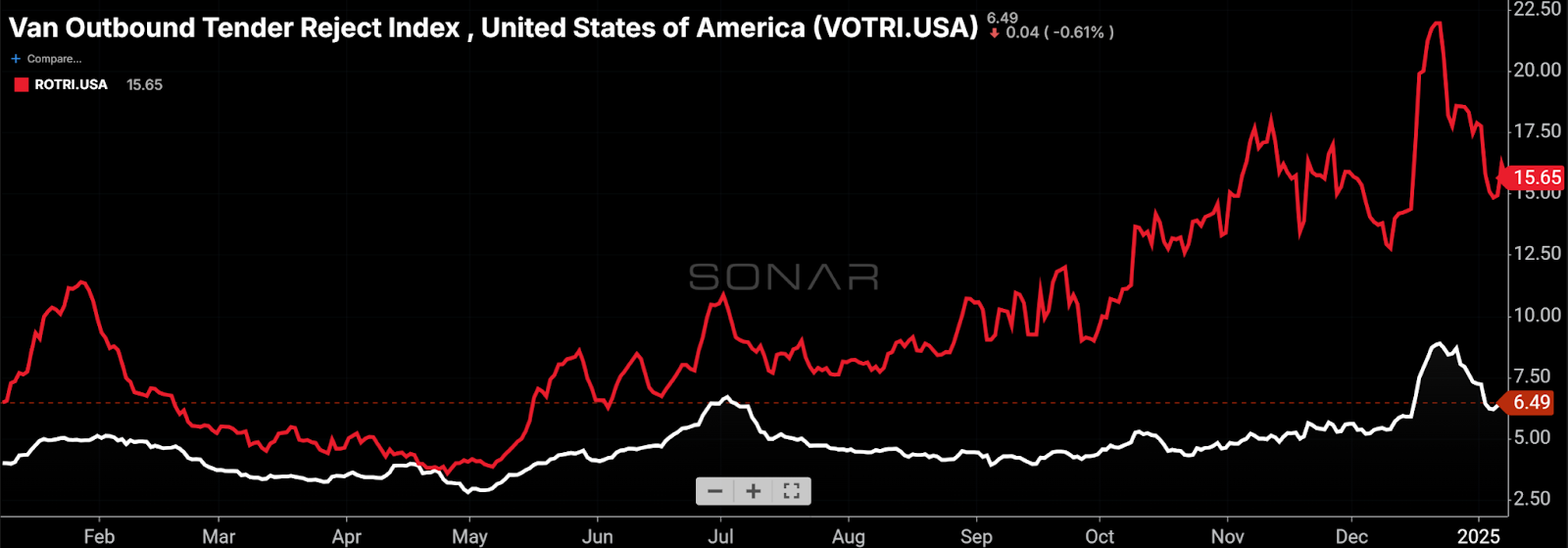
Tender rejection rates for dry van (white) and reefer (red) are ahead of where they were at this time last year but have come down in the past week as capacity returned to the market. (Chart: SONAR)

The freight market still appears to be on track to become meaningfully tighter this year, but not without the impact of normal seasonality during this slow period for demand. As the first full week following the holidays progresses, rejection rates have come down from recent highs but remain higher year over year. The higher tender rejection rates, relative to one year ago, appear to be driven by capacity exiting the market given that tender volume is 7% lower compared to this time last year.

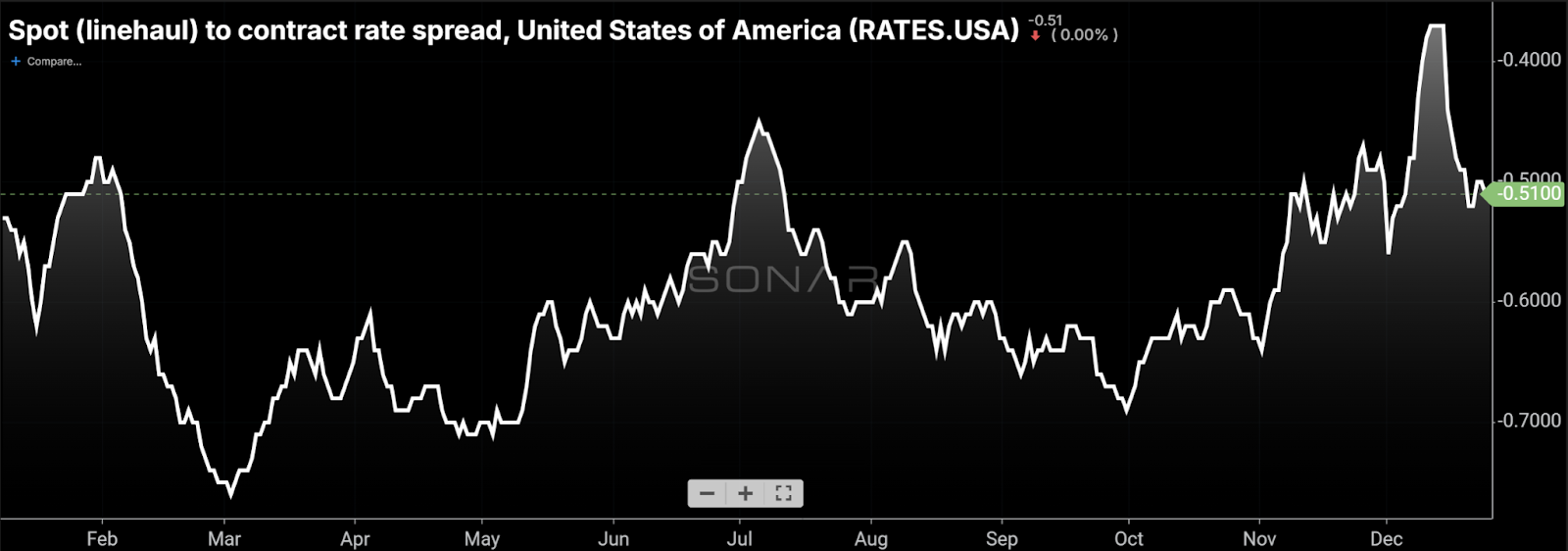
Truckload contract rates are above spot rates, on average, but that spread has narrowed the past few months. (Chart: SONAR) 

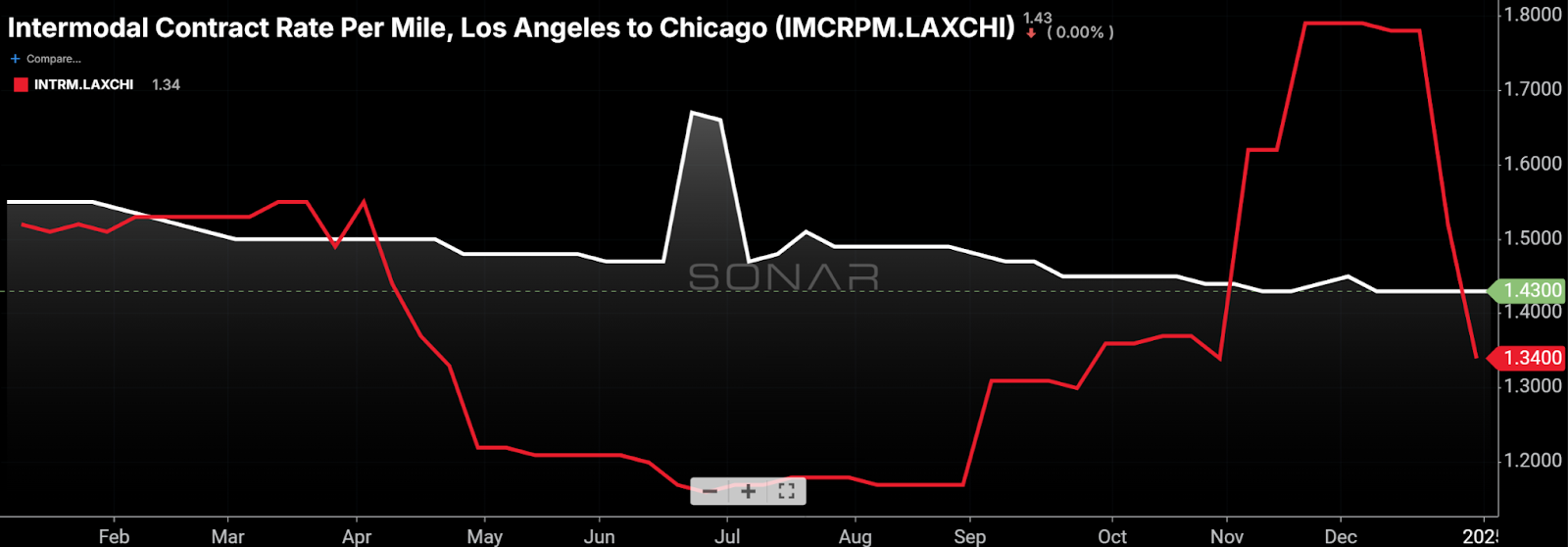
Shippers can still move loads cheaper on the spot market than the contract market – SONAR shows an average difference of 51 cents per mile. But, that spread has narrowed in the past four months from as much as 69 cents a mile in late September, suggesting a market that is on the path toward tightening. In his recent article, Tony Mulvey places the Pricing Power Index at 40, meaning that pricing leverage slightly favors shippers over carriers on a 0-100 scale. Meanwhile, Zach Strickland’s Chart of the Week article argues that there would be additional evidence of a tightening market if not for shippers’ risk mitigation strategies, which include lengthening lead times and improving their inventory management practices. In addition, rail intermodal has taken share from truckload in certain long-haul corridors, especially those outbound from Los Angeles.

Intermodal spot rates have declined from LA to Chicago, the densest intermodal lane, suggesting that carriers are currently unconcerned with protecting capacity for contractual shippers. (Chart: SONAR)

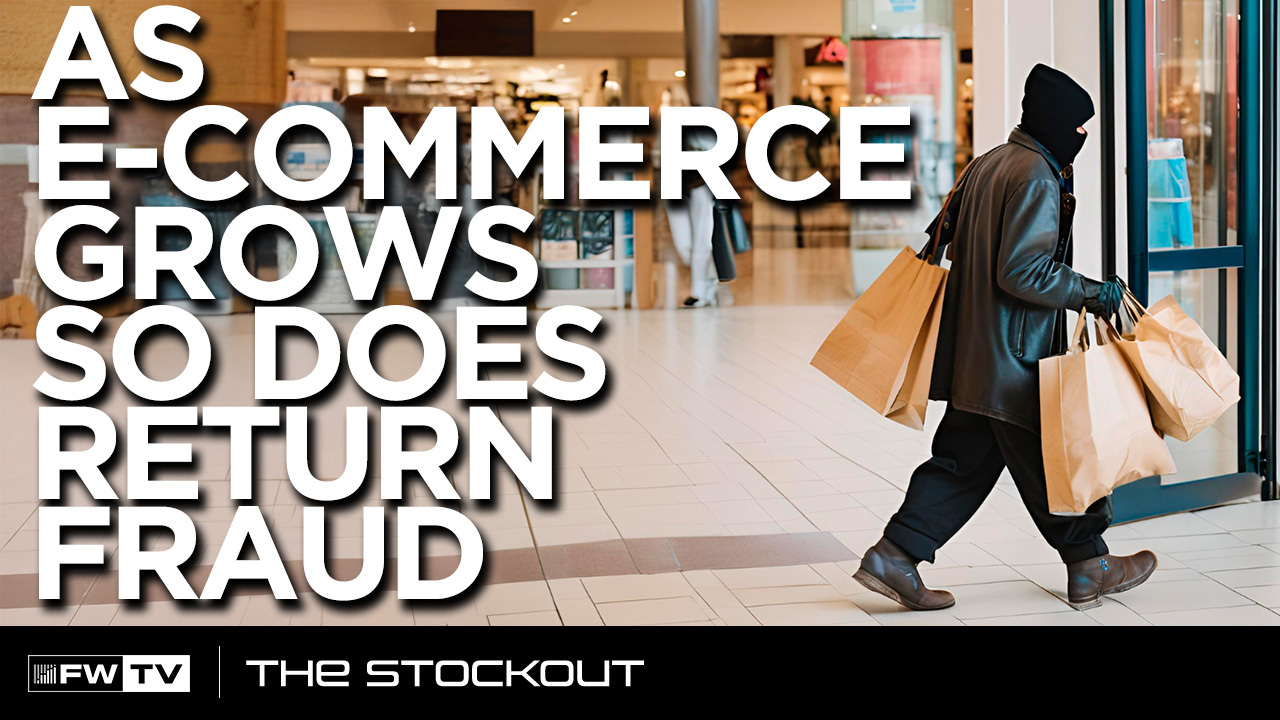
The Stockout show: As e-commerce grows, so does return fraud

(Image: FWTV)

On Monday’s The Stockout show, Grace Sharkey and I tackled the growing issue of fraudulent returns. Even legitimate returns are increasingly a problem as more sellers refund the price of low-value items (say $10 or less) and instruct buyers to keep them rather than incur the cost of processing them and returning them to inventory. As e-commerce grows, so do returns – total returns represent 13% of sales; that breaks down to an 8.7% return rate for in-store purchases and a 24.5% return rate for online sales, according to Retail Dive. Recognizing the cost, retailers are giving consumers a score based on how likely they are to return an item and working behind the scenes to pass the return costs along to consumers.

In addition, a whopping 15% of returns and claims are fraudulent, with schemes that include falsely claiming porch piracy and returning stolen merchandise, among many other devious methods. Retailers lost an estimated $103 billion in 2024 to fraudulent returns, a figure that is expected to grow in the coming years unless there is successful intervention.

Watch The Stockout show here and click here for the full playlist. 
For those who want a steady stream of information on freight fraud, I recommend signing up for Sharkey’s Fraud Watch newsletter here.