Shipbuilder sued by owner, operator of ship in deadly Baltimore bridge collapse 

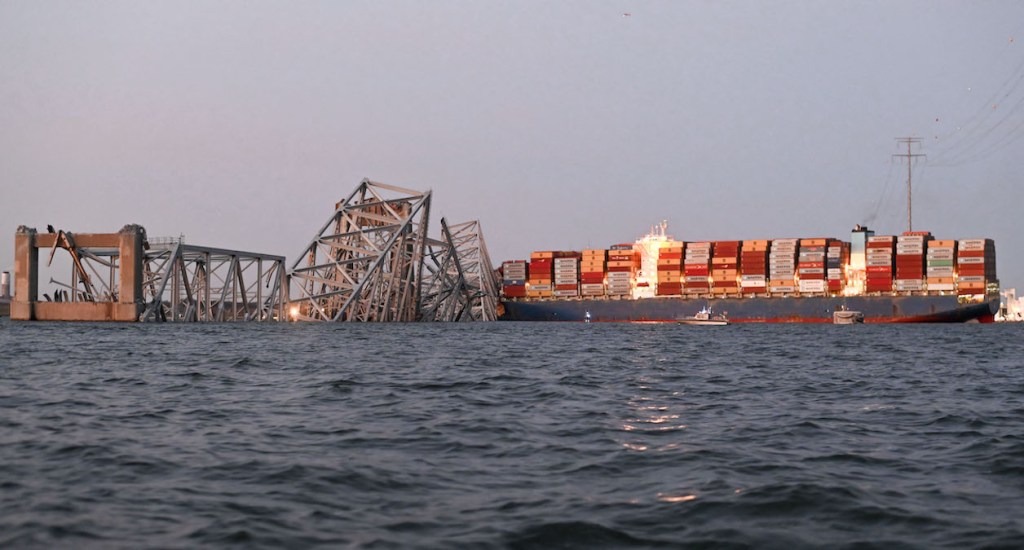
The owner and operator of the container ship involved in a deadly Baltimore bridge collapse in March 2024 are suing the ship’s builder, alleging a defective control panel design caused a power outage that led to the disaster.

The Dali twice lost power as it was departing Baltimore harbor and drifted out of control into a support of the Francis Scott Key Bridge, collapsing the span and killing six highway workers.

The collapse also caused an extended supply chain snarl at the Port of Baltimore, which hosts a major coal terminal and had been the leading U.S. hub for vehicle imports.    

In a lawsuit filed July 31 in the U.S. District Court for the Eastern District of Pennsylvania, owner Grace Ocean Private Limited and operator Synergy Marine Private Limited accused Hyundai Heavy Industries (HHI), the ship’s builder, of negligence that caused the fatal incident.

The plaintiffs charged that a defective design, specifically a loose wire in an electrical switchboard, caused a power outage at 1:25 a.m. the night of the collapse, cutting power to the engine and steering systems.

The National Transportation Safety Board in a 2024 report found that a cable that should have connected to a control for blackout protection was loose. That could have caused the switchboard to lose power without being detected.

Grace Ocean and Synergy Marine have denied wrongdoing since April 2024 but late that same year agreed to pay $102 million for civil claims brought by the federal government and other incident-related costs.

The plaintiffs are seeking damages for vessel repairs and coverage for any third party claims.

Find more articles by Stuart Chirls here.

Related coverage:

China trade fight weakens Matson earnings

Panama ports sales challenge could turn into Trump win

Why a French shipping magnate with US ties is interested in China-owned port terminals 

Rail deal will open new markets for top US container port 

Beleaguered TL carrier Pamt Corp. names new CEO

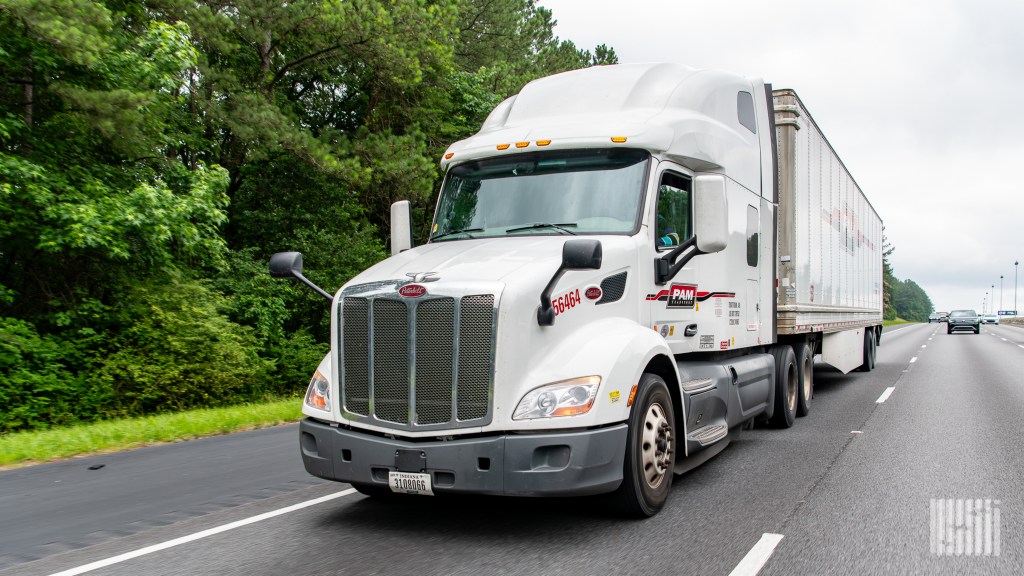
a white Pamt tractor pulling a white Pamt trailer

Pamt Corp., formerly Pam Transportation Services, announced on Monday that Chief Financial Officer Lance Stewart will become president and CEO effectively immediately. Stewart has also been appointed to the company’s board of directors.

The CEO position had been held on an interim basis by Pamt Chairman Matthew Moroun, following former CEO Joe Vitiritto’s departure in June for family reasons. Moroun will continue in his role as chairman.

Excluding a three-year stretch, Stewart has been with the company since 1989, most recently serving as vice president of finance, CFO and treasurer since April 2023.

Daniel Kleine will serve as the carrier’s principal financial and accounting officer effectively immediately until a permanent CFO is named. Kleine has been with the company since 2023, serving as senior vice president of finance at Pam Transport since June.  

Pamt said it is also conducting a national search to find an operations leader.

The Tontitown, Arkansas-based company reported a third consecutive quarterly net loss a week ago, with its TL unit reporting a seventh straight operating loss (a 112.5% operating ratio).

More FreightWaves articles by Todd Maiden:

Future of Clean Truck Partnership now openly pitting OEMs versus environmentalists

The fallout from the ongoing demise of the California Advanced Clean Truck (ACT) rule is picking up more controversy as environmental groups are asking key engine industry companies and their trade group about their plans, and engine manufacturers’ views are starting to become public with the first known statement about the rule’s future from those OEMs.

The deal signed in July 2023 with California by the Engine Manufacturers Association (EMA) pledged that the group’s members, which includes such companies as diesel engine manufacturer Cummins Inc., would abide by the provisions of the ACT in exchange for, in part,  the Golden State easing its then upcoming rules on nitrogen oxide (NOx) emissions and bring them in line with federal standards. The EMA also promised not to file any future litigation against the ACT.

The ACT is a mandate on OEMs to provide California with a rising percentage of zero emission vehicles (ZEVs) stretching into the 2040’s. Sixteen other states have agreed to follow the mandates in the ACT, making it a rule with reach far greater than just California. 

But with the waiver that allowed the ACT to proceed now shelved by Congressional action under the Congressional Review Act (CRA)–though that move is under legal challenge from California–the question has been whether the deal, known as the Clean Truck Partnership (CTP), has any future.

(Coincidentally, a group of intervenors in the California case against the CRA action on Monday requested the litigation in the federal circuit court for the Northern District for California be dismissed. The intervenors are mostly associations of corn growers, whose ethanol markets are threatened by any move to ZEVs.) 

The letter signed by the environmental groups, dated Monday, has no enforcement behind it. But what it did contain was a link to a letter sent by the EMA to the California Air Resources Board that expresses a growing skepticism with the CTP that it signed.

OEMs let CARB know their views

The letter had not been publicized by the EMA; there is no link to it on the organization’s website or statement about its contents. It was sent to CARB as that government agency considered (and ultimately adopted) amendments to its rules in the wake of the Congressional CRA action.

“Over the past several weeks, we the undersigned have grown increasingly concerned by your silence, equivocations, and statements undercutting the validity of the (CTP), an agreement initially championed by your companies,” the letter from the environmental groups said. 

But the EMA has not been completely silent on the issue.The letter it sent to CARB was in connection with the now-approved proposal that involves, among other things, allowing OEMs to pool credits that have been generated by adoption of ZEVs where it has occurred, so that progress toward compliance would not be based just on credits generated in California.

As OEMs are loath to produce two separate lines of vehicles–one to meet the mandates of California and the group of 16, and the other to satisfy the rest of the country–the sheer size of the California market inevitably means its standards become the de facto rules for the country.

But the specifics of the amendments and the EMA’s views of them are less important than what the EMA said about the ACT going forward.

“None of the putative opt-in states has any authority to adopt or attempt to enforce the ACT regulations, as all such state actions have been and remain preempted,” the letter to CARB said. “Accordingly, CARB’s proposal to adopt a credit-pooling option for the opt-in states to use to facilitate their implementation of the ACT regulations is a moot exercise that provides no benefit and has no force or effect in any state. CARB should not adopt such preempted and legally inoperative amendments.”

The EMA then aimed its fire on what it says is the impact of the ACT, even in its now-dormant state. 

Vehicles are there, not selling enough

EMA said its members that produce heavy duty on highway (HDOH) vehicles “have made significant monetary investments in electrified vehicle technology, along with ongoing significant investments in diesel vehicles,” the letter said. The members have promoted the sales of these vehicles, the EMA said, and have met the first requirements in California of the ACT.

“Despite those significant efforts, the demand for ZEV trucks is still minimal, and ZEVs account for only 4% of Class 4-8 trucks, which is less than half of the ACT mandate of 9%,” the letter said.

But echoing another criticism of the uncertainty created by the war over the ACT, the EMA said sales of conventional trucks also have been impacted. “For example, in 2024, new tractor registrations were down by 30% compared to prior years, and there was a 66% reduction in the registration of new current model year Class 4-8 trucks in 2024 compared to 2023,” the EMA wrote in its letter. “The impacts will only get worse if the ACT’s ZEV-sales mandates are allowed to continue to ratchet up year over year.”

Critics of the law have charged that the uncertainty means fleet owners will keep their older vehicles on the road for longer rather than buying a ZEV, resulting in the more polluting model years sticking around longer in a market unclear about the regulatory future.

“For all of the foregoing reasons, before proceeding with its proposed ACT amendments, CARB instead should engage in direct discussions with EMA and its members to address the lack of viability of the ACT regulations as a whole,” the group said in its closing statement.

The environmentalists’ letter was sent not only to the EMA, but also to Cummins (NYSE: CMI), Daimler Truck North America, Ford Motor (NYSE: F), General Motors (NYSE: GM), Hino Motors, Isuzu Technical Center of America,  Navistar (which is now named International Motors under Volkswagen ownership),, PACCAR (NASDAQ: PCAR). Stellantis N.V. and Volvo Group North America.

The move by Congress to override the EPA waiver has “undermined the continuing viability and effect of the CTP,” the letter from the environmental groups said.

The environmental groups told the addressees of the letter that “this is no time for equivocation and backpedalling. The purpose of the Clean Truck Partnership is to provide a clear path forward for industry and the public despite federal policy churn.”

“We ask you to immediately confirm your strong commitment to the Clean Truck Partnership and rescind any statements to the contrary – and to reaffirm your concrete actions serving its goal of creating an affordable and effective path to abundant electric trucks,” the letter said. “We urge you to cease and denounce meritless attacks on the Partnership.”

There are 17 signatories to the letter, including such well-known groups as the Sierra Club and Public Citizen. 

More articles by John Kingston

Averitt pay increase could be a sign of some acceleration in driver wages

Sequential numbers at diversified trucking operator TFI International may mark a turnaround

First legal steps taken, this time by WSTA, to untangle the legal knot of the Clean Truck Partnership

 . 

Trucking, railroads clash over plan to loosen grade-crossing rules

tank truck at railroad crossing

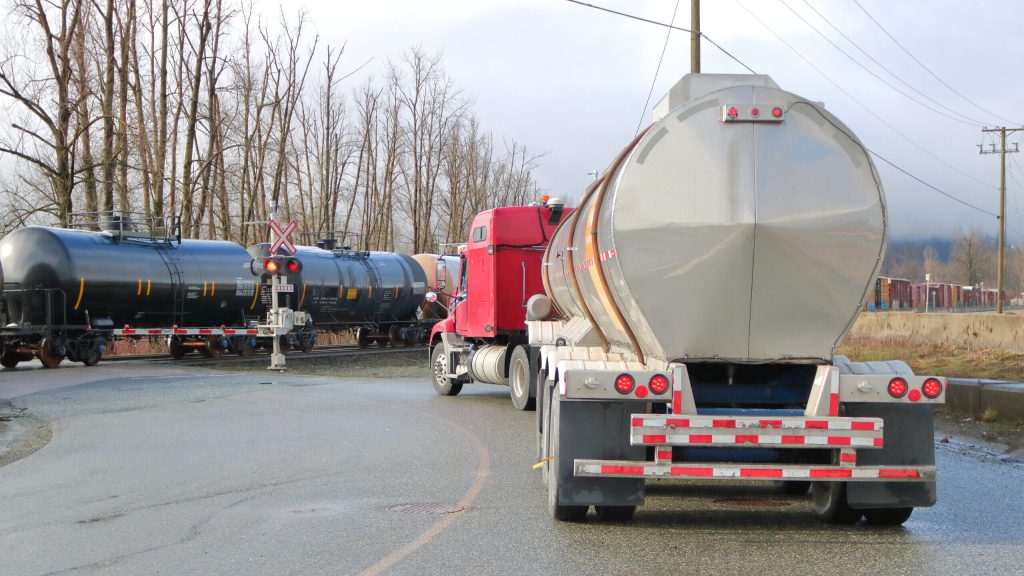
WASHINGTON — The railroad industry is warning that collisions between trains and trucks potentially could increase if regulators allow trucks hauling hazardous materials to drive through certain types of grade crossings without stopping.

Hazmat haulers and passenger buses are currently exempted from stopping at railroad tracks when the crossing is controlled by a functioning highway traffic light with a green signal, or a police officer is directing traffic to proceed through.

If finalized, FMCSA’s proposal – which is supported by the American Trucking Associations and the Owner-Operator Independent Drivers Association – would add a similar exception for rail crossings that have functioning warning devices such as lights and crossing gates but are not activated.

“FMCSA believes it would be appropriate to permit a CMV [commercial motor vehicle] to proceed through an active warning device equipped railroad grade crossing without stopping where the warning device is not in activated state, because local law allows vehicles to proceed across the railroad tracks without slowing or stopping,” the agency stated in the proposed rule.

“This would add an additional exception and therefore reduce the number of required stops” for trucks and buses, it noted.

Like ATA and OOIDA, which highlighted the potential for improved traffic flow, the National Tank Truck Carriers, whose members transport hazardous materials, also supports the proposed rule.

The association pointed out that the likelihood of a collision between a tank truck and a locomotive at grade crossings “is substantially lower than the likelihood of a rear-end collision between a tank truck and another motorist at the same grade crossing” when the truck is stopping or is fully stopped.

“By eliminating unnecessary stops, this reform would prioritize highway safety with the added benefits of delay reduction and congestion mitigation.”

But while there could be cost savings for trucks and other vehicles associated with improved traffic flow, “it does not appear that FMCSA considered the full impact of the change to the railroad industry from increased highway-rail collisions” with trucks and buses that would not have occurred if the vehicle had stopped before attempting to cross the track, wrote the Association of American Railroads and the American Short Line and Regional Railroad Association, in joint comments filed with the agency.

“These costs could be substantial because introducing a change in behavior for some crossings increases the potential for human error.”

They also emphasized that truck drivers approaching highway-rail grade crossing will not always know if the crossing has active warning devices.

“Requiring vehicles to stop provides commercial drivers with extra time to react to unexpected situations, such as a train approaching rapidly around a curve or other vehicles behaving unpredictably around the crossing,” the railroad groups asserted.

The proposal also received pushback from several rail unions, including the Brotherhood of Railroad Signalmen (BRS), which represents workers who install and repair grade crossing signal systems.

“FMCSA’s proposed rule prioritizes speculative data over proven, life-saving practices,” wrote BRS President Michael Baldwin in comments filed with FMCSA. “There is no reliable data supporting the removal of the stop requirement, and a single error, technical or human at a crossing can result in mass fatality events involving children or hazardous materials.”

The Commercial Vehicle Safe Alliance (CVSA), which represents state and local law enforcement, was concerned with the potential for increased crash risk between trucks and trains that the new exception would introduce at grade crossings equipped with active warning devices but are not working properly or are out of order.

Unlike the current exception that gives notice that it is safe to proceed either by a green traffic signal or a human being, “the active warning devices provide notice when it is unsafe to proceed, and there is no active confirmation of safety when those systems are not functional,” CVSA stated.

“Unfortunately, because these CMVs are currently required to stop at grade crossings equipped with active warning devices, there is no readily available crash data related to incidents where a crash occurred due to a malfunctioning warning device.”

Click for more FreightWaves articles by John Gallagher.

China trade fight weakens Matson earnings

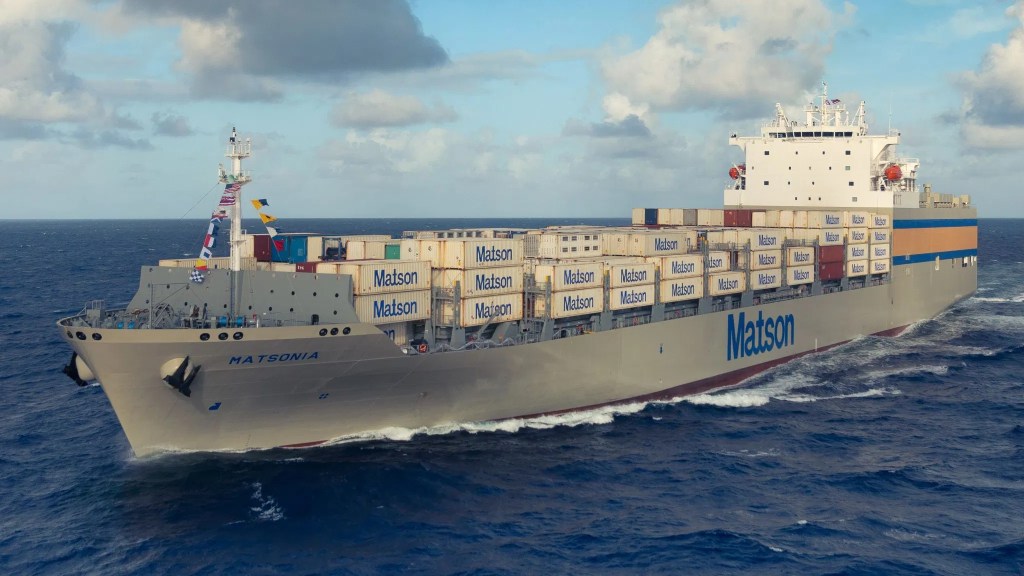
Matson said earnings were hit by U.S. tariffs on China and said that an expected recovery of trans-Pacific trade won’t equal year-ago volumes.

The U.S.-flag carrier (NYSE: MATX) reported revenue for the second quarter ended June 30 totaled $830.5 million compared with $847.4 million for the same period in 2024. Net income fell to $94.7 million, or $2.92 per diluted share, from $113.2 million, or $3.31 per diluted share a year ago.

Operating income was $113.0 million from $124.6 million y/y, while earnings before interest, taxes, depreciation and amortization (EBITDA) declined to $163.6 million versus $171.5 million in the year-ago quarter.

Freight rates were modestly higher in the quarter y/y.

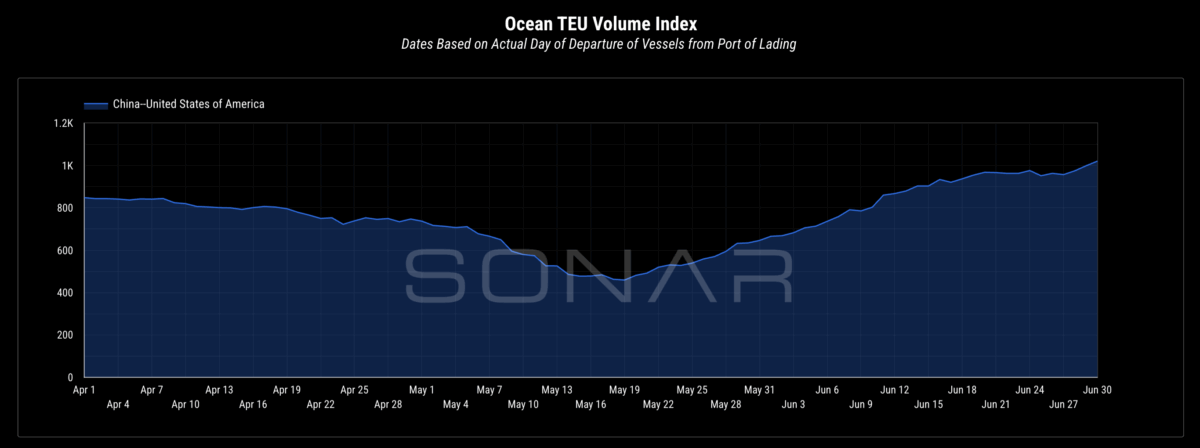
The Honolulu-based company said ocean transportation income was lower year-over-year due to China volumes that fell 14.6%. Demand rebounded following the April tariff pause between China and the U.S., while shifting trade flows boosted container volumes outside of China higher than in the first quarter. 

Hawaii and Alaska volumes were higher y/y.

SONAR chart shows recovery of eastbound China-U.S. container volumes in the second quarter.

Chairman and Chief Executive Matt Cox in a release said that the company was raising its full-year ocean transportation operating income guidance higher than it provided in May, but moderately lower than the level achieved in the prior year. 

Third quarter results are expected to be “meaningfully lower” from a year ago on trade and tariff volatility, as well as the expectation of a “muted” peak shipping season.

Also this week, Matson in a letter to customers said it would no longer ship electric vehicles powered by lithium-ion batteries due to increasing safety concerns. The carrier is an established carrier of roll-on roll-off cargo to Hawaii and Alaska, and hauled 30,000 vehicles in 2024.

Find more articles by Stuart Chirls here.

Related coverage:

Panama ports sales challenge could turn into Trump win

Why a French shipping magnate with US ties is interested in China-owned port terminals 

Rail deal will open new markets for top US container port 

Activist investor may target CSX, citing slumping financial performance

Is Canada Post too big to fail? 

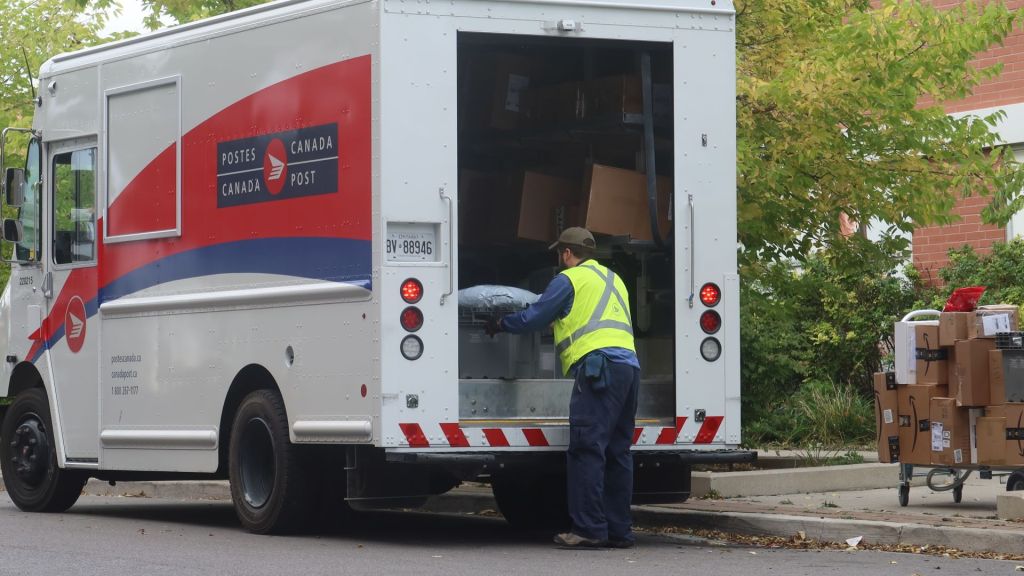
A mailman looking in the open rear door of a red-white-and-blue Canada Post van.

Unionized mail carriers at Canada Post have overwhelmingly voted to reject the company’s latest contract offer, raising questions about the potential for a strike or lockout that could further undermine delivery service and whether the government considers the troubled organization too big to fail.

The result was expected by some experts who said front-line workers feel they have the upper hand because Canada Post is state-owned and has a universal service obligation.  

“The union believes, probably correctly, that at least for the foreseeable future, the government will continue to backstop any losses, so why would you take that offer?” said Eric Miller, president of cross-border government relations consultancy Rideau Potomac Strategy Group and a former industrial policy official in the Canadian government. 

Left unresolved is the core issue of how to run a universal mail service in an age of highly capable private carriers that are taking a bigger share of the nearly $17 billion Canadian parcel market. The government-owned postal operator is looking to a new labor deal as the permission structure for modernizing an outdated business model, with the goal of turning around its finances and improving service for residents and businesses.

Canada Post’s “final” offer was turned down by nearly 70% of Canadian Union of Postal Workers (CUPW) participants in the referendum, according to the Canada Industrial Relations Board on Friday. About 81% of the union’s 55,000 members cast ballots. The offer included a 13% wage hike and better cost-of-living adjustments over four years, but also would have allowed the use of part-time workers Canada Post said are necessary to provide parcel service seven-days a week, as well as more flexibility setting routes and spreading daily loads between mail carriers.

With the rejection of Canada Post’s take-it-or-leave it proposal, Canadians and cross-border shippers face heightened delivery uncertainty as the labor dispute enters its 21st month, yo-yoing in and out of strike risk when service is already slower because of CUPW’s refusal in May to work overtime hours.  

Canada Post, which convinced the Canadian government to impose a vote after CUPW leaders turned down its last proposal, said it is evaluating next steps.

CUPW worked hard to influence a “no” vote.

“It’s time for Canada Post to come back to the bargaining table and start seriously negotiating. With these votes behind us, Canada Post must now recognize that the only way forward is to negotiate ratifiable collective agreements that meet postal workers’ needs. The time for games is over,” CUPW President Jan Simpson said in a statement. “Our negotiators are ready to get back to work right away. We’re committed to staying at the table until we’ve reached a deal. We expect the same from Canada Post. And we’re calling on the government to prove to postal workers that it really respects the collective bargaining process, like it says it does. If the Government truly respects unions and collective bargaining, it will keep out. No more back to work orders. No more forced votes.”

Unions typically see their job as protecting jobs and benefits at all costs, not making employers more competitive. CUPW appears even more emboldened to take a hard line because Canada Post is a quasi-private entity.

“I think the implicit assumption of the union is that when push comes to shove, the government will continue to cover losses at Canada Post. And so they’re focused on trying to maximize their benefits. They want the traditional model with defined benefit pension and wages,” said Miller in a phone interview from his office in Washington.

“The expectation is that rejecting the contract does not lead to long term workforce reductions or any serious consequence, and that the government will ultimately subsidize the losses, so they have no incentive to think critically and strategically [about dealing with market conditions] because they’re focused on their members,” he added. “I think their calculus is right because, ultimately, there likely will be some sort of deal where the union is able to bring more concessions against part time workers and technology.”

Bleeding parcel volumes

A government commission earlier this year said Canada Post, which has lost money for seven consecutive years, faces an “existential crisis” unless it overhauls its delivery model. Canada Post was slow to adapt after email reduced the need to send letters and more private couriers entered the market to support the growth in online shopping. The commission and management say changes to outdated regulatory, policy and labor constraints are also needed if Canada Post is to compete against private parcel carriers and remain self-sufficient. 

Canada Post has lost $2.7 billion since 2018, while its share of the parcel market has since been halved.

Businesses, with fresh memories of a 32-day strike last year, have increasingly migrated to alternative package carriers such as FleetOptics, UniUni, GLS, FedEx and UPS to insulate themselves from a potential service stoppage, according to industry professionals. Canada Post in late May said the unresolved labor bargaining had resulted in a 65% year-over-year decline in parcel volumes. 

Alison Layfield, director of product development at ePost Global, said her customers worry another strike is possible if talks drag out, especially if Canada Post doesn’t return to the bargaining table. CUPW would likely target a strike for the upcoming peak season, when people make online purchases for the holidays and any work stoppage would have the greatest impact on the postal service, she predicted. 

There is also increased risk, Layfield added, that Canada Post could implement a preemptive lockout to further limit operational and financial risk.

ePost Global provides international shipping services for U.S. e-commerce sellers. 

A recent survey by the Canadian Federation of Independent Business showed that a postal strike could push two in three businesses (63%) to permanently abandon Canada Post.

“We’re calling on the government to prevent another strike from happening by extending the current collective bargaining agreement for the foreseeable future. The government also needs to immediately give Canada Post the full authority to make the major reforms needed to ensure it is financially sustainable,” the CFIB said in a statement on Friday. “This will likely require tough decisions, including back-to-work legislation orders. CFIB is calling on all political parties to support the reforms suggested in the Industrial Inquiry report to allow this important service to continue for the long term.”

Layfield said the highly automated Albert Jackson parcel sort facility, which opened two years ago in Toronto with capacity to handle more than 1 million parcels per day, is virtually empty. 

Many shippers are now utilizing six or seven parcel carriers to match the geographic reach of Canada Post, she said. 

Canada Post is hinting that it might reduce rates again to attract large parcel shippers, “but I think they have to prove themselves” on transit times before logistics providers will tender significant volumes again, Layfield told FreightWaves. “The longer Canada Post sits back and is unable to make these network changes, the further behind they’re going to get and it’s going to give those alternative carriers more leverage.”

Miller downplayed prospects that Canada Post might lock out workers to force progress on a collective bargaining agreement because the Canadian government is run by the pro-labor Liberal Party, which wants to avoid labor confrontations. 

“This is what you could call the negative feedback loop where if you can’t make the changes in the overall enterprise, it deteriorates and begins to fall apart. But if you’re the union, your view is, we don’t want to be the ones who bear the brunt of the change even if privately they would admit that the organization could do with some change,” Miller told FreightWaves. “And ultimately, the government could see Canada Post is too big to fail.” 

Click here for more FreightWaves/American Shipper stories by Eric Kulisch.

Write to Eric Kulisch at ekulisch@freightwaves.com.

Canadian government to force union vote on Canada Post contract offer

Canada Post makes ‘final’ offer for labor deal amid growing losses

Prologis sees narrow window before warehouse rents increase

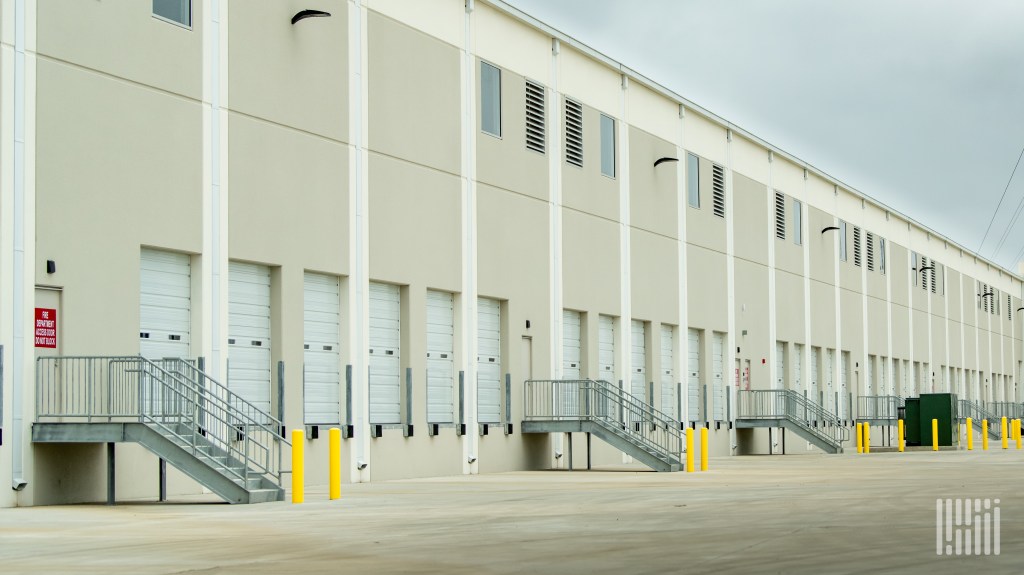
A photo of empty loading docks at a warehouse

Despite navigating weaker demand and uncertainty around trade policy, logistics real estate customers “looked beyond short-term volatility to activate long-term plans” in the second quarter, according to Prologis’ Industrial Business Indicator (IBI) report. While the real estate market remains in flux, indicators like net absorption and new leasing activity improved from the first quarter.

The San Francisco-based real estate investment trust acknowledged that decision making among tenants has been extended given macroeconomic uncertainties, but said buyers in the market looking for space, proposal volumes and signed leases were all up in the period.

Well-capitalized, large-scale tenants are moving forward with the build-to-suit projects that will be required to facilitate their long-term growth plans, the Monday report said. Prologis (NYSE: PLD) noted an uptick in nearshoring and reshoring activity as well as domestic demand from international companies.

“Real-time indicators and direct feedback from users suggest that space needs persist, and that demand is poised to reaccelerate once greater clarity emerges around pricing and broader economic conditions,” the report said.

Leasing activity recovered during May and June, following a slowdown after April’s Liberation Day tariff announcements, according to Prologis.

Warehouse space utilization averaged 85% in the second quarter, a 50 basis-point increase from full-year 2024. The improvement was in part due to some customers pulling forward inventories in response to quickly changing tariff policies. Utilization slid in July, but the report said it was likely due to a sell-through of certain merchandise (temporarily drawing down warehouse inventories) and choppiness in container imports to the U.S.

“We maintain that utilization will be volatile in the near term as shifting trade policies disrupt typical import patterns but generally trend upward as companies grow into any excess capacity.”

The report said supply risk, or overcapacity, in many U.S. markets is now “largely in the past” as speculative development starts have declined by 75% from the peak and second-half warehouse deliveries will be 30% lower year over year.

“This dynamic is creating a short-term window of opportunity for customers,” the report said. “Prime space options are available in select locations, but these are expected to diminish as the pipeline of new deliveries slows and competition for quality product increases.”

The pace of decline in market rents slowed to just 1.4% in the quarter. The change was largely due to price resets in West Coast markets.

The report concluded that long-term structural drivers, like e-commerce growth and the need to modernize operations, remain intact. With new supply falling, the current environment “presents a narrow and time-sensitive window of opportunity for users to secure prime logistics real estate before rents increase.”

According to a separate report, Prologis said nearly $3.2 trillion worth of goods, or 2.9% of the world’s GDP, moved through its warehouses last year. The study was conducted with Oxford Economics and showed Prologis’ 1.3 billion square feet of space contributed $348 billion to the global economy, supporting 3.6 million jobs.

More FreightWaves articles by Todd Maiden:

Panama ports sales challenge could turn into Trump win

Panama’s comptroller general has asked the country’s supreme court to review CK Hutchison’s contract to operate the ports of Balboa and Cristobal.

Hutchison of Hong Kong (0001.HK) operates the maritime centers through its Panama Ports subsidiary as part of an agreement signed in 1997, and extended in 2023 for another 25 years.  

The move comes after Beijing said it could block the $23 billion sale of Hutchison’s 43 marine terminals to U.S.-based investor BlackRock (NYSE: BLK) and Mediterranean Shipping Co. of Switzerland, on anti-trust grounds unless a Chinese business, thought to be state-run shipping giant Cosco, was cut in on the deal.

Panama in the two cases filed July 30 wants the high court to cancel the contract as unconstitutional.

If the agreement is nullified and a new operator solicited, BlackRock, the world’s largest infrastructure fund, could be in line to make a bid to run the ports.

The pact was “unfair” and “abusive,” Comptroller General Anel Flores was quoted as saying. He alleged that Panama Ports Company failed to pay sufficient royalties, and that the extension came without the required authorizations.

“It doesn’t seem correct that in other [parts of the world] there are people negotiating the future of assets that belong to us, the Panamanians,” Flores said, referring to Cosco’s potential involvement.

Flores kicked off Panama’s port fight after President Donald Trump in his January inauguration speech promised to take back control from what he said was China’s influence over the Panama Canal. The same day Flores said he would open an audit of Panama Ports Company.

The sale of CK Hutchinson’s ports unit, Hutchison Port Holdings, has been on hold since July 27, when an exclusive negotiating period with BlackRock ended. Two days later, French shipping conglomerate CMA CGM of France, which operates global container terminals including in the U.S., expressed interest in the business.  

Kenco celebrates 75 years in 3PL

Third-party logistics provider Kenco Group recognized a milestone of 75 years of business with a celebration at its headquarters in Chattanooga, Tennessee, on Friday.

According to a news release from the company, the event featured remarks from CEO Denis Reilly and other executives.

“Only about 3% of family-owned businesses make it to their 75th anniversary,” Reilly said during the event. “It’s a powerful testament to our resilience, our values and our ability to

adapt and lead through change.”

Founded as Cherokee Warehouses in 1950, the company was renamed to Kenco in 1979. Today the company’s team of over 7,500 employees at 140 locations across North America help provide integrated logistics solutions to major brands around the world.

In May, Kenco expanded into Canada with four warehouse locations after acquiring the 3PL arm of Drexel Industries.

Kenco offers distribution, eCommerce fulfillment, comprehensive transportation management, material handling equipment services and customized supply chain solutions. The company serves as an economic cornerstone to its home city of Chattanooga, where 800 of its employees are located.

“Kenco’s focus is to support customers’ business needs and redefine third-party logistics by offering innovative, connected solutions,” the release stated.

Federal Drug Hair Test Battle Rages On

The trucking industry’s decade-long push for hair follicle drug testing is reaching a critical inflection point as the Trump administration prepares to address guidelines that have been delayed repeatedly since 2015, with the controversy now exposing deeper divisions over safety, discrimination, and regulatory authority that could reshape driver screening practices industry-wide.

Major carriers including Schneider National, J.B. Hunt Transport, and Knight-Swift Transportation have spent years lobbying federal regulators to expand drug testing beyond traditional urine screens to include hair follicle analysis, which they say catches 10 times more drug users. But the initiative faces fierce opposition from minority groups, independent truckers, and civil rights advocates who claim the testing methods are discriminatory and could sideline thousands of drivers based on flawed science.

The controversy has stalled federal action since the FAST Act mandated hair testing guidelines in 2015. Initially scheduled for release in 2022, the guidelines have been pushed back repeatedly and were most recently delayed until May 2025, according to federal regulatory schedules. Now, with the Trump administration in office and mounting congressional pressure, industry observers expect movement on the issue before year-end.

Congressional Pressure Intensifies Under Trump Administration

The regulatory gridlock has attracted significant congressional attention. Earlier this year, the House Appropriations Committee approved fiscal year 2025 legislation directing the Department of Health and Human Services to publish revised guidelines, with lawmakers explicitly criticizing federal inaction.

The Trump administration’s approach to the issue remains unclear. Still, industry sources expect more aggressive action than previous administrations given the president’s stated support for strengthening drug enforcement and reducing regulatory delays. The timing coincides with the administration’s broader push to streamline federal regulatory processes and address what supporters call bureaucratic inertia on critical safety issues.

At Knight-Swift alone, hair testing rejected 7,159 driver applicants who passed urine tests, according to company data. J.B. Hunt reported that since implementing hair testing in 2006, the company has identified 3,200 applicants with drugs in their systems, including 1,700 who tested positive for cocaine. But opponents argue the numbers don’t tell the whole story.

“Many individuals have never driven under the influence of any drugs or alcohol, but because a hair test may show traces of a drug like marijuana for weeks, it makes them an ‘abuser’ and greatly inhibits their ability to earn a living,” said Todd Spencer, president of the Owner-Operator Independent Drivers Association. “This is unjust.”

Opponents argue the numbers don’t tell the whole story, particularly as legal marijuana use in multiple states complicates the testing landscape.

Discrimination Claims Complicate 2025 Push

The testing controversy has spawned multiple discrimination lawsuits and federal complaints, with minority groups claiming hair follicle tests produce disproportionate false positives based on hair color and texture. These concerns have intensified as the Trump administration considers action.

J.B. Hunt paid $260,000 in 2016 to settle an Equal Employment Opportunity Commission complaint after the company refused to hire Sikh drivers who couldn’t provide hair samples for religious reasons. The EEOC found the company failed to accommodate religious beliefs and effectively discriminated based on race, national origin, and religion.

In Boston, eight African American police officers sued after testing positive for cocaine in hair follicle tests, with department statistics showing vastly different favorable rates by race. Over seven years, 55 of 4,222 Black officers tested positive compared to 30 of 10,835 white officers, a statistical disparity the court said “cannot be attributed to chance alone.”

The Sikh Coalition and North American Punjabi Trucking Association have formally opposed federal hair testing proposals, noting that Sikhs represent “tens of thousands” of U.S. truckers and maintain uncut hair as a religious practice.

“Sikhs, Punjabis and other South Asians typically have brown or black hair, and are already disproportionately subject to high rates of bias such as employment discrimination and hate crimes,” the groups wrote in federal comments. “Our organizations cannot support initiatives that potentially subject our already vulnerable communities to a greater likelihood of discrimination.”

Current Regulatory Stalemate Faces 2025 Pressure

The standoff has created an unusual situation where large carriers operate under different testing standards than smaller companies. Major carriers routinely use hair testing for hiring decisions. Still, they cannot report positive results to federal databases or share them with other companies, effectively creating a private screening system unavailable to smaller operators.

As of August 2025, positive hair test results still cannot be entered into the FMCSA’s Drug and Alcohol Clearinghouse, meaning drivers who fail hair tests at major carriers can still find work elsewhere. The clearinghouse has recorded more than 181,000 violations since its 2020 launch, with 82% involving positive drug tests, but none from hair testing results.

The regulatory paralysis stems from jurisdictional disputes between agencies. The FMCSA continues to assert it lacks authority to approve hair testing and has repeatedly deferred to the Department of Health and Human Services, which has been evaluating hair testing protocols for nearly a decade without final action.

Industry legal experts note that the Trump administration’s more aggressive regulatory approach could break the deadlock through executive action or direct pressure on HHS to expedite the guidelines that have been delayed since 2015.

“FMCSA doesn’t question the merits of hair testing, only that it does not yet have the authority to grant the application,” said Lane Kidd, managing director of the Trucking Alliance.

Industry Stakes Rise as 2025 Deadline Approaches

The controversy has exposed sharp divisions within trucking over testing costs, effectiveness, and fairness, with implications that extend far beyond drug screening policies. Large carriers argue hair testing is essential for safety and liability protection, while smaller operators worry about increased costs and regulatory burden that could worsen the persistent driver shortage.

The National Minority Trucking Association reports that 1.5 million of the nation’s 3.5 million truck drivers are minorities, amplifying concerns about discriminatory impacts as federal action appears increasingly likely under the current administration.

Small carriers and independent operators have largely opposed expanded hair testing, citing costs that can reach several hundred dollars per test compared to roughly $50 for urine screening. The Owner-Operator Independent Drivers Association argues that expanded testing would create “opportunities for employment discrimination for drivers that refuse to submit hair samples, whether it be for faith-based or other medical reasons.”

Meanwhile, insurance companies and safety advocates have increasingly embraced hair testing as a risk management tool. The Independent Contractors and Small Business Association now requires hair testing for drivers to qualify for its group insurance programs, calling it a “best practice” that helps reduce claims and litigation risk.

Congressional Pressure Builds

The delays have frustrated lawmakers who mandated hair testing guidelines as part of the 2015 FAST Act. The House Appropriations Committee approved language this year directing HHS to publish revised guidelines, noting that federal inaction has “denied Americans a legitimate tool to stem the crisis” of substance abuse.

“Since the FAST Act was signed into law, our nation has experienced a crippling substance use epidemic, particularly from opioids and synthetic opioids,” the committee report states.

The Trucking Alliance says it will “continue to press the issue” despite repeated federal rejections, arguing that thousands of drug-using drivers remain on highways because of regulatory inaction.

Critics counter that rushing to implement hair testing without resolving discrimination concerns could worsen the driver shortage and unfairly impact minority communities already facing employment barriers.

As the industry awaits federal action, the controversy continues to expose fundamental tensions over how to balance highway safety, regulatory authority, and civil rights in an industry critical to the nation’s supply chain. With guidelines now delayed until 2025, resolution appears unlikely before the presidential election, which may potentially reshuffle regulatory priorities once again.

The stakes extend beyond trucking. Hair follicle testing debates are emerging across transportation sectors, from aviation to rail, as regulators grapple with evolving drug detection technology and growing awareness of potential discriminatory impacts. How the trucking industry resolves this controversy may set precedents for drug testing policies across critical infrastructure sectors.