




The Ringold, Oklahoma Post Office serves ZIP Code 74754. Photo by Jimmy Emerson, some rights reserved. Photo shared under the Creative Commons License.
Ringold Post Office
23112 State Hwy 3
Ringold, OK 74754
Location at Google Maps

The Ringold, Oklahoma Post Office serves ZIP Code 74754. Photo by Jimmy Emerson, some rights reserved. Photo shared under the Creative Commons License.
Ringold Post Office
23112 State Hwy 3
Ringold, OK 74754
Location at Google Maps

Borderlands is a weekly rundown of developments in the world of United States-Mexico cross-border trucking and trade. This week: ITS Logistics is making big moves in the Lone Star State; Lineage Logistics opens a cold chain logistics center in Houston; a metal recycling firm acquires a 55-acre tract at a logistics park; and TQL opens a new brokerage office in Arizona.
ITS Logistics recently opened a $100 million logistics facility in Texas aimed at creating a distribution and fulfillment service across the U.S.
The 1.1 million-square-foot facility is located in Fort Worth at the Intermodal Logistics Center, a development adjacent to BNSF Railway’s Alliance Intermodal Facility and also in close proximity to FedEx and UPS regional hubs, Fort Worth Alliance Airport and Interstate 35.
“The Dallas-Fort Worth center is a big one and … we’re starting a heavy-haul special projects division that’s going to focus on cross-border, really heavy industry freight that supports oil and gas, aerospace and manufacturing that’s going to be spearheaded through Houston,” Paul Brashier, vice president of drayage and intermodal at ITS Logistics, told FreightWaves. “We’re going to start really building out that triangle from Houston to Dallas, down to Austin, San Antonio, back to Houston.”
Reno, Nevada-based ITS Logistics is a 3PL providing supply chain solutions across the U.S. The company offers logistics and warehouse services, as well as commercial trucking transportation.
The Fort Worth facility is ITS’ first logistics facility in Texas and, combined with the company’s existing facilities in Reno and Indianapolis, will support efforts to offer national fulfillment services to 95% of the U.S. population in three days or less.
The new space features 40-foot clear heights, 200-plus dock doors and parking for 211 trailers. It also allows ITS to add regional trucking operations, including dedicated contract services, drayage, linehaul and expedited.
Brashier said increasing freight flows at ports along the Gulf of Mexico is another reason for the new logistics facility in Fort Worth.
“If you look just at what’s going on in Texas through Port Houston, and some of the other Gulf Coast ports, it’s the reason that we’re shifting focus there,” Brashier said. “We’re also starting to focus on cross-border. Mexico is now the U.S.’ largest trading partner, larger than China.”
ITS Logistics recently issued its monthly U.S. port/rail ramp freight index on port container and drayage operations for the Pacific, Atlantic and Gulf coasts for November.
For the first time in the history of the index, all modes across all regions are at normal operations, ITS Logistics said.
“As the good news arrives just in time for the holidays, shippers and carriers should continue closely following the choke points at the Suez and Panama Canals as water conditions worsen and the current conflict between Israel and Gaza continues,” according to the index.
Brashier said water levels in the Panama Canal are limiting the amount of cargo that can be transported, while unrest in the Middle East also has the potential to affect vessel flow through the Suez Canal.
The ongoing freight recession is also causing many carriers to offer rates under their operations cost, which will cause more trucking companies and owner-operators to exit the market in the coming months, Brashier said.
“The largest concern there is that you’re seeing that these exits are not just in the dray space. You’ve seen Yellow go down, Convoy. … You’re seeing the canaries in the coal mine,” Brashier said. “It’s adversely affecting the small to medium-sized carriers a lot more.”
Brashier also said shippers should be wary of just looking for the cheapest freight transportation providers in the market.
“If you’re going to the RFP right now, you’re going to get cheap capacity [that is] in many cases, 75% to 65% rate reductions on lanes year over year,” Brashier said. “So you’re going to get the savings that you want, but it’s also a call out to what are you buying? The thing that we always tend to be mindful of and communicate back to our clients and those in this ecosystem is, how financially healthy are those providers?
When rates bottom out, many providers are operating at a loss on a rate per mile, which is bad for the overall freight industry.
“As long as rates stay there, you’re going to start seeing a lot of the folks that probably provided some really super-low rates start kind of washing out, they won’t be able to maintain those rates,” Brashier said. “Make sure that you have strong relationships and folks that you have a long-standing business relationship with, keeping them in network.
“It’s a very difficult balance for shippers, but taking in the fiscal health of the carrier base and hedging and just bringing more carriers on if you’re not 100% sure on some of your current carriers is a smart decision, we feel, as you go into uncharted waters in 2024.”
Lineage Logistics announced the opening of a 315,000-square-foot temperature-controlled logistics facility in Houston, its sixth facility in the area.
Known as the Houston ColdPort facility, it’s located near the Jacintoport Terminal at Port Houston and offers integrated transportation and drayage operations to support import and export demand.
“[Houston] has recently seen a surge in port demand amid congestion and other issues at the big ports on the West Coast,” Brian Beattie, Lineage president of North American West, said in a news release. “By adding ColdPort to our Houston network, Lineage’s customers have another option to help manage their costs and increase productivity.”
The addition expands Lineage’s footprint in Texas to 20 facilities totaling more than 192 million cubic feet of capacity. Lineage also recently opened a cold storage facility in Lancaster, near Dallas.
Novi, Michigan-based Lineage Logistics operates more than 400 facilities on three continents, employing 17,000 workers.
OmniSource LLC, a subsidiary of Steel Dynamics Inc., has acquired a 55-acre, rail-served tract at the Gulf Inland Logistics Park to expand its metals recycling operations.
Gulf Inland Logistics Park is located in Dayton, Texas, about 37 miles northeast of Houston. The logistics park totals 2,400 acres and aims to provide manufacturing, distribution, rail services, storage and transportation capabilities for companies in the Gulf Coast region.
“Gulf Inland Logistics Park’s strategic proximity to Houston and its direct connectivity to key road and rail networks make it the perfect site for our latest metals recycling facility,” Miguel Alvarez, president at OmniSource, said in a news release. “The opportunity to begin operations in 2024 will empower us to quickly enhance our capacity to cater to our customers’ demands and significantly extend our footprint throughout the southern U.S.”
OmniSource operates around 70 scrap collection and processing facilities in the U.S. and Mexico. Its parent company, Steel Dynamics, opened a 1.2 million-square-foot flat roll steel mill about 226 miles south in Sinton, Texas, in 2022.
Total Quality Logistics (TQL) recently opened a brokerage office in Tucson, Arizona, which reinforces its investment across the region, officials said.
“We chose Tucson because it is a major transportation hub and has a great pool of talent,” TQL President Kerry Byrne said in a news release.
The company opened its Phoenix office in 2016 and currently employs 100 people at the location. Tucson is the company’s 57th location nationwide.
Cincinnati-based TQL is one of the largest logistics firms in North America, with more than 9,000 employees in 56 offices across the U.S.
Click for more FreightWaves articles by Noi Mahoney.
More articles by Noi Mahoney
Houston may restrict cargo truck movements inside city limits
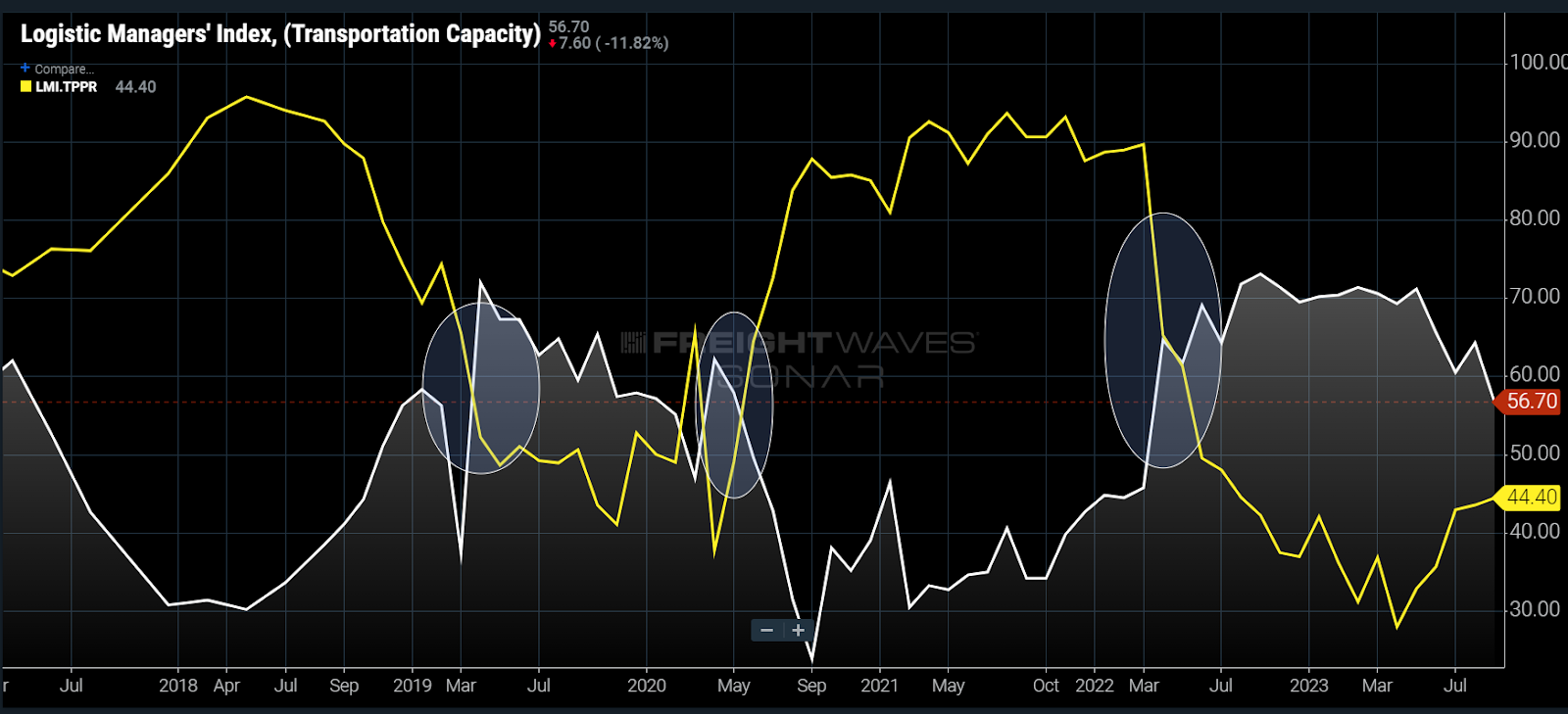
Chart of the Week: Logistics Managers’ Index – Transportation Capacity, Transportation Prices SONAR: LMI.TPCP, LMI.TPPR
When the Logistics Managers’ Index (LMI) transportation capacity component falls below the transportation price figure, capacity is relatively tight. When the inverse is true, capacity is generally loose. The past few months are trending toward another flip that may suggest equilibrium of supply and demand is closer than we thought in the transportation market.
The LMI has proven to be very accurate in describing domestic transportation market conditions over the past several years. In the generally soft 2019 market, the price index was below the capacity index. In June 2020, the two components flipped and remained in strong opposition until March 2022.
The LMI is a diffusion index based on surveys of more than 300 supply chain professionals measuring various components of the transportation and logistics space. Values above 50 indicate expansion, while sub-50 readings are indicative of contraction.
The most recent October reading for prices was 44.4, indicating that prices were contracting but at a much slower pace than the 28 that was printed in April. The October capacity value was 56.7, which was down significantly from the 71 that occurred in May.
As you can tell, over the past five years, there has been little balance in the transportation markets, moving violently from very tight to very loose. COVID can be blamed for most of this. The 2017-18 market was also very tight but was considered a “black swan” type of environment at the time.
The reality is that the economic stability (or stagnation depending on your perspective) of the post-2009 recession may have been the real anomaly. Economically speaking, there are more questions than answers and that will keep companies on edge and more prone to erratic behavior — especially in shipping.
In this past week’s Freightonomics, Zac Rogers, assistant professor of supply chain management at Colorado State University and contributor to the LMI, talked about how shippers have reverted to more of a just-in-time pattern of shipping as demand remains uncertain and warehousing costs have increased.
He also cited how Yellow’s exit has seemingly helped accelerate the perception of a decline in available capacity and propped prices at higher levels. One thing that isn’t clear is to what scale this is occurring.
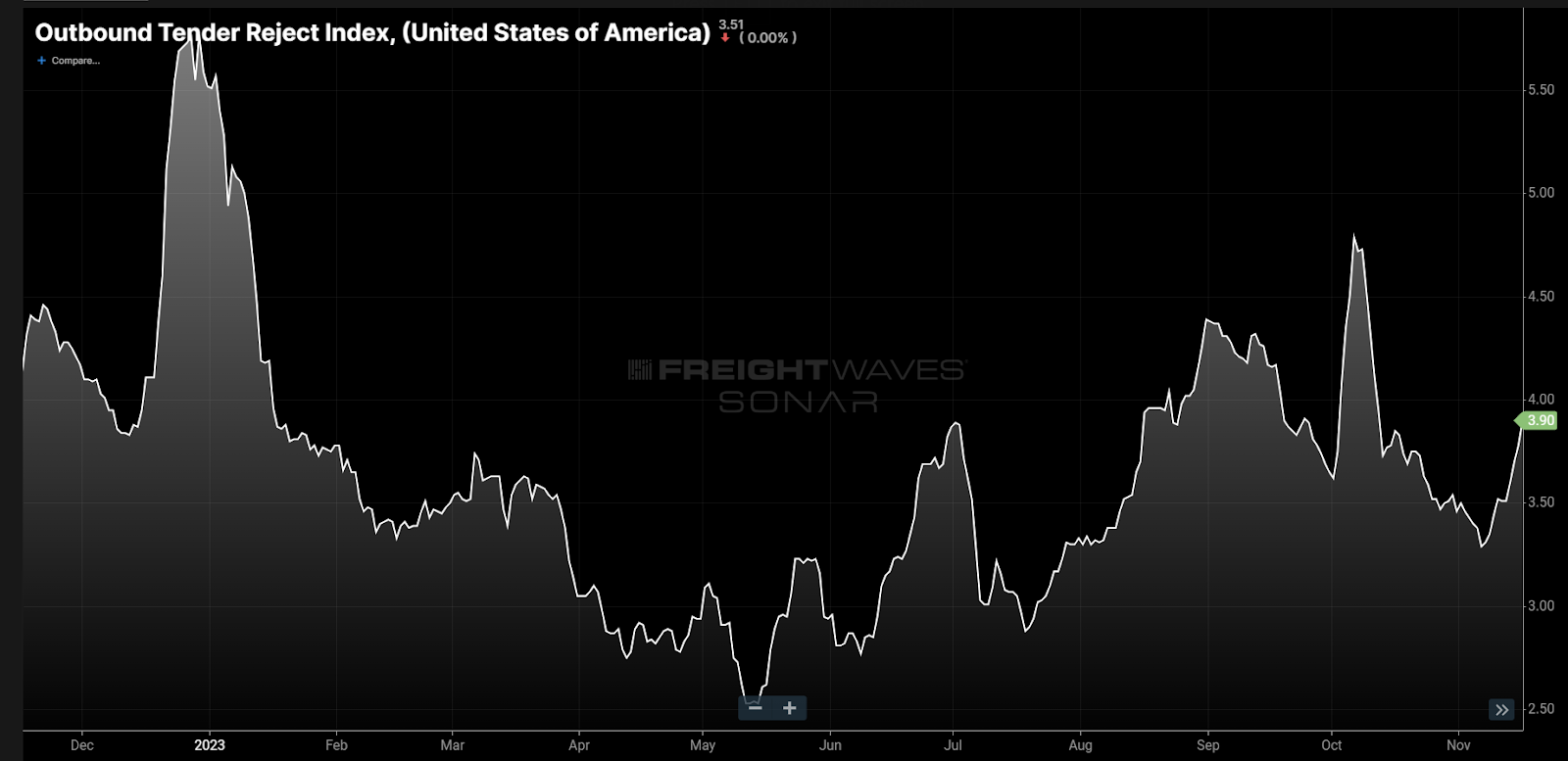
Tender rejection rates, which measure the rate carriers reject or turn down requests for truckload capacity from their customers, bottomed in May as well and have been trending higher since then — suggesting the correlation between Yellow’s exit could be spurious to some extent.
Regardless of the reasoning, there are multiple data sources painting the same picture. Capacity is tightening, though still not enough to generate disruption — yet. The larger question remains around just when will freight market participants feel some noticeable and more consistent service disruptions.
Caveats are always a thing
Possibly the most uncertain aspect of predicting a freight market turn is the underlying economics. The advance release of the Q3 GDP produced one of the most disconnected values in recent history in terms of economic perception.
The 4.9% quarterly growth figure seemed somewhat unbelievable in the context that it would normally be considered a value that is indicative of an economic boom. But the Federal Reserve economists seemingly dismissed the figure and consumer confidence declined.
The consumer spending that fed the figure has become increasingly leveraged with credit card debt and the labor market is showing signs of weakening as people are having increasing difficulties finding employment as continued claims have hit their highest values since late 2021.
In the near-term future, the gap between the two LMI figures may reverse course over the winter if traditional seasonality returns. January and February tend to be the slowest months of the year for shipping. This would push demand down, widening the gap between the capacity ceiling temporarily.
The gap between the LMI capacity and price figures has shrunk from 41 to 12 over a five-month period. The sheer momentum suggests we may be closer to a market flip than we think, but the longest yard is always the last one.
The FreightWaves Chart of the Week is a chart selection from SONAR that provides an interesting data point to describe the state of the freight markets. A chart is chosen from thousands of potential charts on SONAR to help participants visualize the freight market in real time. Each week a Market Expert will post a chart, along with commentary, live on the front page. After that, the Chart of the Week will be archived on FreightWaves.com for future reference.
SONAR aggregates data from hundreds of sources, presenting the data in charts and maps and providing commentary on what freight market experts want to know about the industry in real time.
The FreightWaves data science and product teams are releasing new datasets each week and enhancing the client experience.
To request a SONAR demo, click here.

Nikola Corp. Chief Financial Officer Stasy Pasterick is leaving the role after just six months, the third senior leader to depart the beleaguered electric truck maker since August.
CEO Michael Lohscheller and Nikola President of Energy Carey Mendes both quit in August.
Pasterick worked at Nikola under former CFO Kim Brady, who retired in April. She was on the team that led Nikola public via a reverse merger with special purpose acquisition company VectoIQ in June 2020.
Nikola filed an 8-K announcing her departure with the Securities and Exchange Commission on Friday. The filing said Pasterick submitted her resignation on Monday. She remains in the CFO role until Dec. 1. Nikola said it “expects to conclude a search for a replacement in short order.”
Pasterick is joining startup Universal Hydrogen as its first CFO, the company announced Monday. Universal Hydrogen has raised more than $100 million toward its goal of fueling regional airlines by zero-emission hydrogen.
Former General Motors Vice Chairman Steve Girsky, who led the SPAC merger as VectoIQ managing director and served for three years as chairman, became the company’s fourth CEO in four years in August. He will oversee financial affairs until the naming of a new CFO.
In September, Girsky hired Mary Chan, another former GM executive and a colleague from VectoIQ, as Nikola’s first chief operating officer. Chan’s hiring and the elevation of board member Steve Schindler to chairman put the key players in the SPAC in charge from the boardroom to the factory. Schindler is CFO of VectoIQ.
Nikola faces a range of financial challenges as it launches fuel cell electric trucks this quarter. Cash is tight. The company’s stock price closed Friday at $1.04, and Nikola is footing the entire $61.8 million cost of recalling fire-prone battery-electric trucks. The company expects to begin returning repaired trucks to customers in the first quarter.
Nikola lost $425.8 million, or 50 cents a share, in the third quarter. That compared to a loss of $236.2 million, or 54 cents, a year ago. However, following the recent doubling of authorized shares, Nikola had 857.2 million outstanding shares compared to 438.4 million a year ago.
The company improved its cash and equivalents to $362.8 million, mostly through the sales of new equity. The money is sufficient to cover the recall expense and run the business into 2024, Pasterick told analysts on a Nov. 2 call.
Nikola said in a government filing in February that it may run out of money in the next 12 months and have to “modify or terminate” its business.
Editor’s note: Updates with Pasterick joining Universal Hydrogen as its first CFO.
Nikola electric truck recall price tag $61.8 million
Latest hire puts Nikola’s SPAC sponsors in full control

The Port of Savannah experienced its fourth-busiest October last month, the Georgia Ports Authority said Friday.
The port handled 449,000 twenty-foot equivalent container units last month, GPA said. Although that is down 22% from October 2022, last month’s volumes were 5% higher than pre-pandemic October 2019.
Contributing to the volume increase was the fact that the berths at the Garden City Terminal are now all open, increasing the Port of Savannah’s capacity to handle ships. The port can now host 35 weekly vessel calls, according to GPA.
The Port of Savannah’s Garden City Terminal handled 129 container ship calls in October, which GPA says is 26% higher than in October 2022.
“For the first time in two and a half years, all berths are open at Garden City Terminal for faster, more efficient cargo handling,” GPA President and CEO Griff Lynch said in a release.
At Garden City Terminal, containers moved by rail rose by 9% to 47,750, while at the inland Appalachian Regional Port in Crandall, Georgia, rail cargo increased by 22% year over year, making a record October for that facility.
Since the start of GPA’s 2024 fiscal year on July 1, the Port of Savannah has handled 18% fewer volumes than in the same period in 2023, which had been “some of the busiest months in GPA history,” GPA said. Volume handled fiscal year to date through October was 1.7 million TEUs.
Meanwhile, roll-on/roll-off (Ro/Ro) cargo in October was down on a year-to-year basis but up fiscal year to date. GPA handled 67,500 units of autos and machinery last month, a 5.8% decrease from October 2022. But looking at volumes on a fiscal year-to-date basis, volumes were up 17% to 271,364 Ro/Ro units.
Subscribe to FreightWaves’ e-newsletters and get the latest insights on freight right in your inbox.
Click here for more FreightWaves articles by Joanna Marsh.
Ancora Holdings Group, an activist investor in Forward Air, says Omni Logistics is “seeking to intimidate and threaten” it by “sending legal missives to the firm.” The alleged actions stem from the investment firm’s public criticism of a $3.2 billion merger proposal between the companies.
An open letter from Ancora to Omni released Thursday evening reiterated complaints the firm previously voiced about the deal but also alleged Omni has made “efforts to suppress opposition” to the transaction.
“We believe Omni’s response of unleashing an army of aggressive law firms on a top shareholder of Forward Air for vocalizing our concerns is not only shameful, but telling of the desperate state Omni finds itself in today,” Ancora said.
“Subpoenas and document requests from your counsel, Wachtell, Lipton, Rosen & Katz (“Wachtell”), will not deter us from continuing to vocalize our views as to why terminating the prospective deal with Omni is both a logical and necessary step at this time.”
A separate Forward (NASDAQ: FWRD) shareholder group was able to temporarily block the transaction at the end of September while a Tennessee court contemplated a more permanent injunctive action that could potentially allow a court to determine if shareholders should be allowed to vote on the deal. The restraining order was ultimately dissolved by the court last month. However, that’s when Forward made public its belief that Omni had breached pre-closing terms and announced it was looking to terminate the deal.
Omni followed with a lawsuit asking a Delaware court to force Forward to the closing table. Forward countered on Monday, asking the court to let it out of the deal, reiterating its estimation that Omni has breached the agreement.
A Jan. 19 court date has been set in Delaware regarding the dispute between the two companies while the other group of shareholders is still seeking the right to vote in a Tennessee court.
Omni has maintained it has complied with all pre-closing requirements and stands by the merits of the deal.
“This combination represents a once-in-a-generation opportunity to cause a seismic shift in the industry and ‘change the model,’” a Friday letter from Omni’s board to Forward’s shareholders read. “It allows Forward Air to have a direct relationship with the customer, instead of through an intermediary. It removes a layer of cost and the customer wins.”
Omni said it wasn’t for sale when it was approached by Forward and it has turned down “numerous world-class logistics companies and investment firms” in the past “because none of these options would have enabled Omni to accelerate its growth faster than it could on its own.”
Omni said the deal creates a “lowest-cost provider” in the premium less-than-truckload market and provides Forward with access to its large, blue-chip customer base and ample cross-sell opportunities.
Ancora’s opposition to the transaction stems from the purchase price, the amount of debt Forward will take on to fund it and a perceived transition of power into the hands of Omni’s stakeholders.
It also questioned why the deal is being pushed through without a shareholder vote, among other things.
An initial price tag of $3.2 billion would value Omni at 18 times adjusted earnings before interest, taxes, depreciation and amortization and as much as 30 times on an unadjusted basis. However, expected deal synergies of $125 million may lower those multiples meaningfully. But the deal math is based on a 12-month period ending in June. Full-year 2023 will likely produce weaker results in comparison.
The deal also ups Forward’s debt by $1.85 billion, takes leverage to roughly four times EBITDA and results in more than $190 million in interest expense, Ancora said.
“Since the publication of our investor presentation, there has been further deterioration in operating results for nearly all publicly traded transportation and logistics companies, leading us to believe that Omni faces additional financial strain today,” the letter read. “Perhaps Omni’s growing debt burden, which we understand to be $1.44 billion, is the real motivator for getting this deal over the line.”
Ancora said the deal also shifts control of Forward away from shareholders and into the hands of Omni, including its private equity backers Ridgemont Equity Partners and EVE Partners. If the preferred equity issued to fund the transaction were converted to common stock following the closing, Omni stakeholders would end up with 38% of the voting rights.
Forward’s existing shareholders could vote against the conversion, but the company would be required to pay a dividend of approximately 13% on those shares, according to court filings.
The deal structure gives Omni stakeholders four board seats and its CEO the role of president at the combined entity. Omni’s shares in the company would also be required to vote for future board-chosen director nominees, which Ancora believes ensures the group ongoing control.
“Forward Air investors’ hands are effectively tied as the terms of the convertible preferred stock were intentionally structured to force us to vote in favor of conversion, and in doing so — our own dilution,” the letter stated.
Omni said it has not tried to renegotiate terms following a sell-off in the stock. The equity that would be issued is based on the price of Forward’s shares at the time of closing and not tethered to a specific purchase price, meaning Omni, too, is subject to the decline in value.
“As future significant shareholders in the combined company, our incentives are fully aligned with yours,” Omni said. “We are not looking for a quick exit. The transaction is not for cash — it is for equity in the go-forward combined company. We believe in it, and we intend to be in it for the long haul.”
Longer term, Omni believes the combined entity will garner higher valuation multiples and generate significant cash flows, allowing it to quickly deleverage.
Forward announced new long-term financial targets on Tuesday, which didn’t include a business combination with Omni.
This isn’t Forward’s first dustup with Ancora. The activist investor successfully altered Forward’s path in 2021, leveraging a 5% equity stake to land two board seats. Its complaint at the time centered on the company’s lagging valuation, which it asserted was due to Forward’s continued diversification into lower-margin businesses.
“We are not going to change course now based on Omni and Wachtell’s attempts to stifle our voices and quell shareholder democracy through harassment,” the letter stated. “Rest assured, we will continue to expose these intimidation tactics if they continue.”
Shares of FWRD are off 40% since the deal was announced on Aug. 10.
More FreightWaves articles by Todd Maiden

The logistics industry has become increasingly impacted by phishing attacks and it looks like sophisticated hackers are eyeing brokers and carriers utilizing load board DAT.
On Friday, the industry newsletter Freight Caviar posted an email titled “WE HAD TO CANCEL SETUP: YOU HAVE A REPORT” from an address designated as DAT ONE with case@onedatfreight.com credentials.
The email had sent a fake Carrier411 Freight Guard Report requesting the user respond to the report at onedatfreight.com. DAT’s actual website address is one.dat.com.
The two sites are nearly identical, with only a few varying features, including an “Issues with Login” pop-up.
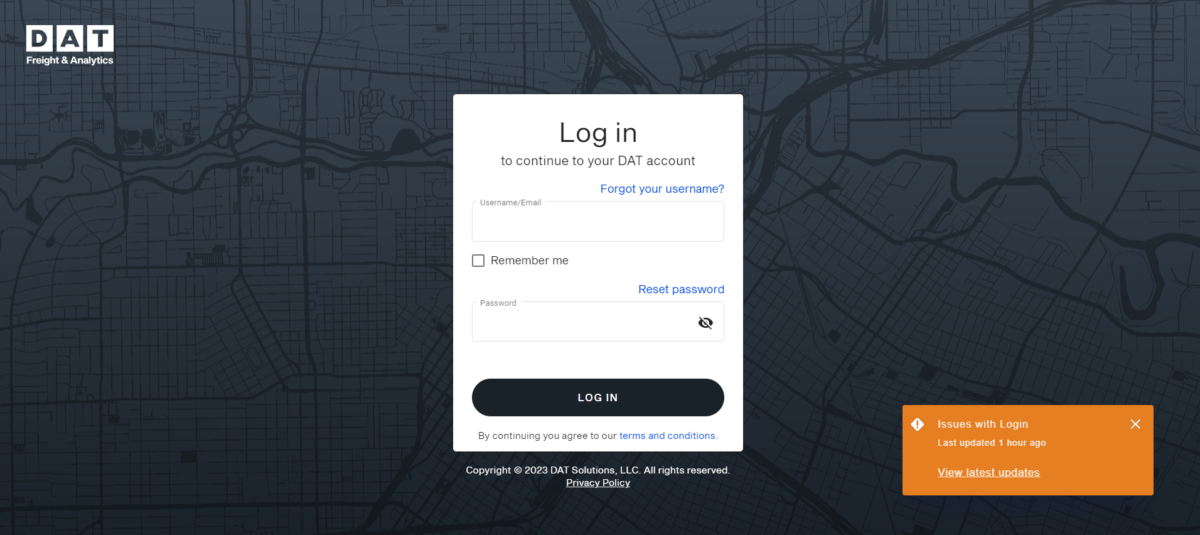

The IP address shows a company called Beget LLC out of St. Petersburg, Russia, is currently hosting the fake site.
Likely, the fake DAT website steals the usernames and passwords of those who respond to the email. Once someone has acquired this information, he or she can log in to the real DAT ONE site and post or win loads under the identification of a real broker or carrier to fraudulently phish loads, steal loads in transit or double broker loads.
According to load board Truckstop.com, marketplace fraud increased 400% from the fourth quarter of 2021 to the fourth quarter of 2022. This is the highest level the industry has seen since the tracking of fraud reports began in 2004.
DAT told FreightWaves on Friday that it is aware of the post shared on X and appreciated the post.
“Fighting fraud is a community effort,” said Annabel Reeves, communication director at DAT.
She explained if customers think they have received a phishing email impersonating DAT or believe their DAT credentials have been compromised they should reach out to their customer service department right away and report the bad actor. She also suggested they send a screenshot of the message to customer service and not forward the actual phishing email to them.
Reeves also noted that even if a username and password are obtained by a hacker, DAT now uses multi-factor authentication to verify log in attempts.
“The sophistication of phishing scams continues to grow. We’re continuing to invest heavily in technology and AI, as well as our Network Integrity Unit, but ‘saying something when you see something’ is essential as well,” she explained while sharing the company’s fraud alert educational document.
If you have a story on load board fraud to share, please email gsharkey@www.freightwaves.com.


The transportation industry is plagued with waste. In fact, nearly half of the heavy-duty trucks on the road at any given time are carrying less than half the inventory they were designed to hold. This means that about 25% of available truck space is wasted on a day-to-day basis.
This year has been financially precarious for the transportation industry, and these high percentages of wasted space contribute to ongoing economic headwinds for shippers and carriers alike. When a truck is running half empty, shippers end up paying for unused space and carriers miss out on opportunities to make more money.
Flock Freight is passionate about cutting out that waste through its industry-leading shared truckload solution, FlockDirect.
“Flock envisions a world without traditional shipping constraints, where customers can produce and ship goods as needed,” Flock Freight founder and CEO Oren Zaslansky said. “At the same time, carriers increase their earnings through optimized trailer space utilization.”
FlockDirect uses real-time data to pool freight for multiple customers. The solution effectively dismantles the physical hub-and-spoke constraints that have defined the supply chain for more than a century. In its place, Flock created a modern, digital platform that puts customers first.
Most recently, Flock implemented a strategic initiative aimed at integrating AI into all facets of its core technology, fusing machine learning with operations research.
“While Flock’s underlying technology is complicated, the concept is simple: We keep trucks full by bringing together multiple shippers whose goods are heading in the same direction,” Zaslansky said.
As a result of those efforts, hundreds of millions of pounds of freight have been pooled to date. That number is expected to grow significantly in the near term due to shippers wanting better, more cost-effective ways to ship their freight, leading to serious financial gains for industry players and environmental gains for the planet.
“More pooled freight equals a smaller carbon footprint in the logistics and transportation industries, something that has never been done before,” Zaslansky said.
Flock recently executed an extensive pool that spanned from the Pacific Northwest all the way to Massachusetts. To pull this off, the carrier embarked on a 3,523-mile journey hauling a trailer loaded with a diverse range of household goods from three pooling customers.
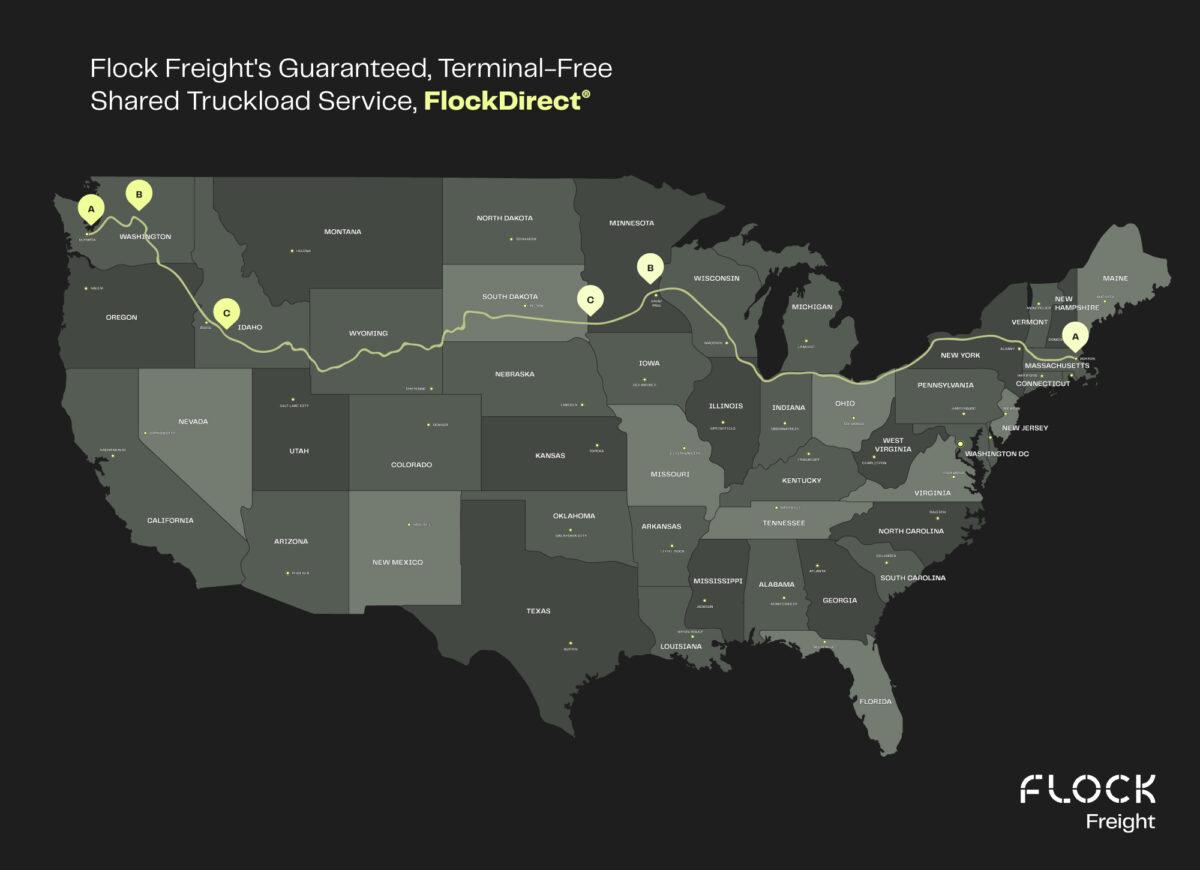
Originally, the carrier had booked only two pickups in Washington, headed for Minnesota and Massachusetts. Those pickups, however, only filled 54% of the trailer. During transit, Flock managed to pool more freight by adding another pickup and drop-off between the initial stops, boosting trailer utilization to 86%.
This created a win-win-win scenario:
These pooling opportunities will become more common as shippers and carriers continue to choose shared truckload as their primary method to move goods.
FreightWaves Classics is sponsored by Old Dominion Freight Line — Helping the World Keep Promises. Learn more here.
Benjamin Franklin’s importance in American history is undisputed, but his lesser-known work as postmaster general may have laid the foundations for his later accomplishments.
In fact, it is very likely that his broader renown could be thanks to his time with the Postal Service.
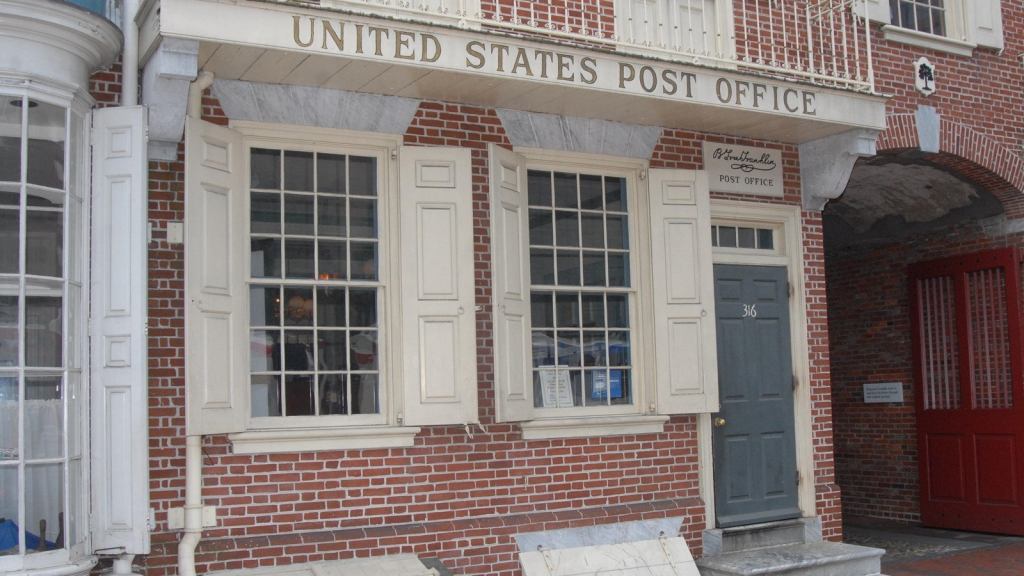
In 1737, Franklin became the postmaster of Philadelphia, appointed by Deputy Postmaster General of America Alexander Spotswood. Control of the Postal Service remained under the British crown, since this was still almost four decades prior to U.S. independence.
As the Philadelphia postmaster, Franklin had access to perks that others at the time did not. He was able to send out his own newspaper, The Pennsylvania Gazette, for free and correspond with numerous prominent figures. Stanford historian Caroline Winterer even refers to this time period as the beginning of social networks, when people around the world were able to communicate more than ever before. It was simply letters instead of tweets.
This ability to more easily communicate spread Franklin’s ideas on both continents and could likely be the reason for much of his fame.
But that’s not to say that his spotlight was undeserved. Historians believe that to have been placed as the very first postmaster general of the United States, which he would eventually become, he must have had immense respect from others in office.
Franklin quickly rose through the ranks from postmaster of Philadelphia to comptroller and from there successfully lobbied for the role of postmaster general after the death of Elliott Benger, who previously held the role. Franklin shared the position with William Hunter of Virginia.
The Founding Father made quick work of innovating within the Postal Service. He sent riders out at night, cutting delivery time for a letter from Philadelphia to New York and a reply to under 24 hours. He also did extensive on-the-ground research of postal routes and roads to determine upgrades and the best directions for delivery.
According to the U.S. Postal Service, Franklin also installed a policy from England that delivered letters that were not originally called for, meaning collected, for the cost of a penny. And, he allowed the admittance of all newspapers through the mailing service for a small fee. In the past, other postmasters general who owned newspapers would simply bar any other publication from the Postal Service.
Franklin eventually worked remotely from England, but things took a turn when resistance to the crown was growing and it was clear the postmaster general leaned toward Colonist loyalty. He helped facilitate the release of letters from the British governor of Massachusetts, which showed the extent of British suppression of the Colonists. He was fired in January 1774.
However, it became clear he was the glue holding the operation together when he returned to the United States without the title of postmaster general and the Postal Service started to fall apart. Other independent postal agencies began to pop up, according to the History Channel.
Franklin helped create one of these independent systems that would later become the U.S. Postal Service. Some others also bid their services to become the official postal service, but Franklin was declared postmaster general by Congress as the United States was less than a year away from declaring independence. He was given a salary that would be equivalent to $33,000 today.
The postmaster general established a well-oiled machine before having to leave the position after only a year to act as ambassador to France after he and the other Founding Fathers declared independence.
FreightWaves Classics articles look at various aspects of the transportation industry’s history. Click here to subscribe to our newsletter!
Have a topic you want us to cover? Email bjaekel@www.freightwaves.com.

Since launching in 2017, FreightWaves’ team of award-winning reporters has covered the good — and bad — news and events in the transportation and logistics industries.
In those years, the freight transportation market has enjoyed prosperous times and periods of pain and misery. The freight market undergoes boom-and-bust cycles, like all commoditized industries.
FreightWaves SONAR correctly predicted the start of a drop in the freight market in March 2022. Since then, the overcapacity spurred by the pandemic has caused freight-hauling rates to drop to 2019 levels — or worse. For the past 18-plus months, there have simply been too many trucks for too little freight.
However, the impact has gone beyond U.S. trucking fleets and freight brokerages. The problems are not confined to the United States or just trucking. Ocean carriers, railroads, air cargo carriers and freight forwarders around the world have been impacted as well.
No one at FreightWaves enjoys reporting bad news. One of my followers on X recently commented, “Everything you post/repost or talk about is doom and gloom. I challenge you to say/find something positive about the economy pertaining to the trucking industry.”
I would love to do so. Unfortunately, the good news in freight, transportation and logistics has been sparse.
After the market began to prove FreightWaves SONAR’s downturn prediction, some analysts and industry experts said the freight slowdown was a reversion to the mean. Unfortunately, it is not. We are in one of the worst downturns in freight market history, caused by a massive buildup of capacity, and it’s going to take time to burn it all off.
Simply put, the freight market is experiencing a severe recession. FreightWaves has an obligation to report that news.
Since early in 2022, many companies have gone out of business or severely cut back by letting employees go. Some of those companies were household names in the industry, such as Yellow Corp. and Convoy. Many others were much smaller, not known perhaps beyond their headquarters location. Nonetheless, the bankruptcies, closures and layoffs have piled up, and the financial and human losses have taken a toll.
The following synopses are some of the articles that FreightWaves has published in the past year that illustrate the poor freight economy. The full articles can be read by following the links; ongoing coverage of the “state of freight” can be found here on FreightWaves.com.
Nov. 6: A court ordered liquidation of Twin Express, a Minnesota trucking company with 76 employees, as FreightWaves’ Clarissa Hawes reported. The 35-year-old company defaulted on a $19 million dollar loan.
Oct. 23: After its founder embezzled $25 million to purchase a G-550 jet and a $5 million mansion in Texas, Goldman Sachs-backed Slync wound down operations and hopes to sell its proprietary technology, as Hawes reported.
Oct. 22: Fort Worth-based SEL Supply Chain Solutions shut down, Hawes reported. Closure of the freight brokerage — that at one time had $65 million in revenue — left 125 employees out of work.
Oct. 19: Convoy, a venture capital-backed digital freight brokerage, shut down, as FreightWaves’ John Kingston reported. Valued at $3.8 billion, the “perfect storm” of the freight recession coupled with tighter capital markets was blamed for the company’s failure.
Oct. 19: A third-generation, family-owned trucking company and brokerage, Certified Freight Logistics, ceased operations after 95 years, as FreightWaves’ Hawes reported. Layoffs impacted 157 workers, including 101 linehaul and local truck drivers. The wind-down of the Santa Maria, California-based company was expected to be completed by Nov. 18.
Oct. 12: Meadow Lark Transport, a 40-year-old Montana trucking company and freight brokerage that previously generated $200 million in revenue, shuttered operations, Hawes reported. The company had 273 drivers and 337 power units at the time of its closure, according to the Federal Motor Carrier Safety Administration. FMCSA data states the company’s brokerage authority was involuntarily revoked on Aug. 15 and its contract carrier authority was slated to be canceled on Oct. 28.
Sept. 29: Grand Rapids, Michigan-based Titan Transportation Services Inc. abruptly ceased operations on Sept. 29, as Hawes reported. Owner-operators said on Oct. 11 that the company, doing business as Sunset Logistics, still hadn’t refunded their $1,000 in escrow or maintenance account funds.
Sept. 25: An 85-year-old Indiana-based trucking and logistics company and its affiliates filed for Chapter 11 bankruptcy protection less than nine months after it was acquired by private-equity firm Transport Acquisitions, as FreightWaves’ Hawes reported. Founded in 1938, Otwell, Indiana-based Elmer Buchta Trucking, which offered bulk, dry van and pneumatic trucking services, had 100 drivers and more than 230 power units, according to federal data.
Aug. 31: U.S. Postal Service contractor Matheson Flight Extenders filed paperwork stating that it planned to eliminate 305 jobs and close its sorting facility in Chicopee, Massachusetts, by the end of October, Hawes reported. That brought to about 1,000 the total job cuts it announced in the days around that time. Two other sorting facilities in Georgia and Maryland were also closed.
Aug. 7: Yellow Corp. filed for bankruptcy, leaving 30,000 employees out of work, as FreightWaves’ Todd Maiden reported. This number included approximately 22,500 members of the Teamsters union. The bankruptcy marked the end of the 99-year-old LTL company.
Aug. 7: FreightWaves’ Eric Kulisch reported Western Global Airlines, which operates chartered cargo jets for the U.S. military and other customers, filed for Chapter 11 bankruptcy protection and announced it will restructure. The company has nearly $500 million in debt. A bankruptcy restructuring has been expected for weeks because of collapsing revenues, a heavy debt load and the decision by credit rating agencies to pull their coverage because of the company’s lack of financial transparency. Bloomberg previously reported that Estero, Florida-based Western Global Airlines was arranging debtor-in-possession financing to support ongoing operations under a court-approved bankruptcy plan.
July 25: After experiencing record sales growth during the COVID-19 pandemic, digital freight brokerage Surge Transportation filed for bankruptcy protection, as FreightWaves’ Hawes reported. The company said it was unprepared for the abrupt decline in product demand and soaring shipping costs that rocked the transportation industry.
July 17: Georgia-based trucking company Big J Express LLC, which reported a significant drop in revenue this year compared with the previous two years, filed for bankruptcy liquidation, Hawes reported. The company, which obtained its operating authority in 2014, had 37 drivers and the same number of power units and hauled general freight. Headquartered in Norcross, Georgia, Big J Express filed its petition in the U.S. Bankruptcy Court for the Northern District of Georgia.
June 29: Cargo airline Amerijet laid off more than a dozen employees as the freight recession drags on, FreightWaves’ Kulisch reported. The airline said the move was necessary to protect its bottom line as revenues sag and costs rise.
June 28: Ameritrans Express filed a bankruptcy petition in the U.S. Bankruptcy Court for the Eastern District of Virginia, as Hawes reported. Owner Frederick Amankwaahe waited almost four months before filing the Chapter 11 petition seeking to reorganize his company. Ameritrans provided transportation and delivery services as a contractor for the Postal Service. Its former employees are owed millions in unpaid wages.
June 28: More than 60 small trucking companies are collectively owed millions of dollars after Transplus Freight System Inc. (Transplus), a Mississippi-based logistics firm, filed for bankruptcy liquidation in the U.S. Bankruptcy Court for the Northern District of Mississippi. FreightWaves’ Hawes reported the story.
June 27: Ailing commercial electric pickup truck maker Lordstown Motors filed for Chapter 11 bankruptcy protection. It also put itself up for sale and sued former partner Foxconn, alleging fraud and failure by Foxconn to live up to its financial commitments.
June 16: Tiger Cool Express, a refrigerated rail shipping and logistics company, abruptly halted operations amid financial troubles. The company reportedly fell behind on loan payments. FreightWaves’ Hawes reported the story.
May 26: Peace Equipment LLC, headquartered in Edcouch, Texas, filed for Chapter 11 bankruptcy protection, citing rising operating costs and “reduced income in the trucking industry.” The company, which has been operating since 2016, has 38 drivers and 27 power units and hauls general freight, fresh produce and refrigerated food throughout the U.S. Hawes reported the story.
March 24: Soler & Soler Hauling, a Miami-based trucking company, filed for bankruptcy protection. The company’s bankruptcy petition cited negative cash flow as well as high fuel and operating costs as factors for the bankruptcy. FreightWaves’ Hawes reported the story.
March 22: Hawes reported that trucking company Flagship Transport abruptly ceased operations, leaving more than 450 truck drivers without jobs after they were not paid for weeks. Flagship Transport was a logistics holding company headquartered in Medley, Florida.
March 7: FreightWorks Transport shut down after losing its top customer. The North Carolina-based trucking company laid off over 200 employees, including 140 drivers. FreightWaves’ Hawes reported the story.
Late November 2022: Art Mulder & Sons, a family-owned trucking company that had been in business for more than 50 years, ceased operations. The Holland, Michigan-based company specialized in refrigerated LTL freight. Hawes reported the story.
Nov. 26, 2022: Family-owned Mid Continent Trucking, a Denison, Iowa-based refrigerated carrier in business for 24 years, ceased operations. Co-owner Brian Wickersham said, “I would rather be able to pay my employees while I still have the money than wait until I don’t have it and then have to tell my employees that I can’t pay them.” FreightWaves’ Hawes reported the story.
Nov. 16, 2022: Freon Logistics, a Bakersfield, California-based trucking company, filed for bankruptcy. It provided truckload, less-than-truckload, intermodal, repair and maintenance, and warehousing services. Freon Logistics employed about 500 people, including truck drivers, administrative personnel and others, according to court records. Many employees claimed they were owed back pay. Hawes reported the story.
Sept. 30, 2022: Two trucking companies that contracted with the Postal Service to haul mail filed for Chapter 11 bankruptcy. McClellan Trucking Inc. filed its petition in the U.S. Bankruptcy Court for the Western District of Pennsylvania on Sept. 28, five days after the company’s parent company, Duran Transfer Inc., filed for bankruptcy protection on Sept. 23. The petitions state both companies are based at the same address in Waterford, Pennsylvania. The companies had been in business for more than 30 years and employed 23 people. FreightWaves’ Hawes reported the story.
July 6, 2022: Vermont-based LTL carrier LandAir, which focused on hauling hazardous materials, ceased operations. The private equity-owned trucking company had 135 drivers and 148 power units at 11 service centers in the U.S., as well as two service centers in Toronto and Ottawa, Ontario. The 54-year-old company serviced the Northeast and parts of Canada. Originally called Allied Air Freight, the company was founded by Fred Spencer in 1968. Hawes reported the story.
May 6, 2022: Family-owned Rooney Trucking Inc., headquartered in Polo, Missouri, ceased operations and filed Chapter 7 bankruptcy. The company contracted with the Postal Service to haul mail. Attorney Ryan Blay stated, “Fuel and labor expenses were certainly issues that affected Rooney Trucking Inc. The bigger issue, though, was the decision by the U.S. Postal Service to take away some routes and cancel certain contracts. The business couldn’t function profitably with a restricted income stream. This was the biggest factor in deciding to declare bankruptcy for the company.” FreightWaves’ Hawes reported the story.
April 26, 2022: Sullivan, Illinois-based Marvin Keller Trucking filed for Chapter 11 bankruptcy protection, citing a jury award of $10 million in December 2021. The bankruptcy petition, filed in the U.S. Bankruptcy Court for the Central District of Illinois, stated the bankruptcy filing was necessary to “avoid irreparable and immediate harm” to the carrier’s operations. The company also noted higher fuel costs and “other market conditions” as reasons for the filing. Hawes reported the story.
Nov. 16: Vehicle life cycle management software provider Solera Holdings Inc. conducted a round of layoffs via Teams on Nov. 13. According to an update on Layoff.com, West Lake, Texas-based Solera released 44 members of its U.S.-based billing team and “now all of their billing is done in Mexico.” FreightWaves’ Grace Sharkey reported the story.
Nov. 15: Trucking company 10 Roads Express laid off 66 workers at its facility in Fort Worth, citing the cancellation of postal contracts. The layoffs, which occurred Oct. 16, affected 55 truck drivers, four dispatchers and seven mechanics, according to a recent filing with the Texas Workforce Commission. FreightWaves’ Noi Mahoney reported the story.
Nov. 8: Hyliion Holdings gives up its electric powertrain business to focus exclusively on its generator technology and cutting 175 jobs in the process.
Nov. 4: Approximately 65 employees of Pittsburgh-based Elite Transit Solutions were laid off. This was the second round of job cuts the freight brokerage has experienced over the past month; about 20 employees were let go on Oct. 20. Hawes reported the story.
Nov. 6: Nearly 200 senior pilots at UPS accepted the company’s voluntary severance package, and regional passenger airline PSA Airlines is trying to recruit them to close a crew shortage. The head count reduction at UPS Airlines is much more limited than one envisioned at rival FedEx Express, where management has acknowledged it has more than 700 excess pilots and recently urged flight crews to quit for the same type of offer at PSA Airlines, an American Airlines subsidiary that operates in the eastern United States. FreightWaves’ Kulisch reported the story.
Nov. 3: Maersk announced plans to lay off 10,000 workers over the next year in light of “worsening market conditions.” The company has already conducted 6,500 of the layoffs, but those were unannounced. FreightWaves’ Greg Miller reported the story.
Oct. 13: Flexport laid off 600 workers. Flexport implemented a 20% workforce reduction as the freight forwarder moved to plug financial losses and become more nimble. Kulisch reported the story.
Sept. 29: Following a sale of BNSF Logistics’ brokerage unit to J.B. Hunt, an undisclosed number of employees were laid off. FreightWaves’ Joanna Marsh reported the story.
Sept. 27: Seattle-based logistics provider Flexe conducted its second round of layoffs in 14 months and laid off about 33% of the company’s nearly 450 employees. FreightWaves’ Mahoney reported the story.
Sept. 12: GXO Logistics laid off 92 workers at a Texas distribution center. The contract supply chain solutions provider is ceasing operations at a distribution center in Wilmer, Texas. Mahoney reported the story.
Sept. 1: Coyote Logistics laid off an unspecified number of employees. FreightWaves’ Rachel Premack reported the story.
Aug. 31: Union Pacific furloughed at least 94 employees due to a drop in rail traffic. The International Association of Machinists and Aerospace Workers, a union, said Union Pacific was planning to store hundreds of locomotives as demand for rail traffic has dropped. FreightWaves’ Marsh reported the story.
Aug. 24: Nationwide moving and storage company WayForth laid off hundreds of employees and shuttered operations in eight states in an effort to stay afloat, as FreightWaves’ Hawes reported. The company’s CEO said the layoffs and reorganization were the result of a downturn in its business, which focuses on moving and storage services for seniors. The company planned to slash its workforce from about 500 employees to 50; laid off employees did not receive any severance packages. The company is exiting markets in Connecticut, Florida, Maryland, Massachusetts, New Jersey, North Carolina, Pennsylvania and Texas. FreightWaves’ Mahoney reported the story.
Aug. 4: FedEx Corp., the nationwide parcel delivery giant, said it was eliminating 280 of 806 jobs at a facility in Fort Worth, Texas, after losing a customer. Mahoney reported the story.
July 11: Freightos laid off 13% of employees as its revenue weakened. The digital freight marketplace also downgraded its 2023 guidance. FreightWaves’ Kulisch reported the story.
June 29: Cargo airline Amerijet laid off more than a dozen workers. FreightWaves’ Kulisch reported the story.
June 1: Venture capital-backed trucking technology provider CloudTrucks laid off an undisclosed number of employees. However, a source close to the company claimed that 40% of the CloudTrucks team was let go. Like many FreightTech companies that have laid off workers in recent months, CloudTrucks blamed the declining freight market for the job cuts. The company had raised nearly $142 million since its founding in 2019. FreightWaves’ Hawes reported the story.
May 19: DHL Supply Chain and GXO Logistics laid off 80 workers in Texas, citing a loss of customers. FreightWaves’ Mahoney reported the story.
May 19: Coyote Logistics announced more layoffs; this round comes after a reported 200 job cuts in February.
May 11: U.S. Xpress laid off 150 staff members and reported a significant loss to the Securities and Exchange Commission. Knight-Swift acquired U.S. Xpress effective July 1. FreightWaves’ Kingston reported the story.
May 9: Freight broker Lipsey Logistics cited a weak freight market as the reason for layoffs. A source familiar with the layoffs said an estimated 20 jobs were cut. FreightWaves’ Hawes reported the story.
April 21: Flock Freight laid off 45 people — 8% of its workforce — in a second round of firings. More than 60 workers were fired in December 2022. Hawes reported the story.
March 8: Global logistics giant Ceva Logistics cut 142 jobs at two of its facilities in Mount Juliet, Tennessee, effective April 22. Prior to the firings there were about 700 employees at the facilities. FreightWaves’ Hawes reported the story.
Feb. 16: Convoy laid off an undisclosed number of employees and closed its Atlanta office. (Convoy ultimately closed in October 2023.) FreightWaves’ Sharkey reported the story.
Jan. 23: Uber Freight cut about 150 jobs — 3% of its workforce. All the job losses were in its digital brokerage operations. FreightWaves’ Kingston reported the story.
Jan. 18: Logistics giant Ryder laid off 800 workers in Texas. Ryder said the cutback was “due to a customer’s changing business needs.” FreightWaves’ Mahoney reported the story.
Jan. 13: Electric truck manufacturer Nikola filed a layoff notice for employees of the former Romeo Power battery-making plant in California, affecting up to 400 workers. Nikola is transferring battery pack manufacturing to Arizona. FreightWaves’ Alan Adler reported the story.
Jan. 11: Flexport laid off about 20% of its employees. Its leadership said they would cut workers because the company had increasingly automated key systems and forecast decreased freight volumes. FreightWaves’ Kulisch reported the story.
Jan. 3: Wells Fargo Bank filed a petition to force United Furniture Industries into Chapter 7 bankruptcy after UFI’s abrupt decision to cease operations two days before Thanksgiving 2022, as FreightWaves’ Hawes reported.
Dec. 12, 2022: Fleet management solutions provider Motive laid off about 240 workers (6% of its workforce), blaming slowing demand. FreightWaves’ Mahoney reported the story.
Dec. 12, 2022: Auto manufacturer Stellantis announced plans to close an Illinois automobile factory in February 2023, terminating 1,350 workers. The company blamed rising electric vehicle costs for the shutdown. Mahoney reported the story.
Nov. 9, 2022: Freight brokerage giant C.H. Robinson laid off about 650 employees amid weaker-than-expected financial results in the third quarter of 2022.
Oct. 29, 2022: Trucking payments platform AtoB laid off 30% of its employees, citing “external economic headwinds.” FreightWaves’ Mahoney reported the story.
July 8, 2022: Logistics provider GXO announced it was closing a Milwaukee facility, laying off 144 workers. Mahoney reported the story.
July 8, 2022: LandAir’s 450 employees were terminated, some via Zoom video call. Former workers and drivers said the management ran the LTL carrier “into the ground.” FreightWaves’ Hawes reported the story.
June 21, 2022: Logistics company DB Schenker announced 130 employees would be laid off at its Fort Worth facility after it lost a Kraft Heinz contract. FreightWaves’ Mahoney reported the story.
June 10, 2022: Global logistics provider Neovia cut 98 jobs at its Tannersville, Pennsylvania, facility. FreightWaves’ Hawes reported the story.
April 14, 2022: Logistics giants Geodis and Ceva filed paperwork for hundreds of job cuts in Ohio. Geodis, headquartered in France, announced that it would close all business operations at its facility in Columbus, eliminating 302 jobs by the end of September 2022. Ceva Logistics, which is owned by French container carrier CMA CGM, said it would close a portion of the Groveport facility, located near Columbus, by Sept. 30. Hawes reported the story.
Did we miss any entries? Email media@www.freightwaves.com.