French-American Thanksgiving: CMA CGM donates 10,000 turkeys
“While COVID-19 has fundamentally shifted how many American families will celebrate Thanksgiving this year, we are very proud to be providing a bit of home.”
Quick action comes on heels of a call for action by key trade group; Commissioner Maffei says it may not be enough
Platform is designed to improve efficiency of returning empty containers.
Where we’re seeing the need for ocean freight-related ingenuity, logistics tech companies are beginning to fill the space, but we are far from seeing the full potential realized.
Air cargo carrier names Yulia Celetaria health care director and forms vaccine task force.
Trucking and rail volumes remain elevated while the imports fade. Is this is beginning of the end of the 2020 freight boom?
There are not enough containers in China to handle all the U.S.-bound cargo — and box factories are now sold out into Q2.
The trans-Pacific capacity crunch continues. Container volume that’s either inbound to Los Angeles or stuck at anchorage is surging.
The trans-Pacific market is bursting at the seams as shippers rush in holiday cargoes.
On a collision course: holiday timing, surging consumer demand, thin inventories, and capacity constraints for container liners and ports.
“Several months into this pandemic, we are now seeing positive signs by these cargo volume totals.”
Port of Virginia gets $20.2 million for container yard expansion.
“Regardless of who wins the upcoming elections, our country is in desperate need of a cohesive export plan as well as an infrastructure program and a digitization strategy for ports across the country,” says Executive Director Gene Seroka.
Freight volumes are not the only thing putting pressure on capacity.
Anthony and Zach bring on Maritime expert Henry Byers to discuss the near- and long-term impacts to the domestic freight market resulting from the record-breaking influx of shipments from Asia.
Executive Director Gene Seroka shines spotlight on trade gap on “Squawk Box Asia.”
Earnings reports from retailers show a clear shakeout between winners and losers.
Gene Seroka says the “disruption and breakdown of the global medical supply chain” during the COVID-19 pandemic highlighted the need for change in the maritime sector.
Information sharing is part of Executive Director Gene Seroka’s quest for more efficient operations.
U.S. importers now paying three times more per mile than Europeans for transport of Chinese goods.
Intermodal was supposed to be the growth engine for rail.
The pandemic, trade war and a communication gap have muddled implementation of a $10-per-TEU surcharge.
U.S. importers turn to Chinese sellers in the wake of COVID.
Freight is getting crammed into the U.S. West Coast as fast as carriers can pick it up. How long will it last?
Executive Director Gene Seroka does not want to break the 15-month record set during the recession of 2008-09.
Asia-U.S. ocean freight rates are hitting record highs as import demand outpaces vessel supply.
Human error-related insurance claims represented over $1.6 billion in losses, according to insurance report.
Ports on the Atlantic are losing imports from Europe as well as Asia.
The U.S. Federal Maritime Commission found during its Fact Finding 29 investigation that the Port of New York and New Jersey showed supply chain resolve during the coronavirus pandemic.
With airfreight capacity squeezed and rates high between China and the U.S., ocean freight consolidators offer the option of fast, cheaper less-than-container load, trans-Pacific services.
Freightliner’s test fleet of 30 electric trucks has circled the world an equivalent of a dozen times as they make drayage runs and a variety of deliveries in Southern California. Daimler Trucks North America plans regular production of electric trucks in 2022.
OffPeak praised for enabling Southern California distribution centers to operate second shifts.
“Employer groups should not play American ports against one another,” says longshore union leader.
Total number of TEUs moved in June down 17.1% year-over-year.
U.S. shippers importing cargo from Asia are getting some price relief.
The U.S. Federal Maritime Commission enters “phase two” of its fact-finding investigation into COVID-19 impacts on container shipping in the Port of New York and New Jersey.
Analysis concludes West Coast ports have lost 19.4% of market share since 2006.
Canceled San Pedro Bay calls more than doubled in the first half of the year compared to 2019.
“Optics” are bad but freight pricing doesn’t appear to meet regulatory bar for intervention.
HTA CEO Weston LaBar says West Coast container ports have suffered a 19.4% loss in market share since 2006.
E-commerce and coronavirus fallout are buoying container services from Asia to the West Coast.
Long Beach mayor taps ILWU officer Bobby Olvera Jr. to serve as commissioner.
Although “Containers Don’t Lie,” the story they are telling may not reveal the entire picture.
By artificially restricting capacity, carrier alliances have engineered rates higher and may book a profit this year.
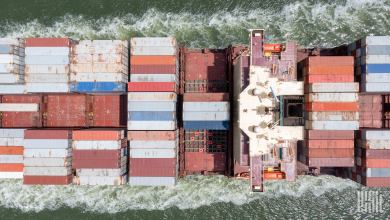
The container ship helping set the record is longer than the Eiffel Tower is tall and capable of carrying 384 million pairs of shoes.
The U.S. Federal Maritime Commission has rolled out guidance on how the ocean shipping industry can collaboratively improve the flow of containers among ocean carriers, marine terminals, shippers and drayage truckers in San Pedro Bay during COVID-19 and beyond.
New data reveals third-quarter ocean schedules still largely intact — a positive sign on cargo bookings.
Gene Seroka reports worst May in more than a decade, predicts 15% of import cargo won’t return
COVID effects far from over, but more positive news on the trans-Pacific.
Global stewardship includes aim to be carbon neutral by 2050
While natural gas trucks have been operating in ports for many years, a new report definitively states that they are a commercially viable option that can handle all the tasks required of drayage trucks.
Escalating airfreight transportation rates and capacity shortages from China due to the global pandemic have encouraged some shippers to split supply chain shipments between ocean and air pallets.
Port of LA chief promotes nationwide port optimization system to enhance visibility and improve execution
Pandemic-caused shortages put spotlight on importance of cargo moved through California ports
Box import volumes may be falling fast, but there are glimmers of hope.
San Pedro Bay complex braces for more blanked sailings as coronavirus pandemic rages on.
The path ahead will look very different, according to global seaport authorities.
The Class I railroads’ expectations that the second quarter could be rough volume-wise are ringing true.
Gene Seroka expects supply chain fractures may remain after the world heals from the coronavirus pandemic.
Harbor Trucking Association hosts a wide-ranging conversation with West Virginia senator.
New data from eeSea reveals that U.S. ports will see capacity plunge by up to 20% this month.
Mayor Eric Garcetti grateful for “lifesaving purchase agreement” with Honeywell.
Triple the number of vessels at anchorage increases risk of oil spill.
While suffering a significant drop in cargo volume during the coronavirus pandemic, the seaport stands “ready to help position America’s industries for future success,” says Executive Director Gene Seroka.
Big April gains at Southern California container terminals are deceiving.
Ports of Seattle, Tacoma, Los Angeles, Long Beach, Oakland, Houston, Jacksonville and Charleston all report drops in March.
The number of empty containers returned to Asia from the California port dropped 23% in March.
Coronavirus and tariffs blamed for lowest total in more than a decade.
“The coronavirus is delivering a shock to the supply chain,” said port chief Mario Cordero.
Mayor taps Gene Seroka to locate and deliver medical supplies critically needed during coronavirus pandemic.
Arrested Pacific Harbor Line locomotive driver apparently thought the Navy hospital ship was not at the Port of LA to do good.
The Comfort and Mercy, now assisting America through the COVID-19 pandemic, started as crude oil tankers.
An in-depth look at coronavirus risks to Panama Canal transits.
“It’s important for us to keep the supply chain fluid” during the coronavirus pandemic, Executive Director Gene Seroka says.
Washington governor also asked Trump for hospital ship’s help during coronavirus pandemic.
Executive Director Gene Seroka said the coronavirus has not impacted landside operations.
Coronavirus left containers scattered in the wrong ports. Liner companies are trying to get them back into position.
Levy is kept modest as report warns high rate would lead to diversions.
Congress urged to double Coast Guard budget over next decade.
Although the number of new coronavirus cases in China is dropping, shipping lines are still canceling sailings in response to expected low demand.
Baltimore terminal reduces working hours; Georgia ports brace for volume dive
Harbor commissions sign agreement to collaborate on common issues.
Over two decades and 2 million miles of trucking, Karl Williams has driven practically every brand of Class 8 tractor. Now behind the wheel of an electric Freightliner eCascadia, he relishes keeping his place in stop-and-go traffic and the sound of near silence.
The magnitude of declines over the next few months from the virus as well as lingering tariffs will have broad flow-through effects on the U.S. economy.
Fifteen projects net funding from the U.S. Department of Transportation’s Maritime Administration.
Good day, Self-driving vehicle startup Nuro has won approval from federal regulators to test its battery-powered driverless delivery vehicles on public streets. According to a news release, the National Highway Traffic Safety Administration granted the Mountain View, California, company a waiver to deploy its low-speed R2s, which lack windshields and side mirrors and aren’t designed […]
Darren Prokop writes about the future of data in for-hire transportation. Data is information and can become knowledge.
The coronavirus is having a far-reaching impact across the globe. The timing may make things worse for domestic trucking.
Geopolitical tides, e-commerce and technology are today’s “disruptors” in freight transportation, say panelists at Transportation Research Board convention.
Everything from driverless trucks, the U.S. tariff war with China and the growth of ocean ports was discussed during the opening day of the National Industrial Transportation League (NITL) Transportation Summit in San Antonio. The 2020 NITL summit is being held through Wednesday. The summit brings together hundreds of professionals from across the freight transportation […]
Los Angeles port signals efficiency gains as the third-largest container alliance plans additional SE Asia stops.
Zach and Anthony discuss the characteristics of the California freight market, the unintended consequences from regulations and the economic impacts from them.
The use of drones and other technology will help ports streamline operations, increase safety and vigilance for drugs and pollution.
More and bigger ships are calling on the East and Gulf Coast, setting the stage for regional logistics development.
Container industry veteran John McCown argues that the shift toward East Coast ports is inexorable.
California ports already face high energy costs, a situation that is likely to continue as the ports pursue clean air goals.
PierPass says long late-afternoon queues at the entrance to container terminals om Los Angeles and Long Beach have been eliminated.
Port of Los Angeles Executive Gene Seroka cautioned the port’s Board of Harbor Commissioners that even if a trade deal is reached with China, it may take months or years for trade volumes to snap back. President Trump on Friday once again gave mixed signals on the likelihood of a trade deal with China as […]
Saybrook Capital alleges that additional evidence shows how port and longshore union aimed to derail project.
“A good trade deal is when both countries are not happy with everything because that means that there was give and take,” LaRocco said.