The ‘ingenious strategy’ behind most truckers’ least favorite week of the year: International Roadcheck

truck fallen over

International Roadcheck Week is hardly the sexiest topic in trucking, but it is a darn-tootin’ important one. Inspectors in the U.S. and Canada halt tens of thousands of trucks for vehicle inspections for a few days every summer or early fall. They remove thousands of trucks and drivers from the road; in 2021, 16.5% of inspected vehicles were put out of service along with 5.3% of drivers.

It’s uncommon for truck drivers to actually get their vehicles inspected at random during most of the year. To avoid International Roadcheck Week, many truckers simply don’t drive during that period of time — which, presumably, means more unsafe vehicles and drivers on the road outside of the inspection blitz. It’s a question that ate at Andrew Balthrop, a research associate at the University of Arkansas Sam M. Walton College of Business. 

Around 5% fewer one-person trucking companies are active during International Roadcheck Week. But Balthrop and his fellow researcher, Alex Scott of the University of Tennessee, found a major upside to the inspection blitz — even with all the folks who avoid it. According to their working paper published in March 2021, vehicles are safer a month before and after the inspection period. There’s a 1.8% reduction of vehicle violations, according to Balthrop and Scott’s analysis. Surprise inspection blitzes don’t result in the same uptick of compliance. 

I caught up with Balthrop about his research last week at FreightWaves’ Future of Supply Chain conference, and we chatted again on the phone this week about his findings on International Roadcheck Week.

Enjoy a bonus MODES and a lightly edited transcription of our phone interview: 

FREIGHTWAVES: For our readers who are not aware of what Roadcheck Week actually is, can you explain a little bit about what it and why it is important to drivers and companies?

BALTHROP: “The International Roadcheck is part of an alliance between the inspectors in Canada and the ones in Mexico and the U.S. to have a unified framework for making sure trucks are safe to operate. That should make it easier to go across borders when you have this kind of unified structure.

“In the U.S., one of these CVSA inspection blitzes is the International Roadcheck that happens for three days in the summer. Usually it’s a Tuesday, Wednesday and Thursday. And usually it’s the first week in June.

“And in it, they focus on Level One inspections, the North American Standard Inspection where they inspect the driver records, the hours of service, the licensure and I believe medical records as well. Then they inspect the truck. It’s an in-depth inspection where the inspector will actually crawl under the truck to look at various things. And these inspections, from the data that I’ve seen, take about a half an hour on average.

“During the Roadcheck Week, they’ll do about 60,000 inspections, so 20,000 a day. They’re going to pull over a lot of trucks, and this can cause a little bit of congestion at the weigh stations and the roadside inspections localities as the inspectors are doing these inspections.”

Roadcheck Week doesn’t catch all truck drivers, but it has a long-lasting benefit to safety

FREIGHTWAVES: So, can most drivers kind of expect to be pulled over? How likely is that?

BALTHROP: “There’s 1 million or 3 million trucks on the road, somewhere around there on any given day. With 20,000 inspections, most drivers still will not get inspected, but there’s going to be a higher proportion of drivers inspected. 

“You’re more likely to get inspected on these days. If you don’t have a recent inspection on your record, or if you have a bad recent inspection on your record, you’re more likely to be pulled over on these days.”

FREIGHTWAVES: Your research focused on that it’s just unusual that this inspection is announced, that it’s planned. We were talking before about how normally, if you’re trying to assure quality or compliance, you would not announce an inspection in advance. It would be more of a surprise-type situation. 

Can you walk us through why that’s so unusual, or what’s the rationale that you see behind announcing it in advance?

BALTHROP: “It is unusual, and on the surface, it doesn’t make much sense, but it turns out to be kind of an ingenious strategy. So I’ll walk through it here. 

“Over the course of a year, there’ll be 2 million inspections of 3 or 4 million trucks out there. The average rate of inspections is pretty low. It’s not uncommon for truckers to go years without having an inspection. With this low inspection intensity, the FMCSA has sort of a problem of, how does it get anybody to abide by the regulations?

“I’m a jaded economist, and I don’t worry or consider too much ethics and morality and all that kind of stuff. It comes down to incentives for drivers to follow these inspections. The incentives do guide behavior. So, how could the FMCSA incentivize drivers to follow these regulations more closely and adhere to the standards?

“They do this by announcing the blitz. This does two things. On one side, it allows everybody to prepare in advance. There’s a bunch of anecdotal evidence out there that people do prepare for these blitzes in advance. They will have their trucks inspected beforehand for any problems. They’ll time maintenance and upkeep in advance to make sure that their vehicles are in order. “They’ll be a little bit more cognizant of the driver-side regulations. One thing we notice in our study is that hours-of-service violations really drop during these extensions, because people see them coming. They don’t fudge the books in any way.”

Owner-operators can evade Roadcheck Week. Big carriers, not so much.

BALTHROP: “The issue with the announcement, on the flip side, is that it allows people to just dodge the inspection entirely. For a long time, people have talked about how owner-operators and smaller carriers time their vacations for this particular time. They could do this for a couple reasons. To avoid the hassle is a nice way to put it, but it also allows you to be noncompliant to avoid the high-intensity inspections.

“You have this balance here that on one side you get the behavior you want with people complying with regulations. That’s the behavior the FMCSA wants. But on the flip side, you get a bunch of people that are kind of outright dodging inspections.

“When you compare these two things on balance, the policy is actually pretty effective because you get a lot of people focused on maintaining their trucks and obeying the rules during that particular week. Especially with the vehicle maintenance stuff, that lasts a long time. 

“In our research, we saw that vehicle violations, a month before and up to a month afterwards, is when you still notice your vehicle violations. That trucks are kind of better maintained around these blitzes.

“The ingenious aspect of it is that the FMCSA, by concentrating their inspection resources all at one time and announcing it, they’re making it clear that they’re serious about enforcing these regulations and everybody prepares for it. For the number of inspections that are happening, you get fewer tickets than you would have otherwise expected.

“The FMCSA, they’re putting people through a little bit of a hassle, but they’re not having to write a bunch of tickets to get people to comply. They’re not really punishing a whole bunch of people because, by making this apparent that this is going to happen, people comply and the FMCSA gets what they want essentially without having to come down on carriers too hard.”

A convenient time for a vacation, indeed

FREIGHTWAVES: OK, interesting. And how does this pattern of shutting down, how does that compare for an owner-operator versus a driver for a big fleet?

BALTHROP: “If you’re a motor carrier with thousands of power units, you can’t just pack up and not do business on a particular day. They just don’t have that option. So they get inspected at a higher intensity, and you see the larger carriers kind of more focused on making sure that they’re prepared for these inspections. With so many inspections, the larger carriers are going to be inspected at higher rates. You can really damage your reputation if your equipment isn’t in order on this particular day. 

“Versus the smaller carriers, especially if you’re talking about a single-vehicle fleet, an owner-operator type, it is not that difficult to just not work for those three days. And so you see a lot about that. 

“In terms of what the roadway composition looks like, if we look at inspection data and relative to a typical day with the usual inspections, on these Roadcheck days, you have about 5% fewer owner-operators on the road than you otherwise would expect.”

FREIGHTWAVES: Wow. And when you say owner-operators, you also mean just like fleets with just —

BALTHROP: “One-vehicle fleets.”

FREIGHTWAVES: OK, that’s interesting.

BALTHROP: “You know, you see a little bit of effect with the smaller fleets, below six vehicles, but it basically disappears by the time you get to a hundred vehicles.

“This effect is being driven by smaller carriers staying off the road in terms of avoidance. You see this goes also how you would expect; it’s also older vehicles that stay off the road. This is correlated with carrier size. The larger carriers use newer vehicles and owner-operators tend to use some of the older vehicles. But it’s particularly the older vehicles that are off the road.

“This makes intuitive sense. Older vehicles are more costly to keep compliant. Maintenance is more costly, and they’ve been around longer so there’s time for more stuff to have broken essentially.

How a truck driver gets stopped for inspection

FREIGHTWAVES: Can you explain a little bit more, the idea of having this inspection history and why it would benefit a larger or small carrier?

BALTHROP: “Getting flagged for inspection is sort of random, but not totally. If somebody notices something obviously wrong with your truck, that’s ground for a more in-depth inspection. Or if you get pulled over for some other reason, this can be grounds for inspection of some type. 

“But there’s also the inspection selection service. The computer program that is random, that it randomly flags people in for inspection, but it’s based on your inspection history.

“So if your firm hasn’t been inspected recently, or if your carrier doesn’t have a very dense inspection history, you’ll be more likely to trigger that system to pull you in and have you inspected. If you have a dense inspection history, you’re less likely to get inspected.”

FREIGHTWAVES: So how do you get pulled over for inspection? As a person who only drives a passenger car, my main interaction with being pulled over is, I’m driving down the freeway or wherever, and I get stopped by the police. How does it work for a truck driver? How does getting pulled over or inspected work in that way?

BALTHROP: “The law is that you cannot pass a weigh station without pulling in and getting weighed. At that point they may flag you to be inspected. Now, in the past decade or two, there’s been a bunch of electronic devices that are installed in cabs. You may have heard of PrePass or Drivewise. This allows you to pass weigh stations. 

“I don’t have data on how many trucks have the in-cab devices. But from a trucking perspective, they’re so convenient that you don’t have to stop every time you cross a state line. I think the vast, overwhelming majority of trucks have some sort of one of these electronic devices. The DOT inspectors at these roadside inspection points have a dial they can twist essentially about how many people they want to inspect. 

“So during the roadcheck inspection week, they’ll crank that dial all the way up and pull everybody over. And if they get too backed up, they might crank it back down a little bit and so on.”

FREIGHTWAVES: OK, interesting. It reminds me of a highly sophisticated E‑ZPass.

A $10 million-plus expense to trucking companies every year … but it’s worth it if just one fatal crash is avoided

FREIGHTWAVES: Zooming out, when we hear about large truck crashes, something like a vehicle maintenance issue is not really the most sexy explanation. But just looking at the FMCSA data, in 29% of all truck crashes, a major factor is brake problems. So it seems like a lot of the truck crashes on the road are caused by vehicle maintenance, versus something like the driver using illegal drugs or some other sort of more dramatic explanation. Can you speak a little bit to why this sort of vehicle maintenance is important for safety in preventing large crashes?

BALTHROP: “We did a little bit of a back-of-the-envelope cost benefit analysis of this. Let me try and make sure I remember it clearly, but we have it in the paper that the cost of this on one side is that you have the compliance costs the firms are undertaking, and then you have to add to that the delay costs from doing this, and then the cost of the inspection itself, having to pay federal inspectors to do this.

“On the benefit side, it reduces crashes. So when we add up, just looking at the cost of what an inspection is, we don’t have a good idea of how to measure the compliance cost. It’d be fun to measure the delay cost, but I don’t have good enough price data on that to get at that cost. 

“But if you look at what the cost of an inspection is, it is something like $100 or $120 is what you would pay to have one of these inspections done privately. A lot of people do this in the run-up to inspections, and have it done privately so that you can fix whatever the problems are and be sure that you would pass the FMCSA inspection.

“With that $120 figure, if you aggregate that up to 60,000 inspections or whatever, and you take that in comparison, I’m going to give you a bad figure here, it’s on the order of $10 million. That is about the value of a statistical human life. Looking at this economically, it’s worthwhile if it saves one human life. If you identify just one faulty brake system that would’ve resulted in an accident, you’re getting some value out of the program. 

“When you add those other costs in there, we’re going to need to save a couple of lives, but in terms of cost benefit analysis with this kind of stuff, we’re usually looking at orders of magnitude differences in cost and benefits to say something for sure. 

“If you can save just a couple lives, this program will pay for itself.”

Time to start inspecting in the winter

FREIGHTWAVES: Then one last question: Is there any rationale for this program happening in the summer? 

BALTHROP: “I think part of it is that for the inspectors this gets much harder and much more miserable to do in winter conditions.”

FREIGHTWAVES: That makes sense.

BALTHROP: “Inspectors are less productive. One of the things that we talk about in the paper, that they have in addition to the International Roadcheck, is that they have Brake Week where they focus a little bit more on brake inspections. You have Operation Safe Driver a little bit later on in the summer, usually in September, where it’s a little bit more focused on passenger vehicles and how they drive around these trucks.

“But there’s not one in the winter time. There’s an unannounced brake check that usually happens in May, a surprise inspection that’s just one day. But you’re right in pointing out that it might be worthwhile having one of these in the wintertime. You have this periodic high-intensity inspection that kind of incentivizes everybody to be compliant through the summer. 

“But there’s nothing in the winter, so that’s an area. But if I was managing the FMCSA, that would be one of the first questions I ask, ‘Why don’t we have one of these in the wintertime?’”

FREIGHTWAVES: That makes sense. Maybe they can do it in the South or something. Maybe a Miami January inspection … 

That’s it for this special bonus MODES. Subscribe here if you’re not already receiving MODES in your inbox every Thursday. Email the reporter at rpremack@www.freightwaves.com with your own tales on International Roadcheck Week or any other trucking topics. 

Why the Northeast is quietly running out of diesel

The nozzle of a diesel fuel pump is inserted into the tank of a commercial truck as its driver looks on the bankground.

The East Coast of the U.S. is reporting its lowest seasonal diesel inventory on record. And some trucking companies appear spooked.

The East Coast typically stores around 62 million barrels of diesel during the month of May, according to Department of Energy data. But as of last Friday, that region of the U.S. is reporting under 52 million barrels. 

The sharp increase of diesel prices has been a major stressor in America’s $800 billion trucking industry since the beginning of 2022. According to DOE figures, the price per gallon of diesel has reached record highs — a whopping $5.62 per gallon. It’s even higher on the East Coast at $5.90, up 63% from the beginning of this year. 

When relief is coming isn’t yet clear, and experts say higher prices are the only way to attract more diesel into the Northeast.

“I wish I had some good news for the Northeast, but it’s bedlam,” Tom Kloza, global head of energy analysis at OPIS, told FreightWaves. 

2022 has seen record-setting diesel prices. (SONAR)

Everyday Americans don’t fill up their cars with diesel, but the fuel powers our nation’s agriculture, industrial and transportation networks. More expensive diesel means the price of everything is liable to increase. Trucks, trains, barges and the like consumed about 122 million gallons of diesel per day in 2020

Patrick DeHaan, a vice president of communications at fuel price site GasBuddy, reported that retail truck stops are hauling fuel from the Great Lakes to the Northeast, calling it “extraordinary.” We’ve also seen anecdotal reports from truck drivers posting company memos:

Pilot Flying J and Love’s, two of America’s largest truck stops, told the Wall Street Journal yesterday that they were not planning to restrict diesel purchases, but were monitoring low diesel inventory.

Not unlike every other supply chain crunch we’ve seen in the past few years, the cause of the Northeast’s diesel shortage is multifaceted. A yearslong degradation of refineries is rubbing against the Gulf Coast preferring to ship its oil to Europe and Latin America.

Here’s a breakdown:

1. The East Coast has lost half of its refineries. 

As Bloomberg’s Javier Blas wrote on May 4 (emphasis ours): 

In the past 15 years, the number of refineries on the U.S. East Coast has halved to just seven. The closures have reduced the region’s oil processing capacity to just 818,000 barrels per day, down from 1.64 million barrels per day in 2009. Regional oil demand, however, is stronger.

Rory Johnston, a managing director at Toronto-based research firm Price Street and writer of the newsletter Commodity Context, told FreightWaves that refining is a “thankless industry,” with intense regulations that have limited the opening of new refineries. The Great Recession of 2008 led to several East Coast refineries shuttering, but there have been more recent shutdowns too. One major Philadelphia refinery shuttered in 2019 after a giant fire (and it already had declared bankruptcy), and another refinery in Newfoundland shut down in 2020.

2. It’s a financial risk to bring diesel to the Northeast.

The Northeast has increasingly relied on diesel from the Gulf region. Much of that diesel travels to the Northeast through the famous and much-adored Colonial Pipeline. You may remember the 5,500-mile pipeline from last year, when a ransomware attack shuttered it for nearly a week!  

It takes 18 days for oil to travel on the Colonial Pipeline from its source in Houston to New York City (or, more specifically, Linden, New Jersey), Kloza said.

That’s a long enough time to prioritize Colonial pipelines financially risky for traders — or, as Kloza said, “incredibly dangerous” — thanks to a concept called “backwardation.”

Backwardation refers to the market condition in which the spot price of a commodity like diesel is higher than its futures price. It’s only gotten stronger over time in the diesel market, Kloza said. So, a company could send off a shipment of diesel and find that it dropped by $1 per gallon in the time the diesel traveled from the Gulf Coast to New York — er, New Jersey. That could mean hundreds of thousands or more in lost profits, so traders often avoid such a fate.

“We’re not in an era where there are any U.S. refiners or big U.S. oil companies who would ‘take one for the team’ and bring cargo in where it’s needed,” Kloza said. 

The desperation is showing in New England and the mid-Atlantic regions. New England diesel retail prices are up 75% from the beginning of 2022, per DOE data. In the mid-Atlantic, diesel is up 67%. 

It’s not worth the risk, even amid ultra-high prices. As FreightWaves’ Kingston reported last week, the spread between a gallon of diesel in the Gulf Coast and its New York harbor price is usually a few cents. Last week, that swung up to 66 cents.

But that uptick still isn’t justifying moving oil to the Northeast — particularly when traders can make so much more money selling diesel abroad. 

3. Of course, we can blame COVID and the crisis in Ukraine. 

The catalyst for this diesel shortage, of course, is the ongoing conflict in Ukraine — particularly Europe’s desperation for diesel after weaning off Russian molecules. 

As CNBC reported in March, Europe is a net importer of diesel. Europe consumed some 6.8 million barrels of diesel each day in 2019; Russia exported some 600,000 barrels per day of that. Today, Europe has only eliminated one-third of its Russian diesel, so prices are expected to continue to climb amid that transition. Latin America, too, has been clammoring for U.S. diesel.

The Gulf Coast has been happy to provide such diesel, amid “insane” prices for diesel abroad, said Johnston. Waterborne exports of diesel from the U.S. Gulf Coast hit record highs last month, according to oil analytics firm Vortexa. (The records only date back to 2016.)

Naturally, COVID is also to blame for the Northeast’s run on diesel. Those refineries still retained on the East Coast scaled back during the pandemic due to staffing issues. It takes six months to a year to reignite refineries that were previously shuttered, Kloza said.

The ‘everything shortage’ endures

It’s been a tale as old as, well, last year. An industry is quietly hampered by supply issues for years, or even decades, and COVID pulls back the curtains on its unsteady foundation. It’s particularly jarring for commodities we never thought about before, like shipping containers or pallets, but that quietly underpinned our livelihood all along. 

Recall the Great Lumber Shortage of 2020? Big Lumber had unusually low stockpiles of wood by the summer of 2020, thanks to a vicious 2019 in the lumber industry shuttering sawmills and the spring of 2020 sparking staffing issues. (There was also a nasty beetle infestation.) Those in lumber expected the pandemic to slow the economy, not ignite online shopping, construction and housing mania. It meant lumber went from around $350 per thousand board feet pre-pandemic to a crushing $1,515 by the spring of 2021. The lumber price roller coaster persists today.  

In diesel, there’s no beetle infestation, but there are plenty of other headaches. It all means higher fuel prices on the East Coast, particularly the Northeast, to lure molecules from the Gulf Coast. And, down the line, probably more expensive stuff for you. 

Do you work in the trucking industry? Do you want to say that you hate or love MODES? Are you simply wanting to chitchat? Email the author at rpremack@www.freightwaves.com, and don’t forget to subscribe to MODES.

Updated on May 13 with the latest comments from truck stops.

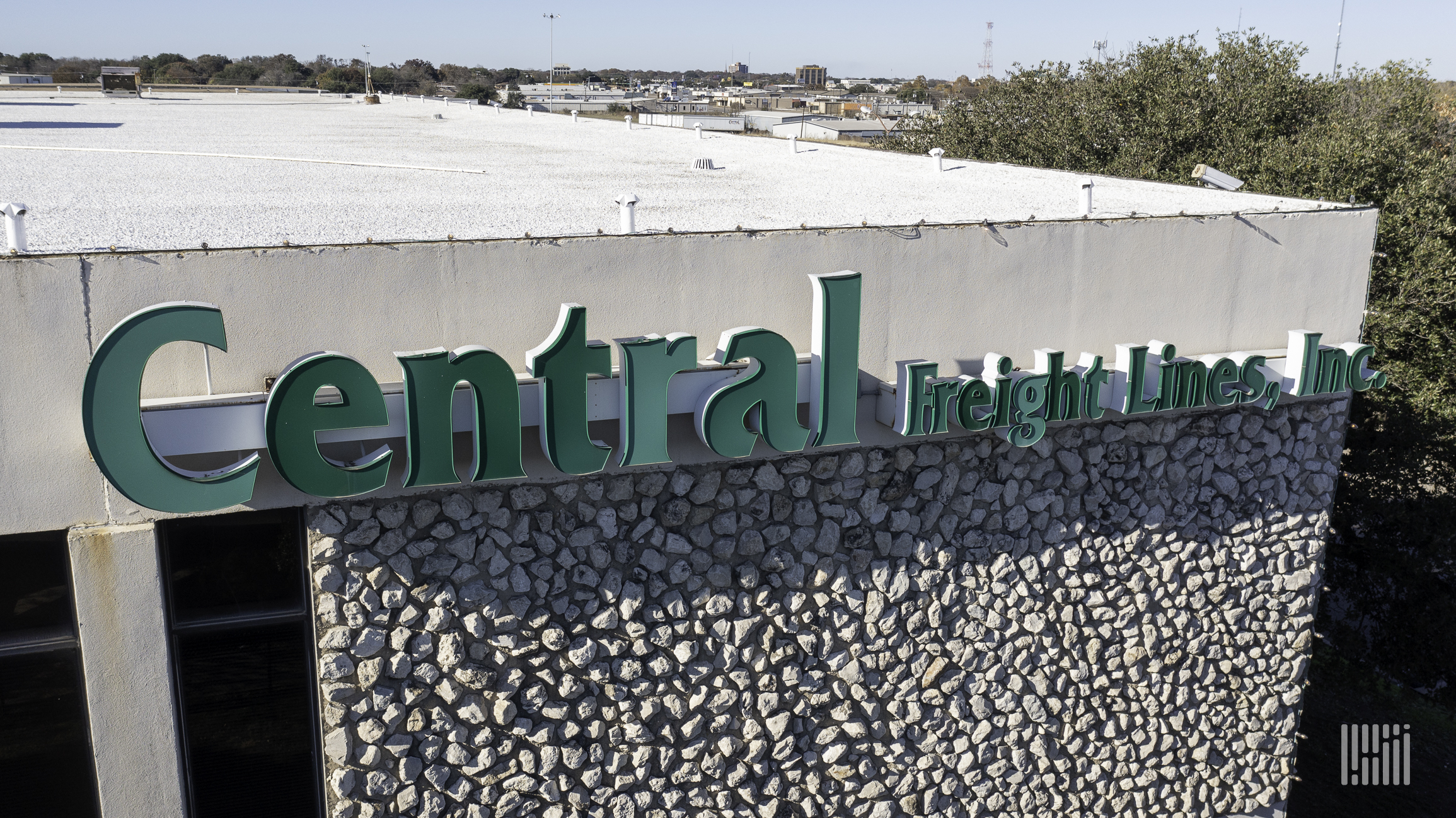
Exclusive: Central Freight Lines to shut down after 96 years

Nearly, 2,100 employees will be laid off right before Christmas. Central Freight Lines is the largest trucking company to close since Celadon ceased operations in 2019.


Waco, Texas-based Central Freight Lines has notified drivers, employees and customers that the less-than-truckload carrier plans to wind down operations on Monday after 96 years, the company’s president told FreightWaves on Saturday.

“It’s just horrible,” said CFL President Bruce Kalem.

A source close to CFL told FreightWaves that CFL had “too much debt and too many unpaid bills” to continue operating, despite exploring all available options to keep its doors open.

Kalem agreed.

“Years of operating losses and struggles for many years sapped our liquidity, and we had no other place to go at this point,” Kalem told FreightWaves. “Nobody is going to make money on this closing, nobody.” 

Central Freight will cease picking up new shipments effective Monday and expects to deliver substantially all freight in its system by Dec. 20, according to a company statement.

A source familiar with the company said he is unsure whether CFL will file Chapter 7 or “liquidate outside of bankruptcy,” but that the LTL carrier has no plans to reorganize.

The company reshuffled its executive team nearly a year ago in an effort to stay afloat, including adding the company’s owner, Jerry Moyes, as CFL’s interim president and chief executive officer. Moyes remained CEO after Kalem was elevated to president in July.

“I think it was surprising that there wasn’t a buyer for the entire company, but buyers were interested in certain pieces but not in the whole thing,” the source, who didn’t want to be identified, told FreightWaves. “Part of it could have been that just the network was so expansive that there was too much overlap with some of the buyers that they didn’t need locations or employees in the places where they already had strong operations.”

Third-party logistics provider GlobalTranz notified its customers that it had removed CFL as “a blanket and CSP carrier option immediately, to prevent any new bookings,” multiple sources told FreightWaves on Saturday.

CFL, which has over 2,100 employees, including 1,325 drivers, and 1,600 power units, is in discussions with “key customers and vendors and expects sufficient liquidity to complete deliveries over the next week in an orderly manner,” a CFL spokesperson said. Approximately 820 employees are based at the company headquarters in Waco.

Despite diligent efforts, CFL “was unable to gain commitments to fund ongoing operations, find a buyer of the entire business or fund a Chapter 11 reorganization,” another source familiar with the company told FreightWaves.

Kalem said the company had 65 terminals prior to its decision to shutter operations. 

FreightWaves received a tip from a source nearly two weeks ago that CFL wasn’t renewing its East Coast terminal leases but was unable to confirm the information with CFL executives. 

Another source told FreightWaves that some of the LTL carrier’s West Coast terminals had been sold recently, but that no reason was given for the transactions.

At that time, Kalem said the company was “working to find alternatives” and couldn’t speak because of nondisclosure agreements. He said executives at CFL, including Moyes, were trying to do everything to “save the company.”

“Jerry [Moyes] pumped a lot of money into the company, but it just wasn’t enough,” Kalem said.

Kalem said he’s aware that a large carrier is interested in hiring many of CFL’s drivers but isn’t able to name names at this point. 

“Central Freight is in negotiations to sell a substantial portion of its equipment,” the company said in a statement. “Additionally, Central Freight is coordinating with other regional LTL carriers to afford its employees opportunities to apply for other LTL jobs in their area.”

As of late Saturday night, Kalem said fuel cards are working and drivers will be paid for freight they’ve hauled for the LTL carrier until all freight is delivered by the Dec. 20 target date.

“I’m going to work feverishly with the time I have left to get these good people jobs — I owe it to them,” Kalem told FreightWaves. “We are going to pay our drivers — that’s why we had to close it like we’re doing now. We are going to deliver all of the freight that’s in our system by next week, and we believe we can do that.”

During the outset of the pandemic, Central Freight Lines was one of four trucking-related companies that received the maximum award of $10 million through the U.S. Small Business Administration’s Paycheck Protection Program (PPP). This occurred around the time that CFL drivers and employees were forced to take pay cuts, a move that didn’t go over well with drivers.

“It all went to payroll,” Kalem said about the PPP funds. “Yes, our employees and drivers did take a pay cut over the past few years, and we gave most of it back, even raised pay over the past several months, but it just wasn’t enough to attract drivers.”

FreightWaves staffers Todd Maiden, Timothy Dooner and JP Hampstead contributed to this report.


Watch: Central Freight Lines’ impact on the LTL market


FreightWaves CEO and founder Craig Fuller reacts to the Central Freight Lines news:

“With Central struggling for many years and unable to reach profitability, it makes sense that they would want to liquidate while equipment and real estate are fetching record prices.”


Central Freight Lines statement

Here is the statement given by Central Freight Lines to FreightWaves late Saturday after reports surfaced of its impending closure:

“We make this announcement with a heavy heart and extreme regret that the Company cannot continue after nearly 100 years in operation. We would like to thank our outstanding workforce for persevering and for professionally completing the wind-down while supporting each other. Additionally, we thank our customers, vendors, equipment providers, and other stakeholders for their loyalty and support.

“The Company explored all available options to keep operations going. However, operating losses sapped all remaining sources of liquidity, and the Company’s liabilities far exceed its assets, all of which are subject to liens in favor of multiple creditors. Despite diligent efforts, the Company was unable to gain commitments to fund ongoing operations, find a buyer of the entire business, or fund a Chapter 11 reorganization. Given its limited remaining resources, the Company concluded that the best alternative was a safe and orderly wind-down. As we complete the wind-down process, our primary goal will be to offer the smoothest possible transition for all stakeholders while maximizing the amount available to apply toward the Company’s obligations.

“Central Freight is in negotiations to sell a substantial portion of its equipment. Additionally, Central Freight is coordinating with other regional LTL carriers to afford its employees opportunities to apply for other LTL jobs in their area. Discussions are ongoing and no purchase of assets or offer of employment is guaranteed.”


Brief history of Central Freight Lines

1925Founded in Waco, Texas, by Woody Callan Sr.
1927Institutes regular routes in Texas between Dallas, Fort Worth and Austin.
1938Dallas facility opens as world’s largest freight facility.
1991Receives 48-state interstate operating authority, expands into Oklahoma.
1993Joins Roadway Regional Group and begins service in Louisiana.
1994Expands into Colorado, Kansas, Missouri, Illinois and Mississippi.
1995Consolidation of Central, Coles, Spartan and Viking Freight Systems into Viking Freight Inc. is announced. Central’s Waco corporate HQ starts closure.
1996Becomes the Southwestern Division of Viking Freight Inc.
1997Investment group led by senior Central management purchases assets of former CFL from Viking Freight and reopens as a new Central Freight Lines.
1999Expands into California and Nevada.
2009CFL Network provides service to Idaho, Utah, Minnesota and Wisconsin.
2013Acquires Circle Delivery of Tennessee.
2014Acquires DTI, a Georgia LTL carrier.
2017Acquires Wilson; new division created with an increase of 80 terminals.
2020Wins Carrier of the Year from GlobalTranz.
Acquires Volunteer Express Inc. of Dresden, Tennessee.
Source: Central Freight Lines

Warehouse cramming is about to begin — Freightonomics

nVision Global, is a leading Global Freight Audit, Supply Chain Management Services company offering enterprise-wide supply chain solutions. With over 4,000 global business “Partners”, nVision Global not only provides prompt, accurate Freight Audit Solutions, but also providing industry-leading Supply Chain Information Management solutions and services necessary to help its clients maximize efficiencies within their supply chain. To learn more, visit www.nvisionglobal.com

Warehouse space is at a premium right now and with peak season right around the corner, shippers are starting to scramble for space. 

Zach Strickland and Anthony Smith look into what shippers are doing to prepare for the end-of-year crunch. They welcome Zac Rogers from Colorado State University to the show to talk through the industry tightness. 

The three also talk about the latest Logistics Managers Index results and what they mean for the fourth quarter of 2021. 

You can find more Freightonomics episodes and recaps for all our live podcasts here.

Seasonality pushing rejections and rates higher ahead of the Fourth

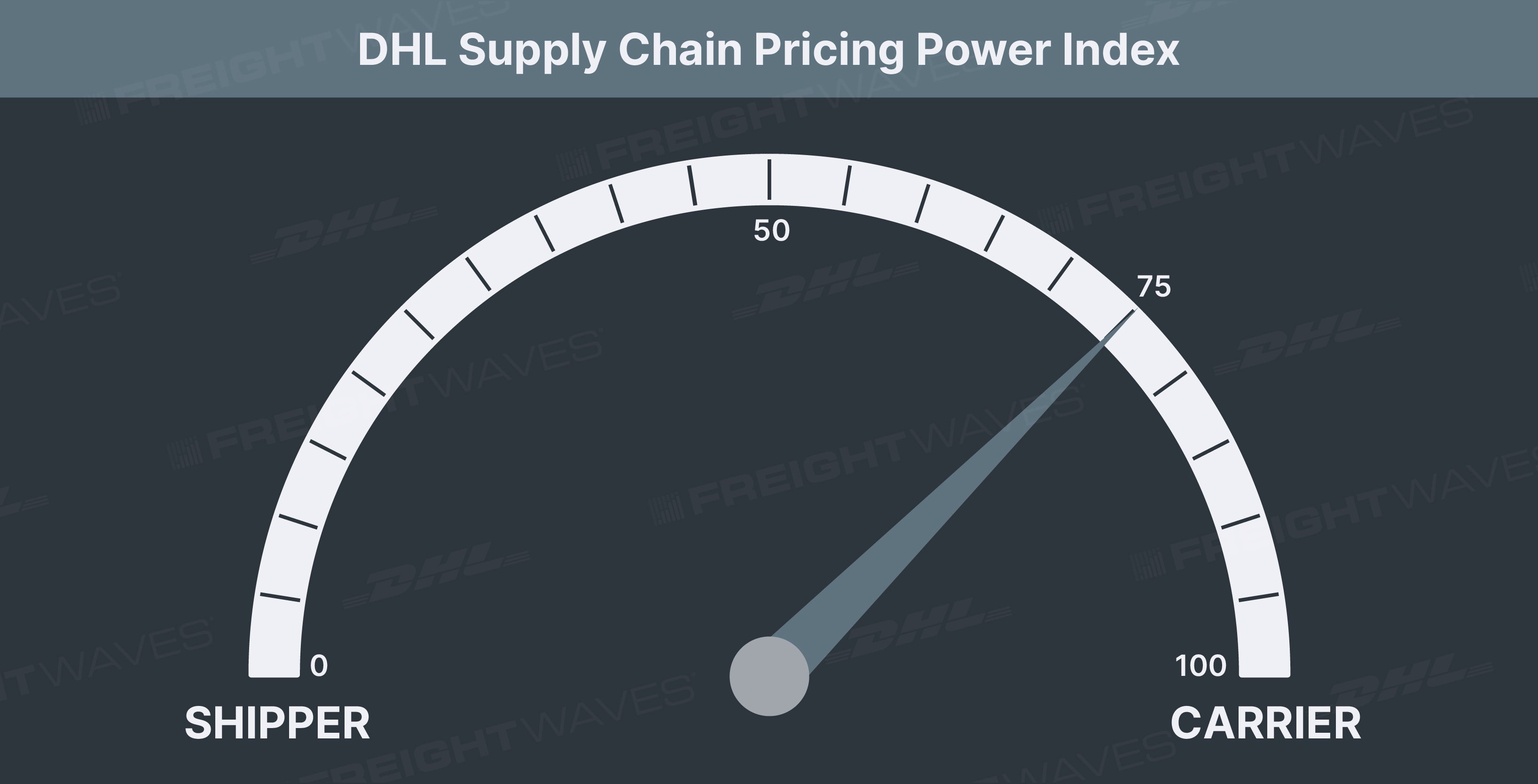
This week’s DHL Supply Chain Pricing Power Index: 75 (Carriers)

Last week’s DHL Supply Chain Pricing Power Index: 70 (Carriers) 

Three-month DHL Supply Chain Pricing Power Index Outlook: 70 (Carriers)

The DHL Supply Chain Pricing Power Index uses the analytics and data in FreightWaves SONAR to analyze the market and estimate the negotiating power for rates between shippers and carriers. 

The Pricing Power Index is based on the following indicators:

Load volumes: Absolute levels positive for carriers, momentum neutral

The Outbound Tender Volume Index at 15,980 is nominally higher now than basically at any point in the past 12 months with the exception of the week prior to Thanksgiving/Black Friday last year. OTVI captures all electronic tenders, including rejected ones, so when accounting for the rejection rate, we can get an even more accurate look at volumes. 

OTVI rose through the back half of May into the national holiday and has risen even further since. Throughout the back half of May and into the middle of June, tender rejections declined substantially. Meaning, current volume throughput is actually understated when comparing OTVI now to OTVI in November 2020. After adjusting for rejected tenders, the accepted outbound tender volume index is just 2.2% below the 2020 peak in November. At that time, OTVI surged towards 17,000, but the rejection rate moved in-kind towards its natural ceiling of 28%. So, the total accepted freight tenders in mid-June is comparable to the peakiest of peak seasons in 2020. Incredible. 

However, since the middle of June, tender rejections have begun increasing again heading into Independence Day, a time when many drivers spend time off the road with their families. The move higher in OTVI this week has been driven primarily by higher rejection rates, rather than higher freight demand. 

Over the past month, the drivers of freight volumes have continued to be imports and from just about every port. The west coast continues to provide seemingly non-stop container ships, while Houston, New Orleans, Miami and Savannah are seeing very strong throughput as well. 

It is van volumes that are driving freight markets higher right now. The Reefer Outbound Tender Volume index has tumbled 25% since its all-time high in the weeks after the polar vortex in February. Since Memorial Day, ROTVI has fallen another 10.5%. This is likely a factor of declining grocery demand, but I would expect the trend to reverse course in the near future as summer festivities accelerate. 

Dry van volumes pushed higher in the back half of May and into June while reefer volumes have declined significantly. 

SONAR: VOTVI.USA (Blue); ROTVI.USA (Green)

The congestion at our nation’s ports has spread from Los Angeles and Long Beach to Oakland, California. The California coastline is a parking lot of container ships, most of which are full to the brim with imports, awaiting berth. As detailed in the economic section, there are some signs that the reversion is underway with Americans paring back spending on pandemic superstar categories in favor of airlines, lodging and entertainment. But spending remains strong despite the moderation, and low inventory levels offset much of the decline that will occur from slowing demand. Real inventories are 3% higher now than pre-pandemic, but real sales growth is far outpacing inventory growth, leading to the lowest inventory-to-sales ratio in decades. 

On the manufacturing side, the ISM Manufacturing PMI expanded in May after declining in April. We’ve been in expansionary territory for 12 consecutive months. New orders, production, imports/exports and employment are all growing. The major issues should come as no surprise: Deliveries are slowing, backlogs are growing and inventories are too low. 

In all, there are many, many catalysts to keep freight demand strong for the foreseeable future. Americans are traveling and spending on services at a high clip, but the high savings rate is enabling it to occur without a massive detriment to goods spending. 

SONAR: OTVI.USA (2021 Blue; 2020 Green; 2019 Orange; 2018  Purple)

Tender rejections: Absolute level and momentum positive for carriers

After declining steadily from mid-March to mid-May, the Outbound Tender Reject Index has reversed course heading into Independence Day. This is typical for a national holiday as carriers selectively choose loads to bring drivers closer to home. OTRI now sits above 25% for the first time in June. 

One of our newest indices in SONAR gives us the ability to compare markets on as close to an apples-to-apples basis as possible. FreightWaves’ Carrier Trend Market Score indices are divided into two perspectives – shipper/broker and carrier. The scores are positioned on a scale from 1-100 and have values measuring van and refrigerated (reefer) capacity. The higher values represent more favorable trends for whichever perspective. For instance, a value near the high-end of the range would suggest very favorable conditions for carriers in our carrier capacity trend score index. 

For the past several weeks, capacity disparities have been driven by import volumes. The markets with the tightest carrier capacity coincide with the nation’s busiest ports. Ontario, California, Savannah, Georgia, and Atlanta all have carrier capacity trend market scores of 100. 

SONAR: Capacity Trend Market Score (Carriers – VAN)

By mode. Reefer rejection rates tumbled from it’s all-time high in March to under 35% in mid-June before popping higher over the past two weeks. Reefer rejections are still quite high from a historical standpoint at 38%, but are significantly lower than just three months ago when reefer carriers were rejecting half of all electronically tendered loads. 

SONAR: VOTRI.USA (Blue); ROTRI.USA (Orange)

Dry van tenders make up the majority of all tenders, so the van rejection rate mirrors the aggregate index closely. Van rejections have surged from ~23% to ~26% over the past two weeks. 

Yes, one-in-four loads being rejected is not ideal, but it’s better than 30%. I am unaware of any meaningful signals that capacity is being added at a rate that would change my outlook. With so many catalysts for demand, and many constraints on drivers including the Drug & Alcohol Clearinghouse, driver training school closures and continued government unemployment benefits, the outlook is tight throughout this year and into 2022. That’s not to say we won’t see improvement as consumers revert to pre-pandemic spending habits and drivers enter or reenter the market. But I’m not expecting any quick reversal of this environment; there are simply too many catalysts driving volume and suppressing capacity. 

SONAR: OTRI.USA (2020/21 Blue; 2020 Green; 2019 Orange)

Freight rates: Absolute level and momentum positive for carriers

Throughout June, spot rates have moderated while contract rates have pushed higher. The Truckstop.com dry van rate per mile (incl. fuel) has fallen from $3.21 to $3.11 since the beginning of June, while FreightWaves van contract rates have risen from $2.50 to $2.59/mile, exclusive of fuel. 

I still believe the Truckstop.com dry van national average will not retest the post-vortex surge pricing that brought spot rates up to an all-time high of $3.30. But, there aren’t many catalysts to bring spot rates down anytime soon either. Demand is unwavering with continued strong consumer goods demand, humming industrial recovery and a potentially cooling, yet still sizzling, hot housing market. And carriers can’t fill enough trucks to keep up with demand. 

Prior to the seasonal movements we’re seeing in tender rejections, routing guides generally had been improving through Q2. We should continue to see a convergence between spot and contract rates, but spot rates will remain historically very elevated throughout the summer as demand simply outstrips capacity. 

SONAR: TSTOPVRPM.USA (Blue); VCRPM1.USA (Green)  

Economic stats: Momentum and absolute level neutral

Several economic releases this week are worth noting.

Weekly jobless claims were released Thursday and give us one of the best close-to-real-time indicators of the overall economy.  This week, the data was again very promising as the labor market continues on a bumpy but trajectorially stable recovery path. 

First-time filings totaled 411,000 for the week ended June 19, a slight decrease from the previous total of 418,000 but worse than the 380,000 Dow Jones estimate, the Labor Department reported Thursday. Initial claims have held above 400,000 for consecutive weeks after falling to a pandemic low of 374,000 three weeks ago. As things stand, the current level of initial claims is about double where it was prior to the Covid-19 pandemic. 

The good news on the jobs front is that continuing claims are on the decline, falling to 3.39 million, a drop of 144,000. That number runs a week behind the headline claims total.

Initial jobless claims (weekly in May 2020-May 2021)

At the time of writing, the newest weekly data for the week ending May 29 had not been updated in SONAR. This week, claims fell from 405,000 to 385,000. 

SONAR: IJC.USA

Consumer. Turning to consumer spending, as measured by Bank of America weekly card (both debit and credit) spending data, total card spending (TCS) in the latest week accelerated to 22% over 2019. This is the first time in June that TCS has topped 20% over 2019, but spending has been running up 16-19% consistently on a two-year comp for months. For contect, the average pre-pandemic two-year growth rate was about 8% (from 2012 to 2019). 

The Bank of America team highlighted service spending in the nation’s two largest state economies, California and New York, which are now fully reopened. Spending at restaurants is now well above 2019 in both states, and the team believes there is more capacity for spending to accelerate in the states that were slower to reopen given pent-up demand. 

There was also a notable acceleration in spending on clothing this week, according to Bank of America. It could be a reversal from some softening in the early weeks of June, or an indication of people refreshing wardrobes ahead of a return to work, more travel and vacations. One tepid statement for freight markets from this week;s report: Leisure spending is on the rise and durable goods spending is flatlining.  

FreightWaves’ Flatbed Outbound Tender Reject Index, both a measure of relative demand and capacity, moves directionally with the ISM PMI. 

SONAR: ISM.PMI (Blue); FOTRI.USA (Green) 

Manufacturing. Over the past two weeks, regional manufacturing surveys have reported generally positive readings amid logistical challenges. The New York Fed’s Empire State business conditions index declined 6.9 points to 17.4 in June, retreating from strong readings the past two months. The Empire State Index is a diffusion index with a baseline of zero; any reading above zero indicates improving or expansionary conditions. 

Delivery times lengthened to a new record during the month, new orders and shipments fell, and inventories entered negative territory. The supply chain and transportation challenges are as visible upstream as downstream, but overall the manufacturing sector is handling. Growth continued throughout the second quarter in both the Empire State and Philly Fed indices. 

The Philadelphia Federal Reserve’s business activity index edged lower to a still robust 30.7 in June from 31.5 in the prior month. Unlike NY, the pace of shipments growth accelerated in the Philly region during June. The employment subcomponent rose to a very healthy 30.7 from 19.3 last month, the regional bank said. 

Record-long lead times, wide-scale shortages of critical basic materials, rising commodities prices and difficulties in transporting products are continuing to affect all segments of the manufacturing economy, but demand remains strong. 

For more information on the FreightWaves Freight Intel Group, please contact Kevin Hill at khill@www.freightwaves.com or Andrew Cox at acox@www.freightwaves.com.

Check out the newest episodes of our podcast, Great Quarter, Guys, here.

Project44 acquires ClearMetal to strengthen predictive tools

Project44, a leader in real-time visibility of the global supply chain, announced on Thursday it has acquired ClearMetal, a San Francisco-based supply chain planning software company that focuses on international freight visibility, predictive planning and overall customer experience. The terms of the acquisition were not disclosed.

ClearMetal, founded by top software engineers and data scientists from Stanford, Google and other Silicon Valley elites, has created a “continuous delivery experience” that leverages proprietary machine learning algorithms that can forecast supply chain disruptions. 

In an interview, Jason Duboe, chief growth officer at project44, explained that bringing in ClearMetal’s elite team is essential for the company’s future predictive solutions.

“Their team construct is fundamentally different. When you look at their data science, machine learning and computer science background, they are best in class,” he said. “Applying the team to solve really interesting challenges, starting with highly predictive ETA and deeper exception management to create more predictive analytics is really a key component here.”

Project44 recently acquired Ocean Insights to gain global supply chain vessel visibility and has announced it has expanded its truckload tracking services within Asia. Bringing on this new team of engineers will allow the company to capitalize on strong predictive tools, strengthening the supply chain of its customers.

“We’re going to be expanding deeper into Asia, and from a port perspective, getting data much earlier than competitors,” explained Duboe. “Our freight forwarder integrations will give us much deeper visibility from an end-to-end perspective in these regions.”

Along with the acquired skills the ClearMetal team will bring to project44, it brings a large book of customers, including large CPGs, retailers, manufacturers, distributors and chemical companies. These advanced use cases will strengthen the predictive planning tools, and project44 continues to expand into different customer markets.

“What we gain from ClearMetal is a holistic platform for anybody that joins the platform in the future,” said Duboe. “They have large customers with incredibly demanding and advanced use cases. So when it comes to order and inventory, functionality, supplier onboarding, and moving upstream into those processes, we can capture exceptions earlier on.”

Click here for more articles by Grace Sharkey.

Related Articles:

Project44 expands real-time visibility into China

Project44 reels in Ocean Insights in ‘largest acquisition in visibility space’

‘Project44’s vision has always been global’

The Non-Domicile CDL Final Rule Isn’t Perfect. It’s Still a Win.

Yesterday I wrote about the final rule Secretary Duffy signed restricting non-domiciled CDL issuance. I said it was a win. Many people disagreed with me. Some of them loudly. Some of them personally. I expected that. I also expected that most of the people telling me I was wrong had never been hit by an illegal truck driver. I have.

On a two-lane highway in Mecklenburg County, Virginia, I was struck by a driver named “GD” Gonzalez operating an unmarked, unregistered 1989 Ford farm truck with no plates and no lights on a Virginia state route. The vehicle weighed over 26,000 pounds and was hauling more than 1,500 gallons of liquid fertilizer. The driver had no license. Not an expired license. Not a suspended license. No license at all. He was brought to this country under agricultural exemptions and put behind the wheel of a commercial vehicle under a V-6 farm use exemption that Virginia has long allowed to exist without meaningful oversight. It cost more than two million dollars in insurance just to put me back together.

I could not walk for eight months. I could not control basic bodily functions. My body is full of metal. That is not a metaphor. That is titanium and surgical steel holding together what a fertilizer truck tore apart. The rest of my life will be shaped by what happened on that road, and every time someone tells me I should be angrier about yesterday’s rule not going far enough, I want them to understand something. I am angry. I have been angry for years. Anger without strategy is just noise, and noise does not get rules signed.

So let me explain what actually happened yesterday and why it matters, because a lot of people are reacting to what they wish had happened instead of understanding what did happen and why it happened the way it did.

The final rule eliminates Employment Authorization Documents as a pathway to a non-domiciled CDL. That is done. Over. If you show up at a DMV with an EAD and nothing else, you are not getting a commercial license. The rule restricts non-domiciled CDL eligibility to three specific visa categories. H-2A, which covers temporary agricultural workers. H-2B, which covers temporary non-agricultural workers. And E-2, which covers treaty investors. These are visa classes that already go through enhanced federal vetting before the person ever sets foot in this country. That is the critical piece. The problem was never that foreign nationals were driving trucks. The problem was that foreign nationals with completely unverifiable backgrounds were driving trucks because nobody checked anything about them beyond a work permit that was never designed for transportation safety screening.

The rule also requires every state to run applicants through the SAVE system, which is the federal immigration status verification database operated by USCIS. If SAVE cannot confirm your lawful status, you will not get a CDL. No workaround. No state discretion. Hard stop. Applicants must present an unexpired foreign passport and their I-94 documentation. Not a photocopy. Not an expired document. The real thing.

The part that bothers people, and I understand why. There are roughly 200,000 non-domiciled CDL holders currently operating in the United States. FMCSA’s own analysis suggests that 97 percent of them will not qualify under the new requirements. That means roughly 194,000 drivers will age out of the system when their current licenses expire. They are not being pulled off the road tomorrow. They will continue driving until their credentials expire. Most of these licenses will expire within the next five years, but the decline is uneven. We expect to lose between 30,000 and 40,000 non-domiciled drivers from the commercial driver pool each year as licenses come up for renewal and those drivers cannot meet the new standard.

That means, for the next several years, there will be drivers on the highway who will not qualify for a CDL under the rule signed yesterday. Some of those drivers will be involved in crashes. Some of those crashes will be fatal. That is the reality, and I am not going to pretend it is not a concern because it absolutely is. If I had my way, every single one of them would be off the road right now. But I do not get to have my way. None of us do. That is not how this works.

We live in a country that is more politically divided than at any point in my lifetime, and I am in my mid-forties. I have seen political disagreement. I grew up with it. But what we have now is not disagreement. It is two fundamentally different ideologies operating on two fundamentally different sets of assumptions about what this country should be, and those ideologies are so entrenched and so hostile to each other that compromise on anything has become nearly impossible. The center is gone. There is no moderate position that both sides can live with on most issues, and immigration policy tied to commercial transportation is one of those issues.

We watched this play out in real time. Last year, Secretary Duffy issued an emergency declaration to end non-domiciled CDL issuance entirely. It was the right call. It was also immediately challenged in court. States sued. Advocacy groups sued. The D.C. Circuit Court of Appeals issued a stay in November that prevented the interim final rule from taking effect. The administration’s own lawyers could not produce the crash data tying immigration status directly to crash causation because that data does not exist in any form that satisfies a federal court. We all know from the frontline that unvetted drivers with unknown backgrounds are dangerous. We know it because we see it every day. But knowing something and proving it in court with data that meets evidentiary standards are two completely different things, and we spent six months and millions of dollars learning that lesson the hard way.

So what did the administration do? They regrouped. They went through the proper rulemaking process. They built a record. They collected public comments. They documented the audit findings from California, Pennsylvania, Minnesota, North Carolina, and every other state where systemic noncompliance was identified. They cataloged the fatal crashes. They built the legal foundation that the emergency declaration lacked. And they got a final rule signed that will survive judicial review because it was done correctly.

That is a strategy. That is how you win battles in a system that requires legal justification for regulatory action. You do not get to just declare something an emergency and expect it to stick when the other side has lawyers and judges and a political apparatus designed to challenge everything you do. You build your case. You follow the process. You get it done right, so it doesn’t get thrown out six months later.

I deeply respect people like Shannon at American Truckers United who are pushing hard for more. They should push. We all should. But pushing for more and dismissing what we got are not the same thing, and treating yesterday’s rule as a total loss because it did not immediately remove 200,000 drivers from the road is not just inaccurate. It is counterproductive. It demoralizes the people fighting for us. It gives ammunition to the people fighting against us. It ignores the reality that getting anything done in this political environment is an accomplishment.

The ATA has been lobbying in Washington for decades. They have the ATRI data arm producing research to support their policy positions. They are as well-connected in government and in this industry as anyone. And they still do not get everything they want. Some of their initiatives have been stuck in legislative limbo for years. If the most powerful trade association in trucking cannot push through every policy it supports despite having the data, the relationships, and the money, what makes anyone think that a single executive action was going to eliminate non-domiciled CDLs overnight without a fight?

A war is not won overnight. You fight battles. You win some. You lose some. You regroup, and you fight the next one. That is what happened here. The emergency declaration was a battle we fought and lost on procedural grounds. The final rule is a battle we fought and won. We have three more years of this administration. There are more battles to fight. TPE fraud. CDL mills. Chameleon carriers. The Training Provider Registry. English language enforcement. These are all fronts in the same war, and if we burn ourselves out screaming about what we did not get instead of building on what we did, we are going to lose ground we cannot afford to lose.

I want to be clear about where I come from on this because people keep questioning my perspective. I have held a CDL for over 25 years. I have been a truck driver, a freight broker, a fleet owner, and a fleet manager. I have scaled private equity fleets with 20 DOT numbers and thousands of vehicles. I have helped Fortune 500 companies from here to Luxembourg build their safety systems and compliance processes. I am a trained crash reconstructionist and risk control consultant. My primary role right now is serving as an expert witness in highway accident litigation. I look at MCMIS data, NTSB records, and crash reports almost every day of my life. I have reported on crashes like Pruitt, Alabama, where eight children were burned alive. I get it. I get it personally because a truck driven by an illegal immigrant nearly killed me. I get it professionally because I see the data and the aftermath every single day.

I am probably one of the few American truck drivers who has been hit by an illegal truck driver and had his life permanently altered by it. 

Every year, 30,000 to 40,000 non-domiciled drivers will be removed from the commercial driver pool under this rule. That is 30,000 to 40,000 drivers who will no longer be operating 80,000-pound vehicles on highways where your family drives. That is a win. It is not the whole win. It is not the win we wanted. But it is a win, and if you cannot see that, I would respectfully suggest you have never had to learn how to walk again because someone who should not have been behind the wheel put you in a hospital for the better part of a year.

Rome was not built in a day. This disaster in our trucking industry was not built in a day or in one administration. It has been decades in the making. Fixing it will take sustained effort, strategic thinking, and the willingness to accept progress even when it falls short of perfection. Yesterday was progress. Significant, meaningful, legally durable progress. We should build on it. Do not burn it down because it was not enough.

Keep up the good fight.

The Loophole That Killed 30 People Just Got Closed. Now What?

The photo is where this started. Today was the beginning of the end. Transportation Secretary Sean Duffy signed a final rule that closes the door on one of the most dangerous regulatory failures in modern trucking history. The rule eliminates the use of Employment Authorization Documents as proof of CDL eligibility, restricts non-domiciled licenses to a narrow set of visa categories that actually involve interagency vetting, and requires states to run every applicant through the SAVE verification system. It is the right move. It is also years too late.

How We Got Here

The American CDL system was designed with a basic premise. You show up, you prove who you are, the state checks your driving history against national databases, and if you’re clean, you get your license. That system works reasonably well for U.S. citizens and lawful permanent residents because the data exists. Your violations, DUIs, crash history, and suspensions are all stored in interconnected databases that every state DMV can query. For foreign nationals, the system had a massive blind spot. States were issuing what are called non-domiciled CDLs to people who presented Employment Authorization Documents. An EAD is a work permit. That is all it is. It tells you someone has authorization to be employed in the United States. It tells you absolutely nothing about whether that person has ever driven before, whether they have a history of reckless driving in their home country, whether they’ve been involved in fatal crashes overseas, or whether their foreign license was even legitimately obtained. More than 30 states were doing this. Not five. Not ten. More than 30 states were issuing commercial driver’s licenses to operate tractor-trailers, tankers, hazmat loads, and passenger buses, based on a document never designed for transportation safety screening. FMCSA knew about it. The states knew about it. The industry knew about it. Nobody did anything until the body count got high enough to make headlines. We covered the chameleon carrier networks that exploit these gaps. We covered the CDL mills churning out licenses to people who couldn’t pass a pre-trip inspection if their life depended on it. We covered government-funded workforce programs that were funneling individuals with no trucking experience into CDL programs with minimal oversight. We documented the Third-Party Examiner fraud pipeline in states such as California, New York, and Colorado. None of this is new information to anyone who has been paying attention. What is new is that we have an Administration in Washington that is acting on America First. On Trucking First. On American Drivers First.

What the Rule Actually Does

First, Employment Authorization Documents are a pathway to a CDL. Gone. Over. If you present an EAD at a state DMV with nothing else, you will not receive a commercial license. Period. The EAD was never meant to serve as a transportation safety document, and it should never have been treated as one. Second, non-domiciled CDL eligibility is now limited to three specific visa categories. H-2A agricultural workers, H-2B temporary non-agricultural workers, and E-2 treaty investors. These are visa classes that already undergo enhanced interagency vetting, meaning the federal government has reviewed these individuals before they arrived. That is the critical distinction. The problem was never that foreign nationals were driving trucks. The problem was that foreign nationals with unknown backgrounds were driving trucks because no one verified any information about them. Third, applicants must now present an unexpired foreign passport and Form I-94. Not a photocopy. Not an expired document. The real thing. Fourth, and this is the enforcement teeth, every state is now required to run applicants through the SAVE system. That is the Systematic Alien Verification for Entitlements database operated by USCIS. If SAVE cannot confirm your lawful immigration status, you do not get a CDL. There is no workaround. There is no state discretion. It is a hard stop. The rule goes into effect 30 days after publication in the Federal Register.

The Human Cost That Forced Action

Let me put some faces on the data, because numbers alone don’t convey the actual cost of this failure. February 2025. A tunnel on I-80 in Wyoming. A non-domiciled driver triggers a multi-vehicle pileup. Three dead. Twenty injured. Imagine being trapped in a tunnel with burning vehicles, knowing the driver who caused the incident was someone the system never checked. August 2025. The Florida Turnpike. A non-domiciled driver attempts an illegal U-turn on a limited-access highway. Three Americans were killed. An illegal U-turn. On the Turnpike. In a commercial vehicle. That is not a momentary lapse in judgment. That is someone who fundamentally did not understand the rules of the road in this country. October 2025. A California highway. A non-domiciled driver fails to stop for traffic. Eight vehicles. Three dead. December 2025. Ontario, California. A non-domiciled driver runs a marked railroad crossing and collides with a train, killing a crew member. Those are just the ones DOT highlighted today. There are more. Behind each of those crashes is a State Driver’s Licensing Agency that issued a CDL without verifying whether the person behind the wheel had ever caused a fatal crash in their home country. Think about that. We require more verification to rent a car from Enterprise than we do to issue a license to drive an 80,000-pound vehicle through a school zone.

What This Means for Capacity and the Freight Market

This rule will remove drivers from the available workforce. There is no way to sugarcoat that. The estimates vary, but we are talking about tens of thousands of non-domiciled CDL holders who were issued licenses under the old system and will not qualify under the new one. Some of those drivers have been operating safely for years. Some of them are excellent drivers. But the system that credentialed them was broken, and this is the correction. For carriers, especially the mid-size and smaller fleets that rely heavily on non-domiciled drivers, this creates a real and immediate hiring challenge. If you have drivers on your roster holding non-domiciled CDLs issued on EADs, you need to speak with your compliance team immediately. Not next month. Now. Understand the transition timeline. Understand which of your drivers fall under the new eligible visa categories and which do not. Start building your contingency plans because 30 days go fast. For the larger fleets and the publicly traded carriers, this is a capacity-tightening event. A smaller available driver pool means upward pressure on driver compensation, which in turn puts upward pressure on rates. If you are a shipper reading this, understand that this rule, while absolutely necessary for safety, is going to have cost implications. The drivers who remain in the system are going to be better vetted and more qualified, but there will be fewer of them and they are going to cost more. For owner operators and independent drivers who have been playing by the rules their entire careers, this is vindication. You sat through the CDL process. You passed your tests. Your driving history is on file and verifiable. You have been competing for loads against carriers staffed with drivers who were never subjected to the same scrutiny. That competitive imbalance is being corrected.

What This Means for Trucking Companies and Hiring

If you run a trucking company, here is your action list. Audit your driver roster immediately. Identify every non-domiciled CDL holder on your payroll. Determine their visa status. If they hold H-2A, H-2B, or E-2 visas, they are in the clear under the new rule, assuming their documentation is current. If they were credentialed under an EAD, their CDL eligibility will expire. Review your hiring pipeline. If your recruiting operation has been sourcing drivers from communities that relied on EAD-based CDLs, that pipeline is about to dry up. You need alternative sourcing strategies yesterday. Talk to your insurance company. This rule fundamentally changes your risk profile, and it should change it for the better. Carriers that can demonstrate a fully vetted, properly credentialed driver force should be pushing their underwriters for rate recognition. If your insurer doesn’t understand the significance of this rule, find one that does. For the love of everything, stop relying on the warm-body theory in driver recruitment. This industry’s obsession with filling seats regardless of qualifications is exactly what created the conditions for 30 states to hand out CDLs like candy. A qualified driver is more expensive than a warm body. A qualified driver is also less likely to kill someone on the Florida Turnpike.

What This Means for Drivers

If you are a non-domiciled CDL holder reading this and you are here legally on an H-2A, H-2B, or E-2 visa, take a breath. You are fine. Make sure your documentation is current. Make sure your passport is not expired. Make sure you have your I-94. When it’s time to renew your CDL, SAVE verification will be part of the process. If your status checks out, you keep driving. If you are a non-domiciled CDL holder who obtained your license using an EAD and you do not hold one of the three qualifying visa types, this rule directly affects you. I am not going to tell you what to do legally because I am not an immigration attorney. I will tell you that you need to speak with one. Quickly. Understand your options. Understand the timeline. Understand that driving on a CDL that is no longer valid is not an option. The enforcement on this is going to be aggressive and the penalties are going to be severe. If you are an American CDL holder or a lawful permanent resident who has been following this situation, this rule means the playing field has just leveled. Your credentials carry weight. Your clean driving record has value. Carriers that need qualified, vetted drivers will compete more aggressively for your services. Leverage that.

What This Means for Shippers

If you ship freight, safety costs money. It always has. The years of artificially cheap capacity that was partially built on an unvetted driver workforce were always going to have a correction, and this is it. In the short term, expect tightening in certain lanes and regions where non-domiciled drivers were heavily concentrated. Produce corridors. Agricultural hauling. Regional LTL in states like California, New York, and Texas. Drivers who leave the system are not distributed evenly geographically, so the impact will be felt more acutely in some markets than others. In the medium term, rates will reflect the true cost of a properly credentialed driver workforce. That is not a bad thing. You know what is more expensive than paying a legitimate per-mile rate? A nuclear verdict because your carrier put an unvetted driver behind the wheel and someone died. If you are a risk manager at a company that ships freight, you should be welcoming this rule with open arms. The carriers that survive this transition are going to be safer, better insured, and less likely to generate the kind of catastrophic liability that keeps general counsel up at night. Do your homework on your carrier partners. Ask questions. Verify credentials. The shippers who treated carrier selection like a commodity auction and just went with the cheapest rate are the ones most exposed right now.

Where Do We Go From Here

Secretary Duffy and Administrator Barrs deserve credit for getting this done. This administration has moved faster on CDL integrity than any administration in my memory, and I have been in this industry for over 25 years. The English language enforcement order. The nationwide state audits. The emergency action last summer. Now this final rule. That is a policy arc that demonstrates genuine commitment to fixing a broken system. This rule closes one loophole. There are others. The Third-Party Examiner system remains riddled with fraud. CDL mills are still operating in multiple states. The Training Provider Registry still has thousands of providers that have never been meaningfully audited. States like California continue to resist federal enforcement at every turn. The chameleon carrier networks we have been investigating are still operating, folding one DOT number and popping up under another the next day. This rule is a significant and necessary step. It is not the finish line. It is not even halftime. If DOT stops here and declares victory, the same systemic failures that created the non-domiciled CDL crisis will simply migrate to other parts of the system. They always do. Congress needs to codify this. Representative Rouzer’s Non-Domiciled CDL Integrity Act needs to pass so that this rule survives future administrations and future court challenges. Policy by executive action is policy on borrowed time. The industry needs to do its part too. Stop lobbying for lower standards because you can’t find enough drivers at the wages you want to pay. Stop pretending there is a driver shortage when what you really have is a retention and compensation problem. The non-domiciled CDL loophole existed in part because segments of this industry were perfectly happy with a pipeline of cheap labor that asked few questions. That era is over. Adjust accordingly. Thirty people are dead because the system failed. Today’s rule means the system is finally being repaired. The question is whether the industry and the government have the will to finish the job. I’m going to keep watching. I’m going to keep writing about it.

FMCSA finalizes new era for non-domiciled CDLs

WASHINGTON — The Federal Motor Carrier Safety Administration has finalized its sweeping overhaul of non-domiciled regulations by reaffirming the core intent of the 2025 Interim Final Rule (IFR) and introducing key refinements.

The final rule, which becomes effective 30 days after publication in the Federal Register (expected on Friday) preserves the IFR’s most rigorous provisions:

  • Strict Eligibility: Eligibility is limited to H-2A, H-2B, and E-2 nonimmigrant status holders, who undergo enhanced interagency vetting.
  • Elimination of Employment Authorization Documents (EADs): EADs are no longer accepted as proof of eligibility due to systemic noncompliance at the state driver’s licensing agencies (SDLAs). Applicants must present an unexpired foreign passport and specific Form I-94 documentation.
  • Mandatory SAVE Verification: States must query the Systematic Alien Verification for Entitlements (SAVE) system to confirm every applicant’s lawful immigration status.

However, while the IFR took effect immediately in 2025 – a move that contributed to a federal court stay – the final rule adopts a standard 30-day implementation window to allow states to finalize procedural adjustments.

New five-year timeline

Another difference between the IFR and the final rule is FMCSA’s adjusted economic modeling. After auditing thousands of credentials, FMCSA discovered that most properly issued non-domiciled CDLs had five-year terms rather than the two-year terms originally assumed, which has led to a staggered projection for driver exits.

Instead of an immediate capacity fallout, the industry expects a periodic attrition of approximately 40,000 drivers per year over the next five years as their credentials expire. While roughly 200,000 drivers remain impacted, only 6,000 annually are expected to qualify under the restricted H-2A, H-2B, and E-2 visa categories.

FMCSA argues this five-year timeline gives carriers ample time to adjust hiring strategies, and that excess capacity will absorb any sudden shocks to capacity.

“A critical safety gap allowed unqualified drivers with unknown driving histories to get behind the wheel of commercial vehicles,” said FMCSA Administrator Derek Barrs. “We are closing that gap today to ensure that only qualified, vetted drivers are operating on our nation’s roadways. If we cannot verify your safe driving history, you cannot hold a CDL in this country.”

The Owner-Operator Independent Drivers Association, a major proponent of the administration’s crackdown on non-domiciled CDLs, asserted that closing gaps in trucker credentialing system is overdue.

“For too long, loopholes in this program have allowed unqualified drivers onto our highways, putting professional truckers and the motoring public at risk,” commented OOIDA President Todd Spencer in a press statement. “This final rule is a major step toward safer roads, stronger accountability, and a more professional trucking industry.”

Click for more FreightWaves articles by John Gallagher.

Kodiak acquired by QXO: a strategic $2 billion-plus leap in building products

QXO, the Brad Jacobs-led company that has targeted rolling up companies in a fragmented building products industry, has made its second acquisition since it came into existence.

Wall Street immediately gave the acquisition of Kodiak from a private equity firm a gigantic round of applause: QXO (NYSE: QXO) stock rose 16.61% Wednesday, up $3.86 to $27.07. Its closing price was just under its high for the day.

Kodiak will be acquired for $2 billion in cash and 13.2 million QXO shares. When the deal was announced, the total size of the transaction was estimated by QXO to be $2.25 billion. But with the increase in the stock price today, if that were to hold the equity value of the deal would be closer to $2.35 billion.

A QXO spokesman described Kodiak as a “national distributor of essential building products, including lumber, trusses, windows and doors, construction supplies, waterproofing, and roofing, operating 110 locations across 26 states with about 5,500 employees serving more than 10,000 customers.”

Private equity firm Court Square Capital Partners is selling Kodiak to QXO. The deal is expected to close in the second quarter.

Logistics a core strategy

The basic “value prop” behind QXO’s formation after Jacobs began stepping away from LTL carrier XPO (NYSE: XPO) and its various spinoffs, such as 3PL RXO (NYSE: RXO), was that the building supply industry was highly fragmented and a ripe candidate for a rollup. At the heart of the business plan is that a successful rollup could occur not just on size alone but the more efficient logistics that would come from that. 

In a research note, Wells Fargo analyst Sam Reid said of the wait for the second deal after the sole QXO acquisition so far, Beacon Roofing Supply: “We have a deal. After 40+ days of virtually non-stop speculation, there’s finally a transaction.”

The reference to 40+ days is roughly the time since QXO announced it was taking on a significant investment via a preferred share offering from a group of investors led by Apollo Management. That gave the company a much larger stockpile for making acquisitions, eventually totaling $3 billion after a second investment was announced in rapid order after the first in the early days of 2026.

QXO also had a new common stock offering last month. 

Analyst assumed a non-public target would be next

Reid said discussions with QXO in recent weeks led him to conclude that the next transaction would likely be a “non-public asset, a point of consistency throughout our conversations.” He said it was also likely the acquisition target would be a company with “residential housing exposure.”

Reid, who is the senior retail hardlines analyst at Wells Fargo, said the deal “signals transactions are indeed in the works & potentially capitalizes on weak cyclical dynamics.” The reason for those possibly weak conditions, Reid said, is that 40% of Kodiak’s business is in Florida and Texas, which are “among the most challenged” residential housing markets at present. He said the purchase of Kodiak against that background is a “bold contrarian move.”

Reid wrote that QXO’s entry into the building products field inevitably led to the question among investors of “who’s next?”

That sort of speculation, he added, “has distorted public distributor multiples; to that end, today’s news should put some (albeit not all) of this to rest.”

The next target, Reid added, is still likely to be a private company, “keeping public peers off the table.”

More money available for deals

Given the money QXO has raised, Reid said the company still has about $6 billion “in acquisition powder post this transaction, leaving the door open for another few private deals in the coming months.”

In addressing the rationale for the acquisition, a QXO spokesman said Kodiak “triples QXO’s existing market opportunity and expands our total addressable market to over $200 billion, placing QXO in nearly every major building products category.”

“The acquisition moves QXO into lumber, trusses, gypsum, and construction supplies, with complementary fabrication, assembly, and installation capabilities, creating a more complete offering in exterior products and strategic entry points into interior categories and services,” he said in an email to FreightWaves.

And to the point about the QXO plan to use logistics leverage as part of the road to success, he added that “vendor overlap is significant: 16 of Kodiak’s top 20 vendors are shared with legacy Beacon.” 

QXO said the deal would be immediately accretive to its earnings.

More articles by John Kingston

Werner settlement ready to go in drivers’ lawsuit that dates to 2014

Amazon’s LTL offering reaching out to shippers as possible customers: report

Wall Street reacts to Proficient’s earnings: a 25% stock decline

El Paso airspace disruption tests counter-drone preparedness

The Federal Aviation Administration abruptly closed, then reopened the airspace around El Paso International Airport, causing widespread confusion and grounding flights Wednesday morning.

The FAA initially cited “special security reasons” for what would be a 10-day closure announced late Tuesday. However, restrictions were lifted just hours later on Wednesday morning after the FAA stated on social media that there was no threat to commercial aviation and all flights would resume as normal.

U.S. Transportation Secretary Sean Duffy later attributed the closure to a “cartel drone incursion,” adding that the threat had been “neutralized.”

Citing three anonymous sources familiar with the situation, the Associated Press reported that the closure stemmed from a dispute between the Pentagon and the FAA over the military’s plans to test a laser designed to shoot down drones used by Mexican drug cartels.

According to the report, the FAA shuttered the airspace after the Pentagon decided to proceed with the test despite a meeting between the agencies being scheduled for later in the month to coordinate.

FreightWaves reached out to the FAA for comment.

A growing problem

The incident comes as national security concerns grow due to rising drone activity along the U.S.-Mexico border.

In his July 2025 testimony before the Senate Committee on the Judiciary, Steven Willoughby, a director of the Department of Homeland Security’s Counter Unmanned Aircraft Systems Program, stated that transnational criminal organizations use drones “nearly every day” to transport narcotics and surveil law enforcement.

Willoughby testified that in the last six months of 2024, over 27,000 drones were detected within 500 meters of the southern border. He noted these drones are used to smuggle thousands of pounds of narcotics, including a UAS seized in October 2023 that carried enough fentanyl pills to “kill tens of thousands of Americans.”

Drone countermeasures in place

Local military installations have been actively training to address such threats. 

Fort Bliss, the U.S. Army post in El Paso, conducted a large-scale integrated defense exercise in August 2025 that simulated multiple security threats, including a drone incursion, to test its counter-unmanned aircraft systems (C-UAS) protocol. The exercise involved the Fort Bliss Fire Department, Army Criminal Investigation Division agents, and military police.

Soldiers with the 2nd Armored Brigade Combat Team, 1st Armored Division in Fort Bliss, Texas, ready a drone to play the role of an adversary during an integrated protection exercise held at Fort Bliss, Aug. 20, 2025. (Photo: David Poe/Fort Bliss Garrison Public Affairs)

A separate report from the 1st Armored Division noted that Fort Bliss conducted its first advanced C-UAS training exercise in April 2025 in response to a newly assessed UAS threat level. The exercise utilized systems with radar and electromagnetic sensors for surveillance and mitigation.

The sudden airspace closure caused significant disruptions. The New York Times reported that over 1,000 flights were set to be canceled over the would-be closure period. Local officials, including El Paso Mayor Renard Johnson and U.S. Rep. Veronica Escobar, stated they received no advance notice of the shutdown, with Johnson calling the failure to communicate “unacceptable.”

Amazon to expand same-day pharmacy delivery by 80% in 2026

A person puts a prescription drug bottle into an Amazon box for shipping.

Amazon’s digital pharmacy business will expand same-day prescription delivery service to another 2,000 U.S. cities and towns by the end of 2026, bringing fast medication delivery to millions of customers, part of a broader initiative to speed up delivery across all categories, the company announced on Wednesday.

Last week, Amazon promoted how it set a record for delivery speed in 2025, with over 13 billion items arriving the same or next day globally. In the United States, Prime members received more than 8 billion items the same or next day, up 30% compared to the prior year, with groceries and everyday essentials making up half of the total items.

Amazon says its fast, free-delivery service saved its U.S. Prime members from dozens of trips to a physical store last year.

Amazon Pharmacy will offer free same-day delivery to nearly 4,500 areas once the service is fully rolled out by the end of the year. New service areas will include the states of Idaho and Massachusetts, where Amazon noted that pharmacy closures, staffing shortages and transportation barriers have historically limited access to care. 

“Patients shouldn’t have to choose between speed, cost, and convenience when it comes to their medication, regardless of where they live,” said John Love, vice president, Amazon Pharmacy, in a news release. “By combining our pharmacy expertise with our logistics network, we’re removing critical barriers and helping patients start treatment faster — setting a new standard for accessible, digital-forward pharmacy care.”

Amazon Pharmacy customers experienced meaningful delivery improvements in 2025 across a wide range of communities — from dense urban neighborhoods like Manhattan, reached via e-bikes, to suburban areas such as Chesterbrook, Pennsylvania, using electric vehicles, and remote locations like Mackinac Island, Michigan, where prescriptions are delivered by ferries and horses, according to the retailer.

In Los Angeles, One Medical patients were able to pick up medications within minutes using Amazon Pharmacy Kiosks located in the lobby before leaving their primary care office, allowing patients to begin treatment immediately after an appointment. Amazon Pharmacy will continue expanding in-person kiosk access across additional locations in 2026, the company said.

Generally, Amazon Pharmacy customers receive medications the next day or within two to three days. 

Last year, Amazon expanded the geographical reach of its same-day and next-day delivery to more than 4,000 smaller cities, towns and rural areas in 44 states, the result of a $4 billion investment to build out its rural delivery network. 

Amazon said in December that it reached its goal of offering same-day delivery of fresh groceries to 2,300 cities and towns by the end of the year, more than doubling its previous reach. It also began testing 30-minute delivery in Seattle and Philadelphia utilizing micro-fulfillment centers.

The Prime membership program first launched in 2005 offering free two-day delivery on a selection of  one million items, primarily made up of DVDs, CDs, and books. Today, members have access to free delivery on over 300 million items across 35 categories.

Click here for more FreightWaves/American Shipper stories by Eric Kulisch.

Write to Eric Kulisch at ekulisch@freightwaves.com.

Amazon’s same-day grocery delivery serves as magnet for parcel business

Amazon tests 30-minute delivery in two US cities

GXO sees stable North American freight demand, cautious on volumes in 2026

GXO Logistics Inc. sees North America as a big opportunity for organic growth, with executives telling analysts that the U.S. market will be a primary driver of revenue and margin expansion in 2026 and beyond.

CEO Patrick Kelleher described North America as “a primary focus,” citing a total addressable market of roughly $250 billion in the region and what he called “a great foundation of business” across consumer, technology, aerospace and industrial verticals.

“We are underrepresented in North America in contrast to our participation in the U.K. and Europe. We are very confident that we have upside there and we’re executing that to that end,” Kelleher said during the company’s fourth-quarter earnings call on Wednesday.

Greenwich, Connecticut-based GXO Logistics (NYSE: GXO) is one of the largest pure-play contract logistics providers in the world. It has more than 970 facilities totaling approximately 200 million square feet, with a global workforce of more than 130,000 people.

GXO reported fourth-quarter results after the market closed on Tuesday. Quarterly revenue rose 7.9% to $3.5 billion, up from $3.25 billion compared to the same year-ago period. 

Adjusted earnings per share was 87 cents in the fourth quarter, compared 83 cents per share, in 2024. 

The results beat Wall Street expectations for fourth quarter earnings of 83 cents per share and revenue of $3.47 billion.

Executives said North American performance outpaced parts of Europe in the fourth quarter.

“In Q4, our trends in North America and the U.S. were stronger than continental Europe and U.K.,” CFO Baris Oren told analysts. “For 2026, it’s too early to call for the entire year. We just take a flat number for prudence … nothing more than that.”

GXO is assuming flat volumes in 2026 in the existing operations across its network, a conservative macro outlook executives said reflects uncertainty around customer demand. Growth is expected to be driven primarily by new business wins rather than a volume rebound. 

The company exited 2025 with $774 million in incremental revenue already secured for 2026 and a global pipeline of $2.5 billion, up from $2.3 billion at year-end, with particular momentum in strategic verticals such as aerospace and defense, life sciences, and technology, including data center infrastructure. 

Re-energizing the U.S. commercial engine

Kelleher said newly appointed North America leader Michael Jacobs, who stepped into the role three months ago, is reallocating resources toward solution design, sales and digital marketing to improve pipeline conversion in the U.S. 

Executives noted that the contract logistics sales cycle typically runs six to nine months, followed by another several months for operational ramp-up, noting that the acceleration in U.S. growth could materialize in the second half of 2026 and into 2027 

“Our guidance for 2026 accurately reflects stepping into that growth based on the sales and startup cycle, and that has us very excited for 2027 as well,” Kelleher said. 

Outsourcing tailwinds despite macro caution

While some analysts pointed to low U.S. inventories and potential restocking as a possible catalyst for higher warehouse throughput, GXO executives said it was too early to call a broad-based rebound and reiterated their cautious volume outlook for 2026. 

Instead, management is prioritizing organic expansion and continued deleveraging, targeting net leverage of about two times EBITDA by the end of the year. 

“The guidance for this year is assumed on flat volume, and as we consider the overall macroeconomic situation and really anticipate how that is going to materialize, we’ve taken a very conservative view there with respect to current customer volumes,” Kelleher said.

“So the lever for this year is really about organic growth, driving top-line.”

Customers facing cost pressures are increasingly turning to third-party providers that can invest in automation, robotics and artificial intelligence at scale — investments many shippers cannot justify independently, executives said. 

Kelleher described the U.S. as the “epicenter of technological innovation” for the company, particularly as it scales its AI-powered GXO IQ warehouse operating system and experiments with humanoid robotics across sites. 

GXO’s fourth quarter key financial results.

New MOL executive team to succeed CEO

Mitsui O.S.K. Lines (MOL) said that it had appointed a new executive team to succeed Takeshi Hashimoto atop the Japan-based ocean container carrier.

Jotaro Tamura will succeed Hashimoto as president and chief executive, effective April 1, as part of what MOL terms a Cooperative Management System, with new Chief Operating Officer Hisashi Umemura and current Chief Financial Officer Kazuya Hamazaki.

Takeshi Hashimoto (l) and Jotaro Tamura. (Photo: MOL)

Hashimoto had served as president and CEO since 2021, and led implementation of the multi-phase Blue Action 2035 management plan. He will now serve as chairman of the company’s board of directors.

MOL is part of joint venture Ocean Network Express (with NYK and K Line.

“Having successfully navigated Phase 1 (to FY 2025) and established a clear path for large-scale strategic investments, I believe now is the perfect time to transition to a new leadership team for Phase 2 (FY 2026–2030),” Hashimoto said in a LinkedIn post. 

Tamura had worked as senior managing executive officer in global container and liner businesses in Singapore and London. Umemura previously was senior managing executive officer in the energy sector.

“Jotaro has earned deep trust both within the company and across the industry,” said Hashimoto. “I am confident that his leadership will be instrumental in enhancing our human capital and organizational capabilities – the very core of our group’s growth – and driving the next stage of our transformation.”

Find more articles by Stuart Chirls here.

Related coverage:

Asia-U.S. ocean freight rates give up 2026 gains

Red Sea torpedoes Hapag-Lloyd rates

Port of New York-New Jersey box gains shake off trade reset

New CBP vessel rule targets high-risk exports

Annual employment report revision shows huge decline in truck transportation jobs

There were a lot fewer people working in truck transportation in 2025 than initially reported.

The Bureau of Labor Statistics’ (BLS) monthly employment report that is released in February is the first to incorporate the annual revision the agency implements as it gathers more data on employment, a process that goes on long past the agency’s monthly reports.

The annual revision is more sweeping than the monthly short-term revisions that can adjust prior reporting for two months. So, for example, the report that comes out in early September will have first-time data for August, as well as potentially adjusted July and June numbers. After that report, June can’t be revised again until the annual revision; July can only be revised one more time a month later before the annual revision.

There are numerous ways to measure the latest report that is the first to incorporate the annual revision. But they all point to the same conclusion: the BLS monthly estimate for truck transportation jobs in 2025 had been running high. The annual revision cut it down to size.

Difference in estimates widened throughout the year

Comparing the latest report for 2025 to the full 2025 report reported in early January, the gap between what was initially reported and was then revised grew as the year went on.  

For example, truck transportation jobs in January 2025 after its “final” short-term revision stood at 1,532,000 jobs. The annual revision puts it at 1,493,100 jobs, a difference of 26,000 jobs.

By the end of the year, the annual revision puts December at 1,466,900 truck transportation jobs, 46,400 less than what had been reported just a month ago for December.

David Spencer, the director of business intelligence at Arrive Logistics, told FreightWaves in an email that the size of the revisions could have been expected given market conditions.

“At first glance, it is difficult to see these revisions without associating them with the market volatility observed since the end of November,” he said. “Depending on the index, linehaul costs per mile have increased by roughly 25%, or about $0.40 per mile, over that same period. If these revisions are accurate, such a large and sudden drop in employment would strongly support the level of volatility seen over the past two months.”

What is more striking is just how many truck transportation jobs have been lost in recent years, well beyond the comparison of 2025 to 2024. 

The revision is not just for the prior year; it makes changes going further back, though numbers for 2022 or 2023 don’t change that much. The latest report said the peak number of truck transportation jobs was in January 2023, at 1,587,800. 

The revised number for December 2025 is 1,466,900 jobs. In January 2026, that was down to 1,462,600 jobs, a drop of 4,300 in one month, a large figure.

What that means is the difference between the January 2023 peak and the number for last month saw a decline of 125,200 jobs.

Aaron Terrazas, an independent economist, noted the overall gain of 130,000 jobs was better than expected. But it was concentrated in two familiar areas.

“Health care has been a perennial driver of job growth through booms and busts, and construction jobs appear to be driven by work on industrial facilities — most likely data center demand,” he said in an email to FreightWaves. “That is a narrow and fragile base supporting the headline jobs stats.”

Warehouse employment higher than estimated

Meanwhile, data in the BLS report showed the opposite trend for warehouse employment: it was higher in 2025 than first estimated.

For example, warehouse employment for December 2025 was initially reported as 1,791,500 workers. The revised estimate released Wednesday is 1,833,100 jobs, a difference of 41,600 workers. 

However, the trend did show a decline in warehouse employment over the course of the year. Peak employment in that category last year was in February at 1,883,400 jobs. The end of year figure was more than 50,000 jobs less than that.  

The latest revision from earlier years puts peak employment in warehouse employment at 1,939,300 jobs in March 2022.

The preliminary estimate released in September is for the full Transportation and Warehouse sector. Truck transportation, warehouses, rail and other activities are subsets of that number but estimates for those sectors are not provided.

The report estimated that jobs in the Transportation and Warehouse sector would rise by 6,600 jobs. But the number released Wednesday is that between December 2024 and 2025, the total fell by 104,000 jobs. 

More articles by John Kingston

Werner settlement ready to go in drivers’ lawsuit that dates to 2014

Amazon’s LTL offering reaching out to shippers as possible customers: report

Wall Street reacts to Proficient’s earnings: a 25% stock decline

Truck Safety Tip Line Created to Address Safety and Fraud Concerns

Truck driver ELD in the cab.

U.S. Senator Jim Banks of Indiana has launched a new federal reporting initiative aimed at collecting safety-related concerns from within the trucking industry. The Truck Safety Tip Line, now live on his official Senate website, is designed as a centralized channel for drivers, carriers, industry employees and members of the public to submit information related to potential safety violations, fraud or regulatory concerns in commercial transportation.

Banks, who serves on the U.S. Senate Committee on Banking, Housing, and Urban Affairs, announced the initiative publicly and positioned it as a way to increase transparency and accountability within the trucking sector. The portal allows individuals to submit tips directly to his office regarding safety issues tied to commercial motor vehicles, licensing standards and regulatory compliance.

The launch comes amid heightened national attention on trucking safety and commercial driver licensing practices. Over the past year, federal regulators and state enforcement agencies have intensified scrutiny of non-domiciled commercial driver’s licenses, English language proficiency enforcement and alleged fraud schemes involving CDL testing and issuance. Several high-profile enforcement actions and criminal indictments tied to CDL fraud have fueled broader policy discussions in Washington.

The Truck Safety Tip Line appears to be part of that broader oversight conversation.

According to information provided on the Senate website, the tip line is intended to gather reports related to unsafe trucking operations, fraudulent activity, regulatory violations and other safety concerns that may warrant federal review. Submissions are directed to the senator’s office, where they may inform legislative oversight efforts or prompt inquiries to federal agencies such as the Federal Motor Carrier Safety Administration.

The website does not describe the portal as an enforcement mechanism. Instead, it functions as a reporting tool for constituents and industry stakeholders who believe certain safety issues are not being adequately addressed through existing regulatory channels.

Banks has been publicly vocal about trucking safety issues in recent months, particularly around CDL standards and regulatory enforcement. His office has referenced concerns about licensing integrity, vetting processes and oversight gaps that could pose safety risks on U.S. highways. The tip line formalizes a direct pathway for those concerns to be documented and reviewed at the congressional level.

The timing of the initiative aligns with ongoing regulatory developments. In late 2025 and early 2026, the FMCSA issued rulemakings and emergency actions tied to non-domiciled CDLs and enforcement standards. Some states also announced reviews or adjustments to their CDL issuance processes following federal guidance and investigative findings.

Industry debate has intensified around questions of compliance, oversight consistency and the role of federal versus state authority in driver credentialing. Advocacy groups, trade associations and safety organizations have issued statements calling for stronger enforcement in some areas, while others have urged caution against overgeneralization and the risk of stigmatizing lawful drivers.

The tip line does not specify a narrow category of concern. Instead, it broadly invites reports related to trucking safety and regulatory integrity. The online form requests details about the alleged issue, including relevant companies, locations and documentation if available.

From a legislative perspective, congressional tip lines are not uncommon. Lawmakers often use them to collect information that may support hearings, letters to agencies or proposed legislation. In transportation policy, anecdotal evidence and documented complaints can influence oversight priorities and future regulatory proposals.

It remains to be seen how the volume and nature of submissions will shape next steps. Depending on what is reported, the information gathered could contribute to oversight inquiries, requests for data from federal agencies or public statements outlining identified patterns.

The launch also underscores the current level of political focus on trucking safety. Commercial transportation remains a critical component of the U.S. economy, moving the majority of domestic freight. At the same time, high-profile crashes, licensing investigations and enforcement disparities have drawn scrutiny from policymakers across party lines.

Why Senator Banks Pushed for This Now

According to Banks’ public statements, the Truck Safety Tip Line was created in response to growing concerns that unsafe operators and fraudulent actors are exploiting gaps in oversight, particularly as freight markets tighten and competition increases.

Over the past several years, the industry has seen a rise in carrier identity theft and impersonation, increased scrutiny around CDL validity and licensing practices, unsafe operators cycling through new authorities to avoid enforcement, payment disputes tied to fraud rather than performance and public safety incidents that raised questions about accountability. Banks has positioned the tip line as a way to bring sunlight to patterns that drivers and small carriers often recognize long before regulators do.

The portal allows individuals to submit information related to repeated unsafe driving behavior, suspected fraudulent carrier activity, identity theft involving DOT or MC numbers, chronic noncompliance that appears intentional and safety issues tied to specific companies or operations.

Tips submitted through the portal are reviewed and, when appropriate, referred to agencies with jurisdiction. Submissions do not automatically trigger citations, audits or penalties. They are intended to highlight trends rather than punish single mistakes. That distinction is central to how the initiative is being presented.

What the Tip Line Is — and Is Not

The Truck Safety Tip Line is a reporting portal, not an enforcement mechanism. It does not replace FMCSA complaint systems, resolve payment or contract disputes, serve as a shortcut to enforcement, penalize one-off violations or eliminate due process. Tips are evaluated, not assumed to be accurate. Any follow-up action still requires verification and evidence.

The structure reflects an intelligence-gathering approach rather than immediate punishment. Lawmakers often rely on aggregated complaints to identify systemic weaknesses, and this initiative appears designed to capture that kind of information in a centralized format.

Why the Industry Is Paying Attention

The existence of the tip line reflects a broader shift in how trucking oversight is evolving. Safety and fraud issues are increasingly viewed not only as roadside enforcement matters but as systemic issues involving licensing systems, financial practices, digital vulnerabilities and interstate regulatory coordination.

By creating a centralized reporting mechanism, Banks is signaling that policymakers are seeking earlier warning signs, not just post-incident enforcement. Whether the tip line becomes a meaningful oversight tool or remains largely symbolic will depend on how responsibly it is used and how carefully submissions are handled.

The Bigger Picture

The Truck Safety Tip Line did not emerge in isolation. It reflects years of tension within the industry between compliant operators and those accused of exploiting regulatory gaps. As enforcement conversations shift upstream, initiatives like this suggest that congressional oversight may increasingly rely on direct input from industry participants.

For now, the portal functions as an open reporting channel. Whether it leads to legislative proposals, formal investigations or agency engagement will depend on the information received and how it is evaluated.

The reporting portal is available through Senator Banks’ official Senate website under the Truck Safety Tip Line section.