Teen Truckers Won’t Fix a Problem That Doesn’t Exist

The Federal Motor Carrier Safety Administration published a notice this week inviting public comment on the American Trucking Associations’ request to extend the Safe Driver Apprenticeship Pilot Program for another five years. The ATA wants to keep putting 18- to 20-year-old drivers behind the wheel of Class 8 trucks in interstate commerce, citing what it calls “positive safety outcomes.”

This is a solution in search of a problem, and the problem they claim exists, a chronic driver shortage, has been thoroughly debunked by everyone from the National Academy of Sciences to the Bureau of Labor Statistics. What we actually have is a quality crisis, a training crisis, and an accountability crisis. And the answer to none of those is handing the keys to teenagers.

The Numbers Story

The SDAP program was designed to accommodate 1,000 motor carriers and 3,000 apprentice drivers over three years. The actual results? A grand total of 42 drivers completed both probationary periods. That’s 1.4 percent of the target. Of the 211 carrier applications received, 88 were rejected for failing to meet basic safety standards, and another 55 voluntarily withdrew. The program that ATA claims enjoys “palpable enthusiasm” couldn’t even fill 7 percent of its carrier slots with companies safe enough to participate.

The ATA points to 2 million “safe miles” driven without reportable crashes. That sounds impressive until you realize that with only 42 completions, you barely have statistical noise, not meaningful data. FMCSA’s own quarterly reports reveal a program that nobody wanted, not the carriers, not the drivers, and certainly not the insurance companies, who would have to underwrite the risk.

The Brain Isn’t Ready, And Neither Is the Industry

The prefrontal cortex, the part of the brain responsible for impulse control, risk assessment, planning, and complex decision-making, doesn’t fully mature until the mid-20s. This isn’t opinion; it’s settled neuroscience documented by the National Institute of Mental Health, peer-reviewed studies published in medical journals, and decades of research on adolescent development.

Research from the American College of Pediatricians shows that even 18- to 21-year-olds demonstrate “diminished cognitive performance” when exposed to emotionally charged or high-stress situations compared to adults over 21. When you’re piloting 80,000 pounds of steel and cargo through rush-hour traffic, unexpected weather, or a construction zone at night, you’re not operating in “cold cognition” mode. You’re in exactly the kind of high-arousal environment where immature brains make poor decisions.

Data from the Insurance Institute for Highway Safety confirms what common sense suggests: truck drivers under 21 and in their 20s have significantly higher rates of involvement in both fatal and nonfatal crashes than older drivers. Drivers aged 19-20 are six times more likely to be involved in fatal truck crashes than drivers 21 and older. That’s not a gap that structured training closes in 400 hours.

I Know Something About Early Maturity

I was legally emancipated at age 15 in Virginia, the only known case in the state at that time, if not since. The juvenile court services worker who handled my case, Kathleen Kellar, is still alive, and she’ll tell you there’s a reason most teenagers aren’t approved for emancipation by the courts: they’re generally not ready or mature enough for early adulthood. Her words about me were simple: “He’s just an old soul.” I already had a place to live. A vehicle. Multiple jobs. I had seen and experienced trauma most of my life, which led to that emancipation. My daughter is 14 today, and it blows my mind that, at just a year older, I was on my own. Shes nowhere near ready, and she’s more mature than most modern young adults. 

Do young people exist who are mature, capable, and ready for adult responsibility at 18? Absolutely. I was one of them. But we’re the exception, not the rule. The courts recognized that then, and the science confirms it now. You don’t build transportation policy around statistical outliers. You build it around the reality that most 18-year-olds are neurologically, developmentally, and experientially unprepared to make split-second life-or-death decisions in a commercial motor vehicle.

The Training Infrastructure Is Broken

Here’s a fact that should terrify everyone: Entry-Level Driver Training has no federally mandated minimum training hours. None. Zero. ELDT establishes a curriculum and a registry, but the actual time behind the wheel? That’s left to state discretion, and most states have few, if any, meaningful requirements. A driver only needs to demonstrate “proficiency” to the training provider’s satisfaction, which, in practice, can mean whatever the training provider says it does.

We issue over 400,000 new CDLs annually in this country. If we had a genuine driver shortage, wages would spike, turnover would plummet, and carriers would be fighting to retain experienced professionals. Instead, base pay remains flat in real terms, turnover at large truckload carriers exceeds 90 percent, and carriers routinely reject the majority of applicants, not because there aren’t enough people with CDLs, but because those applicants can’t pass basic safety screenings.

The problem isn’t that we lack CDL holders. The problem is that we’re producing CDL holders who aren’t actually qualified to operate commercial vehicles safely. And now the industry’s solution is to make the pool younger and less experienced?

When Carriers Kill, Nobody Pays

On June 21, 2019, Volodymyr Zhukovskyy was driving a truck for Westfield Transport when he was involved in a collision that killed seven members of the Jarheads Motorcycle Club in Randolph, New Hampshire. Zhukovskyy was 23 years old. He had obtained his CDL just 10 months earlier. He had a history of crashes, drug arrests, and a DUI charge from just weeks before that should have suspended his license, but didn’t, because of bureaucratic failures at the Massachusetts Registry of Motor Vehicles.

Westfield Transport’s owner, Dunyadar Gasanov, knew Zhukovskyy for years before hiring him. He knew about the prior DUI. He lied to federal investigators, saying he had just met the driver. He falsified driving logs to evade hours-of-service regulations. Seven people died.

Gasanov’s sentence? Two months in federal prison. Two months for falsifying records, lying to investigators, and hiring a driver he knew was a rolling time bomb. The government recommended one year. He got 60 days and a prohibition on driving commercially. That’s the message we send to carriers who cut corners on safety: you might kill people, but you won’t do serious time. Gasanov’s brother was offered a no-time plea agreement by Massachusetts Federal Prosecutors. He turned it down and will go to trial in March. 

This is the industry that wants to hire 18-year-olds for long-haul interstate routes. An industry where carriers who knowingly hire unqualified drivers and falsify safety records face negligible consequences. An industry where the worst operators, the ones who can’t attract qualified drivers because of their safety records and working conditions, are the most desperate for warm bodies to fill seats.

There Is No Driver Shortage

A study commissioned by FMCSA itself and conducted by the National Academies of Sciences, Engineering, and Medicine concluded that claims of a “persistent driver shortage” cannot be supported by available evidence. The Bureau of Labor Statistics has found no indication of the wage increases and employment changes that would characterize a genuine labor shortage.

What we have is a retention problem disguised as a shortage. Turnover exceeds 80 percent at large truckload carriers. Drivers leave because of stagnant pay, unpaid detention time, weeks away from home, and compensation structures that don’t respect their time or professionalism. They leave because the job, as currently designed at many carriers, isn’t worth doing.

The ATA has spent decades promoting the driver shortage narrative because it serves their members’ interests: lower standards, easier hiring, downward pressure on wages. They lobbied for policies that relaxed CDL requirements and training standards during the pandemic. The result was an influx of inadequately trained drivers, deteriorating highway safety, and a capacity glut that has contributed to the freight recession, crushing independent operators and family-owned fleets.

Even ATA’s own chief economist now acknowledges that the real issue is “quality, not quantity.” They’ve pivoted from claiming there aren’t enough drivers to claiming there aren’t enough good drivers. But they want to solve that problem by lowering the age requirement? That’s not a solution. That’s an acceleration of the same failed approach that created the crisis.

What’s Next? 

The Owner-Operator Independent Drivers Association supports the ROUTE Act, which would allow under-21 drivers to operate interstate only within a 150-air-mile radius of their normal work reporting location. That’s a sensible, measured approach: let young drivers build experience in familiar environments, close to home, under conditions that don’t throw them into the deep end of long-haul complexity.

Beyond that, we need a minimum number of training hours at the federal level. We need meaningful career accountability when negligent hiring and falsified records contribute to deaths. We need enforcement that treats highway safety violations as the serious public safety matters they are, not the cost of doing business.

We need to stop treating the driver workforce as disposable bodies to be cycled through the system and start treating them as professionals who deserve compensation and conditions that make the job worth doing for the long term. Fix retention, and you fix the “shortage.”

It Should Be Denied 

The SDAP program failed because nobody wanted it, not young people looking for careers, not carriers willing to take on the liability, not the insurance market that would have to price the risk. ATA’s request for a five-year extension is an attempt to keep a zombie program alive until they can generate enough cherry-picked data to push for permanent policy changes.

FMCSA should reject the exemption request. Congress mandated a report on the program’s safety outcomes before any further action. Let’s see that report. Let’s have an honest assessment of whether 42 completions over three years produced anything resembling meaningful safety data. My bet? It didn’t.

In the meantime, the public comment period is open for 30 days. If you believe that putting neurologically immature drivers in 80,000-pound trucks to solve a labor problem that doesn’t exist is bad policy, say so. Go to Regulations.gov and enter Docket Number FMCSA-2025-1117. Your voice matters.

The industry doesn’t need younger drivers. It needs better training, higher standards, and carriers who face real consequences when they prioritize cheap labor over public safety. Until we fix those problems, putting teenagers on the interstate is just adding fuel to a fire that’s already burning out of control.

Gatik launches fully driverless commercial trucking operations

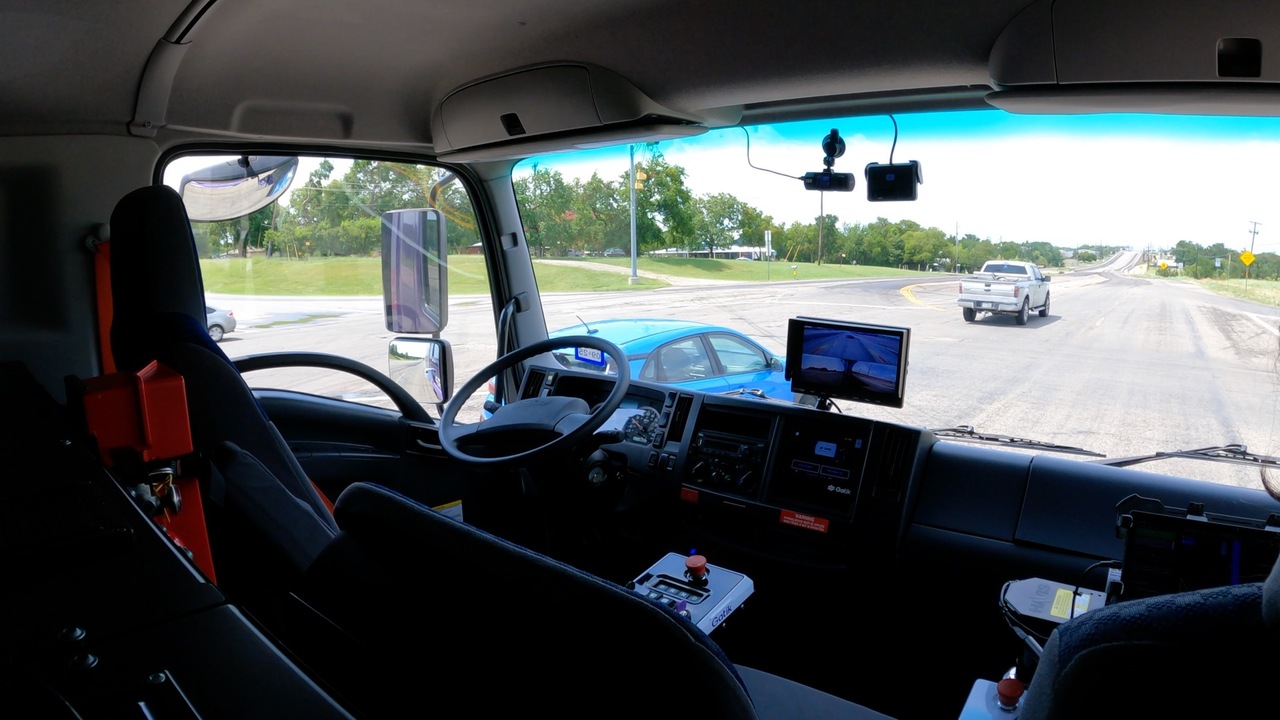
Interior of a Gatik fully driverless medium-duty autonomous truck cab, showing an empty driver’s seat, dashboard with monitoring screens, and forward view of the road during revenue-generating commercial delivery operations in North America.

Gatik announced on Tuesday that it has become the first company in North America to deploy fully driverless trucks in commercial operations at scale. The Mountain View, California-based autonomous trucking technology company now operates trucks with no human driver or safety observer behind the wheel.

The medium-duty autonomous trucks equipped with Gatik Driver complete daily deliveries for Fortune 50 retailers across Texas, Arkansas and Arizona. The milestone is part of a larger autonomous trucking technology trend as companies seek to move beyond limited pilots to sustained, revenue-generating operations.

“Autonomous trucking is no longer a promise. It’s a business,” said Gautam Narang, CEO and co-founder of Gatik. “With more than $600 million in contracted revenue, Gatik has proved that autonomous trucking is not only possible but commercially viable, and the fierce demand for our solution reflects how quickly this new model will reshape the future of logistics.”

Narang told FreightWaves the company has secured more than $600 million in committed, multiyear, noncancelable revenue from large companies in the e-commerce, consumer packaged goods and logistics sectors.

Since launching freight-only operations in mid-2025, Gatik has completed 60,000 fully driverless orders without incident, logged more than 2,000 hours of driverless operation across multiple logistics networks and completed over 10,000 driverless miles on public roads.

Narang noted the current driverless fleet consists of 10 revenue-generating trucks, with plans to increase to 60 trucks in the coming weeks and expand to hundreds of driverless trucks by the end of the year.

Gatik operates in the Dallas-Fort Worth region, the Phoenix metro area and Northwest Arkansas. The company’s 26- and 30-foot trucks run nearly 24 hours a day, moving ambient, refrigerated and frozen goods between distribution centers and stores. Routes extend up to 400 miles, connecting dense networks of distribution centers, warehouses and retail stores on highways at speeds up to 65 mph and on surface streets.

Gatik launched driverless operations only after a successful independent review of critical components of the company’s Safety Assessment Framework. The review was conducted by globally recognized independent testing, inspection and certification organizations with extensive experience in autonomous system safety assurance.

Prior to its fully driverless launch, Gatik conducted briefings with U.S. Department of Transportation agencies, including the Federal Motor Carrier Safety Administration (FMCSA) and the National Highway Traffic Safety Administration (NHTSA), ahead of the launch.

State agencies, including the Department of Transportation, Department of Public Safety and Department of Motor Vehicles in Texas, Arizona and Arkansas, also conducted rigorous reviews. Training sessions for first responders and local stakeholders were completed as part of the company’s community-readiness strategy.

At the heart of operations is Gatik Driver, the company’s third-generation autonomous system featuring redundant safety-critical systems designed for driverless operations.

The achievement builds on ongoing collaboration with Isuzu Motors Ltd., under which Gatik integrates its SAE Level 4 autonomous driving system with Isuzu’s medium-duty platforms.

“We are pleased to see Gatik begin Level 4 driverless operations using Isuzu medium-duty trucks,” said Hiroshi Sato, senior executive officer and vice president, Engineering Division, Isuzu Motors Ltd. “This represents an important step in bringing autonomous driving technologies into commercial logistics operations.”

Isuzu and Gatik continue to advance preparations for a mass-production autonomous-ready vehicle program, with anticipated production start at Isuzu’s new South Carolina facility toward the end of next year.

The company describes its business model as “asset-light and operationally light,” meaning it does not own the trucks or handle maintenance while maintaining direct customer relationships.

Gatik’s driverless trucks are commercially deployed across Texas, Arkansas, Arizona, Nebraska and Ontario, Canada, with plans to expand to new U.S. markets in the near future. Strategic partners supporting scaled operations include Isuzu Motors, NVIDIA and Ryder.

FMCSA triggers 30-day countdown on teen driver exemption

trucks on highway

WASHINGTON — Federal regulators have officially opened the door for public debate on whether to keep the nation’s under-21 interstate trucking program alive.

The Federal Motor Carrier Safety Administration posted a formal notice on Tuesday requesting comments on the American Trucking Association’s five-year exemption request that would allow carriers to continue onboarding 18-to-20-year-old drivers despite the statutory expiration of the Safe Driver Apprenticeship Pilot (SDAP) program last November.

Carriers enrolled in SDAP have been allowed to employ drivers under the age of 21 to haul across state lines, which is currently prohibited under federal regulations.

The public has 30 days – until February 27 – to weigh in on a debate between large-scale fleets looking to maintain driver recruitment momentum and those who warn that SDAP’s failed experiment” should remain closed.

The comment period likely will conclude just as the U.S. Department of Transportation prepares to hand its final SDAP safety report to Congress on March 10, 2026.

FMCSA’s decision to open a public comment period acknowledged ATA’s contention that the SDAP program, through quarterly reports, “demonstrate positive safety outcomes, including millions of miles driven by program participants without reportable crashes,” the notice states. “ATA believes that continuing the regulatory relief under an exemption would create minimal administrative burdens for FMCSA or participating motor carriers.”

While SDAP officially ended on November 7, 2025 – which FMCSA emphasized in its notice as a correction to ATA’s claim that FMCSA “has not acted to end” the program – the agency has offered a limited extension to apprentices who were already enrolled and had completed training but had not yet turned 21. ATA’s petition, if granted, would allow new apprentices to be onboarded only with motor carriers that were previously approved to participate in the SDAP program.

Opposition: Threat to safety, wages

While ATA views SDAP as a success, extending it faces strong pushback from safety advocates and owner-operators, with opponents arguing the program is a “failed experiment” that is a threat to public safety.

The Owner-Operator Independent Drivers Association, the Truck Safety Coalition, Citizens for Reliable and Safe Highways, and Parents Against Tired Truckers, have urged the FMCSA to reject the extension based on several points:

  • Higher crash risk: Safety groups cite data from the Insurance Institute for Highway Safety showing that drivers aged 19–20 are several times more likely to be involved in fatal crashes than those over 21.
  • Biological development: Safety groups point to research showing the prefrontal cortex – the brain region vital for decision-making and risk assessment – is often not fully developed until a person reaches their mid-20s.
  • Low participation rates: OOIDA labels SDAP a “failure,” noting that while it was designed for up to 3,000 drivers, only 80 individuals ever applied to be apprentices, and only 62 motor carriers were approved to participate out of more than 200 applications.
  • Wage suppression concerns: Owner-operators argue that the push for younger drivers is a tactic by large fleets to access “cheapest labor possible” and suppress industry-wide wages, rather than a genuine effort to address a driver shortage they believe is a myth.
  • Premature request: Opponents contend that FMCSA should not take action on ATA’s request until DOT delivers the final report to Congress.

Click for more FreightWaves articles by John Gallagher.

Trucking Alliance’s safety agenda 3: broad regulatory changes on English, ELDs and insurance

The Trucking Alliance, which in terms of numbers is one of the smaller industry lobbying and support groups but which includes some of the bigger players in trucking, has long focused on safety issues in its efforts to shift public policy.

After a tumultuous 2025 in the intersection where trucking, safety and politics all came together in often unexpected ways, the group is laying out its agenda not just for 2026 but for years to come, freely acknowledging there are some shifts in the regulatory landscape that will take a few years to ferment and develop.

In this three-part joint video and editorial series, Freightwaves is presenting highlights of an interview editor at large John Kingston conducted with key members of the Trucking Alliance’s leadership team:  Steve Williams, the co-founder and president of the Trucking Alliance, as well as the chairman and CEO of carrier Maverick USA; Lane Kidd, managing director at the Trucking Alliance; Greer Woodruff, executive vice president of safety, sustainability, and maintenance at J.B. Hunt Transport Services (NASDAQ: JBHT); and Brett Sant, senior vice president at Knight Swift (NYSE: KNX)

The full interview with the Trucking Alliance leaders can be found here. 

Part one dealt with issues that would have their greatest impact on drivers in the cabs. Part two deals with suggested safety steps that would mostly need to be taken by carriers or have their greatest impact on them. 

This final part is about broader regulatory changes. While separating out regulatory changes and declaring that they affect drivers or carriers is a somewhat futile pursuit–it’s all a connected ecosystem–these divisions can make it easier to keep track of the proposed changes. 

Insurance

It has been noted repeatedly in discussions about trucking that when the industry was deregulated in 1980, the minimum insurance requirement for a carrier was set at $750,000. 

Today, the minimum insurance requirement for a carrier is…$750,000. And the Trucking Alliance sees that as a big problem.

“The theory then was that the insurance industry would help regulate those carriers,” Sant said. But with so many of the carriers that provide capacity operating with a small fleet, Sant added, “they’re really not underwritten the way you would maybe expect.”

Sant cited a carrier he did not identify by name with about a 15% to 20% market share of the trucking insurance market as having clients with an average fleet size of two power units or less. “There really isn’t an in-depth underwriting that takes place to appraise the risk of that carrier,” Sant said.

The recommended course of action by the Trucking Alliance is to “adjust the minimum financial responsibility requirement to $2.9 million.” Where did that number come from? It’s the 1980 minimum requirement adjusted for inflation.

After that, according to the Trucking Alliance’s recommendations, the figure would be adjusted on the basis of a medical inflation index.

The question is whether Congress would ever undertake that step. It has been done in certain states; New Jersey is one of the largest and the most recent. 

Sant and Lane said the Trucking Alliance has been looking at ways that the Federal Motor Carrier Safety Administration (FMCSA) could raise the minimum without Congressional action. “We are actively working to provide the data to FMCSA to help them assess the issue and determine how they might increase those minimums and to what extent,” Sant said. 

English language proficiency 

In the video interview with FreightWaves, the issue of English language proficiency was discussed mostly tangentially, in particular that it has become a gateway to a focus on the issue of cabotage. “I think that the efforts around English language proficiency probably brought this to light quicker than it might otherwise have come to light,” Woodruff said.  

In its white paper, the Trucking Alliance lists recommendations on English language proficiency in several different sections. 

One requirement would put some onus back on insurers or their agents: “Require certificates (of English proficiency) delivered directly by the insurer/agent and continuous monitoring for lapses or reductions in coverage.”

Other recommendations include “(enforcing) identify proofing and anti-fraud controls,” and extending identity proofing out to brokers, “closing the door on identity fraud and serial reapplications.”

Under its recommendations for cabotage regulatory enforcement, the Alliance says the industry needs to “advocate for clear, enforceable English language proficiency standards for all commercial drivers operating in the U.S. This will ensure effective communication during roadside inspections, emergency situations, and daily operations—critical for maintaining highway safety and compliance.”

ELD enforcement

One of the Trump administration policies that has been an unexpected shift are the number of ELDs that FMCSA has pulled off the market. 

The Trucking Alliance was firmly aligned behind the launch of the ELD mandate. Kidd said when the rule was imposed, FMCSA “decided that instead of us trying to certify every single manufacturer, let’s just let them self-ceritify and promise on the honor system that they work.”

Over time, he said, in a three to four year period there were 88,000 documented cases where a faulty ELD could not transmit its data to an officer making a roadside stop. 

The only way to fix that, Kidd said, is for “FMCSA to do a very bold thing.” It already has gotten a start on it with the withdrawal of FMCSA approval for dozens of ELDs. But going forward, Kidd said, FMCSA needs to “require those ELDs to recertify and to contract with an independent third party certification lab, and require the ELDs to go back through the channel, as they never have had to do, to certify that their ELD will work.”

Kidd said FMCSA is willing to contract with third party providers for that certification. “I think there’s a willingness now for FMCSA to say, no, there’s better stuff in the private sector than we can do,” Kidd said. “They at least seem willing to talk about it.”

More articles by John Kingston

Court won’t force California revival of non-domiciled CDL renewals

LTL carrier Peninsula adding a 2-state surcharge for regulatory burdens

Trump administration backing C.H. Robinson on broker liability before SCOTUS

OmniTRAX names Dreier as chief commercial officer

Rail and supply chain infrastructure company OmniTRAX has named Ryan Dreier as its new chief commercial officer, the company said today.

Dreier joined OmniTRAX as executive vice president in 2025 from BNSF Railway. In his new role, he will oversee commercial strategy, sales operations, transload, and new business development for a company that has seen growth of more than 50% over the last five years.

“OmniTRAX’s ability to provide trusted, tailored service has fueled our record-setting growth,” OmniTRAX Chief Executive Colby Tanner said in a release. “As we continue to add new markets and new operations, Ryan’s industry relationships and national network experience will play an invaluable role in bringing new customers to rail.”

Ryan Dreier

Dreier previously served as vice president of industrial products marketing at BNSF (NYSE: BRK-B), leading marketing and sales for a diverse portfolio of carload commodities. He has an MBA from Southern Methodist University’s Cox School of Business and a bachelor of science in business administration from the University of Kansas.

“As global and domestic supply chains continue to evolve, rail service provides expanded market access and critical connectivity,” Dreier said. “By combining our rail and real estate resources with industry-leading service, OmniTRAX delivers exceptional operational efficiency to our customers across industry.”

Subscribe to FreightWaves’ Rail e-newsletter and get the latest insights on rail freight right in your inbox.

Related coverage:

Union Pacific reports record financial results

First look: Union Pacific Q4 earnings

Grain helps notch up weekly rail freight

CSX sees small drop in revenue, slight gain in volume

Union Pacific reports record financial results

“The Union Pacific team delivered our best ever full year across safety, service and operating excellence,” Chief Executive Jim Vena said on the railroad’s earnings call on Tuesday morning. “As we close out the year, it’s clear the team is consistently delivering at the highest levels, and I’m confident that’s what we’ll continue to do.”

For the year, the Omaha-based company (NYSE: UNP) said operating income rose 1%, to $9.8 billion, as revenue rose 1%, to $24.5 billion. Overall volume also was up 1%. Earnings per share grew 8%, to $11.09. The railroad’s operating ratio was 59.8%, an improvement of 0.1 points.

“We remain disciplined, setting the best ever full-year record for workforce productivity as we utilized 3% fewer employees to move 1% more volume,” Vena said.

The company expects to file a revised application for its transcontinental merger with Norfolk Southern (NYSE: NSC) within the coming weeks.

Fourth-quarter volume declined 4% due to a 10% drop in premium traffic, which includes intermodal and automotive business.

Most of the intermodal decline was due to a 30% drop in international volume, which came down from record levels in 2024. Domestic intermodal volume had a record quarter and year, said Kenny Rocker, the railroad’s executive vice president of marketing and sales.

Bulk traffic, which includes coal, was up 3%, while industrial products traffic notched out a 1% quarterly gain.

Fourth-quarter operating income declined 5%, to $2.4 billion, as revenue declined 1%, to $6.08 billion. Earnings per share increased 7%, to $3.11. The railroad’s fourth-quarter operating ratio was 60.5%, a 1.8-point increase compared to the fourth quarter of 2024, as expenses increased 2%, to $3.68 billion.

Quarterly freight car velocity increased 9% to a record 239 car-miles per day. Average train speed was up 7%, while terminal dwell was down 9% to a record 19.8 hours. Average train length was a record, at 9,729 feet.

Eric Gehringer, executive vice president of operations, noted that the railroad had its lowest ever train accident and employee injury rates in 2025.

Chief Financial Officer Jennier Hamann says UP expects to hit the three-year financial targets outlined at its September 2024 investor day. For this year, UP forecasts earnings per share growth of around 5%, along with operating ratio improvement despite a muted economic outlook.

Rocker says UP has a positive outlook for coal, grain, and chemicals and plastics traffic this year. The railroad’s outlook is negative, however, for forest products, intermodal, and automotive.

UP’s $3.3 billion 2026 capital plan includes $1.9 on track maintenance, $600 million for capacity improvements and siding extensions, $400 million for locomotive modernizations, and $400 million for technology projects.

Subscribe to FreightWaves’ Rail e-newsletter and get the latest insights on rail freight right in your inbox.

Related coverage:

First look: Union Pacific Q4 earnings

Grain helps notch up weekly rail freight

CSX sees small drop in revenue, slight gain in volume

Norfolk Southern orders first new locomotives since 2022

Nike to lay off hundreds of distribution workers in Mississippi, Tennessee

Nike is laying off hundreds of U.S. distribution center workers as it accelerates automation and restructures its supply chain operations.

The athletic apparel giant plans to cut 775 jobs, primarily at distribution centers in Tennessee and Mississippi, according to company statements and reporting by CNBC. The layoffs are focused on warehouse and fulfillment roles as Nike increases its use of advanced automation and streamlines its logistics footprint.

The company has not disclosed how many total workers it employs at U.S. distribution centers.

“To power our ‘Win Now’ actions, we’re taking steps to strengthen and streamline our operations so we can move faster, operate with greater discipline, and better serve athletes and consumers,” a Nike spokesperson said. “We are sharpening our supply chain footprint, accelerating the use of advanced technology and automation, and investing in the skills our teams need for the future”

Nike operates a major distribution hub in the Memphis area, which serves as a primary supply chain operation for national shipping. The company employed up to 1,900 workers as of April 2020, according to the The Commercial Appeal

Nike also employs an unspecified number of workers at a distribution center in Byhalia, Mississippi, about 43 miles southeast of Memphis.

Nike (NYSE: NKE) is an athletic footwear and apparel corporation headquartered near Beaverton, Oregon. It is one of the world’s largest suppliers of athletic shoes and apparel and a major manufacturer of sports equipment, with revenue in excess of $46 billion last year.

The company did not provide a timeline for the layoffs or specify which facilities would be affected.

American Eagle, Office Depot pull plug on third-party logistics services

A delivery man picks up a package from a retail store brightly lit for Christmas.

American Eagle Outfitters and Office Depot have begun to shut down their logistics businesses geared to serving outside customers, raising doubts about the viability of the supply chain-as-a-service business model for retailers as businesses scramble to find new fulfillment partners.

Lifestyle and apparel company American Eagle Outfitters (NYSE: AEO) is winding down its Quiet Logistics subsidiary, which provides omni-channel fulfillment services to retail brands, FreightWaves has learned. AEO acquired Quiet Logistics for $360 million in 2021 shortly after acquiring delivery startup AirTerra. After achieving reduced delivery times and excess store inventories, AEO extended its in-house logistics capabilities to other businesses looking to better compete with Amazon, Target and Walmart.

“American Eagle Outfitters, Inc. has made the decision to close its wholly-owned Quiet Logistics business and discontinue services for third-party customers over the next several months. This strategic decision will enable AEO to prioritize growth and focus on its portfolio of leading lifestyle brands,” the company confirmed in a statement to FreightWaves. “Quiet has valued its partnerships with its customers and, where we are able, are assisting customers to identify and transition to new providers. We appreciate the contributions of our associates, and we are committed to doing what we can to support them as well.”

AEO customers and other business partners began sharing unsubstantiated news about the Quiet Logistics exit over the weekend on social media. Quiet customers include luxury fashion brand Perfect Moment and Baggu, a maker of stylish reusable bags, according to its website.

Picking operation inside a Quiet Logistics facility. (Photo: Quiet Logistics)

AEO finally realized that having a separate multi-client business didn’t work well with its core retail business and own fulfillment requirements, retail and e-commerce industry experts said. A sign of future potential trouble came about one year ago when Quiet Logistics closed a facility in St. Louis. The company currently operates fulfillment centers in Boston, Atlanta, Dallas and Los Angeles, according to its website.

“The market is forcing everyone to pick a lane. AEO is pivoting back to focusing on its own volume,” said Matthew Hertz, founder and CEO of Third Person, a match-maker for e-commerce brands and logistics providers, on LinkedIn. “For a few years, every major retailer thought they could monetize their supply chain by selling it as a service. It sounded great in a pitch deck. In reality? It’s incredibly difficult to serve third-party brands while managing your own retail volume.”

Earlier this month, e-commerce logistics provider Stord acquired rival Shipwire from parent company Ceva Logistics to beef up its capabilities and distribution footprint. Brittin Ladd, a supply chain and e-commerce logistics consultant who spent three years at Amazon, said on LinkedIn that AEO tried to find a buyer for Quiet Logistics, but there was no interest. 

Office Depot closing Veyer Logistics 

Meanwhile, Veyer, the logistics spinoff of The Office Depot Corp. is ending its fulfillment operation for standalone logistics customers following last month’s $1 billion acquisition of Office Depot by Atlas Holdings, according to a message from Veyer’s business development team to a consulting agency that was viewed by FreightWaves.

“As part of the broader strategy work happening with Atlas’ acquisition of Veyer’s parent company, Veyer will be exiting the e-commerce fulfillment business. Because of that shift, the partnership program is being wound down and we won’t be able to move forward with any further collaboration,” the Veyer manager said. Many employees will lose their jobs because of the restructuring. 

Veyer has 8 million square feet of warehouse space in 40 facilities nationwide.

ODP Corp. is folding Veyer into its Business Solutions subsidiary, which sells office supplies and other products in bulk to businesses, and is not shutting Veyer down, the company said in a statement provided to FreightWaves. “ODP customers were informed upon completion of the acquisition that, to prioritize efficiency, speed, and execution for its customers in this new chapter, the company would be realigned to focus on its two core businesses, ODP Business Solutions and Office Depot OfficeMax. As a result, Veyer is being integrated into ODP Business Solutions, where its logistics, distribution, and transportation capabilities most naturally support commercial customers and future growth.”

Management hinted in a news release announcing the deal that Veyer would be disbanded and stop providing logistics services to outside businesses. 

“Today marks the start of an exciting new chapter for ODP as a private and infinitely more agile business. As my new coworkers and I begin this next phase together, we are refocusing on our two core businesses, Office Depot OfficeMax and ODP Business Solutions. With a refreshed strategy, commitment to our customers and Atlas behind us as our long-term partner, we’ll bring renewed focus and discipline to how we operate, support our people and drive sustainable, profitable growth on both sides of the business,” said new ODP Chief Executive Craig Gunckel.”

Chris Mortl, a senior account executive at Office Depot, confirmed on LinkedIn that rumors about Veyer’s closing were accurate, adding that he was willing to provide referrals to Veyer employees applying for new jobs.

Click here for more FreightWaves stories by Eric Kulisch.

Sign up for the biweekly PostalMag newsletter The Delivery here

RECOMMENDED READING:

Stord buys e-commerce specialist Shipwire from Ceva Logistics

Alaska Airlines dissatisfied with Amazon cargo contract, executive says

UPS won’t resurrect MD-11 fleet after deadly crash, takes $137M charge

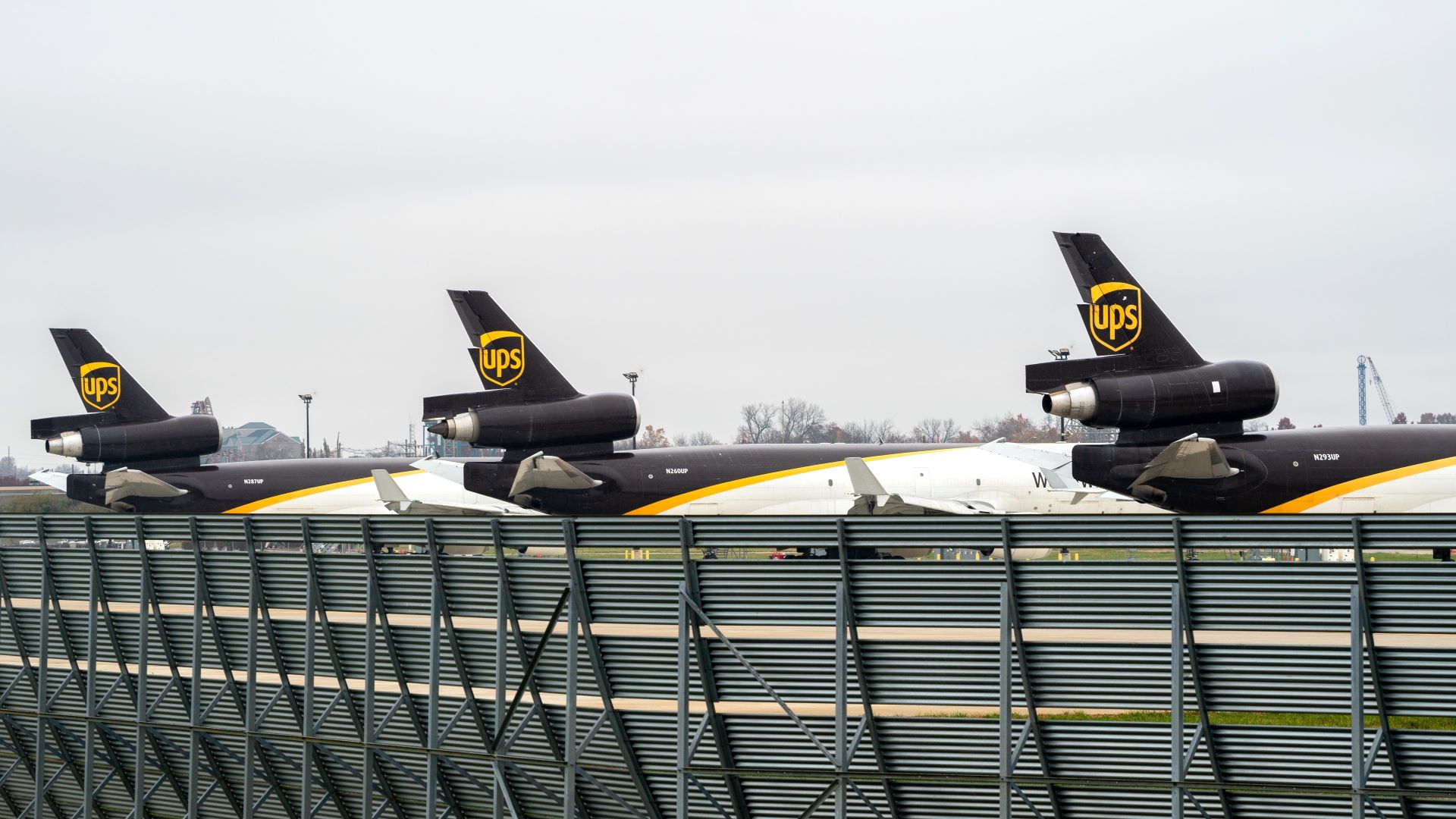
Brown-tailed UPS MD-11 freighter jets parked next to low airport barrier.

UPS has decided to permanently retire its fleet of 27 MD-11 aircraft and take a $137 million after-tax write off instead of returning the widebody freighters to service even if they are cleared to fly again by aviation authorities following the crash of one of its planes in early November.

The express delivery and logistics giant began a phased drawdown of the aging tri-engine aircraft, but said on Tuesday that it has accelerated the retirement plan and will replace the aircraft with more efficient twin-engine Boeing 767-300 cargo jets.

The MD-11s have been parked since Nov. 8, when the Federal Aviation Administration ordered UPS, FedEx and Western Global Airlines to ground their MD-11 fleets until inspections and any potential corrective steps can be completed in the wake of the fiery crash of UPS MD-11 in Louisville, Kentucky, that killed 15 people. Investigators are focusing on why the engine and engine pylon, which was discovered to have structural fatigue cracks, separated from the left wing as the plane moved down the runway. 

UPS (NYSE: UPS) compensated for the loss of MD-11 capacity during the fourth-quarter peak season by repositioning some aircraft from other parts of the world to the United States, moving more packages by truck and leasing aircraft from partner airlines. The ability to meet demand with alternative capacity convinced management to discard the MD-11s, said Chief Financial Officer Brian Dykes during an earnings call with analysts.

“Over the next fifteen months, we expect to take delivery of 18 new Boeing 767 aircraft, with 15 expected to deliver this year. As new aircraft join our fleet, we will step down the leased aircraft and associated expenses. We believe these actions are consistent with building a more efficient global network positioned for growth, flexibility and profitability,” he said.

UPS incurred $50 million in extra costs for other airlines to supply and operate aircraft in the company’s network during the second-half of the fourth quarter and expects to spend $100 million on outsourced capacity this year, Dykes said. Most of the spending for outside airlift will occur in the first half of 2025, when five 767s are expected to be delivered by Boeing. 

The MD-11 has a maximum payload of more than 207,000 pounds, with space for 26 containers on the main deck and 13 in the lower hold. The B767 is smaller, with a 132,000-pound payload capability and room for 24 large containers and seven lower-deck shipping units. It also has a shorter range.

FedEx has said it anticipates its fleet of MD-11 freighters to return to service sometime after March, but there has been little indication from regulators so far about the progress of inspections. Aviation analysts say it may not be worth bringing back the MD-11s if regulators determine that extensive repairs are required to make them safe. 

Boeing issued a service bulletin 14 years ago in which it disclosed four previous separations of an attachment that helps hold engines to the MD-11’s wing, according to a National Transportation Safety Board report earlier this month. 

Click here for more FreightWaves/American Shipper stories by Eric Kulisch.

Write to Eric Kulisch at ekulisch@freightwaves.com.

RELATED STORIES:

FedEx anticipates MD-11 return in spring period

Part that broke in UPS jet crash had history of failure

Distracted Driving’s Death Toll: What a Viral Dashcam Lawsuit Means for CDL Holders

She was texting. Both hands on the phone. Eyes down. For nearly 20 seconds straight at highway speed.

A Washington woman who wrecked a Turo rental car in August 2025 initially told the vehicle’s owner and Snohomish County sheriff’s deputies that another driver ran her off the road. What she apparently forgot was that the 2013 Nissan Leaf had interior and exterior dashcams, and the 18-year-old owner had told her about them before she ever turned the key. She was even offered the option to disconnect them. She declined.

The footage went viral. Millions watched a nurse practitioner bury her face in her phone while piloting two tons of metal down a rural two-lane road before drifting into a mailbox and coming to rest against someone’s property. Now, in January 2026, she’s suing Turo, Meta, YouTube, and Reddit, claiming she was illegally recorded.

The camera saw everything. And now she wants the courts to unsee it. We’re living through a distracted driving epidemic, and it’s getting worse, not better.

The Numbers 

The National Highway Traffic Safety Administration reported 3,275 people killed in distraction-affected crashes in 2023. An estimated 324,819 were injured. Police documented nearly 782,000 distraction-related crashes that year alone, representing 13 percent of all reported collisions.

Those numbers are almost certainly understated. NHTSA’s own analysis suggests the true annual death toll from distracted driving may exceed 10,000, roughly 29 percent of all traffic fatalities, because distraction is notoriously underreported at crash scenes. Dead drivers don’t confess to scrolling Instagram.

The trend lines are moving in the wrong direction. The percentage of drivers observed manipulating handheld electronic devices while driving increased 36 percent between 2014 and 2023, from 2.2 percent to 3.0 percent. Nearly half of American drivers now admit to texting while driving, according to a 2024 survey by The Zebra. That’s a 31 percent increase from just three years earlier.

Among younger drivers, the numbers are even more alarming. 55% of Gen Z and Millennial drivers acknowledge texting while driving, compared to 33% of Boomers. Seven percent of drivers ages 15 to 20 involved in fatal crashes were reported as distracted, the highest proportion of any age group.

For trucking, the stakes are exponentially higher. A fully loaded tractor-trailer at highway speed needs the length of a football field to stop under ideal conditions. At 55 miles per hour, looking down at a phone for five seconds means traveling 306 feet completely blind.

FMCSA research found that commercial motor vehicle drivers who dial a mobile phone while driving are six times more likely to be involved in a safety-critical event, a crash, near-crash, or unintentional lane deviation, than drivers who keep their hands on the wheel.

For CDL Holders, One Violation Can End Everything

Here’s where the conversation gets serious for anyone holding a commercial driver’s license.

Under FMCSA regulations, using a handheld mobile phone while operating a CMV is classified as a serious offense. The first violation carries a fine of up to $2,750 for drivers and up to $11,000 for carriers that allow or require drivers to use handheld devices, but the financial penalties are just the beginning.

A second conviction within three years triggers a mandatory 60-day disqualification. A third or subsequent violation means 120 days on the sidelines. And that’s before we talk about what it does to your CSA scores.

Texting while driving a CMV carries a severity weight of 10 in FMCSA’s Safety Measurement System, the maximum category, equivalent to speeding more than 15 miles per hour over the limit. That violation will follow you in your Pre-employment Screening Program record for years. Every carrier you apply to will see it. Every insurance underwriter pricing your employer’s policy will factor it in.

In an industry where a clean record is currency, a handheld device violation is a self-inflicted wound that never fully heals.

You don’t need to get a citation for the violation to hurt you. A driver vehicle examination report can be issued without a ticket, and those CSA points still hit your record.

The Distractions

The phone gets all the headlines, but it’s not the only threat.

Cognitive distraction, the mental diversion of attention from driving, may be even more insidious because it’s invisible. Research published in Accident Analysis & Prevention found that emotional stimuli can modulate attention and decision-making, with adverse effects on driving behavior.

Studies from the Virginia Tech Transportation Institute discovered something that should terrify every fleet safety manager: Drivers experiencing strong emotions, visible sadness, anger, or agitation, showed a tenfold increase in crash risk compared to emotionally neutral drivers.

Ten times the risk. Not from phones. From feelings. I call it driving under the influence of emotion, and it deserves the same attention we give to alcohol and devices.

A driver who just got off the phone with a spouse announcing they want a divorce. A driver who just learned their kid got expelled from school. A driver who’s been stewing for 200 miles over a dispatcher’s disrespect. 

Cognitive distraction can reduce brain activity associated with driving by up to 37 percent, according to research cited by the National Safety Council. And unlike a phone, which you can put down, emotional distress doesn’t have an off switch.

Add in the physical distractions, eating, drinking, adjusting climate controls, reaching for objects, and the mental distractions, mind-wandering, daydreaming, ruminating about problems back home, and you start to understand why distracted driving kills more people than any single variable except impairment.

The Large Truck Crash Causation Study found that distraction and inattention were the second-most-common driver-related factor in fatal CMV crashes, trailing only speeding. In 2022 alone, distraction or inattention was recorded in 278 fatal large truck crashes.

The Camera Is Your Witness

Which brings us back to that Turo rental and the dashcam that wouldn’t stay quiet. In trucking, we’ve had driver-facing and forward-facing cameras for years. The professional drivers I work with have a nickname: witnesses.

Those cameras protect drivers when four-wheelers cut them off. They protect carriers when frivolous litigation comes knocking. And yes, they expose the truth when a driver makes a bad choice.

The woman in that viral video made a choice. She chose to text. She chose to lie about it. And when the footage made her a cautionary tale for millions, she chose to sue the platforms hosting the evidence.

That lawsuit will play out however it plays out, but the footage isn’t going away. Neither is the reality it documents. The camera didn’t ruin her reputation. Her hands on that phone did.

The Other Side of the Coin

That Turo renter knew about the camera and declined to disconnect it. She had notice. She had a choice. That’s why her lawsuit faces an uphill climb. Carriers installing driver-facing cameras with biometric capture capabilities don’t always extend the same courtesy to their drivers. And they’re paying dearly for it.

In July 2025, Lytx finalized a $4.25 million settlement with approximately 85,000 truck drivers who alleged the company’s DriveCam system collected facial scans without proper notice or consent under Illinois’ Biometric Information Privacy Act. The settlement covered drivers whose biometric data was collected between October 2016 and January 2025.

That same year, HMD Trucking settled a class-action lawsuit after drivers claimed the company installed driver-facing cameras without the required written disclosures and consent forms under BIPA. Lily Transportation agreed to pay $132,300 to settle similar claims involving multiple major dashcam providers. And the granddaddy of them all, BNSF Railway, paid $75 million to resolve claims that fingerprint readers at Chicago rail yards violated biometric privacy laws.

Illinois’ BIPA requires any private entity collecting biometric identifiers, including facial geometry captured by AI-powered cameras, to inform individuals in writing that data is being collected, state the purpose and duration of use, obtain written consent before collection, and maintain a publicly available retention and destruction policy. Violations carry statutory damages of $1,000 per negligent violation and $5,000 per intentional or reckless violation.

A 2024 amendment limited exposure by counting multiple scans of the same individual as a single violation rather than separate infractions, but the math can still get ugly fast for large fleets.

The compliance burden falls on carriers, not vendors. If you’re running driver-facing cameras with AI-powered behavioral monitoring or biometric data collection, you need more than a sticker on the dashboard. You need a written biometric data policy. You need informed consent, in writing, before that camera ever captures a frame of a driver’s face. You need that documentation in the driver file, not lost in an orientation packet nobody reads.

States beyond Illinois are watching. New York, Massachusetts, and Missouri have considered BIPA-style legislation. Texas and Washington have their own biometric privacy statutes with different requirements.

The irony is that a woman who was warned about a dashcam and chose to ignore it is suing for invasion of privacy. Meanwhile, carriers who install biometric surveillance systems without telling their drivers are writing eight-figure settlement checks.

The camera is a tool. Like any tool, it can protect you or expose you. Managing the data the camera provides and obtaining consent are key to building a defensible program. The difference is action and accountability, disclosure, consent, and documentation.

What We Do From Here

Distraction prevention can’t stop at a policy in a handbook. It requires training that addresses cognitive and emotional distraction, not just device usage. It requires a culture where drivers feel comfortable pulling over when they’re not fit to drive, mentally or emotionally.

If you’re deploying driver-facing cameras or any telematics system that captures biometric data, you need a documented process that includes:

  • A written biometric data policy that’s publicly available
  • Clear disclosure to drivers about what data is being collected and why
  • Written consent is obtained before the first frame is captured
  • A defined retention schedule and destruction protocol
  • Acknowledgment forms are in every driver qualification file

Don’t assume your telematics vendor handled this for you. They didn’t. The liability is yours. Telematics vendors can provide valuable resources to help fleets build and implement their systems, programs, and policies, but you must do the work and manage them. For drivers, particularly those holding CDLs, that text, that call, that moment of emotional fog, none of it is worth your career. None of it is worth your life or someone else’s.

The Federal Communications Commission notes that more than eight people are killed or injured daily in reported distraction-related crashes. The actual number is almost certainly higher.

We can do better. We have to do better because the cameras are always watching, and they tell the tale.