US Postal Services wants retailers to compete for last-mile delivery

A USPS mail van delivers mail to a house in a neighborhood with green bushes and trees.

The U.S. Postal Service announced Wednesday it will solicit bids from small and large retailers, and logistics companies, interested in the carrier for the final delivery leg to individual homes and businesses, part of new Postmaster General David Steiner’s strategy to restore financial viability by substantially raising revenue.

A number of parcel industry analysts expressed skepticism about reopening its last-mile service, saying the economics don’t work for smaller shippers.

The Postal Service posted a $2.8 billion operating loss and a net loss of $9.5 billion during the fiscal year ended Sept. 30. Steiner told Reuters that the organization would likely run out of cash by early 2027. He said last month that the national post couldn’t just rely on cost cutting to turn around the financial direction. 

The Postal Service has sold delivery service direct from post offices for years, but it has been limited to very large customers, like Amazon. There are more than 18,000 destination delivery units (DDU), the technical term for post offices. Leadership now wants to open the business to a broader customer case. 

Steiner’s predecessor, Louis DeJoy, felt it was more profitable to provide end-to-end package service after beefing up middle-mile infrastructure. Instead of allowing large e-commerce and logistics companies to sort packages by five-digit zip codes and inject them at the corresponding DDU, DeJoy forced bulk shippers to deliver mail and parcels to upstream distribution centers, where higher rates are charged and only sorting to the three-digit zip code level is required. The Postal Service sorts the packages itself and then transports them to the DDU for final delivery. Parcel experts say self-sorting allows the organization’s sorting machines to operate more efficiently, but that DDU pricing is better than the bundled service. The current system is only open to direct shippers, not logistics providers.

The new pricing structure led UPS to drop the Parcel Select program in January and make home deliveries of economy parcels on its own. After Steiner took office, UPS began renegotiating its workshare contract with the Postal Service. The company last month said it is finalizing an agreement for the USPS to provide last-mile delivery for its low-cost Ground Saver shipping service, with the partnership now expected to resume in January. 

The Postal Service said it will begin accepting bids in late January or early February for same-day and next-day service. 

Shippers who wish to access the DDU network can propose a combination of volume, pricing and tender times at each location, with deliveries for successful bidders being made by USPS the same day or next day, at the customer’s preference.

“In the logistics business, the most expensive part of delivery is generally the ‘last mile’ portion of a route. As part of our universal service obligation, we deliver to more than 170 million addresses at least six days a week, so we are the natural leader in last-mile delivery. We want to make this valuable service available to a wide range of customers that see the worth of last mile access — other logistics companies and retailers large and small,” said Steiner in a news release.

“We see this initiative as a compelling value proposition for many shippers who we know are wrestling with the need to deliver to their customer as quickly and reliably as possible. Our solution is to establish a fair bidding process that enables the marketplace to find the best mix of local shipping attributes for the best volume-driven pricing. Because our delivery operations are already visiting every home and business daily, we can help shippers reduce their costs while generating much-needed revenue for the Postal Service.”

The Postal Service will engage shippers to discuss the procedure, gauge interest in participation, and fine-tune the bidding process before setting up the digital application platform.

“We want to allow customers to custom-build their last mile solution. We want to make the service as convenient, cost-effective and efficient as possible. We have achieved impeccable service performance scores for our last mile, which reflects the simple, quick-turn processing that occurs at a local DDU,” said Steiner.

The Postal Service said it expects to formalize accepted bids for the direct Parcel Select product through a negotiated service agreement contract. Winners will be notified in the second calendar quarter, and service under those NSAs will likely begin in the third quarter of 2026.

Will it work?

Nate Skiver, a parcel consultant and head of LPF Spend Management, said on LinkedIn that the postal network has always been open to shippers of all sizes, “but very few have enough volume density to efficiently leverage it. It rarely makes sense for retailers, outside of the very largest, to directly induct into the USPS network” because of sortation requirements, challenges managing the first and last mile, the availability of many cost-effective alternative carriers and the package tracking capabilities of private couriers. 

The Postal Service should monetize its valuable last-mile network, but Skiver said trying to get shippers to compete with each other for service won’t work. 

Satish Jindel, a veteran parcel industry executive and president of ShipMatrix Inc., said the U.S. Postal Service will undercut its Ground Advantage and Priority Mail parcel products, and enable competitors by providing last-mile delivery. It should go all-in on last-mile delivery and stop accepting packages at the regional distribution centers if it wants to maximize revenue potential, he said in an interview

Amazon and the U.S. Postal Service have been negotiating an extension of their $6 billion contract before it expires in October, but Steiner’s new plan has raised the retailer’s concerns about higher prices after a year of talks, according to multiple media accounts. 

The Government Accountability Office on Tuesday said the Postal Service has lost money nearly every fiscal year since 2007, totaling $118 billion, as first-class mail has fallen to its lowest volume since 1967. 

Click here for more FreightWaves stories by Eric Kulisch.

Sign up for the biweekly PostalMag newsletter The Delivery here

USPS reports 5.7% decline in parcel volumes, $9B loss

UPS, Postal Service to reunite for delivery of low-budget shipments

Despite headwinds, Port of Los Angeles nears 10M TEUs

Tariffs, trade intrigue, economic uncertainty – even a ship fire – won’t keep the Port of Los Angeles from turning in one of its best years ever in 2025.

The leading U.S. import gateway processed 782,249 twenty foot equivalent units (TEUs) in November – down 12% from year-ago levels elevated by frontloading – pushing total traffic to 9,447,731 TEUs, 1% ahead 2024 with one month still to be counted.

“Even with all the trade uncertainty, we’ll finish 2025 north of 10 million TEUs, putting this year firmly in our top three of all time,” Port Executive Director Gene Seroka said in a media briefing. “All that cargo moved without congestion and not a single ship backed up.

He credited resilient consumer spending, as well as the work of longshore labor, truckers, terminal operators, rail partners and other stakeholders for the banner year, adding 200,000 importers and exporters do business with the port annually.

SONAR Ocean TEU Volume Index shows 2025 traffic from China to Los Angeles (right) near year-ago level.

Seroka also said a recent fire aboard the container ship ONE Henry Hudson had no measurable effect on port operations. No injuries were reported in the Nov. 21 blaze, and crews continue to salvage the ship’s cargo.

November loaded imports came in at 406,421 TEUs, 11% lower y/y. Exports numbered 113,706 TEUs, off 8%, while empties, an indicator of future import volume, fell 13% to 262,122 units.

Find more articles by Stuart Chirls here.

Related coverage:

ONE returns to Red Sea with new service

Report: China demands control of Panama ports operator

Carriers look to higher rates, fewer sailings on key Asia-US route

Maersk, Hapag-Lloyd drop US East Coast city from trans-Atlantic services

California Expected to Defy Federal Pressure, and Reissue 17,000 Non-Domiciled CDLs

California is expected to begin reissuing approximately 17,000 non-domiciled commercial driver’s licenses that the state had planned to revoke following federal enforcement pressure. The decision comes despite ongoing corrective action requirements from FMCSA and raises fundamental questions about federal enforcement authority when a state openly defies compliance directives.

State transportation officials confirmed to sources that the Department of Motor Vehicles will begin restoring the contested licenses to immigrant drivers who received 60-day cancellation notices on November 6. The state has not clarified the specific process but points to the D.C. Circuit Court’s November 13 emergency stay of FMCSA’s interim final rule restricting non-domiciled CDL eligibility.

What California apparently misunderstands, or is choosing to ignore, is that the court stay addressed only the September 29 interim final rule. It did not address the separate compliance failures FMCSA documented during its 2025 Annual Program Review, which found that approximately 25% of California’s non-domiciled CDLs were improperly issued under regulations that existed before the emergency rule was ever published.

The federal government threatened to withhold more than $150 million in highway funding from California over these pre-existing violations. Those threats remain fully in effect regardless of the court’s stay of the new rule.

Two Separate Problems California Is Conflating

Understanding California’s legal exposure requires separating two distinct issues that the state appears to be deliberately merging.

Problem One: The Interim Final Rule. On September 29, 2025, FMCSA issued an emergency interim final rule titled “Restoring Integrity to the Issuance of Non-Domiciled Commercial Drivers’ Licenses.” This rule dramatically restricted the eligibility of non-domiciled CDL holders to H-2A, H-2B, and E-2 visas, excluding asylum seekers, refugees, and DACA recipients. The D.C. Circuit Court stayed this rule on November 13, finding petitioners were “likely to succeed” on claims that FMCSA violated federal law, acted arbitrarily, and failed to justify bypassing standard rulemaking procedures. With this rule stayed, states can theoretically continue issuing non-domiciled CDLs under pre-September 29 regulations, except for states under corrective action plans.

Problem Two: Pre-Existing Compliance Failures. FMCSA’s 2025 Annual Program Review found California had been violating federal regulations that existed long before the interim final rule. The agency documented systemic failures: CDLs issued with expiration dates extending years beyond drivers’ lawful presence authorization, licenses issued to Mexican nationals who are prohibited from holding non-domiciled CDLs (unless under DACA), and inadequate verification procedures. These violations triggered a preliminary determination of substantial noncompliance under 49 CFR 384.307, a process entirely separate from the stayed interim final rule.

California remains subject to a corrective action plan addressing these pre-existing violations. The court stay doesn’t change that. FMCSA’s November 13 guidance was explicit: states “subject to a corrective action plan” must maintain their pauses on non-domiciled CDL issuance until demonstrating compliance with pre-rule regulations.

The Nuclear Option: Decertification

Under 49 U.S.C. § 31312, FMCSA has authority to decertify a state’s entire CDL program if the state is found in “substantial noncompliance” with federal requirements. Decertification would prohibit California from issuing, renewing, transferring, or upgrading any commercial learner’s permits or commercial driver’s licenses, not just non-domiciled credentials, until FMCSA determines that the state has corrected its deficiencies.

The consequences would be immediate and severe. Every new driver in California’s CDL pipeline would freeze. CDL schools would halt operations. Testing would stop. Carriers would face weeks or months of disruption in recruiting new drivers. The ripple effects would devastate one of the nation’s most critical freight corridors.

FMCSA recently threatened Pennsylvania with decertification after an Uzbek terror suspect was found holding a Pennsylvania-issued CDL. The agency gave the state 30 days to respond and warned that failure to correct deficiencies could result in losing issuance authority entirely. California’s defiance appears far more egregious; the state is not merely failing to correct problems but actively moving to restore licenses that federal auditors determined were improperly issued.

Interstate Reciprocity and Federal Authority

Here’s where California’s gambit becomes particularly problematic. Commercial driver’s licenses aren’t purely state credentials; they’re federal credentials issued through a partnership with states. The Commercial Motor Vehicle Safety Act of 1986 established minimum standards that all states must meet. When a state issues a CDL, other states recognize that credential based on the assumption that it was issued in compliance with federal standards.

If California reissues non-domiciled CDLs that federal auditors have determined don’t comply with federal regulations, those credentials may not be valid for interstate operation. A driver holding a California CDL issued in violation of federal requirements could face enforcement action in any other state, and carriers who dispatch those drivers could face liability exposure.

Under 49 CFR 384.405, decertification prohibits a state from performing any CLP or CDL transactions. Even short of full decertification, FMCSA could issue guidance that CDLs issued by a noncompliant state during the noncompliance period are not valid for interstate commerce. Other states could refuse to recognize California’s credentials. The Commercial Driver’s License Information System (CDLIS), which enables interstate verification, could flag California licenses.

The question isn’t whether FMCSA has authority to act; 49 U.S.C. § 31312 is unambiguous. The question is whether the agency has the political will to exercise that authority against the nation’s most populous state.

California’s Position

California’s argument rests on several claims. The state contends that the 17,000 licenses with mismatched expiration dates represent “clerical errors” rather than substantive violations. State officials point out that the work authorizations underlying these licenses remain valid; the DMV simply failed to align CDL expiration dates with employment authorization document expiration dates.

With the court stay in effect, California argues it can now correct those date mismatches and reissue compliant credentials. The state maintains that drivers with valid work authorization who pass the knowledge, skills, and medical tests should be able to obtain properly dated CDLs under pre-September 29 regulations.

This argument sidesteps FMCSA’s core findings. The agency didn’t merely identify date mismatches; it documented systemic failures in California’s verification procedures, including the issuance of licenses to Mexican nationals who were prohibited from holding non-domiciled CDLs. California’s October 26 response to FMCSA acknowledged finding 20,000 non-domiciled CDLs with expiration dates exceeding drivers’ lawful presence. Still, it refused to revoke them, arguing the state hadn’t violated federal regulations as they existed before the interim final rule.

FMCSA’s November 13 response rejected this interpretation as “erroneous,” noting that “the regulatory universe of non-domiciled CLPs and CDLs is premised on the basic notion that a non-domiciled driver’s commercial motor vehicle driving privileges cannot extend beyond that driver’s lawful presence in the United States.”

Human Stakes

Behind the legal and regulatory frameworks are real people whose livelihoods hang in the balance. Many of the affected 17,000 drivers are Sikh men who fled persecution in India and sought asylum in the United States. The transportation and logistics industry has been a major employer for this community; approximately 150,000 Sikhs work in trucking nationwide, with California hosting the largest U.S. Sikh population.

Amarjit Singh, a 41-year-old truck owner-operator in Livermore, represents the personal dimension of this crisis. His work authorization extends through 2029. He invested $160,000 in his truck in 2022, faces $4,000 monthly payments, and supports two young children. When Singh heard California would reissue his license, he prayed in gratitude. His wife cried.

“It’s going to save my life, and it’s going to save my business,” Singh told KQED.

Singh’s relief may be premature. If FMCSA determines that California’s reissued licenses don’t comply with federal regulations, Singh and thousands of drivers like him could face the same uncertainty all over again, potentially worse, if other states refuse to recognize California credentials or if FMCSA moves toward decertification.

Political Collision

This confrontation unfolds against a backdrop of intense political conflict between California and the Trump administration. Governor Gavin Newsom has positioned himself as a leading Democratic opponent of federal immigration enforcement. Transportation Secretary Sean Duffy has made non-domiciled CDL enforcement a signature initiative, personally announcing enforcement actions against California and warning of consequences.

When a California asylum seeker named Jashanpreet Singh crashed his truck on I-10 on October 21, killing three people, Duffy issued a “bombshell report” directly blaming California for breaking federal law. “My prayers are with the families of the victims of this tragedy,” Duffy said. “It would have never happened if Gavin Newsom had followed our new rules. California broke the law and now three people are dead.”

California countered that the Jashanpreet Singh case involved the automatic removal of an age-based restriction, not a discretionary upgrade. The state argued it had complied with the then-existing regulations. FMCSA rejected this defense.

The political stakes guarantee that neither side will back down easily. For the Trump administration, allowing California to defy federal CDL requirements would undermine its entire enforcement framework. For California, capitulating would validate what advocates call a “contrived emergency” targeting immigrant workers.

What Happens Next

FMCSA faces a choice. The agency can accept California’s interpretation that the court stay permits license reissuance, effectively allowing the state to sidestep compliance requirements. Or it can enforce its position that California remains under corrective action and must demonstrate compliance with pre-rule regulations before resuming non-domiciled CDL issuance.

The enforcement tools are clear. FMCSA can withhold federal highway funding, up to $75.5 million in fiscal year 2027, with amounts doubling in subsequent years. The agency can issue a final determination of substantial noncompliance. And it can decertify California’s CDL program entirely, prohibiting the state from issuing any commercial driving credentials until deficiencies are corrected.

Given the current political dynamics, FMCSA moving toward decertification seems more likely than backing down. The agency has already threatened to decertify Pennsylvania for less egregious violations. Texas, Colorado, South Dakota, and Washington have all received compliance warnings. If California can openly defy federal requirements without consequence, the entire federal-state CDL partnership becomes meaningless.

For carriers operating in California or employing drivers with California non-domiciled CDLs, the uncertainty continues. The safest course is to monitor FMCSA guidance closely, document immigration status verification for all non-domiciled drivers, and prepare for the possibility that California credentials face additional scrutiny or rejection in other states.

The Big Question

Underlying this entire controversy is a question the D.C. Circuit Court’s stay didn’t resolve: Who ultimately controls commercial driver licensing standards in the United States?

The Commercial Motor Vehicle Safety Act of 1986 established federal minimum standards that states must meet. But states actually administer licensing programs. When a state believes federal standards are wrong, whether procedurally flawed, as the court found with the interim final rule, or substantively discriminatory, as advocates argue, what mechanisms exist to resolve the conflict?

The funding withholding and decertification provisions in 49 U.S.C. § § 31314 and 31312 provide federal enforcement tools. But using those tools against California would create massive disruptions to interstate commerce and potentially strand hundreds of thousands of drivers. The practical consequences may constrain federal enforcement regardless of legal authority.

Meanwhile, 17,000 drivers wait to learn whether the licenses California plans to reissue will actually let them work. Carriers wait to learn whether those credentials will be recognized outside California. And the rest of the trucking industry watches to see whether federal CDL standards mean anything at all when a state decides to ignore them.

DHL drops $1.5 million to expand cold storage at LAX

DHL Global Forwarding is expanding its cold storage capabilities near Los Angeles International Airport, committing $1.5 million to bolster capacity for temperature-sensitive freight as demand from pharmaceutical, life sciences and healthcare shippers continues to accelerate.

The upgraded facility strengthens Los Angeles’ role as a critical gateway for high-value, time- and temperature-sensitive cargo moving between Asia Pacific, Latin America and North America. 

For customers shipping sensitive products, the investment is about risk reduction as much as capacity. Diagnostic and medical testing company bioMérieux said the enhanced infrastructure and operational expertise were key factors in its partnership with DHL Global Forwarding, citing confidence in maintaining product integrity throughout complex international supply chains.

The LAX expansion aligns with DHL Group’s Health Logistics strategy, which prioritizes targeted investments in temperature-controlled infrastructure, digital visibility tools and specialized talent. 

At the network level, the project fits into a much larger capital plan. DHL Group has committed over $2 billion over the next five years to expand its life sciences and healthcare logistics capabilities globally, with roughly half of that investment earmarked for the Americas. The goal is to deliver more integrated, patient-centric logistics solutions as pharmaceutical supply chains become increasingly global, regulated and time-critical.

Inside the LAX facility, advanced temperature-control systems are designed to maintain strict conditions across a wide range of pharmaceutical and healthcare products, while real-time environmental monitoring provides continuous visibility into storage conditions. Digital dashboards, video surveillance and automated workflows support audit-ready operations, an increasingly important requirement for regulated shippers navigating global compliance standards.

Capacity was another driver behind the expansion. The upgraded site significantly increases available cold storage space, enabling DHL to handle higher volumes of temperature-sensitive trans-shipments across the U.S. and the Americas without sacrificing service quality. 

Sustainability also plays a central role in the design. In line with DHL’s GoGreen Plus program and its broader Strategy 2030 commitments, the facility incorporates electric forklifts, energy-efficient lighting, paperless workflows and recycling programs. These measures support DHL’s long-term goal of achieving net-zero emissions by 2050, while responding to growing pressure from healthcare customers to reduce the carbon footprint of their logistics operations.

Equally critical is the human element. The LAX site is staffed by 31 dedicated life sciences specialists with a combined 560 years of industry experience. Team members hold certifications in areas including TAPA, CEIV Pharma and HAZMAT, and undergo regular training aligned with ISO 9001, ISO 14001 and ISO 45001 standards. That depth of expertise is increasingly important as pharmaceutical shipments grow more complex and regulatory scrutiny intensifies.

From a compliance standpoint, the facility adheres to World Health Organization Good Distribution and Storage Practices and meets DHL’s Air GxP baseline requirements. It is also integrated into DHL’s broader network of 112 Air GxP-certified stations and 22 IATA CEIV Pharma-certified stations worldwide, reinforcing consistent handling standards across borders.

With the North American cold storage market projected to more than double by the early 2030s, the company is positioning itself to capture that growth while strengthening Los Angeles’ status as a cornerstone of global temperature-controlled trade.

‘Application day’ nears for UP-NS rail merger

Union Pacific and Norfolk Southern say they will file their formal merger application Dec. 19 with the Surface Transportation Board, detailing their historic proposal for the first transcontinental railroad.

“The comprehensive application will detail how the end-to-end combination will enhance competition and deliver broad public benefits for America that strengthen our economy and protect union jobs,” UP (NYSE: UNP) and NS (NYSE: NSC) said in a release.

The acquisition of NS by UP would create a coast-to-coast network with 53,000 miles of track in 43 states. The companies say the single-line routing will shave as much as two days’ transit time for freight moving through congested interchange hubs such as Chicago and St. Louis compared to the handoffs of traffic from railroad to railroad. They claim the streamlining means less paperwork and lower costs for shippers.

But the deal has been opposed by some shippers who say they’ll have fewer options to ship by rail, and warn of operational meltdowns that followed past mergers.

The full application expected to run to 4,000 pages will also be posted at up-nstranscontinental.com. The partners have scheduled a call with analysts early Friday morning to discuss the filing.

The filing kicks off a 30-day review by the STB to check that the application has been properly completed. The board then accepts the application by publishing a notice in the Federal Register, or serves a rejecting decision. Upon acceptance, the agency will accept comments on the filing for 45 days, and responsive applications for relief or in lieu of the primary application, for 90 days. After that, the STB commences official review of the merger, a process that could take a year or longer. 

The STB has posted merger resources here.  

Subscribe to FreightWaves’ Rail e-newsletter and get the latest insights on rail freight right in your inbox.

Find more articles by Stuart Chirls here.

Related coverage:

Unions oppose historic transcontinental rail merger

Union Pacific completes Arizona yard expansion

Union Pacific adds retiring CF Industries CEO to its board

Deep South Democrats back UP-NS rail merger

The Most Expensive Part of a Breakdown Is Not Knowing What’s Wrong

Your truck isn’t just a piece of equipment. It’s your office. Your income. Your schedule. Your leverage.

And the moment a DPF light or engine fault shows up on the dash, all of that can grind to a halt.

That reality is exactly why this recent episode of The Long Haul hit home for so many owner-operators. I sat down with Tyler Robertson, founder of Diesel Laptops, to talk about something most small carriers don’t think about until it’s too late: diagnostics, downtime, and who actually controls the repair process when your truck breaks.

What came out of that conversation was simple, but uncomfortable:

Waiting on shops to tell you what’s wrong with your truck is one of the most expensive habits in trucking.

From being kicked out of college to changing truck diagnostics

Tyler didn’t come from Silicon Valley or a corporate R&D lab. He came from a truck dealership.

After getting kicked out of college for bad grades, he went to work for his family’s truck dealership and learned every side of the business — parts, service, sales, accounting. That’s where the ideas started forming. Day after day, he watched trucks come in broken and watched drivers wait. And wait. And pay.

Later, while working another job and buried under the same kind of debt most people carry — credit cards, loans, vehicles — Tyler started a side hustle. He found a diagnostic software out of Canada that could read every computer on a commercial truck, something that wasn’t common at the time. OEM software was locked down, fragmented, and expensive.

He bundled that software with a laptop and a cable, listed it on eBay, and sold his first unit in 24 hours.

That was the start of Diesel Laptops.

Why diagnostics are the real bottleneck in trucking

One of the biggest takeaways from the conversation was this: Most breakdown costs aren’t caused by parts. They’re caused by uncertainty.

When a truck goes into derate or throws emissions codes, the first question isn’t “what part do I need?” It’s “how serious is this?”

Without that answer, everything stops. Drivers sit. Loads get rescheduled. Shops start guessing. Tyler calls it the “parts cannon” — throwing parts at a problem until something works.

And that gets expensive fast.

According to Tyler, North America spends tens of billions of dollars every year fixing commercial trucks. Off-highway equipment — construction, agriculture, generators — multiplies that number even further. Yet, unlike automotive, there is still no true right-to-repair framework for commercial trucks.

That means information stays locked behind OEM walls, and small carriers pay the price.

Why the Diesel Decoder exists

Most owner-operators don’t want to rebuild engines or replace harnesses on the shoulder of the road. They just want to know enough to make a decision.

That’s where Diesel Laptops’ Diesel Decoder comes in.

It’s a small, affordable device that plugs into the diagnostic port and pairs with your phone. With it, drivers can:

  • Read and clear fault codes
  • View live engine data
  • Force a regen when safe to do so
  • Pull a truck out of derate mode to limp to a shop
  • See step-by-step troubleshooting guidance
  • Identify exact part numbers, including aftermarket alternatives

The point isn’t to turn drivers into master technicians. It’s to give them situational awareness.

As Tyler put it, saving just one tow bill can pay for the tool. But the real value is avoiding days of downtime caused by not knowing what’s wrong.

Why shops aren’t always the villain — but still cost you money

One of the most important parts of the interview was Tyler’s honesty about repair shops.

Most shops aren’t trying to rip drivers off. They’re often under-trained, under-resourced, and missing the same information drivers are. Even OEM dealerships struggle. Tyler ran service departments himself and described situations where technicians spent dozens of hours chasing a problem without answers.

When you walk into a shop, you don’t know if your truck is being handed to a 20-year veteran or someone fresh out of tech school. And once the clock starts, you’re paying — whether progress is being made or not.

Owning diagnostics changes that dynamic. It allows drivers and fleet owners to ask better questions, verify what they’re being told, and understand whether a repair recommendation makes sense.

The hidden cost of emissions confusion

The conversation also went deep into aftertreatment systems — DPFs, regens, emissions logic — and why so many carriers were hurt when those systems rolled out.

Tyler shared a real story of a driver who spent weeks and thousands of dollars chasing DPF issues that turned out to be caused by an oil leak upstream. The aftertreatment system wasn’t the problem — it was just where the symptoms showed up.

That kind of misdiagnosis has put operators out of business. Not because they refused to maintain equipment, but because the industry failed to provide training and tools when the technology changed.

And to be clear: deleting emissions systems is illegal. Tyler didn’t mince words on that. But understanding how the system works — and what’s actually causing faults — can prevent unnecessary repairs and downtime.

Why AI and cloud diagnostics are coming fast

One of the most forward-looking parts of the discussion focused on AI and predictive diagnostics.

Diesel Laptops is already monitoring transit fleets in real time, using AI and human technicians to flag problems before drivers notice symptoms. The long-term vision is clear: trucks that tell you what’s about to fail, not just what already has.

But Tyler was also honest about AI’s limits. Without accurate, VIN-specific data — much of which is still locked behind OEM paywalls — AI can only guess. That’s why Diesel Laptops has spent years building its own repair databases and training systems.

AI will get better. But it won’t replace understanding. It will amplify it.

What this means for small carriers

The biggest lesson from this episode isn’t about gadgets or software. It’s about control.

When you don’t own diagnostics, you don’t own your time. You don’t control downtime. You don’t know if a problem is minor or catastrophic. And in today’s market, that uncertainty can be the difference between surviving a bad month or shutting the doors.

Diagnostics are no longer a luxury tool for big fleets. They’re part of doing business.

If you’re running one truck or ten, this episode of The Long Haul is worth your time. We barely scratched the surface in this article — from labor time guides to technician shortages to what’s coming next in truck technology.

If you want the full conversation with Tyler Robertson, including stories, examples, and deeper breakdowns, listen to the complete episode of The Long Haul. It’s one of those conversations that makes you rethink how exposed your business really is when that check engine light comes on.

And once you hear it, you’ll probably look at diagnostics a little differently and hopefully, it will help you in 2026.

Over-sized cargo strikes six Oklahoma overpasses, forcing closures

A flatbed truck hauling over-sized cargo struck and damaged six county overpass bridges above the I-44/Will Rogers Turnpike in northeastern Oklahoma on Tuesday, forcing multiple road closures and prompting the Oklahoma Turnpike Authority to declare an emergency.

The incident occurred Tuesday afternoon as the truck traveled eastbound between Claremore and Vinita in Rogers and Mayes counties, according to OTA. Inspectors determined the truck’s load exceeded Oklahoma’s 14-foot height limit and damaged bridge beams on multiple county road crossings.

Three of the six affected bridges have been closed to traffic while repairs are planned, though the Will Rogers Turnpike remains open in both directions. OTA said nightly lane closures are expected once repair work begins.

The truck involved in the bridge strikes was operated by PXM Transportation Inc., an Illinois-based motor carrier registered with the Federal Motor Carrier Safety Administration. 

According to FMCSA records, PXM Transportation is authorized to operate as an interstate for-hire carrier hauling general freight and operates a small fleet of 11 power units with nine drivers, based out of Chicago.

The company logged 164,220 miles in 2023, the most recent year reported to federal regulators. FMCSA inspection data shows the carrier has undergone 11 roadside inspections over the past two years, with two vehicles placed out of service, though the company has no reported crashes during that period.

PXM Transportation did not immediately respond to a request for comment from FreightWaves.

The truck’s load exceeded Oklahoma’s 14-foot height limit and damaged bridge beams along the Will Rogers Turnpike, prompting closures and repairs expected to take up to two weeks. (Photo: Oklahoma Turnpike Authority)

OTA officials said the truck’s cargo was measured at more than 15 feet tall — above the legal limit — and was not properly permitted for travel on the state highway system. Oklahoma law requires special permits and approved routing for loads exceeding 14 feet in height.

Oklahoma Highway Patrol later stopped the driver after multiple bridge strikes.

OTA declared an emergency Wednesday to accelerate repairs, which could take up to two weeks. Planned work includes flame straightening and replacement of damaged steel beam sections.

Over-height truck strikes have been a recurring issue in Oklahoma; nine turnpike bridges were damaged by similar incidents in 2023, resulting in more than $1.6 million in repairs, according to KTUL

Nirvana’s $100M Series D bets big on AI to revolutionize commercial insurance

Nirvana Insurance team photo: Diverse group of employees in business casual attire posing outdoors in front of modern resort buildings and aspen trees, celebrating $100M Series D funding for AI-powered commercial insurance revolution.

AI-driven insurer Nirvana Insurance announced Thursday it has secured a pre-emptive $100 million Series D funding round to expand the company’s AI-powered commercial insurance offerings.

The round was led by Valor Equity Partners, with participation from prior rounds’ lead investors Lightspeed Venture Partners and General Catalyst.

The Series D follows closely on the heels of an $80 million Series C completed in March. According to a company release, Nirvana aims to build the world’s first AI-powered operating system for insurance. That expansion includes developing unique solutions to better incorporate telematics into insurance products.

Rushil Goel, Nirvana’s co-founder and CEO, told FreightWaves in an email that one reason for the company’s rapid expansion is growing demand for better commercial vehicle insurance offerings.

Goel noted that in 2025 alone, Nirvana has scaled its fleet and non-fleet businesses, doubling their size while maintaining best-in-class loss ratios. One of those offerings is insurance for non-trucking commercial fleets, such as those for general and artisan contractors, service fleets, wholesalers, distributors and manufacturers.

On the claims side, the company has used its AI innovations to shift to handling 100% of claims in-house while accelerating the claims closure rate. According to Goel, the in-house claims operation has achieved double the industry average closure rate within 30 days.

Cost factors are another challenge Nirvana hopes to help fleets address. Goel noted that policies continue to grow more expensive for cash-strapped fleets.

“Cost and sustainability continue to be the biggest challenge — we’re seeing the insurance industry raise rates about 20% on average, with certain cohorts getting hit much harder,” Goel said. “We’re also seeing underwriting guidelines tighten up, putting more pressure on motor carriers to find ways to optimize the safety of their operations. These shifts make the precision and cost savings we offer even more of a differentiator.”

Another area where Nirvana is using its AI is in the policy underwriting process. The company has created more than a dozen AI-powered underwriting tools to help users better understand risk and reduce the manual workload that slows the underwriting process.

“The biggest impacts are on things like automating the analysis of loss runs, understanding routes and individual driver performance, and making quote and pricing options easier to develop and explain,” Goel said.

Looking ahead, expect more AI offerings as the technology is deployed across all aspects of the supply chain.

“The promise of AI is not incremental; it gives us an opportunity to rethink industries entirely, from first principles to create the best solutions for the challenges of today and tomorrow,” Nirvana CEO Rushil Goel said in the release. “At Nirvana, we’re building insurance the way it needs to exist in the AI era: with data at the center, models trained on billions of real-world miles, and an OS that can redefine underwriting, claims and services for the industry at scale.”

US rail freight extends weekly losing streak

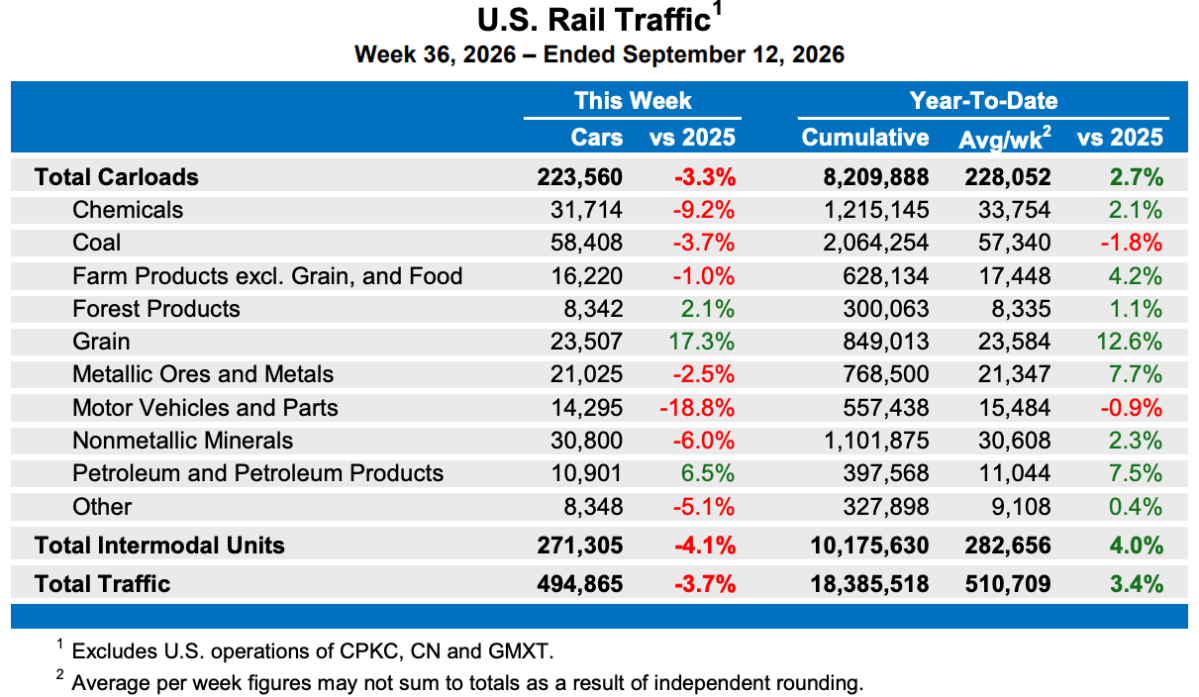
U.S. rail traffic has remained below 2024 levels for an eighth straight week, according to statistics from the Association of American Railroads.

Figures for the week ending Dec. 13, 2025, show 518,904 carloads and intermodal units, a decrease of 1.4% from the same week a year ago. Both carloads and intermodal traffic were down, with volume of 224,620 carloads, a drop of 1.7% from the corresponding week in 2024, and 294,284 containers and trailers, a decrease of 1.2%.

Through 50 weeks, 2025’s overall volume of 24,685,267 carloads and intermodal units were up 1.7% over the same period in 2024. The year-to-date volume of 11,113,752 carloads is a gain of 1.8%, while the 13,571,515 intermodal units represent a 1.7% increase.

(Chart: AAR)

North American volume for the week, as reported by nine U.S., Canadian, and Mexican railroads, was 705,800 carloads and intermodal units, down 1.1% y/y. The 329,271 carloads were down 1.6% from a year ago, while the 376,529 intermodal units represented a 0.7% decline. Year to date, North American volume of 33,973,610 carloads and intermodal units is a 1.6% increase from the first 50 weeks of 2024.

In Canada, weekly traffic included 91,707 carloads, down 0.02% from the corresponding week in 2024, and 66,869 intermodal  units, down 1.4%. The year-to-date volume of 8,102,2476 carloads and intermodal units is better by 2.2% over the same period a year ago.

Mexican railroads handled 12,944 carloads during the week, a decrease of 11.6% from the same week a year ago, and 15,375 intermodal units, a gain of 15%. Year to date, volume of 1,185,096 carloads and intermodal units is a drop of 5.6% from the first 50 weeks of 2024.

Subscribe to FreightWaves’ Rail e-newsletter and get the latest insights on rail freight right in your inbox.

Related coverage:

Unions oppose historic transcontinental rail merger

Union Pacific completes Arizona yard expansion

Union Pacific adds retiring CF Industries CEO to its board

Deep South Democrats back UP-NS rail merger

The Best Way To Maximize Fleet Longevity That You’re Probably Skipping

There’s nothing glamorous about a grease gun. It doesn’t have the technological appeal of telematics, the regulatory weight of ELD compliance, or the strategic complexity of route optimization. It’s a tube that squirts lubricant into fittings. And it might be the single most important maintenance tool in your shop.

During the supply chain chaos of the past few years, fleets that historically cycled out equipment at 500,000 to 700,000 miles suddenly couldn’t source replacement trucks. Lead times stretched to 18 months or longer. The solution was to extend asset life to a million miles, sometimes 1.5 million, or park the freight.

The fleets that pulled it off weren’t running magic equipment. They were running well-maintained equipment. And proper lubrication was where it started.

What You’re Actually Protecting

Every grease point on a Class 5 through Class 8 truck exists because metal is moving against metal, and without lubrication, that contact generates heat, friction, and eventually failure. The components aren’t cheap to replace, and the downtime while you’re replacing them isn’t cheap either.

Upper and lower kingpins control steering precision and suspension movement. When they run dry, you get sloppy handling and accelerated wear, putting your driver in a compromised position. Drag links connect the steering gearbox to the wheels through ball joints that will wear themselves out without regular lubrication.

Slack adjusters and S-cams are the heart of drum brake systems. Let them go without grease and you’re looking at reduced braking efficiency, the kind of thing that shows up in a post-crash investigation when someone asks why your stopping distance was 40 feet longer than it should have been.

Tie rod ends maintain steering alignment under heavy use. Spring pins and shackles support the suspension system and will happily destroy themselves through metal-on-metal contact if you let them. The fifth wheel pivot and plate need lubrication to articulate smoothly and reduce friction between the trailer and tractor.

None of this is complicated. All of it gets overlooked when shops are busy, drivers are pushing to make appointments, and nobody’s tracking intervals.

Not All Grease Is Created Equal

Trucks operate across temperature extremes, load conditions, and environmental exposures, requiring different lubricants for different applications. Using the wrong grease isn’t much better than using no grease at all.

Lithium-based grease performs well in high-load applications and resists both heat and water penetration, making it the workhorse choice for most general fleet applications. Molybdenum disulfide grease, moly grease, is formulated for high-friction contact points, such as kingpins and tie rods, where you need maximum wear protection.

Synthetic grease tolerates temperature extremes better than conventional options, which matters if you’re running equipment through Arizona summers or Minnesota winters. And if you’re operating refrigerated trailers hauling food products, you’re dealing with food-grade grease requirements that aren’t negotiable from a regulatory standpoint.

The OEM maintenance manual specifies what goes where. Follow it. The cost difference between grease types is negligible compared to the cost of a premature component failure caused by someone grabbing the wrong cartridge.

The Tools Have Gotten Better

The manual pump grease gun your grandfather used still works. It’s also slower, more physically demanding, and prone to inconsistent application pressure. Battery-powered grease guns deliver uniform pressure, reduce operator fatigue, and make it easier to reach fittings in awkward locations. For fleets with the budget, automatic lubrication systems eliminate human error by greasing key components on a programmed schedule.

The technology isn’t the point. Consistency is. However, when applying grease, you need to do it at the correct intervals on every fitting, every time. That requires tracking.

Why Intervals Get Missed

Greasing doesn’t generate revenue. It doesn’t move freight. It’s a task that keeps a truck out of service for an hour when it could be earning. In a capacity-constrained environment, there’s always pressure to skip the PM and keep rolling.

That calculus works right up until it doesn’t. A dry kingpin doesn’t send you a warning light. A worn tie rod end doesn’t throw a fault code. These components degrade gradually until they fail suddenly, usually at the worst possible time, leaving an expensive tow bill and a missed delivery in their wake.

The fleets that maintain asset longevity build lubrication into their preventive maintenance programs with the same rigor they apply to oil changes and brake inspections. They track intervals by mileage or hours, they document completed tasks, and they hold technicians accountable for hitting every fitting.

Modern fleet maintenance software makes this easier than it used to be. Automated reminders, digital maintenance logs, and consolidated task scheduling mean there’s no excuse for letting intervals slip. But the software only works if someone’s actually using it.

The Math That Matters

A cartridge of quality grease costs a few dollars. A complete PM service, including lubrication, runs a few hundred. A kingpin replacement runs $1,500 to $3,000 in parts and labor. A steering component failure that causes a crash runs into the millions when you factor in litigation, insurance impacts, and potential out-of-service orders.

Beyond the direct costs, proper lubrication affects fuel efficiency. Components that move freely require less energy than components fighting friction. It affects driver safety, steering and braking systems that operate as designed to protect the person behind the wheel. It involves compliance because DOT inspectors routinely assess component wear during roadside inspections.

There’s no regulatory requirement that you grease your trucks on a specific schedule. There’s also no regulatory requirement that says you have to stay in business. One tends to follow from the other.

The trucking industry loves to talk about driver shortages, rate pressures, and regulatory burdens. Those are real challenges. But the fleets that consistently outperform their competitors tend to do the boring stuff right. They maintain their equipment. They track their intervals. They don’t skip the grease job because a load is waiting.

When new equipment was impossible to source, the difference between a fleet that survived and a fleet that struggled often came down to whether their existing assets could handle another 500,000 miles. That longevity didn’t happen by accident. It happened one grease fitting at a time.

Your maintenance program either includes rigorous lubrication intervals or it doesn’t. If it doesn’t, you’re not saving money. You’re borrowing it from future repair bills.