California’s truck emissions rules under congressional microscope

Congressional review looms for California’s truck emissions rules
(Photo: Jim Allen/FreightWaves)

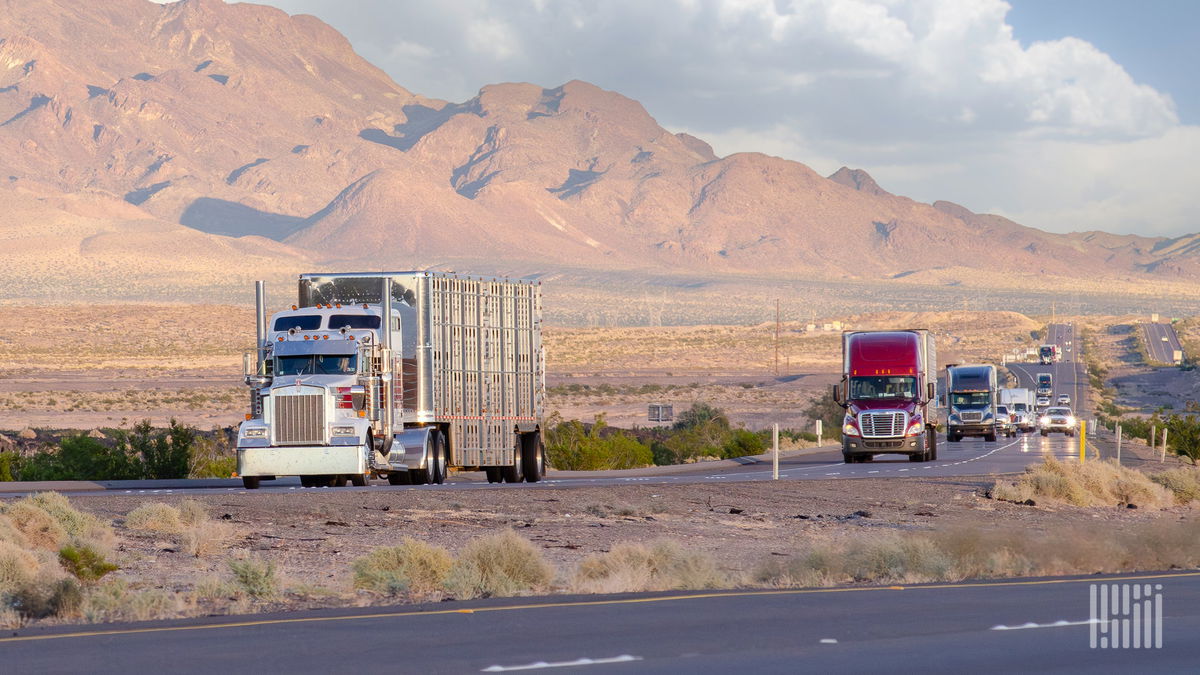
The Environmental Protection Agency under the Trump administration has taken a significant step toward potentially overturning California’s stricter truck emissions regulations. EPA Administrator Lee Zeldin announced that the agency has sent several vehicle emission-related waivers granted to California under the Biden administration to Congress for review.

This move targets California’s Advanced Clean Trucks (ACT) rule, Omnibus NOx rule and Advanced Clean Cars II rule. These regulations, which set more stringent emissions standards than federal rules, have been long-standing issues for the trucking industry.

“This is not the United States of California. California should never be given the keys to set national policy and regulate America’s supply chain,” said Chris Spear, President and CEO of the American Trucking Associations.

The EPA’s action raises complex legal questions. Traditionally, the Congressional Review Act (CRA) applies to federal regulations, not waivers. Glen Kedzie, a principal with E&E Strategies, noted, “So is a waiver a rule, or is it not a rule?” This distinction could be crucial in determining Congress’ authority to overturn these waivers.

Adding to the complexity, a November 2023 General Accounting Office opinion suggested that such waivers might be considered “adjudicatory orders” not subject to congressional review under the CRA.

California has set aside $25 million to fight various Trump administration initiatives, indicating a readiness for potential litigation. The state’s Air Resources Board criticized the EPA’s move, stating it “does not comply with the law.”

Truck parking apps have a driver shortage, researchers say

(Photo: Jim Allen/FreightWaves)

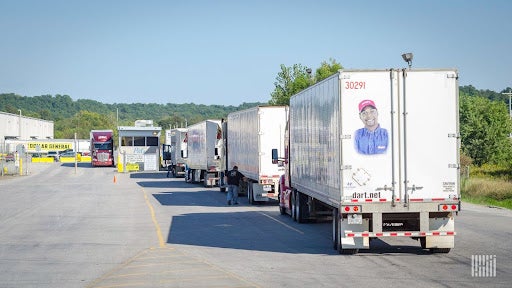
For fleets looking to help their drivers find parking, recent research by the Texas A&M Transportation Institute on behalf of the Federal Motor Carrier Safety Administration suggests it’s easier said than done. The study examined truck parking usage along the Interstate 80 and Interstate 94 corridors in Iowa and Wisconsin.

Despite the availability of app-based solutions, drivers are largely not utilizing these tools to locate available truck parking spaces. The study notes this behavior has led to a persistent problem of trucks parking in unauthorized locations, including entrances, exits and rest areas along the studied corridors.

The research uncovered a significant hurdle: driver adoption. “The two biggest challenges associated with app-based truck parking management platforms are driver participation (i.e., reaching drivers and convincing drivers to download the app) and compliance (i.e., convincing drivers to use the app every time when parking to check in and check out),” the study said.

This resistance to adoption is one of many dichotomies in trucking. On one hand, the input received from truck drivers at the pilot study rest areas during the implementation of the ParkUnload platform was “overwhelmingly positive.” Conversely, responses to social media outreach about such technologies were “overwhelmingly negative.”

In terms of solutions, officials in the states say more funding is needed. Both the Iowa and Wisconsin Departments of Transportation pointed to insufficient funding as a major obstacle in expanding truck parking to meet current and future demand.

Market update: January preliminary trailer orders up 51% compared to 2024
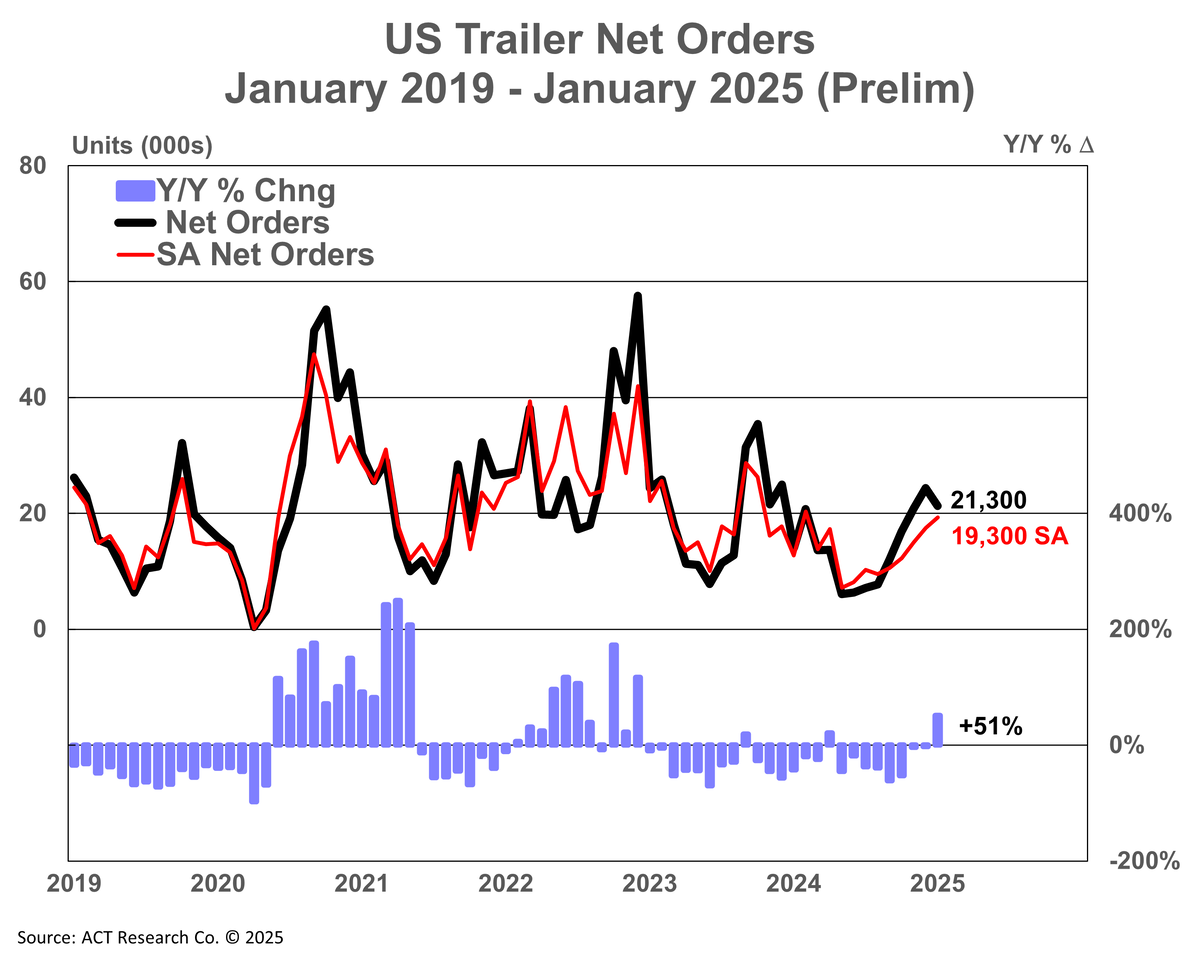
January preliminary net trailer orders started 2025 with a bang, outpacing the previous year’s tally by 51%, according to recent data from ACT Research. Despite preliminary net trailer orders falling by 3,100 compared to December 2024, year-over-year comps surged by 21,300 units. 

“Though past the traditional peak, we’re still in a period of ‘strong order’ intake. This month’s pattern of lower than December but still above average demand was expected. It’s also no surprise that the data are higher than the January 2024 intake, given the slowing demand that marked 2023 and led into the subdued market reported throughout most of 2024,” said Jennifer McNealy, director CV market research and publications at ACT Research.

However, McNealy cautioned that despite the strong start, expectations for the 2025 order cycle remain weak, adding, “Notwithstanding the improvement thus far in the 2025 order cycle, ACT’s expectations for weak trailer demand relative to recent performance remain, as continuing weak for-hire truck market fundamentals, low used equipment valuations, relatively full dealer inventories, and high interest rates impede stronger activity in the near term. An order uptick showcasing demand, or the lack thereof, depends not just on the first few months of the new order cycle, but on order volumes through Q1’25 and beyond.”

SONAR spotlight: Presidents Day brings further spot rate declines

(Source: SONAR)

Summary: The past week saw continued dry van spot market rate declines, breaking a temporary uptick observed in the second week of February. The SONAR National Truckload Index 7-Day Average fell 9 cents per mile all in or 3.8% from $2.37 on Feb. 10 to $2.28. The NTI is 19 cents lower compared to last month. Removing an estimated fuel surcharge from the NTI shows linehaul rates falling 8 cents per mile w/w from $1.80 to $1.72. The NTIL’s fuel surcharge is calculated by a fuel efficiency of 6.5 miles per gallon. The formula is NTID – (DTS.USA/6.5).

On the contract side, dry van outbound tender rejection rates remained mostly unchanged in the past week. VOTRI fell 9 basis points w/w from 5.27% on Feb. 10 to 5.18%. The dry van tender rejection rate performance continues to follow seasonal trends and is 52 bps higher than last year’s value of 4.66%. Part of the softness came from lower dry van outbound tender volumes, which fell in the past week and are underperforming yearly comps. VOTVI fell 499.06 points or 6.61% w/w, from 7,548.18 points to 7,049.12 points. Compared to last year, VOTRI is 832.67 points or 10.56% lower than 7,881.79 points on Feb. 18, 2024.

Trucking braces for immigration crackdowns (FreightWaves)

FMCSA pushed TQL to drop broker transparency contract waivers (Overdrive)

Feds taking another look at truck-broker contract rules (FreightWaves)

The Playbook delivers small fleets, owner-operators a suite of resources to grow their business (FreightWaves)

Tenstreet acquires driver communications provider TextLocate (FreightWaves)
Trucking market remains stable, but recovery is slow amid tariff uncertainty (Commercial Carrier Journal)


Most recent episode

Like the content? Subscribe to the newsletter here.

LTL panel preps shippers for upcoming changes to freight classification codes

A sideview of a Pitt Ohio trailer on a highway

Know your freight dimensions and get familiar with the new classification codes. That was the advice given to less-than-truckload shippers on a panel discussion about upcoming changes to the way their freight will be categorized.

The National Motor Freight Traffic Association, a nonprofit trade group that publishes LTL commodity classifications, is simplifying a 90-year-old rating system. The goal is to get the industry to adopt a density-based approach for categorizing freight, which will allow carriers to accurately price shipments upfront and ultimately remove waste from the supply chain.

The National Motor Freight Classification (NMFC) system will still rely on the four core freight characteristics – density, handling, stowability and liability – but an emphasis will be placed on density. Density ratings are being expanded from 11 subprovisions to 13, with generic headings being consolidated. Roughly 2,000 items are slated to be culled from a list of 5,000 as part of the latest revision.

The proposed changes were released late last month and are currently subject to a public feedback period. The final changes take effect on July 19.

Participants on a Thursday panel hosted by carrier Pitt Ohio advised shippers to start referencing the new class codes when putting a bill of lading together and to be sure the BOL has accurate information like weight and dimensions.

“Nearly all LTL carriers are using some sort of costing model, and the driving factor that you have to make sure that you get right when you enter into a pricing agreement is the density,” said Shawn Galloway, vice president of pricing at Pitt Ohio. “It only makes sense if our costs and our pricing are being driven by density that now we’re making the transition to where the freight invoicing is being driven by the same thing.”

The primary cost drivers for LTL carriers are distance, time and space. Distance and time are largely known factors as they can be easily identified on a standard BOL. Space has been more difficult to determine with carriers defaulting to a weight-based coding system in the past. However, with the broad acceptance of freight dimensioning technology, solving the space equation is easier and ultimately leading to more accurate pricing.

“If you get the density right and you have a decent dataset, there’s a 90% chance you’re going to get to the right sustainable, competitive price,” Galloway said.

The NMFC changes are expected to help minimize reclassifications, reweighs and surprises on final freight bills. Galloway suggested that shippers build a dialogue with their primary carriers to make sure they are prepping their freight in the most efficient way and to implement changes with their dock personnel now.

“Until you get this on the bill of lading, and you get the dimensions … it’s going to be very difficult for you to try to gauge some sort of impact,” Galloway said. “I don’t think your carriers are going to be very successful in helping you with that either if they don’t have this information at their fingertips.”

FAKs are costing you money

The panel also told shippers they are leaving money on the table by allowing their freight to be defaulted to a freight all kinds (FAK) designation. This happens often, especially for shippers that haven’t invested in dimensioners and don’t provide full shipment details upfront. This forces carriers to make assumptions, which leads to building in extra margin on a quote to offset the risk of underpricing a load.

“Carriers don’t want risk,” said Scooter Sayers, director of business development, LTL Solutions, at Cubiscan, a maker of freight dimensioners. He said shippers that have pricing tied to FAKs are likely to see costs move higher when the changes take hold. 

“It’s no different than if you go to the grocery store and you’re forcing your grocery store to charge you the same price per pound for any type of beef you want to get, whether it’s ground beef or tenderloin. … They’re going to raise that average price up really high because they’re afraid all you’re going to do is buy tenderloin.”

Geoff Muessig, executive vice president and chief marketing officer at Pitt Ohio, said most carriers will begin allocating equipment to the shippers that embrace the changes early on, especially when the market turns up and capacity is scarce.

“As the marketplace turns and there’s need for more equipment, carriers are going to ultimately position their equipment where there’s more profit to be gained and that’s going to be where I understand my costs. At that point, it’s not going to be an evolution, it’s going to be something much worse for those shippers who are slow to adapt.”

More FreightWaves articles by Todd Maiden:

No sure thing? ILA head tells rank and file contract vote an ‘obstacle’ to overcome

After hammering out a tentative contract described as the richest in the history of the union, the leader of the International Longshoremen’s Association is taking nothing for granted ahead of a ratification vote by members next Tuesday.

“Even though I am extremely pleased with the proposed extension that the ILA has negotiated, there is still one final obstacle that must be overcome before the ILA can say that its members will be protected for the next six years, the ratification vote,” ILA President Harold Daggett wrote in a Feb. 14 letter to members. “I hope to have the ratification vote among ILA members in good standing in all ILA ports covered by the master contract on Tuesday, Feb. 25. 

“I ask that each of you also approve the agreement by voting yes to its ratification.”

The union agreed to a new six-year master contract with terminal operators and ocean carriers represented by the United States Maritime Alliance covering 25,000 workers in container handling at 14 ports from Texas to Massachusetts.

The pact includes a 62% pay raise over the life of the contract, improved benefits and job guarantees linked to the introduction of automated equipment at container terminals.

Union locals for the past two weeks have been reviewing the terms of the master contract and local area pacts.

“Our collective strength helped produce the richest contact in our history,” said Daggett at a meeting of his own local Wednesday in New Jersey.

In a video laying out details, Daggett said the new contract package is worth $35 billion dollars — a figure he called “a conservative estimate.”

Find more articles by Stuart Chirls here.

Related coverage:

While supply chain frets, Port of Los Angeles sees record January volume

Federal Maritime Commission dropping DEI from strategic plan

US East Coast port sees largest-ever boxship call

In slow season, tariffs a following wind for trans-Pacific container rates

Airbus postpones rollout of A350 freighter until late 2027

A large aircraft seen on the production line as it is built.

Airbus on Thursday said it is pushing back the commercial release of the all-new A350 freighter until the second half of 2027 because of ongoing production challenges at supplier Spirit AeroSystems.

The news puts further pressure on capacity for large freighter aircraft later this decade as a significant portion of the global fleet reaches retirement age.

Problems producing a fuselage section at Wichita, Kansas-based Spirit AeroSystems have slowed the manufacturing ramp-up of the passenger version of the A350 and forced Airbus to delay the entry into service of the A350, which was scheduled for 2026 after completing final development and testing. Airbus is striving to increase build rates for the A350 passenger type above the current six per month.

Airbus has logged 60 orders from 10 airlines and lessors so far for the all-new A350, including a deal for five units from Taiwan’s Starlux that has not been fully finalized. FreightWaves reported in November that Etihad Airways plans to purchase three additional A350s and is negotiating final terms with Airbus.

The A350 freighter is impacted more by Spirit’s troubles than the passenger variant because of extra development work beyond normal production, Airbus CEO Guillaume Faury said during a press conference streamed online. He said other undisclosed factors are also contributing to the launch delay of the widebody cargo jet.

Spirit AeroSystems has struggled financially since the pandemic and is being reacquired by Boeing, with Airbus buying the portion of the company that supports it, to keep it afloat. Those transactions are expected to close this year.

“Spirit is clearly a bottleneck because they’re not able to ramp up the A350 and A220 [programs],” Faury said. “Our focus in the next three years is to spend on capex to bring Spirit in the position that they can support the trajectory that we have in our plans for the A220 and A350.”

Airbus had previously confirmed that supplies to Airbus of A350 fuselage parts from a Spirit plant in North Carolina were running behind schedule.

The lack of future replacements for aging widebody freighters is raising concerns that the air cargo industry may not be able to keep up with international shipping demand. Boeing faces delays of its own for the next-generation 777-8 freighter, which won’t be ready for commercial use until 2028, and intends to stop making the 767 and 777 freighters at the end of 2027. Meanwhile, passenger-to-freighter conversion programs for the Boeing 777 face certification delays, while existing conversion programs are behind schedule because of supply chain problems, including limited availability of skilled technicians. On top of that, a work backlog related to the recall of Pratt & Whitney CFM engines to fix a manufacturing defect has delayed delivery of new and converted freighters to airlines. 

About 650 widebody freighters are in service today, and nearly 20% are older than 20 years, according to Michael Steen, the CEO of Atlas Air. About half of the widebody freighter fleet will reach retirement age in the next three to five years, according to Boeing. Airlines are expected to soon phase out these aircraft because of the high cost of maintenance and fuel consumption, and lower reliability. 

Boeing recently forecast air cargo volumes will grow at a compound annual rate of 4% over the next 20 years. Interest in factory-built cargo jets and passenger-to-freighter conversions is rising because dedicated freighters give businesses greater flexibility and schedule reliability over shipping goods via passenger aircraft. Air cargo demand increased 12% in 2024 as the industry recovered from a steep downturn.

The A350F, powered by Rolls-Royce Trent XWB-97 engines, can carry a payload of up to 120 tons and can fly up to 4,700 nautical miles. It will feature the industry’s largest main deck cargo door, designed to ease loading of shipping containers and nonstandard pieces of freight. The large cargo door offers the option of using 20-foot shipping containers, something that is rarely, if ever, done with traditional side-loading aircraft, said Crawford Hamilton, head of freighter marketing at Airbus, in an interview last March with STAT Media Group. More than 70% of the airframe is made of advanced materials. Airbus claims the lighter airframe and efficient Rolls Royce engines produce a 20% advantage in fuel burn and carbon dioxide emissions over the legacy Boeing 777 currently in production, as well as the older Boeing 747-400.

Trade war

Faury said Airbus is reviewing scenarios for adapting to potential U.S. tariffs threatened by President Trump against Europe, which would increase prices for U.S. airlines. The airline hopes the U.S. administration takes into consideration that Airbus does a significant amount of development, assembly, and purchasing in the United States and that the trans-Atlantic aerospace industry is very integrated.. 

“But we have a strong demand outside of the U.S. and a lot of production capabilities in Europe and outside Europe that we could use to serve export customers,” he said.

Airbus delivered 766 commercial aircraft last year. Revenues increased 6% year over year to 69.2 billion euros ($48.7 billion), and the company had a pretax profit of $3.8 billion.

Click here for more FreightWaves stories by Eric Kulisch.

Airfreight outlook remains bright to start the year

Etihad Airways to order 3 additional A350 freighters from Airbus

China Airlines to buy Boeing 777-8 freighters

Nikola’s Bankruptcy a Reality Check for Diesel Alternatives

The promise of zero-emission freight has suffered a big setback with Nikola Corp.’s bankruptcy. A company that once positioned itself as a disruptor in the trucking industry is dying a slow death. The electric- and hydrogen-powered truck manufacturer, once heralded as the Tesla of trucking, struggled with financial instability, supply chain challenges and a series of setbacks that ultimately led to its demise.

But Nikola’s downfall is bigger than just one company. It raises real questions about the viability of non-diesel alternatives in an industry that depends on power, reliability, and infrastructure stability. This is not just a bad day for Nikola’s investors and partners; it’s a reality check for the push toward green energy in freight.

What Nikola’s Bankruptcy Means for the Industry

At its peak, Nikola was a Wall Street darling, riding the wave of green energy hype and securing high-profile investors and strategic partnerships. The company promised a hydrogen-powered revolution, betting that trucking fleets would abandon diesel for cleaner alternatives. But instead of delivering, Nikola’s vision collapsed under financial mismanagement, production struggles and market skepticism.

For companies like Carter Machinery’s Etheros, which took a gamble on Nikola’s green technology, this bankruptcy is a hard hit to the credibility of alternative fuel trucking. Carter Machinery, a well-known CAT dealer, made an ambitious leap with Etheros, positioning itself as a key player in nondiesel energy solutions. With Nikola’s failure, the go-green push in heavy trucking takes another blow, reinforcing what many diesel lovers and green energy industry skeptics have argued: Diesel is king in power, reliability and infrastructure.

Nikola’s collapse also leaves investors, dealers and customers who placed faith in its hydrogen-powered trucking concept uncertain. Although the technology may have potential, its viability as a diesel replacement remains a significant hurdle, especially since the infrastructure for hydrogen refueling is still decades behind diesel’s availability and efficiency.

The Diesel Debate, Green Energy and Freight 

The trucking industry, for good reason, has long been skeptical of full-scale electrification and hydrogen adoption. While governments, regulators and environmental groups push for zero-emission mandates, fleets and drivers live in the real world, where power, reliability and efficiency matter more than feel-good virtuous policies.

Nikola’s downfall is proof that the shift away from diesel is far more complicated than idealists assume. The main issues with replacing diesel in freight are not in short supply:

  • Diesel engines are unmatched in their ability to haul heavy loads over long distances with sustained torque and efficiency. Electric and hydrogen alternatives have struggled to match this performance, especially in long-haul applications.
  • The U.S. has hundreds of thousands of diesel fueling stations, while the infrastructure for hydrogen and charging networks is severely lacking, making fleet adoption a logistical nightmare.
  • Fleets can’t afford to gamble on a technology that is still inconsistent, costly and dependent on subsidies. Diesel remains the most economical and proven option for trucking businesses that need predictability and reliability.
  • Electric vehicle (EV) batteries depend on lithium, cobalt and rare earth materials, often sourced from politically unstable regions. Hydrogen production still relies on expensive and inefficient processes, making both options financially uncompetitive compared to diesel.
  • Cold weather and mountainous areas are concerns for power, torque and range. When the mercury drops, chemical and physical reactions inside an EV’s battery require more time. The cold slows these physical processes, reducing the power available to the EV.

Despite these challenges, policymakers continue pushing for diesel bans and strict emission regulations, often ignoring the realities of trucking operations and the lack of viable, scalable alternatives. Nikola’s failure is a stark reminder that wishful thinking doesn’t replace infrastructure, efficiency and market readiness.

Is There a Future for Hydrogen and Electric Trucks?

Nikola’s failure doesn’t mean the end of green trucking, but it further exposes the weaknesses of current technology and infrastructure. Companies still investing in nondiesel solutions need to reassess their strategies and address the core issues that have made diesel the dominant force in freight for over a century.

Hydrogen and electric trucks may eventually play a supporting role in regional and specialized operations, but the idea of a fully diesel-free trucking industry remains a distant, unrealistic goal. Even manufacturers like Daimler, Volvo and Tesla, which continue developing electric and hydrogen truck models, acknowledge the logistical challenges. Without massive investments in charging infrastructure, hydrogen refueling stations and better energy storage technology, the transition from diesel won’t happen anytime soon.

For now, Nikola’s bankruptcy is a harsh reality check for green energy advocates who underestimated the complexity of replacing diesel in freight. The road to sustainable trucking isn’t a forced transition from diesel but rather an evolution of technology that works in real-world applications. Until then, diesel remains the backbone of trucking, and it’s not going anywhere anytime soon. My advice is to drive a truck, operate a fleet and then determine what energy you feel is necessary to accomplish that before pushing alternative energy “solutions.”

While supply chain frets, Port of Los Angeles sees record January volume

Containers at the Port of Los Angeles. (Photo: Jim Allen/FreightWaves)

Uncertainty may be sweeping the global supply chain, but it continues to power record container volumes for U.S. maritime gateways.

The Port of Los Angeles reported volume of 924,245 twenty-foot equivalent units in January, up 8% y/y in what was the busiest start in the hub’s 117-year history.

“This January milestone adds to a great run of strong volume, with the last seven months averaging more than 927,000 container units,” said Port of Los Angeles Executive Director Gene Seroka in a media briefing. “A strong economy, along with importers bringing in cargo as a hedge against tariffs and ahead of Lunar New Year, were key factors in January. We continue to move these record-breaking volumes quickly and efficiently, without ship delays.”

January loaded imports totaled 483,831 TEUs, a 9.5% increase compared to 2024. Loaded exports came in at 113,271 TEUs, off 10.5% y/y. 

The port processed 327,143 empty containers, 14% ahead of 2024 and a reliable indicator of pending inbound volume.

Find more articles by Stuart Chirls here.

Related coverage:

Federal Maritime Commission dropping DEI from strategic plan

US East Coast port sees largest-ever boxship call

In slow season, tariffs a following wind for trans-Pacific container rates

Georgia port tops US ro-ro gateways

Freight Market Tightens as Rates Slide: What It Means for Owner-Operators

The freight market is going through a shake-up, and if you’re a small carrier, you are feeling it. Rates aren’t what they were even a month ago, and the numbers don’t lie — spot and contract rates are trending downward, rejection rates are staying low, and overall freight volume is slipping.Freight demand overall  is down 6.5% month over month, and fuel costs have risen 6 cents per gallon over the same period. That means not only are there fewer loads available, but the cost to run those loads is creeping up. With fewer shipments moving and too many trucks chasing the same freight, brokers and shippers have the upper hand, which keeps rates low and makes it harder for small carriers to turn a profit.

If you’ve been struggling to find loads that make sense for your business, you’re not alone. Spot rates are already down 1% from last week and 2.7% from last month, while contract rates have dipped 1.6% over the past 30 days. And with fuel, insurance and maintenance costs continuing to eat away at margins, it’s clear that this market is testing owner-operators and small fleets in a big way.This is one of those moments in trucking where survival depends on making smart moves. Running cheap freight just to keep the wheels turning isn’t the answer, but sitting idle isn’t either. Now’s the time to watch the market closely, cut unnecessary expenses and focus on lanes that actually turn a profit – because in a market like this, the carriers that adapt and make every mile count will be the ones still standing when the tide turns. There are some markets like Boston; Bristol, New Hampshire; and Austin, Texas, that are showing up as hot markets, but there are many more cold markets. Not to mention, the hot markets are small and only account for roughly 1.5% of the total freight market.

The Numbers Don’t Lie

Right now, overall the market is soft, meaning there’s more capacity (trucks available) than freight to move. That imbalance is driving rates down across the board. Here’s what the data is telling us:

  • Spot rates are down 1% from last week, 2.7% from last month and 2.3% from last year. If you’re running load board freight, you’re already feeling the pinch.
  • Contract rates aren’t much better, dropping 1.6% from last week, 1.6% from last month and 2.6% from last year. Even those with dedicated lanes are seeing rate pressure.
  • Rejection rates are near flat, which means carriers aren’t turning down loads — likely because there aren’t many alternatives. That’s a telltale sign that demand is shrinking.

Why This Matters

If you’re an owner-operator, this trend is concerning because you are wondering when things are going to turn the corner. Low rejection rates mean brokers and shippers have more control over pricing: They simply have more carriers to choose from and with low rejection rates, that means carriers are taking whatever comes their way. When demand for trucks is low, rates follow suit, and right now, both contract and spot rates are showing signs of decline.

What’s Next?

Expect the next few weeks to remain tough on rates, unless there’s a shake-up in capacity or demand. If you’re running spot market loads, be extra selective on lanes — don’t fall into the trap of hauling cheap freight just to stay moving. Shorten your lengths of hauls, and you may have to run some areas that aren’t on your list of favorites. There is still good freight out there, just limited at the moment. 

Bottom line: This market is not for the weak. The smartest owner-operators will cut unnecessary expenses, avoid weak-paying lanes and focus on efficiency. Keep your eye on fuel costs, watch your rate per mile, and stay informed — because the ones who adapt will be the ones who survive.

For more market info, tune in to the February State of Freight Webinar today at 2:00 pm ET. Register here.

Getting US industrial production unstuck

Industrial production in the United States has been in a rut since the Great Financial Crisis of 2008-2009. Despite periods of economic growth over the past 15 years, manufacturing output has struggled to regain its pre-crisis momentum. This stagnation presents a significant challenge for policymakers and business leaders alike. 

This is JP Hampstead, co-host of the Bring It Home podcast with Craig Fuller. Welcome to the 14th edition of our newsletter, which asks if industrial policy is the way to get U.S. industrial production unstuck.

Since 2011, U.S. manufacturing productivity has hit a ceiling and even declined in some years. This stagnation isn’t mirrored in other sectors of the economy, with service industries picking up the slack in overall productivity growth. The situation is particularly concerning when compared to other advanced economies – countries like Germany, South Korea and France have managed to increase their manufacturing productivity over the same period.

Several factors contribute to the stagnation in U.S. industrial production. There has been significant underinvestment in machinery and equipment, with U.S. manufacturers demonstrating reluctance to adopt new technologies and to invest in capital infrastructure. This hesitation has resulted in many American factories relying on outdated machinery, which hampers efficiency and innovation. Furthermore, the widening gap between the most and least productive manufacturers has led to a concentration of industry power. Only a select few companies are pushing technological boundaries, while the majority fall behind.

For the past few decades, the U.S. manufacturing sector has placed limited emphasis on exports. In comparison to other advanced economies, U.S. exports constitute a smaller fraction of GDP, which restricts exposure to global markets and limits growth and innovation opportunities. Compounding these issues is a widening skills gap. The skills required by modern manufacturing processes are increasingly mismatched with those offered by the current workforce.

(Photo: Mixabest/Creative Commons)

In response to these challenges, there’s been a renewed interest in industrial policy – targeted government interventions designed to boost specific sectors or technologies. Once out of favor in many Western countries, industrial policy is making a comeback as policymakers grapple with economic challenges and geopolitical competition. The CHIPS Act, which is pouring hundreds of billions of dollars into electric vehicles, batteries, semiconductors and solar energy, is a prominent recent example.

But industrial policy has a long history in the United States. After World War II, initiatives like the Apollo space program and the work of the Defense Advanced Research Projects Agency successfully stimulated innovation in key sectors. Then, the end of the Cold War and a growing skepticism toward government bloat and inefficiency in the 1980s began a decadeslong privatization and “free market” push that drove industrial policy out of the national conversation.

Now a new wave of industrial policy is emerging. The aggressive support that Beijing has extended to its manufacturing sector has prompted the United States to consider implementing a more active industrial policy to maintain its competitive edge. National security concerns have also become increasingly pertinent, with the COVID-19 pandemic and rising geopolitical tensions underscoring the critical importance of having robust domestic manufacturing capabilities for essential goods. Lastly, there is a strong emphasis on maintaining technological leadership, especially in emerging fields such as artificial intelligence and quantum computing, to ensure both economic vitality and national security. These combined pressures are shaping the renewed interest and strategic approach in U.S. industrial policy.

While industrial policy holds promise for revitalizing U.S. manufacturing, its success is not guaranteed. To maximize the chances of positive outcomes, policymakers and industry leaders must prioritize several strategies. There’s still a need to focus on innovation by supporting research and development in key technologies. This involves fostering collaboration among universities, government labs and private industry to drive technological advancement. Additionally, addressing the skills gap is crucial, which can be achieved through targeted training programs and partnerships with educational institutions that prepare the workforce for the demands of modern manufacturing.

Infrastructure modernization is another essential component, requiring improvements in transportation networks, energy systems and digital infrastructure to support advanced manufacturing. Encouraging reshoring is also vital; providing incentives for companies to bring production back to the U.S., especially in critical industries, can strengthen the domestic industrial base. Supporting the growth of small and medium-size enterprises is important, as these firms often drive technological advancements and spur productivity.

To compete more effectively in global markets, strategies to promote exports need to be developed, enabling U.S. manufacturers to expand their reach and influence. Ensuring policy coherence across different government agencies and levels of governance is imperative to maximize the impact of industrial policy efforts. This coordinated approach ensures that initiatives are aligned and resources are used efficiently to foster the resurgence of U.S. manufacturing. Through a combination of innovation, investment and strategic policy, the U.S. could reclaim its position as a global manufacturing powerhouse.

Quotable

“America cannot afford to auction off its industrial base.”

– Then-Sen. JD Vance, 2023

Infographic

U.S. industrial production has only grown approximately 1.5% since the summer of 2007. (Chart: St. Louis Federal Reserve)

News from around the web

Eaton Increasing Transformer Manufacturing with South Carolina Investment

Power management company Eaton said it is helping address the critical shortage of transformers, along with record demand for its solutions from utility, large commercial, industrial and data center customers, with a $340 million investment to increase U.S. production of its three-phase transformers essential to reliable electrical power.

Production and hiring at Eaton’s new Jonesville, South Carolina, facility is expected to begin in 2027. Eaton will also continue to manufacture three-phase transformers at two Wisconsin facilities.

Key Tronic to invest $28 million into Springdale site, add more than 400 jobs

Spokane Valley, Washington-based electronics manufacturer Key Tronic Corp. will invest $28 million to relocate its Fayetteville, Arkansas, plant to a 290,540-square-foot industrial building in Springdale, Arkansas, according to a Thursday news release.

The move is expected to increase its U.S. production capacity by about 40% and create more than 400 jobs over five years as the company expands production to meet customer demand and mitigate tariff impacts.

Isuzu to invest $280M for new production base in South Carolina

Isuzu’s total investment in the plant (including land, building, tooling and equipment) is expected to equal approximately $280 million. The plant will have a production capacity of 50,000 units by 2030 and will initially produce Isuzu N-Series Gas, N-Series Electric and F-Series Diesel trucks. Initial assembly operations will begin in 2027 and will further expand in 2028, at which time the plant is expected to employ more than 700 people.

Most recent episode

Federal Maritime Commission dropping DEI from strategic plan

Following President Donald Trump’s sweeping executive order reshaping development of the federal workforce, the Federal Maritime Commission has eliminated portions of its 2022-2026 strategic plan that focus on diversity, equity and inclusion.

The FMC, which regulates U.S. international ocean transportation, announced the changes in a brief statement Wednesday. 

“Pursuant to Executive Order, Ending Radical and Wasteful Government DEI Programs And Preferencing, and implementing guidance from the U.S. Office of Personnel Management (“Initial Guidance Regarding DEIA Executive Orders”, January 21, 2025), the following sections of the Federal Maritime Commission’s 2022-2026 Strategic Plan are no longer in effect as of January 24, 2025: Objective 2.1 (page 9) – plan for future equity review; Objective 2.3 (page 12) – plan for future equity review; Stewardship Objective (page 15) – agency commitment to the principles of diversity, equity, inclusion, and accessibility; Stewardship sub-objectives S.2.1 and S.2.2 (pages 17-18); Equity Statement (page 19). The Commission will develop and publish a revised Strategic Plan as soon as is practicable.”

No other details were disclosed.

Trump in January appointed incumbent Commissioner Louis Sola as chairman of the five-member bipartisan FMC, succeeding Democrat Daniel Maffei. The remaining members are Republican Rebecca Dye, who as an appointee of then-President George W. Bush is the longest-serving member, and Democrat Max Vekich. One commissioner vacancy remains to be filled following the recent departure of Carl Bentzel.

Separately, Trump issued an executive order that puts all independent federal agencies under his direct supervision. While it was not specifically named in the order, it is expected that the changes if applied will include the FMC. 

Find more articles by Stuart Chirls here.

Related coverage:

US East Coast port sees largest-ever boxship call

In slow season, tariffs a following wind for trans-Pacific container rates

Georgia port tops US ro-ro gateways

WATCH: Helicopter lifts crew to safety from grounded container ship

Truck parking apps have a driver shortage, researchers say

A sign saying "Big Rigs Welcome" in front of a dirt parking lot

The trucking industry has a parking paradox: Despite a critical shortage of parking spaces and the availability of technology-driven solutions, truckers are hesitant to embrace mobile apps designed to help. This is according to a recent study by the Texas A&M Transportation Institute on behalf of the Federal Motor Carrier Safety Administration. The study examined truck parking usage along the Interstate 80 and Interstate 94 corridors in Iowa and Wisconsin.

The researchers wanted to identify when, where and for how long trucks stop in unauthorized locations and determine the feasibility and benefits of deploying truck parking capacity management platforms.

Despite the availability of app-based solutions, drivers are largely not utilizing these tools to locate available truck parking spaces. The study notes this behavior has led to a persistent problem of trucks parking in unauthorized locations, including entrances, exits and rest areas along the studied corridors.

“Adequate, safe parking remains a top concern for the trucking industry and for truck drivers, but providing sufficient and free parking in a timely manner is becoming increasingly challenging for both the public and private sectors,” the study adds. 

The researchers utilized the Truck Parking Information Management System (TPIMS) data collected by the Mid-America Freight Coalition to gauge parking capacity usage. Additionally, they analyzed a sample of telematics data from EROAD to track trucks that were stopping in unauthorized locations. The study also included a pilot program implementing a truck parking technology app with Bluetooth capabilities at nine rest areas along the I-80 and I-39/I-90/I-94 corridors.

Key findings showed a significant mismatch between supply and demand, particularly for overnight parking. The unmet demand resulted in truck drivers resorting to parking on the entrances and exits of rest areas along the I-80, I-39, I-90 and I-94 corridors. The study also showed that the need for short-duration parking exists both day and night, putting constant pressure on available parking facilities.

The pilot program using the ParkUnload platform demonstrated the feasibility of using technology solutions to provide drivers with detailed, real-time information about parking availability. These platforms can offer the number of available spaces and their specific locations within rest areas or truck stops.

However, the research uncovered a significant hurdle: driver adoption. “The two biggest challenges associated with app-based truck parking management platforms are driver participation (i.e., reaching drivers and convincing drivers to download the app) and compliance (i.e., convincing drivers to use the app every time when parking to check in and check out),” the study said.

This resistance to adoption is one of many dichotomies in trucking. On one hand, the input received from truck drivers at the pilot study rest areas during the implementation of the ParkUnload platform was “overwhelmingly positive.” Conversely, responses to social media outreach about such technologies were “overwhelmingly negative.”

It remains difficult for researchers to accurately gauge driver sentiment and predict adoption rates. The feedback received from the ParkUnload App users themselves was predominantly constructive and positive, according to the study authors.

The study authors also highlighted the difficulties in identifying and reaching a representative sample of truck drivers that can be extrapolated to determine whether truck parking management platforms are feasible.

In terms of solutions, officials in the states say more funding is needed. Both the Iowa and Wisconsin Departments of Transportation pointed to insufficient funding as a major obstacle in expanding truck parking to meet current and future demand. 

Other solutions involved adding parking reservation systems at truck stops or diversifying parking services. However, for deployment at smaller rest areas, these systems may be cost-prohibitive.

The authors recommend adopting strategies involving driver education and engagement on the advantages of using parking management apps.