Driving safety with Battaglia Communications – Taking the Hire Road
On this week’s episode of Taking the Hire Road, Lisa M. Battaglia, founder and president of Battaglia Communications, sat down with Jeremy Reymer, founder of DriverReach and Project 61, to discuss the importance of developing and executing an internal marketing and communications strategy to drive employee engagement, retention and safety.
In 2022, Battaglia founded her company because she saw a need for freight companies to shift their marketing and communication efforts from the outside to the inside. “I am a strong believer that communication is key for safety,” she said. “Safety has profound bottom-line results, more so than almost any other element of operation.”
Battaglia now works with transportation and trucking organizations around the country to develop and execute strategic marketing and communication plans that focus on employee engagement.
Her goals are to drive retention, promote safety and ultimately improve results. “These were all needs I saw having worked in the trucking industry for a long time,” Battaglia said.
Why is internal marketing so crucial? According to Battaglia, it comes down to meeting fundamental goals and keeping perspective.
“External marketing is of course necessary,” Battaglia said. “You’ll always need to communicate with clients and reach out to potential new clients.
“I think what’s missing is that the people who are driving that interaction with clients, people who are your producers, people who are responsible for safety, those are your employees, and good communication with those people has to come before external messaging can ever be successful.”
Battaglia often asks companies to think about who their most important clients are, and what it would mean to lose any of them. Then she asks what those same companies would do if they lost employees – which would be a much more devastating loss.
“The fact is, if you don’t have a good relationship and good communication with your employees, you can never have success with external clients,” Battaglia said. “So what are you doing to communicate with them and form a culture? What’s the message you put out there?”
According to Battaglia, safety is driven by behavior, and behavior in a corporate sense is driven by leadership setting an example and opening lines of communication with front-line employees, especially drivers.
“One safety failure – one catastrophic incident – can wipe out an entire company,” Battaglia said. “Not to mention the impact any incident has on employees and families.
“How are you communicating with front-line employees about safety policies and procedures with consistency, and have you made sure that your drivers understand the importance of safety?”
Attaching safety messages to an emotional hook and helping employees understand what it takes for everyone to go home safely to their families, according to Battaglia, is what’s most effective.
“We need to communicate the what, the why and the how,” Battaglia said. “What the expectations are from a procedural perspective, why it’s vital and how we can all work together to get that done.
“Once that line of communication is open and executives are talking with front-line employees, everyone can establish the most important goals top to bottom within an organization.”
The reason talking to drivers is so important, Battaglia says, is that all truck drivers on the road need to understand that not only their safety, but that of the whole motoring public is in their hands. “Innocent people are hurt every day on the road, and the trucking industry has a real responsibility to work together on best practices to ensure we all stay as safe as possible,” she said.
On Monday at 10 a.m. EDT, Grace Sharkey and I will again interview one of our favorite guests: outspoken independent consultant Brittain Ladd. The depth of Ladd’s expertise is impressive and spans companies and topics throughout the retail space and far beyond.
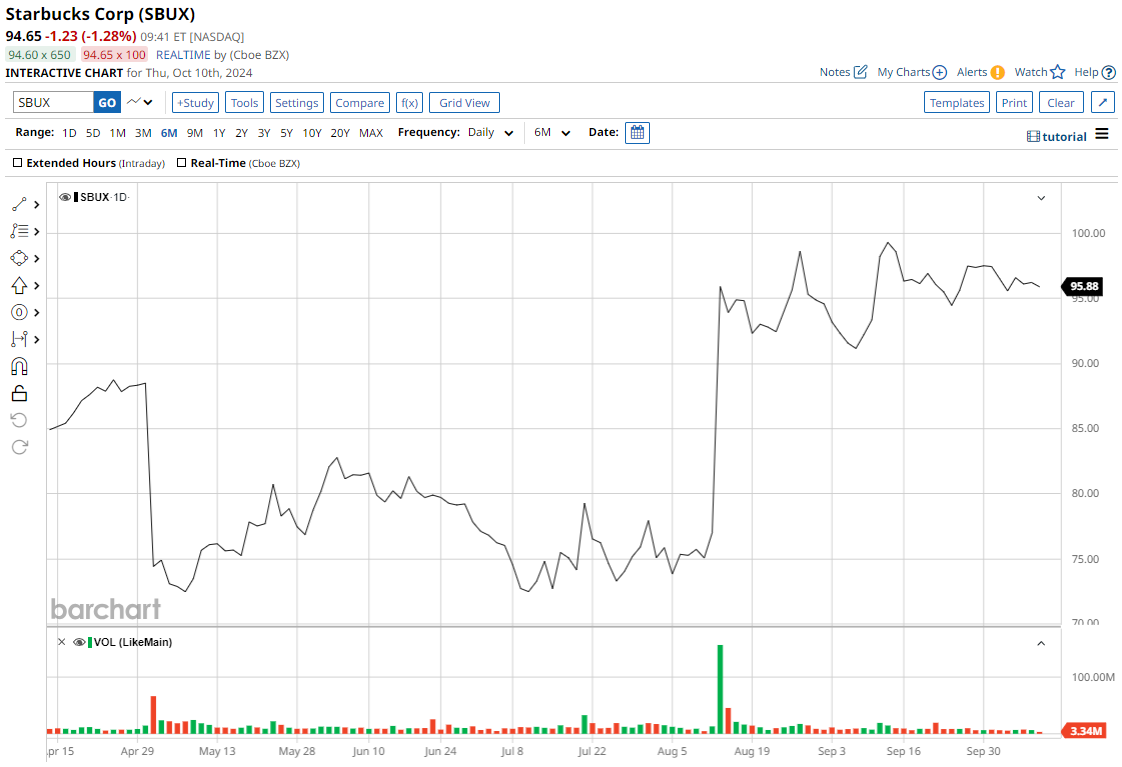
On his prior The Stockout appearance, his Starbucks comments were prescient. Ladd described the company as being “in a world of hurt” and said its board had appointed the wrong CEO. It instead needed an executive who can improve the customer experience. Not long after, Starbucks appointed Brian Niccol, the former head of Chipotle, as CEO. That resulted in an immediate bounce in the share price.
(Chart: Barchart.com Inc.)
Ladd also has plenty of strong thoughts on Kroger’s potential acquisition of Albertsons. In a recent LinkedIn post, he pokes numerous holes in Kroger’s argument that the deal is not anticompetitive. Ladd doubts customers would see any relief in retail prices and doesn’t think that C&S Wholesale Grocers will be a strong competitor. In short, he did the Federal Trade Commission’s homework for them.
Ladd follows e-commerce companies closely as well. Expect him to share his views on Amazon, Shein and Temu as well as the implications for the parcel carriers. He will also tell you what’s wrong with Whole Foods Market.
The show will be available live on FreightWaves.com at 10 Monday and on The Stockout YouTube channel thereafter.
FreightWaves and SONAR have hurricanes covered
I encourage supply chain professionals to take advantage of a free trial of SONAR that is available until Oct. 18. All that’s required is filling out the form here.
After signing up for the free trial, I encourage users to check out Tony Mulvey’s article, which goes through which SONAR datasets provide the most insight into the degree of regional disruption caused by Hurricane Milton.
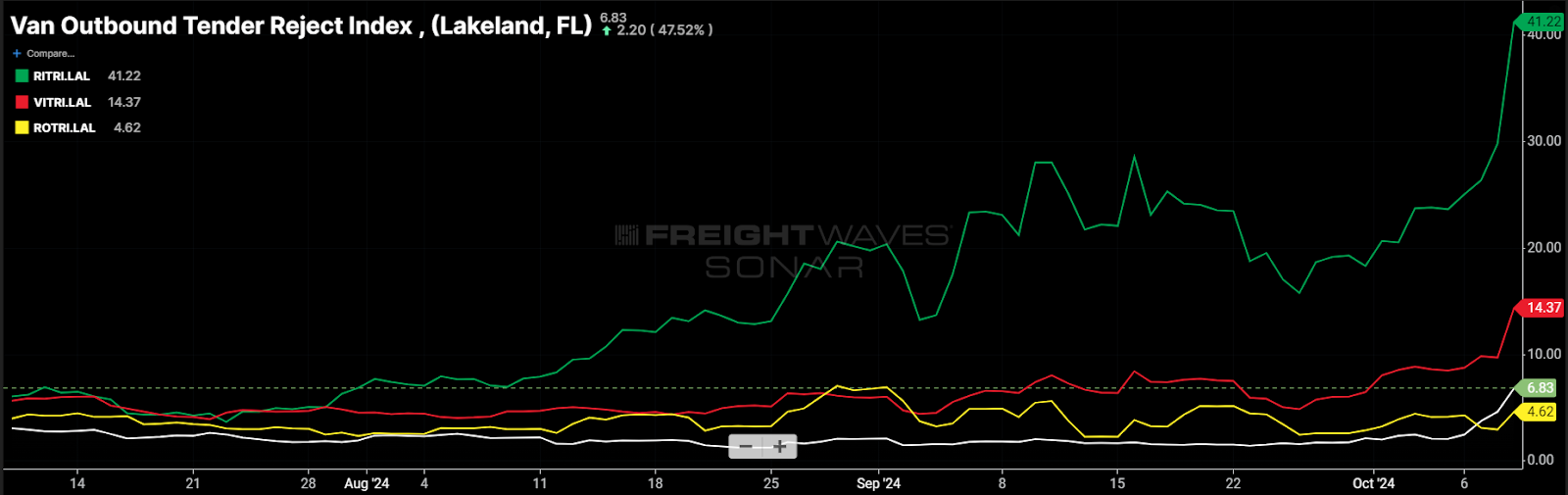
The markets that will most clearly be impacted are those near where the storm made landfall. In our truckload data, the Lakeland granularities (e.g., VOTRI.LAL) include Tampa and Central Florida. In our rail intermodal data, the Tampa granularities (e.g., ORAIL.TPA) cover that region.
While the impact to those areas is critical, many supply chain professionals need instead to see how the locations and lanes where they have operations are being impacted. After signing up for the SONAR free trial, SONAR Customer Success – which can be reached at cs@gosonar.com – can show you how to find that.
Refrigerated carriers are reluctant to send equipment and drivers into Central Florida, rejecting 41% of inbound tenders. (Chart: SONAR)
After reviewing all your most relevant locations, I recommend coming back to FreightWaves.com for additional commentary on the freight market and the latest updates.
Currently, there is a debate whether Hurricane Milton will be impactful enough to tighten the freight market. Zach Strickland says in his latest article that it might.
Not out of the woods following the International Longshoremen’s Association returning to work: 10 ports remains closed following Hurricane Milton.
Hurricanes shut down railroads as the carriers move assets out of harm’s way and take time to inspect/repair tracks before service resumes. The impact of Hurricane Helene may turn out to be an extreme case. The Norfolk Southern line into Asheville, North Carolina, is set to be closed for at least three months.
Warehouses and distribution centers in Milton’s path, including for Amazon, Publix and Walmart, were recalibrating ahead of landfall.
The Stockout show featuring EAIGLE
(Image: FWTV)
On Monday’s The Stockout show, Grace Sharkey and I interviewed Amir Hoss, founder and CEO of EAIGLE. EAIGLE provides an AI and computer vision solution in logistics yards, including those utilized by retailers, CPG companies, manufacturers and transportation companies. In fact, Hoss did the interview live from the active logistics yard of a Toronto-based CPG company.
Leveraging low-cost security cameras that companies already have in place, EAIGLE offers proprietary software and algorithms that interpret collected images and recommend efficiency-improving actions. A typical result is streamlining necessary but menial tasks, which allows employees to focus on responsibilities that require more brainpower. Watch the episode here and click here for the full The Stockout playlist.
Great expectations or paper rates?
Great expectations or paper rates?
(Source: Production and Operations Management)
The term “paper rates” is getting a fresh look with recent research by researchers from the MIT Center for Transportation & Logistics. Angela Acocella, Chris Caplice and Yossi Sheffi divided into how shippers, carriers and market dynamics play into freight contract performance. The recently released paper defines this relationship interplay as a buyer-supplier relationship. To translate this into trucking terms, the buyer refers to a shipper who is buying transportation capacity from a seller, which is either an asset-based carrier or a third-party brokerage that buys capacity from other asset-based carriers.
Current research on shipper-carrier relationships shows that more frequent interactions, longer relationships, and consistency in either sending agreed upon volumes or accepting those tender volumes predict better service. What the report notes and examines is what happens to those relationships when market characteristics change, and if external factors can change those relationships. The report notes that this is new territory, as little research exists on impacts from the latter.
The for-hire truckload space is unique, as nonbinding, relational contracts between shippers and carriers dominate the industry, yet “Incomplete and relational contracts are the norm.” For the study, researchers examined a large transactional dataset from major transportation buyers in the U.S. truckload sector over five years, including the supplier’s decision to accept or reject the load, prices involved for each contracted load, and information about the shipper in the market. Spot market data was also examined to determine which loads were exchanged on the spot market compared to the contract space.
One big takeaway from the research was that 3PLs were better able to handle operationally difficult transportation demand than asset-based providers. Part of this came from the dataset, which included the pandemic-inspired freight demand spike. That datasheet showed that despite carriers and shippers having a long relationship, “we do find that market condition impacts relational factors: during a tightly constrained market when the outside financial option is high, suppliers are pulled from customers with which they have long-term relationships.” To put it more simply, market forces like short-term demand surges in the spot market that spike rates there can pull a carrier away from contracted relationships, making the rate “worth less than the paper it’s printed on” to steal Chicago commodities trader parlance.
For asset-based carriers, constrained by the number of trucks they have, this research helps explain why non-asset-based freight brokerages were able to grow their market share during and following the pandemic. From being a backup service provider with a reputation of overcharging, the brokerage space has exploded in growth and now competes with asset-based carriers on network capability and service.
At the end of the day, the price to move a load remains king. The research adds, “The impact of market conditions on relationship duration and supplier acceptance suggests buyers should not expect to rely solely on long relationships during tight markets. Instead, they should emphasize keeping contract prices competitive.”
Walmart becomes largest private fleet in North America
(Source: Jim Allen/FreightWaves)
When looking at reasons behind the ongoing freight market doldrums impacting the for-hire truckload space, private fleet growth and its ramifications require additional attention. Large truckload carriers service large Fortune 100 shippers, which appear to increasingly look inward for their own transportation needs.
According to Transport Topics, Walmart is now the largest private motor carrier in North America after increasing its fleet to 12,633 power units, up 1,300 units from last year. This growth appears to be in part from the successes tied to its associate-to-driver training program, which launched in January 2023. This is a continuation of its private fleet development program launched in 2022.
Another large shipper heavily tied into the for-hire truckload space that is expanding its private fleet is Home Depot, whose June acquisition of SRS Distribution put it at No. 50 of the largest 100 private fleets. SRS Distribution is a roofing material and building supply distributor that has a private fleet of around 4,000 tractors and 750 branches and warehouses. The reasoning appears to be growth-related. Don Davis of Distribution Strategy Group writes that as of mid-2023 half of Home Depot’s sales were to business buyers, with SRS’ $10 billion in annual sales being 53% business-to-business.
For Home Depot, Davis added that part of this strategy of in-house distribution comes from a more aggressive Federal Trade Commission, which has challenged several proposed mergers under FTC Chair Lina Khan. Ian Heller, co-founder and chief strategy officer of Distribution Strategy Group, said, “Home Depot can’t buy anybody in the home center industry because the FTC isn’t going to let it go through. If Home Depot or Lowe’s want to grow, it will be by going into the highly fragmented distribution industry.”
Another for-hire turning private shipper is Dollar General, which works with for-hire fleets for both over-the-road and dedicated distribution center management. It recently increased its fleet count to more than 2,000 tractors from 1,800 as it seeks to gain more control over costs and its internal supply chain. CEO Jeff Owen said on a Q2 earnings call that the company now handles nearly half of its own outbound transportation needs. Dollar General launched its private fleet back in 2016.
FreightWaves SONAR spotlight: Dry van spot rates see small upswing, reefer rates thaw
(Source: FreightWaves SONAR)
Summary: Dry van spot market rates finally saw a small positive upswing following a monthslong decline after the July Fourth weekend. In the past week, the FreightWaves National Truckload Index 7-Day Average rose 2 cents per mile all-in from $2.21 on Sept. 30 to $2.23. Dry van outbound tender rejection rates also saw an uptick in the past week, with VOTRI up 40 basis points w/w from 4.4% on Sept. 30 to 4.805%.
Compared to the dry van segment, reefer all-in spot market rates had a mild thaw over the past week. RTI fell 5 cents per mile w/w from $2.67 on Sept. 30 to $2.62. Compared to this time last year, RTI is down 11 cents per mile. Despite a softening in the spot market, reefer outbound tender rejection rates fared batter, increasing 169 bps w/w from 9.45% to 11.14%.
For a truckload space in search of an inflection point, the impacts following Hurricane Milton’s landfall in Tampa extending through central Florida will be the next test. Federal Emergency Management Agency and disaster relief shipments disproportionately impact contracted carriers and freight brokers as FEMA tenders loads to its approved transportation service providers.
Depending on the extent of the damage, an increase in nationwide outbound tender rejection rates may be likely, as contracted truckload capacity is rerouted for disaster relief shipments. For those unlucky shipments being rejected, a big question will be whether it filters down into the spot market or if shippers’ carrier routing guides hold fast. This behavior could be observed first by a spike in outbound tender rejection rates followed by a delayed rise in spot market all-in rates.
Like the content? Subscribe to the newsletter here.
E2open stock price plunges after earnings report; strategic review ‘ongoing’
Second-quarter earnings at supply chain software provider E2open were negative enough that investors heavily sold off stock Thursday after management tried to put a positive spin on the company’s outlook.
At approximately 11:15 a.m. EDT, E2open (NYSE: ETWO) stock was down about 75 cents per share to $3.32, a drop of 18.4%. It was not a 52-week low for the company; that mark was set with a price of $2.15 almost one year ago exactly at the time it was pushing its CEO out the door.
Among the key numbers that investors may have found discouraging was subscription revenue of $131.6 million in the second quarter of fiscal 2025. However, that figure was not surprising and actually came toward the high end of the guidance range of $129 million to $132 million that had been provided by the company.
But it appears to be the company’s guidance going forward that set off the drop in E2open’s stock price.
For the third quarter of fiscal 2025, subscription revenue is expected to be $130 million to $133 million. CFO Marj Armstrong said on the conference call with analysts that the figure would represent a drop of 2.1% on the low end from the prior year to an increase of 0.2% on the high end. But she also said E2open expects to have higher “booking and customer retention metrics” in the third quarter sequentially from the second quarter.
For all of fiscal 2025, E2open now expects its subscription revenue to be $526 million to $532 million, which would be a negative 2% to negative 1% growth rate. Total revenue for the company would be $607 million to $616 million, which would be a negative 4% to negative 3% rate compared to the prior year.
The continuing weak fiscal performance at E2open comes several months after it announced it was launching a “strategic review” of its future. That announcement in March followed activist investor Elliott Management’s disclosure a few days after that 52-week low a year ago that it had taken a greater-than-13% stake in the company through outright equity ownership and an options position.
On the earnings call, CEO Andrew Appel, who has been in the seat since February, said that review was “ongoing.” “Our directors are committed to a careful and thorough evaluation of the options we have available to us,” he said, adding that he would not comment further on the review.
The lagging performance of E2open led to the dismissal of Appel’s predecessor, Michael Farlekas, a year ago about the time that 52-week low was reached. Appel was named interim CEO at that time – he had been a director – before being made permanent CEO in February.
Stock higher than a year ago but well below 52-week high
After the big sell-off Thursday, E2open’s stock is about 54% higher than when Farlekas was let go. In the past year, the stock price did move above $5 in May, which is more than a doubling of where it was at its low point when Farlekas was pushed out. But many of those gains are now gone, and stocks with small outright prices are subject to percentage swings that can look enormous.
An earnings per share of a 10-cent loss was well below what SeekingAlpha said was a consensus estimate that E2open would earn 5 cents a share. Total revenue of $152.2 million was less than what SeekingAlpha said were consensus estimates of $154.8 million.
In his comments on the analyst call, Appel said the subscription business at E2open “feels like it has stabilized and is poised to improve further in the coming quarters.”
It’s taking a long time
But he also sounded a familiar theme heard before at the company: Deals are slow to get signed.
“During the second quarter, we continued to see large deals taking longer than expected to close, mainly due to extended customer timelines, which seems to be a common issue across the software sector,” Appel said, according to a transcript of the conference call. “Although we have closed a very high percentage of the deals that have been delayed in the past several quarters while losing very few, our overall pace of new subscription bookings, while moving in the right direction, is still not at the level needed to support double-digit growth.”
Earlier this month, the research team at Bank of America Merrill Lynch cut its rating on E2open to underperform from the “no rating” classification. It summed up its outlook in a subheadline in its report: “missing out on industry growth.”
Merrill has doubts
After citing the performance of such competitors as Manhattan Associates (NASDAQ: MANH), which recently has been trading at 52-week highs, the analysts at Merrill Lynch said the strategic review might be hurting E2open.
“A June 2024 Gartner report cited customer concerns on E2open’s ‘viability’ and ‘quality of service & support,’” the analysts wrote. “Competitors have also been active on M&A – with over $1bn of strategic acquisitions in 2024 alone.”
On the call, Appel said One Network was a “distant competitor” in its markets. Making reference also to the MercuryGate acquisition by German software company Korber, Appel called MercuryGate a “midmarket TMS.”
“And we just don’t see those players in our competitive suite, right?” Appel said. “I think at some point we’ll probably get back to acquiring either synergistic players or capability-based players to enhance our solutions where we aspire to be number one and number two in each of our spaces.”
UPS getting more elbow room at Gary/Chicago airport
Gary/Chicago International Airport broke ground Tuesday on a $26 million-plus project to enhance air cargo infrastructure, with no guarantees it will be able to attract more cargo airlines beyond existing tenant UPS.
The initial phase of a long-term cargo expansion includes a new concrete apron for three additional cargo aircraft, installation of a pipeline for jet fuel, a sanitary sewer system and a deicing facility, according to the airport authority. The second half of the initial apron expansion will be built when additional funding is identified, for a total of eight parking spots. When Phase 2 is complete at a later stage, there will be positions for 18 wide body aircraft, according to the airport’s master plan.
Gary/Chicago International Airport (GCIA) is a general aviation airport in Gary, Indiana, 25 miles south of downtown Chicago, that mostly functions as a destination for corporate jets and weekend aviators. Parcel carrier UPS signed a long-term lease and began cargo flights at GCIA in 2020. Officials hope to attract other all-cargo operators as freight demand in the Chicago metropolitan area grows and warehouses at Chicago O’Hare International Airport become more crowded.
So far, the air cargo industry has shown little interest in GCIA, but officials are laying foundational elements for a future logistics center to attract potential cargo users, while simultaneously supporting UPS.
GCIA gives UPS additional capacity in the Chicago area. The new apron will be on the west end of the runway, far from the temporary space UPS now occupies and where the master plan calls for a cargo terminal. UPS has room to load and unload two standard-size freighters at once. It currently operates one flight per day to GCIA with an Airbus A300, down from two a year ago, according to Flightradar24 data. The new apron will provide parking for extra aircraft, along with a small UPS office and a modular sortation center.
“We congratulate the airport on this important milestone,” said Jeff Simonic, UPS transportation president – Central Zone, in an airport news release. “We are excited about the new cargo ramp space and look forward to seeing it enhance the airport’s ability to accommodate future growth.”
First-phase enhancements are expected to be completed by October 2025, the airport said via email. Funding came from a variety of sources, including $14 million from the Federal Aviation Administration and $9.8 million from the state of Indiana.
Construction of the first phase of the apron project originally was slated to begin in the fourth quarter of 2023.
The new pipeline will connect the airfield to large capacity storage tanks at GCIA, eliminating the need to move fuel with traditional semi-tanker trucks. Officials said the new arrangement will reduce carbon emissions while lowering costs to users. The sanitary sewer line is designed to prevent untreated chemicals from the deicing pad from draining into local water supplies.
GCIA’s runway extends nearly 9,000 feet, the second-longest runway in the region after O’Hare, allowing the airport to handle larger, heavier aircraft.
10 ports remain closed in Hurricane Milton’s aftermath
Ten ports, including two of Florida’s key commercial ports along the Gulf Coast, remained closed Thursday in the wake of devastation caused by Hurricane Milton.
Port Tampa Bay and SeaPort Manatee were closed to commercial vessels after the U.S. Coast Guard set port condition “Zulu” on Tuesday.
Officials for Port Tampa Bay said they are performing preliminary assessments on the port’s landside and seaside operations.
“Our port is currently without power. Some damage was observed on numerous buildings but there has been no significant damage to docks so far. The port is accessible through the main gates. Access to fuel terminals is clear, but awaiting individual facility assessments,” port spokeswoman Lisa Wolf-Chason told FreightWaves in an email.
Large parts of Florida have been dealing with major gas supply issues as thousands fled the state ahead of Hurricane Milton’s landfall Wednesday night.
Port Tampa Bay handles 43% of the fuel used by jets, airplanes, tractor-trailers and passenger vehicles in the state. The region’s fuel arrives by tanker ships.
SeaPort Manatee, located in Tampa Bay about 43 miles from downtown Tampa, is one of the largest U.S. gateways for imports of fresh fruits and vegetables. In 2023, SeaPort Manatee handled $351.17 million in exports and $1.84 billion in imports.
SeaPort Manatee also remains without power on Thursday, officials said.
“At this time the port is without power and in the process of assessing damage,” SeaPort Manatee spokeswoman Virginia Zimmermann told FreightWaves.
Other ports affected include Colonel’s Island in the Port of Brunswick in Georgia. It halted vessel operations Thursday but was slated to resume Friday. Port Panama City in Florida returned to normal cargo operations Thursday. The Canaveral, Fernandina, Jacksonville, Key West, Fort Myers, Sarasota and St. Petersburg ports were closed Thursday, according to the U.S. Coast Guard.
Hurricane Milton made landfall as a Category 3 storm around 8:30 p.m. Wednesday near Siesta Key, Florida, a barrier island next to Sarasota.
The hurricane has been blamed for six deaths so far in Florida, including four in St. Lucie County and two in St. Petersburg.
Hurricane Milton leaves trail of destruction after slamming into Florida
Hurricane Milton smashed into Florida around 8:30 p.m. Wednesday as a Category 3 near Siesta Key and was making its way across the state on Thursday.
Milton left a trail of destruction in its wake, leaving millions without power, shredding the roof of Tropicana Field, and killing at least 10 people in its path. The storm was moving at 20 mph and was expected to move toward the Bahamas Thursday, the National Hurricane Center said. Additional rainfall of 2 to 4 inches is expected, along with flash floods.
The fast-moving storm dumped up to 18 inches of rain onto communities in its path, Gov. Ron DeSantis said. A life-threatening storm surge is possible Thursday along the coast from east-central Florida to southern Georgia, the hurricane center said.
The cloth roof of Tropicana Field, home to the Tampa Bay Rays, was ripped to shreds by the powerful winds. The stadium was serving as a base camp for thousands of emergency responders.
Colonel’s Island in the Port of Brunswick in Georgia halted vessel operations Thursday with plans to resume Friday.
Port Panama City resumed normal cargo operations on Thursday.
The Canaveral, Fernandina, Jacksonville, Key West, Fort Myers, Manatee, Sarasota, St. Petersburg and Tampa ports were closed Thursday, according to the U.S. Coast Guard.
Port Tampa Bay and SeaPort Manatee were conducting damage assessments Thursday. A Tampa Bay port spokeswoman said the port had lost power and numerous buildings sustained damage, though none of the damage was significant. SeaPort Manatee was also without power.
President Joe Biden called Milton “the storm of the century.” He approved an emergency disaster declaration earlier in the week.
Milton hit on the heels of Helene, which slammed into Florida before crawling up the coast and devastating North Carolina.
Warehouses and distribution centers in Milton’s path, including for Amazon, Publix and Walmart, were recalibrating ahead of landfall. David Spencer, market intelligence vice president at Arrive Logistics, said cost volatility and regional demand fluctuations will likely be felt throughout the next week due to the storm’s impact on freight markets. The American Logistics Aid Network, a nonprofit that connects other nonprofits to logistics providers, was juggling requests for both hurricanes Milton and Helene.
Weekly U.S rail traffic ends long run in positive territory
WASHINGTON — For the first time in more than nine months, U.S. weekly rail traffic has dropped below 2023 levels.
For the week ending Oct. 5, total U.S. traffic was 486,187 carloads and intermodal units, a 2.5% decline from the same week a year earlier, according to statistics from the Association of American Railroads. It was the first time since the week ending Jan. 20 — the third week of 2024 — that volume had decreased from the corresponding week in 2023, (The week ending May 4 had a total volume that was level with the same week in 2023).
The week’s traffic included 225,280 carloads, down 3.5%, and 260,907 containers and trailers, down 1.7%.
Through 40 weeks of 2024, carload traffic is down 3.3% from the same period in 2023, while intermodal volume is up 9.1%. Overall, traffic is up 3.1% compared to the first 40 weeks a year ago.
North American traffic for the week, as reported by nine U.S, Canadian, and Mexican railroads, was 331,587 carloads, down 4.5% from a year ago, and 341,107 intermodal units, down 3%. The overall volume of 672,694 carloads and intermodal units represents a decline of 3.7%. Overall, year-to-date North American traffic is up 2.4% through 40 weeks; that includes a 3.6% increase in Mexico and no change in Canada.
Cartage secures $3.3M to support shippers and carriers with automation
Freight coordination software provider Cartage announced Thursday that it has closed a $3.3 million investment round led by Y Combinator, Garage Capital, Wayfinder Ventures, Northside Ventures, Pioneer Fund and Ritual Capital. The funding will be used to automate freight operations for both shippers and carriers.
Angel investors also participated in the round, including Paul Graham, founder of Y Combinator; Nate Smith, founder of Lever; Kulveer Taggar, co-founder of Zeus; and Ian Logan and Caleb Gawne, former associates at TMS Rose Rocket.
Freight tendering remains a notoriously old-school process, with many brokers still relying on phone calls and email to coordinate shipments. Cartage is aiming to change that.
The team was founded by individuals with deep experience in the freight industry. Co-founder and COO Harman Sahota grew up in the trucking business, starting his freight brokering career at just 14. He later bootstrapped and expanded a logistics company called Westcore Logistics.
On the technology side, Cartage’s other co-founders, CEO Abdul Basharat and CTO Josh Lampen, were early product developers at freight software startup Rose Rocket, where they built collaboration features for brokers and carriers.
From left: Josh Lampen, Abdul Basharat and Harman Sahota. (Photo: Cartage)
The company’s mission is to introduce modern technology to an industry that has been slow to adapt. Rather than trying to get shippers, brokers and carriers to change their preferred communication methods, Cartage is using AI to seamlessly integrate with existing workflows like email and phone calls.
“The industry does not need to change for technology; we think technology needs to change for the industry,” said Basharat. “People are not going to leave phone calls. They’re not going to leave emails. But what AI allows us to do is to replicate that, have it make phone calls, send emails and still have people in the loop to handle escalation.”
This approach seems to be resonating with customers. Cartage says it has been doubling in size month over month, working with a diverse set of clients, from small shippers to large enterprises.
Cartage’s technology. (GIF: Cartage)
“What struck me about Cartage is how the company is uniquely implementing technology without necessitating a change in how people work,” Chris Howard, founder and general partner at Ritual Capital, told FreightWaves in an email. “It’s a smart, practical application of AI. The founding team brings together real-world experience in both logistics and tech, making them the right team for the challenge. The team is on track to build something truly groundbreaking.”
The founders are also optimistic about the current freight market, seeing it as an opportunity to provide much-needed innovation. The company believes shippers are increasingly looking for more transparent and cost-effective logistics solutions, especially as the market shifts.
By charging lower margins and passing on savings to both shippers and carriers, Cartage aims to disrupt the traditional brokerage model.
“I think traditional brokers often hammer down the carrier [on rates] as much as they can. That’s not our goal here. It’s to get good carriers working on our lanes and giving them a fair rate,” said Sahota.
Looking ahead, Cartage plans to use its new capital to continue growing the logistics business and developing its internal automation capabilities. The ultimate goal is to achieve a touchless load, where the majority of shipments can be handled automatically, with human coordinators only stepping in for exceptions and escalations.
The views expressed here are solely those of the author and do not necessarily represent the views of FreightWaves or its affiliates.
ASHEVILLE, N.C. — Skepticism spread throughout the railroad community after Hurricane Helene’s devastating once-in-a-generation floods wiped out roadbeds, destroyed bridges, and left most of western North Carolina and eastern Tennessee unrecognizable. Some in the industry expressed doubt that CSX and Norfolk Southern would invest the dollars needed to repair widespread damage.
More than 40 miles of CSX’s ex-Clinchfield Railroad between Erwin, Tennessee, and Spartanburg, South Carolina, are gone, including two bridges, and many sections along 50 miles of NS’ ex-Southern S-Line between Marshall and Old Fort, North Carolina, through Asheville are washed away.
But railroads don’t have the choice to not rebuild as they did 40 or 50 years ago. Class I railroads have rationalized their networks to the extent that there is very little redundancy, leaving few efficient alternatives in the event of a catastrophic event like Hurricane Helene.
CSX’s outage on the former Clinchfield is requiring coal, merchandise and bulk trains to detour across the I-64 corridor between Russell, Kentucky, and Richmond, Virginia, and then down the Seaboard into Hamlet, North Carolina, before diverting west toward Charlotte and into the western part of the state. This adds several hundred miles.
Choosing not to rehabilitate the Clinchfield would mean CSX has little through-route connectivity between Knoxville, Tennessee, and Charlotte, a distance of more than 250 miles. While there is not a significant volume of carload business or through coal trains on this route compared to 40 years ago, the annualized gross ton-miles are still significant enough to justify the rebuilding, given few favorable alternatives.
NS doesn’t have a choice either. It has already downsized its S-Line as a through route between Morristown, Tennessee, and Salisbury, after trimming operations at its Linwood Yard north of Salisbury. Western North Carolina carloads bound for Watco’s Blue Ridge Southern and NS-served customers in the Asheville region rely on NS trains traversing the Southern from Knoxville east into western North Carolina on the French Broad River. Through trains no longer operate east of Asheville, and south of Asheville, across Saluda Grade, is no longer an option. To preserve rail access to the area, NS has to rebuild in at least one direction from Asheville.
NS could theoretically choose to only rebuild from Asheville west to Morristown and forgo repairs east from Asheville across Old Fort loops. Mixed reports from that area suggest the topography has changed around the loops due to major landslides, and the carving of a new roadbed could be difficult and time-consuming. But I still believe we will see trains across Old Fort again.
Also contributing to a likely rebuild is that while there are fewer railroads today, the remaining Class I railroads are large and profitable enough to absorb the costs required to rebuild after large natural disasters.
Hurricane Agnes, which pummeled the Northeast in 1972, caused widespread damage to many smaller and less profitable railroads. Agnes played a contributing role in Erie Lackawana’s decision to file for bankruptcy in 1972 due to significant damage across its network in New York and Pennsylvania. Damage caused by Agnes played a broader role in the government’s intervention and the creation of Conrail, which helped repair and rebuild damaged rail lines.
These two factors are why I believe CSX and NS will rebuild. Because railroads’ circumstances are different than they were a generation ago, this is possibly the first time in modern history that we’ll witness a large section of a railroad being completely rebuilt.