Grain, crude lead rail freight surge
Commodity rail freight continued to improve from a year ago despite weaker intermodal that dragged down overall traffic.
Analysis by the Association of American Railroads revealed that March marked a significant turning point for U.S. freight rail volumes.
Freight on U.S. railroads was flat in the latest week data, as intermodal barely edged ahead of commodities shipments.
Data on rail volumes, inflation, and manufacturing suggest easing inflation without a significant slowdown in economic growth.
Freight on U.S. railroads posted robust weekly gains led by higher energy and metals shipments.
A better than 1300% increase in grain shipments led a winning week for freight moving by rail in the U.S.
Rail freight data showed a waiting game by U.S. shippers as commodity and intermodal volumes declined.
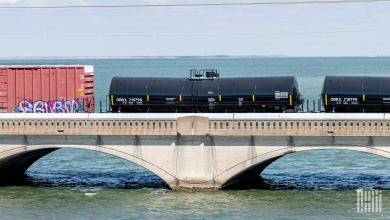
Freight on U.S. railroads plunged into the red in the latest data, after posting across-the-board gains the previous week.
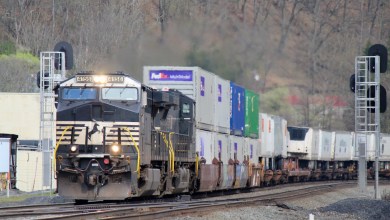
A competing rail alliance drew off Norfolk Southern intermodal volumes in the fourth quarter, leaving freight volumes downward.
Rail freight volumes in the United States posted increases across the board in the latest weekly data.
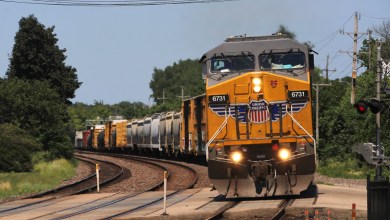
Union Pacific today reported record financial and operational results for 2025 despite a drop in fourth-quarter operating income.
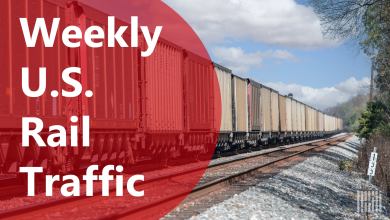
Grain helped lift U.S. rail freight in the latest week’s data amid weaker intermodal and carload shipments.
Fourth-quarter profits at CSX were negatively affected by continued freight weakness, which the railroad anticipates will persist.
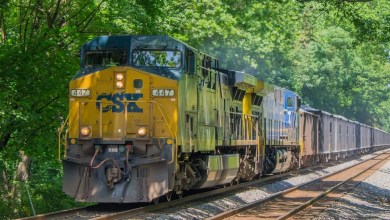
CSX said severance expenses, lower merchandise freight and coal offset higher freight rates as earnings fell short of estimates for the fourth quarter.

U.S. rail carload freight and intermodal shipments for the first week of this year improved nearly by double-digits.
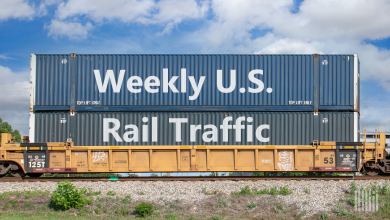
Rail traffic for U.S. railroads fell 4% for the week ending Jan. 3, 2026, according to statistics from the Association of American Railroads. Volume for the week was 404,293 carloads and intermodal units, with 192,665 carloads, down 2.8% from the corresponding week a year earlier, and 211,628 containers and trailers, down 5.1%. Only chemicals, 2.3%, […]
Intermodal shipments led U.S. rail freight lower in the latest weekly data but traffic remains higher year-to-date.
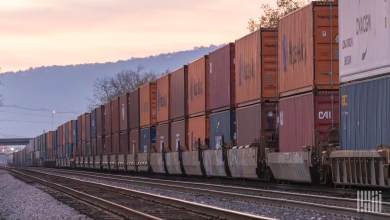
A decline in intermodal shipments led U.S. railfreight volumes lower in the latest week data.
Year-over-year rail volume growth is fading.
Union Pacific’s Q3 profits rose on improved pricing, record workforce productivity and fuel consumption.
An association representing several thousand rail shippers is warning a merger of Union Pacific and Norfolk Southern will push freight rates higher and lead to unreliable service.
Union Pacific saw record results in the fourth quarter as coal shipments led gains across business segments.
Carload freight and intermodal volumes ran ahead of year ago levels, according to the latest weekly rail data.
Intermodal would be approximately 53% of a combined entity’s volume.
Intermodal, coal, and grains are driving Class I railroad traffic higher.
The deposits are in soft coal, making them economically feasible to develop.
Intermodal helped make CPKC the fastest-growing railroad in the second quarter.
Carload rail freight edged down in the latest week but stayed ahead of year-to-date levels.
Rail traffic was flat in the latest week data as softening demand for China imports likely hit intermodal volumes.
U.S. rail traffic was down for a second straight week y/y, the first back-to-back decline this year after 15 straight weeks ahead of 2024 levels.
Carload freight showed solid growth in May, but a marked decline in containers and trailers signals caution for the second half of this year.
Freight on U.S. railroads posted another win against year-ago shipments.
U.S. railroads carried more freight in the most recent week from a year ago, according to the latest industry data.
Weekly U.S. rail traffic posted a 5.5% gain from the year-ago period as coal and grain led commodity gainers, according to the Association of American Railroads.
A fire at a Port of Vancouver marine coal terminal caused damage but no injuries over the weekend.
U.S. railroads see the highest weekly intermodal traffic since the pandemic, and ongoing supply chain issues could aid further gains as a threatened longshore strike creeps closer.
BNSF and Navajo Transitional Energy Co. have reached a settlement on NTEC’s request for more rail service to export coal.
A BNSF coal train derailed at a bridge north of Pueblo, Colorado, spilling coal and rail cars onto Interstate 25 beneath. The highway remains closed for now.
Sixteen environmental groups have filed a rulemaking petition with the EPA asking for the federal agency to require coal train operators to have Clean Water Act permits when moving coal.
Regulatory policy expert Rosyln Layton says it’s dangerous to have the Surface Transportation Board lay the grounds for defining how rail service should look under the common carrier obligation.
The global coal trade is thriving, with dry bulk ships busy carrying the loads. As the West consumes less coal, Asia buys even more.
Navajo Transitional Energy Co. is asking the Surface Transportation Board to declare an emergency service order that would compel BNSF to ship more export coal from the company.
Electricity generated from renewable sources outpaced coal-fired power generation for the first time last year, according to the U.S. Energy Information Administration.
Fallout from the Ukraine-Russia war and concerns over power supply in Europe and Asia support demand for seaborne coal.
Fossil fuels – petroleum, natural
gas and coal – accounted for
79% of the 97 quadrillion British
thermal units (quads) of primary
energy consumption in the
United States during 2021.
The Occupational Safety and Health Administration wants CSX to pay $121,200 total for workplace incidents that might have contributed to the December 2021 blast at the Curtis Bay Coal Terminal.
Average change in the price of selected raw materials
Tampa Electric says rail service issues are why the power company isn’t receiving enough coal from CSX, according to a filing to federal regulators. But CSX says the problem lies with reduced production at the coal mine.
The letter sent by the National Grain and Feed Association to regulators about subpar rail service is finding support among other rail industry stakeholders.
The cause of the explosion is under investigation. No injuries occurred as a result of the incident, CSX said.
U.S. utilities are facing record low coal stockpiles, and network congestion on the rails is only adding to the stress.
Strong economic growth and growing populations will drive increases in global energy-related carbon dioxide emissions and energy consumption through 2050
Capesize bulkers haven’t earned this much since 2009, and freight futures just made “monstrous” move up.
Top commodities by weight and value
Good news for dry bulk shipping stocks, bad news for decarbonization: The global coal trade is thriving.
In 2020, total consumption of
fossil fuels in the United States, including petroleum, natural gas, and coal, fell to 72.9 quadrillion British thermal units (Btu),
down 9% from 2019 and the
lowest level since 1991.
Shares of Total US Energy Consumption by Major Sources
Anticipated higher natural gas prices could prompt coal’s share in U.S. power generation to grow in 2021 and 2022, the U.S. Energy Information Administration said in its Short-Term Energy Outlook.
Falling U.S. coal carload volumes reflect the decline of U.S. energy consumption of power generated by coal. Also, U.S. intermodal traffic offset volume losses in 2020.
The mayor and city council of Richmond, California, have voted phase out and prohibit the storage and handling of coal and petroleum coke in the city.
Jim Blaze writes about the power and influence of mentors on a person’s career and life.
Brian Aoaeh writes about changes in the energy/fuel mix over the next 30 years in developed and developing economies.
Coal production in the region could fall significantly in 2020, affecting rail volumes.
Declining coal consumption in the U.S. may have led to the dispute.
Final investment decisions for new global LNG export plants are surging, a negative for future thermal coal demand.
The decline in U.S. coal production could cost the railroads billions in lost revenue.
Australian bulk rail freight operator Aurizon (ASX: AZJ), which owns one of the world’s largest coal rail networks, reported a 15 percent decline in full year profits. Statutory earnings before interest and taxation (EBIT) were down by 14 percent and revenues were down 7 percent.
Blackjewel’s bankruptcy reminds the broader industrial sector of the vulnerability of U.S. coal production overall, particularly so for western U.S. coal production.
Low pricing will speed up Europe’s transition from coal to gas, according to Morgan Stanley.
Market expert Jim Blaze writes about the movement of coal by rail. He explores the history of rail-coal; more importantly, he writes about what the future may hold for coal in the U.S. and how that will impact the railroads.
U.S. coal export volumes are down 12.7 percent in the first four months of this year and the outlook looks even worse for 2020.
Genesee & Wyoming, Inc. reported adjusted earnings per share of $0.78 for the first quarter of 2019, which were 11 percent better year-over-year, but less than NASDAQ’s consensus estimate of $0.83.
Dry bulk shipping faced multiple headwinds in the first quarter, but NYSE-listed Scorpio Bulkers benefited from its smaller ships and its diversification into the product-tanker sector.
The final part of the FreightWaves series on the Panama Canal focuses on dry bulk transits. The two trends: US agribulk cargo to Asia is down, Colombian coal to the west coast of South America and Asia is up.
Widespread jitters in the Australian political and business communities that China may have banned imports of Australian coal now appear to be unfounded. Customs clearance delays at Dalian are happening owing to entirely “normal” reasons and coal cargo can be re-routed around a given port anyway, coal mining and coal transport executives have explained to FreightWaves.
The Grain Transport Report, a weekly publication by the Agricultural Marketing Service (a division of the U.S. Department of Agriculture) released information showing that total export inspections for grain (corn, wheat and soybeans) declined 22 percent from the previous week.
We hope no one gets coal in their stocking tomorrow morning… But if you do, here’s a few facts about where it may have come from.
SONAR’s signature index has a birthday; Ocean Network Express to lose $600M; oilfield service companies guide for tight margins in Q3; President Trump bails on coal industry incentives; pros and cons of blockchain in container shipping; spending 60,000 hours reverse-engineering a Tesla Model 3.
China’s National Bureau of Statistics reported slowing growth pointing to weaker exports as the China Manufacturing Purchasing Managers Index (PMI) dropped to 50.8 percent, down 0.5 percentage points from the previous month to the second lowest reading in 12 months.
A surge in hydro-power, cleaner air in the Capital and a need to further stimulate the economy will see increased demand for seaborne coal supplies to China this winter. That is good news for freight.
The North Carolina Department of Transportation says not to travel in or to the state; Walmart grabs a 200K square foot foothold in NYC; the IMF says British economy will contract if no deal on Brexit; Freightos raises $45M; global seaborne coal trade grows 4%; Tesla’s having a hard time delivering cars.
For the first half of the year thus far, coal exports are up nearly 24% over the same period last year.
BNSF hauls more coal than any other railroad, but the future of American coal production and consumption is an open question. Is BNSF heavily exposed to downside risk or will it be the last coal carrier standing?
China’s $3B copper mining deal in Afghanistan, the largest foreign investment in the country’s history, is going nowhere. 10 years into a 30 year lease, supply chain problems are keeping any copper from being extracted at all.