Amazon offers money-back guarantee to air cargo shippers

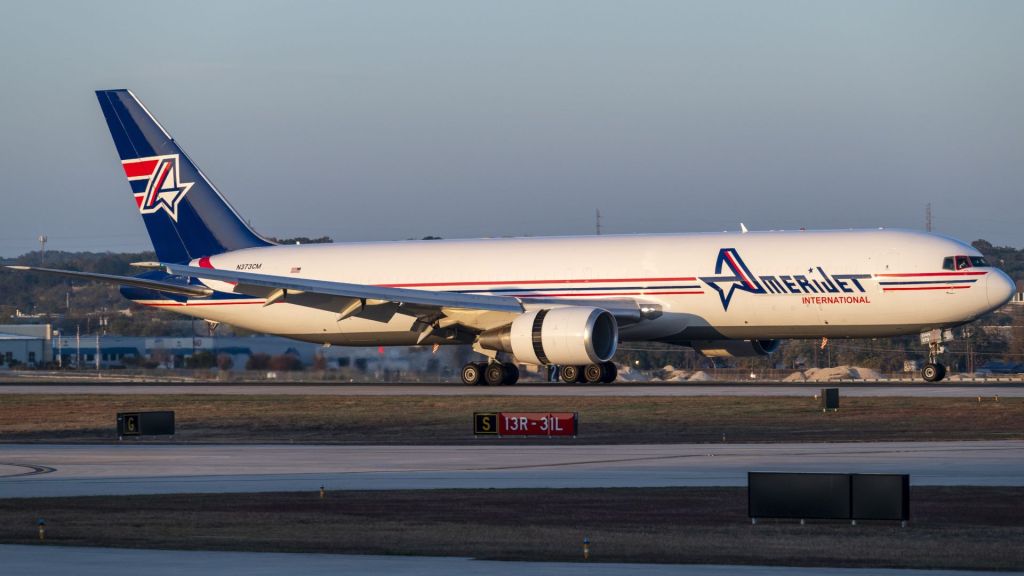
An Amazon Prime Air cargo jet with a dark blue tail moves on an airfield under sunny conditions.

One year after launching an air cargo service for third-party shippers utilizing its parcel freighters, Amazon is offering a money-back guarantee to attract businesses that prioritize on-time delivery and upgraded its digital portal so customers can more easily quote, book and manage air shipments. 

Amazon Air Cargo is the latest example of Amazon opening its logistics network and capabilities to outsiders using a model similar to how it sells access to cloud services through Amazon Web Services (AWS). More importantly, management is leveraging Amazon Web Services to further optimize outsourced logistics services, including the wholesale air cargo business. 

Amazon has made a habit of commercially selling best-in-class services originally developed to support internal operations. The retailer built its own last-mile delivery and warehousing network to better control the customer experience, and now provides fulfillment and logistics service to other sellers on its marketplace. In 2016, it launched Amazon Air to enable next-day and second-day day delivery to more Prime members and now operates an air network with more than 100 cargo jets and more than 65 destinations. As e-commerce sales slowed to a more normalized growth rate and Amazon shifted towards more regional and local fulfillment centers, the company began offering excess air capacity to logistics providers and other businesses. 

“With AWS we built massive computing capabilities for ourselves, and then learned how to share those with customers in really valuable ways. Air Cargo has a similar story. We built a dense, reliable, and interconnected air network to serve Amazon customers quickly — and now we’re discovering that many others can benefit from that same network,” said Kres Nielsen, director of business development at Amazon Air Cargo, according to a transcript of his remarks on Oct. 21 at the Future of Freight Festival hosted by FreightWaves in Chattanooga, Tennessee.

Nielsen joined the Amazon Air Cargo team from AWS earlier this year.

“We’re working closely with AWS on integrated, cloud-based supply chain solutions — helping customers manage logistics more efficiently and intelligently. And I’m especially excited about how agentic AI can help — optimizing routes, identifying opportunities, and supporting customers with predictive insights,” he said during a Q&A session. “Our predictive and forecasting tools, the same ones that power Amazon Retail, can now help suppliers and retailers plan more efficiently across their supply chains. We’re connecting all of Amazon’s capabilities — freight, last mile, analytics — into unified, end-to-end solutions. Customers can now access analytics, visibility, and full supply chain support in one place.”

In September 2024, Amazon fully commercialized a wholesale air cargo service it had tested for years. Shippers can tender freight on an ad hoc basis, reserve regular blocks of space or charter entire aircraft. Amazon also offers air cargo service in Europe and India, where it operates more limited networks. 

Amazon Air, the internal cargo airline, doesn’t have its own pilots or an air operating certificate. It manages the in-house parcel flows, routes and capacity, while relying on contract carriers to operate its fleet of mostly Boeing 737-800 and 767 freighter aircraft, along with 10 Airbus A330-300 converted freighters. This year it acquired a used A330-300 from a leasing company that will be reconfigured by an aircraft conversion specialist before joining the fleet. 

Since the start, executives have reassured freight forwarders their cargo won’t be held from full flights to preserve space for Amazon parcels, pointing to dynamic technology, a vast ground transportation network and millions of route combinations that allows the company to make real-time transit adjustments and ensure shipments reach their destination on time.

“That control gives us the ability to move things efficiently and prioritize customer needs,” Nielsen said. 

Amazon Air Cargo has doubled its customer base over the past 15 months, a spokesperson said via email, but the exact scale of the business remains unclear. Launch customers included logistics giant Kuehne+Nagel, which is using Amazon Air Cargo to relay e-commerce shipments from China to the U.S. mainland via Honolulu, and DHL Express. 

In the spring, Amazon began operating daily flights between Miami and Bogotá, carrying e-commerce packages to Colombia and returning with flowers and other commodities tendered by the cargo division of flag-carrier Avianca. Several months later, Amazon Air Cargo extended third-party cargo service to the Dominican Republic to support Miami-based cargo agent ALK Global Logistics, opening opportunities in the perishables market. Both routes are flown by North Carolina-based 21 Air.

Air Premia, a passenger airline based in South Korea, in July entered into a transportation services agreement with Amazon Air Cargo under which it transfers belly cargo to Amazon at Honolulu airport for onward carriage to the continental United States. Once at U.S. hubs, the Air Premia shipments are relayed to 45 cities, including Atlanta and Houston, through the Amazon Air network.

The for-hire air carrier is also moving thousands of Maui Gold pineapples from Hawaii to the East Coast in about 12 hours every week. Nielsen said Amazon has also connected U.S. cherry growers with markets in Asia with its Hawaii flights. 

Money-back guarantee

To prove it can follow through on its promise, Amazon Air Cargo in October began offering a money-back guarantee to new customers in the U.S. and Puerto Rico. If a shipment doesn’t arrive within two hours of its scheduled time due to a service failure, Amazon will refund shipping fees up to $10,000 per flight, according to slides from a presentation Nielsen made at The International Air Cargo Association’s annual exhibition in Dubai early last month. The deal is valid for 12 months starting with the first shipment.

Money-back guarantees have historically been limited to premium express products offered by integrated carriers like FedEx, UPS and DHL because their business models are built around end-to-end control, time-definite networks, and the ability to manage liability on a closed system. They are rare in the traditional air cargo sector because multiple handoffs between forwarders, airlines, airport ground handlers, warehouse operators, trucking companies and other intermediaries creates more variability and less direct control for any one party. 

Some forwarders do offer performance guarantees for key accounts, but they tend to be contract-specific, negotiated, not widely advertised and tied to to very controlled routings or premium handling arrangements, Brandon Fried, executive director of the Airforwarders Association, explained in an email message.

Amazon Air Cargo’s money-back guarantee “signals a push to position their air network more like a classic integrator product — tight control, predictable delivery windows, and enough confidence to put financial skin in the game. If they frame this as a broad commitment rather than a niche service feature, it could put competitive pressure on others in the e-commerce and express space,” he said. 

John Costanzo, the president and CEO of LDK Global Logistics, questioned whether Amazon needs to offer a money-back guarantee because few can reliably provide dedicated, express domestic air service.

“I see Amazon Cargo as a physical version of Amazon Web Services, which almost everyone uses as their IT platform today. Eventually, I believe most forwarders will utilize Amazon’s cargo network as it’s a much better option for capacity, scheduling and likely pricing since Amazon is filling excess capacity and building their network with this additional volume. They already have a great value proposition without having to offer guaranteed delivery service between point A & B,” he said in an email exchange.

Shipments must be booked through the new self-developed Supply Chain by Amazon console. Amazon recently moved from a manual, offline booking process to a digital one. The digital system provides instant rate quotes and capacity availability; immediate reservations, with guaranteed space for any booked shipment three days; real-time shipment monitoring; billing and payments; and support services in a single dashboard.   

“We’re trying to remove all friction and worry from what’s often a very time-sensitive process,” Nielsen said.

Click here for more FreightWaves/American Shipper stories by Eric Kulisch.

New Amazon cargo flight paves way for next-day delivery in Hawaii

Amazon Air extends third-party cargo service to Dominican Republic

Nauta brings AI-native inventory intelligence to the heart of importer operations

Nauta was founded just a year and a half ago on the premise that global supply chains run on unglamorous but essential work, and that this work is long overdue for a technological upgrade. Built by a team of technologists and logistics obsessives, the company set out to build an AI-native operating system for importers. 

The company has launched a new Nauta Inventory Optimization Engine, an AI-powered tool designed to predict stockout risk and help shippers plan inventory more proactively. The engine integrates with ERP, WMS, and TMS systems, bringing structure and intelligence to data that has historically been too fragmented to use effectively. With SKU-level visibility and predictive analytics, teams across procurement, transportation, merchandising, and operations can finally speak the same language. Instead of scrambling after the fact, shippers can understand where their risks lie and which decisions will protect revenue.

“Shippers need clarity on where their inventory is during the holiday season. They can only serve their customers if they know how it’s moving, and what’s likely to run short,” said Valentina Jordan, CEO and Co-Founder of Nauta. “The AI-powered Nauta Inventory Optimization Engine is built on our industry-first unified data infrastructure layer. This is the data foundation shippers need to make decisions and truly leverage AI for their benefit. We are giving shippers a clear understanding of their exposure down to the SKU-level. Customers can see where stockout risk exists and take action before issues happen, saving them hundreds of thousands in lost revenue and penalties. These benefits are only possible when a shipper’s data is able to be harmonized and used in real-time through an AI-native solution like Nauta.”

Across the United States, most importers are grappling with a familiar set of challenges: disconnected systems, inconsistent product codes, siloed teams, and a constant pressure to balance overstocking with the costly risk of stockouts. Traditional workflows depend on retrospective reports and manual decision-making, approaches that break down under the demands of a peak holiday season or an unexpected spike in customer demand.

Nauta saw the opportunity to build something different, something capable of pulling order data, logistics updates, emails, documents, and context into one harmonized source of truth. In doing so, they believed they could give shippers the power to act before problems unfold.

Inventory is notoriously one of the hardest problems in supply chain, and Nauta intentionally chose to tackle it first. The company has spent its early years building the data foundation required to solve what is, at its core, an $80-billion-a-year problem for U.S. retailers. 

Stockouts cascade far beyond a missed sale. Distributors lose contracts, manufacturers suffer penalties, and every team downstream feels the impact. For many Nauta clients, fulfillment rates hover between 80% and 90%. A shift of even half a percentage point can translate into millions of dollars in preserved revenue. Nauta’s leadership believes that in a business where margins are thin and expectations high, even small movements of the needle are transformative.

The strength of Nauta’s engine comes from its agentic AI layer, which is designed to learn the specific tribal knowledge embedded within each organization. Nauta’s system understands context, how a customer defines safety stock, how internal teams approve replenishment, and how exceptions are handled. 

The AI observes workflows, suggests actions based on business rules and role-specific needs, and then executes once a human approves. Over time, users can grant the AI more autonomy as confidence grows. This closed feedback loop helps companies transition from reactive firefighting to proactive management.

Buoyed by $7 million in seed funding and rapid revenue growth, Nauta is already thinking beyond inventory. The company is exploring how to support one of the last unmodernized links in the supply chain: payments. With goods, data, and money intertwined, Nauta believes its platform can eventually give importers visibility and leverage across all three. If the company succeeds, it won’t just be optimizing shipments or stock levels; it will be redefining how global importers operate in a world where real-time intelligence is no longer optional but essential.

The Real Impact of Secretary Duffy’s Driver ‘Timeout’

Transportation Secretary Sean Duffy took to social media on December 10, 2025, to announce what sounded like a seismic shift in the trucking industry: “We’ve now knocked 9,500 truck drivers out of service for failing to speak our national language, ENGLISH!” The headlines followed predictably, with many suggesting these drivers had been permanently removed from the industry. That’s not quite how this works.

If you’re a parent, think of an out-of-service order like a timeout for your kids. It’s not expulsion from the family; it’s a mandatory pause until the problem gets fixed. And just like a timeout, the duration varies dramatically based on what landed you there in the first place.

The Commercial Vehicle Safety Alliance maintains the North American Standard Out-of-Service Criteria, which serves as the pass-fail standard for roadside inspections across the United States, Canada, and Mexico. These criteria identify critical violations that present an imminent hazard, conditions severe enough that the driver, vehicle, or cargo cannot continue until the issue is resolved.

Vehicle vs. Driver Out-of-Service are Two Very Different Animals

Vehicle out-of-service violations are often the easier fix. You roll into a scale, the officer spots a mechanical defect that falls under the CVSA out-of-service guidelines, maybe a brake issue, a steering component problem, or a tire violation and your truck is benched until it’s repaired. The path back is straightforward: fix the defect, complete a Driver Vehicle Inspection Report for that day, get a work order showing who completed the repair and when, and mail in the signed violation showing completion. Your truck is back in service, potentially within hours.

Driver out-of-service violations can be more complicated. If your CDL is expired, suspended, or you don’t have the proper class or endorsements for what you’re hauling, you’re stuck until you get to a DMV to rectify the situation. Your truck doesn’t move without another qualified driver taking the wheel. Depending on where you are and what’s wrong, this could take days.

An 88-Year-Old Rule With A Complicated History

The requirement that commercial drivers read and speak English isn’t new, it dates back to 1937. Under 49 CFR 391.11(b)(2), commercial motor vehicle drivers must “read and speak the English language sufficiently to converse with the general public, to understand highway traffic signs and signals in the English language, to respond to official inquiries, and to make entries on reports and records.”

What changed over the decades was enforcement. In 2015, CVSA members voted to remove English proficiency from out-of-service criteria because, according to the organization, they “could not substantiate the safety impacts.” Then in 2016, the Obama administration’s FMCSA issued a guidance memo directing inspectors not to place drivers out-of-service for English language proficiency violations. Instead, they’d issue a citation and a fine, but the driver could continue rolling.

That changed dramatically in 2025. President Trump signed an executive order in April requiring strict enforcement of the English proficiency requirement. CVSA followed with an emergency measure in May, and by June 25, 2025, lack of English proficiency was officially back as an out-of-service condition.

The Assessment Process and Its Subjective Nature

According to FMCSA’s enforcement policy, all roadside inspections must now be conducted in English. If an inspector suspects during initial contact that a driver doesn’t understand, they must begin an English Language Proficiency assessment. This includes a driver interview evaluating their ability to respond to official inquiries and directions in English, followed by a highway traffic sign recognition assessment if they pass the first portion.

Under the current guidance, drivers cannot use tools like I-Speak cards, cue cards, smartphone translation apps, or on-call telephone interpretation services during the driver interview. The reasoning? Those tools might “mask a driver’s inability to communicate in English.”

The subjective nature of this assessment creates inconsistencies. We’ve seen drivers placed out-of-service at a scale at 7 PM for English proficiency, sit overnight, and then have a different officer come on shift the next morning, determine they actually communicate sufficiently in English, and put them back on the road. The same driver, the same English ability, two completely different outcomes based on who’s making the call.

What ‘Out of Service’ Actually Means for These Drivers

So what happens to the 9,500 drivers Duffy referenced? They haven’t lost their CDLs. They haven’t been deported. They haven’t been “removed from trucking” in any permanent sense. They’ve been told they can’t drive a commercial vehicle again until they can demonstrate English proficiency to an inspector’s satisfaction.

For some, that might mean sitting at a truck stop until the next shift change brings a different assessment. For others, it means enrolling in English language courses and notably, language learning companies like Babbel are already marketing services specifically to commercial drivers facing this situation.

You don’t learn English overnight. So yes, for drivers who genuinely struggle with the language, this is a significant career disruption. But it’s a timeout, not a termination. They still hold valid CDLs. They can still return to driving once they meet the proficiency standard, however subjectively, that standard might be applied.

The Bigger Picture and Non-Domiciled CDLs and the Ongoing Audit

English proficiency is just one piece of a larger enforcement push. Secretary Duffy has also launched a nationwide audit of states’ practices regarding non-domiciled commercial driver’s licenses, with a particular focus on “the potential for unqualified individuals obtaining licenses and posing a hazard on our roads.”

The Department of Transportation has threatened to withhold tens of millions of dollars in federal highway safety funds from states like California, Washington, and New Mexico unless they enforce English-language rules and revoke improperly issued licenses. California alone risks losing over $40 million, though state officials maintain they already require English testing during commercial road exams.

Emergency rules regarding non-domiciled CDL issuance have been subject to court stays due to a lack of statistical data demonstrating that non-domiciled CDL holders are causing more crashes. The administration is now pursuing the regular rulemaking process to address those concerns.

When you see headlines about 9,500 drivers being “taken off the road” or “removed from trucking,” understand what’s actually happening. These drivers received out-of-service orders and mandatory pauses that end when they can demonstrate English proficiency. Some may be back on the road within hours. Others might need weeks or months of language training.

Whether you think the renewed enforcement is necessary for highway safety or an overreach that ignores the realities of a driver shortage, get the terminology right. Out-of-service is not the same as out of the industry. A timeout is not an expulsion.

If you’re a driver who’s been put out of service for English proficiency? The path back exists. It requires more study than you expected when you got your CDL.

Uber Freight sees U.S.–Mexico trade driving freight rebound into 2026

Nearshoring, Mexico investment and tightening truck capacity could reshape North American freight flows next year.

Uber Freight’s latest market outlook points to a U.S. freight market that is quietly stabilizing and setting up for tighter conditions in 2026, with cross-border trade with Mexico emerging as one of the most important structural drivers.

Uber Freight is a part of San Francisco-based Uber Technologies Inc. (NYSE: UBER), which operates three platforms: Uber (ride-hailing), Uber Eats (food and goods delivery) and Uber Freight (logistics).

In its “Q4 2025 Market Update & Outlook,” released on Thursday, Uber Freight said resilient consumer spending, nearshoring activity and capacity discipline among carriers are helping stabilize demand after a prolonged freight downturn — even as manufacturing remains under pressure and geopolitical risks persist. 

Mexico strengthens position as top U.S. trading partner

Uber Freight highlighted Mexico’s expanding role in North American supply chains, driven by nearshoring and reshoring activity across automotive, industrial machinery and advanced manufacturing.

Mexico increased its share of U.S. imports to 15.5%, up from 14.5% previously, cementing its position as the largest U.S. trading partner, according to the report. 

Foreign direct investment into Mexico reached $34.3 billion in the first half of 2025, up 10.2% year over year, with the U.S. remaining the country’s top investor.

Uber Freight said export growth from Mexico has been particularly strong in vehicles, auto parts, industrial machinery, furniture and medical instruments — categories that generate steady truckload and cross-border freight demand.

Despite ongoing U.S. tariffs on steel, aluminum and copper, Mexico has largely maintained export volumes, albeit at higher production costs, reinforcing its importance in North American manufacturing supply chains.

Border risks and regulatory headwinds remain

While the long-term outlook for U.S.–Mexico trade remains constructive, Uber Freight flagged several risks that could disrupt cross-border freight flows in 2026.

The report pointed to road blockades across Mexico’s Bajío region, led by labor groups such as the country’s National Union of Workers, that have disrupted more than 8,000 truckloads, causing delays and congestion on key Mexico-U.S. corridors. 

Security concerns, including cargo theft, continue to drive shipper investment in advanced tracking, geofencing and in-cab monitoring technologies.

On the regulatory front, Uber Freight noted that stricter U.S. enforcement of English-language proficiency and commercial driver licensing rules, combined with pauses in certain U.S. visa processing programs, could further tighten cross-border driver availability.

Industry groups in Mexico warn that a significant share of B-visa drivers may not meet evolving U.S. language standards, potentially exacerbating capacity constraints.

Freight rates expected to rise as capacity tightens

Across the broader U.S. freight market, Uber Freight said capacity reductions — driven by weak tractor orders and ongoing fleet discipline — are likely to push rates higher in 2026.

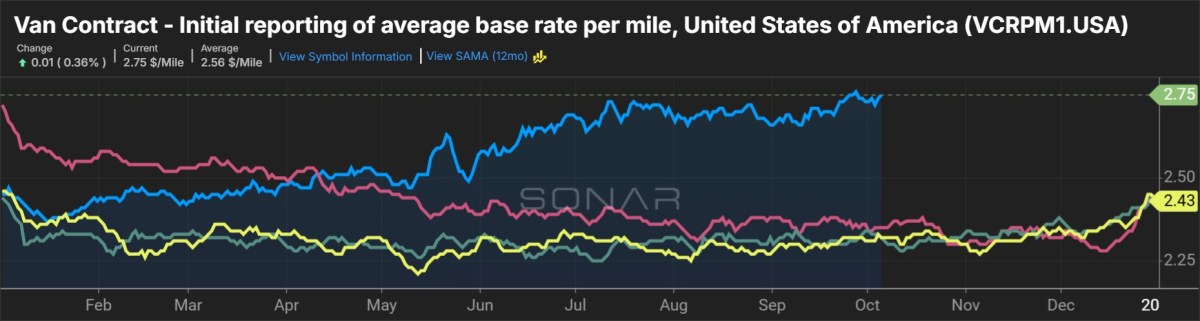
Dry van spot rates rose 1.2% year over year in November, while route guide acceptance remained strong at 93%, signaling a balanced but tightening market. Uber Freight expects spot rates to soften seasonally in early 2026 before rising in the second half of the year as capacity exits accelerate.

If pending federal action on non-domiciled CDL holders moves forward, Uber Freight said the market could experience significant tightening, potentially leading to double-digit spot rate growth.

Outlook: cautious optimism for North American trade

Looking ahead, Uber Freight said the 2026 United States-Mexico-Canada-Agreement review, scheduled for July, will be a pivotal moment for North American trade. Automakers are already increasing local sourcing in Mexico to prepare for stricter rules of origin and closer scrutiny of Asian content.

Major global events, including the 2026 FIFA World Cup, which will be hosted in Mexico, could also introduce temporary logistics challenges across major metros such as Monterrey, Guadalajara and Mexico City.

Despite these risks, Uber Freight said the long-term trajectory for U.S.–Mexico freight remains positive, underpinned by nearshoring, resilient consumer demand and continued investment in North American manufacturing capacity.

Maersk, Hapag-Lloyd drop US East Coast city from trans-Atlantic services

Maersk and Hapag-Lloyd are eliminating calls at the port of Baltimore, among several changes to their Gemini cooperation’s North Europe-North America services.

To better align with customer needs, Philadelphia will replace Baltimore on the TA3 service, Maersk (MAERSK-B.CO) said in a customer advisory Monday.

The new rotation is Southampton – Rotterdam – Hamburg – Wilhelmshaven – Newark – Norfolk – Philadelphia – St. John – Southampton. The new schedule kicks off with the sailing of the Maersk Fredericia from Southampton Jan. 4.

Hapag-Lloyd (HLAG.DE) in an update said its North Europe–North America AL1 service and Americas Service Northbound Service (USW) will omit Baltimore “for schedule recovery”.

The changes comes as the Maryland port continues to recover from the collapse of the Francis Scott Key Bridge in 2024, which is now expected to take longer and cost more than originally planned. At the same time, CSX recently restarted operations on the city’s Howard Street tunnel following construction to clear the century-old bore for doublestack trains along the I-95 corridor. That was projected to boost Baltimore volume by as much as 160,000 containers per year.

Baltimore has long been known as the leading Northeast ro-ro hub, with vehicle traffic compromising more than 50% of all cargo, according to some reports. In 2024 Baltimore handled approximately 750,000 cars and light trucks as well as 850,000 tons of farm and construction equipment, second to Brunswick, Ga., among U.S. gateways. Disruptions from the Key bridge collapse hurt container throughput, which fell 41% from a record 1.26 million TEUs in 2023 to an estimated 741,215 TEUs. 

For ocean carriers, calling Baltimore adds several days’ transit time compared to Norfolk, Va., and Philadelphia. Ships have to navigate 150 miles through the Chesapeake Bay, among the longest ship channels in the world, according to a 2019 study by Texas A&M University. The route also requires the services of multiple local pilots to guide vessels in, along with a separate docking pilot at the port.  

Maersk said it has also added an inbound call at St. John in Canada on its TA2 service. The new rotation is Antwerp – Southampton – Rotterdam – Hamburg – Saint John – Charleston – Savannah – Norfolk – Antwerp. The first vessel on the new schedule is the Kiel Express departing Antwerp Dec. 29.

Maersk and the Maryland Port Administration did not immediately return messages seeking comment.

Find more articles by Stuart Chirls here.

Related coverage:

Maersk tabs new CFO, North American chief in global leadership shakeup

Seamless integration behind DP World rebrand of ocean container line

Jaxport COO Bennett dies in car crash

Retailers see container import hangover for 2026

Qargo lands $33M Series B to fuel AI-driven TMS growth in Europe

Three Qargo co-founders, Adriaan Coppens (center), pose confidently in front of the company's illuminated hexagonal logo, highlighting their AI-driven TMS growth after $33 million Series B funding.

Qargo, a Belgium-based transportation management system (TMS), has secured $33 million in a Series B funding round led by Sofina, with participation from Balton Capital. The round brings Qargo’s total funding to $54 million. The cloud-based TMS platform aims to digitize operations for carriers, freight forwarders and third-party logistics providers.

Since entering the European market less than 18 months ago, Qargo has quadrupled its customer base and grown its revenue fivefold. The company expanded from two to six European logistics markets during that time.

According to a company news release, Qargo’s platform’s AI engine has helped logistics companies automate many parts of their end-to-end transportation workflows, including order creation, route planning, trip optimization, load building, invoicing and booking time slots for warehousing. The automation has helped customers reclaim 75% of their time previously spent on these manual tasks.

The rise of agentic AI and its incorporation into TMS platforms also has boosted Qargo’s platform by reducing its overhead costs and enabling it to grow its scale.

The recent funding follows Qargo’s Series A round in May. Customer invoicing processed through Qargo’s platform rose from $560 million to $2.5 billion annually as its customer base expanded from about 100 to more than 400.

“This round is a strong endorsement of our progress and our mission to modernize transport management,” said Adriaan Coppens, CEO and co-founder of Qargo, in a company news release. “Since our Series A, we’ve grown revenue, our customer base and our team at an exceptional pace while remaining highly capital efficient. The Series B funding allows us to continue investing and growing the team so that we can keep offering the same level of customer service.”

Union Pacific adds retiring CF Industries CEO to its board

Union Pacific has appointed W. Anthony “Tony” Will to its board of directors, effective Jan. 5.

Will has served as president, CEO and board member of CF Industries Holdings, a global manufacturer of hydrogen and nitrogen products, since 2014. He plans to retire Jan. 4, and will serve in an advisory role through March 15.

Tony Will (Photo: UP)

“We are excited to welcome Tony to our board,” UP (NYSE: UNP) Board Chairman Mike McCarthy said in a statement. “His proven leadership and impressive track record will be instrumental as we continue our work to build America’s first transcontinental railroad and transform the nation’s supply chain.”

Union Pacific and Norfolk Southern (NYSE: NSC) earlier said they expect to file their formal merger application with federal regulators on Dec. 19.

Will joined CF Industries (NYSE: CF) in 2007 as vice president, corporate development. He was promoted to vice president, manufacturing and distribution in 2009 and senior vice president, manufacturing and distribution in 2012.

“I’m honored to join Union Pacific’s board,” Will said. “It’s an exciting time for both Union Pacific and the rail industry as a whole, and I’m looking forward to leveraging my experience to help guide Union Pacific as we shape the future of rail.”

Before joining CF Industries, Will was a partner at Accenture LLP (NYSE: ACN), a global management consulting, technology services and outsourcing company. He previously held positions at Sears, Roebuck & Co., Fort James Corp., Boston Consulting Group, and Motorola (NYSE: MSI) .

Will has a bachelor’s degree in electrical engineering from Iowa State University and an MBA from the Kellogg School of Management at Northwestern University.

Subscribe to FreightWaves’ Rail e-newsletter and get the latest insights on rail freight right in your inbox.

Related coverage:

Deep South Democrats back UP-NS rail merger

Intermodal traffic continues to hold down overall U.S. rail volume

Union Pacific sets date for historic rail merger filing

Feds OK automation, say railroads can make fewer visual track safety checks

FMCSA waives driving limits for fuel haulers in Northeast

Tanker truck in winter

WASHINGTON — Federal regulators are temporarily waiving hours-of-service regulations for truckers hauling heating fuel in four northeastern states in response to severe winter weather and a power outage.

The regional emergency order, issued by the Federal Motor Carrier Safety Administration on Friday, exempts drivers operating in Delaware, New Jersey, New York, and Pennsylvania from regulation 49 CFR 395.3, which covers daily and weekly maximum allowable driving times.

“This emergency declaration is issued in response to winter storms and cold weather in the affected States and a power outage at a major gas refinery and industrial complex in Marcus Hook, Pennsylvania severely disrupting the flow of propane and the current and anticipated effects on people and property, including the immediate risk to public health, safety and welfare,” the order states.

“This emergency declaration addresses the emergency conditions creating a need for immediate transportation of heating fuel, including propane, natural gas, and heating oil, and provides necessary relief.”

The order applies to all shipments regardless of where the freight originated as long as the carrier or driver is responding to the emergency.

“Direct assistance does not include transportation related to long-term rehabilitation of damaged physical infrastructure after the initial threat to life and property has passed, nor does it include routine commercial deliveries, including mixed loads with a nominal quantity of qualifying emergency relief added to obtain the benefits of the declaration,” according to the order.

FMCSA has attached several conditions to the waiver, including:

  • Drivers are not exempted from drug and alcohol testing requirements or from vehicle size and weight limits.
  • Carriers and drivers subject to an out-of-service order are not eligible for waiver relief until the order has been rescinded.
  • Direct assistance by carriers and drivers responding to the emergency ends when the driver or the truck begins hauling cargo not associated with the emergency relief efforts.

The order expires on December 26, unless emergency conditions end sooner.

Click for more FreightWaves articles by John Gallagher.

3PL Wagner Logistics acquires contract logistics business

trucks at a warehouse

National 3PL Wagner Logistics announced that it has acquired Dawson Logistics’ contract logistics business for an undisclosed sum. The deal adds four warehouses and one million square feet to Wagner’s network.

“This acquisition is a big leap forward on our path toward expanding our national footprint and contract logistics capabilities,” said Brian Smith, president and CEO of Wagner Logistics, in a news release.

Danville, Illinois-based Dawson Logistics is a full-service 3PL providing services like warehousing, fulfillment and reverse logistics. It also provides full truckload and less-than-truckload transportation through a network of carriers.

The deal only includes the contract logistics operations of Dawson, which has 90 employees and warehouses in Danville, Cincinnati and Nashville, Tennessee. The unit now operates under the Wagner Logistics brand.

North Kansas City, Missouri-based Wagner Logistics provides distribution-center, fulfillment and transportation services for sectors like energy, food and beverage, automotive, and consumer products, among others. The acquisition pushes its warehouse footprint to more than eight million square feet and bolsters its presence in the apparel and industrial markets.

“Divesting our Contract Division with Wagner Logistics marks an exciting new chapter,” said Doug Dawson, founder and CEO of Dawson Logistics. “Wagner’s strong reputation and nationwide network will enable it to deliver even greater value to our customers while creating new opportunities for our employees.”

More FreightWaves articles by Todd Maiden:

Amazon’s same-day grocery delivery serves as magnet for parcel business

Closeup rear view of a light blue Amazon Prime delivery van.

Amazon has reached its goal of offering same-day delivery of fresh groceries to 2,300 cities and towns by the end of the year, more than doubling its previous reach. A secondary benefit of the service is that users are more likely to also use the company for parcel delivery of regular merchandise.

In four months, the e-commerce giant has grown same-day availability for perishables to 2,300 areas, up from 1,000 communities when it announced the planned expansion in August, according to an article last week on its blog page. The latest phase of the roll out brought same-day grocery delivery to places like Boise, Idaho; Salt Lake City; Fort Collins, Colorado; Omaha, Nebraska; Sugar Land, Texas; Des Moines, Iowa; Kennesaw, Georgia; Gaithersburg, Maryland; and their surrounding areas. 

The Amazon (NASDAQ: AMZN) service now offers a 30% larger selection of perishable goods than in August, primarily sourced from Whole Foods Market. Customers can combine groceries with general merchandise in a single order. 

The expansion into same-day delivery is made possible by improvements to Amazon’s temperature-controlled delivery network, last-mile delivery partnerships and ability to offer more selection, according to analysts and the company.

Prime members with access to fresh delivery can order fresh fruits, vegetables, dairy, meat, seafood, baked goods, and frozen foods alongside dry goods and other products. They receive same-day delivery for free on orders over $25 in most areas. If an order doesn’t meet the minimum, members can still choose same-day delivery for a $2.99 fee. Non-Prime customers pay $12.99 for the service. 

Amazon said perishable grocery sales have grown 30 times since January as more customers to same-day delivery for convenience. The service’s popularity is demonstrated by the fact that customers who add fresh groceries to their same-day delivery orders shop about twice as often as those who don’t. 

Investments in grocery delivery allows Amazon to compete in the grocery segment with fewer stores and achieve the scale necessary to maintain profit margins and take on competitors like Instacart, analysts say. Amazon is currently testing 30-minute delivery in Philadelphia and Seattle.

“We continue to see this grocery expansion as a Trojan horse encroaching on parcel carriers’ share if customers’ reliance on Amazon for groceries extends to non-grocery items as well,” Morgan Stanley freight analyst Ravi Shanker wrote in a research note. Parcel carriers like FedEx and UPS, already under pressure from large retailers and independent couriers, could face more business loss if Walmart and Target also bundle grocery and non-grocery shopping baskets in their digital marketplaces, he added.

“We’re seeing customers combine their fresh grocery orders with their regular Amazon purchases, like electronics, gifts, clothes, and household essentials, in ways that make their lives easier and save them valuable time,” Doug Herrington, CEO of Worldwide Amazon Stores, said in the blog post. 

In May, Amazon announced a $4 billion investment to expand its rural parcel delivery network by the end of 2026.

“If this rural initiative is eventually integrated with its grocery delivery efforts, it could significantly lower rural delivery costs, further increasing pressure on traditional parcel services and positioning Amazon closer to becoming more of a third-party parcel carrier,” Shanker said. 

Click here for more FreightWaves/American Shipper stories by Eric Kulisch.

Amazon tests 30-minute delivery in two US cities

Amazon expands same-day delivery of perishables in big grocery push

Amazon taps FedEx for big-and-bulky residential deliveries