Freightmate AI seeks dismissal of Flexport copyright lawsuit

Freightmate AI has filed a motion to dismiss Flexport’s copyright infringement lawsuit against it.

The motion, filed on April 22, argues that Flexport’s claims for trade secret misappropriation and copyright infringement lack a sufficient legal basis.

Freightmate AI’s attorneys contend that the complaint fails to demonstrate any direct involvement of the company in the alleged misappropriation acts carried out by former Flexport employees now affiliated with Freightmate.

“Flexport never should have named Freightmate as a defendant in this case,” Freightmate stated in the motion. “While the allegations … contain some detail regarding supposed exfiltration of its materials by [Jason] Zhao, they say virtually nothing about Freightmate.”

Zhao is a former Flexport employee and a founder of Freightmate AI.

The motion says the timeline of events does not support Flexport’s claims, stating that Freightmate AI was incorporated after the alleged unauthorized actions by Zhao, who left Flexport in early June 2024. 

The filing states that Freightmate’s founders, Zhao and Bryan Lacaillade, only began substantial work on their company’s product after this date, without reliance on Flexport’s proprietary information.

“None of the work leading to Freightmate’s product was developed during its founders’ employment with Flexport,” the motion stated.

Flexport had initially accused Freightmate AI of using its proprietary information, allegedly lifted by Zhao and Lacaillade, to develop a competing product. The lawsuit, filed in the U.S. District Court for the Northern District of California, seeks remedies for alleged trade secret misappropriation, copyright infringement and breach of contract.

Freightmate AI maintains that its technology presents “a unique product distinct from Flexport.” The hearing for the motion to dismiss is scheduled for early June 2025.

Running on Ice: Air cargo upgrades at JFK include cold storage

All thawed out

(Photo: Jim Allen/FreightWaves)

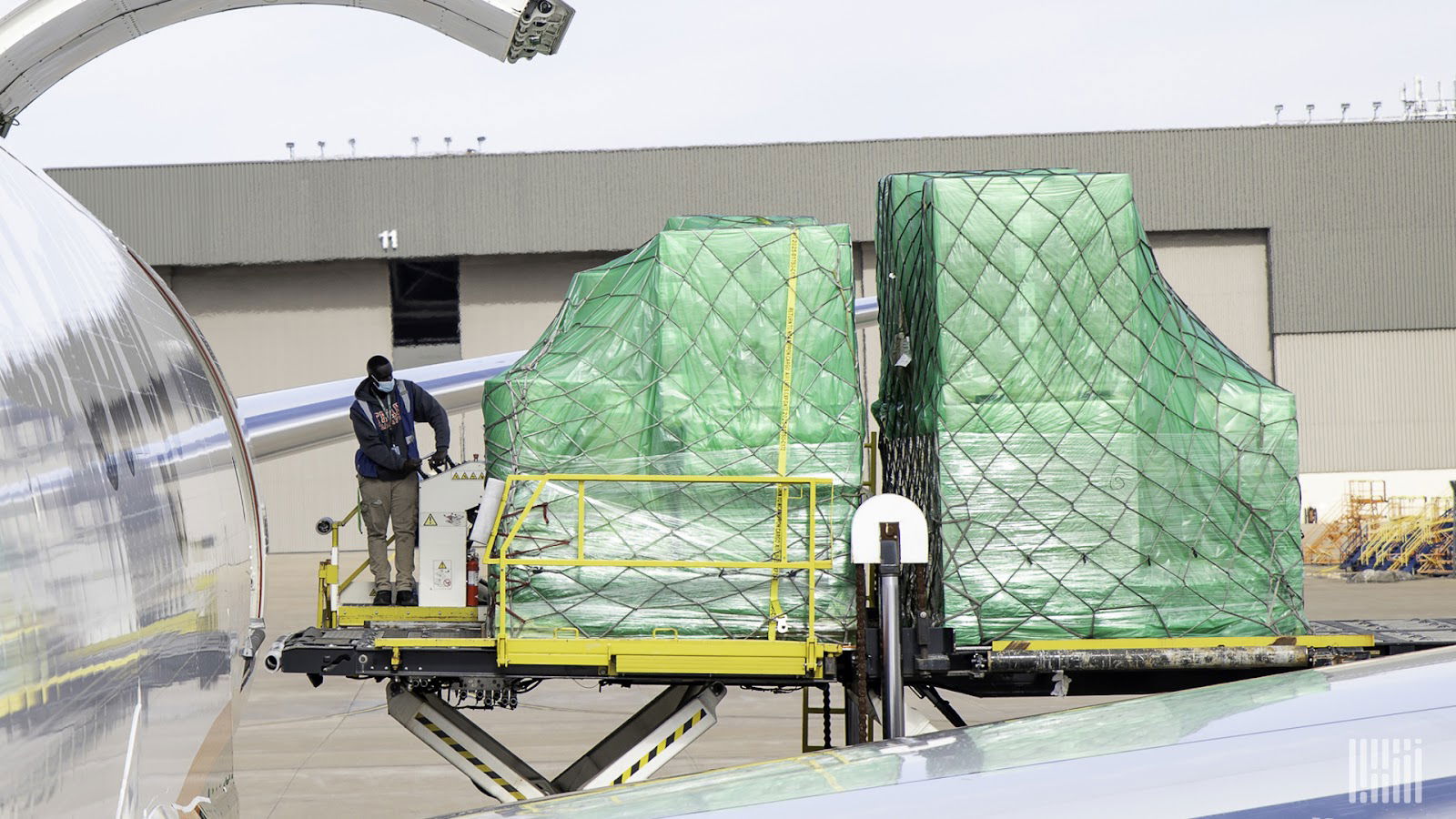
John F. Kennedy International Airport has gotten a much-needed glow-up in the cargo area. Recently, the Port Authority of New York and New Jersey unveiled a $270 million consolidated cargo handling center at (JFK) – the first new airfreight facility at the airport in 25 years.

The expansion and update bring operations from four separate cargo zones into one spot. The facility spans 350,000 square feet over 26 acres and replaces two older terminals. This is phase one in a larger redevelopment plan for JFK’s cargo area. As part of the overall extra square footage, the new building has 3,000 square feet of cooler space for environments of 2-8 C and 15-25 C. These are the first on-airport areas at JFK specifically designed for items such as pharmaceuticals and fresh goods.

According to a Supply Chain Digital article, “JFK plays a key role in international cargo flows, handling everything from high-value goods such as electronics and pharmaceuticals to perishables. The airport processed 1.67 million tonnes of freight in 2024, which is 5% up on 2023 and 25% more than in 2019, making it the eighth-busiest cargo airport in the US and 21st globally.”

Temperature checks

(Photo: DHL)

Health care supply chains continue to grab the spotlight. This time it’s DHL Express. The international express services provider has expanded its next-day delivery capabilities by adding a Brazil-to-U.S. lane within its enhanced Medical Express Service. This service facilitates the transport of samples from Puerto Rico, Brazil, Argentina, Chile, Colombia and Peru to central U.S. destination labs in less than 30 hours from the time of patient draw.

As FreightWaves reported, Brian Bralynski, senior director of life sciences and healthcare, DHL Express Americas, said: “Given the complexities of export processes, tax payments, and ANVISA (Brazil’s health regulatory agency) approvals necessary in Brazil, our integrated system allows DHL to initiate export approvals before samples arrive at our facilities. This enables DHL to extend later collection times for investigator sites, allowing more time to schedule patient visits while still exporting on the day of collection.”

DHL is investing $2.2 billion over the next five years to enhance its logistics capabilities in the life sciences and health care sector. The organization is also trying new strategies for boosting efficiency within the network. The most recent example is a DHL-operated aircraft departing Miami to its Cincinnati hub in the morning instead of the evening.  As a result, over 65% of ambient patient samples now arrive at central U.S. labs for testing one day sooner.

Food and drug

(Photo: Tillamook County Creamery Association)

Tillamook County Creamery Association is sweetening up  in the frozen aisle just in time for summer with two new limited-edition ice cream flavors: Salty Caramel Pretzel and Apple Crisp.

In addition to these seasonal debuts, Tillamook is making two previous limited-edition hits — Orange & Cream and Campfire Peanut Butter — permanent fixtures in its product lineup.

Supporting its momentum, Tillamook cited Circana data that named the Oregon-based creamery the fastest-growing family-size ice cream brand in the U.S. across multioutlet retail channels for the year ending March 23.

Expansion in the already sizable market is going to continue. The global ice cream market was estimated at $77.8 billion in 2024 and is projected to grow from $79.4 billion in 2025 to $139.7 billion by 2033.

Cold chain lanes

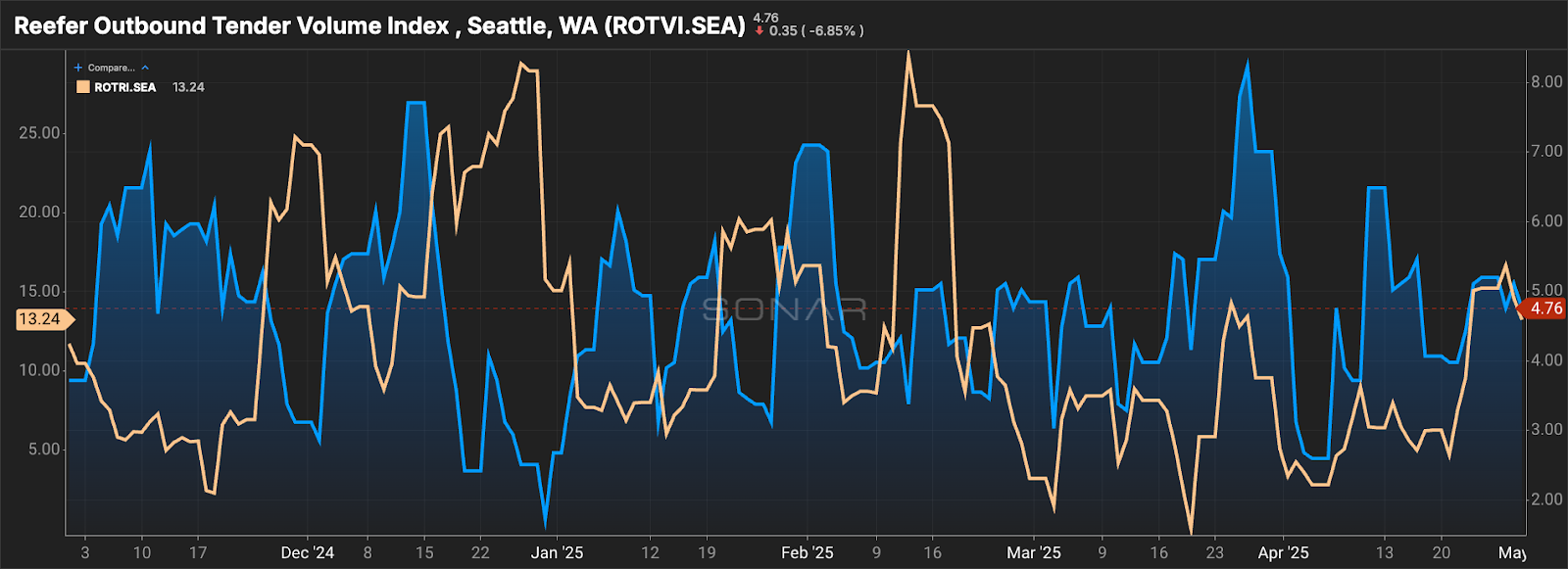
SONAR Tickers: ROTVI.SEA, ROTRI.SEA

This week’s market under a microscope heads to the Pacific Northwest, where both reefer outbound tender volumes and reefer outbound tender rejections are elevated. Reefer outbound tender volumes have increased 7.69% week over week. On the other hand, reefer outbound tender rejections have risen 372 basis points w/w for a ROTRI of 13.24%.

Reefer rejection rates have remained in a bit of a yo-yo effect to some extent as levels have ranged from 5%-29% since the beginning of the year. Shippers can expect lower carrier contract compliance as rejections continue to increase. Secondary and tertiary carriers on the routing guide can expect to see increased volumes in their network as the ROTRI continues to climb. 

Is SONAR for you? Check it out with a demo!

Shelf life

Inside the small Alberta town powering Canada’s cold chain revolution

Tyson Foods enters agreement with cold-storage unit company 

Lineage looks to expand U.S. cold-storage network

Port of Guam adds tractors, reefer generators 

NBA star Shaq O’Neal tips off big chicken’s ‘Inside The Sandwich Wars’

Wanna chat in the cooler? Shoot me an email with comments, questions or story ideas at moconnell@freightwaves.com.

See you on the internet.

Mary

If this newsletter was forwarded to you, you must be pretty chill. Join the coolest community in freight and subscribe for more at freightwaves.com/subscribe.

Convoy Platform: Zero thefts over last 380,000 loads; tariffs vs. fasteners | WHAT THE TRUCK?!?

On Episode 833 of WHAT THE TRUCK?!?, Dooner is talking to Flexport’s Bill Driegert about resurrecting Convoy Platform. The company has just announced that it has had zero loads stolen over its past 380,000 shipments. Across the industry, cargo thefts were up 27% year over year, and the average value of theft ballooned to $202,364. We’ll find out how Flexport has managed to beat the bad guys. 

Can fasteners hang in there against tariffs? Field Fastener’s John Oldham Jr. stops by to talk about how trade policy could be impacting the very goods holding everything together. 

Plus, Commercial Carrier Journal gets cooked over driver shortage article; layoffs/bankruptcies hit trucking; GTA6 delayed until 2026; XBOX Series X up $100; and is the port of Seattle really empty? 

Catch new shows live at noon EDT Mondays, Wednesdays and Fridays on FreightWaves LinkedIn, Facebook, X or YouTube, or on demand by looking up WHAT THE TRUCK?!? on your favorite podcast player and at 5 p.m. Eastern on SiriusXM’s Road Dog Trucking Channel 146.

Watch on YouTube

Check out the WTT merch store

Visit our sponsor

Subscribe to the WTT newsletter

Apple Podcasts

Spotify

More FreightWaves Podcasts

Ocean carriers blank sailings as bookings drop

Ocean rejection rates spike as bookings fall

(Chart: SONAR Container Atlas)

Much of the focus the past several days has been on the drop in ocean bookings from China to the U.S., and with good reason. The SONAR Ocean Booking Volume Index from China to the U.S. is now down about 50% year over year, roughly in line with the reported average from ocean carriers and other data sources. A FreightWaves article published last week goes into detail.

(Chart: SONAR Container Atlas)

A related dataset that has moved sharply in recent days is the Ocean TEU Rejection Index from China to the U.S. It’s now up over 20%, which only has historical precedent during the early days of COVID and the rush surrounding major Chinese holidays. To mitigate the impact that falling demand will have on rates, carriers are employing a range of tactics including deploying smaller vessels, blanking sailings and suspending entire service loops (regular routings that call on a set sequence of ports). In fact, according to Flexport, ocean carriers are reducing capacity from China to the U.S. at a rate faster than the early days of COVID. Summer goods are already on shelves or in warehouses, but the sharp reduction in capacity presents risks to goods availability in the fall. Those strategies are helping to keep container rates relatively stable

Transportation earnings season has largely been a flurry of cuts to expectations

Here is a sample of the earnings writeups on FreightWaves.com:

Tender rejection rates depressed in many multimodal hub cities

The Long-haul outbound tender rejection rate is shown for Los Angeles (yellow), Newark, New Jersey, (green), Chicago (red), Atlanta (peach) and the U.S. as a whole (white). (Chart: SONAR)

Domestic intermodal companies and Class I railroads have recently described how the competitiveness with truckload is keeping a lid on intermodal rates despite intermodal volume that grew in the mid-single digits in the first quarter. Looking at long-haul tender rejection rates, which limits the datasets to lengths of haul exceeding 800 miles to exclude many noncompetitive loads is one way to monitor the competitive dynamic between truckload and intermodal.

Average long-haul tender rejection rates typically exceed rejection rates for other lengths of haul, as they do currently. (The national long-haul tender rejection rate is 5.55% versus a national tender rejection rate of 4.95% for all lengths of haul.) What also stands out is that long-haul tender rejection rates are significantly below the national tender rejection rate for many locations that serve as major intermodal hubs. Most notable is the depressed long-haul Los Angeles and Atlanta outbound tender rejection rates of just 2.5% and 2.9%, respectively. Those rates suggest that carriers are accepting nearly all loads available on the contract market and imply that shippers may be able to move freight at lower rates on the truckload spot market. One example is the Atlanta-to-Chicago lane – SONAR Market Dashboard shows a highway spot rate of just $1.35 per mile, well below the highway contract rate of $2.29 and even below the intermodal contract rate in SONAR of $1.48. (All rates include fuel surcharges.)
The Stockout on final mile at Werner

(Image: FWTV)

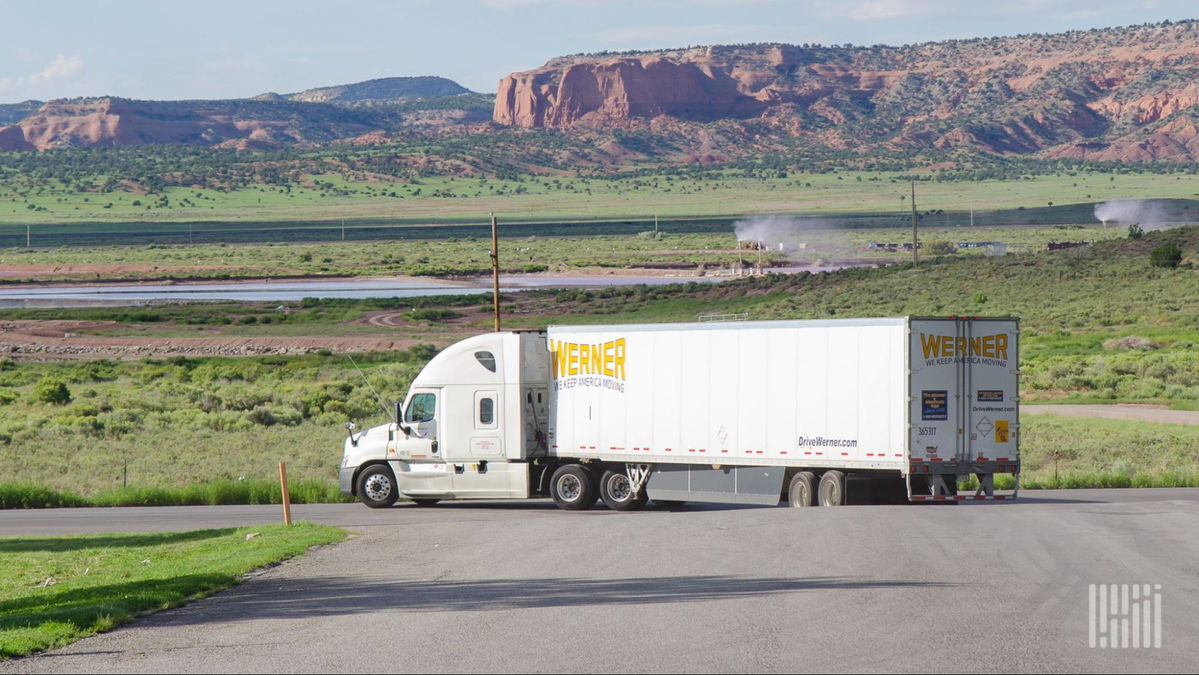
On Monday’s The Stockout, FreightWaves’ retail and CPG show, Grace Sharkey and I discussed the impacts of tariffs and Sharkey interviewed Meg Meurer, vice president of dedicated and final-mile sales at Werner Enterprises.

As Meurer explained, Werner has built an extensive training program to ensure that final-mile customers are getting white-glove treatment, whether that involves the delivery of furniture or appliances at a residence or specialized equipment at a hospital or auto assembly plant. Staff is trained on installation, assembly and disassembly. The training involves role-playing and ride-alongs to help drivers deal with unique situations, which could include an unruly dog or a customer with disabilities.
Monday’s show can be viewed on The Stockout YouTube channel.

To subscribe to The Stockout, FreightWaves’ CPG and retail newsletter, click here.

CVSA votes to put truck drivers with limited English out of service

Truck driver in parking lot

The Commercial Vehicle Safety Alliance board of directors voted on Thursday to make English proficiency violations grounds for truck drivers to be placed out of service, a decision that could significantly reduce trucking capacity.

The vote, held under an emergency provision in CVSA’s bylaws, came just days after President Donald Trump issued an executive order directing that the federal out-of-service criteria be revised to reflect the policy change, reversing a less stringent policy that has been in place for 10 years.

Under the Obama Administration in 2016, the Federal Motor Carrier Safety Administration removed the requirement to place truck drivers out of service for violating federal English Language Proficiency rules.

The new out-of-service rule becomes effective June 25.

“By adding English language proficiency to the out-of-service criteria, a commercial motor vehicle inspector may place a driver out of service if they cannot demonstrate proficiency in reading and speaking English,” CVSA stated in a press release.

“The [FMCSA] will issue guidance for commercial motor vehicle inspectors to ensure enforcement of the English language proficiency standard is applied consistently.”

While FMCSA sets the safety rules for the trucking industry, CVSA, whose members include state highway patrol officers, has been given the authority, in most cases, to determine whether violating those regulations is serious enough to warrant placing a driver out of service.

Insurance experts specializing in the trucking sector have estimated that 10% of the total driver population lacks proficiency in English. With over 3 million interstate CDL drivers in the country, according to FMCSA’s most recent statistics, the out-of-service mandate could lead to a significant drop in capacity in the market.

CVSA explained that its emergency provision bylaws allow the board “to vote on a change to the out-of-service criteria without a vote by Class I Members, which is the usual process for changes to the criteria. The board utilized the emergency bylaw provision to meet the president’s 60-day deadline, as noted in his executive order.”

CVSA stated it will petition FMCSA to update the English language proficiency regulation – [49 CFR 391.11(b)(2)] – to formally identify violations as an out-of-service condition.

“CVSA will also send a petition to FMCSA requesting that the agency harmonize the commercial driver’s license English language requirements in 49 CFR Part 383, ‘Commercial Driver’s License Standards,’ with those in 49 CFR Part 391, ‘Qualifications of Drivers and Longer Combination Vehicle Driver Instructors,’ so that the standards are consistent.”

Click for more FreightWaves articles by John Gallagher.

Research on driver shortage claim points to churn rather than burn

OOIDA report takes aim at driver shortage, argues turnover is the issue

(Photo: Jim Allen/FreightWaves)

Recent research published by the Owner-Operator Independent Drivers Association’s Research Foundation took aim at the theory of a persistent driver shortage in the long-haul truckload segment. The report titled “The Churn: A Brief Look at the Roots of High Driver Turnover in U.S. Trucking,” argues that despite claims by other trucking associations of a shortage, it’s the turnover rates of upwards of 90% across large truckload fleets that are to blame. The researchers argue that a persistent shortage would lead to higher driver wages, as a lack of labor would, according to some economists, result in higher wages from demand for said labor. 

The research outlines many structural issues that it deems a feature, not a bug, of the long-haul driver labor market. The first comes from the intense competition that prevents carriers from raising wages for fear of losing out to a cheaper competitor. The carrier that raises wages needs a higher rate, and that means that among price-sensitive shippers, someone else gets the coveted incumbent spot on the routing guide. The second argument the report notes is labor subsidies via industry and government initiatives that increase the labor pool of available drivers without resulting in higher wages. 

Overtime and regulatory loopholes also exist, with truck drivers not qualifying for overtime under the Fair Labor Standards Act. However, this exemption has been around since the 1930s. This results in a fragmented pool of drivers who, by the nature of their job, are unable to negotiate for better working conditions. The final piece of the report talks about information asymmetry, in which new drivers who enter trucking are misled and believe the earnings starting out are much greater than the reality. From personal experience, it took this long-haul over-the-road driver at least a year to learn the habits the lifestyle needed to become economically productive. Those same new drivers who graduated from CDL school had a 50% success rate to make it past six months. 

Trump executive order targets truckers who cannot speak and read English

(Photo: Jim Allen/FreightWaves)

On Monday, President Trump signed an executive order requiring that truck drivers be able to speak English or be placed out of service. According to a fact sheet published by the White House, the order rescinds previous guidance that had watered down the law that required English proficiency, which had removed the out-of-service criteria. Additionally the order instructs the secretary of transportation to review state issuance of nondomiciled commercial driver’s licenses to identify any irregularities and ensure the drivers are licensed and qualified.

FreightWaves founder and CEO Craig Fuller weighed in, noting on the X platform, “This is a positive development for safety, but it will have a significant impact on trucking capacity and could help the industry right-size from excess capacity.” Fuller added that one insurance executive from one of the largest firms in the U.S. estimates 40% of truck drivers are first-generation immigrants and 10% of the total driver population lacks English proficiency. 

The White House notes that safety is one of the reasons behind the move, with over 120 people killed every day as a result of motor vehicle crashes. This is roughly the equivalent of a Boeing 737-700 crashing each day.

Another challenge is resources. An estimated 45,000 people work for the Federal Aviation Administration. The Federal Motor Carrier Safety Administration has 1,000 to 1,100 employees. 

Werner posts rare loss in Q1 earnings

(Photo: Jim Allen/FreightWaves)

Werner Enterprises’ first-quarter earnings came as a surprise. The company reported a net loss of $10.2 million compared to last year’s Q1 gain of $6.2 million. In the earnings release, CEO Derek Leathers cited elevated insurance costs, extreme weather, a smaller fleet and customer changes related to tariff uncertainty as reasons behind the earnings miss. Fewer trucks did impact top-line revenue, which fell $36.8 million in Q1 to $433 million. The company’s operating ratio net of fuel was 99.6%, a 430-basis-point decline from 95.3% in Q1 2024.

Fleet count also took a hit, with the combined truckload transportation services segment shedding 520 tractors from 7,935 in Q1 2024 to 7,415 units in Q1 2025. Broken down by segment, one-way truckload fell by 154 tractors y/y from 2,786 to 2,632, while dedicated saw a larger loss of 366 units from 5,149 to 4,783 tractors. The percentage of empty miles, or deadheading, also crept up, from 14.9% in Q1 2024 to 16%. A good rule of thumb for deadhead percentages is to try to keep them around 10%, which is easier said than operationally done. 

During the earnings call, Leathers gave more details and noted the possible impacts of tariffs. While the quarter is an outlier due to the rare instance of Werner’s posting an operating loss, Leathers notes the company is in a better position regarding liquidity, having recently secured a $300 million receivables-backed line of credit. Leathers also referred to the impacts of tariffs on Werner’s business as an air pocket, referencing the reduction in inbound freight to U.S. ports from Asia. That pocket will need to be filled with substitutes to offset the loss in freight demand. FreightWaves’ John Kingston adds: “[Leathers] said Werner customers have been telling him their inventory levels ‘are in good shape,’ so there won’t be a rescue from those customers needing to increase their freight demand.”

SONAR spotlight: Freight demand continues to sink

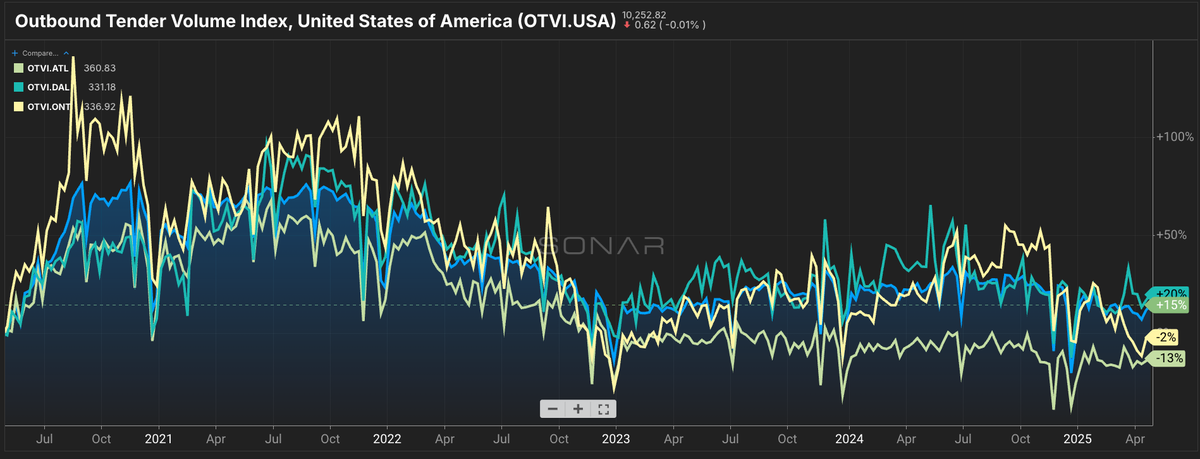
(SONAR Tickers: OTVI.USA, OTVI.DAL, OTVI.ONT, OTVI.ATL)

Summary: Dallas’ outbound tender volumes (OTVI.DAL) have grown approximately 20% over the past five years compared to the national average of 15%. The two largest outbound markets in the U.S. — Ontario, California, and Atlanta — have both lost significant shares: 2% and 13%, respectively. The ongoing capacity glut is hiding a rather significant shift in national freight flow patterns.

In a more balanced market, freight demand changes are discovered through isolated pockets of tightening, where spot rates increase and carriers flock to cover the freight. In the current market, where supply is abundant, there is no tightening or increased rates as carriers are nearly sitting on the sides of the streets ready to pounce.

Import demand has dropped, but that hasn’t been strongly felt in the domestic freight market as of yet. It does create volatility in the market that makes for uncertain long-term planning.

A Light That Moved Fast and Shined Bright: Honoring Brittany Traylor (FreightWaves)

Dispute over $6.7 million leads to closure of Kingsley Trucking (FreightWaves)

Mass layoffs in trucking and retail coming – Apollo (FreightWaves)

FMCSA denies truck driver learner’s permits for 17-year-olds (FreightWaves)

Strong demand drives up used truck prices and volumes (Commercial Carrier Journal)
Insurance costs, entry-level driver training top ATRI’s research priorities for 2025 (The Trucker)

Most recent episode

Like the content? Subscribe to the Loaded and Rolling newsletter here.

Southern Tire Mart at Pilot Expands Network

Professional drivers are constantly working to maximize their time on the road. With strict limits on driving hours and increasing demands in the logistics industry, fast and reliable maintenance and repair services are vital. Southern Tire Mart at Pilot (STMP) is rising to meet this challenge by expanding its network of high-quality maintenance and tire service locations across the United States.

Pilot, the largest travel center network in North America, and Southern Tire Mart, a leader in tire and mechanical services, have partnered to create a powerful combination of convenience and expertise. Southern Tire Mart at Pilot has now reached over 80 locations and counting – rapidly growing its presence to serve more drivers and fleets. When combined with Southern Tire Mart’s shops, the total service network offers nearly 250 locations nationwide.

“Time is the most precious commodity for professional drivers,” said John Boynton, president of Southern Tire Mart at Pilot. “When there is a maintenance need, planned or unplanned, our goal is to get drivers back on the road as quickly as possible without compromising on service quality.”

This commitment to efficiency is evident in the company’s approach. STMP prides itself on getting drivers back on the road quickly, a critical factor for drivers working within the constraints of 14-hour shifts, only 11 of which can be spent driving. STMP employs the use of up to six service trucks to provide 24/7 mobile repair services within a 50-mile radius of every location so that drivers are never left stranded and ensure they can access vital maintenance and repairs.

Service offerings go beyond basic tire maintenance. Drivers can access a full range of mechanical services, including preventative maintenance, trailer washouts, vehicle diagnostics, DOT inspections, alignments, and complex repairs. This comprehensive approach allows fleets to quickly and efficiently address multiple maintenance needs in a single stop from certified technicians.

But speed isn’t the only priority. STMP takes pride in customizing its services to meet the specific needs of drivers and fleets in each location. “It’s not a cookie-cutter solution,” Boynton said. “We sit down with our customers, listen to their needs and tailor our approach accordingly.”

This flexible, customer-centric strategy has earned STMP a reputation for exceptional service. Professional drivers consistently report high satisfaction. Here’s what some customers are saying:

The folks at Southern Tire Mart were amazing. My valve extender popped a leak in Ohio. I stopped in without an appointment, and they saw me right away and fixed it. The place down the road had a 5-hour wait. I wish this place was closer to my home – I would frequent it for my needs! 

– Cyndie C (London, Ohio location)

I’m an owner operator, and the staff at STMP have done everything possible to take very good care of me and have given me the best service I believe I’ve ever had. Whatever you’re doing, keep it up. You have my business now. 

– Paul W (Jeffersonville, Ohio location)

Our truck had a slow leak in the front right tire on our way home to Michigan from Florida, pulling our fifth-wheel trailer. We got the best, fastest service and they got us back on the road in no time! In the future, we will try to look for Southern Tire Mart at Pilot for all our maintenance needs and will highly recommend them to our friends! 

– Mark T (Niota, TN location)

As STMP continues to expand with five new locations opened so far in 2025, growing its network to over 80 locations, the company is introducing a special offer at each new location for a free, no-obligation 25-point road-ready inspection. With consistent pricing and rapid service across locations, drivers can count on quick, high-quality care with STMP wherever their routes take them.

Click here to learn more about Southern Tire Mart at Pilot.

Transportation hiring slows to a crawl in April, warehousing sees strong growth

Will big inventories eventually create demand for downstream trucking?

Although employment in truck transportation soared in March as the industry added 7,000 jobs, hiring in transportation slowed to a crawl in April.

The Bureau of Labor Statistics released jobs numbers Friday morning that highlight the uncertainty and caution that has gripped the industry: Truck transportation added just 1,400 jobs in April, seasonally adjusted, for a total of 1,524,500 jobs, representing less than a tenth of a percent increase.

March figures were also revised downward, suggesting that the hiring in the industry is at an inflection point and may reverse course: Initially reported March numbers were at 1.525 million and were trimmed to 1.523 million. 

In April 2025, truck transportation employment was down 3.2% across the industry compared to April 2023, the record number for April, and down 3.9% from its all-time peak in July 2022.

(Chart: Bureau of Labor Statistics)

The railroad industry put hiring on pause, too, adding just 100 jobs from March to April and bringing its total employment to 153,800 in April, seasonally adjusted. 

On the other hand, as importers pulled forward freight onto American shores to avoid the Trump administration’s tariffs, inventories swelled, and so did seasonally adjusted warehousing and storage employment, adding 9,800 jobs in April from a massively upwardly revised March number. The initial March warehousing and storage employment figure was 1,822,400. With this latest release, that March number shot up to 1,843,600, an increase of more than 20,000 jobs. The initial April number, just reported Friday, stands at 1.853 million, another increase of approximately 10,000 jobs.

Courier jobs have essentially been steady. The initial March figure looked like the industry was posting a substantial increase in employment, but that was revised downward Friday morning, showing that the courier sector lost approximately 10,000 jobs from February to March, seasonally adjusted, to stand at 1,175,700 jobs in March. April added 8,400 courier jobs to bring the total to 1,184,100. 

“Trade war and tariff driven disruptions are the likely culprits behind the recent strength, as it has become more clear that proactive safety stocking from shippers has created a boost in short term trucking demand,” wrote David Spencer, vice president of market intelligence at Arrive Logistics, in an email to FreightWaves. “Strong growth of 29,000 jobs in the larger Transportation and Warehousing segment of the report illustrate the increased needs associated with the boost, particularly around warehousing and storage, as shippers pulled forward inventories ahead of potential price increases.”

“Despite widespread expectations for a large correction, the U.S. jobs market remains the little engine that could,” commented Aaron Terrazas, a labor economist, in an email to FreightWaves. “Payrolls grew at a pace in line with a healthy economy, though some of that comes with an asterisk. The latest wave of supply chain turmoil is very clearly visible in the data. The prior two months of headline payrolls were revised sharply down — so February’s job gain was initially reported as 151,000, but then revised down to 117,000 last month and now to 102,000. Data revisions are net neutral in the long term, but they can be especially important to watch at turning points in the economy. The underlying risk for 2025 is that initial reports look strong, but then the story shifts in subsequent months.”

Commenting on the surge in warehousing and storage jobs, Terrazas said, “It’s abundantly clear that this is an unseasonably large temporary uptick in payrolls associated with inventory and consumer front-loading ahead of expected tariffs.”

Average hourly earnings in truck transportation slipped slightly, but are still strong. The initial February report put truck transportation hourly earnings at $30.50, but that has since been revised upward to $32.05; the March number, just reported, is at $31.92, slightly down from a record high. Average weekly hours ticked up slightly to 40.4 in March from 39.9 in February, meaning that average weekly earnings for truck transportation employees ticked up by about $11.

What the Latest Rate Dip Means for Small Carriers Part 2

rate dip

It is May 2025, and if you have been paying any attention to your settlements over the last 30 days, you already know what we are about to talk about today. We are officially staring down another rate dip, one that is not just uncomfortable but potentially damaging if you are still operating without a plan. Spot rates have slid once again, tender rejections are falling like a rock, and the combination of softer volumes and rising global tariffs is stacking headwinds against small carriers.

This is not the time for theories. This is the time for facts, strategy, and action. Because what we are seeing right now is not just a market cycle. It is a separation season.
And you need to be on the right side of it.

Rates Are Dropping Again and Here Is the Proof

(Photo: SONAR, gosonar.com)

Take a hard look at the SONAR charts.

The National Truckload Index (NTI) is sitting at $2.20 per mile today. That is a continuous three-month slide from $2.29 in March and $2.25 in April.

This is not an isolated blip. This is a trend.

  • Van Spot Rate Per Mile has dropped nine cents in just 60 days.
  • Van Contract Rate Per Mile is hovering at $2.27, near its 52-week low.
  • Outbound Tender Rejection Index (OTRI) is down to 4.95%, a clear sign that carriers are accepting nearly every contracted load offered, with no pricing leverage.
  • Outbound Tender Volume Index (OTVI) remains soft, barely above 10,000 tendered loads nationally, showing no meaningful surge in demand even during typical spring shipping seasons.

Translation for small carriers:
The freight is out there—but not enough to support aggressive rate negotiation.
You are ultimately taking what you can get in this market.


Tariffs Are Quietly Adding Pressure

(Photo: SONAR, gosonar.com)

As if the market dynamics were not enough, May also brings another pressure point—tariffs.

The U.S. government recently expanded tariffs on multiple Chinese goods, including electric vehicles, solar components, and critical manufacturing inputs. The ripples from those decisions are starting to flow into the supply chain, and they are not helping freight volumes.

What does that mean for you?

  • Certain sectors like retail and consumer goods could tighten inventory orders
  • Import-heavy markets like Los Angeles and Savannah might see softer inbound flows
  • Pricing pressure will continue downstream, making cost control even more critical

You are now playing in a freight market that is being squeezed from both sides—demand softness and cost inflation.

That is why you have to move differently now.


What This Rate Climate Really Means for You

If you are a one-truck operator or a boutique fleet under ten trucks, here is the brutal truth.

You cannot bank on rates improving anytime soon.
You cannot depend on load boards to save you.
You cannot operate on emotion.

As The 12 Week Year reminds us:

“Success is not based on intention. It is based on execution.”

And execution in this market looks like controlling the controllables.


Controllable Number One – Operating Efficiency

Your break-even cost per mile is no longer just a nice number to know. It is your survival number.

If you do not know exactly:

  • Your fuel cost per mile
  • Your maintenance cost per mile
  • Your insurance cost per mile
  • Your fixed expenses per week

You are driving blind.

This rate environment does not reward hustle. It rewards precision.

Every penny saved on maintenance, every idle hour you eliminate, every tire you properly inflate—that is how you build margin in a $2.20 RPM world.


Controllable Number Two – Strategic Market Focus

(Photo: SONAR, gosonar.com)

Look at the spot rate map above. The pockets of rate strength are not national—they are regional.

The Southeast and parts of Texas are showing some resilience.
The Midwest remains volatile but opportunistic if you play it correctly.
The West Coast? Soft, unless you are landing high-value produce or air freight.

Chasing miles from coast to coast will bleed your profits dry.

In this market, smart carriers shorten their lanes, tighten their operating radius, and build density around 1-2 core lanes.

You need to operate like a sniper, not a shotgun.


Controllable Number Three – Shipper Relationships

If you are still waiting for brokers to call you with good freight, you are already behind.

The carriers who will survive this stretch are the ones proactively building direct shipper relationships now, not six months from now.

That means:

  • Picking up the phone every week
  • Sending follow-up emails
  • Building small lanes with local manufacturers and distributors
  • Showing up professional, consistent, and reliable

It is not glamorous. It is not quick. But it is how you get off the hamster wheel of the spot market.

Remember from The 12 Week Year:

“Action is the bridge between where you are and where you want to be.”

Shipper outreach is not optional anymore. It is necessary.


What You Should Be Doing Right Now

If you are feeling the squeeze, you are not alone.
But feeling it is not an excuse to freeze.

Here are a few things every small carrier should be doing immediately:

  • Review every controllable expense on your books
  • Audit your route density and regional exposure
  • Make five direct shipper outreach attempts per week minimum
  • Double down on preventive maintenance to avoid breakdown premiums
  • Track idle time, speed, and MPG weekly using your ELD data
  • Reset your revenue goals based on realistic RPM assumptions (between $2.10–$2.30, not $2.70 dreams)

The carriers who keep moving, who keep adjusting, and who keep executing daily rhythms will not just survive this rate dip—they will be the ones standing tall when the rebound comes.


Final Word

You cannot fake your way through this market.

Every corner cut, every lazy load booked, every late delivery—those cracks are getting exposed faster than ever.

And if you are serious about being here 12 months from now, you need to be serious about playing the long game starting today.

Inside the Playbook Masterclass, we are not teaching theories.
We are teaching systems.
Systems that work whether the rate is $2.70 or $2.20.
Systems that give you power when the rest of the market is losing control.

Because just like The 12 Week Year says:

“When you choose execution, you choose freedom.”

The question is—what are you choosing today?

Because the clock is ticking, and the market is not waiting for anyone.


DHL cuts ties with cargo airlines as efficiency initiative ramps up

A mustard-yellow DHL cargo jet is loaded with a yellow shipping container.

DHL’s recent cancellation of transport partnerships with third-party airlines supporting its courier and freight forwarding networks is part of a new cost improvement campaign that helped the Express division achieve first-quarter operating profit despite lower shipment volume and rising trade volatility.

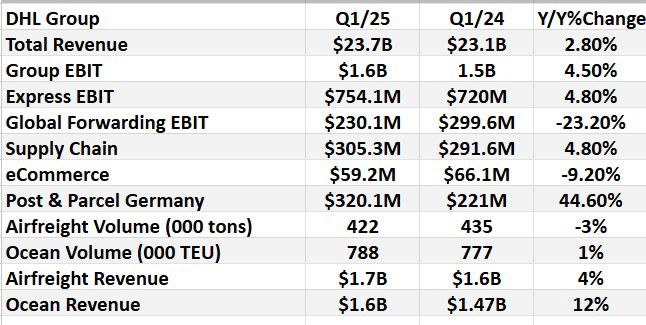
DHL Express’ operating profit increased 4.8% year over year to $754 million as efficiency measures ramped up, while better pricing and product mix boosted revenue 2%, according to DHL Group financial results released Wednesday. 

Management said improved capacity utilization, seasonal network adjustments and higher yields countered the drop in volume. Demand for time-definite international parcels, the Express division’s core product, fell 7.1% to 975,000 items per day, while aviation supply costs for DHL’s own fleet and purchased transportation declined 7% year over year. Operating costs at Express air hubs decreased 1%. 

In March, DHL (DHL.DE) unveiled a plan, called Fit for Growth, to eliminate more than $1.1 billion in annual structural costs by the end of next year. (FedEx and UPS have similar programs called Drive and Efficiency Reimagined.)

One way the integrated logistics provider will take out cost and drive efficiency in the air network is by streamlining the number of partner airlines that supplement the transportation provided by DHL’s own fleet, top executives said during the fourth-quarter earnings call in early March.

The recent end of several air cargo partnerships is more clearly understood in the context of DHL’s desire to eliminate excess capacity. DHL in February, for example, pulled out of its Polar Air Cargo joint venture with Atlas Air. The parties said at the time  they mutually decided to close one of the best-known air cargo brands after 18 years.

Also in February, DHL dropped SmartLynx Airlines as a contract carrier in Europe. DHL was leasing four Airbus A321 converted narrowbody freighters from SmartLynx, which has since decided to focus on providing capacity for passenger airlines. Shortly afterward, FreightWaves reported that Slovakia’s AirExplore was discontinuing cargo business because of limited demand for its Boeing 737-800 converted freighters. The company didn’t disclose whether it had lost any customer accounts, but is known to have started operations for DHL in early 2024.

DHL Aviation is a group of airlines, either wholly owned or chartered by DHL Express. The company regularly flexes the fleet to handle shifts in volume. Aircraft space not filled by overnight packages is sold to shippers, either by guaranteed blocks for businesses with large, repetitive loads or on the spot market. The largest buyer of remaining capacity is DHL’s Global Forwarding business unit.

DHL continues to upgrade its intercontinental fleet. Boeing is expected to deliver the six 777 production freighters this year, the final tranche of a 28-unit order.

Air Hong Kong, an all-cargo subsidiary of Cathay Pacific that flies regional routes under contract within the DHL Express network in Asia, is expected to complete its fleet renewal and modernization this year, company officials said during the March earnings call. The project involves transferring several Airbus A300-600 freighters to DHL operators in Europe and replacing them with larger A330-300 converted freighters. Air Hong Kong received another A330 in March, according to aviation database Planespotters.com.

Fit for Growth aims to leverage technology across all divisions to improve productivity. Management said it is already showing results in sortation centers and for pickup and delivery.

Big picture

Overall, DHL delivered modest growth during a first quarter marked by destabilizing U.S. tariffs and economic weakness in Europe. Group revenue increased 2.8% to $23.7 billion year over year, and operating profit was $1.6 billion, up 4.5%. 

The spread of tariffs hasn’t materially impacted finances so far, but forced the company to make significant operational changes. Management said it expects more demand and rate volatility going forward. Tariffs are double-edged for DHL: They can suppress consumer demand because of higher prices, but they also generate business from customers looking for ways to minimize their total landed import costs, including rerouting shipments and extra customs handling.

Top executives stressed that the company’s geographic diversification, experience navigating supply chain disruption and increased focus on high-margin services position it well to navigate current trade uncertainty.

DHL has relatively limited exposure to a downturn in trans-Pacific trade due to the tariff fight between the United States and China, CEO Tobias Meyer said during Wednesday’s briefing. Only 8% of DHL Express overnight shipments move from China and Hong Kong to the U.S., while only 4% of DHL Global Forwarding’s airfreight volume is on that trade lane.

DHL used to have a higher concentration of volume in the trans-Pacific, but the logistics provider last year was able to weed out low-margin, lighter-weight e-commerce traffic by raising prices and selling the space to freight forwarders with more dense cargo. 

Meyer reiterated that DHL plans to concentrate expansion in countries with the fastest trade growth, such as Indonesia, India, Vietnam and the Philippines, which are also benefiting from geopolitical shifts as manufacturers explore production alternatives to China.  

“On the one hand, our global presence makes us significantly less dependent on the U.S. market than many of our competitors. On the other hand, trade continues even with tariffs. It just becomes more expensive and complex,” Chief Financial Officer Melanie Kreis said. “We cannot spare our customers the tariffs, but we can take the complexity off their hands. In short, we are closely monitoring the situation and feel well prepared for various scenarios.”

At DHL’s annual general meeting on Friday, Meyer said, “the majority of world trade takes place without the U.S. Around three quarters of global trade now involves neither U.S. imports nor U.S. exports. If the US closes itself off more, other countries will benefit. Other trade lanes will then become more important. Trade lanes where DHL generally has a significantly greater market share than for trade to and from the United States.”

DHL’s road map for sustainable growth – Strategy 2030 – also helps insulate against demand ebbs by concentrating investment in markets with high-growth potential such as life science and health care logistics, new energy (wind and solar power, electric vehicles, batteries, battery storage systems and devices for grid expansion) and e-commerce, according to leadership.

In early April, DHL announced it will invest $2.2 billion over five years to upgrade capabilities in the pharmaceutical and medical sectors as it looks to double health care logistics revenue to $10.8 billion by decade’s end. It also agreed to acquire Nashville, Tennessee-based CryoPDP, a specialty courier that provides logistics services for clinical trials, biopharma, and cell and gene therapies, for $195 million.

The German logistics giant in January acquired Inmar Supply Chain Solutions, a large reverse logistics provider for e-commerce retailers in North America. 

“We want to buy capability, not scale, and then leverage that capability across our network,” Meyer said. Drug and medical device manufacturers, who have smaller, high-value shipments, benefit from using an integrated express delivery company that offers better control than a traditional freight forwarder who cobbles together different transportation and distribution vendors to execute a delivery, he said in the March presentation.

Challenges for freight unit

Industrial weakness in Europe, particularly in Germany’s automotive sector, caused a significant drop in trucking business, which weighed on results for DHL’s Global Forwarding and Freight division. Management also acknowledged that the rollout of a new transportation management system in the German market was more costly and bumpier than expected. Excluding the system integration, the unit likely would have broken even on profits.

Airfreight volumes for Global Forwarding declined by 3%, with most of the impact on trade lanes from Europe and Asia. Airfreight revenues rose 4% while gross profit fell by 1.8%. Ocean freight volumes increased by 1.4% year on year, with growth especially on trade lanes from Asia. Volume growth was impacted by the systematic withdrawal from the transport of high-volume, low-yield business. This impact is likely to continue throughout 2025.

The Supply Chain division continued its growth trajectory in the first quarter, aided by the signing of new customers and productivity increases from automation.

DHL eCommerce, which provides international and domestic shipping services for merchants with lightweight parcels, saw top-line growth of 6% even as consumers became more cautious. Results were hurt by depreciation costs for ongoing network investments as the company pursues greater market share in the sector. 

In addition to Inmar, it is investing in sorting facilities in India and other countries, as well as last-mile delivery in Turkey. Earlier this year it gained a stake in Ajex Logistics Services, a parcel carrier in Saudi Arabia.

Meanwhile, Post & Parcel Germany significantly increased earnings thanks to a spike in revenue associated with the first postage increase in three years and the recent federal election, which required delivery of mail ballots. Second-quarter results could be worse as costs will rise again due to a planned wage increase for postal workers.

Europe’s largest postal company continues to face structural hurdles in the form of sharply rising costs and a significant decline in letter volumes. Kreis said the postage increases are insufficient to cover all the inflation in recent years. Without higher postage rates, DHL can’t maintain the necessary profitability to make future investments, she added.

The Fit for Growth plan calls for the elimination of 8,000 postal positions this year.

Tariffs

Customers are responding to the 145% U.S. tariffs on China, a 10% tariff on all nations, sector-specific tariffs and the specter of more tariffs in June, in a variety of ways, said Meyer.

Some businesses are pausing orders and investments until the shifting regulatory landscape settles down or pre-bought inventory to beat tariff deadlines. Others are shifting some procurement elsewhere in Asia to avoid the 145% U.S. tariff on Chinese goods. And e-commerce retailers are likely to switch from shipping individual packages to consolidated containers through traditional business-to-business distribution channels with the elimination Friday of the de minimis rule, which means consumers no longer enjoy duty-free purchases on low-value goods from China and Hong Kong.  

“There is still the belief with many of our customers in the U.S. that this environment is going to evolve and move back to lower tariff levels as those negotiations, much talked about, unfold,” Meyer said in explaining the wait-and-see approach.

Trade talks between China and the United States could begin soon, according to news reports on Friday.

Management noted that U.S. tariff exemptions for electronics are generally positive for its express and air freight businesses. As for the loss of de-minimis exemptions, DHL said it sees opportunities in consolidated shipments of such parcels, or what it calls breakbulk express.

Click here for more FreightWaves/American Shipper stories by Eric Kulisch.

DHL drops embargo on medium-value goods after US walks back customs rule

DHL eCommerce expands operations to Saudi Arabia

Atlas Air, DHL terminate Polar Air Cargo joint venture

DHL Express’ Miami air hub meets the moment for peak season

Air cargo faces $22B revenue hit when China tariff exemption ends