Express logistics providers bet big on healthcare business

A man in a yellow-red uniform pushes a large container through a warehouse with the help of machinery.

The big three integrated parcel and logistics carriers are aggressively targeting the high-margin health care vertical as a profit center, with DHL on Monday announcing a $2.2 billion investment over five years and FedEx expecting to capture $400 million in business from new health care customers.

Not to be outdone, UPS (NYSE: UPS) in January acquired Frigo-Trans and sister company BPL, which provide temperature-controlled warehousing and transportation in Europe for pharmaceutical and biotech companies.

The companies are interested in health care because the high technical and compliance requirements allow for lucrative value-added services beyond basic parcel transportation. The health care logistics market is estimated to reach $152 billion next year, up from $130 billion in 2023 as an aging global population needs more drugs and biological medical products to deal with chronic disease, according to industry experts.

DHL Group (DXE: DHL) on Monday said it planned to invest $2.2 billion to upgrade logistics capabilities and footprint in the life sciences and health care sector. Half of capital expenditures will be allocated to the Americas, with the balance split between Asia-Pacific and the Europe, Middle East and Africa region. (DHL on April 14 said it will deploy $11.4 million of the $568 million Asia budget towards a new pharma hub in Singapore.)

The investment is part of DHL’s recent strategy to double health care logistics revenue to $10.8 billion by 2030, with an extensive temperature-controlled network, first- and last-mile specialty courier coverage, and integrated service offerings. Last week, DHL agreed to acquire Nashville, Tennessee-based CryoPDP, a specialty courier that provides logistics services for clinical trials, biopharma, and cell and gene therapies, for $195 million.

Investments will concentrate on improving infrastructure and technology from factory to patient, including temperature-controlled storage, order fulfillment, distribution, global shipping and last-mile delivery. DHL said the enhancements will allow it to deliver integrated health care solutions, while improving delivery speed and reliability for pharmaceutical, biopharma and medical device customers, as well as patients.

DHL, headquartered in Bonn, Germany, recently created DHL Health Logistics to serve as an umbrella brand for end-to-end capabilities available across the DHL Express, Global Forwarding and Supply Chain divisions. Life sciences and health care contributed more than 5 billion euros ($5.4 billion) in revenue to the group in 2024. 

A significant part of the investment will be budgeted for new cross-divisional pharma hubs for transporting multitemperature shipments, expanding cold chain capacity in existing facilities, ordering new temperature-controlled vehicles and enhancing insulated and refrigerated containers, DHL said.

With growing demand in critical areas such as clinical trials, biopharma, and cell and gene therapies, DHL is also investing in specialized cooling infrastructure to accommodate low and ultra-low temperature ranges. Additionally, the Group said it will implement sophisticated IT systems that provide real-time status updates to ensure that sensitive medical products have not been compromised.

DHL Group operates nearly 600 locations in almost 130 countries dedicated to life sciences and health care logistics, encompassing a total of more than 27 million square feet of temperature-controlled warehouse space.

FedEx tools support health care business

Meanwhile, FedEx’s (NYSE: FDX) efforts to build capabilities in health care logistics are paying off. The company is in the process of onboarding nearly $400 million in new annualized health care revenue during the next 90 days, said Chief Customer Officer Brie Carere during the third-quarter earnings presentation on March 20.

FedEx’s latest technologies to help track and monitor temperature-sensitive life science shipments are attracting pharmaceutical and medical companies, Carere said, putting the express logistics company on track to finish the fiscal year ending May 31 with about $9 billion in health care revenue.

Carere highlighted how FedEx is dual-purposing its parcel returns platform for health care customers, such as laboratories and medical providers, with recurring two-way shipping. “This process enables a simpler shipping process with more visibility, allowing shipment recipients to staff more appropriately and efficiently,” she said.

FedEx is also continuing to roll out FedEx Surround, a tool that combines advanced sensor technology with an AI-powered dashboard that provides continuous monitoring and proactive intervention for shipments worldwide.

The compact sensor transmits precise package location data every two seconds via Bluetooth short-range wireless systems to Wi-Fi access points or established gateway devices in the FedEx network. Packages equipped with the SenseAware ID sensor are tracked hundreds of times versus dozens of times with traditional package scanning protocols, according to FedEx. Features include predictive delay alerts and the ability to prioritize the most critical or time-sensitive shipments ahead of others in the FedEx network. 

FedEx Surround is now available in more than 40 countries. The enhanced visibility and control is especially important for customers transporting high-value or sensitive goods, Carere said.

UPS last year said it plans to double revenue in health care logistics to $20 billion through organic growth and acquisitions by 2026.

(This story was updated on April 14.)

Click here for more FreightWaves/American Shipper stories by Eric Kulisch.

New UPS tool helps online shoppers calculate import fees before buying

FedEx offers lower cost no-box, no-label returns

FedEx says economic uncertainty slowing parcel and freight demand

Fleets Face Privacy Challenges as Workplace Surveillance Looks at Major Overhaul

Privacy has long been an industry argument from the driver seat when it comes to dashcams. California trucking fleets may soon face substantial hurdles in how they monitor driver activity if Assembly Bill 1331 becomes law. AB 1331 limits employer surveillance, explicitly requiring fleets and businesses to disable dashcams and other monitoring devices during employee off-duty periods, including mandatory rest breaks and meal periods, even when taken inside the vehicle. The bill defines these off-duty moments as private, meaning fleets would no longer have the choice, or even the option to obtain consent from drivers, to maintain surveillance during these times.

This legislation goes far beyond privacy protections typically seen in other states, many of which focus primarily on transparency and informed consent. States like New York, Connecticut and Delaware, for example, only mandate that employers inform employees about monitoring practices. By contrast, California’s AB 1331 completely prohibits surveillance in private off-duty areas such as breakrooms, cafeterias and lounges, as well as in a worker’s personal vehicle or residence, except under vague conditions deemed “strictly necessary.”

Trucking fleets, already burdened by regulatory compliance, could face difficulties under AB 1331. For instance, since rest breaks for non-exempt employees in California are paid, many drivers never formally clock out. Fleets often don’t know exactly when drivers choose to start or end their 10-minute breaks. Under AB 1331, this uncertainty becomes a major compliance challenge. Would fleets need to disable GPS tracking systems or dashcams each time a driver spontaneously pulls over for a break? The bill offers no clarity on these scenarios, potentially opening fleets to more driver legal battles, given the law’s $500-per-employee-per-violation penalty and the ability of drivers and state attorneys to sue employers directly.

AB 1331’s expansive reach could compromise legitimate safety and security efforts. Fleets rely heavily on dashcams, GPS tracking and biometric monitoring to safeguard drivers, cargo and the public, and to comply with federal safety standards mandated by the Federal Motor Carrier Safety Administration. Removing or disabling these devices during breaks, especially in vehicles still technically on duty, could undermine accident prevention, theft deterrence and internal investigations into misconduct, harassment or theft.

This issue isn’t limited to California. Illinois and Texas already have stringent biometric consent laws that have triggered significant litigation, particularly when companies failed to secure explicit consent from drivers for facial recognition technologies embedded in dashcams or telematics devices. Fleets operating nationally now must navigate an intricate patchwork of privacy rules that vary dramatically from state to state, from full-consent models in Illinois to California’s more restrictive prohibition-based approach.

Given the stakes, trucking employers must closely track AB 1331’s progress through the California legislature. To manage risk, fleets should immediately evaluate current surveillance practices, update privacy policies and engage proactively with industry advocacy groups to highlight the impracticality and risks of compliance under this sweeping new law.

California’s step in redefining workplace privacy could set a national precedent, dramatically reshaping the way trucking fleets handle driver monitoring, privacy and consent. As privacy concerns intensify nationwide, fleets have to find a way to balance privacy, risk and regulatory demands with operational practicality, because failing to do so could prove costly in more ways than one.

Arbitrator awards 3% raises for CN employees represented by TCRC

Canadian National train service employees represented by the Teamsters Canada Rail Conference will get a 3% annual raise under an arbitrator’s contract decision.

Arbitrator William Kaplan released his decision Monday on the three-year contract, which runs from Jan. 1, 2024, through Dec. 31, 2026.

When CN (NYSE: CNI) and the TCRC were unable to reach a negotiated settlement during their contract talks, the Canada Industrial Relations Board sent the matter to binding arbitration in August 2024 after a brief lockout.

Kaplan urged the railway and union to iron out their differences regarding changes to work rules.

“Both parties proposed detailed changes to work rules. And both parties described the proposals they sought as justified by demonstrated need, and the ones advanced by the other party as breakthroughs that would never be accepted in free collective bargaining,” Kaplan wrote. “This is what led to the bargaining impasse (and inability to bridge the divide in the mediation phase). Between now and the expiry of the collective agreement settled by this award the parties, obviously, need to turn their attention to both employee rest and employee availability; both extremely important issues for the TCRC and CN. Doing so is in their evident shared interest requiring their focused attention. These issues are, in my view, best resolved in free collective bargaining with its associated gives and takes. Experience in this matter indicates that they will not be resolved absent appropriate reciprocity.”

Union leaders told the rank and file that binding arbitration was never their goal when seeking a new contract with CN.

“While this is not the preferred outcome for the TCRC, it must be understood that the award does not contain any of the significant concessions sought by the company,” the union’s six general chairmen wrote in a letter to members.

“Unfortunately, CN’s demands were (and remain) completely unacceptable throughout the entire bargaining process,” the union said. “The Company would not relent on what it considered necessary operational changes, primarily resulting from reforms in government regulation. The TCRC could never agree to these concessionary demands that encroached on the rights of you, the TCRC members at CN.”

CN expressed disappointment, as well.

“Although CN remains disappointed that a negotiated agreement was not reached at the bargaining table, the Company is pleased to be moving forward,” the railway said in a statement. “CN also remains committed to modernizing the collective agreement for the benefit of employees, customers, and the North American economy.”

Canadian Pacific Kansas City’s (NYSE: CP) contract with the TCRC also was sent to arbitration. A decision on that contract has not yet been announced.

Related:

Canada’s labor minister orders arbitration to end CN, CPKC work stoppages, but union keeps picket lines up

Union Pacific Railroad CEO ‘very comfortable’ working through tariffs

DENVER — The chief executive of Union Pacific says his company will work through tariff shocks gripping the economy the same way it worked through the pandemic.

“I can’t control what governments do,” Union Pacific Chief Executive Jim Vena told a rail industry conference. “It’s noisy, it’s a son of a gun. But we can get through this the same way we got through the tech bubble and COVID.

“I’m very comfortable going through all this.”

Vena was the keynote speaker Monday at the annual conference of the American Short Line and Regional Railroad Association.

Vena did say that pursuant to tariffs, the United States needs to have the capacity to make the products that are needed for national defense. But, he emphasized that the fundamentals of running a railroad haven’t changed.

“We need to be efficient and watch the money. We need to go after products that are now in trucks and move them in different ways,” a feisty Vena declared. 

“If you don’t like me, I don’t give a s—.”

Vena, a disciple of precision scheduled railroading who came out of retirement in 2023 to succeed Lance Fritz, has UP (NYSE: UNP) leading Class I’s in most financial and performance categories. He said his company’s strategy is built around safety, service, asset utilization, cost control and people. He was quick to note that the railroad in 2024 saw a 22% reduction in injuries and 26% decline in accidents.

Vena said technology has helped UP reduce total walking by yard crews from about 6-7 miles a day several years ago to the current 2 miles per day.

Union Pacific works with more than 180 shortline and regional railroads, and Vena told the conference that the objective is the same: Customers want high levels of service. Up to one-quarter or more of UP’s traffic lanes are touched by a carrier other than UP. “We get 2 million cars from short lines or ports each year,” he said.

The top markets for UP via short lines are grain products, construction materials and forest products, while industrial products are almost half of short lines’ business mix. Volume grew 4% yy, with total carloads accounting for 25% of total volume among the Class I’s.

The shortline market has been recent fertile ground for UP. It leased 28 miles of track in the Eugene, Oregon, area to Genesee & Wyoming’s Central Oregon & Pacific Railroad. In late March, UP leased land and track in Kansas City, Missouri, to Jaguar Transport Holdings, which will operate the new Kansas City West Bottoms Railroad.

“That’s just the start,” said Vena. “I think we can grow our business by partnering with companies that can help us grow the biz, remove inefficiencies, and drive value to customers. When it comes to short lines, the baseline has to be that you do a better job than a Class I. The short line has to be much more efficient, costwise, than a Class I. But short lines can have a better relationship with a customer because they work in a community at the local level, and grow the business that way.”

While he was sanguine about tariffs and trade, Vena, who started railroading in Canada and is now a U.S. citizen, had sharp words for the Trump administration’s rhetoric where that country is concerned.

“You want to p— off a country? Tell them they’re the 51st state. Or call the prime minister a ‘governor.’ It just doesn’t go good. I still have a little place on a lake in British Columbia. It’s a great country. They’ll get over it. But it’s not good when you miss the point and call them something you shouldn’t call them.”

Subscribe to FreightWaves’ Rail e-newsletter and get the latest insights on rail freight right in your inbox.

Find more articles by Stuart Chirls here.

Related coverage:

BNSF’s trade-related intermodal projects move ahead despite tariffs

BNSF, NS, Northwestern ports trim 3 days from intermodal speed service to Chicago

US weekly rail traffic shows strong gains

Tanner tabbed as new CEO of OmniTRAX

Trump threatens additional 50% tariff on imports from China

President Donald Trump on Monday said he will impose an additional 50% tariff on goods from China unless the country immediately withdraws its 34% retaliatory tariff on imports from the U.S.

China levied matching tariffs against the U.S. on Friday in response to the White House’s additional 34% reciprocal duties that were announced last Wednesday.

“If China does not withdraw its 34% increase above their already long term trading abuses by tomorrow, April 8th, 2025, the United States will impose ADDITIONAL Tariffs on China of 50%, effective April 9th. Additionally, all talks with China concerning their requested meetings with us will be terminated! Negotiations with other countries, which have also requested meetings, will begin taking place immediately,” Trump posted on Truth Social.

If Trump imposes an additional 50% tariff on China-based imports starting Wednesday, it would take U.S. duties on all Chinese goods to an all-time high of 84%.

Trump unveiled a broad tariff plan for all U.S. trade partners on Wednesday, during what he has referred to as “Liberation Day.”

Trump’s plan includes a baseline 10% tariff on trade partners, as well as 25% tariffs on certain imported vehicles and auto parts arriving into the U.S. The plan also calls for a 34% tax on imports from China and 20% on the European Union, among others.

As part of its retaliatory measures, China also said on Friday it will impose more export controls on rare earth materials, which are used in high-tech products such as computer chips and electric vehicle batteries.

China was the third-ranked U.S. trading partner in 2024 at $582 billion in cross-border commerce.

Ocean shipping carbon tax could gouge US consumers, say opponents 

Government representatives are meeting this week to finalize the first-ever global carbon tax on ocean shipping emissions in a move that opponents say could disproportionately hit American consumers.

The initiative is being driven by the International Maritime Organization, which regulates global shipping, following a 2023 agreement that sets a goal of net-zero shipping emissions by 2050. 

Members of the organization’s Marine Environment Protection Committee are gathering this week in London where the IMO is headquartered. They’ll try to work out emissions fees and a green protocol for shipping.

The measures, if adopted, would become mandatory for participant countries’ vessels in container shipping, crude oil and other cargo transport. The Biden administration supported the zero emissions goal in 2023. The Trump administration has made no public statement on the IMO proposal.

Proponents say the fees and standards for green fuels will close the cost gap between fossil fuels and alternative fuels such as ammonia, hydrogen and methanol. They say the fees are the most effective way to push vessel operators to adopt green fuels industrywide, moving toward the IMO’s goal of zero emissions by 2050.

As container ships have increased in size so have emissions, rising to 3% of the global total in the past decade, according to the United Nations.

At the same time, major liner operators have voluntarily specified dual-fuel propulsion systems in many of their recent orders with shipbuilders for new vessels.   

Published reports say 60 countries currently support a flat levy of from $19 to $150 per metric ton of emissions per the IMO’s proposal. A smaller group comprising China, Brazil, Saudi Arabia and South Africa want a cap-and-trade system, while others seek a compromise between the two.

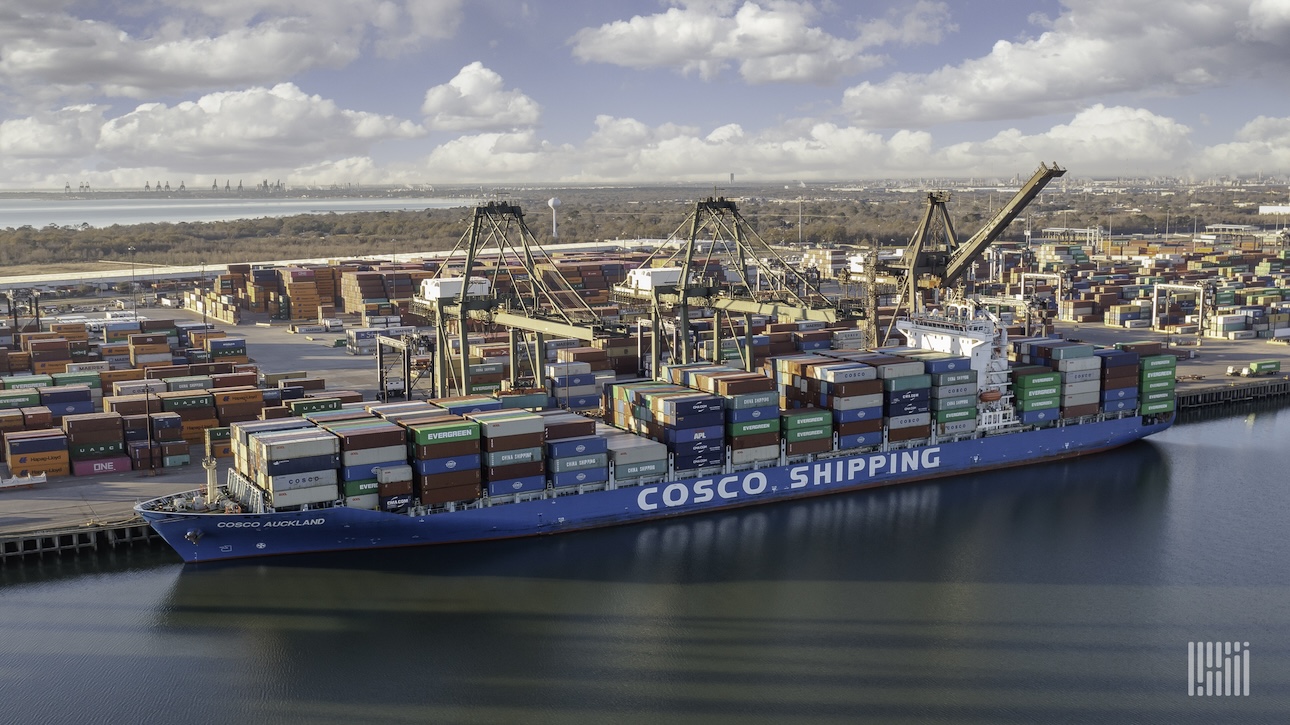
China’s Cosco is the world’s fourth-largest container carrier, while Saudi Arabia depends on a fleet of tankers to move crude oil to global customers.

Proponents say a high-cost, universal carbon levy would be the most effective means forward, since it wouldn’t allow rich shipowners to use cap-and-trade credits to buy their way to compliance.

But some opponents argue that the proposed fees represent a hidden tax on U.S. consumers – the world’s largest market – since substantial increases in vessel operating costs will be passed on by ocean lines as higher freight rates to shippers and importers and eventually, show up as higher retail prices for appliances, food, clothing and other goods.

Major ocean carriers saw billions in windfall profits in 2024 diverting vessels on longer, more expensive voyages around Africa and away from the strife-torn Red Sea-Suez Canal route where Houthi rebels based in Yemen carried out attacks on merchant shipping in 2024.

While there have been no attacks on shipping in several months, it’s not known when container lines will return to the Red Sea, even as the United States steps up attacks on rebel Houthi positions in Yemen.

Find more articles by Stuart Chirls here.

Related coverage:

Expect ‘subdued’ peak container season in wake of tariffs, says analyst

Port of LA’s Seroka says tariffs to cut container volumes by 10%

Tariff backdrop finds ocean rates steady

As China blocks terminals deal, BlackRock chief says ports ‘will define the future’

Everything you need to know about Trump’s tariffs with logistics legend Matt Silver | WHAT THE TRUCK?!?

On Episode 823 of WHAT THE TRUCK?!?, Dooner is joined by cross-border logistics legend Matt Silver to talk all about the impact of Trump’s tariffs. You’ll learn how they work; what will cost more; short-term and long-term strategy; what’s exempt; how the tariffs will impact trucking, ocean, warehousing and capacity; and more. 

Silver’s firm Cargado just announced a $12 million Series A. We’ll find out how and what the plans are for the cash.

Plus, White House calls 90-day tariff delay “fake news”; and an update on the I-35 crash that left five dead. 

Catch new shows live at noon EDT Mondays, Wednesdays and Fridays on FreightWaves LinkedIn, Facebook, X or YouTube, or on demand by looking up WHAT THE TRUCK?!? on your favorite podcast player and at 5 p.m. Eastern on SiriusXM’s Road Dog Trucking Channel 146.

Watch on YouTube

Check out the WTT merch store

Visit our sponsor

Subscribe to the WTT newsletter

Apple Podcasts

Spotify

More FreightWaves Podcasts

BNSF’s trade-related intermodal projects move ahead despite tariffs

BNSF Railway is not hitting the pause button on a pair of trade-dependent intermodal projects in California and Arizona despite the broad tariffs that the Trump administration unveiled last Wednesday.

BNSF is planning to build a $1.5 billion terminal and transload center in Barstow, California, to handle international containers. The 4,500-acre Barstow International Gateway project aims to speed imported freight to inland markets by reducing the amount of time containers dwell on the docks at the ports of Los Angeles and Long Beach as well as by streamlining the transloading process into domestic containers.

In Arizona, BNSF plans to build a 4,321-acre project near Phoenix that would include an intermodal terminal, a logistics park to handle the warehousing and distribution of consumer goods, and a logistics center to handle carload traffic in support of local industries.

Both projects still have a green light. “We’re not reevaluating at this time,” BNSF spokesman Zak Andersen said.

BNSF last year set a record for the number of on-dock containers it handled at the ports of LA and Long Beach as retailers pulled forward their import orders in order to beat anticipated tariffs. Measured by container volume, the Port of Los Angeles had its second-busiest year on record in 2024, while the Port of Long Beach set an annual container volume record last year. Combined, the ports handle about a third of the cargo imported into the U.S.

Port of Los Angeles Executive Director Gene Seroka said last week that he expects container volume to fall by at least 10% in the second half of this year due to a combination of inventory pull-forward and the impact of tariffs on consumer spending.

Intermodal analyst Larry Gross said last week that it’s unclear how tariffs will ultimately affect global trade.

“What we’ve seen here is that when there is a deal it’s never quite a done deal, but just a starting point for further negotiation,” Gross said of proposed tariffs. The administration, he notes, has typically modified its tariff plans based on concerns raised by various industries.

“So where things land and how long they stay that way is a big question mark,” Gross said. “And that is an important point because what that does is create continued uncertainty.”

Related:

‘Liberation Day’: A look at Trump’s tariff timeline and what to expect

CRST Expedited settles claim it pulled job offer over criminal history

Iowa-based carrier CRST Expedited Inc. has agreed to pay $100,000 and take corrective actions to settle claims that it unlawfully rescinded a job offer based on the applicant’s criminal history, according to the California Civil Rights Department.

California’s Fair Chance Act requires employers to show a direct relationship between the duties of a job and an arrest or conviction before rejecting an otherwise qualified candidate, the department said in a news release on Thursday.

CRST, which admits no wrongdoing in the settlement, will pay $100,000 to the unnamed job candidate, train employees involved in employment decisions on the Fair Chance Act and ensure company policies comply with the law, including a provision that convictions more than 7 years old are not considered.

The California law forbids most employers from asking about criminal history before making a job offer and limits disqualifying convictions to those that have a “direct and adverse” bearing on the job. According to the Civil Rights Department, almost a third of adults in California have an arrest or conviction that can harm their ability to get a job.

A CRST Expedited applicant in Southern California claimed to have been rejected for a senior leadership role based on the candidate’s criminal history, the department stated. The company, a subsidiary of Cedar Rapids, Iowa-based CRST The Transportation Solution Inc., allegedly did not conduct an individualized assessment of the criminal past and “failed to consider the nature and gravity of the offense, the time that had passed, and how the offense related to the job being sought.” The department did not state the nature of the conviction.

“Everyone deserves an opportunity to make a living,” Civil Rights Department Director Kevin Kish said in the release. “The Fair Chance Act helps ensure every Californian can work and contribute to their communities.”

CRST did not immediately respond to a FreightWaves email seeking comment.

Family-owned CRST is a $2 billion nationwide enterprise, according to the company’s website.

Related:

Court rules CRST team drivers must be paid for some hours in sleeper berth

CRST, back in the acquisition game, buys Larkin’s BCB Transport

UPS rebrands SurePost as Ground Saver

A brown UPS delivery van on a tree-lined neighborhood street.

UPS has changed the name of its most economical domestic shipping service from SurePost to Ground Saver after ending its partnership with the U.S. Postal Service at the end of 2024.

The company didn’t make an announcement, but customers now see the new name on the website. Ground Saver is primarily used by large businesses to ship packages door to door.

With SurePost, UPS (NYSE: UPS) inducted massive parcel volumes deep into the postal network for last-mile delivery to residences. The Atlanta-based parcel giant decided to fully insource the product when the Postal Service raised its prices. As the cost difference with its own ground network narrowed, management realized it could provide better service on its own. 

Ground Saver promises delivery times equal to regular Ground plus one or two days, with greater reliability and visibility than SurePost. It is ideal for less urgent packages under 10 pounds and available within the lower 48 states, according to UPS. SurePost also delivered to Alaska, Hawaii, Puerto Rico and other territories. Ground Saver features include photo proof of delivery,  package tracking and the ability to upgrade to faster UPS Ground via the MyChoice app.

UPS has also changed the liability terms in the case of loss or damage to packages. Ground Saver packages are limited to a maximum of $20 for loss and damages, down from the $100 SurePost offered. Parcel consultancy Shipware drew attention to the change in a LinkedIn post last week. 

Supply Chain Dive first reported the Ground Saver rebranding.

Click here for more FreightWaves/American Shipper stories by Eric Kulisch.

Write to Eric Kulisch at ekulisch@freightwaves.com.

New UPS tool helps online shoppers calculate import fees before buying