Trucker group seeks ban on foreign motor carriers

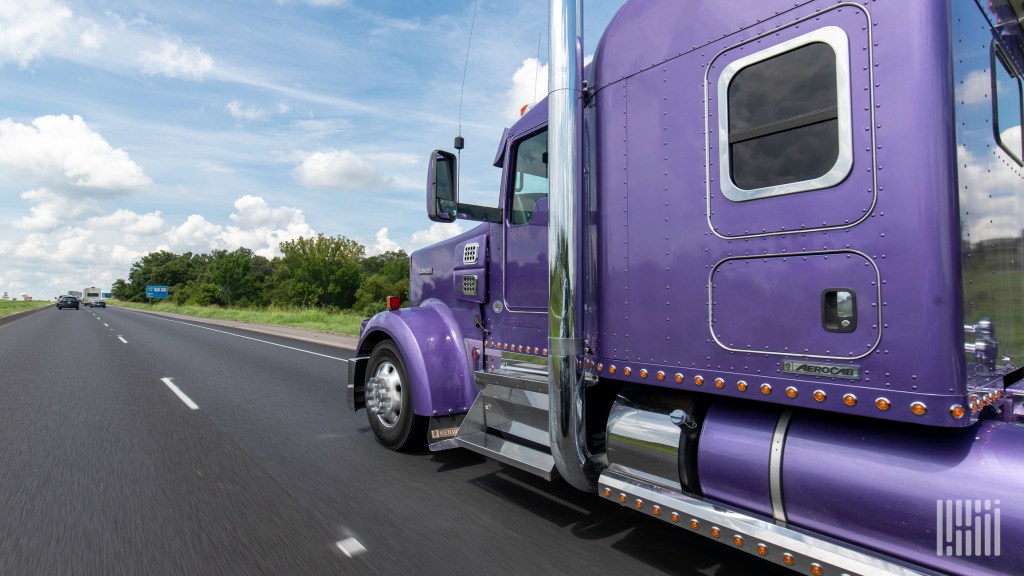
Truck with purple cab on highway

WASHINGTON — A group representing small trucking companies and owner operators is concerned about unfair competition from foreign-based motor carriers approved to operate in the U.S., but that concern is not supported by federal data.

The Small Business in Transportation Coalition (SBTC) is asking the U.S. Department of Transportation and FMCSA to repeal regulations – specifically 49 CFR Subpart H, subsection 385.601-385.603 – which allow new-entrant, non-North America-domiciled carriers to apply for operating authority in the U.S., asserting that providing such authority runs counter to U.S. interests.

“Notwithstanding bona fide E-2 Treaty Investors [foreign nationals who invest significant capital in a U.S. business], who make substantial, at risk investments, we contend this current FMCSA practice of granting operating authority to individual foreign nationals violates immigration law, constitutes illegal and unfair competition against American citizens operating small motor carrier and independent owner-operator businesses within the United States, and unreasonably restrains American trade,” stated SBTC Executive Director James Lamb, in an email petition to FMCSA.

“We respectfully request this section please be repealed, any certificates or permits of operating authority granted under this subpart be revoked, and FMCSA be directed to discontinue this unlawful practice in the interest of public safety.”

Regulations require carriers and brokers outside North America that apply for non-domicile operating status complete an FMCSA-administered safety audit before FMCSA will allow them to operate in the U.S.

“The safety audit is a review by FMCSA of the carrier’s written procedures and records to validate the accuracy of information and certifications provided in the application and determine whether the carrier has established or exercises the basic safety management controls necessary to ensure safe operations,” the regulations state.

Asked to comment on the petition, P. Sean Garney, co-director of Scopelitis Transportation Consulting, said he’s “not seeing a growing problem” based on FMCSA registration data.

The data reveals that as of June 2025, only three operating authorities – two property carriers and one broker – are based outside North America. There have not been more than seven such registrants in a given year since 2016, according to FMCSA statistics.

“I wonder about the scope of the problem we’re looking to solve and where we should be spending our resources to make our roads safer,” he said.

SBTC’s request follows a regulatory crackdown by the Trump administration aimed at combatting CDL fraud, including a nationwide audit of non-domiciled CDL holders. The audit, to be conducted by FMCSA, responds to a directive issued by President Trump in April.

FMCSA’s review of states issuing non-domiciled CDLs “will examine state procedures for issuing non-domiciled CDLs to identify and stop any patterns of abuse and ensure federal standards are being met across the country,” according to DOT.

Related articles:

Click for more FreightWaves articles by John Gallagher.

Earlier TQL victory on broker liability overturned by Sixth Circuit; SCOTUS next?

The legal issue of broker liability just got a lot messier with an appellate court decision that reversed an earlier lower court victory for 3PL giant Total Quality Logistics (TQL).

And the outcome could open the door again for what many in the industry have long sought: a Supreme Court review to clear up inconsistency on broker liability among federal circuit courts. The circuit court split now is 2-2, with a pair having ruled against a 3PL on the question of federal law protecting broker protection from litigation, and two others having backed strong protection against brokers from lawsuits.

The U.S. Court of Appeals for the Sixth Circuit Tuesday reversed an earlier decision in Cox vs. TQL that had found TQL was not liable for its role in hiring a driver that was involved in a fatal 2019 accident. As had been the decision in several other recent cases involving broker liability, the U.S. District Court for the Southern District of Ohio in June 2024 found that the Federal Aviation Administration Authorization Act (FAAAA, also known as F4A) protected TQL as a broker from liability for its hiring of Gold Transit, the carrier involved in a fatal 2019 crash. 

But that decision was reversed Tuesday by a unanimous vote of a three-judge panel of the Sixth Circuit, with particular focus on what is known as the safety exception. 

The exception, which is part of F4A and ultimately led to a C.H. Robinson (NASDAQ: CHRW) defeat in 2020 on broker liability in Miller vs. Robinson, essentially says that while the F4A does offer significant legal protection against transportation providers in most circumstances by preempting state action, F4A does not completely protect them over issues of safety.

Circuits in opposition

That C.H. Robinson case was in the Ninth Circuit. The defeat of a 3PL on the circuit court level now has a companion case from the Sixth Circuit with the ruling in Cox vs. TQL. 

The key cases that protected brokers came out of the Seventh and Eleventh circuits. As trucking-focused law firm Scopelitis said Wednesday in a widely-distributed email, “While there are no guarantees, the deepened circuit split increases the likelihood that the Supreme Court will take up the question should TQL decide to request Supreme Court review.”

The Court has rejected certiorari in several cases that sought Supreme Court clarity on the issue: the aforementioned Miller vs. Robinson (request for certiorari from C.H. Robinson rejected in 2022), the Ying Ye case in the Seventh Circuit involving GlobalTranz (rejection in January 2024 on appeal from Ye, whose husband was killed in a crash involving a carrier hired by GlobalTranz which was held not liable under F4A), and Gauthier vs. TQL, where Katia Gauthier asked the Supreme Court to overturn an Eleventh Circuit decision that cited F4A to protect TQL from being held for liability in a fatal crash involving Gauthier’s husband, who was killed, and a carrier hired by TQL.

To demonstrate the importance the industry has put on its desire to see the Supreme Court check in on the issue, TQL, even though it had won on the appellate level, supported Gauthier’s request for Supreme Court certiorari. But as it did with the other cases, the high court chose not to take up the issue.

Another key recent case involving broker liability was Aspen vs. Landstar (NASDAQ: LSTR). That Eleventh Circuit case involved a stolen truck. But the appellate court decision backing Landstar is viewed as another decision in the mix that might lead the Supreme Court to review the issue even though the safety exception was not part of the litigation.

F4A bars state action–referred to in the legal arguments as preemption–that could impact a “price, route or service” as well as actions that are “related to” those key provisions. Debating the meaning of “related to” has been a key part of litigation surrounding F4A. 

Citing wording from an earlier precedent, the Sixth Circuit in Cox vs. TQL said the “connection to a broker’s prices, routes or services may be direct or indirect, as long as the connection is not too ‘tenuous, remote or peripheral.'”

Robert Cox, the plaintiff in the case, is the widower of Greta Cox, who was killed in the crash with Golden Transit. That carrier, according to the testimony and filings in the lower court, had a poor safety history with the Federal Motor Carrier Safety Administration. It had an “overwhelming number” of drivers that were illegally on the road, that testimony said, and the specific driver of the load that killed Greta Cox, Amarjit Singh Khaira, “was purportedly an inexperienced and unsafe driver.”

The crash occurred on interstate 40 in Oklahoma. Greta Cox, while driving with her grandson, slowed while approaching a construction zone. But Khaira did not, plowed into Greta Cox’ vehicle, and she was killed. The grandson suffered unspecified injuries.

The initial case was in federal court in Ohio because that is where TQL is based.

Discussing the safety exception, the court said that part of F4A “carves out an exemption to the preemption provision that preserves a state’s power to regulate motor vehicle safety.” 

One argument the 3PL industry has made in its earlier legal forays into the question of preemption is that the safety exception applies solely to motor vehicles. Its argument is that brokers aren’t motor vehicles.

‘Respectfully diverge’

The court said it would “respectfully diverge” from earlier precedents from the Seventh and Eleventh circuits which it said had found “that for a direct connection to exist, the regulated entity must be one which directly owns or operates motor vehicles.”

“That formulation misses the mark,” the court said. “Requiring that the regulated entity directly own or operate motor vehicles would impose an additional limitation beyond what (the safety exception) requires.”

With that TQL defense undercut, the court supported Cox’ claim that TQL was required under Ohio common law to “adhere to a basic standard of care when hiring motor carriers. (Brokers) are required to conform to that standard in their hiring practices, for example, by dedicating time and resources to evaluating the safety metrics of prospective motor carriers.”

The appellate panel then elevated the safety exception to the determinative factor in its ruling.

The preemption provision of F4A does block many state laws impacting transportation providers, the court said, but the “safety exception correspondingly shields from preemption the subset of those laws that regulate motor vehicle safety, which necessarily includes certain types of common law claims,” the court said.

Outside attorney speaks

The Public Citizen interest group was an outside attorney for Gauthier in that case, though ended up on the losing side. But it was on the winning team this time around.

Adina Rosenbaum, an attorney for the Public Citizen Litigation Group that represented Cox, said the precedent set in Aspen vs. Landstar in the Eleventh Circuit, where Gauthier was decided, hurt the Gauthier case because it established precedents that were not offset by any consideration of the safety exception. 

But in the Cox case, she said in an interview with FreightWaves, “we’re talking about a state  requirement that’s really intended to protect people and the public from the dangers of motor vehicles. You can really see that this is about part of the state’s safety regulatory authority with respect to motor vehicles.”

An email to a TQL spokeswoman and a phone message to the company’s outside counsel had not been responded to by publication time. 

More articles by John Kingston

XPO rating cut by S&P, agency cites continuing weak freight market

First legal steps taken, this time by WSTA, to untangle the legal knot of the Clean Truck Partnership

Two positive votes on logistics at Moody’s: GXO and C.H. Robinson

How to Create a Maintenance Budget You Can Stick To

If your maintenance budget feels like a moving target, you’re not alone. Most small fleet owners and owner-operators either guess at their maintenance costs—or worse, react to them only after something breaks. That’s not a strategy. That’s survival. And in this industry, running your business in survival mode will kill your margins faster than a blown turbo.

A real maintenance budget isn’t about predicting every part failure. It’s about putting structure behind one of the most controllable—but commonly ignored—parts of your business. When done right, your maintenance budget becomes a competitive weapon. It protects your uptime, keeps drivers safe, makes your equipment last longer, and shields you from the chaos of emergency repairs.

You don’t need to be a CPA or diesel tech to build one. You just need a system. This article breaks down that system in plain terms—so you can stop flying blind and start leading your fleet like a business owner, not a fireman.

Why Most Maintenance Budgets Don’t Work

Let’s start with the truth.

Most folks throw a number out like $0.10 per mile and call it a day. But when a DEF system fails or a clutch job hits them for $4,000, they realize real quick that guesswork doesn’t cut it.

Here’s what usually goes wrong:

  • No data tracking
  • No separation between preventive and corrective costs
  • Treating PMs as optional
  • Over-relying on warranties
  • Underestimating labor and downtime

A proper maintenance budget has three core parts:

  1. Preventive Maintenance (PM)
  2. Scheduled Repairs & Replacements
  3. Emergency & Unscheduled Breakdowns

If you’re not budgeting for all three, you’re setting yourself up for a cash flow disaster.

Step 1: Know Your Cost Per Mile—The Right Way

Start with the data that matters most: how much you’re actually spending on maintenance per mile.

Pull the last 6–12 months of maintenance records—this includes oil changes, tires, brakes, sensors, shop labor, mobile repairs, towing, parts, and even fluid top-offs. Divide the total by the number of miles your truck or fleet ran.

Formula:

Total Maintenance Costs ÷ Total Miles = Maintenance Cost Per Mile (CPM)

If your number’s under $0.10/mile, you’re either lucky, ignoring major repairs, or missing expenses. Realistically, it should fall between $0.12 and $0.18 per mile depending on truck age, make, and how well you stay on top of PMs.

Use that baseline CPM to forecast next quarter and next year’s maintenance spend based on your mileage goals. This gives you a realistic number to work with—not a shot in the dark.

Step 2: Separate Preventive from Corrective Costs

Treating all maintenance as one lump sum is a mistake. Preventive maintenance is planned. It’s predictable. And it’s cheaper in the long run.

Corrective maintenance—your “uh-oh” moments—are unpredictable and expensive.

Break them down like this:

Preventive:

  • Oil and filter changes
  • Tire rotations
  • Brake inspections
  • Fluid flushes
  • Belt and hose replacements
  • DPF cleanings

Corrective:

  • Air compressor failure
  • DEF system issues
  • Blown turbo
  • Faulty EGR valve
  • Injector replacement
  • Transmission repair

Build your budget to handle both—but prioritize the preventive. Why? Because every PM service you delay increases the odds you’ll face a more expensive, unplanned failure later.

Step 3: Build a Maintenance Reserve That’s Non-Negotiable

You don’t create a budget to hope repairs don’t happen—you build one because they will.

Set up a maintenance reserve account—separate from your operating cash. This is money set aside specifically for truck maintenance and repairs. No exceptions.

How much should go in?

Use your CPM and mileage goals. Let’s say your truck runs 10,000 miles/month and your real CPM is $0.15. That’s $1,500/month.

Transfer that amount every single month into your reserve account.

And here’s the part that matters—don’t dip into it for other business expenses. That reserve isn’t a slush fund. It’s the wall between you and a roadside breakdown that costs you two loads, a hotel stay, and $7,000 in repairs.

Step 4: Budget Based on Truck Age and Condition

Not all trucks are created equal—and neither are their maintenance needs.

If you’re running late-model equipment under warranty, your budget will look different than someone with a 2016 Cascadia pushing 800,000 miles. Older trucks need more love. That means more cash.

Here’s a general guideline:

  • Newer Trucks (0–3 years): $0.10–$0.12 CPM
  • Mid-Life Trucks (3–7 years): $0.13–$0.16 CPM
  • Older Trucks (7+ years): $0.17–$0.22 CPM

Don’t just go by age. Look at maintenance history, engine type, and previous issues. For example, trucks with DD15s often see aftertreatment system issues around the 500k–600k mark. Budget for it before it hits.

Step 5: Schedule Major Repairs in Advance

Here’s where most owner-operators miss the mark: They treat major component failures like surprises. But most parts give you warning signs—or have recommended replacement intervals.

Start forecasting major expenses 6–12 months in advance.

Examples:

  • Clutch replacement at 500,000–700,000 miles
  • Suspension bushings at 400,000–600,000 miles
  • DPF replacements around 480,000 miles


If you know you’ve got a component nearing end-of-life, build that cost into your monthly budget now—even if the failure hasn’t happened yet.

This gives you time to plan downtime, negotiate shop rates, and avoid the financial gut punch of emergency work.

Step 6: Track Downtime Costs

Your maintenance budget shouldn’t just include parts and labor. It should account for lost revenue when your truck is parked.

Every day you’re down, you’re losing opportunity—and that costs more than you think.

Example:

If your truck normally grosses $1,200/day and you’re down for 3 days waiting on a part? That’s $3,600 in revenue loss—on top of the repair cost.

Track these numbers so you understand the true cost of neglecting maintenance. It’s not just about the shop bill. It’s about protecting uptime.

Step 7: Use a Maintenance Management System

Whether you have one truck or ten, keeping track of every repair, PM service, and shop visit manually will catch up with you.

Use software like Fleetio, Whip Around, or even a simple Excel tracker to document:

  • Service dates and types
  • Mileage at service
  • Vendor and cost
  • Next scheduled service date

This lets you build history, spot patterns, and catch repeat failures early. It also helps with warranty claims and resale value when it’s time to move equipment.

If you’re still relying on memory or scribbled notes, you’re not budgeting—you’re gambling.

Step 8: Review and Adjust Quarterly

The market shifts. Shop rates go up. Parts availability changes. Your trucks age.

That’s why a one-time budget isn’t enough. Set a quarterly review on your calendar—non-negotiable.

Ask yourself:

  • Did I go over budget? Why?
  • Were most of my costs preventive or corrective?
  • Did I have unexpected breakdowns? What caused them?
  • Is my CPM going up or down?

Use that feedback to adjust your next quarter’s budget. This isn’t guesswork—it’s leadership by the numbers.

Final Word

A maintenance budget you can stick to isn’t about perfection—it’s about preparation. It’s not just a spreadsheet or a line item—it’s a commitment to running your fleet like a business, not a gamble.

Stop thinking of maintenance as a cost. Start thinking of it as protection—against downtime, against driver turnover, against missed loads, and against financial chaos.

Put structure behind your maintenance process. Track everything. Budget proactively. Build reserves. And take pride in running trucks that are ready to move freight every single day.

Because in this business, the ones who win long-term aren’t the ones with the shiniest trucks. They’re the ones who knew how to keep their trucks moving—and their books balanced.

That’s how you run a business that lasts.

Parcel provider Deliver It shuts down 

A woman weighs a package and affixes a label before shipping it.

Parcel delivery provider Deliver It has shut down, an apparent victim of intense competition in the domestic last-mile delivery sector that took off with the entry of tech-enabled startups responding to a surge in pandemic-driven online shopping.

Deliver It, which provided next-day delivery e-commerce and B2B customers in California, Arizona and Nevada, is the latest parcel service to go under in the past year. Pandion shut down in January, citing difficult market conditions. Other companies that have disappeared include Maergo, Point Pickup and Pitney Global E-Commerce. 

Kendra Jackson, Deliver It’s chief commercial officer, wrote on LinkedIn she received notice that the company “unexpectedly closed its doors” on Monday. The company’s website does not have any information about going out of business and executives could not be reached for further details.

Pitney Bowes’ recent Parcel Shipping Index underscored how the recent influx of couriers in the United States has created a buyer’s market with providers competing on price and eating into the market share of FedEx, UPS and the U.S. Postal Service. The volume carried by alternative carriers has jumped nearly 40% in the past five years. In 2024, carrier revenue per parcel ticked down a penny to $9.09. 

Independent and regional parcel carriers only represent 9.7% of the domestic parcel, according to ShipMatrix, making it difficult for all of them to succeed. Experts say too many companies jumped into the parcel market without full consideration of the high cost of residential delivery and they were squeezed when the e-commerce market normalized., 

Inflation, macro-economic uncertainty, declining e-commerce volumes from China because of Trump administration tariffs, more aggressive pricing from traditional integrated carriers and a slowdown in venture capital funding have also pressured delivery companies, according to Cirrus Global Advisors. Some carriers also expanded too quickly and were unable to maintain quality service levels.

“There is no need for the number of carriers that deliver today [or next day] in Southern California. I know of 8 different companies that can do your parcel delivery, not including UPS, USPS, FedEx or Amazon Shipping. The market is too fragmented for all of them to be individually successful. We will continue to see exits or consolidation in the months to come,” said Derek Lossing, founder of Cirrus Global Advisors, on LinkedIn.

Deliver It was an asset-light provider that used third-party carriers for physical distribution. The company served industries such as real estate, court reporting, finance and healthcare, according to the website. RFID tracking and after-hours drop boxes were part of its product offering. 

Click here for more FreightWaves/American Shipper stories by Eric Kulisch.

US parcel market to grow 36% by 2030, Pitney Bowes says

DHL Express Canada resumes service after workers ratify labor deal

ArcBest touts results from EV semi pilot

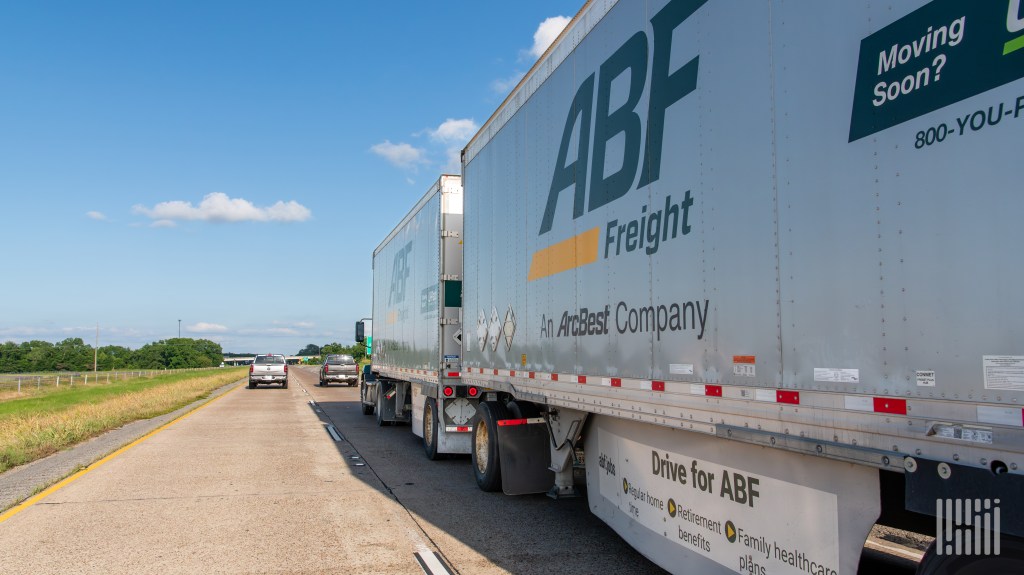
a pair of ABF Freight pup trailers on a highway

Transportation and logistics company ArcBest announced Wednesday the successful completion of a pilot using an electric Class 8 truck in over-the-road operations. The company concluded the unit’s “performance generally matched its diesel counterparts” during the long-range evaluation.

The three-week test was conducted through its less-than-truckload subsidiary, ABF Freight, using a Tesla (NASDAQ: TSLA) semi on routes between ABF terminals in Reno, Nevada, and Sacramento, California.

The truck averaged 321 miles per day (4,494 miles in total) with a 1.55 kilowatt-hour usage per mile across a variety of routes, including a 7,200-foot climb over Donner Pass in Northern California.

“We’re not looking for a truck that performs well ‘for an EV.’ It must meet or exceed the performance and total cost of ownership targets of our most efficient diesel units,” said ABF Freight President Matt Godfrey in a news release. “This pilot gives us great insight into the potential of EV semis in our operations.”

The company pointed to limitations for broader application of electric trucks, citing a “need for continued development of charging infrastructure to support broader deployment across longer routes.”

ArcBest (NASDAQ: ARCB) said it has also been testing electric versions of yard tractors, forklifts and Class 6 straight trucks.

“While the path to decarbonization presents complex challenges — such as infrastructure needs and alternative fuel development — it also opens the door to innovation,” said Dennis Anderson, ArcBest’s chief innovation officer. “Vehicles like the Tesla Semi highlight the progress being made and expand the boundaries of what’s possible as we work toward a more sustainable future for freight.”

Tesla has targeted volume production of its semi for next year.

More FreightWaves articles by Todd Maiden:

Trump floats 50% tariff on copper, 200% on pharmaceuticals

President Donald Trump said he plans to implement a 50% tariff on copper imports, and is mulling a 200% levy on imported pharmaceutical products later this year.

“Today, we’re doing copper,” Trump said during a cabinet meeting on Tuesday in Washington. “I believe the tariff on copper, we’re going to make it 50%.”

The 50% tariff on imported copper and a potential 200% import tax on pharmaceutical products is part of a plan to get companies to move production back to the U.S., Trump administration officials said.

“The idea is to bring copper home, bring copper production home,” Commerce Secretary Howard Lutnick said in an interview on CNBC

Lutnick said that tariffs on imports of copper could be put in place by Aug. 1. In June, the Trump administration doubled its tariffs on steel and aluminum imports to 50%, with the exception of the United Kingdom, which remains at 25%.

While the U.S. has domestic copper production, it imported around $17 billion worth of copper in 2024, according to the U.S. Commerce Department. Chile, Canada, Peru and Mexico were the leading suppliers of imported copper to the U.S.

Copper is used in everything from consumer electronic devices (including smartphones), electric vehicles, and medical devices, along with components for electric grids and transportation systems, according to the National Mining Association

Copper is imported into the U.S. through a combination of ocean freight, trucking and rail. The majority of copper imports to the U.S. arrive via ocean container ships, often at major ports such as the ports of New Orleans, Los Angeles, and Houston.

Rail freight gains in short week

Weekly rail freight showed a marked improvement as total U.S. weekly traffic reached 443,049 carloads and intermodal units, reflecting a 5% increase compared to the year-ago period.

Total carloads for the week ending July 5 were reported at 204,513, an increase of 4.8% compared to the corresponding week in 2024, according to the Association of American Railroads, which also included July 4.

Intermodal volume was 238,536 containers and trailers, 5.2% ahead of the previous-year period.

An uptick was recorded in eight out of ten categories y/y compared to the previous year. Motor vehicles and parts led, up 12.9%, followed by metallic ores and metals, ahead 10%.

(Chart: AAR)

Narrow declines were seen in forest products, off 2%, and farm products excluding grain and food, down 1% y/y.

For the first 27 weeks of 2025, cumulative U.S. rail traffic showed a positive trajectory with 5,910,080 carloads, an increase of 2.5% from a year ago. Intermodal amounted to 7,221,865 units, up 5.1%. Collectively, traffic came in at 13,131,945 carloads and intermodal units, a 3.9% climb y/y.

North American rail volumes for U.S., Canadian, and Mexican railroads totaled 301,800 carloads, marking a 2.2% rise y/y. Intermodal surged by 6.9%, to 323,164 units. Altogether, the total combined weekly rail traffic in North America reached 624,964 carloads and intermodal units, a 4.6% increase. Year-to-date, North American rail volume stands at 18,170,855 carloads and intermodal units, showing 2.8% growth over 2024.

Subscribe to FreightWaves’ Rail e-newsletter and get the latest insights on rail freight right in your inbox.

Find more articles by Stuart Chirls here.

Related coverage:

Setback for rail shippers as court vacates switching rule

BNSF, UP clash over new Salt Lake City intermodal service

CPKC paces all railroad freight gains in latest quarter

U.S. intermodal rail narrowly down

REPOWR announces Chris Hines as new CEO

Freight Industry Pioneer Joins REPOWR to Lead Expansion in the B2B Trailer-Sharing Space

REPOWR, the leader in the B2B trailer-sharing space, is excited to announce the appointment of Chris Hines as the company’s new Chief Executive Officer. With over 38 years of experience in the transportation and technology sectors, Hines brings a wealth of leadership, entrepreneurial spirit, and industry expertise to REPOWR during a pivotal time of growth and innovation.

Hines has long been recognized as a trailblazer in the freight and transportation industry. Throughout his career, he has demonstrated a remarkable ability to drive change, build successful businesses, and lead complex transformations. Hines’ professional journey includes 17 years at GE Capital/TIP, the world’s largest trailer leasing business, where he honed his leadership skills as President and developed a deep understanding of transportation finance/leasing, 5 years as President/COO at Celadon Group, where he led a profitable 4,500 truck fleet across North America, and 6 years at Zonar Systems, where he scaled the business from $5M ARR to $100M ARR. Hines has spent 22 years focused on transportation technology M&A, start-ups, and reorganizations, solidifying his reputation as a key industry figure. 

“REPOWR is at the forefront of revolutionizing the trailer-sharing space, and I am excited to join this dynamic team as we continue to scale and innovate,” said Hines. “I have seen firsthand the power of technology in transforming industries, and I am confident that REPOWR’s platform will continue to reshape how businesses think about trailer utilization. I look forward to leading REPOWR as we continue to disrupt the logistics and transportation sector.” 

REPOWR has seen significant momentum in recent years as the demand for flexible, cost-effective transportation solutions has soared. The company’s platform connects shippers, brokers, and all sizes of fleets, providing them with easy access to a network of trailers across the country, reducing costs, improving trailer utilization, and streamlining operations. As the leader in the B2B trailer-sharing space, REPOWR is committed to delivering innovative solutions that drive efficiency and profitability for its customers.

“Chris’ appointment is a major milestone for REPOWR as we continue to build on our success and expand our market presence,” said Patrick Visintainer, Co-Founder of REPOWR. “His extensive experience, proven track record, and industry relationships will be instrumental in guiding REPOWR through its next phase of growth. We are thrilled to welcome Chris to the team and look forward to achieving great things together,” added Spencer Ware, Co-founder of REPOWR.

Under Hines’ leadership, REPOWR is poised to accelerate its growth, drive new customer acquisition, and expand its footprint in the trailer-sharing market. With a strong focus on innovation, customer success, and strategic partnerships, REPOWR is positioning itself as the go-to solution for the logistics and transportation sectors.

Setback for rail shippers as court vacates switching rule

A federal court has tossed out the Surface Transportation Board’s 2024 reciprocal switching rule that would have allowed shippers who suffer from inadequate rail service to gain access to a second railroad.

The STB exceeded its authority when it adopted the rule, the U.S. Court of Appeals for the Seventh Circuit said in a decision issued yesterday.

The rule arose out of the 2022 service crisis that was related to widespread crew shortages on the big four U.S. railroads. The board said the rule would provide a streamlined path for access to reciprocal switching when service to a terminal-area shipper fails to meet any one of three performance standards.

CSX (NASDAQ: CSX), Canadian National (NYSE: CNI), and Union Pacific (NYSE: UNP) brought the lawsuit challenging the rule. The railroads had argued that the rule would have negative consequences for the industry and shippers alike. A forced switching order, they said, would require alternative service that is more operationally and economically complex than existing service.

The court agreed that the board’s rule was inconsistent with the Staggers Act of 1980, which largely deregulated the rail industry. “The Board exceeded its statutory authority because the Final Rule, by its terms, deviates from the statutory standards Congress established authorizing reciprocal switching,” the three-judge panel said.

The board had been considering various reciprocal switching proposals since 2010. The rule aimed to streamline the process under which shippers could gain a reciprocal switching order. The process was so complex and burdensome that over the past four decades no shipper sought a reciprocal switching order from regulators.

“The whole objective of the Board’s regulatory action, dating back to its April 2022 hearing, was to improve rail service that the agency deemed inadequate. Nevertheless, the Board now concedes that the Final Rule’s three performance metrics — around which the entire scheme authorizing the prescription of a switching agreement is built — do not correspond with a finding that an incumbent rail carrier’s service is inadequate. And we must take the Board at its word,” the judges wrote.

“Because the process the Final Rule provides to obtain a reciprocal switching agreement does not include a determination of whether an incumbent carrier’s rail service is inadequate, we conclude that the Final Rule, by its terms, is inconsistent with the Board’s statutory authority,” the court said.

The court returned the matter to the STB.

The decision, however, did not overturn the board’s requirement that the Class I railroads provide expanded service performance metric reports every week. “We refrain from deciding today whether the disclosure requirements, as written, exceed the agency’s statutory authority,” the court said.

Subscribe to FreightWaves’ Rail e-newsletter and get the latest insights on rail freight right in your inbox.

Related coverage:

BNSF, UP clash over new Salt Lake City intermodal service

CPKC paces all railroad freight gains in latest quarter

U.S. intermodal rail narrowly down

This new LA-NY passenger train will carry long-haul trucks, too

June rebound as West Coast containers best East, Gulf ports

In June 2025, U.S. container import volumes experienced a modest rebound, marking a stabilization after May’s sharp decline.

Data from Descartes reveals a 1.8% increase in container imports to 2,217,675 twenty foot equivalent units, narrowing the year-over-year decline to 3.5%. This rebound suggests that U.S. importers are beginning to adapt their supply chains amid ongoing tariff and policy shifts, with year-to-date import volumes tracking 3.8% above 2024 levels.

Volume gains at top U.S. ports

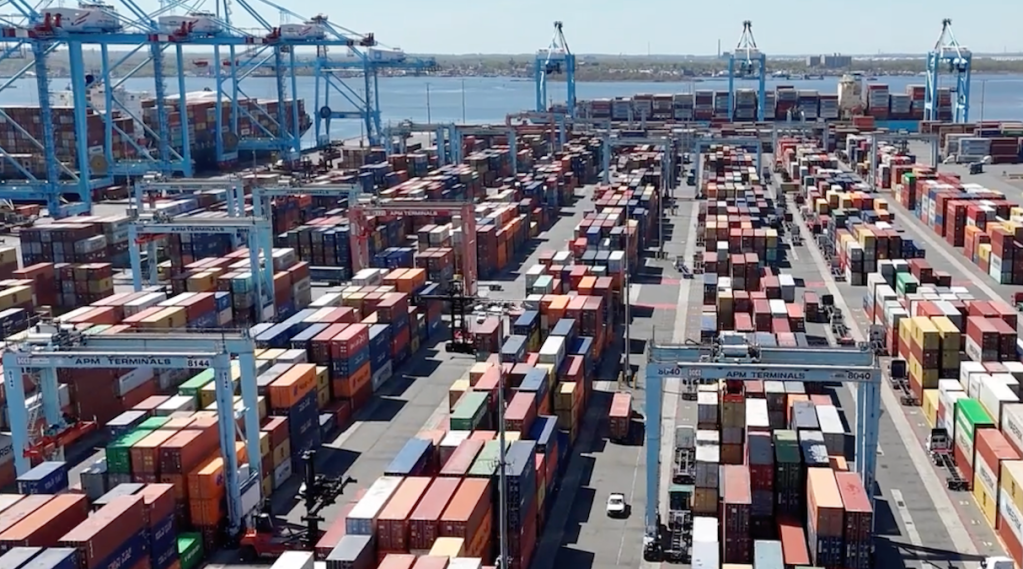
The shift in port dynamics was noticeable, with top West Coast ports regaining momentum. Los Angeles experienced a 29.1% increase in volume, adding 103,884 TEUs, while Long Beach saw an 18.8% rise, contributing an additional 58,492 TEUs. Tacoma’s volume increased by 33.3%, highlighting a strong performance on the West Coast.

Conversely, most East and Gulf Coast ports reported significant declines. Savannah saw a decrease of 16.9%, and Houston experienced a 15.8% drop in volumes. Overall, the top 10 U.S. ports handled a combined volume showing a 3.1% rise month-over-month.

China-origin import challenges

Despite a slight month-over-month increase of 0.4% to 639,300 TEUs, U.S. imports from China were down 28.3% from June 2024, reflecting the sustained impact of elevated tariffs and the rollback of the de minimis exemption. Categories such as furniture and plastics saw sharp year-over-year declines. With China-origin imports constituting only 28.8% of total U.S. imports — the lowest in four years — importers are pushing toward diversification, favoring Southeast Asian countries. Vietnam, for example, increased its export volumes to the U.S. by 7.7% over May, indicating a shift in sourcing strategies.

Port delays and efficiency improvements

Port delays improved notably in June, particularly at key West Coast ports such as Los Angeles and Long Beach, which saw reductions in congestion by 2.1 and 3.3 days, respectively. This improvement signals an easing of the bottlenecks prevalent in May. East and Gulf Coast ports, while experiencing smaller gains, remained more stable with minimal changes in transit times.

U.S.-China trade talks and global shipping disruptions

As of July 2025, the U.S.–China trade relationship remains under a temporary truce, with a framework agreement in development following May’s tariff reduction to 30%, down from 145%. However, upcoming deadlines in July and August could trigger renewed tensions if unresolved disputes persist. Meanwhile, worsening disruptions in the Red Sea due to Houthi attacks on shipping and Iran–Israel conflicts continue to impact global shipping routes, forcing carriers to reroute vessels, leading to higher costs and extended transit times.
Descartes had recommendations to manage supply chain risk:

  1. Monitor tariff deadlines: With upcoming expirations of key tariff agreements, modeling the impacts of potential increases is critical for planning.
  2. Assess port volumes and delays: Given the historical strain on U.S. logistics infrastructure at certain volumes, continuous monitoring is essential.
  3. Track geopolitical risks: Ongoing Middle Eastern conflicts necessitate strategic assessments of routing options and potential alternatives.
  4. Diverse sourcing: Evaluating supplier and factory locations can mitigate risks associated with over-reliance on specific regions, a crucial step in maintaining supply chain resilience.

Find more articles by Stuart Chirls here.

Related coverage:

Port Newark opens new electric drayage charging station

Italy shipbuilder appoints new US chief

Crowley adds new U.S. Northeast ocean service with Central America

Merchant vessel attacked in Red Sea