Democrats: Trump’s immigration focus undermines war on cargo theft

Truck with theft imposed on picture

WASHINGTON — Legislation created to address the cargo theft crisis across the U.S. is being undermined by the Trump administration’s focus on illegal immigration, according to Senate Democrats.

The Combating Organized Retail Crime Act of 2025, introduced in both the House and Senate in April, would set up a coordinated multiagency federal response to organized cargo and retail theft and make it easier to prosecute the crime groups responsible.

But Sen. Dick Durbin, D-Ill., who supports the bill, said that thousands of agents at the Department of Homeland Security have been told to shift their priority to deporting illegal aliens, based on President Trump’s executive orders.

“Let’s put the cards on the table,” Durbin said at a hearing on cargo theft held by the Senate Judiciary Committee on Tuesday.

“If anyone’s involved in illegally being in the U.S., undocumented or otherwise, that has engaged in criminal activity that endangers themselves and others, they should be removed, prosecuted, or never let in [to the country] in the first place.

“But to say we’re worried about whether someone who’s cutting grass on a golf course today is undocumented, and that we ought to put the resources of the federal government into putting him into a detention facility and deporting him, is that a priority over what we’re discussing today? Not in my book.”

The hearing was the third this year held to spotlight the rise in cargo theft as costs and safety risks rise in proportion.

Donna Lemm, chief strategy officer of Collierville, Tennessee-based IMC Logistics, an intermodal logistics company specializing in moving ocean containers to and from major seaports and rail hubs, told lawmakers at the hearing that cargo theft at her company has exploded from five incidents in 2021 to 876 in 2024.
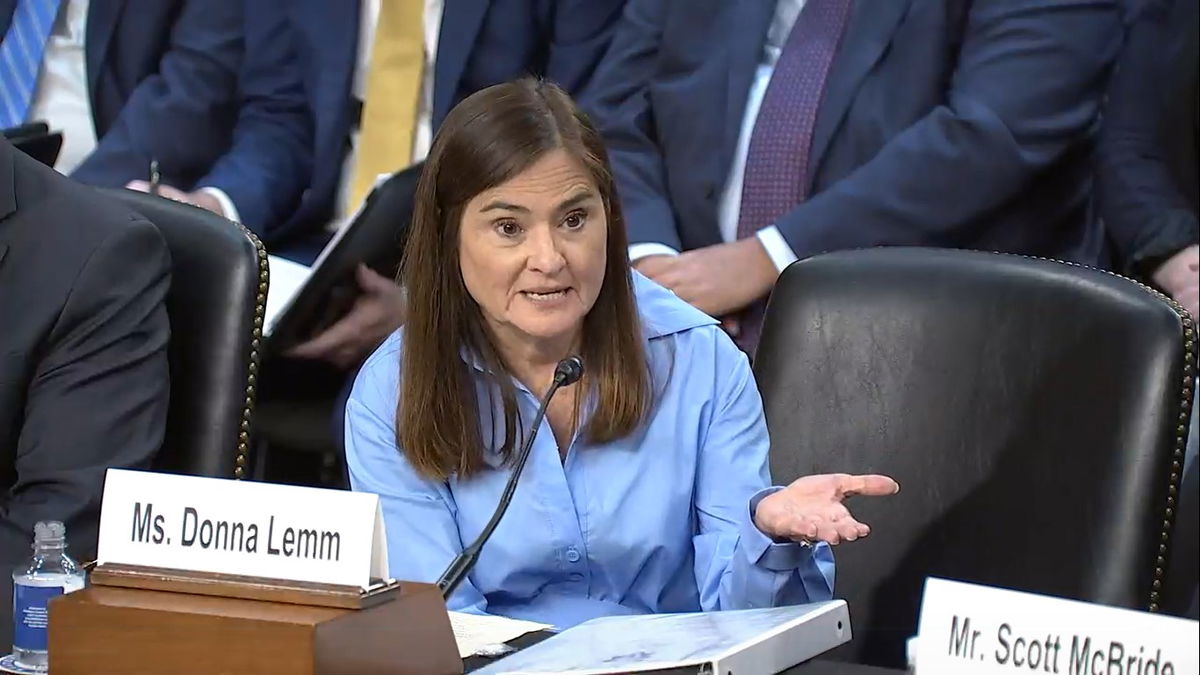
Lemm testifying on Tuesday. Credit: U.S. Senate

“We’re talking about hundreds of thousands of dollars stolen in incidents across the United States with no resolution,” said Lemm, testifying on behalf of the American Trucking Associations.

IMC Logistics operates approximately 1,900 power units and employs over 2,000 drivers, according to FMCSA data.

Lemm recounted an elaborate plot by fraudsters in 2023 to impersonate a real motor carrier that ended in five full cargo loads being stolen.

“The scheme involved outfitting a truck with fake placards and printing counterfeit IDs for the drivers. IMC Logistics’ chassis were equipped with GPS units, but the criminals were savvy enough to disable them within 20 minutes of leaving our lot. The total value of the lost cargo was substantial.”
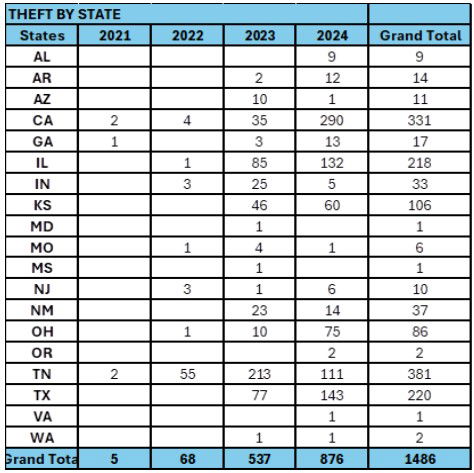
Cargo thefts occurring at IMC Logistics. Source: IMC Logistics.

Lemm described another incident in which two containers of appliances were stolen from a company facility in St. Louis, which was reported for insurance purposes but no arrests were made. Several months later the Bureau of Alcohol, Tobacco, Firearms and Explosives called.

“They had stumbled across our appliances in a warehouse that they raided. These refrigerators were being stuffed with cash to smuggle money across the southern border.

“This is not just an insurance matter. Cargo crimes, if connected, can help us link these operations orchestrated by transnational criminals. Brazen heists like these put our whole supply chain and workers in harm’s way.”

But connecting the dots on cargo crime at local, state, and federal levels will be difficult, Democrats asserted, without deploying sufficient assets.

“There are dozens of experienced people who focused on these kinds of crimes who are no longer [at DHS],” said Sen. Mazie Hirono, D-Hawaii, at the hearing.

“We can pass whatever laws we want, but unless there is that commitment to enforcement at the federal level we’re going to continue to run into resource problems.”

Click for more FreightWaves articles by John Gallagher.

FMC investigating Port Houston pacts with container carriers

The Federal Maritime Commission has initiated a probe into the Terminal Service Agreements (TSAs) between Port Houston and several major container lines.

The agency said in a July 11 filing that the nonadjudicatory investigation will examine the Terminal Service Agreements (TSAs) between Port Houston and several major container lines, to determine if these agreements compel certain carriers to route a percentage of their loaded containers through Port Houston and away from competing Gulf hubs.

A TSA is a contract between port and carrier spelling out the terms and conditions for the use of port facilities and services.

At the heart of the inquiry is the Commitment Clause and Shortfall Amount embedded within these TSAs. These provisions potentially obligate participating carriers including CMA CGM, Evergreen Line Joint Service, Hapag-Lloyd (OTC: HLAGF), Maersk Line, Mediterranean Shipping Co., and Zim Integrated Shipping Services Ltd. (NYSE: ZIM) to ensure a specific volume of container traffic through the Texas gateway.

The FMC’s Bureau of Enforcement, Investigations, and Compliance (BEIC), will scrutinize the circumstances leading to the formation, signing, and enforcement of these clauses, the filing stated.

Houston handled a record 4.12 million twenty foot equivalent units (TEUs) in 2024, up 8% y/y.

Find more articles by Stuart Chirls here.

Related coverage:

June box record for Port of Los Angeles 

China-US container trade trending down as peak season nears

Container Q2 volumes up 4.4% for OOCL parent 

Longshore unions to unite for ‘anti-automation’ protest

First Look: J.B. Hunt Q2 earnings

JB Hunt 360box trailers at a loading dock

J.B. Hunt Transport Services’ second-quarter result was largely in line with analysts’ expectations.

The Lowell, Arkansas-based multimodal transportation provider reported earnings per share of $1.31 for the period after the market closed on Tuesday, which was 1 cent below the year-ago result.

Consolidated revenue of $2.93 billion was in line with consensus and flat year over year. Operating income dipped 4% y/y to $197 million.

Click for full report – “J.B. Hunt still waiting for market to turn”

Table: J.B. Hunt’s key performance indicators – Consolidated

The company’s flagship intermodal unit reported a 2% y/y increase in revenue to $1.44 billion as a 6% increase in loads was partially offset by a 3% decline in revenue per load. A mix shift to the Eastern network weighed on the yield metric given the shorter length of haul. The unit’s operating ratio (inverse of operating margin) deteriorated 40 basis points y/y to 93.3%.

Dedicated revenue dipped less than 1% y/y to $847 million as a 3% decline in average trucks in service was largely offset by a 3% increase in revenue per truck per week (up 5% excluding fuel surcharges). The unit’s OR was 30 bps worse y/y at 88.9%.

A $3.6 million operating loss in the company’s brokerage segment widened slightly from the first quarter, but was nearly $10 million lower y/y. Brokered loads declined 9% y/y but revenue per load was up 6%.

J.B. Hunt (NASDAQ: JBHT) will host a call at 5 p.m. EDT on Tuesday to discuss second-quarter results.

Click for full report – “J.B. Hunt still waiting for market to turn”

Table: J.B. Hunt’s key performance indicators – all segments

More FreightWaves articles by Todd Maiden:

Yellow Corp. to sell 4 terminals for $6.9M

A Yellow tractor parked at a terminal

Defunct Yellow Corp. has entered a request with a federal bankruptcy court in Delaware to sell four terminals for $6.85 million, according to a Monday filing.

The purchase agreements for the owned properties include a 38-door terminal near Long Island, New York valued at $4 million, a 39-door service center near Omaha, Nebraska ($2 million), a 20-door facility near Atlantic City, New Jersey ($600,000), and a 15-door location in Alexandria, Louisiana ($250,000).

The buyers appear to include various real estate and other investor groups.

Proceeds from the sales will settle claims against the estate, including employee claims for PTO, sick time and amounts sought under the Worker Adjustment and Retraining Notification Act.

The bankrupt less-than-truckload carrier has liquidated more than 210 terminals for nearly $2.4 billion since filing for bankruptcy in 2023.

More FreightWaves articles by Todd Maiden:

Large union, U.S. Postal Service finalize 3-year contract

A male U.S. Postal Service worker in a blue shirt moves letter bins at a processing center.

The American Postal Workers Union, which represents more than 190,000 clerks, mechanics, vehicle drivers, custodians and administrative personnel, has ratified a new three-year labor contract with the U.S. Postal Service that will run through Sept. 20, 2027.

The deal covers annual general wage increases, full semi-annual cost-of-living adjustments, recruitment and retention, work rule changes, the first differential increase for night work in 30 years, and use of postal support employees to provide the agency operational flexibility.

The contract was approved last week by 95% of members who voted, but turnout was low with only about 36,000 members participating, according to APWU figures. A letter carrier, who spoke on condition of anonymity and is represented by a different union, said voter apathy is increasingly common with some workers believing their vote doesn’t count or disillusioned with their leadership.

“This contract, with no givebacks or concessions, provides a strong foundation for us to build on in the years to come,” said APWU President Mark Dimondstein in a news release.  “At a time when government workers are facing layoffs and attacks on their union rights, this contract will protect postal workers through the turbulent years ahead.” Dimonstein signed the final contract on Friday.

The union, which is affiliated with the AFL-CIO, said the contract protects previous gains, including protections against layoffs, regular step increases and an automatic conversion for temporary workers to permanent status after two years.

Groups that want to keep down Postal Service costs, such as bulk mailers and small-government advocates, sometimes point to APWU jobs as a savings opportunity because clerks who handle bulk loads and sort mail make more money than counterparts at FedEx or UPS, where warehouse work is considered an entry-level job. Clerks, however, work in a variety of areas, including retail sales at post offices, call centers and administration.

“This agreement is fair and balanced. It addresses both parties’ bargaining objectives in a financially responsible manner, and importantly, supports our mission to modernize postal operations to better serve the needs of our customers and provide first-in-class service,” said acting postmaster general Doug Tulino, in a statement. 


Click here for more FreightWaves/American Shipper stories by Eric Kulisch.

USPS hikes parcel rates and stamps by 7%

Australia Post rolls out parcel-only post offices

Check Call: Cross-border volumes surge ahead of possible tariffs

(GIF: GIPHY)

Trade between the U.S. and Mexico continues to surge, fueled in large part by nearshoring trends and tighter regional supply chains. In May, U.S.-Mexico trade volumes reached an impressive $74 billion, according to the latest data from the U.S. Census Bureau. That figure marks a 2.64% increase from the same time last year, with key growth areas in automotive parts, computers, agricultural products, and electronics.

Laredo, Texas, once again stood out as the busiest international gateway for trade, processing over $27.6 billion in total imports and exports. Much of that movement was truck-based, with the port recording nearly 300,000 commercial crossings in May alone. This sustained growth signals continued opportunity, but looming trade tensions could complicate the road ahead.

The Trump Administration recently announced a proposal to reinstate broad tariffs on Mexican imports if re-elected, calling for a 30% tariff on all goods coming from Mexico. Tariffs at this scale would likely introduce volatility into what has recently been one of the most stable growth areas for freight.

A fresh ruling by the U.S. Commerce Department in late June reinstated a 17.56% tariff on Mexican fresh tomatoes, a staple in U.S. grocery imports. Produce industry experts warn that prices could jump 30% or more in the coming months, especially as buyers seek alternative sources. Any cost shift like this could ripple across reefer capacity and affect seasonal planning for brokers that move perishable goods.

Despite this uncertainty, nearshoring remains a long-term force reshaping North American freight. As more companies relocate manufacturing from Asia to Mexico, cross-border freight continues to solidify its importance. But the prospect of sweeping tariffs injects a new layer of unpredictability that supply chains must be prepared for.

With U.S.-Mexico trade showing no signs of slowing, watching regulatory developments while reinforcing their relationships on both sides of the border will become paramount. 

Get the full edition of the newsletter in your inbox every Tuesday

Modernization of Cross-Border Trade event draws industry experts to Laredo, TX

trucks at border crossing

In the ever-evolving landscape of cross-border trade between the U.S. and Mexico, Reliance Partners continues to foster collaboration and expertise with annual Modernization of Cross-Border Trade events. 

Held on June 17, 2025, at the Laredo Country Club in Laredo, Texas, the 8th Annual Modernization of Cross-Border Trade event drew in over 500 logistics professionals. 

2025 featured a strong sponsor lineup, including Cargado, Monex USA, Volvo Trucks, Evans Transportation, Werner, Dunavant, Atlantic Logistics, and more, with complimentary admission for all logistics providers, shippers, and freight brokers.

What started eight years ago as an insurance-focused gathering has evolved into a premier industry forum where cross-border technology disruptors, logistics firms expanding into Mexico, and capacity providers connect and collaborate. 

This year’s speakers highlighted the following topics:

  • What to expect from the 2026 United States-Mexico-Canada Agreement review upon the election of President Donald Trump and Mexican President Claudia Sheinbaum
  • How and when to leverage cross-border warehouse space
  • What cross-border investment firms are looking at in 2025
  • Cross-border partner vetting
  • Practical technology for cross-border in 2025
  • U.S.-Mexico customs brokerage panel with Customs and Border Protection

The Need for Cross-Border Insurance

At the core of the event’s discussions was the vital role of cross-border insurance, a topic that is gaining increasing prominence amid escalating trade volumes and complexities. The importance of having robust cross-border insurance cannot be overstated, particularly as the Mexican cargo landscape presents numerous challenges. With a 3% increase in cargo truck hijacking reported in 2023, the situation is only getting more volatile. 

Mark Vickers, Executive Vice President and Head of International Logistics at Reliance Partners, highlighted key differences between U.S. and Mexican insurance policies. U.S.-issued Mexican cargo insurance is particularly beneficial as it allows claims to be resolved in the U.S., offering more reliable outcomes. In contrast, Mexican cargo insurance often involves lenient liability requirements. Carriers’ liability for cargo damage tends to be capped significantly lower than actual shipment values.

These limitations are coupled with burdensome documentation requirements and exclusions typical to Mexican policies, which often delay claim payouts and complicate logistics operations. Moreover, the negligence-based liability in Mexico means that carriers are only accountable for damages caused by negligence, leaving significant risks for shippers uncovered.

Effective insurance has become a more crucial need than ever. Cross-border insurance helps to ensure continuity and mitigate risk. Every cross-border operation needs stability when it comes to an uncertain environment. 

The 8th Annual Modernization of Cross-Border Trade event featured a range of thought-provoking panels covering topics such as cross-border disruption, Mexican cargo insurance, and strategies for expanding capacity. The participation level and diversity of attendees spanned shippers, freight brokers, U.S. and Mexican carriers, customs brokers, warehouse operators, logistics tech companies, and investors.

Many event participants validated the necessity for progress and preparedness in regards to this topic. “It starts with great people, and this event truly brought them together,” said one attendee. 

One industry professional noted, “If you’re investing in cross-border and you aren’t in Laredo at this event, you’re missing out.” Another echoed, “This event showcases how fast the space is evolving and how important it is to be part of the conversation.”

Reliance Partners’ Cross-Border Solutions

In response to these challenges, Reliance Partners has developed the Borderless Coverage program. This innovative program is specifically designed to connect shippers, carriers, and brokers with U.S.-based underwriters who specialize in Mexican cargo insurance. The program aims to eliminate the uncertainties of traditional policies by ensuring expedited claims payments directly to the shipper, thus maintaining operational flow while supporting cost recovery.

Borderless Coverage offers transparent policies that reflect the tangible realities of cross-border risk, thereby shielding shippers from vulnerabilities associated with traditional insurance models. Simplified coverage options reduce unrealistic requirements that often lead to disputes. This model promotes collaboration and partnership rather than tedious policy navigation.

Likewise, Reliance Partners’ Cargo Truck Hijacking Portal is designed to help nearshoring executives, journalists, international logistics professionals and researchers analyze roadway logistics risk in Mexico. The Reliance team compiles, consolidates, and crunches data from Mexico’s federal government’s National Public Security System in order to provide the first and only open source data portal on cargo hijackings in Mexico.

Upcoming News

With nearshoring initiatives gaining momentum, the impetus for robust partnerships and comprehensive insurance solutions remains high. The insights shared at the 8th Annual Modernization of Cross-Border Trade event reinforce the critical nature of insurance in facilitating secure and efficient trade activities across borders.

As the landscape continues to shift (fueled by innovations and policy changes), the role of cross-border insurance as a stabilizing force shouldn’t be overlooked. Industry players need to align towards common goals, and for that they need the knowledge and tools to navigate the complexities of a dynamic trading environment.

Reliance Partners has already set its sights on future engagements, with preparations underway for the 9th Annual Modernization of Cross-Border Trade. Because this is a topic of growing importance, there has to be continued dialogue and collaboration within the trade community. Reliance Partners wants to enhance industry discourse and play a pivotal role in shaping the future of cross-border logistics and insurance.

Click here to learn more about Reliance Partners.

LTL pricing index to hit record high in Q3

A white sleeper cab pulling two white LTL pup trailers

A sagging industrial economy and global trade uncertainty continue to constrain less-than-truckload demand, but carriers are still pushing through rate increases. The LTL rate-per-pound component of the TD Cowen/AFS Freight Index is expected to reach a record high during the third quarter, a quarterly report showed on Tuesday.

Third-party logistics company AFS Logistics and financial services firm TD Cowen are forecasting their LTL rate index to climb to a level that is 65.9% higher than a January 2018 baseline. That would be 170 basis points above the second quarter reading and 130 bps above the prior peak set during the freight boom that concluded in 2022.

If the forecast holds, the index would be up on a year-over-year comparison for a seventh straight quarter.

“The continued resilience of the rate-per-pound index shows the effect of carrier pricing discipline, and the upcoming NMFC [National Motor Freight Classification] transition to a density framework should equip carriers with another method to tightly manage freight classification and pricing,” said Aaron LaGanke, vice president of freight services at AFS, in the report.

(Changes to the National Motor Freight Traffic Association’s classification system will take effect on Saturday.)

SONAR: Midhaul LTL Monthly Cost per Hundredweight, Class 125+ Index. Less-than-truckload monthly indices are based on the median cost per hundredweight for four National Motor Freight Classification groupings and five different mileage bands. To learn more about SONAR, click here.

Cost per LTL shipment fell 2.9% y/y in the second quarter but weight per shipment was off 5.1% y/y, “indicating that carriers are holding firm on pricing and emphasizing revenue management strategies,” the report said.

Sequentially, cost per shipment was down 1.6% but weight per shipment (down 1.8% from the first quarter) and fuel surcharges (down 1.3%) were headwinds, which were offset by a 3.6% increase in length of haul.

The report is in line with second-quarter updates in early June that showed LTL carriers continued to realize y/y yield increases in April and May.

Truckload data from the index, however, continued to show depressed trends.

The TL rate-per-mile component of the TD Cowen/AFS index is expected to decline 40 bps sequentially in the third quarter to just 5.6% above the 2018 baseline. That would mark 10 straight quarters of trough-like conditions for the pricing dataset after peaking at 25.7% in the first quarter of 2022.

SONAR: National Truckload Index (linehaul only – NTIL) for 2025 (blue shaded area), 2024 (green line) and 2023 (pink line). The NTIL is based on an average of booked spot dry van loads from 250,000 lanes. The NTIL is a seven-day moving average of linehaul spot rates excluding fuel. Spot rates remain slightly higher on a y/y comparison.

Truckload linehaul cost per shipment was up 1.7% sequentially in the second quarter, but the increase was driven by a 1.8% uptick in miles per shipment.

“Ongoing trade and tariff uncertainty is hampering the truckload market’s recovery from the freight recession that started three years ago,” the report concluded.

The LTL earnings season kicks off on July 25 when Saia (NASDAQ: SAIA) reports second-quarter results before the market opens.

AFS Logistics is a non-asset-based 3PL providing audit and cost management services, managed transportation, and freight brokerage. It has visibility into more than $39 billion in annual freight spend.

More FreightWaves articles by Todd Maiden:

DHL rotates leaders at forwarding, supply chain divisions

View of stage at a DHL annual meeting, with DHL yellow signage.

DHL Group executives have been playing a game of musical chairs in the past month. On Tuesday, the parent company’s board announced the transfer of Oscar de Bok, the chief executive officer of DHL Supply Chain, to head DHL Global Forwarding. He will succeed Tim Scharwath, who will retire from the company.

Hendrik Venter, currently responsible for Supply Chain in mainland Europe, Middle East and Africa will move up to lead the Supply Chain division. The leadership changes take effect on Aug. 16.

Management credited Scharwath with modernizing Supply Chain’s IT infrastructure, accelerating digitalization, and improving customer service. 

Deutsche Post AG is the legal entity that does logistics business worldwide as DHL Group. Post and Parcel is a separate unit that provides national mail service in Germany.

De Bok joined DHL Group in 1999 and was managing director of DHL Supply Chain for several countries and regions, including Italy, the Nordics, and Asia. He was named CEO of DHL Supply Chain in October 2019. De Bok will lead Global Forwarding, Freight until August 2030.

Venter has more than 15 years of management experience at DHL Supply Chain. 

Last week, DHL named Markus Voss to succeed Uwe Brinks as CEO of DHL Freight, effective Sept. 1. Voss currently is chief development officer at DHL Supply Chain. He will report to de Bok. One of his top agenda items will be to digitize more customer-facing products and services. Brinks built up DHL’s road freight business for nearly nine years. 

DHL also said it established a European Transportation Board to enhance cross-divisional collaboration in land transport among DHL Global Forwarding, DHL Freight, and DHL Supply Chain. The initiative aims to deliver more integrated and efficient solutions for customers while unlocking further business growth opportunities. 

Earlier this month, DHL named a new CEO for Forwarding in the United States, as well as a new leader for DHL eCommerce Americas. And in June, DHL promoted Mark Kunar to CEO of DHL Supply Chain North America  


Click here for more FreightWaves/American Shipper stories by Eric Kulisch.

FedEx buys world’s first ATR 72-600 passenger-to-freighter aircraft

DHL appoints new chiefs for Americas divisions

DHL Express Canada reinstates service after workers ratify labor deal 

Diesel benchmark moves up slightly but in a market with increasingly bullish factors

The benchmark diesel price used for most fuel surcharges rose Monday for the fifth time in six weeks, and it seems that market conditions for distillates–which includes diesel–are the only oil market fundamentals garnering attention these days.

The Department of Energy/Energy Information Administration average weekly retail price rose 1.9 cents/gallon to $3.758/g, effective Monday and published Tuesday. That stretch of five up, one down in the last six weeks has added 30.7 cts/g to the benchmark.

Most of the chatter on broad oil market moves has been looking to geopolitics as reasons for movement. But when it turns to fundamentals, it is the diesel market that has been the most important factor.

That the oil markets are being led by diesel can be seen in one basic comparison.

Since the start of last month, the price of Brent on the CME commodity exchange has risen 7%, to a settlement Monday of $69.21 from a starting point of $64.63/barrel on June 2.

During that same period, ultra low sulfur diesel on CME climbed to a settlement Monday of $2.3898/g from $2.0445/g, an increase of 16.9%.

The widening of diesel to crude continued Tuesday. At approximately 11 a.m., ULSD was up about 0.75% while Brent crude was down about 0.16%.

The broader market economics for crude still remains heavily weighted toward bearish. The OPEC+ group continues to add supply into the market, voting to approve higher output in August when it met earlier this month. 

It has been setting that “more is better” policy for several months when it gathers for its remote meetings. The OPEC+ more than 2-million barrel/day cutback in production that dates back to 2023 is expected to be fully unwound by September, far earlier than expected. 

The monthly production estimate from S&P Global Commodity Insights, which had not been showing large increases in OPEC+ output in recent months despite the changes in the group’s production policies, finally did so in its estimate of OPEC+ output in June. It was up about 600,000 b/d, a huge one-month increase.

And the monthly estimate of the International Energy Agency released late last week still showed an overall global petroleum market where new supply is outstripping new demand.

But that is the macro picture. In diesel and distillates, tight inventories are driving their price higher relative to crude. 

A straight comparison of the price of ULSD versus the price of CME Brent, translated into cents per gallon, shows that ULSD was about 53 cts/g more than Brent on June 2. That number is now solidly above 70 cts/g. 

In his weekly report, energy economist Philip Verleger, who has long focused on diesel markets as the underappreciated driver of oil prices,  cited several factors that he said could be tightening diesel supply, leading to those dwindling stocks.

The OPEC cuts that are in place, as well as sanctions against Russia, are removing heavier barrels from the market that tend to have strong diesel yields when refined. Those supplies in many cases have been replaced with light crude from the U.S. which has a much lower diesel yield, Verleger wrote.

A tighter emissions rule for shipping in the Mediterranean that took effect in May also is a factor, Verleger said. That rule dropped the sulfur emission limit in that body of water to 0.1% from the broader worldwide limit of 0.5%. To get there, diesel or distillate molecules are often called upon to replace heavier and dirtier fuel sources. 

The Iran-Israel conflict also has a role in the tighter diesel market, Verleger reported. Israel, as a defensive move, had cut supplies of its offshore natural gas production that had been used to power generators in Egypt, Verleger said. But with those cuts, Egypt has turned to diesel as a generating fuel, adding another source of demand that didn’t exist a few months ago.

The overall impact of these various factors can be seen in how tight ULSD inventories are in the U.S. for this time of year. The most recent weekly report on ULSD inventories was published Wednesday with data for the week ended July 4. It shows that current ULSD inventories are well below those of other reports for the first week of July.