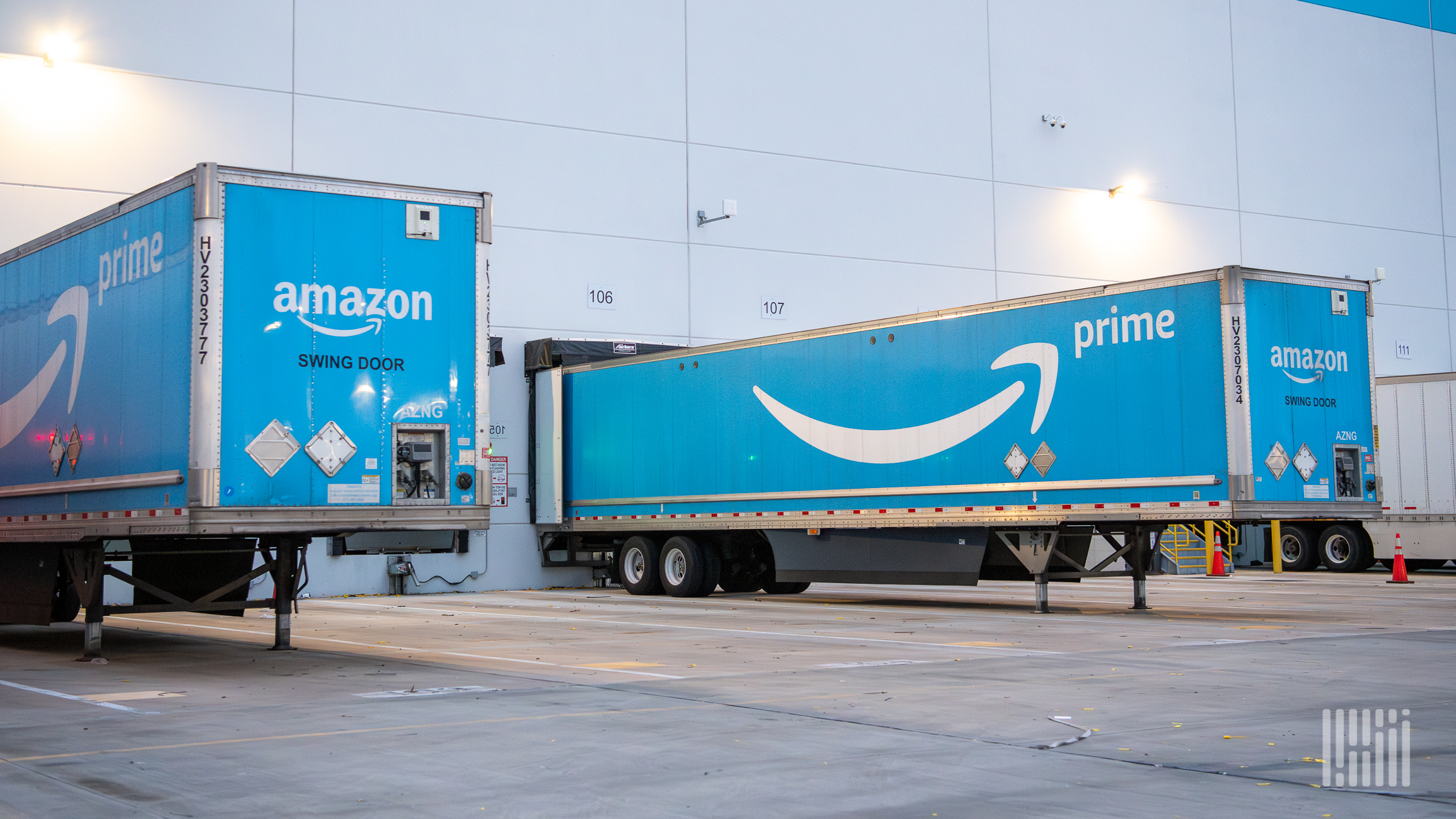
Amazon involved in legal action over deaths in 2 states, possible scam in 1

Amazon has found itself involved in three recent legal developments regarding its trucking operations.

In one, it suffered a setback in Indiana in a lawsuit involving a driver who was killed near a fulfillment center. In another, prosecutors in Connecticut said the company was scammed out of $3 million. And in the third, a tractor-trailer pulling an Amazon load near Chattanooga, Tennessee, was involved in an accident that led to multiple deaths and charges against the driver. 

In the Indiana case, a three-judge panel at the state’s Court of Appeals last week unanimously overturned a lower court decision from June 2023 that dismissed a lawsuit filed by the estate of Harvail Singh Dhillon, an independent owner-operator who was killed near an Amazon (NASDAQ: AMZN) fulfillment center in Greenfield in October 2022.

According to the court’s recap of the case, Dhillon was making a delivery to the Amazon facility, which he was not familiar with, and got lost trying to enter the grounds. He pulled to the side of a road that went past the fulfillment center, got out of the truck to cross the road, and was struck and killed by a fuel carrier.

One of the surrounding roads that also had entrances had a “no trucks” sign, according to the recap. The only directions from Amazon, the recap said, were an address and a time of delivery. 

The Court of Appeals described the Amazon facility as having two entrances on the north side but with “no truck” signs present. “There was no signage posted at either of the two entrances to inform incoming truck drivers as to where they were expected to enter the facility,” the court said. There was a third entrance as well.

Dead driver described as ‘confused’

The result, according to the court: Dhillon “became confused … as he could not discern any other entrances serving the facility.”

Dhillon was attempting to deliver goods to Amazon at 6:40 a.m. in October, when it was still dark.

He pulled his truck over on one of the roads, the court wrote, got out to figure out what to do, and was immediately struck and killed by the tanker truck.

It wasn’t the first time; according to the court, there had been another incident 48 days earlier in which a driver was struck at Greenfield. That also led to a lawsuit by the driver, Mahari Oukbo, an independent owner-operator who survived. 

The Court of Appeals, citing testimony from the Oukbo case, quoted the driver who struck Oukbo as saying that “you see these truck drivers all the time stopping and getting out here” because they were confused as to where to go. Also in that case, according to the court, citing Oukbo-related testimony, an Amazon employee told local police that he “sees these lost truck drivers get out of their trucks at this spot every day.”

Dhillon’s estate filed suit, saying confusion it blamed on Amazon created an “imminent danger” to drivers. But the argument lost on the lower court level in June 2023, with the judge saying Amazon had “no duty” in part because the incident occurred off Amazon property.

In overturning the lower court and sending the case back to it for further proceedings, the Court of Appeals relied on a precedent from a 1994 case. A hospital was ruled negligent after a woman was struck on the grounds of the facility.

The Court of Appeals’ conclusion last week was that Dhillon’s estate had “sufficiently alleged that Amazon used its premises in a manner that harbored a dangerous condition off its own premises, i.e., on the county road, that affected the risk of injury to others. Amazon’s lack of signage and its failure to direct delivery truck drivers where to enter the fulfillment center created confusion and a dangerous condition.”

The Oukbo case took a similar path: The driver lost on the lower court level in Indiana in the suit against Amazon and CF Mount Comfort DST, which the court collectively refers to as Amazon, but the Court of Appeals reversed. A recent request by the attorneys for Amazon for a transfer of the Court of Appeals case to the Supreme Court was denied. (Indiana law defines “transfer” as accepting jurisdiction in a case by the state’s highest court.)

If the Oukbo case then is headed back to the lower court – attorneys for Oukbo had not responded to queries by publication time – it will mean there are two cases in the state involving Amazon’s responsibility for proper directions and signage at one of its fulfillment facilities. Amazon’s press relations team had not responded to an email by publication time.

Fraud costs estimated at $3 million

In the federal indictment in which Amazon is alleged to be a victim, the U.S. attorney for the District of Connecticut said a 24-year-old named Ameer Nasir was hit Wednesday with a 13-count indictment charging wire fraud.

According to the indictment, between December 2019 and February 2021, Nasir “evaded” a security feature in Amazon Relay, the transportation management system of Amazon Logistics. 

According to the indictment, Amazon Relay would allow a trucking company that accepted the task of moving an Amazon trailer to “virtually check out a trailer at the initial location, and then to check in the same trailer at the destination location once the trailer movement was complete.”

By getting through the geofencing capabilities in Amazon Relay, according to the indictment, Nasir was able to show that he had “completed trailer movements which he had not, in fact, completed.”

According to the indictment, Nasir would then submit invoices to Amazon. The company did make deposits to Nasir’s companies. The total number of submitted trailer moves by Nasir: more than 1,000, resulting in the payments of more than $3 million.

Multiple carrier names were registered by Nasir, including Pak Express, Adam Express and Roadstar Logistics.

The U.S. attorney’s office said each offense carries a maximum imprisonment of 20 years on each count.

Deaths on the highway near Chattanooga

In the third legal incident involving Amazon and drivers in just the past few days, a driver hauling freight for Amazon was involved in a crash Sunday near Chattanooga, Tennessee, that led to multiple deaths. (Drivers hauling an Amazon trailer are either independent owner-operators or work for a fleet that is working for Amazon. Amazon does not employ a driver fleet.)
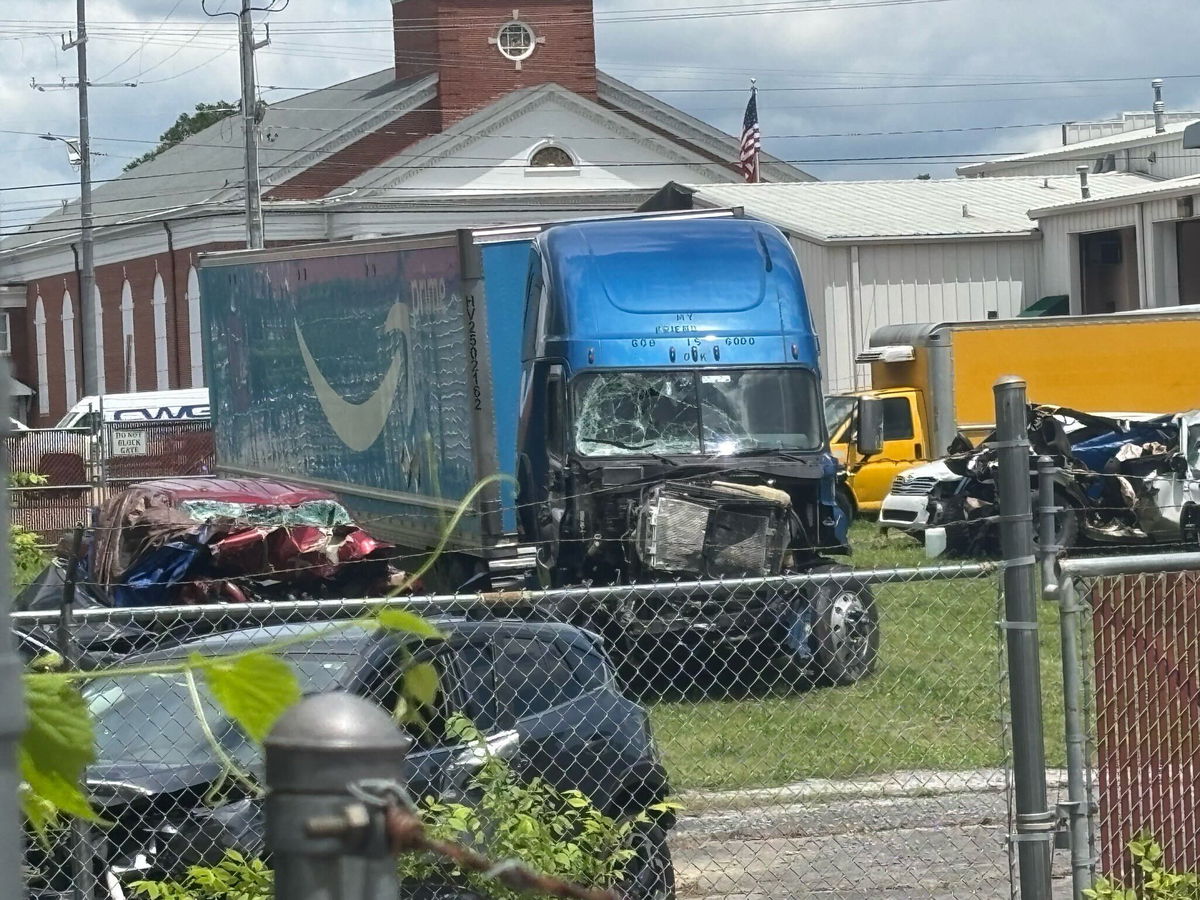
The truck involved in the Chattanooga-area accident that led to fatalities and charges against the driver. Photo courtesy of  WDEF news channel 12 in Chattanooga.

FreightWaves has requested the full incident report from local authorities. But other local outlets report the crash that occurred on Interstate 75 northbound at the Tennessee/Georgia line resulted in two deaths.

The driver, Joseph Antoinier, was taken to the hospital and later booked into the Hamilton County Jail on multiple charges, including reckless homicide and felony reckless endangerment.

More articles by John Kingston

California deal with 16 states would end key parts of Advanced Clean Fleets rule

2 markets in 1 quarter: Auto-hauling demand volatile for Proficient

New Jersey, feds take opposite paths on independent contractor rules

Ocean lines welcome tariff pause, but is the supply chain ready?

Ocean container lines say they are ready to pivot back to normalized trans-Pacific operations following the 90-day pause in the tariff war between the United States and China.

It’s likely there will be a surge in demand for eastbound vessel capacity on the part of cargo owners, but the outlook is rife with uncertainty.

“We welcome the agreement between the U.S. and China — which sends an important positive signal on the importance and future of global trade,” said a spokesman for German carrier Hapag-Lloyd, in an email to FreightWaves. “We expect bookings from China to the U.S. to increase which should help us to have a good start into the peak season.”

Prior to the pause, the Gemini Cooperation of Hapag-Lloyd (HLAG.DE) and Maersk (MAERSK-B.CO) of Denmark had planned to deploy smaller ships for services from China to the U.S. East and West coasts, but may reverse that if demand is strong. 

“We have not blanked any sailings or taken out any services, so we will fully continue our weekly operations from and to China,” the spokesman said.

“The agreement between China and the USA is a step in the right direction,” Maersk said, also in an email. “We hope it can lay the foundation for the parties to also reach a permanent deal that can create the long-term predictability our customers need. Right now, our customers have gotten 90 days of clarity with reduced tariffs, and we are working hard to help them make the best use of this window.

“In response to any demand shock, our new modular network allows us to swap capacity from lower to higher demand services and to optimize for utilization without disrupting reliability.”

In a statement, Port of Los Angeles Executive Director Gene Seroka said, “The 90-day pause and reduction of tariffs between the United States and China is welcome news for consumers, American businesses, workers and the supply chain. Even with this announcement, tariffs remain elevated compared to April 1.

“To avoid further uncertainty and disruption of trade, both sides should work together swiftly toward a long-term agreement. Additionally, it’s important for the United States to work with other nations to reduce existing tariffs.”

But shipping executives cautioned that there are too many unknowns along the supply chain to predict to what degree of normalization business will resume on the trans-Pacific.

“There is the expectation that we will see a turnaround in eastbound trans-Pacific bookings from China — the extent and scope, the intensity of those bookings, no one can be sure of since there are tariffs still in place,” said Mike Jacob, president of the Pacific Merchant Shipping Association, a trade group representing marine terminals and vessel operators. “This is something that results in higher demand and in the short term, also dealing with issues such as vessel space, equipment availability on both sides of the Pacific, repositioning. We really don’t know how limiting those factors are going to be for quite some time.”

How cargo owners respond to the tariff pause, Jacob said, is also an open question. 

“Will it be a flood or a measured response? Importers have been frontloading for some time. There may be constraints on the Chinese side we don’t even know about. How long for manufacturing  to ramp back up? How many empty containers will be needed? That will all take a while to sort out.”

For vessel operators, those questions are moot if a ship has been moved to another service and is unavailable because it’s sailing, say, around the Cape of Good Hope. In that case, Jacob said, returning sufficient tonnage to the trans-Pacific could take four to six weeks — half the length of the tariff pause itself.

Jacob said that what he has heard recently is reserved optimism about what was going to happen with tariffs, particularly with companies that chose to wait it out. 

“It was like the pandemic, supply chain resiliency can break down on our end for imports in lots of different ways. Lack of space for warehouses and distribution centers, competition for trucking, places to store product if you’re off season, things like that.”

Find more articles by Stuart Chirls here.

Related coverage:

Less China means more business for Port of Virginia

Maersk: US-China trade war will swing world container demand

Maersk expects no changes from US port fees

US container imports see one of strongest Aprils ever

Radiant Logistics beats expectations to start year

Tractors pulling ocean containers outside Port of Los Angeles

Radiant Logistics posted better-than-expected results for the first quarter of the year but noted a recent slowing in international trade volumes will likely weigh on results in the second.

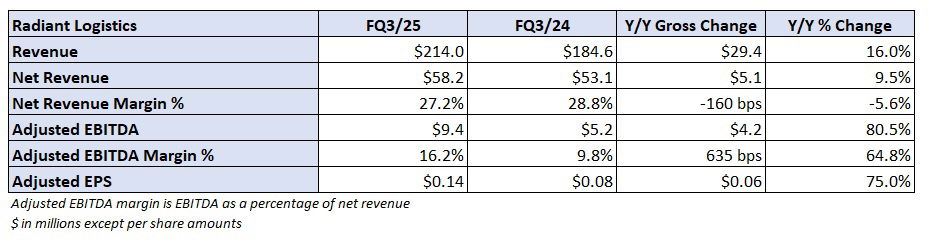
The Renton, Washington-based 3PL reported adjusted earnings per share of 14 cents for its fiscal third quarter ended March 31, 10 cents higher than the consensus estimate and 6 cents higher year over year.

Consolidated revenue increased 16% y/y to $214 million. Revenue net of purchased transportation expenses increased 10% y/y to $58 million. 

Management from Radiant (NYSE: RLGT) said even with the U.S. and China agreeing to step down tariffs while trade talks continue, its fiscal fourth quarter ending June 30 will likely be soft. It said roughly 25% to 30% of the recent quarter’s gross margin would have been impacted by previously announced tariffs. However, it doesn’t believe the slowdown means that shipments will be lost.

“With that said, we also expect that any near-term slowdown will likely result in a corresponding bullwhip effect, with a surge in global trade as these tariff disputes are brought to rest and are encouraged by the de-escalation of U.S – China trade tensions that occurred over the weekend,” said CEO Bohn Crain in a Monday news release.

Table: Radiant’s key performance indicators

Adjusted earnings before interest, taxes, depreciation and amortization of $9.4 million in the quarter was 81% higher y/y. Approximately $2 million of the increase was tied to recent acquisitions.

Radiant ended the quarter with $19 million in cash and only a $15 million outstanding balance on a $200 million credit facility.

The company said its acquisition of Houston-based operating partner Universal Logistics closed at the beginning of the month. Universal has been operating under Radiant’s Airgroup banner since 2001. The acquisition was the third of the year for the company.

Shares of RLGT were up 5.3% in after-hours trading on Monday.

More FreightWaves articles by Todd Maiden:

How to Pass a DOT Audit in 2025 Without Losing Sleep

Fleet compliance is like a diet; it has to be a lifestyle change. It has to be consistent over time. When it’s not, it fails, and those failures can have serious effects on your business. One of those effects might be a compliance review, aka, an audit. For small fleet owners, owner-operators and trucking managers, a DOT audit can feel daunting and threaten their business and livelihood. Whether you run a single truck or manage a small fleet, preparing for an FMCSA compliance review or DOT audit is critical to avoiding costly fines, maintaining your operating authority and ensuring your business stays rolling. With audits happening unexpectedly, trucking professionals must remain proactive to survive one without losing sleep. 

Understanding DOT Audits and What’s at Stake

The Federal Motor Carrier Safety Administration regularly conducts audits, officially called compliance reviews, to ensure trucking companies follow federal safety regulations. These audits dig deeper than roadside inspections, thoroughly examining your safety records, driver qualification files, hours-of-service logs, vehicle maintenance files, and drug and alcohol testing compliance.

Failure isn’t an option. A satisfactory rating after an audit shows you have robust safety practices in place. A conditional or unsatisfactory rating, on the other hand, can seriously damage your business. Conditional ratings mean higher insurance premiums and potentially lost freight from brokers or shippers. An unsatisfactory rating is even more severe; it can shut down your business entirely. According to FMCSA data, approximately 20% of compliance reviews have resulted in conditional or unsatisfactory ratings in recent years, emphasizing the importance of ongoing preparedness.

What Prompts a DOT Audit?

New fleets must undergo a New Entrant Safety Audit within their first year of operation, so establishing compliance measures, systems, and procedures is essential from the start. Fleets in general can be selected for a full or focused compliance review due to:

  • High Compliance, Safety and Accountability (CSA) scores.
  • Repeat violations during roadside inspections.
  • Major crashes.
  • Complaints from drivers or customers. 

Key Areas of DOT Audit Focus and How to Stay Prepared

DOT compliance reviews follow a process from the FMCSA, which is laid out in the Electronic Field Operations Training Manual (EFOTM). Audits focus on several crucial areas to ensure your fleet is audit-ready:

Driver Qualification (DQ) Files

DOT auditors thoroughly examine driver qualifications to ensure drivers hold valid CDLs, current medical certifications and clean driving histories. Your DQ files should contain:

  • Driver application with previous employer checks.
  • Copy of valid CDL and endorsements.
  • Medical Examiner’s Certificate (MEC) and registry verification.
  • Motor Vehicle Record (MVR) is reviewed annually.
  • Certificate of road test or equivalent.
  • Driver safety performance history.

Hours-of-Service Compliance
Hours-of-service violations are among the top reasons trucking companies fail audits. Maintaining accurate records through FMCSA-approved electronic logging devices and regularly reviewing logs for discrepancies is critical. Ensure your drivers understand the ELD system and that your fleet’s data is correctly stored and accessible. Auditors will request:

  • Records-of-duty status (RODS) for the past six months.
  • Supporting documents (fuel receipts, toll records, bills of lading).
  • ELD user manuals and instructions for drivers.
  • Documentation of HOS training provided to drivers.

Vehicle Maintenance and Safety
Vehicle safety and maintenance records are also scrutinized. Keep meticulous documentation of regular vehicle inspections, repairs and routine maintenance. Pay extra attention to brakes, tires, lights and safety equipment. Issues in these areas frequently lead to violations. Essential maintenance documentation includes:

  • Daily driver vehicle inspection reports (DVIRs) for the past 90 days.
  • Scheduled and unscheduled maintenance records.
  • Annual vehicle inspection reports.
  • Documentation of repairs and replacements (brakes, tires, lights, etc.).
  • Preventive maintenance schedule and policies.

Drug and Alcohol Testing Compliance
Your drug and alcohol testing program must align strictly with FMCSA rules. Random testing compliance and preemployment tests are particularly important. Make sure your drug and alcohol policy is clearly documented and enforced, and ensure you’re conducting the required Drug & Alcohol Clearinghouse queries annually and at hiring. Auditors expect:

  • Company drug and alcohol policy document.
  • Preemployment and random test results.
  • Random testing roster and selection process.
  • Annual Drug and Alcohol Management Information Systems (MIS) data summary reports.
  • FMCSA Clearinghouse annual queries.
  • Supervisor training records for reasonable suspicion testing.

Accident Register and Documentation

FMCSA requires all DOT-reportable crashes to be documented clearly in your accident register, accompanied by appropriate supporting documents. Maintain:

  • An accident register listing all reportable crashes within the past three years.
  • Police accident reports, witness statements and driver statements.
  • Evidence of post-accident drug/alcohol testing, where applicable.

General FMCSA Documentation and Filings

Beyond driver and vehicle specifics, auditors will request company-level records including:

  • Current MCS-150 form filed within the past 24 months.
  • Proof of financial responsibility (insurance filings, forms BMC-91 or BMC-91X).
  • USDOT number registration documents (MC numbers discontinued in October 2025).

Recent Audit Changes You Should Know About

FMCSA has recently strengthened audit procedures. For instance, since November 2024, state driver licensing agencies must automatically downgrade CDLs of drivers prohibited in the Drug & Alcohol Clearinghouse. Also, effective June 2025, medical examiners are required to electronically submit DOT physical exam results directly to FMCSA’s National Registry, eliminating paper certificates and placing additional emphasis on electronic record-keeping accuracy.

Eliminated Requirements and Reduced Regulatory Burdens

The return of President Donald Trump’s administration in 2025 has already brought about significant deregulation. Notably, the Beneficial Ownership Information (BOI) reporting requirement, widely criticized by truckers and small businesses as burdensome, has been rolled back. Eliminating this obligation simplifies administrative processes, reducing paperwork and overhead, which is particularly beneficial for small fleets.

How Small Fleets Can Stay Audit-Ready

Preparing for a DOT audit should be a routine part of your trucking operation. Establishing a system for organizing critical compliance documentation, such as driver qualification files, HOS logs and maintenance records, can simplify audit preparations. Regular self-audits and mock DOT audits can help spot and correct potential violations long before an FMCSA auditor knocks on your door.

Many companies find engaging third-party compliance consultants who can provide mock DOT audits beneficial. These mock audits highlight gaps, provide corrective action plans and minimize your chances of negative outcomes. Proactive audits also demonstrate a good-faith effort toward compliance, which can significantly influence the results of a real FMCSA review.

What Happens After the Audit?

If your audit doesn’t go as planned, it’s not the end of the road. FMCSA allows carriers to appeal ratings or request upgrades by demonstrating they’ve corrected violations through detailed Safety Management Plans. Civil penalties can be challenged or negotiated down if approached correctly. Always respond to FMCSA promptly, fully document your corrective actions and take proactive steps to show your compliance efforts. Things to consider:

  • Request an upgrade by documenting corrective actions.
  • Appeal civil penalties, negotiate fines, and demonstrate proactive safety management improvements.
  • Develop a detailed Safety Management Plan that FMCSA can review and approve.

Keeping the Rubber on the Road

Passing a DOT audit doesn’t need to keep you awake at night. Trucking is tough enough without worrying about regulatory fines and potential shutdowns. By staying proactive, conducting regular internal audits, staying organized, embracing electronic compliance tools and promptly addressing problems, you can keep your fleet running smoothly, safely and profitably.

Attorney Brandon Wiseman, president of Trucksafe Consulting, says: “I can’t overemphasize to fleets the importance of understanding a DOT compliance review’s mechanics and potential implications. Being proactive and taking time to study the methodology behind these audits and the types of violations that can lead to problems goes a long way to protect your safety rating and compliance posture.”

Above all, preparation is your best defense. Don’t wait until you’re under review. Make DOT compliance part of your daily operations. With the right preparation, passing a DOT audit in 2025 will be less about losing sleep and more about ensuring your fleet stays safe and successful.

Eight ELDs Pulled from FMCSA Registry and What Fleets Need to Know

On Monday, the Federal Motor Carrier Safety Administration announced it was removing eight electronic logging devices associated with Gorilla Fleet Safety LLC from its list of registered devices. This emphasizes the importance of vendor selection when choosing ELDs to remain compliant and avoid operational disruptions. These devices were removed because they failed to meet the minimum requirements of Title 49 CFR Appendix A to Subpart B of Part 395.

Revoked ELDs

  • AllwaysTrack
  • Command Alkon Trackit
  • ELDX
  • Gorilla Safety Compact ELD
  • HCSS ELD
  • LB Technologies FleetTrack HOS
  • Simplex ELD 2GO
  • Trucker Path ELD Pro

Immediate Actions Required

Motor carriers using these revoked ELDs must:

  • Discontinue use of the revoked devices immediately.
  • Revert to paper logs or compliant logging software to record hours of service data.
  • Replace the revoked ELDs with compliant devices from the FMCSA’s registered list before July 11.

Failure to comply with the deadline will result in violations under 395.8(a)(1) – “No record of duty status,” and drivers may be placed out of service in accordance with Commercial Vehicle Safety Alliance (CVSA) criteria. 

Understanding the Self-Certification Process

In the U.S., ELD providers self-certify their devices’ compliance with FMCSA standards. This process relies on manufacturers asserting their devices meet technical specs without prior independent verification by the FMCSA. The agency monitors compliance post-certification and can remove devices from the registry if they fail to meet standards.

International Certification Practice

Other countries, like Canada, employ third-party certification processes for ELDs. Canada requires ELDs to be certified by an accredited third-party organization before they can be used by carriers, ensuring higher compliance and reliability.

Historical Context

As of April, 1,050 devices are on FMCSA’s Registered ELDs list, all self-certified by manufacturers. Additionally, 248 devices are on the revoked list, 37 have been removed by the agency and 211 have been self-revoked by providers.

Recommendations for Carriers:

  • Due diligence: Research ELD vendors, focusing on their compliance history and customer support reputation.
  • Continuous monitoring: Check the FMCSA’s list of registered and revoked ELDs to ensure your device remains compliant.
  • Contingency planning: Develop a plan to swiftly transition to an alternative, compliant ELD in case of revocation.

For more information on ELD compliance and to view the current list of registered devices, visit the FMCSA’s ELD website: https://www.fmcsa.dot.gov/newsroom/fmcsa-removes-eight-devices-list-registered-elds 

Driverless-truck lobby urges federal action toward full autonomy

Camera on autonomous truck

WASHINGTON — A truck industry lobbying group is urging the Trump administration to modify and streamline federal regulations to spark deployment of driverless trucks on the nation’s highways.

The Autonomous Vehicle Industry Association (AVIA), whose members include autonomous truck tech companies Aurora (NASDAQ: AUR), Kodiak and Plus, as well as FedEx (NYSE: FDX), told the U.S. Department of Transportation that making changes to the current regulations to remove hurdles to deploying driverless trucks will “provide both regulatory certainty and greater operational flexibility” for autonomous vehicle (AV) developers.

AVIA’s recommendations were included in response to DOT’s request for information on regulations that should be eliminated or modified. AVIA’s recommendations to the Federal Motor Carrier Safety Administration and the National Highway Traffic Safety Administration echo objectives outlined by Project 2025, the conservative policy playbook published by The Heritage Foundation in 2023.

“Both [DOT] operating administrations have issued Advance Notices of Proposed Rulemakings that begin the process of updating their regulations to reflect this new technology,” the playbook noted.

“However, these regulations have stalled under the Biden administration, which has chosen to use the department’s tools to get people to take transit and drive electric vehicles instead of helping people to choose the transportation options that suit them best.”

In comments filed with DOT, AVIA General Counsel Ariel Wolf stated that DOT “now has the opportunity to leverage its own previous work along with industry expertise to advance the American AV industry, eliminate or streamline outdated regulations, and ensure that the United States retains its international leadership and competitive advantage as this critical technology continues to grow and evolve.”

In addition to codifying into law a 2018 FMCSA interpretation that states that its regulations do not require a human driver to operate or be present in an autonomous truck, AVIA recommends FMCSA update hours-of-service and inspection requirements that currently require action by a human driver.

FMCSA should also reverse course on its stance on roadside warning devices, the group told DOT. Current regulations require that devices such as orange triangles and flares be placed by a human being in front of and behind a stopped truck, but the agency has denied AVIA-backed exemption requests to allow new cab-mounted beacons that do not require deployment by a human.

“Modifying the existing regulations to allow for the use of cab-mounted beacons instead of driver placed devices not only allows [autonomous] CMVs to meet the warning device requirement, but also gives human drivers a safe alternative to exiting their vehicles on busy highways,” Wolf asserted in his comments.

Wolf’s group is also seeking modifications to the Federal Highway Administration’s truck size restrictions. FHWA currently limits the width of a commercial vehicle to 102 inches, with some exceptions for rearview mirrors and other devices.

AVIA wants the exceptions to be clarified “to expressly include vehicle sensors such as lidar, radar, and cameras, to provide AV developers with added flexibility on the placement of their sensors, to allow for design flexibility and ensure sensors can be placed where they will best serve vehicle safety.”

Click for more FreightWaves articles by John Gallagher.

Logistics firm buys $2M in Trump meme coins to boost US-Mexico trade

Houston-based Freight Technologies Inc. (Fr8Tech) recently invested millions in President Donald Trump’s official meme coins as a way to push for more technology investment and commerce between the United States and Mexico.

Fr8Tech announced on April 30 a $20 million bond agreement earmarked for the purchase of $TRUMP meme coins. Since then, Fr8Tech has made two purchases of $TRUMP totaling $2 million.

“Fr8Tech’s continued investment into TRUMP puts us at the intersection of finance and advocacy,” CEO Javier Selgas said in a news release on Monday. “It reflects our confidence in the long-term value and utility of blockchain-based digital assets and provides a unique opportunity to champion fair and free trade across the U.S.-Mexico border in the interests of our customers.”

Fr8Tech (Nasdaq: FRGT) is a digital freight matching technology for shippers and carriers moving loads between the U.S. and Mexico, as well as domestic U.S. and domestic Mexico shipments.

“While Mexican President Claudia Sheinbaum’s recent comments that the U.S. and Mexico are … ‘working in the coming days on options to improve our trade balance and advance outstanding issues for the benefit of both countries’ is encouraging, we see no reason why a collaborative and constructive framework for fair and free trade cannot be established now,” Selgas said. “We believe both countries have the tools and resources to simultaneously resolve current challenges, such as the flow of fentanyl and other narcotics, and maintain legitimate cross-border commerce.”

In addition to advocating for more trade between Mexico and the U.S., Fr8Tech aims to make the cryptocurrency the cornerstone of its digital asset strategy, officials said.

Fr8Tech’s flagship products — Fr8App and Fr8Now — use AI to connect freight transportation with carriers in real time.

In addition to $TRUMP, Fr8Tech purchased $5.2 million in FET Tokens from Fetch Compute Inc. on April 1. FET Tokens are the cryptocurrency that powers Fetch.ai, a decentralized machine learning platform.

“For Fr8Tech, cryptocurrencies are not just a treasury strategy; they are part of a broader, long-term vision of how technology can enhance logistics, incentives, and the movement of goods,” a Fr8Tech spokesman told FreightWaves in an email. “For example, we are evaluating how carriers, shippers, brokers and other participants in the logistics market can transact, invest and grow using crypto on our Fr8App platform.”

Trump launched his meme coins on Jan. 17, which “celebrates a leader who doesn’t back down, no matter the odds,” according to its website. A business entity linked to Trump owns a large share of the coins, The New York Times reported.

Meme coins are often created out of novelty rather than an investment. However, $TRUMP has generated more than $320 million in fees for its creators, according to CBS News

Trump is raising millions of dollars hosting cryptocurrency-focused dinners, including the $1.5 million-per-plate “Crypto & AI Innovators Dinner” on May 5.

Trump will also attend a dinner on May 22 at his Virginia golf club for the largest investors in the $TRUMP meme coins.

Critics of Trump’s meme coins said the president seems to be using $TRUMP to allow purchasers to buy access.

“Trump appears to be auctioning off access to the presidency,” Noah Bookbinder, executive director of Citizens for Responsibility and Ethics, wrote in an op-ed on MSNBC. “The more of his cryptocurrency that people buy, the higher their chances of meeting Trump at his club.”

Fr8Tech said it hasn’t spoken to Trump or anyone from his administration and does not plan to attend the May 22 event.

Officials for Fr8Tech said they hope the Trump administration keeps commerce with Mexico tariff-free.

“As a North American transportation logistics technology company with a focus on U.S.-Mexico cross-border trade, the Company’s primary concerns are on disruptions and barriers to fair, balanced and free trade,” Fr8Tech said. “Active and productive commerce across the U.S.-Mexico border is essential to the success of our business, as it is to many of our customers and partners. We are naturally concerned about the potential limiting or detrimental impacts that certain trade policies, such as high tariffs, quotas or embargoes, may have on healthy trade and their potential micro and macro-economic repercussions on our customers and partners, and more broadly on economic growth and levels of employment.”

Fuel-Saving Strategies Worth Trying in 2025 – Part 2

As diesel prices continue to bounce unpredictably, your fleet’s fuel strategy has to evolve beyond the pump. Last week, Adam Wingfield shared tools to trim fuel consumption; this week, we’re stepping back to look at the bigger picture, blending high-tech innovations with practical fleet-management techniques that can boost fleet profitability. From safeguarding against fuel fraud to reevaluating your transmission choices, every little detail can add to serious savings.

Fighting Fuel Fraud and Not Overpaying at the Pump

According to industry reports, fuel fraud is a silent thief, quietly draining profits by as much as 10% annually. Motive’s Fuel Card stands out by linking your fuel purchases to real-time truck location data and tank capacities. It also actively searches local fueling options, recommending the cheapest nearby alternative to your preferred stops.

Say your driver habitually stops at TA, but Motive finds diesel 20 cents cheaper across the street at Love’s. It will alert you. Motive automatically reviews purchases, flags suspicious activity and offers a $250,000 fraud-protection guarantee, providing substantial peace of mind.

  • Potential Annual Savings: Up to 10% via fraud prevention and optimized fueling.
  • Cost: Included with Motive subscription.

Transmission Matters 

One area often overlooked by small fleets is the choice of transmission. While many veteran drivers swear by manual transmissions for control, automated manual transmissions (AMTs) and fully automatic options have become incredibly efficient, shaving critical percentages off your fuel bills.

Modern AMTs and automatics shift precisely, keeping engines at optimal RPMs to conserve fuel. Studies by OEMs like Volvo and Freightliner consistently show that automatic transmissions yield 3%-5% better fuel efficiency than traditional manuals. This may seem small, but a year translates into thousands in savings per truck.

  • Potential Annual Savings: 3%-5% fuel savings.
  • Recommendation: Evaluate the cost-benefit for your fleet, especially during equipment upgrades.

Vehicle Utilization – Optimize Your Fleet’s Capacity

An underutilized truck burns almost the same amount of diesel as a fully loaded one, without the revenue. Maximizing vehicle utilization and consolidating loads can significantly reduce unnecessary fuel usage.

One strategy is to use load optimization software or good old-fashioned fleet dispatch planning to eliminate partial loads or empty backhauls. Additionally, consider carefully matching truck size and type to the cargo. Running heavy-duty trucks for lightweight local runs is often wasteful; downsizing where practical can lead to meaningful fuel savings.

  • Potential Annual Savings: Up to 10% through better load planning.
  • Practical Tip: Regularly audit your dispatch patterns and cargo loading efficiency.

Bulk On-Site Fueling – Smart Choice for Regional and Local Fleets

Buying diesel wholesale and storing it on-site can offer dramatic cost savings for fleets that regularly return home. Bulk fuel often costs significantly less per gallon than retail. This option also helps manage driver downtime and improves route efficiency.

Quality is crucial, so storage tanks must be kept well maintained. Dirty or water-contaminated diesel quickly erodes your savings and damages engines.

  • Potential Annual Savings: 10%-15% per gallon savings versus retail prices.
  • Implementation Cost: Setup can range from $5,000-$15,000, depending on tank capacity.

Fleet Telematics – Beyond Just Tracking

Telematics solutions from Motive, Netradyne and Geotab analyze driver behavior, route efficiency and maintenance needs. They also show real-time fuel performance and pinpoint fuel-wasting behaviors like excessive idling, hard braking and aggressive acceleration.

Regularly reviewing this data with your drivers and providing targeted coaching reduces fuel waste.

  • Potential Annual Savings: 5%-10% with effective use.
  • Typical Cost: Around $30-$50 a month per truck.

Idle Reduction – Practical Alternatives to Idling

Idle time is dead money. A top-tier APU like the Thermo King TriPac is exceptional, but budget-conscious options include battery-operated climate-control systems and diesel-fired heaters (Espar/Eberspaecher). Each eliminates the need for overnight idling without a significant upfront investment.

  • Potential Annual Savings: 3,000-5,000 gallons per truck per year.
  • Implementation Cost: $2,000-$8,000 per truck.

Predictive Maintenance – Keep Your Fleet Efficient

Waiting until an engine fault forces downtime is risky and expensive. Predictive maintenance software like Uptake uses sensors and analytics to anticipate problems well before they become breakdowns, reducing unplanned maintenance and associated fuel inefficiencies.

  • Potential Annual Savings: 5%-10% through improved uptime and efficiency.
  • Cost: Approximately $20-$50 a month per vehicle.

Max Mileage Fuel Catalyst

The Pittsburgh Power Max Mileage additive isn’t just hype. It cleans injectors and improves combustion efficiency, making each gallon of diesel do more. Real-world fleet users report consistent fuel economy and diesel exhaust fluid (DEF) consumption improvements.

  • Potential Annual Savings: Additional 3%-5% savings.
  • Typical Cost: About $120 a month per truck.

Smart Routing

Sometimes, fuel savings are less about technology and more about strategy. UPS famously reduced millions of gallons of fuel consumption by minimizing left-hand turns on delivery routes, saving time, avoiding idling and reducing accident risk. Independent owner-operators and small fleets can adopt a similar mindset, optimizing routes by distance and turning patterns, congestion hot spots, and predictable idling points. Using advanced routing platforms like the Garmin dēzl OTR1010 GPS, which integrates real-time traffic, topographical data and live fuel prices, fleets can strategically reroute drivers to avoid high-idle scenarios and costly maneuvers. Coupling data-driven route optimization with practical changes, such as limiting left turns, bypassing congested intersections and identifying alternative fueling locations, can significantly enhance fuel efficiency and profitability.

  • Potential Annual Savings: 2%-5% through route optimization, strategic turn reduction and reduced idling.
  • Cost: Around $900 per Garmin dēzl OTR1010 unit, or minimal cost when implementing practical routing strategies manually.

Tire Pressure Monitoring and Automatic Inflation Systems

Proper tire inflation is important for safety and can dramatically reduce fuel consumption. Systems like the Meritor Tire Inflation System (MTIS) automatically maintain tire pressure while driving, maximizing fuel economy and extending tire life.

  • Potential Annual Savings: 1%-2% fuel savings.
  • Cost: $1,200-$1,800 installed per trailer.

Hiring Fuel-Conscious Drivers (Training Them Right)

Fuel efficiency starts with the person behind the wheel. Not every driver is created equal when it comes to MPG. One driver can squeeze 7.5 MPG out of a load while another barely gets 5.5 MPG on the same route. The difference often comes from training, shifting habits, throttle discipline and mindset. Hiring drivers who understand cruise control, idle management and progressive shifting is a competitive advantage, especially when fuel is 25%-30% of your operating cost.

Hiring is just half the equation. Training closes the gap. Systems like Luma Brighter Learning offer bite-sized, video-driven modules that reinforce fuel-conscious driving behaviors, from maintaining momentum on hills to using predictive cruise and understanding terrain-based throttle control. Carriers using Luma see improved MPG, reduced wear on equipment and fewer compliance headaches.

You can also combine this with Motive’s driver-facing app or coaching tools, which score driver performance, flag aggressive driving behaviors and reward fuel-efficient habits.

  • Estimated Annual Savings: 5%-15% based on driver behavior.
  • Cost: Variable. Often under $10-$20 a month per driver for eLearning programs like Luma.

Bottom line? Smart drivers drive leaner, and trained drivers stay longer. Build a fuel-first culture, and the savings show up in every trip, every mile, every tank.

Small Changes Mean Big Savings

Fuel economy is about habits, awareness and the innovative application of proven tools. Whether it’s learning to live with the automated transmissions, leveraging bulk fueling or cutting fraud with smart fuel cards, the incremental gains add up. Each small improvement can yield thousands of dollars annually per truck.

The bottom line? Pick one or two strategies, measure your savings, and then build upon them. It’s about consistent, incremental improvements. This isn’t a sprint, it’s a marathon, and every mile counts. If you want to keep your trucking business profitable in the unpredictable fuel market in 2025, it’s time to embrace a proactive, comprehensive approach to fuel management.

Work smarter, not harder.

Motive says court has no basis to grant Omnitracs’ request for retrial

Motive is fighting a motion by Omnitracs for a new trial in a copyright infringement case. In seeking a retrial, Omnitracs claimed Motive used prejudiced religious and racial insinuations in court.

Motive’s response, filed in the U.S. District Court for the Northern District of California on Thursday, stated that the jury’s verdict was supported by “substantial evidence,” and that competing fleet technology company Omnitracs did not meet legal standards necessary to overturn the verdict or mandate a new trial.

After a nearly two-year legal battle between Omnitracs and Motive, a federal jury unanimously found on April 24 that Motive was not guilty of copyright infringement.

A week later, Omnitracs filed a motion for a retrial, arguing that Motive “relied on a host of improper and irrelevant assertions designed to prejudice the jury against Omnitracs” because one of the jurors was “presumably Muslim” and wore a head covering.

“In lieu of actual non-infringement evidence, Motive relied on a host of improper and irrelevant assertions designed to prejudice the jury against Omnitracs,” stated Omnitracs’ motion for a retrial. “When cross examining Omnitracs’ technical expert, for instance, Motive lobbed an accusation that Omnitracs (and its witness) were racially and religiously insensitive for not explaining that Motive’s co-founder allegedly used an American-sounding email alias to avoid discrimination from truck drivers against Muslim[s].”

“There may not be a more prejudicial statement to make to a jury in the Northern District of California, particularly when one of the jurors was born and raised in and wore a head scarf every day of trial.”

Additionally, Omnitracs claimed that Motive violated court orders regarding the disclosure of Motive’s legal investigation.

In Thursday’s response, Motive stated that its cross-examination of an Omnitracs expert about a Motive employee who used an American-sounding alias rather than the employee’s real name “to better interface with truckers” was supported by the record, “did not violate any stipulation, and was not prejudicial.”

“Accordingly, such testimony does not even come close to a ‘miscarriage of justice’ and provides no basis for a new trial,” Motive stated.

Motive also disputed Omnitracs’ allegation that it violated the court’s pretrial order when asking a witness a question that “revealed text had been redacted” from a letter between Motive and an individual in October 2018.

“This allegation is demonstrably false,” Motive stated. “[The witness’] testimony is consistent with the unredacted portions of the letter. Critically, these redactions … were agreed by the parties. Additionally, Plaintiffs themselves admitted the October 15, 2018 letter into evidence.”

“Thus, not only did Plaintiffs not object, but they also admitted the evidence [that] they now allege prejudiced them,” Motive continued. “This alone precludes awarding a new trial.”

FMCSA Rule Updates for 2025 and What Fleets Need to Know

As the trucking industry rolls into 2025, fleets face regulatory changes that could significantly impact their operations. From eliminating Motor Carrier (MC) numbers to establishing new requirements for driver qualifications, understanding these changes is crucial for maintaining compliance and ensuring smooth operations.

Elimination of MC Numbers

Effective Oct. 1, the Federal Motor Carrier Safety Administration will discontinue using MC numbers and consolidate carrier identification under USDOT numbers. This move aims to streamline the registration process and reduce fraud.

What this means for drivers and fleets: Carriers will need to ensure their USDOT number is up to date and used consistently across all documentation. This change simplifies the identification process but requires attention to detail during the transition period.

Medical Certification Process Changes

Starting June 23, certified medical examiners must electronically submit DOT exam results to the FMCSA’s National Registry, which will transmit them to State Driver Licensing Agencies (SDLAs). This change eliminates the need for drivers to carry paper medical certificates, reducing administrative burdens.

What this means for drivers and fleets: Drivers should verify that their medical certifications are recorded properly and in a timely manner with their SDLA or DMV to avoid potential issues during inspections or license renewals. Fleets should emphasize the best practice of pulling a motor vehicle report to ensure this process functions correctly. 

Drug & Alcohol Clearinghouse II Implementation

As of Nov. 18, 2024, SDLAs have been required to downgrade the commercial driving privileges of drivers listed as “prohibited” in the Drug & Alcohol Clearinghouse, emphasizing the importance of compliance with substance testing regulations.

What this means for drivers and fleets: Drivers must ensure they comply with drug and alcohol testing requirements to avoid license downgrades. While the Clearinghouse does send out updates when a driver’s record changes, fleets should regularly check the Clearinghouse to monitor their drivers’ statuses.

English Language Proficiency Enforcement

A new executive order mandates that commercial drivers read and speak English well enough to understand road signs, communicate with officials and complete paperwork. Noncompliant drivers will be taken out of service on the spot, a shift from previous policies that issued warnings or citations.

What this means for drivers and fleets: Drivers should self-reflect, determine their level of English proficiency and seek necessary training. Fleets may need to provide language support or resources to ensure compliance for current drivers. For driver applicants, fleets need to determine objective guidelines for ensuring hired drivers are proficient. 

Broker and Freight Forwarder Financial Responsibility

The FMCSA has extended the compliance date for certain provisions of the Broker and Freight Forwarder Financial Responsibility final rule to Jan. 16, 2026. This extension allows for implementing a new online registration system to accept filings and track notifications.

What this means for drivers and fleets: While this change primarily affects brokers and freight forwarders, carriers should stay informed about these developments, as they can impact business relationships and payment security.

Beneficial Ownership Information (BOI) Reporting Requirements

In March, the Financial Crimes Enforcement Network removed the requirement for U.S. companies and U.S. individuals to report beneficial ownership information under the Corporate Transparency Act. This change narrows the scope of reporting obligations to foreign entities only.

What this means for drivers and fleets: U.S.-based carriers are no longer required to submit BOI reports, reducing administrative tasks. However, foreign entities operating in the U.S. must still comply with these requirements.

Non-Domiciled Commercial Driver’s Licenses (CDLs)

The Department of Transportation reviews non-domiciled CDLs to identify unusual patterns or suspicious irregularities. This action follows concerns about the increasing number of non-domiciled CDLs and the need for consistent training and oversight.

What this means for drivers and fleets: Drivers with non-domiciled CDLs should ensure their credentials are valid and comply with FMCSA standards. Fleets employing such drivers must verify their qualifications and monitor regulatory developments.

Broker Transparency

The FMCSA has proposed new rules to enhance broker transparency. These rules require brokers to provide electronic records of transactions and disclose charges and payments within 48 hours upon request. This move aims to protect carriers from fraudulent practices and ensure fair compensation.

What this means for drivers and fleets: Carriers should know their rights to access transaction records and report discrepancies. Staying informed about these regulations can help prevent fraud and promote fair dealings.

Looking Ahead

The Trump administration’s emphasis on deregulation may influence future FMCSA rulemaking. For instance, there is legislative pushback against the proposed speed limiter rule, which would require speed limiters on commercial vehicles weighing over 26,000 pounds. A bill introduced in Congress aims to block the FMCSA from issuing this rule, reflecting the administration’s deregulation.

The FMCSA’s Truck Leasing Task Force also recommended banning lease-purchase agreements between carriers and drivers, citing concerns over financial hardship and exploitative practices. While this recommendation awaits legislative action, it underscores the agency’s focus on protecting drivers’ interests.

What this means for drivers and fleets: Carriers should monitor legislative developments affecting operational requirements. Understanding potential changes allows for proactive adjustments to business practices.

As 2025 and the next four years of an administration focused on deregulation and smaller government unfold, fleets need to stay informed about regulatory changes and potential shifts in policy direction. Engaging with industry resources, participating in public comment periods and adapting to new compliance requirements will be crucial for maintaining successful operations in the evolving landscape of trucking regulations.