Bill would open US shipping to foreign allies

U.S. Coast Guard crew member onboard ship

WASHINGTON — Legislation targeting China’s shipyard industry would also open U.S. domestic shipping trades to foreign operators, a practice currently barred by federal law.

Introduced by U.S. Reps. Ed Case, D-Hawaii, and James Moylan, R-Guam, the Merchant Marine Allies Partnership Act addresses what the lawmakers say are loopholes in the law that incentivize U.S. domestic trade ships to be built and repaired in the People’s Republic of China (PRC).

They contend that the law, known as the Jones Act, creates domestic shipping monopolies that artificially inflate the cost of goods imported to Hawaii and Guam.

“Under long-standing loopholes in maritime law, Jones Act shippers can and do outsource major vessel parts fabrications and modifications to foreign shipyards, primarily those in the PRC,” Case said in introducing the legislation.

“These modifications are not minor, and often include full engine replacements, liquefied natural gas conversions and other critical overhauls. Through further loopholes, these modifications largely avoid the 50% import duty imposed on foreign ship repair.”

Case cited as examples retrofits of Jones Act-compliant container ships operated by Honolulu-based Matson Inc. (NYSE: MATX) recently converted to liquified natural gas at Cosco’s Nantong facility in China, “which has known ties to the Chinese government and military-industrial complex,” he said.

“By closing loopholes that benefit the People’s Republic of China and instead partnering with trusted allies like Japan and South Korea, we can grow our shipbuilding capacity, support good-paying jobs, and deliver real relief for families and businesses,” Moylan said.

According to the text of the bill, the legislation would create a “Foreign Ally Shipping Registry,” composed of countries determined to be a U.S. ally.

U.S. companies would be exempt from the 50% tax on major vessel modifications if the work is performed in shipyards located in allied nations included in the registry.

Companies from those nations would also be eligible to operate foreign-built, foreign-crewed vessels in coastwise trade “under appropriate regulatory conditions, in recognition of the global nature of modern shipping,” Case said.

The Secretary of Transportation would be able to authorize, for renewable five-year periods, “a qualified vessel to transport merchandise by water, or by land and water, between points in the United States to which the coastwise laws apply, either directly or via a foreign port,” according to the bill’s text.

Case insisted, however, that the legislation does not repeal or abandon the Jones Act, but that it “restores the law to its intended purpose – to serve as a foundation for national resilience, industrial strength and strategic security, rather than being hijacked by the hypocritical umbrella of national defense at the expense of increased costs of consumer goods across the country,” he said in introducing the bill.

“It recognizes that modern maritime commerce is global, but that global alignment must be rooted in trust, shared values and common defense.”

Click for more FreightWaves articles by John Gallagher.

New US de minimis policy could trim DHL profit by 3%

A line of yellow DHL delivery vans parked along the dock of the yellow DHL warehouse.

DHL express shipments fell sharply when the U.S. government recently eliminated a waiver on duties and fees for small-dollar shipments arriving from China and Hong Kong. Applying the new rule worldwide at the end of August could reduce projected full-year operating profit by $231 million, the company’s chief financial officer said Tuesday. 

DHL Group increased profits during the second quarter, despite a rise in protectionism and fighting in the Middle East that lowered shipment volume, by successfully eliminating structural costs and improving yield management. 

The integrated parcel logistics giant reported second quarter revenue decreased 3.9% to $22.9 billion, but operating profit grew 5.7% to $1.6 billion with profit margins improving 0.7 of a point to 7.2%. Slower trade activity and negative effects of exchange rates diminished results. 

“We anticipate continued volatility in the global economy in the second half of the year. Our focus on efficiency improvements and growth markets is paying off in this situation. We have adjusted our capacities to the volume development and achieved structural cost improvements,” Chief Financial Officer Melanie Kreis said in the announcement. “This combination has significantly contributed to earnings growth. We are working to further improve our efficiency and leverage growth opportunities in the current environment.”

Express overnight B2C shipments fell 20% in large measure due to the U.S. imposition of tariffs on low-value parcels from China and Hong Kong that previously enjoyed duty-free access. Meanwhile, B2C volumes in Europe for DHL eCommerce were strong, up 11%. 

Rival UPS last week also described how the elimination of the de minimis policy caused average daily volumes on the China-U.S. trade lane to tumble 35% during May and June. That is UPS’s most profitable trade lane, but DHL has less exposure to it. 

Only 8% of DHL Express overnight shipments move from China and Hong to the U.S., while only 4% of DHL Global Forwarding’s airfreight volume is on that route. The carrier last year began to squeeze out low-margin, lighter-weight e-commerce traffic by raising prices and selling the space to freight forwarders with more dense cargo, management said during an earnings presentation on May 2. 

The Trump administration last week declared that the crackdown on de minimis shipments will extend to the rest of the world on Aug. 29. Kreis said the new rule could wipe out as much as $231 million — or 3.3% — from full-year operating profit, but she said that was a worst-case scenario that wasn’t likely to happen. 

“It’s not the likely scenario. That is why we have not included it in the guidance,” she told analysts. 

DHL maintained guidance for operating profit of at least $6.9 billion and free cash flow of about $3.5 billion in what it anticipates as a subdued macroeconomic environment.

Management said the Fit for Growth plan, launched this year with the goal of eliminating $1.1 billion in structural costs by the end of 2026, along with regular capacity adjustments enabled DHL to control expenses. 

DHL Express, for example, experienced an overall volume decline of 10% in its core time-definite international air product (only down 2% in the B2B segment), but was able to increase operating profit and margin through effective capacity management and other savings. DHL took out 7% of airfreight capacity, mostly on the China-U.S. lane, which lowered airfreight network costs by 8%. Express also cut pickup and delivery costs by 5% mostly by reducing U.S. capacity to adjust for the lower inbound package volume from China and consolidating deliveries. The division was also able to reduce full-time employees by 3.2%, while maintaining price discipline. 

Earlier this year, DHL began streamlining the number of partner airlines that supplement transportation provided by DHL’s own fleet. Kreiss said DHL is able to easily flex capacity because it has a mix of long-term, medium-term and short-term leases with a variety of third-party carriers and can move aircraft from less busy to busier routes, as needed. 

“When volumes come back, that will allow us also to flex back up,” she said. 

All divisions recorded lower revenues, led by a 5.7% decline at Express. Revenues for Germany’s postal operator ticked down 0.2%. 

Global Forwarding and Freight produced the worst year-over-year results, with a nearly 30% drop in earnings before interest and taxes on a 5.3% revenue decline. It is the unit most susceptible to volatile market swings. The division recorded a slight increase in airfreight volume, while ocean freight volumes declined 6%year over year. Ocean volumes were flat if two companies that are no longer customers are excluded. Performance was signficantly affected by the economic slowdown and weakness in the German and European trucking sector. 

Kreis said on the analysts’ call that it is too early to determine how the new U.S.-EU trade deal would impact import-export activity because details are still to be finalized, but a 15% U.S. tariff could impact trans-atlantic volumes. 

UPS last week also said U.S. tariff policies and economic weakness dragged down volumes and revenue, but unlike DHL its cost-reduction campaign was unable to prevent a drop in operating profit. About 14% of DHL’s international trade volume goes to the United States.

Kreis said DHL would apply a demand surcharge during the upcoming peak season, as it did for the first time last year, but is still working on the details because of the uncertain macroeconomic environment.

Other DHL divisions also had mixed results during the second quarter. 

DHL Supply Chain increased operating profit and margin with the increased deployment of digitization and automation. The top line would have been flat, instead of down 3.9% if not for currency exchange headwinds. The sluggish global economy is reflected in lower throughput volumes in company warehouses, which is a drag on revenue, said Kreis.

Meanwhile, DHL eCommerce experienced slower volume growth due to economic conditions in some markets. Operating profit declined as the company continued to invest in network expansion, the company said. 

Deutsche Post

DHL credited yield management and cost improvements with stabilizing earnings at Post & Parcel Germany, despite slower growth in parcels amid weak economic conditions, a continued decline in mail volumes and higher costs from new labor agreements. Letter mail volume declined 9% year over year. DHL says the German postal division needs to earn at least $1.2 billion per year so it can fund investments for the transition from letter to parcel business and in clean-energy vehicles.

By the end of the year, Post & Parcel Germany will have 4,900 electric vans from Ford Motor Co. in its delivery fleet after taking delivery of 2,400 E-Transit two-ton and E-Transit Custom one-ton vans, the company said last month. The total number of electric vehicles deployed in P&P will rise to about 35,000, making it the largest electric delivery fleet in Germany. DHL uses the E-Transit, which has an electric battery range of 196 miles, for urban parcel delivery. The smaller version, with a range of 203 miles, is used for letter and parcel delivery in more rural and suburban areas. 

DHL is still extensively investing in products and infrastructure, especially in growth markets, but dialed back capital expenditures by 4% to $703.5 million in the second quarter in response to the uncertain economic climate.

Q2 milestones

During the quarter, the company announced planned investments of more than $570 million in the Gulf Arab states, which are benefitting from shifting trade flows, through 2030. In July, DHL Supply Chain took majority control over Saudi Arabian joint venture ASMO Advanced Logistics Services.  It also expanded capabilities in pharmaceutical logistics by completing the acquisition of Nashville, Tennessee-based speciality courier CrypPDP and expanding its life sciences and health care campus near Frankfurt, Germany. The quarter was also marked by the acquisition of IDS Fulfillment, which expands Supply Chain’s e-commerce warehouse network in the United States.

DHL Express was forced to shut down service in Canada for nearly three weeks in June when the company and employees reached a standoff over a new labor contract. 

In late June, DHL Global Forwarding celebrated the official opening of a new air freight hub at Frankfurt Airport, which consolidates existing facilities in one location and reduces truck movements. The 264,000-square foot cargo warehouse features 54 cross-docks and enables the processing of up to 300,000 tons of air freight for both German and international customers.

The new facility also accommodates the European headquarters of in-house air freight operator StarBroker, which is responsible for booking and coordinating air freight capacities for DHL Global Forwarding and managing controlled flight operations. The new hub facilitates services such as consolidation and deconsolidation of air freight, customs clearance, handling for truck transfers, and organization of charter capacities.

Last month, DHL announced several management changes in its forwarding, supply chain and eCommerce divisions. In an online Q&A on DHL’s website, Kreis praised outgoing CEO of DHL Global Forwarding, Tim Scharwath, for making the division more profitable, customer-oriented and efficient. Oscar de Bok, who will replace him, propelled DHL Supply Chain in 2024 to more than $1.2 billion in operating profit for the first time. 

Click here for more FreightWaves/American Shipper stories by Eric Kulisch.

Write to Eric Kulisch at ekulisch@freightwaves.com.

DHL rotates leaders at forwarding, supply chain divisions

DHL Express Canada reinstates service after workers ratify labor deal 

DHL Express prepares to open $140M cargo facility at Lyon airport

DHL steps up Middle East expansion with $570M in planned investments

First look: GXO Q2 earnings

An employee working on a GXO warehouse floor

Contract logistics provider GXO Logistics beat analysts’ second-quarter expectations on Tuesday after the market closed.

Greenwich, Connecticut-based GXO (NYSE: GXO) reported adjusted earnings per share, which exclude one-off charges like acquisition and restructuring expenses, of 57 cents. The result was 2 cents higher year over year and 1 cent ahead of consensus.

Adjusted earnings before interest, taxes, depreciation and amortization of $212 million was 13% higher y/y.

Consolidated revenue of $3.3 billion was 16% higher y/y and ahead of the consensus estimate of $3.1 billion. The bulk of the growth was tied to recent acquisitions. Organic revenue grew by 6% in the quarter.

Click for full story – “GXO encouraged by pre-peak season activity, well positioned for 2026”

The company inked $307 million in new deals in the period, surpassing $500 million in business wins year-to-date.

“Given our better-than-expected performance in the first half of the year, we are again raising our full-year adjusted EBITDA guidance, following our guidance raise in June for organic revenue growth, adjusted EBITDA and adjusted diluted earnings per share,” said CEO Malcolm Wilson in a Tuesday news release.

The new full-year 2025 adjusted EBITDA guidance is $865 million to $885 million ($5 million higher at each end of the range). The company reiterated guidance for organic revenue growth of 3.5% to 6.5% and adjusted EPS of $2.43 to $2.63. (The consensus EPS estimate was $2.50 at the time of the print.)

Click for full story – “GXO encouraged by pre-peak season activity, well positioned for 2026”

GXO announced that Chief Financial Officer Baris Oran is leaving the company to pursue other opportunities. However, he will remain in place until his successor is named.

“Baris has been dedicated not only to the performance of the company, but to our customers and our people,” Wilson said. “GXO is well positioned for its next chapter of growth thanks, in large part, to his valuable contributions.”

The company announced in June that supply chain veteran Patrick Kelleher will succeed Wilson, who is retiring as CEO this month.

Shares of GXO were up 1.1% in after-hours trading on Tuesday. 

GXO will host a conference call to discuss second-quarter results at 8:30 a.m. EDT on Wednesday.

More FreightWaves articles by Todd Maiden:

Nothing but higher numbers in Expeditors’ quarterly earnings report

Expeditors International turned in a second quarter earnings performance that saw almost all key metrics higher than a year ago.

The company’s revenues at $2.65 billion were up 9% from a year earlier, while its cost of transportation and other expenses rose 7%. That difference helped contribute to an 11% rise in operating income to $650.8 million, up from $575.7 million.

Its year-on-year comparison for the amount of freight moved was higher across the board. Expeditors (NYSE: EXPD) does not disclose actual tonnage, but it does report rates of growth or decline. 

Both air freight and ocean freight kilos moved for the quarter were up 7% from the second quarter a year earlier. For air freight, the month-by-month increases were 9% in April, 4% in May and 7% in June. For ocean freight measured in 40-foot equivalent units,  the gains were 12%, 7% and 4%, respectively. 

Expeditors does not hold a conference call with analysts. But in his comments in the company’s earnings statement, CEO and President Daniel Wall sounded similar to the types of statements made by C.H. Robinson on their earnings call, citing changes in operations as the basis for the strong performance in the quarter.

““Throughout the Expeditors global network, we are seeing the positive impact of our strategic initiatives to maximize operational excellence,” Wall said in the statement.“Our focus on growth and execution puts us in a strong position to quickly adapt to this highly unpredictable environment. We are working with each of our regions and districts to increase efficiency and further optimize customer service to drive organic growth and boost profitability.”

Net earnings per share were up 8% to $1.34 per share. According to SeekingAlpha, that number beat Wall Street consensus by 10 cents per share. The total revenue figure of $2.65 billion was $200 million above consensus.

Stock market reaction is quiet

There was little reaction to the earnings in trading Tuesday. At approximately 3:20 p.m. EDT, the decline in Expeditors stock was about 0.75% to $116.02 on a day when the S&P 500 at that time was down about 0.4%. 

Despite Expeditors being at the forefront of international trade and the impacts from tariffs, its stock price now isn’t that much different that it was a month ago (-1.9%), three months ago (+3.9%) and a year ago (-4.2%). The 52-week low was $100.47 back in April; the 52-week high was $131.59 in September. 

Even in an earnings report where the numbers looked solidly higher, Wall’s statement said average buy and sell rates, in the air and on the water, “remained highly volatile.” Expeditors processed a “substantial increase” in customs clearances, and they “(required) greater skills as they have become more complex” coming alongside the increase in volumes.

Tariff-driven activity a factor

Expeditors did see “pull-forward” business, particularly in its air freight activities. “Capacity remained tight despite new government limits on de minimis shipments, and particularly as customers sought to ship technology and other high-value inventory ahead of trade deadlines,” Wall said.

Getting freight on the water ahead of tariffs also affected Expeditors’ business, Wall said. And ocean freight was impacted as volumes grew, “particularly exports out of South Asia, as customers relocated sourcing to that region and moved freight in advance of extended tariff deadlines.”

But while air capacity may have been tight, that was not the case with ocean freight, according to Wall. “Ocean rates softened throughout the quarter, with demand unable to match increased ocean capacity,” he said.

Although C.H. Robinson (NASDAQ: CHRW) is only tangentially a direct competitor, both it and Expeditors share two key aspects: they are both considered 3PLs, and they are both dividend aristocrats, having increased their dividend annually for at least 25 consecutive years. 

But one difference in the companies is that while C.H. Robinson is shedding a significant number of employees–down 17.4% from the second quarter of 2024 to the corresponding quarter of 2025–the headcount at Expeditors is rising. It was up to 19,666 employees from 18,463 a year ago, for a gain of 6.5%.

More articles by John Kingston

Each driver’s payout in Lytx Illinois biometrics case will be between about $650 and $850

Averitt pay increase could be a sign of some acceleration in driver wages

Sequential numbers at diversified trucking operator TFI International may mark a turnaround

Fleetworthy and Motive Partner to Streamline Toll Management Through Integrated Data

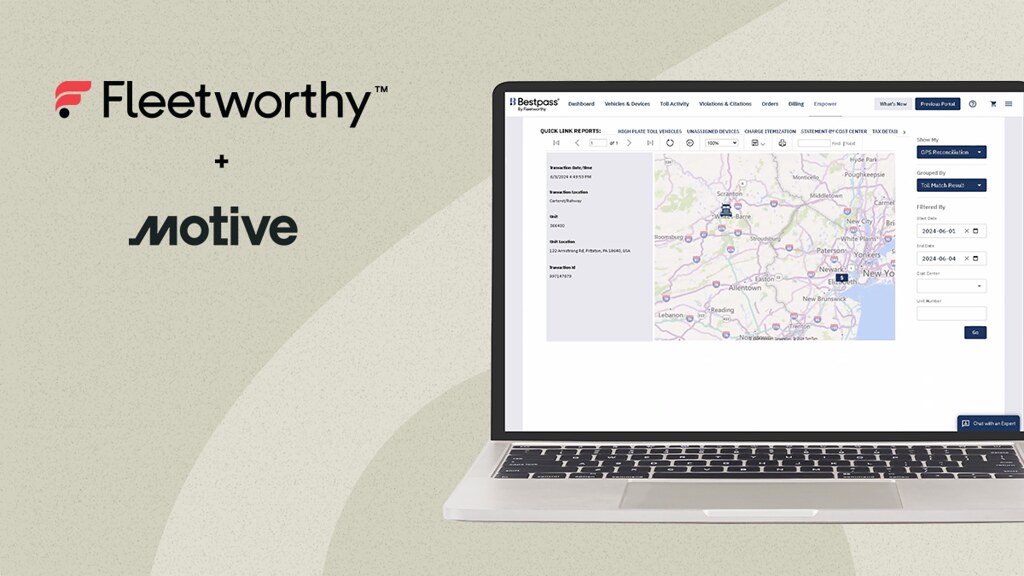
Fleetworthy and Motive have announced a new integration aimed at improving toll management capabilities for commercial fleets. The partnership brings together Fleetworthy’s Bestpass toll management system with Motive’s GPS and vehicle telematics, enabling a more comprehensive view of toll-related activity and associated costs.

A central component of the integration is a tool called Toll Genius, which merges GPS data with toll transactions to provide real-time visibility into toll expenses. By correlating vehicle location data with toll events, Toll Genius can identify inconsistencies such as unrecognized charges or mismatches in billing. This added layer of verification gives fleet managers a more accurate understanding of toll usage across their operations.

The integration also eliminates the need for manual data uploads, allowing information to flow automatically between the Motive and Fleetworthy platforms. Users can access toll insights and reports directly through the Bestpass portal, enabling quicker decision-making and improved responsiveness to potential discrepancies.

Fleetworthy reports that the tool also incorporates machine learning models, which can help detect patterns and streamline compliance efforts. Early adopters have noted reductions in toll errors and faster dispute resolution, suggesting the tool may contribute to improved back-office efficiency.

Shay Demmons, Chief Product Officer at Fleetworthy, said in a news release, “Our goal with Toll Genius is to bring unmatched accuracy, transparency, and insight to toll management. Whether it’s for cost optimization, compliance, or dispute resolution, this new integration gives Motive users the tools they need to run smarter and more efficient operations.”

This initiative aligns with broader trends in commercial transportation, where fleets are increasingly relying on integrated data systems to manage compliance, safety, and operational efficiency. The combined capabilities of Fleetworthy and Motive support this shift, offering fleets tools to enhance cost control while maintaining regulatory readiness.

Fleetworthy serves a wide network of fleets nationwide and offers one of the largest toll management programs available through its Bestpass integration. As data continues to play a growing role in fleet management strategies, solutions like Toll Genius may help operators keep pace with rising expectations around transparency, accuracy, and performance.

Small decline in benchmark diesel price against a backdrop of falling futures numbers

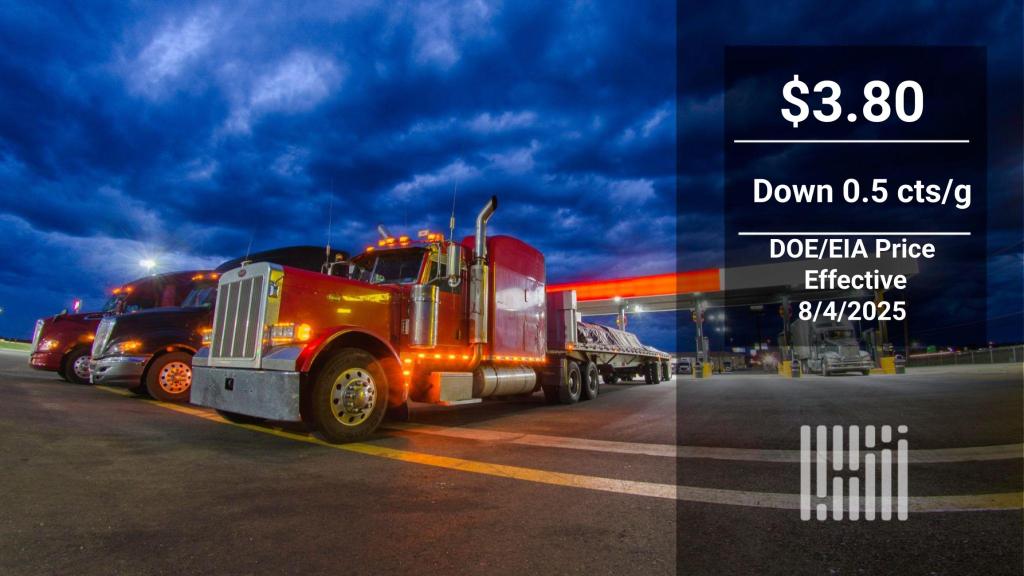
The Department of Energy/Energy Information Administration average weekly retail diesel price declined 0.5 cents/gallon to $3.80/g, effective Monday and announced Tuesday. It follows a decline the week before of 0.7 cts/g. 

Relative calm in the benchmark price comes as a new round of volatility–this one pointing down–is rearing its head in the market for ultra low sulfur diesel (ULSD) on the CME commodity exchange.

In the four trading days leading up to the ULSD settlement Monday, the price of ULSD fell to  $2.3176/g, down almost 15 cts/g from the July 29 settle of $2.4638/g. On July 21, ULSD settled at more than $2.50/g.

But market news has been largely bearish since then. Oil, including crude and diesel, both fell hard Friday in sympathy with the large asset selloff that accompanied the news of the weakest monthly employment report in several months. Prices bounced back only slightly Monday with the rise in equity markets, and resumed their decline Tuesday. At approximately 11:05 a.m. EDT, ULSD was down just over 6 cts/g, a drop of 2.6%. 

Over the weekend, eight members of the OPEC+ group announced an increase in their output of 547,000 barrels/day. That increase would bring the group, which consists of OPEC and several non-OPEC oil exporters nominally led by Russia, close to fully reversing the more than 2-million b/d in output cuts the group has had in effect since spring 2023. 

Diamondback CEO warns of imbalance

The bearish view of the market was laid out Monday in a letter from Kaes Van’t Hof, CEO of Diamondback Energy, one of the largest operators in Texas’ Permian Basin.

In the letter to investors, Van’t Hof said the market could have been worse for an upstream company like Diamondback. “The likelihood of a massive oil supply glut combined with an oil demand shock seems to have dissipated (on the demand side),” he wrote.

But there is no basis for a recovery, he added. “The  projected increase in global oil supply in the second half of this year is hard to ignore,” Van’t Hof wrote. “Although projections are often incorrect in this sector, particularly when consensus is uniformly bullish or bearish (in this case bearish), we still believe we are approaching a yellow light to pull from last quarter’s ‘stop light’ analogy.”

Diesel coming back to earth against crude

One small piece of good news for diesel consumers is that the raging strength of diesel relative to crude has slowed. 

A straight comparison of the front-month price of ULSD to the price of Brent crude, the world’s benchmark, peaked July 21 at more than 86 cts/g. But that spread dropped to almost 64 cts/g by Friday. The average for the year is about 61 cts/g.

Another piece of positive news for diesel buyers is that the spread between the first month and second month ULSD price on CME has narrowed sharply. 

That spread is a function of several factors, but inventories are the largest.  

When inventories are tight, the market will move into a structure known as backwardation, with the front month price higher than the next month, the next month higher than the next one after that, and so on. It is a reversal of the structure of a market in perfect balance, known as contango, when prices rise as they go out the calendar.

That spread got as high as 6-7 cts/g at the end of June, with the front month that much higher than the second month. But by the settlement Monday, it was just 7/10 of one cent, still in backwardation but getting closer to flipping into contango.

One reason: growing inventories. The EIA reported last week that U.S. stocks of all non-jet fuel distillates had risen to 113.5 million barrels. That is an increase of almost 11 million barrels in just three weeks and was the highest number since the end of March.

More articles by John Kingston

Averitt pay increase could be a sign of some acceleration in driver wages

Sequential numbers at diversified trucking operator TFI International may mark a turnaround

At C.H. Robinson, improved profitability, productivity and a lot fewer workers

Freight market’s ‘holding pattern’ continues in July

a lone white tractor pulling a silver dryvan trailer on a rainy highway

The logistics industry continued to expand in July, but the transportation market remains stuck in a “holding pattern,” according to a monthly survey of supply chain professionals.

The Logistics Managers’ Index – a diffusion index in which a reading above 50 indicates expansion while one below 50 signals contraction – returned a 52.6 reading for transportation capacity in the month. While up only 20 basis points from June, the subindex continued to show that any recovery in the freight cycle is unlikely to come from the supply side.

Sentiment around transportation capacity has signaled growth for more than three years now. (The dataset returned neutral readings of 50 twice last year.)

“So long as this metric comes in above 50.0, it is unlikely that we will have a truly robust expansion in the freight market,” a Tuesday report said.

Even with the modest capacity expansion, both transportation utilization (59.5) and transportation prices (63) were up in the month, 6.6 percentage points and 1 point, respectively. 

Most truckload carriers have advanced initiatives to better utilize equipment through the protracted downturn, including the removal of tractors from service. July marked the highest utilization reading since January (60.1), with firms upstream in the supply chain, like wholesalers, reporting expansion (60.7) versus no change (50) among downstream retailers.

Transportation pricing has remained firmly in growth mode this year, averaging a monthly reading of 63.2. The pricing index again grew faster than the capacity index, suggesting the freight market is recovering, albeit slowly. (The pricing dataset has outpaced the capacity dataset by an average of 10 points in each month this year.)

Respondents returned a 12-month-forward prediction of 75.5 for the pricing subindex. 

SONAR: Outbound Tender Reject Index for 2025 (blue shaded area), 2024 (green line) and 2023 (pink line). A proxy for truck capacity, the Outbound Tender Reject Index shows the number of loads being rejected by carriers. Current tender rejections are outperforming prior-year levels but still not signaling a recovery. To learn more about SONAR, click here.
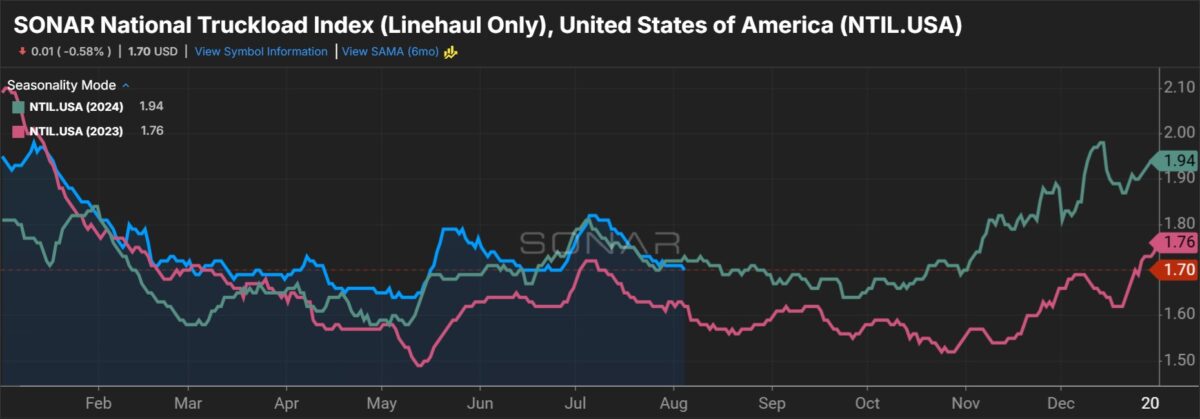
SONAR: National Truckload Index (linehaul only – NTIL) for 2025 (blue shaded area), 2024 (green line) and 2023 (pink line). The NTIL is based on an average of booked spot dry van loads from 250,000 lanes. The NTIL is a seven-day moving average of linehaul spot rates excluding fuel. Spot rates remain largely flat on a year-over-year comparison.

The overall LMI came in at 59.2 for the month, down 1.5 points from June. The all-time average for the dataset is 61.5.

Smaller firms – companies with less than 1,000 employees – and upstream companies drove activity in the supply chain during July, with both reporting higher inventories.

Overall, inventory levels (55.6) fell 4.2 points in the month.

Smaller companies reported rapid expansion in inventory (64.8). Most of the smaller respondents are distributors, wholesalers and logistics service providers that reside in “the middle mile of the supply chain,” between ports, manufacturers and retailers. Upstream firms saw expansion (58.5) versus contraction among downstream companies (47.6). A decline in stock levels among retailers was said to be “due to the start-stop nature of tariffs.”

The growth in inventories kept inventory costs (71.9) elevated, albeit 9 points lower than in June.

Warehouse capacity (51.1) was up 3.3 points, crossing back into expansion territory. Capacity was 10 points tighter for smaller companies given their inventory additions.

Warehouse utilization (59.4) fell 2.8 points while warehouse prices (68.3) were unchanged, maintaining a “robust rate of expansion” in the month.

Logistics real estate investment trust Prologis (NYSE: PLD) said on Monday that it is just a matter of time before market rents increase, noting well-capitalized, large-scale tenants are moving forward with leasing plans despite an uncertain macroeconomic backdrop.

The LMI is a collaboration among Arizona State University, Colorado State University, Florida Atlantic University, Rutgers University and the University of Nevada, Reno, conducted in conjunction with the Council of Supply Chain Management Professionals.

More FreightWaves articles by Todd Maiden:

FMCSA safety chief joins Scopelitis law firm

FMCSA/DOT headquarters in Washington, DC
Sue Lawless. Credit: FMCSA

WASHINGTON — Former FMCSA Acting Deputy Administrator and Chief Safety Officer Sue Lawless will be joining Indianapolis-based Scopelitis, Garvin, Light, Hanson and Feary in October, the law firm announced on Tuesday.

Lawless, who briefly lead FMCSA in an acting role after the resignation of administrator Robin Hutchison in January 2024, will help lead the law firm’s safety practice and will be based in its Washington, D.C. office.

“Sue has been a leader on the front lines in shaping policy and influencing the law within the trucking industry for many years,” said Greg Feary, a Scopelitis partner, in a news release. “Scopelitis is quite fortunate to gain Sue’s superior foresight, skill, and knowledge. She is a perfect addition to our DC office.”

While leading the agency as acting deputy administrator last year, Lawless weighed in on the issue of predatory towing and its effects on trucking in comments filed with the Federal Trade Commission.

“It is detrimental to the overall health of the trucking industry, and it’s time to end excessive rates, surcharges and other unfair fees associated with predatory towing,” she said.

Prior to her position as chief safety officer at FMCSA, Lawless served as director of the agency’s Motor Carrier, Driver, and Vehicle Standards Division, as well as its assistant chief counsel for enforcement and litigation.

Click for more FreightWaves articles by John Gallagher.

PrimeFlight Aviation buys StratAir cargo handling business

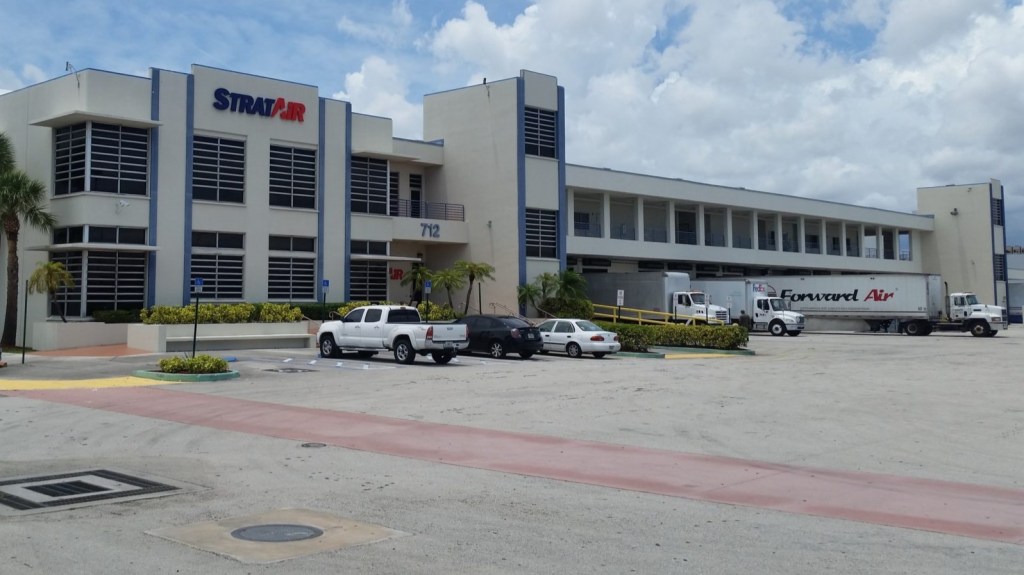
Front view of the StratAir warehouse with a Forward Air truck at the dock.

PrimeFlight Aviation Services has acquired the cargo handling operations of StratAir, an international freight forwarder that has decided to focus on its core business, expanding its footprint and business opportunities at three airports, the company announced on Monday.

The transaction comes less than two weeks after FreightWaves reported that StratAir’s parent company, Seattle-based freight transportation, energy and logistics provider Saltchuk Resources moved to ground the four Boeing 767 widebody freighters operated by subsidiary Northern Air Cargo as the airline retrenches in Hawaii and Alaska utilizing standard-size aircraft on local routes. 

Sugarland, Texas-based PrimeFlight Aviation Services will absorb StratAir’s 120,000-square foot cargo warehouse and workforce at Miami International Airport, as well as ground handling operations in Richmond, Virginia, and San Juan, Puerto Rico, into its cargo division.

PrimeFlight Aviation, owned by The Sterling Group and Capitol Meridian Partners, is an agent for passenger airlines at more than 200 locations, mostly in North America, providing baggage handling, fueling, deicing, and other services. It also provides cargo services in 10 domestic markets, including loading and unloading for Amazon Air in Houston, Kansas City, Missouri; St. Louis, Portland, Oregon; and Ontario, California. In Mexico, It  processes cargo at a dozen locations for passenger airline Viva Aerobus. 

In July, PrimeFlight Aviation acquired a Turkish refueling and aircraft maintenance company. Earlier this year, PrimeFlight acquired London-based Airbase GSE, which offers air container repair and logistics services, as well as cabin repair and maintenance, at Heathrow Airport and Frankfurt Airport in Germany. It also bought Airworld Handling, a cargo and mail handler with a border inspection post business at Heathrow. 

“This acquisition is a key step forward in our mission to build a world-class, integrated cargo handling network,” Craig Smyth, president and CEO of PrimeFlight, said in a news release. The StratAir transaction follows PrimeFlight’s recent acquisition of AirWorld, a cargo and mail handler at London Heathrow Airport.

The addition of London and Miami facilities gives PrimeFlight cargo infrastructure at two large international air hubs. 

“Together, these investments reflect our commitment to developing a scalable platform focused on high-volume cargo gateways and specialized product handling — supporting the industry’s growing demand for time-critical and e-commerce-driven logistics solutions,” Smyth added. 

Saltchuk Aviation, the former owner of StratAir, supported its growth since acquiring the company in 2016. Northern Air Cargo operated a couple 767 freighters on a charter lease with StratAir.  It also laid off 30 employees, in addition to winding down 767 operations. 

PrimeFlight said StratAir’s operations will function under its current brand, but over time the business will transition to the PrimeFlight name. Terms of the deal were not disclosed.

The legacy StratAir will continue to conduct import/export business from its distribution center near Miami airport, Amanda Byers, a PrimeFlight vice president, confirmed. 

Click here for more FreightWaves/American Shipper stories by Eric Kulisch.

Northern Air Cargo abandons big freighter aircraft, cuts staff

Each driver’s payout in Lytx Illinois biometrics case will be between about $650 and $850

A case involving in-cab video company Lytx and the closely-watched Illinois state law on biometric surveillance is coming to an end with a judge’s recent approval of the settlement reached by the two sides several months ago. 

The case had three named plaintiffs and a broader class of drivers, with carrier Maverick Transportation and Lytx as defendants. 

The settlement of $4.25 million brings an end to the litigation–which never made it to a trial–that began with a state lawsuit filed by driver Joshua Lewis in November 2021 against Maverick, which employed him, and Lytx. Later cases were ultimately all combined into the one now-settled lawsuit that made its way into the federal court system. The settlement is in the U.S. District Court for the Southern District of Illinois. 

At issue was Lewis’ complaint that, according to the initial lawsuit, the Lytx system would “scan the driver’s face geometry and harnesses those biometric data points by feeding them into sophisticated algorithms that identify the driver’s actions, in what amounts to constant AI surveillance.” Maverick used Lytx’ system. 

Illinois is ground zero for biometrics law

And it was Illinois that ended up as the venue for the lawsuit because its law on biometrics–the Biometric Information Privacy Act (BIPA)–is considered one of the stricter in the country, and has been a focus for law firms involved in the issue. It was first approved in 2008 and amended in 2024 to make it less onerous against corporations than as previously written.

In an online commentary on why Illinois’ law has taken center stage in the discussion over the legal limits of surveillance and biometrics, law firm King & Spalding said BIPA “has become the leading biometric data privacy law in the country due to its private right of action for injured individuals.”

The settlement agreed to by the two sides was first submitted to the court in January. With the approval last week of Judge Nancy Rosenstengel, it lays out what individual drivers who responded to the solicitation to join the class of plaintiffs will receive.

Out of the final settlement of $4.25 million, one-third will go to the lawyers for the plaintiff, approximately $1.42 million. 

Ultimately, the court received responses from 3,599 unique individuals with 2,061 of them from Illinois and 1,538 from out of state. 

Each of the Illinois residents will receive approximately $631 and each non-Illinois resident will receive $845, according to a document filed by Lytx and Maverick attorneys in support of the settlement. The difference between the two is because the settlement called for 50% of the payouts to go to Illinois residents with non-residents accounting for the other half.  

The three named plaintiffs in the case, including Lewis, will each receive $10,000.

How the payouts compare

In the document, Lytx and Maverick described these amounts as “substantial” compared to other class settlements. The attorneys cited individual payouts in several other instances of BIPA-related litigation for comparison, ranging from a high of $188.59 to a low of $47. 

The Lytx/Maverick document said the estimated full pool of potential class members at about 85,000. About 22.5% were contacted. Ultimately, the court received responses from 3,599 unique individuals seeking to become part of the class, with 2,061 of them from Illinois and 1,538 from out of state. 

Another transportation-related case over BIPA involving railroad BNSF resulted in a payout of about $1,000 per individual.

The core of the plaintiffs’ argument was that Lytx violated drivers’ rights by not having a “publicly available retention schedule and guidelines for the destruction of biometrics,” and that its communications with drivers about the system were inadequate. 

In a statement emailed to FreightWaves, a Lytx spokesman said the company was “pleased to put this settlement behind us. Although we maintain that these lawsuits are not warranted, we’re continuing our focus on delivering category-defining driver safety technology to meet the evolving needs of today’s fleets.”

Lytx, on its website, has made its view clear of the relationship between its system and BIPA. 

“Lytx firmly believes that BIPA does not apply to Lytx’s technology and that these lawsuits are not warranted,” the company said in its statement. “As designed, Lytx’s in-vehicle Machine Vision + Artificial Intelligence (“MV+AI”) Alerting System does not collect retina or iris scans, facial geometry, or any type of biometric data, for any purpose whatsoever. Our in-vehicle MV+AI technology detects driving behaviors, not the identity of a driver.”

Was a precedent set?

With a settlement, the company’s defense of its product and its compliance with BIPA didn’t get a chance to be heard in court. 

However, in a blog post on the website of Milberg Coleman Bryson Phillips Grossman, one of the law firms that represented the plaintiffs and the class, the firm noted that an earlier attempt by Lytx and Maverick to have the case dismissed was rejected.

While the law firm conceded that “no precedent has been set on whether Lytx’s system constitutes a BIPA violation,” it also saw the rejection of the defendants’ move to dismiss as having significance.

“In denying dismissal, the court reinforced a key feature of BIPA: the law’s protections apply regardless of whether biometric data is used for actual identification,” the law firm said. “That interpretation reaffirmed BIPA’s emphasis on the type (their italics) of data collected, not its immediate identifiability, and continues to drive litigation risk for companies deploying biometric and AI technologies in Illinois.”

More articles by John Kingston

Averitt pay increase could be a sign of some acceleration in driver wages

Sequential numbers at diversified trucking operator TFI International may mark a turnaround

At C.H. Robinson, improved profitability, productivity and a lot fewer workers