DHL eCommerce to merge with UK courier Evri

Light blue Evri delivery vans and heavy trucks at an Evri warehouse dock.

Global parcel logistics powerhouse DHL announced Wednesday it is taking a significant minority stake in Evri, a large dedicated parcel delivery company in the United Kingdom, and will merge its e-commerce division with the company.

The deal combines Evri’s specialty courier capabilities with the scale of DHL eCommerce’s U.K. and international networks, and brings Evri into the business letter market for the first time. The companies touted their ability to provide small and medium enterprises with a one-stop-shop capability for mail, lightweight, large, high-value, B2B, international delivery and fulfillment services. 

The integrated operations will deliver more than 1 billion parcels and over 1 billion business letters annually, according to a joint news release.

E-commerce is one of several sectors DHL Group has targeted for investment because of their high-growth potential. Earlier this year, it gained a stake in Ajex Logistics Services, a parcel carrier in Saudi Arabia.

Evri delivered more than 800 million parcels last year and reaches about 85% of households in the U.K. On average, it serves more than 12 million customers per week. Top clients include Marks & Spencer, John Lewis, Etsy and Vinted. The delivery company recently inked a deal with UK shopping platform Eflorist to deliver flowers.

The company was previously named Hermes when acquired in 2020 by private equity firm Advent International. It relaunched in 2022 as Evri with a heavy investment in infrastructure and technology aimed at improving reliability. The company was acquired last August by New York-based private fund manager Apollo.

Evri has more than 8,000 employees, 25,000 independent couriers and a growing network of fulfillment hubs and depots. The combined operation will include more than 12,000 personnel and 30,000 couriers. 

In addition to providing customers more choices for next-day and standard deliveries, Evri’s courier service will be folded into DHL eCommerce’s premium van delivery network for time-sensitive, high-value, and larger B2B and B2C parcels and be rebranded Evri Premium.

DHL eCommerce is a division within DHL that provides parcel delivery, returns and international shipping customized for online merchants. 

DHL (DHL.DE) will also expand Evri’s international reach by utilizing DHL eCommerce’s extensive expertise in cross-border parcel shipping and its global network of nearly 150,000 access points. By connecting to DHL’s own eCommerce network in Europe, the United States and certain markets in Asia, Evri shipments will have faster transit times, DHL said.

The combined DHL-Evri group will retain DHL’s UK Mail unit, giving e-commerce businesses more options for sending lighter-weight items. Customers will also benefit from the group’s store and locker network for parcel delivery and collection. 

“We are excited that DHL eCommerce UK will merge with Evri to bring together two highly complementary UK businesses – committed to innovation and offering customers and clients the best possible service. By combining Evri’s scale, innovation and DHL eCommerce’s best-in-class premium van network, we are creating the pre-eminent parcel delivery group in the UK. Over the last decade Evri has grown ten-fold in size and this transaction will further expand our access into the European and global e-commerce markets,” said Evri CEO Martijn de Lange in the announcement.

Completion of the transaction is contingent on normal regulatory approvals and other closing conditions. Evri will continue to be majority-owned by Apollo-managed funds.

DHL Group generated about $88 billion in revenue last year. Group revenue increased 2.8% in the first quarter to $23.7 billion year over year, with operating profit up 4.5% to $1.6 billion.

Click here for more FreightWaves/American Shipper stories by Eric Kulisch.

UPS to eliminate 20K jobs as Amazon decoupling accelerates

Analyst: Amazon’s $4B rural delivery investment aimed at slowing Walmart

DHL cuts ties with cargo airlines as efficiency initiative ramps up

FedEx converts parcel freighter to heavy cargo operation

Despite red ink at Heartland, Morgan Stanley report relatively upbeat

With Heartland Express holding no conference call with analysts and recording a series of unprofitable quarters, outside reviews of the truckload carrier’s performance can be infrequent.

But the transportation team at Morgan Stanley led by Ravi Shanker has done so for Heartland’s first quarter. And despite another quarter of both operating and net losses at Heartland, the Wall Street investment firm, in a report released Tuesday, kept its rating of equal weight – EW – on the truckload carrier’s stock, which is down about 20.5% in the past three months and 22.5% in the past year. 

The stability in Morgan Stanley’s outlook was driven in part by statements Heartland CEO Mike Gerdin made in the release of the earnings. Gerdin said Heartland (NASDAQ: HTLD) would “strategically shrink the fleet in order to right size to freight demand along with evaluating all cost measures for opportunity for efficiency.’’

“It is encouraging to see Heartland outline fleet size and cost actions following 7 quarters without an operating profit,” Morgan Stanley wrote. 

But the analysis also questioned whether such a decision should have been made earlier. “The decision to rightsize the fleet begs the question of whether this may be a little too late, as we suspect the second half to likely see a strong rebound as a 1H drawdown of inventory leads to a back half restock,” Morgan Stanley wrote. 

Optimism assumes a tariff ‘resolution’

However, the “caveat” to that statement, the analyst team wrote, is assuming a “favorable tariff resolution and no material step back from the consumer.” Morgan Stanley used a recently popular term to describe the phenomenon of a sudden disappearance of imported freight from China due to tariffs: the “air pocket,” in which supply suddenly plunges. “We hope that 1Q becomes the inflection point; however, a 2Q air pocket presents some further risk of deterioration,” it wrote.

If that air pocket is limited and there is a restocking-driven trucking market, Morgan Stanley sees an opportunity for Heartland, “depending on how well [it] is able to capture the cyclical upside as it materializes.”

That situation creates the possibility of “cyclical torque” at a level greater than usual for Heartland, Morgan Stanley wrote, with the “current starting point and cost actions acting as a coiled spring.”

Even though the equal weight rating wasn’t changed, Morgan Stanley did reduce its earnings forecast for Heartland. The new per-share forecast over the next three years is minus 12 cents in 2025, 59 cents in 2026 and $1.16 in 2027. The earlier forecast was plus 12 cents per share this year, 78 cents in 2026 and $1.25 in 2027. Its price target remains $12; Heartland closed Tuesday at $8.91.

The diluted loss per share at Heartland last year was 38 cents.

100 basis point OR turnaround?

By 2027, Morgan Stanley is predicting an OR for Heartland of 90.1%. Heartland’s adjusted OR in 2024 was 101.7%. A year earlier, it was 95.4%.  

In spelling out its “thesis” as to why Heartland is considered equal weight, Morgan Stanley said the market already has priced in the company’s cyclical risks as well as what it called its “idiosyncratic risks.”

“Heartland has historically been defensive in cycle downturns and the stock has been countercyclical since 2014, both of which should hold it in good stead,” Morgan Stanley wrote. It also said any risks to the financial impact from a decline in used truck pricing is “more than priced in and risk-reward looks balanced here.”

That price target is the base case. Morgan Stanley said the bear case for the stock would be $6, if a “recession outweighs restock.”” A bull case of $17 would be if “macro growth accelerates.”

A request for comment left by FreightWaves to Heartland had not been responded to by publication time. 

More articles by John Kingston

California deal with 16 states would end key parts of Advanced Clean Fleets rule

2 markets in 1 quarter: Auto-hauling demand volatile for Proficient

New Jersey, feds take opposite paths on independent contractor rules

How Samsara is revolutionizing fleet management with data and AI

Samsara, the leading connected operations platform, recently hosted a panel on how automation is transforming the way businesses manage their fleets through advanced data analytics and artificial intelligence. 

In an interview following the event, Samsara co-founder and CEO Sanjit Biswas and Chief Product Officer Kiren Sekar sat down with FreightWaves to talk about how the company’s technology is helping customers automate operations, improve safety and prepare for an autonomous future.

Data and AI driving automation

Across Samsara’s customer base, data and AI are changing fleet operations through better customer experiences and improving safety. According to Biswas, one of the clearest examples is in the automation of estimated time of arrival notifications.

“One of the themes we’ve seen across the customer base is automation helps with customer experiences for their end customers,” said Biswas. “Think about estimated time of arrival. If you’re in field services, if you’re in utilities construction, you want to show up on time, and if you can’t show up on time, you want to notify the customer that you’re going to be a little delayed.”

What previously required multiple driver check calls can now be automated through Workflows and AI, providing multistop ETA calculations that adjust throughout the day as conditions change.

Safety management has also been augmented and improved by automation. With safety managers’ limited time, AI-powered coaching has become a huge time saver. “Safety managers have only so much time in the day. They can’t sit down with drivers and coach them every day. If you can automate that and provide some tips and tricks at the end of that shift, or maybe the end of the week … it makes everyone’s life a little bit better,” Biswas explained.

Sekar noted that customers using Samsara’s AI safety technologies have seen marked improvement in accident reduction – often 25%-50% – by using AI and Samsara systems.

Establishing a baseline level of safety also sets expectations when customers look to adopt autonomous solutions. “Now, when we think about introducing autonomy, it gives customers a baseline, because you always want to say, considering autonomy, it actually shouldn’t be just as good as a human. It actually needs to be significantly better,” added Sekar.

Evolving with customer operations

As customers become more comfortable with automation, Samsara has observed that they quickly expand their integration footprint. This has prompted the company to develop streamlined, one-click integration processes.

“What we’re seeing is our customers, once they get started with automations and integrations … they’re on a roll,” said Biswas. “We see our large customers integrate us with half a dozen systems. So what we’re doing now is trying to streamline that process to make it basically one click.”

This approach has manifested in an app store-like setup that makes connecting with transportation management systems, fleet management companies and other operational software simple enough for operations teams to handle without extensive IT support.

Sekar emphasized that data provides critical insights for companies considering autonomous technologies: “With our platform, specifically, customers have data into their safety, into their efficiency, into their routes, into their asset utilization. They can find the bottlenecks, and they can use those to say, OK, when I’m ready to start embracing autonomy, … I can see where it’s going to have the biggest impact.”

Making informed decisions with AI and data

For fleet operators, making data accessible and actionable is just as important as collecting it. Samsara focuses on helping customers turn raw information into concrete improvements through recognition programs and clear metrics.

“The way you make informed decisions is by using data and making sense of that data,” Biswas noted. “One of the interesting things we’re seeing with the customer base is basically rewards and recognition programs. So if someone’s doing great on their miles per gallon, like they’re really fuel-efficient, or they’re doing great with their driver logs and they maintain compliance, … we’re helping make that easy.”

Rather than overwhelming fleet managers with extensive reports, Samsara’s AI highlights what needs attention, enabling more effective decision-making. “No one wants to sit in piles and piles of reports. You just want the AI to tell you what needs to happen, and that’s a lot of what we’re doing,” added Biswas.

The power of OEM integrations to enhance data flow

Samsara’s partnerships with major equipment manufacturers like Ford, GM, Caterpillar, John Deere and Freightliner are also allowing customers to incorporate data from their assets directly into the Samsara platform.

“The assets, the equipment that’s coming off the line these days [are] more sophisticated than ever. There’s a lot of data available on there,” said Biswas. “Because of our scale, we’re able to build some pretty deep relationships with them that could be on everything from engine fault codes and understanding what’s going on under the hood, to tire pressure monitoring, just to overall servicing.”

Sekar added that this integration capability is particularly valuable for companies with diverse assets: “If they’re a logistics company, they typically buy trucks from multiple vendors. If they are [a] field services company, they have medium duty, heavy duty, light duty. They might have construction equipment, forklifts. They have very diverse assets.”

The cloud-to-cloud integration with newer equipment that comes with built-in connectivity has been a game-changer, especially for large fleets. “In some cases, we have customers who do not have to install any hardware,” Biswas remarked. “The whole idea is to make it practical for them to get the data. We’re not religious about the hardware; if the OEMs can partner with us on it, we love it.”

Preparing for the future of fleet management

As technology improves, Samsara recognizes that fleet management has expanded beyond just vehicle tracking and into driver training and development. 

“Fleet management used to be about the trucks and compliance and fuel mileage and things like that. Now this is about people and like, how do we do training? How do we do enablement? How can we make that driver’s experience even better?” said Biswas.

This approach is important as companies continue to face driver recruitment and retention challenges. “If you think about the driver experience and retention, and recruiting, it’s a huge problem,” noted Biswas. He adds that anything that can be done to make the front-line experience better will result in the overall organization getting better.

Sekar highlighted two essential elements in Samsara’s strategy for future-readiness: “One is customer feedback. … The most important thing is spending time with operators, with drivers, with mechanics, with dispatchers … understanding what’s working, what opportunities they see, what challenges they have.”

The second element is substantial investment in research and development. “We invest hundreds of millions of dollars a year in R&D to continue to evolve our products, because this problem set is not static,” Sekar explained.

With fleets increasingly blending human operators with autonomous technologies, Samsara’s technology is situated to provide a unified view to help customers understand performance across their entire operation. This allows companies to rethink operational strategies to take advantage of emerging capabilities like nighttime autonomous driving or energy-optimized scheduling.

With a strong foundation in data analytics and AI, Samsara is poised to help companies manage their current fleets while better preparing them for a future in which automation and human expertise work hand in hand to create safer, more efficient operations.

Click here to learn more about Samsara.

Flock Freight’s shared truckload model hauls in $60M Series E

In an industry up against rising costs, inefficient capacity and margin erosion, Flock Freight just made it clear it’s not pivoting, it’s persevering. With a $60 million Series E raise led by O’Neil Strategic Capital and joined by Susquehanna Private Equity Investments, SignalFire, GLP Capital Partners, Bracket Capital and other, unnamed investors, the company has committed to its shared truckload technology.

“We’re not here to talk about launching a new TMS or some new product. We’re really thrilled and thankful to be who we are. We will continue to keep growing our business and building shared truckload technology that works really well,” founder and CEO Oren Zaslansky told FreightWaves.

Flock Freight is focused on a future where fewer trucks move more freight more efficiently. Zaslansky has long fought against the absurdity of what he calls “shipping air.” According to a company study, roughly 58% of truckload shipments moved as partials in 2024, leaving an average of 34 linear feet of deck space underutilized.

The core offering, Shared Truckload (STL), allows shippers to pay only for the space they use, effectively pooling multiple shipments into one truckload without the traditional cross-docking of LTL. This focus can result in better service, lower costs and a tangible reduction in emissions, Zaslansky explained.

What makes Flock Freight’s model work is its pairing of deep freight knowledge with hard tech. Its AI-powered optimization engine evaluates more than 3 trillion freight combinations to form STL routes in real time. The pricing engine allows customers to receive instant shared truckload quotes online, without the delays that typically plague partial shipment bookings.

Enterprise shippers are taking note, including Academy Sports, which reported a 16% cost savings on underutilized loads since adopting Flock’s STL solution.

Oren Zaslansky speaking at FreightWaves’ F3 in 2023. (Photo: Jim Allen/FreightWaves)

Zaslansky said the company is partnering more with managed transportation or procurement providers, which are increasingly recognizing Flock Freight’s unique capabilities. The company is positioning itself not as a competitor to procurement platforms, but as a specialized supplier that can solve a problem they cannot.

The Series E funding will fuel several key initiatives, including continued hiring of both top technologists and freight veterans, expanded integration capabilities for enterprise customers, deeper partnerships with managed transportation providers, and enhanced tools for carrier engagement.

“We’re focused on innovating new ways to just be frictionless,” said Zaslansky.

As part of the round, Dean Carlson, investor at Susquehanna International Group, will join the company’s board.

“Flock has demonstrated impressive growth, consistently achieving double-digit gross margins while delivering exceptional value to both shippers and carriers. Even amidst challenging freight market conditions in recent years, their innovative Shared Truckload model has proven unmatched in creating efficiencies that no other brokerage can replicate. We’re looking forward to supporting their continued momentum,” said Carlson in the release.

The funding comes at a time when others in the FreightTech sector are pivoting, consolidating or closing up shop. Flock, by contrast, is holding its course. 

“We are not becoming a freight consolidator. The freight is never going to come off the truck. … It’s going to get loaded into the trailer, and it’s never going to come off until it gets to its final destination. The ability to do that, coupled with the optimization work we do, that’s a technological solution that we’ve had to invent in order to bring STL to the market.”


Cyberthreats surge against US logistics infrastructure

Is English proficiency enforcement the right focus for safer roads?

Aurora goes driverless with partners Uber Freight, Hirschbach

CSX lost out on $1 million a day in Q1 revenue amid hurricane, tunnel work

Rebuilding from hurricane damage and a major tunnel project cost CSX a million dollars a day in lost revenue in the first three months of the year, the railroad’s top financial executive told an investor conference.

“We got hit in the first quarter; it was a difficult winter,” said Executive Vice President and Chief Financial Officer Sean Pelkey, speaking at the Bank of America conference in New York. “There were a hundred million dollars in revenue opportunities we missed, a million dollars a day, because of constraints on our network.”

The railroad (NASDAQ: CSX) continues to rebuild its 60-mile line through eastern Tennessee and western North Carolina after Hurricane Helene devastated the region in September 2024.

Pelkey said reconstruction is expected to last “through the better part of this year” before completion in October or November. “There’s a massive amount of work there,” he said.

Detours of trains around the rebuilding of Baltimore’s Howard Street tunnel also hurt network performance. Pelkey said tunnel construction to accommodate doublestack trains is expected to be completed in eight months, slightly ahead of schedule. “Some clearances need to get done, and there is work on some bridges; we’re relying on the state for that. We see reopening the beginning of the fourth quarter.”

After a difficult start to the year, CSX saw a reset in April.

“We needed fewer cars online, sitting in yards and at customers’ facilities,” said Pelkey. “We saw 80% trip length compliance for the fourth week in a row; we were at the 60 percents earlier this year. We are getting back to scheduled railroading, not that we got away from it, but we were dealing with difficult operating conditions.”

Normal seasonality has seen volumes pick up in unit coal trains, metals and fertilizers, among other commodities. 

Just as the winter was receding, CSX got hit by more severe weather, from flooding to tornadoes across portions of its territory.

“The team was hunkered down in Jacksonville [Florida operations center], and we were like, ‘Crap, we gotta deal with this now?’ We did see some effects. For example, one of our interchange partners had a bridge out in a key part of our network.”

The pause in tariffs agreed to this week by China and the United States is expected to have less of an impact on East Coast-based CSX, Pelkey said. “There is probably a lot of inventory sitting in West Coast warehouses that will come east. If we see a little lull in intermodal across Chicago, there may be an opportunity to pick up some incremental business and combine trains.”

The company recently completed a new contract with the Brotherhood of Locomotive Engineers and Trainmen (BLET), leaving its conductors represented by SMART-TD as the only union without a new deal. Pelkey pointed out that the BLET has a single agreement across the system, while conductors have multiple agreements covering, for example, some employees working east-west trains while others work north-south out of some terminals, a legacy of the carrier’s predecessor railroads. Pelkey said the company considers it a priority to have all single-system contracts.

Even with a decrease in health care costs, CSX will see wage inflation of 4.24% this year — above the increase in labor costs that are projected to rise less than 3%. “We can offset that with [freight] pricing gains, for sure, and it comes down over time,” Pelkey said. 

While freight volume growth was off 1% in the first quarter, it is up 3% so far in the second quarter, and the railroad is expecting growth for all of 2025, said Pelkey, “We are encouraged by the demand picture, trade and tariffs in terms of trade and demand. Aggregates, grain and intermodal are very, very strong so far this year before hitting that ‘air pocket’ caused by tariffs.”

The cold winter helped CSX move more coal, with carloads up six consecutive quarters to date, accounting for 11% of total carloads. Pelkey said CSX is moving more export coal after the collapse of the Key Bridge in 2024 hurt that business at the Port of Baltimore, a key loadout for international shipments. CSX handled 44 million tons of export coal in 2024 and forecasts 2025 to be better by 10%. The railroad made some system investments, including at the Curtis Bay Pier in Baltimore, for improved reliability. “We have moved a total 10% more export coal over the past decade,” said Pelkey.

Among other commodities:

  • Fertilizer shipments are up 12% quarter to date on steady demand after CSX cycled through the effects of a customer fire in 2024.
  • The metals business serving automotive and construction that had a 60%-70% order fill is now at 90%.
  • Automotive volume is up by single digits, against competition with what Pelkey said was a ‘below cost trucking’ rate at $1.49 per mile.
  • International intermodal is the biggest driver of gains, in double digits year to date, with domestic intermodal flat to slightly up.

Pelkey said intermodal service reliability in the first quarter paid off in volume growth, and he highlighted intermodal provided in cooperation with CPKC (NYSE: CP) and Schneider National (NYSE: SNDR) for cross-border connections linking Mexico, Texas and the U.S. Southeast.

While Pelkey did not offer guidance for the second quarter, he said CSX expects sequential growth from the first to second quarter as volumes pick up and service gets better. Pelkey said that “we still feel good about” the company’s Investors Day guidance from November.

A total of 40-50 industrial projects are slated to start on the CSX network this year, Pelkey said, with 24 having come online since the beginning of the year and 37 in the pipeline. “Annual run rate will support 1-2% volume growth,” he said, adding that CSX has 600 projects in various stages of development.

The number of freight cars on the network spiked to 140,000 in the first quarter as velocity fell and dwell time increased. To clear yards, Pelkey said, CSX added 45 locomotives that were out of service, rebuilt 20 others and added weekend time for engineering work. 

Tactically, Pelkey said CSX combines trains where it can to improve business and is leaning into AI and advanced analytics to improve operations. 

“Railroads have not unlocked that capability yet,” he said. “A lot of decisions are made using visibility tools for what’s happening now but not in the future. We want to accelerate our focus on that technology, leverage data, and think we can do that this year.”

While CSX handled 7.5 million carloads a year two decades ago, that total fell to 3.5 million in 2024. Pelkey said the railroad has capacity to grow volumes in the mid-single digits over the next several years, and has made investments, for example, adding sidings along its Southern corridor, improvements at Cumberland Yard in Maryland to speed processing of cars and spending on its network of Transflo bulk transloading terminals, to capture customer demand.

The company has no plans to buy new locomotives but will continue to rebuild, for example, AC4600 and SD60 units as it has for the past five to six years, as well as redeploy power out of storage.

The company employs approximately 23,000, and Pelkey said that number is expected to remain stable. “‘Flat’ employees allows us to grow, with capacity within that head count level. Employee efficiency is a key indicator for us and the industry. We are looking at ways we can drive efficiency.”

As for stock buybacks, Pelkey said the company would not give a number but planned to be opportunistic at attractive prices. He added CSX does not have a specific leverage target but “feels good” about its debt ratings and continues to have conversations with rating agencies.

Subscribe to FreightWaves’ Rail e-newsletter and get the latest insights on rail freight right in your inbox.

Find more articles by Stuart Chirls here.

Related coverage:

Trump’s FRA nominee vows to uphold 2-person train crews

Union Pacific President Whited stepping down

Layoffs hit BNSF tech staff amid restructuring

Railroads want feds to scrap 2-person train crew rule

Trump’s FRA nominee vows to uphold 2-person train crews

David Fink

WASHINGTON — President Donald Trump’s pick to head the Federal Railroad Administration affirmed to lawmakers that he would uphold a rule requiring two-person train crews that is being targeted for repeal by the big U.S. railroads.

At his nomination hearing before the Senate Commerce Committee on Tuesday, David Fink, the FRA nominee, assured Sen. Ed Markey, D-Mass., that he would stand by the regulation, which the FRA finalized in April 2024, aligning himself with Transportation Secretary Sean Duffy, who also pledged to maintain the rule.

That seems to put both at odds with the Class I railroads, which are asking the Department of Transportation, through their lobbying group the Association of American Railroads, to scrap the rule as “an unsubstantiated mandate that conflicts with the Trump administration’s policy goals of regulatory reform, technological advancement, and data-driven rule-making.”

The major railroads have campaigned for allowing single-person crews they say have been successfully implemented by smaller railroads.

Fink was less committal when asked by Sen. John Fetterman, D-Pa., if he would help push through the Senate a stalled rail safety bill, a significant safety overhaul drawn up in the wake of the East Palestine, Ohio, train derailment and chemical spill.

“As far as legislation, my job [if confirmed as FRA administrator] is the person that executes the laws that you pass,” Fink responded. “So if you pass the law, we’re going to make sure the law is carried out.”

Fink, who began his career with General Motors in the 1980s, in 2006 became president of Pan Am Railways, a major regional railroad, after serving as its executive vice president in 1998. He remained president through Pan Am Railways’ acquisition by CSX Transportation, a deal announced in 2020 and approved in April 2022.

As the potential top official overseeing U.S. rail safety, Fink was confronted at the hearing regarding his own safety record while leading Pan Am Railways.

Several lawmakers cited a 2022 FRA audit calling out the company for “significant safety issues” that “are not receiving the serious and thoughtful consideration by railroad leadership that Pan Am’s employees, and the public, deserve.”

Fink told Sen. Gary Peters, D-Mich., that he disagreed with some of the audit’s findings. “When they said we didn’t have a safety culture, I disagree and that’s just not true,” Fink said.

“I also worked very closely with organized labor 14 times per year, going out into the field meeting with the people, and finding out what the issues were … and we would correct those things to try to make things safer. Safety is the first importance in the discharge of duty, and I will not waiver from that as an administrator.”

Tackling cargo theft

Sen. Marsha Blackburn, R-Tenn., sought a commitment from Fink to address cargo theft, which has been on the rise and is one of the costliest problems facing both railroads and trucking. Blackburn said businesses in her state describe the intermodal railyards in Memphis as a “war zone” due to the significance of the problem there.

“As administrator, I’d like to know how you’re going to work with communities like Memphis and how you’re going to address what is a growing problem nationwide,” she told Fink.

“I’ve not heard of the issues in Memphis,” Fink said. “I’ve seen over the years, particularly in Southern California, where the trains were broken into while they were moving.

“It’s an issue we need to sit down and talk about with the security folks from the railroads, our folks at FRA, to find out what’s going on and talk with the local communities. You have my word that if confirmed I will work on that.”

Related articles:

Click for more FreightWaves articles by John Gallagher.

Mass layoffs from freight-related jobs continue across US, Germany

Mass layoffs continue across freight-related companies in the U.S. and Germany.

More than 3,500 job cuts have been announced since April 30, according to media reports and Worker Adjustment and Retraining Notification (WARN) Act notices.

Since Jan. 1, more than 30,000 freight-related layoffs have been announced, impacting workers in food production and distribution, manufacturing, transportation, warehousing, and logistics.

Manufacturing, food production industries hit hard

Among the companies facing layoffs this month, manufacturers and food producers announced the most reductions.

Steel maker Cleveland-Cliffs recently announced it will lay off about 950 workers as it idles two Pennsylvania plants, along with a factory in Illinois. The company cited weak demand as one of the main reasons for the decision.

Atlanta-based Smurfit Westrock said it is closing four factories and laying off a total of 650 workers. The packaging manufacturer is closing plants in Texas and Minnesota, as well as two in Germany.

Georgia-Pacific Corp. is permanently closing its plywood mill in Emporia, Virginia, and laying off 554 employees. The shutdown is due to a decline in plywood demand caused by a slower housing market, company officials said in a news release.

Other manufacturers announcing plant closures include Elkay Plumbing Products Co. in Savanna, Illinois, affecting 135 workers; and plastics maker Berry Global Inc., which is closing a plant in Lannett, Alabama, and laying off 112 people.

Food production and distribution firm Weinstein Industries LLC and its sister company Midwest Perishable Industries are closing two meat processing centers, as well as its transportation and warehousing arm, PDS Industries LLC. The closures will result in 115 layoffs.

Amsted Rail Co. Inc., which makes railcar components, said it is laying off 74 workers from a factory in Granite, Illinois. The company cited a “business slowdown” in a state filing as its reason for the workforce reduction.

3PLs and distribution providers also report layoffs

Rite Aid said it is closing distribution centers in Aberdeen, Maryland, and Des Moines, Washington, resulting in 494 layoffs.

On May 5, Rite Aid announced it was filing for Chapter 11 bankruptcy and plans to either sell or close its 1,240 stores and facilities across 15 states.

Berger Logistics said it is closing its supply chain operations in Phoenix and laying off 121 workers by June 4. The transportation, forwarding and logistics services firm, which is based in Austria, did not provide a reason for the facilities closure.

Logistics and warehouse provider Cardinal Logistics Management Corp. said it  is laying off 43 warehouse workers by June 13 from a facility in Naperville, Illinois, after losing a contract.

Northern Air Cargo LLC said it is closing its operations in Miami and laying off 30 workers by July 13.

Additionally, up to 40 pilots who are based out of Miami International Airport but do not reside in 

Florida will be furloughed, Northern Air Cargo officials said in a WARN notice filing. The company did not provide a reason for the facility’s closure or furloughs.

CompanyCityTypeReasonLayoff dateNumber of layoffs
Cleveland-Cliffs Inc.Riverdale, Illinois; Conshohocken and Steelton, PennsylvaniaSteel millsInsufficient demandJune 30950
Smurfit WestrockForney, Texas; St. Paul, Minnesota; two factories in GermanyPackaging manufacturerWidespread staff and facility reductionJune 30650
Georgia Pacific LLCEmporia, VirginiaPlywood millSlow home sales July 1554
Rite AidAberdeen, Maryland; Des Moines, WashingtonDrugstore/retail chainChapter 11 bankruptcy, closing two distribution centersJune 4494
Elkay Plumbing Products Co.Savanna, IllinoisManufactures faucets, bottle filling stations, drinking fountainsClosing plantDecember 31135
Berger LogisticsPhoenixLogistics and storage solution providerClosing facilityJune 4121
Berry Global Inc.Lanett, AlabamaPlastics manufacturerClosing plantJuly 1112
PDS Industries LLC, Midwest Perishable Industries, Weinstein Industries, LLCForest Park, Illinois; Madison, WisconsinMeat processor and its transportation companyClosing two meat processing centers and its transportation company May 31115
Stahls’ Decorating Fulfillment Center, Transfer Express Inc.Chandler, ArizonaGarment manufacturer, materials and equipment supplierClosing two facilitiesJuly 386
Amsted Rail Co.Granite City, IllinoisManufactures components for rail cars Business slowdownJune 2674
United Facilities Inc. Galesburg, IllinoisLogistics and warehouse providerLoss of contractJune 1662
Saddle Creel LogisticsRichmond, VirginiaWarehousing, order fulfillment and transportation solutionsUnspecifiedJuly 3154
Trigo GroupAustin, TexasProvides staffing solutions for the automotive, aerospace, transport industriesTesla workforce reduction at Austin GigafactoryMay 750
Cardinal Logistics Management Corp.Naperville, IllinoisThird-party logistics providerLoss of contractJune 1343
TH Foods Inc.Elgin, IllinoisSnack food manufacturerUnspecifiedJune 3033
Northern Air CargoMiamiAir cargo carrierUnspecifiedJuly 1330

Pause and effect: Container rates await new demand

While the United States and China exhale after the trading titans agreed to a 90-day pause in tariffs, it’s not yet clear to what degree demand may rematerialize on the eastbound trans-Pacific, and how that could weigh on ocean container rates.  

The pause, which takes effect Wednesday, will see the U.S. knock down its reciprocal tariffs from 125% to 10% and, when combined with 20% tariff hikes aimed at blunting fentanyl from China, establish a new 30% baseline tariff on all Chinese imports. That also includes  any tariffs that were in place prior to President Donald Trump’s taking office for the second time.

China’s retaliatory tariffs on U.S. exports will fall into the basement, from 125% to 10%, while negotiations continue.

This resulting 30% minimum tariff on all Chinese goods is higher than the highest tariffs applied to a more limited list of goods during the first Trump administration, said research head Judah Levine of shipping analyst Freightos, in a note. But Levine pointed to National Retail Federation U.S. ocean import data showing that even with a minimum 20% tariff on all Chinese goods in March, U.S. importers continued to frontload inventory ahead of the prospect of even higher tariffs. “Volumes in March and April were 11% higher than in 2024 and featured one of the strongest Aprils on record, though some of that growth was from countries other than China, like Vietnam and Thailand.”

“The 145% tariffs drove a drop of 35% or more in China-U.S. ocean volumes since early April,” Levine said, “so we’re likely to see a significant demand rebound in the near term as shippers replenish inventories that may have started to run down in the past month, and as many Chinese manufacturers have high levels of finished goods already ready to ship.”

Levine expects yet more frontloading ahead of the end of the pause in August as shippers hedge against the return of higher tariffs. That would mark the early start of this year’s peak season when shippers bring in end-of-year holiday merchandise, which could end earlier than usual as well for the same reasons.

While there has been some anecdotal evidence, the strength of the peak season is a matter of debate. Levine said the 30% tariff levels may deter some shippers, while earlier frontloading may have sated some peak season demand — and shrink those volumes compared to the same period a year ago.

Despite the sharp drop in China-U.S. volumes since April, trans-Pacific container rates have remained level at about $2,300 per forty-foot equivalent unit to the West Coast and $3,400 per FEU to the East Coast, according to the Freightos Baltic Index, as carriers reduced capacity by an estimated 22% through blank sailings and service suspensions, and by deploying smaller vessels.

“Carriers shifted some of that excess trans-pacific capacity and equipment to other lanes during the April-May pause, and the reduction in sailings over the last few weeks also means fewer empty containers than usual will be making their way back from the U.S. to China in the near term, said Levine.

If demand snaps back, Levine said, shippers may face a period of tight capacity and equipment shortages as volumes rebound and vessels and containers are still being moved back into place.

“The quick restart could also mean a big bump in the number of vessels and container volumes arriving at U.S. ports in a few weeks. Taken together, shippers could face difficulty securing space and some congestion and delays in the next few weeks at both origins and U.S. destinations. Even if this is the start of peak season though, it’s likely that this congestion will subside after the initial backlog and imbalances are cleared.”

Levine said this should drive up near-term spot rates, though even with the Red Sea route shut down, rates are already more than 30% lower than a year ago due to fleet growth and increased competition between new carrier alliances. 

Peak season rates may not climb as high as in 2024, to $8,000 per FEU to the West Coast and more than $9,800 to the East Coast.

Find more articles by Stuart Chirls here.

Related coverage:

Ocean lines welcome tariff pause, but is the supply chain ready?

Less China means more business for Port of Virginia

Maersk: US-China trade war will swing world container demand

Maersk expects no changes from US port fees

Check Call: TIA’s annual fraud report spotlights surge in incidents

(GIF: GIPHY)

The Transportation Intermediaries Association (TIA) has released its April 2025 “State of Fraud in the Industry” report, revealing a significant surge in freight fraud incidents that are impacting 3PLs and freight brokers nationwide. From Sept. 1, 2024, through Feb. 28, 2025, there were 1,611 fraud reports filed across seven key categories — an increase of 65% from the prior eight-month reporting period.

Key findings:

  • Truckload freight as primary target: An overwhelming 97% of respondents identified truckload freight as the mode most susceptible to fraud.
  • Prevalence of unlawful brokerage: Unlawful brokerage schemes, in which fraudsters impersonate legitimate brokers to misappropriate loads or payments, were cited by 34% of respondents as the most common fraud tactic encountered.
  • Multiple fraud types experienced: Some 83% of respondents reported encountering at least three different types of fraud within the past six months.
  • Widespread geographic impact: Fraud incidents have been reported across nearly every region, with Texas, California, South Carolina and Washington identified as top states where fraudulent activities originated.
  • Financial strain on small businesses: About 22% of respondents reported losses exceeding $200,000 due to fraud in the past six months, while 10% have invested over $200,000 in fraud prevention measures.

Chris Burroughs, TIA president and CEO, emphasized the severity of the situation: “Our members are on the front lines of this crisis, and when fraud hits, they need to act fast.”

TIA has also released a Post-Fraud Incident Checklist. Burroughs said, “This checklist gives 3PLs and freight brokers a clear, tactical guide they can turn to in the heat of the moment — and we believe it’s going to make a real difference.”

The report highlights the evolution of fraud tactics, including:

  • Identity theft and spoofing: Fraudsters are increasingly using identity theft and spoofing techniques, with 42% of respondents citing these as common fraud experiences.
  • Compromised communications: There has been a steady increase in impersonation attempts, unauthorized contact changes and bad actors attempting to gain access to broker networks.

The report also delivers a strong message to policymakers: Now is the time for coordinated action. TIA is urging the Federal Motor Carrier Safety Administration to crack down on fraudulent carriers and remove illegitimate listings from its databases. The association is also calling on Congress to pass the Household Goods Shipping Consumer Protection Act and the Combating Organized Retail Crime Act, which would provide additional tools for law enforcement to investigate and prosecute this crime.

For a comprehensive understanding of the findings and recommendations, access the full TIA fraud report here.

SONAR Key Market Insights – Dallas

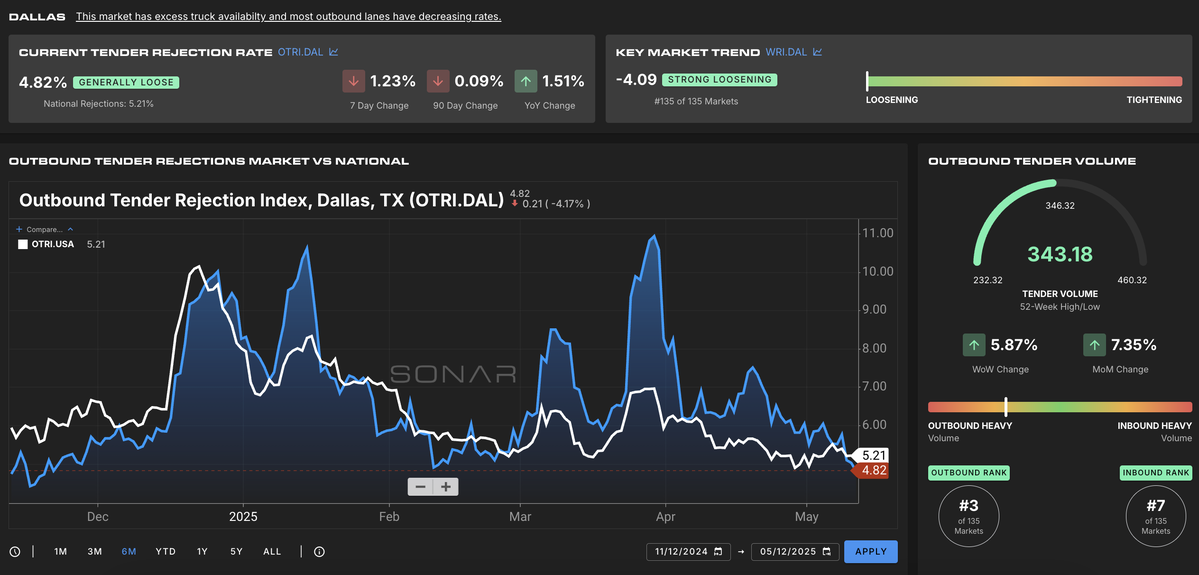
Market Check. Dallas sees more than just the FreightWaves Freight Fraud Symposium this week, as outbound tender rejections have fallen 1.23% week over week. Rejections are sitting at 4.82% in this relatively stable freight market. Volatility comes when rejections are at or above 7% for many weeks, which was seen throughout April in Dallas. 

With rejection rates lowering, brokers and shippers can expect stronger contract carrier compliance. Secondary carriers will see less award volumes and freight coming out of Dallas. Brokers can take their time when it comes to prioritizing coverage for lanes. Spot rates continue to leave a lot to be desired as rejections fall, meaning the rates from April will be on the high side when bidding for freight.

(GIF: GIPHY)

Who’s with whom. After months of escalating tensions and economic uncertainty, a welcome pause has arrived in the U.S.-China tariff standoff. The two global powers have agreed to a 90-day suspension of most tariffs that have been in place since April 2, offering a reprieve and an opportunity for further negotiations over the next three months.

As part of the agreement, both nations will begin rolling back many of the reciprocal tariffs that have defined the trade dispute. U.S. tariffs on Chinese goods will fall from 145% to 30%, and China’s tariffs on U.S. goods will fall back to 10%. These lower tariff rates are set to take effect Wednesday, signaling the first tangible sign of de-escalation in what has been a prolonged trade battle.

Beyond tariff reductions, the deal addresses key nontariff barriers. Beijing has committed to suspending or canceling several retaliatory measures, including export restrictions and the blacklisting of dozens of U.S. companies. This is seen as a significant move to rebuild trust and open dialogue between the two economies.

One of the most critical components of the new agreement centers on intellectual property rights. Article 1.1 of the agreement reaffirms both nations’ commitment to respecting IP rights, while Article 1.2 mandates the fair, adequate, and effective protection and enforcement of those rights. It also guarantees equitable market access to companies whose businesses depend on robust IP protections.

The agreement comes at a pivotal time. Just last month, concerns were raised as certain Chinese manufacturers began promoting luxury goods at significantly reduced prices, raising red flags about potential IP violations. This temporary trade truce may help curb those practices and ensure a more level playing field.

For U.S. retailers and importers facing an average transit time of about 20 days for goods traveling from Chinese ports to the U.S. West Coast, this window allows companies to pull forward inventory or restock products that may have run low during the high-tariff period.

The more you know

Highway releases Freight Fraud Index revealing 400,000 sophisticated fraud attempts in Q1 2025

CEVA Logistics acquires Turkish logistics company Borusan Tedarik

XPO sees minimal shipper conversion from LTL to TL

Taking on Porter, Uber launches logistics service Courier XL for delivery of large goods

Logistics firm buys $2M in Trump meme coins to boost US-Mexico trade

Fifth straight drop in benchmark diesel comes as futures prices rise sharply

The fifth consecutive decline in the benchmark diesel price used for most fuel surcharges is likely the end of the road for this particular downward cycle.

The Department of Energy/Energy Information Administration average weekly retail diesel price dropped 2.1 cents a gallon to $3.476 effective Monday, announced on Tuesday. The five-week decline from $3.639 a gallon on April 7 marks a drop of 16.3 cents a gallon during that time.

But for the declines to continue, they would need to fight back against the headwinds of ultra low sulfur diesel (ULSD) prices on the CME commodity exchange, which have turned sharply higher in just the past five trading days.

ULSD settled Wednesday at $1.9766 a gallon, the third time in the prior four trading days it had settled at less than $2. But since then, it has climbed sharply, settling Monday at $2.1111. At approximately 11:30 a.m. EDT Tuesday, ULSD was up another 3.3 cents, an increase of 1.56%, to $2.1441 a gallon. That number, if it was Tuesday’s settlement, would have been the highest since April 24.

Much of the increase came Monday, when ULSD rose 4.47 cents, or 2.16%, to the $2.1111 mark, driven in part by the rise in virtually all financial assets following the China-U.S. agreement on lowering tariffs.

Even in the face of increasing OPEC+ production into a market that has been seen as weak, prices in key crude benchmarks have risen in recent days. Brent, the world crude benchmark, rose to settle at $64.96 a barrel Monday, up from $60.23 on May 5.

One reason cited for the upward market pressure is the data showing worldwide inventories are tightening.

For example, the weekly EIA inventory report released last week, with data through May 2, showed ULSD inventories in the U.S. at 97.3 million barrels. The average of ULSD inventories for the first week of May from 2018 to 2024 was 113.9 million barrels, though that figure would have been impacted to some degree by the turmoil of COVID. 

Potentially more revealing is the spread between the first and second month’s ULSD contract on CME.

When a market is dealing with tight inventories, it will be structured in a situation known as backwardation, with the front month more expensive than the second month, the second month more expensive than the next month and so on. In a perfectly balanced market, the exchange prices should rise month to month, reflecting the time value of money and the cost of storage.

When inventories are tight, the most valuable market is the current month. And the backwardation is reflecting that in the ULSD market.

But meanwhile, possibly reacting to the latest news of an increase in OPEC+ production, the backwardation in Brent settled Tuesday at 57 cents/barrel. On April 22, it was $2.95/b, suggesting that while products like ULSD might be dealing with tightening inventories, the situation in crude might not be as much of a squeeze. 

The spread between first month and second month ULSD had tightened to 1.42 cents per gallon by May 6, with front month June barrels worth that much more than those for July barrels. But since then, the spread has widened to a settlement Monday of 3.32 cents.

That is still not as wide as where the spread was a few weeks ago. It hit 7.69 cents on April 28. But the sum total of the backwardation shows a market whose structure is reflecting tight inventories.

More articles by John Kingston

California deal with 16 states would end key parts of Advanced Clean Fleets rule

2 markets in 1 quarter: Auto-hauling demand volatile for Proficient

New Jersey, feds take opposite paths on independent contractor rules