DHS launches sweeping I-9 audits on California truck fleets
Department of Homeland Security agents are conducting aggressive workplace audits across Northern and Central California trucking companies, with a heavy focus on Punjabi-owned carriers, according to a detailed account aired November 28 on Punjab Radio USA.
Harpreet Thera, owner of a mid-sized fleet operating since 1997, told the station that DHS served him with a Notice of Inspection while he was at a dentist appointment in Sacramento. Agents first went to his home, then called his cellphone and identified his exact location before meeting him in a parking lot to hand-deliver the summons.
I just came across this TikTok from Punjab Radio USA and ran the translation. It is wild. Homeland Security is doing full audits on trucking companies in Northern and Central California. They are pulling I9s for every employee going back two years and now they are interviewing… pic.twitter.com/8DwSQbbeDY
The notice gave Thera three days to produce I-9 employment eligibility forms for every current and former employee going back two years – more than 100 records in total. Thera, who uses BBSI for payroll and runs 100% W-2 drivers to comply with California’s AB5 law, submitted the documents the same day.
DHS then escalated the audit: agents selected 15 employees – including U.S. citizens, green card holders and work-permit drivers – for individual interviews and requested their personal phone numbers. Agents told Thera they may conduct the interviews in person.
During the handoff, the lead agent said this was part of a new, broad initiative. When Thera asked how many companies were being targeted, the agent replied, “We are auditing all companies in Northern California.” Thera said the agent admitted it was his first such audit, suggesting the campaign is still ramping up.
The audits come amid wider federal pressure on California’s trucking sector:
FMCSA revoked 17,000 non-domiciled CDLs issued to foreign nationals earlier this month after finding the state failed to verify legal residency. Another 44,000 remain under review.
A reinstated English-language proficiency requirement for CDL holders has already pulled 7,248 drivers off the road since June.
ICE workplace enforcement actions in California rose sharply in 2025, with 77 Northern California trucking firms hit in the first half of the year alone.
Industry sources say many smaller Punjabi carriers still operate with 1099 independent contractors, a model that keeps costs competitive but leaves them exposed to both AB5 labor claims and now federal immigration audits.
Scale of the Punjabi Trucking Community in California
California is home to an estimated 50,000–74,000 Punjabi/Sikh truck drivers and owner-operators – roughly 40% of the state’s total long-haul driver pool.
Nationwide, the Punjabi/Sikh trucking community is estimated at 150,000–200,000 drivers and owners, controlling up to 20% of U.S. trucking companies despite representing only about 4–5% of the overall driver workforce.
The North American Punjabi Trucking Association (NAPTA) lists more than 1,400 member companies operating over 9,000 trucks, though this represents only a fraction of the total community.
Thera’s interview has circulated rapidly in California trucking chat groups. Punjab Radio USA closed the segment by urging owners to review records immediately, warning that “they are doing all of them” in Northern California.
DHS has not publicly announced the audit campaign or released numbers on how many carriers have been served.
Asia-US container rates fall 32% in latest week
Overcapacity in the trans-Pacific container trade lanes blew up carriers’ plans for November general rate increases, which had briefly pushed prices to the U.S. West Coast up to about $3,000 per forty foot equivalent unit (FEU).
Rates dropped 32% last week to $1,900 per FEU, according to the latest update from Freightos (NASDAQ: CRGO) and fell an additional $100 this week, though they remain above the $1,400 per FEU yearly low from early October. East Coast rates fell 8% last week to $3,400 per FEU and are now at $3,000 per FEU this week, roughly back to early October levels.
“Last week’s vessel fire at the Port of Los Angeles does not seem to have had an impact on prices as operations have quickly recovered,” said Freightos research chief Judah Levine, in a note to clients. Rates are now about even with levels from early October before the rollout of the latest GRIs.
The vessel ONE Henry Hudson returned to berth after being towed to anchorage safely outside the port while emergency responders fought a stubborn fire belowdecks.
Ocean shipping was the subject of global trade conversations as a tenuous ceasefire in the Gaza war prompted talk of a return of the largest carriers to the Red Sea-Suez Canal route. CMA CGM said it would expand services; the French line has maintained some scheduled services since attacks on merchant shipping by Yemen-based Houthi militia beginning in late 2023 led most liners to divert on longer voyages around Africa.
But Maersk (MAERSK-B.CO), the world’s second-largest ocean carrier, said it had no imminent plans to return.
“While most carriers are not offering a timeline, ZIM’s (NYSE: ZIM) chief executive recently stated that a return in the near future is increasingly likely,” Levine said. “The shift of most of the 30% of global container volumes that normally transit the Suez Canal away from the Red Sea and around the Cape of Good Hope almost exactly two years ago added seven to 10 days and thousands of miles to Asia-Europe journeys and to some Asia-North America sailings as well.”
The return of container traffic to the shorter Suez route will lead to the sudden early arrival of ships, causing significant vessel bunching and congestion at already persistently congested European hubs, Levine noted. This resultant congestion will cause delays and absorb capacity, which could increase container rates on the affected lanes and potentially elsewhere, although carriers have plans for a gradual phase-in, with smaller vessels transiting first, to minimize the impact of the reset and mitigate vessel bunching.
A gradual transition would be less disruptive despite shippers’ likely demands for a quick return; it could take up to two months for schedules to return to normal during which a hurried process would weaken rates. A total of 2 million TEUs could be reinstated, according to industry estimates.
“The capacity absorbed through Red Sea diversions pushed East-West rates up to highs of $8,000-$10,000 per FEU in 2024 and set a highly elevated floor of $3,000-$5,000 per FEU during low demand periods that year,” Levine said. Rates on these lanes have consistently been significantly lower than last year, he added, with prices on some lanes reaching 2023 levels in early October.
Rate hikes in October and November on Asia-Europe lanes have been more effective. Prices to Europe and the Mediterranean are 40% higher than in early October at $2,500 per FEU and $3,000 per FEU as lines ratcheted up blanked sailings.
“Carriers are planning additional GRIs for December aiming for the $3,000-$4,000 per FEU-level as they continue to reduce capacity,” Levine said, with an announced labor strike in Belgium likely to absorb some supply, but there are signs that these increases may not take.”
Borderlands Mexico: Truckers lift nationwide blockades after reaching deal
Borderlands Mexico is a weekly rundown of developments in the world of United States-Mexico cross-border trucking and trade. This week: Truckers lift nationwide blockades after reaching deal; Jisu Fortune arrives in Mexico with more than 5,000 vehicles from China; and Dual Borgstena opens a new automotive plant in Coahuila, creating up to 900 jobs.
Truckers lift nationwide blockades after reaching deal
Mexican truckers and farmers began removing most highway and border blockades on Thursday after reaching a series of agreements with federal authorities, easing several days of disruptive protests that choked freight flows across the country and into the U.S.
The blockades — which hit major highways, toll booths and multiple U.S. border crossings — were organized in response to escalating highway insecurity, rising cargo theft, farmer grievances over water regulations, and demands for overdue subsidy payments, according to KGUN.
The road blockades sharply curtailed cross-border shipments: in Nogales, Arizona, only 3 of 32 produce trucks scheduled to arrive earlier this week made it through, raising concerns about fresh-fruit and vegetable shortages after Thanksgiving.
Trade leaders said the blockade was having an economic impact of about $3 million a day in lost cross-border salaries and revenue, including impacting Mexico’s maquiladora industry which relies on finished products being exported to the U.S.
“In Nogales alone, approximately 50,000 jobs depend on the export of finished products,” Genaro Vecerra, CEO of Index Nogales, told El Emparcial.
After more than 12 hours of negotiations, leaders from the National Front for the Rescue of the Countryside and the National Association of Truckers said the government committed to:
• Improving highway security amid growing violence and trucker disappearances,
• Reviewing provisions of the proposed Water Law,
• Guaranteeing pending payments for corn and wheat producers,
• Maintaining a permanent working group to address rural pricing and trade issues, including protecting basic grains in the 2026 USMCA review.
Mexico’s Interior Ministry (Segob) said the agreement will restore “the free movement of the population and emergency services” and begin normalizing freight flows nationwide,” reported Evyn Chihuahua.
By Thursday afternoon, Omnia reported at least 90% of blockades had been lifted, according to the National Association of Transporters (ANTAC), though isolated closures remained in states such as Tamaulipas, Oaxaca, Hidalgo and Guanajuato.
Despite progress, protest leaders stressed that lifting the blockades does not mean their demands have been abandoned. They warned they will continue monitoring the government’s commitments and could resume demonstrations if promised actions stall.
Jisu Fortune arrives in Mexico with more than 5,000 vehicles from China
The Port of Lázaro Cárdenas received the Jisu Fortune on Nov. 22, marking the vessel’s inaugural call to Mexico and delivering more than 5,000 vehicles from Chinese automaker Geely, according to a news release.
The Liberian-flagged ship — powered primarily by liquefied natural gas — arrived from Ningbo, China, and discharged 5,041 Geely and Zeekr vehicles over a four-day, 12-shift operation at the port’s Specialized Automotive Terminal operated by SSA Mexico.
The landing of the Jisu Fortune strengthens Lázaro Cárdenas’ position as a growing automotive hub, supporting an expanding pipeline of Asian vehicle imports into Mexico, authorities said.
The Port of Lázaro Cárdenas is a key Pacific Coast gateway for automotive imports and exports from Asia, and has an annual container capacity of over 2.2 million twenty-foot equivalent units.
Dual Borgstena opens new automotive plant in Coahuila, creating up to 900 jobs
South Korean manufacturer Dual Borgstena has opened a production plant in Monclova, Coahuila, Mexico, an investment that will generate more than 880–900 new jobs and bolster the state’s growing automotive supply chain, according to The Saltillo Herald.
The facility will produce upholstery for car seats, with state officials highlighting the project as another sign of Coahuila’s stability, labor quality and appeal to foreign investors.
Coahuila state economic officials said the new plant aligns with Coahuila’s industrial strategy, noting that additional Korean suppliers are already considering future investments in the region.
Yellow settles with pensions
Bankrupt Yellow Corp. has agreed to terms with 14 multiemployer pension plans regarding more than $7.4 billion in claims stemming from the former less-than-truckload carrier’s 2023 shutdown.
A motion filed this week with a federal bankruptcy court in Delaware is seeking approval for term sheets allowing roughly $1.5 billion in withdrawal liability and other claims from the pension plans. Central States Pension Fund, which covered thousands of the Yellow’s union employees, holds a little more than half of the total amount. The final payouts, however, are likely to be just a fraction of the face value.
The pension plans and Yellow have engaged in costly litigation over the past two years, trying to reach an agreement on the exit fees.
Yellow lost an appeal in September to have the withdrawal liabilities tossed. It argued that the pension plans were fully funded after receiving federal bailout money in 2021, leaving the company with no liability. However, the U.S. Court of Appeals for the Third Circuit upheld the Delaware court’s decision that The American Rescue Plan lawfully gave pension insurer Pension Benefit Guaranty Corp. the authority to craft guidelines to make sure bailout money would only cover plan benefits and costs.
The pensions ultimately agreed to the lower amounts as potential recoveries from the estate continue to dwindle.
“Absent settlement, it has been represented to the Debtors that parties intend to continue litigating these disputes, including exercising appellate rights, resulting in continued litigation for months, if not years, at significant cost to the estates,” the filing stated. “The Debtors estimate such costs would likely be in the tens of millions of dollars, if not more.”
The bulk of Yellow’s estate has been liquidated. Proceeds from roughly $2.4 billion in real estate sales and $176 million in net proceeds from fleet sales have been used to satisfy $1.2 billion in secured debt, $213 million in bankruptcy financing, and various other claims and expenses.
Recent estimates show the estate will have just $600 million to $700 million to satisfy remaining claims, including those from the pensions and former employees.
The Delaware court recently approved a final waterfall distribution plan showing high-teen percentage recoveries for unsecured creditors. However, Yellow’s largest equity holder MFN Partners has appealed the court’s ruling. (Employee claims for PTO and sick time have been classified as priority and will be paid.)
The Administration has announced a major new initiative targeting the financial channels used by undocumented immigrants, marking a strategic and powerful shift in enforcement priorities. Moving beyond traditional border security measures, this action focuses on financial institutions and money transmitters that facilitate the transfer of funds from undocumented workers to their home countries, effectively targeting the economic lifelines of the U.S. shadow economy.
The Administration dropped the hammer today on illegal immigration with its biggest announcement yet:
It intends to go after financial institutions and money transmitters that allow illegal immigrants to transfer money back home.
At the center of this enforcement is the Financial Crimes Enforcement Network (FinCEN), a powerful division of the Department of Treasury. FinCEN is often called “the most powerful law-enforcement agency you’ve never heard of.”
Created in 1990 and vastly empowered by Title III of the Patriot Act, FinCEN exerts extensive control over the banking system, giving it unique leverage over money transfer services. FinCEN’s far-reaching powers include the ability to:
Compel any financial institution to hand over records without a warrant (via National Security Letters).
Unilaterally freeze assets.
Impose civil penalties of $250,000 per transaction.
Criminally prosecute executives for “willful blindness.”
Crucially, FinCEN has now explicitly classified sending “proceeds of unlawful employment” as a form of illicit activity (akin to structuring or money laundering). This classification means a standard remittance transfer—for instance, an $800 Western Union transfer from an undocumented driver to family in Uzbekistan—could theoretically trigger felony charges against the CEO of the money transmitter for facilitating a crime. Financial institutions are absolutely terrified of FinCEN action, as violations target not just the companies but also their executives and principals.
The Economic Choke Point: Remittances
This enforcement action targets the primary means by which undocumented immigrants support their families abroad. Of the estimated 11–14 million undocumented immigrants in the U.S., roughly 60% to 70% regularly send remittances, totaling approximately $160 billion annually—an amount exceeding the GDP of many countries. Mexico, Guatemala, Honduras, and El Salvador alone receive over $100 billion combined.
By explicitly criminalizing funds derived from unlawful employment, the Administration aims to choke off this massive financial flow. When these flows are severely restricted, the financial incentive to remain in the U.S. shadow economy evaporates, resulting in a collapse of the economic model of illegal immigration.
Ground Zero: Trucking’s Workforce, Safety, and Capacity Glut
Trucking stands as ground zero for this enforcement shift, given its historically low barriers to entry and dependence on foreign-born labor. The total population of foreign-born drivers now exceeds 720,000, comprising about 18% of the entire U.S. driver pool. This group includes approximately 200,000 holders of non-domiciled CDLs (ND-CDLs), many of whom are the direct target of new compliance rules. Trucking has become especially attractive to immigrants who lack permanent residence because a sleeper cab offers both a way to generate income and a moving home.
Lawmakers, heavily encouraged by lobbying from the American Trucking Association (ATA), previously eliminated barriers to entry, arguing that the industry faced a perpetual driver shortage and needed to make it easier for people to join. The ATA was instrumental in pushing the FMCSA to open up non-domiciled CDLs to immigrants and implementing the Entry-Level Driver Training (ELDT) program that facilitated the rise of fraudulent “CDL mills” with little oversight.
This erosion of standards for the sake of cheap labor and capacity has been directly correlated with a catastrophic decline in public safety and security:
Safety Crisis: Fatal accidents involving heavy-duty trucks have surged by an alarming 40% since 2014.
Cargo Security: Cargo theft has become a massive, systemic problem, with billions of dollars of cargo stolen annually. According to Verisk, theft losses are up a staggering 60% in the past year alone.
In parallel with FinCEN’s financial attack, DOT Secretary Sean Duffy has significantly ramped up enforcement measures, including cracking down on CDL mills, enforcing English Language Proficiency standards, and banning non-domiciled CDLs. The Secretary has also threatened to target shippers and brokers that load non-compliant drivers.
Industry Impact
While DOT Secretary Duffy’s actions address safety, the Treasury’s FinCEN action holds far greater power for immediate, systemic change to the immigrant labor supply. The timing is significant. This is the time of year when truck drivers leave the trucking industry and find alternative work, the annual capacity purge. I wrote about this in a recent article.
For the trucking industry, which has been locked in the Great Freight Recession since 2022, reduction in capacity is welcome news. The industry is currently struggling with an unprecedented capacity glut caused by the easy entry of too many new drivers and trucks—a glut exacerbated by the policies the ATA pushed for. This oversupply has decimated spot rates and strained carrier operating ratios to unsustainable levels.
The targeted removal of an estimated 194,000 non-compliant drivers (roughly 5% of the total capacity) through ND-CDL and ELP enforcement, combined with the chilling effect of the FinCEN financial crackdown, represents a significant capacity correction event.
The reduction in labor is expected to:
Tighten Capacity: This will alleviate the current oversupply and stabilize the market.
Raise Rates: Carriers will finally gain pricing power, allowing them to improve their margins and recover from three years of depressed spot rates.
In short, the Administration’s enforcement will accelerate the market correction the trucking industry desperately needs, providing the first major headwind against excess capacity in years and potentially paving the way for a more profitable and safer sector.
FedEx scrubs MD-11 flights for December as crash inspection drags on
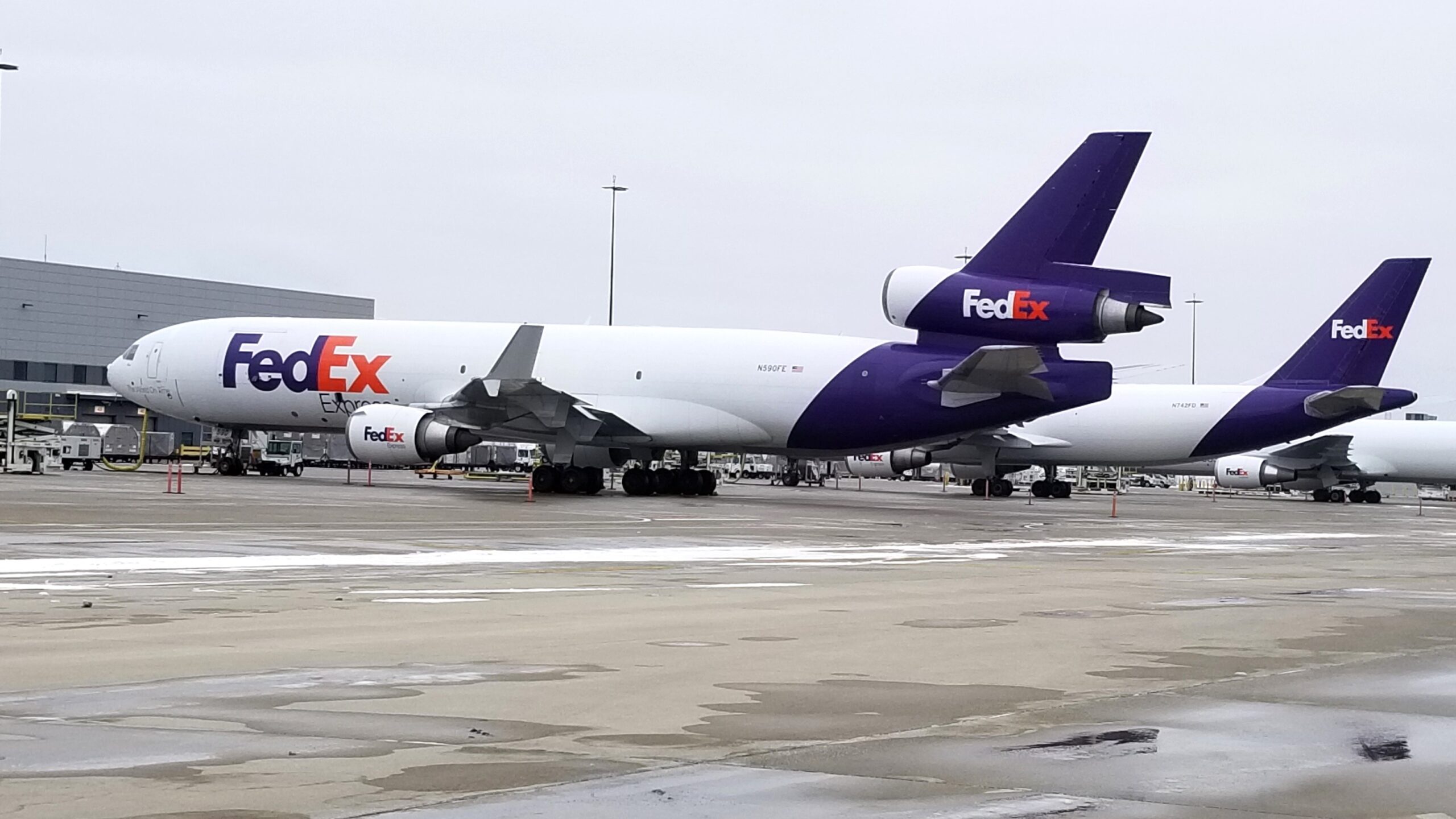
FedEx Corp. has canceled the December flight schedule for its fleet of MD-11 cargo jets, FreightWaves has learned, further signaling that federally-mandated inspections following the fiery crash of one of the planes early this month will take significantly longer than originally anticipated.
The development dovetails with recent internal communications from UPS and Western Global Airlines, the other operators of the tri-engine MD-11, that their fleets are likely to be grounded for several months and be unavailable for the peak shipping season now underway.
FedEx (NYSE: FDX) has scrubbed all MD-11 flights from the December schedule, according to an official with the union representing the company’s pilots and another person who is an MD-11 pilot. The decision makes clear the company doesn’t expect the plane to be available during the month and raises questions about whether the airline will again be without 8% of its main line capacity in January.
“I don’t think this is going to be as short-term as people expected,” the FedEx MD-11 pilot, who asked for anonymity to prevent any employer repercussions, said in an interview.
Following the deadly crash of UPS Flight 2976 in Louisville, Kentucky, the Federal Aviation Administration banned MD-11s from flying until the entire fleet is thoroughly inspected and any necessary repairs are completed. The National Transportation Safety Board on Nov. 20 said it found fatigue cracks in a structural section that held an engine to the left-wing.
FedEx operated 28 MD-11s at the start of November.
The level of regulators’ concern about the safety of the MD-11s is reflected by the fact that the FAA isn’t even issuing ferry permits for the aircraft so they can be flown from their current airfields to other locations for inspection or maintenance, according to the pilot source.
FedEx pilots will get paid as normal for their December assignments, but exactly what the pay structure will be in the event of a January flight cancellation remains to be determined. There are about 500 MD-11 pilots at FedEx.
The other source said the union has seen internal company emails indicating management intends to place MD-11 pilots on reserve duty in January, despite there being no defined flying or duty requirements at this time.
“The association does not agree with applying reserve status and its related pay provisions in a circumstance where there is no operational need to be on reserve. We believe the situation would be best addressed through direct engagement between the company and the association to reach a solution that is appropriate and fair to both parties,” the union representative said.
The FedEx Master Executive Council, part of the Air Line Pilots Association, is the bargaining unit for the express carrier’s pilots.
“Safety is our highest priority at FedEx. We are working with Boeing and the FAA to address any required inspection and maintenance that may be needed to return our MD-11 aircraft safely to service,” spokeswoman Isabel Rollison said in a statement. “The flight schedules for December and January account for the MD-11s being currently grounded.”
UPS MD-11s out of action into 2026
Meanwhile, UPS pilots have been informed that the inspection process, and possible repairs, for the MD-11s will likely take several months instead of a few weeks, as originally estimated, Brian Gaudet, a spokesman for the Independent Pilots Association, said Thursday evening.
UPS (NYSE: UPS) employs 277 MD-11 pilots, according to IPA figures.
The UPS pilots are pay protected, which means they will be compensated for flights they were already awarded in December and for future cycles, even if the fleet remains grounded, Gaudet explained in a phone call.
Newsweek reported Thursday that UPS Airlines President Bill Moore conveyed in an internal letter that the MD-11 fleet will require more extensive inspections and potential repairs than first thought and the planes will remain grounded for several months.
In his letter, Moore said Boeing’s ongoing evaluation of the aircraft model has led to the determination that removing engines and pylons may be necessary for “detailed inspections and repairs,” the news site said.
FedEx Chief Financial Officer, speaking at an investor conference on Nov. 11, said the inspection process was expected to be relatively quick and that the airline would return MD-11 freighters to service on a rolling basis after they passed safety checks and any required repairs. His comments came before the NTSB issued its preliminary accident report, in which it highlighted discovery of the fatigue cracks.
The extended grounding of the MD-11 fleets could prove costly for the companies. FedEx and UPS, for example, have contracted with partner airlines to fill in a portion of the MD-11 flight schedules in their respective air networks.
Misclassification lawsuit: New Jersey truck school’s costly settlement
A north New Jersey truck driving school that has been in business since 1983 has agreed to a financial settlement with the state to end a lawsuit in which it was accused of misclassifying driver instructors as independent contractors.
The state’s attorney general Matthew Platkin announced the settlement earlier this week with Jersey Tractor Trailer Training of Hasbrouck Heights in Bergen County.
The original lawsuit was brought by Robert Asaro-Angelo, commissioner of the New Jersey Department of Labor and Workforce Development, in September 2024 in Bergen County Superior Court.
New Jersey’s original lawsuit said the misclassification involved “at least” 30 of JTTT’s instructors. The announcement of the settlement by Platkin gave no further specifics on the number of instructors involved in the misclassification.
Payouts to instructors will vary
Payment by JTTT as a result of the settlement was broken down by the state as a “total gross settlement” of $345,000. But the state also said the largest payout to an eligible driving instructor could reach $137,160.
JTTT also will pay $127,839 to the state for penalties and the state’s costs.
Penalties to be paid could be cut by $80,000 if JTTT “fulfills all its reporting obligations,” the state said in its announcement of the deal. Among that documentation is that the driving school “is treating all current and future instructors as employees under all applicable State labor and employment laws.”
“No business operating in our state should be allowed to deprive workers of their rightful pay and benefits,” Platkin said in a prepared statement. “Today’s settlement is another important victory in the fight against worker misclassification. Our message is simple: comply with the law or face the consequences.”
The question of control
In the original lawsuit filed last year, the state said JTTT’s instructors were the subject of “significant control” over their activities by JTTT. “Control” is a key test in independent contractor (IC) classification cases as whatever legal process seeks to determine if a worker was truly independent or effectively an employee masquerading as an IC through the company’s definition and rules.
According to the lawsuit, the control included JTTT setting work hours, requiring Saturday training sessions, mandating curriculum provided by the school and “having the right to hire and fire workers.”
“Such misclassification has given (JTTT) an unfair competitive advantage over employers who have followed all of the relevant laws, and have accordingly provided all mandated benefits to their employees and contributions to the State,” Asaro-Angelo said in his initial lawsuit.
The specific violations the state alleged in its initial lawsuit included failure to pay overtime; not maintaining records of wages paid; avoiding sick leave pay; and not making payments to both the state’s unemployment compensation fund and a workforce development fund.
Established through earlier court decisions, New Jersey operates under the ABC test to guide litigation and state action over IC classification. That goes back to a 2015 decision in a case involving mattress retailer Sleepy’s.
New Jersey’s Department of Labor is in the midst of a rulemaking process that would seek to codify the ABC test, much as California’s 2019 AB5 law codified the ABC test spelled out in the Dynamex decision of 2018.
Neither the original lawsuit filed by the state nor the announcement of the settlement with JTTT made reference to the ABC test.
The ABC test has three “prongs.” While the wording can differ slightly among the jurisdictions that use it, the California test says a worker can be considered an independent contractor if:
A. The person is free from the control and direction of the hiring entity in connection with the performance of the work, both under the contract for the performance of the work and in fact.
B. The person performs work that is outside the usual course of the hiring entity’s business.
C. The person is customarily engaged in an independently established trade, occupation, or business of the same nature as that involved in the work performed.
Richard Reibstein, an attorney with the firm of Troutman Pepper Locke who specializes in independent contractor law, said the JTTT case posed some difficult questions.
“It is not that easy to have an independent contractor relationship with a bunch of CDL instructors,” Reibstein said in an email to FreightWaves. “I could certainly create a bona fide basis to structure an IC relationship as IC compliant, although it’s much harder in New Jersey under its ABC Test than in other states.”
Emails sent to JTTT through its contact portal on its website, and an email sent to the company’s outside counsel listed in court documents, had not been responded to by publication time.
FedEx to lay off 856 employees as Texas logistics facility shuts down
FedEx is laying off 856 employees in Coppell, Texas, as it prepares to close a logistics facility by April after a major customer shifted its business to another provider, according to a filing with the Texas Workforce Commission on Wednesday.
The layoffs will occur in phases beginning in January.
“This action is necessitated solely by our customer’s decision to transition its business to a new location that will be managed by a new third-party logistics provider,” the company wrote in its notice. “The discontinuance of FedEx Supply Chain Logistics & Electronics, Inc.’s operation of the Coppell facility is expected to be permanent and is expected to be finalized by April 29, 2026.”
Coppell is located about 21 miles northwest of downtown Dallas.
FedEx Corp. (NYSE: FDX) provides customers and businesses worldwide with a broad portfolio of transportation, e-commerce and business services.
FedEx said employees were notified in advance and that some workers may be eligible for other roles within the company. The company added it will provide “job placement assistance, relocation aid or severance, as applicable.”
The Coppell cuts follow other recent FedEx job reductions in North Texas, including 305 layoffs at a Fort Worth facility announced in May and 131 layoffs at sites in Garland and Plano announced in June.
Logistics and manufacturing employers across the country have been hit with a wave of job cuts in recent months, pressured by the Trump administration’s trade policies, facility closures, EV-market slowdowns and shifting consumer demand that continue to strain global supply chains.
Airbus finalizes A350 freighter prototype for test flights, certification
Airbus is conducting rigorous systems ground tests as it gears up for a nine-month campaign of flight tests for the all-new A350 freighter beginning next October with hopes of getting the first aircraft in service by the end of 2027.
Airbus has passenger-to-freighter conversion programs for smaller aircraft, but until 2021 had never participated in the large freighter market. It currently has 82 firm orders from 13 airlines and leasing companies, compared to more than 50 orders at Boeing for the next-generation 777-8 freighter.
The company last month released a 20-year forecast calling for shipping demand to grow at a 3.3% compounded annual rate, helping to drive a 45% increase in the worldwide fleet of dedicated freighter aircraft to 3,420 units — 815 existing freighters and 2,605 new units. The majority of new builds (1,530) will replace older aircraft and the rest will be for growth.
Airbus estimates that the new aircraft will be split between 1,120 small aircraft, 855 mid-size widebodies and 630 large widebodies. Overall, of the 2,605 additional freighters, 1,670 will be conversions from passenger aircraft and 935 will be production freighters.
Program managers on Tuesday outlined plans for production of two test aircraft and achieving certification for the next-generation widebody freighter, a derivative of the popular A350 composite-frame passenger aircraft. The freighter program was delayed one year by supply chain problems.
Flight testing will be relatively light — about 400 hours — because the freighter only requires an upgrade certification from the latest A350 variant, the A350-1000, and the engine doesn’t need certification because the Rolls-Royce Trent engines are totally unchanged. That doesn’t mean the process is simple.
“What we’ve learned is that it’s quite tricky to certify the derivative of an existing certified platform. And the certification authorities are much more demanding than they used to be a decade ago,” said Guillaume Vuillermoz, the head of widebody program development, during a virtual briefing for members of the press. “And for that reason we have started about a year earlier compared to what we would have done.”
The airframer has commenced final assembly line work for the first test aircraft, involving the installation of systems, engines and instrumentation, with the second prototype to follow soon.
The first prototype will focus on the aircraft’s behavior in the air, including cruise and autopilot performance, and fly about 300 hours in test mode. The second unit will focus on testing the air conditioning system for cooling and heating, smoke tests and low-visibility take offs.
Airbus has more than 30 sets of ground test equipment that are currently checking the functionality and endurance of operating systems, including for environmental control, fog detection, tail-tip warning and cargo loading, said Vuillermoz. Two specialized facilities are validating the cargo door actuation and capabilities of the automated cargo loading system.
The goal is to obtain concurrent certifications from the European Union Aviation Safety Agency and the U.S. Federal Aviation Administration, said lead flight test engineer Laurent Bussiere.
The aerospace giant designed the A350F with a customer wish list of features, including perfect ground stability and in-flight balance when fully loaded, independent pallet loading systems for the main and lower decks, volume to carry outsize loads such as aircraft engines, highly-accurate temperature controlled cargo areas and digital connectivity between the cockpit, cargo and cargo compartment, said Joel Rocker, chief engineer for the A350 project.
The main deck cargo door, for example, is 175 inches across, wider than any cargo door in the market, and the extra reinforced floor will allow pallets with a higher maximum weight, providing flexibility for transporting all manner of goods. Another welcome feature is the watertight main-deck floor, which will allow operators to clean corrosive substances and other dirt without having to worry about corrosion or dry cleaning.
“That will improve, significantly, the operability and the cost of operation,” he said.
A section of the A350 freighter arrives at Airbus’ Toulouse assembly plant. (Photo: Airbus)
Crew upgrades include windows in the galley area and segregated air recirculation for the cockpit area and the cargo compartment, where livestock or other shipments could create unwanted odors.
The A350F can haul up to 111 metric tons, comparable to that of a Boeing 747-400, with a range of 4,700 nautical miles. Powered by the latest Rolls-Royce Trent XWB-97 engines, the aircraft will reduce fuel consumption and carbon emissions by 40% compared to previous generation aircraft with a similar payload-range capability, according to Airbus.
Rocker said Airbus has taken a cautious approach on the payload, but is likely to increase the maximum allowable takeoff weight once engineers gather data on how the A350F behaves in real-world operations.
Shipping demand supports production growth
Between 2019 and 2024, the freighter fleet recorded its strongest period of growth, expanding by 33%. The surge was fuelled by heightened demand for goods and air transport when the Covid pandemic disrupted normal supply chain flows. All-cargo carriers and leasing companies heavily invested in feedstock for converting narrowbody aircraft, especially the Boeing 737-800 and Airbus A321, creating a short-term glut. The aerospace manufacturers and aviation experts expect a large number of large freighter retirements in the next few years because airlines held onto assets longer than planned during the Covid era, when freight rates soared.
Airbus has a more conservative outlook about air cargo market growth and fleet expansion than rival Boeing.
Rival Boeing projects a 67% increase in the global freighter fleet by 2044. Last summer it forecast 2,900 new freighters will enter the market, about 300 more than the Airbus estimate, of which 855 will be large widebody aircraft.
Meanwhile, London-based aviation market intelligence and consulting company IBA recently estimated that the global freighter fleet will grow by almost 4,000 aircraft, marking a 41% increase from 2024’s figure of 2,800 in-service aircraft. IBA’s outlook calls for about 2,000 passenger-to-freighter conversions and 900 factory deliveries to drive fleet growth.
Boeing forecast air cargo volumes to grow 3.7% annually. The bottom line is both aircraft manufacturers expect volumes to approximately double over the next two decades.
IBA is even more tempered than Airbus, predicting air cargo shipment volumes will only grow about 1% to 2% per year, as geopolitical conflicts and rising tariff policies cause businesses to diversify their supply chains, especially from China to other countries in the Asia-Pacific like Vietnam and the Philippines, and look at souring goods near their home base.
At the same time, countries like Brazil and Indonesia are becoming stronger economies and opening up to trade, which is attracting freight transportation. Meanwhile, e-commerce remains a standout sector for demand, with IBA anticipating growth of 6% to 7% by 2030, well above global GDP forecasts for the same period.
Although these trends will alter the global air freight flows they won’t hurt overall demand, according to Airbus.
In 2025, air cargo volumes so far have grown about 4% year over year. While a significant drop from last year, when demand grew about 12%, but many still feel the market is solid considering that demand was expected to cool off and fears of a contraction after the Trump administration launched tariff wars early this year.
Boeing is finalizing development of the 777-8 for commercial release in 2028. It will cease producing the legacy 767 and 777 freighters at the end of 2027.
Odyssey Logistics hit with a 2nd Moody’s ratings downgrade since September
Odyssey Logistics has had its debt rating cut by Moody’s for the second time in less than three months, a rapid deterioration that is far quicker than normal movements by a ratings agency.
Two other ratings–the probability of default and the senior secured first lien bank credit facility–also went to Caa1 from B3.
A rating of Caa1 is deep into speculative territory, colloquially known as “junk.” It is seven notches below the cut line between investment grade and non-investment grade debt and only four notches above the Moody’s grade for a default.
The Moody’s rating is also one notch less than the B- rating of S&P Global Ratings (NYSE: SPGI). S&P gave Odyssey that rating in June and it remains in place.
Before the latest two cuts by Moody’s, Odyssey Logistics carried a B2 rating that was increased to that level in August 2022 and affirmed in March 2024.
Stable outlook before both moves
Both cuts in the company’s debt rating this year came even as the Moody’s outlook on Odyssey was listed as “stable.” Many downgrades are preceded by a company first having its outlook changed to negative. A downgrade then may or may not ensue, and if there is an action, it might take months before it occurs. (The inverse of that is that prior to an upgrade, a company may be bestowed with a positive outlook that can be in place for a long time before any action is taken).
Odyssey’s downgrade then is particularly notable in two ways: a second one occurred so soon after the first, and conditions were considered strong enough prior to both moves that Moody’s didn’t even have Odyssey with a negative outlook before it acted.
The outlook on Odyssey at Moody’s was held at stable after the latest reduction in its rating. S&P Global also has a stable outlook on Odyssey.
The Transport Topics rankings of top brokerages of 2024 lists Odyssey as the 80th largest brokerage, with gross revenue of $169 million.
It is unusual in having publicly-trade debt; other 3PLs that carry ratings of public debt from ratings agencies are some of the biggest brokers, such as C.H. Robinson(NASDAQ: CHRW), RXO(NYSE: RXO) and privately-held Echo Global Logistics. Smaller firms like Odyssey generally do not have publicly-traded debt.
Big debt load in a down market
The basic message of Moody’s in its rating of Odyssey was one of too much debt and a poor market ahead to help reduce it.
“The downgrade of Odyssey’s ratings reflects our expectation that the company will operate with very high leverage and weak interest coverage over the next twelve months,” Moody’s said in its report. “A challenging freight market with weak pricing and soft volumes have contributed to Odyssey’s lower earnings and persistently negative free cash flow.”
Moody’s said Odyssey will be operating this year with a debt to EBITDA load “well in excess of 7X.”
By contrast, when Moody’s affirmed the B3 rating of Echo Global in October, it said the company’s debt/EBITDA ratio would be “slightly below” 7X by the end of this year. It also said it expected a decline in that ratio to below 6.5X next year. That B3 rating is where Odyssey was, and is now one notch less than that.
But the real crunch could be coming in 2027, Moody’s said.
“We believe a reduction in leverage to a more sustainable level is dependent on improving freight market conditions, which we expect will remain challenging heading into 2026,” the ratings agency said. “This poses a risk to Odyssey since the company faces refinancing risk with significant debt maturities in 2027.”