The ‘ingenious strategy’ behind most truckers’ least favorite week of the year: International Roadcheck

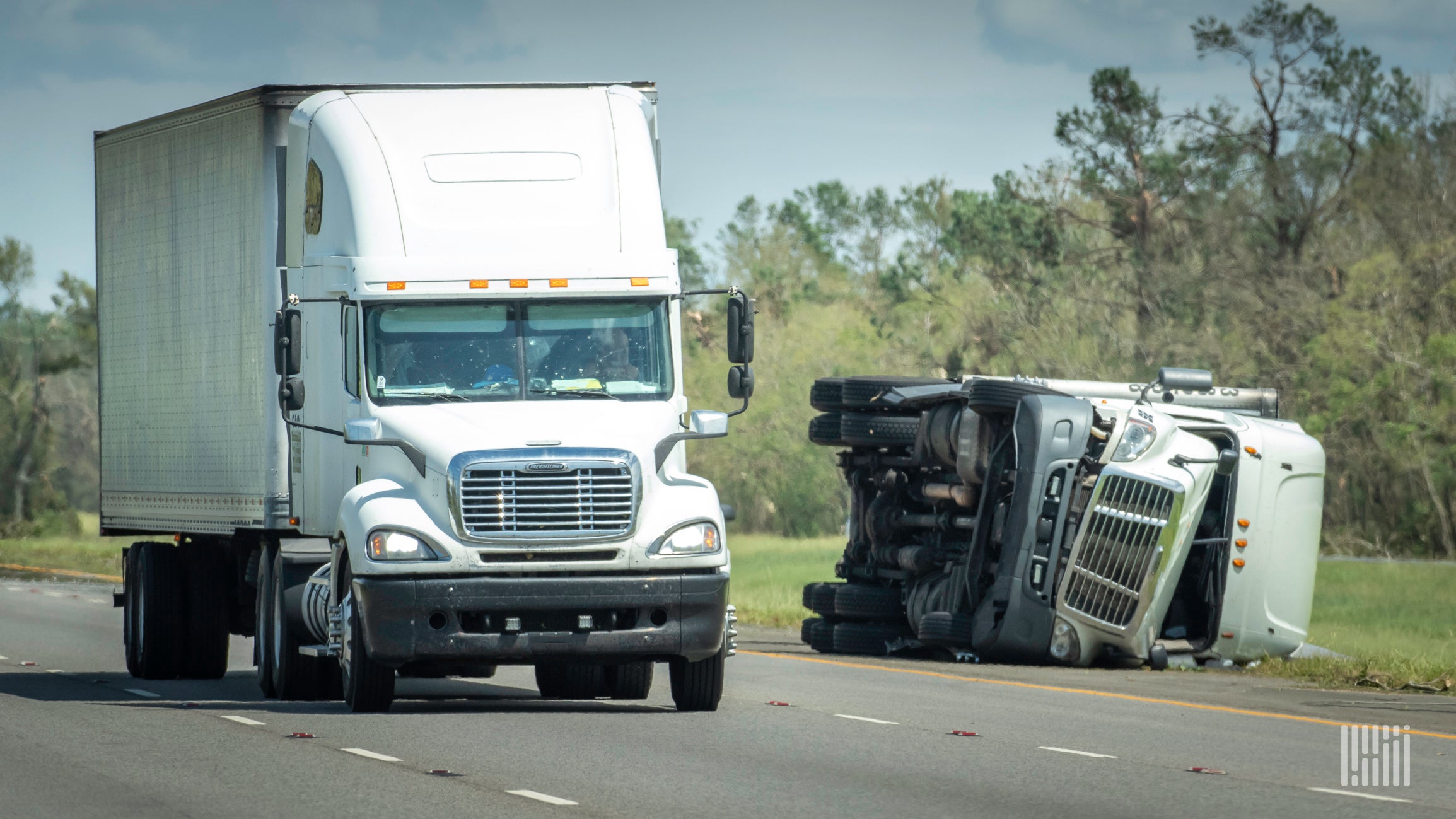
truck fallen over

International Roadcheck Week is hardly the sexiest topic in trucking, but it is a darn-tootin’ important one. Inspectors in the U.S. and Canada halt tens of thousands of trucks for vehicle inspections for a few days every summer or early fall. They remove thousands of trucks and drivers from the road; in 2021, 16.5% of inspected vehicles were put out of service along with 5.3% of drivers.

It’s uncommon for truck drivers to actually get their vehicles inspected at random during most of the year. To avoid International Roadcheck Week, many truckers simply don’t drive during that period of time — which, presumably, means more unsafe vehicles and drivers on the road outside of the inspection blitz. It’s a question that ate at Andrew Balthrop, a research associate at the University of Arkansas Sam M. Walton College of Business. 

Around 5% fewer one-person trucking companies are active during International Roadcheck Week. But Balthrop and his fellow researcher, Alex Scott of the University of Tennessee, found a major upside to the inspection blitz — even with all the folks who avoid it. According to their working paper published in March 2021, vehicles are safer a month before and after the inspection period. There’s a 1.8% reduction of vehicle violations, according to Balthrop and Scott’s analysis. Surprise inspection blitzes don’t result in the same uptick of compliance. 

I caught up with Balthrop about his research last week at FreightWaves’ Future of Supply Chain conference, and we chatted again on the phone this week about his findings on International Roadcheck Week.

Enjoy a bonus MODES and a lightly edited transcription of our phone interview: 

FREIGHTWAVES: For our readers who are not aware of what Roadcheck Week actually is, can you explain a little bit about what it and why it is important to drivers and companies?

BALTHROP: “The International Roadcheck is part of an alliance between the inspectors in Canada and the ones in Mexico and the U.S. to have a unified framework for making sure trucks are safe to operate. That should make it easier to go across borders when you have this kind of unified structure.

“In the U.S., one of these CVSA inspection blitzes is the International Roadcheck that happens for three days in the summer. Usually it’s a Tuesday, Wednesday and Thursday. And usually it’s the first week in June.

“And in it, they focus on Level One inspections, the North American Standard Inspection where they inspect the driver records, the hours of service, the licensure and I believe medical records as well. Then they inspect the truck. It’s an in-depth inspection where the inspector will actually crawl under the truck to look at various things. And these inspections, from the data that I’ve seen, take about a half an hour on average.

“During the Roadcheck Week, they’ll do about 60,000 inspections, so 20,000 a day. They’re going to pull over a lot of trucks, and this can cause a little bit of congestion at the weigh stations and the roadside inspections localities as the inspectors are doing these inspections.”

Roadcheck Week doesn’t catch all truck drivers, but it has a long-lasting benefit to safety

FREIGHTWAVES: So, can most drivers kind of expect to be pulled over? How likely is that?

BALTHROP: “There’s 1 million or 3 million trucks on the road, somewhere around there on any given day. With 20,000 inspections, most drivers still will not get inspected, but there’s going to be a higher proportion of drivers inspected. 

“You’re more likely to get inspected on these days. If you don’t have a recent inspection on your record, or if you have a bad recent inspection on your record, you’re more likely to be pulled over on these days.”

FREIGHTWAVES: Your research focused on that it’s just unusual that this inspection is announced, that it’s planned. We were talking before about how normally, if you’re trying to assure quality or compliance, you would not announce an inspection in advance. It would be more of a surprise-type situation. 

Can you walk us through why that’s so unusual, or what’s the rationale that you see behind announcing it in advance?

BALTHROP: “It is unusual, and on the surface, it doesn’t make much sense, but it turns out to be kind of an ingenious strategy. So I’ll walk through it here. 

“Over the course of a year, there’ll be 2 million inspections of 3 or 4 million trucks out there. The average rate of inspections is pretty low. It’s not uncommon for truckers to go years without having an inspection. With this low inspection intensity, the FMCSA has sort of a problem of, how does it get anybody to abide by the regulations?

“I’m a jaded economist, and I don’t worry or consider too much ethics and morality and all that kind of stuff. It comes down to incentives for drivers to follow these inspections. The incentives do guide behavior. So, how could the FMCSA incentivize drivers to follow these regulations more closely and adhere to the standards?

“They do this by announcing the blitz. This does two things. On one side, it allows everybody to prepare in advance. There’s a bunch of anecdotal evidence out there that people do prepare for these blitzes in advance. They will have their trucks inspected beforehand for any problems. They’ll time maintenance and upkeep in advance to make sure that their vehicles are in order. “They’ll be a little bit more cognizant of the driver-side regulations. One thing we notice in our study is that hours-of-service violations really drop during these extensions, because people see them coming. They don’t fudge the books in any way.”

Owner-operators can evade Roadcheck Week. Big carriers, not so much.

BALTHROP: “The issue with the announcement, on the flip side, is that it allows people to just dodge the inspection entirely. For a long time, people have talked about how owner-operators and smaller carriers time their vacations for this particular time. They could do this for a couple reasons. To avoid the hassle is a nice way to put it, but it also allows you to be noncompliant to avoid the high-intensity inspections.

“You have this balance here that on one side you get the behavior you want with people complying with regulations. That’s the behavior the FMCSA wants. But on the flip side, you get a bunch of people that are kind of outright dodging inspections.

“When you compare these two things on balance, the policy is actually pretty effective because you get a lot of people focused on maintaining their trucks and obeying the rules during that particular week. Especially with the vehicle maintenance stuff, that lasts a long time. 

“In our research, we saw that vehicle violations, a month before and up to a month afterwards, is when you still notice your vehicle violations. That trucks are kind of better maintained around these blitzes.

“The ingenious aspect of it is that the FMCSA, by concentrating their inspection resources all at one time and announcing it, they’re making it clear that they’re serious about enforcing these regulations and everybody prepares for it. For the number of inspections that are happening, you get fewer tickets than you would have otherwise expected.

“The FMCSA, they’re putting people through a little bit of a hassle, but they’re not having to write a bunch of tickets to get people to comply. They’re not really punishing a whole bunch of people because, by making this apparent that this is going to happen, people comply and the FMCSA gets what they want essentially without having to come down on carriers too hard.”

A convenient time for a vacation, indeed

FREIGHTWAVES: OK, interesting. And how does this pattern of shutting down, how does that compare for an owner-operator versus a driver for a big fleet?

BALTHROP: “If you’re a motor carrier with thousands of power units, you can’t just pack up and not do business on a particular day. They just don’t have that option. So they get inspected at a higher intensity, and you see the larger carriers kind of more focused on making sure that they’re prepared for these inspections. With so many inspections, the larger carriers are going to be inspected at higher rates. You can really damage your reputation if your equipment isn’t in order on this particular day. 

“Versus the smaller carriers, especially if you’re talking about a single-vehicle fleet, an owner-operator type, it is not that difficult to just not work for those three days. And so you see a lot about that. 

“In terms of what the roadway composition looks like, if we look at inspection data and relative to a typical day with the usual inspections, on these Roadcheck days, you have about 5% fewer owner-operators on the road than you otherwise would expect.”

FREIGHTWAVES: Wow. And when you say owner-operators, you also mean just like fleets with just —

BALTHROP: “One-vehicle fleets.”

FREIGHTWAVES: OK, that’s interesting.

BALTHROP: “You know, you see a little bit of effect with the smaller fleets, below six vehicles, but it basically disappears by the time you get to a hundred vehicles.

“This effect is being driven by smaller carriers staying off the road in terms of avoidance. You see this goes also how you would expect; it’s also older vehicles that stay off the road. This is correlated with carrier size. The larger carriers use newer vehicles and owner-operators tend to use some of the older vehicles. But it’s particularly the older vehicles that are off the road.

“This makes intuitive sense. Older vehicles are more costly to keep compliant. Maintenance is more costly, and they’ve been around longer so there’s time for more stuff to have broken essentially.

How a truck driver gets stopped for inspection

FREIGHTWAVES: Can you explain a little bit more, the idea of having this inspection history and why it would benefit a larger or small carrier?

BALTHROP: “Getting flagged for inspection is sort of random, but not totally. If somebody notices something obviously wrong with your truck, that’s ground for a more in-depth inspection. Or if you get pulled over for some other reason, this can be grounds for inspection of some type. 

“But there’s also the inspection selection service. The computer program that is random, that it randomly flags people in for inspection, but it’s based on your inspection history.

“So if your firm hasn’t been inspected recently, or if your carrier doesn’t have a very dense inspection history, you’ll be more likely to trigger that system to pull you in and have you inspected. If you have a dense inspection history, you’re less likely to get inspected.”

FREIGHTWAVES: So how do you get pulled over for inspection? As a person who only drives a passenger car, my main interaction with being pulled over is, I’m driving down the freeway or wherever, and I get stopped by the police. How does it work for a truck driver? How does getting pulled over or inspected work in that way?

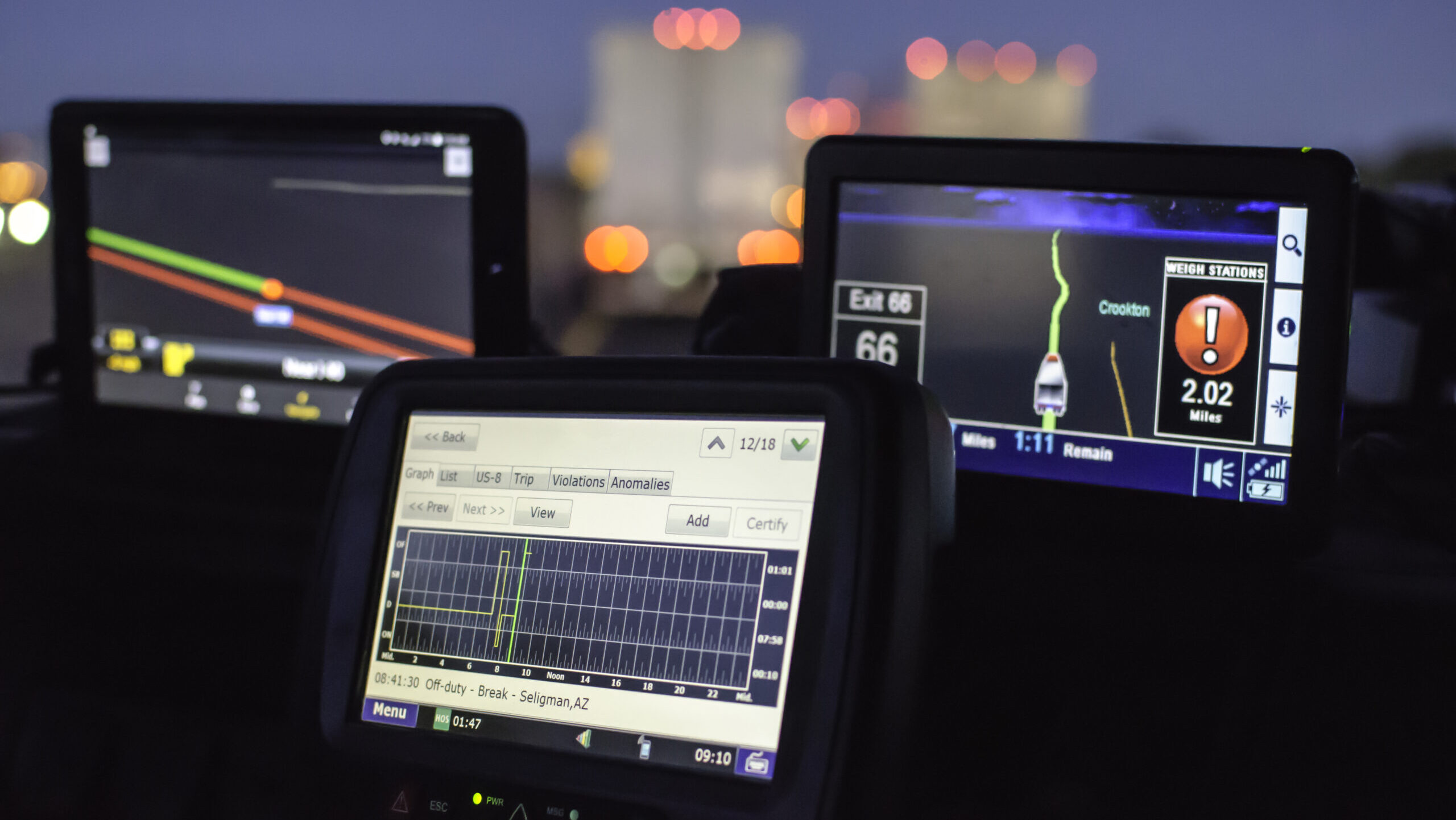
BALTHROP: “The law is that you cannot pass a weigh station without pulling in and getting weighed. At that point they may flag you to be inspected. Now, in the past decade or two, there’s been a bunch of electronic devices that are installed in cabs. You may have heard of PrePass or Drivewise. This allows you to pass weigh stations. 

“I don’t have data on how many trucks have the in-cab devices. But from a trucking perspective, they’re so convenient that you don’t have to stop every time you cross a state line. I think the vast, overwhelming majority of trucks have some sort of one of these electronic devices. The DOT inspectors at these roadside inspection points have a dial they can twist essentially about how many people they want to inspect. 

“So during the roadcheck inspection week, they’ll crank that dial all the way up and pull everybody over. And if they get too backed up, they might crank it back down a little bit and so on.”

FREIGHTWAVES: OK, interesting. It reminds me of a highly sophisticated E‑ZPass.

A $10 million-plus expense to trucking companies every year … but it’s worth it if just one fatal crash is avoided

FREIGHTWAVES: Zooming out, when we hear about large truck crashes, something like a vehicle maintenance issue is not really the most sexy explanation. But just looking at the FMCSA data, in 29% of all truck crashes, a major factor is brake problems. So it seems like a lot of the truck crashes on the road are caused by vehicle maintenance, versus something like the driver using illegal drugs or some other sort of more dramatic explanation. Can you speak a little bit to why this sort of vehicle maintenance is important for safety in preventing large crashes?

BALTHROP: “We did a little bit of a back-of-the-envelope cost benefit analysis of this. Let me try and make sure I remember it clearly, but we have it in the paper that the cost of this on one side is that you have the compliance costs the firms are undertaking, and then you have to add to that the delay costs from doing this, and then the cost of the inspection itself, having to pay federal inspectors to do this.

“On the benefit side, it reduces crashes. So when we add up, just looking at the cost of what an inspection is, we don’t have a good idea of how to measure the compliance cost. It’d be fun to measure the delay cost, but I don’t have good enough price data on that to get at that cost. 

“But if you look at what the cost of an inspection is, it is something like $100 or $120 is what you would pay to have one of these inspections done privately. A lot of people do this in the run-up to inspections, and have it done privately so that you can fix whatever the problems are and be sure that you would pass the FMCSA inspection.

“With that $120 figure, if you aggregate that up to 60,000 inspections or whatever, and you take that in comparison, I’m going to give you a bad figure here, it’s on the order of $10 million. That is about the value of a statistical human life. Looking at this economically, it’s worthwhile if it saves one human life. If you identify just one faulty brake system that would’ve resulted in an accident, you’re getting some value out of the program. 

“When you add those other costs in there, we’re going to need to save a couple of lives, but in terms of cost benefit analysis with this kind of stuff, we’re usually looking at orders of magnitude differences in cost and benefits to say something for sure. 

“If you can save just a couple lives, this program will pay for itself.”

Time to start inspecting in the winter

FREIGHTWAVES: Then one last question: Is there any rationale for this program happening in the summer? 

BALTHROP: “I think part of it is that for the inspectors this gets much harder and much more miserable to do in winter conditions.”

FREIGHTWAVES: That makes sense.

BALTHROP: “Inspectors are less productive. One of the things that we talk about in the paper, that they have in addition to the International Roadcheck, is that they have Brake Week where they focus a little bit more on brake inspections. You have Operation Safe Driver a little bit later on in the summer, usually in September, where it’s a little bit more focused on passenger vehicles and how they drive around these trucks.

“But there’s not one in the winter time. There’s an unannounced brake check that usually happens in May, a surprise inspection that’s just one day. But you’re right in pointing out that it might be worthwhile having one of these in the wintertime. You have this periodic high-intensity inspection that kind of incentivizes everybody to be compliant through the summer. 

“But there’s nothing in the winter, so that’s an area. But if I was managing the FMCSA, that would be one of the first questions I ask, ‘Why don’t we have one of these in the wintertime?’”

FREIGHTWAVES: That makes sense. Maybe they can do it in the South or something. Maybe a Miami January inspection … 

That’s it for this special bonus MODES. Subscribe here if you’re not already receiving MODES in your inbox every Thursday. Email the reporter at rpremack@www.freightwaves.com with your own tales on International Roadcheck Week or any other trucking topics. 

Why the Northeast is quietly running out of diesel

The nozzle of a diesel fuel pump is inserted into the tank of a commercial truck as its driver looks on the bankground.

The East Coast of the U.S. is reporting its lowest seasonal diesel inventory on record. And some trucking companies appear spooked.

The East Coast typically stores around 62 million barrels of diesel during the month of May, according to Department of Energy data. But as of last Friday, that region of the U.S. is reporting under 52 million barrels. 

The sharp increase of diesel prices has been a major stressor in America’s $800 billion trucking industry since the beginning of 2022. According to DOE figures, the price per gallon of diesel has reached record highs — a whopping $5.62 per gallon. It’s even higher on the East Coast at $5.90, up 63% from the beginning of this year. 

When relief is coming isn’t yet clear, and experts say higher prices are the only way to attract more diesel into the Northeast.

“I wish I had some good news for the Northeast, but it’s bedlam,” Tom Kloza, global head of energy analysis at OPIS, told FreightWaves. 

2022 has seen record-setting diesel prices. (SONAR)

Everyday Americans don’t fill up their cars with diesel, but the fuel powers our nation’s agriculture, industrial and transportation networks. More expensive diesel means the price of everything is liable to increase. Trucks, trains, barges and the like consumed about 122 million gallons of diesel per day in 2020

Patrick DeHaan, a vice president of communications at fuel price site GasBuddy, reported that retail truck stops are hauling fuel from the Great Lakes to the Northeast, calling it “extraordinary.” We’ve also seen anecdotal reports from truck drivers posting company memos:

Pilot Flying J and Love’s, two of America’s largest truck stops, told the Wall Street Journal yesterday that they were not planning to restrict diesel purchases, but were monitoring low diesel inventory.

Not unlike every other supply chain crunch we’ve seen in the past few years, the cause of the Northeast’s diesel shortage is multifaceted. A yearslong degradation of refineries is rubbing against the Gulf Coast preferring to ship its oil to Europe and Latin America.

Here’s a breakdown:

1. The East Coast has lost half of its refineries. 

As Bloomberg’s Javier Blas wrote on May 4 (emphasis ours): 

In the past 15 years, the number of refineries on the U.S. East Coast has halved to just seven. The closures have reduced the region’s oil processing capacity to just 818,000 barrels per day, down from 1.64 million barrels per day in 2009. Regional oil demand, however, is stronger.

Rory Johnston, a managing director at Toronto-based research firm Price Street and writer of the newsletter Commodity Context, told FreightWaves that refining is a “thankless industry,” with intense regulations that have limited the opening of new refineries. The Great Recession of 2008 led to several East Coast refineries shuttering, but there have been more recent shutdowns too. One major Philadelphia refinery shuttered in 2019 after a giant fire (and it already had declared bankruptcy), and another refinery in Newfoundland shut down in 2020.

2. It’s a financial risk to bring diesel to the Northeast.

The Northeast has increasingly relied on diesel from the Gulf region. Much of that diesel travels to the Northeast through the famous and much-adored Colonial Pipeline. You may remember the 5,500-mile pipeline from last year, when a ransomware attack shuttered it for nearly a week!  

It takes 18 days for oil to travel on the Colonial Pipeline from its source in Houston to New York City (or, more specifically, Linden, New Jersey), Kloza said.

That’s a long enough time to prioritize Colonial pipelines financially risky for traders — or, as Kloza said, “incredibly dangerous” — thanks to a concept called “backwardation.”

Backwardation refers to the market condition in which the spot price of a commodity like diesel is higher than its futures price. It’s only gotten stronger over time in the diesel market, Kloza said. So, a company could send off a shipment of diesel and find that it dropped by $1 per gallon in the time the diesel traveled from the Gulf Coast to New York — er, New Jersey. That could mean hundreds of thousands or more in lost profits, so traders often avoid such a fate.

“We’re not in an era where there are any U.S. refiners or big U.S. oil companies who would ‘take one for the team’ and bring cargo in where it’s needed,” Kloza said. 

The desperation is showing in New England and the mid-Atlantic regions. New England diesel retail prices are up 75% from the beginning of 2022, per DOE data. In the mid-Atlantic, diesel is up 67%. 

It’s not worth the risk, even amid ultra-high prices. As FreightWaves’ Kingston reported last week, the spread between a gallon of diesel in the Gulf Coast and its New York harbor price is usually a few cents. Last week, that swung up to 66 cents.

But that uptick still isn’t justifying moving oil to the Northeast — particularly when traders can make so much more money selling diesel abroad. 

3. Of course, we can blame COVID and the crisis in Ukraine. 

The catalyst for this diesel shortage, of course, is the ongoing conflict in Ukraine — particularly Europe’s desperation for diesel after weaning off Russian molecules. 

As CNBC reported in March, Europe is a net importer of diesel. Europe consumed some 6.8 million barrels of diesel each day in 2019; Russia exported some 600,000 barrels per day of that. Today, Europe has only eliminated one-third of its Russian diesel, so prices are expected to continue to climb amid that transition. Latin America, too, has been clammoring for U.S. diesel.

The Gulf Coast has been happy to provide such diesel, amid “insane” prices for diesel abroad, said Johnston. Waterborne exports of diesel from the U.S. Gulf Coast hit record highs last month, according to oil analytics firm Vortexa. (The records only date back to 2016.)

Naturally, COVID is also to blame for the Northeast’s run on diesel. Those refineries still retained on the East Coast scaled back during the pandemic due to staffing issues. It takes six months to a year to reignite refineries that were previously shuttered, Kloza said.

The ‘everything shortage’ endures

It’s been a tale as old as, well, last year. An industry is quietly hampered by supply issues for years, or even decades, and COVID pulls back the curtains on its unsteady foundation. It’s particularly jarring for commodities we never thought about before, like shipping containers or pallets, but that quietly underpinned our livelihood all along. 

Recall the Great Lumber Shortage of 2020? Big Lumber had unusually low stockpiles of wood by the summer of 2020, thanks to a vicious 2019 in the lumber industry shuttering sawmills and the spring of 2020 sparking staffing issues. (There was also a nasty beetle infestation.) Those in lumber expected the pandemic to slow the economy, not ignite online shopping, construction and housing mania. It meant lumber went from around $350 per thousand board feet pre-pandemic to a crushing $1,515 by the spring of 2021. The lumber price roller coaster persists today.  

In diesel, there’s no beetle infestation, but there are plenty of other headaches. It all means higher fuel prices on the East Coast, particularly the Northeast, to lure molecules from the Gulf Coast. And, down the line, probably more expensive stuff for you. 

Do you work in the trucking industry? Do you want to say that you hate or love MODES? Are you simply wanting to chitchat? Email the author at rpremack@www.freightwaves.com, and don’t forget to subscribe to MODES.

Updated on May 13 with the latest comments from truck stops.

Exclusive: Central Freight Lines to shut down after 96 years

Nearly, 2,100 employees will be laid off right before Christmas. Central Freight Lines is the largest trucking company to close since Celadon ceased operations in 2019.


Waco, Texas-based Central Freight Lines has notified drivers, employees and customers that the less-than-truckload carrier plans to wind down operations on Monday after 96 years, the company’s president told FreightWaves on Saturday.

“It’s just horrible,” said CFL President Bruce Kalem.

A source close to CFL told FreightWaves that CFL had “too much debt and too many unpaid bills” to continue operating, despite exploring all available options to keep its doors open.

Kalem agreed.

“Years of operating losses and struggles for many years sapped our liquidity, and we had no other place to go at this point,” Kalem told FreightWaves. “Nobody is going to make money on this closing, nobody.” 

Central Freight will cease picking up new shipments effective Monday and expects to deliver substantially all freight in its system by Dec. 20, according to a company statement.

A source familiar with the company said he is unsure whether CFL will file Chapter 7 or “liquidate outside of bankruptcy,” but that the LTL carrier has no plans to reorganize.

The company reshuffled its executive team nearly a year ago in an effort to stay afloat, including adding the company’s owner, Jerry Moyes, as CFL’s interim president and chief executive officer. Moyes remained CEO after Kalem was elevated to president in July.

“I think it was surprising that there wasn’t a buyer for the entire company, but buyers were interested in certain pieces but not in the whole thing,” the source, who didn’t want to be identified, told FreightWaves. “Part of it could have been that just the network was so expansive that there was too much overlap with some of the buyers that they didn’t need locations or employees in the places where they already had strong operations.”

Third-party logistics provider GlobalTranz notified its customers that it had removed CFL as “a blanket and CSP carrier option immediately, to prevent any new bookings,” multiple sources told FreightWaves on Saturday.

CFL, which has over 2,100 employees, including 1,325 drivers, and 1,600 power units, is in discussions with “key customers and vendors and expects sufficient liquidity to complete deliveries over the next week in an orderly manner,” a CFL spokesperson said. Approximately 820 employees are based at the company headquarters in Waco.

Despite diligent efforts, CFL “was unable to gain commitments to fund ongoing operations, find a buyer of the entire business or fund a Chapter 11 reorganization,” another source familiar with the company told FreightWaves.

Kalem said the company had 65 terminals prior to its decision to shutter operations. 

FreightWaves received a tip from a source nearly two weeks ago that CFL wasn’t renewing its East Coast terminal leases but was unable to confirm the information with CFL executives. 

Another source told FreightWaves that some of the LTL carrier’s West Coast terminals had been sold recently, but that no reason was given for the transactions.

At that time, Kalem said the company was “working to find alternatives” and couldn’t speak because of nondisclosure agreements. He said executives at CFL, including Moyes, were trying to do everything to “save the company.”

“Jerry [Moyes] pumped a lot of money into the company, but it just wasn’t enough,” Kalem said.

Kalem said he’s aware that a large carrier is interested in hiring many of CFL’s drivers but isn’t able to name names at this point. 

“Central Freight is in negotiations to sell a substantial portion of its equipment,” the company said in a statement. “Additionally, Central Freight is coordinating with other regional LTL carriers to afford its employees opportunities to apply for other LTL jobs in their area.”

As of late Saturday night, Kalem said fuel cards are working and drivers will be paid for freight they’ve hauled for the LTL carrier until all freight is delivered by the Dec. 20 target date.

“I’m going to work feverishly with the time I have left to get these good people jobs — I owe it to them,” Kalem told FreightWaves. “We are going to pay our drivers — that’s why we had to close it like we’re doing now. We are going to deliver all of the freight that’s in our system by next week, and we believe we can do that.”

During the outset of the pandemic, Central Freight Lines was one of four trucking-related companies that received the maximum award of $10 million through the U.S. Small Business Administration’s Paycheck Protection Program (PPP). This occurred around the time that CFL drivers and employees were forced to take pay cuts, a move that didn’t go over well with drivers.

“It all went to payroll,” Kalem said about the PPP funds. “Yes, our employees and drivers did take a pay cut over the past few years, and we gave most of it back, even raised pay over the past several months, but it just wasn’t enough to attract drivers.”

FreightWaves staffers Todd Maiden, Timothy Dooner and JP Hampstead contributed to this report.


Watch: Central Freight Lines’ impact on the LTL market


FreightWaves CEO and founder Craig Fuller reacts to the Central Freight Lines news:

“With Central struggling for many years and unable to reach profitability, it makes sense that they would want to liquidate while equipment and real estate are fetching record prices.”


Central Freight Lines statement

Here is the statement given by Central Freight Lines to FreightWaves late Saturday after reports surfaced of its impending closure:

“We make this announcement with a heavy heart and extreme regret that the Company cannot continue after nearly 100 years in operation. We would like to thank our outstanding workforce for persevering and for professionally completing the wind-down while supporting each other. Additionally, we thank our customers, vendors, equipment providers, and other stakeholders for their loyalty and support.

“The Company explored all available options to keep operations going. However, operating losses sapped all remaining sources of liquidity, and the Company’s liabilities far exceed its assets, all of which are subject to liens in favor of multiple creditors. Despite diligent efforts, the Company was unable to gain commitments to fund ongoing operations, find a buyer of the entire business, or fund a Chapter 11 reorganization. Given its limited remaining resources, the Company concluded that the best alternative was a safe and orderly wind-down. As we complete the wind-down process, our primary goal will be to offer the smoothest possible transition for all stakeholders while maximizing the amount available to apply toward the Company’s obligations.

“Central Freight is in negotiations to sell a substantial portion of its equipment. Additionally, Central Freight is coordinating with other regional LTL carriers to afford its employees opportunities to apply for other LTL jobs in their area. Discussions are ongoing and no purchase of assets or offer of employment is guaranteed.”


Brief history of Central Freight Lines

1925Founded in Waco, Texas, by Woody Callan Sr.
1927Institutes regular routes in Texas between Dallas, Fort Worth and Austin.
1938Dallas facility opens as world’s largest freight facility.
1991Receives 48-state interstate operating authority, expands into Oklahoma.
1993Joins Roadway Regional Group and begins service in Louisiana.
1994Expands into Colorado, Kansas, Missouri, Illinois and Mississippi.
1995Consolidation of Central, Coles, Spartan and Viking Freight Systems into Viking Freight Inc. is announced. Central’s Waco corporate HQ starts closure.
1996Becomes the Southwestern Division of Viking Freight Inc.
1997Investment group led by senior Central management purchases assets of former CFL from Viking Freight and reopens as a new Central Freight Lines.
1999Expands into California and Nevada.
2009CFL Network provides service to Idaho, Utah, Minnesota and Wisconsin.
2013Acquires Circle Delivery of Tennessee.
2014Acquires DTI, a Georgia LTL carrier.
2017Acquires Wilson; new division created with an increase of 80 terminals.
2020Wins Carrier of the Year from GlobalTranz.
Acquires Volunteer Express Inc. of Dresden, Tennessee.
Source: Central Freight Lines

Warehouse cramming is about to begin — Freightonomics

nVision Global, is a leading Global Freight Audit, Supply Chain Management Services company offering enterprise-wide supply chain solutions. With over 4,000 global business “Partners”, nVision Global not only provides prompt, accurate Freight Audit Solutions, but also providing industry-leading Supply Chain Information Management solutions and services necessary to help its clients maximize efficiencies within their supply chain. To learn more, visit www.nvisionglobal.com

Warehouse space is at a premium right now and with peak season right around the corner, shippers are starting to scramble for space. 

Zach Strickland and Anthony Smith look into what shippers are doing to prepare for the end-of-year crunch. They welcome Zac Rogers from Colorado State University to the show to talk through the industry tightness. 

The three also talk about the latest Logistics Managers Index results and what they mean for the fourth quarter of 2021. 

You can find more Freightonomics episodes and recaps for all our live podcasts here.

Seasonality pushing rejections and rates higher ahead of the Fourth

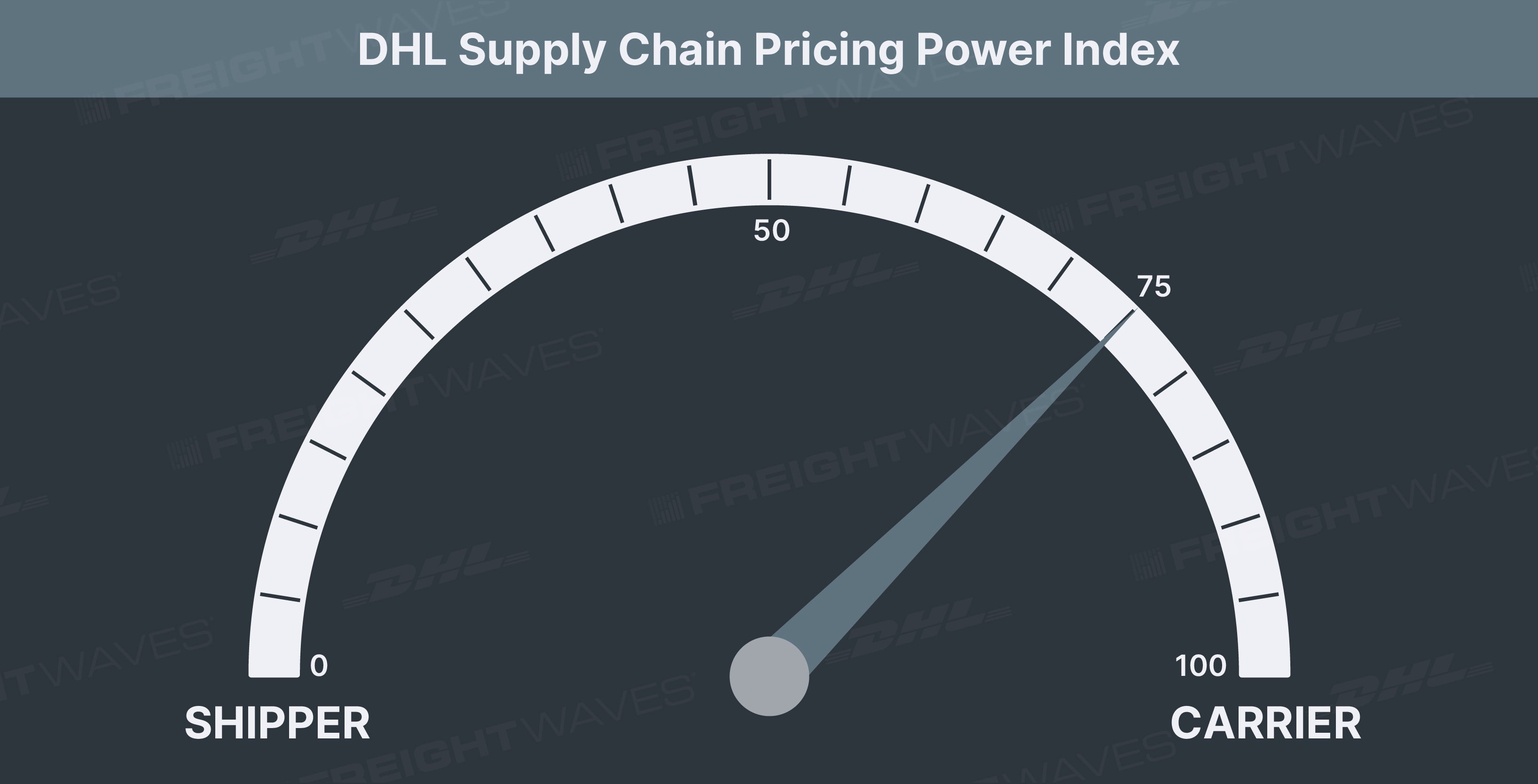
This week’s DHL Supply Chain Pricing Power Index: 75 (Carriers)

Last week’s DHL Supply Chain Pricing Power Index: 70 (Carriers) 

Three-month DHL Supply Chain Pricing Power Index Outlook: 70 (Carriers)

The DHL Supply Chain Pricing Power Index uses the analytics and data in FreightWaves SONAR to analyze the market and estimate the negotiating power for rates between shippers and carriers. 

The Pricing Power Index is based on the following indicators:

Load volumes: Absolute levels positive for carriers, momentum neutral

The Outbound Tender Volume Index at 15,980 is nominally higher now than basically at any point in the past 12 months with the exception of the week prior to Thanksgiving/Black Friday last year. OTVI captures all electronic tenders, including rejected ones, so when accounting for the rejection rate, we can get an even more accurate look at volumes. 

OTVI rose through the back half of May into the national holiday and has risen even further since. Throughout the back half of May and into the middle of June, tender rejections declined substantially. Meaning, current volume throughput is actually understated when comparing OTVI now to OTVI in November 2020. After adjusting for rejected tenders, the accepted outbound tender volume index is just 2.2% below the 2020 peak in November. At that time, OTVI surged towards 17,000, but the rejection rate moved in-kind towards its natural ceiling of 28%. So, the total accepted freight tenders in mid-June is comparable to the peakiest of peak seasons in 2020. Incredible. 

However, since the middle of June, tender rejections have begun increasing again heading into Independence Day, a time when many drivers spend time off the road with their families. The move higher in OTVI this week has been driven primarily by higher rejection rates, rather than higher freight demand. 

Over the past month, the drivers of freight volumes have continued to be imports and from just about every port. The west coast continues to provide seemingly non-stop container ships, while Houston, New Orleans, Miami and Savannah are seeing very strong throughput as well. 

It is van volumes that are driving freight markets higher right now. The Reefer Outbound Tender Volume index has tumbled 25% since its all-time high in the weeks after the polar vortex in February. Since Memorial Day, ROTVI has fallen another 10.5%. This is likely a factor of declining grocery demand, but I would expect the trend to reverse course in the near future as summer festivities accelerate. 

Dry van volumes pushed higher in the back half of May and into June while reefer volumes have declined significantly. 

SONAR: VOTVI.USA (Blue); ROTVI.USA (Green)

The congestion at our nation’s ports has spread from Los Angeles and Long Beach to Oakland, California. The California coastline is a parking lot of container ships, most of which are full to the brim with imports, awaiting berth. As detailed in the economic section, there are some signs that the reversion is underway with Americans paring back spending on pandemic superstar categories in favor of airlines, lodging and entertainment. But spending remains strong despite the moderation, and low inventory levels offset much of the decline that will occur from slowing demand. Real inventories are 3% higher now than pre-pandemic, but real sales growth is far outpacing inventory growth, leading to the lowest inventory-to-sales ratio in decades. 

On the manufacturing side, the ISM Manufacturing PMI expanded in May after declining in April. We’ve been in expansionary territory for 12 consecutive months. New orders, production, imports/exports and employment are all growing. The major issues should come as no surprise: Deliveries are slowing, backlogs are growing and inventories are too low. 

In all, there are many, many catalysts to keep freight demand strong for the foreseeable future. Americans are traveling and spending on services at a high clip, but the high savings rate is enabling it to occur without a massive detriment to goods spending. 

SONAR: OTVI.USA (2021 Blue; 2020 Green; 2019 Orange; 2018  Purple)

Tender rejections: Absolute level and momentum positive for carriers

After declining steadily from mid-March to mid-May, the Outbound Tender Reject Index has reversed course heading into Independence Day. This is typical for a national holiday as carriers selectively choose loads to bring drivers closer to home. OTRI now sits above 25% for the first time in June. 

One of our newest indices in SONAR gives us the ability to compare markets on as close to an apples-to-apples basis as possible. FreightWaves’ Carrier Trend Market Score indices are divided into two perspectives – shipper/broker and carrier. The scores are positioned on a scale from 1-100 and have values measuring van and refrigerated (reefer) capacity. The higher values represent more favorable trends for whichever perspective. For instance, a value near the high-end of the range would suggest very favorable conditions for carriers in our carrier capacity trend score index. 

For the past several weeks, capacity disparities have been driven by import volumes. The markets with the tightest carrier capacity coincide with the nation’s busiest ports. Ontario, California, Savannah, Georgia, and Atlanta all have carrier capacity trend market scores of 100. 

SONAR: Capacity Trend Market Score (Carriers – VAN)

By mode. Reefer rejection rates tumbled from it’s all-time high in March to under 35% in mid-June before popping higher over the past two weeks. Reefer rejections are still quite high from a historical standpoint at 38%, but are significantly lower than just three months ago when reefer carriers were rejecting half of all electronically tendered loads. 

SONAR: VOTRI.USA (Blue); ROTRI.USA (Orange)

Dry van tenders make up the majority of all tenders, so the van rejection rate mirrors the aggregate index closely. Van rejections have surged from ~23% to ~26% over the past two weeks. 

Yes, one-in-four loads being rejected is not ideal, but it’s better than 30%. I am unaware of any meaningful signals that capacity is being added at a rate that would change my outlook. With so many catalysts for demand, and many constraints on drivers including the Drug & Alcohol Clearinghouse, driver training school closures and continued government unemployment benefits, the outlook is tight throughout this year and into 2022. That’s not to say we won’t see improvement as consumers revert to pre-pandemic spending habits and drivers enter or reenter the market. But I’m not expecting any quick reversal of this environment; there are simply too many catalysts driving volume and suppressing capacity. 

SONAR: OTRI.USA (2020/21 Blue; 2020 Green; 2019 Orange)

Freight rates: Absolute level and momentum positive for carriers

Throughout June, spot rates have moderated while contract rates have pushed higher. The Truckstop.com dry van rate per mile (incl. fuel) has fallen from $3.21 to $3.11 since the beginning of June, while FreightWaves van contract rates have risen from $2.50 to $2.59/mile, exclusive of fuel. 

I still believe the Truckstop.com dry van national average will not retest the post-vortex surge pricing that brought spot rates up to an all-time high of $3.30. But, there aren’t many catalysts to bring spot rates down anytime soon either. Demand is unwavering with continued strong consumer goods demand, humming industrial recovery and a potentially cooling, yet still sizzling, hot housing market. And carriers can’t fill enough trucks to keep up with demand. 

Prior to the seasonal movements we’re seeing in tender rejections, routing guides generally had been improving through Q2. We should continue to see a convergence between spot and contract rates, but spot rates will remain historically very elevated throughout the summer as demand simply outstrips capacity. 

SONAR: TSTOPVRPM.USA (Blue); VCRPM1.USA (Green)  

Economic stats: Momentum and absolute level neutral

Several economic releases this week are worth noting.

Weekly jobless claims were released Thursday and give us one of the best close-to-real-time indicators of the overall economy.  This week, the data was again very promising as the labor market continues on a bumpy but trajectorially stable recovery path. 

First-time filings totaled 411,000 for the week ended June 19, a slight decrease from the previous total of 418,000 but worse than the 380,000 Dow Jones estimate, the Labor Department reported Thursday. Initial claims have held above 400,000 for consecutive weeks after falling to a pandemic low of 374,000 three weeks ago. As things stand, the current level of initial claims is about double where it was prior to the Covid-19 pandemic. 

The good news on the jobs front is that continuing claims are on the decline, falling to 3.39 million, a drop of 144,000. That number runs a week behind the headline claims total.

Initial jobless claims (weekly in May 2020-May 2021)

At the time of writing, the newest weekly data for the week ending May 29 had not been updated in SONAR. This week, claims fell from 405,000 to 385,000. 

SONAR: IJC.USA

Consumer. Turning to consumer spending, as measured by Bank of America weekly card (both debit and credit) spending data, total card spending (TCS) in the latest week accelerated to 22% over 2019. This is the first time in June that TCS has topped 20% over 2019, but spending has been running up 16-19% consistently on a two-year comp for months. For contect, the average pre-pandemic two-year growth rate was about 8% (from 2012 to 2019). 

The Bank of America team highlighted service spending in the nation’s two largest state economies, California and New York, which are now fully reopened. Spending at restaurants is now well above 2019 in both states, and the team believes there is more capacity for spending to accelerate in the states that were slower to reopen given pent-up demand. 

There was also a notable acceleration in spending on clothing this week, according to Bank of America. It could be a reversal from some softening in the early weeks of June, or an indication of people refreshing wardrobes ahead of a return to work, more travel and vacations. One tepid statement for freight markets from this week;s report: Leisure spending is on the rise and durable goods spending is flatlining.  

FreightWaves’ Flatbed Outbound Tender Reject Index, both a measure of relative demand and capacity, moves directionally with the ISM PMI. 

SONAR: ISM.PMI (Blue); FOTRI.USA (Green) 

Manufacturing. Over the past two weeks, regional manufacturing surveys have reported generally positive readings amid logistical challenges. The New York Fed’s Empire State business conditions index declined 6.9 points to 17.4 in June, retreating from strong readings the past two months. The Empire State Index is a diffusion index with a baseline of zero; any reading above zero indicates improving or expansionary conditions. 

Delivery times lengthened to a new record during the month, new orders and shipments fell, and inventories entered negative territory. The supply chain and transportation challenges are as visible upstream as downstream, but overall the manufacturing sector is handling. Growth continued throughout the second quarter in both the Empire State and Philly Fed indices. 

The Philadelphia Federal Reserve’s business activity index edged lower to a still robust 30.7 in June from 31.5 in the prior month. Unlike NY, the pace of shipments growth accelerated in the Philly region during June. The employment subcomponent rose to a very healthy 30.7 from 19.3 last month, the regional bank said. 

Record-long lead times, wide-scale shortages of critical basic materials, rising commodities prices and difficulties in transporting products are continuing to affect all segments of the manufacturing economy, but demand remains strong. 

For more information on the FreightWaves Freight Intel Group, please contact Kevin Hill at khill@www.freightwaves.com or Andrew Cox at acox@www.freightwaves.com.

Check out the newest episodes of our podcast, Great Quarter, Guys, here.

Project44 acquires ClearMetal to strengthen predictive tools

Project44, a leader in real-time visibility of the global supply chain, announced on Thursday it has acquired ClearMetal, a San Francisco-based supply chain planning software company that focuses on international freight visibility, predictive planning and overall customer experience. The terms of the acquisition were not disclosed.

ClearMetal, founded by top software engineers and data scientists from Stanford, Google and other Silicon Valley elites, has created a “continuous delivery experience” that leverages proprietary machine learning algorithms that can forecast supply chain disruptions. 

In an interview, Jason Duboe, chief growth officer at project44, explained that bringing in ClearMetal’s elite team is essential for the company’s future predictive solutions.

“Their team construct is fundamentally different. When you look at their data science, machine learning and computer science background, they are best in class,” he said. “Applying the team to solve really interesting challenges, starting with highly predictive ETA and deeper exception management to create more predictive analytics is really a key component here.”

Project44 recently acquired Ocean Insights to gain global supply chain vessel visibility and has announced it has expanded its truckload tracking services within Asia. Bringing on this new team of engineers will allow the company to capitalize on strong predictive tools, strengthening the supply chain of its customers.

“We’re going to be expanding deeper into Asia, and from a port perspective, getting data much earlier than competitors,” explained Duboe. “Our freight forwarder integrations will give us much deeper visibility from an end-to-end perspective in these regions.”

Along with the acquired skills the ClearMetal team will bring to project44, it brings a large book of customers, including large CPGs, retailers, manufacturers, distributors and chemical companies. These advanced use cases will strengthen the predictive planning tools, and project44 continues to expand into different customer markets.

“What we gain from ClearMetal is a holistic platform for anybody that joins the platform in the future,” said Duboe. “They have large customers with incredibly demanding and advanced use cases. So when it comes to order and inventory, functionality, supplier onboarding, and moving upstream into those processes, we can capture exceptions earlier on.”

Click here for more articles by Grace Sharkey.

Related Articles:

Project44 expands real-time visibility into China

Project44 reels in Ocean Insights in ‘largest acquisition in visibility space’

‘Project44’s vision has always been global’

GXO sees stable North American freight demand, cautious on volumes in 2026

GXO Logistics Inc. sees North America as a big opportunity for organic growth, with executives telling analysts that the U.S. market will be a primary driver of revenue and margin expansion in 2026 and beyond.

CEO Patrick Kelleher described North America as “a primary focus,” citing a total addressable market of roughly $250 billion in the region and what he called “a great foundation of business” across consumer, technology, aerospace and industrial verticals.

“We are underrepresented in North America in contrast to our participation in the U.K. and Europe. We are very confident that we have upside there and we’re executing that to that end,” Kelleher said during the company’s fourth-quarter earnings call on Wednesday.

Greenwich, Connecticut-based GXO Logistics (NYSE: GXO) is one of the largest pure-play contract logistics providers in the world. It has more than 970 facilities totaling approximately 200 million square feet, with a global workforce of more than 130,000 people.

GXO reported fourth-quarter results after the market closed on Tuesday. Quarterly revenue rose 7.9% to $3.5 billion, up from $3.25 billion compared to the same year-ago period. 

Adjusted earnings per share was 87 cents in the fourth quarter, compared 83 cents per share, in 2024. 

The results beat Wall Street expectations for fourth quarter earnings of 83 cents per share and revenue of $3.47 billion.

Executives said North American performance outpaced parts of Europe in the fourth quarter.

“In Q4, our trends in North America and the U.S. were stronger than continental Europe and U.K.,” CFO Baris Oren told analysts. “For 2026, it’s too early to call for the entire year. We just take a flat number for prudence … nothing more than that.”

GXO is assuming flat volumes in 2026 in the existing operations across its network, a conservative macro outlook executives said reflects uncertainty around customer demand. Growth is expected to be driven primarily by new business wins rather than a volume rebound. 

The company exited 2025 with $774 million in incremental revenue already secured for 2026 and a global pipeline of $2.5 billion, up from $2.3 billion at year-end, with particular momentum in strategic verticals such as aerospace and defense, life sciences, and technology, including data center infrastructure. 

Re-energizing the U.S. commercial engine

Kelleher said newly appointed North America leader Michael Jacobs, who stepped into the role three months ago, is reallocating resources toward solution design, sales and digital marketing to improve pipeline conversion in the U.S. 

Executives noted that the contract logistics sales cycle typically runs six to nine months, followed by another several months for operational ramp-up, noting that the acceleration in U.S. growth could materialize in the second half of 2026 and into 2027 

“Our guidance for 2026 accurately reflects stepping into that growth based on the sales and startup cycle, and that has us very excited for 2027 as well,” Kelleher said. 

Outsourcing tailwinds despite macro caution

While some analysts pointed to low U.S. inventories and potential restocking as a possible catalyst for higher warehouse throughput, GXO executives said it was too early to call a broad-based rebound and reiterated their cautious volume outlook for 2026. 

Instead, management is prioritizing organic expansion and continued deleveraging, targeting net leverage of about two times EBITDA by the end of the year. 

“The guidance for this year is assumed on flat volume, and as we consider the overall macroeconomic situation and really anticipate how that is going to materialize, we’ve taken a very conservative view there with respect to current customer volumes,” Kelleher said.

“So the lever for this year is really about organic growth, driving top-line.”

Customers facing cost pressures are increasingly turning to third-party providers that can invest in automation, robotics and artificial intelligence at scale — investments many shippers cannot justify independently, executives said. 

Kelleher described the U.S. as the “epicenter of technological innovation” for the company, particularly as it scales its AI-powered GXO IQ warehouse operating system and experiments with humanoid robotics across sites. 

GXO’s fourth quarter key financial results.

New MOL executive team to succeed CEO

Mitsui O.S.K. Lines (MOL) said that it had appointed a new executive team to succeed Takeshi Hashimoto atop the Japan-based ocean container carrier.

Jotaro Tamura will succeed Hashimoto as president and chief executive, effective April 1, as part of what MOL terms a Cooperative Management System, with new Chief Operating Officer Hisashi Umemura and current Chief Financial Officer Kazuya Hamazaki.

Takeshi Hashimoto (l) and Jotaro Tamura. (Photo: MOL)

Hashimoto had served as president and CEO since 2021, and led implementation of the multi-phase Blue Action 2035 management plan. He will now serve as chairman of the company’s board of directors.

MOL is part of joint venture Ocean Network Express (with NYK and K Line.

“Having successfully navigated Phase 1 (to FY 2025) and established a clear path for large-scale strategic investments, I believe now is the perfect time to transition to a new leadership team for Phase 2 (FY 2026–2030),” Hashimoto said in a LinkedIn post. 

Tamura had worked as senior managing executive officer in global container and liner businesses in Singapore and London. Umemura previously was senior managing executive officer in the energy sector.

“Jotaro has earned deep trust both within the company and across the industry,” said Hashimoto. “I am confident that his leadership will be instrumental in enhancing our human capital and organizational capabilities – the very core of our group’s growth – and driving the next stage of our transformation.”

Find more articles by Stuart Chirls here.

Related coverage:

Asia-U.S. ocean freight rates give up 2026 gains

Red Sea torpedoes Hapag-Lloyd rates

Port of New York-New Jersey box gains shake off trade reset

New CBP vessel rule targets high-risk exports

Annual employment report revision shows huge decline in truck transportation jobs

(This is a developing story. FreightWaves will have additional coverage over the course of the day).

There were a lot fewer people working in truck transportation in 2025 than initially reported.

The Bureau of Labor Statistics’ (BLS) monthly employment report that is released in February is the first to incorporate the annual revision the agency implements as it gathers more data on employment, a process that goes on long past the agency’s monthly reports.

The annual revision is more sweeping than the monthly short-term revisions that can adjust prior reporting for two months. So, for example, the report that comes out in early September will have first-time data for August, as well as potentially adjusted July and June numbers. After that report, June can’t be revised again until the annual revision; July can only be revised one more time a month later before the annual revision.

There are numerous ways to measure the latest report that is the first to incorporate the annual revision. But they all point to the same conclusion: the BLS monthly estimate for truck transportation jobs in 2025 had been running high. The annual revision cut it down to size.

Difference in estimates widened throughout the year

Comparing the latest report for 2025 to the full 2025 report reported in early January, the gap between what was initially reported and was then revised grew as the year went on.  

For example, truck transportation jobs in January 2025 after its “final” short-term revision stood at 1,532,000 jobs. The annual revision puts it at 1,493,100 jobs, a difference of 26,000 jobs.

By the end of the year, the annual revision puts December at 1,466,900 truck transportation jobs, 46,400 less than what had been reported just a month ago for December.

What is more striking is just how many truck transportation jobs have been lost in recent years, well beyond the comparison of 2025 to 2024. 

The revision is not just for the prior year; it makes changes going further back, though numbers for 2022 or 2023 don’t change that much. The latest report said the peak number of truck transportation jobs was in January 2023, at 1,587,800. 

The revised number for December 2025 is 1,466,900 jobs. In January 2026, that was down to 1,462,600 jobs, a drop of 4,300 in one month, a large figure.

What that means is the difference between the January 2023 peak and the number for last month saw a decline of 125,200 jobs.

Warehouse employment higher than estimated

Meanwhile, data in the BLS report showed the opposite trend for warehouse employment: it was higher in 2025 than first estimated.

For example, warehouse employment for December 2025 was initially reported as 1,791,500 workers. The revised estimate released Wednesday is 1,833,100 jobs, a difference of 41,600 workers. 

However, the trend did show a decline in warehouse employment over the course of the year. Peak employment in that category last year was in February at 1,883,400 jobs. The end of year figure was more than 50,000 jobs less than that.  

The latest revision from earlier years puts peak employment in warehouse employment at 1,939,300 jobs in March 2022.

The preliminary estimate released in September is for the full Transportation and Warehouse sector. Truck transportation, warehouses, rail and other activities are subsets of that number but estimates for those sectors are not provided.

The report estimated that jobs in the Transportation and Warehouse sector would rise by 6,600 jobs. But the number released Wednesday is that between December 2024 and 2025, the total fell by 104,000 jobs. 

More articles by John Kingston

Werner settlement ready to go in drivers’ lawsuit that dates to 2014

Amazon’s LTL offering reaching out to shippers as possible customers: report

Wall Street reacts to Proficient’s earnings: a 25% stock decline

Truck Safety Tip Line Created to Address Safety and Fraud Concerns

Truck driver ELD in the cab.

U.S. Senator Jim Banks of Indiana has launched a new federal reporting initiative aimed at collecting safety-related concerns from within the trucking industry. The Truck Safety Tip Line, now live on his official Senate website, is designed as a centralized channel for drivers, carriers, industry employees and members of the public to submit information related to potential safety violations, fraud or regulatory concerns in commercial transportation.

Banks, who serves on the U.S. Senate Committee on Banking, Housing, and Urban Affairs, announced the initiative publicly and positioned it as a way to increase transparency and accountability within the trucking sector. The portal allows individuals to submit tips directly to his office regarding safety issues tied to commercial motor vehicles, licensing standards and regulatory compliance.

The launch comes amid heightened national attention on trucking safety and commercial driver licensing practices. Over the past year, federal regulators and state enforcement agencies have intensified scrutiny of non-domiciled commercial driver’s licenses, English language proficiency enforcement and alleged fraud schemes involving CDL testing and issuance. Several high-profile enforcement actions and criminal indictments tied to CDL fraud have fueled broader policy discussions in Washington.

The Truck Safety Tip Line appears to be part of that broader oversight conversation.

According to information provided on the Senate website, the tip line is intended to gather reports related to unsafe trucking operations, fraudulent activity, regulatory violations and other safety concerns that may warrant federal review. Submissions are directed to the senator’s office, where they may inform legislative oversight efforts or prompt inquiries to federal agencies such as the Federal Motor Carrier Safety Administration.

The website does not describe the portal as an enforcement mechanism. Instead, it functions as a reporting tool for constituents and industry stakeholders who believe certain safety issues are not being adequately addressed through existing regulatory channels.

Banks has been publicly vocal about trucking safety issues in recent months, particularly around CDL standards and regulatory enforcement. His office has referenced concerns about licensing integrity, vetting processes and oversight gaps that could pose safety risks on U.S. highways. The tip line formalizes a direct pathway for those concerns to be documented and reviewed at the congressional level.

The timing of the initiative aligns with ongoing regulatory developments. In late 2025 and early 2026, the FMCSA issued rulemakings and emergency actions tied to non-domiciled CDLs and enforcement standards. Some states also announced reviews or adjustments to their CDL issuance processes following federal guidance and investigative findings.

Industry debate has intensified around questions of compliance, oversight consistency and the role of federal versus state authority in driver credentialing. Advocacy groups, trade associations and safety organizations have issued statements calling for stronger enforcement in some areas, while others have urged caution against overgeneralization and the risk of stigmatizing lawful drivers.

The tip line does not specify a narrow category of concern. Instead, it broadly invites reports related to trucking safety and regulatory integrity. The online form requests details about the alleged issue, including relevant companies, locations and documentation if available.

From a legislative perspective, congressional tip lines are not uncommon. Lawmakers often use them to collect information that may support hearings, letters to agencies or proposed legislation. In transportation policy, anecdotal evidence and documented complaints can influence oversight priorities and future regulatory proposals.

It remains to be seen how the volume and nature of submissions will shape next steps. Depending on what is reported, the information gathered could contribute to oversight inquiries, requests for data from federal agencies or public statements outlining identified patterns.

The launch also underscores the current level of political focus on trucking safety. Commercial transportation remains a critical component of the U.S. economy, moving the majority of domestic freight. At the same time, high-profile crashes, licensing investigations and enforcement disparities have drawn scrutiny from policymakers across party lines.

Why Senator Banks Pushed for This Now

According to Banks’ public statements, the Truck Safety Tip Line was created in response to growing concerns that unsafe operators and fraudulent actors are exploiting gaps in oversight, particularly as freight markets tighten and competition increases.

Over the past several years, the industry has seen a rise in carrier identity theft and impersonation, increased scrutiny around CDL validity and licensing practices, unsafe operators cycling through new authorities to avoid enforcement, payment disputes tied to fraud rather than performance and public safety incidents that raised questions about accountability. Banks has positioned the tip line as a way to bring sunlight to patterns that drivers and small carriers often recognize long before regulators do.

The portal allows individuals to submit information related to repeated unsafe driving behavior, suspected fraudulent carrier activity, identity theft involving DOT or MC numbers, chronic noncompliance that appears intentional and safety issues tied to specific companies or operations.

Tips submitted through the portal are reviewed and, when appropriate, referred to agencies with jurisdiction. Submissions do not automatically trigger citations, audits or penalties. They are intended to highlight trends rather than punish single mistakes. That distinction is central to how the initiative is being presented.

What the Tip Line Is — and Is Not

The Truck Safety Tip Line is a reporting portal, not an enforcement mechanism. It does not replace FMCSA complaint systems, resolve payment or contract disputes, serve as a shortcut to enforcement, penalize one-off violations or eliminate due process. Tips are evaluated, not assumed to be accurate. Any follow-up action still requires verification and evidence.

The structure reflects an intelligence-gathering approach rather than immediate punishment. Lawmakers often rely on aggregated complaints to identify systemic weaknesses, and this initiative appears designed to capture that kind of information in a centralized format.

Why the Industry Is Paying Attention

The existence of the tip line reflects a broader shift in how trucking oversight is evolving. Safety and fraud issues are increasingly viewed not only as roadside enforcement matters but as systemic issues involving licensing systems, financial practices, digital vulnerabilities and interstate regulatory coordination.

By creating a centralized reporting mechanism, Banks is signaling that policymakers are seeking earlier warning signs, not just post-incident enforcement. Whether the tip line becomes a meaningful oversight tool or remains largely symbolic will depend on how responsibly it is used and how carefully submissions are handled.

The Bigger Picture

The Truck Safety Tip Line did not emerge in isolation. It reflects years of tension within the industry between compliant operators and those accused of exploiting regulatory gaps. As enforcement conversations shift upstream, initiatives like this suggest that congressional oversight may increasingly rely on direct input from industry participants.

For now, the portal functions as an open reporting channel. Whether it leads to legislative proposals, formal investigations or agency engagement will depend on the information received and how it is evaluated.

The reporting portal is available through Senator Banks’ official Senate website under the Truck Safety Tip Line section.

SONAR: The Ultimate Cure for Market Pain

Use SONAR’s Forward-Looking Market Intelligence (NOT just historical data) as preventative medicine for your market pain.

Who SONAR Helps:

Avoid getting caught flat-footed, most tools tell you what has already happened, SONAR provides context and leading indicators to help you act proactively.

What competitors do:

Competitor TypeLimitation
Rate platforms (DAT, Truckstop, Xeneta, etc.)Benchmarking + backward-looking
TMS/ERP dataInternal only, no market signal
Consulting reportsStatic, lagging, quarterly
Forecasting modelsNarrow scope or rate-only

SONAR has:

A live macro supply–demand engine using:

  • Tender volumes (OTVI and STVI)
  • Tender rejections (OTRI and STRI)
  • Mode shifts (intermodal, ocean, air)
  • Macro flows
  • Seasonal + structural trend modeling

This is not a rate tool — it’s a market direction engine.

How to Make Smarter Tender Acceptance Decisions (Part 1)

As tender rejection rates surge nationally to over 14%, compared to just 5.5% last year at this time, be sure you’re focusing o your “take” strategy rather than just your freight coverage strategy. Watch this brief webinar to learn how to use SONAR’s Quick Rates Chrome Extension and Rate Intelligence tools to inform your tender acceptance strategy.

Watch the webinar here.

Asia-U.S. ocean freight rates give up 2026 gains

Containers being lifted at Port of Long Beach

Ocean container rates on the benchmark eastbound trans-Pacific have given up gains won in 2026 as muted demand marks a lull that could last until the peak shipping season.

“And while ocean rates typically ease as the holiday approaches, they normally remain elevated relative to levels before the rush until after the post-holiday backlog is cleared,” said Freightos (NASDAQ: CRGO) analyst Judah Levine, in a note to clients.

The Freightos Baltic Index shows Asia-U.S. West Coast prices tumbled 21% to $1,916 per forty foot equivalent unit (FEU) in the latest week. Asia-U.S. East Coast rates fell by 10% to $3,457 per FEU.

Freightos is a contributor to SONAR ocean data. 

“Asia-U.S. West Coast rates slipped more than 20% last week to about $1,900 per FEU are all the way back to early December levels, suggesting that prices are already entering the post-Lunar New Year, pre-peak season lull,” Levine wrote.

The National Retail Federation U.S. ocean import report projects March volumes will dip 5% month-on-month. First-quarter demand is projected to trail year-ago levels by 7% year as retailers exercise caution and totals are compared to volumes frontloaded in Q1 last year.

U.S. container ports and air hubs have mostly recovered from the recent winter storm, though backlogs at inland rail terminals continue to cause delays for shippers.

Levine noted that record global container volumes in 2024 failed to keep pace with carriers’ expanding fleets. Maersk last week  (MAERSK-B.CO) reported its first quarterly loss in years and its Gemini Cooperation partner, Hapag-Lloyd (HLAG.DE), also saw lower  earnings amid traffic growth. Maersk for the first time said it would factor a major economy’s recession into its outlook, and forecast a possible profit/loss swing of $1 billion, depending on whether substantial container traffic returns to the Red Sea.

Find more articles by Stuart Chirls here.

Related coverage:

Red Sea torpedoes Hapag-Lloyd rates

Port of New York-New Jersey box gains shake off trade reset

New CBP vessel rule targets high-risk exports

New Jaxport project to boost Toyota volumes

Startup courier Gofo acquires Cirro E-commerce for access to retailers

An orange Gofo truck heads down the highway.

Parcel delivery startup Gofo has acquired Cirro E-commerce, an end-to-end provider of international small-parcel logistics services in the United States, Europe and Oceania, the latest stage in an infrastructure race between low-cost carriers to achieve scale in the last-mile delivery market.

Gofo also made two appointments to lead its commercial strategy and sales execution, including Ron Jansen from YunExpress, where he served as U.S. CEO, to be chief commercial officer, U.S. YunExpress is a subsidiary of Zongteng Group, a large, China-based provider of cross-border warehousing and logistics services for e-commerce sellers. 

Integrating Cirro E-commerce’s U.S. market expertise, customer relationships and established retail integrations with Gofo’s semi-national delivery network expands Gofo’s domestic reach and ability to provide more consistent service to e-commerce merchants in the U.S. market, Gofo executives said. Cirro specializes in domestic and cross-border parcel logistics. 

“CIRRO E-Commerce brings strong local market expertise, high-performing commercial and customer experience teams, and established e-commerce integrations. Gofo brings network scale, automation, and operational discipline. Together, we will deliver a stronger, more seamless experience for U.S. shippers,” said Leon Li, CEO of Gofo U.S.

Gofo said it will retain Cirro E-commerce’s executive team and named Vincent D’Amata, who headed sales for Cirro, as chief sales officer, U.S. Terms of the deal were not disclosed.

In October, Cirro added Gofo to the list of last-mile carriers available to retailers using its shipping platform. 

Gofo made the acquisition announcement from Manifest, a large supply chain conference held in Las Vegas, where it is promoting itself to shippers.

Gofo was founded in 2023 by Chuan Zheng, a U.S. citizen of Chinese heritage with extensive experience in logistics and cross-border e-commerce, who previously formed a company called Ebisu. 

A significant share of historical volume has come from e-commerce merchants linked to China, but the U.S. business is rapidly expanding its presence among North American retailers and smaller online sellers. International parcels are customs cleared by partner companies, but the majority of shipments originate from U.S. domestic warehouses. The courier’s operations, leadership and decision-making are centered in the United States, the spokesman said.

Gofo has rapidly expanded its logistics foundation across the United States with nearly 100 hubs and stations supported by more than 30 linehaul routes. It currently has more than 1,000 full-time employees and uses delivery service partners to provide physical last-mile delivery. 

Gofo recently said it processed over 60 million parcels during peak season — Thanksgiving to Christmas — with a sortation capacity of 3 million parcels per day during the busiest stretch. Its network remained stable, with a 99% delivery success rate, despite the surge in volume. 

Gofo in October opened super hubs in Newark, New Jersey, and Los Angeles ahead of the peak shipping season. In addition to the $150 million investment, Gofo operates more than 100 automated hubs and stations and a U.S. line-haul network with more than 30 routes. Its delivery service, which provides next-day delivery around major hubs and three-to-five day delivery across states and regions, is available in 49 of the top 50 markets, according to the company. 

The company also increased its app-based independent driver workforce by 30% year over year to ensure smooth operations. Gofo operates 1,500 self-owned and partner-operated vehicles, including 26-foot and 53-foot trucks that form the backbone of its nationwide network. Gofo said trucks achieved 99.5% on-time pick score and met service level agreements 95% to 99% of the time. Long-haul trucks carried up to 16,000 parcels. 

Retailers are increasingly turning from legacy parcel carriers FedEx, UPS and the U.S. Postal Service, to smaller, independent providers that offer much lower rates. Many of the new carriers are investing millions of dollars to build regional and national networks, raising questions about how long they can sustain that growth.

Click here for more FreightWaves/American Shipper stories by Eric Kulisch.

Write to Eric Kulisch at ekulisch@freightwaves.com.

Veho to flex delivery speed for price-sensitive e-commerce sellers

New SpeedX superhub in Chicago expedites more parcel deliveries

Independent parcel carriers continue network, tech investments

Update: FAA re-opens El Paso airspace

Update: CNN reports the U.S. military responded to a drone incursion in El Paso

It appears that counter-drone technology was deployed by the U.S. military from Fort Bliss in response to drone incursions into controlled airspace. Fort Bliss tested counter-unmanned aerial system or c-UAS technology for the first time in April 2025.

The Federal Aviation Administration abruptly imposed a rare 10-day closure of airspace over El Paso International Airport (ELP) and surrounding areas, halting all commercial, cargo, and general aviation flights from late Tuesday through Feb. 20, but reversed course only hours later and re-opened flights. The temporary flight restriction, citing “special security reasons” and designated as national defense airspace, covered a roughly 10-nautical-mile radius, including parts of southern New Mexico near Santa Teresa. It excluded Mexican airspace and high-altitude overflights above approximately 18,000 feet.

The move, which took local officials and airport operators by surprise, immediately grounded operations at one of West Texas’s busiest gateways. El Paso International handled more than 4 million passengers and about 94,000 tons of cargo in 2024. While cargo volumes are modest compared to major hubs, the airport supports key regional shipments, including electronics components, medical supplies, perishables, and express packages for carriers like DHL, FedEx, and UPS.

Air cargo disruptions and rerouting pressures

The shutdown forced air cargo carriers to divert flights or shift to ground alternatives, increasing costs and extending transit times for time-sensitive freight. Shippers dependent on air links for just-in-time deliveries to maquiladoras in Ciudad Juárez may face delays in high-value or urgent goods. Airlines including Southwest, American, Delta, and United are rebooking passengers to distant alternatives such as Albuquerque or Dallas, creating knock-on effects for business travel that supports logistics planning in the region.

Highways and border crossings remain open but face indirect risks

Major highways through El Paso, including Interstate 10, continue operating amid routine construction lane closures for widening projects, with no full shutdown reported. However, the security-driven airport closure raises concerns about potential ripple effects on ground transportation.

El Paso stands as a cornerstone of U.S.-Mexico trade. The Borderplex metro area and its crossings — notably Ysleta-Zaragoza and the Bridge of the Americas — facilitate billions in annual two-way commerce, with hundreds of thousands of commercial truck crossings each year. Key commodities include automotive parts, consumer electronics, machinery, and agricultural products flowing through integrated North American supply chains.

If the underlying security concerns prompt heightened inspections, personnel shifts, or increased vigilance at ports of entry, truck wait times could lengthen. Even modest delays at these crossings can disrupt just-in-time manufacturing models prevalent in the Juárez-El Paso manufacturing corridor, where components often cross the border multiple times.

Local and regional supply chain implications

For the El Paso metro area (population nearing 900,000 including cross-border ties), the closure isolates the region from air connectivity, affecting not only freight but also executive travel, supplier coordination, and support services tied to logistics. Ground transport may absorb some air cargo demand, potentially straining capacity on I-10 and local distribution networks.

Broader supply chain professionals are watching closely. While direct impacts are concentrated in air freight and regional connectivity, any escalation in border security measures could amplify costs and uncertainty for cross-border truckers and importers/exporters. Shippers are urged to review inventories, explore intermodal rail-truck options where feasible, and maintain close contact with carriers.

The FAA has not indicated when or if more details on the security rationale will emerge. As of now, the 10-day window represents a significant test of resilience for a critical border logistics node. FreightWaves will continue monitoring developments for updates on ground operations and trade flows.

The Catastrophic State of Trucking and Highway Safety

Four Amish men are dead in Jay County, Indiana. A father and his two sons, ages 19 and 25, and a family friend. Killed on February 3 when a Freightliner semi driven by 30-year-old Bekzhan Beishekeev, a Kyrgyzstani national who entered the country through the Biden administration’s CBP One app and received his CDL from Pennsylvania, swerved into oncoming traffic rather than braking for a slowed truck ahead of him. The van was carrying 15 people.

Three weeks earlier, Kamalpreet Singh, an illegal immigrant living in California, rear-ended and killed Robert Pearson in Washington state. Singh was released on bond despite an ICE detainer. Pearson’s family says no lawyer will take their case because the liability chain is so fractured that no single entity can be held accountable.

Last August, Harjinder Singh, a 28-year-old Indian national in the country illegally who couldn’t speak English, killed three Haitian migrants on Florida’s Turnpike after making an illegal turn. He held a non-domiciled CDL from California.

In Alabama, the Pruitt crash killed eight children when a truck slammed into the back of a Ford Explorer at over 50 mph. The driver, an Ethiopian immigrant who came through a CDL mill network in Clarkston, Georgia, was never charged criminally for killing those children. Three years later, that same driver now operates his own trucking company under active federal authority. The carrier owner who put him behind the wheel has operated at least eight different companies since the crash. No meaningful accountability for anyone.

In June 2024, Ignacio Cruz-Mendoza, a 16-time-deported illegal immigrant from Mexico, lost control of his truck hauling improperly secured steel piping for Monique Trucking, a carrier with 18 violations and multiple ignored out-of-service orders, and crushed 64-year-old Scott Miller to death. Miller and his wife, Deann, had just retired from the trucking industry themselves. They had plans. Cruz-Mendoza received a downgraded charge of misdemeanor careless driving and served nine months and 23 days.

June 21, 2019, seven members of the Jarheads Motorcycle Club, Marine Corps veterans and their spouses, were killed in Randolph, New Hampshire, when a pickup towing a flatbed for Westfield Transport crossed the centerline and plowed into their formation. The NTSB found the driver was impaired by heroin, fentanyl, and cocaine, had a suspended license in Connecticut, and that the carrier’s managers routinely tampered with electronic logging devices and falsified hours-of-service logs. The driver, Volodymyr Zhukovskyy, was acquitted of all manslaughter charges. The carrier owner, Dunyadar Gasanov, pleaded guilty to three counts of making false statements. His sentence: two months in prison. Seven dead Marines. Two months.

I’ve spent 25 years in trucking. CDL driver. Freight broker. Fleet executive. Compliance consultant. Expert witness. I’ve held nearly every job in this industry from the cab to the C-suite to the courtroom, and I’ve spent the last year systematically documenting every failure point in the system through my “30 Days of Why” investigative series on Substack and here on Freightwaves. What I found isn’t a handful of bad actors exploiting a few loopholes. It’s a machine. A self-attesting fraud machine with interlocking parts that was built over two decades, and it’s grinding Americans into the asphalt while every party in the supply chain points fingers at someone else.

This is the State of Trucking in 2026. Every piece of it. The people making policy need to see the full picture, and the drivers and families paying the price deserve to know why.

The Accountability Crisis Of Kill. Catch. Release. 

If there is a single word that defines the state of trucking in 2026, it’s unaccountable. Nobody is accountable for anything. Not the carriers. Not the brokerages. Not the shippers. Not the state agencies issuing licenses. Not the medical examiners’ rubber-stamping physicals. Not the third-party testers selling passing scores. If there’s going to be accountability, it’s almost always isolated to the drivers who kill people on the highway. That’s not the general rule, sometimes even the driver walks free. 

Dunyadar Gasanov falsified driver logs, instructed employees to deactivate electronic logging devices, lied to federal investigators, and knowingly employed a drug-impaired driver with a suspended license who killed seven Marine veterans. His punishment consisted of two months. His driver was acquitted entirely. Seven families buried their loved ones, and the system handed them nothing. The driver, despite still living in the US under Temporary Protective Status, requested that his CDL be returned. He failed, but he’s eligible again in June. 

The Pruitt crash in Alabama is arguably worse. Eight children were burned alive in a crash caused by a driver who came through an Ethiopian CDL mill network, employed by a carrier with known violations. The driver who delivered the killing blow, rear-ending the Explorer at over 50 mph, faced no criminal charges. Not one. And the regulatory system that failed to prevent an unqualified driver from obtaining a CDL didn’t just let him walk; it rewarded him. That driver now operates his own trucking company under active federal authority. The carrier owner who put him in the truck has since opened at least eight more companies. Nobody in the NTSB or FMCSA investigation even questioned how the driver obtained his commercial license in the first place. No investigation of the CDL school. No investigation of the Ethiopian trucking network in Clarkston, Georgia. The system treated the symptoms and ignored the disease.

Ignacio Cruz-Mendoza was deported 16 times. He was hauling improperly secured 500-to-1,000-pound steel piping on a flatbed that hadn’t been inspected in over two years, for a carrier that had been ordered to cease operations multiple times. He killed a retired trucker, a man who had spent his career doing it the right way. The criminal justice system gave Cruz-Mendoza a misdemeanor. Nine months. The only justice Deann Miller received came from ICE, which showed up on the day he walked out of jail and deported him. Not from the courts. Not from FMCSA. From immigration enforcement.

Meanwhile, in Texas, SB 39 passed the state Senate, a bill that would prevent juries from hearing about a trucking company’s prior safety record or driver hiring failures unless the court has already found the company at fault for the crash in question. Think about that. A carrier with 50 prior violations hires an unlicensed driver who kills a family, and the jury might never hear about the pattern. We should absolutely pursue litigation reform; third-party litigation funding has driven nuclear verdicts that threaten legitimate carriers, but absolving fleets of accountability for their history is not reform. It’s a shield for negligence.

Accountability means consequences that match the gravity of the failure. Right now, you face stiffer penalties for tax fraud than for running an illegal trucking operation that kills someone. Until that changes, until carrier principals face real prison time, until brokerages face real liability, until the entire chain of profit is held to the same standard as the chain of harm, nothing changes. People will keep dying.

Licensing Standards

A commercial driver’s license is supposed to mean something. It’s supposed to mean the person holding it has demonstrated the knowledge, skill, and physical fitness to operate a vehicle that can weigh 80,000 pounds at highway speed alongside families in sedans. In 2026, the CDL means whatever the issuing state decides it means, and the standards vary so wildly that calling it a “national” licensing system is a joke. I baby mine because it was so difficult for me to get I ensure I take care of it. They’re no longer as difficult to get as they were 25 years ago. 

The DOT Office of Inspector General has been raising this alarm for years. Their audits have repeatedly questioned whether we have one CDL standard or 50. With nearly 5,000 truck and bus fatalities last year and English proficiency enforcement under scrutiny, the latest OIG audit could reshape how states test, license, and oversee drivers nationwide. But the question is whether it actually will, or whether it’ll be another report that gathers dust while bodies pile up.

Start with the skills test itself. Federal regulations establish minimum standards for what the CDL skills test should include: a pre-trip vehicle inspection, a basic vehicle control test, and an on-road driving test. But states have enormous latitude in how they implement those standards. Some states require extensive behind-the-wheel training and rigorous road tests on challenging routes. Others allow third-party examiners to administer the test in private courses with minimal exposure to traffic. The result is a patchwork where a CDL earned in one state may represent fundamentally different competencies than a CDL earned in another.

English proficiency is a prime example. The requirement that CMV drivers be able to read and speak English sufficiently to communicate with the public and understand highway signs has existed since 1937. The Obama administration’s 2016 guidance told inspectors to issue warnings rather than out-of-service orders to non-proficient drivers. That single policy change, downgrading enforcement from removal to a note in a file, opened the floodgates. Secretary Duffy’s May 2025 order reinstated out-of-service enforcement for English proficiency violations, but even with that restoration, inspectors issued 6,455 English-language proficiency violations through October 2025 while placing only 1,816 drivers out of service. That’s a gap of over 4,600 drivers cited for not speaking English while behind the wheel of a commercial vehicle who were allowed to keep driving.

The non-domiciled CDL system has been the most spectacular licensing failure. New York programmed its DMV systems to default to eight-year license terms for non-REAL ID CDLs regardless of when a foreign driver’s legal presence expired, a systemic, intentional disregard of federal requirements. California issued CDLs with endorsements to drive passenger buses and school buses to drivers whose legal status had expired years earlier. Pennsylvania issued a CDL to Bekzhan Beishekeev, who then killed four people in Indiana. In every case, the states defended their processes until the federal audit exposed them.

The FMCSA’s Entry Level Driver Training rule, effective February 2022, was supposed to professionalize the front end of the pipeline by requiring all new CDL applicants to complete training at a school listed on the Training Provider Registry. At peak, more than 35,000 providers were registered. The vetting was essentially self-certification. Schools could register, issue completion certificates, and put students on the road with minimal oversight. FMCSA has since removed thousands of providers for noncompliance, but only after tens of thousands of drivers had already been certified through programs that couldn’t meet basic standards. We need a different approach to driver training and licensing. 

Then there’s the third-party examiner system, where states outsource CDL skills testing to private entities. My Day 28 investigation compiled a criminal case repository spanning 2001 to 2025, including dozens of federal and state cases involving corrupt examiners selling passing scores. Georgia. Washington. Massachusetts. Illinois. The pattern repeats across states and decades: examiners take money, drivers get licenses they didn’t earn, and people die. The George Ryan scandal in Illinois, where CDL bribes funded a governor’s campaign and contributed to a crash that killed six children from the Willis family, is the most infamous case. But it’s not the exception. It’s the template.

We don’t have a national CDL standard. We have 50 state interpretations of a federal suggestion, administered by a mix of state employees and private contractors with varying levels of competence and integrity, overseen by an agency that can’t audit fast enough to keep up with the fraud. And then we put those drivers on the same highways as your family.

The CDL Pipeline and Where the Fraud Begins

Every fatal crash involving an unqualified driver starts with a license that should never have been issued. And the CDL issuance system in America isn’t just broken, it’s been systematically exploited for profit at every level.

CDL mills, and I call them that because that’s what they are, are licensing factories. During my 30 Days of Why investigation, I documented operations coast to coast in which students paid thousands of dollars, spent a few hours in a truck, and walked away with completion certificates that allowed them to take the CDL skills test. Some never drove at all. The certificates were pre-signed. The training records were fabricated. In one case documented by the Inspector General, a CDL school owner was convicted alongside a third-party examiner for altering test dates and hand-picking easy routes. In Washington state, a CDL school bribery scandal led to federal charges.

The medical examiner system is the other broken gate. Every commercial driver must pass a DOT physical from a certified medical examiner on FMCSA’s National Registry. In practice, I’ve identified examiners issuing physicals in volumes that would be impossible if actual examinations were being conducted, hundreds of certificates per month from single practitioners operating out of strip malls and truck stop parking lots. Two-year certificates are going to drivers who should have been flagged for disqualifying conditions. When examiners are removed from the registry, the certificates they issued may still be valid, depending on the reason for their removal.  

The Nationwide CDL Audit

In June 2025, Transportation Secretary Sean Duffy launched the most significant federal intervention in CDL integrity in modern history, a nationwide audit of non-domiciled commercial driver’s license issuance, directed by President Trump’s executive order on truck driver roadway safety. The results vindicated everything the industry had been screaming about for years.

New York: 53 percent failure rate. Over half of the sampled non-domiciled CDL records were issued in violation of federal law. DMV systems defaulted to eight-year terms regardless of immigration status expiration. One CDL was issued to “No Name Given Anmol.” That driver was later apprehended in Oklahoma.

California: More than 25 percent of non-domiciled CDLs reviewed were improperly issued, with licenses extending up to four years beyond the expiration of lawful presence. California ultimately admitted to illegally issuing 17,000 non-domiciled CDLs. When they missed the January 5, 2026, deadline to revoke them, Secretary Duffy withheld approximately $160 million in federal highway funding. In one case, a Brazilian driver was issued a CDL with endorsements to operate passenger and school buses, even though his legal status had expired months earlier.

North Carolina: 54 percent failure rate. Minnesota: one-third of reviewed non-domiciled CDLs were illegally issued under Governor Walz’s watch. Colorado, Pennsylvania, South Dakota, Texas, and Washington were all identified with licensing patterns inconsistent with federal regulations.

Secretary Duffy’s emergency action in September 2025 drastically restricted non-domiciled CDL eligibility, requiring employment-based visas and mandatory federal immigration status checks through the SAVE system. FMCSA Administrator Derek Barrs summed it up plainly: “Under the Trump Administration, states have two choices: meet our standards or face the consequences. Following the law is not optional.”

New carrier registrations skyrocketed from around 50,000 in 2016 to 158,000 by 2023. The Obama administration’s 2016 rule change, which instructed inspectors to issue warnings rather than out-of-service orders to drivers who weren’t proficient in English, opened the floodgates. The correlation isn’t coincidental. It’s causal. Operation SafeDRIVE, the three-day DOT crackdown in January 2026 across 26 states, pulled roughly 2,000 unqualified truck drivers off the road. That’s in three days. FMCSA estimates there are around 200,000 illegal commercial drivers currently on American highways.

Chameleon Carriers Are The Cockroaches of Trucking

You shut one down. It reopens tomorrow under a new name, a new LLC, a new DOT number, often at the same address with the same trucks, the same drivers, and the same disregard for human life. These are chameleon carriers, the operational backbone of the fraud machine.

The Beishekeev crash in Indiana wasn’t just caused by an unqualified driver. It was caused by a known chameleon carrier network, one that had been discussed in freight industry social media circles for years. I’ve been investigating this specific network extensively. A cluster of carriers operating out of Chicago-area terminals with connections spanning insurance fraud, ELD tampering, predatory driver leasing, and recruitment pipelines reaching into Central Asian communities. A federal civil complaint described one operation as a “unified fraudulent enterprise” that promised drivers 88 percent of revenue with no rate confirmations, charged $14,000 in impossible fuel deductions, levied a 12 percent dispatch fee, and violated Truth in Leasing requirements at every turn.

The network shared 139 trucks across multiple DOT numbers. AJ Partners shared 36 VINs with KG Line Group. One carrier listed its headquarters as a single-family home in Streamwood, Illinois, supposedly the operations center for over 300 trucks and 300 drivers. Process servers attempting to reach the principals found empty offices, residences where occupants claimed to speak no English, and suite addresses that had been vacated. These aren’t businesses. They’re ghosts with DOT numbers.

The Government Accountability Office documented the problem over a decade ago. Chameleon carriers are three times more likely to be involved in serious crashes than legitimate operators. From 2005 to 2010, the GAO found that 18 percent of carriers with chameleon attributes were involved in severe crashes, compared to just 6 percent of new applicants without those red flags. Congress directed FMCSA to build detection tools. ARIMS has existed for 13 years. But you can still set up a trucking company in a day, and the out-of-service order process takes months.

Monique Trucking had been ordered to cease operations multiple times before one of its drivers killed Scott Miller. The FMCSA’s imminent-hazard order documented repeated evasion: “You have repeatedly engaged in conduct designed to evade regulation and oversight by the FMCSA.” When roadside inspectors caught a Monique driver operating under the OOS order, the driver showed them a poster board sign with a different DOT number handwritten on it, TPO Transports, and kept hauling.

Hope Trans LLC killed five people on I-20 near Terrell, Texas, in June 2025 while hauling U.S. mail. The same principles had operated multiple prior trucking companies that shut down due to safety issues. CBS News traced trucks by VIN from the defunct Bee Zone Logistics to Hope Trans. After killing five people, Hope Trans trucks continued operating across 24 states. Brokers kept assigning them loads. The Postal Service, according to a 2024 government audit, didn’t always know who was authorized to transport the mail and didn’t track contractor accidents and fatalities.

That’s the absence of enforcement.

The Broker-Shipper Accountability Gap

Here’s where the money is and where the accountability disappears. This doesn’t even touch on the broker bond issues, which have record claim filings against brokers. 

Multibillion-dollar freight brokerages and shippers have been the primary financial beneficiaries of the explosion in small, often fraudulent carriers flooding the market since 2016. When you have 158,000 new carrier registrations in a single year, capacity is cheap. American-owned trucking companies that maintain proper safety standards are undercut by carriers that use illegal labor at below-market rates. According to industry sources, the United States Postal Service has, over the last five years, nearly completely gutted its relationships with American-owned trucking companies that served it for decades, replacing them with multibillion-dollar brokerages.

Total Quality Logistics, the brokerage that contracted the load Cruz-Mendoza was hauling when he killed Scott Miller, saw its gross revenue rise from $2.6 billion in 2016 to more than $7.9 billion at its peak in 2022. That’s public financial data and a timeline that speaks for itself.

Now the brokerages are seeking permanent legal immunity. Montgomery v. Caribe Transport II, LLC is before the Supreme Court; oral arguments are scheduled for March 4, 2026, with a decision expected by summer. The question: whether the Federal Aviation Administration Authorization Act preempts state negligent-hiring claims against freight brokers. The federal government filed an amicus brief supporting preemption. The U.S. Chamber of Commerce and NFIB filed briefs arguing that holding brokers liable would “impose enormous costs on the shipping industry without improving safety.”

If the Court rules for the brokerages, they will have federal immunity in scenarios exactly like Scott Miller’s death. When the carrier that hired the driver is a ghost LLC registered to a UPS Store, and the broker claims federal preemption, and the shipper points at the broker, who’s left holding the bag? The family of the person who died. Every time.

Insurance Insanity 

The minimum insurance requirement for motor carriers hasn’t been updated since 1980. Carriers are required to carry $750,000 in liability coverage, a figure that was inadequate 45 years ago and is laughable today. A single fatal crash with multiple victims can generate claims exceeding $10 million. When the carrier’s insurance maxes out, and the carrier itself is an LLC with no real assets, the victims are left with pennies on the dollar.

It goes deeper than minimums. My recent analysis for FreightWaves identified 13 insurers that simultaneously insure at least 500 carriers each and have at least 50 percent of their book in HIGH or CRITICAL risk tiers. That group represents just 0.65 percent of all insurer-carrier relationships, but accounts for roughly 6 percent of all crashes, fatal crashes, and injuries. Less than 1 percent of the relationships. Six percent of the carnage. That’s not noise. That’s a signal.

I’ve documented carriers operating with insurance policies that were effectively voidable, policies issued under one authority while the carrier operated under different DOT numbers. GEICO’s commercial truck program advertises “quick purchase” options with “an instant price and coverage within minutes.” No risk control review. No underwriter on the file. Self-attestation, payment, and a policy. A non-domiciled individual with no license and no real office can get instantly underwritten for less than what legitimate insurance costs. When insurance stops being a filter for safety and becomes a commodity to be purchased, the entire risk transfer system breaks down.

Human Trafficking Behind the Wheel

When most people hear “human trafficking in trucking,” they picture people smuggled in the back of a trailer. But there’s another form operating in plain sight: the drivers themselves.

Foreign nationals are recruited in their home countries under false pretenses, brought to the United States, and placed into predatory leasing arrangements with carriers. The driver’s family lives in an apartment, often in the Chicago area or other major metros, while the driver is sent over the road. The family becomes collateral. The “88 percent of revenue” promise turns into a take-home of next to nothing after fuel deductions, dispatch fees, insurance charges, and lease payments are extracted. The driver can’t quit because the carrier controls the housing, the work authorization narrative, and the paycheck.

This is wage theft. This is labor trafficking. It’s happening across the country right now, enabled by the same chameleon carrier networks that evade FMCSA enforcement.

Government Programs and How Taxpayers Fund the Pipeline

Workforce Innovation and Opportunity Act grants, state workforce development programs, and refugee resettlement CDL training initiatives have poured millions into CDL training programs with minimal outcome tracking and almost no safety accountability. States like Minnesota have funded immigrant and refugee CDL programs through workforce development boards. The money flows. The drivers get trained, sometimes adequately, often not. And nobody tracks what happens after they get the license.

How many WIOA-funded CDL graduates have been involved in crashes? Nobody knows. How many are driving for carriers with active violations? Nobody tracks it. How many received their training from schools that have since been removed from the Training Provider Registry? The data doesn’t connect.

The “driver shortage” narrative, fueled by a global pipeline of labor, was relentlessly pushed by the American Trucking Associations. It has been used for decades to justify lowering barriers to entry. The reality is that the industry doesn’t have a shortage of people willing to drive trucks. It has a retention problem driven by low pay, poor working conditions, and an economic model that treats drivers as expendable. The “shortage” narrative creates political cover for programs that import cheap labor and lower standards. The people who die on the highway are the ones who pay for it.

ELD Tampering and Hours of Service Fraud

The Electronic Logging Device mandate was supposed to be the technological solution to hours-of-service fraud. No more paper logbooks. The device would electronically record driving time and prevent fatigued drivers from exceeding legal limits.

Except that the devices can be tampered with. During my investigations into chameleon carrier networks, I documented allegations of carriers maintaining backdoor access to ELD systems to falsify hours-of-service records. Colorado state inspectors identified patterns of ELD tampering. Westfield Transport, the carrier whose driver killed seven Marines, routinely tampered with ELDs and falsified hours-of-service logs, according to the NTSB. When a carrier can manipulate the device that’s supposed to ensure compliance, the entire regulatory framework becomes performative. The device exists. The data it produces is fiction. And the fatigued driver is still behind the wheel.

Enemies. Foreign and Domestic

The failures I’ve documented so far,  the fraud, the crashes, the accountability gaps, are the visible damage. The threat landscape facing American trucking in 2026 extends well beyond what’s happening on the pavement.

Cargo theft is surging. CargoNet recorded over 3,600 strategic cargo theft incidents in 2025, a number that’s been climbing double digits year over year. The methods have evolved from the old smash-and-grab at truck stops to sophisticated identity-fraud operations, thieves impersonating legitimate carriers and brokers through fictitious pickups, double-brokering schemes, and spoofed load-board identities. The same chameleon carrier infrastructure I described earlier doesn’t just kill people on highways. It steals freight. A carrier operating under a fraudulent DOT number can pick up a $400,000 load of electronics, vanish the authority, and reappear next week under a new name at the same address. The system that can’t stop a carrier from killing a family of four also can’t stop them from stealing your customer’s freight, and the Venn diagram between those two populations is closer to a circle than anyone in this industry wants to admit.

Freight fraud, double brokering, factoring fraud, falsified BOLs, phantom carriers collecting payment on loads they never touched, is draining billions from an industry already bleeding from a two-year freight recession. The same technological gaps that allow a carrier to operate with a poster board DOT number allow a broker to collect payment on both sides of a transaction, assign loads to entities that don’t exist, and disappear into the same jurisdictional cracks that swallow chameleon carriers. Every fraud vector I’ve investigated traces back to the same root cause, one that the FMCSA has fixed with Idemia, to verify in real time that the entity operating a truck is who it claims to be.

Then there’s the threat inside the truck itself. I wrote a piece for FreightWaves in January, “Dragon in the Cab: How China Quietly Embedded Itself in American Trucking,” documenting how Chinese state-owned companies operate our port terminals, manufacture 80 percent of our port cranes, track U.S. military cargo through the LOGINK platform, and buy farmland next to air bases. The vulnerability is the CAN bus, the unencrypted, unauthenticated vehicle control network that every modern truck runs on. The ELD mandate required every CMV in America to connect an electronic device to that network. We set no cybersecurity standards for those devices. We didn’t ask where they were manufactured. A significant percentage of the lowest-cost ELDs flooding the market were built by Chinese OEMs, white-labeled under American brands, and bought by the same carriers already cutting every other corner. Each of those devices has theoretical access to engine, braking, and transmission systems via a protocol designed in the 1980s that treats all commands equally. The same system that can’t verify a driver speaks English is the system we’re trusting to secure the digital integrity of vehicles hauling defense freight. The full investigation is in the FreightWaves piece. Read it.

Cargo theft, freight fraud, and vehicle cybersecurity aren’t separate problems. They’re symptoms of the same disease: an industry where identity is unverifiable, oversight is underfunded, and the barriers to entry are so low that anyone with an internet connection and a willingness to lie can operate an 80,000-pound vehicle, broker a load, or plug a device into a truck’s central nervous system. Until we fix the foundation, every threat built on top of it will keep growing.

The Legislative Landscape. Who’s Writing the Rules and Who’s Buying Them? 

Meanwhile, the FMCSA’s interim final rule “Restoring Integrity to the Issuance of Non-Domiciled CDLs” was changed to “pending review” at the Office of Management and Budget last week. The nationwide CDL audit continues. Secretary Duffy has been the most aggressive DOT Secretary on trucking safety enforcement ever. But regulatory actions are reactive. They address symptoms. The disease is a system designed to prioritize commerce over safety. We have to understand that we didn’t get here overnight. 

Congress has more trucking-specific legislation in the pipeline right now than anything I’ve seen in 25 years. I’ve been tracking 23 active bills and analyzing the positions of 538 members of Congress. I wrote the full breakdown in my legislation piece for FreightWaves, every bill, every sponsor, every argument for and against, and I’d encourage you to read it, but the State of Trucking conversation requires understanding not just what’s being proposed, but why most of it will never become law, and who’s making sure it doesn’t.

Here’s the short version of what’s moving:

Connor’s Law would require FMCSA to cross-reference the Drug and Alcohol Clearinghouse with state DMV records, basic database integration that should have happened a decade ago. A kid is dead because a driver failed a drug test in one state and got a new CDL in another. The Stop Aliens From Evading Driving Laws Act targets federal penalties for fraudulently obtained CDLs. Arizona House Bill 2345 would make it a Class 5 felony for an undocumented person to possess a fraudulent CDL and require law enforcement to impound the vehicle, with the carrier potentially losing the truck and facing civil penalties equal to the vehicle’s fair market value if they knowingly employed the driver. That bill cleared the committee on January 28 in a 5-3 vote. States are tired of waiting for Washington.

The Predatory Truck Leasing Prevention Act targets the lease-purchase debt traps that create indentured servitude conditions that feed the trafficking pipeline I described earlier. The Guaranteeing Overtime for Truckers Act would end the 1938 motor carrier exemption from overtime pay, a relic of a time when Congress apparently decided that the people keeping the economy moving didn’t deserve the same wage protections as everyone else.

On the dangerous side: the LICENSE Act would expand third-party CDL testing, the exact pipeline my 30 Days of Why investigation documented as criminally compromised from coast to coast. The Non-Domicile CDL Integrity Act has 36 co-sponsors and a name that sounds great until you read it and realize it could actually make CDL fraud easier by creating new categories and exceptions. When a bill has “Integrity” in the title, read the fine print.

Eighty-one percent of Congress, 438 members, have zero trucking-related legislative activity. Trucking moves 72 percent of the nation’s freight by weight. We employ 3.5 million drivers. We’re one of the last middle-class careers that doesn’t require a four-year degree. Four out of five members of Congress can’t be bothered to file, sponsor, or co-sponsor a single bill that addresses the industry.

The ones who do engage? Some of their engagement has often been purchased.

The American Trucking Associations hasn’t hired a lobbyist since 2013. The largest trade organization in the country’s most critical freight industry stopped using lobbyists over a decade ago. They didn’t need them anymore. They cut out the middleman and went straight to the source, greasing legislators’ pockets directly, Republican and Democrat alike.

I’ve tracked nearly $600,000 in ATA political contributions across both chambers. House Transportation and Infrastructure Committee Chair Sam Graves: $44,000. Former T&I Chair Peter DeFazio: $40,000. Former Speaker Kevin McCarthy: $37,500. Jim Clyburn: $34,000. Earl Blumenauer: $34,000. Mario Diaz-Balart: $32,000. Rick Crawford, the same congressman sponsoring both the DRIVE SAFE Act to put younger drivers in trucks and the Clearinghouse bill that critics say would weaken drug and alcohol enforcement: $30,000. Steny Hoyer: $26,500. The money flows to committee chairs, leadership, appropriators, and anyone with a hand on the levers that control DOT funding, FMCSA rulemaking authority, and trucking regulation.

This is how the “driver shortage” narrative became federal policy. This is how barriers to entry were lowered rather than raised. This is how English proficiency enforcement got downgraded from an out-of-service offense to a warning. This is how the insurance minimum stayed at $750,000 for 45 years. This is how third-party CDL testing expanded despite documented criminal fraud. Every policy failure I’ve outlined in this article has a money trail, and that trail leads to an industry trade organization that represents the interests of large carriers and brokerages, not drivers, not small carriers, and certainly not the families who bury their loved ones after preventable crashes.

The ATA’s stated positions consistently prioritize keeping operating costs low for large fleets over raising safety standards. They’ve pushed the “driver shortage” narrative to justify lowering the interstate driving age, importing foreign labor, and expanding CDL testing access, the same access that feeds the fraud pipeline. They’ve lobbied against meaningful increases to the minimum insurance requirement. And they’ve spent nearly $600,000 making sure the members of Congress who write trucking law see things their way.

Legislation in trucking doesn’t live or die on merit. It lives or dies on money. Good bills with no financial backing stall in committee. Bad bills with well-funded sponsors get 36 co-sponsors and “Integrity” in the title. The families of crash victims testify on Capitol Hill, and the committees nod sympathetically, and then they vote the way the contribution ledger tells them to.

Secretary Duffy and Administrator Barrs have done more through executive action and enforcement in the last year than Congress has done legislatively in a decade. That’s not only a compliment to the administration; it’s an indictment of the legislature. When the executive branch has to drag the regulatory framework forward because Congress is too bought to act, the system isn’t broken. It’s working exactly as the people who paid for it intended.

I wrote the full legislative breakdown: every bill, every co-sponsor, every argument, so carriers can see exactly what’s at stake. Trucking Legislation 2026. The 101 Breakdown Carriers Need Read it. Know who your representatives are. Know where their money comes from. The next time someone tells you “there’s nothing we can do,” remember: 81 percent of Congress isn’t even trying.

What Happens Next?

I’m not a politician. I’m a guy who started driving trucks, worked his way through every level of this industry, and now spends his time trying to keep people from dying on the highway. Here’s what needs to happen, stripped of the political theater we often never see through its disguise. 

Accountability first. Carriers’ principals who knowingly operate illegal companies that kill people need to face real prison time, not two months, not misdemeanor careless driving. Federal prosecutors should pursue manslaughter charges against carrier ownership when their negligence directly causes death. Seven dead Marines and the carrier owner does two months? That’s not justice. That’s an invitation to keep killing people.

Raise the minimum insurance requirement. $750,000 was set in 1980. Adjust it for inflation at a minimum. Tie it to fleet size, cargo type, and safety record. Make the insurance cost of operating unsafely prohibitive enough that carriers either get compliant or get off the road.

Fund FMCSA enforcement to match the scale of the problem. The agency oversees more than 500,000 active motor carriers with a budget that makes meaningful oversight impossible. New carrier registrations should trigger automatic safety audits.

Close the chameleon carrier loophole permanently. Biometric identification of carrier principals. Cross-referencing of officers, addresses, vehicles, and drivers across all active and recently revoked authorities. If a carrier is shut down for cause, any entity that shares officers, addresses, or assets should be flagged and investigated immediately.

Standardize CDL licensing nationally. One standard. One test. Administered consistently. If a CDL is supposed to mean something, it needs to mean the same thing in all 50 states.

Hold brokers and shippers accountable. If the Court grants brokers blanket immunity in Montgomery v. Caribe, Congress needs to act. The entities that profit from moving freight have a moral obligation and should have a legal obligation to ensure the carriers they contract with are safe.

Overhaul the medical examiner program. Audit certificate volumes by provider. Flag statistical outliers. Remove examiners issuing certificates in volumes inconsistent with legitimate practice and retroactively review the certifications they issued.

Track outcomes from publicly funded CDL programs. Every dollar of WIOA funding used for CDL training should include mandatory reporting of safety outcomes. Graduation rates are meaningless. Crash involvement rates and carrier compliance status of employers, that’s what matters.

Senator Jim Banks took the floor Monday to name the Jay County victims and call out the system that killed them. I’m glad the mainstream conversation is finally catching up. But I want to be clear: this problem didn’t start with immigration policy, and it won’t end with immigration enforcement alone.

Illegal labor is a symptom of a system built to fail. Licensing standards were lowered. Enforcement was defunded. Accountability was spread across so many parties that no one was responsible for anything. The brokerages got rich. The shippers got cheap freight. The carriers cut corners. The drivers, legal and illegal alike, were exploited. And Americans died.

I’ve been documenting this system for years, but more so over a year through my 30 Days of Why series, my FreightWaves coverage, and my investigative work. I’ve compiled criminal case repositories going back to 2001. I’ve mapped chameleon carrier networks, carrier by carrier, crash by crash, VIN by VIN. I’ve identified the fraud pipeline from the CDL school to the medical examiner to Chameleon Carrier to the fatal crash. None of this is new to people inside the industry. What’s new is that the rest of America is finally seeing it.

The question is whether we’ll do something about it or move on to the next news cycle and wait for the next crash and the next set of grieving families asking why.

Deann Miller said it best: “He was my soulmate. We had all kinds of plans. And now I’m alone.”

That’s the cost. Not a regulatory compliance metric. Not a number on a spreadsheet. A 64-year-old man who just wanted to enjoy his retirement with the woman he’d loved for 47 years, crushed to death by improperly secured steel piping on a truck that shouldn’t have been on the road, driven by a man who shouldn’t have been in the country, employed by a carrier that should have been shut down years ago, hauling a load brokered by a company that will never be held accountable.