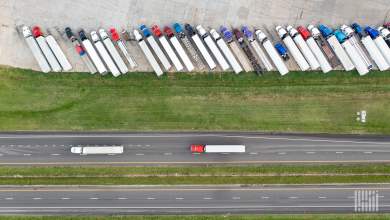
DOT cuts funding to NY, cites non-domiciled CDL policies
New York transportation funding is cut after dispute with feds over non-domiciled CDLs.
TheMaritime Administration announced nearly $489 million in funding aimed at revitalizing U.S. ports, shipyards, and maritime capabilities.
The favorite argument from those supporting the ATA’s teen trucker push is “if they can go to war at 18, they can drive a truck at 18.” Military service transforms young people into disciplined, responsible adults who understand that their decisions affect others. That’s why military-trained drivers have 42% fewer accidents. The solution isn’t younger drivers; it’s requiring the standards that make military drivers safer. We’ve lost something fundamental in how we raise our young people, and the highway data proves it.
The Trump administration’s decision to drop its appeal that tied billions in transportation funding to immigration enforcement represents a significant legal setback, but don’t mistake this tactical retreat for surrender. For motor carriers employing non-domiciled CDL holders, the regulatory battlefield has only shifted, not cleared.
Tennessee has notified approximately 8,800 CDL holders that they must provide proof of citizenship or lawful presence by April 6 or face an automatic downgrade to a standard driver’s license. The move follows Transportation Secretary Sean Duffy’s escalating enforcement campaign that has already frozen California’s non-domiciled licensing program and threatened multiple states with the loss of federal highway funds.
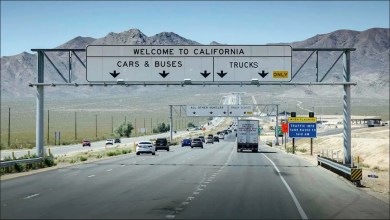
California’s years of documented CDL fraud, enforcement failures, and defiance of federal regulations finally caught up with it. Today’s $160 million funding cut for non-domiciled CDL violations, combined with October’s $40 million ELP penalty, marks the largest federal enforcement action against a state licensing program in FMCSA history.
Inspectors are monitoring the progress of DOT organizations in implementing prior recommendations.
California delays cancellation of 17,000 non-domiciled CDLs until March despite Secretary Duffy’s January 5 deadline. With $160 million in federal funding and potential decertification of the state’s entire CDL program on the line, the standoff could reshape federal-state authority over commercial licensing for years.
The order directs expedited rescheduling to Schedule III, but the same agency that’s held up oral fluid testing for two years now holds the keys to marijuana testing’s future.
California is expected to reissue approximately 17,000 non-domiciled commercial driver’s licenses it planned to revoke after federal enforcement pressure, setting up what may become the most significant federal-state confrontation over CDL authority in decades.
One owner who hired an unqualified driver got 60 days. Other owner offered no time plea deal. The driver who killed seven was acquitted. The system that enabled them both remains largely unchanged.
When a November 2025 draft memo from the Department of Transportation surfaced promising a groundbreaking “data-driven severity matrix” to catch chameleon carriers, it raised uncomfortable questions about ARCHI (Application Review and Chameleon Investigation), built with $3.5 million in congressional funding in 2012-2013. Is this bureaucratic amnesia, rebranding of an underperforming system, or evidence that FMCSA’s chameleon detection infrastructure has been quietly abandoned?
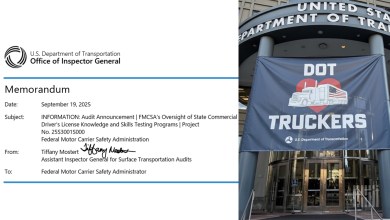
Federal watchdogs are once again questioning whether we have one CDL standard or 50. With nearly 5,000 truck and bus fatalities last year and English proficiency enforcement under fire, the new OIG audit could reshape how states test, license, and oversee drivers nationwide.
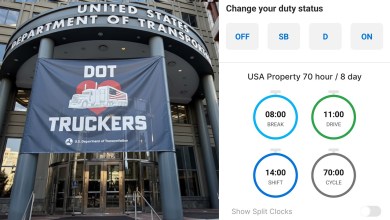
Two pilot programs will test flexible hours-of-service configurations as questions persist about ELD fraud, system vulnerabilities, and whether current regulations effectively reduce fatigue-related crashes despite improved compliance rates.
The Trump administration threatens to cut funds to California, New Mexico and Washington, over trucker English enforcement.
The Trump administration announced Thursday night it is immediately pausing issuing of worker visas for commercial truck drivers.
Veteran Congressional investigator Sang H. Yi has been named acting chief of the Maritime Administration.
The DOT is expediting infrastructure projects in North Carolina and Tennessee.
The Association of American Railroads is asking the Trump administration to repeal a Biden-era rule requiring two-person train crews.
Pink Cheetah Express LLC, a small Kissimmee, Florida-based motor carrier, alleges that TQL has flouted a 2023 Department of Transportation order mandating compliance with federal broker transparency rules.
President Donald Trump’s administration on Wednesday rescinded a freeze on federal grants and other funding that could have had far-reaching effects on the transportation sector, one day after the order was announced amid public uncertainty and criticism, media outlets reported. The reversal also follows a federal judge’s order on Tuesday that temporarily blocked the pause […]
At the Transportation Research Board annual meeting, intermodalists advise and dissent over developments in the freight sector.
Deregulatory priorities within the Trump administration could throw a wrench in federal agencies’ rulemaking pipeline.
To view more FreightWaves infographics, click here
Transportation Secretary Pete Buttigieg has been lambasted for his performance. Supply chain insiders don’t entirely agree with the criticism.
In order to remain relevant and endure a soft market in this year’s competitive trucking sphere, fleets must put in the legwork to create a positive driver culture and grow their advantage.
As supply chain logjams lessen, improving new truck production levels put downward pressure on used truck prices.
LogRock is dedicated to building technology that manages all aspects of compliance for trucking companies from driver-qualification files and permits to hours-of-service and maintenance records, so they don’t have to.
Soaring diesel fuel prices rank as the trucking industry’s most critical issue, knocking the driver shortage from the top spot.
Community colleges to prepare veterans for jobs in trucking
Mineta led the agency during the 9/11 attacks and oversaw the TSA’s launch.
Georgia governor hails project to ‘provide the infrastructure our economy needs to thrive’
Oral fluid testing is not only a win for the safety-conscious, but the cost-conscious too.
The two groups disagree on numerous issues but came together over the issue of parking.
DOE’s Office of Nuclear Energy and the Navy have been collaborating to construct and test what could be North America’s safest railcar — one that would carry nuclear fuel that had been used by power plants.
Sales of Hybrid, Plug-in Hybrid, and Battery Electric Vehicles
The White House is asking carriers to play nice with exporters, but next year Congress may give it a hammer to use if shipping practices don’t change.
Percent of bridge area rated poor in state
Even when everyone agrees, regulations take a year to get approved. And there are detractors to autonomous trucking rulemaking
In 2020, DOT received a total of 102,561 consumer complaints
From 1987 to 2017, frontal air bags saved 50,457 U.S. lives.
SPAC-sponsored autonomous software developer Embark Trucks is tapping industry experts for advice as its public debut nears.
Western Global Airlines is a midsize cargo carrier that can’t grow its fleet until the U.S. DOT lifts conditions placed on startups.
Based on a FreightWaves survey, these are the mobile weather apps that truckers like the best while on the job.
The Cuban government blames the U.S. economic embargo for its woes. The situation has worsened and authorities are allowing some cargo airlines to make flights to Havana.
Professional drivers help teach their robotic successors while evangelizing for the technology among truckers who feel threatened.
Automation will mitigate exposure created by process errors and duplication of efforts by integrating disparate systems.
One of the Kalitta cargo companies is trying to stop a small Mexican airline from providing cross-border service between Mexico and the U.S., a market that it serves too. It doesn’t want free trade in transport services because it might cut into its business.
In today’s edition of The Daily Dash, raising fuel taxes could be an option to pay for infrastructure, and a truck driver who faced a life-or-death decision on a bridge is rewarded for his choice.
Airlines are bleeding red ink and are asking incoming DOT nominee Pete Buttigieg to focus on testing and other steps to give people confidence to travel.
In today’s edition of The Daily Dash, the freight bull market shows no signs of slowing; Chao says goodbye; and trucking continues to add jobs.
From narrow lanes to sheer old age, these are some more bridges that truckers fear the most.
The coronavirus pandemic created a traffic shift — from highways to the internet — as citizens shelter in place.
CEO Jim Newsome calls Walmart’s $220 million investment a signal that SCPA is “prepared to be a force in retail distribution.”
In today’s edition of The Daily Dash, lender BMO’s earnings shed light on the state of the trucking market. Plus, Flock Freight flies high and the top challenge for the next U.S. Department of Transportation leader.
National freight “outlook” is significant for states, municipalities and companies that may want federal money for rail or other transport projects.
The provision of sizable infrastructure is an example of the government’s positive role in the market for transportation.
To learn more about FreightWaves.Careers, click here.
Jack Mahoney will take over for the retiring Guy Stephenson.
“Tom Hanks’ work throughout his career reflects a deep respect for those who serve.”
To view the full article, click here.
The U.S. Department of Transportation says it won’t entertain requests from Chinese airlines to operate more flights beyond the current cap.
Port Logistics operates a 140,000-square-foot refrigerated warehouse at Berth 219.
Air cargo and cross-border trade could be unintended victims of the dispute between the U.S. and China over access by their respective passenger airlines.
Airlines continue adjusting their flight schedules and capacity to contain costs as traffic dries up due to the coronavirus scare.
Fifteen projects net funding from the U.S. Department of Transportation’s Maritime Administration.
Cars and containers also reach new benchmarks in 2019.
SF Airlines isn’t from San Francisco. It’s an all-cargo carrier from Shenzhen, China, and it’s coming to a U.S. airport near you – near someone – soon.
The implementation of Positive Train Control is the largest technology program deployed in CN history and they are already ahead of the game
“Your body is your engine” and needs routine maintenance to prevent a breakdown.
Don’t Get Caught- 94% of DOT Audits Result in Violations!
Learn how to protect your business and avoid fines with our FREE DOT Audit Survival Guide.
U.S. Secretary of Transportation Elaine Chao announced that the Department of Transportation has sent an hours of service (HOS) Notice of Proposed Rulemaking to the White House Office of Management and Budget (OMB) for approval.
Fraudulent medical certifications that can put carriers and drivers at risk of more accidents.are under scrutiny.
FMSCA Administrator Raymond Martinez comments on his first nine months, and the potential for an early rollout of revised HOS rules.
As any driver knows, parking is at a premium at truck stops, even during the middle of the day. A new survey is being conducted to get an update on the current parking situation.
Cameras and “magnetometers” will be used to supply data into a system that will tell drivers whether parking is available.
As part of a wide-ranging DOT initiative to prepare for driverless vehicles, FMCSA will address regulations that could be slowing the development of these technologies in the commercial vehicle space.
A USDOT 3-year pilot program would allow drivers under the age of 21 and holding a military CDL to drive interstate commerce when sponsored by a participating trucking company.
With all the advances being made in technology, it’s time for state transportation departments to be innovative and forward thinking, but that is not the case, according to the latest edition of McKinsey & Co.’s Voices on Infrastructure report.