Texas probes CDL schools, warns CVS over supply chain practices
The Texas Attorney General’s Office is investigating CDL training programs while also challenging supplier diversity policies at CVS Health.
We have never seen a twelve-month period in which the White House, the Department of Transportation, and FMCSA moved as aggressively, as comprehensively, and as effectively on the specific safety failures that haunt our highways and our industry. Before we sit down with Derek Barrs on Monday, here is the year that got us here.
On April 23, a State Department spokesperson confirmed that commercial truck driver visa processing has resumed under strict new standards. Now the question is whether the states tasked with running the new system have the institutional capacity to maintain what federal audit pressure forced them to fix.
The single most common-sense safety reform available to the trucking industry right now is to acknowledge that a regulation based on annual snapshots of a driver’s licensing status is inadequate for an industry where licenses can be suspended, revoked, or downgraded at any time.
This week the agency announced that new Clearinghouse registrants will have to prove their identity before gaining SAP-level access to a federal database that 38 million queries have trusted since 2020.
FMCSA confirmed today that $73,502,543 in federal highway funding has been withheld from New York after the state refused to revoke non-domiciled commercial driver’s licenses that its own DMV system issued illegally. More than half of the records audited violated federal law. Decertification of New York’s entire CDL program remains explicitly on the table.
One Indianapolis suburb has 1,000 newly registered trucking carriers. One neighborhood inside that suburb has more than 300 active carriers covering roughly 250 homes. The CDL crackdown is real, starting today in Indiana
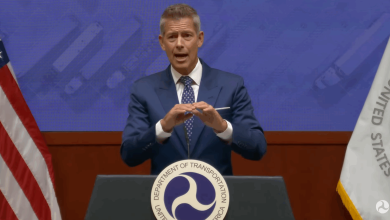
America’s highways became a testing ground for unqualified drivers long before anyone in Washington was paying attention. Now, with Transportation Secretary Sean Duffy shuttering thousands of sham CDL schools and placing unqualified truckers out of service, he emphasized to the frontline at the Mid-America Trucking Show that drivers’ day has finally come.
The headline writes itself and the industry groups are celebrating: Pell Grants are coming to CDL schools. The American Trucking Associations called it a move that would “dismantle financial barriers that prevent students from low-income households from accessing the career pathways that lead to the trucking industry.” The Secretary of Education said a great education […]
A driver gets his permit in Hawaii, boards a plane to New Jersey, trains Sunday through Thursday, passes a skills test on Friday, flies home Saturday, and walks out of a DMV with a commercial driver’s license. Federal law allowed all of it. That’s the problem.
A firsthand, frontline reality of how freight moves from broker, carrier, spot, shipper direct, interlined and non-commodity freight to the crash scene.
The Entry-Level Driver Training regulations took effect in February 2022 after years of development and industry lobbying. The result was a federal training standard that requires no minimum hours of instruction, relies on self-certification at every checkpoint, and leaves every meaningful decision about actual driver competency to the fifty states, each operating in fifty different ways. The fraud factories did not slow down.
A new legal battle is underway following the U.S. Department of Transportation’s final rule tightening eligibility standards for nondomiciled commercial driver’s licenses, setting the stage for continued litigation in the D.C. Circuit Court of Appeals. One day after the Federal Motor Carrier Safety Administration published its final rule formalizing restrictions on nondomiciled CDLs, a coalition […]
It’s a win.
The non-domicile CDL final rule eliminates EADs as a pathway to a commercial license and restricts eligibility to H-2A, H-2B, and E-2 visa holders. With 97 percent of the current 200,000 non-domiciled CDL holders unable to qualify under the new standard, expect 30,000 to 40,000 drivers removed from the commercial pool every year.
42 investigative article links covering CDL mills. Chameleon carriers. Fraudulent examiners. Bought legislators. Exposed vehicles. Every failure point in America’s deadliest supply chain crisis, exposed by an 25 year industry veteran.
A fatal Indiana crash has exposed a pipeline stretching from Kyrgyzstan to Chicago to Philadelphia, chameleon carriers sharing trucks and DOT numbers, a CDL school with no public footprint, an ELD allegedly built with a backdoor, and a driver whose immigration status passed a federal database check. Secretary Duffy is investigating. Will the investigation follow the money?
The agency confirmed investigators visited the carrier linked to a deadly Indiana crash and a massive chameleon network. But the enforcement pathway matters more than the headline.
A Mexican licencia federal de conductor can be obtained without a behind-the-wheel road test. Third-party brokers advertise mail-order processing for as little as $200. Under existing reciprocity agreements, that license can be converted to an American CDL in states that accept foreign credentials, and at least six of those states have been flagged by FMCSA for failing to verify the legal presence of non-domiciled applicants.
SB 1587 adds $1 million minimum damages, employer liability and ICE notification requirements
The freight industry moved $14 trillion in goods last year. It cannot function without trust, trust that the carrier picking up your load is who they claim to be, trust that the broker paying you will actually pay, and trust that the load you accepted exists. That trust has been systematically exploited for decades. At its root, every form of freight fraud, chameleon carriers, double brokering, cargo theft, identity spoofing, comes down to one question: Are you who you say you are?
Tennessee has notified approximately 8,800 CDL holders that they must provide proof of citizenship or lawful presence by April 6 or face an automatic downgrade to a standard driver’s license. The move follows Transportation Secretary Sean Duffy’s escalating enforcement campaign that has already frozen California’s non-domiciled licensing program and threatened multiple states with the loss of federal highway funds.
The U.S. Postal Service is moving to eliminate foreign truck drivers who are ineligible to work in the U.S. from third-party motor carriers.
California’s latest high-risk audit reads like a warning label for the freight industry. As the state struggles with data integrity, benefit administration, and mounting fiscal pressure, the consequences may extend beyond Sacramento, into CHP staffing, roadside inspections, and federally funded enforcement programs that trucking depends on.
California delays cancellation of 17,000 non-domiciled CDLs until March despite Secretary Duffy’s January 5 deadline. With $160 million in federal funding and potential decertification of the state’s entire CDL program on the line, the standoff could reshape federal-state authority over commercial licensing for years.
A class-action lawsuit filed in Alameda County seeks to block California’s Jan. 5 cancellation of nearly 20,000 commercial driver’s licenses. The plaintiffs argue the DMV is punishing immigrant drivers for the agency’s own administrative failures while refusing to let them reapply for corrected credentials, violating state law and due process.
The order directs expedited rescheduling to Schedule III, but the same agency that’s held up oral fluid testing for two years now holds the keys to marijuana testing’s future.
Biden’s FMCSA buried a FOIA request seeking to link driving schools to fatality data.
California is expected to reissue approximately 17,000 non-domiciled commercial driver’s licenses it planned to revoke after federal enforcement pressure, setting up what may become the most significant federal-state confrontation over CDL authority in decades.
Discover why 9,500 drivers out of service doesn’t mean what you think it means and what that really means for the industry.
CDL schools are exploiting federal loopholes and flooding the trucking industry with untrained drivers, industry exec says.
After 25 years of documented CDL fraud schemes producing 6,000+ fraudulent licenses and at least 13 deaths, FMCSA finally removed 3,000 training providers from the federal registry. The problem? Another 36,000 providers remain unvalidated, operating on the same honor system that enabled Operation Safe Road, Larex Incorporated, and the Massachusetts golden handshake scheme.
The U.S. Court of Appeals for the District of Columbia Circuit found FMCSA likely violated federal law when it attempted to eliminate approximately 200,000 commercial driver licenses without following standard procedures. The November 13 emergency stay revealed failures that leave 200,000 drivers in legal limbo while courts define the boundaries of administrative power during claimed emergencies.
During a press conference on commercial driver’s license (CDL) enforcement, U.S. Transportation Secretary Sean Duffy responded to a reporter’s questions about the truck driver shortage and the potential impacts of stricter rule enforcement. The discussion focused on workforce challenges in the trucking industry and the Department of Transportation’s (DOT) approach to addressing them. The press […]
Introduction to the Emergency Interim Final Rule On September 29, 2025, U.S. Department of Transportation (DOT) Secretary Sean P. Duffy announced an emergency interim final rule to restrict non-domiciled Commercial Driver’s Licenses (CDLs). This significant regulatory action, issued by the Federal Motor Carrier Safety Administration (FMCSA), aims to address widespread abuse in issuing these licenses […]
On September 26, 2025, U.S. Transportation Secretary Sean P. Duffy announced an emergency order requiring states to immediately stop issuing or renewing non-domiciled commercial driver’s licenses (CDLs). This directive ends a widespread practice in many states of issuing CDLs to non-citizens without employment-based visas or extending them well beyond the expiration of holders’ work visas. […]
Federal watchdogs are once again questioning whether we have one CDL standard or 50. With nearly 5,000 truck and bus fatalities last year and English proficiency enforcement under fire, the new OIG audit could reshape how states test, license, and oversee drivers nationwide.
From twin sticks to push-button drive, trucking’s gearshift evolution changed transmissions, it changed drivers, and it changed the industry. The old twin-stick rigs demanded patience, timing, and respect for the machine. They created a natural filter, separating those willing to master the craft from those who weren’t. Today, with 90% of new trucks equipped with automated manuals, anyone can simply drop it into drive and go. Easier? Absolutely. But in removing the barrier, the industry may have also lost a layer of mechanical awareness, attentiveness, and skill that once defined professional driving.
FMCSA will decide on a rule to exempt specialized drivers from a hazardous materials endorsement – a move opposed by tank-truck companies over safety concerns.
Six persons were indicted in Louisiana for operating a scheme to falsely obtain class A CDLs.
A commercial tractor-trailer’s illegal U-turn on Florida’s Turnpike last week killed three people in a minivan that collided with the trailer at highway speed, putting new focus on critical flaws in commercial driver licensing and training standards that have made America’s highways increasingly dangerous.
New legislation would mandate that all truck drivers be tested for proficiency in speaking and reading English before being allowed on the road.
According to reports, nearly 4% of drivers on U.S. highways don’t have valid CDLs, and that’s just the tip of the iceberg. With licensing standards fractured across states and risky drivers slipping through the cracks, here is how fleets can get ahead of driver risk before it costs them a verdict, a fatality or the whole business.
Non-domiciled CDL holders are just a small sliver of a bigger issue with how CDLs are issued and regulated.
WASHINGTON — The Federal Motor Carrier Safety Administration has voided thousands of medical examiner certificates issued by two Houston-area doctors, putting the livelihoods of over 15,000 commercial drivers at risk. A “high volume” of physical examinations performed by Dr. Jenny Le (Medical Examiner National Registry No. 4762579227) and Dr. Dustin Mai (National Registry No. 7120983977) […]
A CDL is a commodity. Many drivers feel stuck in low-paying, high-turnover jobs, but those who grow, specialize, gain endorsements, and strategically pivot can turn their experience into a high-value career. Whether it’s moving into specialized freight, fleet management, brokerage, or even autonomous vehicle testing, a CDL opens doors beyond the driver’s seat.
The key is to treat trucking like a business. Understanding market demand, positioning yourself for better opportunities, and leveraging your expertise. The industry is changing, and drivers who adapt will thrive. The question is, Will you be one of them?
Federal regulators are considering a waiver that carries potential cost savings for truck drivers and agricultural aircraft operators.
Changes are coming to prohibited classifications at the Drug & Alcohol Clearinghouse.
Congress has approved legislation to expand opportunities for veterans looking to start a truck driving career.
Another large trucking company has asked federal regulators to relax its permitting rules to get drivers in seats faster.
To view more FreightWaves infographics, click here
Federal regulators are proposing to ease requirements for new truck drivers — but crash victim advocates warn safety will be compromised.
Protecting drivers with TVC Pro-Driver.
Texas man gets 2 years in prison for selling $215K worth of fraudulent CDLs.
As competition for truck drivers heats up, fleets need to take steps to improve their recruiting, hiring and onboarding processes to find candidates and get them into trucks.
The No. 1 place to find or post a job in the freight industry
Efforts to codify regulatory flexibility should be applauded, and the FREIGHT Act is no different.
Click here to Prepare Your Driver Trainers to Comply with the new ELDT Rule
California officials are trying to address a perceived shortage of truck drivers by making it easier to get a license.
What’s in your Driver Qualification File?
Roadside Inspections, Driver Violations (2021 Fiscal Year)
Learn about how to make sure you’re hiring qualified drivers
“I had never spent more than three days away from my daughters so it was really hard for me when I first started driving a truck.”
The driver shortage, while not a new problem, requires new approaches to resolve.
Trucking fleets that conduct only yearly reviews of driver records may miss signs of risky driver behavior that ultimately could put lives in jeopardy.
Drug and Alcohol Clearinghouse penalties of up to $5,833 issued by FMCSA are more than double what had been used as guidance over the past two years
In today’s edition of The Daily Dash, could an influx of capacity drive down spot rates? Plus, ArcBest President Tim Thorne is retiring, and federal regulators consider nixing a vision exemption for CDL holders.
In today’s edition of The Daily Dash, FMCSA will ease restrictions for obtaining a CDL. Plus, Schneider is boosting driver pay again and Navistar reports lower truck sales and earnings.
In today’s edition of The Daily Dash, volumes and rates take a step back; complete coverage of FreightWaves’ Cold Chain Summit; and CDL fraud.
Peterbilt is offering a discount on the first year of a six-year lease for its Model 220EV medium-duty electric truck, hoping to entice non-commercially licensed drivers to try battery power instead of diesel.
Now is a good time for carriers that boosted their balance sheets with PPP loans to leverage that by investing in technology.
Commercial Vehicle Training Association’s Don Lefeve and Roadmaster Drivers School’s Brad Ball discuss the state of CDL training at FreightWaves Carrier Summit.
FMCSA has proposed a rule that would force states to stop issuing new, renewing or upgrading CDLs and CLPs, and in some cases even downgrading, for drivers until they complete the return-to-duty process following a positive drug or alcohol test result.
Drivers looking for work or changing jobs should register before Jan. 6.
Employers can choose $1.25 bundling option or $24,000 annual fee.
Report asserts industry needs to hire 1.1 million new drivers over the next decade.
Proposal would make it easier for drivers to take test from out of state.
Groups claim teen drivers carry more risk resulting in more fatalities.
Driver hiring includes many steps to ensure compliance, and many fleets turn to outside help to assist in that process.
Trucker union sides with most of proposal’s early comments.
Amazon has broken ground on its Kentucky air hub, which will bring 2,000 jobs and up to 100 planes to the area.
Support for proposal split between large and small carriers.
Hair follicle testing – once cleared for use in the federal database – could have the biggest effect on driver availability.
Study finds lagging response to demand surges makes managing driver recruitment and retention more difficult.
Fraudulent medical certifications that can put carriers and drivers at risk of more accidents.are under scrutiny.
The Commercial Vehicle Training Association is pushing for more states to adopt third-party testing to shorten wait times for those seeking to schedule CDL tests.
States will soon be able to give would-be drivers more time to get their CDLs at the same time potentially lowering knowledge exam costs.
Do you know the different types of CDLs? Our latest video may help.
Military members looking to become truck drivers may have an easier time in doing so as the Federal Motor Carrier Safety Administration (FMCSA) has authorized states to waive the commercial learner’s permit (CLP) knowledge test and driving skills tests.
Truck drivers involved in certain behaviors are more likely to have a future crash, ATRI research has concluded.
Have you ever been driving down a highway only to be passed by a hulking 18-wheeler? Have you secretly wondered what it would be like to drive across the country and get paid to do so? You may have been born to a truck driver.
New Prime (Prime) has been granted an exemption by the Federal Motor Carrier Safety Administration for commercial learner permit (CLP) drivers to operate a truck without a CDL holder in the front seat under certain conditions.
President Donald Trump’s apprenticeship program may provide an avenue to solving the truck driver shortage issue. But to make it work, it will require a little give on the government’s part.